Story Section
Reading edition
Author’s Announcement
The stories following relate my experiences and those of other officers and detectives. They are stories of cases in real life, handled successfully by different officers of the law. The stories are educational, covering several branches of the detective profession, both in police circles and private detective agencies.
The detectives, the police officer and all peace officers may derive both pleasure and profit by a reading of these stories.
Rufus H. Clendenen.
Professional Bootlegging, 1915–1921.
(Written before National Prohibition became effective)
Mountains subserve important uses of the economy of nature, especially with the water system of the world. They are at once great collectors and distributors of water. But from time immemorial the mountains of the Virginias, Kentucky and Tennessee have been famed for things other than the uses of water.
Who is there who has not read of the mountain character who relied upon his “still” in some brush covered cove to produce the mountain nectar from yellow corn that has waved its golden bannerets on those sun-kissed hills, and which has brought imagined happiness to the wearied soul of the mountaineer—and not infrequently filled his heart with murder—for the juice of the yellow corn breeds dangerous lightning in the blood.
We have also read of the hatred these men have borne towards the law’s representatives,—the “revenu” officers and detectives. Of the many and bloody battles, of the strategic moves adopted by the one and of the deadly aim of the other’s rifle.
But this story deals not with the mountain “still” but rather with the new mountain, the “bootlegger”—the man who smuggles whiskey into dry territory in violation of the law and sells it to those who are ready and willing to pay the price.
The different dry states have raised a great crop of those “bootleggers” but West Virginia, in proportion to its size, has perhaps outstripped them all. In cities of 5,000 or more there are several “professionals” who vie with one another in their anxiety to break the law. By the “professional” is meant the man of means who is financially able to hire from one to a dozen men, or women, to work for him. These workers are called “runners” and when caught bringing more than one quart of whiskey a month into the state, or selling or attempting to sell the liquor, they are frequently sentenced to serve sixty days in jail and fined $100, or more, while the “professional” goes unmolested.
But the professional “bootlegger” invariably places the indelible mark of his nefarious profession upon himself, for he stands by his “runners” and secures for them the best of counsel, who continues their cases from term to term on one pretext or another, and if eventually convicted, he sees that they receive good meals while in jail, and when the sentence is finished he sees that the fine is paid. The old legend, that there is “Honor among thieves” seems to hold in these cases, for the “runner” never connects the man higher up, the “professional”, with his misfortune, and receives his confinement and punishment without a word of complaint. No doubt the man receives a financial consideration for his silence.
It is estimated that in the City of Charleston, West Virginia, the State capital, which has a population of something like 40,000, there are at least two thousand persons engaged in violating the prohibition law. Hundreds are convicted each year. It is charged that there is lack of co-operation between the Prohibition Department of the state and the municipal and county officers. The laxity in this respect on the part of municipal officers may be due to the fact that there is no fee attached to the conviction of violators of the prohibition law.
The schemes invented to evade the law are about as remarkable and numerous as the violators themselves. It is known that automobiles have slipped into the state carrying as many as thirty-two cases of whiskey, which is seven hundred and sixty pints. The “bootlegger” can buy the whiskey at $27.00 a case and can sell it in wholesale lots at $80.00 a case. Should he conclude to retail it he can get $5.00 a pint, out of which he must pay his runner $1.00. Thus it can be seen that the “professional” bootlegging business is a rather profitable enterprise.
It is remarkable the extent and the ingeniousness of the schemes adopted and devised in order to bring whiskey into the state. A short time ago a funeral procession wound its way slowly and majestically down the turnpike that connects Ohio and West Virginia. An alert officer was impressed with the extreme seriousness of the driver of the hearse and the undertaker who sat by his side. The hearse was stopped and an inspection made, and to the surprise of the officer he found the hearse packed with cases of the rarest brands of whiskey.
Farm houses and buildings are frequently used by the “professional” to secrete quantities of whiskey until such time as it is safe to attempt distribution. It is marvelous the amount of ingenuity that is being wasted in the construction of false partitions, sliding floors, window facings, door facings and traps and other devices that almost defy detection. The freight train is also used by the common “bootlegger”, and daily deliveries are made of supposed coffee in huge sacks, while in reality the coffee is just around the outside, as the center of the sack is filled with whiskey bottles.
It is surprising how many men of shady character and dishonest methods have grown in corpulence since the passing of the prohibition law. An investigation of the person of some of those “big” boys have revealed specially made vests with various and sundry pockets which invariably contain a pint of whiskey. As many as twenty-four pints have been found in the pockets of one man. While engaged in the search of a Virginian train at the Chesapeake and Ohio depot in the City of Charleston one morning, the writer and Sam Fields, a local prohibition officer, noticed an unusually large colored preacher across the aisle from where we were standing. Fields approached the preacher and said “Good morning, Parson.” Fields and I engaged the colored man in conversation and soon confirmed our suspicion that the man was a “bootlegger” owing to the fullness of his clothing. A search of the clothing of the supposed “Parson” disclosed an under-jacket made of bed-ticking, underclothing made of canvass containing pockets, thirty-six pockets in all, and each one containing a pint of whiskey. When taken from the coach to the platform it required aid to get him from the seat, he was so burdened with contraband.
Often I have taken from a person a caulking hammer with a bunch of oakum tied around it so as to hide from two to six pints of whiskey. I have relieved the male and female foreigner of corsets made of tin and shaped and soldered so as to fit the breast and abdomen, containing approximately one gallon of liquor. The extra tires on automobiles, copper lined, have been found to contain a large quantity of liquor. False bottoms, radiators, extra gasoline tanks, etc., have been confiscated containing gallons of liquors. I have frequently caught both men and women with from three to five hot water bottles on their person—and each bottle filled with whiskey. Violin, mandolin, guitar and banjo cases are frequently placed very carefully in the racks of passenger coaches and when inspected more often hold whiskey than musical instruments. Trunks and express packages are used as a means of conveyance, but the trained detective soon discerns the odor coming from such articles, and when the goods are called for arrests follow. Even a casket supposed to contain a corpse and bearing a doctor’s certificate has been found to contain “Old Crow” instead of the remains of some recently departed soul. A one-legged negro in Charleston capitalized his misfortune by adopting and using a hollow cork leg which would hold five gallons of whiskey. He was caught and a solid leg was substituted for the shell-like affair.
Even the well-to-do people of this State who are possessed with an unquenchable thirst resort to all sorts of tricks to get whiskey either for themselves or friends. One prominent woman pretended to have broken her arm and it was discovered that the supposed injured member was bound with splints of half pints instead of pieces of wood. Even old saw mill boilers have been used to convey liquors into the state, to say nothing of milk cans, egg shells and dozens of other methods. The bootleggers were so numerous in this state a few months back that it was considered among themselves that some plan or means of identification would soon be necessary to prevent wasting time trying to sell to one another. The officers might suggest a red badge.
The up-to-date and modern bootlegger has gone all the rest one better. He has himself fitted with a corset which is hollow and has hinges at various points. The same enterprising variety of mankind also has similar outfits made of rubber or oil cloth.
Several persons in this state have died from drinking wood alcohol, not knowing that it was deadly poison. A negro porter in a hospital was recently arrested and convicted of selling, to men of the back counties, alcohol which had been used in preserving freak babies. Another brand of drink which is made in sections of the state is called “cow cider” and is in reality the juice from the grain and fodder of the silo. It not only causes intoxication but carries with it a severe headache for several days thereafter. A hop brew called “old hen” is another of the strange drinks made for the purpose of making drunk come.
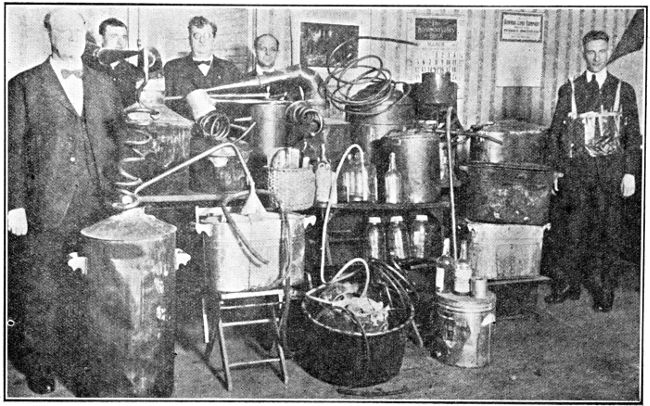
These stills are products of the West Virginia Mountains.
Whether prohibition develops booze maniacs has not as yet been determined by the medical fraternity, but it seems to be a proven fact that human nature wants that which it is told it cannot have. Man is something like a marauding old muley cow. A muley cow will eat anything on top of this majestic earth that she can steal, from a hickory shirt to a temperance newspaper, and anything she can’t get through her throat she will chew and suck the juice. That is human nature to a T. Man values that which is hardest to get. I fear that until the law of nature is reversed the legitimate effect of prohibition will be blind tigers, mountain and cellar stills, the breeding of bootleggers and the sale and consumption of a death dealing brand of booze.
We shall not commence at 1921 to 1922. The white corn nectar is now made in each little village, coal camp, oil fields and principal cities in the Virginias, Kentucky and Tennessee, and this mountain dew is flavored with ground ivy, drugs of different kinds and sometimes even lye is put into it to make it taste hot like whiskey of high proof. People are now complaining of the theft of their wash tubs, rain barrels, wash boilers, etc. Stills are made of zinc tubs, oil cans, milk cans, tin boilers, gasoline tubes, kettles, etc.
They have a coloring (caramel) making the color of corn whiskey red. Dried peaches used as a “mash” makes the liquor yellow in color like peach brandy. About 75% of the stills captured are made of zinc vessels, tin and iron pipes, making a poison called “moonshine” which is killing people every day.
In West Virginia you will find the moonshiners organized and assistance and aid given them from people in good standing. It is also the case in Kentucky and Tennessee. In the Blue Ridge and Cumberland mountains of Virginia moonshining has been going on since the civil war. They are an organized band, and when the approach of officers of the law is noticed, where no telephone system is used, they use a ramshorn, gun barrel, conch shells, high power rifles, etc., to warn the offenders of the approach of the officers. Very often a woman will go to the back door of her home and call her cows at the hour of midnight, using this method to warn her husband or other members of the family that officials are at the house or are near. The sounds made by these different signals can be heard for a long distance at night among the mountains and 80% of the contemplated raids of officers of the law on moonshiners and moonshine stills are “tipped-off” in this manner. The old method of building fires of wood has given way to the more modern and less easy to detect method of using gasoline or kerosene stoves, which method is a very good one, owing to the fact that no smoke arises from the fires and the light is very easily shielded from view.
It has been worked many times that a man would come in from the mountains, disclose to officers of the law the location of a “still” and receive from said officers a small reward for the information. As soon as he leaves the officers he will return to the moonshine region and tell the moonshiners that a raid is to be made on a certain day. In this way the informer will receive a reward from both officers of the law and the moonshiners.
When moonshine liquor cannot be obtained in the cities the “topers” resort to all kind of drugs to satisfy their thirst, such as hair tonic, pre-digested beef, Jamaica ginger, lemon extracts, all of which contain a certain per cent of alcohol.
Prohibition Amendment.
Amendment of Section 46, Article 6 of the State Constitution, ratified by vote of the people at a general election held in the month of November, 1912, known as the Prohibition Amendment.
“Sec. 46. On and after the first day of July, one thousand nine hundred and fourteen, the manufacture, sale and keeping for sale of malt, vinous or spirituous liquors, wine, ale, porter, beer or any intoxicating drink, mixture or preparation of like nature, except as hereinafter provided, are hereby prohibited in this State. Provided, however, that the manufacture and sale and keeping for sale of such liquors for medicinal, pharmaceutical, mechanical, sacramental, and scientific purposes, and the manufacture and sale of denatured alcohol for industrial purposes may be permitted under such regulations as the legislature may prescribe. The legislature shall, without delay, enact such laws, with regulations, conditions, securities and penalties as may be necessary to carry into effect the provisions of this section.”
An Act of Congress of the United States known as the
Webb-Kenyon Law.
“An Act divesting intoxicating liquors of their inter-state character in certain cases.”
“Be it enacted by the Senate and House of Representatives of the United States of America in Congress Assembled, That the shipment or transportation, in any manner or by any means whatsoever, of any spirituous, vinous, malted, fermented, or other intoxicating liquor of any kind, from one State, Territory or District of the United States, or place non-contiguous to but subject to the jurisdiction thereof, into any other State, Territory or District of the United States, or place non-contiguous to but subject to the jurisdiction thereof, or from any foreign country into any State, Territory or District of the United States, or place non-contiguous to but subject to the jurisdiction thereof, which said spirituous, vinous, malted, fermented, or other intoxicating liquor is intended, by any person interested therein, to be received, possessed, sold, or in any manner used, either in the original package or otherwise, in violation of any law of such State, Territory or District of the United States, or place non-contiguous to but subject to the jurisdiction thereof, is hereby prohibited.
Postal Regulations—Parcels Post.
The regulations of the United States Postal Department prohibit the shipment of intoxicating liquors by mail—the language of the rule being as follows:
“There shall be prohibited from the mails all spirituous, vinous, fermented or other intoxicating liquors of any kind.”—Section 16, paragraph 2, Parcels Post Regulations.
Sec. 37. It shall be unlawful for any person to own, operate, maintain or have in his possession, or interest in any apparatus for the manufacture of intoxicating liquors, commonly known as “moonshine still”, or any device of like kind or character. For the purposes of this act, any mechanism, apparatus or device that is kept or maintained in any desert, secluded, hidden, secret or solitary place, away from the observation of the general public, or in any building, dwelling-house or other place, for the purpose of distilling, making or manufacturing intoxicating liquors, or which by any process of evaporation, separate alcoholic liquor from grain, molasses, fruit, or any other fermented substance, or that is capable of any such use, shall be taken and deemed to be a “moonshine still”; and the owner or operator of any such “moonshine still” shall be deemed a “moonshiner”. Any person owning, operating, maintaining or having in his possession, or having any interest in any moonshine still, shall be guilty of a felony, and upon conviction thereof shall be fined not less than three hundred dollars nor more than one thousand dollars, and be confined in the penitentiary not less than two nor more than five years. Any person who aids or abets in the operation or maintenance of any moonshine still shall be guilty of a felony, and upon conviction thereof shall be fined not less than two hundred dollars nor more than five hundred dollars, and confined in the penitentiary not less than one nor more than three years.
Gunnoe Murder Case.
On the banks of the Great Kanawha river, two miles above the City of Charleston, West Virginia, lived a dairyman by the name of Willard Gunnoe. Gunnoe, together with his wife and his wife’s sister, Ocie Mullens, lived in a brown cabin surrounded by the picturesque mountains of West Virginia and five acres of fertile soil, on which grazed the milch cows of his dairy. The nearest cabin to Gunnoe’s place was about one quarter of a mile away.
In the month of April, in the Spring of 1914, Mrs. Gunnoe was reported to have been found dead in her kitchen by Willard Gunnoe, her husband, and Ocie Mullens, her sister. The Mullens girl and Gunnoe had been to the barn, some seventy-five yards from the house, attending the cows. The alarm or report of the finding of Mrs. Gunnoe was given by her husband to neighbors. On information furnished to the Prosecuting Attorney of Kanawha County, that official instructed G. D. Acree, a constable of Charleston District, to investigate the circumstances surrounding the case. The Prosecuting Attorney also requested the writer to work in conjunction with Mr. Acree in making the investigation.
On our arrival at Gunnoe’s house we started our investigations and found foot prints from a large foot on the kitchen cabinet and the condition of the room showed there had been a struggle. Our next step was to examine the body of Mrs. Gunnoe. A careful examination disclosed finger prints on her throat and bruises on her arms. Her lips and right side of her face were burned, apparently by carbolic acid. These findings aroused our suspicions and we called Doctor O. L. Aultz, then the county physician. Dr. Aultz advised a post-mortem examination of the body, and all witnesses were hastily summoned before C. W. Dering, a Justice of the Peace of Charleston District, who acted as coroner.
Mr. Gunnoe’s testimony before the coroner’s jury was to the effect that he, together with Ocie Mullens, were in the habit of going to the barn and milking before daylight in order to make early deliveries of milk in the City of Charleston and suburbs; that after completing their work they returned to the house and found Mrs. Gunnoe’s body lying on the kitchen floor. He stated that at the time he returned to the house day was breaking and he saw a man running from the kitchen door; that he and his wife had had no trouble and there was no reason for her committing suicide; that he was positive she had been murdered by the unknown man he saw running from the house. Mr. Gunnoe also stated that he heard no cries or commotion in the house whatsoever. Gunnoe showed no emotion over the matter and acted unconcerned. His actions caused no suspicion. Gunnoe had a long scratch from the left eye leading to the tip of the nose as if caused by a finger nail and when asked the question as to the cause of the scratch, he stated that while watering his horse down at the river a sharp stick struck him in the face and made the scratched place.
Ocie Mullens testified that she had heard no struggle or cries and that she had also seen the man running from the house as Gunnoe had testified. The witnesses were not separated during the examination and she corroborated Gunnoe’s statements. After the hearing of the evidence, the jury returned a verdict that Mrs. Gunnoe had been murdered at the hands of an unknown person. For the purpose of further investigating the matter, a warrant was sworn out for the arrest of Gunnoe and Miss Mullens on instructions from the Prosecuting Attorney and they were held without bond to await the action of the next grand jury.
Constable Acree and I made repeated trips to Kanawha City and continued our investigations and found foot prints in the mud leading from the rear of the house to the barn and from the barn to the kitchen. About half way between the barn and the house we discovered tracks which led us to believe there had been a struggle at that point. One of the prints compared with that found on the kitchen cabinet and the other tallied with that of Mrs. Gunnoe, showing that she and her husband had been at this point on the morning of the murder. To further bear out this point, Mrs. Gunnoe’s shoes were covered with mud. On our return from the Gunnoe house we visited the morgue and viewed again the body of Mrs. Gunnoe. Our purpose for the second examination was to try and determine, if possible, whether or not the scratch on Gunnoe’s face was caused by Mrs. Gunnoe during some kind of a struggle or fight. We examined beneath the finger nails of Mrs. Gunnoe and cleaned them out with a tooth pick. The result of this disclosed human flesh.
Our next step in the line of evidence was obtained from the post-mortem examination made by Doctor Aultz, which disclosed that death preceded the apparent taking of the carbolic acid, as when her throat was examined it showed no discoloration.
Gunnoe was indicted and tried in the Intermediate Court of Kanawha county for the murder of his wife. The jury returned a verdict of guilty of murder in the second degree, which carries a sentence of from five to eighteen years in the penitentiary. Judge H. K. Black sentenced Gunnoe to serve twelve years. Gunnoe resorted to all legal steps to avoid the serving of his sentence, carrying his case to the State Supreme Court, which court sustained the judgment of the court below. After failing in his purpose Gunnoe, while confined in jail awaiting transportation to the penitentiary requested permission to converse with the Prosecuting Attorney. This leave was granted and in the presence of Hon. T. C. Townsend, then Prosecuting Attorney for Kanawha County, and the writer, Gunnoe confessed to the crime and stated that he killed his wife accidentally by strangling her to death. The altercation between them which led to the killing was caused by jealousy on the part of Mrs. Gunnoe, she accusing him of being intimate with her sister.
Strange Creek Case.
In September, in the Fall of 1915, the writer was called to Glenville, the county seat of Gilmer county, and was also called upon about the same time by the Prosecuting Attorney of Braxton county in regard to the above case.
Near Gilmer Station, on the then Coal and Coke Railway (now the B. & O.) a young boy was rowing a small boat in Elk river and found the corpse of a fully developed baby about three months old. The boy was somewhat frightened at his gruesome find and went to the Town of Gilmer and reported the finding of the dead baby. For some time there was a question of jurisdiction between the authorities of Braxton and Gilmer counties, and after a conference between L. H. Barnett, Prosecuting Attorney of Gilmer county, and James E. Cutlip, Prosecuting Attorney of Braxton county, it was decided that Gilmer county had jurisdiction.
I was then detailed on the case by Mr. Barnett and began my investigation the latter part of September. No clue was in evidence and no information to start from. For several days I visited each little town on the Coal and Coke road between Orlando in Lewis county and Clay Court House in Clay county. About ten days after I started my investigation I was lunching at a small hotel at Burnsville and heard a lady speaking of a young woman who had left the station at Burnsville one night before the arrival of the B. & O. train carrying a small baby and a yellow suit case. Upon investigating this matter I found that a yellow suit case filling this description had been checked to a station a few miles away, called Strange Creek on the C. & C. railway. After securing all the information I could around Burnsville I went to Strange Creek and found out that a young lady who had been teaching school at Uniontown, Pennsylvania, had returned home and lived on a farm up Strange Creek a few miles from Strange Creek station. No one suspicioned the young school teacher, whose name was Ora Wilson. She was from a good and respectable family which owned several farms in Braxton and Clay counties.
I received at Strange Creek a description, as best I could, of Ora Wilson and went back to Burnsville with this description. I found it tallied with the one given me by the agent and the woman who had seen her leave the depot a few nights before. I then walked from Burnsville to Gassaway, a distance of about fourteen miles, inquiring as I went if any one had seen a lady carrying a baby the night that she was seen at Burnsville. There is a little school house about one mile from the station at Gilmer and I ascertained that a strange woman had stayed there all night alone. My next step was to proceed to Strange Creek where I gathered from dates which I had that Miss Ora Wilson had reached Strange Creek the evening after the woman had been seen in the school house near Gilmer station.
Through an intimate friend of the Wilson family I found out that Ora Wilson had been stopping at Weston, the county seat of Lewis county, and that she had a three months old baby. This friend also advised me that she was at her home on Strange Creek and that the baby was missing. After receiving this information I satisfied myself that Miss Wilson was the party wanted for the drowning of the child. I secured a warrant for her arrest and went to Strange Creek and proceeded up Strange Creek on horse back. On my way up the Creek I tapped the telephone wires and learned from conversations on the rural line that my presence and purpose in the neighborhood had been divulged to the Wilson family and others along the line. When I arrived at the Wilson home Miss Wilson was not there, and on account of it being a stormy night it was impossible for me to make any search at that time. The next morning Miss Wilson’s brother, who is a farmer, came to me at the place where I stopped over night and stated that his sister, Ora Wilson, had been out all night in the woods and wished to give herself up. Mr. Wilson said he would accompany me to Gassaway that night and we would then take the morning train there to Gilmer Station. When we arrived at Gilmer station the whole town and vicinity had turned out to see us, about two hundred in number. We hurried her from the train to a taxi-cab which was waiting and from there went to Glenville where she was placed in the county jail. Miss Wilson would make no statement and would not converse with me. Her brother remarked to me on different occasions that his sister was insane and that he was going to employ the best counsel to do what he could for her. He employed Senator Kidd, a very able attorney. At the preliminary hearing of Miss Wilson, held at Glenville, Senator Kidd waived examination and she was held without bond to await the action of the next grand jury.
When the grand jury finished its work, it failed to return an indictment against her. The jury’s action in this matter, I have always thought, was brought about by Senator Kidd’s cleverness. He would take every farmer and citizen who would come to Glenville on business to see “the crazy woman up here in jail.” This caused the sentiment of the people to favor Miss Wilson and so many of the people and citizens of the county had seen her it was impossible to get a jury who was not in sympathy with her and she was released from custody.

The Smith Gang, or the Lucky Thirteen.
In the year 1906, the Smith family, originally from Kentucky, moved to Crown Hill, West Virginia, a mining town a short distance from Charleston, known as one of the toughest little centers in the State of West Virginia.
The father, W. H. “Bud” Smith, by occupation a miner, with a chief side line in making counterfeit ten dollar gold pieces, which he passed in poker games, at country stores and on persons who were unable to detect them. This counterfeit would only last a few days, as its color would change. The United States Marshal and other officers pursued him for about four years and about the year 1910 found his molds in the “Black Cat” mine near Crown Hill.
Tot Smith, a son of W. H. “Bud” Smith was a very young and desperate outlaw. While engaged in a friendly wrestling match at Crown Hill one Sunday evening, a young man by the name of Albert Summerfield threw Tot to the ground twice, when Smith became aggravated and shot Summerfield through the body. Mrs. Charles Summerfield interfered and tried to take the pistol from Tot and he discharged a shot into her body from which she afterwards died. Tot was apprehended for this murder and was incarcerated in the county jail for a number of months, when he became ill and one of Charleston’s best citizens aided and assisted him in getting a $5,000.00 bond. When his case was called for trial in the Intermediate Court he was absent and his bond was forfeited. His bondsman at this time detailed the writer to apprehend young Smith. In my investigation I found that young Smith would mail a package to his mother from some point in Oklahoma and his next letter would be mailed in Missouri or Kansas, never giving us a chance to apprehend him in any city from where he would communicate. I made several trips to Kentucky, Ohio and Indiana and parts of West Virginia in an effort to secure the proper information to effect his arrest, but he evaded me at all times. One winter day in 1913 I went to Crown Hill to capture him when he and his father quietly got into a row boat, each having a Springfield rifle and crossed the Kanawha river, leaving me behind. They took the mountain trail which is just back of Riverside, West Virginia, and not having anyone to assist me I did not follow them into the woods.
My investigation quietly went on, and at all times I had the house of Richard Hager (his uncle), under surveillance. On Friday evening, March 13, 1913, (Lucky Thirteen) I received a telephone call which stated that two strange men were at the Hager home at Paint Branch on Cabin Creek. Being well armed, I summoned a local officer to accompany me, but between Charleston and a stop on the C. & O. called South Ruffner he gave up the trip and returned to Charleston. I then walked on to South Ruffner and caught what is known as the “Bull Moose” train, a local C. & O. freight, and went to Cabin Creek Junction and walked up to Paint Branch, a distance of five miles, arriving there just before dawn.
Upon my arrival the Hager family was up making a fire in the kitchen stove when I knocked on the door. Mrs. Hager came to the door and asked me what I wanted. I stated to her that I had been informed that Tot Smith, who was wanted for murder, was in the house. She told me there had been two men from Kentucky staying with them for a few days but they had gone. By this time Richard Hager came through the house and told me that there were two strange men up stairs, but neither of them was Tot Smith or Bud Smith. I told them I wanted to look the situation over myself and started up the stairs. Mrs. Hager told me that if I went up the steps I would never come back alive, at the same time urging her husband to shoot me in the back. I went up the stairs where the children of Hager’s were sleeping and there were two young girls, aged about 12 and 16 years in the first room I entered. I examined the under mattress and found two feet which did not belong to either of the girls, which feet were between the mattress. I was satisfied that these were Tot Smith’s feminine feet. At this point I heard a door open and Bud Smith said, “You will take nobody from this house,” and saying this ran down the stairs. I ran down the stairs after him and he ran into the front room and picked up a Mauser rifle. I demanded at the point of my pistol that he drop the rifle, which he did. I did not fear Tot Smith and I was sure that it was he up stairs and thought he was securely hidden. I then told Bud Smith that I knew Tot was upstairs and that I was going to search the place. At this point Tot Smith knocked on the window while I was standing in front of the house and called to me and remarked, “Clendenen, if you won’t shoot, I will come down and give up.” I told him not to bring anyone with him and to come down the stairs with his hands up, which he did. I had their clothes brought to the front door where they dressed.
Mrs. Hager proceeded to curse me and call me all manner of vile names till her husband made her cease.
By this time breakfast was ready and the prisoners asked me to allow them to eat. Over the protest of Mrs. Hager I sat down and joined them at the table. After breakfast both men requested me not to handcuff them and I complied with their request, bringing them to Charleston to the Kanawha county jail. In this case I received a reward of $700.00.
Fred Smith, a younger son, became a notorious burglar, having served a term in the state penitentiary for robbery committed in Boone county. He was arrested and convicted by the writer and members of the police department for highway robbery. While waiting to serve his sentence he made good his escape from the county jail, in company with another Smith, named Dot, convicted of the same crime. At this time fifteen prisoners sawed their way to freedom.
W. H. “Bud” Smith was tried and convicted at Charleston in the United States Court for the Southern District of West Virginia and given a sentence of a number of years, which he served, and on returning died at Leewood on Cabin Creek, West Virginia, in the year 1919.
Tot Smith was tried for murder and convicted and given eight years in the penitentiary at Moundsville. Serving about four years of this sentence he was paroled on good behavior and became a noted bootlegger, carrying liquor from Kentucky to the coal fields of West Virginia. While leaving Ashland, Kentucky, with a considerable quantity of liquor, riding in a coal car a special agent of the C. & O. at Ashland saw him. Tot saw the special agent first and pulled his gun and instantly killed him. After this affair he escaped. Being indicted for this murder a reward was offered for his apprehension and about six months later he was accidentally arrested for hoboing and identified by Special Agent Johnson of the C. & O. as Tot Smith. He was returned to Ashland, Kentucky, tried for murder and convicted of murder in the first degree. He is now serving a life sentence in the Kentucky State Penitentiary at Frankfort, Kentucky.
A Railroad Theft.
During the holidays it is customary for railroads to employ what is termed “relief agents” or men who are experienced in railroad agent work, to take the places of men wishing to be absent during the holidays.
The agent at Clendenin, West Virginia, on the Coal and Coke Railway, wanted to be relieved for ten days. H. Crawford Bosworth, alias R. W. Edwards, called on the train master of the Coal and Coke at Charleston, West Virginia, and advised him that he was a telegraph operator and had had considerable experience as station agent and that if there was a position open as “relief agent” he would like to have the same.
Bosworth was employed by E. O. McGrain to relieve the station agent at Clendenin for ten days. At this time the oil fields were running in full blast and Clendenin was in the center of the field. Considerable money was taken in by the railroad from freight and passenger traffic during the holidays. At one time Bosworth had over four thousand dollars in his possession and the assistant agent became suspicious of him and notified one of the Clendenin banks just across the street from the depot to call and get about twenty-six hundred dollars, which he knew should be placed in the bank. The bank did so, leaving several hundred dollars in cash still in Bosworth’s hands. On Monday evening before Christmas, 1915, Bosworth came to Charleston, bringing with him several hundred dollars and never returned to Clendenin. The writer, being Special Agent of the Coal and Coke system, was notified of the theft and I immediately started an investigation.
No one was acquainted with Bosworth. No one knew of any of his relatives or place of abode. In a few days I understood that some of the references Bosworth gave to Mr. McGrain had been dead for a number of years. I gathered all the data and information I could and consulted with the different employees, passenger conductors, etc. We received some information from a conductor on a local freight who stated that he had seen Bosworth over on the B. & O. about Chillicothe, Ohio. I went to Chillicothe and made an investigation but received no information or clue that would lead to his identity. On this trip I visited several small Ohio towns on the B. & O. but failed to get any information as to my man. On returning from Chillicothe I purchased a Cincinnati Post from the news agent, dated January 26, 1916. In this issue of the Post I found a photograph of one Miss Myrta Snider, stating that she had been holding a “man’s job” on the B. & O. at Orient, Ohio, which is on the B. & O. S. W. Miss Snider was in Cincinnati at the time seeking employment and had made application to Miss Margaret Maxon, in charge of the State Cities Free Employment Bureau in the City Hall. I went to Cincinnati and located Miss Snider and had an interview with her in reference to the description of Bosworth. She stated that at one time she had a sweetheart on the B. & O. at Manchester, Ohio, by the name of H. Crawford Bosworth and she told me that he had married a girl by the name of Marjorie Smithson, a daughter of a blacksmith at Cuba, Ohio. I followed this clue and found it genuine, but found that the Smithsons had moved to Manchester, Ohio. I detailed one of my female representatives to make the trip to Manchester, Ohio, by way of Cincinnati and she went there under the disguise of an agent of the Prisoner’s Relief and Aid Society of Huntington, West Virginia. The operative was in Manchester but a few days when she made the acquaintance of Mr. Smithson, who was still engaged in the blacksmith business and informed him of her business, saying that she was appointing sub-agents on a nice percentage to work for her. He immediately informed her that his daughter Marjorie had been “down south” and had returned home and would be glad to assist her. My representative went to the Smithson home where she met Marjorie Bosworth, the wife of H. Crawford Bosworth. After gaining her confidence and employing her as an agent, she gradually extracted from her the information that Bosworth was in business in Atlanta, Georgia.
Upon receiving this information from my representative I immediately started for Atlanta, Georgia, and on my arrival there went to police headquarters. The chief of police at Atlanta detailed two of his best detectives at that time, namely: Hollingsworth and Sturdevant to assist me in locating Bosworth and making the arrest. After two days of investigation we found that Bosworth had owned a pool room at No. 249 Whitehall street, but had sold out and had left the city. The detectives gave up the case when they were assured by persons whom they trusted that Bosworth was not there any longer. I then started the investigation myself and in two days I had Bosworth located and called the two detectives above mentioned. We arrested him as he was entering a fashionable rooming house. When told we wanted him for the embezzlement, he said he would not return alive and started to fight. We were compelled to give him a severe beating before he was subdued. After the fight, he and two other crooks were taken to the hospital which adjoins the city hall. Bosworth engaged the services of Lawton Nalley as counsel and for several days fought requisition papers. We were granted an audience at 11:45 on Saturday morning before the Governor. Mr. Nalley called us at the State House forty-five minutes later stating that he had withdrawn from the case. Governor Harris of Georgia immediately honored the requisition of Governor Hatfield of West Virginia and we left with Bosworth for West Virginia.
After Bosworth’s arrival in Charleston we received telegrams from numerous railroads and bonding companies who wanted him. The reward would have amounted to about $2500.00 in all, but while confined in the county jail, Bosworth made the statement that if the bonding companies would not allow him to settle for all the thefts he had committed that he would not be tried. A week before the convening of the grand jury, Bosworth in some mysterious manner sawed his way from the jail and escaped.
Holly Griffith—West Virginia’s Most Noted Criminal.
A little over thirty years ago there was born in Harrison county, West Virginia, near the City of Clarksburg, a young man by the name of Holly Griffith. Griffith was born of poor parents and had very little chance to secure an education. The thought never entered the minds of his parents that their child would turn out to be the case-hardened criminal and murderer that he is, but such was his fate, as never before in the annals of history of criminals in the State of West Virginia has there been a man who led such a spectacular life of crime as did Griffith.
In the month of May, 1915, Chief of Police Orden Thompson, of Gassaway, West Virginia, while attempting to arrest Holly Griffith on a warrant charging him with passing bogus checks, was shot and fatally wounded by Griffith, and a bystander shot in the leg. As Griffith ran from the scene of the shooting, he turned and told the crowd that had gathered, “Don’t any of you men follow me.” He left Gassaway going toward Gilmer county.
A mob was soon formed of Braxton and Gilmer county citizens and the man hunt was on. The posse followed him through Braxton, Gilmer and Jackson counties, and at times were only one mile behind Griffith. Griffith showed cleverness in going to farmers and using the Citizens Telephone lines and several times turned the mob back by giving them the wrong information as to his own trail.
At one time in Gilmer county, the prosecuting attorney and other members of the posse who were driving in automobiles came upon a man near a little creek bank and almost surrounded him. This man was Griffith and he picked out the prosecuting attorney, who was talking to him at the time, and shot several times at the telephone pole behind which the prosecuting attorney was hiding, splinters flying in every direction. This posse claimed to be unarmed and Griffith escaped.
The next time he was seen was near Ravenswood in Jackson county by a posse there. He knew that he was surrounded and had no chance of escape. Griffith came down to the county road from the edge of the hill and displayed two automatics, a deputy sheriff’s badge and a pair of handcuffs, asking the posse if they were trying to apprehend Griffith. They told him they were and he replied: “I have seen him and will get in your car and assist you in finding him.” Griffith rode about three miles in this car. At this time his left hand was bandaged from a bullet wound inflicted while in the scuffle with Thompson at Gassaway. Griffith saw some other cars coming in the opposite direction and figured that he would be captured. He had the car he was riding in stopped and said he would go into the hill and search for him. When the two posses met they discovered that Griffith was the man they wanted and went into the hill and separated and tried to surround him. He evaded them by taking a boat and crossing the Ohio river near Ravenswood. He was shot in the head while in the boat, which was only a flesh wound and when he went up the bank on the other side his right shoe heel was shot off. He then went about three miles from Ravenswood into the country and got information from a farmer as to the telephone connections, etc., and talked with the posse over the telephone, telling them that Griffith had gone in another direction and threw them entirely off the trail. At this farm house he had them prepare a meal as he had not eaten in four days, being continually on the “go”.
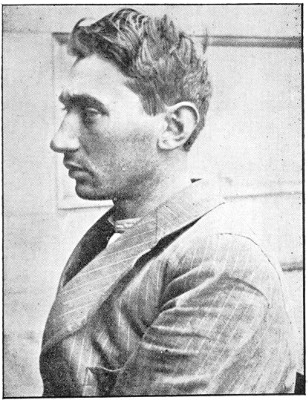
Holly Griffith alias F. S. Rose
Serving three life sentences in Moundsville State Penitentiary and will be tried for the murder of Jeff Goff, a constable of Wirt County, West Virginia.
Griffith then went to Parkersburg, where he stayed a few days and while there visited his wife. He went from Parkersburg to Wheeling, West Virginia. While in the act of boarding a B. & O. train bound for Pittsburgh an officer attempted to arrest him and he knocked the officer down, and I have been informed that the officer’s leg was broken in the scrap. Griffith then went to Pittsburgh, where he pawned one of his automatics and from Pittsburgh went to East Youngstown, Ohio, on a freight train.
I had secured information that he had sent his wife a post card from Pittsburgh and that he was on his way to Youngstown. I was at this time City Detective for the Police Department of Charleston. One day while searching the waste basket (this in the month of May, 1915) I found a letter addressed to the Chief of Police, asking him if he wanted a man by the name of Rose, for a crime, stating that he was under arrest for resisting an officer, carrying concealed weapons and hoboing at East Youngstown, Ohio. This letter was signed by the Town Marshal of East Youngstown, James Murray. Murray stated that he had blank checks from the Kanawha Valley Bank of Charleston, West Virginia, on his person when arrested and also that he had a flesh wound in his left hand. I asked permission of the Chief of Police to investigate this letter and advised him that it was my opinion from the information that I had secured before that it was Griffith who was apprehended at East Youngstown. I sent several telegrams and told them that we wanted Rose in this county for a forgery. As soon as I was satisfied that the man was Griffith I went to East Youngstown, Ohio. I arrived there and presented my warrant for S. F. Rose on a forgery charge and asked him if I could not speak privately with the prisoner. I was granted permission and was placed in a cell 6x10 feet with Rose. Rose (Griffith) informed me that he was not able to talk much as the authorities had been giving him a “sweating” for two days in order to get him to tell where he was from and what he was wanted for. They had kept him two days in this cell with a large Burnside stove, which is usually found in small school houses, going full blast. They gave him very little water and nothing to eat. Still Griffith refused and would not talk. I told Rose his right name and said, “Holly, I remember you distinctly. When you were in Charleston your chum was Grover Roush and you are the same man that visited a certain dive on Dryden street, and the same that gave Lawrence Beller a bad check for $100.00 for a motor boat.” I also told him that the scar that was on his left hand was caused by a bullet wound when he shot and fatally wounded the Chief of Police at Gassaway. He then opened up and said to me: “Clendenen, I thought several times of writing you a letter and telling you where I was so that you would come and get me and return me to either Wirt or Braxton county for a trial for the crimes that I have committed, and as you are ‘on to me’, and if you will agree to take me to the Clarksburg jail and leave me there until I am tried in either county, I will go back with you without requisition papers, but please go and get me something to eat as I am suffering from hunger.”
I told Griffith not to do any talking until I could investigate the charges against him to see whether or not I could get the authorities to allow him to go back to West Virginia on charges of forgery. At this point, I want to state that I tried to get an officer from either Youngstown or East Youngstown to accompany me to Charleston with Griffith but without avail. My purpose in asking this was that a large reward had been offered for the arrest and detention of Griffith and I felt that the officer who had arrested him in Ohio should get his share of same, but could not afford to give them full details as they were holding him on two charges in Mahoning county, Ohio.
After several days’ deliberation, the prosecuting attorney of Mahoning county agreed for Griffith to return with me on a forgery charge and I brought him back, arriving in Charleston May 24, 1915. It has been stated by the press that Griffith attempted to assault me in a restaurant in Pittsburgh, but this is not true, as he was a model prisoner at all times while in my care. It was not necessary to handcuff him—this being one of our agreements when he agreed to return without the necessary papers.
By some mysterious manipulation of “police routine” Griffith was taken from Charleston to Sutton by another officer of the Charleston Police Department and the whole credit for his apprehension and arrest was given to another member of the department, which was unjust in every sense of the word. Neither of these officers were familiar with the crimes Griffith had committed and had not devoted one moment of their time in looking up data in regard to him which might have led to his apprehension.
When Griffith’s case was called for trial at the county seat of Braxton county I assisted Hon. James E. Cutlip, the prosecuting attorney of Braxton county, in the prosecution. While on the witness stand I related Griffith’s confession to me, which was as follows:
“I was born of poor parents near Clarksburg, West Virginia, and have worked considerable of my time at hard labor and had very little chance to secure an education owing to the financial standing of my parents. I have only been married a short time, living near Elizabeth in Wirt county. While dealing at a country store in the neighborhood I gave a merchant a check for merchandise which was turned down by the bank and a warrant was issued for my arrest and placed in the hands of Jeff Goff, a constable of Wirt county. Goff came to my house one night in the winter of 1914 with a warrant for my arrest. He knocked at the door and I asked him who was there. He stated his business and said if I did not open the door at once he would kick it down, which he did. My wife told him I would go without any trouble and he began cursing and swearing. He shoved my wife to one side and came at me in an angry way. I reached for my pistol and shot Goff. He went outside through the door and some of his friends came to his rescue and carried him home. There is no doubt in my mind but what Goff was drunk on this night as I had never done anything to him and was afraid that he would do me bodily harm. I left my little cottage that night and walked several miles and came to Charleston. I stayed around Charleston for a few weeks in company with Grover Roush and assisted him in selling liquor. I went to a house boat near the Kanawha river bridge and contracted a deal for a motor boat with a man by the name of Lawrence Beller, giving him a bum check for $100.00 for the boat. I left in the boat and he became suspicious of the check and was advised by one of the Charleston banks that it was bad. Beller ’phoned to Lock Ten on the Kanawha river and got me on the telephone there. He told me the check was bad and I told him that if it was bad that there must be some mistake about it; but this was not a fact—the check was a forgery. He told me he was coming down to get his boat and I told him that if the check was bad to come on and get it that it would be there.
“I left the boat and went to a little place called Robertsburg, in Putnam county. I stayed there a few days and gained the confidence of some old people at a farm house. When I left I showed them my deputy sheriff’s badge, two pistols and handcuffs and told them I was going in the country after a man who was wanted for murder. I gave them a bad check for my board bill and secured $28.00 in cash. I then went to Clarksburg and again met my relatives and came from Clarksburg over the B. & O. to Burnsville. I went from Burnsville to Sutton and deposited a check for $500.00 on a Clarksburg bank, which check was a forgery. I then passed several checks at Gassaway on the Home National Bank of Sutton, drawing on the account. For these checks Orden Thompson secured warrants and tried to apprehend me. When he approached me with the warrants, which I learned later were for bad checks, I thought it was a warrant for my arrest in connection with the killing of Jeff Goff in Wirt county. I resisted arrest and shot Thompson and in the scuffle shot a bystander who was near. This occurred in a little store at Gassaway. I was at one time with the mob while they were looking for me and talked several times with the posse over the telephone. This bunch seemed to be a bunch of cowards. I do not believe I should be convicted for either murder, because I think I acted in self-defense in each case. I admit I did wrong in forging checks and trying to get by with it—it is one of my mistakes. I can show you fence posts near my home in Clarksburg filled with steel jacket and lead bullets fired from the pistols which I carried. I did this in order to become a sure shot and thought maybe sometime I might need my pistols to defend myself.”
Holly Griffith made several desperate attempts to escape from the Moundsville State Penitentiary. At one time he was hidden in a shop in which he worked and had prepared a dummy made of a pair of trousers, an old coat and other clothing and put it in his cell in a position that would look like a person. The guard discovered this was a dummy by speaking to Griffith and when he found that Griffith was not in the cell, they made a search of the shops and found him concealed there.
On January 6, 1921, Griffith succeeded in making a daring escape from the institution. He first set fire to several buildings and then proceeded to the power house in an attempt to destroy the lighting system. A fellow inmate interfered with Griffith in this attempt and Griffith immediately drew a knife and stabbed the fellow so severely that his death resulted. He also assaulted several other inmates and scaled the walls. In going over the wall he passed within fifteen feet of a guard who was so excited that he permitted Griffith to make his escape.
Griffith came down the Ohio river on foot and by freight train and stopped at a house on the Ohio side of the river where lived a family by the name of Roush. One of the sons, a young man, owned a motor boat which was for sale. Griffith induced him to run him to Portsmouth where he said he would draw money out of the bank and purchase the boat. After they had traveled a short distance Griffith shot the young man in the back of the head and then finished the job by beating him over the head with the butt of the gun, throwing him into the Ohio river. Griffith then proceeded alone to Portsmouth. Just as he was landing the motor boat several persons acquainted with young Roush inquired of Griffith where he was, to which Griffith replied that Roush had gotten off in the east end of town and would be down soon. Griffith then landed the boat on the Kentucky side of the river at a place called South Portsmouth, and was never seen again until he was captured.
Griffith was captured in Greenwood, South Carolina, by policeman C. T. Nelson and turned over to Newberry county officers for the robbery of the Post Office, Express Office and three stores at Silverstreet in that county on the night of January 24th. He confessed to all the robberies when arrested. A blank check has been the cause of Griffith’s arrest each time. When apprehended at East Youngstown, Ohio, a Kanawha Valley Bank check was found on his person and this information led up to his arrest. When caught at Greenwood, South Carolina, a blank check from a Moundsville bank was found on his person which led to his identity. The following is a facsimile of one of Griffith’s forged checks given in the City of Charleston, West Virginia, under the assumed name he used—“S. F. Rose”.
My information is that when Griffith was arrested he had upon his person four pistols, two razors and two pocket knives. No doubt this was one of Griffith’s clever tricks to get a short term in the Federal prison for the post office robbery in order to evade the officers who were on his trail to collect the $1000.00 reward which was offered for his apprehension. I understand that Griffith smiled and made a full confession of all his criminal actions to the authorities at the Newberry county jail. This was one of his polite ways in deceiving the public.
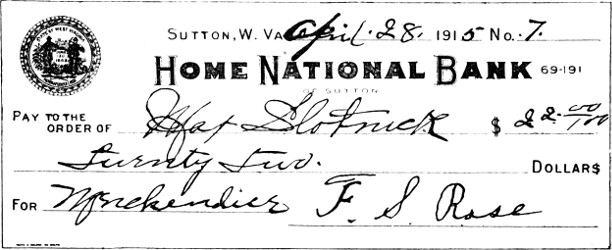
This check was one of Holly Griffith’s forgeries under the alias of F. S. Rose.
Griffith was returned on requisition papers to Moundsville, West Virginia, and tried in Marshall county for the murder of his fellow inmate. The jury returned a verdict of guilty and he was again sentenced to life imprisonment. After this trial Griffith was taken to Point Pleasant, the county seat of Mason county and tried on the charge of killing young Roush. The jury there also returned a verdict of guilty and he was again sentenced to life imprisonment, this making three life sentences he is now serving in the State penal institution.
At each of his trials Griffith in some way managed to either quote himself or have quoted to the jury the following from the Bible: “Do not take that which you cannot give.”
Griffith still stands charged with the murder of Jeff Goff in Wirt county in 1914, and it has been intimated that he will be tried for this crime, in an endeavor to hang him. He is the only man in the United States now serving three life sentences.
A Moonlight Tragedy.
At one A. M. on the morning of March 26, 1921, T. E. Martin, a Justice of the Peace for Loudon District, Kanawha County, West Virginia, together with Special Officers Pete Tyler, Lawson Tyler and George Jarrold, conducted a raid on the Davis Creek section, three miles from the City of Charleston. The party was in search of moonshiners, and during their progress from the mouth of the creek they discovered a large mash box containing about two hundred gallons of sour corn mash hidden in the underbrush in a small ravine above what is known as Jack Dodson’s farm.
The officers, on finding the mash, came to the conclusion that the ones interested in it would return soon and start their run. In carrying out their plans, the officers concealed themselves and awaited the return of the moonshiners. It later developed that the moonshiners had seen the officers approaching and had hidden in the thick underbrush. Two of the moonshiners rose from their hiding place and Pete Tyler discovered them, saying to Martin: “Tom, there are two men.” Martin immediately arose from the ground and promptly raised his shot gun to his shoulder with the command to “throw up your hands,” Pete Tyler rising at the same time. No sooner had these words been uttered by Martin than a volley from the hillside echoed through the still night and Martin and Tyler fell to the ground, Martin with a bullet wound in his neck and Tyler shot just below the left eye. After the volley Lawson Tyler and Jarrold fled from the scene, and reaching the nearest telephone notified members of the Charleston Police Department, who together with J. Walter Bee, Prohibition Officer; Clark Martin, a Constable for Charleston District, and other officers left immediately for the scene of the shooting.
On reaching the scene the injured men were placed in an ambulance and rushed to the Saint Francis Hospital in Charleston where four days later Martin died, Tyler recovering from his wound.
On delivering the men to the hospital a posse was formed under the command of J. Walter Bee and Clark Martin and left for Davis Creek with warrants for Jim Richards, Gilbert Hall, Jim Smith, Deward Huffman, Charles Aldridge, Arthur Hudson and Herman Hudson. These men were brought before G. D. Acree, a Justice of the Peace, charged with the shooting of Martin and Tyler. They were placed in the county jail and held without bond awaiting the outcome of Martin’s injuries. They were later charged with murder and released from custody under heavy bonds. After the preliminary examination Deward Huffman, Arthur Hudson and Herman Hudson were released from custody and Richards, Hall, Aldridge and Smith were held to await the action of the grand jury.
The author was absent from the city at the time of this murder on his farm at Rural Retreat, Virginia. I was advised by wire of the crime and immediately left for Charleston and on my arrival was given personal charge of the investigation. Having a very good idea of who the assassins were, I immediately began work on the case. My knowledge of who the guilty men were came from several trips I made with Squire Martin and other officers into this locality where Martin was killed.
At that time I had information that this mash belonged to Jim Richards and others.
The prisoners all employed the same counsel and were advised to do no talking. It was at all times impossible to get any statements from them relative to the shooting and their whereabouts on the night of the shooting.
In my investigation I saw that a mistake had been made by these men being apprehended before there was an investigation made as to the shooting, because as soon as they were apprehended their wives and relatives began arranging an alibi for each man, and Davis Creek being a moonshining neighborhood, and clannish, it was easy for this sort of evidence to be secured for the defense.
After the indictments were returned Richards would make frequent trips to Charleston declaring his innocence and talked as if insane upon the streets, remarking that he knew a lot about the murder but was not guilty and was afraid that his life would be taken because he had informed on the other prisoners.
One beautiful spring day before the trial the sheriff was notified that Jim Richards had been murdered and burned up in his log cabin home on Davis Creek. Deputy sheriffs were sent to the scene to make an investigation, bringing back with them what seemed to be the bones of Richards tied up in a piece of cloth. These bones were shown to the writer as soon as they returned. I saw immediately that they were not the bones of a human body. I immediately left for the scene of the fire and collected a number of small bones and turned them over to Dr. W. P. Black, County Coroner, who was assisting in conducting the investigation. We then held a consultation with the prosecuting attorney and the State Fire Marshal. The Fire Marshal immediately filed a complaint and had a warrant issued for the arrest of Venie Richards, the wife of Jim, for the burning of her residence. She refused to give any statement regarding the fire and murder, other than to remark:
“Jim and I were sitting in our little cabin on Davis Creek when a rap came to the door and some one requested admittance. On opening the door, thinking that it was some of our neighbors, five masked men pushed their way through to where Jim was standing and said, ‘Jim, we have come for you and are going to put you out of the way.’ Jim saw that he was up against it and said, ‘Well you have me,’ and picking up the old banjo, which was a family relic, handed it to me and said: ‘Venie, you take the old banjo and keep it, I may never see you anymore.’ I ran from the house and as I started up the hillside I heard a pistol shot and knew that poor Jim had been murdered. I turned and saw the house was in flames and everything was silent. I never seen poor Jim anymore.”
With these remarks she burst into tears.
She was placed in the county jail and could not arrange bond for her appearance. Doctor Black examined the bones that were found in the ruins of the home and discovered what were supposed to be human bones were really sheep bones which had been sawed with a meat saw in a butcher shop. The saw marks were very distinct. We gave Mrs. Richards every chance to make a true statement but she refused and the above story was repeated to everyone who interviewed her, even her close friends.
The search was then instituted for Jim Richards. Several Charleston citizens were on his bond as surety in the sum of six thousand dollars. A close watch was kept for mail that might come to Mrs. Richards and after a patient vigil, Henry A. Walker, Sheriff of Kanawha, discovered a telegram for Mrs. Richards from some man in Boone’s Mills, Virginia. After a careful investigation he located Richards in Rocky Mount, Virginia, and had him arrested, returning him to Charleston where a reward of two hundred dollars had been offered for his apprehension by his bondsmen, this reward going to J. P. Hodges, Sheriff of Franklin county, Virginia. The writer at this time was at the Ponce de Leon Hotel in Roanoke, Virginia, making an investigation as to the character of Jim Smith, etc., and while there met Sheriff Walker and others, in the lobby of the hotel. I remarked, “Well, boys, where is Jim?” and they told me he was in the county jail. My investigation was completed and we all returned from Roanoke to Charleston on the Virginian train. Several people from Princeton and other places on the Virginian Railway identified Richards as the man who had been riding the Virginian train between Deepwater and Roanoke and told us they believed he was crazy, as he had made several proposals of marriage to young girls, telling them that he had a fine farm in the Blue Ridge Mountains of Virginia and that he was a single man at present and wanted a wife. He would carry with him on these trips a small Bible and quote scripture.
Richards made a complete confession coming from Roanoke to Charleston as to the arrangements made for getting the bones and burning his own residence, and offered as an excuse that a Voodoo Man from Virginia had worked some kind of a hoodoo on him until he did not have his own mind; that this man had sent word to him by a detective from Virginia telling him that if he burned his house and put the bones in the ashes that everything would be alright. He still denied any connection with the murder of Martin.
Thinking that our strongest case was against Richards we proceeded to try him at the next term of court on a charge of murder. He was tried and the jury, after a short deliberation, returned into court with a verdict of “Not Guilty”. The jury in rendering this verdict based their actions on the fact that the only eye witness who identified Richards as one of the men who did the shooting was himself shot in the eye, Pete Tyler, together with the fact that it was in the night time and the men were some forty feet away from Martin at the time of the shooting.
Gilbert Hall was next tried and acquitted and the cases against the others are still pending.
An odd incident occurred in connection with this case. During our search of the ruins and the discovery of the bones, a resident of that section of the district remarked: “Jim Richards is now in the Blue Ridge Mountains of Virginia souring his mash.”

An Investigation I Feared.
In the spring of 1921 I received a telegram from a friend of mine in Carter County, Kentucky, asking me to report at Soldier, Kentucky, which is on the Lexington Division of the Chesapeake and Ohio Railroad out from Ashland, Kentucky. I communicated with my friend by letter and ascertained that there had been a murder committed near Soldier, Kentucky. After arranging a contract which was satisfactory I took a young lady operative and we together went to Soldier, Kentucky. We were met at the station by Albert Bailey and taken to the farm of I. N. Edens. After arriving there, Mr. Edens and his wife told us the following story:
“We only had two sons and both of them went to war. My youngest son was shell-shocked and lived but a short time after his return home. Our other boy lived on a nearby farm, a faithful and true son to his parents and was loved by all who knew him. It was customary for him about two evenings each week when the weather was favorable to take a hunting trip by himself at night, carrying with him a sixteen gauge shot gun, a carbide light and his faithful hunting dog, Ned. One beautiful moonlight night he left his home and went in the direction of the farm of Kate Tolliver. On this farm is a large still house containing a large copper still. This still had been running for a number of years in Rowan County, Kentucky. Our boy failed to return from his hunting trip at his usual time and about ten o’clock the following day we started a search for him.
“Kate Tolliver had posted a sign on his land stating that no one was allowed to hunt upon the premises. About 11:30 A. M. the following day we found our boy in a dying condition near a little mud hole about two hundreds yards from the still house on Kate Tolliver’s farm. He only lived about twenty minutes after we reached him. He told us that he was coming from the top of the mountain towards the still house when a man, unknown to him, sprang out in front of him and fired two shots from a high powered rifle, both shots taking effect. He told us that after being shot he had made it to this mud hole for a drink of water, a distance of two hundred yards. The parties with me when I found our boy had several different kinds of horns and shot guns, and when we were near the scene one of the men would blow into the barrel of a sixteen gauge shot gun and we could hear the whines and bark of our boy’s dog. We discovered that the only sound he would answer was that which came from a sixteen gauge shot gun. By this means we located him.”
During my investigation in Rowan, Lewis and Carter Counties, a number of men approached me on horse back and asked permission to form a mob to go to the farm of Kate Tolliver and hang both him and Buck McKenzie. Generally speaking the public believed that young Edens was killed by Buck McKenzie at the instance of Kate Tolliver.
During my investigation I examined the thirty acre laurel patch in Carter County which was at one time a noted moonshine den. A notice was made on a small board with the following inscription: “This is as far as any officer is allowed to come.” My understanding is that none would venture beyond that sign.
The next day after the murder of young Edens, the prosecuting attorney, sheriff and other officers came from the county seat to the farm of Tolliver and burned his still house, but the night before Kate Tolliver, with a gray team of horses and a sled, had hauled the still away into Lewis County where it had been destroyed by the roadside. The posse tried several times to catch Tolliver at home, but when he would see them coming he would proceed to the hills and would not be seen again for several days. We never located McKenzie.
Kate Tolliver was a member of a noted family of criminals living in Rowan and Carter Counties, Kentucky, he having served a number of sentences for murder in the Kentucky state prison and at this time was on parole from a life sentence for murder. He was a member of the same family of which four were murdered by Logan and a number of other citizens about thirty years ago in Moorehead, Kentucky.
While completing my evidence ready for an indictment at Moorehead Kate Tolliver rode into the county seat of Rowan county in a drunken and disorderly manner. He was stopped by the Marshal and a pistol duel ensued in which Tolliver was shot to death by the Marshal. This finished my investigation, one that I feared more than any other I ever made in a criminal case.