DAN CUNNINGHAM AND SOME STORIES FROM HIS SCRAP-BOOK
Reading edition
Dan Cunningham and His Slow Vengeance.
“Dan Cunningham, Huntsman of the Law,” was the title of a very interesting article in a current number of McClure’s Magazine which attracted considerable attention in this state about the year 1900. The author, Samuel Hopkins Adams, author also of the pamphlet putting forth a strong defense for Caleb Powers, goes on to show that a mission of revenge through the instrumentality of the law dominates the life of Cunningham.
While Cunningham was teaching school in Jackson County, West Virginia, in 1877, his brother, Nathan Cunningham, was waylaid and murdered by what the author called a “consolidated band”, a great secret organization engaged in murder and moonshining. After endeavoring to secure the conviction of Wade Counts, Joe Kiser and others of the band and failing on account of the fear of the officials to molest the band, Cunningham left Jackson County.
For ten years he taught school in Roane County, Putnam and Kanawha Counties. School teaching was all he knew and he had to make a living while learning certain things the normal school does not teach—such as rifle and revolver shooting, wood-craft, mountain training and tricks of the moonshiner. For Dan Cunningham was seeking a job under the United States Government as a local revenue officer. The law that this breed had established and defended at the risk of their lives had failed him. He would try Uncle Sam’s Law. He shrewdly suspected that the band would be moonshining. The band, gaining prestige from the successful murder of Nathan Cunningham, had by terrorizing and political weight, strengthened their hold on the county until in 1887, they dominated it completely. They were thoroughly organized on a clan principle with a “legal adviser” and a “spiritual adviser”. Murders of the most brutal kind were laid to the band’s account. Robbery, arson and other crimes were credited to its various members. Nobody dared to testify against them; the death rate among their enemies was too high. Their distilling industries and their land grabbing were making them prosperous; it was fair weather for the clan.
Being successful in procuring an appointment as Deputy United States Marshal for the southern District of West Virginia, Cunningham returned to Jackson County, raided several stills, secured the conviction of two of the Kiser family and one Counts and broke up the band, which emigrated to Roane County. Cunningham followed them up and here comes in the incident as related by Mr. Adams which will arouse some discussion upon the part of those familiar with the subject—the murder of Reverend T. P. Ryan, the father of J. L. and M. W. Ryan and T. P. Ryan, well known attorneys of Fayette County. The affair is related as follows by Mr. Adams:
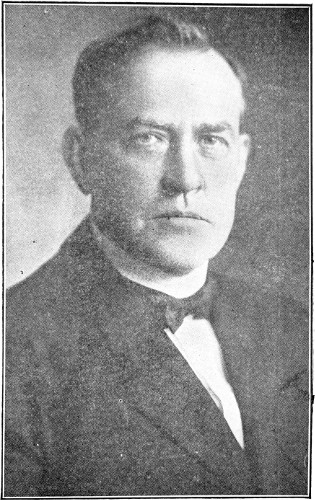
Dan W. Cunningham
“In the District of Harper in Roane County, West Virginia, lived the Reverend T. P. Ryan, generally known as Father Ryan. He was a man of clean and up-right life, a hater of crime and disorder and a fearless preacher, therefore, the unerring instinct of the clan saw an enemy. He was shot to death through the window of his own house and before the murder was committed the Skeens and Counts settlements, twelve miles distant, knew all about it. Long before the news could have reached their settlement, the gang were armed and enroute to the spot, to accuse and arrest the Duff boys and a man by the name of Coon, all of whom had been associated with Cunningham in raiding the Jackson County illicit stills. After a mock trial, in secret session, they shot George Duff to death, hanged Coon, and cut Robert Duff’s throat in the presence of his wife. As soon as he learned of this Cunningham started for Roane County. Here was his chance to secure a conviction for murder against the slayers of his brother. He collected the evidence, even to the proceedings and the pass word at the meeting which sentenced the victims, and was about to present them when to his amazement he learned that a warrant had been sworn out charging him with the murder of Father Ryan. To be taken then meant the same death that had been meted out to his friends. For the first and only time in his life, Dan Cunningham evaded the law. He made good his escape while the clan was gathering. The prosecuting attorney, who had married the niece of the consolidated gang, sent word that if the United States Marshal would agree to keep away from Roane County the case would be nollied. The answer was prompt, Cunningham would be there when the case came up for trial and he would bring protection against lynching, but not against any due process of law. The case was called. Witnesses had been subpoenaed to swear that they saw Cunningham fire the shot. Some fled, some were silent; no one testified, the jury returned a verdict of acquittal without leaving their seats. Now came Cunningham’s inning. With his evidence of the murder of Duff and Coon, he went to the prosecuting attorney. That official refused to proceed against the murderers. The inquest, he said, had decided that the victims came to their death at the hands of parties unknown. “Very well,” said Cunningham, “this is another Jackson County. I will await for them to commit a Federal crime.” The Federal crimes were committed—post office robberies, moonshining and counterfeiting. One by one Cunningham got his men. Once he met on a lonely roadway one of the elder Kisers who had borne a part in the slaying of Nathan, his brother. By way of precaution Cunningham covered him with his revolver. Kiser fell to his knees and began to pray. “Get up,” said the Marshal, “if I wanted to kill you and your like, couldn’t I have done it a hundred times? Go on and do not turn around.” Gossip was then circulated about the countryside that Dan Cunningham was witched against bullets and poison. Both had been tried by the band and both had failed. The bullet fired, fired with a close and steady aim from ambush by the crack shot of the clan which sleeps with its rifle, cut through the breast of his coat, barely burning the skin; the arsenic skillfully prepared in an apple by the “yarb witch” of the band he tried on a hen and watched the hen die, and he went out and arrested two young hopefuls of the Skean family for petit larceny.
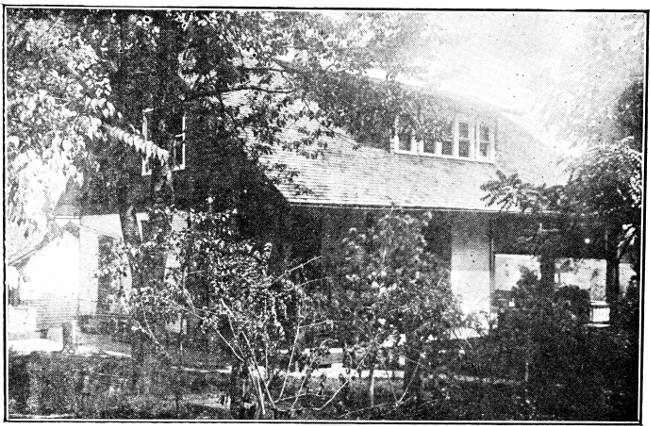
Pine-Beech Hill—Home of Dan W. Cunningham.
By repeated arrests and minor convictions he broke up the consolidated band in Roane County as he had in Jackson County. They split, a few remaining in their dens, but too weakened and cowed to be any longer a menace to their district. One faction went down into Tennessee and effected a location there. Several times he went to the county seat of Roane County to present his evidence against the murderers of the Duff boys. Always with the same negative result. The entry in his diary of one of these failures is followed by this note:
“Some day there will be another prosecuting attorney in Roane County and I will apprehend and bring to justice my brother’s murderers.”
There came a time when the event lay in Cunningham’s hand in Parkersburg, West Virginia. He found lying senseless on the railroad track the official who stood between him and his twenty year deferred vengeance. There was a train in hearing, he had only to walk away. He had, twenty years before, held his hand from the vengeance of murder, so now he forewent his reckoning rather than have a life on his conscience. He dragged the stupefied man from the track and left him lying. If the official reads this, it will be his first knowledge of who saved his life.
Another Case from Cunningham’s Scrap-Book.
“In the year of 1904, a most horrible and cruel murder was committed in Putnam County, West Virginia. Never in the history of this county did a crime so incense the residents of this section as did the foul assassination of Thomas N. Starks, on the night of February 15, 1904. At the time the Charleston Daily Mail reported in full all the horrible details and from time to time recorded the progress of the officers who were investigating the case.
Thomas N. Starks, one of the most respected citizens of the county, was discovered by his daughter, Miss Minerva Starks, who had returned from a visit to neighbors, lying on the floor of his room in his home, bathed in blood from a wound in his temple that had been done by a charge from a shot gun entering his brain. Friends were summoned and medical attention was rendered the wounded man, but with no avail.
The shooting must have occurred about ten-thirty. Thomas Starks, who for eighty-three years had lived without strife and turmoil, died of the assassin’s wounds.
The defense was represented by Attorney Stevens, of Winfield, West Virginia, and E. L. Stone, of Jackson County.
Adam B. Littlepage, of Charleston, West Virginia, opened the case in a statement of the theory of the prosecution. He detailed the surroundings of the murder, and finally announced that the state was in possession of evidence such as he did not doubt would convict the prisoner, Charles Hawkins, of the fearful crime.
E. L. Stone responded for the defense and stated that the defense would prove their client not guilty to the satisfaction of the court and jury. J. L. Stevens made an additional statement for the defense, to which Mr. Littlepage responded briefly.
The hearing of the evidence commenced in the afternoon. Miss Minerva Starks, the daughter of the murdered man, herself a white-haired old lady, was the first witness called by the state. She stated that on the night of February 15th, she left her father’s house just before dark and went about a quarter of a mile to the house of a neighbor named Schultz. Here she remained about three quarters of an hour. When she returned home she saw her father lying on his side in the room usually occupied by him and his face covered with blood. She picked him up and dragged him in the room and then ran for help. She stated that her father frequently kept money at home, sometimes in large sums. He had a boot jack with a hidden receptacle under it where he frequently hid money. The boot jack was exhibited by the state. The cross examination brought out very little except that Mat Bright had been in her father’s employ some months prior to his death and that they had had some little differences, the old man having accused Bright of stealing some potatoes from his potato hole. Bright’s innocence was afterwards proven and her father had apologized to Bright. Bright was somewhat familiar with the arrangement of the house and the habits of her father. The next witness called was Doctor A. Y. Martin, who gave a professional opinion regarding the wound, its location and the angle at which the charge was fired. Doctor Meyer, the other physician who attended the murdered man, testified to practically the same thing. C. L. Bowyer testified the condition under which he found Starks when he got there just before the arrival of the Doctor. C. A. Howell, the jailer of the county and a deputy sheriff, one of the first to reach the spot from Winfield on the night of the murder, testified regarding the location of furniture in the room when he arrived. He also told of the range of the charge from the shot gun and stated that the chimney of the lamp on the table beside Mr. Starks was also shattered by the charge. J. P. Smith and his wife were both placed on the stand and stated that about nine o’clock on the night of the murder, they heard two men run by their house, which is near the bridge over Big Hurricane. J. Francis, who resides near the same bridge, corroborated their statements.
Marion Adkins and Raymond Adkins, both of whom were at this time in the Kanawha County jail on a charge of stealing a cow on Cabin Creek several weeks before, were brought to Winfield to testify in the trial.
These men on the night of the 15th of February were on their way to Parkersburg, making across Putnam County on foot from the C. & O. to the K. & M., and saw Hawkins and Bright within a mile of the Starks home.
This is considered a very important link in the chain of circumstances against these men.
The most important witness in the case on trial is none other than Mat Bright, who is under indictment for the same crime.
A month or two ago, his confession in the Kanawho County jail led to the arrest of Charles Hawkins. It was Bright’s evidence before the grand jury at a special term, called for the purpose of investigating this murder, that indicted both Hawkins and himself.
The testimony of Bright, who will go on the stand Wednesday, will be one of the most sensational ever heard.
His statements to the officers have been borne out by the other facts secured, and when he faces the jury Wednesday and details to them how Hawkins and he planned the entire crime, and how it was executed, and the disposal of the pitiful returns that resulted from the crime, the effect will be little less than terrible.
Early Tuesday morning, a party consisting of Bright, one of the Adkins, Detective H. C. Smith, T. G. Cochran and Dan W. Cunningham and several newspaper representatives visited the scene of the murder. The Starks farm is a small one located about one and a half miles below Winfield, on the Kanawha River Turnpike.
The house is a comfortable two-story dwelling with a one-story extension in the rear. It was in the room in the extension that the aged farmer was murdered.
Bright explained in detail how, on the night of February 14th, Hawkins made one of his numerous visits to Bright’s home, and that there they planned to kill and rob Thomas N. Starks on the following night.
It was agreed to meet at Hickory Post Office during the following day. Bright was seen on the road with something done up in a paper flour sack which was at the time supposed to have been a banjo, but was in reality the shotgun taken apart with which on that night Hawkins did the killing.
According to the statement of Bright the pair of plotters met at the appointed place and proceeded across the hill to the Starks farm. Bright waited up in a small hollow while Hawkins took the gun and proceeded up the small knoll to the house. Bright heard the report of the gun and the hurried footsteps of the murderer. Hawkins and Bright proceeded down the road and across the bridge of Big Hurricane.
Finally Hawkins divided the spoils, giving Bright a revolver and overcoat and $2.50 in money, claiming he only secured $5.00. The County jail here, an antiquated and rather vulnerable looking building, is now occupied by Charles Hawkins and Mat Bright, who are under indictment for murder, and by the two Adkins boys, who are here as witnesses. The Sheriff has the place heavily guarded at all times and especially so after midnight. Last evening there was considerable gossip that a mob was organizing and the jail would be broken into and the prisoners hanged; however, this did not materialize, though a rather ugly looking crowd had assembled near the scene of the murder. On Tuesday afternoon there was still some talk of lynching the men and a proposition was discussed of slipping the two men under indictment out of town and taking them to Charleston for the night.
The sheriff considered this inadvisable and the project was abandoned.
One of the prettiest places in the Kanawha Valley marks the home of Thomas N. Starks. Just back of his house a beautiful green knoll stands out from the surrounding slopes; here, amid the waving grass and under shady trees, is the grave of the murdered man.

A Typical West Virginia Mountain Abode.
The picture opposite is the first house of what is now, and was then Maben, West Virginia. Maben now is a flourishing little town on the Virginian Railway and the center of a large lumber industry—the Ritter Lumber Company.
In the picture may be seen a pioneer of West Virginia and his wife, who were postmaster and postmistress, respectively, for the town of Maben. The next in the picture is that of myself, D. W. Cunningham. To the right of me is Charles E. Wright, former Special Agent of the Department of Justice, Washington, D. C. To the extreme right is a man under arrest for counterfeiting, who was apprehended by myself and Mr. Wright.
For many years this place was a resting place for officers of the law, as in those days the only mode of transportation was by wagon and foot along narrow trails. The old folks shown would prepare meals for the hungry that passed along the trail.
From a close observation you can see that the man on the extreme right is concealing his hands in his lap, not wanting to disclose the fact that his hands are securely fastened together by handcuffs.
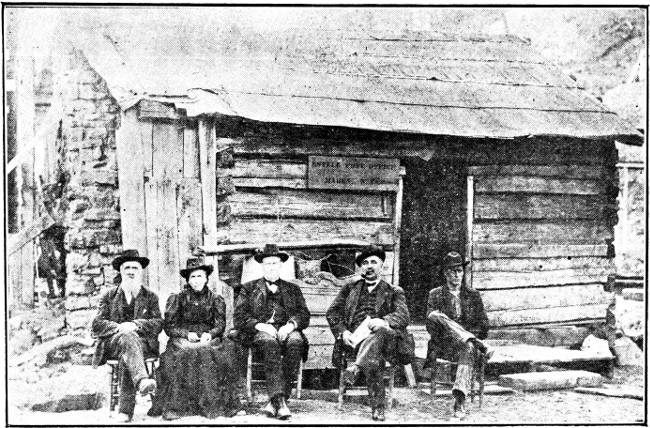
Log Cabin—The Pioneer Home of Maben, W. Va.
A Horrible Crime.
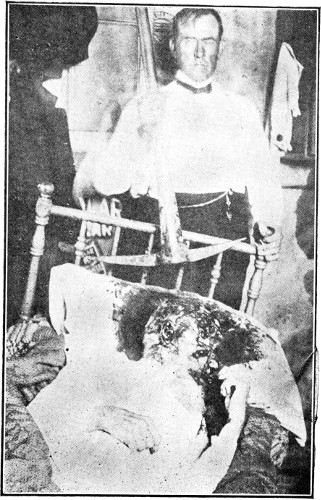
About fifteen years ago, in the peaceful, quiet little town of Barboursville, in Cabell County, West Virginia, nine miles south of the City of Huntington, lived a man by the name of Baker, eighty-four years of age, who ran a small confectionery store, in the rear of which was his living quarters.
One summer evening, while the old gentleman was asleep on his cot, some unknown person entered his little store and home and using the pick shown in the picture herewith, killed him in the most brutal manner, robbery being the motive.
The assassin used the pick with such force that he drove it clear through the head several times.
I accompanied the prosecuting attorney of Cabell County to the awful scene, and we found Mr. Baker as shown in the photograph, and after an investigation located the pick. This pick was taken from the tool house of the Chesapeake and Ohio Railroad Company about one-half mile south of Barboursville, but we failed to apprehend the man that committed this terrible crime. Several suspects were arrested only to be released from custody after a severe examination. The best clue ever obtained was to the effect that a colored man from some point in Kentucky had been absent from the construction camp a short distance away on the Sunday night of the crime and that he did not show up until the next evening. We tried in every way to locate this man in the State of Kentucky and elsewhere but failed, and to this date the assassin is still at large.
Confessions of An Amateur Yegg.
During the early teens the counties of Lincoln, Raleigh, Boone, Kanawha, Nicholas, Clay, Pocahontas and Webster were terrorized by a series of store and postoffice robberies and safe blowing. Lincoln county alone had in the neighborhood of forty robberies within two weeks.
The writer was employed by the different merchants in the localities where the robberies occurred to make an investigation. I went from Charleston to Racine, in Boone county, where the general store had been robbed. From this store I was able to obtain some soap with finger prints on it which I kept and followed up this point. The postoffice and general store at Enon, in Nicholas county, was robbed and the iron safe, which was a four way combination affair, was hauled about three hundred yards from the store building and residence of the postmaster by his own sled and horse and blown open with nitroglycerin. The charge was too heavy and blew papers and other documents in the safe several hundred feet away. The robbers obtained nothing but a small amount of money and one ring which had been sent by registered mail to a party at Enon.
While at Racine on my third trip, I accidentally came across some information in a little store by over-hearing a conversation about a young man, whose name I do not care to mention, who had been ordering shoes from Sears, Roebuck & Company and sending them stamps of large denominations to pay for same.
For months I went from county to county securing information on this gang of thieves. The young man from Racine had been sent to the State Hospital at Huntington, West Virginia, to be given treatment for the drug habit. I watched faithfully for his recovery and notified the physician in charge that when he was able I wanted to be wired and would come to Huntington to interview him. The wire came and I went to Huntington. After questioning him, he confessed as follows:
“About one year ago I became acquainted with three men by the names of Calvin Doe, Milton Doe and C. & O. Red, who was a professional yeggman. We traveled from county to county robbing small stores and postoffices, sleeping at night in barns and in the woods. We would go into the woods and when out of nitroglycerin, would make our ‘soup’ by boiling down dynamite. We also carried a small quantity of peroxide to color our hair. One morning while under the influence of drugs, tired and worn out, in the mountains of Pocahontas county, the three above mentioned by me prepared breakfast and they handed me a mirror and told me to take a peep at myself. I did so and discovered that my head of black hair had been dyed a light red color. This process was used while I was sleeping. We all used the hypodermic needle containing morphine when we could not get liquor. I would make an estimate of one hundred or more stores that we robbed. We at one time made a trip from Lincoln to Pocahontas county and then to Webster Springs, robbing several places as we went. While going through to Webster county we stopped to rob a little country store in Flatwoods in Braxton county. The little one room building had shutters and iron bars. At this time we were carrying about one hundred pounds of seng, which we had stolen. After we released the bars and shutters and started to enter the room someone from the inside fired a heavy shot through the window and we escaped, leaving the seng on the porch of the little store. Before meeting these men I never used drugs in any form and from my association with them I became addicted to the same.”
The writer, after obtaining this information, secured warrants and for several weeks was on the trail of the two men, who at this time were living near the line between Clay and Nicholas counties. These men were from good families. After several failures to capture them, we learned they were in a lumber camp in Pocahontas county, selling moonshine liquor. They were apprehended by the sheriff and others while eating dinner. On being searched each one had a pair of revolvers of a large caliber and plenty of ammunition, together with four gallons of liquor. They were taken to the Pocahontas County jail, charged with moonshining and carrying concealed weapons. I had very little trouble in convincing the sheriff and prosecuting attorney of Pocahontas county that I had these men indicted for serious crimes and would be able to convict them for felonies in the United States Court. Before I brought them from Pocahontas to Charleston, Calvin, who had a wife in Catlettsburg, Kentucky, wrote a letter and asked her to send him a paste board book and conceal two Black Diamond saws between the boards so that he could saw his way to liberty. This letter was given to a trusty to mail, Calvin giving him $5.00 for the favor. The trusty turned the letter over to the sheriff and in a few days the book came through the mail. Sheriff Cochran received it and took from the paste board back the two saws which Calvin had sent for. He placed them in a solution of acid which took the temper out of them and then replaced them in the book. The book was delivered to Calvin. During the night a watch was kept upon the prisoners and they labored for hours to saw the bars in two, but the saws would only bend and it was of no avail. The next day Calvin figured out the joke and only laughed at what had been done to him. Milton, his brother, had not spoken in the presence of any stranger for weeks, Calvin claiming that he was insane.
I brought both of them from Pocahontas to the Kanawha County jail. While confined here the Post Office Inspector and myself visited the county jail and the Inspector asked Calvin where he purchased the signet ring he was wearing. Calvin immediately left us, walking to the lavatory where he threw it down the commode, flushing it down. This was the same ring which was taken after blowing the safe at Enon in Nicholas county.
They were both tried in the Federal Court for the Southern District of West Virginia, which convened at Webster Springs in September. They were indicted in several cases and given a term of four and one-half years in the Moundsville Penitentiary. Milton had already served at least three sentences in different prisons for robbery. Calvin had served two terms, this making his third conviction and Milton’s fourth.
Calvin, at one time, while serving a sentence in the Moundsville prison, scaled the wall by tying together some bed clothing and throwing a hook or loop over the wall, by this means making his escape. He was afterwards captured and returned to the institution. He is now confined in the Federal Prison at Fort Leavenworth, Kansas, and Milton, his brother, is a fugitive from justice, having been indicted in the Intermediate Court of Kanawha county for an automobile theft. It is my understanding that in case Milton is captured he will be tried under the habitual criminal statute and if convicted will receive a life sentence.
My reason for withholding the right names of these men is on account of their parents, who are respected, law-abiding citizens. The young man who made the confession is now married and no longer addicted to the use of drugs, living a clean life.

Soldiers Turn Bandits.
(The following story and data is printed through the courtesy of Rome Mitchell, who is in the opinion of the writer, the best and most efficient Special Agent ever employed by the Huntington Division of the Chesapeake & Ohio Railway. His activities brought to justice these murderers.)
In the summer of 1919, an interurban street car running between Saint Albans and Charleston was boarded at Stop 19, a short distance above Saint Albans, by three suspicious looking men wearing overalls. People in the car afterwards stated that they felt that something was wrong by the actions of the men, they appeared to be in such a nervous condition. Two of the men went to the front of the car and one remained at the rear. At an agreed signal from one of the men in the front of the car, who fired his pistol, the other two got up and commanded the passengers to put up their hands. The conductor started to run and one of the men fired a shot in his direction. During the excitement that followed Kemper Ruffner, a Charleston boy, escaped through one of the windows of the car with over three hundred dollars in his pocket. After searching the passengers the three men got off the car, where they found the conductor mortally wounded. They searched his clothes and obtained $10.00 in money, vanishing into the darkness.
This hold-up and murder caused considerable feeling in Kanawha and surrounding counties. Officers of the law everywhere were on the lookout for the culprits. The Police Department at one time during the search for the three men arrested three deaf mutes and had them confined in the Kanawha County jail for a period of about three weeks, trying to connect them with the crime.
At this time Special Officer Mitchell started his investigation of the crime and his first clue led him to believe that the three men in custody were not the ones wanted, as passengers on the car testified that two of the men spoke in giving commands, when only one of the trio confined could speak. Following this up Mitchell started his investigation at Saint Albans and from evidence secured ascertained that two rowboats had been stolen on the night of the crime from the opposite side of the river from Saint Albans near the Town of Nitro. This gave him the idea that persons residing on the Nitro side of the river had committed the crime, as tracks leading from the scene of the crime down to the river bank further bore this theory out.
Conductor John Dame, who was killed, was struck by a 45 caliber automatic bullet, such as is used by the United States Government, and from this evidence Mitchell suspected some of the soldiers on guard duty at Nitro, the Government Powder City. On making inquiries of the officials at Nitro he ascertained the number of men who were absent from camp on this particular night, and after a process of elimination the number absent who could not account for their whereabouts during their absence was reduced to three, namely: Private Doc Maddox, Private Ralph E. Farley and Corporal Warnie Anderson. These three men were arrested, charged with the murder of Dame and brought to Charleston, where they were confined in the Kanawha County jail. They were questioned several times while confined but refused to give any information whatever regarding the crime, stoutly maintaining their innocence.
Maddox was brought before the prosecuting attorney and questioned at some length about the case. At first he was inclined to tell conflicting stories, but after he had been “cornered” several times, he voluntarily made a complete confession. Before the questioning began, Maddox was informed that anything he might say would be used against him in the trial, and that he did not have to answer any of the questions put to him if he preferred to keep quiet on the matter. He expressed a willingness to answer all questions.
Before making his written confession Maddox expressed the desire to be alone for awhile and it was finally agreed that he could remain in the prosecuting attorney’s office as long as he chose with only one officer in the room, who would not talk to him.
In making a “clean breast” of the crime Maddox said that he felt guilty and wanted to get the matter off his mind and take his punishment along with his two accomplices. His confession is as follows:
The Confession.
“Charleston, W. Va., June 16, 1919.
“I, Private Doc Maddox, Supply Company, United States Infantry, stationed at Nitro, West Virginia, do make the following statement of my own free will and accord, without hope or promise of favor and not under threats of any kind, but realizing the full effect of my confession.
“I am nineteen years of age. I have been in the service two years. On Monday evening, one week ago today, Private Ralph E. Farley, Wagoner, Supply Company, ——th infantry, discussed with me a proposition to hold up the street car running from Saint Albans to Charleston and rob its passengers and conductor. At first I refused; later I agreed if we could get the third man to help. Farley later told me he had talked with Corporal Warnie Anderson, Supply Company, ——th Infantry, and Anderson had agreed to help us. Later, I talked it over with Anderson and he agreed. On Tuesday, I borrowed Bugler Cooper’s (Company E, ——th United States Infantry) 45 caliber automatic pistol to take with me. The three of us, at Farley’s suggestion, had agreed to go armed and wear overalls as a disguise. I borrowed overalls. They were khaki colored, buttoning clear up to the throat. The others also had overalls, one blue and khaki colored also. I carried my overalls in a bundle, accompanied by Farley and Anderson, on the ferry boat, “Sandy Valley”, about seven p. m. of Tuesday, June 10th. At Saint Albans, I took my overalls to the bushes on the river bank and put them with Anderson’s and Farley’s. Later, I went there, got all of them, and went up the river bank, met them and we all put the overalls on in the bushes. Just before that I saw some woman and children and a man in swimming. I did not see them again. After putting on the overalls, we three crossed the field to the railroad pumping station. We asked a man in charge there for water and he gave it to us.
“We went from there to Stop 19 on the car line. We boarded it. Anderson and I went to the front and Farley remained at the rear. At an agreed signal from Farley, who was to shoot, Anderson and I got up and I shot through the top of the car, calling on passengers to put up their hands. The conductor, whom I knew slightly, tried to run and I saw Farley shoot in his direction as he ran. I saw Anderson at the front of the car after the motorman. I think he struck the motorman with his gun. One passenger jumped through the window and my gun jammed so that I could not fire it.
“We went through the passengers and then got off. We started down the track and came upon the motorman and conductor. Farley shot into the ground near the motorman and told them to put up their hands. I searched the conductor and got $10.00. He said he was shot in the side. We then went down the river bank, took a boat, crossed to Sattes side of the river and walked to Nitro. We hid our guns on the way into Nitro. Later I got mine and returned it to Cooper. We threw our overalls into the river as we crossed it. We wore our uniforms into camp.
“I have not talked to witnesses of the car robbery, but I told ———— after the robbery all about our intentions and what we had done. Later I learned of an attempt to identify us at Nitro and I left. At Lock Seven I saw the man who had jumped through the window and turned away so he could not see me. I think Farley shot the conductor. I shot no one and I think Anderson struck the motorman with the butt of his revolver.
“The foregoing is written at my instance in the presence of Thomas Cochran and others.
“It is freely given after a consideration by me of it all, being given ample time to think it over at my request.
“(Signed) Doc Maddox.
“Witness:
“T. G. Cochran and others.”
The above men were brought to trial, Farley and Anderson still maintaining their innocence in view of the above confession. The trial proceeded and when about half completed, they changed their plea of not guilty to one of guilty and threw themselves upon the mercy of the court. Farley was sentenced to life imprisonment, Anderson received fifteen years and Maddox fifteen years.
A Peculiar Murder.
On the west side of the City of Charleston on the hill opposite Crescent Road, lived a family by the name of Jarrett. Jarrett and his wife had separated and were divorced, Mrs. Jarrett later marrying a man by the name of B. Overstreet. After living with Overstreet a short while, Mrs. Jarrett compelled her second husband to return to the home of her former husband and live there where she could be with her children.
Domestic troubles frequently occurred in this home. Overstreet became ill and could not work, Jarrett ordering him to leave the home. Mrs. Overstreet agreed with her former husband in this respect that Overstreet should leave. Overstreet would leave and stay away through the day and return home at night, seemingly losing his mind on account of his illness.
One evening about ten o’clock the writer was called by the prosecuting attorney to investigate the circumstances surrounding what was termed a suicide on the West Side. Being busy with another criminal matter I turned the case over to W. M. Thomas and C. H. Martin, Constables of Charleston District. These men went to the scene of the supposed suicide and found B. Overstreet lying near the back porch of the house with the top of his head completely blown off. The first thing the officers noted was the distance the gun was lying from the body of Overstreet. They next used their flash light in looking under the floor and the gun was lying a distance of twelve feet from the body, and when the gun was lifted from the ground an exact impression of the gun was found in the dust which could not have been otherwise unless carefully laid down in the dust under the house. This led the officers to believe that the supposed suicide was a murder. Questioning several people in the neighborhood they secured information that showed Overstreet had been ordered from the home because he was unable to work and pay the expenses of him and his wife, his wife refusing to live with him and stay away from her children.
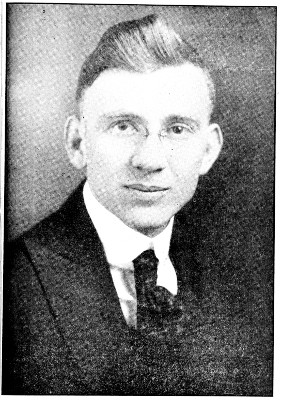
W. M. THOMAS
George J. Jarrett was interviewed and he claimed that Overstreet had been hunting that evening and came in and went to the back porch and had been sitting there for a considerable time when they heard the gun explode and running from the house to the place where Overstreet had been sitting found him with his head blown off. The children were all trained to tell the same story. Our investigation from time to time showed that a wilful murder had been committed either by George Jarrett or his son, Hamilton Jarrett.
On Sunday following the murder we issued warrants and arrested George Jarrett, the father and Hamilton Jarrett, the son, and brought them before G. D. Acree, Justice of the Peace, where we questioned them in reference to the murder. After two hours sweating Hamilton Jarrett told the story, as follows:
“Father and B. Overstreet have been having trouble for weeks, father having ordered him away on several occasions. This evening he came back, and father asked him if he was not going to leave. Father had taken a shot gun from the rack and going out the back way walked to where Overstreet was and said: ‘B, are you going to leave here as I told you? If you do not go I am going to shoot you.’ Overstreet replied: ‘Shoot, damn you,’ and the shot was fired and when I went out B. Overstreet had his head blown off by the gun father had taken from the rack. Father told us what story to tell and we all stuck to it. I had nothing to do with the murder and father did it all.”
This same statement was also corroborated by Jarrett’s former wife and daughter, Jarrett claiming that they had been scared into telling falsehoods on him and denying that he was guilty of the murder. George Jarrett and Hamilton were confined in the county jail for some time, after which they gave bond. George Jarrett was later indicted for the murder of Overstreet by a Kanawha County Grand Jury. The evidence was insufficient to convict on the ground that the evidence was not voluntary and that the family would change their statements, saying that they were scared into telling this story by threats of being punished themselves for the murder. This, however, was not true as to threats. In making the investigation the only evidence obtainable was that of the Jarrett family and under these circumstances the prosecution was blocked.
This case is cited to show suicide is some times murder. Make an investigation in all cases of this nature.
Mat Jarrell—Holly Griffith No. 2.
In the fall of 1915, Kanawha and Raleigh counties, West Virginia, were terrorized by a young outlaw named Mat Jarrell, who was a coal miner by occupation, and while working in the mines a slate fall crippled him so severely that it was necessary to amputate one of his legs.
For years he wore a peg leg and later on a cork leg. After this accident he would do outside work in the coal fields, such as hostler and other light work. Jarrell had been reared by poor parents and had learned from childhood to use mountain dew, commonly called moonshine. While under the influence of liquor, Jarrell had committed a number of assaults and other depredations, being feared by most everyone in the community.
Jarrell, during one of his drunken sprees, killed one of his fellowmen on Cabin Creek and was given a long sentence in the penitentiary. After serving a short term he was paroled and on the day he left prison, he made the following remark to the Warden: “Prepare the death cell for me for I am coming back.” After enjoying a few months of freedom on parole, Jarrell violated the conditions under which he was released and re-commitment papers were issued by the Governor and placed in the hands of the Sheriff of Kanawha County for execution. Before the sheriff could apprehend Jarrell and place him under arrest, a man by the name of Albert Webb, who had served terms in the penitentiary for both murder and counterfeiting, engaged in a free-for-all fight with Jarrell and during the fray, shot Jarrell five times, but not before Jarrell had slashed Webb and his brother severely with a knife. Jarrell was taken to the Sheltering Arms Hospital at Hansford where five weeks later he recovered.
After leaving the hospital and on his way to see his aged mother, Jarrell again became intoxicated in a little town called Oakley on Cabin Creek, where he engaged in a discussion with Henry Ratliff and threatened to do Ratliff bodily harm, displaying two large revolvers. Ratliff seized a shot gun and Jarrell killed him instantly before he had an opportunity to use the weapon. During this shooting scrape Jarrell shot a young lady by the name of Belle Adams, who recovered.
After this occurrence Jarrell brandished his two guns in true western style and swung to the pilot of a locomotive and made his escape, getting off at Cane Fork on Cabin Creek, where he was joined by his brother and another confederate, who at this time had secured arms and ammunition.
Before they left Cane Fork, Jarrell was approached by Frank Nantz, a special officer, who had learned of Jarrell’s escapades. The meeting took place in Risk’s store. The trio opened fire on the officer, sending three shots through his body. Nantz died in a few hours.
Rome Mitchell, Constable of Cabin Creek District at that time, and E. E. Bragg, a Deputy Sheriff, organized a posse of ten determined men. Mitchell notified Sheriff Bonner Hill at Charleston and he later joined the posse.
After leaving Cane Fork, Jarrell and his pals stole a push car and went to the house of Esau Coon, one mile below the mouth of Seng Creek on Big Coal river. Mitchell and his men tracked Jarrell from the mouth of the creek to the house, the tracks being very plain on account of the cork leg worn by Jarrell. On approaching the house, Mitchell discovered Jarrell at the window and telling his brother to stand by the fence and if anything went wrong to pulverize the window, proceeded towards the house. He was met inside of the fence a short distance from the house by a young man coming from the house who informed him that he would be killed if he entered the house. Mitchell finally gained admission to the home and heard Jarrell up stairs. He called out to him and asked him to surrender, Jarrell answering, saying “Alright, don’t shoot me.” Mitchell told him that he would not be shot if he surrendered peaceably and Jarrell told him that he would surrender to him but no one else. Mitchell proceeded up the steps and on reaching the top of the stairs threw a rifle on Jarrell. Jarrell grabbed a young lady that was in the room with him and shoved her in front of him, saying all the time, “Rome, don’t shoot me.” Two revolvers, a high power rifle and plenty of ammunition was found in the room.
Jarrell was brought to Charleston and confined in the Kanawha County jail without bond. He was finally tried and sentenced to hang for his crimes. While awaiting transportation to the penitentiary his gray haired old mother made a brave fight against odds to have her son’s life saved, but without success, and he paid the supreme penalty for his many crimes. Some years later his mother was buried by the side of her “Darling Boy”, the term she used in addressing him while he was confined in the county jail.
Jarrell, during his life, was one of the most blood-thirsty criminals in the annals of the history of West Virginia, and on several occasions he would draw a pistol from his pocket and compel men, women and children to kneel in the middle of a country road and say their prayers, all the while shooting with his pistol into the ground beside them. While awaiting the date of his death in what is known as the “death cell” in the penitentiary, he weakened, and wrote a letter to Dr. O. L. Aultz, at that time county physician for Kanawha county who had attended Jarrell at the jail. In this letter he implored the doctor to do everything in his power to persuade the Governor to commute his sentence to life imprisonment.