Omelets
Reading edition
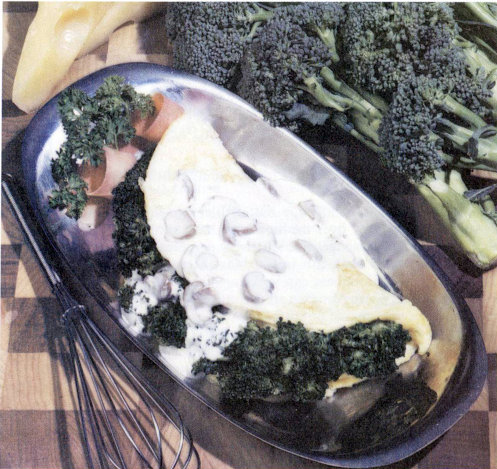
FRENCH OR PLAIN OMELET
1 serving
2 eggs 2 T. water ¼ tsp. salt Dash pepper 1 T. butter
Mix eggs, water, salt and pepper with fork. Heat butter in 8-inch omelet pan or fry pan over medium-high heat until just hot enough to sizzle a drop of water. Pour in egg mixture. Mixture should set at edges at once. With pancake turner turned over, carefully push cooked portions at edges toward center so uncooked portions flow to bottom. Tilt pan as necessary so uncooked eggs can flow. Slide pan rapidly back and forth over heat to keep mixture in motion and sliding freely. While top is still moist and creamy-looking, fill, if desired. With pancake turner fold in half or roll, turning out onto plate with a quick flip of the wrist.
Variations: Omelets can be flavored with a variety of herbs and spices. Mix in ⅛ to ¼ teaspoon per omelet.
Omelets can hold almost any leftover food. For each omelet, fill with ⅓ to ½ cup of any of the following:
Shredded or sliced Cheddar, Swiss Mozzarella, Gouda, Provolone, or other firm cheese Cottage, ricotta or cream cheese Cooked, drained and crumbled sausage, bacon or ground beef Flaked canned or cooked fish Sauteed sliced mushrooms Sauteed chopped onions or green pepper Drained, cooked, chopped, diced or sliced vegetables Drained, canned or chopped or sliced fresh fruit Chopped nuts Jelly, jam or preserves
Nutritional Quality of Eggs
Eggs are especially rich in high-quality protein, unsaturated fats, iron, phosphorus, trace minerals, vitamins A, E, and K, and all B vitamins, including vitamin B 12. Eggs are second only to fish liver oils as a natural source of vitamin D.
Two eggs are an economical means of adding a lot of nutritive value to the menu. The price per two-egg servings of large eggs ranges from 11 to 16 cents; for medium eggs, from 9½ to 14 cents.
13
PUFFY OMELET
2 servings (Pictured on cover)
Puffy omelets have a long history, dating back to ancient Roman times. Beating the yolks and whites separately results in the “puff.” An ovenproof pan is essential because, after the omelet puffs over a surface unit, it goes into a hot oven for final baking.
4 eggs, separated ¼ C. water ¼ tsp. cream of tartar ¼ tsp. salt 1 T. butter
Beat egg whites with water, salt and cream of tartar at high speed until stiff but not dry, or just until whites no longer slip when bowl is tilted. Beat egg yolks at high speed until thick and lemon-colored, about 5 minutes. Fold yolks into whites.
Heat butter in 10-inch omelet pan or fry pan with ovenproof handle[3] over medium-high heat until just hot enough to sizzle a drop of water. Pour in omelet mixture and gently smooth surface. Reduce heat to medium. Cook slowly until puffy and lightly browned on bottom, about 5 minutes. Lift omelet at edge to judge color. Bake in preheated 350° F. oven 10 to 12 minutes, or until knife inserted halfway between center and outside edge comes out clean.
To serve, loosen omelet edges with spatula. With a sharp knife cut upper surface down center of omelet but DO NOT cut through to bottom of omelet. Fill, if desired. Tip skillet. With pancake turner, fold in half and turn out onto plate with a quick flip of the wrist. Serve immediately.
14