WEALTH.
Reading edition
[From Arthur Selwyn's Note-book.]
Here in The City I ponder, Through its long pathways I wander. These are the spires that were gleaming All through my juvenile dreaming. This is The Something I heard, far away, When, at the close of a tired Summer day, Resting from work on the lap of a lawn, Gazing to whither The Sun-god had gone, Leaving behind him his mantles of gold— This is The Something by which I was told; "Bend your head, dreamer, and listen— Come to my splendors that glisten! Either to triumph they call you, Or to what worst could befall you!" This is The Something that thrilled my desires, When the weird Morning had kindled his fires, And the gray city of clouds in the east Lighted its streets as for pageant or feast, Whisp'ring—my spirit elating— "Come to me, boy, I am waiting! Bring me your muscle and spirit and brain— Here to my glory-strewn, ruin-strewn plain!" Treading the trough of the furrow, Digging where life-rootlets burrow, Blade of the food-harvest swinging, In the barns toiling and singing, Breath of a hay-meadow smelling, Forest-trees loving and felling— Where'er my spirit was turning, Lived that mysterious yearning! When in the old country school-house I conned Legends of life in the broad world beyond— When in the trim hamlet-college I cast Wondering glances at days that were past— Ever I longed for the walls and the streets, And the rich conflict that energy meets!
So I have come: but The City is great Bearing me down like a brute with its weight. So I have come: but The City is cold, And I am lonelier now than of old.
Yet, 'tis the same restless story: Even to fail here were glory! Grand, to be part of this ocean Of matter and mind and emotion! Here flow the streams of endeavor, Cityward trending forever.— Wheat-stalks that tassel the field, Harvests of opulent yield, Grass-blades that fence with each other, Flower-blossoms—sister and brother— Roots that are sturdy and tender, Stalks in your thrift and your splendor, Mind that is fertile and daring, Face that true beauty is wearing— All that is strongest and fleetest, All that are dainty and sweetest. Look to the domes and the glittering spires, Waiting for you with majestic desires! List to The City's gaunt, thunderous roar, Calling and calling for you evermore! Long in the fields you may labor and wait— You and your tribe may come early or late; Beauty and excellence dwell and will dwell Oft amid garden and moorland and fell; Long generations may hold them, Centuries oft can enfold them; But the rich City's they some time shall be, Sure as the spring is the food of the sea.
[From Farmer Harrington's Calendar.]
September 20, 18—.
Wind in the south-west; weather wondrous fine; Thermometer 'twixt seventy-eight and nine. Ground rather dry; sun flails us over-warm; It's most time for the equinoctial storm. Family healthy as could be desired; Except we're somewhat mind and body tired At moving over such a lengthy road, And settling down here in our town abode, And wrestling with the pains that filter through one When he gives up an old home for a new one. Old Calendar, you've always stood me true; Now I'll change works, and do the same by you! You're just as good as when, with aching arm, I cleared and worked that eighty-acre farm! And every night, in those hard, dear old days, 'Twas one of my most unconditional ways, When to my labors I had said Good-night, And recompensed my home-made appetite, And talked with Wife, and traded family views, And gathered all the latest township news, And dealt my sons a sly fraternal hit, And flirted with my daughters just a bit, And through the papers tried my way to see, So the world shouldn't slip out from under me, As I was saying—in those sweet old days, 'Twas one of my most unconditional ways, To go to you, old book, before I'd sleep, And hand you over all the day to keep. I gave you up what weather I could find, Likewise the different phases of my mind; What my hard hands from morn to night had done, And what my mind had been subsisting on; What accidents had touched my brain with doubt, And what successes it had whittled out; How well I had been able to control The weather fluctuations of my soul; What progress or what failures I had made In spying round and stealing Nature's trade; The seeds of actions planted long ago, And whether they had blossomed out or no; And oft, from what you of the past could tell, I've learned to steer my future pretty well. And now I'm rich (who ever thought 'twould be!) I'll stand by you, as you have stood by me; And now I'm "City people"—having moved (My circumstances suddenly improved) Into this town, with some quick-gotten pelf, To educate my children and myself, And give my wife, who has a pedigree, A chance to flutter round her family tree, And show her natural city airs and graces (Which didn't "take" quite so well in country places) Now we are here, old fellow, while we stay I'll give you all the news from day to day. I'll find the good that in this city lurks, By regular, systematic, hard days' works; I'll rummage fearless round amongst the harm, As when I hoed up thistles on my farm; Shake hands with Virtue, help Sin while I spurn it, And if there's anything to learn, I'll learn it. How little I suspected, by the way— Scrambling for pennies in that patch of clay, The bare expenses of our lives to meet— That waves of wealth were washing at my feet! And when my hard and rather lazy soil Sprung a leak upward with petroleum-oil— When, through the wonder in my glad old eyes, I saw tall derricks by the hundred rise, Flinging wealth at me with unceasing hand, And turning to a mine my hard old land, Until it seemed as if the spell would hold Till every blade of grass was turned to gold— I felt, as never yet had come to me, How little round the curves of life we see; Or, in our rushings on, suspect or view What sort of stations we are coming to! It brought a similar twinge—though not so bad— As once, when losing every cent I had. But still it could not shift my general views; My mind didn't faint at one good piece of news. I think I'd too much ballast 'neath my sail To be capsized by one good prosperous gale (Same as I didn't lie down and give up all That other time, when tipped up by a squall). I didn't go spreeing for my money's sake, Or with my business matters lie awake; 'Twould never do, as I informed my wife, To let a little money spoil our life! And now I'm rich (who ever thought 'twould be!) I'll look about, and see what I can see; Appoint myself a visiting committee, With power to act in all parts of the city; Growl when I must, commend whene'er I can, And lose no chance to help my fellow-man. For he who joy on others' paths has thrown, Will find there's some left over for his own; And he who leads his brother toward the sky, Will in the journey bring himself more nigh. And what I see and think, in my own way, I'll tell to you, Old Calendar, each day; And if I choose to do the same in rhyme, What jury would convict me of a crime? For every one, from palaces to attics, Has caught, some time or other, The Rhythmatics.
[From Arthur Selwyn's Note-book.]
Still through The City I ponder, Still do I wonder and wander. City—unconscious descendant Of olden-time cities resplendent! Child of rich forefathers hoary, Clad in their gloom and their glory!— Dream I of you in the rich, mellow past, Throbbing with life, and with Death overcast. Thebes—not to you, crushed and ghastly and dumb, Even the wreck-loving Ivy will come! Where stood your hundred broad, world-famous gates, Now a black Arab for charity waits. Not like this City—metropolis bold— Where the whole world brings its goods and its gold! Babylon—here the queen's gardens climbed high, Painting their flowers on the blue of the sky:
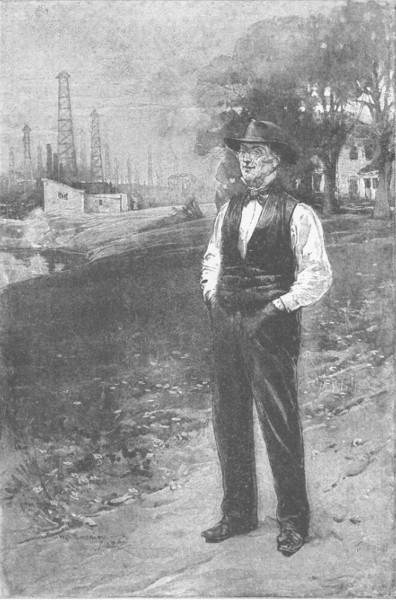
"I SAW TALL DERRICKS BY THE HUNDRED RISE."
This is where sinners, one asinine hour, Thought they could travel to Heaven by tower. (How like some sinners to-day, whose desires Mount by the way of their greed-builded spires!) Troy—of rare riches and valor possessed, Ruined fore'er by one beautiful guest— (Here many Helens, though less of renown, Do for some men what she did for a town!) Wondrous Palmyra, whose island of green, 'Mid the bleak sand, reared the beautiful queen (Sweet-faced Zenobia, peerless Proud in her virtue, and fearless) In this metropolis, virtuously grand, Many a queen is a joy to the land! Tyre—the huge pillars that groaned under thee, Rest in the depths of a desolate sea; Long may it be ere the spray's salted showers Foam o'er the walls of this city of ours! Mound-men's vast cities, whose graves we accost, Even your names are in ruins—and lost. What if, some time when this nation is nought, Vainly our names in our graves should be sought!
Cities that yet are to flourish, That the rich Future must nourish! Where will you take up your stations— Where set your massive foundations? Where are the slumbering meadows, Dreaming of clouds through their shadows, That by rough wheels rudely shaken, Into new life shall awaken? Harbors that placidly float Nought but the fisherman's boat, Think you of fleets that shall lie Under the blue of your sky; When shall be built on your land Palaces wealthily grand; When in your face from tall spires Gleam the electrical fires? Cities that yet are to be, You are not phantoms to me! You are as certain and sure As that Old Time shall endure.
Stars in the distant, mysterious sky, Flashing and flaming and dancing on high, Each is an earth to its millions, Each has its domes and pavilions. Cities, I see you—by reasoning led— On the great map with blue leaves overhead. Seaport and lakeport and rich inland town, Capital city, and village of brown; Thanking the prairie-food-givers, Strung on the winding star-rivers. Earths that can signal to earths, every one, With the bright torches you stole from the sun, Each on its surface has strown Cities and towns of its own, Fraught with their crimes and their graces, Full of mysterious places. They are no myths unto me— Clearly their outlines I see; Millions of towns I descry Hanging o'er me from the sky.
Still through the paths of the town, Dreaming, I walk up and down. Is it so much of a wonder— Part of this whole, yet asunder, I in this throng, and I only— That I am wretched and lonely? Loneliness—loneliness ever— Leaving me utterly, never! Yes, I am part of this ocean Of matter and mind and emotion; Yet how entirely apart, Severed in mind and in heart!
[From Farmer Harrington's Calendar.]
September 25, 18—.
Wealth—wealth—wealth—wealth! I never had been led, From all I'd thought and dreamed and heard and read, To think so much wealth, in whatever while, Could be raked up into one shining pile! Not long ago, a hundred dollars clear, Big as a hay-stack would to me appear. When first a thousand dollars made me smile, I sympathized with Crœsus quite a while; But looking round here makes me feel the same As if I hadn't a nickel to my name! Wealth—wealth! why, every acre I behold Has cost a mine of Californi' gold! The very ground one building here might fill Would almost buy the town of Tompkins Hill! There isn't a house my scrutiny has crossed But catches several figures in its cost; And when your eyes into the parlor go ('Mongst things they leave the curtains up to show), And see the carpets, rugs, and draperies rich, That twine ten dollars into every stitch, And view great pictures that such prices hold As if the painter's brush were dipped in gold; And when along the roads great buggies glide, With covers on, and rich-dressed folks inside, And up on top a man to drive the team— As fat as any cat brought up on cream (Man and team both), the driver dressed as gay As if he meant to marry that same day, Or wed his boss's daughter that same night (Which some consider as the coachman's right, And think it's understood, when he engages, A daughter should be thrown in with his wages), When even the horses, as so many do, Wear jewelry that cost a farm or two, You wonder in what tree-top grew the cash To buy so much reality and trash! Wealth—wealth—wealth—wealth! the very corner stores Are gold-mines from the ceilings to the floors! The shop we thought would ruin Cousin Phil, Because 'twas over-large for Tompkins Hill, Would, in the small vest-pocket, lose its way, Of one man's place I wandered through to-day! And then the banks—a hundred on one street— As full of money as an egg of meat (Although one never knows beyond a doubt What colored chickens they'll be hatching out); And then the churches—elegant to view— An independent fortune in each pew. One window-pane in one big church that's here Cost more than our old preacher made per year! (A city pastor's salary, I declare, Would keep him all his life, with cash to spare, A-preaching in that little house of wood, Holding his hearers' eyes in all he could, With rolling meadows and green trees in view, And fresh-complexioned streamlets wandering through); And then the rich school-houses in this town, Where children can be taught up-stairs and down, Swifter (if not so thorough), I suppose, Than in the small log school-house, where I rose From Numeration to the Rule of Three, And had Irregular Verbs whipped into me; And then the railroad stations, where, each day, Fortunes on wheels rush in and drive away; And then the steamboats paddling up and down— Towns swimming on their way from town to town; And then the ladies, in both street and store, Done up in silks and satins, spangled o'er As if it had rained diamonds for an hour, And they had gone and stood out in the shower; And then the rich and idle-houred young men— The rising generation's "Upper 10" (With the "1" left off), who each day, no doubt, Spend twice as much as all my "setting out," When Father said, "The family craft is full; Launch your own craft and show us how to pull." I often think, when past a dandy glides, Throwing his (father's) money on all sides, And peeking under each young lady's veil, As if he'd bought her at a mortgage sale, How shrewd it was of him, right on the start, To have a father who was rich and smart! (Folks often pride themselves much, by-the-way, Because their parents greater were than they.) Walking to-day along Fifth Avenue, A slip of paper on the sidewalk flew Before my eyes—some one the same had dropped; I reached my hand down for it and it stopped. I picked it up—the reading on't was queer; I think, perhaps, I'll paste it right in here.
THE LOVELY YOUNG MAN.
Oh the elements varied—the exquisite plan— That are used in constructing the lovely young man! His face he has easily made to possess The expression of nothing within to express; His hair is oiled glossily back of his ears, Atop of his head an equator appears; His scanty mustache has symmetrical bends, Is groomed with precision, and waxed at both ends; His darling complexion, bewitching to see, Is powdered the same as a lady's might be. And this is the dear whom the newspapers rude Have scornfully treated, and christened the——. The mental equipment I'll tell, if I can, That Nature has given the lovely young man: A set of emotions consistently weak, To go with a creature so gentle and meek; A will no opposing can break or surmount (Concerning all matters of no great account); A reasoning wheel, quite correctly revolved (When used on small questions already resolved); A taste for each gaudy and glistening thing That grows on the vision and dies on the wing. Elaborate methods and principles crude Encompass the mental estate of the——. The outer habiliments hastily scan, Employed in adorning the lovely young man! His feet two triangular cases have sought, By which his five toes to a focus are brought;
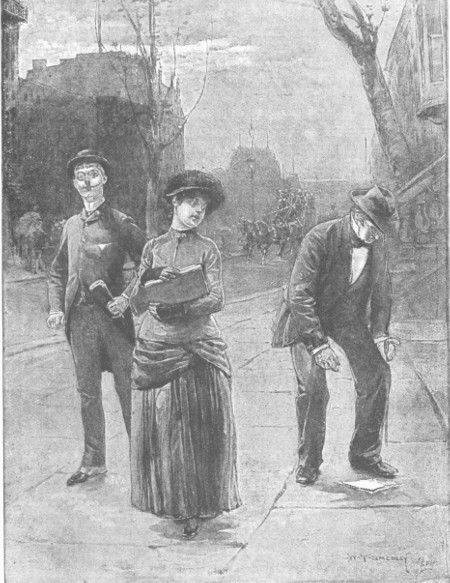
"I REACHED MY HAND DOWN FOR IT AND IT STOPPED."
The sheathes that enfold his propellers within Are on the most intimate terms with his skin; His starch-tortured collar on tip-toe appears, Desirous of learning the length of his ears; And fifteen-sixteenths of his brain, very nigh, Has run all to blossom and stopped in his tie. Such some of the splendors mad Fashion has strewed All over the surface comprising the——. Oh measure the brief philological span Of the high-pressure words of the lovely young man!— "B' Jauve! you daun't sayh saw! youah playing it low! Aw, auyn't she a daisy! I knaw her, y' knaw. She's thweet on me, somehow, though why I dawn't say, It cawn't be my beauty, it must be my way! Did you notith, laust night, Chawley Johnson's neck-tie? It paralyzed me, and I thought I should d-i-e! He's quite a sound fellaw to talk to awhile; It's weally a pity he isn't our style!" And thus talks forever, with slight interlude, The creature that lately was christened a——. Oh boys! there are several hundreds of ways To make yourselves small to the average gaze; Of which some will cost you considerably less, Accomplishing nearly an equal success. Go purchase a gilded hand-organ some day, And stand on the corner and solemnly play; Envelop yourselves in the skin of an ape, Assuming his methods as well, as his shape; Submit to refined zoological charms, And carry a lap-dog about in your arms; But don't let Destruction upon you intrude. So far as to make you down into a——.
I think I saw, a minute's half or less, The young girl who composed this spiteful mess; She watched me pick it up, made a half rush Toward me, and then retreated with a blush. I called, before she vanished from my vision, "My dear, I think you've lost your composition!" But she dodged off, as if she seemed to doubt it, And, I suppose, went on to school without it.
Pacing the question over, far and near, I think the little maid was too severe. Sweet Charity can roof much sin, they tell, Why shouldn't it shelter foolishness as well? When we draw rein and look about a minute, We see no field but God is somewhere in it; He made the eagle and the lion, I've heard; Why not the monkey and the chipping-bird?
[From Arthur Selwyn's Note-book.]
Pavement and window and wall What is the cost of you all? Parlor and boudoir and stair, Crowded with furniture rare; Gems from the mountains and seas, Spires that out-measure the trees; Chamber and palace and hall— What is the price of you all? [Voices.] What did we cost? Bend ear; What did we cost? Now hear. Several millions men, There in the field and fen. Look! they are stripped and grim, Sturdy of voice and limb. Painfully, now, they toil Into the sullen soil; Stabbing the hills and meads, Planting the silent seeds. Into each streaming face Glides the hot sun apace. You in the thoughtful guise, You with the dreamy eyes— "Why do you labor so? Where do your earnings go?— "A goodly part to the rulers that form the powers that be; A modest part, if lucky, for my family and for me; And all the rest for the splendors that fringe the river and sea." [Voices.] What did we cost? Bend ear; What did we cost? Now hear. Listen! the factory wall Sends out its morning call. Hear the machinery's din; Look at the folks within. Child with a poor, pale face; Woman with hurried grace; Man with the look half wise; Girl with the handsome eyes. How the long spindles whirl! How the rich webs unfurl! Maid with the orbs that quiver With light from "Over the River,"[1] Why are you toiling so? Where do your wages go?— "A goodly part to the owners, whoever they may be; A little part to the living of those I love and me; And all the rest to the cities that gem the river and sea."
[1] As is well known, the weird, inimitable poem, "Over the River," was written by a factory girl.
[Voices.] What do we cost? Now hear; Hearken, with eye and ear. Several thousand men, There in the hill and glen; Forward, march! Take aim! Fire! now a storm of flame! Shriek and curse and shout; Death-beds lying about. Man with the kingly face, There in that gory place Bleeding and writhing so (Well a moment ago), Tell me, in mangled tones— Tell us, amid your groans, What do they buy with war? What were you fighting for?— "For country and for glory, and for the powers that be; To deck with pride and honor the family dear to me; And to defend our cities that gem the river and sea." [Voices.] What do we cost? Bend ear: No; you will never hear.
[From Farmer Harrington's Calendar.]
November 1, 18—.
Wind north-east; weather getting cross and cool; Wife and the children gone to Sunday-school. And I—not very well—am home again, Holding a conversation with my pen. And all that I can make it say to me Is Wealth, wealth, wealth! how much I hear and see! Strange, how, on human brains, sixteen times o'er, Is stamped and carved the magic word of More! Some several thousands to my credit lie In a small bank on Wall Street, handy by; But I can't help contriving what I'd do If I possessed the whole Sub-Treasury too; Or if I had (to take a modest tone) A million million dollars, all my own! The subject took so strong a growth in me, I overtalked the same, last night, at tea;[2] And so my oldest daughter (who can rhyme, And strikes some notes that with her father's chime) Became with that same foolishness possessed, So much so that it would not let her rest, But hung about her bedside all the night And brought its capabilities in sight. So much so that she threw it into verse As bad as that her father writes—or worse. And then, with some unconscious girlish grace, And blushes chasing all about her face, She, in a way I've learned to understand Quite accident'ly, slipped it in my hand. It was not made in public to appear, But, privately, I'll paste it right in here:
[2] Our dinner is at noon; our supper, six, We have not yet learned all the city tricks.
IF I'D A MILLION MILLIONS.
If I'd a million millions— Just think! a million millions!— What wouldn't I do—what couldn't I do— If I'd a million millions? From every forest's finest tree My many-gabled house should be; With silver threads from golden looms Should be attired my palace-rooms; My blossomed table have the best Of all the East and all the West; My bed should be a daintier thing Than ever sheltered queen or king; What wouldn't I do, What couldn't I do, If I'd a million millions? If I'd a million millions— A good, square million millions— With gratefulness my friends should bless Me and my million millions! None that had e'er befriended me But he a millionaire should be; Who kindly words of me had told, Should find their silver turned to gold; And he who did but just advance The sunbeam of a friendly glance In my affliction's cloudy day Should have rich, unexpected pay. What wouldn't I do, What couldn't I do, If I'd a million millions? If I'd a million millions— Just think! a million millions!— How many coals on hostile souls I'd heap with all my millions! No enemy that earned my hate Should for a fiery guerdon wait; With roses sweet I'd twine him o'er Until the thorns should prick him sore (How much of credit may be claimed For sweetly making foes ashamed I do not know; it may depend On how much true love we extend); But love outpoured I could afford, If I'd a million millions! An honest million millions— Just think! a million millions! The poor should bless the strange success That gave me all those millions! I'd slaughter every hungry wight Within the circle of my sight, And resurrect him with such food As should go far to make him good; No poor-house but must bow its head And gaze at cottage walls instead; And hungry paupers soon should see A year of genuine jubilee. Nought should alloy Their perfect joy, That could be saved by millions! Just think! a million millions!— The care of all those millions! And after all, what would befall A life with all those millions? Would not the lucre clog my brain, And make me hard and cold and vain? Might not my treasure win my heart, And make me loath with it to part? How could I tell, by mortal sign, Betwixt my money's friends and mine? And then, the greed, and strife, and curse, The world brings round a princely purse: Perhaps my soul, Upon the whole, Is best, without the millions!
[From Arthur Selwyn's Note-book.]
Now comes the Christmas-tide: Love wakes on every side; Mirth smiles from every eye; Wreaths greet the passer-by. Who, full of haughty pride, Loves not the Christmas-tide? He who, with av'rice low, Cares not to joy bestow. God save the wretch denied Love for the Christmas-tide! God tell his hardened heart Pure joy must joy impart! Who, close to grief allied, Grieves 'mid the Christmas-tide? She who, at Sorrow's call, Now mourns the loss of all. God save the dear bereft— Teach her the mercies left! Show her that clouds may yet Lift, ere her sun be set!
Who lonely must abide All through the Christmas-tide? He who has never known Love-passion of his own. So follows he his fate, Friendly but desolate; So—sad—his heart must hide All through the Christmas-tide!
[From Farmer Harrington's Calendar.]
December 25, 18—.
Wind in the north-east; snow in wagon-loads; Good sleighing everywhere on all the roads. Family healthy, sensible, and pleasant, And each one got the proper Christmas-present. (At least it seems so, for they all act suited, And Santa Claus's taste hasn't been disputed.) Our family room is filled with tasty mixings Of evergreens and other woman-fixings; The open grate makes things look rich and mellow, With good hard coals the fire has painted yellow;[3] Pictures peep from the walls, with thought all through them, That set me studying every time I view them; There's certain books upon the centre-table That say what I'd have said if I'd been able; And, measuring up this room with honest style, 'Tisn't a bad place to be in for a while. And so I sit here, thinking, musing, dreaming, About the world and all its curious scheming, And, full of certainty-begotten doubt, Wondering what this life is all about (From all that I can learn I'm not to blame, For wiser men have often done the same). We went a mile or two, last night, to see The decorations on a Christmas-tree; I spied, hung on that sapling's gilded arms, Things that would buy a couple good sized farms; And just upon our way home, I should guess We met some fifty people, more or less, Who needed, to make passable their days, A decent share of what those farms would raise. But here's the question: should those ill-to-do Deprive rich people of their comforts too? Because there are some people lack for bread, Must others' minds and fancies go unfed? It's quite a puzzle, which I don't know whether My clumsy mind knows how to put together; But one thing's sure: wants satisfied wants breed— The more folks get, the more they seem to need. Then, one man lives on what would starve another, And what is joy for you might kill your brother.
[3] Although to me it doesn't contain the charm Of our old, wide log fire-place on the farm.
January 5, 18—.
Went to a skating-rink a little while, To see them slide in the new-fangled style; And, strange enough, this eve a letter came From a friend—Abdiel Stebbins is his name— A cousin of my aunt, Sophia Dean; A wise old man, but clumsy like, and green. He's on a visit in a neighboring city, And he has been a-skating—more's the pity! He tells it in a manner quite sincere; I think perhaps I'll paste it right in here:
[FARMER STEBBINS ON ROLLERS.]
Rochester, January 4.
Dear Cousin John:
We got here safe—my worthy wife an' me— An' put up at James Sunnyhopes'—a pleasant place to be; An' Isabel, his oldest girl, is home from school just now, An' pets me with her manners all her young man will allow; An' his good wife has monstrous sweet an' culinary ways: It is a summery place to pass a few cold winter days. Besides, I've various cast-iron friends in different parts o' town, That's always glad to have me call whenever I come down; But t'other day, when 'mongst the same I undertook to roam, I could not find a single one that seemed to be to home! An' when I asked their whereabouts, the answer was, "I think, If you're a-goin' down that way, you'll find 'em at the Rink." I asked what night the Lyceum folks would hold their next debate— (I've sometimes gone an' helped 'em wield the cares of Church an' State), An' if protracted meetin's now was holdin' anywhere (I like to get my soul fed up with fresh celestial fare); Or when the next church social was; they'd give a knowin' wink, An' say, "I b'lieve there's nothin' now transpirin' but the Rink." "What is this 'Rink?'" I innocent inquired, that night at tea. "Oh, you must go," said Isabel, "this very night with me! And Mrs. Stebbins she must go, an' skate there with us, too!" My wife replied, "My dear, just please inform me when I do. But you two go." An' so we went, an' saw a circus there, With which few sights I've ever struck will anyways compare. It seems a good-sized meetin'-house had given up its pews (The church an' pastor had resigned, from spiritual blues), An' several acres of the floor was made a skatin' ground, Where folks of every shape an' size went skippin' round an' round; An' in the midst a big brass band was helpin' on the fun, An' everything was gay as sixteen weddin's joined in one. I've seen small insects crazy-like go circlin' through the air, An' wondered if they thought some time they'd maybe get somewhere; I've seen a million river-bugs go scootin' round an' round, An' wondered what 'twas all about, or what they'd lost or found; But men an' women, boys an' girls, upon a hard-wood floor, All whirlin' round like folks possessed, I never saw before. An' then it straight came back to me, the things I'd read an' heard About the rinks, an' how their ways was wicked an' absurd; I'd learned somewhere that skatin' wasn't a healthy thing to do— But there was Doctor Saddlebags—his fam'ly with him, too! I'd heard that 'twasn't a proper place for Christian folks to seek— Old Deacon Perseverance Jinks flew past me like a streak! Then Sister Is'bel Sunnyhopes put on a pair o' skates, An' started off as if she'd run through several different States. My goodness! how that gal showed up! I never did opine That she could twist herself to look so charmin' an' so fine; And then a fellow that she knew took hold o' hands with her, A sort o' double crossways like, an' helped her, as it were. I used to skate; an' 'twas a sport of which I once was fond. Why, I could write my autograph on Tompkins' saw-mill pond. Of course to slip on runners, that is one thing, one may say, An' movin' round on casters is a somewhat different way; But when the fun that fellow had came flashin' to my eye, I says, "I'm young again; by George, I'll skate once more or die!" A little boy a pair o' skates to fit my boots soon found— He had to put 'em on for me (I weigh three hundred pound); An' then I straightened up an' says, "Look here, you younger chaps, You think you're runnin' some'at past us older heads, perhaps. If this young lady here to me will trust awhile her fate, I'll go around a dozen times an' show you how to skate." She was a niceish, plump young gal, I'd noticed quite a while, An' she reached out her hands with 'most too daughterly a smile; But off we pushed with might an' main; when all to once the wheels Departed suddenly above, an' took along my heels; My head assailed the floor as if 'twas tryin' to get through, An' all the stars I ever saw arrived at once in view. 'Twas sing'lar (as not quite unlike a saw-log there I lay) How many of the other folks was goin' that same way; They stumbled over me in one large animated heap, An' formed a pile o' legs an' arms not far from ten foot deep; But after they had all climbed off, in rather fierce surprise, I lay there like a saw-log still—considerin' how to rise. Then, dignified I rose, with hands upon my ample waist, An' then sat down again with large and very painful haste; An' rose again, and started off to find a place to rest, Then on my gentle stomach stood, an' tore my meetin' vest; When Sister Sunnyhopes slid up as trim as trim could be, An' she an' her young fellow took compassionate charge o' me. Then after I'd got off the skates an' flung 'em out o' reach, I rose, while all grew hushed an' still, an' made the followin' speech: "My friends, I've struck a small idea (an' struck it pretty square), Which physic'ly an' morally will some attention bear:
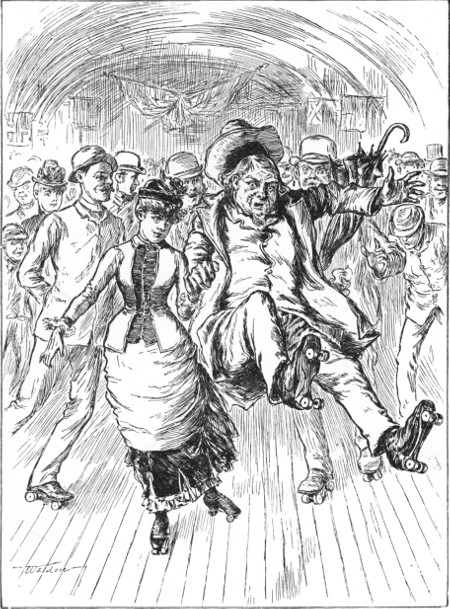
"...WHEN ALL TO ONCE THE WHEELS DEPARTED SUDDENLY ABOVE, AN' TOOK ALONG MY HEELS."
Those who their balance can preserve are safe here any day, An' those who can't, I rather think, had better keep away." Then I limped out with very strong unprecedented pains, An' hired a horse at liberal rates to draw home my remains; An' lay abed three days, while wife laughed at an' nursed me well, An' used up all the arnica two drug-stores had to sell; An' when Miss Is'bel Sunnyhopes said, "Won't you skate some more?" I answered, "Not while I remain on this terrestrial shore."
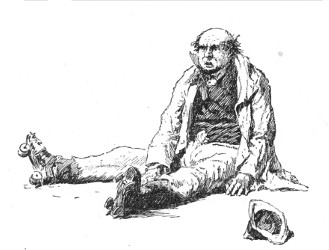
FARMER STEBBINS ON ROLLERS.