TRAVEL.
Reading edition
[From Farmer Harrington's Calendar.]
November 1, 18—.
It's quite the thing to "travel" nowadays (Although I do not think it always pays), And see if distant ground in general looks As mentioned in the papers and in books. I find, in sifting what few facts I know, Three ways of realizing things are so: First, when you're told them in such trusty shape That square belief isn't easy to escape. (There's lots of people—this town wouldn't hold them— Who don't know much excepting what is told them.) Second, what you've put on some mental shelf, By having seen and understood yourself. (How well we know things witnessed, largely lies On how much brain there is behind our eyes.) The third way is the surest and the best (Though sometimes painful, it must be confessed): It's where a truth has whipped the earth with you, Until you feel, from head to foot, 'tis true. I think, sometimes, when all is said and done, Feeling is all the senses joined in one. We're going to travel!—not so very far As our new friends, the Fitzcumnoodles, are, Who cannot read their social title's clear Unless they ride twelve thousand miles a year, (I told them, with a philosophic smile, That travelling shouldn't be measured by the mile.) But we shall take a little trip, to-morrow, With some spare time that wife's contrived to borrow, To where George Washington laid out a town That several centuries won't see tumbled down! A city which, with all the sneaking sinners That come down there to steal their daily dinners, And all the human insects hovering nigh, Such as swarm thick wherever good things lie, And spite of all the bad weeds growing round, Has always some good folks upon the ground, And will be head-piece of the greatest nation That ever helped spruce up the Lord's plantation. The Fitzcumnoodles, through their daughter Maud, Inform us that we ought to go abroad; The Clancdenancies, we have lately learned, From an extended trip have just returned; And so my eldest daughter, Isabel, Who knows Miss Clanc, etc., very well, Called on her in the progress of a walk, And had a pleasant little travel-talk; And after coming home misspent her time In putting what she heard there into rhyme And—lost it—not by accident, I fear; I'll paste the "conversation" right in here:
HER TOUR.
Yes, we've been travelling, my dear, Three months, or such a matter, And it's a blessing to get clear Of all the clash and clatter! Ah! when I look the guide-book through, And see each queer place in there, 'Tis hard to make it seem quite true That I myself have been there! Our voyage? Oh, of course 'twas gay— Delightful! splendid! glorious! We spurned the shore—we sped away— We rode the waves victorious. The first mate's mustache was so grand! The ocean sweet, though stormy (I was so sick I could not stand, But papa saw it for me). At Queenstown we saw land once more— Ground never looked so pretty! We took a steam-car near the shore For some light-sounding city. A very ordinary stone We had to kiss at Blarney; The beggars wouldn't let us alone That half-day at Killarney! The Giants' Causeway? 'Tis arranged With no regard to science; It must somehow of late have changed— At least we saw no giants. Some little funny scrubs of folks Sold pictures, and were merry; The men were full of yarns and jokes, The women barefoot—very. Old Scotland? Yes, all in our power We did there to be thorough; We stopped in Glasgow one whole hour, Then straight to "Edinborough." At Abbotsford we made a stay Of half an hour precisely. (The ruins all along the way Were ruined very nicely.) We "did" a mountain in the rain, And left the others undone, Then took the "Flying Scotchman" train. And came by night to London. Long tunnels somewhere on the line Made sound and darkness deeper; No; English scenery is not fine, Viewed from a Pullman sleeper. Oh, Paris! Paris! Paris! 'tis No wonder, dear, that you go So far into the ecstasies About that Victor Hugo! He paints the city, high and low, With faithful pen and ready (I think, my dear, I ought to know— We drove there two hours steady). Through Switzerland by train. Yes, I Enjoyed it, in a measure; But still the mountains are too high To see with any pleasure. Their tops—they made my neck quite stiff, Just stretching up to view them; And folks are very foolish if They clamber clear up to them! Rome, Venice, Naples, and the Rhine? We did them—do not doubt it; This guide-book here is very fine— 'Twill tell you all about it. We've saved up Asia till next year, If business gets unravelled; What! going? Come again; and, dear, I will not seem so travelled.
Washington, November 3, 18—.
We're travelling, and we're here! and what a town! I own, it picks me up and sets me down! I thought I had some idea of the place, And what its corporation lines embrace; I'd read the county papers every week, Which seldom failed "From Washington" to speak; I'd travelled through these streets by photograph, And, with Imagination for a staff, Had wandered round, in little trips disjointed, Even where the artist's brass gun has not pointed; And so I said, "Though I wouldn't like to miss it, 'Twill be a good deal like a second visit." But 'tisn't an easy perpetrated scheme To prophesy how anything will seem. This city's new to me—I do not doubt it— As if I'd never heard a word about it! There's something in these white-clothed buildings' glare, And something even in the very air, And in the great variety of faces, Bearing the ear-marks of a thousand places, And in that monument that reaches high— The farthest stone has climbed into the sky, And in that dome, whose kingly size and height Contrive, where'er you are, to keep in sight— From these, and several hundred other things This nation's lead-horse city at you flings, You feel as if you'd stepped, through many a mile, Into another planet for a while! But men too weary to hold up their heads Are apt to bless the man[7] who first made beds; Then, having found one, and reclined within it, Forget about him in just half a minute. So I'll let Morpheus (who is at me winking) Do the remainder of this evening's thinking.
[7] Or woman—let due praise to her be paid; A bed is never made until 'tis made.
[From Arthur Selwyn's Note-book.]
AT THE SUMMIT OF THE WASHINGTON MONUMENT.
Look North! A white-clad city fills This valley to its sloping hills; Here gleams the modest house of white, The statesman's longed-for, dizzy height. Beyond, a pledge of love to one Who in two lands was Freedom's son— The holder of an endless debt— Our nation's brother, Lafayette. But yonder lines of costly homes And bristling spires and swelling domes, And far away the spreading farms Where thrift displays substantial charms, And hamlets creeping out of sight, And cities full of wealth and might, Must own the fatherhood of him Whose glory Time can never dim. All who can reckon Freedom's worth Would write across this whole broad earth, With pen dipped in the golden sun, The magic name of Washington! If we can keep the rules he gave This land he more than fought to save, Our future fame will glisten forth Grand as the winter-lighted North!
FROM THE MONUMENT.
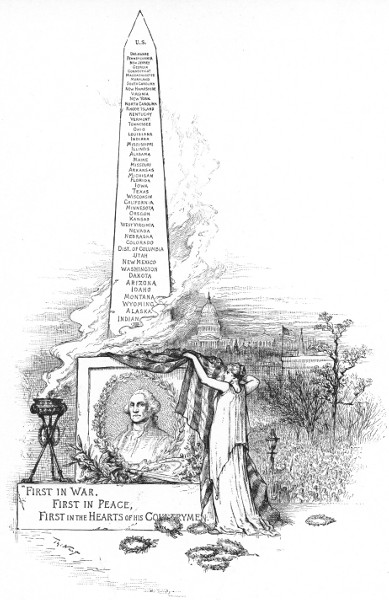
Look South!—where, in its coat of gray, The broad Potomac creeps away, And seeks the blue of distant skies; But pauses where the great chief lies Within his humble, hallowed tomb, Amid Mount Vernon's deathless bloom. As glides this stream, great corse, past thee, First to the bay, and then the sea, So flowed thy life to rural rest, Ere thou wast Heaven's eternal guest. Oh strong, high man! whose patriot heart Climbed from all common greeds apart; To whom men's selfish ways were small, As from this tower, serenely tall (Built that all years thy fame may know), Men look while creeping there below! How weak was power to thy clear gaze, Builder of nations joined in one, Kindler of splendors still to blaze, Finder of glories just begun! Live on, great sleeper! as this stone, Highest from earth that man has known, So shall be ranked thy solid worth, Highest of heroes on the earth! Happy, secure, and cherished name, Love is the pillar of thy fame; Thy praise comes from each patriot's mouth, Warm as the sunbeams of the South!
Look East! The Nation's castle walls Spread out in massive beauty now; Their lofty dome and pictured halls In homage to this summit bow. Oh, well that from these palaced lands The marble spire obeisance win; But for the one for whom it stands, This chieftain-town had never been! Yon plot, so full of brain and will, Had staid a bleak and lonely hill! If at five thousand dizzy feet This shaft the whirling clouds could meet, Until our gaze for miles, might be, To the uncrowned but royal sea, 'Twere not too much of honor then, To grant our crownless king of men. You who the Nation's laws indite, Look to this summit's honest white, Where, throned on walls that must endure, Pure fame entreats you to be pure; Until our glory be increased, Like sunbeams from the dazzling East!
Look West! There lie the hilly fields Where brothers fought through days of dread, Where mothers brooded o'er their dead, And soil the thrift of carnage yields; Where cannon roared and bullets sung, Till every hillock had a tongue. O Nation being and to be, That silent blood speaks loud to thee! God grant, if e'er our guns again Must tear the quivering flesh of men, The leaden hail-storm may be pressed Against some foul invader's breast— Against some alien tribe and zone— And not, as then, to kill our own! May all the fruitful strifes of peace The thrilling bonds of love increase; May yonder orb, in his quick change From mountain range to mountain range, From valley to rich valley o'er, From river shore to river shore, From wave to wave—may yonder sun One Nation count, and only one; Until he dips his fiery crest Into the ocean of the West!
Look up! The phantom clouds of gray— Grim ghosts of storm—have passed away; The veiling of the sky is done, And downward shines the welcome sun. He kindles grand and peaceful fires Upon the city's domes and spires; He sends his strong magnetic glow Through yonder moving throngs below. Thou art, O sky serene and clear, A symbol of our country here! What land in all this world of pain, This earth, where millions toil in vain, Where famine, pestilence, and strife Play careless games with human life, Where Superstition clouds the soul, And heartless brains sad hearts control— What country, framed in frost or flowers, Can see so clear a sky as ours? Peace throws her mantle, broad and free, O'er all who peaceable will be; Plenty her sheltering flag doth wave O'er those who will but toil and save; Enlightenment each day shall rise For all who do not cloud their eyes; While Liberty from every race Has made this land a refuge-place. Let our deep thanks forever fly Far as the reaches of the sky!
[From Farmer Harrington's Note-book.]
November 5, 18—.
Went to Mount Vernon; and I wouldn't have lost That trip, for fifteen hundred times its cost! Those farm-lands sleeping in the autumn sun; The house HE slept in when his work was done; The trees he planted with his own brave hand, That set out Freedom's trees all o'er the land: The humble tomb he lies in, which—like me— Pilgrims from all the world have come to see: These look up in one's eyes and sadly smile, And preach a funeral sermon all the while! Even the river-boats upon their way Toll bells, as if he'd died that very day! And through it all this precept may be traced: The noblest men are simplest in their taste. I've read how grand, Napoleon's tomb is made, And all the surface-honors to him paid; But I don't think the people that come there Bring any heartfelt sympathy to spare; While every true-brained patriot, night and morn, Thanks God for letting Washington be born! While I was standing, hat off, at the tomb, A youth approached, three-quarters made of bloom; And with his hat perched on his close-sheared head, And smoking a small white cigar, he said: "Sirrh, would you kindly just enlighten me As to where Gawge cut down the cherry-tree?" Said I, "Young man, just please at once disgorge The fool-idea of calling that man 'George;' His body, mind, and soul were firmly set Higher, no doubt, than you will ever get. He isn't the man, though lying dead, 'tis true, When friends are near, to be half-named by you. Take off your hat, and bow; if you rebel, I'll get a cherry switch and trounce you well." He looked at me a moment in surprise, And mutiny stood foremost in his eyes; But I was quite indignant, and could feel The blood of Bunker Hill all through me steal. I said, "One minute more will be allowed;" The fine young man took off his hat, and bowed. Irreverence is the fashion, nowadays, And shows itself in good and evil ways; Its mission is legitimate and clear In cases where there's nothing to revere; But they who use it must be judgment-fixed, And not get reverend and unreverend mixed.
[From Arthur Selwyn's Note-book.]
Through these broad streets do I fly— Furlongs and miles I defy, Till the "magnificent distance" Vanishes out of existence. Let me with pencil prolong Strains of the Bicycler's Song:
[THE SILENT WHEEL.]
Good-morning, good Pedestrian—I'm glad to see you out; The day is full of healthfulness, the birds are all about; There is a quiet breeziness in all the pleasant air— I hope this happy exercise will drive away your care. For I am a pedestrian— A very good pedestrian— And all the glowing benefit of walking I can share; Although I tread the atmosphere, and do not touch the ground, I greet you as a brother, sir, wherever you are bound. But my impatient lady-love in yonder town doth wait; I wish you better company, and strike a swifter gait. Good-morning, good Equestrian—a noble steed you ride; I do not seem to frighten him, so here is by your side. It is a feast of happiness to smoothly bound along, With sturdy muscles under you, and footing swift and strong. For I am an equestrian— A very fair equestrian— With bugle blast of melody and unassuming song; And all the thrilling ecstacy of horsemanship I feel, Although the nag I ride upon was bred of burnished steel. But his impatience urges me to swifter gait than you, And so I wish you pleasure, sir, and bid a kind adieu. Good-morning, Mr. Racer, you've a trotter that is fine; I never would disparage him, or say too much of mine; Your horse is full of mettle, sir, and bravely draws his load; It must be pure deliciousness to speed him on the road. But I am quite a racing man— A modest, humble racing man— Though small is my solicitude upon the turf bestowed; And if you have anxiety to try a little race, I'll undertake, with courtesy, to give you second place; But if the first you take from me, and it be fairly earned, I'll hope that on some future day the tables may be turned. Good-morning, Mr. Carriageer, you have an easy ride; Those cushions are luxurious, and pleasantly you glide! 'Tis very good and fortunate, if one be tired or ill, To calmly call his carriage out, and travel as he will. But I, sir, keep my carriage, too— A very pleasant carriage, too— Though it is not the easy one that your desire would fill; It carries me in comfort over many a pleasant mile, And all my best acquaintances are suited with its style. 'Tis with a blithe economy establishments are run, With driver, footman, passenger, and horses—all in one! Good-morning, fellow Wheelmen; here's a warm, fraternal hand, As with a rush of victory we sweep across the land! If some may be dissatisfied to view the way we ride, We only wish their majesties could wander by our side! For we are good philanthropists— Unqualified philanthropists— And would not have our happiness to any one denied. We claim a great utility that daily must increase; We claim for inactivity a bright and grand release; A constant mental, physical, and moral help we feel, Which makes us turn enthusiasts, and bless the silent wheel!
[From Farmer Harrington's Calendar.]
November 20, 18—.
It's quite a show, and strikes me a good deal— How many ride around here on a wheel; The streets are graded very smooth and nice, And make this town the wheelman's paradise. A brother-farmer—neighbor, once, to me— Who's down here, like myself, to hear and see, Told me, last night, before we "doused the glim," How a young wheel-chap got the start of him. 'Twould skip my memory, maybe, if I'd let it; I'll put it down here so I sha'n't forget it.
[FARMER AND WHEEL; OR, THE NEW LOCHINVAR.]
I.
I was hoein' in my corn-field, on a spring day, just at noon, An' a hearkin' in my stomach for the dinner-trumpet's tune, An' reflectin', when my daughter should be married, 'twould be best She should take Josiah Baker's son, who jines me on the west, An' consolidate our acres into one immense abode, When my hired man says, "By ginger, look a-yender down the road!" "Well," I says, "my goodness gracious! things is rather overgrown, When a buggy-wheel gets loosened, an' goes runnin' 'round alone." But my man he says, "By mustard!" (as the critter nearer came) "Don't you see that there's a feller on a-straddle of the same?" An' it was as nice a shaver as you'd see 'most any day, Who was travellin' through the country in that unexpected way. He was rather young an' han'some, an' as smilin' as you please, An' his pants they signed a contract with his stockin's at the knees; An' he had a pair o' treadles some'at underneath his seat, So's to run the queer contraption, by a-workin' of his feet; An' the sun descended on it, in a manner warm an' bright; 'Twas as sing'lar as a circus, an' an interestin' sight. When, as fate was bound to have it, on that quite partic'lar morn, There was somethin' was the matter with my folks's dinner-horn; Ah! the hired girl, when she tried to, couldn't blow it very well, For to call us in to dinner—so she sent my daughter Belle: Who came up just at that minute—nice a girl as could be found: An' this fellow looked her over, an' came smashin' to the ground. Smash to bang he came a-floppin'—wheel an' stockin's, pants an' all; An' I run to him, remarking "You have caught a dreadful fall." An' my daughter hovered round him, tremblin' with her she alarms, Lookin' just as if she would like to some'at take him in her arms; But he glanced up, faintly smilin', an' he gaspin'ly replied, "I am only hurt intern'lly" (which I s'pose he meant inside). An' we packed him on the stone-boat, an' then drove him to the house An' he lay there on the sofa, still an' quiet as a mouse; An' he would not have a doctor; but he called my daughter Belle, An' then laughed an' chatted with her, like a person gettin' well; An' along late in the evenin', I suppose, he went away; For he wasn't there next mornin', an' Belle hadn't a word to say. An' he left two silver dollars in an easy-noticed spot, For to pay us for his passage on the stone-boat, like as not; An' 'twas quite enough equivalent for his transitory stay; But whate'er he might have left us, still he carried more away; For my daughter Belle grew absent, glanced at every sound she heard, And Josiah Baker junior couldn't get a civil word.
II.
I was workin' in my meadow, on a blazin' summer's day, When my son-in-law by contract came a-runnin' 'cross the way, An' remarked, "It's been the bargain—for how long I needn't tell— That these two farms should be married—as should also me an' Belle; An' how much the indications indicate that that'll be, If you'll come down here a minute, you will have a chance to see."
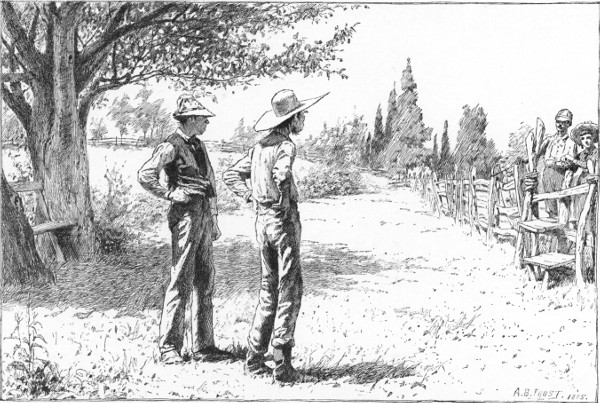
"AND HE STOOD THERE, LIKE A COLONEL, WITH HER TREMBLING ON HIS ARM."
An' he led me 'cross the fallow, underneath some picnic trees, Where my gal an' that wheel fellow sat as cosy as you please; An' she'd put some flowers an' ribbons on the wheel, to make a show, An' they'd been a-shakin' hands there, an' forgotten to let go; An' she sort o' made a chair-back of the fellow's other arm, With no 'parent recollection of Josiah Baker's farm. Then we walked around front of 'em, an' I says, "Your very fine; But this gal that you are courtin' is Josiah's gal an' mine; You're a mighty breechy critter, an' are trespassin' all round; Why, this very grove you sit in is Josiah's father's ground." Then he rose up, stiff an' civil, an' helped Belle across the stile, Also put the masheen over, with a queer but quiet smile; An' he stood there, like a colonel, with her tremblin' on his arm, An' remarked, "I beg your pardon, if I've done you any harm. But so far as 'trespass' matters, I've relieved you of that load, Since the place I now am standing is, I think, the public road. And this very sweet young lady, you in one sense yours may call, But she's mine, sir, in another—and Josiah's not at all. "I'll escort this lady home, sir, leave my wheel here in your care, And come back in fifteen minutes to arrange the whole affair. And please do not touch the 'cycle'—'tis as yet without a flaw, And I do not want a quarrel with my future father-in-law; If this Mr. Baker junior follows up his glances, though, With his fingers, I will thrash him till he thinks his cake is dough." Then he left us both suspectin' that he'd rather got the start, An' the acres of the daddies seemed increasin'ly apart; An' we didn't wait to see him; but, with one impatient jerk, We shook our heads in concert, an' went back unto our work; An' I couldn't help reflectin'—"He is steady like, an' cool, An' that wheel may be a folly, but it didn't bring a fool."
III.
I was on my stoop a-restin', on a hazy autumn day, Rather drowsy from a dinner that had just been stowed away, And regrettin'—when old Baker's an' my homestead jined in one. That he wasn't to furnish daughter, an' I wasn't to furnish son, So's to have my name continued, 'stead of letting it go down, When Josiah Baker junior came a drivin' home from town. An' a little ways behind him came that wheel scamp, ridin' hard, An' they both to once alighted, an' come walkin' through the yard; When, as fate was bound to have it, also came my daughter Belle, From a visit in some neighbor's, lookin' very sweet an' well; An' they stood there all together—that 'ere strange, dissimilar three, An' remained in one position—lookin' steady down at me. Then Josiah spoke up loudly, in a kind o' sudden pet, "If this gal an' I's to marry, it is time the day was set; For that one-wheel feller's always 'round here courtin', on the fly, An' they say she rides out with him, in the night-time, on the sly. Father'll give us board an' victuals, you can give her land an' dower, Wherefore, if she wants to have me, please to set the day an' hour." Then the wheel scamp spoke up quiet, but as if the words he meant, "I would like to wed your daughter, an' have come for your consent. She is very dear to me, sir, when we walk or when we ride, And, I think, is not unwilling to become my cherished bride. I can give her love and honor, and I ask of you no dower; Wherefore, please bestow your blessing; we have set the day and hour." Then I might have told my daughter that she now could have the floor, An' remarked that on this question there should be just one speech more; But I rendered my decision in a flame of righteous rage, An' I shouted, "You'd no business for to court or to engage! This 'ere gal has long been spoke for; an' you'll please to clamber on Your old hind-wheel of a buggy, an' forevermore be gone!" Then he picked up Belle quite sudden, an' made swiftly for the gate, An' I formed a move to stop 'em, but was most perplexin' late; He had fixed a small side-saddle on his everlastin' wheel, So that she could ride behind him (clingin' 'round him a good deal); An' straight down the Beebe turnpike, like a pair o' birds they flew Towards a preacher's who had married almost every one he knew.
CHASING THE BICYCLE.
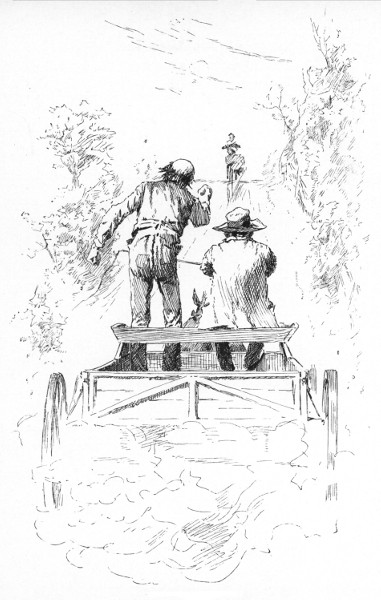
"Stop 'em! head 'em! chase 'em! catch 'em!" I commanded, very vexed; "They'll be hustlin' off our daughters on a streak o' lightnin', next!" An' we took Josiah's wagon, an' his old gray spavined mare, An' proceeded for to chase 'em, with no extra time to spare; An' Josiah whipped an' shouted, it was such a dismal pinch, An' kept just so far behind 'em, but we couldn't gain an inch! Down the turnpike road we rattled; an' some fellows loudly cried, "Go it, Baker, or you'll lose her! ten to one upon the bride!" An' I fumed an' yelled an' whistled, an' commanded them to halt, An' the fact we couldn't catch 'em wasn't Josiah Baker's fault; But he murmured, "I am makin' father's mare into a wreck, Just to see my gal a-huggin' round another feller's neck!" An' they rushed into that preacher's, maybe twenty rods ahead, An' before I reached the altar all their marriage-vows was said; An' I smashed in wildly, just as they was lettin' go o' han's, An' remarked, in tones of sternness, "I hereby forbid the banns!" While Josiah Baker junior close behind me meekly came, Sayin', "Were my father present, he would doubtless do the same!" But they turned to me a-smilin', an' she hangin' on his arm, An' he said, "I beg your pardon; let Josiah have the farm. We've accomplished the sweet object for which we so long have striven, And, as usual in such cases, are prepared to be forgiven." An' the whole thing seemed so funny, when I thought of it a while, That I looked 'em both all over, an' then blessed 'em with a smile. Then Josiah Baker junior took his spavined mare for home, An' 'twas difficult decidin' which indulged the most in foam; An' he said, "I'll drive alone, sir, if the same you do not mind; An' your son an' daughter Wheeler maybe'll take you up behind." An' he yelled, while disappearing with a large smile on his mouth. "I kin git a gal whose father jines my father on the south!"
IV.
I was workin' in my wood-house on a snowy winter day, An' reflectin' on a letter that had lately come our way, How that Belle had every blessin' that a married gal could need, An' had bought her two twin daughters a small-sized velocipede, When the thought came stealin' through me, "Well, so far as I can see, In the line of love an' lovin', what's to be is apt to be."
November 21, 18—.
Went into Congress for a little spell, Where everything seemed going pretty well; But all through boyhood's easy-moulding day I'd heard so much of Webster and of Clay, That, though they had been dead for many a year, I thought at least by proxy they'd appear. It was a disappointment, I declare: Daniel or Henry—neither one was there!
New York, January 1, 18—.
Got back from several cities; and it looks As if the things we've seen would fill ten books! Some time I'll write our wanderings to and fro; It's a large job: I'll have to take it slow.
[From Arthur Selwyn's Note-book.]
[ONLY A BOX.]
Only a box, secure and strong, Rough, and wooden, and six feet long, Lying here in the drizzling rain, Waiting to take the up-bound train.
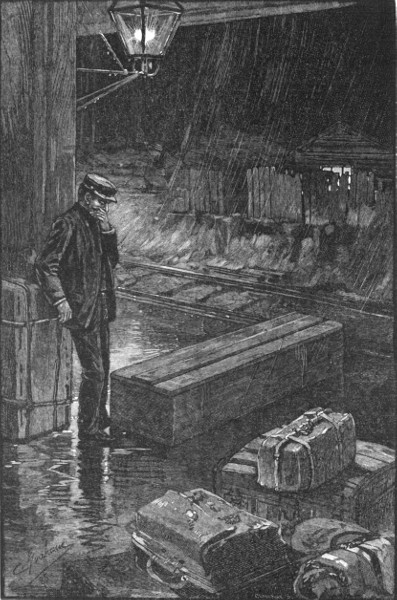
"ONLY A BOX, SECURE AND STRONG, ROUGH AND WOODEN, AND SIX FEET LONG."
Only its owner, just inside, Cold, and livid, and glassy-eyed; Little to him if the train be late! Nothing has he to do but wait. Only an open grave, somewhere, Heady to close when he gets there; Turfs and grasses and flowerets sweet, Ready to press him 'neath their feet. Only a band of friends at home, Waiting to see the traveller come; Naught he will tell of distant lands; He cannot even press their hands. He has no stories weird and bright, He has no gifts for a child's delight; He did not come with anything; He had not even himself to bring. Yet they will softly him await, And he will move about in state; They will give him, when he appears, Love, and pity, and tender tears. Only a box, secure and strong, Rough and wooden, and six feet long; Angels guide that soulless breast Into a long and peaceful rest!