THE SLATE-COLORED JUNCO
Reading edition
(THE SNOWBIRD)
"Here we have a northern winter bird—or, at least, one that we associate with winter and call the Snowbird; for everybody sees him on his autumn and winter travels, and knows his Sparrow-like call-note, while his summer home is so far north or so high on mountains that few visit him in the tangled woodlands where he sings a pretty trilling song to his mate.
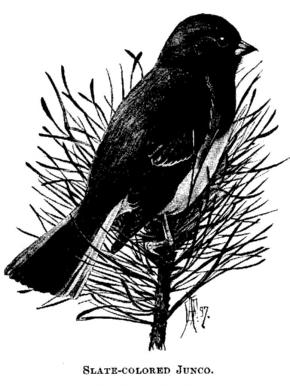
"When I was a boy here at the Farm, these white-vested Juncos were my winter pets. A flock was always sure to come in October and stay until the last of April, or even into May if the season was cold. One winter, when the snow came at Thanksgiving and did not leave the ground until March, the birds had a hard time of it, I can tell you. The Robins and Bluebirds soon grew discouraged, and left one by one. The Chickadees retreated to the shelter of some hemlock woods, and I thought the Winter Wrens were frozen into the woodpile, for I did not see any for weeks. The only cannibal birds that seemed to be about were a pair of Cat Owls that spent most of the time in our hay-barn, where they paid for their lodgings by catching rats and mice.
"But my flock of Juncos were determined to brave all weathers. First they ate the seeds of all the weeds and tall grasses that reached above the snow, then they cleaned the honeysuckles of their watery black berries. When these were nearly gone, I began to feed them every day with crumbs, and they soon grew very tame. At Christmas an ice storm came, and after that the cold was bitter indeed. For two days I did not see my birds; but on the third day in the afternoon, when I was feeding the hens in the barnyard, a party of feeble, half-starved Juncos, hardly able to fly, settled down around me and began to pick at the chicken food.
"I knew at a glance that after a few hours' more exposure all the poor little birds would be dead. So I shut up the hens and opened the door of the straw-barn very wide, scattered a quantity of meal and cracked corn in a line on the floor, and crept behind the door to watch. First one bird hopped in and tasted the food; he found it very good and evidently called his brothers, for in a minute they all went in and I closed the door upon them. And I slept better that night because I knew that my birds were comfortable.
"'They may go in once, but you will never catch them so again,' said my father, when he heard about it. I had an idea, however, that the birds trusted me; for though they flew out very gladly the next morning, they did not seem afraid.
"Sure enough, in the afternoon they came back again! I kept them at night in this way for several weeks, and one afternoon several Snowflakes came in with them. Later on this same winter five thin starving Quails came to the barnyard and fed with the hens. I tried several times to lure or drive them into the barn with the Juncos, but they would not go. Finally, one evening when I shut the chickens up, what did these Quails do but run into the hen-house with the others and remain as the guests of our good-natured Cochins until spring!
"I well remember how happy I was when grandmother gave me half a dollar and told me to go over to the mill and buy a bag of grain sweepings for my 'boarders'; how angry I was with the miller when he said, 'Those Quails'll be good eatin' when they're fat'; and how he laughed when I shouted, 'It's only cannibals that eat up their visitors!'"
The Slate-colored Junco
Length about six inches.
Dark slate color; throat and breast slate-gray; belly and side tail-feathers white; beak pinkish-white.
A Citizen of North America, nesting in the northern tier of States and northward, and also on high mountains as far south as Georgia.
A Tree Trapper, Seed Sower, and Weed Warrior, according to season.
THE SONG SPARROW (EVERY ONE'S DARLING)
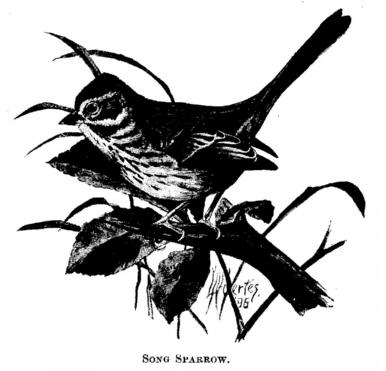
"This Sparrow, who guides you to his name by the dark spot on the breast as clearly as the Peabody-bird does by his white cravat, is every one's bird and every one's darling," said the Doctor, as if he were speaking of a dear friend.
"When you have learned his many songs, his pretty sociable ways, and have seen his cheerfulness and patience in hard times, you will, I know, agree with me that all possible good bird qualities are packed into this little streaked Sparrow.
"Constancy is his first good point. If we live in southern New England or westward to Illinois, we shall probably have him with us all the year, wearing the same colored feathers after the moult as before, not shedding his sweet temper and song with his spring coat. Now there are a great many birds, as you will see, that wear full-dress suits and sing wonderful songs in spring and early summer, while the weather is warm, food plentiful, and everything full of promise; but whose music and color vanish from the garden and roadside when frost comes. Yet the Song Sparrow sings throughout the year, except in the storms of February and March—not always the varied spring song, but still a sweet little tune.
"The Song Sparrow is humble and retiring about the location of his nest, usually putting it on or near the ground; though of course some pairs may have ideas of their own about nest-building, and choose a bird-box or even a hole in a tree. One thing you must remember about birds and their ways: Nature has fixed a few important laws that must not be changed, but has given birds and other animals liberty to follow their own tastes in all other matters.
"Wherever the thick nest is placed, it is cleverly hidden. If in a low shrub, it is in the crotch where the branches spread above the root. If on the ground, it is against an old stump with a tuft of grass on each side, or in a little hollow between bushes. Our Sparrow likes to live in the garden hedges and about the orchard, and to cultivate the acquaintance of House People in a shy sort of way.
"He never flies directly to and from his home like the Chippy, Wren, and Robin, but slips off the nest and runs along the ground as nimbly as a Thrush, till he reaches a bush, well away from his house, when he hops into it and flies away.
"'Chek! chek! chek!' is the call-note of the Song Sparrows, who also have a short, sweet song, which every bird varies and lengthens to please himself or his mate. 'Maids, maids, maids, hang on your tea-kettle-ettle-ettle,' some people fancy the bird says, and the short song fits these words very well. But when this Sparrow sings his best music, all trembling with love and joy, he forgets about such a simple thing as the tea-kettle! Now it is a grand banquet he tells you of, with flowers and music; then he stops suddenly, remembering that he is only a little brown bird, and sings to his favorite alder bush by the brook a soft apology for having forgotten himself. This Sparrow even dreams music in the spring, when you will often hear his notes in the darkest hours of the night.
"The eggs are as varied as the songs, being light blue or whitish, with every imaginable sort of brown marking—no two sets are exactly alike. Birds' eggs often vary in color, like their plumage, and the different hues seem fitted to hide the eggs; for those of birds that nest in holes and need no concealing are usually plain white.
"If you ever make a bird calendar at Orchard Farm, you may be able to write this Sparrow's name in every month of the year. Another good thing about this happy faithful bird is, that his tribe increases in Birdland, in spite of all dangers."
"My mother loves Song Sparrows," said Rap. "She says they are a great deal of company for her when she is doing her washing out under the trees. She thinks they tell her that people can be happy, even if they wear plain clothes and have to be snowed up in the country half the winter. She is right, too; the Song Sparrows only tell her what happens to themselves."
The Song Sparrow
Length about six inches.
Head and back all streaked with gray and brown, and a brown stripe on each side of throat. Under parts whitish, all striped with dark brown, the heaviest stripes making a large blackish spot on the breast.
A Citizen of the United States east of the plains, nesting from Virginia northward to the Fur Countries.
A Ground Gleaner as well as a Weed Warrior, and a constant joyful songster.
"Here we have one of the larger birds of the Finch family, who is both nervous and shy, and so quick to slip out of sight that he always surprises one.
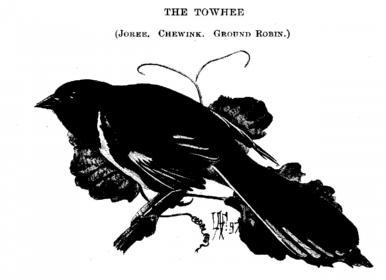
"To see the Towhee as he hops away from the briers that hide his nest, you would never dream that he is a cousin to the meek brown Sparrows. A very smart bird is 'Jore-e Blur-re,' as he keeps telling you his name is, trig in his glossy black long-tailed coat, his vest with reddish side facings, white trousers, and light-brown shoes and stockings. A knowing glance has he in the ruby-red eyes that sparkle in his coal-black head, while inside that little head are very wise thoughts."
"How are his eyes red, Uncle Roy?" asked Dodo. "Are they all plain red or only red in a ring around the seeing part where mine are blue?"
"They are 'red in a ring,' as you say; we call this ring the iris, and the 'seeing part' the pupil."
"Please, what does iris mean? Iris is the name of one of the lily flowers that grow in the garden."
"Iris is a word that means rainbow, which as you know is a belt of beautiful colors, made by the sun shining through rain. The iris of the eye is a film of color covering the watery inside part of the eyeball, and the pupil is a round hole in the iris that lets the light into the back of the eye. This opening expands and contracts according to whether the eye needs much or little light. I tell you this now, but you will need to remember it when we come to the Owls, who have curious ways of keeping too much light from their eyes.
"The iris in birds, as in House People, may be of many different colors—red, as in the Vireo I told you about, and as you now know it is with the Towhee. Each has a brother with white eyes. You remember the White-eyed Vireo, and in Florida there is a Towhee who has white eyes; but this is so unusual that it makes the bird look to you as if it were blind, until you understand that it is the natural color. Most birds' eyes are brown of some shade, or perfectly black; a few have blue or green eyes. But where did I leave Mr. Jore-e Blur-re?" "You were saying that he is wise," answered Rap.
"Well, he is wise enough never to fly either straight to or from his nest, which is a rather poor affair, down on the ground, within reach of every weasel or snake that cares to rob it.
"He does not sing on the ground, but moves silently among the leaves and litter of old ferns, such as are found near ponds and streams. A stick will crackle perhaps, and thus draw your attention to him. When he knows that he is seen, he will flip his wings and flirt his tail, like suddenly opening and shutting a fan, as he flits on before you with his head on one side, giving the pert call 'Towhee! towhee!' that is one of his names. Some people think he says 'Chewink! chewink!' and call him by that name; while some who have noticed where he lives, and seen that the color of his sides is like the reddish breast of the Robin, call him the Ground Robin, though he is no relation of the Thrush family.
"Meanwhile his wife stays quietly on the nest, where her brown back matches the dead leaves of which it is made outside, keeping her quite safe from sight.
"In the afternoon, when the work of the day is almost over, and her mate is tired of scratching about for food, he takes a little rest and goes up high in a tree to boldly declare his whereabouts.
"'Jore-e Blur-re, Jore-e Blur-re, willy-nilly, willy-nilly!' he calls defiantly, as if he did not like having to keep quiet all day, and meant to tell his name at last.
"In early autumn the Joree family grow sociable enough to come into the garden, but they seldom linger late; vigorous as they are, they hurry southward before any hard frosts come."
The Towhee
Length about eight and a half inches.
Male: black with chestnut sides, white belly, tan-colored under the tail, the side feathers of which are white-tipped.
Female: reddish-brown where the male is black.
A Summer Citizen of the United States east of the plains, and along the southern border of Canada. Nests northward from Georgia. Winters south of the Middle States.
A Ground Gleaner, Seed Sower, and Weed Warrior.
THE CARDINAL (THE CARDINAL GROSBEAK)
"There is a legend about this Cardinal—the soldier with a red uniform," said the Doctor; "one of Mammy Bun's strange stories that came from the Indians to the negroes, always growing larger and stranger.
"There were two Indian warriors of the southwest that hated each other. One had an only daughter and the other a son. While their fathers were at war, this boy and girl met in the green forest. The old women of their tribes told them that they must never speak to each other, or their fathers would surely kill them. But the children said, 'There is no war or hate in our forest; the birds meet—why may not we?' One summer evening they stayed too long, watching the fish swim in the river and floating little sticks for canoes. The two warriors returned suddenly to their villages, missed their children, and then some one told them tales.
"The wind whispered to the trees, 'Trouble, trouble! These warriors hate each other more than they love their children. Hide them, O trees!' Then the trees whispered to the birds, 'Help the poor children—help, help!' And the birds said, 'They shall be turned into birds and escape, if you will make a little fire, O wind, to delay the warriors and give us time.'
"So the trees told the fireflies to light the dead leaves that covered the ground; the wind breathed on the fire, and soon the wood was all aflame!
"'What birds do you choose to be, that you may always live in the forest together?' asked the Bird Brothers of the children. 'Answer quickly, for the time is short.'
"'I will be a large brown Sparrow,' said the girl; 'then none will trap me for my feathers.'
"'And I too,' said the boy.
"Suddenly they were no longer children. But there was confusion, as the fire burned nearer and nearer. "'Fly! fly!' cried the Bird Brothers. 'You have wings—do not look at the earth, lest you grieve to leave it.'
"Gonda, being obedient, made an effort to fly above the flame, which only tinged some of her feathers red. But Towai, loath to leave the earth, lingered so long that his feathers became all red from the flames, and the soot blackened his face.
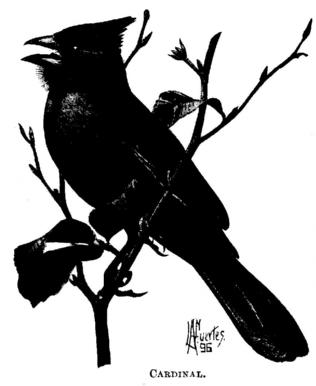
"Though these two birds and their children still belong to the dull-brown Sparrow family, they have little peace in the forest where they live. Towai wears a splendid red robe and is called the Cardinal, but there is a price upon his head because of his beauty.
"This is one of the legends that explains why this bird is classed with Sparrows. The Tanager is more fiery red, and the Oriole carries flame on his back; but there is something strange about the Cardinal—he seems out of place and lonely with us. He should belong to a tropical country and have orchids and palms for companions—but instead, where do we find him?"
"Please, Doctor," said Rap, who thought he could answer that question, "the miller's wife has a pair in a cage, but they aren't very pretty, 'cause they've scraped most of the feathers off their heads and rumpled their tails, trying to get out. The miller caught three of them down there last winter, only one died and the other two aren't a bit happy; the male doesn't sing and the female has a cough. The miller's wife doesn't care much for them; they're a bother to feed, she says—have to have meal-worms, and rice with the hulls on, and all that." "Why doesn't she let them out?" asked Olive.
"'Cause she thinks that maybe some of the people that come fishing will buy them."
"How much does she ask for them?" said the Doctor.
"She said if they ever moulted out and got any decent feathers she could ask three dollars for them, but the way they were looking a dollar was all she could expect."
"Children, shall we have a Liberty Festival this morning? How would you like for me to buy these birds and bring them here, so that you can see them, then—then what?"
"Open the cage and let them out and see what they will do!" screamed Dodo, jumping up and down.
"May I go down to buy them?" begged Nat.
"You will have to take me, too," said Olive.
"Can I open the door?" asked Dodo.
"Here is the dollar—now go, all together," said the Doctor, putting his hands over his ears; "but if you make so much noise the birds in the river woods will mistake your kind intentions and think you are a family of wildcats."
In less than half an hour the party returned, Nat carrying the cage, which was only a box with a bit of wire netting over the front.
"No wonder poor Mrs. Cardinal has a cough, living in this dirty box," said Olive. "See, father, only one perch—and I don't believe the poor things have ever had a bath given them."
"That is the saddest part of caging wild birds," said the Doctor. "Not one person in fifty is willing to give them the care they need. Put the cage under those bushes, Nat.
"I began by asking, Where do we find this bird? Living in Florida in sunshine, among the shady redwoods of Kentucky, and in all the bitterness of our northern winters. He varies his habits to suit his surroundings, and roves about after the nesting season; in mild climates he sings for six months of the year—from March until August. But one of the strangest things about him is that he wanders most when the trees are bare and he can be so easily seen that hundreds of his kind are shot for their gay feathers, or trapped to sell alive for cage birds. When snow is on the ground he is very conspicuous."
"Why doesn't he get into evergreens or cedar bushes?" asked Rap.
"He does when he can and often sings when so hidden; but he is not a very quick-witted bird and seems to move awkwardly, as if his topknot were as heavy as a drum major's bearskin.
"But no one can find fault with his song; it first rings out loud like a shout, then ends as clearly as the bubbling of the stream near which he likes best to live—'Cheo-cheo-chehoo-cheo-qr-qr-qrr-r-r.'"
"Isn't it time to let them out?" whispered Dodo. "Mrs. Cardinal is coughing again dreadfully!"
"In a moment. Turn the cage sideways, Nat, so that we can watch them through the bushes—so, and please keep quite still. Now, Dodo, open the little door—carefully."
For two or three minutes there was perfect silence. Four young people squeezed behind a tree, and a Wise Man down on his hands and knees behind a stump—all watching two forlorn birds, who did not understand that liberty was theirs for the taking.
Mrs. Cardinal put out her head, then took a step and hopped along the ground into a cornel bush; where, after looking around a moment, she began to smooth her poor feather's. Another minute and Mr. Cardinal followed, giving a sharp chip like a loud Sparrow call. They both hopped off as if they were not half sure their freedom was real.
"I think they might have sung to us," whispered Dodo.
"Too soon," said the Doctor; "but I'm sure that we have not seen or heard the last of our Cardinals."
"Hist!" said Nat, "they are taking a bath in the brook this side of the stepping-stones." And so they were.
The Cardinal
Length eight and a quarter inches.
Male: splendid cardinal-red, with a black throat and band about the coral-red bill, and a fine long crest, like a Cedar Waxwing's.
Female: yellowish-brown with a little red in her crest, wings, and tail, and her face not so black as her mate's.
A Citizen of the eastern United States to the plains and from Florida to the Great Lakes, nesting wherever found.
A Tree Trapper, Ground Gleaner, Seed Sower, and Weed Warrior, besides being a fine singer.
THE ROSE-BREASTED GROSBEAK (THE POTATO-BUG BIRD)
"This must be the bird I saw the other day in the brush lot by the old barn," said Rap; "and there were two more this morning in our own potato patch. Why do they go there, Doctor?" "Because this bird, besides wearing a beautiful rosy shield on his breast, and singing at morning and evening more beautifully even than the very best Robin, is a very industrious and useful bird. He earns his living by helping farmers clear their fields of potato-bugs. If you go quietly over to the large potato lot on the north side of the Farm, you will find these birds at work any morning. I saw them myself to-day, and am going to trust my crop entirely to their keeping this season. They are nesting in the young growth near these very river woods, and I will show you one of their homes presently. You see that protecting birds, and leaving suitable bits of woodland and brush for them to build in, is practical as well as sentimental.
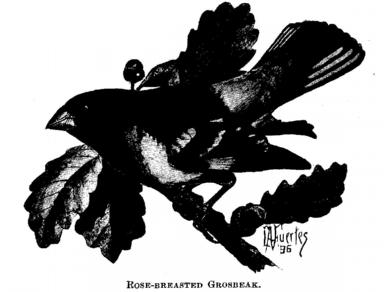
"This Grosbeak dares not trust its brilliant colors in large trees or open places, and so nests where it may hide in a maze of bushes. When it finds the right spot, it is not very particular about nest-building. A jumble of weeds, twigs, roots, and sometimes rags or bits of paper, serves to hold its light-blue eggs with brown markings.
"If it be ever right to cage a wild bird, you may make a prisoner of this Grosbeak; but remember, you must take a young male before it has known the joys of freedom, and give at least a half-hour every day to taking care of him. Then he will grow to love you and be a charming pet, living happily and singing gladly; but under any other circumstances it is less cruel to shoot one than to make it a prisoner."
The Rose-breasted Grosbeak
Length about eight inches.
Male: black on the head, back, wings, and tail; the belly, rump, several spots on the wings, and three outer tail-feathers, white; rose-colored breast and wing-linings; bill white and very heavy.
Female: streaked brownish above and below, without any rosy color, but orange-yellow under the wings; she looks like an overgrown Sparrow with a swelled face.
A Summer Citizen of the eastern United States from Kansas and the Carolina mountains to Canada, travelling south of the United States in winter.
A Tree Trapper, Ground Gleaner, Weed Warrior, and Seed Sower. Rather naughty once in a while about picking tree-buds, but on the whole a good neighbor.
THE INDIGO BIRD (THE BLUE CANARY)
"Blue birds and blue flowers are both rare; you can count our really blue birds on the fingers of one hand, and a Blue Canary is even stranger than a green rose or a black tulip.
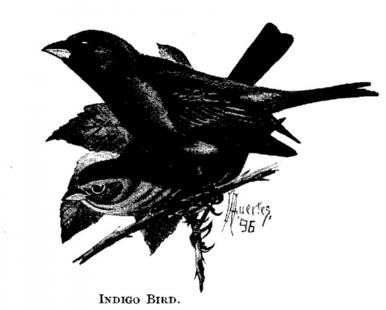
"The Indigo Bird has many of the Canary's gentle ways, and though his music is not so fine or varied as that of the Goldfinch or Song Sparrow, he sings a sweet little tune to his brown mate on her nest in the bushy pasture.
"She is fortunate in having a dull dress; for, if she were as splendidly blue as her husband, nesting would be a very anxious occupation for her. Indeed, her poor mate has anything but an easy time; his color is so bright that everybody can see him at a glance, and when he picks up grass-seed in the streaming sunlight, his feathers glisten like sapphires."
"We saw an Indigo Bird yesterday!" cried Nat and Dodo together. "It was in the geraniums by the dining-room window, eating the seed I tipped out of my Canary's cage when I cleaned it," continued Dodo. "Mammy Bun said it was a Blue Canary, but Nat said it couldn't be, and I forgot to ask about it."
"Are you going to tell us about many more birds in the Finch family, Uncle Roy?"
"Not now. You have heard about those that will be most likely to attract your attention, and when you can name them, they will introduce you to all the rest of their relations."
"It is a great family," said Rap, who was sitting thinking. "Big birds and little, plain gray and brown, or red, blue, and yellow—some like warm weather and some want it cold." "Speaking of cold, I wonder what became of the ice that Dodo saw Mammy Bun cracking this morning?" asked the Doctor, looking at Olive. "The very word has a pleasant sound, for it seems to me to be growing warmer and warmer."
"Toot! toot! t-o-o-t!" squeaked a tin horn across the field from the direction of the farmhouse.
"What's that?" said Nat, jumping up; "it's the dinner horn, and it can't be dinner-time."
"Not more than eleven o'clock," said Rap, looking at the sun after the fashion of those who spend much time out of doors.
"I know what the horn means," said Olive. "It means that the cake, that Nat said Mammy Bun was going to bake with the ice, is done!"
"But that was only nonsense, you know," said Nat. "Ice won't bake anything!"
"Perhaps not, but ice can freeze something, if you mix salt with it, even on this warm day, and the horn means that mammy has a tin pail full of ice cream, waiting for some one to eat it! Ice cream, made with fresh strawberries! Don't break your neck, Nat!" For Nat had dashed off so quickly that it was no use for Dodo and Rap to try to keep up with him.
"Why do you mostly have something nice for us to eat on bird-days?" asked Dodo, cuddling into the bend of her uncle's arm.
"For two reasons, girlie. When I was a boy, being out of doors made me so hungry that it always seemed a long time between breakfast and dinner. I know that little brains remember best when the stomachs that nourish them are not empty. Neither Bird Children nor House Children should go too long hungry; it is as bad as nibbling all day."
"I've noticed since I came here I haven't needed even to peep in the cooky box between times. Aren't you one of the seven Wise Men of—of—I-forget-where?" asked Dodo, hugging him.
"Greece," answered the Doctor; "no, fortunately, I am not, for they are all dead."
"What's that?" whispered Rap, pointing toward the river, whence a strong, rapid, musical song came, ending before you could catch the syllables, and then being repeated two or three times.
"It is the Cardinal," said, the Doctor, in some surprise—for the bird was singing almost at noon. "I can see his red liberty cap near the top of the tallest hemlock!"
"Che-o—hoo—hoo," called the Cardinal, and then the ice-cream pail arrived, escorted by Nat.
"This is a festival for us as well as for the Cardinal," said Rap.
The Indigo Bird
Length five and a half inches.
Male: bright blue, of a greener tint than the Bluebird; wings and tail dusky.
Female: plain brown above and whitey brown below, with a few streaks, including a sharp black one under her beak.
A pleasant neighbor and good Citizen, belonging to the southern branch of the Finch family.
A Tree Trapper and a Weed Warrior.
A Summer Citizen of the eastern United States, west to Kansas and north to Canada. From Kansas to the Pacific Ocean he is replaced by his brother, the Lazuli Bunting.