Chapter XVI
Reading edition
A TRIBE OF WEED WARRIORS
(Containing both Soldiers and Quakers)
"A new family? Soldiers and Quakers? What does that mean?" asked Nat. "I thought my jolly yellow bird with the black cap came next."
"His family does come next—the Finch family. You must hear a little about that first, and let your American Goldfinch take his turn with his brothers and cousins, for Rap's Rose-breasted Grosbeak belongs also in this family."
"You say my bird is called American Goldfinch. He is such a bright yellow that gold is a good name for him, but what does 'Finch' mean?"
"Finch, as I said, is the name of the great family to which he belongs. It is the very largest family in Birdland, and members of it live in almost all parts of the world. All kinds of Finches and Sparrows belong to it, and so do Grosbeaks and Buntings, as well as the Canaries that we keep for pets. There are about five hundred and fifty different kinds of them.
"The birds that you have been studying thus far, from the Bluebird, Robin, and Wood Thrush to the Tanagers, belong to several different families and are chiefly insect-eaters, taking various fruits and berries in season, it is true, but making insects their regular diet. Insects are not hard for any bird to eat, and so the bills of these birds do not have to be very stout or thick—some, indeed, are very thin and weak, like the Brown Creeper's.
"But the habits of the Finch family are quite different, and their beaks also. They are true seed-eating birds, and their beaks are short, stout, and thick—cone-shaped it is called, like that of the White-throated Sparrow you learned about one day. This enables them to crack the various seeds upon which they live at all times except in the nesting season, when few seeds are ripe. During this time they eat a variety of insects, and feed them to the young birds; for young birds must grow so rapidly, in order to be strong enough for the autumn journey, that they require more nourishing food than seeds.
"The Finch family being able to live so well upon seed food do not have to make such long autumn journeys; for even in very cold places there are plenty of seeds to be had all through the winter."
"Do you mean berries, please, uncle?" said Dodo; "because if it was very cold wouldn't berries freeze as hard as pebbles?"
"They eat berries, but only as Weed Warriors,—for the seeds that are in the berries,—not for the juicy, fruity part, as the Seed Sowers do.
"The Robin, Thrush, and Catbird eat fruits and berries for the juicy, pulpy part. They swallow this, and the seeds or pits pass out with the wastage of their bodies; this is what makes them Seed Sowers. But when one of the Finch family eats berries, it is for the seed or pit inside the pulp. His strong beak cracks the seed and his stomach digests its kernel. So these birds do not sow the seeds they eat, but destroy them. This is why I call them Weed Warriors. A warrior is any one who goes to war, and fights against enemies; we have enemies among plants, and these birds fight for us against them. There are hundreds of different kinds of plants, whose flowers have no beauty, and for which we have not as yet found any use; so we call them weeds. All such seeds would be blown about, take root, and sprout everywhere, thus filling the place of useful plants, if they were not held in check by these seed-eating birds."
"Isn't it wise the ways things are fixed?" said Rap. "Some birds to eat the insects and sow wild fruits and berries; some birds to eat weed seeds and prevent them from being sown. I think some people would do better if they didn't think themselves so smart and mix things all up!"
"You are right, my boy! We should not interfere with Heart of Nature by foolishly trying to aid him unless we are perfectly sure that he wishes and needs our help.
"There is one member of this Finch family, the European Sparrow, that we know by the name of English Sparrow. In his native country he eats both insects and seeds, and also does some good by eating certain tree-worms. A number of years ago the trees in our cities were being eaten by canker-worms, and some one said—'Let us bring over some of these Sparrows to live in the cities and eat the canker-worms.' This person meant well, but he did not know enough about what he was doing.
"The birds were brought, and for a while they ate the worms and stayed near cities. But soon the change in climate also changed their liking for insects, and they became almost wholly seed and vegetable eaters, devouring the young buds on vines and trees, grass-seed, oats, rye, wheat, and other grains.
"Worse than this, they increased very fast and spread everywhere, quarrelling with and driving out the good citizens, who belong to the regular Birdland guilds, taking their homes and making themselves nuisances. The Wise Men protested against bringing these Sparrows, but no one heeded their warning until it was too late. Now it is decided that these Sparrows are bad Citizens and criminals; so they are condemned by every one. All this trouble came because one man, as Rap says, 'thought he was so smart and mixed things up.'"
"It was those Sparrows in the city that made me think all wild birds must be ugly; but that was because I was too smart and didn't know anything about other birds," said Nat frankly.
"I think we are getting way off from Nat's yellow bird," said Dodo; "and now I see lots more of Rap's Rose-breasted Grosbeaks, over on the fence. I want to know what they are doing in the potato field. I hope they don't dig up the little potatoes."
"No, you need not worry about that," said the Doctor, "and you must wait a bit yet, for the Rose-breast does not come until nearly the end of his family."
"There must be a great many different-looking birds in this Finch family," said Rap, "if plain Sparrows and yellow Goldfinches both belong to it." "Indeed there are! Did I not say that there were both Quakers and soldiers in it?" said the Doctor. "For in addition to the Goldfinch there is a bright-blue cousin and a red one."
"What are their names, and shall we see them here?" cried Dodo.
"You will learn their names very soon. The blue one now has a nest across the meadow, and the red one makes us a visit every autumn; but you must stop asking questions if you want to hear about them to-day.
"The first of the Finch family is a bird you will only see in the winter, and not even then if you are living further south than the middle range of States. It is called the Pine Grosbeak."
THE PINE GROSBEAK
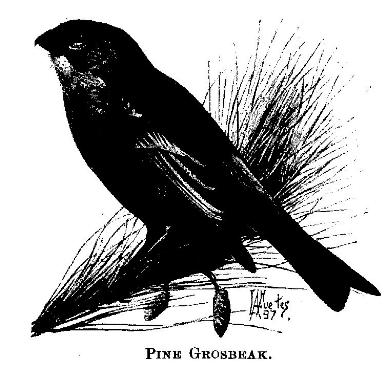
"This bird has a great heavy beak, that makes him look rather stupid; in fact, this beak gives him the name of Gros-beak, which means the same as Great-beak. He loves the pine woods of Canada and builds his nest among them, only a little way above the snow that still covers the ground at the early season when this bird begins housekeeping.
"When the northern winter is very severe, Pine Grosbeaks gather in flocks and scatter through the States. But you must not expect to see a whole flock of beautiful strawberry-red birds, for only the old males are red; the females are dull gray and yellowish, while the young males look like their mothers, and do not wear their gay coats until they are two years old. You will not be likely to hear these birds sing, though they sometimes do so on their winter trips. Their usual call-note is a whistle which they give when flying.
"Some day this winter when you are taking a walk you may see them on the ground under chestnut and beech trees, and in old pastures where the red sumach berries are the only bright things left above the snow. You will think it a very cheerful sight—red birds and red berries together. You will also have time to take a good look at them, for they move slowly, and be glad to know the names of your friends who are hardy enough to brave the cold.
"Though this Grosbeak seems rather dull and stupid out of doors, he is a charming cage pet, growing tame and singing a delightful warbling song. I picked up one with a broken wing when I was a boy, and kept him for many years; the hurt wing was soon healed, and the bird was always tame and happy after that, though he soon lost his bright feathers. But I would never advise any one to make a cage pet of a bird who has been born wild and once known liberty. No matter if he lives and thrives: he will sometimes remember the days when he was free, and be very sad." "My Canary is never sad," said Nat: "he is always singing."
"For very many years Canaries have been bred in cages, to be pets, and as these have never been wild they are used to cage life. They are the best birds for pets, because they are seed-eaters, and it is easy to supply the food they like.
"Some winter day, or even late in autumn, you may see on your walks, another red bird—a near relation of the Pine Grosbeak; in fact, the two often flock together. This bird is called the American Crossbill."
The Pine Grosbeak
Length about nine inches.
General color of adult male strawberry-red, the wings and tail dark, with some light-brown and white edgings; the tail forked a little.
The female and young male gray, tinged here and there with saffron-yellow.
A Summer Citizen as far north from the States as trees grow, roving in winter about the northerly and middle States.
A fine, large Weed Warrior, with a very stout beak, almost like a Parrot's.
THE AMERICAN CROSSBILL (THE CONE WRENCHER)
"When it is winter in the northern parts of North America, and the Great Snow Owls have scattered on their southward journey—when heavy snows have beaten down and covered the seed-stalks of weeds and well-nigh walled the little fur-bearing beasts into their holes—then in regions where March brings only storms of sleet to coat the tree-trunks and lock up insect food, a pair of strange birds are already building their nest.
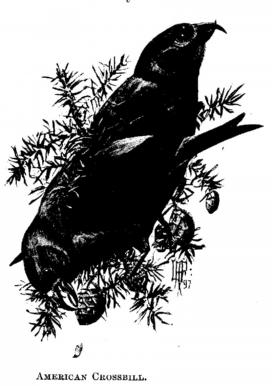
"These two birds, though alike in shape, are as different in color as Mr. and Mrs. Scarlet Tanager. But there is one point about them by which you may tell them from any others. Their curving bills are crossed at the tip, which strange arrangement gives them their name of Crossbill. At a little distance you might mistake them for Paroquets, but only the upper half of a Paroquet's beak is curved, and it closes over the under half; while both parts of the Crossbill's beak are curved, and they cross each other at the tip like a pair of scissors that do not close properly.
"How and where do you think these birds build their nests in such a cold season?"
"Make a burrow in the snow, perhaps," said Dodo.
"Go into a haystack or under a shed," said Nat.
"Or a hole in a tree," added Rap.
"No, the Crossbill does not place his nest in any of these ways. He chooses a thick evergreen tree, and upon the fork of one of the branches makes a little platform of rubbish to support the nest. With great care the couple gather shreds of bark, twigs, and small sticks, till they think they have enough; then they begin the nest itself, weaving it of softer materials and lining it with grasses, fur, and feathers, until they make a very comfortable bed for the pale-green, purple-spotted eggs to lie in."
"How cold the poor birds' toes must be while they are working," said Dodo with a shiver; "and I should think the eggs would freeze instead of hatching."
"But what do they find to eat when everything is frozen stiff?" asked Rap. "Are they cannibal birds that can eat other birds and mice?"
"These two questions can be answered together," said the Doctor. "The nests are usually built in evergreens, which are cone-bearing or coniferous trees. You all know what a cone is like, I think?"
"Yes, I do!" cried Rap. "It is a long seed pod that grows on evergreens. In summer it is green and sticky, but by and by it grows dry and brown, and divides into little rows of scales like shingles on a house, and there is a seed hidden under each scale. Each kind of an evergreen has a different-shaped cone; some are long and smooth like sausages, and some are thick and pointed like a top. The squirrels often pick the cones off the spruces over at the miller's and shell out the scales, just as you shell corn off the cob, to get the seeds."
"Very good, my boy," said the Doctor. "I see you know something about trees as well as birds. The Crossbills build in evergreens, and all around their nests hang the cones with spicy seeds stored away under the scales, ready for the birds to eat. So they do not have to go far from home for their marketing."
"But their beaks are so crooked that I don't see how they can pick out the cone seeds," said Nat.
"These curiously twisted bills, like pincers, are made expressly for the purpose of wrenching the scales from the cones, so that the seeds are laid bare."
"It's very funny," said Nat; "whenever we think a bird is queer or awkward and would be better in some other way, it is sure to be made the very best way, only we don't know it."
"By and by, when the eggs are laid and the young are hatched," continued the Doctor, "Crossbills make the most devoted parents; they would let themselves be lifted from the nest rather than leave their family.
"And when it is midsummer the old and young Crossbills form into flocks. Then the parents begin to think that the young people need a change of air for their health, and a few months of travel to finish their education. So they wander southward through the States without any method or plan, sometimes going as far as New Orleans before winter really begins; and it is on these journeys that we see them.
"Some frosty morning in October, if you hear a sound coming from the sky, like the tinkling of little bells—'Tlink-link-link-link'—you may be sure there is a flock of Crossbills near, and soon you will see them climbing about an evergreen, or quietly picking seeds on a birch or beech. The moment before they move to another tree they begin to call; this is the only note you will be likely to hear from them, and one which they often keep up during flight.
"They are capricious birds when on their travels, sometimes letting you come very near them without showing a sign of fear, then suddenly taking flight and dashing about in a distracted way. They are also tardy in getting back to their piney homes sometimes, and choose their mates on the journey, unlike most birds. Very often a thoughtless couple are obliged to camp out and build a home wherever they happen to be, so that their nests have been found in several of the New England States."
"Is there only one kind of Crossbill in North America?" asked Rap.
"No, this Red Crossbill has two cousins; one with two white bars on each wing, called the White-winged Crossbill, who sometimes travels with him, but is rarer; and another who lives in Mexico."
The American Crossbill
Length about six inches.
Beak crossed at the tips, but looking like a Parrot's if you do not notice how the points cross.
Male: general color Indian red, with dark wings and tail.
Female: general color dull olive-green, with wings and tail like the male's.
A Citizen of the North, making winter excursions all through the United States.
THE AMERICAN GOLDFINCH
(THE JOLLY BIRD, or THISTLE BIRD)
"This must be my other bird," said Nat, "the yellow one from the wild grass meadow, who had what looked like a little black velvet cap tipped down over his eyes. They are such jolly little chaps that it made me laugh when I watched them swinging on the ends of the tall grass. Once in a while one would play he was angry and try to look cross; but he couldn't keep it up long, because he really felt so good natured."
"I believe every one knows Goldfinches," said Olive. "I remember them longer than any birds, but the Robin and Bluebird."
"Yes, for even I know them a little bit," said Dodo, "but not by their right name, for when I saw some in the Park last summer somebody said they were wild Canaries that had flown out of cages."
"What do they eat, cones or little seeds?" asked Nat.
"They eat grass-seeds, and the seeds of weeds—the most fly-away weeds too, that blow everywhere and spread ever so fast," said Rap. "Look, quick! There's a flock coming by now, and they are calling 'Come talk to me! Come talk to me!' See—they have settled on the long grass by the fence and are gobbling seeds like everything," continued Rap in a whisper.
As he spoke a flock of twenty or more birds flew over; some were the bright-yellow males and others the more plainly colored females. They did not fly straight, but in a jerky way, constantly dropping down and then lifting up again, and calling out "wait for me" on every down-grade curve, until by common consent they alighted among some wild grasses, where the early yellow thistles were already going to seed.
"Watch and listen," said the Doctor, as he handed the field-glass to the children in turn.
There was a perfect babel of bird-talk, the jaunty blond males all making pretty speeches to the gentle brown-haired females, who laughed merry little bird-laughs in return.
"It is like the noise in the store where they sell Canaries," whispered Nat, after taking a long look; "first they all sing together and then a few sing so much louder that the others stop. I wonder what they are saying?"
"They are talking about housekeeping," said the Doctor. "Some of the ladies say they prefer high apartments in a tree-top, while others like one-story bushes the best; but all agree that the ground floor is too damp for the health of their families. In a few days, or a week at most, this merry flock will have parted company, and two by two the birds will begin housekeeping."
"Why, they are pulling off the thistle-down, and gobbling it up. I should think it would choke them," said Dodo.
"Those are some of the fly-away seeds that Rap spoke of a moment ago. The fluff is not the seed, but a sort of sail to which the seed is fastened, that the wind may blow it away to another place to grow. If you look carefully you will see that the birds do not eat thistle-down, but only the seed; they will soon use the down to line their pretty round cup-shaped nests." "Oh, yes," said Dodo, "there are lots of fluffy seeds, and they mostly belong to very bad weeds. Olive has been telling us about them, Uncle Roy, and so of course the Goldies do heaps of good by eating them. If they eat those weed-seeds and do not need insects they can live here all winter—can't they, uncle?"
"Certainly; they gather in flocks after their nesting-time, which you see is very late. Then the males shed their bright-yellow feathers, and look exactly like their wives and children. Still, they make a merry party flying about in the garden and field edges, where the composite flowers have left them food, whispering and giggling all day long—even singing merrily now and then. They often have hard times in winter, and when I am here at the Farm I always scatter canary seed on the snow for them."
"What is a com-pos-ite flower?" asked Dodo.
"A kind of flower which has a great many little blossoms crowded together in a bunch, so that they look like one big flower—such as a dandelion, thistle, or sunflower. Olive will tell you more about them to-morrow. She is the Flower Lady, you know—I am only your Bird Uncle, and if I mix up flowers with birds I shall be apt to confuse you."
"They eat sunflower seeds," said Rap. "We grow these seeds for our hens and the Goldies always get their share."
"I wonder if that is why they are such a beautiful yellow," said Dodo. "'Flying Sunflower' would be a nice name for them. No, you needn't laugh at me, Nat; the man in the bird store said he gave Canaries red pepper to make them red, so I don't see why the seed of yellow sunflowers shouldn't make birds yellow!" But in spite of her argument Nat and Rap continued to laugh.
"It must be hard to tell them when they lose their yellow feathers," said Nat finally.
"No; Goldfinches keep up a habit by which you can always tell them, old or young, male or female, in summer or winter. Can you guess what it is?"
"I know! Oh, I know!" cried Rap. "They always fly with a dip and a jerk."
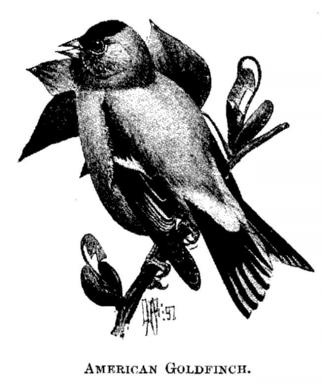
The American Goldfinch
Length about five inches.
Male in summer: bright clear yellow, with a black cap, and the wings and tail black with some white on both.
Female at all times, and male in winter: light flaxen brown, the wings and tail as before, but less distinctly marked with white, and no black cap.
A Citizen of temperate North America, and a good neighbor.
Belongs to the guild of Weed Warriors, and is very useful.
THE SNOWFLAKE (THE AUTUMN LEAF)
"It is a very warm day to talk about snowstorms and winter birds, but several of these birds belong to the Finch family," said the Doctor, a few mornings later, as the children went through the old pasture down to the river woods in search of a cool quiet place to spend the morning. The sun was hot, and most of the birds were hiding in the shade trees. "But as the Snowflake will walk next to the Goldfinch in the procession of Bird Families I am going to show you after a while, we must have him now." "I think a cool bird will be very nice for a warm day," said Dodo. "Something like soda water and ice cream. That makes me think—Mammy Bun was cracking ice this morning, and I wonder what for!"
"I wonder!" said Olive, laughing.
"I know," said Nat, who was a tease; "it must be to bake a cake with!"
"Here is a nice place for us," said the Doctor, who had walked on ahead, "where we can see over the fields and into the woods by only turning our heads, and the moss is so dry that we may sit anywhere we please.
"The trees are in full leaf now," he continued, looking up as he leaned comfortably against the trunk of an oak that spread its high root ridges on each side of him like the arms of a chair. "The spring flowers are gone, strawberries are ripe, and there is plenty of food and shelter for birds here. But if we were to travel northward, beyond the United States and up through Canada, we should find that the trees were different; that there were more pines and spruces. Then if we went still further north, even these would begin to grow more scanty and stunted, until the low pines in which the Grosbeak nests would be the only trees seen. Then beyond this parallel of latitude comes the 'tree limit'—"
"Oh, I know what a 'parallel of latitude' is, because I learned it in my geography," said Dodo, who had been pouting since Nat teased her about the cracked ice; "it's a make-believe line that runs all round the world like the equator. But what is a 'tree limit'?"
"Don't you remember, little girl," answered the Doctor, "what I told you about the timber-line on a mountain—the height beyond which no trees grow, because it gets too cold for them up there? It is just the same if you go northward on flat ground like Orchard Farm; for when you have gone far enough there are no more trees to be seen. In that northern country the winter is so long and cold, and summer is so short, that only scrubby bushes can grow there. Next beyond these we should find merely the rough, curling grass of the Barren Grounds, which would tell us we were approaching the arctic circle, and already near the place where wise men think it is best to turn homeward; for it is close to the Land of the Polar Bear and the Northern Lights—the region of perpetual snow. But dreary as this would seem to us, nest building is going on there this June day, as well as here.
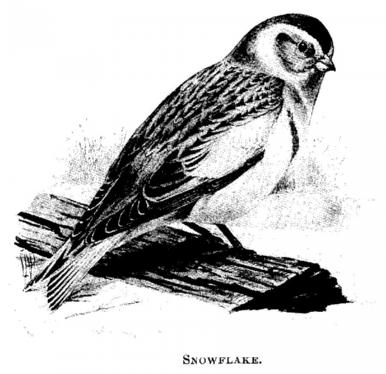
"Running lightly over uneven hummocks of grass are plump, roly-poly, black-and-white birds, with soft musical voices and the gentlest possible manners. They may have already brought out one brood in thick, deep grassy nests, well lined with rabbit fur or Snow Owl feathers, that they know so well how to tuck under a protecting ledge of rock or bunch of grass. Now and then a male Snowflake will take a little flight and sing as merrily as his cousin the Goldfinch, but he never stays long away from the ground where seeds are to be found.
"The white feathers of these birds are as soft as their friend the snow, of which they seem a part. They have more white about them than any other color, and this snowy plumage marks them distinctly from all their Sparrow cousins. After the moult, when a warm brown hue veils the white feathers, and the short northern summer has ended, the birds flock together for their travels. When they will visit us no one can say; they come and go, as if driven by the wind.
"A soft clinging December snowstorm begins, and suddenly you will wonder at a cloud of brown, snow-edged leaves that settle on a bare spot in the road, then whirl up and, clearing the high fence, drop into the shelter of the barnyard.
"'How very strange,' you will say; 'these leaves act as if they were bewitched.' You look again, and rub your eyes; for these same whirling winter leaves are now walking about the yard, picking up grass-seed and grain under the very nose of the cross old rooster himself! Then you discover that they are not leaves at all, but plump little birds who, if they could speak, would say how very much obliged they are for the food.
"When the snow melts they fly away. By the time they have got home again, weather and travel have worn the brown edges of their feathers away, so that the black parts show; and thus, without a second moulting, they are black-and-white birds again.
"When you search for them look in the air, or on the shed-top, or about the haystack, or on the ground; for they seldom perch in trees."
"Why is that?" asked Rap. "I should think it would be warmer for them in the thick evergreens."
"They nest on the ground, and as they also gather their food there, are unused to large trees."
"Why don't they nest in trees up North?" asked Nat.
"For the same reason," laughed Olive, "that Simple Simon didn't catch a whale in the water pail! There are no trees where the Snowflake nests!"
The Snowflake
Length seven inches.
In summer snow-white, with black on the back, wings, and tail.
In winter wears a warm brown cloak, with black stripes, fastened with a brown collar, and a brown and white vest.
A Citizen of the North, travelling southward in snowstorms as far sometimes as Georgia.
A member of the guild of Weed Warriors, eating seeds at all seasons.
THE VESPER SPARROW (THE GRASS FINCH)
"Please, uncle, before you tell us about this Sparrow, will you look at a sort of a striped, dull-brown bird that has been fidgeting over there under the bushes ever since we have been here?"
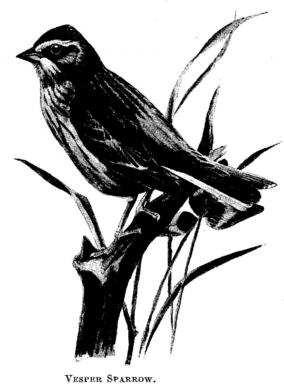
"I have been watching him too," said Rap; "a minute ago, when he flew over the stone fence, I saw he had white feathers outside on his tail—now he is back again."
"How very kind that bird is to come when he is wanted, and save my time—it is the Vesper Sparrow himself. I suspect that we are nearer to his nest than he cares to have us, he is so uneasy."
"Where would the nest most likely be?" asked Nat; "in a tree or a bush?"
"Most Sparrow nests are near the ground," said Rap.
"A little lower yet, Rap; the Vesper Sparrow sinks his deep nest either in thick grass or in the ground itself; but though it is thus supported on all sides it is as nicely woven as if it were a tree nest."
"It isn't a very pretty bird," said Dodo. "Does it sing well? Why is it called the Vesper Sparrow—what does Vesper mean, Uncle Roy?"
"Vesper means evening. This plainly clothed little bird has a beautiful voice, and sings in the morning chorus with his brothers; but he is fond of continuing his song late into the twilight, after most others have gone to bed. Then in the stillness his voice sounds sweet and clear, and the words of the song are: 'Chewee, chewee, chewee lira, lira, lira lee.' That is the way he says his evening prayers: you know that in some of the churches there is a beautiful service called Vespers. Ah, if we only knew bird language!"
"Do you remember," said Olive, "last night when you were going to bed you asked me if it wasn't a very rare bird that was singing so late down in the garden, and I told you that it was a Sparrow? It was the Vesper Bird, perhaps the very one who is over there in the bushes, wondering if the giant House People will find his nest. You can easily tell him when he flits in front of you by the roadside, because he always shows two white feathers, one on each side of his tail."
The Vesper Sparrow
Length six inches.
Upper parts brown, streaked with dusty; some bright bay on the wings, but no yellow anywhere, and two white tail-feathers.
Under parts dull-white, striped on breast and sides with brown.
A Citizen of North America from Canada southward, nesting north of the Middle States.
A regular member of the guild of Weed Warriors, and in summer belonging also to the Seed Sowers and Ground Gleaners.
WHITE-THROATED SPARROW. (THE PEABODY BIRD)
"The White-throat is another bird that you will not see in his summer home, unless you look for him in the Northern States. You may find him nesting about the White Mountains, on or near the ground, with the Olive-backed Thrush and Winter Wren. In other places he may be seen as a visitor any time in spring and autumn, or may even linger about the whole winter. You remember the dead one Nat found, that we used when I was teaching you something about birds in general that rainy day, before I began to tell you the particular bird stories.
"If you think of Sparrows only as a sober, dusty-colored family, you may be surprised to learn that this large, handsome bird, with the white throat, the head striped with black and white, a yellow spot over the eye, and richly variegated brown feathers, is a member of that group."
"It bothered me dreadfully at first," said Rap, "until one fall some sportsmen, who came through the upper fields looking for Quail, whistled his song and told me about him. There were lots of them here early this spring by the mill, but the miller didn't like them because they pitched into his new-sown pasture and gobbled the grass-seed."
"Yes, of course they eat grass-seed in spring, when the old weed seeds of autumn are well scattered; but surely we must give a Citizen Bird some good valuable food, not treating him like a pauper whom we expect to live always on refuse.
"Some morning in early spring, when the Chickadees who have wintered about the Farm are growing restless, and about ready to go to a more secluded spot to nest, you will hear a sweet persuasive whistling song coming from a clump of bushes. What is it? Not a Bluebird, or a Robin. The notes are too short and simple for a Song Sparrow or a Thrush, too plaintive for a Wren, and too clear for a lisping Wood Warbler.
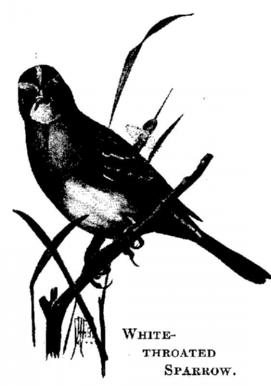
"Presently several White-throats fly down to a bit of newly seeded lawn or patch of wild grass, where they feed industriously for a few minutes, giving only a few little call-notes—'t'sip, t'sip'—by way of conversation. Then one flies up into a bush and sings in a high key. What does he say—for the song of two short bars surely has words? One person understands it one way, and thinks the bird says 'all-day whittling, whittling, whittling!' Some one else hears 'pe-a—peabody—peabody—peabody!' While to me the White-throat always says 'I work—cleverly, cleverly, cleverly—poòr mè—cleverly, cleverly, cleverly!'"
As the Doctor paused a moment, Rap whistled an imitation of the song, throwing the sound far from him after a fashion that the Chat has, so that it seemed to come from the trees, completely deceiving Dodo. "Uncle, uncle!" she whispered, creeping softly up to him, "one of the White-throats must have stayed until now, for that bird says 'cleverly! cleverly! cleverly!'"
Rap was delighted at the success of his imitation, and Nat and Dodo tried to whistle with him, Dodo being the most successful.
"Oh! oh! what happens to whistling girls?" said Nat, who was a little provoked at her success.
"Nothing at all," said Olive, "when they only whistle bird-songs. I've whistled to birds ever since I could pucker up my lips, and father taught me how—didn't you, father dear? Only you used to say, 'Never whistle in public places.'"
"I believe I did; and Rap shall teach you, Dodo, so you can call a bird close to you by imitating its song."
The White-throated Sparrow
Length about six and a half inches.
Striped on the back with bay, black, and gray; two white crossbars on each wing, the edge of which is yellow; two white stripes on the black crown, and a yellow spot before the eye.
Gray below, more slate-colored on the breast, with a pure white throat, which is bounded by little black streaks.
A Summer Citizen of the Northern States and beyond. Spends the winter in the Middle and Southern States.
Belongs to the guild of Weed Warriors, and is a bright, cheerful, useful bird.
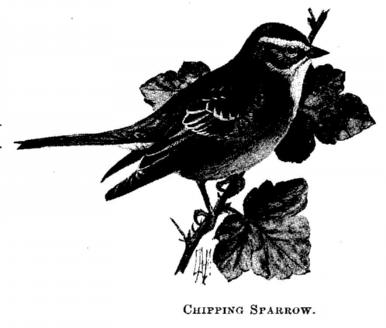
THE CHIPPING SPARROW (THE CHIPPY. THE SOCIABLE BIRD)
"I know a Chippy now, when I see it, before you tell us anything about it!" said Dodo gleefully. "There were three or four dear little ones yesterday on the grass, near the dining-room window. They had velvety brown caps on, and said 'chip, chip, chip' as they hopped along, and as they didn't seem afraid of me I threw out some bread-crumbs and they picked them up. Then I knew, to begin with, that they must be seed-eating birds."
"How did you know that?" asked Nat. "Bread-crumbs aren't seeds!"
"No, but bread is made of ground-up wheat-seed! Don't you remember Olive said so last week when she told us about all the grains?"
"Yes," said Nat reluctantly.
"Birds that won't eat seeds won't eat bread-crumbs either," continued Dodo earnestly; "'cause I tried Wood Thrushes with bread-crumbs last week and they simply turned up their noses at them."
Rap and Nat laughed at the idea of birds turning up their noses, but the Doctor said:
"Very good indeed, Miss Dodo, you are learning to use your eyes and your reason at the same time. Tell us some more about your Chippies."
"At first I didn't know what they were, and then they seemed like some kind of Sparrows; so I went to the wonder room and looked at some of the books that you left out on the low shelf for us. I couldn't find any picture that matched, but then I began to read about Sparrows, and when I came to Chippy Sparrow I was sure it matched; for the book said it was a clever little fellow with a jaunty red cap that came with his mate to the very door and that children make the Chippy's acquaintance and hunt in the vines on the piazza or in a bush for its nest and that the nest is very neat and made of horsehair—" Here Dodo stopped to get her breath.
"Bravo! bravo!" called the Doctor. "I see that I shall soon have to resign my place as Bird Man if this young lady takes to bird hunting and reading also. Is there more to come, little one?"
"Yes, Uncle Roy, just a little bit more. Because the book said children looked for Chippies' nests I went right away to see if I could find one. First I hunted in all the bushes, and the Catbirds scolded me and the Brown Thrasher in the barberry bush was very mad and a Robin in the low crotch of the bell-pear tree nearly tipped his nest over, he flew away in such a hurry. I thought I had better stop, but by this time I was way down in the garden and all at once I saw a Chippy fly straight into the big rose bush at the beginning of our arbor. I looked in and there about as high up as my chin was the loveliest little nest like a nice grass cup, with pretty rosebuds all around it for a trimming, and on it sat a Chippy—and do you know it never flew away when I stroked its back with my finger! It was so cute and friendly I thought I would give it a little mite of a kiss on top of its head. But I guess it misunderstood and thought I meant to bite, for it flew off a little way and I saw three speckled blue eggs and—then I thought I'd better come away." "Did you hear it sing?" asked Nat.
"No—it only said 'chip—chippy—chip.'"
"Chippies have two songs," said the Doctor. "One is a kind of chirp or trill like an insect's note—'trr-r-r-r-r.' They give this usually when they first wake up in the morning. The other is a pretty little melody, but is less frequently heard."
"If they eat seed, why don't they stay here all winter?" asked Rap; "yet I'm sure they don't."
"They are not as hardy as some of their brothers, and do not like our winter weather; but even in autumn you may mistake them for some other Sparrow, for then Mr. Chippy takes off his brown velvet cap, and his dainty little head is stripped."
The Chipping Sparrow
Length about five inches.
A dark chestnut cap, a light stripe over the eye, and a dark stripe behind the eye; forehead and bill black; back streaked with black, brown, and buff; rump slate-gray; wings and tail dusky.
Under parts plain light gray, almost white on throat and belly, darker on breast.
A Citizen of North America, nesting from the Gulf of Mexico to Canada, wintering in the Southern States and beyond.
A Weed Warrior and a member of the Tree Trappers and Ground Gleaners in nesting-time.