XIV MEDICINES FROM THE METALS
Reading edition
Metals are all identical in their essence; they only differ by their form. The form depends on accidental causes which the artist must seek to discover. The accidents interfere with the regular combinations of sulphur and mercury; for every metal is a combination of these two substances. When pure sulphur meets pure mercury, gold results sooner or later by the action of nature. Species are immutable and cannot be transformed from one into the other; but lead, copper, iron, silver, &c., are not species. They only appear to be from their diverse forms.
Albertus Magnus:—“De Alchemia.” (About 1250.)
ANTIMONY.
Some of the old writers insisted that antimony (the native sulphide) was used as a medicine by Hippocrates who called it Tetragonon, which simply meant four-cornered, and of which we also know that it was made up with the milk of a woman. The reason which the iatro-chemists gave for believing that this compound was made from antimony was worthy of the age when it was the practice to apply enigmatic names to medicinal substances, a practice, however, quite foreign to Hippocrates. They understood the term to imply four natures or virtues, and they said antimony had four virtues, namely, sudorific, emetic, purgative, and cordial; therefore tetragonon meant antimony.
The Etymology of Antimony.
The name of this metal is one of the curiosities of philology. The old legend was that Basil Valentine, testing his medicine on some of his brother monks, killed a few of them. “Those who have ears for etymological sounds,” says Paris in “Pharmacologia,” “will instantly recognise the origin of the word antimonachos, or monks-bane.” Another version of the monk story is to the effect that after Basil Valentine had been experimenting with antimony in his laboratory he threw some of his compounds out of the window, and pigs came and ate them. He noticed that after the purgative action had passed off the pigs fattened. On this hint he administered the same antimonial preparation to certain monks who were emaciated by long fasts, and they died through the violence of the remedy.
These stories were probably the invention of some French punster, who worked them into shape out of the French name of the substance, antimoine, which, without the change of a letter, might mean bad for the monk. Littré entirely demolished any possibility of their truth by discovering the name in the writings of the Salernitan physician, Constantine, the African, who lived at the end of the eleventh century, three or four hundred years before the earliest dates suggested for Basil Valentine.
Other suggested derivations have been anti-monos, for the reason that the sulphide was never found alone; anti-menein, in reference to its tonic properties; and anti-minium, because it was used as an eye paint in the place of red lead. These are all guesses unsupported by evidence.
The modern philological theory is that the early Latin stibium and the late Latin antimonium have the same etymological origin. Stibium was the Latinised form of the Greek stimmi. Stimmi declined as stimmid—and this may have found its way into the Arabic through a conjectural isthimmid to the known Arabic name uthmud, which via athmud and athmoud became Latinised again into antimonium.
Al-Kohol.
The antimony known to the ancients as stibium or stimuli was the native sulphide which Eastern women used for darkening their eyelashes. Probably it was used by Jezebel when, expecting Jehu at Samaria, “she painted her eyes and tired her head.” The Hebrew expression is “she put her eyes in paint,” and the Hebrew word for the paint is Phuph; (2 Kings, c. 9, v. 30). In Ezekiel, c. 23, v. 40, a debauched woman is described who painted her eyes, and in this case the Hebrew word employed is Kohol. The Septuagint translated both Phuph and Kohol by stimmi. The method is still used by Arabic women. They have a little silver or ivory rod which they damp and dip into a finely levigated powder called ismed, and draw this between the eyelids. Karrenhappuch, one of Job’s daughters, meant a vessel of antimony. The writer of the Book of Enoch says that the angel Azazel taught the practice to women before the Flood. He “taught men to make swords, and knives, and shields, and coats of mail, and made known to them metals, and the art of working them; bracelets, and ornaments, and the use of antimony, and the beautifying of the eyebrows, and the most costly and choicest stones, and all colouring tinctures, so that the world was changed.” Some of the early Christian fathers condemned the vanity. “Inunge oculos non stibio diaboli, sed collyrio Christi,” writes Tertullian.
Alchemical Hopes of Antimony.
The alchemists and the early chemical physicians had great hopes of antimony. “They tormented it in every possible manner,” says Fourcroy, “in the hope of getting from it a universal remedy.” With it, too, they were convinced that they were coming near to the transmutation of other metals into gold. Noticing how readily it formed alloys with other metals they named it Lupus Metallorum, the Wolf of Metals. Their process for getting the Powder of Projection, as well as can be gathered from their mystic jargon was to first fuse the crude antimony, the sulphide, with iron which withdrew the sulphur from the antimony. The metal thus obtained they called the Martial Regulus of Antimony. Regulus, or little king, implied an impure gold. Combining this with corrosive sublimate and silver, and subliming the mixture they got the lunar butter of antimony. The sublimation had to be repeated eight or ten times, the residue, or fæces, being added to the sublimate every time. At last the sublimed butter of antimony was transferred to an oval glass vessel capable of containing twelve times its quantity, and hermetically sealed. The Philosophic Egg, as the vessel with its contents was called, was then placed in a sand-bath and kept at a moderate heat for several months. When it had become converted into a red powder, the operation was finished. This powder was the Powder of Projection. It was sprinkled on other metals in a state of fusion, mercury being an ingredient of the fused mass, and yellow gold was produced.
Antimonial Compounds.
By other processes the early experimenters obtained various other products. By simply heating crude antimony in a crucible they would sometimes get a vitreous substance in consequence of some of the silica of the crucible combining with the antimony. That was their glass of antimony, which was generally an oxide with some sulphide. In other cases the so-called liver of antimony resulted, a compound containing a larger proportion of the sulphide. This they also called crocus metallorum or saffron of the metals, and one or other of these products was originally the basis of antimonial wine.
It was digested with Rhine wine, and the tartar of the wine formed a tartrate of antimony, but, as may be supposed, the composition of the wine was very variable. Emetic tartar was subsequently substituted for the liver.
The crystalline protoxide of antimony obtained by inflaming, volatilising, and condensing the regulus was known as argentine flowers of antimony. The regulus heated with nitric acid yielded a compound of metal with antimonious acid, and was called mineral bezoar; a compound, really a suboxide, got by fusing sulphide of antimony and nitre was called diaphoretic antimony; the chloride, first made by distilling crude antimony (the native sulphide) with corrosive sublimate, yielded the thick soft butter of antimony; the addition of water to this chemical caused the precipitation of a white oxychloride which was long known as Algaroth’s powder, or mercury of life. It contained no mercury, but was the most popular emetic before the introduction of the tartrate. Victor Algarotti, who introduced it, was a physician, of Verona, who died in 1603. It was alleged that he was poisoned by his local rivals in consequence of the success of his remedy. He was also the inventor of a quintessence of gold.
The regulus of antimony in alloy with some tin was used to make the antimony cups from which antimonial wine originated. It was also made into the pilulæ perpetuæ, or everlasting pills, which, passing through the body almost unchanged, were kept as a family remedy and taken again and again. It is probable that the surface of these pills became slightly oxidised, and consequently acquired a medicinal effect.
Kermes Mineral.
One of the most famous of the antimony compounds was the kermes mineral, which it is understood was invented by Glauber about 1651. He made it by treating a solution of the oxide of antimony with cream of tartar, and then passing a current of sulphuretted hydrogen through the solution. An orange-red powder was obtained, and famous cures were effected by it. Glauber kept his process secret, but a Dr. de Chastenay learnt it after Glauber’s death from one of his pupils and confided it to a surgeon named La Ligerie, who in his turn communicated it to Brother Simon, a Carthusian monk, who at once commenced successfully to treat his brother monks with it, and soon after the Poudre des Chartres was one of the most popular remedies in France for many serious diseases, small-pox, ague, dropsy, syphilis, and many others. In 1720 Louis XIV bought the formula for its preparation for a considerable sum from La Ligerie. It has been agreed by chemists, Berzelius and others, who have studied Kermes Mineral, that it is a mixture of about 40 per cent. or less of oxide of antimony with a hydrated sulphide of the metal, and a small proportion of sulphide of sodium or potassium (according to the method of preparation). It is still official in the Pharmacopœias of the United States and of many Continental countries.
From the solution from which the Kermes had been deposited a further precipitate was obtained by the addition of hydrochloric acid. This, too, was a mixture, consisting of protosulphide and persulphide of antimony with some sulphur. It was the golden sulphuret which in association with calomel became so noted in the form of Plummer’s powder and Plummer’s pills. The powder was at first known as Plummer’s Æthiops Medicinalis.
It would be tedious to go through the multitude of antimonial compounds which have become official, and it would be impossible in any reasonable space even to enumerate the quack medicines with an antimonial base which were so recklessly sold in this and other countries, especially in the earlier half of the seventeenth century. The most important of all the antimonial compounds, or, at least, the one which has maintained the favour of the medical profession in all countries, is, of course, the tartrate of antimony and potassium, emetic tartar.
Emetic Tartar.
Adrian Mynsicht, physician to the Duke of Mecklenburg in the early part of the seventeenth century, is generally credited with the invention of emetic tartar. Certainly the earliest known description of it is found in his “Thesaurus Medico-Chymicum,” published in 1631. But Hofer has pointed out that the mixture known as the Earl of Warwick’s Powder, which consisted of scammony, diaphoretic antimony (a binantimoniate of potash) and cream of tartar, which Cornachinus of Pisa described in 1620, was really its forerunner, and he considers that the salt was recognised in medicine before Mynsicht published his description.
Glauber, in 1648, described the process of making Mynsicht’s emetic tartar from cream of tartar and argentine flowers of antimony.
Antimony Controversy.
No medicine has been more violently attacked or so enthusiastically praised as antimony. The virulent antagonism to it manifested by the Faculty of Physicians of Paris was unquestionably the exciting cause of much of the fame to which it attained. It is generally stated that on the instigation of the Faculty the Parliament of Paris decreed that it should not be employed in medicines at all. This, however, has been proved to be incorrect. Certainly the Faculty in 1566 did, in fact, forbid its own licentiates to use it, and actually expelled one of their most able associates, Turquet de Mayerne, because he had disobeyed their injunction. But M. Teallier has shown by documentary evidence that the decree of the Parliament did not go beyond requiring that antimony should not be supplied for medicinal use except on the order of a qualified physician. The action of the Faculty, although approved for a time, was later almost disregarded, and when the court physicians cured the young king, Louis XIV, in 1657, by the administration of antimony, the defeat of the anti-antimonists was completed. The repeal of the decree against antimonials was dated 1666, just a century after its promulgation.
Louis XIV was taken dangerously ill at Calais, in 1657, when he was 19 years of age. A physician (Voltaire says a quack) of Abbeville had the audacity to treat him by the administration of emetic tartar, and the King himself and his Court were convinced that he owed his life to this remedy. The opponents of antimony were silenced, though they did not yield in their opinion. Gui Patin, who had termed the new medicine “tartre stygiè” (its usual French name was tartre stibié), protested against the attempt to canonise this poison, and asserted that the cure of the king was due to his own excellent constitution.
To illustrate the earnestness, not to say the ferocity, of medical controversy at the beginning of the seventeenth century, the record of the expulsion of Turquet de Mayerne from the College of Physicians of Paris, in 1603, quoted from the minutes of the College and translated by Nedham, may be given. It should be remembered that Turquet was the favourite physician of Henri IV, and, nominally, his offence was that he had published a defence of his friend, Quercetanus, who had prescribed mercurial and antimonial medicines. The minute is in the following terms:—
The College of Physicians in the University of Paris, being lawfully congregated, having heard the Report made by the Censor to whom the business of examining the Apology published under the name of Turquet de Mayerne, was committed, do with unanimous consent condemn the same as an infamous libel, stuffed with lying reproaches and impudent calumnies, which could not have proceeded from any but an unlearned, impudent, drunken, mad fellow: And do judge the said Turquet to be unworthy to practise physick in any place because of his rashness, impudence, and ignorance of true physick: But do exhort all physicians which practise Physick in any nations or places whatsoever that they will drive the said Turquet and such like monsters of men and opinions out of their company and coasts; and that they will constantly continue in the doctrine of Hippocrates and Galen. Moreover, they forbid all men that are of the Society of the Physicians of Paris, that they do not admit a consultation with Turquet or such like person. Whosoever shall presume to act contrary shall be deprived of all honours, emoluments, and privileges of the University and be expunged out of the regent Physicians.
Dated December 5, 1603.
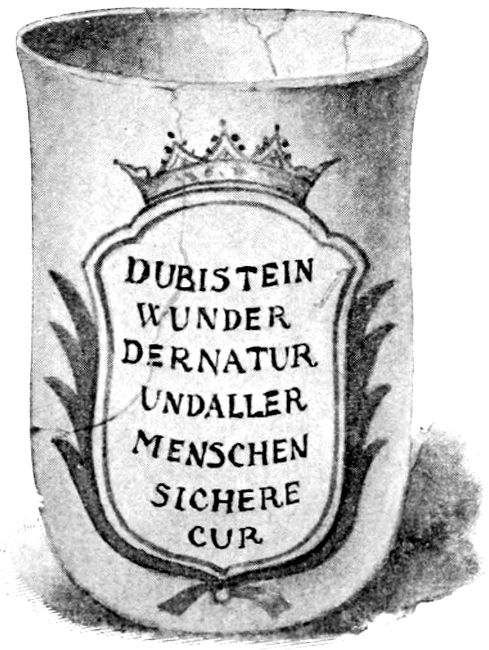
Antimony Cup.
(From an illustration to a note by Professor Redwood in the Pharmaceutical Journal, July 1, 1858.)
Antimony Cups (Pocula Emetica)
were in use in the sixteenth and seventeenth centuries, more perhaps in Germany than in this country. The one illustrated is in the Museum of Practical Geology, Jermyn Street. It was bought for a shilling at a sale at Christies’ in 1858, and was described in the catalogue as “An old metal cup, with German inscription and coronet, gilt, in woodcase.” The cups are said to have been made of an alloy of tin and antimony, and wine standing for a time in one of them would become slightly impregnated with emetic tartar, the tartar of the wine acting on the film of oxide of antimony which would form on the inner surface of the cup. How far these cups were used in families does not appear, but it is said they were common in monasteries, and that monks who took too much wine were punished by having to drink some more which had been standing in the poculum emeticum. Dr. Walter Harris, in “Pharmacopœia Anti-Empirica” (1683) refers to the cups, and says, “their day is pretty well over. It is rare to meet with one now.”
It was supposed by the early chemical physicians that antimony imparted emetic properties to wine without any loss of weight. Angelo Sala tells of a German who attained some fame in his time by letting out a piece of glass of antimony on hire. The patient was instructed to immerse this in a cup of wine for three, four, or five hours (according to the strength of the person prescribed for), and then to drink the wine. The practitioner charged a fee of a dozen fresh eggs for the use of his stone, and, as he had hundreds of clients, patients had to wait their turn for their emetic.
BISMUTH.
Bismuth, the metal, was not known to the ancients nor to the Arabs. It was first mentioned under that name by Agricola, in 1546, in “De Natura Fossilium,” and was not then regarded as a distinct body. Agricola considered it to be a form of lead, and other mining chemists believed that it gradually changed into silver. The Magistery (trisnitrate or oxynitrate) was the secret blanc de fard which Lemery sold in large quantities as a cosmetic. He bought the secret from an unknown chemist and made a large fortune out of it. His process was to dissolve one ounce of the metal in two ounces of nitric acid and to pour on the solution five or six pints of water in which one ounce of sea-salt had been dissolved. The sea-salt would yield a proportion of bismuth oxychloride in the precipitate. Lemery made a pomatum, ʒi to the ounce, and a lotion, ʒi to ʒiv of lily water.
Until the latter part of the eighteenth century bismuth salts were regarded as poisonous and were scarcely used in medicine by way of internal administration. Even Odier, of Geneva, to whom we owe the introduction of this medicine in dyspepsia and diarrhœa, prescribed it in 1 grain doses with 10 grains each of magnesia and sugar.
Lemery says the bismuth of his time was a compound made in England from the gross and impure tin found in the English mines. “The workmen mix this tin with equal parts of tartar and saltpetre. This mixture they throw by degrees into crucibles made red hot in a large fire. When this is melted they pour it into greased iron mortars and let it cool. Afterwards they separate the regulus at the bottom from the scoriæ and wash it well. This is the tin-glass, which may be called the regulus of tin.” Pomet says much the same about the composition. He adds, “It is so true that tin-glass is artificial that I have made it myself, and am ready to show it to those who won’t believe me.”
Those writers belonged to the first quarter of the eighteenth century. A quarter of a century later Quincy is telling us that the metal called Bismuth “is composed of tin, tartar, and arsenic, made in the northern parts of Germany, and from thence brought to England.”
Meanwhile Stahl and Dufay had been studying bismuth and had established its character and elementary nature.
Liquor Bismuthi et Ammonii Citratis was introduced into the B.P. 1867, as an imitation of the proprietary Liquor Bismuthi, which Mr. G. F. Schacht, pharmaceutical chemist, of Clifton, had invented a few years previously. It was found that the official preparation differed from the proprietary one in taste and action principally because no attempt had been made to free it from the nitric acid used to dissolve the bismuth. This was corrected in 1885 by a liquor prepared from citrate of bismuth dissolved by solution of ammonia. This method has been further elaborated. Continental physicians have not favoured a solution of bismuth. They consider that the remedial value of bismuth depends on its insolubility; this view now obtains in England also.
Trochisci Bismuthi Compositi of the B.P. 1864, were believed to be intended to imitate the “Heartburn Tablets,” made by Dr. Burt, an eminent medical practitioner of Edinburgh in the early part of the nineteenth century, and sold for him at a guinea a pound. Notwithstanding the price, perhaps because of it, these tablets attained to considerable popularity. It was said that Dr. Burt and his apprentices made all he supplied in his kitchen. Some said that his tablets contained no bismuth, the antacid properties being due entirely to chalk. In 1867 rose-flavour was substituted for cinnamon in the official lozenges, and in 1898 the oxynitrate of bismuth gave place to oxycarbonate.
GOLD.
For gold in physick is a cordiall, Therefore he loved gold in special. Chaucer’s Doctour of Phisike.
The employment of gold as a remedy is but rarely mentioned in ancient medical literature. Gold leaf was probably used by the Egyptians to cover abrasions of the skin. Pieces of it have been found on mummies apparently so applied. Some of the Arab alchemists, Geber among them, are believed to have made some kind of elixir of life from gold, but their writings are too enigmatical to be trusted. Avicenna mentions gold among blood purifiers, and the gilding of pills originated with the Eastern pharmacists. Probably it was believed that the gold added to the efficacy of the pills. It was not, however, until the period of chemical medicine in Europe that gold attained its special fame.
Arnold of Villa Nova, and Raymond Lully were among the advocates of the medicinal virtues of gold; but in the century before Paracelsus appeared, Brassavolus, Fallopius, and other writers questioned its virtues. With Paracelsus, Quercetanus, Libavius, Crollius, and others of that age, however, gold entered fully into its kingdom. They could hardly exalt it too highly. But it is difficult to ascertain from the writings of this period what the chemical physicians understood by gold.
Paracelsus says it needs much preparation before it can be administered. To make their aurum potabile some of the alchemists professed to separate the salt from the fixed sulphur, which they held was the real principle of gold, its seed, as some of them called it, and to obtain this in such a form that it could be taken in any liquor. The seed of gold was with many of them the universal medicine which would cure all diseases, and prolong life indefinitely. It was the sulphur of the sun with which that body revivifies nature.
Paracelsus prescribed gold for purifying blood, and intimates that it is useful as an antidote in cases of poisoning, and will prevent miscarriages in women. He considered it not so cordial as emeralds, but more so than silver. He also states that if put into the mouth of a newly-born babe it will prevent the devil from acquiring power over the child.
The Archidoxa Medicinæ of Paracelsus, his famous Elixir of Long Life, is believed to have been a compound of gold and corrosive sublimate. He recommended gold especially in diseases connected with the heart, the organ which the sun was supposed to rule. Among the earlier Paracelsians Angelo Sala wrote a treatise on gold, entitled “Chrysologia, seu Examen Auri Chymicum,” Hamburg, 1622. Sachsens prepared a Tinctura Solis secundem secretiorem Paracelsi Mentem preparata. But Thurneyssen, who carried on his quackeries on the largest scale, did the most to push the gold business. His Magistery of the Sun attained to great popularity in Germany, and these and his other preparations, together with the astrological almanacks and talismans which he sold, enabled him to live in great splendour at Frankfort, where he is said to have employed 200 persons in his laboratory. His fame departed, however, and he died in poverty at Cologne, in 1595.
Aurum Potabile.
Roger Bacon is said to have held that potable gold was the true elixir of life. He told Pope Nicholas IV that an old man in Sicily, ploughing, found one day a golden phial containing a yellow liquid. He thought it was dew, drank in off, and was immediately transformed into a hale, robust, handsome, and highly accomplished youth. He entered into the service of the King of Sicily, and remained at court for the next eighty years.
Francis Anthony was a famous quack in the reigns of Queen Elizabeth and James I. The College of Physicians took proceedings against him several times, fined him and imprisoned him, but aristocratic influences were exerted on his behalf and ultimately the College found it prudent to let him alone. His panacea “Aurum potabile” professed to be a solution of gold, and the wealthy classes of the period had unbounded belief in its wonderful remedial virtues. Some years after the death of Anthony the famous Honourable Robert Boyle (the “Father of philosophy and brother of the Earl of Cork”) in the “Sceptical Chymist” wrote that though he was prejudiced against all such compositions, he had known (and he describes) some such wonderful cures resulting from this aurum potabile that he was compelled to bear testimony to its efficacy. Boyle also states that he had seen in part the preparation of this nostrum. He rather enigmatically reports that there was but a single ingredient associated with the gold, that this came from above, and was reputed to be one of the simplest substances in nature.
Anthony claimed that his product would cure most diseases; vomitings, fluxes, stoppages, fevers, plague, and palsies were included among the evils which it overcame. Several of the well-known physicians of the time wrote angry pamphlets denouncing Anthony’s pretensions. Dr. Matthew Gwynne’s “Aurum non aurum,” and Dr. Cotta’s “Cotta contra Antonium” were two of the most noted. Of course these gave Anthony opportunities of reply, and largely promoted the business. In one of his later publications Anthony boldly offered to exhibit his process to a committee of proper and unbiassed witnesses with the object of proving that the compound was truly a solution of gold. The challenge appears to have been accepted, and the Master of the Mint, Baron Thomas Knivet, and other experts were present when the test was made. According to Gwynne the result was failure, but I do not find any unprejudiced report of the experiment.
The writer of the life of Anthony in the old “Biographia Britannica,” who is his warm partisan, gives what he declares to have been the genuine formula for the aurum potabile. It had long been in the possession of Anthony’s descendants, he says, and was given to him (the author of the biography) by an eminent chemist. If this is true it is evident that a solution of gold would not have resulted from the process.
This is what the alleged Anthony’s manuscript prescribes:—The object, Anthony says, is to so far open the gold that its sulphur may become active. To open it a liquor and a salt are required, these together forming the menstruum. The liquor was 3 pints of red wine vinegar distilled from a gallon; the salt was block tin burnt to ashes in an iron pan; these to be mixed and distilled again and again. Take one ounce of filed gold, and heat it in a crucible with white salt; take it out and grind the mixture; heat again; wash with water until no taste of salt is left; mix this with the menstruum, one ounce to the pint, digest, and evaporate to the consistence of honey. The Aurum Potabile was made by dissolving this in spirit of wine.
Whatever may have been the opinion of the experts who watched Anthony make his Aurum Potabile, the sale of the panacea was not destroyed, perhaps not injured by the result. Anthony made a handsome fortune out of it and continued to sell it largely until his death in 1623, and according to the authority already quoted, his son John Anthony, who qualified as an M.D. and held the licence of the College, derived a considerable income from the sale of the remedy. Dr. Munk, however, in the “Roll of the College of Physicians” intimates that this gentleman was free from the hereditary stain. “He succeeded to the more reputable part of his father’s practice,” is the pleasant way in which Dr. Munk describes John Anthony, M.D. John, however, wrote the following epitaph on his father:
Though poisonous Envy ever sought to blame Or hide the fruits of thy Intention; Yet shall all they commend that high design Of purest gold to make a Medicine That feel thy Help by that thy rare Invention.
Glauber (1650) expounds “the true method of making Aurum Potabile,” knowledge of which, he says, was bestowed on him from the highest. “Haply there will be some,” he remarks at the beginning of his treatise on this subject, who will deny “that gold is the Son of the Sun, or a metallic body, fixed and perfect, proceeding from the rays of the Sun; asking how the Solary immaterial rays can be made material and corporeal?” But this only shows how ignorant they are of the generation of metals and minerals. Disposing of such incredulity by a few comments, and referring the sceptics to his treatise De Generatione Metallorum, he deals with several other irrelevant matters, and at last describes his process in prolix and unintelligible terms.
“℞ of living gold one part, and three parts of quick mercury, not of the vulgar, but the philosophical everywhere to be found without charges or labour.” He recommends, but not as essential, the addition to the gold of an equal part of silver. “The mixture of male and female will yield a greater variety of colours, and who knoweth the power of the cordial union of gold and silver?” These metals being mixed in a philosophical vessel will be dissolved by the mercury in a quarter of an hour, acquiring a purple colour. Heating for half an hour, this will be changed to a green. The compound is to be dissolved in water of dew, the solution filtered and abstracted in a glass alembic three times until the greenness turns to a black like ink, “stinking like a carcase.” After standing for forty hours the blackness and stink will depart, leaving a milky white solution. This is to be dried to a white mass, which will change into divers colours, ultimately becoming a finer green than formerly. That green gold is to be dissolved in spirit of wine, to which it will impart a quintessence, red as blood, which is the quickening tincture, a superfluous ashy body being left. After some more distillations and abstractions a strong red solution will be obtained which is capable of being diluted with any liquid and may be kept as a panacea for the most desperate diseases. Next to “the stone” this is the best of all medicines.
The author cautions his readers against the yellow or red waters sold by distillers of wine at a great price as potable gold. Further he explains that the solution of gold made with aqua regia or spirit of salt is of little or no medicinal value, because the Archeus cannot digest it, but can only separate the gold and discharge it in the excrements.
In the “Secrets of Alexis” (John Wight’s translation) a recipe for a potable liquor of gold is given which “conserveth the youth and health of man, and will heal every disease that is thought incurable in the space of seven doses at the furthest.” Gold leaf, lemon juice, honey, common salt, and spirit of wine were to be frequently distilled. “The oftener it is distilled the better it be.”
Kenelm Digby made a tincture of gold thus:—Gold calcined with three salts and ground with flowers of sulphur; burnt in a reverberatory furnace twelve times, and then digested with spirit of wine.
Lemery gives a formula for potable gold, or tincture of gold, or diaphoretic sulphur of gold:—Dissolve any quantity of gold you like in aqua regia; evaporate to dryness, and make a paste of the residue with essence of cannella. Then digest it in spirit. He adds, sarcastically I suppose, “This tincture is a good cordial because of the essence of cannella and the spirit of wine.”
About 1540 Antoine Lecoque, a physician of Paris, acquired considerable reputation for his cures of syphilis by gold. Fallopius, Hoffmann, and Dr. Pitcairn, of Edinburgh, more or less fully adopted his treatment, but the theory gradually dropped out of medical practice. It was revived early in the nineteenth century by Dr. Chrestien, of Montpellier, a physician of considerable reputation, and his ardent advocacy had for a time considerable effect. But subsequent trials in the French hospitals gave negative results.
There were, no doubt, many honest attempts to make aurum potabile, and certainly there were a multitude of frauds palmed off on to a public who had come to believe in the miraculous remedial powers of the precious metal. The following is one of the simplest formulas for extracting the virtue of gold. It is given in “Lewis’s Dispensatory,” 1785, but not with any suggestion of its medicinal value:—One drachm of fine gold was dissolved in 2 ounces of aqua regia. To the solution 1 ounce of essential oil of rosemary was added, and the mixture well shaken. The yellow colour of the acid solution was transferred to the oil, which was decanted off, and diluted with 5 ounces of spirit of wine. The mixture was digested for a month, and then acquired a purple colour. Lewis explains that the oil takes up some of the gold, which, however, is deposited on the sides of the glass, or floats on the surface in the form of a slight film.
Aurum Fulminans
was described in the works attributed to Basil Valentine, and later by Oswald Crollius. It is sometimes termed Volatile Gold. Valentine explains very clearly the process of making it, that is, by dissolving gold leaf in aqua regia and precipitating the fulminating gold by salt of tartar. By treatment with vinegar or sulphur its explosive properties were to be reduced. It was supposed to possess the medicinal value of gold in a special degree, and was particularly recommended as a diaphoretic. It appears from reports that it occasioned violent diarrhœas, and was, no doubt, often fatal. The so-called Mosaic Gold, which was given as a remedy for convulsions in children, was an amalgam of mercury with tin, ground with sulphur and sal ammoniac.
Hahnemann insisted that gold had great curative powers, and several homœopathic physicians of our time have highly extolled it. Dr. J. C. Burnett, in “Gold as a Remedy,” recommended triturations of gold leaf, one in a million, as a marvellous heart tonic, especially in cases of difficult breathing in old age.
IRON.
Iron was not regarded as of special medicinal value by the ancients. The alleged administration of the rust of iron by Melampus was apparently looked upon as a miracle, and though this instance is often quoted as the earliest record of ferruginous treatment, it does not appear to have been copied. Classical allusions, such as that of the rust of the spear of Telephus being employed to heal the wounds which the weapon had inflicted, which is referred to by Homer, can hardly be treated as evidences of the surgical skill of that period. Iron is not mentioned as a remedial agent by Hippocrates, but Dioscorides refers to its astringent property, and on this account recommends it in uterine hæmorrhage. He states that it will prevent conception; it subsequently acquired the opposite reputation. The same authority, as well as Celsus, Pliny, and others, allude to a practice of quenching a red-hot iron in wine or water in order to produce a remedy for dysentery, weak stomachs, or enlargement of the spleen.
The later Latin physicians made very little use of iron or its compounds. Oribasius and Aetius write of the uses of its oxide outwardly in the treatment of ulcers, and Alexander of Tralles prescribes both an infusion and the metal in substance for a scirrhus of the spleen. He was probably the earliest physician who discovered its value as a deobstruent. Rhazes, the Arab, gave it in substance, and in several combined forms, but Avicenna regarded iron as a dangerous drug, and suggested that, if any had been accidentally taken, some loadstone should be administered to counteract any evil consequences.
Vitriol (sulphate of iron and sulphate of copper) was the iron medicine most in use up to the sixteenth century; but it was not given with the special intention of giving iron. Paracelsus had great faith in the Arcanum Vitrioli, which, indeed, appears to have been sulphur. He also introduced the use of the magnet, but only externally. It was in the century after him that the salts of Mars came into general medical use. In the course of the seventeenth and eighteenth centuries the preparations of iron became very numerous. Iron filings brought into an alcohol, that is very finely powdered, were much employed, sometimes alone and sometimes saccharated, or combined with sugar candy. Crocus martis was the sesquioxide, æthiops martial was the black oxide, and flores martis, made by subliming iron filings and sal ammoniac, yielding an ammoniated chloride of iron, was included in the several British pharmacopœias of the eighteenth century.
The association of iron with Mars probably influenced the early chemical physicians in their adoption of iron salts in anæmic complaints, and as general tonics. The undoubted effect of iron remedies in chlorotic disease was naturally observed, and the reputation of the metal was established for the treatment of this condition long before it was discovered that iron is an invariable constituent of the human body. When this physiological fact came to be recognised it was supposed that the action of iron salts was explained; but, in fact, the investigations of the last century have only tended to make this theory doubtful.
It is known that in health the proportion of iron in the body is fairly constant. An average man’s blood contains about 38 grains, almost all of which is contained in the hæmoglobin. He requires from one to two grains every day to make up for waste, and this he gets in the meat and vegetable food which he absorbs. The vegetables obtain iron from the soil, and animals acquire it from the corn, roots, or grasses which they eat. So far as is known it is from these sources only that human beings assimilate the iron they require. It is very doubtful whether a particle of the iron administered in any of the multitudinous forms which pharmacy provides is retained. A noted modern physiologist, Kletzinsky, says “From all the hundredweights of iron given to anæmics and chlorotics during centuries not a single blood corpuscle has been formed.” For all that there is no medical practitioner of any considerable experience who has not found directly beneficial results follow the administration of these medicines in such cases.
To Sydenham and Willis, two of the most famous physicians of the seventeenth century, the general employment of iron as a medicine may be traced. Sydenham, in his treatise on hysteric diseases, which, he says, are occasioned by the animal spirits being not rightly disposed, and not as some supposed by the corruption of the blood with the menstrual fluid, points out that the treatment must be directed to the strengthening of the blood, for that is the fountain and origin of the spirits. In cachexies, loss of appetite, chlorosis, and in all diseases which we describe as anæmic, he recommends that if the patient is strong enough recourse should be had first to bleeding, this to be followed by a thirty days’ course of chalybeate medicine. Then he describes, much the same as modern treatises do, how rapidly iron quickens the pulses, and freshens the pale countenances. In his experience he has found that it is better to give it in substance than in any of the preparations, “for busy chemists make this as well as other excellent medicines worse rather than better by their perverse and over officious diligence” (Pechey’s translation). He advises 8 grains of steel filings made into two pills with extract of wormwood to be taken early in the morning and at 5 p.m. for thirty days; a draught of wormwood wine to follow each dose. “Next to the steel in substance,” he adds, “I choose the syrup of it prepared with filings of steel or iron infused in cold Rhenish wine till the wine is sufficiently impregnated, and afterwards strained and boiled to the consistence of a syrup with a sufficient quantity of sugar.”
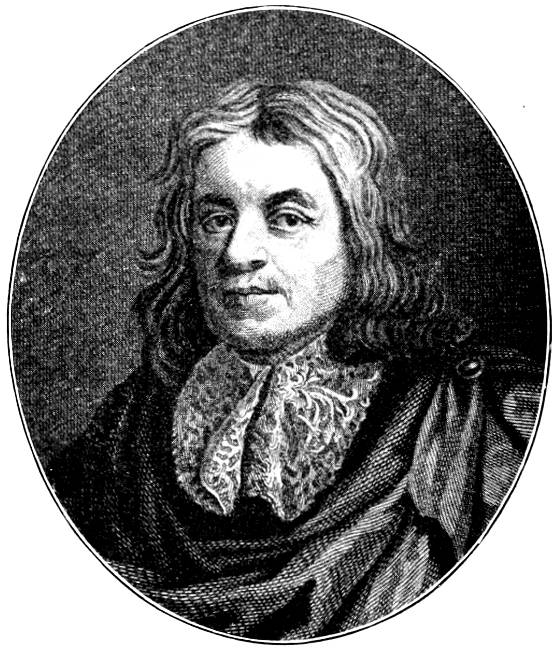
Dr. Thomas Sydenham. 1624–1689.
(Originator of Sydenham’s Laudanum.)
Dr. Willis had a secret preparation of iron of which Dr. Walter Harris, physician in ordinary to Charles II, in “Pharmacologia Anti-Empirica” (1683), writes:—“The best preparation of any that iron can yield us is a secret of Dr. Willis. It has hitherto been a great secret and sold at a great price. It was known as Dr. Willis’s Preparation of Steel.” Dr. Harris thinks it will not be an unacceptable service to the public to communicate this masterpiece of that eminent and ever famous man. “It was no strained stately magistery, no sublimation or salification, no calcined crocus, and no chemical mystery; but an easy and a natural way of opening this hard body that it may open ours.” It was given particularly for the removal of obstructions. The formula was equal parts of iron filings and crude tartar powdered and mixed with water in a damp mass in a glazed earthen vessel. This was to be dried over a slow fire or in the sun; wetted and dried again; and this process repeated four or five times. It might be given in white wine, or made into a syrup, or into pills, electuary, or lozenges. Dr. Willis preferred the crude tartar because the cream of tartar sold by the druggists was generally a cheat, often combined with alum. The crude could be bought at 6d. to 8d. per lb. In the apothecaries’ shops cream of tartar was sold at 3s. to 3s. 6d. per lb.
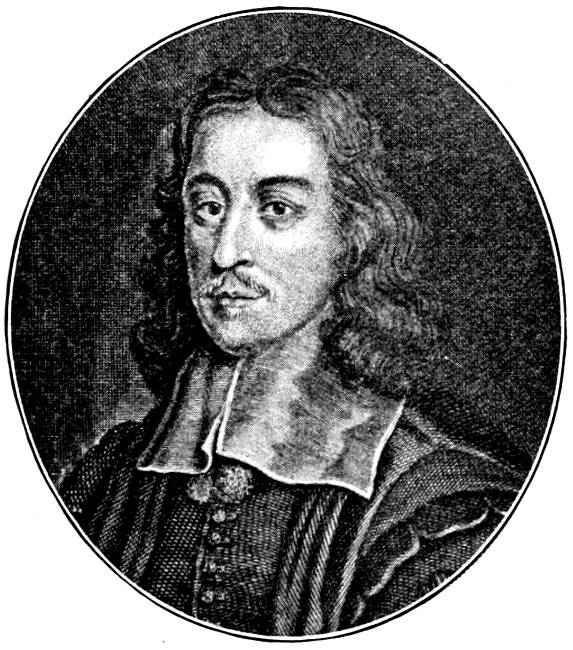
Thomas Willis, M.D. 1621–1675.
Quincy (1724), who frequently offers explanations of the exact way in which medicines exercise their remedial power, thus scientifically describes the action of iron in removing obstructions:—“Mechanics teach nothing more plainly than that the momenta of all percussions are as the rectangles under the gravities and celerities of the moving bodies. By how much more gravity then a metalline particle has more than any other particle in the Blood, if their celerities are equal, by so much the greater will the stroke of the metalline particle be against everything that stands in its way than of any other not so heavy; and therefore will any Obstruction in the Glands and Capillaries be sooner removed by such particles than by those which are lighter. This is a way of reasoning that is plain to the meanest Capacity.”
Tartarised iron has always been a favourite form for its administration. The Balls of Mars (boules de Mars, or boules de Nancy), still a popular medicine in France, are a tartarised iron prepared by a complicated process. First, a decoction of vulnerary species is made from 12 parts of water and 2 of the species. This is strained and poured on 12 parts of pure iron filings in powder. The mixture is evaporated to dryness and powdered. On this powder another decoction, 18 of water and 3 of species, is poured, and 12 parts of red tartar added. This compound is evaporated to the consistence of a firm paste, and a third decoction, 35 water and 5 species, is added to 25 of the paste and 25 of red tartar. This is evaporated to the proper consistence to make balls, which are usually about 1 oz. or 2 oz. in weight. They are kept to dry and then wrapped in wrapper. They are taken in doses of 4 to 5 grains much as Blaud’s pills are taken here. Sometimes the balls are dipped in water until a brown colour is imparted to the liquid. This water is also used as an application to bruises.
Mistura Ferri Composita was adopted in the P.L., 1809, from the formula of his anti-hectic mixture which Dr. Moses Griffith, of Colchester, had published thirty or forty years previously. Paris quotes it as a successful instance of a medical combination which could not receive the sanction of chemical law; and he testifies to the opposition offered on that ground to its official acceptance, but adds that subsequent inquiry had proved that the chemical decompositions which constituted the objections to its use were in fact the causes of its utility. It yields a protocarbonate of iron in suspension, and a sulphate of potash in solution. The compound of iron is in the state in which it is most active.
As evidence of the faith in ferruginous waters as tonics of the generative system, Phillips quotes from the thesis of Dr. Jacques, of Paris, a curious marriage contract said to have been common at one time among the burghers of Frankfort to the effect that their wives should not visit the iron springs of Schwalbach more than twice in their lives for fear of being too fruitful. The story looks suspiciously like an advertisement of Schwalbach.
Tincture of perchloride of iron acquired its reputation in the 18th century from the secret medicines known as La Mothe’s “gouttes d’or,” and Bestucheff’s Nerve Tincture (see page 321). The formula of the latter, published by the Academy of Medicine of St. Petersburg, was corrected by Klaproth, and under various names and in different forms found its way into all the pharmacopœias. Klaproth’s process was to dissolve powdered iron in a mixture of muriatic acid 3, and nitric acid 1; evaporate to dryness, and then leave the mass to deliquesce to a brown liquor. Mix this with twice its weight of sulphuric ether. The saturated ethereal solution to be mixed with twice its volume of spirit of wine, and kept in small bottles exposed to light until the liquid acquired the proper golden tint. A similar preparation is retained in the French Codex under the title of ethereal-alcoholic tincture of muriate of iron.
Reduced Iron, or Iron reduced by hydrogen, was first prepared by Theodore Quevenne, chief pharmacist of the Hôpital de la Charité, about the year 1854. Pharmacological experiments were made with it by himself in association with Dr. Miquelard. It was believed at first that the metallic iron obtained by the process described, which was to heat the hydrated oxide of iron in a porcelain tube to dull red, and then to pass a current of hydrogen through the tube, was absolutely pure, and from experiments on dogs they came to the conclusion that the metal in this form was more assimilable than any of its salts. It had besides the advantage of being almost tasteless. Quevenne’s treatise describing the process and the experiments was published in 1854 under the title of “Action physiologique et therapeutique des ferrugineux.” Later investigations, while supporting the original opinion to a great extent as to the assimilability of the reduced iron, established that the product is not and cannot be pure. Dusart showed in 1884 that the proportion of actual iron could not exceed 87 per cent., and was not likely to be more than 84 per cent. Oxides, and carbonates of iron were inevitable, while sulphur, arsenic, phosphorus, and silicon were probable contaminations from the gas.
Citrate of Iron in scales was introduced by Beral, of Paris, in 1831. His formula is given in the Pharm. Jnl., vol. I, p. 594.
Syrup of Phosphate of Iron was introduced in a paper read to the Medical Society of London in 1851 by Dr. Routh, and Mr. Greenish subsequently described to the Pharmaceutical Society the process by which it was prepared. The formula was afterwards improved by Mr. Gale, and his process was adopted in the B.P. It has since been modified.
A solution of iodide of iron was first employed in medicine in this country by Dr. A. T. Thomson some time in the '30’s of the nineteenth century. It was introduced into the London and Edinburgh Pharmacopœias in the form of a solid salt, and in the latter also in the form of a solution. Neither of those preparations could be preserved from decomposition, and the first suggestion of a syrup appears to have been made in Buchner’s Repertorium in 1839, and soon after by other experimenters. Dr. Thomson gave a formula for a syrup of iodide of iron to one of the earliest meetings of the Pharmaceutical Society in 1841, reported in the first volume of the Pharm. Jnl.
LEAD.
Lead is one of the ancient metals and was associated in classical writings with Saturn. The lead compounds used by the ancients in medicine were white lead or ceruse (carbonate and hydrate), and litharge (oxide). Ceruse is supposed to owe its name to cera, and to mean waxy; litharge is from Greek, and means silver stone; it was regarded as the scum of silver. Red lead or minium was also used to some extent in the form of an ointment.
Although not much used now as a medicine for internal administration, lead in various forms has been tried and advocated by doctors, usually as a sedative. The Pil. Plumbi c. Opio is what remains in our Pharmacopœia of these recommendations. Galen mentions lead as a remedy in leprosy and plague, and little bullets of lead were at one time given in cases of twisted bowels. The sedative property of lead salts has caused them to be prescribed for neuralgia, hysteria, and convulsive coughs; Goulard, recognising the anticatarrhal and astringent effects of the acetate, recommended it in urethritis; and on the theory that lead poisoning and phthisis were incompatible French practitioners at one time hoped to find in lead a remedy for tuberculosis.
Litharge was the basis of most of the popular plasters, and a century or two ago there were about a hundred of these either official or in demand. Litharge was called lithargyrum auri or lithargyrum argenti, according to its colour; but the deeper tint was only the result of a stronger fire in preparing the oxide. White lead was an ingredient in several well-known old ointments, the unguentum tripharmacum of Mesuë, which was the ceratum lithargyri of Galen, the unguentum nutritum, the unguentum diapomphologos, in which it was associated with pompholyx or oxide of zinc, and others. To a large extent these ointments were superseded after Goulard’s time by the unguentum Saturninum which he introduced. The ointment of Rhazes was composed of white lead, wax, and camphor dissolved in oil of roses. He also ordered the addition of the white of an egg to every half-pound, but this came to be omitted as it caused the ointment to become odorous. The Mother’s Ointment (onguent de la Mère) has long been a favourite ointment in France for promoting suppuration, and it is included in the Codex. It was made empirically by a nun at the Hotel Dieu, named La Mère Thecle, and as it became much sought after she furnished the formula. It is made by heating together mutton suet, lard, and butter, and when vapours are being exhaled, finely powdered litharge is sifted into the fats, causing a violent effervescence. Some wax and pure black pitch are afterwards added. The process has been studied by several pharmacists, and the conclusion come to is that the fats are decomposed and a number of fatty acids with some acroleine are produced. The operation is a rather dangerous one, especially if there is any naked light in the vicinity.
Magistery of Saturn was a white lead precipitated from a solution of the acetate by carbonate of potash. This was the principal ingredient in the Powder of Saturn devised by Mynsicht. The other components of this powder, which was recommended in phthisis and asthma especially, were magistery of sulphur (lac sulphuris), squine root, flowers of sulphur, pearls, coral, oatmeal, Armenian bole, flowers of benzoin, olibanum, sugar candy, saffron, and cassia.
The chief apostle of lead in medical practice was Goulard, whose name has become inseparably associated with the solution of the acetate. Some account of the bearer of this familiar name, and of his medicinal preparations of lead will be found in the section on Masters in Pharmacy.
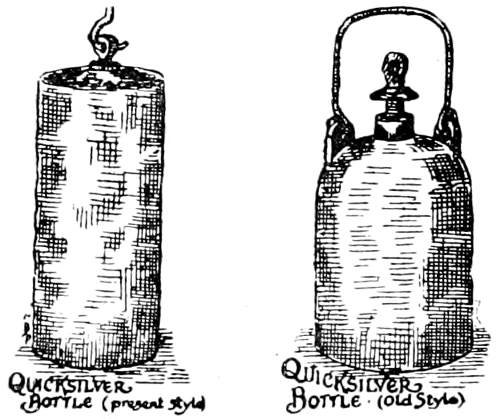
QUICKSILVER
is first alluded to in Greek writings by Theophrastus, about 315 B.C., but it was certainly known and used medicinally by the Chinese and in India long before. Apparently, too, it was known by the Egyptians. Dioscorides invented the name hydrargyrum, or fluid silver, for it. Pliny treats it as a dangerous poison. Galen adopted the opinion that the metal is poisonous, but states that he had no personal knowledge of its effects. With these authors argentum vivum was the term generally used to mean the native quicksilver, while hydrargyrum was more usually employed to describe the quicksilver obtained from the sulphide, cinnabar. Ancient writers appear to have regarded the two substances as distinct. Dioscorides points out that cinnabar was often confused with minium (red lead). The name Mercury, and the association of the metal (or demi-metal, as it was often regarded) with the planet and with its sign, formerly associated with tin, dates from the middle ages. It is mentioned first in this connection in a list of metals by Stephanus of Alexandria, in the seventh century.
Arabs used Mercury Medicinally.
The Arabs, who inherited the medical lore of the Greeks, and probably added to this in the case of mercury knowledge acquired from India, were much interested in mercury. In the chemical works attributed to Geber not only the metal itself, but its compounds, red precipitate and corrosive sublimate, are described. Much use of mercury was made by the Arabs in the form of ointments for skin diseases, for which Mesuë recommended it, and Avicenna was probably the first physician to express doubt in regard to the poisonous nature of the metal. He observed that many persons had swallowed it without any bad effect, and he noted that it passed through the body unchanged.
Mercury prescribed internally.
Fallopius (1523–1562) remarks that in his time shepherds gave quicksilver to sheep and cattle to kill worms, and Brassavolus (1500–1554) states that he had given it to children in doses of from 2 to 20 grains, and had expelled worms by that means. Matthiolus (died 1577) relates that he had known women take a pound of it at a dose with the object of procuring abortion, and says it had not produced any bad result.
Frictions and Fumigations.
Sprengel fixes the year 1497 as that in which mercury was first employed externally for the cure of syphilis. Frictions, fumigations, and plasters were the earliest forms in which it was employed. Berenger de Carpi, a famous surgeon and anatomist of Bologna, who practised in the early part of the sixteenth century, is said to have made an immense fortune by inventing and prescribing frictions with mercurial ointment for syphilis. John de Vigo was a strong partisan of fumigations in obstinate cases. His fumigations were made from cinnabar and storax. It is not quite clear whether this physician gave red precipitate internally in syphilis. He expressly indicates its internal use in plague.
Mercury a Remedy for Syphilis.
Peter Andrew Matthiolus, born at Sienna in 1500, died at Trent in 1577, latterly the first physician to the Archduke Ferdinand of Austria, a botanist and author of “Commentaries on Dioscorides,” was, according to Sprengel, the first who is known for certain to have administered mercury internally. Paracelsus, however, was without doubt the practitioner who popularised its use. He gave red precipitate, corrosive sublimate, and nitrate of mercury, and describes how each of these was made. Sprengel credits him also with acquaintance with calomel, but other authors do not recognise this in any of his writings.
Vigo’s Plaster.
The Emplastrum Vigonium was a highly complicated compound, which was held in great veneration and is the subject of innumerable comments in the pharmaceutical writings of the sixteenth, seventeenth, and eighteenth centuries. Charas, Lemery, Baumé, and others modified and simplified it. John de Vigo was a native of Naples, where he was born about 1460, and he became the first physician of Pope Julius II. His plaster still figures in the French Codex, and contains 600 parts of mercury by weight in 3,550 parts. This made into a liquid with olive oil and spread on calico makes the sparadrap of Vigo, in which form it is most frequently used, as an application to syphilitic eruptions.
Ambrose Paré gives the earliest formula for Vigo’s plaster, which was then called Emplastrum Vigonium seu de Ranis. It was looked upon as a masterpiece of combination. First 3½ oz. of earthworms were washed in water, and afterwards in wine. Then they and twenty-six live frogs were macerated in 2 lb. of odoriferous wine, and the whole was boiled down to two-thirds of its volume. A decoction of camel’s hay (andropogon schœnanthus), French lavender, and matricaria (chamomilla) was then mixed with this wine. Meanwhile 1 lb. of golden litharge had been “nourished” for twelve hours with oils of chamomile, dill, lilies, and saffron; these were melted down with 1 lb. each of the fat of the pig, calf, and viper. Human fat might be used instead of that of vipers. Juices of elder root and of elecampane with euphorbium, frankincense, and oil of spike were then worked in and the whole melted with white wax. Lastly, quicksilver extinguished by turpentine, styrax, oil of bitter almonds, and oil of bay, were added. In Lemery’s time the minimum proportion of mercury was 1 drachm to 1 oz. of the plaster. There was also a simple Vigo’s plaster made without mercury. In the Codex formula the worms, the frogs, the fats, the herbs, roots, and oils have all gone, but some more aromatic resins are added.
The First Mercurial Pills.
The first formula for mercurial pills was one which Barbarossa II, a famous pirate and king of Algiers, and admiral of the Turkish Fleet under Soliman, Sultan of Turkey, sent to Francis I, king of France, some time in the second quarter of the sixteenth century. The recipe was published (says Dr. Etienne Michelon, of Tours, in his “Histoire Pharmacotechnique de Mercure”) in 1537 by Petrus de Bayro, physician to the Duke of Savoy. He does not give the exact formula, but Lemery quotes it as follows:—
“Best aloes, and quicksilver extinguished by rose juice, aa 6 drachms;
“Trochises of agaric, ½ oz.; selected rhubarb, 2 drachms;
“Canella, myrrh, mastic, aa 1 drachm; musk, amber, aa 1 scruple;
“Make a mass with Venice turpentine.”
Lemery says you cannot kill the mercury with rose juice, but must use some of the Venice turpentine.
These pills were largely used in syphilis, but they were practically superseded later by the pills of Belloste, which are still official in the French Codex. These were very similar. Belloste was a French Army surgeon, and his formula was devised about the year 1700. A formula for them was published in the Pharmacopœia of Renaudot during Belloste’s lifetime, but after the death of Belloste in 1730 his son tried to make a mystery of the pills and sold them as a proprietary product, which probably had the effect of making them popular. The formula of Renaudot, which is also that of the Codex, was: Mercury, 24 (killed with honey); aloes, 24; rhubarb, 12; scammony, 8; black pepper, 4. Made into pills, each of which should contain 5 centigrams of mercury.
The Treatment of Syphilis.
It was at the close of the fifteenth century that syphilis began to spread through Europe. There are doubtful evidences of its existence in both Europe and Asia long previously, but the theory is generally accepted that it was brought from America by the sailors of the earliest expeditions, while its rapid spread throughout the old world in the decade from 1490 to 1500 has often been attributed to the Spanish Jews in the first place, and also particularly to the siege of Naples by the French in 1495. That large numbers of the French soldiers then engaged contracted it in the course of that war is undoubted, and as they were largely instrumental in spreading the contagion the disease soon came to be known as the French disease, or morbus Gallicus, though it has been questioned whether the adjective was not originally a reference to the skin diseases known under the name of “gale” or “itch.” The opinion that syphilis came from the west is not universally adopted. It has been pointed out that Columbus only reached Lisbon on March 6, 1493, on his return from his first voyage of discovery; and there are several more or less authentic allusions to the French disease before that date.
The rapidity with which this epidemic seized on all the countries of Europe, and the virulence of its symptoms, alarmed all classes and staggered the medical men of the day. Special hospitals were opened and Parliamentary edicts were promulgated in some of the French and German cities, ordering all persons contaminated to at once leave the neighbourhoods. Mercury was one of the first remedies to suggest itself to practitioners. It had been employed by the Arabs in the form of ointments and fumigations for skin diseases, and quacks and alchemists had long experimented with it in the hope of extracting a panacea from it. Before Paracelsus had begun to administer it, Torrella, physician to the Borgias, had prescribed mercurial lotions made from corrosive sublimate, and Jean de Vigo, of Naples, had compounded his mercurial plaster, and mercurial ointment, and had even given red precipitate in pills.
At the time when syphilis was causing excitement through Europe sarsaparilla and guaiacum were much praised as sudorifics, and wonderful cures of syphilis by them were reported. The poet and reformer Ulrich von Hutten wrote a book, De Morbo Gallico, in which he related his own years of suffering from the disease, and his complete cure by means of guaiacum in 30 days. “You may swallow these woods up to the tomb,” said Paracelsus. He had not much more respect for fumigations with cinnabar, which he regarded as a quack treatment by which it was impossible to measure the dose of the mercury, though he recognised that it cured sometimes. Red precipitate with theriacum made into pills with cherry juice was his favourite remedy, and was one of his laudanums. His Catholicon, or universal panacea, was a preparation of gold and corrosive sublimate, which was largely used by his followers under the name of Aurum Vitæ.
Corrosive sublimate was the great quack remedy for syphilis for more than a century, and the so-called vegetable remedies, syrups and decoctions of guaiacum, sarsaparilla, and sassafras, maintained their reputation largely in consequence of the perchloride of mercury, which was so often added to them. Aqua Phagadænica, 1 drachm of corrosive sublimate in 1 pint of lime water, was a very noted lotion for venereal ulcers. It began from a formula by Jean Fernel, a Paris medical professor and Galenist (1497–1558), who dissolved 6 grains of sublimate in 3 oz. of plaintain water. This was known as the Eau Divine de Fernel. By the time when Moses Charas published his Pharmacopœia this lotion had acquired the name by which it was so long known, and was made from ½ oz. of sublimate in 3 lb. of lime water, and ½ lb. of spirit of wine. It yielded a precipitate which varied in colour from yellow to red.
A curious controversy prevailed for a long time among the chemical and medical authorities in France in regard to a popular proprietary remedy for syphilis known as Rob Boyveau-Laffecteur. It was sold as a non-mercurial compound. It was first prepared or advertised in 1780 by a war office official named Laffecteur, whose position enabled him to get it largely used in the army. Subsequently a Paris doctor named Boyveau bought a share in the business, but in time the partners separated, and both sold the Rob. Boyveau wrote a bulky volume on the treatment of syphilis, and in that he strongly praised the Rob. After the deaths of Laffecteur and Boyveau the business came into the hands of a Dr. Giraudeau, of St. Gervais. This was about the year 1829. In 1780 the Academie de Medicine had examined this preparation, and had apparently, though not formally, tolerated its sale. Their chemist, Bucquet, had been instructed specially to examine the syrup for sublimate. He reported that he could not find any, but he was by no means sure that there was none there, for he stated that he had himself added 2 grains to a bottle, and could not afterwards detect its presence. Between that time and 1829 several chemists studied the subject, and came to the conclusion that if corrosive sublimate had been added to the syrup the vegetable extractive or the molasses with which it was made so concealed it or decomposed it into calomel that it could not be detected. In 1829 Giraudeau was prosecuted for selling secret medicines, and for this offence was fined 600 francs. But the interesting feature of this trial was the testimony of Pelletier, Chevallier, and Orfila that the Rob contained no mercurial. They reported that the formula given by the maker might be the correct one, but that in that case the mixture would contain too small a quantity of active substances to possess the energetic properties claimed for it. Guaiacum and sarsaparilla were the principal ingredients, but there were also lobelia, astragalus root, several other herbs, and a little opium. The history of this discussion is related at some length in Dr. Michelon’s “Histoire Pharmacotechnique et Pharmacologique du Mercure” (1908).
Red Precipitate.
Red precipitate was one of the first preparations of mercury known. It is traced to Geber, but when the works attributed to that chemist were written is doubtful. Avicenna in the tenth century was acquainted with it. In his writings he says of the metal mercury that “warmed in a closed vessel it loses its humidity, that is to say its liquid state, and is changed into the nature of fire and becomes vermilion.” Being obtained direct from mercury acted on by the air, it became known to the early chemical experimenters as “precipitatus per se.” Paracelsus obtained it by acting on mercury with aqua regia and heating the solution until he got the red precipitate. Then he reduced it to the necessary mildness for medicinal purposes by distilling spirit of wine from it six or seven times. Charas described a method of obtaining the precipitate by nitric acid but by a complicated process, and to the product he gave the name of arcana corallina. Boyle obtained the red oxide by boiling mercury in a bottle fitted with a stopper which was provided with a narrow tube by which air was admitted. The product was called Boyle’s Hell, because it was believed that it caused the metal to suffer extreme agonies.
Other Mercurial Precipitates.
The multitude of experiments with mercury yielded many products, and often the same product by a different process which acquired a distinct name.
Turbith mineral was a secret preparation with Oswald Crollius who gave it this name, probably, it is supposed, on account of its resemblance in colour to the Turbethum (Convolvulus) roots which were in his time much used in medicine. It is a subsulphate, made by treating mercury with oil of vitriol and precipitating with water.
The precipitation of mercury by sal ammoniac was first described by Beguin in 1632. For a time it was given as a purgative and in venereal diseases. A double chloride of mercury and ammonium was also made by the alchemists and was highly esteemed by them, especially as it was soluble. It was called Sal Alembroth and also Sal Sapientiæ. The origin of the first name is unknown, but it has been alleged to be of Chaldean birth and to signify the key of knowledge.
A green precipitate was obtained by dissolving mercury and copper in nitric acid, and precipitating by vinegar. This was also used in syphilis.
Homberg put a little mercury into a bottle and attached it to the wheel of a mill. The metal was thereby transformed into a black powder (the protoxide.)
By a careful and very gradual precipitation of a solution of nitrate of mercury by ammonia Hahnemann obtained what he called soluble mercury. Soubeiran proved that this precipitate was a mixture in variable proportions of sub-nitrate and ammonio-proto-nitrate of mercury.
Calomel.
Calomel was introduced into practice by Sir Theodore Turquet de Mayerne about the year 1608. It has been said that he was the inventor of the product, but as it was described and, perhaps, to some extent used by other medical authorities, Crollius among these, who lived and died before Turquet was born, this was evidently impossible. Theodore Turquet de Mayerne had been a favourite physician to Henri IV, but he had been compelled to leave Paris on account of the jealousies of his medical contemporaries. His employment of mineral medicines, antimony and mercury especially, was the occasion of bitter attacks, but his professional heresy was perhaps actually less heinous than his firm Protestantism. Both James I and Charles I accepted his services and placed great confidence in his skill. He was instrumental, as explained in another section, in the independent incorporation of the apothecaries, and was also one of the most active promoters of the publication of the “London Pharmacopœia.”
It appears likely that Turquet invented the name by which this milder form of mercurial has come to be most usually known. The alchemical writers of the time called it Aquila Alba or Draco Mitigatus. A notorious Paracelsian of Paris, Joseph Duchesne, but better known by his Latinised surname of Quercetanus, who shared with Turquet the animosity of Gui Patin and his medical confederates, and for similar reasons, also made calomel and administered it, probably sold it, under the designation of the mineral Panchymagogon, purger of all humours. Panacea mercurialis, manna metallorum, and sublimatum dulce, were among the other fanciful names given. It was believed by the old medical chemists that the more frequently it was resublimed the more dulcified it became. In fact, resublimation was likely to decompose it, and thus to produce corrosive sublimate.
What the name “calomel” was derived from has been the subject of much conjecture. “Kalos melas,” beautiful black, is the obvious-looking source, but it does not seem possible to fit any sense to this suggested origin. A fanciful story of a black servant in the employ of de Mayerne manufacturing a beautiful white medicine is told by Pereira with the introduction of “as some say.” A good remedy for black bile is another far-fetched etymology, and another conceives the metal and the sublimate in the crucible as blackish becoming a fair white. Some thirty years ago, in a correspondence published in the “Chemist and Druggist,” Mr. T. B. Groves, of Weymouth, and “W. R.” of Maidstone, both independently broached the idea that “kalos” and “meli” (honey) were the constituents of the word, forming a sort of rough translation of the recognised term, dulcified mercury; a not unreasonable supposition, though this leaves the “kalos” not very well accounted for. In Hooper’s “Medical Dictionary” it is plausibly guessed that the name may have been originally applied to Ethiops Mineral, and got transferred to the white product; and Paris quotes from Mr. Gray the opinion that a mixture of calomel and scammony which was called the calomel of Rivierus may have been the first application of the term, meaning a mixture of a white and dark substance.
Beguin (1608) is generally credited with having been the first European writer to describe calomel. He gave it the name of “Draco mitigatus” (corrosive sublimate being the dragon). But Berthelot, in his “Chemistry of the Middle Ages,” has shown that the protochloride of mercury was prepared as far back as Democritus, and that it is described in certain Arab chemical writings. It is also alleged to have been prepared in China, Thibet, and India many centuries before it became known in Europe.
Quicksilver Girdles,
made by applying to a cotton girdle mercury which had been beaten up with the white of egg, were used in the treatment of itch before the true character of that complaint was understood.
Basilic Powder
was the old Earl of Warwick’s powder or Cornachino’s powder (equal parts of scammony, diaphoretic antimony, and cream of tartar), to which calomel, equal in weight to each of the other ingredients, was added. But I have not succeeded in tracing why or when the name of basilic (royal) was given to the compound.
Corrosive Sublimate.
Van Swieten’s solution of corrosive sublimate was introduced in the middle of the eighteenth century as a remedy for syphilis, and for a long time was highly esteemed. Its author, Baron von Swieten, was of Dutch birth, and was a pupil of Boerhaave. He was invited to Vienna by the Empress Maria Theresa, and exercised an almost despotic authority in medical treatment. His original formula was 24 grains of corrosive sublimate dissolved in two quarts of whisky, a tablespoonful to be taken night and morning, followed by a long draught of barley-water.
Corrosive sublimate was the recognised cure for syphilis, at least in Vienna, at that time. Maximilian Locher, another noted physician of the same school, claimed to have cured 4,880 cases in eight years with the drug. This was in 1762.
Cinnabar.
The bisulphide of mercury (cinnabar) was also used in many nostrums. Paris says it was the active ingredient in Chamberlain’s restorative pills, “the most certain cure for the scrophula, king’s evil, fistula, scurvy, and all impurities of the blood.”
“Killing” Mercury.
The art of extinguishing or “killing” mercury has been discussed and experimented on from the fifteenth century until the present day. The modern use of steam machinery in the manufacture of mercurial ointment, mercurial pills, and mercury with chalk has put a check on the ingenuity of patient pharmacists, who were constantly discovering some new method for accelerating the long labour of triturating, which many operators still living can remember. Venice turpentine, or oil of turpentine, various essential oils, sulphur, the saliva of a person fasting, and rancid fat were among the earlier expedients adopted and subsequently discarded. The turpentines made the ointment irritating, the sulphur formed a compound, and the rancid fat was found to be worse than the turpentines. Nitrate of potash, sulphate of potash, stearic acid, oil of almonds and balsam of Peru, the precipitation of the mercury from its solution in nitric acid, spermaceti, glycerin, and oleate of mercury have been more modern aids.
It would be outside the purpose of this sketch to deal with the questions which the numerous processes suggested have raised. Apparently it is not completely settled now whether the pill, the powder, and the ointment depend for their efficiency on any chemical action such as the oxidation of the metal in the cases of the two former, or on a solution in the fat in the case of the ointment. These theories have been held, and do not seem unlikely; but there also seems good reason to believe that mercury in a state of minute division has definite physiological effects by itself. At any rate, it is well established that the more perfectly the quicksilver is “killed” the more efficient is the resulting compound.
SILVER.
The moon was universally admitted under the theory of the macrocosm and the microcosm to rule the head, and as silver was the recognised representative of Luna among the metals the deduction was obvious that silver was the suitable remedy for all diseases affecting the brain, as apoplexy, epilepsy, melancholia, vertigo, and failure of memory. Tachenius relates that a certain silversmith had the gift of being able to repeat word for word anything that he heard, and this power he attributed to his absorption of particles of silver in the course of his work. It does not appear, however, that all silversmiths were similarly endowed.
The Greek and Latin doctors make no allusion to silver as a medicine, and the earliest evidence of its actual employment as a remedy is found in the writings of Avicenna, who gave it in the metallic state “in tremore cordis, in fœtore oris.” He is also believed to have introduced the practice of silvering pills with the intention of thereby adding to their efficacy. To John Damascenus, a Christian saint who lived among the Arabs before Avicenna, is attributed the remark concerning silver, “Remedium adhibitum est, et in omnibus itaque capitis morbis, ob Lunæ, Argenti, et Cerebri sympathicam trinitatem.” This association of the moon, silver, and the brain was believed in firmly by the chemical doctors of the sixteenth century, and for a long time a tincture of the moon, tinctura Lunæ, was the most famous remedy in epilepsy and melancholia. A great many high authorities, among them Boyle, Boerhaave, and Hoffmann in the eighteenth century, continued to prescribe this tincture or the lunar pills, but silver gradually dropped out of fashion. A great number of medical investigators since have from time to time recommended the nitrate or the chloride of silver in various diseases, but without succeeding in securing for silver a permanent reputation as an internal medicine.
The Pilulæ Lunares were generally composed of nitrate of silver combined with opium, musk, and camphor. Nitrate of silver was given in doses varying from a twentieth to a tenth of a grain. The tincture of the moon was a solution of nitrate of silver with some copper, which gave it a blue tint and probably was the active medicinal ingredient. Fused nitrate of silver or lunar caustic seems to have succeeded to the reputation of fused caustic potash as a cautery, and also to have acquired the name of lapis infernalis (sometimes translated “hell-stone” in old books) originally applied to the fused potash.
The only reason assigned for this title is the keen pain caused by the application of the caustic, though probably it was first adopted to contrast it with the lapis divinus, which was a combination of sulphate of copper and alum used as an application to the eyes.
Christopher Glaser, pharmacien at the court of Louis XIV, who subsequently had to leave France on suspicion of being implicated in the Brinvilliers poisonings, was the first to make nitrate of silver in sticks.
TIN.
Tin came into medical use in the middle ages, and acquired its position particularly as a vermifuge. For this purpose tin had a reputation only second to mercury. Several compounds of this metal were popular as medicines both official and as nostrums in the seventeenth and eighteenth centuries, and tin did not drop out of medicinal employment until early in the nineteenth century.
The beautiful mosaic gold (aurum musivum), a pet product with many alchemists, was probably the first tin compound to be used in medicine. It was made by first combining tin and mercury into an amalgam, and then distilling this substance with sulphur and sal ammoniac. It is now known to be a bisulphide of tin. The mercury only facilitates the combination of the tin and the sulphur, and the sal ammoniac has the effect of regularising the temperature in the process. The product is a beautiful golden metal of crystalline structure and brilliant lustre. It was given in doses of from 4 to 20 grains; was sudorific and purgative; and was recommended in fevers, hysterical complaints, and venereal disorders. The subsequent preparations of tin which came to be used principally as vermifuges were the Calx Jovis (the binoxide), the sal Jovis (sometimes the nitrate and sometimes the chloride), and the Amalgama Jovis. These, however, were all ultimately superseded by the simple powder of tin given either with chalk, sugar, crabs’ eyes, or combined with honey or some conserve. The dose was very various with different practitioners. Some prescribed only a few grains, others gave up to a drachm, and Dr. Alston, an eminent Edinburgh physician in the eighteenth century, said its success depended on being administered in much larger doses. He recommended an ounce with 4 ounces of treacle to be given on an empty stomach. To be followed next day with ½ oz., and another ½ oz. the day after; the course to be wound up by a cathartic.
The Anti-hecticum Poterii was a combination of tin with iron and antimony, to which nitrate of potash was added. It was sudorific and was thought to be especially useful in the sweats of consumption and blood spitting. Flake’s Anti-hæmorrhoidal Ointment was an amalgam of tin made into an ointment with rose ointment, to which some red precipitate was added. Brugnatelli’s Poudre Vermifuge was a sulphide of tin. Spielman’s Vermifuge Electuary was simply tin filings and honey.
Oxide of tin is the basis of certain applications for the finger nails. As supplied by perfumers the pure oxide is coloured with carmine and perfumed with lavender. Piesse says pure oxide of tin is similarly used to polish tortoiseshell.
ZINC.
The earliest known description of zinc as a metal is found in the treatise on minerals by Paracelsus, and it is he who first designates the metal by the name familiar to us. Paracelsus says:
“There is another metal, zinc, which is in general unknown. It is a distinct metal of a different origin, though adulterated with many other metals. It can be melted, for it consists of three fluid principles, but it is not malleable. In its colour it is unlike all others, and does not grow in the same manner; but with its ultima materia I am as yet unacquainted, for it is almost as strange in its properties as argentum vivum.”
The alloy of zinc with copper which we call brass was known and much prized by the Roman metal workers, and they also knew the zinc earth, calamine, and used this in the production of brass. Who first separated the metal from the earth is unknown; so too is the original inventor of white vitriol (sulphate of zinc). Beckmann quotes authorities who ascribe this to Julius, Duke of Brunswick, about 1570. Beckmann says white vitriol was at first known as erzalaum, brass-alum, and later as gallitzenstein, a name which he thinks may have been derived from galls, as the vitriol and galls were for a long time the principal articles used for making ink and for dyeing. Green vitriol, he adds, was called green gallitzenstein. The true nature of several vitriols was not understood until 1728, when Geoffrey studied and explained them.
The ideas entertained of zinc by the chemists who studied it were curious. Albertus Magnus held that it was a compound with iron; Paracelsus leaned to the idea that it was copper in an altered form; Kunckel fancied it was congealed mercury; Schluttn thought it was tin rendered fragile by combination with some sulphur; Lemery supposed it was a form of bismuth; Stahl held that brass was a combination of copper with an earth and phlogiston; Libavius (1597) described zinc as a peculiar kind of tin. The metal he examined came from India.
The white oxide of zinc was originally known as pompholyx, which is Greek for a bubble or blister, nihil album, lana philosophica, and flores zinci. The unguentum diapompholygos, which was found in the pharmacopœias of the eighteenth century, and was a legacy from Myrepsus, was a compound of white lead and oxide of zinc in an ointment which contained also the juice of nightshade berries and frankincense. It was deemed to be a valuable application for malignant ulcers.
Oxide of zinc as an internal medicine was introduced by Gaubius, who was Professor of Medicine at Amsterdam about the middle of the eighteenth century. It had been known and used under the name of flowers of zinc from Glauber's time. A shoemaker at Amsterdam, named Ludemann, sold a medicine for epilepsy which he called Luna fixata, for which he acquired some fame. Gaubius was interested in it and analysed it. He found it to be simply oxide of zinc, and though he did not endorse the particular medical claim put forward on its behalf he found it useful for spasms and to promote digestion.
END OF VOL. I
R. CLAY AND SONS, LTD., BREAD ST. HILL, E.C., AND BUNGAY, SUFFOLK.