XI MASTERS IN PHARMACY
Reading edition
We are guilty, we hope, of no irreverence towards those great nations to which the human race owes art, science, taste, civil and intellectual freedom, when we say that the stock bequeathed by them to us has been so carefully improved that the accumulated interest now exceeds the principal.
Macaulay: “Essay on Lord Bacon” (1837).
Dioscorides.
It has been a subject of lively dispute whether Dioscorides lived before or after Pliny. It seems certain that one of these authors copied from the other on particular matters, and in neither case is credit given. Pliny was born A.D. 23 and died A.D. 79, and would therefore have lived under the Emperors Tiberius, Caligula, Claudius, Nero, Galba, Otho, Vitellius, and Vespasian. Suidas, the historian, who probably wrote in the tenth century, dates Dioscorides as contemporary with Antony and Cleopatra, about B.C. 40, and some Arab authorities say he wrote at the time of Ptolemy VII, which would be still a hundred years earlier. But Dioscorides dedicates his great work on materia medica to Areus Asclepiades, who is otherwise unknown, but mentions as a friend of his patron the consul Licinius Bassus. There was a consul Lecanius Bassus in the reign of Nero, and it is therefore generally supposed that Dioscorides was in his prime at that period, and would consequently be a contemporary of Pliny’s. It is possible that both authors drew from another common source.
Dioscorides was a native of Anazarbus in Cilicia, a province where the Greek spoken and written was proverbially provincial. Our word solecism is believed to have been derived from the town of Soloe in the same district. The Greek of Dioscorides is alleged to have been far from classical. He himself apologises for it in his preface, and Galen remarks upon it. Nevertheless Dioscorides maintained for at least sixteen centuries the premier position among authorities on materia medica. Galen complains that he was sometimes too indefinite in his description of plants, that he does not indicate exactly enough the diseases in which they are useful, and that he does not explain the degrees of heat, cold, dryness, and humidity which characterise them. He will often content himself with saying that a herb is hot or cold, as the case may be. As an illustration of one of his other criticisms Galen mentions the Polygonum, of which he notes that Dioscorides says “it is useful for those who urinate with difficulty.” But Galen adds that he does not particularise precisely the cases of which this is a symptom and which the Polygonum is good for. But these defects notwithstanding, Galen recognises that Dioscorides is the best authority on the subject of the materials of medicine.
It is generally stated that Dioscorides was a physician; but of this there is no certain evidence. According to his own account he was devoted to the study and observation of plants and medical substances generally, and in order to see them in their native lands he accompanied the Roman armies through Greece, Italy, and Asia Minor. This was the easiest method of visiting foreign countries in those days. It is not unlikely that he went as assistant to a physician, perhaps to the one to whom he dedicated his book. That is to say, he may have been an army compounder. Suidas says of him that he was nicknamed Phocas, because his face was covered with stains of the shape of lentils.
In his treatise on materia medica, “Peri Ules Iatrikes,” or, according to Photius, originally “Peri Ules,” On Matter, only, he describes some six hundred plants, limiting himself to those which had or were supposed to have medicinal virtues. He mentions, besides, the therapeutic properties of many animal substances. Among these are roasted grasshoppers, for bladder disorders; the liver of an ass for epilepsy; seven bugs enclosed in the skin of a bean to be taken in intermittent fever; and a spider applied to the temples for headache.
Dioscorides also gives a formula for the Sal Viperum, which was a noted remedy in his time and for long afterwards. His process was to roast a viper alive in a new earthen pot with some figs, common salt, and honey, reducing the whole to ashes. A little spikenard was added to the ashes. Pliny only adds fennel and frankincense to the viper, but Galen and later authors make the salt a much more complicated mixture.
His botany is very defective. He classifies plants in the crudest way; often only by a similarity of names. Of many his only description is that it is “well-known,” a habit which has got him into much trouble with modern investigators who have looked into his work for historical evidence verifying the records of herbs named in other works. Hyssop is an example. As stated in the section entitled “The Pharmacy of the Bible,” it has not been found possible to identify the several references to hyssop in the Bible. Dioscorides contents himself by saying that it is a well-known plant, and then gives its medicinal qualities. But that his hyssop was not the plant known to us by that name is evident from the fact that in the same chapter he describes the “Chrysocome,” and says of it that it flowers in racemes like the hyssop. He also speaks of an origanum which has leaves arranged like an umbel, similar to that of the hyssop. It is evident, therefore, that his hyssop and ours are not the same plant.
The mineral medicines in use in his time are also included in the treatise of Dioscorides. He mentions argentum vivum, cinnabar, verdigris, the calces of lead and antimony, flowers of brass, rust of iron, litharge, pompholix, several earths, sal ammoniac, nitre, and other substances.
Other treatises, one on poisons and the bites of venomous animals, and another on medicines easy to prepare, have been attributed to Dioscorides, but it is not generally accepted that he was the author. The best known translation of Dioscorides into Latin was made by Matthiolus of Sienna in the sixteenth century. The MS. from which Matthiolus worked is still preserved at Vienna and is believed to have been written in the sixth century.
The very competent authority Kurt Sprengel, while recognising the defects in the Materia Medica of Dioscorides, credits him with the record of many valuable observations. His descriptions of myrrh, bdellium, laudanum, asafoetida, gum ammoniacum, opium, and squill are selected as particularly useful; the accounts he gives of treatments since abandoned (some of which are mentioned above, but to these Sprengel adds the application of wool fat to wounds which has been revived since he wrote), are of special interest; and the German historian further justly points out that many remedies re-discovered in modern times were referred to by Dioscorides. Among these are castor oil, though Dioscorides only alludes to the external application of this substance; male fern against tape worms; elm bark for eruptions; horehound in phthisis; and aloes for ulcers. He describes many chemical processes very intelligently, and was the first to indicate means of discovering the adulterations of drugs.
Galen.
No writer of either ancient or modern times can compare with Claudius Galenus probably in the abundance of his output, but certainly in the influence he exercised over the generations that followed him. For fifteen hundred years the doctrines he formulated, the compound medicines he either introduced or endorsed, and the treatments he recommended commanded almost universal submission among medical practitioners. In Dr. Monk’s Roll of the College of Physicians, mention is made of a Dr. Geynes who was admitted to the Fellowship of the College in 1560, “but not until he had signed a recantation of his error in having impugned the infallibility of Galen.”[2] This was at the time when to deny Galen meant to follow Paracelsus, and the contest was fiercer just then than at any time before or since.
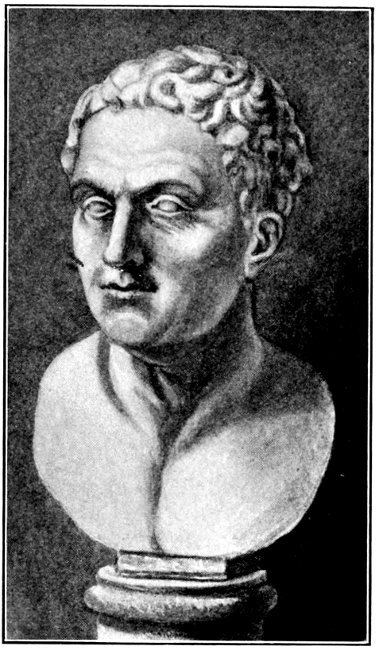
There is of course no authentic likeness of Galen in existence. The Royal College of Physicians possesses an unquestionably antique bust, copied in Pettigrew’s Medical Portraits (and illustrated in the margin), which is traditionally credited with being a representation of the Physician of Pergamos. It was presented to the College by Lord Ashburton, to whom it was presented by Alexander Adair, who had acquired it from his relative Robert Adair, principal surgeon to the British forces at the siege of Quebec. This Robert Adair was a man of considerable eminence in his profession, and is described as a man of character and a scholar. Beyond this very slight evidence there is no authority for the presumption that the bust was intended for Galen. The other portrait is copied from the diploma of the Pharmaceutical Society, but this is not said to have any history. With these may be compared the portrait given on the title page of the first London Pharmacopœia. The conclusion will probably be reached that we have no idea what manner of man the eminent physician was.
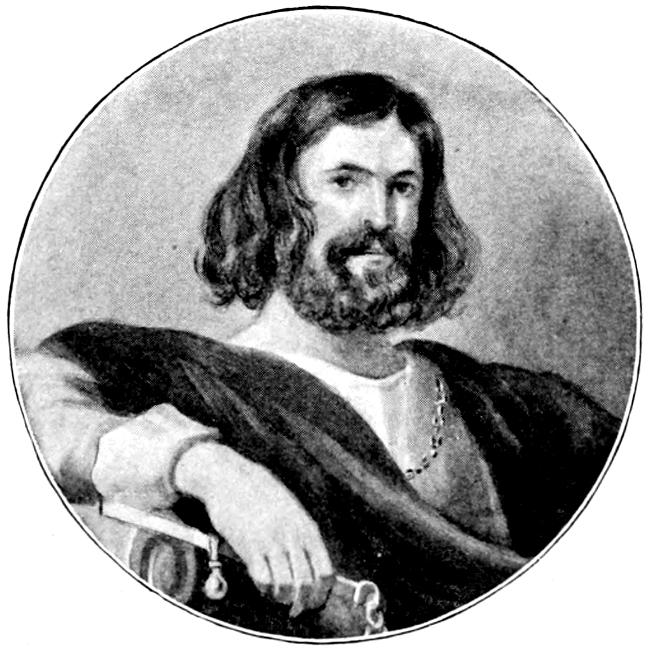
Galen was born at Pergamos, in Asia Minor, A.D. 131, and died in the same city between A.D. 200 and 210. His father was an architect of considerable fortune, and the son was at first destined to be a philosopher, but while he was going through his courses of logic, Nicon (the father) was advised in a dream to direct the youth’s studies in the direction of medicine. It will be seen directly that Galen’s career was a good deal influenced by dreams.
Nothing was spared to obtain for the youth the best education available, though his father died when he was 21. After exhausting the Pergamos teachers, Galen studied at Smyrna, Corinth, and Alexandria. Then he travelled for some years through Cilicia, Phœnicia, Palestine, Scyros, and the Isles of Crete and Cyprus. He commenced practice at Pergamos when he was 29 and was appointed Physician to the School of Gladiators in that city. At 33 he removed to Rome and soon acquired the confidence and friendship of many distinguished persons, among them Septimus Severus, the Consul and afterwards Emperor, Sergius Paulus, the Prætor, the uncle of the reigning Emperor, Lucius Verus, many of whom he cured of various illnesses.
His success caused bitter jealousy among the other Greek physicians then practising in Rome. They called him Paradoxologos, and Logiatros, which meant that he was a boaster and a master of phrases. It appears that he was able to hold his own in this wordy warfare. Some of his opponents he described as Asses of Thessaly, and he also made allegations against their competence and probity. However, he quitted Rome in the year 167, and as at a later time he left Aquilea, both movings being coincident with the occurrence of serious plagues, his reputation for courage has suffered. It was at this period of his life that he visited Palestine to see the shrub which yielded Balm of Gilead, and then proceeded to Armenia to satisfy himself in regard to the preparation of the Terra Sigillata. He was able to report that the general belief that blood was used in the process was incorrect.
It was to Aquilea that Galen was sent for by the Emperor Marcus Aurelius, who was there preparing a campaign against the Marcomans, a Germanic nation dwelling in what is now called Bohemia. Marcus Aurelius was in the habit of taking Theriaca, and would have none but that which had been prepared by Galen. He urged Galen to accompany him on his expedition, but the physician declined the honour and the danger, alleging that Æsculapius had appeared to him in a dream, and had forbidden him to take the journey. The Emperor therefore sent him to Rome and charged him with the medical care of his son Commodus, then 11 years of age. Galen is said to have done the world the ill-service of saving the life of this monster. Galen retained the favour of Marcus Aurelius till the death of the Emperor, and continued to make Theriaca for his successors, Commodus, Pertinax, and Septimus Severus. He died during the reign of the last named Emperor.
Galen is sometimes said to have kept a pharmacy in the Via d’Acra at Rome, but his “apotheca” there appears to have been a house where his writings were kept and where other physicians came to consult them. This house was afterwards burned, and it is supposed that a number of the physician’s manuscripts were destroyed in that fire.
His medical fame began to develop soon after his death. In about a hundred years Eusebius, Bishop of Cæsarea, reproaches the world with treating Galen almost as a divinity. Nearly all the later Roman medical writers drew freely from his works, and some seemed to depend entirely on them. Arabic medicine was largely based on Galen’s teaching, and it was the Arabic manuscripts translated into Latin which furnished the base of the medical teaching of Europe from the eleventh and twelfth centuries to the eighteenth.
Galen aimed to create a perfect system of physiology, pathology, and treatment. He is alleged to have written 500 treatises on medicine, and 250 on other subjects, philosophy, laws, grammar. Nothing like this number remains, and the so-called “books” are often what we should call articles. His known and accepted medical works number eighty-five. All his writings were originally in Greek.
Oribasius.
Oribasius, like Galen, was a native of Pergamos, and was physician to and friend of the Emperor Julian. He is noted for having compiled seventy-two books in which he collected all the medical science of preceding writers. This was undertaken at the instance of Julian. Only seventeen of these books have been preserved to modern times. Oribasius adds to his compilation many original observations of his own, and in these often shows remarkable good sense. He was the originator of the necklace method of treatment, for he recommends a necklace of beads made of peony wood to be worn in epilepsy, but does not rely on this means alone.
Aetius.
Aetius, who lived either in the fifth or sixth century, was also a compiler, but he was besides a great authority on plasters, which he discusses and describes at enormous length. He was a Christian, and gives formulas of words to be said when making medicinal compounds, such as “O God of Abraham, of Isaac, and of Jacob, give to this remedy the virtues necessary for it.” In the works of Aetius, mention is made of several nostrums famous in his time for which fabulous prices were charged. The Collyrium of Danaus was sold in Constantinople for 120 numismata. If this means the nummus aureus of Roman money it would be equal to nearly £100 of our money. At this price, Aetius says, the Collyrium could only be had with difficulty. He also mentions a Colical Antidote of Nicostratus called very presumptuously Isotheos (equal to God), which sold for two talents.
The remedy devised by Aetius for gout was called Antidotos ex duobus Centaureae generibus, and was the same as the compound which became popular in this country under the title of Duke of Portland’s Powder. (See page 309). Aetius prescribed a regimen along with his medicine extending over a year. In September the patient was to take milk; in October, garlic; in November to abstain from baths; December, no cabbage; in January to take a glass of pure wine every morning; in February to eat no beet; in March to be allowed sweets in both food and drink; in April, no horse radish; in May, no Polypus (a favourite dish); in June, to drink cold water in the morning; in July, no venery; in August, no mallows.
Alexander of Tralles.
This writer, who acquired considerable celebrity as a medical authority, lived a little later than Aetius, towards the end of the sixth century. He was a native of Tralles, in Lydia, and is much esteemed by the principal medical historians, Sprengel, Leclerc, Freind, and others who have studied his writings. Especially notable is his independence of opinion; he does not hesitate occasionally to criticise even Galen. He impresses strongly on his readers the danger of becoming bound to a particular system of treatment. The causes of each disease are to be found, and the practitioner is not to be guided exclusively by symptoms. Among his favourite drugs were castorum, which he gave in fevers and many other maladies; he had known several persons snatched from the jaws of death by its use in lethargy (apoplexy); bole Armeniac, in epilepsy and melancholia; grapes and other ripe fruits instead of astringents in dysentery; rhubarb appeared as a medicine for the first time in his writings, but only as an astringent; and he was the first to use cantharides for blisters in gout instead of soothing applications. His treatment of gout by internal remedies and regimen recalls that of Aetius and is worth quoting. He prescribed an electuary composed of myrrh, coral, cloves, rue, peony, and aristolochia. This was to be taken regularly every day for a hundred days. Then it was to be discontinued for fifteen days. After that it was to be recommenced and continued during 460 days, but only taking a dose every other day; then after another interval thirty-five more doses were to be taken on alternate days, making 365 doses altogether in the course of nearly two years. Meanwhile the diet was strictly regulated, and it may well be that Alexander only provided the medicine to amuse his patient while he cured the gout by a calculated reduction of his luxuries. Alexander of Tralles was the author who recommended hermodactyls, supposed to be a kind of colchicum in gout; a remedy which was forgotten until its use was revived in a French proprietary medicine. His prescription compounded hermodactyls, ginger, pepper, cummin seeds, anise seeds, and scammony. He says it will enable sufferers who take it to walk immediately. He is supposed to have been the first to advocate the administration of iron for the removal of obstructions.
Mesuë and Serapion.
These names are often met with in old medical and pharmaceutical books, and there is an “elder” and a “younger” of each of them, so that it may be desirable to explain who they all were. The elder and the younger of each are sometimes confused. Serapion the Elder, or Serapion of Alexandria, as he is more frequently named in medical history, lived in the Egyptian city about 200 B.C., and was the recognised leader of the sect of the Empirics in medicine. He is credited with the formula that medicine rested on the three bases, Observation, History, and Analogy. No work of his has survived, but he is alleged to have violently attacked the theories of Hippocrates, and to have made great use of such animal products as castorum, the brain of the camel, the excrements of the crocodile, the blood of the tortoise, and the testicles of the boar.
Serapion the Younger was an Arabian physician who lived towards the end of the tenth century and wrote a work on materia medica which was much used for some five or six hundred years.
Mesuë the Elder was first physician at the court of Haroun-al-Raschid in the ninth century. He was born at Khouz, near Nineveh, in 776, and died at Bagdad in 855. Under his superintendence the School of Medicine of Bagdad was founded by Haroun. Although a Nestorian Christian, Mesuë retained his position as first physician to five Caliphs after Haroun. To his teaching the introduction of the milder purgatives, such as senna, tamarinds, and certain fruits is supposed to be due. His Arabic name was Jahiah-Ebn-Masawaih.
Mesuë the Younger is the authority generally meant when formulas under his name, sometimes quaintly called Dr. Mesuë in old English books, are quoted. He lived at Cairo about the year 1000. He was a Christian, like his earlier namesake, and is believed to have been a pupil or perhaps a companion of Avicenna; at all events, when the latter got into disgrace it is alleged that both he and Mesuë took refuge in Damascus. At Damascus Mesuë wrote his great work known in Latin as Receptarium Antidotarii. From the time of the invention of printing down to the middle of the seventeenth century, when pharmacopœias became general, more than seventy editions of this work, mostly in Latin, but a few in Italian, have been counted. In some of the Latin translations he is described as “John, the son of Mesuë, the son of Hamech, the son of Abdel, king of Damascus.” This dignity has been traced to a confusion of the Arabic names, one of which was very similar to the word meaning king. Nearly half of the formulæ in the first London Pharmacopœia were quoted from him.
Nicolas Myrepsus.
For several centuries before the era of modern pharmacopœias the Antidotary of Nicolas Myrepsus was the standard formulary, and from this the early dispensatories were largely compiled. This Nicolas, who was not the Nicolas Praepositus of Salerno, is sometimes named Nicolas Alexandrinus. He appears to have been a practising physician at Constantinople, and as he bore the title of Actuarius, it is supposed that he was physician to the Emperor. He is believed to have lived in the thirteenth century. Myrepsus, which means ointment maker, was a name which he assumed or which was applied to him, probably in allusion to his Antidotary.
This was the largest and most catholic of all the collections of medical formulas which had then appeared. Galen and the Greek physicians, the Arabs, Jews, and Christians who had written on medicine, were all drawn upon. A Latin translation by Leonard Fuchs, published at Nuremberg in 1658, contains 2,656 prescriptions, every possible illness being thus provided against. The title page declares the work to be “Useful as well for the medical profession and for the seplasarii.” The original is said to have been written in barbarous Greek.
Sprengel, who has hardly patience to devote a single page to this famous Antidotary, tells us that the compiler was grossly ignorant and superstitious. He gives an instance of his reproduction of some Arab formulæ. One is the use of arsenic as a spice to counteract the deadly effects of poisons. This advice was copied, he says, down to the seventeenth century. It was Nicolas’s rendering of the Arabic word Darsini, which meant cannella, and which they so named because it was brought from China.
The compounds collected in this Antidotary are of the familiar complicated character of which so many specimens are given in this volume. Many of the titles are curious and probably reminiscent of the pious credulity of the period when Myrepsus lived. There is, for example, the Salt of the Holy Apostles, which taken morning and evening with meals, would preserve the sight, prevent the hair from falling out, relieve difficulty of breathing, and keep the breath sweet. It was obtained by grinding together a mixture of herbs and seeds (hyssop, wild carrot, cummin, pennyroyal, and pepper) with common salt. The Salt of St. Luke was similar but contained a few more ingredients.
A Sal Purgatorius prescribed for the Pope Nicholas consisted of sal ammoniac, 3 oz., scammony, 3 drachms, poppy seeds, 2 drachms, orris root, 3 drachms, pepper, 13 grains, one date, pine nut 25 grains, and squill 2 drachms. This might be made into an electuary with honey.
Antidotus Acharistos, which means unthanked antidote, is stated to be so named because it cured so quickly that patients were not sufficiently grateful. They did not realise how bad they might have been without it.
An electuary said to have been prescribed for King David for his melancholy was composed of aloes, opium, saffron, lign-aloes, myrrh, and some other spices, made up with honey. A Sal Sacerdotale (salt combined with a few spices) stated to have been used by the prophets in the time of Elijah had come down to this Antidotary through St. Paul.
Raymond Lully.
The life of Raymond Lully is so romantic that it is worth telling, though it only touches pharmaceutical history occasionally. Born at Palma, in the island of Majorca, in 1235, in a good position of life, he married at the age of twenty-two, and had two sons and a daughter. But home life was not what he desired, and he continued to live the life of a gallant, serenading young girls, writing verses to them, and giving balls and banquets, to the serious derangement of his fortune. Ultimately he conceived a violent passion for a beautiful and virtuous married woman named Ambrosia de Castello who was living at Majorca with her husband. She, to check this libertine’s ardour, showed him her breast, ravaged by cancer. This so afflicted him that he set himself to study medicine with the object of discovering a cure for the cruel disease. With the study of medicine and of alchemy he now associated an insatiable longing for the deliverance of the world from Mohammedan error. He renounced the world, including it would seem his wife and children (though it is recorded that he first shared his possessions with his wife), and went to live on a mountain in a hut which he built with his own hands. This career, however, did not promise an early enough extirpation of infidels, so before long Lully is found travelling, and residing at Paris, Rome, Vienna, Genoa, Tunis, and in other cities, preaching new crusades, importuning the Pope to establish new orders of missionary Christians, and at intervals writing books on medicine. He had invented a sort of mathematical scheme which in his opinion absolutely proved the truth of Christianity, and by the use of diagrams he hoped to convert the Saracens. His ideas are set forth, if not explained, in his Ars Magna. In the course of his strange life he visited Palestine and Cyprus, and at Naples in 1293 he made the acquaintance of Arnold de Villanova. This learned man taught Lully much, and found a fervent discipline in him. He was more than seventy when, according to tradition, he travelled to London with the object of urging on Edward III a new war against the Saracens. Edward alleged his want of means, but Lully was prepared to meet the difficulty, and some of the historians of the science of the period assert that he coined a lot of gold for the purpose of the new crusade. Edward promptly used this money for the war with France, in which he was more interested. Disappointed and disgusted, Lully left England, and some time after, at the age of seventy-eight, set out to visit Jerusalem. Having accomplished that journey he visited several of the cities of North Africa on his way back, and at Bougia, after preaching with his usual vehemence against the Mohammedan heresy, he was stoned by the Moors and left for dead. Some friendly merchants took his body on their ship bound for his native Majorca. He revived, but died on the voyage in his eightieth year, A.D. 1415. His tomb is still shown in the church of San Francisco in the City of Palma.
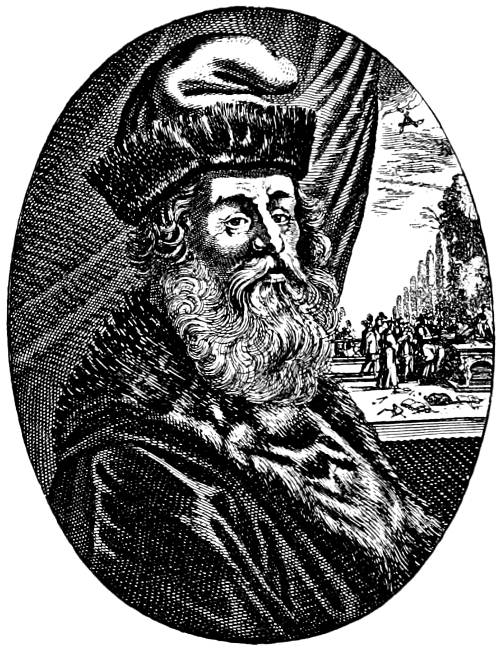
Raymond Lully.
(From a portrait in the Royal Court and State Library, Munich.)
Raymond Lully is particularly famous in pharmaceutical history for the general use of the aqua vitae or aqua ardens which he introduced. He had learned the process of distilling it from wine from Arnold of Villanova, who had himself probably acquired it from the Arab chemists of Spain, but Lully discovered the art of concentrating the spirit by means of carbonate of potash. Of the aqua vitae which he made he declared that “the taste of it exceedeth all other tastes, and the smell of it all other smells.”
Frascator.
Hieronymo Frascatoro, generally known as Jerome Frascator, was a physician and poet of high repute in the early part of the sixteenth century. Frascator was born at Verona in 1483 and died near that city in 1553. As a physician he aided the Pope, Paul III, to get the Council of Trent removed from Germany to Italy by alarming the delegates into believing that they were in imminent danger of an epidemic. They therefore adjourned to Bologna. Frascator especially studied infectious diseases, and his celebrated Diascordium, which is described in the section entitled “The Four Officinal Capitals,” was invented as a remedy for the Plague. His great literary fame depended principally on a Latin poem he wrote with the now repellent title of “Syphillides, sive Morbi Gallici,” in three books. This was published in 1530. The author did not accept the view that this disease had been imported from America. He held that it had been known in ancient times, and that it was caused by a peculiar corruption of the air. His hero, Syphilis, had given offence to Apollo, who, in revenge, had poisoned the air he breathed. Syphilis is cured by plunging three times in a subterraneous stream of quicksilver. The best classical scholars of the age regarded the poem as the finest Latin work written since the days when that language was in its full life, and they compared it appreciatively with the poems of Virgil. The following lines will serve as a specimen:—
... nam saepius ipsi Carne sua exutos artus, squallentia ossa Vidimes, et foedo rosa era dehiscere hiatu Ora, atque exiles renentia guttura voces.
The name of the disease was acquired from this poem, and though it has a Greek form and appearance, no ancient derivative for it can be suggested. Frascator also wrote a poem on hydrophobia.
Basil Valentine.
The name and works of Basil Valentine are inseparably associated with the medical use of antimony. His “Currus Triumphalis Antimonii” (the Triumphal Chariot of Antimony) is stated in all text-books to have been the earliest description of the virtues of this important remedy, and of the forms in which it might be prescribed. And very wonderful indeed is the chemical knowledge displayed in this and other of Valentine’s writings.
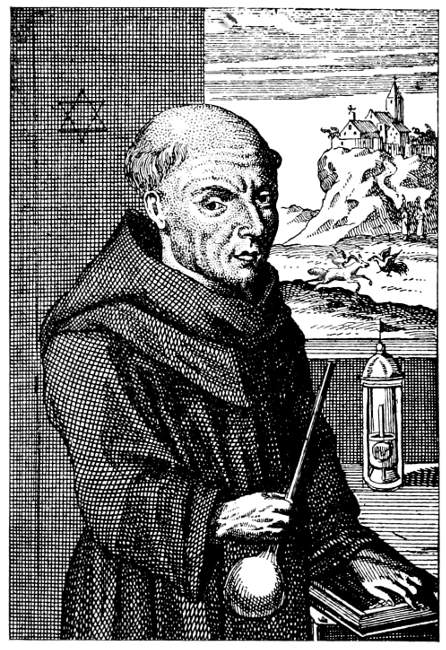
Basil Valentine.
(From the Collection of Etchings in the Royal Gallery, Munich.)
Basil Valentine explains the process of fusing iron with this stibium and obtaining thereby “by a particular manipulation a curious star which the wise men before me called the signet star of philosophy.” He commences the treatise already mentioned by explaining that he is a monk of the Order of St. Benedict, which (I quote from an English translation by Theodore Kirkringius, M.D., published at London in 1678) “requires another manner of Spirit of Holiness than the common state of mortals exercised in the profane business of this World.”
After thus introducing himself he proceeds to mingle chemistry, piety, and abuse of the physicians and apothecaries of his day with much repetition though with considerable shrewdness for about fifty pages. At last, after many false starts, he expounds the origin and nature of antimony, thus:—
“Antimony is a mineral made of the vapour of the Earth changed into water, which spiritual syderal Transmutation is the true Astrum of Antimony; which water, by the stars first, afterwards by the Element of Fire which resides in the Element of Air, is extracted from the Elementary Earth, and by coagulation formally changed into a tangible essence, in which tangible essence is found very much of Sulphur predominating, of Mercury not so much, and of Salt the least of the three. Yet it assumes so much Salt as it thence acquires an hard and unmalleable Mass. The principal quality of it is dry and hot, or rather burning; of cold and humidity it hath very little in it, as there is in common Mercury; in corporal Gold also is more heat than cold. These may suffice to be spoken of the matter, and three fundamental principles of Antimony, how by the Archeus in the Element of Earth it is brought to perfection.”
It needs some practice in reading alchemical writings to make out the drift of this rhapsody, and no profit would be gained by a clear interpretation of the mysticism. It may, however, be noted that the Archeus was a sort of friendly demon who worked at the formation of metals in the bowels of the earth; that all metals were supposed to be compounds of sulphur, mercury, and salt in varying proportions, the sulphur and the salt, however, being refined spiritual essences of the substances we know by these names; and that it was a necessary compliment to pay to any product which it was intended to honour to trace its ancestry to the four elements.
As the author goes on to deal with the various compounds or derivatives from antimony, it is abundantly clear that he writes from practical experience. He describes the Regulus of Antimony (the metal), the glass (an oxy-sulphide), a tincture made from the glass, an oil, an elixir, the flowers, the liver, the white calx, a balsam, and others.
Basil Valentine’s scathing contempt for contemporary medical practitioners calls for quotation. “The doctor,” he says, “knows not what medicines he prescribes to the sick; whether the colour of them be white, black, grey, or blew, he cannot tell; nor doth this wretched man know whether the medicament he gives be dry or hot, cold or humid.... Their furnaces stand in the Apothecaries’ shops to which they seldom or never come. A paper scroll in which their usual Recipe is written serves their purpose to the full, which Bill being by some Apothecary’s boy or servant received, he with great noise thumps out of his mortar every medicine, and all the health of the sick.”
Valentine concludes his “Triumphal Chariot” by thus apostrophising contemporary practitioners:—“Ah, you poor miserable people, physicians without experience, pretended teachers who write long prescriptions on large sheets of paper; you apothecaries with your vast marmites, as large as may be seen in the kitchens of great lords where they feed hundreds of people; all you so very blind, rub your eyes and refresh your sight that you may be cured of your blindness.”
In the same treatise Basil Valentine describes spirit of salt which he had obtained by the action of oil of vitriol on marine salt; brandy, distilled from wine; and how to get copper from pyrites by first obtaining a sulphate, then precipitating the metal by plunging into the solution a blade of iron. This operation was a favourite evidence with later alchemists of the transmutation of iron into copper.
According to some of his biographers Basil Valentine was born in 1393; others are judiciously vague and variously suggest the twelfth, thirteenth, or fourteenth century. That he was a Benedictine monk, he tells us himself, and several monasteries of the order have been named where he is supposed to have lived and laboured.
Many medical historians have doubted whether such a person as Basil Valentine ever existed. His writings are said to have been circulated in manuscript, but no one has ever pretended to have seen one of those manuscripts, and the earliest known edition of any of Basil Valentine’s works was published about 1601, by Johann Thölde, a chemist, and part owner of salt works at Frankenhausen in Thuringia. It is rather a large claim on our credulity, or incredulity, to assume that Thölde was himself the author of the works attributed to the old monk, and that he devised the entire fiction of the alleged discoveries, chemistry and all. It was not an uncommon thing among the alchemists and other writers of the middle ages to represent their books as the works of someone of acknowledged fame, just as the more ancient theologians were wont to credit one of the apostles or venerated fathers with their inventions. But it was not common for a discoverer to hide himself behind a fictitious sage whose existence he had himself invented. This theory is, however, held by some chemical critics.
It is certain that the real Basil Valentine could not have been so ancient as he was generally believed to be. Syphilis is referred to in the “Triumphal Chariot” as the new malady of soldiers (Neue Krankheit der Kriegsleute), as morbus Gallicus, and lues Gallica. It was not known by these names until the invasion of Naples by the French in 1495. Another allusion in the same treatise is to the use of antimony in the manufacture of type metal, which was certainly not adopted at any time at which Basil Valentine could have lived. Another reason for questioning his actual existence is that the most diligent search has failed to discover his name either on the provincial list or on the general roll of the Benedictine monks preserved in the archives of the order at Rome. Boerhaave asserted that the Benedictines had no monastery at Erfurt, which was generally assigned as the home of Valentine.
A curious item of evidence bearing on the allegation that Thölde was the fabricator of Basil Valentine’s works, or at least of part of them, has been indicated by Dr. Ferguson, of Glasgow, in his notes on Dr. Young’s collection of alchemical works. Thölde, it appears, had written a book in his own name entitled “Haliographia.” This is divided into four sections, namely: 1. Various kinds of Salts. 2. Extraction of Salts. 3. Salt Springs. 4. Salts obtained from metals, minerals, animals, and vegetables. This Part 4 of the work was subsequently published by Thölde among Basil Valentine’s writings. One of two things therefore is obvious. Either Thölde adopted a work by Valentine and issued it as his own, or one at least of the pieces alleged to have been by Valentine was really by Thölde.
Basil Valentine, meaning the valiant king, has assuredly an alchemical ring about it. It is exactly such a name as might be invented by one of the scientific fictionists of the middle ages. It is impossible, too, to read the “Triumphal Chariot,” at least when suspicion has been awakened, without feeling that the character of the pious monk is a little overdone. A really devout monk would hardly be proclaiming his piety on every page with so much vehemence. Then there is the legend which accounts for the long lost manuscripts. It is explained that they were revealed to someone, unnamed, when a pillar in a church at Erfurt was struck and split open by lightning, the manuscripts having been buried in that pillar. When this happened is not recorded.
In Kopp’s “Beitrage zur Geschichte der Chemie” the learned author argued that Thölde could only be regarded as an editor of Basil Valentine’s works, because when they were published they gave so many new chemical facts and observations that it was impossible to think that Thölde would have denied himself the credit of the discoveries if they had been his in fact. That book was published in 1875. In “Die Alchemie,” which Kopp published in 1886, he refers to Basil Valentine, and says that there is reason to think that the works attributed to him were an intentional literary deception perpetrated by Thölde.
Paracelsus: His Career.
No one man in history exercised such a revolutionary influence on medicine and pharmacy as the erratic genius Philipus Aureolus Theophrastus Bombast von Hohenheim. The name Paracelsus is believed to have been coined by himself, probably with the intention of somewhat Latinising his patronymic, von Hohenheim, and also perhaps as claiming to rank with the famous Roman physician and medical writer, Celsus. The family of Bombast was an old and honourable one from Württemberg, but the father of the founder of the iatro-chemists was a physician who had settled at Maria-Einsiedeln, a small town in Switzerland, not far from Zurich. He (the father) died at Villach, in Carinthia, in 1534, aged 71.
Theophrastus was an only child. He was born in 1490 or 1491, and owed to his father the first inclination of his mind towards medicine and alchemy. Later he was taught classics at a convent school, and at 16 went to the University of Basel. Apparently he did not stay there long. Classical studies, and the reverence of authorities, which the Universities taught, never attracted him. He is found next at Wurzburg, in the laboratory of Trithemius, an abbot of that city, and a famous adept in alchemy, astrology, and magic generally. He must have acquired much chemical skill in that laboratory, and, doubtless, many of his mystic views began to shape themselves under the instruction of the learned abbot. But Paracelsus was not content with the artificial ideas of the alchemists. By some means he became acquainted with the wealthy Sigismund Fugger, a mine owner in the Tyrol, and either as assistant or friend he joined him. The Fuggers were the Rothschilds of Germany at that time, and one of them entertained Charles V at Augsburg, when the famous diet at which the Emperor was to crush the Reformation was held in that city. On that occasion the wealthy merchant made a cinnamon fire for the Emperor, and lighted it with a bond representing a large sum which Charles owed him.
In the Tyrolese mines Paracelsus learned much about minerals, about diseases, and about men. Then he travelled through various parts of Europe, paying his way by his medical and surgical skill, or, as his enemies said, by conjuring and necromancy. He states that he was in the wars in Venice, Denmark, and the Netherlands; it is supposed as an army surgeon, for he afterwards declared that he then learned to cure forty diseases of the body. He boasted that he learned from gypsies, physicians, barbers, executioners, and from all kinds of people. He claims also to have been in Tartary, and to have accompanied the Khan’s son to Constantinople. Van Helmont tells us that it was in this city that he met an adept who gave him the philosopher’s stone. Other chroniclers relate that this adept was a certain Solomon Trismensinus, who also possessed the elixir of life, and had been met with some two hundred years later.
Although Paracelsus in his writings appears to hold the current belief in the transmutation of metals, and in the possibility of producing medicines capable of indefinitely prolonging life, he wasted no energy in dreaming about these, as the alchemists generally did. The production of gold does not seem to have interested him, and his aims in medicine were always eminently practical. It is true that he named his compounds catholicons, elixirs, and panaceas, but they were all real remedies for specific complaints; and in the treatment of these he must have been marvellously successful.
Whether he ever went to Tartary or not, and whether he served in any wars or not, may be doubtful. His critics find no evidence of acquaintance with foreign languages or customs in his works, and they do find indications of very elementary notions of geography. But it is certain that for ten years he was peregrinating somewhere; if his travels were confined to Germany the effect was the same. Germany was big enough to teach him. Passionately eager to wrest from Nature all her secrets, gifted with extraordinary powers of observation and imagination, with unbounded confidence in himself, and bold even to recklessness as an experimenter, this was a man who could not be suppressed. Armed with his new and powerful drugs, and not afraid to administer them, cures were inevitable; other consequences also, in all probability.
When, therefore, Paracelsus arrived at Basel, in the year 1525, in the thirty-second year of his age, his fame had preceded him. Probably he was backed by high influence. According to his own account he had cured eighteen princes during his travels, and some of these may have recommended him to the University authorities. It is to the credit of Paracelsus that he was warmly supported by the saintly priest Œcolampadius (Hausschein), who subsequently threw in his lot with the reformers. Besides being appointed to the chair of medicine and surgery, Paracelsus was made city physician.
His lectures were such as had never been heard before at a university. He began his course by burning the works of Galen and Avicenna in a chafing dish, and denouncing the slavish reliance on authority which at that time characterised medical teaching and practice. He taught from his own experience, and he gave his lectures in German. Many quotations of his boastful utterance have been handed down to us, and they match well with what we know of him from his recognised writings. All the universities had less experience than he, and the very down on his neck was more learned than all the authors. He likened himself to Hippocrates, the one ancient whom he esteemed. He contrasted himself with the doctors in white gloves who feared to soil their fingers in the laboratory. “Follow me,” he cried; “not I you, Avicenna, Galen, Rhazes, Montagnana, Mesuë, and ye others. Ye of Paris, of Montpellier, of Swabia, of Cologne, of Vienna; from the banks of the Danube, of the Rhine, from the islands of the seas, from Italy, Dalmatia, Sarmatia, and Athens, Greeks, Arabs, Israelites. I shall be the monarch, and mine shall be the monarchy.”
In his capacity as city physician he naturally created many enemies among his fellow practitioners. His friends said he cured the cases which they found hopeless; they said he only gave temporary relief at the best, and that his remedies often killed the patients. He fell foul, too, of the apothecaries. He denounced their drugs and their ignorance. The three years he spent in Basel must have been lively both for him and his opponents.
“In the beginning,” he says, “I threw myself with fervent zeal on the teachers. But when I saw that nothing resulted from their practice but killing, laming, and distorting; that they deemed most complaints incurable; and that they administered scarcely anything but syrups, laxatives, purgatives, and oatmeal gruel, with everlasting clysters, I determined to abandon such a miserable art and seek truth elsewhere.” Again he says: “The apothecaries are my enemies because I will not empty their boxes. My recipes are simple and do not call for forty or fifty ingredients. I seek to cure the sick, not to enrich the apothecaries.”
His career at Basel was brought to a close by a dispute with a prebendary of the cathedral named Lichtenfels, whom he had treated. The canon, in pain, had promised him 200 florins if he would cure him. The cure was not disputed, but as Paracelsus had only given him a few little pills, the clergyman relied on the legal tariff. Paracelsus sued him, and the court awarded the legal fee, which was six florins. The doctor published his comments on the case, and it can readily be supposed that they were of such a character as to amount to contempt of court. He found it advisable to leave Basel hurriedly.
Between 1528 and 1535 he lived and practised at Colmar, Esslingen, Nuremberg, Noerdlingen, Munich, Regensburg, Amberg, Meran, St. Gall, and Zurich. From Switzerland he again set forth, and records of him are to be traced in Carinthia and Hungary. Lastly, the Prince Palatine, Duke Ernst of Bavaria, took him under his protection, and settled him at Salzburg. There a few months afterwards he died. From dissipation and exhaustion, say his enemies; by assassination, say his friends. A German surgeon who examined his skull when the body was exhumed thirty years after death, found in it a fracture of the temporal bone, which, he declared, could only have been produced during life, because the bones of a solid but desiccated skull could not have separated as was the case here. It was suggested that some hirelings of the local doctors whose prospects were endangered by this formidable invader had “accidentally” pushed him down some rocks, and that it was then that the fracture was caused. A monument to this great medical revolutionist is still to be seen by the chapel of St. Philip Neri, at Salzburg. It is a broken pyramid of white marble, with a cavity in which is his portrait, and a Latin inscription which commemorates his cures of diseases, and his generosity to the poor in the following terms:—
“Conditur hic Philippus Theophrastus, insignis Medicinæ Doctor, qui dira illa vulnera, lepram, podagram, hydroposim, aliaque insanabilia contagia mirificu arte sustulit; ac bona sua in pauperes distribuenda collocandaque honoravit. Anno 1541, die 24 Septembr. vitam cum morte mutavit.”
(“Here lies Philippus Theophrastus, the famous Doctor of Medicine, who by his wonderful art cured the worst wounds, leprosy, gout, dropsy, and other diseases deemed incurable and to his honour, shared his possessions with the poor.”)
Among the contemporaries of Paracelsus were Luther, Columbus, and Copernicus. Their names alone are sufficient to show how the long-suppressed energy of the human intellect was at that period bursting forth. These four men were perhaps the greatest emancipators of the human race from the chains of slavish obedience to authority in the past thousand years. Paracelsus was not, so far as is known, a Lutheran Protestant. But he could not help sympathising with his heroic countryman. “The enemies of Luther,” he wrote, “are to a great extent fanatics, knaves, bigots, and rogues. You call me a medical Luther, but you do not intend to honour me by giving me that name. The enemies of Luther are those whose kitchen prospects are interfered with by his reforms. I leave Luther to defend what he says, as I will defend what I say. That which you wish for Luther you wish for me; you wish us both to the fire.” There was, indeed, much in common between these two independent souls.
Columbus landed in the Western world the year before Paracelsus was born. Luther burnt the Pope’s Bull at Wittenberg in 1520, and it was this action of his which at the time at least thrilled the German nation more than any other event in the history of the Reformation. It is evident that Paracelsus, in imitating the conduct of his famous contemporary, was only demonstrating his conviction that scientific, no less than religious, thought needed to free itself from the shackles of tyrannic tradition.
His Character.
Such details of the personality of Paracelsus as have come down to us were written by his enemies. Erastus, a theologian as well as a physician, who may have met Paracelsus, and who fiercely attacked his system, depreciates him on hearsay. But Operinus, a disciple who had such reverence for him that when Paracelsus left Basel, he accompanied him and was with him night and day for two years, wrote a letter about him after his death to which it is impossible not to attach great importance.
In this letter Operinus expresses the most unbounded admiration of Paracelsus’s medical skill; of the certainty and promptitude of his cures; and especially of the “miracles” he performed in the treatment of malignant ulcers. But, adds Operinus, “I never discovered in him any piety or erudition.” He had never seen him pray. He was as contemptuous of Luther as he was of the Pope. Said no one had discovered the true meaning or got at the kernel of the Scriptures.
During the two years he lived with him, Operinus declares Paracelsus was almost constantly drunk. He was scarcely sober two hours at a time. He would go to taverns and challenge the peasantry to drink against him. When he had taken a quantity of wine, he would put his finger in his throat and vomit. Then he could start again. And yet Operinus also reports how perpetually he worked in his laboratory. The fire there was always burning, and something was being prepared, “some sublimate or arsenic, some safran of iron, or his marvellous opodeldoch.” Moreover, however drunk he might be he could always dictate, and Operinus says “his ideas were as clear and consecutive as those of the most sober could be.”
According to this same letter Paracelsus had been an abstainer until he was 25. He cared nothing for women. Operinus had never known him undress. He would lie down with his sword by his side, and in the night would sometimes spring up and slash at the walls and ceiling. When his clothes got too dirty he would take them off and give them to the first passer, and buy new ones. How he got his money Operinus did not know. At night he often had not an obolus; in the morning he would have a new purse filled with gold.
It is not easy to form a fair judgment of Paracelsus from this sketch. Many writers conclude that Operinus was spiteful because Paracelsus would not tell him his secrets. More likely Operinus left his master because his religious sentiments were shocked by him. Paracelsus was evidently a born mocker, and it may be that he took a malicious delight in making his disciple’s flesh creep. Operinus gives an instance of the levity with which his master treated serious subjects. He was sent for one day to see a poor person who was very ill. His first question was whether the patient had taken anything. “He has taken the holy sacrament,” was the reply. “Oh, very well,” said Paracelsus, “if he has another physician he has no need of me.” I think Operinus wrote in good faith, but the stories of the doctor’s drunkenness must have been exaggerated. It is inconceivable that he could have been so constantly drunk, and yet always at work. Operinus, it may be added, returned to Basel and set up as a printer, but failed and died in poverty.
Robert Browning’s dramatic poem of “Paracelsus” has been much praised by the admirers of the poet. It was written when Browning was 23, and represents in dramatic form the ambitious aspirations of a youth of genius who believes he has if mission in life; has intellectual confidence in his own powers; and the assurance that it is the Deity who calls him to the work.
In some time, His good time, I shall arrive; He guides me.
His bitter disappointment with his professorship at Basel, and his contempt for those who brought about his fall there, are depicted, and the effect which the realisation that his aims had proved impossible had on his habits and character is suggested; and at last, on his death-bed in a cell in the Hospital of St. Sebastian at Salzburg, he tells his faithful friend, Festus, who has all his life sought to restrain the ambitions which have possessed him—
You know the obstacles which taught me tricks So foreign to my nature, envy, hate, Blind opposition, brutal prejudice, Bald ignorance—what wonder if I sank To humour men the way they most approved.
“A study of intellectual egotism,” this poem has been called. Paracelsus was an egotist, without doubt. Indeed, egotism seems a ludicrously insignificant term to apply to his gorgeous self-appreciation. But it is, perhaps, a little difficult to recognise the wild untameable energy of this astonishing medical reformer in the prolix preacher represented in the poem.
Butler’s verse (in “Hudibras”) may be taken to represent the popular view held about Paracelsus after the first enthusiasm of his followers had cooled down
Bombastus kept a Devil’s bird, Shut in the pommel of his sword, That taught him all the cunning pranks Of past and future mountebanks.
German studies of Paracelsus have been very numerous during the past fifty years, and the general tendency has been greatly to enhance his fame.
After the death of Paracelsus, the Archbishop of Cologne desired to collect his works, many of which were in manuscript and scattered all over Germany. By this time there were many treatises attributed to him which he never wrote. It was a paying business to discover a new document by the famous doctor. It is believed that the fraudulent publications were far more numerous than the genuine ones, and it is quite possible that injustice has been done to his memory by the association with his name of some other peoples’ absurdities.
His Mysticism.
The mystic views of Paracelsus, or those attributed to him, are curious rather than useful. He seemed to have had as much capacity for belief as he had disbelief in other philosophers’ speculations. He believed in gnomes in the interior of the earth, undines in the seas, sylphs in the air, and salamanders in fire. These were the Elementals, beings composed of soul-substance, but not necessarily influencing our lives. The Elementals know only the mysteries of the particular element in which they live. There is life in all matter. Every mineral, vegetable, and animal has its astral body.
That of the minerals is called Stannar or Trughat; of the vegetable kingdom, Leffas; while the astral bodies of animals are their Evestra. The Evestrum may travel about apart from its body; it may live long after the death of the body. Ghosts are, in fact, the Evestra of the departed. If you commit suicide the Evestrum does not recognise the act; it goes on as if the body were going on also until its appointed time.
Man is a microcosm; the universe is the macrocosm. Not that they are comparable to each other; they are one in reality, divided only by form. If you are not spiritually enlightened you may not be able to perceive this. Each plant on earth has its star. There is a stella absinthii, a stella rorismarini. If we could compile a complete “herbarium spirituale sidereum” we should be fully equipped to treat disease. Star influences also form our soul-essences. This accounts for our varying temperaments and talents.
The material part of man, the living body, is the Mumia. This is managed by the Archæus, which rules over everybody; it is the vital principle. It provides the internal balsam which heals wounds or diseases, and controls the action of the various organs.
His theories of mercury, sulphur, and salt, as the constituents of all things, seem at first likely to lead to something conceivable if not credible. But before we grasp the idea we are switched off into the spiritual world again. It is the sidereal mercury, sulphur, and salt, spirit, soul, and body, to which he is alluding.
His Chemical and Pharmaceutical Innovations.
These fantastic notions permeate all the medical treatises of Paracelsus. But every now and then there are indications of keen insight which go some way towards explaining his success as a physician; for it cannot be doubted that he did effect many remarkable cures. His European fame was not won by mere boasting. His treatise, De Morbis ex Tartare oriundus, is admittedly full of sound sense.
Some of his chemical observations are startling for their anticipations of later discoveries. If there were no air, he says, all living beings would die. There must be air for wood to burn. Tin, calcined, increases in weight; some air is fixed on the metal. When water and sulphuric acid attack a metal there is effervescence; that is due to the escape of some air from the water. He calls metals that have rusted, dead.
Saffron of Mars (the peroxide) is dead iron. Verdigris is dead copper. Red oxide of mercury is dead mercury. But, he adds, these dead metals can be revivified, “reduced to the metallic state,” are his exact words (and it is to be noted that he was the first chemist to employ the term “reduce” in this sense), by means of coal. Elsewhere he describes digestion as a solution of food; putrefaction as a transmutation. He knew how to separate gold from silver by nitric acid. It is quite certain that the writer of Paracelsus’s works was a singularly observant and intelligent chemist. He had “a wolfish hunger after knowledge,” says Browning.
“Have you heard,” wrote Gui Patin to a friend a hundred years after the death of the famous revolutionary, “that 'Paracelsus’ is being printed at Geneva in four volumes in folio? What a shame that so wicked a book should find presses and printers which cannot be found for better things. I would rather see the Koran printed. It would not deceive so many people. Chemistry is the false money of our profession.”
His Pharmacy.
The composition of Paracelsus’s laudanum, the name of which he no doubt invented, has never been satisfactorily ascertained. Paracelsus himself made a great secret of it, and probably used the term for several medicines. It was generally, at least, a preparation of opium, sometimes opium itself. He is believed to have carried opium in the pommel of his sword, and this he called the “stone of immortality.”
Next to opium he believed in mercury, and was largely influential in popularising this metal and its preparations for the treatment of syphilis. It was principally employed externally before his time. He mocked at “the wooden doctors with their guaiacum decoctions,” and at the “waggon grease with which they smeared their patients.” He used turpith mineral (the yellow sulphate), and alembroth salt (ammonio-chloride), though he did not invent these names, and it is possible that he did not mean by them the same substances as the alchemists did. Operinus states that he always gave precipitated mercury (red precipitate, apparently) as a purgative. He gave it in pills with a little theriaca or cherry juice. This he also appears to have designated laudanum. It is certain that he gave other purgatives besides.
It must be admitted that if Basil Valentine is a mythical character, the reputation of Paracelsus is greatly enhanced. Nowhere does the latter claim to have been the first to introduce antimony into medical practice, but it is certain that it could not have been used to any great extent before his time. If we suppose that the works attributed to Basil Valentine were fictitious, so far, that is, as their authorship is concerned, they were compiled about fifty years after the death of Paracelsus, and at the time when his fame was at its zenith. Many of the allusions to antimony contained in those treatises might have been collected from the traditions of the master’s conversations and writings, much from his immediate disciples, and the whole skilfully blended by a literary artist.
Paracelsus praises highly his magistery of antimony, the essence, the arcanum, the virtue of antimony. Of this, he says, you will find no account in your books of medicine. This is how to prepare it. Take care at the outset that nothing corrupts the antimony; but keep it entire without any change of form. For under this form the arcanum lies concealed. No deadhead must remain, but it must be reduced by a third cohobation into a third nature. Then the arcanum is yielded. Dose, 4 grains taken with quintessence of melissa.
His “Lilium,” or tinctura metallorum, given as an alterative and for many complaints, was formulated in a very elaborate way by his disciples, but simplified it consisted of antimony, 4, tin 1, copper 1, melted together in a crucible, the alloy powdered, and combined (in the crucible) with nitre 6, and cream of tartar 6, added gradually. The mixture while still hot was transferred to a matrass containing strong alcohol 32, digested, and filtered.
Besides mercury and antimony, of which he made great use, iron, lead, copper, and arsenic were among the mineral medicines prescribed by him. He made an arseniate of potash by heating arsenic with saltpetre. He had great faith in vitriol, and the spirit which he extracted from it by distillation. This “spirit” he again distilled with alcohol and thereby produced an ethereal solution. His “specificum purgans” was afterwards said to be sulphate of potash. He recommended sublimed sulphur in inflammatory maladies, saffron of Mars in dysentery, and salts of tin against worms.
Whether his formulas were purposely obscure in so many cases, or whether mystery is due to the carelessness or ignorance of the copyists cannot be known. Much of his chemical and pharmaceutical advice is clear enough.
Honey he extols as a liquor rather divine than human, inasmuch as it falls from heaven upon the herbs. To get its quintessence you are to distil from it in a capacious retort a liquid, red like blood. This is distilled over and over again in a bain mariæ until you get a liquid of the colour of gold and of such pleasant odour that the like cannot be found in the world. This quintessence is itself good for many things, but from it the precious potable gold may be made. The juice of a lemon with this quintessence will dissolve leaf gold in warm ashes in forty-eight hours. With this Paracelsus says he has effected many wonderful cures which people thought he accomplished by enchantment. Elsewhere he speaks of an arcanum drawn from vitriol which is so excellent that he prefers it to that drawn from gold.
He refers with great respect to alchemy and the true alchemists, but with considerable shrewdness in regard to their professions of transmuting other metals into gold. He considered it remarkable that a man should be able to convert one substance into another in a few short days or weeks, while Nature requires years to bring about a similar result; but he will not deny the possibility. What he insists on, however, is that from metals and fire most valuable remedies can be obtained; and the apothecary who does not understand the right way of producing these is but a servant in the kitchen, and not a master cook.
Hellebore was an important medicine with Paracelsus. The white, he said, was suitable for persons under 50, the black for persons over 50. Physicians ought to understand that Nature provides different medicines for old and for young persons, for men and for women. The ancient physicians, although they did not know how to get the essence of the hellebore, had discovered its value for old persons. They found that people who took it after 50 became younger and more vigorous. Their method was to gather the hellebore when the moon was in one of the signs of conservation, to dry it in an east wind, to powder it and mix with it its own weight of sugar. The dose of this powder was as much as could be taken up with three fingers night and morning. The vaunted essence was simply a spirituous tincture. It was more effective if mistletoe, pellitory and peony seeds were combined with it. It was a great remedy for epilepsy, gout, palsy and dropsy. In the first it not merely purges out the humours, but drives away the epileptic body itself. The root must be gathered in the waning of the moon, when it is in the sign Libra, and on a Friday.
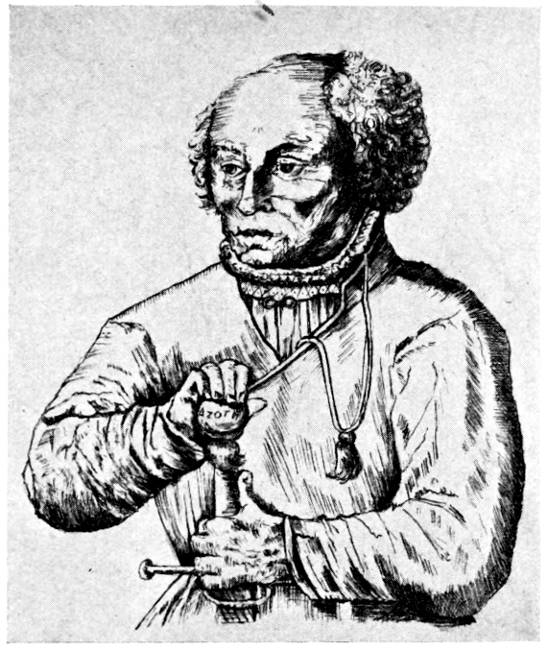
Paracelsus (a).
Paracelsus made balsam from herbs by digesting them in their own moisture until they putrefied, and then distilling the putrefied material. He obtained a number of essential oils and used them freely as quintessences. He defines quintessences thus:—Every substance is a compound of various elements, among which there is one which dominates the others, and impresses its own character on the compound. This dominating element, disengaged, is the quintessence. This term he obtained from Aristotle.
His oil of eggs was obtained by boiling the eggs very hard, then powdering them, and distilling until an oil rose to the surface. This he recommended against scalds and burns. Oil of aniseed he prescribed in colds to be put in the nostrils and applied to the temples on going to bed. Oil of tartar rectified in a sand-bath until it acquires a golden colour will cure ulcers and stone. Coral would quicken fancy, but drive away vain visions, spectres, and melancholy. Oil of a man’s excrements, twice distilled, is good to apply in fistulas, and also in baldness. Oil of a man’s skull which had never been buried got by distillation was given in 3 grain doses for epilepsy.
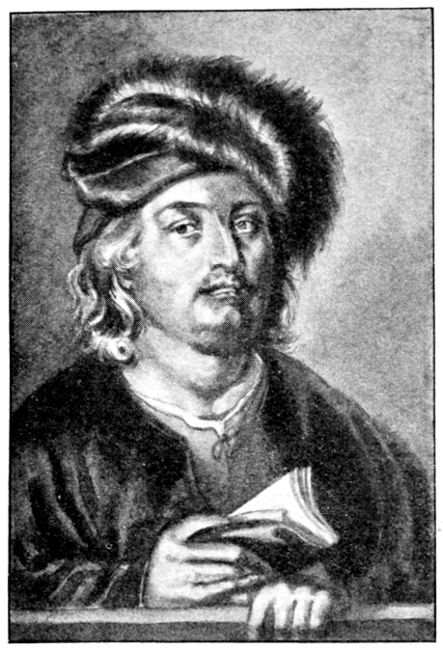
Paracelsus (b).
He had abundant faith in animal remedies. His “Confectio Anti-Epileptica,” formulated by his interpreter, Oswald Crollius, is as follows:—First get three human skulls from men who have died a violent death and have not been buried. Dry in the air and coarsely crush. Then place in a retort and apply a gradually increasing heat. The liquor that passed over was to be distilled three times over the same fæces. Eight ounces of this liquor were to be slowly distilled with 3 drachms each of species of diamusk, castorum, and anacardine honey. To the distilled liquor 4 scruples of liquor of pearls and one scruple of oil of vitriol were to be added. Of the resulting medicine one teaspoonful was to be taken in the morning, fasting, by epileptic subjects, for nine days consecutively.
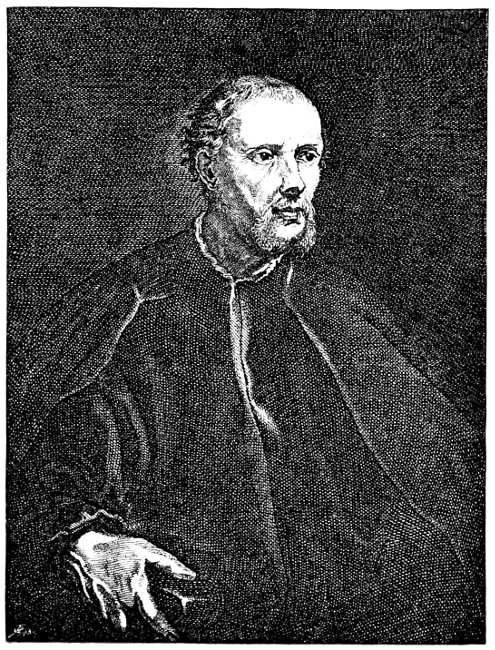
Paracelsus (c).
An Arcanum Corallinum of Paracelsus which was included in some of the earlier London Pharmacopœias, was simply red precipitate prepared in a special manner. The Committee of the College of Physicians which sat in 1745 to revise that work rejected this product with the remark that an arcanum was not a secret known only to some adept, but was simply a medicine which produces its effect by some hidden property. (This might be said of many medicines now as well as then.) They recognised, however, that “Paracelsus, whose supercilious ignorance merits our scorn and indignation,” did use the term in the sense of a secret remedy.
The Pharmacy of Paracelsus is so frequently referred to in other sections of this book that it is not necessary to deal with it here at greater length. It is evident, however, that some of the formulas he devised, some of the names he coined, and some of the theories he advanced have entered into our daily practice; and even the dogmas now obsolete which are sometimes quoted to show how superior is our knowledge to his, served to quicken thought and speculation.
Portraits of Paracelsus.
The portraits of Paracelsus to be found in old books, as well as some celebrated paintings, are curiously various as likenesses. The oldest and by far the most frequent representation of him on title pages of his works is more or less similar to the portrait marked A, p. 247. This particular drawing was copied from one in the print room of the British Museum. Portrait B is copied from a painting attributed to Rubens which was for a long time in the Duke of Marlborough’s collection at Blenheim. It was sold publicly in 1886 in London for £125 and is now in the “Collection Kums” at Antwerp. There is a similar painting, believed to be a copy of this one, in the Bodleian Library at Oxford.
In the year 1875, at an exhibition of historical paintings held at Nancy (France), a painting “attributed to Albert Dürer,” and bearing his name in a cartouche, was exhibited and described as “Portrait presumé de Paracelse.” It was not a copy but was unmistakably the same person as the one shown in the painting of Rubens. It came from a private collection and was sold to a local dealer for 2,000 francs, and afterwards disposed of to an unknown stranger for 3,000 francs. It has not been traced since. Dürer died in 1528 (thirteen years before the date of the death of Paracelsus). There is no mention of this likeness in any of his letters. It may have been the work of one of his pupils.
The third portrait (C) which is unlike either of the others professes to have been painted from life (“Tintoretto ad vivum pinxit”) by Jacope Robusti, more commonly known as Tintoretto. The original has not been found, and the earliest print from it was a copper-plate engraving in a collection issued by Bitiskius of Geneva in 1658. The picture here given is a reduced copy of that engraving from a phototype made by Messrs. Angerer and Göschl, of Vienna, and published in a valuable work by the late Dr. Carl Aberle in 1890 entitled “Grabdenkmal, Schadel, und Abbildungen des Theophrastus Paracelsus.” The publisher of that book, Mr. Heinrich Dieter, has kindly permitted me to use this picture.
Tintoretto scarcely left Venice all his life, and it has been supposed that he may have become acquainted with Paracelsus when the latter was, as he said he was, an army surgeon in the Venetian army in the years 1521–1525. Dr. Aberle points out that if Tintoretto was born in 1518, as is generally supposed, the painting from life was impossible; even if he was born in 1512, as has also been asserted, it was unlikely. Moreover, the gentle-looking person represented, whose amiable “bedside manner” is obviously depicted in the portrait, could not possibly have been the untamable Paracelsus if any reliance can be placed on the art of physiognomy.
Nicholas Culpepper.
This well-known writer, whose “Herbal” has been familiar to many past generations as a family medicine book, deserves a place among our Masters in Pharmacy for the freedom, and occasional acuteness with which he criticised the first and second editions of the London Pharmacopœia. One specimen of his sarcastic style must suffice. The official formula for Mel Helleboratum was to infuse 3 lbs. of white hellebore in 14 lbs. of water for three days; then boil it to half its bulk; strain; add 3 lbs. of honey and boil to the consistence of honey. This is Culpepper’s comment (in his “Physicians’ Library”):—
“What a monstrum horrendum, horrible, terrible recipe have we got here:—A pound of white hellebore boiled in 14 lbs. of water to seven. I would ask the College whether the hellebore will not lose its virtue in the twentieth part of this infusion and decoction (for it must be infused, forsooth, three days to a minute) if a man may make so bold as to tell them the truth. A Taylor’s Goose being boiled that time would make a decoction near as strong as the hellebore, but this they will not believe. Well, then, be it so. Imagine the hellebore still remaining in its vigour after being so long tired out with a tedious boiling (for less boiling would boil an ox), what should the medicine do? Purge melancholy, say they. But from whom? From men or beasts? The devil would not take it unless it were poured down his throat with a horn. I will not say they intended to kill men, cum privilegio; that’s too gross. I charitably judge them. Either the virtue of the hellebore will fly away in such a martyrdom, or else it will remain in the decoction. If it evaporate away, then is the medicine good for nothing; if it remain in it is enough to spoil the strongest man living. (1.) Because it is too strong. (2.) Because it is not corrected in the least. And because they have not corrected that, I take leave to correct them.”
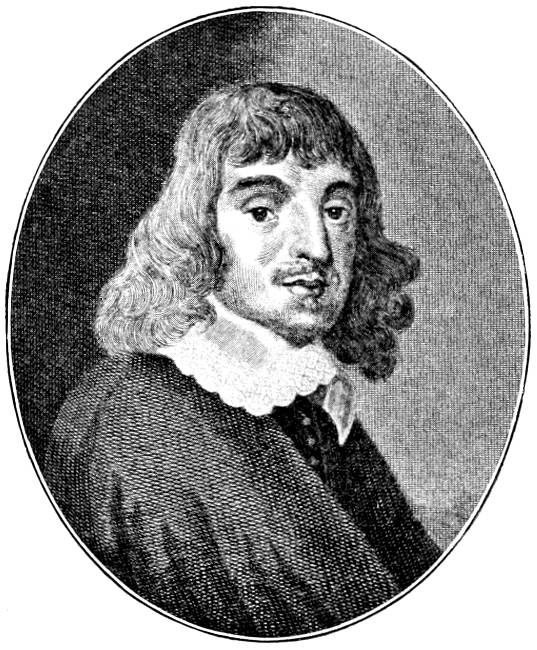
Culpepper.
(From an old book of his.)
This passage is not selected as a favourable specimen of Culpepper’s pharmaceutical skill, but as a sample of the manner in which he often rates “the College.” His own opinions are open to quite as severe criticism. A large part of his lore is astrological; and he is very confident about the doctrine of signatures. But he knew herbs well, and his general advice is sound.
Perhaps many of those who have studied his works have formed the idea that he was a bent old man with a long grey beard, who busied himself with the collection of simples. He was, in fact, a soldier, and died at the early age of 38. His portraits and the descriptions of him by his astrological friends represent him as a smart, brisk young Londoner, fluent in speech and animated in gesture, gay in company, but with frequent fits of melancholy, an extraordinarily good conceit of himself, and plenty of reason for it.
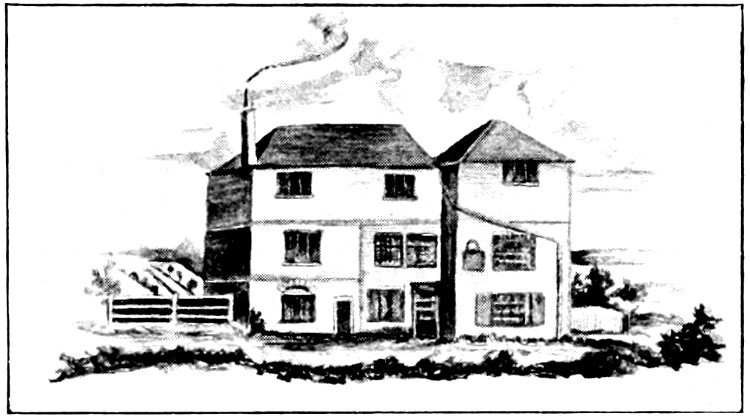
Culpepper’s House.
(From an old book of his.)
Culpepper lived in the stirring times of the Civil War, and fought on one side or the other, it is not certain which. Most likely, judging from the frequent pious expressions in his works, he was a Parliamentarian. He was severely wounded in the chest in one of the battles, but it is not known in which. It is probable that it was this wound which caused the lung disease from which he died.
Such information as we have of Culpepper’s career is gathered from his own works, and from some brutal attacks on him in certain public prints. He describes himself on the title-pages of some of his big books as “M.D.,” but there is no evidence that he ever graduated. He lived, at least during his married life, at Red Lion Street, Spitalfields, and there he carried on his medical practice. Probably it was a large one, for he evidently understood the art of advertising himself. He claims to have been the only doctor in London at the time who gave advice gratis to the poor, and his frequent comments on the cost of the pharmacopœia preparations suggest that the majority of his patients were not of the fashionable class.
Nicholas Culpepper was apprenticed to an apothecary in Great St. Helen’s, Bishopsgate, and at the same time a certain Marchmont Nedham was a solicitor’s clerk in Jewry Street. Nedham became the most notorious journalist in England, and founded and edited in turn the Mercurius Britannicus, an anti-royalist paper, the Mercurius Pragmaticus, violently anti-Commonwealth, and the Mercurius Politicus, subsidised by Cromwell’s government, and supervised by Mr. John Milton. This publication, amalgamated with the Public Intelligencer, its principal rival, has descended to us as the London Gazette. Probably Nedham and Culpepper were friends in their early days, and they may have been comrades in arms when the war broke out. But evidently they became fierce enemies later. In Mercurius Pragmaticus Nedham, pretending to review Culpepper’s translation of the official Dispensatory, takes the opportunity of pouring on him a tirade of scurrilous abuse. The translation, he says, “is filthily done,” which was certainly not true. This is the only piece of criticism in the article. The rest deals with the author personally. Nedham informs his readers that Culpepper was the son of a Surrey parson, “one of those who deceive men in matters belonging to their most precious souls.” That meant that he was a Nonconformist. Nicholas himself, according to Nedham, had been an Independent, a Brownist, an Anabaptist, a Seeker, and a Manifestationist, but had ultimately become an Atheist. During his apprenticeship “he ran away from his master upon his lewd debauchery”; afterwards he became a compositor, then a “figure-flinger,” and lived about Moorfields on cozenage. After making vile insinuations about his wife, Nedham states that by two years’ drunken labour Culpepper had “gallimawfred the Apothecaries’ Book into nonsense”; that he wore an old black coat lined with plush which his stationer (publisher) had got for him in Long Lane to hide his knavery, having been till then a most despicable ragged fellow; “looks as if he had been stued in a tanpit; a frowzy headed coxcomb.” He was aiming to “monopolise to himself all the knavery and cozenage that ever an apothecary’s shop was capable of.”
Culpepper’s works answer this spiteful caricature, for at any rate he must have been a man of considerable attainments, and of immense industry. That his writings acquired no little popularity is best proved by the fact that after his death it was good business to forge others somewhat resembling them and pass them off as his.
Turquet de Mayerne.
Sir Theodore Turquet de Mayerne, Baron Aulbone of France, was born at Geneva in 1573, of a Calvinistic family and studied for the medical profession first at Heidelberg and afterwards at Montpellier. Moving to Paris he acquired popularity as a lecturer on anatomy to surgeons, and on pharmacy to apothecaries. His inclination towards chemical remedies brought him to the notice of Rivierus, the first physician to Henri IV, and he was appointed one of the king’s physicians. But his medical heterodoxy offended the faculty, and his Protestantism raised enemies for him at court. The king, who valued Turquet, did his best to persuade him to conform to the Church of Rome as he himself had done, and to moderate the rancour of his professional foes. But he was unsuccessful in both efforts. Still Henri tried to keep him, ignoring his heresies, and perhaps rather sympathising with them. But the queen, Marie de Medici, insisted on Turquet’s dismissal, and the Faculty of Paris was no whit behind the queen in intolerance. Coupling him with a quack named Pierre Pena, a foreigner then practising medicine illicitly at Paris, they issued a decree forbidding all physicians who acknowledged their control to consult with De Turquer, and exhorting practitioners of all nations to avoid him and all similar pests, and to persevere in the doctrines of Hippocrates and Galen.
Turquet de Mayerne came to England evidently with a high reputation, for he was soon appointed first physician to the king (James I) and queen, and held the same position under Charles I and Charles II. He seems to have kept in retirement during the Commonwealth, though in 1628 it appears from his manuscript records (“Ephemerides Anglicæ,” he called them) that he was consulted by a “Mons. Cromwell” whom he describes as “Valde melancholicus.” He died at Chelsea in 1655 at the age of 82. It was in England that he used the name of Mayerne.
De Mayerne exercised a considerable influence on English pharmacy. The Society of Apothecaries owed to him their separate incorporation, and the first London Pharmacopœia was compiled and authorised probably to some extent at his instigation. He certainly wrote the preface to it. Paris quotes him as prescribing among absurd and disgusting remedies “the secundines of a woman in her first labour of a male child, the bowels of a mole cut open alive, and the mummy made of the lungs of a man who had died a violent death.” But such remedies were common to all practitioners in England and France at the time. The principal ingredient in a gout powder which he composed was the raspings of an unburied human skull. He devised an ointment for hypochondria which was called the Balsam of Bats. It contained adders, bats, sucking whelps, earthworms, hog’s grease, marrow of a stag, and the thigh bone of an ox. On the other hand, Mayerne is credited with the introduction of calomel and black wash into medical practice.
Van Helmont.
Jean Baptiste Van Helmont, born at Brussels in 1577, and died at Vilvorde near that city in 1644, was an erratic genius whose writings and experiments sometimes astonish us by their lucidity and insight, and again baffle us by their mysticism and puerility.
Van Helmont was of aristocratic Flemish descent, and possessed some wealth. He was a voracious student and a brilliant lecturer. At the University of Louvain, however, where he spent several years, he refused to take any degree because he believed that such academic distinctions only ministered to pride. He resolved at the same time to devote his life to the service of the poor, and with this in view he made over his property to his sister, and set himself to study medicine. His gift of exposition was so great that the authorities of the University insisted on his acceptance of the chair of Surgery, though that was the branch of medical practice he knew least about, and though it was contrary to the statutes of the faculty to appoint a person as Professor not formally qualified.
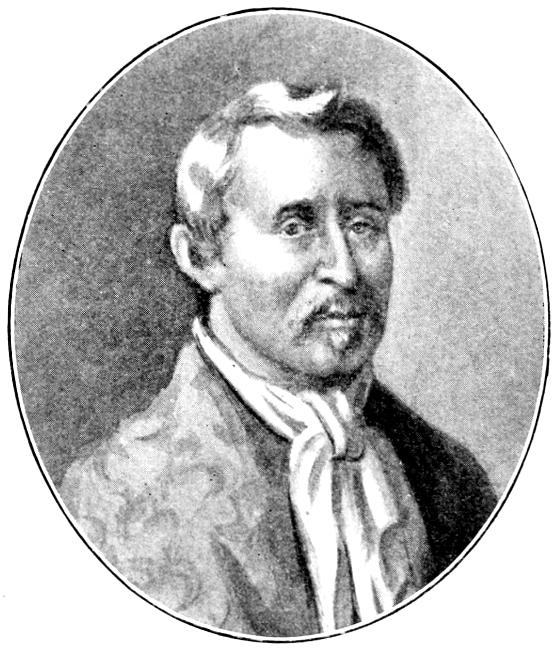
J. B. Van Helmont. 1577–1644.
(From an engraving in the Bibliothèque Nationale, Paris.)
For a time things went well, but Van Helmont got tired of medical teaching before the University became tired of him. The particular occasion which disgusted him with medical science was that he contracted the itch, and though he consulted many eminent physicians could not get cured of it. He came to the conclusion that the pretended art of healing was a fraud, and he consequently resolved to shake the dust of it from his feet, after he had recovered from the weakening effects of the purgatives which had been prescribed for his complaint.
Then he set forth on his travels, and in the course of them he met with a quack who cured him of his itch by means of sulphur and mercury. After this he became a violent anti-Galenist. He studied the works of Paracelsus, and after some years came back to his native country full of ideas and phantasies.
By marrying a wealthy woman Van Helmont became independent, and his scientific career now commenced. He erected and fitted a laboratory at Vilvorde, and devoted his time and skill to the study of chemistry, medicine, and philosophy. He described himself as “Medicus per Ignem,” and was one of the most earnest believers in the possibility of discovering the philosopher’s stone, and the elixir of life. Indeed he claimed that he had actually transmuted mercury into gold, and by his medical compounds it is alleged that he performed such miraculous cures that the Jesuits actually brought him before the Inquisition.
The advance in chemistry for which he is most famous was the discovery of carbonic acid gas, and the first steps in the recognition of the various kinds of gases. Previous to his discovery chemists had no clear perception of a distinction between the various gases; they reckoned them all as air. Geber and other predecessors of Van Helmont had observed that certain vapours were incorporated in material bodies, and they regarded these as the spirits, or souls, of those bodies. Van Helmont was the first actually to separate and examine one of these vapours. He tracked this gas through many of the compounds in which it is combined or formed: he got it from limestone, from potashes, from burning coal, from certain natural mineral waters, and from the fermentation of bread, wine, and beer. He found that it could be compressed in wines and thus yield the sparkling beverages we know so well. He also observed that it extinguished flame, and asphyxiated animals. He alludes to other kinds of vapour, but does not precisely define them. The carbon dioxide he named “gas sylvestre.”
This was the first use of the term gas. “Hunc spiritum, hactenus ignotum, novo nomine gas voco.” (I call this spirit, heretofore unknown, by the new name gas.) What suggested this name to him is not certain. Some have supposed that it was a modification of the Flemish, geest, spirit; by others it is traced to the verb gaschen, to boil, or ferment; and by many its derivation from chaos is assumed.
His physiology was a modification of that of Paracelsus. An Archeus within ruled the organism with the assistance of sub-archei for different parts of the body. Ferments stirred these archei into activity. In this way the processes of digestion were accounted for. The vital spirit, a kind of gas, causes the pulsation of the arteries. The Soul of Man he assigned to the stomach. The exact locality of this important adjunct was a subject of keen discussion among the philosophers of that age. Van Helmont’s conclusive argument for the stomach as its habitation was the undoubted fact that trouble or bad news had the effect of destroying the appetite.
Glauber
John Rudolph Glauber, who was born at Carlstadt, in Germany, in 1603, contributed largely to pharmaceutical knowledge, and deserves to be remembered by his many investigations, and perhaps even more for the clear common sense which he brought to bear on his chemical work. For though he retained a confident belief in the dreams of alchemy, he does not appear to have let that belief interfere with his practical labour; and some of his processes were so well devised that they have hardly been altered from his day to ours.
Not much is known of his history except what he himself wrote or what was related of him by his contemporaries. According to his own account he took to chemistry when as a young man he got cured of a troublesome stomach complaint by drinking some mineral waters. Eager to discover what was the essential chemical in those waters to which he owed his health he set to work on his experiments. The result was the discovery of sulphate of soda, which he called “Sal mirabile,” but which all subsequent generations have known as Glauber’s Salts. This, it happens, was the one of his discoveries of which he was not particularly vain, for he supposed that he had only obtained from another source Paracelsus’s sal enixon, which was in fact sulphate of potash. His own account of this discovery is necessarily of pharmaceutical interest. He gives it in his work De Natura Salium, as follows:—
In the course of my youthful travels I was attacked at Vienna with a violent fever known there as the Hungarian disease, to which strangers are especially liable. My enfeebled stomach rejected all food. On the advice of several friends I dragged myself to a certain spring situated about a league from Newstadt. I had brought with me a loaf of bread, but with no hope of being able to eat it. Arrived at the spring I took the loaf from my pocket and made a hole in it so that I could use it as a cup. As I drank the water my appetite returned, and I ended by eating the improvised cup in its turn. I made several visits to the spring and was soon miraculously cured of my illness. I asked what was the nature of the water and was told it was “salpeter-wasser.”
Glauber was twenty-one at that time, and knew nothing of chemistry. Later he analysed the water and got from it, after evaporation, long crystals, which, he says, a superficial observer might confuse with saltpetre; but he soon satisfied himself that it was something quite different. Subsequently he obtained an identical salt from the residue in his retort after distilling marine salt and vitriol to obtain spirit of salt. As already stated, he believed he had produced the “sal enixon” of Paracelsus. But in memory of the benefit he had himself experienced from its use he gave it the title of “sal mirabile.”
In the seventeenth and eighteenth centuries the sign of “Glauber’s Head” appears to have been used in this country by some chemical manufacturers. The picture annexed is from one of these signs which was used more than a hundred years ago by Slinger and Son, of York, and is now in the possession of Messrs. Raimes and Co., of that city, who have kindly given me a photograph of it. It is a wooden bust which was once gilded, and presumably presents the traditional likeness of the famous German chemist.
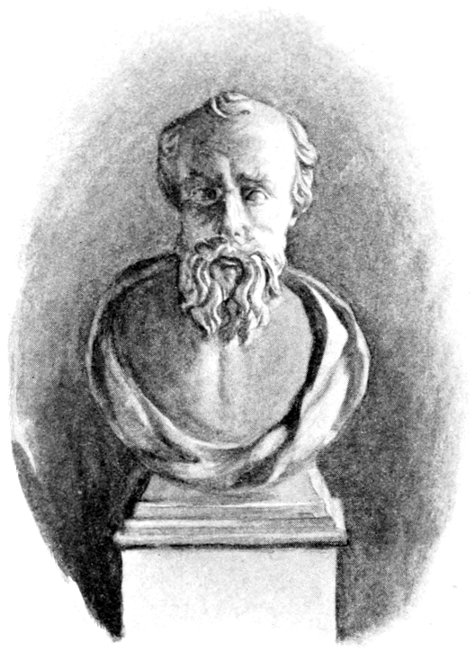
This distillation of sulphuric acid with sea-salt, which yielded spirit of salt, or as it is now called hydrochloric acid, was probably Glauber’s principal contribution to the development of chemistry. He observed the gas given off from the salt, and it is a wonder that with his acuteness he did not isolate and describe the element chlorine. He called it the spirit of rectified salt, and described it as a spirit of the colour of fire, which passed into the receiver, and which would dissolve metals and most minerals. He noted that if digested with dephlegmated (concentrated) spirit of wine his spirit of salt formed a layer of oily substance, which was the oil of wine, “an excellent cordial and very agreeable.” He distilled ammonia from bones, and showed how to make sal ammoniac by the addition of sea salt. His sulphate of ammonia, now so largely used as a fertiliser and in the production of other ammonia salts, was known for a long time as “Sal ammoniacum secretum Glauberi.” He made sulphate of copper, and his investigation of the acetum lignorum, now called pyroligneous acid, though he did not claim to have discovered this substance, was of the greatest value. He produced artificial gems, made chlorides of arsenic and zinc, and added considerably to the chemistry of wine and spirit-making.
Glauber worked at many subjects for manufacturers, and sold his secrets in many cases. His enemies asserted that he sold the same secret several times, and that he not unfrequently sold secrets which would not work. It is impossible now to test the truth of these accusations. Probably some of the allegations made against him were due to the fact that those who bought his processes were not as skilful as he was. One secret which he claimed to have discovered he would neither sell nor publish. It was that of the Alkahest, or universal solvent. To make this known might, he feared, “encourage the luxury, pride, and godlessness of poor humanity.”
Oliver Cromwell wrote in an old volume of Glauber’s Alchemy: “This Glauber is an errant knave. I doe bethinke me he speaketh of wonders which cannot be accomplished; but it is lawful for man too the endeavour.”
Glauber complained that he was not appreciated, which was probably true. “I grieve over the ignorance of my contemporaries,” he wrote, “and the ingratitude of men. Men are always envious, wicked, ungrateful. For myself, faithful to the maxim, Ora et Labora, I fulfil my career, do what I can, and await my reward.” Elsewhere he writes, “If I have not done all the good in the world that I should have desired, it has been the perversity of men that has hindered me.” His employees, he says, were unfaithful. Having learned his processes, they became inflated with pride, and left him. Apparently there was a good business to be done in chemical secrets at that time. But Glauber did not give away all he knew, and he found it best to do all his important work himself. “I have learnt by expensive experience,” he wrote, “the truth of the proverb, 'Wer seine Sachen will gethan haben recht, Muss selbsten seyn Herr und Knecht.’”
Although all Glauber’s books appeared with Latin titles they were written in German.
Goulard.
Thomas Goulard was a surgeon of Montpellier with rather more than a local reputation. He was counsellor to the king, perpetual mayor of the town of Alet, lecturer and demonstrator royal in surgery, demonstrator royal of anatomy in the College of Physicians, fellow of the Royal Academies of Sciences in Montpellier, Toulouse, Lyons, and Nancy, pensioner of the king and of the province of Languedoc for lithotomy, and surgeon to the Military Hospital of Montpellier. His treatise on “The Extract of Saturn” was published about the middle of the eighteenth century, and his name and the preparations he devised were soon spread all over Europe. White lead and sugar of lead, and litharge as the basis of plasters had been familiar in medical practice for centuries; and Galen and other great authorities had highly commended lead preparations for eye diseases and for general lotions. The preparation of sugar of lead is indicated in the works attributed to Basil Valentine. Goulard’s special merit consisted in the care which he gave to the production of his “Extract of Saturn,” and in his intelligent experiments with it, and its various preparations in the treatment of external complaints.
Goulard made his extract of Saturn by boiling together golden litharge and strong French wine vinegar at a moderate heat for about an hour, stirring all the while, and after cooling drawing off for use the clear supernatant liquor. Diluting this extract by adding 100 drops to a quart of river water with four teaspoonfuls of brandy, made what he called his Vegeto-Mineral Water, which he used for lotions. His cerate of Saturn was made by melting 4 oz. of wax in 11 oz. of olive oil, and incorporating with this 6 lbs. of vegeto-mineral water (containing 4 oz. of extract of Saturn). A cataplasm was made by gently boiling the vegeto-mineral water with crumb of bread. A pomatum was prepared by combining 4 oz. of the extract with a cerate composed of 8 oz. of wax in 18 oz. of rose ointment. This was made stronger or milder as the case might need. There was another pomatum made with the extract of Saturn, sulphur, and alum, for the treatment of itch; and several plasters for rheumatic complaints. Goulard gave full details of the various uses of these applications in inflammations, bruises, wounds, abscesses, erysipelas, ophthalmia, ulcers, cancers, whitlows, tetters, piles, itch, and other complaints. His own experience was supported by that of other practitioners.