XVII THE DIARY OF HIS EXCELLENCY CHING SHAN
Reading edition
[Note.—Ching Shan, a Manchu of the Plain Yellow Banner Corps, was born in 1823. In 1863 he became a Metropolitan Graduate and Hanlin Compiler, especially distinguished as a scholar in Sung philosophy. In the following year he was appointed a Junior Secretary of the Imperial Household (Nei wu fu), rising to Senior Secretary in 1869 and Comptroller in 1879. His father, Kuang Shun, had held the post of Comptroller-General under the Emperor Tao-Kuang, with whom he was for years on terms of intimacy; he was a kinsman of the Empress Dowager’s family and in close touch with all the leading Manchu nobles. Ching Shan had therefore exceptional opportunities of knowing all the gossip of the Court, of learning the opinions and watching the movements of the high officials, Chinese and Manchu, who stood nearest to the Throne. After holding office in several of the Metropolitan Boards, he retired in 1894. He was tutor to Prince Tuan, Duke Tsai Lan, and other sons of Prince Tun (younger son of the Emperor Tao-Kuang), and therefore intimately associated with the leaders of the Boxer movement.
Seen even against the lurid background of the abomination of desolation which overtook Peking in August 1900, Ching Shan’s fate was unusually tragic. Above the storm and stress of battle and sudden death, of dangers from Boxers, wild Kansuh soldiery and barbarian invaders, the old scholar’s domestic griefs, the quarrels of his women folk, his son’s unfilial behaviour, strike a more poignant note than any of his country’s fast pressing misfortunes. And with good cause. On the 15th August, after the entry of the allied forces into Peking and the flight of the Empress Dowager, his wife, his senior concubine, and one of his daughters-in-law committed suicide. He survived them but a few hours, meeting death at the hands of his eldest son, En Ch’un, who pushed him down a well in his own courtyard. This son was subsequently shot by British troops for harbouring armed Boxers.
The Diary was found by the translator in the private study of Ching Shan’s house on August 18th and saved, in the nick of time, from being burnt by a party of Sikhs. Many of the entries, which cover the period from January to August 1900, refer to trivial and uninteresting matters. The following passages are selected chiefly because of the light they throw on the part played by the Empress Dowager in that tragedy of midsummer madness—on the strong hand and statecraft of the woman, and on the unfathomable ignorance which characterises to-day the degenerate descendants of Nurhachu. It should be explained that Ching Shan (景善), who retired from office in 1894, must be distinguished from Ching Hsin (敬信), who died about 1904. The latter was also a Manchu and a favourite of Tzŭ Hsi, well known to foreigners at the capital. He held various high posts, rose to be a Grand Secretary, and remained in Peking after the flight of the Court, in charge of the Palace. It was he who escorted the Diplomatic Body through the deserted halls of the Forbidden City in September 1900. He was highly respected by all who knew him.
Ching Shan, though of similarly high rank, was personally quite unknown to foreigners, but a short note on his career (and another on that of Ching Hsin) will be found in the “List of the Higher Metropolitan and provincial officials” periodically compiled by the Chinese Secretariat of the British Legation; Edition of 1902, Kelly and Walsh, Shanghai.]
25th Year of Kuang Hsü, 12th Moon, 25th Day (25th January, 1900).—Duke Tsai Lan came to see me, his old tutor, to-day. He has much to tell me concerning the “Patriotic Harmony” train-bands (I Ho Tuan) which have been raised in Shantung by Yü Hsien, the Governor. Later, he described yesterday’s audience at the Palace; in addition to the Grand Secretaries, the Presidents of Boards and the Ministers of the Household, the “Sacred Mother” received Prince Kung, his uncles Tsai Ying and Tsai Lien and Prince Tuan. The Old Buddha announced her intention of selecting a new Emperor. She said: “The nation has shown resentment and reproached me for putting Kuang Hsü on the Throne, he being of the wrong generation; furthermore, he himself has shown great lack of filial duty to me notwithstanding the debt of gratitude he owed me for my kindness in thus elevating him. Has he not plotted against me with traitors from the south? I now propose therefore to depose him and to place a new Emperor on the Throne, whose accession shall take place on the first day of the New Year. It should be for you Ministers now to consider what title should be given to Kuang Hsü upon his abdication. There is a precedent for his removal from the Throne in the case of the Emperor Ching T’ai of the Ming Dynasty who was reduced to the rank of Prince and whose brother was restored to the Throne after eight years of captivity among the Mongols.” There was dead silence for some time in the Hall of Audience. At last the Grand Secretary Hsü T’ung suggested as appropriate the title of “Hun-te-Kung,” which means, “The Duke of Confused Virtue”—or well-meaning bungler:—it had been given by the Mongol Dynasty to a deposed Sung Emperor. The Old Buddha approved. She then declared to the assembly that her choice of the new Emperor was already made; it had fallen upon the eldest son of Prince Tuan, whose great devotion to Her Majesty’s person was well known. Henceforward Prince Tuan should be in constant attendance at the Palace to supervise the education of his son. At this point the Grand Secretary Sun Chia-nai[68] craved permission to speak. He implored the Empress not to depose the Emperor; of a certainty there would be rebellion in the Southern provinces. The choice of a new Sovereign rested with her, but it could only be done after “ten thousand years had elapsed” (i.e., after the death of the present Emperor). The “Motherly Countenance” showed great wrath; turning on Sun Chia-nai, she bade him remember that this was a family council to which she only admitted Chinese as an act of grace. She had already notified the Emperor of her intention, and he had no objections to offer. The Empress then ordered all present to repair to the Hall of Diligent Government there to await her and the Emperor, and upon their coming to witness the draft of the Decree appointing the Heir Apparent. The formal announcement of his accession to the throne would be postponed until the first day of the New Year.
They proceeded therefore to the entrance of the appointed Hall, and in a few minutes the Empress’s chair appeared at the gateway, when all knelt and kowtowed three times. A number of eunuchs accompanied her, but she bade them remain without. She sent Major-domo Li Lien-ying to request the Emperor’s presence; he came in his chair, alighting at the outer gate and kowtowed to the Empress, who had taken her seat on the main throne within. She beckoned him to come to the Hall, and he knelt again, all officials still kneeling outside. “Chin lai, pu yung kuei hsia” (Come in, you need not kneel), called Her Majesty. She bade him sit down, and summoned next the princes and ministers—some thirty in all—to enter. Again the Old Buddha repeated her reasons for the step she was taking. The Emperor only said “What Your Majesty suggests is quite proper and in accordance with my views.” At this the Grand Secretary Jung Lu handed to the Empress the Decree which the Grand Council had drafted.[69] She read it through and forthwith ordered its promulgation. Nothing was said to “The Lord of Ten Thousand Years” as to his being deposed; only the selection of the Heir Apparent was discussed. The Grand Council then remained for further audience, but the Princes were ordered to withdraw, so that Duke Lan does not know what passed thereafter. The Emperor seemed dazed, as one in a dream.
30th Day (30th January, 1900).—To-day Liu Shun shaved my head; he leaves to-night for his home at Pao-ti-hsien there to spend the new year. My eldest son, En Ch’u, is pressing me to give him fifty taels to buy an ermine cloak; he is a bad son and most undutiful. Chi Shou-ch’ing came to see me to-day; he has moved to “Kuai Pang” Lane. He tells me that his father-in-law, Yü Hsien, is to be made Governor of Shansi. The Old Buddha has received him in audience since his removal from the Governorship of Shantung on account of the murder of a French[70] missionary, and praised him for the honesty and justice of his administration. She does not approve of the Big Sword Society’s proposed extermination of foreigners, because she does not believe they can do it; Yü Hsien goes often to Prince Tuan’s palace, and they have many secret interviews. Prince Tuan declares that if he were made President of the Tsung-li Yamên he would make short work of all difficulties with foreigners. He is a violent man and lacking in refinement.
1st Day of 26th Year of Kuang Hsü (31st January, 1900).—To-day I am 78 years of age and my children mock me for being deaf. They are bad sons and will never rise so high as their father has done. When I was their age, between 20 and 30, the Emperor Tao-Kuang had already praised my scholarship and presented me with a complimentary scroll bearing a quotation from the writings of the philosopher Chu.
This year will witness many strange events; the people all say so. The eighth month is intercalary which, in a year that has “Keng” for its cyclical character, has ever been an evil omen. The New Emperor was to have been proclaimed to-day under the title of “Heng-Ching”—all pervading prosperity—but my son En Lin tells me that the new year sacrifices were performed by the Ta-A-Ko (heir apparent) at the Palace of Imperial Longevity, acting only as Deputy for the Emperor Kuang Hsü. The Ta-A-Ko is a boy of fourteen; very intelligent, but violent-tempered. He walked on foot to the Palace Hall from the Coal Hill Gate.
5th Moon, 5th Day: The Dragon Festival (1st June, 1900).[71]—Arose at six o’clock and was washing my face in the small inner room, when Huo Kuei, the gatekeeper, came in with the card of Kang Yi, the Grand Secretary, and a present of ten pounds of pork, with seasonable greetings. I was not aware that he had already returned from his journey to Chu Chou, whither he had gone with Chao Shu-ch’iao to examine and report on the doings of the “patriotic train bands” (i.e. Boxers). He sends word by the messenger that he will call upon me this morning.
My sons En Ch’u and En Shun are going to-day to a theatrical performance at Chi Shou-ch’eng’s residence. My youngest son, En Ming, is on duty at the Summer Palace, where, for the next four days, the Old Buddha will be having theatricals. I am surprised that Kang Yi is not out there also. No doubt he only returned to Peking last night, and so does not resume his place on the Council till to-morrow morning.
The Hour of the Monkey (3 P.M.).—Kang Yi has been here and I persuaded him to stay for the mid-day meal. He is a worthy brother-in-law, and, though twenty years younger than I am, as wise and discreet a man as any on the Grand Council. He tells me that several hundred foreign devil troops entered the City yesterday evening. He and Chao Shu-ch’iao arrived at Peking at 4.30 P.M., and immediately set to composing their memorial to the Empress Dowager about the heaven-sent Boxers, for presentation to-morrow morning. Prince Tuan has five days’ leave of absence: Kang Yi went to see him yesterday evening. While they were discussing the situation, at the Prince’s own house, there came a Captain of Prince Ch’ing’s bodyguard with a message. Saluting Prince Tuan, he announced that about 300 foreign soldiers had left Tientsin in the afternoon as reinforcement for the Legation Guards. Prince Ch’ing implored Prince Tuan not to oppose their entry, on the ground that a few hundred foreigners, more or less, could make no difference. He trusted that Prince Tuan would give orders to his Corps (the “Celestial Tigers” Force) not to oppose the foreign devils. It was the wish of the Old Buddha that they should be permitted to guard the Legations. Prince Tuan asked for further details, and the Captain said that Prince Ch’ing had received a telegram from the Governor-General of Chihli (Yü Lu) to the effect that the detachment carried no guns. At this Prince Tuan laughed scornfully and said “How can the few resist the many? What indeed will a hundred puny hobgoblins, more or less, matter?” Kang Yi, on the contrary, tells me that he strongly urged Prince Tuan to issue orders to Chung Li, the Commandant of the city, to oppose the entry of the foreign troops, but it appears that Jung Lu had already ordered their admission. Kang Yi is much incensed with Jung Lu about this, and cannot understand his motives. It seems that towards the close of last year Prince Tuan and Jung Lu had agreed to depose the Emperor and to put the Heir Apparent on the Throne, and Tuan confesses that, were it not for Jung Lu’s great influence with the Old Buddha she would never have agreed to select his son as Heir Apparent. But now Jung Lu is for ever denouncing the Boxers and warning the Empress against encouraging and countenancing them. Prince Tuan and Kang Yi despair of ever being able to induce her to support the Boxers whole-heartedly so long as Jung Lu is against them. As an example of her present attitude, Prince Tuan told Kang Yi one day lately that his son, the Ta-a-ko, had dressed himself up as a Boxer and was going through their drill in the Summer Palace grounds with some eunuchs. The Old Buddha saw him and promptly gave orders that he be confined to his rooms. She also reprimanded the Grand Secretary, Hsü Tung, for not keeping a better watch on his pupil and for permitting such unseemly behaviour, as she called it.
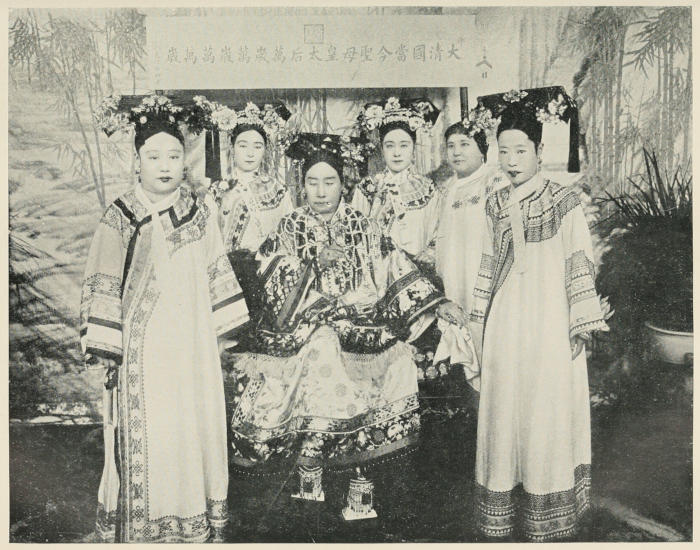
H.M. The Empress Dowager and Ladies of her Court (1903).
Daughters of H. E. Yü Keng. Wife of H. E. Yü Keng, ex-Minister to Paris.
Second wife of late Emperor. H.M. Tzŭ Hsi. Empress Consort of Kuang-Hsü, now Empress Dowager.
After leaving Prince Tuan’s house, Kang Yi had gone out of the city by the Ch’ien Men and had seen the foreign troops pass in. The people muttered curses, he says, but no one molested them. What does it matter? None of them will ever leave the city. Kang Yi’s journey to Chu-chou has convinced him that the whole province stands together as one man; even boys in their teens are drilling. Not a doubt of it; the foreigner will be wiped out this time! At Chu-chou the Departmental Magistrate, a man named Kung, had arrested several Boxer leaders, but Kang Yi and Chao Shu-ch’iao ordered them to be released and made them go through their mystic evolutions and drill. It was a wonderful sight, scarcely to be believed; several of them were shot, some more than once, yet rose uninjured from the ground. This exhibition took place in the main courtyard of the Magistrate’s Yamên, in the presence of an enormous crowd, tight pressed, as compact as a wall. Chao Shu-ch’iao remembers having seen many years ago, in his native province of Shensi, a similar performance, and it is on record that similar marvels were seen at the close of the Han Dynasty, when Chang Chio headed the Yellow Turban insurrection against the Government and took many great cities with half a million of followers. They were said to be under the protection of the Jade Emperor[72] and quite impervious to sword-thrusts. Kang Yi and Chao Shu-Ch’iao will memorialise the Empress to-morrow, giving the results of their journey and begging her to recognise the “patriotic train-bands” as a branch of the army. But they should be placed under the supreme command of Prince Tuan and Kang Yi, as Jung Lu, the Commander-in-Chief of the Northern army, is so incredulous as to their efficacy against foreign troops.
Although Major Domo Li Lien-ying is a warm supporter of the Boxers, and never wearies of describing their feats to the Old Buddha, feats which he himself has witnessed, it is by no means certain that the “kindly Mother” will heed him so long as Jung Lu is opposed to any official encouragement of the movement. And, besides, the nature of the Empress is peace-loving; she has seen many springs and autumns. I myself know well her refined and gentle tastes, her love of painting, poetry, and the theatre. When in a good mood she is the most amiable and tractable of women, but at times her rage is awful to witness. My father was Comptroller-General of the Imperial Household, and it was his lot on one occasion to experience her anger. This was in the sixth year of T’ung Chih (1868), when she learned that the chief eunuch, “Hsiao An’rh,”[73] had been decapitated in Shantung by the orders of the Co-Regent, the late “Empress Dowager of the East.” She accused the Comptrollers of the Household of being leagued together in treachery against her, as they had not told her of what was going on she declared that Prince Kung was plotting against her life, and that all her attendants were associated in his treason. It was years before she forgave him. All An’s fellow-eunuchs were examined under torture by the Department responsible for the management and discipline of the Household. When the chief eunuch’s betrayer was discovered by this means, he was flogged to death by her orders in the Palace. But nowadays the Old Buddha’s heart has softened, even towards foreigners, and she will not allow any of them to be done away with. One word from her would be sufficient to bring about their immediate and complete destruction, so that neither dog nor fowl be left alive, and no trace be left of all their foreign buildings. Kang Yi stayed with me about two hours and left to go and see Prince Tuan, who was expecting Major Domo Li Lien-ying to come into the city this afternoon.
K’un Hsiu, Vice-President of the Board of Works, called to see me. He tells me that Prince Ch’ing habitually ridicules the Boxers in private conversation, declaring them to be utterly useless, and unworthy of even a smile from a wise man. In public, however, he is most cautious—last week when the Old Buddha asked his opinion of them he replied by vaguely referring to the possible value of train-bands for protection of the Empire.
9 P.M.—My son En Ch’u has returned from Chi Shou-ch’eng’s theatricals; everyone was talking, he says, of Jung Lu’s folly in allowing the foreign troops to enter the city yesterday. Chi’s father-in-law, Yü Hsien, has written to him from Shansi saying that for the present there are but few Boxers enrolled in that province, but he is doing his best to further the movement, so that Shansi may unite with the other provinces of the north “to destroy those who have aroused the Emperor’s wrath.” By common report, Yüan Shih-k’ai has now become a convert to Christianity: if he too were to suppress the movement in Shantung, not death itself could expiate his guilt.
En Chu’s wife is most undutiful; this evening she has had a quarrel with my senior concubine, and the two women almost came to blows. Women are indeed difficult to manage; as Confucius has said, “Keep them at a distance, they resent it; treat them familiarly, and they do not respect you.” I am seventy-eight years of age and sore troubled by my family; their misconduct is hard for an old man to bear.
12th Day of the 5th Moon (June 8th, 1900).—My son, En Ming, came in this morning about midday; as Officer of the Bodyguard he had been in attendance on the Empress coming in from the Summer Palace. Jung Lu had been there yesterday morning and had had a long audience with Her Majesty. He gave her details of the burning of the railway by the Boxers. She was seriously alarmed and decided to return at once to the Winter Palace on the Southern Lake. It seems she cannot make up her mind as to the Boxers’ invulnerability. Jung Lu has again applied for leave. When he is absent from the Grand Council, Kang Yi and Ch’i Hsiu have the greatest influence with her. En Ming says that on the way to the city she kept urging the chair-bearers to hurry, and seemed out of sorts—nervously fanning herself all the time. At the Ying Hsiu gate of the Winter Palace the Emperor and the Heir Apparent were kneeling to receive her. No sooner had she reached the Palace than she summoned Prince Tuan to audience, which lasted a long time. It is a pity that the Old Buddha will not decide and act more promptly. The Emperor never speaks at audience nowadays, although Her Majesty often asks him for his opinion. Tung Fu-hsiang accompanied the Court into Peking; he denounced Jung Lu at audience to-day, telling the Empress that if only the Legations were attacked, he would undertake to demolish them in five days; but that Jung Lu, by failing to support the Boxers, was a traitor to the Dynasty. The Empire, said he, would be endangered unless the present opportunity were seized to wipe off old scores against the foreigner. Tung is a coarse, foul-spoken fellow, most violent in his manner towards us Manchus. Kang Yi hates him, but for the present is only too willing to make use of him.
14th day of the 5th Moon (June 10th).—Grand Councillor Ch’i Hsiu called to-day—he showed me the draft of a Decree breaking off all relations with foreigners, which he had prepared for the Empress’s signature; so far, however, she has given no indication of agreeing to make war against them. In the afternoon I went to Duke Lan’s residence—to-day being his wife’s birthday. There are more than a hundred Boxers living in his outer courtyard, most of them country-folk, under the command of a Banner Captain named Wen Shun. Among them are five or six lads of thirteen or fourteen who will fall into a trance, foam at the mouth, then rise up and grasp wildly at anything that comes within their reach, uttering the while strange uncouth noises. Duke Lan believes that by their magic arts they will be able to guide him, when the time comes, to the houses of Christian converts (lit. Secondary Devils). He says that his wife goes often to the Palace and that she has told the Old Buddha of these things. The “Ta Kung Chu” (Princess Imperial and adopted daughter of the Empress Dowager) has over two hundred and fifty Boxers quartered at the Palace outside the Hou Men, but she has not dared to tell the Empress Dowager. Her brother, the “Prince” Tsai Ying, is also learning this drill. Truly it is a splendid society! The Kansuh braves are now entering the Chinese city, and thousands of people are preparing to leave Peking.
16th day of the 5th Moon (June 12th).—Jung Lu attended the Grand Council this morning. Prince Li, the Senior Councillor, did not dare to tell the Empress that a foreign devil[74] had been killed yesterday by the Kansuh braves just outside the Yung-Ting Gate. Jung Lu was called to the audience chamber after Prince Li had retired, and Kang Yi believes that he urged her to order Tung Fu-hsiang to leave the city with his troops and at the same time to issue an Edict, bestowing posthumous honours on the murdered foreigner. None of the other Grand Councillors were summoned to audience; when Jung Lu left the presence, he returned straightway to his own house and spake no word to any of his colleagues. It is rumoured that more foreign troops are coming to Peking, and that the Empress Dowager will not permit them to enter the city. In this Jung Lu agrees with her. He has advised that all foreigners shall be allowed to leave Peking, but that it is contrary to the law of nations to attack the accredited representatives of foreign Powers.
18th Day of the 5th Moon (June 14th).—Yesterday, just before nightfall, En Ch’u came in to tell me that several hundred Boxers had entered the Ha-Ta Gate. I was sorry that my lameness prevented me from going out to see them, but I sent Hao Ching-ting to report. Well indeed, is it, that I have lived to see this day; almost every foreign building except the Legations had been burnt to the ground. Throughout the night flames burst forth in every quarter of the city; a grand sight! Kang Yi has sent me a message to say that he and Duke Lan went to the Shun Chih (S.W.) Gate at about the third watch to encourage and direct the Boxers who were burning the French Church. Hundreds of converts were burnt to death, men, women and children, and so great was the stench of burning flesh that Duke Lan and Kang Yi were compelled to hold their noses. At dawn Kang Yi went to the Palace to attend the Grand Council. Major Domo Li Lien-ying told him that the Old Buddha had watched the conflagrations from the hillock to the west of the Southern Lake, and had plainly seen the destruction of the French Church at the Shun-Chih Men. Li Lien-ying had told her that the foreigners had first fired on the crowd inside the Ha-Ta Gate, and that this had enraged the patriotic braves who had retaliated by slaughtering the converts. It seems that Hsü T’ung is unable to get out of his house because the foreign devils have barricaded the street; the Old Buddha is anxious about him and has commanded Prince Ch’ing to ask the foreign Legations to let him pass out. She is amazed at the Boxers’ courage, and Kang Yi believes that she is about to give her consent to a general attack upon the Legations. Nevertheless, Li Lien-ying has warned him that exaggerated praise of the Boxers arouses her suspicions, and that, with the exception of Jung Lu, all the Grand Councillors are afraid to advise her. Her Majesty is moving into the Palace of Peaceful Longevity in the Forbidden City, as all these alarms and excursions disturb her sleep at the Lake Palace.
21st Day of the 5th Moon (June 17th).—A great fire has been raging all to-day in the southern city. Those reckless Boxers set fire to a foreign medicine store in the Ta Sha-lan’rh, and from this the flames spread rapidly, destroying the shops of the wealthy goldsmiths and assayers. Rightly says the Canon of History, “When fire rages on the Kun Lun ridge, common pebble and precious jade will be consumed together.” The Boxers themselves are worthy men, but there are among them many evil doers whose only desire is plunder; these men, wearing the Boxer uniform, bring discredit upon the real “patriotic braves.” The outer tower of the Ch’ien Men having caught fire, the Empress ordered Jung Lu to send Banner troops on to the wall so as to prevent any ruffians entering the Tartar City by the Ta Ch’ing Gate.
In the afternoon my married niece came over to see her aunt: she has been greatly alarmed by the uproar and fighting near her home, so they are moving to her father-in-law’s house in the northern city.
I hear that Prince Tuan has now persuaded the Old Buddha to appoint him President of the Tsung Li Yamên; also that she has authorised him to require all foreigners to leave Peking, but they are to be protected against any attacks by the Boxers. My old friend, Ch’i Hsiu, has been made a Minister of the Tsung Li Yamên, also Na T’ung, the Sub-Chancellor of the Grand Secretariat. The latter memorialised lately advising the Throne to declare war before the foreign Powers could send reinforcements; the Old Buddha has placed him in the Tsung Li Yamên to assist Prince Tuan and Chi Hsiu in arranging for the foreigners’ departure from the city. Prince Ch’ing still says nothing for or against the Boxers. Jung Lu has offered to escort the foreign Ministers half-way to Tientsin, but he stipulates that the Viceroyalty of Chihli must be taken from Yü Lu. My wife was taken seriously ill this evening; she kept on muttering incoherently and rolling about on the k’ang as if in great pain. We sent for Dr. Yung, who applied acupuncture.
24th Day of the 5th Moon (June 20th).—Yesterday, at mid-day, Yü Lu’s memorial reached the Throne. He says that the foreign devils have actually demanded the surrender of the Taku forts, and he begs the Empress Dowager to declare war on them forthwith, to make them atone for their insolence and treachery. A special meeting of the Grand Council was immediately called. The Old Buddha was very wroth, but said she would postpone her decision until to-day, when all the Princes, Presidents and Vice-Presidents of the Boards and Ministries, and the Lieutenant-Generals of Banners, would meet in special audience. Prince Tuan, Ch’i Hsiu and Na T’ung showed her a despatch from the foreign Ministers couched in most insolent language demanding her immediate abdication, the degradation of the Heir Apparent, and the restoration of the Emperor.[75] The Ministers also asked that the Emperor should allow 10,000 foreign troops to enter Peking to restore order. Kang Yi came to tell me that never had he seen the Old Buddha so angry, not even when she learned of K’ang Yu-wei’s treason. “How dare they question my authority!” she exclaimed. “If I can bear this, what must not be borne? The insults of these foreigners pass all bounds. Let us exterminate them before we eat our morning meal.”[76]
The wrath of the Old Buddha is indeed beyond control; neither Jung Lu, nor any other can stop her now. She has told Jung Lu that if he wishes, he may still offer to escort the foreign Ministers to Tientsin, but she will give no guarantee for their safety on the journey because of their monstrous suggestion that she should abdicate. She does not absolutely desire their death, but says that the consideration she showed them in allowing the Legation guards to enter the city, and her solicitude in restraining the Boxers, have been ill-requited. “It were better,” says she, “to go down in one desperate encounter than to surrender our just rights at the bidding of the foreigner.”
Though only a woman, Her Majesty Tzŭ Hsi has all the courage of a man, and more than the ordinary man’s intelligence.
24th Day of the 5th Moon: The Hour of the Cock, 5-7 P.M. (20th June).—I have just returned from visiting my brother-in-law, the Grand Secretary Kang Yi; he told me all about this morning’s audience. At the hour of the Tiger (3-5 A.M.) the Grand Council assembled in the Palace by the Lake, and were received by the Old Buddha in the Pavilion of the Ceremonial Phœnix. All were there, Prince Li, Jung Lu, Kang Yi, Wang Wen-shao, Ch’i Hsiu, and Chao Shu-ch’iao, but the Emperor was absent. This was a special audience, preparatory to the general audience of all the Princes and Ministers, and its object was to give the Grand Council an opportunity of laying before Her Majesty any new facts or opinions bearing upon the situation.
With tears in his eyes, Jung Lu knelt before Her Majesty; he confessed that the foreigners had only themselves to blame if China declared war upon them, but he urged her to bear in mind that an attack on the Legations, as recommended by Prince Tuan and the rest of the Council, might entail the ruin of the ancestral shrines of the Dynasty, as well as the altars of the local and tutelary Gods. What good purpose, he asked, would be served by the besieging nay, even by the destruction, of this isolated handful of Europeans? What lustre could it add to the Imperial arms? Obviously, it must be waste of energy and misdirected purpose.
The Old Buddha replied that if these were his views, he had better persuade the foreigners to leave the city before the attack began; she could no longer restrain the patriotic movement, even if she wished. If therefore, he had no better advice than this to offer, he might consider himself excused from further attendance at the Council.
Jung Lu thereupon kowtowed thrice and left the audience hall to return to his own house. Upon his departure, Ch’i Hsiu drew from his boot the draft of the Decree which was to declare war. Her Majesty read it and exclaimed, “Admirable, admirable! These are exactly my views.” She asked each Grand Councillor in turn for his opinion, and they declared unanimously in favour of hostilities. It was now the hour appointed for the general audience and Li-Lien-ying came in to conduct her Majesty to her own apartments to take tea before proceeding to the “Hall of Diligent Government.”
All the leading members of the Imperial Clan were kneeling at the entrance to the Hall, awaiting their Majesties’ arrival: the Princes Kung, Ch’un and Tuan; the “Beilehs” Tsai Lien and Tsai Ying; Duke Lan and his brother the “Beitzu” Ying; Prince Ch’ing and the five Grand Councillors; the Princes Chuang, Su and Yi; the Presidents, Chinese and Manchu, of the six Boards and the nine Ministries; the Lieutenants-General of the twenty-four Banner divisions; and the Comptrollers of the Imperial Household. Their Majesties arrived together in chairs, borne by four bearers. The Emperor alighted first, and knelt as the “benign mother” left her palanquin and entered the Hall, supported by the Chief Eunuch Li Lien-ying, and by his immediate subordinate, T’sui Chin. The Emperor was ghastly pale, and it was observed that he trembled as he took his seat on the Lower Throne by the Empress Dowager’s side.
The Old Buddha first called on all present to draw near to the Throne; then, speaking with great vehemence, she declared that it was impossible for her to brook these latest indignities put upon her by the foreigners. Her Imperial dignity could not suffer it. Until yesterday, until, in fact, she had read the dispatch addressed to the Tsungli Yamên by the Diplomatic Body, it had been her intention to suppress the Boxers; but in the face of their insolent proposal that she should hand over the reins of government to the Emperor, who had already proved himself quite unfitted to rule, she had been brought to the conclusion that no peaceful solution of the situation was possible. The insolence of the French Consul at Tientsin Tu Shih-lan (Du Chaylard), in demanding the surrender of the Taku Forts was bad enough, but not so grievous an affront as the Ministers’ preposterous proposal to interfere with her personal prerogatives as Sovereign. Her decision was now taken, her mind resolved; not even Jung Lu, to whom she had always looked for wise counsel, could turn her from this purpose. Then, addressing more directly the Chinese present, she bade them all to remember that the rule of her Manchu House had conferred many and great benefits upon the nation for the past two hundred and fifty years, and that the Throne had always held the balance fairly in the benevolent consideration for all its subjects, north and south alike. The Dynasty had scrupulously followed the teachings of the Sages in administering the government; taxation had been lighter than under any previous rulers. Had not the people been relieved, in time of their distress, by grants from the Privy Purse? In her own reign, had not rebellions been suppressed in such a manner as to earn the lasting gratitude of the southern provinces? It was therefore now their duty to rally to the support of the Throne, and to assist it in putting an end, once and for all, to foreign aggression. It had lasted too long. If only the nation were of one mind, it could not be difficult to convince these barbarians that they had mistaken the leniency of the past for weakness. That leniency had been great; in accordance with the principle which prescribes the showing of kindness to strangers from afar, the Imperial House had ever shown them the greatest consideration. The Emperor K’ang Hsi had even allowed them liberty to propagate their religion, an act of mistaken benevolence which had been an increasing cause of regret to his successors. In matters of vital principle, she said, these foreigners ignore the sacred doctrines of the Sages; in matters of detail, they insult the customs and cherished beliefs of the Chinese people. They have trusted in the strength of their arms, but to-day China can rely upon millions of her brave and patriotic volunteers. Are not even striplings taking up arms for the defence of their country? She had always been of the opinion that the allied armies had been permitted to escape too easily in the tenth year of Hsien Feng (1860), and that only a united effort was then necessary to have given China the victory. To-day, at last, the opportunity for revenge had come.
Turning to the Emperor, she asked for his opinion. His Majesty, after a long pause, and with evident hesitation, urged her to follow Jung Lu’s advice, to refrain from attacking the Legations, and to have the foreign Ministers escorted in safety to the coast. But, he added, it must be for her to decide. He could not dare to assume any responsibility in the matter.
The junior Chinese Member of the Council, Chao Shu-ch’iao then spoke. He begged the Old Buddha to issue her orders for the immediate extermination of every foreigner in the interior, so as to avoid the danger of spies reporting on the nature and extent of the patriotic movement. Her Majesty commanded the Grand Council to consider this suggestion and to memorialise in due course for an Edict.
After him, however, each in his turn, the Manchu Li-shan, and the Chinese Hsü Ching-ch’eng and Yüan Ch’ang implored the Empress not to declare war against the whole world. China, they said, could not possibly escape defeat, and, even if the Empire should not be partitioned, there must arise great danger of rebellion and anarchy from within. Yüan Ch’ang even went so far as to say that he had served as a Minister of the Tsungli Yamên for two years and that he had found foreigners to be generally reasonable and just in their dealings. He did not believe in the authenticity of the despatch demanding the Empress’s abdication, which Prince Tuan professed to have received from the Diplomatic Body; in his opinion, it was impossible that the Ministers should have dared to suggest any such interference with China’s internal affairs.
At this Prince Tuan arose and angrily asked the Empress whether she proposed to listen to the words of a Chinese traitor? Her Majesty rebuked him for his loud and violent manner of speaking, but ordered Yüan Ch’ang to leave the Audience Hall. No one else dared to say anything.
She then ordered the promulgation of the Decree, for immediate communication to all parts of the Empire; at the same time announcing her intention of sacrificing at the ancestral shrines before the commencement of hostilities. Prince Chuang and Duke Lan were appointed joint Commanders-in-Chief of the Boxers, but Tzŭ Hsi gave them clearly to understand that if the foreign Ministers would agree to take their departure from Peking this afternoon Jung Lu was to do his best to protect them as far as Tientsin. Finally, the Empress ordered the Grand Council to report themselves at mid-day for further orders. All were then permitted to retire with the exception of Prince Tuan and Duke Lan; these remained in special audience for some time longer. Hsü T’ung was present at the general audience, having made good his escape from the Legation quarter, and was congratulated by Her Majesty on his safety.
They say that Duke Lan told the Empress of a vision in which, the night before, he had seen Yü Huang, the Jade Emperor. To him, and to his company of Boxers while drilling, the god had appeared, and had expressed his satisfaction with them and their patriotic movement. The Old Buddha observed that the Jade Emperor had appeared in the same manner at the beginning of the reign of the Empress Wu of the T’ang Dynasty (the most famous woman ruler in Chinese history); the omen, she thought, showed clearly that the gods are on the side of China and against the barbarians.
When, at the hour of the Sheep (1 P.M.) Kang Yi returned to the Palace, he found Prince Ch’ing in the anteroom of the Grand Council, greatly excited. It seems that En Hai,[77] a Manchu sergeant, had just come to his residence and reported that he had shot and killed two foreigners whom he had met, riding in sedan chairs that morning, just opposite the Tsungpu Street. As orders had been issued by Prince Tuan and Ch’i Hsiu to the troops that all foreigners were to be shot wherever met, and as one of these two was the German Minister, he hoped that Prince Ch’ing would recommend him for special promotion. Prince Tuan had already heard the news and was greatly pleased. Prince Ch’ing and Kang Yi discussed the matter and decided to inform the Empress Dowager at once. Kang Yi did not think that the death of one foreign devil, more or less, could matter much, especially now that it had been decided to wipe out the Legations entirely, but Prince Ch’ing thought differently and reiterated his opinion that the killing of an accredited Envoy is a serious matter. Until now, only missionaries and their converts had been put to death, but the murder of a Minister could not fail to arouse fierce indignation, even as it did in the case of the British negotiator[78] who was captured by our troops in the 10th year of Hsien-Feng (1860).
The Grand Council then entered the presence. Prince Li, as the senior member of the Council, told the Old Buddha the news, but added that the foreigners had brought it on themselves because they had first fired on the people. Upon hearing this Her Majesty ordered Jung Lu to be summoned in haste, but Kang Yi, being extremely busy with his work of providing supplies for the Boxers, did not await his arrival.
Now, even as I write, they tell me that bullets are whizzing and whistling overhead; but I am too deaf to hear them. En Ch’u says that already the Kansuh braves have begun the attack upon the Legations and that Jung Lu’s endeavours to have the foreigners escorted to a place of safety have completely failed.
Liu Shun has just come in and asked for leave to go home for a week. People are leaving the city in all directions and in great numbers.
24th Day of the 5th Moon: the Hour of the Dog, 7-9 P.M. (June 20th, 1900).—En Ming has just come in to inform me that a foreign devil[79] has been captured by Tung Fu-hsiang’s troops. They were taking him, wounded, to Prince Chuang’s Palace, prodding at him with their bayonets; and he was babbling in his foreign tongue. He will be decapitated, and his captors will receive good rewards (Prince Ch’ing has just been given command of the gendarmerie). “The rut in which the cart was overturned is just ahead.” Let this be a warning to those puny barbarian ruffians, the soldiery encamped at the very gates of the Palace. (This alludes to the proximity of the Legations to the Palace enclosure.) Jung Lu was all ready to escort the foreigners to Tientsin; he had with him over 2,000 Manchu troops. Doubtless he means well, but the Old Buddha now says that she will not prevent the Kansuh braves from destroying the Legations. If the foreigners choose to leave with Jung Lu, let them do so, and they will not be attacked; but if they insist upon remaining, then their punishment be upon their own heads, and “let them not say they were not forewarned.”
Duke Lan sent over to invite me to breakfast with him to-morrow; he is sore pressed with business cares just now; nevertheless, he and his brothers always treat their old teacher with politeness and respect. Though bellicose by nature, he is singularly gentle and refined. Chi Pin[80] sent over to ask whether we would like to move to his house in the north of the city, because the noise of the firing is very great in our quarter, but I am so deaf that I hear not a sound of it all.[81]
Chi Pin is writing to his father-in-law, Yü Hsien, about the audience in the Palace.
Duke Lan writes to tell me that this evening ⸺ informed Prince Tuan and Chi Hsiu that, by the orders of that rascally Chinaman, Yüan Ch’ang, the corpse of the foreign devil had been coffined. ⸺ wanted Prince Tuan to have the corpse decapitated and the head exhibited over the Tung An Gate. Yüan Ch’ang defends his action, saying that he knew the German Minister personally at the Tsung Li Yamên, and he cannot bear the idea of leaving his body uncoffined. Mencius says, “It is common to all men to feel pity. No one can see a child fall into a well without a shudder of commiseration and horror.” But these Chinese traitors of ours are compassionate to the enemies of our glorious Kingdom, and the foes of our ancient race. It is passing strange!
25th Day of the 5th Moon: the Hour of the Monkey, 3-5 P.M. (June 21st).—My chair-bearers have fled from the city, so to-day I had to use my cart to go to Duke Lan’s residence. Prince Tuan and the Grand Secretary, Kang Yi, were there; also Chung Li, lately Commandant of the gendarmerie, and the “Beileh” Tsai Lien. Prince Tuan had seen the Old Buddha this morning; their Majesties have moved from the Palace by the lake into the Forbidden City. As the Empress Dowager was crossing the road which runs between the Gate of the Hsi Yüan (Western Park) and the Hsi Hua Gate of the Forbidden City she saw that a number of Boxers had lined up on each side of the street as a Guard of Honour for the “Sacred Chariot.” She presented them with 2,000 taels, congratulating their commander, Prince Chuang, on their stalwart appearance. Said the Old Buddha to Prince Tuan, “The foreigners are like fish in the stew-pan. For forty years have I lain on brushwood and eaten bitterness because of them, nursing my revenge like Prince Kou Chien of the Yüeh State (5th Century B.C.). Never have I treated the foreigners otherwise than generously; have I not invited their womenfolk to visit the Lake Palace? But now, if only the country will stand together, their defeat is certain.”
I think Prince Tuan hopes that the Old Buddha will now have the Ta-A-Ko proclaimed Emperor; but unfortunately the Nanking Viceroy, Liu K’un-yi, has much influence over her in this matter. When he was in Peking this spring, in the second moon, he solemnly warned her against the Boxers and ventured even to remonstrate at the Ta-A-Ko being made Heir Apparent. Were it not for Liu K’un Yi, he would have been Emperor long since; therefore Prince Tuan has a very bitter hatred against him. Liu told the Old Buddha at his second audience that if H.M. Kuang Hsü were deposed, the people of his province would assuredly rise in rebellion. What concern is it of theirs who reigns in the Capital? His present Majesty’s reign has brought many misfortunes to the nation; it is high time that it came to an end. Why does not Prince Tuan enter the Palace and proclaim his son Emperor? Tung Fu-hsiang’s Kansuh braves and the Prince’s own Manchu soldiery would surely rally round him. But if Jung Lu opposed them the Old Buddha would side with him. His wife[82] is for ever in the Palace.
26th Day of the 5th Moon (June 22nd).—I went this morning to Prince Li’s palace in the western quarter of the city. I had to go in my small cart, because my chair-bearers have either run away to their homes in the country or had joined the Boxers. My two sons, En Ch’u and En Ming, have been making arrangements to quarter one hundred Boxers in our outer courtyard, and it seems that we shall have to supply them with food. Although it cannot be denied that everyone should join in this noble work of exterminating the barbarians, I grudge, nevertheless, spending money in these hard times even for the Boxers, for rice is now become as dear as pearls, and firewood more precious than cassia buds. It may be that, in my old age, I am becoming like that Hsiao Lung, brother to the founder of the Liang Dynasty, who was so miserly that he stored up his money in heaps. On every heap of a million cash he would place a yellow label, while a purple label marked each hoard of ten millions. It is recorded of him, that his relatives abused him for this habit; as for me, my sons would like to get at my money, but they cannot.
I find Prince Li much depressed in his mind; his treasure vaults contain vast wealth; as senior member of the Grand Council, moreover, he feels a weight of responsibility that is too much for him. His abilities are certainly small, and I have never yet understood why the Old Buddha appointed him to succeed Prince Kung as senior Councillor. He tells me of a stormy meeting at the Grand Council this morning; it seems that Her Majesty is greatly annoyed with Liu K’un-yi for sending in a telegram strongly denouncing the Boxers. He has also telegraphed privately to Jung Lu, imploring him to check their rebellion, but no one knows what answer Jung Lu has made.
In his telegram to the Empress Dowager, which came forward by express couriers from Pao-ting-fu, the Viceroy declares that he would be more than ready to march north with all his troops if it were to repel a foreign invasion, but he firmly declines to lend his forces for the purpose of massacring a few helpless foreigners. Commenting on this, the Empress Dowager quoted the words of the Classic Historical Commentary (Tso Chüan): “The upper and lower jaws mutually assist each other; if the lips shrivel, then must the teeth catch cold.” Thereby she meant to imply that even such, in its close interdependence, is the relation between the northern and southern parts of our Empire, and no one should know this better than Liu K’un-yi, after his experiences at the time of the Taiping Rebellion.
The Old Buddha has directed Prince Chuang, as head of the city gendarmerie, to issue a proclamation offering Tls. 50 for every head of a male barbarian brought in, Tls. 40 for that of a woman, and Tls. 30 for that of a child.
While I was still talking with Prince Li, Jung Lu came over in his sedan chair to visit his kinsman. He looks very tired, and walks with a limp. He was loud in denouncing the Boxers, who, he says, are quite incapable of doing any good. They had even now dared to shout abuse at him while passing the “Houmen,” calling him a Chinese traitor. I could not help thinking that Jung Lu deserved the name, but I did not say so. He is a strong man, the strongest of all the Manchus, and I greatly fear that his influence may yet be able to wreck all our hopes.
Returning to my house, I heard that the Princes Tuan and Chuang were sending troops to surround the French Cathedral, which is defended by a few foreign soldiers only, and which should, therefore, be easily captured. Prince Li’s palace is within a stone’s throw of the cathedral, and to enter the Forbidden City he has to pass just south of it, through the “Hsi-Hua” gate. Although greatly disturbed by the impending hostilities in his neighbourhood, he fears to move to a quieter locality, lest, in his absence, his treasure vaults should be plundered. No doubt the cathedral will fall in a few days.
My courtyard is now full of Boxers and Kansuh soldiery; I can no longer call my house my own. How I loathe these cursed foreigners for causing all this disturbance!
The same Day: at the Hour of the Dog (7-9 P.M.).—I learn that Jung Lu has just sent off a courier with a telegram, which Yüan Shih-k’ai is to send on to the Viceroys of Canton, Nanking and Wucha’ng. Prince Li has sent me a copy, which I am to keep secret; it reads as follows:—
“With all respect I have received your telegrams. Where one weak people dares to oppose ten or more powerful nations, the inevitable result can only be complete ruin. It has always been maintained as a fixed principle with civilised nations, that, in the event of war between any two Powers, their respective Envoys should be treated with respect. Can it now be that this our great inheritance, founded by our remote ancestors at so great a cost of toil and danger, is to be endangered, and suddenly brought to ruin, by these false workers of magic? Shall the fate of the Dynasty be staked on a single throw? It requires no peculiar sagacity to see that these Boxers’ hopes of success are nothing but the shadow of a dream. It is true and undeniable, that, from their Majesties on the Throne down to the very lowest of our people, all have suffered from the constant aggression of foreigners and their unceasing insults. For this reason these patriotic train-bands have been organised, claiming a divine mission of retaliation; but the present crisis is all-serious, and although I have used every effort to explain its dangers, I have laboured in vain. I am sick and suffering from lameness, but since I obtained leave of absence I have already submitted seven separate memorials denouncing these Boxers. Seeing that they produced no result, I have now left my sick bed, in order, if possible, to explain the situation clearly to their Majesties; and this also has been in vain.
“All the Princes and Ministers of State who surround the Throne now cry out against me with one voice, as your Excellencies can readily believe. I dare not quote in this place the words of Her Majesty, but I may say that the whole of the Imperial family have joined the Boxers, and at least two-thirds of our troops, both Manchu and Chinese, are with them. They swarm in the streets of our capital like a plague of locusts, and it will be extremely difficult to disperse them.
“Even the divine wisdom of Her Majesty is not sufficient to stand against the will of the majority. If Heaven is not on our side, how can I oppose its will? For several days past I have been pondering night and day on some way out of our difficulties, some forlorn hope of escape. Therefore yesterday morning (June 20th) I arranged for a meeting with the foreign Ministers at the Tsung Li Yamên, with a view to providing a safe conduct for the entire foreign community, with my own troops, to Tientsin. This course appeared to me to hold out some reasonable chances of success, but Prince Tuan’s soldiery slew the German Minister, and since then the situation continues to develop from hour to hour with such extraordinary rapidity that words fail me to describe it. On my side, in the discussions of the Grand Council and the Chamberlains of the Presence, are Prince Ch’ing and Wang Wen-shao, but the former, following his usual practice, has applied for leave, and Her Majesty will have nothing to do with him; so that these two are of no real assistance to me. I have no fear of death, but I grieve at the thought of the guilt which will be recorded against me in history; Heaven knows that I am overwhelmed with grief and shame. I have received great favours at the hands of the Throne, and can only now pray to the spirits of the Dynastic ancestors to protect our Empire. The situation here is well-nigh lost, but it remains for your Excellencies to take all possible steps for the protection of your respective provinces. Let each do his utmost, and let proper secrecy be maintained.” Signed “Jung Lu, with tears in his eyes.”
It is reported from the Grand Council that Chang Chih-tung has telegraphed to Her Majesty, assuring her of his devotion and loyalty, and asking whether he should come north with his troops to help in the work of destroying the barbarians. Chang is a time-server, and loves not the Emperor;[83] we have not forgotten how he approved the Decree appointing an Heir Apparent, and how he would have been a party to His Majesty’s removal from the Throne, justifying himself on quibbling grounds of legality and precedents as to the lawful succession. He trims his sails according to the wind of the moment, and has no courage of fixed principles, like Liu K’un-yi. I despise the latter’s views in opposing the Boxers, but no one can help admiring his upright character.
(At this point the diarist proceeds to give a full account of the rise and spread of the Boxer movement, describing in detail their magic rites, their incantations, and their ceremonies of initiation. The facts have nearly all been published before, so that most of this portion of the Diary is here omitted. It is chiefly interesting as showing to what heights of superstition even the most educated of the Manchus, including the Empress Dowager, could go. We give one example only of the farrago of gibberish which, believed in high quarters, nearly brought about the end of the Dynasty.)
The Boxers also possess a secret Talisman, consisting of a small piece of yellow paper, which they carry on their persons when going into battle. On it is drawn, in vermilion paint, a figure which is neither that of man nor devil, demon nor saint. It has a head, but no feet; its face is sharp-pointed, with eyes and eyebrows, and four halos. From the monster’s heart to its lower extremities runs a mystic inscription, which reads: “I am Buddha of the cold cloud; before me lies the black deity of fire; behind is Laotzu himself.” On the creature’s body are also borne the characters for Buddha, Tiger, and Dragon. On the top left-hand corner are the words “invoke first the Guardian of Heaven,” and on the right-hand corner, “invoke next the black gods of pestilence.” The Empress Dowager has learned this incantation by heart, and repeats it seventy times daily, and every time that she repeats it the chief eunuch (Li Lien-ying) shouts: “There goes one more foreign devil.” The Boxers determine the fate of their victims by a curious test, which consists of burning a ball of paper, and seeing whether the ashes ascend or remain upon the ground. They may believe that it is the spirits who decide, but, as a matter of fact, these balls of paper are sometimes made of thinner material, which naturally leave a lighter ash that is easily caught up in the air; whereas, when they use thick paper, the ashes seldom rise. Some of the balls are also more tightly rolled than others, and it is quite evident that the ashes of the loose ones have a much better chance of blowing away than those which are tightly rolled. Similarly, when they set fire to any place, they profess to be guided by their gods, and they say that fire leaps forth at the point of their swords in any quarter which the spirits desire to have destroyed. As a matter of fact, however, there is deception practised in this also, for when they wish to burn any place for purposes of plunder they have it sprinkled in advance with kerosene oil, and if no oil is available, they even pile up brushwood around it, upon which they drop a lighted match secreted upon their persons.
27th Day of the 5th Moon (June 23rd).—The foreign barbarian of whom I have written[84] was executed this morning at the hour of the Hare (6 A.M.) and his head is now exhibited in a cage, hanging from the main beam of the “Tung-An” gate. It had to be put in a cage, as there was no queue to hang it by. The face has a most horrible expression, but it is a fine thing, all the same, to see a foreigner’s head hung up at our palace gates. It brings back to memory the heads that I saw outside the Board of Punishments in the tenth year of Hsien-Feng (1860), but there were black devils among those. Jung Lu tried to save the barbarian’s life, and even intended to rescue him by force, but the Princes Tuan and Chuang had determined upon his death, and they had him executed before Jung Lu knew it, so that, when his men arrived upon the scene, the foreigner’s head had already parted company from his body. The Princes had him kneeling before them yesterday for several hours on a chain, and all the time he kept on imploring them to spare his life; his groans were most painful to hear. The Old Buddha has been informed of his death, and she gave orders that Tls. 500 be distributed to the soldiers who had captured him, i.e. a reward ten times greater than that which was promised in the proclamations.
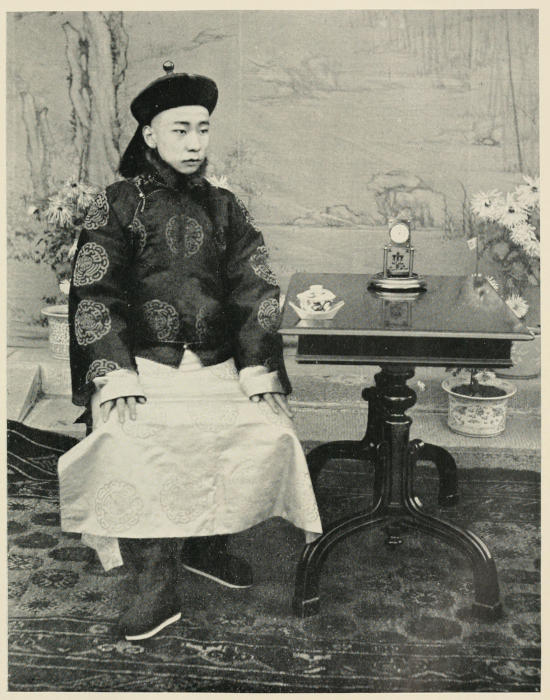
The Ta-A-Ko, Son of Prince Tuan, the Boxer Leader.
Appointed Heir-Apparent in January, 1900. Appointment rescinded November, 1901.
The Boxers who occupy my courtyard tried to take away my cigars from me, but subsequently relented and allowed me to keep them because of my extreme old age. Nothing of foreign origin, not even matches, may be used nowadays, and these Boxer chiefs, Chang Te-ch’eng and Han Yi-li, both of whom are common and uneducated men, are treated with the greatest respect even by Princes of the blood: a curious state of affairs indeed!
Duke Tsai Lan came to see me this afternoon. He tells me an extraordinary story how that the Heir Apparent called the Emperor a “Devil’s pupil” this morning, and, when rebuked for it, actually boxed His Majesty’s ears. The Emperor then reported the facts in a memorial to Her Majesty, who flew into a towering rage, and gave orders to the eunuch Ts’ui to administer twenty sharp strokes of the whip on the Heir Apparent’s person. Prince Tuan is much enraged at this, but he is horribly afraid of Her Majesty, and, when she speaks to him, “he is on tenter-hooks, as if thorns pricked him, and the sweat runs down his face.”
T’ung Fu-hsiang told the Empress Dowager yesterday that the Legations have come to the end of their tether. From a rockery on some high ground in the Forbidden City gardens, the Old Buddha could see the flames bursting from the Legation quarter, and was more than once assured that final destruction had come upon the foreigners at last. But later in the afternoon, Hsü Ching-ch’eng was received in audience, when he presented a memorial which he and Yüan Chang had drawn up, denouncing the Boxers; he told Her Majesty that it was not the Legations, but the Han Lin Academy, that was in flames, the Kansuh soldiery having set fire to it in the hope that the conflagration might spread and thus enable them to force a way into the Legation. Her Majesty was greatly disappointed and displeased, severely blaming Tung Fu-hsiang, and she sent for Jung Lu and talked with him in private for a long while.
Good news has come in to-day of victorious fighting at Tientsin; Yü Lu reports that many foreigners were slain in their attack on the Taku forts, and several of their warships sunk. Practically the whole of the foreign community of Tientsin had been annihilated, he says.
Many hundreds of Chinese Christians were put to death to-day just outside Prince Chuang’s palace. The judges who convicted them were Prince Chuang, Yi Ku, Fen Che, and Kuei Ch’un. There was no mercy shown, and a large number of innocent people perished with the guilty. The Empress is essentially a kind-hearted woman, and she was greatly shocked to hear of this wholesale massacre. She was heard to say that if the Catholics would only recant and reform, a way of escape might very well be provided for them.
29th Day of the 5th Moon (June 25th).—To-day about sixty of the Boxers, led by the Princes Tuan and Chuang, and the “Beilehs” Tsai Lien and Tsai Ying, marched to the Palace at 6 o’clock in the morning to search there for converts. Coming to the gate of the Palace of Peaceful Longevity, where their Majesties were still abed, they noisily clamoured for the Emperor to come out, denouncing him as a friend of foreigners. Prince Tuan was their spokesman. I heard of the incident from Wen Lien, Comptroller of the Household, who was on duty this morning; he was amazed at the foolhardy effrontery of Prince Tuan, and thought that he had probably been drinking. On hearing the noise outside and the shouts of the Boxers clamouring to kill all “Devil’s pupils,” the Old Buddha, who was taking her early tea, came out swiftly and stood at the head of the steps, while the Princes and the Boxer leaders swarmed in the court-yard below her. She asked Prince Tuan whether he had come to look upon himself as the Emperor; if not, how dared he behave in this reckless and insolent manner? She would have him know that she, and she alone, had power to create or depose the Sovereign, and she would have him remember that the power which had made his son Heir Apparent could also wipe him out in a moment. If he and his fellow Princes thought that because the State was at a crisis of confusion they could follow their own inclinations in matters of this kind, they would find themselves very seriously mistaken. She bade them depart, and refrain from ever again entering the palace precincts, except when summoned to her presence on duty. But they would first prostrate themselves and ask His Majesty’s pardon for their insolent behaviour. As a slight punishment for their offences, she further commanded that the Princes be mulcted of a year’s allowances. As to the Boxer chiefs, who had dared to create this uproar in her hearing, they should be decapitated upon the spot, and Jung Lu’s guards, who were on duty at the outer gates, were ordered to carry this sentence into immediate effect. Her Majesty is so greatly incensed against the Boxers at this moment that everyone thinks that Jung Lu will now be able to put a stop to the attacks on the Legations. The Emperor was much alarmed at this incident, and when it was over humbly thanked Her Majesty for so benevolently protecting him.
Later; 9 P.M.—The Old Buddha has suddenly determined, in her rage against Prince Tuan and his followers, to put a stop to the fighting in Peking, and she now agrees that Jung Lu shall proceed to the Legations to discuss terms of peace. At 6 P.M. to-day all firing stopped, and Jung Lu, at the head of his troops, proceeded to the bridge which lies on the north of the Legation quarter. The foreigners came out from their hiding-places and commenced to parley; they were shown a board, and on it the words written: “Orders have now been received from the Empress Dowager to afford due protection to the Legations.” Jung Lu hoped to be able to induce the foreign Ministers to confer with him for the purpose of restoring order. For three hours not a shot has been fired; but En Ming has just come in to tell me that the situation has again changed, and that the Old Buddha has heard such good accounts of the defeat of the foreign relief force on its way to Peking that she is once more determined to give the Boxers their head and “to eat the flesh and sleep on the skins” of the foreign devils.
4th Day of the 6th Moon: at the Hour of the Dog, 7 P.M. (June 30, 1900).—Kang Yi called to-day, and remained with me for the evening meal. He tells me that Tung Fu-hsiang called in person this morning on Jung Lu at his residence, and asked him for the loan of the heavy artillery which is under his orders. Jung Lu is said to have ample armaments in stock in the city, the property of the Wu Wei-chün (Military Defence Corps) sufficient to knock every foreign building to pieces in a few hours.
Tung was kept waiting at Jung Lu’s door for over an hour; when finally admitted, he began to bluster, whereupon Jung Lu feigned sleep. “He gave no consent, but leant on his seat and slumbered.”[85] Tung then expostulated with Jung Lu for his rudeness, but the Commander-in-chief only smiled, and brought the interview to an end by remarking that Tung’s only way to get the guns would be to persuade the Old Buddha to give him Jung Lu’s head with them. “Apply for an audience at once,” he said. “She believes you to be a brave man and will certainly comply with any request you may make.”
Tung Fu-hsiang left in a towering rage, and made straight for the Forbidden City, although the hour for audiences was long since past. At the gate of the Hall of Imperial Supremacy (Huang Chi-tien) he made a loud disturbance, bidding the eunuchs inform Her Majesty that the Kansuh Commander-in-chief was without, desiring audience. It so happened that the Old Buddha was engaged in painting a design of bamboos on silk, and she was highly displeased at being thus disturbed. Tung was ushered in, however, and fell on his knees. “Well,” said Her Majesty, “I suppose that you have come to report the complete destruction of the Legations? This will be the tenth time since the end of last Moon.” “I have come,” replied Tung Fu-hsiang, “to ask Your Majesty’s permission to impeach the Grand Secretary Jung Lu as a traitor and the friend of barbarians. He has the guns which my army needs; with their aid not a stone would be left standing in the whole of the Legation quarter. But he has sworn never to lend these guns, even though Your Majesty should command it.” Angrily the Old Buddha replied, “Be silent. You were nothing but a brigand to begin with, and if I allowed you to enter my army it was only to give you an opportunity of atoning for your former misdeeds. Even now you are behaving like a brigand, forgetting the majesty of the Imperial Presence. Of a truth, your tail is becoming too heavy to wag. Leave the Palace forthwith, and do not let me find you here again unless summoned to audience.”
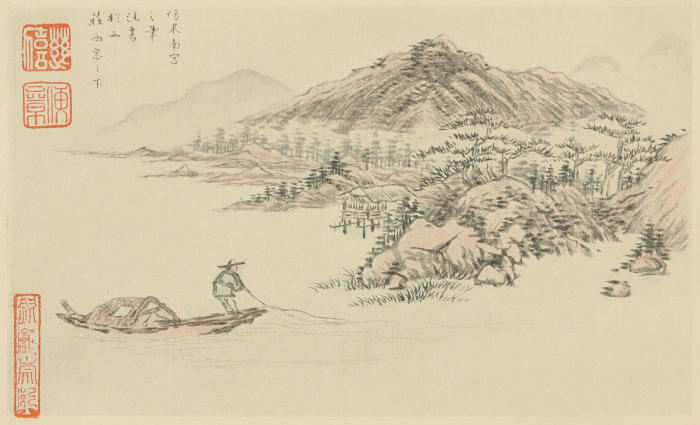
Reproduction of Picture painted on Silk, by Her Majesty Tzŭ Hsi.
Kang Yi declares that we shall never take the Legations so long as Jung Lu continues to exercise his present great influence at Court. Li Shan, who is also a great favourite of the Empress Dowager, is now on the side of those who would make peace with the foreigners, and has been impeached for it by Na T’ung.
The following proclamation is now placarded all over the city, in accordance with the Empress Dowager’s orders issued to Prince Chuang. They say that she means to pay the rewards from her own privy purse:
“Rewards.
“Now that all foreign churches and chapels have been razed to the ground, and that no place of refuge or concealment is left for the foreigners, they must unavoidably scatter, flying in every direction. Be it therefore known and announced to all men, scholars and volunteers, that any person found guilty of harbouring foreigners will incur the penalty of decapitation. For every male foreigner taken alive a reward of 50 taels will be given; for every female 40 taels, and for every child 30 taels; but it is to be clearly understood that they shall be taken alive, and that they shall be genuine foreigners. Once this fact has been duly authenticated, the reward will be paid without delay. A special proclamation, requiring reverent obedience.”
Much larger rewards than these were paid in the tenth year of Hsieng-Feng (1860) for the heads of barbarians, but of course in those days they were comparatively rare, whereas now, alas, they have become as common as bees!
This morning an important trial took place outside the gate of Prince Chuang’s palace; Yi Ku, Fen Che, and Kuei Ch’un presided. Over nine hundred people were summarily executed by the Boxers, in some cases before any proofs whatsoever had been substantiated in regard to their alleged connection with foreigners. Helpless babes even were amongst the slain. Fen Che is nothing more than a butcher and the Old Buddha remonstrated with Prince Chuang for not keeping the Boxers in better order.
8th Day of the 6th Moon, 11 A.M. (July 4th).—Yü Hsien’s son-in-law, Chi Shou-ch’eng, came and talked with me for a long while. The bombardment of the city was going on all the time he was here, and to the south of my house, close to the Imperial City Wall, the troops of Li Ping-heng were mounting cannon on an elevated platform. They are all still very wroth with Jung Lu, who refuses to lend his guns, and his troops are so faithful to him that it is impossible to bribe them to disobey him. Jung Lu’s courage is really extraordinary; he said of himself lately, that “in the days of the wicked Ruler (meaning Prince Tuan) he bided his time on the shores of the bleak North Sea, awaiting the purification of the Empire.”[86] I am told that Prince Tuan has taken possession of one of the Imperial Seals, so as to be able to proclaim his son Emperor at the first favourable opportunity; but if the Old Buddha finds this out, as most probably she will, there is trouble ahead for Prince Tuan.
Chi Shou-ch’eng tells me that Yü Hsien has sent in a memorial to the Empress Dowager with reference to the missionaries in Shansi. Ten days ago she had sent him a secret Decree, saying, “Slay all foreigners wheresoever you find them; even though they be prepared to leave your province, yet must they be slain.” It seems that the Old Buddha ordered that this Decree should be sent to every high provincial official in the Empire, but it is now reported that Tuan Fang, the acting governor of Shensi, and Yü Chang, governor of Honan, together with the high officials in Mongolia, received the Edict in a very different form, for the word “slay” had been changed to “protect.” It is feared that some treacherous minister is responsible for this, but no one dares inform Her Majesty. To Yü Hsien’s latest memorial, she has made the following reply, which has been sent by the fastest express riders to T’ai-Yüan fu:—“I command that all foreigners—men, women, and children, old and young—be summarily executed. Let not one escape, so that my Empire may be purged of this noisome source of corruption, and that peace may be restored to my loyal subjects.” Chi Shou-ch’eng tells me that Yü Hsien’s bitterness against foreigners is inspired by his wife, of whom he is greatly afraid. He himself has earned golden opinions in T’ai-Yüan during his short administration, and has a high reputation for even-handed justice. He says also that this last Decree gave pleasure to Prince Chuang; Jung Lu tried to stop it, asking the Old Buddha what glory could China expect to gain by the slaughter of women and children. “We should become the laughing-stock of the world,” he said, “and the Old Buddha’s widespread fame and reputation for benevolence would be grievously injured.” “Yes,” replied the Empress Dowager, “but these foreigners of yours wish to see me deposed, and I am only paying off old scores. Ever since the days of Tao-Kuang this uproarious guest within our borders has been maltreating his hosts, and it is time that all should know who is the real master of the house.”
Yesterday afternoon the Empress Dowager crossed over to the Lake Palace for a water picnic, attended by several ladies of the Court. The continuous bombardment of the French cathedral eventually made her head ache, so she despatched a chamberlain to the officer commanding at the Hsi-Hua Gate, ordering them to cease firing until her return to the Forbidden City.
11th Day of the 6th Moon (7th July).—Yü Lu has sent in a ridiculous memorial, reporting the capture of four camels, as well as the killing of many foreigners, in Tientsin. Jung Lu has advised him to cease attacking the foreign Settlements. Talking of Jung Lu, I hear that Tung Fu-hsiang recently hired a Manchu soldier to assassinate him, but, instead of doing so, the man betrayed the plot to Jung Lu. This soldier turns out to be a brother of that En Hai who slew the foreign devil (Baron von Ketteler), and Tung thought therefore that he would gladly do anything to assist in destroying the Legations. But he is a clansman of Jung Lu’s banner, and, like Yü Kung-ssŭ, whom Mencius called the best archer in Wei, “he could not bear to slay the old Chief who had taught him the arts of war.” Jung Lu has again memorialised the Old Buddha, reminding her of that well-known saying in the Spring and Autumn annals,[87] which lays down that the persons of foreign Envoys are always inviolate within the territories of any civilised State. This attack on the Legation, he says, is worse than an outrage; it is a piece of stupidity which will be remembered against China for all time. Her Majesty appeared to think that, because a small nation like the Transvaal could conquer a great Power like England, China must necessarily be even more successful in fighting the whole world; but there was no analogy between the two cases. If peace were to be made at once, the situation might still be saved; but if the Legations were demolished, there must be an end of Manchu rule. He warned Her Majesty solemnly, and she appears to be gradually coming to look at things from his point of view. These Boxers can certainly talk, but they do very little.
Bad news has reached the palace to-day of the fighting around Tientsin, and Her Majesty is most anxious about it, though she still refuses to believe that the foreign brigands can possibly enter Peking.
15th Day of the 6th Moon (11th July).—My neighbour Wen Lien, Comptroller-General of the Imperial Household, tells me that the Old Buddha is in a furious rage. She finds the heat trying, and yesterday she turned on the Heir Apparent and snubbed him badly for impertinence; he had asked if he might be permitted to escort her to Jehol, leaving the Emperor to settle matters with his foreign friends in Peking. One of the young eunuchs tried to mollify her by reporting, whenever the report of a gun was heard, that another foreign devil had been killed, but as the Old Buddha observed, “there has been enough firing for the past few weeks to kill off every foreigner in China several times, and so far there is hardly anything to show for it.”
17th Day of the 6th Moon (13th July).—Jung Lu asked Her Majesty yesterday what she would do if the Boxers were defeated, and if Peking were captured by the foreigners. In reply, she quoted to him the words of Chia Yi, a sophist of the Han dynasty, in reference to the Court’s diplomatic dealings with the Khan of the Hans:—
“If the Emperor wishes to gain the allegiance of other countries, he can only do so by convincing their rulers that he possesses the three cardinal virtues of government, and by displaying the five allurements.
These allurements are: (1) Presents of chariots and rich robes, to tempt the eye; (2) rich food and banquets, to tempt the palate; (3) musical maidens, to tempt the ear; (4) fine houses and beautiful women, to tempt the instinct of luxury; and (5) the presence of the Emperor at the table of the foreign ruler, to tempt his pride.
The three cardinal virtues of government are: (1) to simulate affection; (2) to express honeyed sentiments; and (3) to treat one’s inferiors as equals.”
Two years ago, said the Empress, she had invited the foreign ladies to her Court, and had noticed their delight at the reception she gave them, although she well knew that their sympathies were with the Emperor, and against her. She would again allure them to her side with rich gifts and honeyed words.[88]
20th Day of the 6th Moon (16th July).—Bad news from Yü Lu; Tientsin has been captured by the foreigners, who now swarm like locusts. Not one of the Grand Councillors dared to carry the news to Her Majesty, so Prince Tuan went in boldly, and informed her that the foreign devils had taken the city, because the Boxers had been negligent in the performance of their prescribed rites; Peking, however, would always be perfectly safe from invasion. Early this morning Jung Lu had informed the Old Buddha that he had ascertained beyond doubt that the document, which purported to come from the Foreign Ministers, demanding her abdication, was a forgery. It had been prepared by Lien Wen-chung, a Secretary of the Grand Council, at Prince Tuan’s orders. The Old Buddha was therefore in no soft mood; angrily she told Prince Tuan that, if the foreigners entered Peking, he would certainly lose his head. She was quite aware of his motives; he wanted to secure the Regency, but she bade him beware, for, so long as she lived, there could be no other Regent. “Let him be careful, or his son would be expelled from the palace, and the family estates confiscated to the throne.” His actions had indeed been worthy of the dog’s[89] name he bore. Prince Tuan left the palace, and was heard to remark that “the thunderbolt had fallen too quickly for him to close his ears.”
Jung Lu has won over all the military commanders except Tung Fu-hsiang and his staff, and they have come to a general understanding that the bombardment of the Legations must cease. Jung Lu has explained, as his reason for not allowing the heavy artillery to be used, that it would inevitably have inflicted serious damage on the Imperial shrines and the Ancestral temple.
The Old Buddha is sending presents to the Legations, water-melons, wine, vegetables, and ice, and she has expressed a wish that Prince Ch’ing should go and see the Foreign Ministers.
They say that Hsü Ching-ch’eng is secretly communicating with the Legations.
A messenger with twelve dispatches from the Legations was captured to-day and taken to Prince Chuang’s Palace. Three of the twelve were in cipher and could not be translated by the Tsung Li Yamên interpreter, but from the others it was learned that the foreigners had lost over a hundred killed and wounded and that their provisions were running very low.
Chi Shou-ch’eng has gone to T’ai-Yüan fu to see Yü Hsien, his father-in-law. The latter has memorialised the Throne, reporting that he cunningly entrapped all the foreigners, cast them into chains and had every one decapitated in his Yamên. Only one woman had escaped, after her breasts had been cut off, and had hidden herself under the City wall. She was dead when they found her.
Rain has fallen very heavily to-day. Liu Ta-chiao brought me 8 lbs. of pork from the Palace kitchen, and I sent a large bowl of it to my married sister. Towards evening a detachment of cavalry, with several guns, passed my door. They were Li Ping-heng’s men, on their way to mount these guns on a platform above the Forbidden City wall, as a precaution against sorties by the foreigners. There has been heavy firing all night, and it is reported that foreign devils have been seen in the neighbourhood of the Ha-Ta Men.
21st Day of the 6th Moon (17th July).—A lovely day. I walked over to call on Prince Li and Duke Lan. The latest rumour is that Yü Lu’s troops are in flight and harrying the country side. They are said to be clamouring for their pay, which is months in arrears, and have plundered both Tungchou and Chang Chia-wan most thoroughly. Both the eastern gates of the City are now kept closed, and the northern gate (Anting men) is only opened occasionally.
Yang Shun, the gate-keeper, has returned from his home at Pao-ti hsien, east of Peking, where he reports things fairly quiet.
Li Ping-heng’s troops are reported to have won a great victory and driven the barbarians to the sea. Nevertheless, heavy firing was heard to the south-eastward this afternoon.
Duke Lan has gone out with a large force of Boxers to search for converts reported to be in hiding in the temple of the Sun.
27th Day of the 6th Moon (23rd July).—This morning Yüan Ch’ang and Hsü Ching-ch’eng handed in the third of their Memorials against the Boxers, in which they recommend the execution of several members of the Grand Council. Their valour seems to be more laudable than their discretion, especially as the Old Buddha is disposed once more to believe in the Boxers as the result of Li Ping-heng’s audience with her yesterday. He came up from Hankow, and has now been appointed joint Commander, with Jung Lu, of the army of the North. He confidently assured her of his ability to take the Legations by storm, and repeatedly said that never again would the tutelary deities of the Dynasty suffer her to be driven forth, in humiliation, from her capital.
I went across to Duke Lan’s house this morning and found Prince Tuan and Li Ping-heng there. They were busy planning a renewed attack on the Legations, and Li was strongly in favour of mining from the Hanlin Academy side. He has advised the Empress Dowager that a mine should be sprung, as was done lately at the French Cathedral, and he is convinced that in the ensuing confusion the foreigners would be easily overwhelmed.
After reading the latest Memorial of Hsü and Yüan, the Old Buddha observed, “These are brave men. I have never cared much for Hsü, but Yüan behaved well in 1898 and warned me about K’ang Yu-wei and his plotting. Be that as it may, however, they have no business to worry me with these persistent and querulous questions. The Throne itself is fully competent to judge the character of its servants, and it is a gross misconception of duty for ‘the acolyte to stride across the sacred vessels and show the priest how to slaughter the sacrificial beasts.’[90] Desiring to deal leniently with the Memorialists, I command that my censure be communicated to them and that they take heed to refrain in future from troubling my ears with their petulant complainings.”
3rd Day of the 7th Moon (28th July).—The Old Buddha places much confidence in Li Ping-heng. Yesterday he and Kang Yi discovered that the word “to slay,” in Her Majesty’s Decree ordering the extermination of all foreigners, had been altered to “protect” by Yüan Ch’ang and Hsü Ching-ch’eng. I have just seen Kang Yi, and he says that Her Majesty’s face was divine in its wrath. “They deserve the punishment meted out to Kao Ch’u-mi,”[91] she said, “their limbs should be torn asunder by chariots driven in opposite directions. Let them be summarily decapitated.” An Edict was forthwith issued, but no mention is made in it of the alteration of the Decree, as this is a matter affecting the nation’s prestige; the offenders are denounced only for having created dissensions in the Palace and favoured the cause of the foreigner. Both were executed this morning; my son, En Ming, witnessed their death. It is most painful to me to think of the end of Yüan Ch’ang, for he had many sterling qualities; as for Hsü, I knew him in the days when we were colleagues at the Grand Secretariat, and I never had a high opinion of the man. His corruption was notorious. Just before the sword of the executioner fell, Yüan remarked that “he hoped that the Sun might soon return to its place in the Heaven, and that the usurping Comet might be destroyed.” By this he meant that Prince Tuan’s malign influence had led the Empress Dowager to act against her own better instincts. Duke Lan, who was superintending the execution, angrily bade him be silent for a traitor, but Yüan fearlessly went on, “I die innocent. In years to come my name will be remembered with gratitude and respect, long after you evil-plotting Princes have met your well-deserved doom.” Turning then to Hsü, he said, “We shall meet anon at the Yellow Springs.[92] To die is only to come home.” Duke Lan stepped forward as if to strike him, and the headsman quickly despatched them both.
8th Day of the 7th Moon (3rd August).—I have had much trouble with my eldest son to-day. He has been robbing me lately of large sums, and when I rebuked him he had the audacity to reply that my duty to the Throne would make my suicide a fitting return for the benefits which I have received at its hands.
Li Ping-heng has gone to the front to rally the troops and check the foreigners’ advance. He has impeached Jung Lu but the Old Buddha has suppressed the Memorial. The Emperor thanked Jung Lu for his services, and the Commander-in-Chief replied that he of all the servants of the Throne never expected to receive praise from His Majesty, considering the events of the past two years.[93]
11th Day of the 7th Moon (5th August).—The Old Buddha has commanded Jung Lu to arrange for escorting the foreigners to Tientsin, so that the advance of the Allies may be stopped. In this connection, I hear that not many days ago, ⸺ persuaded Ch’i Hsiu to have a letter sent to the Foreign Ministers, inviting them to come, without escort of troops, to an interview with the Tsung Li Yamên, his idea being to have them all massacred on the way. Ch’i Hsiu thought the suggestion excellent, but, although several letters have been sent proposing it, the Ministers decline to leave the Legations. Meanwhile, there have been several fresh attacks on the Legations during the past few days.
A foreign devil, half naked, was found yesterday in Hatamen Street. He kowtowed to everyone he met, high class or low, imploring even the rag-pickers to spare his life and give him a few cash. “We shall all be massacred soon,” he said, “but I have done no wrong.” One of Jung Lu’s sergeants seized him and took him to the Commander-in-Chief’s residence. Instead of decapitating him, Jung Lu sent him back. This shows, however, the desperate straits to which the foreigners are reduced.
15th Day of the 7th Moon (9th August).—Bad news from the South. Yü Lu’s forces have been defeated and the foreigners are approaching nearer every day. The Old Buddha is meditating flight to Jehol, but Jung Lu strongly urges her to remain, even if the Allies should enter the City. Duke Lan scoffs at the idea of their being able to do so. One comfort is that, if they do come, they will not loot or kill. I remember well how good their discipline was forty years ago. I never stirred out of my house and not one of the barbarians ever came near it. We had a little difficulty about getting victuals, but the foreigners hardly came into the city, and did us no harm.
16th Day of the 7th Moon (10th August).—My old colleague, Li Shan, whose house adjoins the French Cathedral, has been accused of making a subterranean passage and thus assisting the foreigners with supplies. He has been handed over to the Board of Punishments by Prince Tuan, without the knowledge of the Empress Dowager, together with Hsü Yung-yi and Lien Yuan. Prince Tuan has long had a grudge against Hsü for having expressed disapproval of the selection of the Heir Apparent. As to Lien, they say that his arrest is due to ⸺, and his offence is that he was on terms of intimacy with Yüan Ch’ang. All three prisoners were decapitated this morning. Hsü Yung-yi was older than I am (seventy-nine) and his death is a lamentable business indeed. But he went to his death calmly and without complaint when he learned that the Empress Dowager knew nothing of the matter and that it was Prince Tuan’s doing alone. “The power of the usurper,” said he, “is short-lived. As for me, I am glad to die before the foreigners take Peking.” The Old Buddha will be very wrath when she hears that two Manchus have thus been put to death. Li Shan and Jung Lu were old friends.
A certain General Liu, from Shansi, assured the Empress this morning that he would undertake to demolish the Legations in three days, and this would so alarm the allies that their advance would certainly be stopped. A furious bombardment has just begun.
The Boxers have proved themselves utterly useless. I always said they never would do anything.
18th Day of the 7th Moon (12th August).—The foreigners are getting nearer and nearer. Yü Lu shot himself with a revolver on the 12th at Ts’ai Ts’un. He had taken refuge in a coffin shop, of all ill-omened places! His troops had been utterly routed thrice, at Pei Tsang, Yang Ts’un and at Ts’ai Ts’un. Li Ping-heng reached Ho-hsi wu on the 14th, but in spite of all his efforts to rally our forces, the two divisional leaders, Chang Ch’un-fa and Ch’en Tsê-lin, refused to fight. Li Ping-heng therefore took poison. Jung Lu went to-day to break the news to the Old Buddha: sovereign and Minister wept together at the disasters which these Princes and rebels have brought upon our glorious Empire. Jung Lu refrained from any attempt at self-justification; he is a wise man. The Old Buddha said she would commit suicide and make the Emperor do the same, rather than leave her capital. Jung Lu besought her to take his advice, which was to remain in Peking and to issue Decrees ordering the decapitation of Prince Tuan and his followers, thus proving her innocence to the world. But she seems to cling still to a hope that the supernatural powers of the Boxers may save Peking, and so the furious bombardment of the Legations continues.