XVII THE DIARY OF HIS EXCELLENCY CHING SHAN (continued 2)
Reading edition
Eight audiences have been given to-day to Jung Lu and five to Prince Tuan. All the other members of the Grand Council sat with folded hands, suggesting nothing.
20th Day (14th August), 5 P.M.—Tungchou has fallen and now the foreigners have begun to bombard the city. The Grand Council has been summoned to five meetings to-day in the Palace of Peaceful Longevity: Her Majesty is reported to be starting for Kalgan. At the hour of the Monkey (4 P.M.) Duke Lan burst into the Palace, unannounced, and shouted, “Old Buddha, the foreign devils have come!” Close upon his footsteps came Kang Yi, who reported that a large force of turbaned soldiery were encamped in the enclosure of the Temple of Heaven. “Perhaps they are our Mahommedan braves from Kansuh,” said Her Majesty, “come to demolish the Legations?” “No,” replied Kang Yi, “they are foreign devils. Your Majesty must escape at once, or they will murder you.”
Later, midnight.—There has just been an Audience given to the Grand Council in the Palace, at which Kang Yi, Chao Shu-ch’iao and Wang Wen-shao were present. “Where are the others?” said the Old Buddha. “Gone, I suppose, everyone to his own home, leaving us here, Mother and Son,[94] to look after ourselves as best we may. At all events, you three must now accompany me on my journey.” Turning to Wang Wen-shao, she added:—“You are too old, and I could not bear the thought of exposing you to such hardships. Make such speed as you can and join me later.” Then to the other two she said, “You two are good riders. It will be your duty never to lose sight of me for an instant.” Wang Wen-shao replied, “I will hasten after Your Majesty to the best of my ability.” The Emperor, who seemed surprisingly alert and vigorous, here joined in, “Yes, by all means, follow as quickly as you can.” This ended the audience, but the actual hour of Her Majesty’s departure remains uncertain. Jung Lu’s attendance was impossible because he was busy trying to rally our forces.
21st Day (15th August).—Wen Lien tells me that the Old Buddha arose this morning at the Hour of the Tiger (3 A.M.) after only an hour’s rest, and dressed herself hurriedly in the common blue cloth garments of a peasant woman, which she had ordered to be prepared. For the first time in her life, her hair was done up in the Chinese fashion. “Who could ever have believed that it would come to this?” she said. Three common carts were brought into the Palace; their drivers wore no official hats.
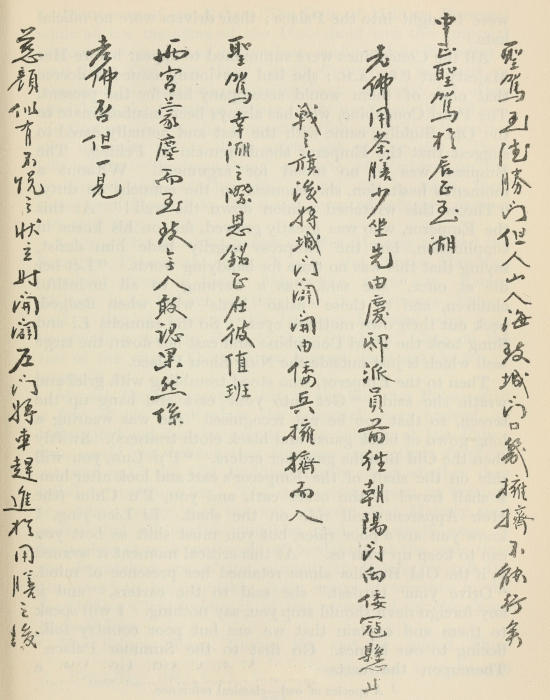
Facsimile of a Fragment of the Diary.
All the Concubines were summoned to appear before Her Majesty at 3.30 A.M.; she had previously issued a decree that none of them would accompany her for the present. The Pearl Concubine, who has always been insubordinate to the Old Buddha, came with the rest and actually dared to suggest that the Emperor should remain in Peking. The Empress was in no mood for argument. Without a moment’s hesitation, she shouted to the eunuchs on duty, “Throw this wretched minion down the well!” At this the Emperor, who was greatly grieved, fell on his knees in supplication, but the Empress angrily bade him desist, saying that this was no time for bandying words. “Let her die at once,” she said, “as a warning to all undutiful children, and to those ‘hsiao’ birds[95] who, when fledged, peck out their own mother’s eyes.” So the eunuchs Li and Sung took the Pearl Concubine and cast her down the large well which is just outside the Ning Shou Palace.
Then to the Emperor, who stood trembling with grief and wrath, she said: “Get into your cart and hang up the screen, so that you be not recognised” (he was wearing a long gown of black gauze and black cloth trousers). Swiftly then the Old Buddha gave her orders. “P’u Lun, you will ride on the shaft of the Emperor’s cart and look after him. I shall travel in the other cart, and you, P’u Chün (the Heir Apparent) will ride on the shaft. Li Lien-ying, I know you are a poor rider, but you must shift as best you can to keep up with us.” At this critical moment it seemed as if the Old Buddha alone retained her presence of mind. “Drive your hardest,” she said to the carters, “and if any foreign devil should stop you, say nothing. I will speak to them and explain that we are but poor country folk, fleeing to our homes. Go first to the Summer Palace.” Thereupon the carts started, passing out through the northern gate of the Palace (The Gate of Military Prowess) while all the members of the Household and the Imperial Concubines prostrated themselves, wishing their Majesties a long life. Only the three Grand Councillors followed on horseback, a rendezvous having been arranged for other officials at the Summer Palace. My neighbour Wen Lien, the Comptroller of the Household, followed their Majesties at a distance, to see them safely out of the city. They left by the “Te-sheng-men,” or Gate of Victory, on the north-west side of the city, where for a time their carts were blocked in the dense mass of refugees passing out that way.
4 P.M.—The Sacred Chariot of Her Majesty reached the Summer Palace at about 8 A.M. and Their Majesties remained there an hour. Meanwhile, at 6 A.M., Prince Ch’ing, just before starting for the Summer Palace, sent a flag of truce to the Japanese Pigmies who were bombarding the city close to the “Chi Hua” Gate on the east of the city. The gate was thrown open and the troops swarmed in.
My son En Ming was on duty at the Summer Palace with a few of his men, when the Imperial party arrived, all bedraggled and dust-begrimed. The soldiers at the Palace gate could not believe that this was really their Imperial mistress until the Old Buddha angrily asked whether they failed to recognise her. The carts were driven in through the side entrance, and tea was served. Her Majesty gave orders that all curios, valuables, and ornaments were to be packed at once and sent off to Jehol; at the same time she despatched one of the eunuchs to Peking to tell the Empress[96] to bury quickly every scrap of treasure in the Forbidden City, hiding it in the courtyard of the Ning Shou Palace.
The Princes Tuan, Ching, Na, and Su joined Their Majesties at the Summer Palace; a few Dukes were there also, as well as Wu Shu-mei and Pu Hsing of the higher officials. About a dozen Secretaries from the different Boards, and three Clerks to the Grand Council, accompanied the Court from this point. General Ma Yu-k’un, with a force of 1,000 men escorted Their Majesties to Kalgan, and there were, in addition, several hundreds of Prince Tuan’s “Heavenly Tiger” Bannermen, fresh from their fruitless attacks on the Legations. Jung Lu is still endeavouring to rally his troops.
I have just heard of the death of my old friend, Hsü T’ung, the Imperial Tutor and Grand Secretary. He has hanged himself in his house and eighteen of his womenfolk have followed his example. He was a true patriot and a fine scholar. Alas, alas! From all sides I hear the same piteous story; the proudest of the Manchus have come to the same miserable end. The betrothed of Prince Ch’un, whom he was to have married next month, has committed suicide, with all her family. It is indeed pitiful.[97]
Thus, for the second time in her life, the Old Buddha has had to flee from her Sacred City, like the Son of Heaven in the Chou Dynasty, who “fled with dust-covered head.” The failure of the southern provinces to join in the enterprise has ruined us. Prince Tuan was much to blame in being anti-Chinese. As Confucius said, “By the lack of broad-minded tolerance in small matters, a great design has been frustrated.” After all, Jung Lu was right—the Boxers’ so-called magic was nothing but child’s talk. They were in reality no stronger than autumn thistledown. Alas, the bright flower of spring does not bloom twice!
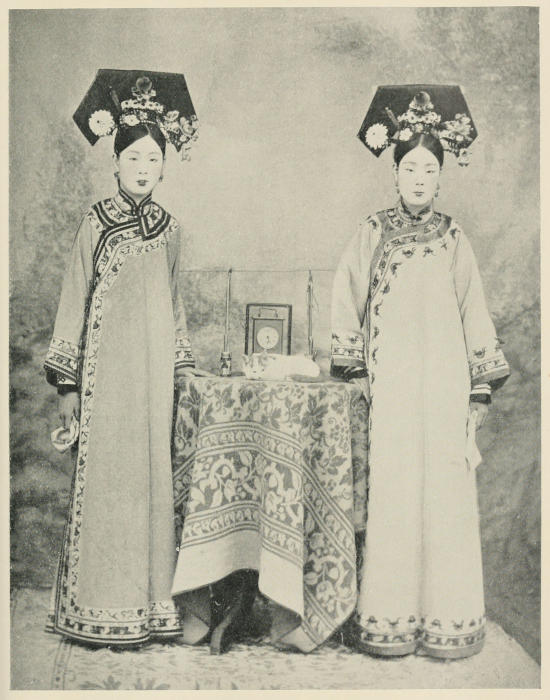
Daughters of a High Manchu Official of the Court.
My wife and the other women, stupidly obstinate like all females, intend to take opium. I cannot prevent them from doing so, but, for myself, I have no intention of doing anything so foolish. Already the foreign brigands are looting in other quarters of the city, but they will never find my hidden treasure, and I shall just remain here, old and feeble as I am. My son, En Ch’u, has disappeared since yesterday, and nearly all my servants have fled. There is no one to prepare my evening meal.
(Here the Diary ends. The old man was murdered by his eldest son that same evening; all his women folk had previously taken poison and died.)
Vermilion Decree of H.M. Kuang Hsü, 24th day, 12th Moon of 25th year (January, 1900), making Prince Tuan’s son Heir Apparent.
“In days of our tender infancy we succeeded by adoption to the Great Inheritance, and were favoured by the Empress Dowager, who graciously ‘suspended the curtain’ and administered the Government as Regent, earnestly labouring the while at our education in all matters. Since we assumed the reins of government, the nation has passed through severe crises, and our sole desire has been to govern the Empire wisely in order to requite the material benevolence of Her Majesty as well as to fulfil the arduous task imposed on us by His late Majesty.
“But since last year our constitution has been sore-stricken with illness, and we have undergone much anxiety lest the business of the State should suffer in consequence. Reflecting on the duty we owe to our sacred ancestors and to the Empire, we have therefore besought Her Majesty to administer the Government during the past year. Our sickness has so far shown no signs of improvement, and it has prevented us from performing all the important sacrifices at the ancestral shrines and at the altars of the gods of the soil.
“And now at this acute crisis, the spectacle of Her Majesty, labouring without cease in the profound seclusion of her Palace, without relaxation or thought of rest, has filled us with dismay. We can neither sleep nor eat in the anxiety of our thoughts. Reflecting on the arduous labours of our ancestors from whom this great Heritage has descended to us, we are overwhelmed by our unfitness for this task of government. We bear in mind (and the fact is well known to all our subjects) that when first we succeeded by adoption to the Throne, we were honoured with a Decree from the Empress Dowager to the effect that so soon as we should have begotten an heir, he should become the adopted son of His Majesty T’ung-Chih. But our protracted sickness renders it impossible for us to hope for a son, so that His late Majesty remains without heir. This question of the succession is of transcendent importance, and our grief, as we ponder the situation, fills us with feelings of the deepest self-abasement, and renders illusive all hope of our recovery from this sickness.
“We have accordingly prostrated ourselves in supplication before our Sacred Mother, begging that she may be pleased to select some worthy person from among the Princes of the Blood as heir to His Majesty T’ung-Chih, in order that the Great Inheritance may duly revert to him. As the result of our repeated entreaties Her Majesty has graciously consented, and has appointed P’u Chün, son of Prince Tuan, as heir by adoption to His late Majesty. Our gratitude at this is unbounded, and obediently we obey her behests, hereby appointing P’u Chün to be Heir Apparent and successor to the Throne. Let this Decree be made known throughout the Empire.”
Seldom has history seen so tragically pathetic a document. It was not only a confession of his own illegality and an abdication, but his death-warrant, clear writ for all men to read. And the poor victim must perforce thank his executioner and praise the “maternal benevolence” of the woman whose uncontrollable love of power had wrecked his life from the cradle.
Memorial from the Censorate at Peking to the Throne at Hsi-an, describing the arrest of En Hai, the murderer of the German Minister, Baron von Ketteler.[98]
This Memorial affords a striking illustration of the sympathy which animated, and still animates, many of those nearest to the Throne in regard to the Boxers and their anti-foreign crusade, and their appreciation of the real sentiments of the Empress Dowager, even in defeat. It also throws light on the Chinese official’s idea of heroism in a soldier.
“A spy in Japanese employ, engaged in searching for looted articles in the pawnshops of the district in Japanese military occupation, found among the unredeemed pledges in one shop a watch bearing Baron von Ketteler’s monogram. The pawnbroker said that it had been pledged by a bannerman named En Hai, who lived at a carters’ inn of the Tartar city. This spy was a man named Te Lu, a writer attached to the Manchu Field Force, of the 8th squad of the ‘Ting’ Company. He went at once and informed the Japanese, who promptly sent a picquet to the inn mentioned. Two or three men were standing about in the courtyard, and the soldiers asked one of them whether En Hai was there. ‘I’m the man,’ said he, whereupon they took him prisoner. Under examination, En was perfectly calm and showed no sort of emotion. The presiding Magistrate enquired ‘Was it you who slew the German Minister?’ He replied ‘I received orders from my Sergeant to kill every foreigner that came up the street. I am a soldier, and I only know it is my duty to obey orders. On that day I was with my men, some thirty of them, in the street, when a foreigner came along in a sedan chair. At once I took up my stand a little to the side of the street, and, taking careful aim, fired into the chair. Thereupon the bearers fled: we went up to the chair, dragged the foreigner out, and saw that he was dead. I felt a watch in his breast pocket and took it as my lawful share; my comrades appropriated a revolver, some rings and other articles. I never thought that this watch would lead to my detection, but I am glad to die for having killed one of the enemies of my country. Please behead me at once.’
“The interpreter asked him whether he was drunk at the time. He laughed and said, ‘Wine’s a fine thing, and I can put away four or five catties at a time, but that day I had not touched a drop. Do you suppose I would try to screen myself on the score of being in liquor?’ This En Hai appears to have been an honest fellow; his words were brave and dignified, so that the bystanders all realised that China is not without heroes in the ranks of her army. On the following day he was handed over to the Germans, and beheaded on the scene of his exploit. We, your Memorialists, feel that Your Majesties should be made acquainted with his meritorious behaviour, and we therefore report the above facts. We are of opinion that his name should not be permitted to fall into oblivion, and we trust that Your Majesties may be pleased to confer upon him honours as in the case of one who has fallen in battle with his face to the foe.”