Checkers (continued 3)
Reading edition
The afternoon wore on towards dusk. Sadie went about her household duties, humming softly. Once she thought she heard Pert call, but as the sound was not repeated, she fancied herself mistaken, and sat down to read, happy in the thought that Pert must have fallen asleep. It seemed to be blowing up cooler; the wind had shifted, and a few dark clouds were rolling up from the west, with distant rumbling.
About five o'clock Mr. and Mrs. Barlow drove up in a buggy. Mrs. Barlow got out, and Mr. Barlow drove on toward the store. Sadie saw them and opened the door.
"Is Pert here, Sadie?" was the question which greeted her. "We 've been up to her house, and 'Mandy' said she had come down here."
"Yes; she 's here, Auntie Barlow."
"The poor little thing! My husband only told me the news this afternoon; he 's been down street all morning, and I wanted to see her and comfort her."
"She wasn't feeling well," explained Sadie, "and after dinner I sent her up stairs to sleep. You 'll find her in the bedroom over the parlor. She must be awake by this time."
"Very well; I 'll go up." Mrs. Barlow ascended the stairs.
Sadie went to the window and looked out upon the gathering storm, now vividly foretold by constant flashes of jagged lightning. Suddenly she started, and stood transfixed, as though turned to ice with a chilling horror. There had come to her ears from above an awful cry of bitter anguish, quickly followed by a jarring, muffled sound, as of a falling body.
"Auntie Barlow!" she gasped, regaining her faculties with a superhuman effort, and rushing blindly toward the stairs. Staggering up with the aid of the banister, she reached the landing and entered the room beyond. There, prostrate upon the floor, lay Mrs. Barlow in a deathlike swoon. Upon the bed lay the lifeless body of poor little Pert—her pure, white soul had flown.
There are some who faint at the thought of a thing, but are brave when they meet it face to face. Such a one was Sadie. She realized the situation at a glance; and though the awfulness of it benumbed her, she did, dry-eyed and mechanically, what she knew must be done. Mrs. Barlow she could not lift, but, she sprinkled her face with water, and put a pillow under her head. Then with the ghost of a hope that Pert was but in a stupor, she rushed down the stairs, and out into the street, toward the doctor's, a few doors away. She met him just coming out of his gate. "Come, quick," she said; and as they hurried back she told him in a few words what had happened.
Mrs. Barlow still lay in a state of semi-consciousness, moaning pitifully at intervals. With all her soul in her eyes, Sadie watched the doctor while he felt Pert's wrist and held a glass before her lips for an indication of breathing. But his face gave never a sign of hope, and his eyes, as he looked up, told her all. "She is dead," he said softly. Sadie burst into a fit of uncontrollable weeping. The doctor lifted Mrs. Barlow carefully and deposited her upon a bed in another room.
The sound of voices was heard outside—those of Arthur and Judge Martin talking to Mr. Barlow, who had just driven up and met them as they were coming in. Sadie went slowly down the stairs and opened the door. The sight of her tear-stained face startled them all. "What is it?" they exclaimed simultaneously.
"Oh, Pert—" she began; but burst again into weeping and was unable to continue.
The doctor appeared just behind her, and told the three men what had happened. Mr. Barlow, his face set hard, and a ghastly white under his yellow skin, tottered up the stairs, the doctor following. Judge Martin penned a telegram to Checkers, and dispatched Arthur with it at once.
"Pert is very sick. Come home," it read, and it was signed as though from Mr. Barlow.
Fortunately, Checkers, in Little Rock, had but a few moments to wait for the outgoing train after receiving the message; but every moment of the journey was torture; every delay at way-stations, agony. When, after what seemed to him like years, they at last pulled into Clarksville, he jumped from the moving train to the platform.
Judge Martin had set for himself the unwelcome task of meeting him and breaking the sad news. But his resolution all but failed him when Checkers, grasping both his hands, asked breathlessly, "How is she, sir?" his face upturned with a pleading look, as though upon the answer depended his very life and salvation.
"She is very low, my poor boy," answered the Judge, the tears coming into his eyes; "but you must be brave—"
"My God, my God!" breathed Checkers, raising his hand to his eyes in a dazed way, as though to ward off the blow of the Judge's words, the import of which was all too plain. The Judge laid his hand upon Checkers' shoulder and drew him toward him, protectingly. "Come," he said, gently; "she is at my house."
Checkers started as though from a dream. "At your house," he echoed, "and I have been standing here wasting precious time."
With a sudden bound he jumped to the ground and flew up the street through the darkness, toward the Judge's house, not many yards away. Arthur heard the sound of his footsteps, and silently opened the door. "Upstairs, Checkers," he whispered. Checkers hurried frantically up the stairs, but paused at the threshold, ere he entered the room. There before him, by the light of one dim, flickering candle, sat Sadie, silently weeping. There upon the bed, cold and silent in death, lay the mortal remains of his sweet girl-wife.
With an agonized cry he fell to his knees at the bedside, and taking her cold little hand, he rubbed it and kissed it caressingly. "Pert, my darling," he moaned, "come back to me! Don't leave me, Pert, my precious one—tell me you won't dear—tell me you hear me!—" But only the sound of Sadie's convulsive sobbing answered him as she stumbled from the room.
The long threatened storm now suddenly broke in all its fury. The rain blew fiercely in at a window near him, and drenched him through and through with the flying spray; but he heeded it not. Kneeling at the bedside, his face above the little hand clasped in both of his, he uttered mingled incoherent prayers to Pert to come back, and to God to take him too.
Judge Martin noiselessly entered the room and closed the window. Gently he put a hand under each of Checkers' arms, and raised him up. "Come, my boy," he said kindly, but firmly, "you must not stay here in this condition. Try to bear up. It's an awful blow that has come upon us; but God, in his inscrutable wisdom, has thought it best to take her—"
Again, with a sudden burst of anguish, as though his very heart had broken within him, Checkers threw himself to his knees by the bedside, and burying his face between his outstretched arms, poured out in bitter, choking sobs, his utter hopeless, despairing misery. So terrible a strain, however, brought about, in the end, its own results. Beneficent nature intervened, and toward the morning hours Judge Martin and Arthur gently lifted the grief-stricken boy from the kneeling position in which he had fallen asleep, and put him comfortably upon a bed in another room, without his awakening.
Details of this sort are harrowing at best, but nothing imaginable could have been sadder than was the funeral two days later. The rain, which had never intermitted, fell with dismal hopelessness. Mrs. Barlow had not been able to leave her bed since the shock, and, never strong, her life was now almost despaired of.
Checkers stood uncovered in the down-pouring rain, beside the open grave, his clear-cut face as hard and white as marble. In spite of the draggling wet and clinging mud, the country people were out in force; but their gapes, their nudges and whispers, were as little to him as the falling rain. He was dead to everything but the sense of his utter, hopeless desolation.
What made it all even sadder, if possible, was that a dreadful breach had come between him and Sadie and Arthur.
On the morning following that first awful night, he had suddenly confronted them with the box of powders crushed in his hand, and in his eyes a tragic, questioning look which spoke, while he stood sternly silent.
"Oh, Checkers," cried Sadie, falling to her knees and holding out her hands entreatingly, "forgive us—we did n't know—we didn't know! Forgive us; please forgive us!"
But his face only grew the harder. "Forgive you," he said, as he raised his clenched hand to heaven, invokingly; "may God eternally—" but he faltered, and his voice grew suddenly soft, "forgive you," he added, dropping his arm and lowering his voice contritely. "But I," he began again, in measured passionless words—"I can never forgive you. I never want to see you—either of you—again." And from that hour he never spoke to them, nor looked at them, any more than as though they were not.
The funeral was over. He had come home. The rain had ceased. He sat alone on his doorstep. The minister and some well-meaning but mistaken friends, who had tried to comfort him, were gone. Over the western hills the lowering sun broke through the heavy, moving clouds, painting some a lurid tinge, and lining the heavier ones with silver. Checkers noted it absently. "Another lie nailed," he muttered, as the trite old proverb occurred to him. "My cloud is blacker and heavier than any of those—and silver lining? Humph! Well, silver 's demonetized!" Over his face there flitted the ghost of a smile. A smile, not at the sorry jest, but at the thought that at this hour there should have come to him so whimsical a fancy.
A number of days went by. He simply drifted, doing a few needful duties mechanically; sometimes eating the food which Mandy prepared for him, but oftener going without altogether; sitting, brooding, hours at a time, gazing vacantly into space.
Mrs. Barlow—he learned one day from the doctor, who stopped a moment in passing—had taken a slight turn for the better. Mr. Barlow, the following morning appeared, as Checkers stood meditatively surveying a fine old apple tree, from which a large limb, hanging heavy with fruit, had been blown during the night.
"Thar," snorted the old man as he came up; "thar ye go, with yer dog-durned laziness. If you 'd o' propped that limb weeks ago, as you 'd ought t' done, you 'd o' saved me a couple o' barrels o' apples—Shannons, too. It's high time I was takin' a holt here myself. Git the saw and the grafting-wax." Checkers obeyed, and stood apathetically watching Mr. Barlow minister to the tree's necessity.
"Now," said the old man, when at last he had finished, "come and set in the shade; I want to have a talk with ye;" and he led the way around to the doorstep. Both sat down. The old man drew a plug of "Horseshoe" from his pocket, and cut off a liberal piece, which he chewed into a comfortable consistency before beginning.
"Now, boy," he said, "luck's ben a-comin' mighty hard for you and me these last few weeks, and I ain 't a-sayin' it's over yit for both o' us." Checkers made no response.
The old man chewed ruminatingly, and spat at a "devil's-horse" which sat alertly atop of a shrub near by. "Y' see," he continued, "times is gittin' wuss and wuss; banks failin' everywhar, and nawthin' wuth a cent on th' shillin', 'cept Gov'ment bonds. Corn aint wuth nawthin; farmers is feedin' their wheat to th' hogs, and cotton ye could n't give away." Again there was a silence, and again the "devil's-horse" narrowly escaped a deluge.
"By the way, whar 've ye got them Gov'ment bonds o' yourn?" Checkers came out of his reverie at the question.
"Mr. Bradley 's got them put away in the safe for me at the store," he answered.
"Mm-hmm!" mused the old man; "I was kinder wonderin' whether ye ever give any on 'em away, like ye done th' place here;" and he glanced at Checkers cunningly out of the corner of his eye.
"I never gave them away," said Checkers, drearily, "because there was no occasion for it. What we had we owned together and shared in common, and it makes little difference whether it was in my name or—or any one else's."
"Yes; but it does. It makes a difference in the eye o' the law."
"Well, the law can leave it in its eye, or get it out, if it worries it any."
The old man grinned sardonically on the side of his face away from Checkers. He had never liked our little friend from the time when Checkers had caused him to fall over a rocking-chair in the parlor the night that he and Pert became engaged; and Checkers had fostered this dislike by snubbing and belittling him whenever an opportunity occurred. His entire make-up of sneaking, petty selfishness and greed was abhorrent to one of Checkers' open, generous nature, and it was only for Pert's sake that he had ever consented to have the old man about or notice him at all.
"Wal," said Mr. Barlow, musingly, "that 's one thing I kin see stickin' out; you ain't no kind o' hand to run a place like this—ye 're too tarnal shif'less. Somebody 's got to look after things. Now, my place down below 's all right for raisin' cotton and sich, but it 's onhealthy, mighty. The doctor says it 's livin' down thar gives my wife chills and ager. So, take it all 'round, and bein' 's ye 're fixed so nice up here, but lonesome-like by yerself, I guess me an' wife 'll close up the ole house an' move up here to live."
"Guess again."
"No; I 'low I guessed it right fust time," grinned the old man. "What 's the good in runnin' two houses when we kin all live together in one jist ez well? Wife kin have the parlor bedroom all t' herself, and you kin have the front or back room upstairs, either you like—I ain't pertic'lar on that pint—"
"Now, see here," interrupted Checkers, jumping up with an impatient gesture, "I 've listened to enough of this bloody nonsense. I 'll live here by myself and run this place to suit myself. Now, when you go out, close the gate—I 'm tired of talking, and I want to be left alone."
But the old man never budged; and again the "devil's-horse" braved an unrighteous fate with a stoicism worthy of a better cause.
"Young feller," said Mr. Barlow, after several moments' cogitation, "you ain't never treated me with the perliteness and respect as is due from a boy yer age t' his elders and betters. But I never harbored no grudge, 'cause I knowed it was only a matter o' time when chickens like them 'ud come home to roost."
Checkers had intended to move off and leave him sitting there alone; but he stopped long enough to light a cigarette (a thing which the old man abominated) and listen to this last remark.
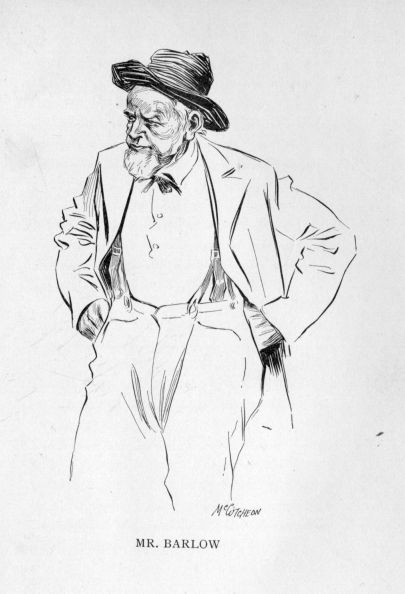
MR. BARLOW
"Now it's roostin' time," continued Mr. Barlow with emphasis, "and onless ye come down off'n th' high horse ye 're ridin', ye 're goin' ter hear suthin' drap that 'll kinder put a crimp in that pride o' yourn."
This was a new tone for him to take, and Checkers turned and looked at him surprisedly.
"The fact is," he went on, "you ain't got no head for bizness, and it 's providential things hez come round so 's I kin run this place and make what they is to be made out'n it." He looked up as though he expected to be interrogated.
"What's your lay?" asked Checkers.
"Wal, the situation, ez near ez I kin figger it out, accordin' to law, is this: I owns this ranch."
Checkers stood silent for a moment, and then laughed. "You owns it?" he mimicked; "nit."
"This real estate," began Mr. Barlow dryly, as though repeating a well-conned lesson, "with the house upon it, was owned in fee by Persis Barlow Campbell at the time o' her death. Said Persis Campbell died intestate and without issue, and accordin' to th' laws o' the State of Arkansas all real and personal property standin' in her name, or belongin' to her at th' time o' her death, reverts to her next o' kin, who 's her father. Now, what d 'ye say?"
"It's a lie," exclaimed Checkers, trembling with anger at the thought of so outrageous a thing.
"It 's th' gospel truth," said Mr. Barlow, trying in vain to hide the look of satisfaction which sat upon his face. His words and the tone of his voice carried conviction. This was the final blow; the crowning evil. Checkers staggered under it. The house and the trees floated before his eyes like a stifling vapor, but with a mighty effort he gathered himself together.
"If this is so," he began, his voice hoarse with passion, "it's the most ungodly outrage that ever—I 'm going down to ask Judge Martin if that's the law. But let me tell you," he added, "law or no law, you shall never live in this house while I 'm alive and able to shoot a gun. Do you understand?"
The old man was silent.
"Do you understand?" repeated Checkers, more vehemently.
"Pp-tttt," said the old man, and this time the "devil's-horse" fell a victim to its too great temerity.
X
Sadly enough, it was all too true. Judge Martin, while forced to admit the fact, cursed Mr. Barlow in no measured terms. "The damned old pachyderm!" he exclaimed; "suppose it is the letter of the law, by every sense of equity, justice, and decency, the place belongs to you, and if he tries to take it, damme, I 'll head a movement to tar and feather him."
Checkers went back in utter dejection.
Mandy had a tempting dinner ready, but he barely touched it. All the afternoon he sat under the shade of the trees, thinking deeply. Mr. Barlow he knew too well to believe that he could be dissuaded from any purpose once formed, if he had the law on his side, and there was any question of money in it. He was already miserable; but to be forced to live with the old man, even with the mitigating circumstances of his wife—to have him around all the time—would be wholly unbearable.
Then, too, stronger than this was the feeling that such an invasion of the house would be a profanation. Every ornament, every chair, was standing just as Pert had left it. No vandal hand should move or break them, devoting them to secular use—not if he had power to help it; and he believed he had.
He jumped up and hurried into the house. For two hours he worked in eager haste, opening and closing drawers, and sorting articles into different piles on the floor.
As night approached he entered the Kendall store, and related the whole affair in a quiet tone to Mr. Bradley. That good old soul could hardly contain himself for righteous indignation; but Checkers cut him short by telling him he was in a hurry.
"There 's two things I want to ask of you, Mr. Bradley," said Checkers. "I want that package of bonds you have for me in the safe, and I want you to cash a check for two hundred dollars—it's just the balance I have in the bank here. I 'm going away to-night—for a while, at least."
Mr. Bradley gave him the package, and luckily had enough money on hand to cash his check. "Thank you," said Checkers, "for this and for all your other kindness to me. Good-bye."
"Good-bye, my son, and God bless you!" and Mr. Bradley wrung Checkers' hand, while the tears welled up in his kind old eyes and trickled down his wrinkled cheeks.
Outside, Checkers met Tobe, lumbering along with a pair of mules and a lumber wagon.
"Tobe, you 're the very man I want!" he exclaimed; "come, turn round, and drive up to my place." Tobe proceeded to obey without demur or questioning.
Since last we saw him, Tobe had tried his luck with a fifth "woman," and lived in a two-room shanty on a clearing in the mountains.
Checkers walked ahead until they reached the house. "Drive up as near to the door as you can, Tobe," he said. "I 'll be out in a minute."
Mandy was preparing his supper in the kitchen. "Mandy," said Checkers, "I 'm afraid I 've got bad news for you. I 'm going away to-night, and I may not come back again; so, Mandy, I 'm afraid I won't need you any more."
Mandy's honest black face took on a comically serious look. Her lip hung pendulously, as she slowly shook her gaudily turbaned head. "You aint goin' sho' 'nough, is you, Marse Checkahs?" she asked, for lack of something better to say.
"Yes, Mandy, I'm going to-night," he said, "and before I go I want to lock up this house. So after you 've washed the dishes and put things to rights, you 'd better arrange to go home. And, Mandy, there 's a number of things here I 'll never need, that would make your cabin very comfortable. Tobe is here with his wagon, and I 'll get him to give you a lift with them to-night."
"Thank you, Marse Checkahs, thank you, sah," was all the poor old soul could say.
Two hours later Tobe drove out of the gate with a wagonful of furniture, carpets, bedding, and kitchen utensils, en route for Mandy's cabin. Mandy sat beside him, rocking back and forth, and crooning to herself in a curious mixture of boundless grief and delirious joy.
Tobe returned and piled another wagon-load even higher. This was destined for the cabin in the mountains. Tobe's delight was indescribable, and his efforts to express his thanks were quite as futile as had been those of Mandy. Checkers had allowed the two to take every useful article they chose from all save the parlor and Pert's room. Those rooms remained inviolate.
"I will write to Judge Martin to-night, Tobe," said Checkers, "telling him what I have done for you and Mandy, in case any one should question how you came by all this plunder. This furniture belongs to me," he muttered to himself, "whatever the law may do with the house and ground, for I bought it and paid for it myself, and never gave it to anybody."
"Now, Tobe, one thing more, here 's my trunk; put it on your wagon and drop it off at the station on your way through town. That's it. Good-bye, old fellow; my regards to the madam—I hope she 'll be pleased with my wedding-gift."
Tobe buried Checker's hand in his great horny palm. "Mr. Checkers," he said, and his voice grew husky, "ye 're God's own kind; may He have ye in His keepin'!" and he climbed upon his wagon, and drove slowly out into the night.
Checkers was alone. He went slowly into the house. A clock upon the mantel was chiming ten. There was still two hours before train time. He sat down and wrote a long letter to Judge Martin, sealed and stamped it, and put it in his pocket. His hat and light overcoat lay upon a chair beside him. He arose and put them on. His satchel, cane, and umbrella he then carefully laid on the stoop outside, and stood a while listening in the darkness. Apparently satisfied, he returned, and, taking one last, lingering look around, put out the lights.
For perhaps ten minutes he was busy at something under the stairway. He then silently emerged and locked the door.
The people of Clarksville and that vicinity are given to retiring early. Had they been abroad, or even awake, as late as eleven o'clock that night, they might have seen a startling spectacle in the distance—that of a mass of ruthless, hungry flames devouring a little white dwelling; leaping up in their fierce ecstacy to the heavens, and painting the sky all about a lurid, smoky crimson.
Checkers sat perched upon the fence some distance off. One heel was caught upon the first rail below him. His elbow rested upon his knee, and his upturned palm supported his chin.
The poor little house writhed helpless in the withering grasp of the remorseless flames. "This, then, was the final ending," he thought—"ashes to ashes," literally. This was the awakening from his short dream of bliss. Here he had lived six happy months; then ill-fortune singled him out for a plaything. He laughed a bitter, mirthless laugh.
The night was perfectly still and the myriad sparks from the flames rose straight to heaven. "There 's one good thing about it all," he mused, "and that is that I kept neglecting to insure the house and furniture when I went to Little Rock. That being the case, it 's a wonder I did n't burn out before this. I guess it was coming. I probably got a lead of a couple of days on my luck, and beat it out a length or two."
He looked at his watch. He had still half an hour before train time. The fire was burning lower. Suddenly the whole standing structure fell in with a muffled crash. Again the flames rose high and fierce; but they rapidly died down, and soon there remained of the fair white cottage but a blackened, smouldering ruin.
Checkers climbed down and went over near by. Nothing of value was left. The very foundations were cracked and fallen in; but the sounds of voices on the road now warned him that he must be going.
He turned for an instant in the direction of the Barlow house, and bowed low. "Now, you thieving old highbinder," he said, "take the change;" and, diving into a grove of trees he took a roundabout way through the fields to avoid the gathering crows which, finally aroused, now flocked to the scene of the disaster. Breathless, he arrived on the nick of time. His trunk was thrown aboard the train; he entered the sleeper and was whisked away toward Little Rock.
He went out again and stood upon the platform until the last vestige of Clarksville was passed. He then found a seat in the smoking-room and smoked until almost morning.
"Chicago!" Checkers stood once more upon his native heath. He had come directly from Little Rock, had rented a modest room, and had taken up again the thread of a drifting, devil-may-care existence. Gradually, the constant, active, throbbing pain of his bereavement wore away, and in its stead there came a sullen, morbid sense of the uselessness of all things. He had neither friends nor acquaintances; even Murray Jameson was out of town. He haunted the Fair grounds in the daytime and the theatres at night.
"Excitement and Forgetfulness"—this might have been his watchword.
I feel that if I could have met him at this time instead of almost a year later as I did, I might have brought an active pressure to bear upon him, and saved to him the good that the refining influence of his wife and his Clarksville connections had done him. But, alas! in this busy world there is no such thing as standing still. We either advance or retrograde. The hill is steep to climb, but going down is easy.
Checkers went down; gradually, it is true, but still he went down.
By degrees he met his fellow-roomers in the house—good fellows, all of them, in their way, but worthless. Checkers craved companionship. Often he sat in a poker game all night with them, in some one of their rooms, or "did the Midway" with them, ever "mocking the spirit which could be moved to such a thing," but sometimes finding in it a temporary respite from the bitter, haunting memories of the past.
It would be difficult to follow, and uninteresting to read, the devious windings of Checkers' way during the next few months. Hardened, despondent, and utterly careless; without the restraining influence of worthy friends or home ties to soften and hold him; with money, but no occupation; time, but nothing to do with it—little wonder is it that, after the great White City finally closed its gates, shutting him off from his one simple pleasure, he gradually drifted back to the stirring scenes of his youth—the races and the betting-ring.
The history of every one of the hundreds of thousands of men who have "played the races" may be told in three short words: "They went broke"—sooner or later. Generally sooner than later; but "they went broke."
So it was with Checkers. Good information, careful betting—playing horses for place when he thought they could win; sometimes not risking a cent all day; watching the owners, standing in with the jockeys—all this put him nicely ahead for a while, and staved off the evil day for long. But the eternal law of average will not down, and the percentage in the betting-ring is absurdly against the bettor. A streak of hard luck; a slaughter of the favorites; a plunge; throwing good money after bad; doubling up once or twice; a final coup. Pouf! One afternoon Checkers found himself penniless.
That night he pawned his watch for all it would bring. This put him in funds again, but gave him pause. He decided to stop gambling and go to work. But the morning paper contained a tempting list of entries. It was Saturday, and a short day.
He went to the track as usual, and at the end of the third race was "broke." Then he met Murray Jameson. Both were surprised. Checkers told him his story, and borrowed ten dollars. Murray lost fifty more by playing Checkers' tips, against his own better judgment. Murray was "sore"—Checkers apologetic. This was his first experience as a tout. After that he picked up a precarious living, selling whatever articles of value he possessed, one after another, until he had left but the diamond star he had given Pert as a wedding gift, and a scanty wardrobe.
When necessity caused him to part with the star he forswore the races, and for two full weeks conscientiously sought for legitimate employment. But Chicago was filled with idle hands, which the closing of the Fair months before had left there stranded. Everything was overcrowded. Business was dead, and his search was unavailing. Then he took up "touting" as a profession. He rotated between the various "merry-go-rounds," which were open all seasons of the year. The tout's stock devices—the "bank-roll" game, the "phoney" ticket, the "jockey's cousin"—he worked with better success than most; but, as a rule, his method was simple. He sought the acquaintance of such as he thought might be "persuaded," and by showing confidence where they were doubtful, knowledge where their own was lacking, he usually managed to get some four or five men to make bets during the day. Those who won were grateful, and generally paid him well for his "information." The losers got an explanation of "how it was" and "a sure thing for the next."
One thing, however, must be said for Checkers. He never "touted" a horse unless he thought it had a best chance of winning. That is, if there were five horses in a race, and Checkers had five men "on his string," he never descended to the common practice of getting each one of the five to bet on a different horse, and thus "land a sure winner."
All five were certain to have the same chance, and to stand or fall upon Checkers' judgment.
Some weeks later it was that I first met him, at Washington Park, Derby Day. He told me afterward that the minute he saw me he knew me for a "mark" and tried to "get next."
Yet, for all, Checkers was not innately bad. He was weak, I 'll admit, and cruelly mistaken; but he had a simple, lovable nature, and a natural longing for higher things. A case in point: I learned by chance that he never missed a Sunday at church since the death of his wife. He had no predilection, and I espied him one day in my own sanctuary. When questioned about it he told me these facts, and confessed to the pleasure he found in going.
"I don't know," he said; "I always enjoy it. It's quiet and cool; everybody 's well dressed, and I like to sit there, close my eyes, think over my troubles, and listen to the music. And then, again"—here his voice grew soft—"I 've a feeling that it pleases Pert to know that I 'm there. She liked me to go to church, and I think she knows it now when I go; do n't you? I would n't take a great deal of money and think that she did n't know."
What Pert must have thought of his actions weekdays was perhaps a fair question; but it was one that I had the heart not to ask. And so it went on; my efforts to get him a position and reform him ending in nothing, as I have previously related.
After the big meeting closed Checkers reached his lowest ebb. It was during these days that he made my office a loafing place. I suppose that for six weeks I practically supported him, lending him two or three dollars at a time, to "square his room rent," "get out his overcoat," "pay a doctor's bill," "play a good thing," and heaven knows what not—each time assuring him that I positively would not succumb again, but regularly doing so. Still, I never begrudged it. A couple of hours with him was worth a few dollars at any time. I divided the expense between my amusement and charity accounts; and, in truth, when with him I never could tell whether pleasure or compassion had the upper hand with me. I have tried to set down with some succinctness the major part of his experiences as I heard them; but I fear they have greatly lost, in the telling, that delicious flavor of originality which Checkers' person, voice, and manner gave to them as I heard them piecemeal. Many of his sayings, when repeated afterward by Murray or me, scarcely caused a smile, while coming from him they had seemed to us excruciatingly funny. But I believe the secret was this—he never seemed to say anything with the primary idea of being funny. He always looked up with genuine surprise when his listeners laughed, and only joined them, when the mirth was infectious, by deepening a little the cynical curves at either corner of his expressive mouth.
For two weeks I missed him. On a morning of the third he came in with a look of happiness on his face. "I 've got a job," he said, simply. I wrung his hand.
"Where?" I asked.
"With Mr. Richmond."
Richmond was one of my friends. He was a partner in a wholesale paper-house. As a boy Checkers had worked in a paper-house and knew the stock. As a consequence he had been after Richmond, whom he had met through me, to give him a position. Richmond liked him, and, when an opportunity offered, he sent for him and put him to work in the stock. At the end of two weeks he determined to give Checkers a chance upon the road. So Checkers was going out that night, and had come to say good-bye. I was delighted, you may be sure. I gave him good advice, and bade him Godspeed. A few days later I received this characteristic letter, dated from some little town in Kansas:
"DEAR MR. PRESTON:
"I 'm here doing a stage-coach business—straining the leaders of my legs, hustlin'. If trade keeps up I 'll have coin to melt when I get home, and you bet I 'll melt it. The food out here would poison a dog. I ain't got the health to go against it. I 've been sick ever since I left Chicago, anyhow, on account of Murray Jameson. I met him at the depot the night I left. He had a box of cigars he said a friend of his brought him from Mexico. He gave me a handful. I got on the train, and got busy with one—I like to croaked. Strong!!! Oh, no—it was n't strong! Drop one of them in a can of dynamite and it's ten to one it would 'do' the can. Start a 'Mexican' and a piece of Limburger in a short dash, it's a hundred to one you 'd need a searchlight to find the Limburger. I 've switched to cigarettes.
"I got in here at six to-night, and I 'm going to get away at one. After supper (Supper! I 'll tell you about that later!) I went over to the only shanty in the place that looked like a store, and opened the door. There were a lot of 'Jaspers' sitting around the stove, chewing tobacco and swapping lies. I asked the guy that got up when I came in where he kept his stock (he had nothing in sight). He lighted a lantern, walked me a quarter of a mile, and showed me four 'mooley-cows'—say, I was sore. But I 'm square with him—I gave him a couple of 'Mexicans.'
"That supper! Well, say, it was a 'peach.' (I had an egg this morning and it was a 'bird.') I sat down to the table with a St. Louis shoe-man. We turned the things down one by one as they came in. A few soda-crackers on the table saved our lives. We tried the griddle-cakes. They were pieces of scorched, greasy dough, as big as pie-plates. There were a couple of 'Rubes' at the other end of the table; a short, little, fat one, and a long, lean, thin one. We shoved the cakes on down their way. They ate their own and ours, and ordered more. I bet the shoe-man five on the fat one. We ordered more ourselves and pushed them along. The thin man finally began to weaken, but the fat one got stronger every minute. My friend said I was 'pullin',' and wanted to draw the bet; but I made him 'give up.'
"Just as we were going, the waitress came up with a grouch on, stuck out her chin, and says, 'Pie?'
"'Is it compulsory?' says the shoe-man.
"'Naw; it's mince.'
"'Well, that lets us out,' he says, and we skipped."
Later—
"I got interrupted here. The boys wanted me to play 'high-five' until train-time; I picked up a little 'perfumery money,' and came up here to Kansas City to spend Saturday night and Sunday.
"There 's a lot of 'rummies' I used to know hanging around here, 'broke.' They 've all 'got their hand out.' One of them made me a talk last night for enough to get to St. Louis on—said he 'must get there.'
"'Well,' I says, 'try the trucks; how are you on swinging under?'
"'Yes,' he says, 'you're in luck, and makin' a swell front, with your noisy duds and plenty of money, but it's a wonder you would n't 'let your blood gush' a little when you see an old friend of yours in trouble.'
"That was a new one on me, and I 'loosened.' Well, perhaps he 'll do me a good turn some time.
"Now, I must close. I see dinner's ready. There's a big, fat guy has been beating me out in a race for a seat I want in the dining-room. I 'll 'put it over him a neck' to-day for the chair. The cross-eyed fairy that waits on that table can dig up cream while the rest of the waitresses are looking around to see if there 's any skimmed milk in the joint.
"Yours till death—and as long after as they need me at the morgue.
"EDWARD CAMPBELL."
Occasionally I met Richmond and asked him how Checkers was doing. "Not badly," was the usual answer. "He is handicapped, though," explained Richmond one day, "by not thoroughly knowing our goods and those of other houses. After this trip I shall put him to work in the store again for a while."
But this never occurred. Either by mistake or through a serious error in judgment, Checkers sold an unusually large bill at an absurdly low figure. This brought a sharp reproof from the house, which he answered cavalierly. His recall and prompt dismissal followed.
A month elapsed before I saw him. He had been trying to get another position before coming to me, for his pride was lowered. One morning he came in looking careworn and threadbare. I welcomed him cordially, as usual. But though neither of us referred to his recent misfortune, it caused an evident embarrassment in his manner. After a few moments' desultory conversation he drew a letter from his pocket. "Read that," he said simply, handing it to me. With difficulty I read what seemed to be a letter from Mr. Barlow, his father-in-law. In effect it set forth that he was now alone. Mrs. Barlow was dead, and her last dying request had been that he find Checkers and restore to him his own. This he had solemnly promised to do. He complained that he was "poorly" himself, and expected to be carried off at any time, with "a misery in his chest." And he went on to say that if Checkers had not married again (perish the thought!), and would come back and live with him and take care of him, he would make him his heir to the old place as well, and to what little else he had to leave. He "did n't bear no grudge" for the loss of the house, as things had turned out—he "liked a lad of sperrit." However, whether he found Checkers or not, "the preacher and them whited sepulchers" at the church "should never finger a cent of what he left." There followed a tirade which seemed to show that the church people had made it hot for the old man after Checkers' departure, and doubtless more so after the death of Mrs. Barlow.
"What do you think?" asked Checkers as I finished.
"Think! I think it's the best of good fortune."
"Yes; with a horrible string tied to it. Of course I want my place back; but I 'd rather be hung than go back to Clarksville."
"Stuff and nonsense!" I exclaimed.
"Yes; everything is; what is n't 'stuff' is nonsense. But, say, the funniest thing of all is that he seems to think I burnt up the house. How do you suppose he got such a notion?" This with a laughable expression of innocence.
"Isn't it possible, Checkers," I said, "that this letter is a ruse to get you down there and have you arrested for arson?"
He thought a moment. "No," he replied; "I hardly think so. No judge or jury down there would convict me, anyhow, when they heard the facts—still, it's about his size. If I had a little money I would n't need to be in a hurry. There 's some friends of mine got a bottled-up 'good thing' they 're going to 'turn loose' next week, that's a 'mortal'—'Bessie Bisland'—she 'll back in. If I had about fifty I 'd win a lot of money, quit gamblin', and wait till the old man croaked."
"Checkers!"
"Still, that might be risky; these old guys 'take notice' again scand'lous quick. While I was foolin' around some Arkansas fairy might get in and nail down my little job."
"Yes," I laughed; "upon all accounts, the quicker you get there the better."
Checkers closed one eye and fixed the other on a spot in the ceiling. "I wonder," he murmured, "how the walking is between here and Clarksville?"
"Checkers," I said, "are you broke again?"
"If you can find the price of a car ride on me, I 'll give it to you—and I 'll help you hunt."
"Checkers, your acquaintance has been expensive for me," I said soberly. "I suppose now you want me to give you the money to take you to Clarksville."
"Mr. Preston!" he exclaimed, with an earnest expression, "I don't want you to give me anything. All the money I 've had from you has been borrowed. I 've kept a strict tab on it, and I intend to repay it. My farm down there is worth $20,000; when I get that back I 'll be 'in the heart of town.' But I don't want to go back looking like a 'hobo,' and I 've got to have some money 'to make a front with.' I could write the old man that I 'm flat, and get him to send me some money easy enough. But that would give him the upper hand of me, and queer me on the start. If I drop in unexpectedly, looking as though I had money to throw to the birds, he 's likely to 'unbelt' right away, and I 'll send you your stuff the minute I get it."
Well, the upshot of it all was that I advanced to Checkers what he needed—within reason. He consumed nearly a week in making his preparations; but in the mean time I suggested that he advise Mr. Barlow and Judge Martin of his coming. When the day finally arrived he insisted that I dine with him before his departure; but I had an engagement, and was forced to refuse. We compromised, however, on a modest luncheon, during which I advised him earnestly and well.
"Now, Checkers," I said, before bidding him farewell, "you are about to begin a new life; be a man, settle down, and make some good resolutions."
"I have," he said. "It'll take me a year to live down those I have made already. Just think of Bessie Bisland running this afternoon and me with not a nickel on her."
"And, Checkers," I said, "you must school yourself to endure what may come, however unpleasant. Treat the old man well—it won't be for long; and remember what it means to you in the future. When you get your property, whether soon or late, keep it, or rent it, and live within your income."
"You bet I will," he replied, "and I believe I 'll hire three or four little sleuths to go round with me all the time, and see that nobody 'does' me."
"Have Judge Martin advise you," I said. "He doubtless knows the law; and write to me when you are settled—I shall be interested." I clasped his hand warmly in one of mine, and rested my other upon his shoulder. "And now good-bye, my boy," I said; "you have had a long run of hard luck, and I am glad that fortune is about to smile upon you again. Quit gambling; watch your opportunities and make the best of them as they come. Good-bye."
"Good-bye, Mr. Preston. What you say is no 'song without words,' and I 'll remember it. I have had hard luck, and, no matter what comes, I can never be as happy as I 've been in the past. But we all have our troubles, and I 'll try to make the best of things, like the old crone who had only two teeth, but she said 'Thank God, they hit!' Good-bye."
Again we shook hands and parted silently, taking opposite directions.
Ten days have passed, and I have not heard from Checkers—it is doubtless still a little early.
The morning after we parted I chanced to see in the paper that "Bessie Bisland" "also ran." It is quite as well, therefore, that Checkers did not defer his going, but went that night.
PRINTED AT THE LAKESIDE PRESS, CHICAGO, FOR THE PUBLISHERS, HERBERT S. STONE & CO. CHICAGO, U.S.A.
By CLINTON ROSS
THE SCARLET COAT
A tale of the siege of Yorktown.
It is seldom that so much valuable history is to be found in a novel as "The Scarlet Coat" contains. It is one of the most interesting stories of the Revolution that has appeared in many a year—a charming story from first to last.—The Army and Navy Register.
"The Scarlet Coat" is an extremely interesting historical novel.—Springfield Republican.
16mo. Cloth. $1.25.
THE PUPPET
A story of adventure.
All the work that we have seen thus far glows with happy enthusiasm. His brush is moist with the colors that tell.—Boston Herald.
Unless we are very much mistaken, he is a literary figure of great importance. There is an ease, combined with delicacy of treatment, which renders his stories peculiarly attractive. Add to this freshness of motive, skill, characterization, and excellent powers of description, and it will be seen that this young romancer has distinct claims on our attention.—Boston Transcript.
16mo. Cloth. Uniform with "The Scarlet Coat." $1.25.
THE MEDDLING HUSSY
The thirteen tales making up this collection have from time to time appeared in the great magazines, and have met with great success. Indeed, it was through these "Battle Tales" that Mr. Ross first came to be known by the larger public, and not until the appearance of "The Scarlet Coat" was his genius for the novel recognized.
16mo. Cloth. Uniform with "The Scarlet Coat." Illustrated. $1.50.
HERBERT S. STONE & Co., CHICAGO & NEW YORK.
By ROBERT HICHENS
THE LONDONERS: AN ABSURDITY
"The Green Carnation" was among the most amusing society sketches that recent years have given us. After it Mr. Hichens, perhaps wisely, devoted himself to much more serious work. In "The Londoners" he returns to his original manner without making his burlesque so personal. It is the story of a smart woman, wearied by her position and its duties, who seeks to get out of society. The idea is an original one, and when contrasted with the efforts of a second heroine to get into society, the result is wholly delightful. The story has already attained a considerable popularity.
With a cover designed by Claude F. Bragdon. 12mo. Cloth. Second impression. $1.50.
FLAMES: A LONDON FANTASY
The book is sure to be widely read.—Buffalo Commercial.
It carries on the attention of the reader from the first chapter to the last. Full of exciting incidents, very modern, excessively up to date.—London Daily Telegraph.
In his last book Mr. Hichens has entirely proved himself. His talent does not so much lie in the conventional novel, but more in his strange and fantastic medium. "Flames" suits him, has him at his best.—Pall Mail Gazette.
"Flames" is a powerful story, not only for the novelty of its plot, but for the skill with which it is worked out, the brilliancy of its descriptions of the London streets, of the seamy side of the city's life which night turns to the beholder; but the descriptions are neither erotic nor morbid. * * * We may repudiate the central idea of soul-transference, but the theory is made the vehicle of this striking tale in a manner that is entirely sane and wholesome. It leaves no bad taste in the mouth. * * * "Flames"—it is the author's fancy that the soul is like a little flame, and hence the title—must be read with care. There is much epigrammatic writing in it that will delight the literary palate. It Is far and away ahead of anything that Mr. Hichens has ever written before.—Brooklyn Eagle.
With a cover designed by F. R. Kimbrough. 12mo. Cloth. Second impression. $1.50.
HERBERT S. STONE & Co., CHICAGO & NEW YORK.
By JULIA MAGRUDER
A REALIZED IDEAL
Miss Julia Magruder has by this time firmly established her reputation as one of the most popular of our younger writers. Many readers had their introduction to her when "The Princess Sonia" began in the pages of The Century Magazine, and all agreed that the most charming love-story they had read for years came from this almost unknown Southern girl.
Since then "The Violet" and a volume of short stories, entitled, "Miss Ayr of Virginia," have appeared. In the title of this latest volume, Miss Magruder, in a way, makes the confession that she is an old fashioned writer. At least she is not modern in some of the unpleasant meanings of the word. In her book, "ideals" are sometimes to be "realized," and the whole story is an unobtrusive protest in favor of sweetness and of sentiment in fiction.
The volume is bound in an exceedingly good design by Frank Hazenplug, in three colors.
16mo. Cloth. $1.25.
MISS AYR OF VIRGINIA AND OTHER STORIES
By means of original incident and keen portraiture, "Miss Ayr of Virginia, and Other Stories," is made a decidedly readable collection. In the initial tale the character of the young Southern girl is especially well drawn; Miss Magruder's most artistic work, however, is found at the end of the volume, under the title "Once More."—The Outlook.
The contents of "Miss Ayr of Virginia" are not less fascinating than the cover. * * * These tales * * * are a delightful diversion for a spare hour. They are dreamy without being candidly realistic, and are absolutely refreshing in the simplicity of the author's style.—Boston Herald.
Julia Magruder's stores are so good that one feels like reading passages here and there again and again. In the collection, "Miss Ayr of Virginia and Other Stories," she is at her best, and "Miss Ayr of Virginia," has all the daintiness, the point and pith and charm which the author so well commands. The portraiture of a sweet, unsophisticated, pretty, smart Southern girl is bewitching.—Minneapolis Times.
With a cover designed by F. R. Kimbrough. 16mo. $1.25.
HERBERT S. STONE & Co., CHICAGO & NEW YORK.
By HAROLD FREDERIC
GLORIA MUNDI: A NOVEL
Mr. Frederic's two triumphs of the last few years have been "The Damnation of Theron Ware" in serious fiction and "March Hares" in a light and brilliantly witty style which is all his own. "Gloria Mundi" comes as his first work since the publication of these two successful books—and happily enough—it combines the keen thoughtful analysis of the one with the delicacy of touch of the other. Mr. Frederic takes for his hero a young man brought up without much attention in the south of France, who, by a wholly unexpected combination of circumstances, falls heir to an English earldom. His entire training has unfitted him for the position, and Mr. Frederic makes much of the difficulties it forces upon him. The other characters are some good and bad members of the nobility, an "actress-lady," and a typewriter.
12mo. Cloth. Uniform with "The Damnation of Theron Ware." 11.50.
THE DAMNATION OF THERON WARE
It is unnecessary at this time to say much of "The Damnation of Theron Ware" or "Illumination" as it is called in England. The sales have already reached thirty-five thousand, which is in itself the most substantial evidence of the novel's readableness. Owing to the failure of its former publishers the book was temporarily out of print, but it is now enjoying a constant and certain success.
The merit of the book is worthy of special praise because of the exceptional strength, variety, and originality of the characters.—Cleveland World.
Mr. Frederic has written a daring story, and one which is doubly impressive because of the straightforward simplicity of his manner of presenting his case. His attack is certainly a bold one, and it will be strange if he does not bring down the unanimous maledictions of the cloth on his devoted head.—Chicago Evening Post.
12mo. Cloth. Thirty-fifth thousand. $1.50.
HERBERT S. STONE & Co., CHICAGO & NEW YORK.
By H. C. CHATFIELD-TAYLOR
THE VICE OF FOOLS
A novel of society life in Washington.
The great success of Mr. Chatfield-Taylor's society novels gives assurance of a large sale to this new story. It can hardly be denied that few persons in this country are better qualified to treat the "smart set" in various American cities, and the life in diplomatic circles offers an unusually picturesque opportunity.
Mr. Chatfield-Taylor has brought out a fourth novel, and one which is distinctly a gain in style over his previous achievements in that line. As a series of society scenes the panorama of the book is perfect. A dinner at the Hungarian embassy is detailed with much humor, great pictorial power and keen knowledge. The dialogue may be characterized heartily as crisp, witty, and sparkling. Mr. Chatfield-Taylor proves himself a past master of epigram; and if society were to talk a tenth as well as he represents there would be no cause for accusing it of frivolity.—Chicago Times-Herald.
16mo. Cloth. With ten full-page illustrations by Raymond M. Crosby. Fifth thousand. $1.50.
TWO WOMEN AND A FOOL
The story of an actress, an artist and a very sweet girl. The scenes are laid in Chicago, London, and Paris; in theatres, studios, and bachelor apartments. It is the history of an infatuation—with moral interludes.
Mr. H. C. Chatfield-Taylor, whom Paul Bourget has named as the most promising novelist of American social life, has given us a clever story in "Two Women and a Fool." The tale is retrospective; one hears it from the lips of Guy, an artist; and it concerns his love for two women, a very naughty and an extremely nice one, Moira and Dorothy respectively. Moira, who becomes a soubrette, leads Guy, who becomes a successful artist, a tremendous pace, wearying him at length, but still holding the power to revive him with her look that allures. The romance leaps from Chicago to London and Paris and back to the Windy City again. It is steadily entertaining, and its dialogue, which is always witty, is often brilliant. C. D. Gibson's pictures are really illustrative.—Philadelphia Press.
18mo. Cloth. With frontispiece by C. D. Gibson. Ninth thousand. $0.75.
HERBERT S. STONE & Co., CHICAGO & NEW YORK
By F. FRANKFORT MOORE
THE JESSAMY BRIDE
One of the best stories of recent years. It had no large success on publication but the sale has steadily increased, every reader recommending it to others. Mr. George Merriam Hyde writes in the Book Buyer:
"The story seems to me the strongest and sincerest bit of fiction I have read since "Quo Vadis."
The Bookman says of it:
"A novel in praise of the most lovable of men of letters, not even excepting Charles Lamb, must be welcome, though in it the romance of Goldsmith's life may be made a little too much of for strict truth * * * Mr. Moore has the history of the time and of the special circle at his finger-ends. He has lived in its atmosphere, and his transcripts are full of vivacity. * * * "The Jessamy Bride" is a very good story, and Mr. Moore has never written anything else so chivalrous to man or woman."
12mo. Cloth. Third impression. $1.50.
THE IMPUDENT COMEDIAN AND OTHERS
A volume of capital short stories relating to seventeenth and eighteenth centuries characters—Nell Gwynn, Kitty Olive, Oliver Goldsmith, Dr. Johnson, and David Garrick. They are bright, witty and dramatic.
The person who has a proper eye to the artistic in fiction will possess them ere another day shall dawn.—Scranton Tribune.
Full of the mannerisms of the stage and thoroughly Bohemian in atmosphere.—Boston Herald.
The celebrated actresses whom he takes for his heroines sparkle with feminine liveliness of mind.—New York Tribune.
A collection of short stories which has a flash of the picturesqueness, the repartee, the dazzle of the age of Garrick and Goldsmith, and Peg Wellington and Kitty Clive.—Hartford Courant.
Mr. F. Frankfort Moore had a capital idea when he undertook to throw into story form some of the traditional incidents of the history of the stage in its earlier English days. Nell Gwynn, Kitty Clive, Mrs. Siddons, Mrs. Abbington and others are cleverly depicted, with much of the swagger and flavor of their times.—The Outlook.
12mo. Cloth, $1.50.
HERBERT S. STONE & Co., CHICAGO & NEW YORK.
By MARIA LOUISE POOL
A GOLDEN SORROW
This novel was running serially in Godey's Magazine at the time of Miss Pool's death. It will not, however, be completed in that periodical, but will be issued at once in book form. It is a story of love and adventure in St. Augustine, much more exciting than Miss Pool's stories usually are, but with all her delightful sense of humor.
16mo. Cloth. $1.25.
IN BUNCOMBE COUNTY
"In Buncombe County" is bubbling over with merriment—one could not be blue with such a companion for an hour.—Boston Times.
It is brimming over with humor, and the reader who can follow the fortunes of the redbird alone, who flutters through the first few chapters, and not be moved to long laughter, must be sadly insensitive. But laugh as he may, he will always revert to the graver vein which unobtrusively runs from the first to the last page in the book. He will lay down the narrative of almost grotesque adventure with a keen remembrance of its tenderness and pathos.—New York Tribune.
16mo. Boards. Second impression, $1.25.
IN A DIKE SHANTY
Of the same general character as this author's "Tenting on Stony Beach," but written with more vigor and compactness. Each of the persons in this outing-sketch is strongly individualized, and an effective little love story is interwoven. The author has a certain hardness of tone which gives strength to her work.—Atlantic Monthly.
With a cover designed by Frank Hazenplug. 16mo. Cloth. 11.25.
HERBERT S. STONE & Co., CHICAGO & NEW YORK.
By ELIA W. PEATTIE
PIPPINS AND CHEESE
A book of stories and conversations telling how a number of persons ate a number of dinners at various times and places.
A group of stories which bear the marks of faithful care and polishing, of deep feeling and an understanding of the heights and depths of the soul, stories which must be a satisfaction to their author, are included in the gray-and-green volume, with its quaint title, "Pippins and Cheese," with the name of Mrs. Elia W. Peattie below.—Chicago Daily News.
Mrs. Peattie proves without doubt her versatility and talent for short-story-telling, and "Pippins and Cheese" is a good example of the work of a Western writer Chicago is glad to claim.—Chicago Evening Post.
With a cover designed by Frank Hazenplug. 16mo. Cloth. $1.25.
A MOUNTAIN WOMAN
The collection of brief stories of Western life which Mrs. Elia W. Peattie put forth under the title of "A Mountain Woman" is decidedly out of the ordinary. These tales are vigorous in conception, and are gracefully and affectively told.—New York Tribune.
If anyone were to name the best quality of the Western school of fiction, it would be a very fine sincerity untouched by cynicism; faithfulness to reality, and yet a belief in the real human nature that it finds. This is the best democracy. * * * Mrs. Peattie has done some work very characteristic of her school, and yet individual. One is impressed at the very outset with the honesty and vitality of her observations.—The Bookman.
We wish to call most particular attention to a collection of short Western stories by Mrs. Peattie, entitled "A Mountain Woman." The book contains several of the best tales of Western life ever written. The Nebraska stories throw so true a light upon recent conditions in the sub-arid belt that they explain, better than any political speeches or arguments could do, the reasons why men in that part of the country are advocating free silver.—Review of Reviews.
With a cover designed by Bruce Rogers. 16mo. Cloth. $1.25.
HERBERT S. STONE & Co., CHICAGO & NEW YORK.
By GEORGE ADE
PINK MARSH
A story of the Streets and Town.
There is, underlying these character sketches, a refinement of feeling that wins and retains one's admiration.—St. Louis Globe-Democrat.
Here is a perfect triumph of characterization ... Pink must become a household word.—Kansas City Star.
It is some time since we have met with a more amusing character than is "Pink Marsh," or to give him his full title, William Pinckney Marsh of Chicago.... "Pink" is not a conventional "coon" of the comic paper and the variety ball, but a genuine flesh and blood type, presented with a good deal of literary and artistic skill.—New York Sun.
16mo. Cloth. Uniform with "Artie." With forty full-page illustrations by John T. McCutcheon. Eighth thousand. $1.25.
ARTIE
A story of the Streets and Town.
Mr. Ade shows all the qualities of a successful novelist.—Chicago Tribune.
Artie is a character, and George Ade has limned him deftly as well as amusingly. Under his rollicking abandon and recklessness we are made to feel the real sense and sensitiveness, and the worldly wisdom of a youth whose only language is that of a street-gamin. As a study of the peculiar type chosen, it is both typical and inimitable.—Detroit Free Press.
16mo. Cloth. Uniform with "Pink Marsh." With many illustrations by John T. McCutcheon. Sixteenth thousand. $1.25.
HERBERT S. STONE & Co., CHICAGO & NEW YORK.
By HENRY JAMES
IN THE CAGE: A NOVELETTE
With every recent story Mr. James seems to have entered a new field. "What Maisie Knew" was certainly a wide departure from his previous work, and "In The Cage," the life of a girl behind the wire screen of an English telegraph office, is as novel as one could wish. The story is slight and the incidents are few, but the charm of Mr. James's style, the absolute precision of his expression, the keenness of the analysis make the book remarkable in contemporary fiction.
We could not wish for a better representation of the art of Mr. Henry James. In appearance it is only a sketch of a girl who works the telegraph in an office that is part of a grocer's shop in the West End, but as background there is the extravagant world of fashion throwing out disjointed hints of vice and intrigue in messages handed in as indifferently as if the operator were only part of the machine. Nevertheless, she is a woman, too, and feminine interest and curiosity so quicken her wits that she is able to piece together "the high encounter with life, the large and complicated game" of her customers. This, in fact, is the romance in her life, the awakening touch to her imagination, and it is brought into skilful contrast with the passionless commonplace of her own love.—Academy.
12mo. Cloth. Uniform with "What Maisie Knew." $1.25.
WHAT MAISIE KNEW: A NOVEL
Henry James's masterpiece.—Chicago Times-Herald.
It will rank as one of his most notable achievements.—New York Sun.
The book contains some of the author's cleverest dialogue.—New York Tribune.
"What Maisie Knew," taken all in all, contains some of the keenest, most profound analysis which has yet come from the pen of that subtle writer. There is no question that Henry James's latest work will sell.—New York Commercial Advertiser.
It is quite impossible to ignore that, if the word have any significance and is ever to be used at all, we are here dealing with genius. This is a work of genius as much as Mr. Meredith's best work.—Pall Mall Gazette.
12mo. Third impression. $1.50.
HERBERT S. STONE & Co., CHICAGO & NEW YOKE.