Checkers (continued 2)
Reading edition
Checkers put on an incredulous look. "Arthur fast!" he exclaimed with a laugh. "Why, if he was in a city, I 'd expect him to get run over by a hearse inside of a week."
"Oh, you men always stand up for each other; but I know all about it. You can't fool me."
Mrs. Barlow looked up from her sewing. "You and Arthur are very old friends, I suppose," she said, interrogatively.
This was just the question that Checkers had feared. "We went to school at about the same time," he replied, and immediately struck up an air, which, for the time, precluded further questioning. "At least, I suppose we did," he thought to himself, "as we are about the same age."
Meanwhile Pert and Arthur sat in the hammock outside in the radiant moonlight. It seemed to Arthur Pert had never looked so beautiful before. Her large, dark eyes were lustrous; and a silvery halo played about her soft, brown hair, while the pale light gave the clear skin of her oval face the pallor of marble, save for her lips, which were the redder by contrast.
"Such a nice little fellow!" she had exclaimed, as Sadie and Checkers went into the house. "Who is he, Arthur? Where did he come from?"
Arthur hesitated awkwardly. It had been his intention to confess to Pert all the circumstances of his last misadventure; but her few words in praise of Checkers now suddenly emphasized in his mind the thought that everything he had to tell was as clearly discreditable to himself as it was favorable to Checkers, and he had n't the generosity of nature to put the matter upon that footing.
Still, when upon several former occasions, he had confessed to Pert his weaknesses and sins, there had been a kindness in her ready sympathy, her gentle chiding and disapproval, which seemed to bring her nearer to him than she ever was during good behavior. He had found a certain desperate pleasure at times in telling her of his misdoings. It roused her, at least temporarily, out of her usual placid indifference toward him—an attitude to which he sometimes felt that her hatred would have been preferable.
As a school-girl of sixteen, with romantic tendencies, Pert had entered upon the task of reforming Arthur, with a childish belief that the love he professed for her, and which she, in a measure, returned, might be made a means to an earnest and successful endeavor upon his part to become worthy of her. But lapse after lapse had shaken this faith, and three years of experience found her with simply a sisterly pity for this weak young man, whose devotion was so abject that he ceased to interest her, and whose spasmodic vices were not of the kind which make some men so darkly fascinating.
And so Arthur hesitated, debating rapidly in his mind what to say, what to leave unsaid. "Well, it's a rather peculiar story, Pert, although it all happened naturally enough," he answered, after a little time. "I went up to Little Rock a few weeks ago to see a party on business. I found when I got there that he had gone to Hot Springs, and so I followed him over there. I wound up the business in a couple of days, but, as long as I was there, I thought I 'd stay a week or so and take a few baths.
"Well, one day in the cooling-room I struck up a conversation with the man lying next to me, and I 'll pledge you my word I never laughed so much in all my life as I did that morning at our little friend here, who told me a lot of his hard-luck stories.
"We dressed, and went and had lunch together, and he told me that he was dead, flat broke. He had been 'bucking the tiger,' and was waiting to hear from his uncle, to whom he had written for money. I met him again a few days later, and he told me he had n't heard a word as yet; that his trunk was in hock at the hotel, and altogether he was in the deuce of a fix. But he seemed so cheerful about it all that I could n't help taking a liking to him, and I proposed that he come to Clarksville with me, and take a job in the store, till he heard from his uncle, or had saved enough money to get straightened out again. He jumped at the chance, and I brought him along. He 's a first-class salesman, and jolly good company; but I 'm afraid he won 't stay with me much longer; he's getting tired of the place already. I shall be dreadfully lonesome when he 's gone.
"But heavens, Pert; how lonesome I 've been without you, away at your school all these months. It seems so good to see you here that I can scarcely believe my eyes."
"I 'm glad to be back on some accounts, although it grows horribly stupid here."
"Stupid, Pert! It wouldn't seem stupid to me on a desert island, if you were there."
"I should n't care to try it."
"Pert, dear," Arthur's voice grew tender, "I want to say a few words to you seriously, and I beg of you to listen seriously. We are children no longer, little girl. You have finished with school, and I have practically assumed control of father's business. I have no new story to tell you, but you know that I love you and long for you now as I have loved and longed for you for years.
"You have been my good angel, Pert. It has been my love for you and your influence over me alone that has kept me steadfast during hours of terrible temptation. You know I 'm not naturally vicious, Pert; I must have inherited this appetite I have had to fight so hard against. But I am overcoming it—I 'll conquer it, Pert; and with you to be with me to love me and help me, I 'll make a good man. I 'll make a place and a name in the world. But I need you, darling—I love you, and I 'd rather die than live without you. We 'll sell out this business, leave this place, and go back to the East and civilization to live, where there 's something to see and to do. You shall have everything, anything, dear, that your heart desires—only say that you love me." And bending nearer, he sought to draw her to him in a passionate embrace.
Pert did not move from her position in the hammock; but firmly resisted his endeavor, and, taking his arm from around her waist, simply handed it back to him, as it were. (A maneuvre upon a girl's part more aggravating, en passant, than any other one thing she can do.)
"I am sorry," she said, as Arthur still sat in the hammock beside her, silent and downcast—"I 'm dreadfully sorry, Arthur, that you should have brought this matter up again. We have been such friends so many years, and you are such a good friend, when you are only a friend. I hate to wound you, if, indeed, you care for me as you say you do; but I do n't love you, Arthur, in the way you would have me, and I know I never shall. It's best that I should tell you this plainly, and I know you will be glad of it in the end. I am not the girl you think me, Arthur. You do n't know me as I really am. If you did you 'd be glad to have escaped so luckily. I always try to make a good impression, but really I am willful, selfish and discontented. You would be awfully sorry when it was too late. Believe me, I am telling the truth. So let's never talk about this any more, but be the good friends we have always been."
Arthur jumped up impatiently. "You are trifling with me, as you always do," he said, with a savage ring in his voice. "I do n't care what your faults are. I want you, just as you are, to be my wife. Care for you as I say I do! I have loved you since we were children together. I have never cared for any one else. My every thought has been for your happiness. I have never spared trouble, time or money in doing what I thought would please you—and why do you suppose I 've done so? for fun? for glory? for something to pass away time? I tell you, Pert, I 'm getting mighty tired of this kind of foolishness. You and I are fitted for each other by reason of natural situation, if nothing else. What other man is there around here who is anywhere near your equal, socially? What kind of a life will you lead cooped up on this hillside farm as the years go by?—a living death, only think of it!
"Your father is willing, anxious, that you should be married and safely provided for—I have talked with him; he has told me so. My father simply worships you, and nothing on earth would please him so much as to have you for a daughter-in-law."
"But, Arthur," said Pert, almost pleadingly, "I have told you how I feel about it. I don't love you, and how can I marry a man I do n't love? I am fonder of you, much fonder, than of any other man I know, and I can't begin to tell you how bad I should feel to lose your friendship, but—"
She paused as a sound of voices reached them, and in a moment, to her great relief, Sadie and Checkers, with the banjo, came round the house and joined them.
One sweep of the strings, to be sure it was in tune, and Checkers tendered Pert the instrument.
"No, I shan't play; we want to hear you," she laughingly exclaimed, putting her hands behind her. "I am only a novice, and you know the old proverb, 'The poor ye have always with ye.'"
Without more ado Checkers sat down and played a couple of lively airs.
"Now, a song," exclaimed Pert; "I am sure that you sing."
"How did you guess it?" asked Checkers, smiling. "Well, what shall it be, a 'serio-chronic,' or a song about some 'old oaken' thing?"
"Oh, something funny, Mr. Campbell," said Sadie.
Checkers sang a song of an Irish dance. This he followed with one of the popular ballads of the day, full of melody.
He had a clear, high voice, with a touch of that boyish sweetness in it, which made Emmet so famous. A sweetness to which the open air and the sharpness of the banjo added a charm.
The girls were delighted. They called upon him for song after song, until Arthur, pulling out his watch, said abruptly, "It is time to be going," and went to untie the horses.
Amid hearty hand-shakings and cordial invitations to call again soon, Checkers said good-by, and climbed into the buggy as Arthur drove up.
Down the driveway, out upon the moon-lit road, they sat in silence. Each was busy with his own thoughts. Arthur cut the horses viciously from time to time for no apparent reason. Checkers smoked a cigarette as though altogether pleased with himself. Arthur finally broke the spell. "Well," he exclaimed, with a rising inflection.
"A nice line of girls. Miss Barlow's 'Class A'" answered Checkers. "The other one is all right, too; but she 's just a few chips shy on looks."
"Looks are not the only thing in the world," snapped Arthur; "beauty's only skin deep."
"It might improve some of our friends a little to skin 'em, then, if that's so," laughed Checkers. "That reminds me," he continued musingly, "of what a friend of mine, 'Push' Miller, told me once. He said he never in his life ran across two pretty girls that trotted together. If one of 'em was a queen, her partner was safe to be about a nine-spot. He figured that the pretty one used the other as a kind of foil, while the homely one trailed along to get in on the excess trade which the pretty one drew, and turned over to her."
As Arthur neither laughed at, nor replied to, this sally, Checkers concluded he had a grouch, and left him to his own devices.
That night, upon going to bed, the girls, as was natural, had compared notes, and quickly discovered the apparent discrepancy between Checkers' statement to Mrs. Barlow, and the story Arthur had related to Pert.
"I am sorry to know that Mr. Campbell has told a deliberate lie," said Pert, "but there is some excuse for him, after all, for any other explanation would have been embarrassing."
"Oh, a little thing like a lie or two does n't stand in the way of the average man," said Sadie.
"Well, there is something back of Arthur's story, Sadie, I know from the way he hesitated. We 'll know all about it before long, I guess. He 's an awfully cute little fellow, though, isn't he? I hope he'll decide to stay a while; he 's such jolly good company, and Arthur's so tiresome."
"Poor Arthur!" sighed Sadie.
"Poor Pert," echoed Pert.
VI
The following afternoon Arthur complained of feeling ill. On the way home from the store he was taken with a violent chill, which was followed by a raging fever. The doctor was summoned, and pronounced it malaria, but typhoid symptoms developed later, and for weeks his life hung in the balance.
Meanwhile Checkers worked early and late at the store, to make up for Arthur's absence. He felt this loss of a companion keenly, and soon the long drive home alone, and the air of apprehension and lonesomeness, which pervaded the house, became so irksome to him that he arranged to stay in town with Mr. Bradley, who kept house with a maiden sister in their little home just next to the store.
It was from this same sister, who disliked Arthur, but had taken to Checkers, as every one did, that Pert at last learned the reason of Checkers coming to Clarksville.
Mr. Bradley had told his sister the bare facts as he had learned them from Arthur, and these she had enlarged upon in relating them to Pert, embellishing the story to suit her fancy.
The discovery of this attempt upon Arthur's part to shield himself, and belittle his friend, checked the growing pity and tenderness Pert felt for him because of his illness, and killed every possible vestige of regard she might have had remaining for him. Checkers, on the contrary, grew in favor. He had discovered that it was but a pleasant and picturesque walk from town to the Barlow place, and evening after evening found him seated under the trees with the girls, banjo in hand, singing for them, and telling them interesting tales of his many and varied experiences.
Sadie's father returned, and she went back to town to be with him. But Checkers still took his evening walk out the country road, except when Pert came in to spend the night with her cousin, as she often did.
Under such conditions friendships quickly ripen, and Checkers, at least, soon found himself upon the borderland of a warmer sentiment; but his manner continued one of purely good-natured interest and friendship, for, in spite of what Sadie had told him, he still felt that Pert belonged to Arthur.
One night he stayed somewhat later than usual. It had been dreadfully hot all day, but now it was gratefully cool. The stars were bright, as he had never seen them bright before; the scent of the magnolias was delicious, and he and Pert had been singing together. She looked more than sweet in her thin, white dress, and the night, the perfume and the music had stirred him strangely. He longed for the power to tell her in beautiful words, he knew not what. But he had the good sense to realize that he and poetry were far apart. Nevertheless, as he said good night, he held her small white hand in his, till she forcibly withdrew it, but not with any sign of anger.
How his heart swelled as he walked along. How he still thrilled with the gentle pressure he fancied he had felt returned. Here was the faintest opening to possibilities which might end, who could tell where? He had never before known a girl like this. In fact, with the one exception previously mentioned, girls had never in any way entered his life. Still he had learned in his fight with the world to look at everything from a practical standpoint, and he had not gone very far before his natural shrewdness asserted itself.
"It won't do, Campbell," he soliloquized, with an unconscious sigh. "You 're 'playing a dead one.' It's a hundred-to-one shot in the first place, and there is Arthur in the second. I wonder how he is to-day. I wonder if he's going to get well. If he shouldn't—but, my God, I hope he does—ain't it awful what thoughts will come to a fellow?
"I wonder if he 's got her 'nailed;' she does n't act much like it to me. But I do n't believe I 'm acting on the square to try to 'do' him when he ain't around to look after his trade. I 'll go up home to-morrow night and see the old man, if he 's able to sit up. I had my nerve with me to hold her hand—I wonder what she 'd have done if I 'd have kissed it? Gee! but it's tough to be on the tram," he continued with a sigh. "With a couple of thou. what could n't I do? But a man without money hasn't got 'openers;' he draws four to a queen and never betters."
He found Arthur convalescent and jealous of all the time that could be spared to him. So, much to Checkers' disgust, his only opportunity of now seeing Pert lay in her occasional visits to the store, when shopping, generally accompanied by Sadie.
As soon as Arthur was strong enough to be about the house, Aunt Deb, as a little surprise for him, asked Sadie and Pert to one o'clock Sunday dinner.
Arthur's hollow eyes beamed lovingly from his thin, pale face, as Pert entered the room. Checkers saw it, and his conscience smote him. "I 'll scratch my entry," he inwardly resolved, "and leave Arthur a walk-over."
The afternoon passed uneventfully. The day was warm, the sun shone bright, and they all sat under the shade of the trees, enjoying the air and the beautiful view of the mountains, now made gorgeous by the brilliant and variegated colors of the changing autumn leaves.
Pert so managed that she was not left alone with Arthur at any time, and she and Sadie left somewhat early in order to reach home well before dark.
After their departure Checkers and Arthur sat together in the hammock. Arthur was monosyllabic. Checkers talked for a while against time, but not with any brilliant success. "Come, 'smoke up,' old man—you 're going out!" he exclaimed, slapping Arthur on the back, a figure doubtless suggested to him by the dying cigarette-stump between his fingers.
"I wish to heaven I had 'gone out;' instead of getting well," was the answer; "I am no good to myself, nor to any one else, and the only being in the world I love, except my father, cares no more for me than she does for a yellow dog."
There was an embarrassing silence.
"Girls are funny," said Checkers, musingly.
Arthur saw no grounds for argument, and Checkers continued, "I never had much time for them, myself, but my friend 'Push' Miller had them coming his way in carriages. You never saw such a fellow for girls; he always had three or four on his staff. He used to play a system on them. I think he called it the Fabian System, after some old joker in the war, who used to win his battles by running away. You see, the other guys would come chasing after this joker, and when he got them where he wanted, he 'd go out and nail them—easy thing.
"Well, this Fabian System was a dead sure winner for Push, and if I were you, I 'd try it. The next time you get together, 'jolly up' Sadie. Don't push it too strong; but just enough so that Pert will notice it—she'll get jealous. 'Jolly' Sadie harder, but be polite to Pert, and pretty soon you 'll have her guessing. The chances are that before long she 'll make a play at you—give her the frozen face. Put up a talk about how much you used to love her; work in something about the past, and what might have been. But keep a little up your sleeve; you do n't want her to think you 're coming too easy, and after things are all fixed up, do n't treat her too well again. Push used to say 'there was nothing that really spoiled a girl like treating her too well.' He used to make a date every once in a while, and then break it without sending any excuse, just to show the girl that he was 'good people,' and teach her to have a proper respect for him."
Arthur smiled wearily. "Yes;" he said, "that may have done all very well for Push, but it would n't do for me. The girl does n't love me, and there's the end of it. Perhaps some day—well, there's no use discussing it; besides, it would n't be fair to Sadie to use her merely as a cat's-paw. She is a true little girl, with a big, warm heart, and I would n't deceive her for the world."
"Well, what's the matter with going out after Sadie in earnest, then?" said Checkers. "Now there 's a scheme that fixes things up all around." Checkers waxed enthusiastic.
Arthur did not reply immediately. "Sadie is an earnest, capable girl," he said at length, "and she 'll make some man a splendid wife. I would cheerfully recommend her to my very best friend, but——"
"But your friend could have her without a struggle," suggested Checkers; and then they both laughed.
This, Checkers afterwards told me was the nearest approach to a joke he ever heard Arthur make.
A week passed by uneventfully. Arthur continued to improve in health. Checkers drove home each evening tired from his hard day's work. Saturday night a note from Pert arrived, inviting them both to dinner on the following day; a return of courtesies which they accepted with pleasure.
Sadie drove up that morning to spend a day or two with her cousin. The dinner passed off pleasantly, and in the afternoon the four took a stroll through the neighboring woods, to a beautiful spot where from the top of a cliff of massive rock they could gaze for miles up the dark, thickly wooded ravine, lying sheer many feet below.
Sadie and Arthur walked off together. Checkers and Pert followed leisurely.
"Do you think you deserve to be treated so well, after neglecting me as you have lately?" asked Pert.
"I have n't been able to get here, Miss Pert," replied Checkers. "The Broadway cable isn't in it with the way I've been pulling to get away; but if Arthur had known I was coming here, we would only have had a speaking acquaintance. I'll tell you, Miss Pert, that poor boy is all broke up about you, and to come down to cases, it ain't very safe for me to be seeing so much of you, when—well, you know he saw you first, and the rights of property——"
"Now, listen to me," interrupted Pert, with a stamp of her foot, "Arthur is nothing to me; I do n't love him and I shall never marry him. I 've told him so, and I 'll tell you so. I 've enjoyed having you call here very much, and there 's no reason why you shouldn't come—unless, of course, you would rather not."
Ahead, Arthur was carefully helping Sadie over a fallen tree which lay across the path. "He 's playing the system, after all," thought Checkers, "I'll help him push it along. May I come to-morrow night?" he said; "it's the first night I 've got disengaged."
"Certainly," laughed Pert. "Sadie is going to stay until Tuesday morning, and—"
"Make it Tuesday night."
Pert assented with an audible chuckle.
And now they had come to the fallen tree, an ancient pine of huge dimensions. Checkers clambered atop of it, and, taking both of Perl's hands, pulled her up; then, from the other side, he supported her tenderly as she jumped to the ground. 'Twas a rapturous moment. The fair, sweet face above him, and the bright, roguish eyes looking down into his; the warm, red lips, half parted in a smile, and coming so near as he carefully lowered her, tempted him sorely. But he resisted; not from any strength of virtue, but because he did not dare to do otherwise.
"Thank you," said Pert. Checkers was silent. His emotions of mingled excitement and regret were such that he could not trust his voice; but as they drew near to where Arthur and Sadie were sitting, he purposely drew away from Pert, and feigned a look of general indifference, which was masterly in its way.
"I may possibly stay down to-night, Arthur," called Checkers, as he drove out of the door-yard Tuesday morning.
Tuesday night found him seated with Pert in the cozy, old-fashioned little sitting-room, before the blazing embers of a large, wood fire, for it had suddenly turned cold.
Checkers had brought up the illustrated papers, and with these and the banjo, with nuts and apples, pop-corn and cider, for refection, time sped merrily on.
Now, just how it all came about that night, Checkers never adequately explained to me. He always claimed, shamefacedly, to have a confused recollection of the matter. But suffice it to say, there came an opportunity, and, forgetting his former resolutions, forgetting his poverty—everything, he told as best he could the story of his love to the listening girl beside him. What matter how he told it? She cared not for that, so long as the tale rang true to her ears; and of Checkers' whole-hearted sincerity, there was never a doubt, as after events proved.
The strangeness of a woman's love has been a prolific source of wonder and remark for philosophers of every age. It should not, therefore, seem incongruous that Checkers, penniless, slangy, illiterate, should have won, in a few, short weeks, the love of a girl whom Arthur, a higher type, from a worldly standpoint, had tried for years to make his own, without success. Perhaps the explanation lay in the fact that Checkers possessed two qualities in which Arthur was wholly lacking—tact and magnetism; and again, Pert was too young and inexperienced to let worldly advantages weigh with her.
At all events, they sat there together, blissful in their new-found happiness, talking the love all lovers talk, and heedless of the speeding hours.
As Checkers rather coyly put it, "There was n't very much room in the room." The fire had died almost to ashes, and for the hundredth time he had said, "I must go," when suddenly he was jerked from his seat by a rough hand which had laid hold of his collar.
With a violent effort he broke away, and, turning about, faced Mr. Barlow.
"So!" snorted the old man, angrily, "so this is what ye 're doin', is it, settin' here philanderin'? I reckoned somethin' was goin' on. You go to yer room, girl; come, git along. And you, my young jack-snipe, mosey off afore I wear ye out with a switch."
Checkers' surprise had been so complete that for a moment he could not collect himself. Then such was his sense of anger at the indignity that had been put upon him that only Pert's hand upon his arm restrained him from making a fight of it. As it was, the two men stood with an armchair between them, grimly glaring at each other.
"Father," cried Pert, peeping timidly from behind Checkers, "Mr. Campbell and I are engaged to be married."
"To be what?" howled the old man, dancing with rage.
"To be married," said Checkers. "Now, listen to me, and don't you get so gay with yourself. I love your daughter; she loves me; we are going to be married, and that's the end of it."
Checkers stepped back. It was well that he did, for the old man suddenly reached for him, "and if he 'd have got me," said Checkers, afterwards, relating the incident to me, "he would n't have done a thing to me. We made a few laps around the room," he continued, "with the chairs and table in the middle. The old man ran a bang-up second, but he was 'carrying weight for age,' and I fouled him in the stretch, by pulling a rocker in the way, that he stumbled over; then, I opened the door, kissed Pert good by, grabbed my hat, and did the slide for the road. The old joker tried to 'sic' the dogs on me, but they knew me so well they would n't 'sic.'"
It had long been a pet scheme of Mr. Barlow's to marry Pert to Arthur Kendall. In fact, he considered the matter settled, and had often congratulated himself upon his prospects of securing a wealthy son-in-law. The presumption, therefore, of this "little pauper" drove him nearly beside himself.
Pert thought it wise to spend most of her time in her room next day, until the first burst of his anger should have subsided.
As Checkers drove home the following evening, he was met by Tobe, the hired man, about a mile from the house. "Hello, Tobe," he called, "what's up?"
"Thar's hell out, Mr. Checkers," said Tobe.
"Has old Barlow been up here?'
"He ain't gone two hours."
Checkers smiled. He was glad to know the worst. "I suppose I 'm not very popular with Arthur?"
"He swars he 'll fill ye full o' lead. I overheern the hull conversation atween 'em, and I 'lowed I 'd come down and warn ye. Mr. Kendall and Aunt Deb 's gone to Little Rock, and won't be back afore to-morrow night."
"Thank you, Tobe; get in and ride."
"Wal, till we gits in sight o' the house; but don't you 'low you 'd better go back?"
"No; I'll go on and face the music."
"Thar never was nawthin' but trouble come o' foolin' with women, anyhow," said Tobe. "I 've had four on 'em in my time, and they've worn the soul-case off'n me."
"Four!" exclaimed Checkers.
"Yes, I 've had four. My first woman spent me out o' house and home, and then run away—I was glad to get shet o' her. The second un I jest nachally could n't live with, she hed sech a pizen-bad temper; and I 've had two others to die on me. I 've worked like a nigger airnin' 'em money fer cloes, and doctor's bills and sich, and not one on 'em but what 'ud claim she wa'n't well treated. The trouble with women is that a man takes and treats 'em so well when he's a-courtin' of 'em, that after they 're married, plain, ordinary, every-day treatment seems like cruelty to 'em."
This was a phase of the woman question which had never before occurred to Checkers; but the weight of suspense at his heart prevented his encouraging Tobe to further reminiscence.
As he drove into the door-yard, Arthur came out of the house, trembling and pale with anger and excitement.
"Hello, Arthur?" called Checkers, cheerily.
"Traitor, hypocrite," was the answer; "how can you look me in the face?"
"Oh, get used to it."
"Ha! you make a jest of it, do you?"
"Of what, your face?"
Arthur grew livid. "It's easy and safe for you to taunt a man who is just recovering from a weakening sickness," he said. "If it were n't for my father, I 'd shoot you like the cur that you are, if I hanged for it."
Checkers jumped to the ground. "Now, look here, Arthur Kendall," he said threateningly. "I won't stand any such talk from any one. If you 're making your roar about Miss Barlow, and I suppose you are, I'll tell you this: The girl doesn't love you and never did, and why you should want to do the dog-in-the-manger act is more than I can see."
"No; of course she does n't love me, if a sneaking Judas goes and betrays me to her."
"I never mentioned your name to her, unless it was to say something good about you."
"You lie! You told her all about our affair at Hot Springs."
"I did no such thing."
"You did. She told her father about it, and he told me this very afternoon."
"Did he say I told her?"
"Who else could have told her? do you think I told her?"
"I do n't know, and, what's more, I don't care a damn. I do n't want any trouble with you, but I have n't got the temper of an angel, and I 'd advise you to take a tumble to yourself until I 'm gone—and that won't be longer than it takes me to get my stuff into my trunk."
"It can't be any too quick to suit me."
Checkers started for the house, but stopped half-way, and turned for a parting word, while Arthur stood still, and eyed him malignantly.
"Now, listen, Arthur Kendall," said Checkers earnestly; "and these are the last words I 'm going to say. I 've been on the square with you from the day I met you, and if our positions were reversed, I 'd take you by the hand and wish you all kinds of happiness, but as it is, you show the yellow streak I always thought you had in you—it's wider than I thought it was, that's all. But just keep saying this over to yourself: 'I love that girl and I 'm going to have her, in spite of her father, or you, or the world.'" And turning on his heel, Checkers went into the house to collect his few, poor, little belongings.
VII.
That same night Pert, after another stormy interview with her father, had gone to her room, and, throwing herself on her little white bed, in a paroxysm of bitter grief, had softly sobbed herself to sleep.
Gradually into her dreams there came the whistled notes of a familiar little cadence, faint and far away at first, but growing louder and nearer until she awoke with a start.
It was "a whistle" which Checkers had taught her weeks before, and ran as follows:
Come, my love, and walk with me. Yes, my love, I'll walk with thee. Ta-ra-dum.
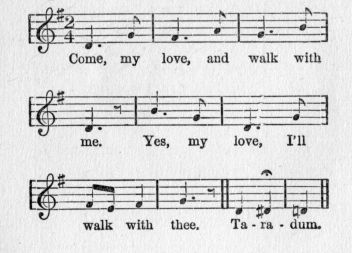
At this time, however, Checkers, standing down in the road outside, had cut the "ta-ra-dum" as flippant and irrelevant—a delicacy which, in her trepidation, Pert failed to remark. But, jumping up, she lighted her lamp, and cautiously exposed it at the window for a moment. Then, thanking fortune that she chanced to be dressed, she slipped a warm wrap over her shoulders, and stole down the stairs, out into the night.
Checkers folded her in his arms, and kissed her gently. "My darling," he murmured, "you haven't let them turn you against me, have you?"
"Why, Checkers dear," she answered looking into his eyes, "the whole world could n't turn me against you—I love you." Checkers kissed her again.
In the bright starlight they sat together, once more on the little rustic bench under the tree, listening with ready sympathy, as each related to each the trials of the day.
"No, little sweetheart," said Checkers finally, "there is no possible way for me to stay in Clarksville. The old man is practically right, I am a pauper, but I won't be long. Pert, I can hustle, when I want to; I 've got enough money to take me to Chicago, and keep me till I can get a job. When I get to work I 'll salt every cent, and with any kind of luck, I 'll come back and get you within a year. A year is not such a very long while." And with a show of genuine enthusiasm, Checkers ended by talking the downcast girl into a happy confidence in himself and the future.
"And now, Pert," he said, solicitously, "it's too cold for you to stay out here longer; come, we must be brave, and say good-bye."
"O, Checkers," she exclaimed, with a choking sob, suddenly throwing her arms around his neck, "I can't bear to let you go; I shall be miserable, miserable without you."
Tenderly Checkers soothed and reasoned with her. Once more their plans were gone over. Checkers was to leave in the morning for Chicago. He was to write to her as often as possible, addressing the letters to Sadie, whom Pert knew she could depend upon. Checkers was to bend every effort towards getting a position and saving money; and Pert was to be brave, and wait—the common lot of women.
With his arm around her, lovingly, he led her slowly to the house. Again and again they said good-bye; but there is something in the word which makes us linger.
"Some little keepsake, sweetheart," he whispered—"this ribbon, or your handkerchief."
"No; wait here a minute," she answered. Carefully entering the house, she crept to her room, and from its hiding-place brought forth a fifty-dollar gold piece. It was of California gold, octagonal in shape, and minted many years before.
"Here, dear," she said, returning noiselessly. "Here is a coin that was given me long ago by my grandfather—take it as a lucky-piece. And whenever you see it, think of one who loves you and is praying for you. And, Checkers, if you should have misfortune, and should really need to, don't hesitate to spend it; because, you see, if you don't have good luck, so that you do n't need to spend it, why it is n't a lucky piece, and you 'd better get rid of it—that is, if—if you have to."
Checkers embraced her passionately. "My darling," he protested, "I shall have to be nearer starving to death than I 've ever been, or expect to be, before I part with this. I shall treasure it as a keepsake from the dearest, sweetest, prettiest, sandiest girl in the world; the one that I love and the one that loves me; and here—here's a scarfpin that once was my father's. They say opals are unlucky. Well, father got shot, but I wore it the lucky day I met you; so that does n't prove anything—wear it for my sake. Now, dear, I must go. Keep a stiff upper lip, and do n't let the old man get in his bluff on you. Win your mother over—she'll help you out. I think she likes me; I am sure I do her. I 'll write to you every day. Good-bye, my precious—I 'll be back for you soon; good-bye, good-bye."
One last fond embrace, one lingering kiss, and Checkers turned and walked resolutely away.
The next morning early he bid the Bradleys a sorrowful farewell, and boarded the train for Little Rock. Mr. Bradley gave him letters to a number of merchants there, but he was unable to find employment. In fact, he only sought it in a half-hearted way; Little Rock was too small, too near Clarksville. Chicago was his Mecca. He felt a happy presentiment that once there circumstances would somehow solve for him the problem of existence. But, alas, for vain hopes! Day after day, from door to door, he sought employment without success. The answers he received to his inquiries for work were ever the same: "Business was dull; they were reducing rather than increasing their forces; sorry, but if anything turned up they would let him know." At times he received just enough encouragement to make his eventual failure the more disheartening and cruel.
How could he write to Pert under such circumstances? At first it had not been so hard; but now he had put it off from day to day, dreading to tell her of his non-success, always hoping that surely to-morrow he must have good news, until fully a week elapsed in which he had not written. How troublesome a thing is pride—to the poor.
In the course of his wanderings he came across numbers of the old companions of his pool-room days. Few of them had changed, but for the worse. Most of them were penniless, hungry and threadbare, but still the victims of the hopeless vice, and whenever fortune threw in their way a dollar, it went into the insatiable maw of the race-tracks. Checkers noted and was warned; and to their earnest solicitations to "play their good things" he pointed them to their own condition—a pertinent and unanswerable argument.
But though never so careful the time came apace when his little hoard was all but exhausted. His treasured keepsake he still vowed nothing should make him part with. "If I 've got to starve," he grimly resolved, "it might as well be a week or two earlier as later—but I 'll keep Pert's gold piece."
That same day he received from Pert a letter full of encouragement, but pleading with him, as he loved her, to write. "All in the world that I have to look forward to now, Checkers, dear," she said, "is your letters; and you can 't imagine how disappointed I am, and how I worry for fear you are sick, or something, as the days go by, and no word comes from you."
Standing by the window in his dismal boarding-house room Checkers read the letter over and over. Meditatively he examined his pockets—nothing! nothing but the gold piece. Something must be done. There were a number of garments hanging on the wall, among them an overcoat. "I can do without that," he said, with a shiver.
Half an hour later, richer by a few pieces of silver, he stood in a telegraph-office, penning a message to Pert. "Letter received," he wrote. "Am well, but no luck. Will write to-day. Checkers."
Beside him as he wrote, stood a man whom he recognized—one Brown, an owner of a racing-stable. With the tail of his eye Checkers read what he was writing. It was a telegram to some one in St. Louis, and ran: "Stand a tap on the mare to-day. She can't lose." Checkers' heart was in his mouth. Instantly his resolution was taken. Out into the street he followed Brown. With the furtive care of a Hackshaw he shadowed him in and out of hotels and saloons, until about noon they brought up at a restaurant, where Checkers modestly seated himself at a table behind Brown and ordered a light repast. But Brown was hungry, and Checkers had ample time to think the thing over. "I 'm in luck at last," he soliloquized. "Stand a tap on the mare! His friend will play it in the foreign-book at East St. Louis and he 'll play it at the track. It must be a 'hot one'—I wonder what the odds will be. Well, I 'll keep this can 't-shake-me glide on my feet till I see what he plays, and then 'get down' on it myself. I 'll put up the gold-piece, and stand to either lose it or make a stake for myself. Somehow I 'd feel better to have it go in one last effort to make a killin' than to spend it a quarter at a time on sandwiches and cigarettes. To-night I 'll either be able to write to Pert that my luck has turned, or I 'll know the worst, and that 's some comfort. Ah, Brown 's paying his bill at last."
The summer meeting at Washington Park, with large purses and high-class horses, was over and gone. But there were other tracks where racing was carried on all the fall and most of the winter; gambling-hells, pure and simple, or rather, purely and simply gambling-hells, which the Legislature has since effectively closed.
In the betting-ring of one of these, that afternoon, Checkers threaded his way through the crowd after Brown. The programme showed that Brown had an entry in the last race—Remorse, an aged selling-plater. Checkers remembered the horse as one that had shown considerable speed as a three-year-old. He glanced at the programme again: Remorse, by Gambler, dam Sweetheart. Was it an omen? Remorse would certainly follow if he gambled away the keepsake which his sweetheart had given him. But wouldn't an equally poignant regret possess him if after this providential tip he failed to play the horse and she won? He felt that it would.
The fourth race was on, and the last was approaching. Brown stood at the edge of the ring, his hands in his pockets, smoking idly. The official results of the fourth were announced, and the bookmakers tacked up the entries for the last. Still, Brown seemed nonchalant.
Checkers anxiously watched the posting of the odds. "Remorse, four to one," he exclaimed under his breath. Brown also glanced at the blackboards—and lighted a fresh cigar. Every minute some one would buttonhole him, and ask, "How about Remorse?" "O, she's got a chance," he would answer, with a shrug which seemed to indicate that she had no chance.
The favorite, under a heavy play, was rapidly cut to even money, while the odds on the others were correspondingly increased. Remorse went to five and six to one. Brown took fifty dollars out of his pocket, and, going up to a prominent bookmaker, played—the favorite. Checkers was paralyzed. The same performance Brown repeated with another book-maker on the other side of the ring. Gradually Remorse's price went up to eight to one, as it became generally known that her owner was not playing her.
The favorite's odds went to "four to five," and Checkers fingered his gold piece nervously. One book-maker still laid even money. Here was his chance if he wanted to play it. He started forward, and stopped. As he hesitated, Brown sauntered out of the ring. Checkers followed mechanically.
From a distance he saw Brown meet two horsemen and, after a brief conversation, give them each a roll of bills. He saw these two enter the betting-ring and, taking opposite sides, "start down the line" on Remorse; then the scheme was revealed to him.
From stand to stand they went, betting Remorse in each book, ten and twenty dollars at a time; not enough to cause remark, but amounting to hundreds in the aggregate. Gradually the odds began to recede. Checkers rushed to the other end of the ring. "Gimme Remorse!" he exclaimed, excitedly, handing his gold-piece to a convenient blockman.
"What the 'ell's this?" asked the wondering book-maker.
"It's fifty," answered Checkers, laconically.
"Well, it's the first time I ever seen one of them babies—but it looks like it's good. Remorse, four hundred to fifty."
"If I win, I want it back," said Checkers. "It was given to me by—it's my lucky piece."
"All right," was the answer, and Checkers walked away with his dearly purchased ticket deep in his pocket.
Under a steady but somewhat mysterious play, Remorse was cut to four to one, and the favorite went up to six to five. This was gratifying to Checkers, as indicating that Brown and his friends were confident.
He went up into the grand stand; the horses were at the post. Remorse was acting very badly—plunging, kicking and refusing to break. "I 'll just about get left at the post," thought Checkers. "Say, that favorite looks good," he remarked to a young fellow next to him.
"Good," echoed the youth; "well, I should say he is good. He 's cherry-ripe, and he 'll gallop in. If I had a thousand dollars, and did n't know where I was goin' to eat to-night, I 'd put it all on him. There 's a lot of 'marks' around toutin' Remorse to beat him—why, that old mare could n't beat a carpet; her last two races she could n't get out of her own way."
This was pleasant for Checkers, but he held his counsel. The next moment the starter dropped the flag.
Remorse, with a running start from behind, got two lengths the best of it; and, setting a hot pace, widened up the gap between herself and the field in a way that cheered Checkers' heart.
It was a three-quarter dash, and at the half she had a lead of at least ten lengths, with the others strung out in a regular procession. The favorite was trailing along in fifth place; but Checkers noticed that he was "running easy." The jockey was leaning back in the saddle, and the horse's mouth was pulled wide open, as he fought for his head under a double wrap.
As they rounded into the stretch Remorse still led, but she seemed to be tiring rapidly. The favorite swung very wide at the turn, losing several lengths; his jockey then drew in behind three others, and allowed himself to be hopelessly "pocketed."
Up to now Checkers' new acquaintance had been silent; but at this exhibition of incompetent jockeyship he expressed a desire to be "good and damned if that ride would n't frost a cigar-sign Indian."
Under whip and spur Remorse staggered on two lengths in the lead. Within fifty feet of the wire the favorite got through, and coming with a rush, as it seemed almost in spite of his jockey's efforts to restrain him, he nipped Remorse on the post.
From where Checkers stood it looked as though Remorse was beaten half a length. The crowd yelled with delight; No. 4 was posted. Checkers looked at his programme—"Remorse, No. 4." Then it was his turn to yell, and he rather abused his privilege. The tumult of varied emotion within him demanded this vent, and he gave it full play. "I thought I was out of it," he laughed delightedly to the young man beside him. "It looked like it, did n't it, at the angle? You see, Remorse had the rail."
But the young man was n't interested in Checkers' good luck. Just then he had "troubles of his own." He vouchsafed one glance of sour contempt and hurried off to try to borrow car-fare from some one.
Often Checkers had won and lost more money than was involved in his present venture and stood it stoically; but never before had his need been so great, and he had reason to know that necessity and luck have at best little more than a speaking acquaintance. Exultantly, therefore, he skipped down the stairs into the betting-ring. "You can 't keep a squirrel on the ground," he chuckled. "They 've got to stop printing money when I ain't got some." The next minute he was in line behind the stand where he had made his purchase, tightly grasping the ticket which was to give him back his gold-piece and four hundred dollars.
Four hundred dollars! It was a snug little sum. The gold-piece had proved a mascot after all. Now, he would "get out" his overcoat and purchase some other necessary articles. He decided to pay off his landlady and find some more inviting quarters. But the pleasantest thought of all was that now he could write to Pert. The delight he found in this reflection could only have been surpassed by the joy of seeing her in person. He did not know what he should say; but he knew that with this load off his heart, and with the return to self-respect which this success had brought him, he would be able to write a letter which would encourage and cheer her—it should be his first task. He longed to be at it, and he began to chafe at what seemed an unusual delay in announcing "the official."
Turning, he glanced toward the judge's stand. There was a surging, interested crowd around it. A presentiment of sudden misfortune came over him. Almost at the same moment the air was rent by joyous yells from hundreds of throats.
The crowd turned about, and with one accord made a rush for the betting-ring.
In the van was Checkers' surly acquaintance—surly no longer, but radiant with a smile which extended from ear to ear. Checkers broke from the line, and grabbed him by the arm. "What 's up?" he exclaimed. "What's the yelling about?"
"All bets off," was the glad rejoinder; "the favorite was 'pulled.' The judges are onto a job in the race. It was 'fixed' for Remorse. We all get our money back. Let go—I 'm in a hurry."
Checkers stood as though paralyzed from an actual blow. His eyes were fixed and his lips were colorless. "By the bald-headed, knock-kneed Jove!" he exclaimed, suddenly rousing himself with a vehement gesture; "if my luck ain't—" But he felt it impossible to do the occasion justice.
With a set face and a heavy heart he again lined up behind the stand. In turn he was given his gold piece in exchange for his ticket, but the $400 was gone, to return no more forever.
Under any sudden and crucial misfortune the subsequent action of the average man is largely a matter of temperament. Numbers, no doubt, in Checkers' position would have felt themselves justified in drowning their sorrows in the flowing bowl. Others, with the obstinacy of despair, might 'ave sought, perforce, the smiles of frowning fortune, throwing discretion to the winds, and risking their all at any desperate game chance threw in their way until satiated. A few might have taken their hard luck resignedly, only thankful that it was no worse, and hoping for better luck next time—such are they who, in the end, succeed.
These alternatives occurred to Checkers in turn, and he effected a sort of compromise. He needed a temporary excitement of some sort as a counter-irritant to his nerves. He was tired and hungry, and he decided that his first move would be to get a good supper. He did n't care how good or what it cost—he was tired of practicing economy. But he must have some money; it would hardly do to "spring" the fifty in a restaurant. Ah! Uncle Isaac! Yes, he believed he could pawn the gold piece as he would a watch, and then if luck ever came his way, he would have a chance of redeeming it.
The staid old waiters in a fashionable caf£ smiled that evening as a youthful figure entered with an unaccustomed air, and, seating himself at one of the tables, studied the menu earnestly. A few deft suggestions from one of them, however, put him in the way of a very good supper; and with a pint of Mumm's to wash it down, and a cigarette to top off with, Checkers, for it was he, began to feel that things might have been a bit worse after all. As he stepped into the street, the glaring and impossible posters of a spectacular show at a neighboring theater caught his eye and decided him. Five minutes later he was comfortably seated in the front row of the orchestra chairs, enjoying himself in present forgetfulness of troubles past or troubles to come.
Now, I fear, that to properly do my part, I should here create a dream for Checkers to have had that night, in which Pert, Remorse, a waiter, and a comedian should all take more or less senseless parts. But being somewhat skeptical myself, I was careful to question Checkers on this point, especially when I afterward learned what great things the morrow had in store for him. And, in spite of all precedent, he confessed to the oblivion of "the insensate clod," devoid of dream or premonition, until nine the next morning, when he awoke with a start. With the awakening came a realizing sense of his situation in all its most disheartening phases. His course of the night before now seemed to him the height of idiocy. He reproached himself in no measured terms for having neglected to write to Pert as promised in his telegram. "I ought to have a guardian appointed to look after me," he grumbled to himself. "Think of my blowing myself for wine and the show, with starvation staring me in the face; and then to think of that poor little girl expecting a letter, and not getting it."
He was interrupted by a knock at the door. "A letter for you, Mr. Campbell," said the servant. Taking it from her he recognized the well-known writing of his beloved. He put the letter in his pocket, and, grabbing his hat, started down the stairs. "I 'm too late for breakfast here," he exclaimed; "I 'll go next door to the 'beanery' and get a roll and a cup of coffee. I 've got to play 'em close to my vest now," he sighed. "A dime is nothing when you 've got it, but it 's bigger than a mountain when you have n't; and it won 't be long before I have n't at this rate."
Seated on a little round stool at the corner in the "beanery," he gave his order, and then opened and commenced to read his letter. A newspaper clipping dropped to the floor; he picked it up mechanically, continuing his reading as he did so. Suddenly he began to glance from one to the other rapidly. An instant later he jumped to his feet, and rushed to the window for a better light. It could n't be true—it simply could n't! Yes, yes, it must be; for here was a notice from the public administrator in Baltimore, advertising for him as an heir of Giles Edward Campbell, deceased, who died intestate, etc., etc., and Judge Martin, so Pert said in the letter, had had an inquiry regarding him, with the statement that the only knowledge the authorities had of such a person was based upon a letter found among the effects of the deceased, headed "Eastman Hotel, Hot Springs," beginning "My dear Uncle," and signed "Your affectionate nephew, Edward Campbell." The clerk at the Eastman, when applied to, had reported a memorandum left by Checkers, that any mail which might come for him be forwarded to Clarksville, Ark.; hence this letter to Judge Martin, and hence Pert's knowledge of the matter, as her uncle immediately applied to her for the necessary information.
"Uncle has written to Baltimore to-day," continued the letter, "and he says you will hear from the authorities there without delay. The inclosed clipping is from a Little Rock paper. Oh! Checkers, darling, is n't it lovely?"
The slovenly waiter shuffled to the counter with his cup of muddy coffee and a soggy roll. Checkers tossed him half a dollar, and stalked majestically out. "I think the joint where I ate last night is just about my size this morning," he chuckled. "Gee, but I 'd like to yell just once. The judges can't call all bets off this time." All during breakfast his mind was busy with a thousand different speculations, and he finally decided that in so momentous a matter he ought to consult a lawyer. "I 'll find one in some big office building," he mentally resolved, "and get his advice."
+---------------------+ | MURRAY JAMESON, | | Attorney-at-Law. | +---------------------+
This, in modest gold letters upon an office window, was the first thing he saw upon reaching the street.
"Everything 's coming my way to-day," he thought. "Well, I 'll go in and see the old joker."
He was much taken aback upon entering, however, to find the "old joker" a man of about thirty.
"Is Mr. Jameson in?" he asked.
"I am Mr. Jameson," was the reply.
"Well, I wanted to get a little advice, but—"
"Certainly; come into my private office."
Checkers was trapped. "I do n't believe," he began desperately, "that you 'll be able to help me. It's a very important case, and—well, I—I want some one with a lot of experience."
"As you like," said Mr. Jameson, who, by the way, was none other than my old friend Murray, "but I 've been practicing law for more than five years."
"Well, that's enough practice to learn any game;" and, seating himself, Checkers told him the facts as succinctly as possible from the beginning.
Of his uncle's circumstances he really knew nothing; but he remembered hearing his mother speak of him, just before her death, as being "well off," and "Uncle Giles was n't the kind, once he had a dollar, ever to let it get away."
If Checkers' chronology was correct, it was clear that he was the only heir, and "whether his Uncle left much or little, it was that much better than nothing at all." But Murray somewhat damped his enthusiasm by the statement that there might be bills and claims of various sorts against the estate, which, in the end, would show it to be insolvent. However, he agreed to take the matter up at once, and be content to receive his fee when the final settlement was made.
Checkers spent the rest of the day in writing the long-delayed letter to Pert, telegraphing her in the mean time that he had received her letter, and expressing his thanks.
A few days brought to light these facts concerning Giles Edward Campbell, deceased: He had drawn a large pension undeservedly for years, and by pinching and saving had amassed a fortune. Under Cleveland in '84 his pension was annulled, and about the same time he was nearly bankrupted in a greedy and foolish speculation. Then fear of absolute want must have seized him, for, converting the little that was left into gold, he hoarded it in miserly fashion; loaning it at usurious rates, and hiding it when not in use in chests and crannies in his den. At the time of his death, which was due more to lack of nourishment than to anything else, there was found upon his person and in nooks and corners of his room, thirty thousand dollars in gold and government bonds, all of which in due time became the property of Checkers.
VIII
On a certain bright December day not many weeks after the occurrence of the last related events, the town of Clarksville seemed to have assumed a most unwonted bustle and confusion. People were actually hurrying in and out of the little white Methodist church, carrying evergreen boughs, chrysanthemums and sprays of holly and mistletoe. Wagons were driving back and forth between town and the Barlow place, and the Barlow house was in the hands of a Little Rock caterer and his assistants. It was Checkers' wedding day. He and Pert were to be married that night at six o'clock. Nothing they could think of had been left undone to make the occasion a happy one.
Though the old man fumed and fretted at the expense, Checkers insisted upon having things "right." "This is my first and last wedding," he said, "and there 's going to be nothing Sioux City about it." So, though the old man groaned in spirit, caterer, orchestra, flowers, etc., were ordered, regardless of expense, from Little Rock, and all the town took a surpassing interest in the event.
Checkers' return to Clarksville had been the triumphant return of Caesar to Rome. As is usual in such cases, current report had magnified his fortune twenty-fold. Mr. Barlow was now all smiles and acquiescence; but his first meeting with Checkers was painfully strained. Checkers treated him on the principle of "least said, soonest mended;" but Mrs. Barlow he kissed and called "mother."
He had found Pert looking a little pale, and her bright eyes seemed somewhat larger and brighter. But the happiness which accompanied his return soon brought the color back to her cheeks.
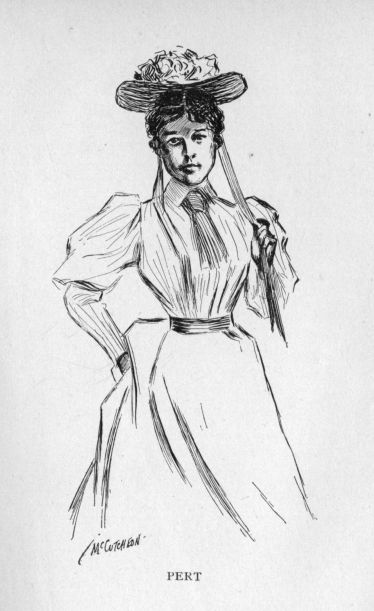
PERT
Of course Checkers urged an immediate marriage, and of course there was the usual demur; but, in the end, a date was fixed upon as near as would conveniently allow for such preparations as Pert and her mother felt it necessary to make. And in the mean time Checkers and Pert were ideally happy. They took long drives and walks through the woods, and spent long evenings in talking over their plans for the future, with a never-flagging interest.
It was practically decided that Checkers was to buy the Tyler place. This was a fruit farm in perfect condition, with a neat little house upon it, and not far from town. It could be purchased for cash at a very low figure, and as the trees were all bearing, it seemed to promise a large and sure return for the money, even cutting in half, for possibilities of frost or drought, a conservative estimate of what the trees should yield to the acre.
Mr. Barlow and Checkers figured upon it carefully from every standpoint, and the more they figured, the more it seemed a providential opportunity, Checkers knew nothing of any other business, and his money was practically lying idle in the bank. No other safe investment could promise so large an income and at the same time furnish him with employment and a pleasant home.
And so at last the matter was decided. The earnest money was paid, and the order given for the execution of the necessary papers. The house was vacated and thoroughly renovated, and Pert found a new delight in selecting paper, carpets and furniture to her liking—Checkers had given her carte blanche.
As soon as the title to the property was found to be clear, Checkers gave a certified check to Mr. Tyler for twenty thousand dollars, and a warranty deed was signed, conveying the property, in fee, to Persis Barlow. This was in accordance with Checkers' desire, and was a great surprise to Pert and her parents. "What's mine is yours, dear," he said with a smile, "and what's yours is your own." And that ended the matter—unfortunately for Checkers.
There was just one question upon which the two had a serious difference—the case of Arthur Kendall.
"Now, Edward," said Pert one evening (when she called him 'Edward' he knew that something important was coming), "I want to talk to you about something that has been worrying me dreadfully."
"What is it, sweetheart?"
"And I want you to promise to do as I ask you."
Checkers felt suspicious, and refused to "go it blind."
"Well, it's about the Kendalls. I want you to make up with Arthur, somehow—"
"Not on your—"
"Yes, Edward; you must. Remember the Thanksgiving sermon about forgiveness and loving your neighbors."
"Oh, it's all well enough to love your neighbor, but there 's no necessity for taking down the fence. Arthur treated me like a step-child, and—"
"But, Checkers dear, we want Aunt Deb. and Mr. Kendall at the wedding. They won't come unless Arthur does, and Arthur won't come unless you make up with him. Consider, Checkers, you 've been unusually blest, and you ought to be humble and thankful, and do something to show it; and here's your opportunity. Another thing"—this came hesitatingly—"he 's the only fellow about here who could make a decent appearance as your best man."
Checkers went off into peals of laughter. "Oh," he exclaimed, "I begin to tumble. Forgive your neighbor, if you happen to need him—afterwards you can shake him again."
Pert joined in the laugh. "It is no such thing," she responded. "If you half appreciated me, you would n't blame Arthur for being angry at you for doing what you did to him. He loved me a great deal more than you do; he never refused me a favor in his life."
"That's just why he lost you. Push Miller used to say—"
"Never mind Push Miller; Arthur is to be at Sadie's to-morrow evening. You and I are going there to call. You are to shake hands with Arthur and tell him you 're glad to see him, and be natural and friendly. Afterwards you can ask him to stand up with you."
"It seems to be settled," said Checkers; and so it eventuated. Checkers greeted Arthur with frank cordiality, and relieved the tension by a few well-turned witticisms. No apologies passed between them, and reference to the past was tacitly barred. Checkers' sunny nature was not one to harbor a grudge, and if Arthur still felt rebellious, he managed to hide it gracefully. He readily consented to act the part of best man for Checkers; and Sadie, of course, was to be Pert's maid of honor. Most of the evening was spent in discussing other available material in the way of bridesmaids and groomsmen, and it was agreed that with a few importations from Little Rock, they would be able to present an attractive wedding party.
"Now, I have an idea," said Arthur, "which I think is a good one. Checkers ought to know those fellows before they are asked to be his groomsmen; we'll go up to Little Rock to-morrow, and I 'll invite them to meet him at an informal dinner at one of the hotels."
"A very good scheme," assented Pert.
"And I 'll invite the party here to supper for the night before the wedding," put in Sadie.
"It 's very kind of you both," said Checkers, "and I appreciate it more than I can tell you."
Early the next morning the two boys went to Little Rock. Arthur invited four of the most desirable of his acquaintances to dinner that evening, and luckily they all accepted.
Most of Checkers' day was taken up in fulfilling missions for Pert and her mother. He returned to the hotel late in the afternoon, and had barely time to don his new dress-suit and join Arthur in the rotunda before their guests arrived.
They were jolly good fellows, all of them. Checkers was duly presented, and after a preliminary cocktail the party adjourned to the private dining-room, where a round table was prettily laid for six. Checkers felt apprehensive for Arthur, when he noticed three different glasses at each plate; but Arthur took early occasion to state that he was "on the water-wagon," and he hoped that the boys would "not let it make any difference with them, or with the gayety of the evening"—and it did n't. After the first edge of their hunger was turned the jollity grew apace. Checkers in his happiest vein related numberless humorous anecdotes, among them his experience of Remorse and the gold piece. Each of them told his particular pet joke, and all were boisterously applauded.
"Now, waiter," exclaimed Arthur, suddenly righting his down-turned champagne glass, "fill them up again all around, and give me some. Gentlemen, I want to propose a double toast, and I 'll ask you to drink it standing—a bumper." All arose expectantly. "Let us drink," he said, "to the health and happiness of the sweetest, fairest, most lovable girl God ever put upon this earth—it is needless to name her. Let us also drink to the health and prosperity of the thrice-fortunate man who has won her love—Mr. Campbell, your health." He touched his wine to his lips; the others drained their glasses, and all sat down.
There was an expectant silence. Checkers felt the blood go surging to his brain, while his heart seemed to sink like lead within him. He felt powerless to rise, although he knew that all were awaiting his response. The silence became painful. "Speech," murmured some one. "Speech," echoed the others. With a superhuman effort he managed to arise, and grasping a full glass of water, drained it. "I 'll tell you, boys," he said huskily, "here's where I 'd put up the talk of my life, if I could; but it's like it was that day they declared all bets off—the occasion 's too much for me. I feel it all—I feel it in my heart," he continued earnestly. "I 'm obliged to Arthur for his motion, and to you all for making it unanimous. I know that I 'm lucky, so lucky that I can hardly believe my good fortune myself. Half the time I think that I must be asleep, and trying to 'cash a hop-dream.' I 've been ready to get married for a couple of years—I 've had everything but the stuff and the girl; I was ready to furnish the groom all right; but I 've always had a feeling that I could n't have much respect for a girl that would marry me if she was 'onto' me—every fellow feels the same, or ought to. And so when I find I have drawn a prize girl, who, as Arthur says, is 'the fairest and sweetest God ever put on this earth,' and it's true, it jars me, boys; it does, on the dead. I feel like the only winner in a poker-game, as though I ought to apologize for it—and I do, with about the same regret.
"Well, I 've had my hard luck, and 'played out the string,' and now that things seem to be coming my way, I 'm going to enjoy myself while it lasts. 'Life is short, and we 're a long time dead.' That's an old saying, but it's a good one. Boys, I hope you 'll all be as happy as I am when it comes your turn, and may it come soon. Here 's how." He lifted his glass, which in the mean time the waiter had filled, and, smiling around the circle, tossed off his wine in unison with the others and sat down.
There was the usual clapping and cheering, after which Checkers asked their attention for a moment more. "I want to sign two of you fellows for groomsmen," he said. "I wish I needed four, I 'd like to have you all; but Pert said 'two,' and what Pert says goes. Now, how shall we decide it?"
"Why not match for it!" suggested one of them.
"Good idea!" exclaimed Checkers; "you four match nickels, odd man out. until two are left—come on, get busy."
On the first trial, two called "heads," and two "tails." "No business," said Checkers. On the second trial, three called "heads" and one "tails." "Tough luck, old man," said Checkers to the one; "I wanted you particularly." At the first essay of the three remaining, all showed "heads" up; at the second two of them "switched" to "tails," while the third kept "heads"—thus deciding the matter.
"Well, that settles that," said Checkers; "but groomsmen or not, we 'll all be there, and I hope we'll all have a good time."
It was in "the wee, sma' hours" when the party broke up, and Checkers and Arthur, after seeing their guests safely out, sought their rooms, and quickly tumbled into bed. Checkers, however, took occasion to thank Arthur warmly for his kindness, and to express a hope that an opportunity might soon occur for him to requite it. The next afternoon saw them back in Clarksville.
The few intermediate days passed quickly. Sadie's supper was a success, as such things go; the ceremony was rehearsed, and all was in readiness for the great event.
The wedding morning dawned, as bright and beautiful a winter's day as nature ever vouchsafed a happy bridal pair. Checkers was up with the lark. He felt the weight of the nations upon his shoulders. All day he was back and forth between house and church, anxious that nothing should be overlooked; suggesting and helping until late in the afternoon, when Arthur laid violent hands upon him, and insisted upon his taking a rest before making a toilet for the evening.
Promptly at six, to the Lohengrin March on a cabinet organ, the bridal party came slowly down the aisle, the two ushers first, and following them, the two bridesmaids. After these came Sadie, alone, with a huge bouquet of roses, and lastly leaning upon her father's arm, came Pert, in a simple white gown, her veil wreathed with orange blossoms and pinned with a diamond star, one of Checkers' gifts.
Every neck was craned, and every eye fastened upon her in breathless admiration, for she was beautiful.
From behind a screen at the side, Checkers and Arthur came forth, and met them at the altar. The service was simple, but solemn and impressive. The earnestness of Checkers' answers caused a quiet smile to pass around, which culminated in down-right laughter at the ardor with which he kissed the bride when the time came; but he was wholly oblivious. Marching out to the accustomed music, he could scarcely maintain a decorous step, so great was his elation.
Their short drive to the house, during which he folded Pert in his arms, and knew that she was his—all his—he felt to be the moment of his supremest earthly happiness.
The others followed quickly. The guests arrived, and soon there were congratulations, feasting, music and merry-making galore.
But all things—good things—have an end, and perhaps it is just as well that they have; at least, in this case Checkers and Pert, as they crossed the threshold of their own little home, breathed a happy sigh at the thought that they were alone at last—together.
IX
The succeeding days brought one continuous round of simple pleasures. Christmas and the holidays followed hard upon the wedding, and New Year's Day being Sunday, Pert invited the members of the wedding party to the house for from Friday to the Monday following.
At this season of the year there was nothing of actual work to be done upon the place, and Checkers was free to hunt with the men or drive with the girls, as he elected.
Whether it be for the reason that "misery loves company," or for the much more probable and kindly reason that "our truest happiness lies in making others happy," it is certain that most young married couples have a very strong "weakness" for match-making. And Pert and Checkers were no exception to this rule.
They decided that Arthur's truest good demanded that he marry Sadie; and poor little Sadie showed but too plainly in what direction her happiness lay.
But in spite of Pert's well-laid plans to leave them in quiet corners together, in spite of her many little tactful suggestions, Arthur remained unresponsive. He was attentive in a perfunctory way, but that was all. And often Pert would blush to find him gazing at her with a wistful, far-away look in his eyes, which told more surely than words what was in his heart. In fact, Sadie timidly suggested to Pert one day that Arthur was always distrait and silent after seeing her and Checkers together; and that instead of making him desire a domestic little home of his own, it seemed to embitter and sour him.
So, after the house party Checkers settled down to serious life on a farm, and Pert busied herself with housekeeping, learning to cook from her neat old colored servant "Mandy," trying new dishes herself, and doing the thousand and one little things that go to make up "a woman's work," which 't is said "is never done"—"done," of course, in the sense of "finished."
And so the winter glided quickly into spring—the spring of '93; a year that many of us will long remember.
One evening Checkers unfolded to Pert a long-cherished scheme, which delighted her. This was nothing less than a plan to take her to Chicago in May to see the World's Fair. "We 'll call it our wedding trip, little girl," he said caressingly, "and we won't be gone but ten days or two weeks."
But when Mr. Barlow heard of it, "he made a monkey of himself," as Checkers put it. He ranted and swore, and told them both they would end in the poorhouse with their reckless extravagance. But Checkers laughed him off good-naturedly. He knew that the trip would be expensive; but he felt that he could afford it, and he had another and a deeper reason for taking Pert to Chicago. He was greatly worried about her health, and he desired to have her consult some eminent physician regarding herself.
One day, when they were out for a walk, she had run a playful race with him along a level stretch of road, bending every energy to beat him. He was running easily behind her, puffing and grunting to make her think that she was really worsting him, when suddenly she stumbled, tottered, and, putting her hand to her heart, sank limply upon a bed of leaves at the side of the road. In an instant Checkers was kneeling beside her. She had not fainted, but was as pale as death, and she still held her hand to her heart and gasped for breath. Checkers loosened her gown about her throat, then filling his hat with water at a little stream near by, he bathed her brow and wet her lips. Fully an hour passed before she was able with his assistance to walk to the house, and though about, next day apparently as well as ever, she complained thereafter, at intervals, of dizziness, chilly sensations and strange flutterings at her heart.
The local doctor joked her about the size of her waist, and told her that her trouble was probably due to a combination of lacing and indigestion. But to Checkers he confided a fear that there might be some affection of the heart, and earnestly advised that he consult some worthy specialist.
So, while Checkers told nothing of his apprehensions to Pert, he would brook no interference in his plans. The middle of May they left the house in care of "Mandy," and set out for the land of "The Great White City."
What delight they found in roaming about through those wonderful buildings and marvelous displays! Checkers, alert and all-observing, Pert, enthusiastic and wondering—they spent whole days in a single building or upon the ever-interesting Midway.
Checkers had found cozy quarters in a small hotel not far from the grounds, but they lunched and dined where it suited them best. Thus it chanced that one night, when they were going to the theater, they dined beforehand at Kinsley's, as related by Checkers in the opening chapters.
Meanwhile, Checkers did not neglect the more serious part of his mission. He hunted up Murray, who was surprised and glad to see him, and who evinced a genuine interest in the story of his marital felicity.
Upon the matter of a doctor for Pert, Murray happened to know "just the man," a friend of his, to whom he gave Checkers a letter of introduction. Checkers called and explained the case to the doctor, and the next day Pert underwent a thorough examination. Checkers awaited the verdict anxiously. In effect it was this: her heart action was weak, and at times irregular, but there was no reason to apprehend but what, with a careful diet, regular exercise, plenty of sleep and fresh air, she would live as long as the average woman, and fully recover from the troublesome symptoms which sudden over-exertion had brought upon her. Violent exercise and excitement, however, were especially to be avoided; and the use of all stimulants, narcotics and anaesthetics must be set down as dangerous in the extreme.
Checkers breathed a sigh of relief. He had warned the doctor to make as light of the case to Pert as his conscience would permit, explaining that he himself would tell her gradually, as fitting occasion offered, what had been said to him, and would see that all instructions were carefully carried out. Violent exercise she was already warned against, and Checkers felt that he could guard her against unusual excitement. He carefully avoided the harrowing plays at the theater, but took her to operas and burlesques. But it never occurred to him as necessary to warn her specifically against stimulants and drugs.
A few days before their departure for home, they received a pleasant surprise in the shape of a telegram from Arthur and Sadie, announcing their marriage.
A letter from Sadie arrived the next day, in which she said that she and Arthur had hoped to join them in Chicago and surprise them, but that conditions were such at the store that Arthur's every available moment was demanded, and he could not possibly get away. But this was not the half of it. The panic of '93, of which premonitory notice had been given by numerous bank failures, was now a stern reality. Collections were bad, business was dead, and the firm of Kendall & Co., which had unfortunately laid in a larger stock of goods than usual that season, found it all they could do to keep themselves from going to the wall.
Checkers and Pert returned and soon fell into their accustomed grooves. They called upon Arthur and Sadie, and found them reasonably happy under new conditions, although Arthur was evidently carrying a load of care and responsibility; while Judge Martin sat up and cheerfully predicted "confusion and every evil work" as a result of the demonetization of silver and other kindred political "outrages."
One morning as Checkers was working about the dooryard, he espied his father-in-law coming up the road at a gait which presaged important news. The old man reached him, out of breath. Checkers waited expectantly.
"Well, what do ye think has happened now?" panted Mr. Barlow. "The First National Bank of Little Rock has gone up—busted; got yer money."
There was in his voice and manner something of the triumph that mean spirits feel at being the first to bring disastrous news, as well as a show of personal injury at the thought of Checkers allowing himself to lose what he himself had even the shadow of an interest in.
"My God!" exclaimed Checkers involuntarily, growing pale at the news. Then for a moment he stood in silence, nervously biting his upper lip. He had had long experience in controlling himself under trying circumstances. "If that's so," he finally answered in a quiet voice, "it 's tough."
This exasperated Mr. Barlow. "Tough," he repeated; "you nincompoop, it's actual ruin; the bank has been robbed by its president—looted—ye 'll never see a cent of it ag'in," and he started toward the house.
"Hold on!" exclaimed Checkers, grabbing him by the arm. "Not a word of this to Pert; it will only excite her, and not do any good."
But the old man shook him off and continued his way. Checkers picked up a handy piece of scantling, and running up the steps, turned and faced his father-in-law.
"Now, see here, old man," he exclaimed, "I 've taken as much of your slack as I 'm going to—see? I tell you you can't come into this house; and I give you fair warning, if you put your foot on one of those steps I 'll smash you over the head;" and he swung his weapon threateningly to his shoulder. "What I 've made or lost is mine, not yours," he continued, "and it don't 'cut any pie' with you—you'll never get a cent of it. My wife is mine, not yours, and I 'll take care of her, what ever happens. But she is n't well, and the doctor said any sudden excitement might kill her. I 'll tell her gradually and quietly, and go down to Little Rock this noon and see if there 's anything can be done. If I 'd let you tell her you 'd break the news with an ax, and I tell you I ain't going to have it; so just 'jar loose,' and 'pull your freight.'"
There was something in Checkers' determined look which cowed the old man, but he would n't go without a last word. "Well, ye 'll both o' ye end a couple of paupers and die in the poorhouse if this keeps up," he said, "with your fancy furniture and trips to Chicago. How much did you have in that bank?"
Just here Pert appeared in the doorway. Checkers' threatening attitude and her father's question, which she overheard, surprised and startled her. "What is it?" she cried, putting her arm around Checkers and disarming him gently.
"Nothing much," he began.
"Nothing much," interrupted her father, "except that the Little Rock bank is busted, and all yer money's gone."
Checkers reached for his stick, but Pert restrained him. "Never mind, dearest," she said, "it may not be as bad as you think—things never are; and we 've got the house and the farm, and the bonds; and, whatever happens, we 've got each other."
"Yes; you 've got each other," said the old man cynically, "and that's all ye will have, if things goes this way. If yer goin' to Little Rock, boy," he said sharply, consulting his old silver watch, "ye must hurry; ye ain't more 'n time to make it now."
Checkers saw that this was so, and going to his room, made a hasty toilet. "Good-bye, Pert, darling," he said, as he emerged, catching her up and embracing her lovingly. "I 'll be back soon; don't mind what he says;" and with a warning glance at Mr. Barlow, he hurried off down the road toward the station.
As he stood upon the platform awaiting the train he felt a sudden presentiment of evil, and with a superstition born of his early experience in gambling, he half decided to turn back. "I 've got a feeling I ought n't to go," he muttered; "but I guess it's because I 'm afraid the old man will worry Pert. Still, she seemed to take it calm enough, and I ought to get there and look after my stuff." He boarded the train and went steaming off, but he could not get rid of his bugaboo.
The situation with Checkers at this time was about as follows: Of the legacy left him, $20,000 had gone for the farm, or fruit ranch, which he had given Pert. A thousand more had been spent in refitting and furnishing the house. Most of the wedding expenses, which Checkers had assumed, Part's presents, an elaborate wardrobe for himself, the household expenses, and the trip to Chicago, had consumed about another thousand. The balance, except ten government bonds and a few hundred dollars in the bank at Clarksville, was on deposit at interest in this bank which failed—$4,800, for which he held a certificate of deposit. It was very unfortunate, and the sense of his loss kept growing upon him as time went on.
Meanwhile Mr. Barlow had taken occasion to lecture Pert on her sinful extravagance. With pencil and paper he sat before her, and showed her how within six short months she and Checkers had spent one-tenth of their fortune, and how with this loss at the bank they were poorer by a third of all they had ever possessed.
"Figures won't lie, but liars will figure." He knew, but he did not tell her, that of what was actual expense there would be little cause for its repetition, and that most of the money expended was visible in assets of one sort or another. He only made her feel perfectly miserable, and wrought her up beyond the point of thinking or answering intelligently.
When he had gone she tried for a while to busy herself about the house, but she felt a growing lonesomeness—a desire for sympathy and companionship—and she decided to put on her hat and go down to her cousin Sadie's.
It was now high noon, and a stifling hot day; but she braved the heat of the blistering sun, and trudged along the dusty way to her destination. When she reached the Martins' house she was dizzy and faint from the heat and the blinding glare.
Judge Martin and Arthur came home to dinner, and both expressed the greatest sympathy for her and Checkers in their sudden misfortune. At the table Pert tried to eat for appearance's sake, but her efforts ended in mere pretense. Sadie noticed it, and insisted that after dinner she go to a room on the cool side of the house and "take a nap." To this Pert objected. "I can never sleep during the day," she said; "the longer I lie, the wider awake I get. I am really all right," she added, smiling bravely, "only my head aches—a very little."
"We'll soon fix that," exclaimed Arthur. "I 've been troubled with headache and sleeplessness lately, myself, and I 've struck a remedy that beats anything you ever saw; knocks a headache, and makes you sleep like an infant. It's perfectly harmless, too—guaranteed. Excuse me a minute; I'll get the box."
Pert felt too miserably weak and apathetic to further object to Sadie's suggestion or Arthur's remedy; so, under her cousin's ministering guidance, she retired to an upper room and prepared herself with what comfort she could to rest, while Sadie opened the windows and drew the shades.
"Now, Pert," said Sadie, "take one of these powders with a little water, and I think you 'll feel better right away. I 'll leave the box here on the table, near the bed, and if the first one does n 't cure your headache and put you to sleep, take another. Now is there anything more you want, dear? If there is, just call; I 'll leave the door the least bit open." A sudden impulse prompted her, as she was going out, to return and kiss Pert fondly, and though not an uncommon thing between them, still both wondered for a moment afterward at the unusual tenderness and feeling that each had unconsciously put into the embrace.
Left alone, Pert tried to compose her mind and go to sleep; but in spite of herself her brain dwelt anxiously upon Checkers in Little Rock, and upon what her father had said to her. Half an hour passed and still her fancy teemed, as she restlessly tossed from side to side. She felt herself growing nervous, and her ear upon the pillow told her that her heart was beating rapidly.
"At least my head feels a great deal better," she murmured, raising herself upon her elbow; "now if I could only get to sleep I believe I should wake up quite myself again. Perhaps another powder will do it; I 'm afraid of them, though. Still, Arthur says they 're perfectly harmless—I 'll take just one more. Checkers would n 't like it; he told me never to take any medicine." She lifted her box from the table. "Dear old Checkers," she said to herself, with a sigh, preparing the powder; "how he loves me! His first thought was to keep the news from me for fear I would worry." She took the draught and sank back upon the pillow—"to be loved as he loves me—Oh, Checkers! mother!!"