THE STORY OF CHALDEA.
Reading edition
I.
NOMADS AND SETTLERS.—THE FOUR STAGES OF CULTURE.
1. Men, whatever their pursuit or business, can live only in one of two ways: they can stay where they are, or they can go from one place to another. In the present state of the world, we generally do a little of both. There is some place—city, village, or farm—where we have our home and our work. But from time to time we go to other places, on visits or on business, or travel for a certain length of time to great distances and many places, for instruction and pleasure. Still, there is usually some place which we think of as home and to which we return. Wandering or roving is not our natural or permanent condition. But there are races for whom it is. The Bedouin Arabs are the principal and best known of such races. Who has not read with delight accounts of their wild life in the deserts of Arabia and Northern Africa, so full of adventure and romance,—of their wonderful, priceless horses who are to them as their own children,—of their noble qualities, bravery, hospitality, generosity, so strangely blended with love of booty and a passion for robbing expeditions? They are indeed a noble race, and it is not their choice, but their country which has made them robbers and rovers—Nomads, as such wandering races are called in history and geography. They cannot build cities on the sand of the desert, and the small patches of pasture and palm groves, kept fresh and green by solitary springs and called "oases," are too far apart, too distant from permanently peopled regions to admit of comfortable settlement. In the south of Arabia and along the sea-shore, where the land is fertile and inviting, they live much as other nations do, and when, a thousand years ago, Arabs conquered vast and wealthy countries both in Europe and Asia, and in Africa too, they not only became model husbandmen, but built some of the finest cities in the world, had wise and strictly enforced laws and took the lead in literature and science. Very different are the scattered nomadic tribes which still roam the steppes of Eastern Russia, of Siberia and Central Asia. They are not as gifted by far as the Arabs, yet would probably quickly settle down to farming, were it not that their wealth consists in flocks of sheep and studs of horses, which require the pasture yielded so abundantly by the grassy steppes, and with which they have to move from one place, when it is browsed bare, to another, and still another, carrying their felt-tents and simple utensils with them, living on the milk of their mares and the meat of their sheep. The Red Indian tribes of the far West present still another aspect of nomadic life—that of the hunter, fierce and entirely untamed, the simplest and wildest of all.
2. On the whole, however, nomadic life is at the present day the exception. Most of the nations that are not savages live in houses, not in portable tents, in cities, not encampments, and form compact, solidly bound communities, not loose sets of tribes, now friendly, now hostile to one another. But it has not always been so. There have been times when settled life was the exception and nomadic life the rule. And the older the times, the fewer were the permanent communities, the more numerous the roving tribes. For wandering in search of better places must have been among the first impulses of intelligent humanity. Even when men had no shelter but caves, no pursuit but hunting the animals, whose flesh was their food and in whose skins they clothed themselves, they must frequently have gone forth, in families or detachments, either to escape from a neighborhood too much infested with the gigantic wild beasts which at one time peopled the earth more thickly than men, or simply because the numbers of the original cave-dwellers had become too great for the cave to hold them. The latter must have been a very usual occurrence: families stayed together until they had no longer room enough, or quarrelled, when they separated. Those who went never saw again the place and kindred they left, although they carried with them memories of both, the few simple arts they had learned there and the customs in which they had been trained. They would stop at some congenial halting-place, when, after a time, the same process would be repeated—and so again and again.
3. How was the first horse conquered, the first wild-dog tamed and conciliated? How were cattle first enticed to give man their milk, to depend on his care and follow his movements? Who shall tell? However that may have happened, it is certain that the transition from a hunter's wild, irregular and almost necessarily lawless existence to the gentler pursuits of pastoral life must have been attended by a great change in manners and character. The feeling of ownership too, one of the principal promoters of a well-regulated state of society, must have quickly developed with the possession of rapidly increasing wealth in sheep and horses,—the principal property of nomadic races. But it was not a kind of property which encouraged to settling, or uniting in close communities; quite the contrary. Large flocks need vast pasture-grounds. Besides, it is desirable to keep them apart in order to avoid confusion and disputes about wells and springs, those rare treasures of the steppes, which are liable to exhaustion or drying up, and which, therefore, one flock-owner is not likely to share with another, though that other were of his own race and kin. The Book of Genesis, which gives us so faithful and lively a picture of this nomadic pastoral life of ancient nations, in the account of the wanderings of Abraham and the other Hebrew patriarchs, has preserved such an incident in the quarrel between the herdsmen of Abraham and his nephew Lot, which led to their separation. This is what Abraham said to Lot: "Is not the whole land before thee? Separate thyself, I pray thee, from me: if thou wilt take the left hand, then I will go to the right; or if thou depart to the right hand, then I will go to the left."[Y] So also it is said of Esau that he "went into the country from the face of his brother Jacob: for their riches were more than they might dwell together, and the land wherein they were strangers could not bear them because of their cattle."[Z] This was a facility offered by those immense plains, unclaimed as yet by any one people in particular, and which must oft-times have averted strife and bloodshed, but which ceased from the moment that some one tribe, tired of wandering or tempted by some more than usually engaging spot, settled down on it, marking that and the country around it, as far as its power reached, for its own. There is even now in the East something very similar to this mode of occupation. In the Turkish Empire, which is, in many places, thinly peopled, there are large tracts of waste land, sometimes very fertile, accounted as nobody's property, and acknowledged to belong, legally and forever, to the first man who takes possession of them, provided he cultivates them. The government asks no purchase price for the land, but demands taxes from it as soon as it has found an owner and begins to yield crops.
4. The pastoral nomad's life is, like the hunter's, a singularly free one,—free both from restraint, and, comparatively, from toil. For watching and tending flocks is not a laborious occupation, and no authority can always reach or weigh very heavily on people who are here to-day and elsewhere to-morrow. Therefore, it is only with the third stage of human existence, the agricultural one, that civilization, which cannot subsist without permanent homes and authority, really commences. The farmer's homestead is the beginning of the State, as the hearth or fireplace was the beginning of the family. The different labors of the fields, the house, and the dairy require a great number of hands and a well-regulated distribution of the work, and so keep several generations of the settler's family together, on the same farm. Life in common makes it absolutely necessary to have a set of simple rules for home government, to prevent disputes, keep up order and harmony, and settle questions of mutual rights and duties. Who should set down and enforce these rules but the head of the family, the founder of the race—the patriarch? And when the family has become too numerous for the original homestead to hold it, and part of it has to leave it, to found a new home for itself, it does not, as in the primitive nomadic times, wander off at random and break all ties, but settles close by on a portion of the family land, or takes possession of a new piece of ground somewhat further off, but still within easy reach. In the first case the land which had been common property gets broken up into lots, which, though belonging more particularly to the members who separate from the old stock, are not for that withdrawn from the authority of the patriarch. There are several homesteads now, which form a village, and, later on, several villages; but the bond of kindred, of tradition and custom is religiously preserved, as well as subordination to the common head of the race, whose power keeps increasing as the community grows in numbers and extent of land, as the greater complications of relationships, property, inheritance, demand more laws and a stricter rule,—until he becomes not so much Father as King. Then naturally come collisions with neighboring similar settlements, friendly or hostile, which result in alliances or quarrels, trade or war, and herewith we have the State complete, with inner organization and foreign policy.
5. This stage of culture, in its higher development, combines with the fourth and last—city-building, and city-life, when men of the same race, and conscious of a common origin, but practically strangers to each other, form settlements on a large scale, which, being enclosed in walls, become places of refuge and defence, centres of commerce, industry and government. For, when a community has become very numerous, with wants multiplied by continual improvements and increasing culture, each family can no longer make all the things it needs, and a portion of the population devotes itself to manufacture and arts, occupations best pursued in cities, while the other goes on cultivating the land and raising cattle, the two sets of produces—those of nature and those of the cunning hand and brain—being bartered one for the other, or, when coin is invented, exchanged through that more convenient medium. In the same manner, the task of government having become too manifold and complicated for one man, the former Patriarch, now King, is obliged to surround himself with assistants—either the elders of the race, or persons of his own choice,—and send others to different places, to rule in his name and under his authority. The city in which the King and his immediate ministers and officers reside, naturally becomes the most important one—the Capital of the State.
6. It does not follow by any means that a people, once settled, never stirred from its adopted country. The migratory or wandering instinct never quite died out—our own love of travelling sufficiently proves that—and it was no unfrequent occurrence in very ancient times for large tribes, even portions of nations, to start off again in search of new homes and to found new cities, compelled thereto either by the gradual overcrowding of the old country, or by intestine discords, or by the invasion of new nomadic tribes of a different race who drove the old settlers before them to take possession of their settlements, massacred them if they resisted and reduced those who remained to an irksome subjection. Such invasions, of course, might also be perpetrated with the same results by regular armies, led by kings and generals from some other settled and organized country. The alternative between bondage and emigration must have been frequently offered, and the choice in favor of the latter was helped not a little by the spirit of adventure inborn in man, tempted by so many unexplored regions as there were in those remote ages.
7. Such have been the beginnings of all nations. There can be no other. And there is one more observation which will scarcely ever prove wrong. It is that, however far we may go back into the past, the people whom we find inhabiting any country at the very dawn of tradition, can always be shown to have come from somewhere else, and not to have been the first either. Every swarm of nomads or adventurers who either pass through a country or stop and settle there, always find it occupied already. Now the older population was hardly ever entirely destroyed or dislodged by the newcomers. A portion at least remained, as an inferior or subject race, but in time came to mix with them, mostly in the way of intermarriage. Then again, if the newcomers were peaceable and there was room enough—which there generally was in very early times—they would frequently be suffered to form separate settlements, and dwell in the land; when they would either remain in a subordinate condition, or, if they were the finer and better gifted race, they would quickly take the upper hand, teach the old settlers their own arts and ideas, their manners and their laws. If the new settlement was effected by conquest, the arrangement was short and simple: the conquerors, though less numerous, at once established themselves as masters and formed a ruling nobility, an aristocracy, while the old owners of the land, those at least that did not choose to emigrate, became what may be called "the common people," bound to do service and pay tribute or taxes to their self-instituted masters. Every country has generally experienced, at various times, all these modes of invasion, so that each nation may be said to have been formed gradually, in successive layers, as it were, and often of very different elements, which either finally amalgamated or kept apart, according to circumstances.
The early history of Chaldea is a particularly good illustration of all that has just been said.

FOOTNOTES:

II.
THE GREAT RACES.—CHAPTER X. OF GENESIS.
1. The Bible says (Genesis xi. 2): "And it came to pass, as they journeyed in the east, that they found a plain in the land of Shinar; and they dwelt there."
Shinar—or, more correctly, Shineâr—is what may be called Babylonia proper, that part of Mesopotamia where Babylon was, and south of it, almost to the Gulf. "They" are descendants of Noah, long after the Flood. They found the plain and dwelt there, but they did not find the whole land desert; it had been occupied long before them. How long? For such remote ages an exact valuation of time in years is not to be thought of.
2. What people were those whom the descendants of Noah found in the land to which they came from the East? It seems a simple question, yet no answer could have been given to it even as lately as fifteen or sixteen years ago, and when the answer was first suggested by unexpected discoveries made in the Royal Library at Nineveh, it startled the discoverers extremely. The only indication on the subject then known was this, from a Chaldean writer of a late period: "There was originally at Babylon" (i.e., in the land of Babylon, not the city alone) "a multitude of men of foreign race who had settled in Chaldea." This is told by Berosus, a learned priest of Babylon, who lived immediately after Alexander the Great had conquered the country, and when the Greeks ruled it (somewhat after 300 b.c.). He wrote a history of it from the most ancient times, in which he gave an account of the oldest traditions concerning its beginnings. As he wrote his book in Greek, it is probable that his object was to acquaint the new masters with the history and religion of the land and people whom they had come to rule. Unfortunately the work was lost—as so many valuable works have been, as long as there was no printing, and books existed only in a few manuscript copies—and we know of it only some short fragments, quoted by later writers, in whose time Berosus' history was still accessible. The above lines are contained in one such fragment, and naturally led to the question: who were these men of foreign race who came from somewhere else and settled in Chaldea in immemorial times?
3. One thing appears clear: they belonged to none of the races classed in the Bible as descended from Noah, but probably to one far older, which had not been included in the Flood.
4. For it begins to be pretty generally understood nowadays that the Flood may not have been absolutely universal, but have extended over the countries which the Hebrews knew, which made their world, and that not literally all living beings except those who are reported to have been in the Ark may have perished in it. From a negligent habit of reading Chap. VI.-IX. of Genesis without reference to the texts of other chapters of the same Book, it has become a general habit to understand it in this literal manner. Yet the evidence is by no means so positive. The question was considered an open one by profounder students even in antiquity, and freely discussed both among the Jews themselves and the Fathers of the early Christian Church. The following are the statements given in the Book of Genesis; we have only to take them out of their several places and connect them.
5. When Cain had killed his brother Abel, God banished him from the earth which had received his brother's blood and laid a curse on him: "a fugitive and a vagabond shalt thou be in the earth"—using another word than the first time, one which means earth in general (éréç), in opposition to the earth (adâmâh), or fruitful land to the east of Eden, in which Adam and Eve dwelt after their expulsion. Then Cain went forth, still further East, and dwelt in a land which was called "the land of Nod," i.e., "of wandering" or "exile." He had a son, Enoch, after whom he named the city which he built,—the first city,—and descendants. Of these the fifth, Lamech, a fierce and lawless man, had three sons, two of whom, Jabal and Jubal, led a pastoral and nomadic life; but the third, Tubalcain, invented the use of metals: he was "the forger of every cutting instrument of brass and iron." This is what the Chap. IV. of Genesis tells of Cain, his crime, his exile and immediate posterity. After that they are heard of no more. Adam, meanwhile, has a third son, born after he had lost the first two and whom he calls Seth (more correctly Sheth). The descendants of this son are enumerated in Chap. V.; the list ends with Noah. These are the parallel races: the accursed and the blest, the proscribed of God and the loved of God, the one that "goes out of the presence of the Lord" and the one that "calls on the name of the Lord," and "walks with God." Of the latter race the last-named, Noah, is "a just man, perfect in his generation," and "finds grace in the eyes of the Lord."
6. Then comes the narrative of the Flood (Chap. VI.-VIII.), the covenant of God with Noah and re-peopling of the earth by his posterity (Chap. IX.). Lastly Chap. X. gives us the list of the generations of Noah's three sons, Shem, Ham and Japhet;—"of these were the nations divided in the earth after the flood.
7. Now this tenth chapter of Genesis is the oldest and most important document in existence concerning the origins of races and nations, and comprises all those with whom the Jews, in the course of their early history, have had any dealings, at least all those who belonged to the great white division of mankind. But in order properly to understand it and appreciate its value and bearing, it must not be forgotten that each name in the list is that of a race, a people or a tribe, not that of a man. It was a common fashion among the Orientals—a fashion adopted also by ancient European nations—to express in this manner the kindred connections of nations among themselves and their differences. Both for brevity and clearness, such historical genealogies are very convenient. They must have been suggested by a proceeding most natural in ages of ignorance, and which consists in a tribe's explaining its own name by taking it for granted that it was that of its founder. Thus the name of the Assyrians is really Asshur. Why? Clearly, they would answer, if asked the question, because their kingdom was founded by one whose name was Asshur. Another famous nation, the Aramæans, are supposed to be so called because the name of their founder was Aram; the Hebrews name themselves from a similarly supposed ancestor, Heber. These three nations,—and several more, the Arabs among others—spoke languages so much alike that they could easily understand each other, and had generally many common features in looks and character. How account for that? By making their founders, Asshur, and Aram, and Heber, etc., sons or descendants of one great head or progenitor, Shem, a son of Noah. It is a kind of parable which is extremely clear once one has the key to it, when nothing is easier than to translate it into our own sober, positive forms of speech. The above bit of genealogy would read thus: A large portion of humanity is distinguished by certain features more or less peculiar to itself; it is one of several great races, and has been called for more than a hundred years the Semitic, (better Shemitic) race, the race of Shem. This race is composed of many different tribes and nations, who have gone each its own way, have each its own name and history, speak dialects of the same original language, and have preserved many common ideas, customs and traits of character,—which all shows that the race was once united and dwelt together, then, as it increased in numbers, broke up into fractions, of which some rose to be great and famous nations and some remained comparatively insignificant tribes. The same applies to the subdivisions of the great white race (the whitest of all) to which nearly all the European nations belong, and which is personified in the Bible under the name of Japhet, third son of Noah,—and to those of a third great race, also originally white, which is broken up into very many fractions, both great nations and scattered tribes, all exhibiting a decided likeness to each other. The Bible gives the names of all these most carefully, and sums up the whole of them under the name of the second son of Noah, Ham, whom it calls their common progenitor.
8. That the genealogies of Chap. X. of Genesis should be understood in this sense, has long been admitted by scientists and churchmen. St. Augustine, one of the greatest among the Fathers of the early church, pointedly says that the names in it represent "nations, not men."[AA] On the other hand there is also literal truth in them, in this way, that, if all mankind is descended from one human couple, every fraction of it must necessarily have had some one particular father or ancestor, only in so remote a past that his individuality or actual name cannot possibly have been remembered, when every people, as has been remarked above, naturally gave him its own name. Of these names many show by their very nature that they could not have belonged to individuals. Some are plural, like Mizraim, "the Egyptians;" some have the article: "the Amorite, the Hivite;" one even is the name of a city: Sidon is called "the first-born of Canaan;" now Sidon was long the greatest maritime city of the Canaanites, who held an undisputed supremacy over the rest, and therefore "the first-born." The name means "fisheries"—an appropriate one for a city on the sea, which must of course have been at first a settlement of fishermen. "Canaan" really is the name of a vast region, inhabited by a great many nations and tribes, all differing from each other in many ways, yet manifestly of one race, wherefore they are called "the sons of Canaan," Canaan being personified in a common ancestor, given as one of the four sons of Ham. Modern science has, for convenience' sake, adopted a special word for such imaginary personages, invented to account for a nation's, tribe's, or city's name, while summing up, so to speak, its individuality: they are called Eponyms. The word is Greek, and means "one from whom or for whom somebody or something is named," a "namesake." It is not too much to say that, while popular tradition always claims that the eponymous ancestor or city-founder gave his name to his family, race, or city, the contrary is in reality invariably the case, the name of the race or city being transferred to him. Or, in other words, the eponym is really only that name, transformed into a traditional person by a bold and vivid poetical figure of speech, which, if taken for what it is, makes the beginnings of political history wonderfully plain and easy to grasp and classify.
9. Yet, complete and correct as is the list of Chap. X., within the limits which the writer has set to himself, it by no means exhausts the nations of the earth. The reason of the omissions, however, is easily seen. Among the posterity of Japhet the Greeks indeed are mentioned, (under the name of Javan, which should be pronounced Yawan, and some of his sons), but not a single one of the other ancient peoples of Europe,—Germans, Italians, Celts, etc.,—who also belonged to that race, as we, their descendants, do. But then, at the time Chap. X. was written, these countries, from their remoteness, were outside of the world in which the Hebrews moved, beyond their horizon, so to speak. They either did not know them at all, or, having nothing to do with them, did not take them into consideration. In neither case would they have been given a place in the great list. The same may be said of another large portion of the same race, which dwelt to the far East and South of the Hebrews—the Hindoos, (the white conquerors of India), and the Persians. There came a time indeed, when the latter not only came into contact with the Jews, but were their masters; but either that was after Chap. X. was written or the Persians were identified by the writers with a kindred nation, the Persians' near neighbor, who had flourished much earlier and reacted in many ways on the countries westward of it; this nation was the Medes, who, under the name of Madai, are mentioned as one of the sons of Japhet, with Javan the Greek.
10. More noticeable and more significant than these partial omissions is the determination with which the authors of Chap. X. consistently ignore all those divisions of mankind which do not belong to one of the three great white races. Neither the Black nor the Yellow races are mentioned at all; they are left without the pale of the Hebrew brotherhood of nations. Yet the Jews, who staid three or four hundred years in Egypt, surely learned there to know the real negro, for the Egyptians were continually fighting with pure-blood black tribes in the south and south-west, and bringing in thousands of black captives, who were made to work at their great buildings and in their stone-quarries. But these people were too utterly barbarous and devoid of all culture or political importance to be taken into account. Besides, the Jews could not be aware of the vast extent of the earth occupied by the black race, since the greater part of Africa was then unknown to the world, and so were the islands to the south of India, also Australia and its islands—all seats of different sections of that race.
11. The same could not be said of the Yellow Race. True, its principal representatives, the nations of the far East of Asia—the Chinese, the Mongols and the Mandchous,—could not be known to the Hebrews at any time of antiquity, but there were more than enough representatives of it who could not be unknown to them.[AB] For it was both a very old and extremely numerous race, which early spread over the greater part of the earth and at one time probably equalled in numbers the rest of mankind. It seems always to have been broken up into a great many tribes and peoples, whom it has been found convenient to gather under the general designation of Turanians, from a very ancient name,—Tur or Tura—which was given them by the white population of Persia and Central Asia, and which is still preserved in that of one of their principal surviving branches, the Turks. All the different members of this great family have had very striking features in common,—the most extraordinary being an incapability of reaching the highest culture, of progressing indefinitely, improving continually. A strange law of their being seems to have condemned them to stop short, when they had attained a certain, not very advanced, stage. Thus their speech has remained extremely imperfect. They spoke, and such Turanian nations as now exist still speak, languages, which, however they may differ, all have this peculiarity, that they are composed either entirely of monosyllables, (the most rudimentary form of speech), or of monosyllables pieced into words in the stiffest, most unwieldy manner, stuck together, as it were, with nothing to join them, wherefore this kind of language has been called agglutinative. Chinese belongs to the former class of languages, the "monosyllabic," Turkish to the latter, the "agglutinative." Further, the Turanians were probably the first to invent writing, but never went in that art beyond having one particular sign for every single word—(such is Chinese writing with its forty thousand signs or thereabouts, as many as words in the language)—or at most a sign for every syllable. They had beautiful beginnings of poetry, but in that also never went beyond beginnings. They were also probably the first who built cities, but were wanting in the qualities necessary to organize a society, establish a state on solid and lasting foundations. At one time they covered the whole of Western Asia, dwelt there for ages before any other race occupied it,—fifteen hundred years, according to a very trustworthy tradition,—and were called by the ancients "the oldest of men;" but they vanish and are not heard of any more the moment that white invaders come into the land; these drive the Turanians before them, or bring them into complete subjection, or mix with them, but, by force of their own superiorly gifted nature, retain the dominant position, so that the others lose all separate existence. Thus it was everywhere. For wherever tribes of the three Biblical races came, they mostly found Turanian populations who had preceded them. There are now a great number of Turanian tribes, more or less numerous—Kirghizes, Bashkirs, Ostiaks, Tunguzes, etc., etc.—scattered over the vast expanse of Siberia and Eastern Russia, where they roam at will with their flocks and herds of horses, occasionally settling down,—fragmentary remnants of a race which, to this latest time, has preserved its original peculiarities and imperfections, whose day is done, which has long ceased to improve, unless it assimilates with the higher white race and adopts their culture, when all that it lacked is supplied by the nobler element which mixes with it, as in the case of the Hungarians, one of the most high-spirited and talented nations of Europe, originally of Turanian stock. The same may be said, in a lesser degree, of the Finns—the native inhabitants of the Russian principality of Finland.
12. All this by no means goes to show that the Yellow Race has ever been devoid of fine faculties and original genius. Quite the contrary; for, if white races everywhere stepped in, took the work of civilization out of their hands and carried it on to a perfection of which they were incapable, still they, the Turanians, had everywhere begun that work, it was their inventions which the others took up and improved: and we must remember that it is very much easier to improve than to invent. Only there is that strange limitation to their power of progress and that want of natural refinement, which are as a wall that encloses them around. Even the Chinese, who, at first sight, are a brilliant exception, are not so on a closer inspection. True, they have founded and organized a great empire which still endures; they have a vast literature, they have made most important inventions—printing, manufacturing paper out of rags, the use of the compass, gunpowder—centuries before European nations made them in their turn. Yet the latter do all those things far better; they have improved these, to them, new inventions more in a couple of hundred years than the Chinese in a thousand. In fact it is a good many centuries since the Chinese have ceased to improve anything at all. Their language and writing are childishly imperfect, though the oldest in existence. In government, in the forms of social life, in their ideas generally, they follow rules laid down for them three thousand years ago or more and from which to swerve a hair's breadth were blasphemy. As they have always stubbornly resisted foreign influences, and gone the length of trying actually to erect material walls between themselves and the rest of the world, their empire is a perfectly fair specimen of what the Yellow Race can do, if left entirely to itself, and quite as much of what it cannot do, and now they have for centuries presented that unique phenomenon—a great nation at a standstill.
13. All this obviously leads us to a very interesting and suggestive question: what is this great race which we find everywhere at the very roots of history, so that not only ancient tradition calls them "the oldest of men," but modern science more and more inclines to the same opinion? Whence came it? How is it not included in the great family of nations, of which Chap. X. of Genesis gives so clear and comprehensive a scheme? Parallel to this question arises another: what became of Cain's posterity? What, above all, of the descendants of those three sons of Lamech, whom the writer of Genesis clearly places before us as heads of nations and thinks of sufficient importance to specify what their occupations were? (See Genesis iv. 19-22.) Why do we never hear any more of this entire half of humanity, severed in the very beginning from the other half—the lineage of the accursed son from that of the blest and favored son? And may not the answer to this series of questions be the answer to the first series also?
14. With regard to the second series this answer is plain and decisive. The descendants of Cain were necessarily out of the pale of the Hebrew world. The curse of God, in consequence of which their forefather is said to have gone "out of the presence of the Lord," at once and forever separated them from the posterity of the pious son, from those who "walked with God." The writer of Genesis tells us that they lived in the "Land of Exile" and multiplied, then dismisses them. For what could the elect, the people of God, or even those other nations who went astray, who were repeatedly chastised, but whose family bond with the righteous race was never entirely severed—what could they have in common with the banished, the castaway, the irretrievably accursed? These did not count, they were not of humanity. What more probable, therefore, than that, being excluded from all the other narratives, they should not be included in that of the Flood? And in that case, who should they be but that most ancient race, set apart by its color and several striking peculiarities, which everywhere preceded their white brethren, but were invariably supplanted by them and not destined to supremacy on the earth? This supposition has been hazarded by men of great genius, and if bold, still has much to support it; if confirmed it would solve many puzzles, throw strong and unexpected light on many obscure points. The very antiquity of the Yellow Race tallies admirably with the Biblical narrative, for of the two Biblical brothers Cain was the eldest. And the doom laid on the race, "a fugitive and a vagabond shalt thou be on the earth," has not been revoked through all ages. Wherever pure Turanians are—they are nomads. And when, fifteen hundred years ago and later, countless swarms of barbarous people flooded Europe, coming from the east, and swept all before them, the Turanian hordes could be known chiefly by this, that they destroyed, burned, laid waste—and passed, vanished: whereas the others, after treating a country quite as savagely, usually settled in it and founded states, most of which exist even now—for, French, German, English, Russian, we are all descended from some of those barbarous invaders. And this also would fully explain how it came to pass that, although the Hebrews and their forefathers—let us say the Semites generally—everywhere found Turanians on their way, nay, dwelt in the same lands with them, the sacred historian ignores them completely, as in Gen. xi. 2.
15. For they were Turanians, arrived at a, for them, really high state of culture, who peopled the land of Shinar, when "they"—descendants of Noah,—journeying in the East, found that plain where they dwelt for many years.

FOOTNOTES:

III.
TURANIAN CHALDEA.—SHUMIR AND ACCAD.—THE BEGINNINGS OF RELIGION.
1. It is not Berosus alone who speaks of the "multitudes of men of foreign race" who colonized Chaldea "in the beginning." It was a universally admitted fact throughout antiquity that the population of the country had always been a mixed one, but a fact known vaguely, without particulars. On this subject, as on so many others, the discoveries made in the royal library of Nineveh shed an unexpected and most welcome light. The very first, so to speak preliminary, study of the tablets showed that there were amongst them documents in two entirely different languages, of which one evidently was that of an older population of Chaldea. The other and later language, usually called Assyrian, because it was spoken also by the Assyrians, being very like Hebrew, an understanding of it was arrived at with comparative ease. As to the older language there was absolutely no clue. The only conjecture which could be made with any certainty was, that it must have been spoken by a double people, called the people of Shumir and Accad, because later kings of Babylon, in their inscriptions, always gave themselves the title of "Kings of Shumir and Accad," a title which the Assyrian sovereigns, who at times conquered Chaldea, did not fail to take also. But who and what were these people might never have been cleared up, but for the most fortunate discovery of dictionaries and grammars, which, the texts being supplied with Assyrian translations, served our modern scholars, just as they did Assyrian students 3000 years ago, to decipher and learn to understand the oldest language of Chaldea. Of course, it was a colossal piece of work, beset with difficulties which it required an almost fierce determination and superhuman patience to master. But every step made was so amply repaid by the results obtained, that the zeal of the laborers was never suffered to flag, and the effected reconstruction, though far from complete even now, already enables us to conjure a very suggestive and life-like picture of those first settlers of the Mesopotamian Lowlands, their character, religion and pursuits.
2. The language thus strangely brought to light was very soon perceived to be distinctly of that peculiar and primitive type—partly monosyllables, partly words rudely pieced together,—which has been described in a preceding chapter as characteristic of the Turanian race, and which is known in science by the general name of agglutinative, i.e., "glued or stuck together," without change in the words, either by declension or conjugation. The people of Shumir and Accad, therefore, were one and the same Turanian nation, the difference in the name being merely a geographical one. Shumir is Southern or Lower Chaldea, the country towards and around the Persian Gulf,—that very land of Shinar which is mentioned in Genesis xi. 2. Indeed "Shinar" is only the way in which the Hebrews pronounced and spelt the ancient name of Lower Chaldea. Accad is Northern or Upper Chaldea. The most correct way, and the safest from all misunderstanding, is to name the people the Shumiro-Accads and their language, the Shumiro-Accadian; but for brevity's sake, the first name is frequently dropped, and many say simply "the Accads" and "the Accadian language." It is clear, however, that the royal title must needs unite both names, which together represented the entire country of Chaldea. Of late it has been discovered that the Shumiro-Accads spoke two slightly differing dialects of the same language, that of Shumir being most probably the older of the two, as culture and conquest seem to have been carried steadily northward from the Gulf.
3. That the Accads themselves came from somewhere else, is plain from several circumstances, although there is not the faintest symptom or trace of any people whom they may have found in the country. They brought into it the very first and most essential rudiments of civilization, the art of writing, and that of working metals; it was probably also they who began to dig those canals without which the land, notwithstanding its fabulous fertility, must always be a marshy waste, and who began to make bricks and construct buildings out of them. There is ground to conclude that they came down from mountains in the fact that the name "Accad" means "Mountains" or "Highlands," a name which they could not possibly have taken in the dead flats of Lower Chaldea, but must have retained as a relic of an older home. It is quite possible that this home may have been in the neighboring wild and mountainous land of Shushan (Susiana on the maps), whose first known population was also Turanian. These guesses take us into a past, where not a speck of positive fact can be discerned. Yet even that must have been only a station in this race's migration from a far more northern centre. Their written language, even after they had lived for centuries in an almost tropical country, where palms grew in vast groves, almost forests, and lions were common game, as plentiful as tigers in the jungles of Bengal, contained no sign to designate either the one or the other, while it was well stocked with the signs of metals,—of which there is no vestige, of course, in Chaldea,—and all that belongs to the working thereof. As the Altaï range, the great Siberian chain, has always been famous for its rich mines of every possible metal ore, and as the valleys of the Altaï are known to be the nests from which innumerable Turanian tribes scattered to the north and south, and in which many dwell to this day after their own nomadic fashion, there is no extravagance in supposing that there may have been our Accads' original point of departure. Indeed the Altaï is so indissolubly connected with the origin of most Turanian nations, that many scientists prefer to call the entire Yellow Race, with all its gradations of color, "the Altaïc." Their own traditions point the same way. Several of them have a pretty legend of a sort of paradise, a secluded valley somewhere in the Altaï, pleasant and watered by many streams, where their forefathers either dwelt in the first place or whither they were providentially conducted to be saved from a general massacre. The valley was entirely enclosed with high rocks, steep and pathless, so that when, after several hundred years, it could no longer hold the number of its inhabitants, these began to search for an issue and found none. Then one among them, who was a smith, discovered that the rocks were almost entirely of iron. By his advice, a huge fire was made and a great many mighty bellows were brought into play, by which means a path was melted through the rocks. A tradition, by the by, which, while confirming the remark that the invention of metallurgy belongs originally to the Yellow Race in its earliest stages of development, is strangely in accordance with the name of the Biblical Tubalcain, "the forger of every cutting instrument of brass and iron." That the Accads were possessed of this distinctive accomplishment of their race is moreover made very probable by the various articles and ornaments in gold, brass and iron which are continually found in the very oldest tombs.
4. But infinitely the most precious acquisition secured to us by the unexpected revelation of this stage of remotest antiquity is a wonderfully extensive collection of prayers, invocations and other sacred texts, from which we can reconstruct, with much probability, the most primitive religion in the world—for such undoubtedly was that of the Accads. As a clear and authentic insight into the first manifestation of the religious instinct in man was just what was wanting until now, in order to enable us to follow its development from the first, crudest attempts at expression to the highest aspirations and noblest forms of worship, the value of this discovery can never be overrated. It introduces us moreover into so strange and fantastical a world as not the most imaginative of fictions can surpass.
5. The instinct of religion—"religiosity," as it has been called—is inborn to man; like the faculty of speech, it belongs to man, and to man only, of all living beings. So much so, that modern science is coming to acknowledge these two faculties as the distinctive characteristics which mark man as a being apart from and above the rest of creation. Whereas the division of all that exists upon the earth has of old been into three great classes or realms—the "mineral realm," the "vegetable realm" and the "animal realm," in which latter man was included—it is now proposed to erect the human race with all its varieties into a separate "realm," for this very reason: that man has all that animals have, and two things more which they have not—speech and religiosity, which assume a faculty of abstract thinking, observing and drawing general conclusions, solely and distinctively human. Now the very first observations of man in the most primitive stage of his existence must necessarily have awakened in him a twofold consciousness—that of power and that of helplessness. He could do many things. Small in size, weak in strength, destitute of natural clothing and weapons, acutely sensitive to pain and atmospheric changes as all higher natures are, he could kill and tame the huge and powerful animals which had the advantage of him in all these things, whose numbers and fierceness threatened him at every turn with destruction, from which his only escape would seem to have been constant cowering and hiding. He could compel the earth to bear for him choicer food than for the other beings who lived on her gifts. He could command the service of fire, the dread visitor from heaven. Stepping victoriously from one achievement to another, ever widening his sphere of action, of invention, man could not but be filled with legitimate pride. But on the other hand, he saw himself surrounded with things which he could neither account for nor subdue, which had the greatest influence on his well-being, either favorable or hostile, but which were utterly beyond his comprehension or control. The same sun which ripened his crop sometimes scorched it; the rain which cooled and fertilized his field, sometimes swamped it; the hot winds parched him and his cattle; in the marshes lurked disease and death. All these and many, many more, were evidently Powers, and could do him great good or work him great harm, while he was unable to do either to them. These things existed, he felt their action every day of his life, consequently they were to him living Beings, alive in the same way that he was, possessed of will, for good or for evil. In short, to primitive man everything in nature was alive with an individual life, as it is to the very young child, who would not beat the chair against which he has knocked himself, and then kiss it to make friends, did he not think that it is a living and feeling being like himself. The feeling of dependence and absolute helplessness thus created must have more than balanced that of pride and self-reliance. Man felt himself placed in a world where he was suffered to live and have his share of what good things he could get, but which was not ruled by him,—in a spirit-world. Spirits around him, above him, below him,—what could he do but humble himself, confess his dependence, and pray to be spared? For surely, if those spirits existed and took enough interest in him to do him good or evil, they could hear him and might be moved by supplication. To establish a distinction between such spirits which did only harm, were evil in themselves, and those whose action was generally beneficial and only on rare occasions destructive, was the next natural step, which led as naturally to a perception of divine displeasure as the cause of such terrible manifestations and a seeking of means to avert or propitiate it. While fear and loathing were the portion of the former spirits, the essentially evil ones, love and gratitude, were the predominant feelings inspired by the latter,—feelings which, together with the ever present consciousness of dependence, are the very essence of religion, just as praise and worship are the attempts to express them in a tangible form.
6. It is this most primitive, material and unquestioning stage in the growth of religious feeling, which a large portion of the Shumiro-Accadian documents from the Royal Library at Nineveh brings before us with a force and completeness which, however much room there may still be for uncertainty in details, on the whole really amounts to more than conjecture. Much will, doubtless, be discovered yet, much will be done, but it will only serve to fill in a sketch, of which the outlines are already now tolerably fixed and authentic. The materials for this most important reconstruction are almost entirely contained in a vast collection of two hundred tablets, forming one consecutive work in three books, over fifty of which have been sifted out of the heap of rubbish at the British Museum and first deciphered by Sir Henry Rawlinson, one of the greatest, as he was the first discoverer in this field, and George Smith, whose achievements and too early death have been mentioned in a former chapter. Of the three books into which the collection is divided, one treats "of evil spirits," another of diseases, and the third contains hymns and prayers—the latter collection showing signs of a later and higher development. Out of these materials the lately deceased French scholar, Mr. François Lenormant, whose name has for the last fifteen years or so of his life stood in the very front of this branch of Oriental research, has been the first to reconstruct an entire picture in a book not very voluminous indeed, but which must always remain a corner-stone in the history of human culture. This book shall be our guide in the strange world we now enter.[AC]
7. To the people of Shumir and Accad, then, the universe was peopled with Spirits, whom they distributed according to its different spheres and regions. For they had formed a very elaborate and clever, if peculiar idea of what they supposed the world to be like. According to the ingenious expression of a Greek writer of the 1st century a.d. they imagined it to have the shape of an inverted round boat or bowl, the thickness of which would represent the mixture of land and water (kî-a) which we call the crust of the earth, while the hollow beneath this inhabitable crust was fancied as a bottomless pit or abyss (ge), in which dwelt many powers. Above the convex surface of the earth (kî-a) spread the sky (ana), itself divided into two regions:—the highest heaven or firmament, which, with the fixed stars immovably attached to it, revolved, as round an axis or pivot, around an immensely high mountain, which joined it to the earth as a pillar, and was situated somewhere in the far North-East—some say North—and the lower heaven, where the planets—a sort of resplendent animals, seven in number, of beneficent nature—wandered forever on their appointed path. To these were opposed seven evil demons, sometimes called "the Seven Fiery Phantoms." But above all these, higher in rank and greater in power, is the Spirit (Zi) of heaven (ana), Zi-ana, or, as often, simply Ana—"Heaven." Between the lower heaven and the surface of the earth is the atmospheric region, the realm of Im or Mermer, the Wind, where he drives the clouds, rouses the storms, and whence he pours down the rain, which is stored in the great reservoir of Ana, in the heavenly Ocean. As to the earthly Ocean, it is fancied as a broad river, or watery rim, flowing all round the edge of the imaginary inverted bowl; in its waters dwells Êa (whose name means "the House of Waters"), the great Spirit of the Earth and Waters (Zi-kî-a), either in the form of a fish, whence he is frequently called "Êa the fish," or "the Exalted Fish," or on a magnificent ship, with which he travels round the earth, guarding and protecting it. The minor spirits of earth (Anunnaki) are not much spoken of except in a body, as a sort of host or legion. All the more terrible are the seven spirits of the abyss, the Maskim, of whom it is said that, although their seat is in the depths of the earth, yet their voice resounds on the heights also: they reside at will in the immensity of space, "not enjoying a good name either in heaven or on earth." Their greatest delight is to subvert the orderly course of nature, to cause earthquakes, inundations, ravaging tempests. Although the Abyss is their birth-place and proper sphere, they are not submissive to its lord and ruler Mul-ge ("Lord of the Abyss"). In that they are like their brethren of the lower heaven who do not acknowledge Ana's supremacy, in fact are called "spirits of rebellion," because, being originally Ana's messengers, they once "secretly plotted a wicked deed," rose against the heavenly powers, obscured the Moon, and all but hurled him from his seat. But the Maskim are ever more feared and hated, as appears from the following description, which has become celebrated for its real poetical force:
8. "They are seven! they are seven!—Seven they are in the depths of Ocean,—seven they are, disturbers of the face of Heaven.—They arise from the depths of Ocean, from hidden lurking-places.—They spread like snares.—Male they are not, female they are not.—Wives they have not, children are not born to them.—Order they know not, nor beneficence;—prayers and supplication they hear not.—Vermin grown in the bowels of the mountains—foes of Êa—they are the throne-bearers of the gods—they sit in the roads and make them unsafe.—The fiends! the fiends!—They are seven, they are seven, seven they are!
"Spirit of Heaven (Zi-ana, Ana), be they conjured!
"Spirit of Earth (Zi-kî-a, Êa), be they conjured!"
9. Besides these regular sets of evil spirits in sevens—seven being a mysterious and consecrated number—there are the hosts untold of demons which assail man in every possible form, which are always on the watch to do him harm, not only bodily, but moral in the way of civil broils and family dissensions; confusion is their work; it is they who "steal the child from the father's knee," who "drive the son from his father's house," who withhold from the wife the blessing of children; they have stolen days from heaven, which they have made evil days, that bring nothing but ill-luck and misfortune,—and nothing can keep them out: "They fall as rain from the sky, they spring from the earth,—they steal from house to house,—doors do not stop them,—bolts do not shut them out,—they creep in at the doors like serpents,—they blow in at the roof like winds." Various are their haunts: the tops of mountains, the pestilential marshes by the sea, but especially the desert. Diseases are among the most dreaded of this terrible band, and first among these Namtar or Dibbara, the demon of Pestilence, Idpa (Fever), and a certain mysterious disease of the head, which must be insanity, of which it is said that it oppresses the head and holds it tight like a tiara (a heavy headdress) or "like a dark prison," and makes it confused, that "it is like a violent tempest; no one knows whence it comes, nor what is its object."
10. All these evil beings are very properly classed together under the general name of "creations of the Abyss," births of the nether world, the world of the dead. For the unseen world below the habitable earth was naturally conceived as the dwelling place of the departed spirits after death. It is very remarkable as characteristic of the low standard of moral conception which the Shumiro-Accads had attained at this stage of their development, that, although they never admitted that those who died ceased to exist altogether, there is very little to show that they imagined any happy state for them after death, not even as a reward for a righteous life, nor, on the other hand, looked to a future state for punishment of wrongs committed in this world, but promiscuously consigned their dead to the Arali, a most dismal region which is called the "support of chaos," or, in phrase no less vague and full of mysterious awe, "the Great Land" (Kî-gal), "the Great City" (Urugal), "the spacious dwelling," "where they wander in the dark,"—a region ruled by a female divinity called by different names, but most frequently "Lady of the Great Land" (Nin-kî-gal), or "Lady of the Abyss" (Nin-ge), who may then rather be understood as Death personified, that Namtar (Pestilence) is her chief minister. The Shumiro-Accads seem to have dimly fancied that association with so many evil beings whose proper home the Arali was, must convert even the human spirits into beings almost as noxious, for one or two passages appear to imply that they were afraid of ghosts, at least on one occasion it is threatened to send the dead back into the upper world, as the direst calamity that can be inflicted.
11. As if all these terrors were not sufficient to make life a burden, the Shumiro-Accads believed in sorcerers, wicked men who knew how to compel the powers of evil to do their bidding and thus could inflict death, sickness or disasters at their pleasure. This could be done in many ways—by a look, by uttering certain words, by drinks made of herbs prepared under certain conditions and ceremonies. Nay, the power of doing harm sometimes fatally belonged even to innocent persons, who inflicted it unintentionally by their look—for the effect of "the evil eye" did not always depend on a person's own will.
12. Existence under such conditions must have been as unendurable as that of poor children who have been terrified by silly nurses into a belief in ogres and a fear of dark rooms, had there not existed real or imaginary defences against this array of horrible beings always ready to fall on unfortunate humanity in all sorts of inexplicable ways and for no other reason but their own detestable delight in doing evil. These defences could not consist in rational measures dictated by a knowledge of the laws of physical nature, since they had no notion of such laws; nor in prayers and propitiatory offerings, since one of the demons' most execrable qualities was, as we have seen, that they "knew not beneficence" and "heard not prayer and supplication." Then, if they cannot be coaxed, they must be compelled. This seems a very presumptuous assumption, but it is strictly in accordance with human instinct. It has been very truly said[AD] that "man was so conscious of being called to exercise empire over the powers of nature, that, the moment he entered into any relations with them, it was to try and subject them to his will. Only instead of studying the phenomena, in order to grasp their laws and apply them to his needs, he fancied he could, by means of peculiar practices and consecrated forms, compel the physical agents of nature to serve his wishes and purposes.... This pretension had its root in the notion which antiquity had formed of the natural phenomena. It did not see in them the consequence of unchangeable and necessary laws, always active and always to be calculated upon, but fancied them to depend on the arbitrary and varying will of the spirits and deities it had put in the place of physical agents." It follows that in a religion which peoples the universe with spirits of which the greater part are evil, magic—i.e., conjuring with words and rites, incantations, spells—must take the place of worship, and the ministers of such a religion are not priests, but conjurers and enchanters. This is exactly the state of things revealed by the great collection of texts discovered by Sir H. Rawlinson and G. Smith. They contain forms for conjuring all the different kinds of demons, even to evil dreams and nightmares, the object of most such invocations being to drive them away from the habitations of men and back to where they properly belong—the depth of the desert, the inaccessible mountain tops, and all remote, waste and uninhabited places generally, where they can range at will, and find nobody to harm.
13. Yet there are also prayers for protection and help addressed to beings conceived as essentially good and beneficent—a step marking a great advance in the moral feeling and religious consciousness of the people. Such beings—gods, in fact—were, above all, Ana and Êa, whom we saw invoked in the incantation of the Seven Maskim as "Spirit of Heaven," and "Spirit of Earth." The latter especially is appealed to as an unfailing refuge to ill-used and terrified mortals. He is imagined as possessed of all knowledge and wisdom, which he uses only to befriend and protect. His usual residence is the deep,—(hence his name, Ê-a, "the House of Waters")—but he sometimes travels round the earth in a magnificent ship. His very name is a terror to the evil ones. He knows the words, the spells that will break their power and compel their obedience. To him, therefore, the people looked in their need with infinite trust. Unable to cope with the mysterious dangers and snares which, as they fancied, beset them on all sides, ignorant of the means of defeating the wicked beings who, they thought, pursued them with abominable malice and gratuitous hatred, they turned to Êa. He would know. He must be asked, and he would tell.
14. But, as though bethinking themselves that Êa was a being too mighty and exalted to be lightly addressed and often disturbed, the Shumiro-Accads imagined a beneficent spirit, Meridug (more correctly Mirri-Dugga), called son of Êa and Damkina, (a name of Earth). Meridug's only office is to act as mediator between his father and suffering mankind. It is he who bears to Êa the suppliant's request, exposes his need sometimes in very moving words, and requests to know the remedy—if illness be the trouble—or the counter-spell, if the victim be held in the toils of witchcraft. Êa tells his son, who is then supposed to reveal the secret to the chosen instrument of assistance—of course the conjuring priest, or better, soothsayer. As most incantations are conceived on this principle, they are very monotonous in form, though frequently enlivened by the supposed dialogue between the father and son. Here is one of the more entertaining specimens. It occupies an entire tablet, but unfortunately many lines have been hopelessly injured, and have to be omitted. The text begins:
"The Disease of the Head has issued from the Abyss, from the dwelling of the Lord of the Abyss."
Then follow the symptoms and the description of the sufferer's inability to help himself. Then "Meridug has looked on his misery. He has entered the dwelling of his father Êa, and has spoken unto him:
"'My father, the Disease of the Head has issued from the Abyss.'
"A second time he has spoken unto him:
"'What he must do against it the man knows not. How shall he find healing?'
"Êa has replied to his son Meridug:
"'My son, how dost thou not know? What should I teach thee? What I know, thou also knowest. But come hither, my son Meridug. Take a bucket, fill it with water from the mouth of the rivers; impart to this water thy exalted magic power; sprinkle with it the man, son of his god, ... wrap up his head, ... and on the highway pour it out. May insanity be dispelled! that the disease of his head vanish like a phantom of the night. May Êa's word drive it out! May Damkina heal him.'"
15. Another dialogue of the same sort, in which Êa is consulted as to the means of breaking the power of the Maskim, ends by his revealing that
"The white cedar is the tree which breaks the Maskim's noxious might."
In fact the white cedar was considered an infallible defence against all spells and evil powers. Any action or ceremony described in the conjuration must of course be performed even as the words are spoken. Then there is a long one, perhaps the best preserved of all, to be recited by the sufferer, who is supposed to be under the effects of an evil spell, and from which it is evident that the words are to accompany actions performed by the conjurer. It is divided into parallel verses, of which the first runs thus:
"As this onion is being peeled of its skins, thus shall it be of the spell. The burning fire shall consume it; it shall no more be planted in a row, ... the ground shall not receive its root, its head shall contain no seed and the sun shall not take care of it;—it shall not be offered at the feast of a god or a king.—The man who has cast the evil spell, his eldest son, his wife,—the spell, the lamentations, the transgressions, the written spells, the blasphemies, the sins,—the evil which is in my body, in my flesh, in my sores,—may they all be destroyed as this onion, and may the burning fire consume them this day! May the evil spell go far away, and may I see the light again!"
Then the destruction of a date is similarly described:
"It shall not return to the bough from which it has been plucked."
The untying of a knot:
"Its threads shall not return to the stem which has produced them."
The tearing up of some wool:
"It shall not return to the back of its sheep."
The tearing of some stuff, and after each act the second verse:
"The man who has cast the spell," etc.
is repeated.
16. It is devoutly to be hoped, for the patients' sake, that treatments like these took effect on the disease, for they got no other. Diseases being conceived as personal demons who entered a man's body of their own accord or under compulsion from powerful sorcerers, and illness being consequently considered as a kind of possession, clearly the only thing to do was to drive out the demon or break the spell with the aid of the beneficent Êa and his son. If this intervention was of no avail, nothing remained for the patient but to get well as he could, or to die. This is why there never was a science of medicine in the proper sense in Chaldea, even as late as three or four hundred years b.c., and the Greek travellers who then visited Babylon must have been not a little shocked at the custom they found there of bringing desperately sick persons out of the houses with their beds and exposing them in the streets, when any passer-by could approach them, inquire into the disease and suggest some remedy—which was sure to be tried as a last chance. This extraordinary experiment was of course not resorted to until all known forms of conjuration had been gone through and had proved inefficient.
17. The belief that certain words and imprecations could break the power of demons or sorcerers must have naturally led to the notion that to wear such imprecations, written on some substance or article, always about one's person must be a continual defence against them; while on the other hand, words of invocation to the beneficent spirits and images representing them, worn in the same way, must draw down on the wearer those spirits' protection and blessing. Hence the passion for talismans. They were of various kinds: strips of stuff, with the magic words written on them, to be fastened to the body, or the clothes, or articles of household furniture, were much used; but small articles of clay or hard stone were in greater favor on account of their durability. As houses could be possessed by evil spirits just as well as individuals, talismans were placed in different parts of them for protection, and this belief was so enduring that small clay figures of gods were found in Assyrian palaces under thresholds—as in the palace of Khorsabad, by Botta—placed there "to keep from it fiends and enemies." It has been discovered in this manner that many of the sculptures which adorned the Assyrian palaces and temples were of talismanic nature. Thus the winged bulls placed at the gateways were nothing but representations of an Accadian class of guardian spirits,—the Kirûbu, Hebrew Kerubim, of which we have made Cherub, Cherubim—who were supposed to keep watch at entrances, even at that of the Arali, while some sculptures on which demons, in the shape of hideous monsters, are seen fighting each other, are, so to speak, imprecations in stone, which, if translated into words, would mean: "May the evil demons stay outside, may they assail and fight each other,"—as, in that case, they would clearly have no leisure to assail the inhabitants of the dwelling. That these sculptures really were regarded as talismans and expected to guard the inmates from harm, is abundantly shown by the manner in which they are mentioned in several inscriptions, down to a very late date. Thus Esarhaddon, one of the last kings of Assyria (about 700 b.c.), says, after describing a very sumptuous palace which he had built:—"I placed in its gates bulls and colossi, who, according to their fixed command, against the wicked turn themselves; they protect the footsteps, making peace to be upon the path of the king their creator."
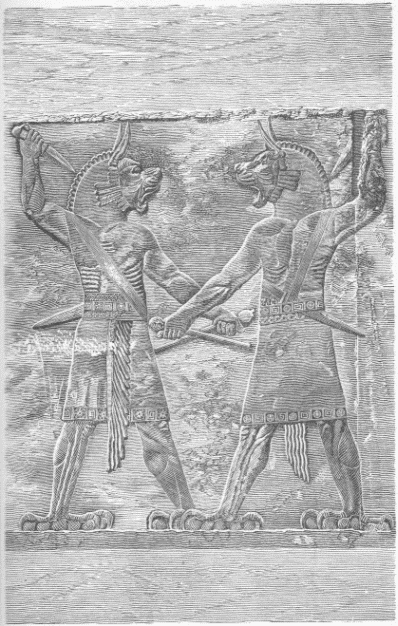
54.—DEMONS FIGHTING.
(From the British Museum.)
18. The cylinder seals with their inscriptions and engraved figures were mostly also talismans of like nature; which must be the reason why so many are found in graves, tied to the dead person's wrist by a string—evidently as a protection against the fiends which the departed spirit was expected to meet. The magic power was of course conferred on all talismans by the words which the conjurer spoke over them with the necessary ceremonies. One such long incantation is preserved entire. It is designed to impart to the talisman the power of keeping the demons from all parts of the dwelling, which are singly enumerated, with the consequences to the demons who would dare to trespass: those who steal into gutters, remove bolts or hinges, shall be broken like an earthen jug, crushed like clay; those who overstep the wooden frame of the house shall be clipped of their wings; those who stretch their neck in at the window, the window shall descend and cut their throat. The most original in this class of superstitions was that which, according to Lenormant, consisted in the notion that all these demons were of so unutterably ugly a form and countenance, that they must fly away terrified if they only beheld their own likeness. As an illustration of this principle he gives an incantation against "the wicked Namtar." It begins with a highly graphic description of the terrible demon, who is said to "take man captive like an enemy," to "burn him like a flame," to "double him up like a bundle," to "assail man, although having neither hand nor foot, like a noose." Then follows the usual dialogue between Êa and Meridug, (in the identical words given above), and Êa at length reveals the prescription: "Come hither, my son Meridug. Take mud of the Ocean and knead out of it a likeness of him, (the Namtar.) Lay down the man, after thou hast purified him; lay the image on his bare abdomen, impart to it my magic power and turn its face westward, that the wicked Namtar, who dwells in his body, may take up some other abode. Amen." The idea is that the Namtar, on beholding his own likeness, will flee from it in dismay!
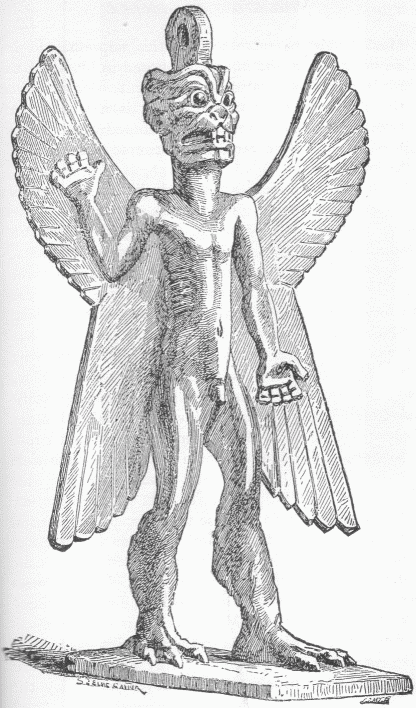
55.—DEMON OF THE SOUTH-WEST WIND.
(Perrot and Chipiez.)
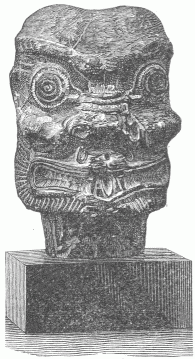
19. To this same class belongs a small bronze statuette, which is to be seen in the Louvre. Mr. Lenormant thus describes it: "It is the image of a horrible demon, standing, with the body of a dog, the talons of an eagle, arms ending in a lion's paws, the tail of a scorpion, the head of a skeleton, but with eyes, and a goat's horns, and with four large wings at the back, unfolded. A ring placed at the back of the head served to hang the figure up. Along the back is an inscription in the Accadian language, informing us that this pretty creature is the Demon of the South-west Wind, and is to be placed at the door or window. For in Chaldea the South-west Wind comes from the deserts of Arabia, its burning breath consumes everything and produces the same ravages as the Simoon in Africa. Therefore this particular talisman is most frequently met with. Our museums contain many other figures of demons, used as talismans to frighten away the evil spirits they were supposed to represent. One has the head of a goat on a disproportionately long neck; another shows a hyena's head, with huge open mouth, on a bear's body with lion's paws." On the principle that possession is best guarded against by the presence of beneficent spirits, the exorcisms—i.e., forms of conjuring designed to drive the evil demons out of a man or dwelling—are usually accompanied with a request to good spirits to enter the one or the other, instead of the wicked ones who have been ejected. The supreme power which breaks that of all incantations, talismans, conjuring rites whatever, is, it would appear, supposed to reside in a great, divine name,—possibly a name of Êa himself. At all events, it is Êa's own secret. For even in his dialogues with Meridug, when entreated for this supreme aid in desperate cases, he is only supposed to impart it to his son to use against the obdurate demons and thereby crush their power, but it is not given, so that the demons are only threatened with it, but it is not actually uttered in the course of the incantations.
56.—HEAD OF DEMON
20. Not entirely unassisted did Êa pursue his gigantic task of protection and healing. Along with him invocations are often addressed to several other spirits conceived as essentially good divine beings, whose beneficent influence is felt in many ways. Such was Im, the Storm-Wind, with its accompanying vivifying showers; such are the purifying and wholesome Waters, the Rivers and Springs which feed the earth; above all, such were the Sun and Fire, also the Moon, objects of double reverence and gratitude because they dispel the darkness of night, which the Shumiro-Accads loathed and feared excessively, as the time when the wicked demons are strongest and the power of bad men for weaving deadly spells is greatest. The third Book of the Collection of Magic Texts is composed almost entirely of hymns to these deities—as well as to Êa and Meridug—which betray a somewhat later stage in the nation's religious development, by the poetical beauty of some of the fragments, and especially by a purer feeling of adoration and a higher perception of moral goodness, which are absent from the oldest incantations.
21. At noon, when the sun has reached the highest point in its heavenly course, the earth lies before it without a shadow; all things, good or bad, are manifest; its beams, after dispelling the unfriendly gloom, pierce into every nook and cranny, bringing into light all ugly things that hide and lurk; the evil-doer cowers and shuns its all-revealing splendor, and, to perform his accursed deeds, waits the return of his dark accomplice, night. What wonder then that to the Shumiro-Accads Ud, the Sun in all its midday glory, was a very hero of protection, the source of truth and justice, the "supreme judge in Heaven and on earth," who "knows lie from truth," who knows the truth that is in the soul of man. The hymns to Ud that have been deciphered are full of beautiful images. Take for instance the following:—
"O Sun,[AE] I have called unto thee in the bright heavens. In the shadow of the cedar art thou;" (i.e., it is thou who makest the cedar to cast its shadow, holy and auspicious as the tree itself.) "Thy feet are on the summits.... The countries have wished for thee, they have longed for thy coming, O Lord! Thy radiant light illumines all countries.... Thou makest lies to vanish, thou destroyest the noxious influence of portents, omens, spells, dreams and evil apparitions; thou turnest wicked plots to a happy issue...."
This is both true and finely expressed. For what most inveterate believer in ghosts and apparitions ever feared them by daylight? and the last touch shows much moral sense and observation of the mysterious workings of a beneficent power which often not merely defeats evil but even turns it into good. There is splendid poetry in the following fragment describing the glory of sunrise:—
"O Sun! thou hast stepped forth from the background of heaven, thou hast pushed back the bolts of the brilliant heaven,—yea, the gate of heaven. O Sun! above the land thou hast raised thy head! O Sun! thou hast covered the immeasurable space of heaven and countries!"
Another hymn describes how, at the Sun's appearance in the brilliant portals of the heavens, and during his progress to their highest point, all the great gods turn to his light, all the good spirits of heaven and earth gaze up to his face, surround him joyfully and reverently, and escort him in solemn procession. It needs only to put all these fragments into fine verse to make out of them a poem which will be held beautiful even in our day, when from our very childhood we learn to know the difference between good and poor poetry, growing up, as we do, on the best of all ages and all countries.
22. When the sun disappeared in the West, sinking rapidly, and diving, as it were, into the very midst of darkness, the Shumiro-Accads did not fancy him as either asleep or inactive, but on the contrary as still engaged in his everlasting work. Under the name of Nin-dar, he travels through the dreary regions ruled by Mul-ge and, his essence being light, he combats the powers of darkness in their own home, till He comes out of it, a triumphant hero, in the morning. Nin-dar is also the keeper of the hidden treasures of the earth—its metals and precious stones, because, according to Mr. Lenormant's ingenious remark, "they only wait, like him, the moment of emerging out of the earth, to emit a bright radiancy." This radiancy of precious stones, which is like a concentration of light in its purest form, was probably the reason why they were in such general use as talismans, quite as much as their hardness and durability.
23. But while the Sun accomplishes his nightly underground journey, men would be left a prey to mortal terrors in the upper world, deprived of light, their chief defence against the evil brood of darkness, were it not for his substitute, Fire, who is by nature also a being of light, and, as such, the friend of men, from whose paths and dwellings he scares not only wild beasts and foes armed with open violence, but the far more dangerous hosts of unseen enemies, both demons and spells cast by wicked sorcerers. It is in this capacity of protector that the god Gibil (Fire) is chiefly invoked. In one very complete hymn he is addressed thus:—
"Thou who drivest away the evil Maskim, who furtherest the well-being of life, who strikest the breast of the wicked with terror,—Fire, the destroyer of foes, dread weapon which drivest away Pestilence."
This last attribute would show that the Shumiro-Accads had noticed the hygienic properties of fire, which does indeed help to dispel miasmas on account of the strong ventilation which a great blaze sets going. Thus at a comparatively late epoch, some 400 years b.c., a terrible plague broke out at Athens, the Greek city, and Hippocrates, a physician of great genius and renown, who has been called "the Father of Medicine," tried to diminish the contagion by keeping huge fires continually blazing at different points of the city. It is the same very correct idea which made men invoke Gibil as he who purifies the works of man. He is also frequently called "the protector of the dwelling, of the family," and praised for "creating light in the house of darkness," and for bringing peace to all creation. Over and above these claims to gratitude, Gibil had a special importance in the life of a people given to the works of metallurgy, of which fire is the chief agent: "It is thou," says one hymn, "who mixest tin and copper, it is thou who purifiest silver and gold." Now the mixture of tin and copper produces bronze, the first metal which has been used to make weapons and tools of, in most cases long before iron, which is much more difficult to work, and as the quality of the metal depends on the proper mixture of the two ingredients, it is but natural that the aid of the god Fire should have been specially invoked for the operation. But Fire is not only a great power on earth, it is also, in the shape of Lightning, one of the dreadest and most mysterious powers of the skies, and as such sometimes called son of Ana (Heaven), or, in a more roundabout way, "the Hero, son of the Ocean"—meaning the celestial Ocean, the great reservoir of rains, from which the lightning seems to spring, as it flashes through the heavy showers of a Southern thunder storm. In whatever shape he appear, and whatever his functions, Gibil is hailed as an invariably beneficent and friendly being.
24. When the feeling of helplessness forced on man by his position in the midst of nature takes the form of a reverence for and dependence on beings whom he conceives of as essentially good, a far nobler religion and far higher moral tone are the immediate consequence. This conception of absolute goodness sprang from the observation that certain beings or spirits—like the Sun, Fire, the Thunderstorm—though possessing the power of doing both good and harm, used it almost exclusively for the benefit of men. This position once firmly established, the conclusion naturally followed, that if these good beings once in awhile sent down a catastrophe or calamity,—if the Sun scorched the fields or the Thunderstorm swamped them, if the wholesome North Wind swept away the huts and broke down the trees—it must be in anger, as a mark of displeasure—in punishment. By what could man provoke the displeasure of kind and beneficent beings? Clearly by not being like them, by doing not good, but evil. And what is evil? That which is contrary to the nature of the good spirits: doing wrong and harm to men; committing sins and wicked actions. To avoid, therefore, provoking the anger of those good but powerful spirits, so terrible in its manifestations, it is necessary to try to please them, and that can be done only by being like them,—good, or at least striving to be so, and, when temptation, ignorance, passion or weakness of will have betrayed man into a transgression, to confess it, express regret for the offence and an intention not to offend again, in order to obtain forgiveness and be spared. A righteous life, then, prayer and repentance are the proper means of securing divine favor or mercy. It is evident that a religion from which such lessons naturally spring is a great improvement on a belief in beings who do good or evil indiscriminately, indeed prefer doing evil, a belief which cannot teach a distinction between moral right and wrong, or a rational distribution of rewards or punishment, nor consequently inculcate the feeling of duty and responsibility, without which goodness as a matter of principle is impossible and a reliable state of society unattainable.
25. This higher and therefore later stage of moral and religious development is very perceptible in the third book of the Magic Collection. With the appreciation of absolute goodness, conscience has awakened, and speaks with such insistence and authority that the Shumiro-Accad, in the simplicity of his mind, has earnestly imagined it to be the voice of a personal and separate deity, a guardian spirit belonging to each man, dwelling within him and living his life. It is a god—sometimes even a divine couple, both "god and goddess, pure spirits"—who protects him from his birth, yet is not proof against the spells of sorcerers and the attacks of the demons, and even can be compelled to work evil in the person committed to its care, and frequently called therefore "the son of his god," as we saw above, in the incantation against the Disease of the Head. The conjuration or exorcism which drives out the demon, of course restores the guardian spirit to its own beneficent nature, and the patient not only to bodily well-being, but also to peace of mind. That is what is desired, when a prayer for the cure of a sick or possessed person ends with the words: "May he be placed again in the gracious hands of his god!" When therefore a man is represented as speaking to "his god" and confessing to him his sin and distress, it is only a way of expressing that silent self-communing of the soul, in which it reviews its own deficiencies, forms good resolutions and prays to be released from the intolerable burden of sin. There are some most beautiful prayers of this sort in the collection. They have been called "the Penitential Psalms," from their striking likeness to some of those psalms in which King David confesses his iniquities and humbles himself before the Lord. The likeness extends to both spirit and form, almost to words. If the older poet, in his spiritual groping, addresses "his god and goddess," the higher, better self which he feels within him and feels to be divine—his Conscience, instead of the One God and Lord, his feeling is not less earnest, his appeal not less pure and confiding. He confesses his transgression, but pleads ignorance and sues for mercy. Here are some of the principal verses, of which each is repeated twice, once addressed to "my god," and the second time to "my goddess." The title of the Psalm is: "The complaints of the repentant heart. Sixty-five verses in all."
26. "My Lord, may the anger of his heart be allayed! May the fool attain understanding! The god who knows the unknown, may he be conciliated! The goddess who knows the unknown, may she be conciliated!—I eat the food of wrath and drink the waters of anguish.... O my god, my transgressions are very great, very great my sins.... I transgress, and know it not. I sin, and know it not. I feed on transgressions, and know it not. I wander on wrong paths, and know it not.—The Lord, in the wrath of his heart, has overwhelmed me with confusion.... I lie on the ground, and none reaches a hand to me. I am silent and in tears, and none takes me by the hand. I cry out, and there is none that hears me. I am exhausted, oppressed, and none releases me.... My god, who knowest the unknown, be merciful!... My goddess, who knowest the unknown, be merciful!... How long, O my god?... How long, O my goddess?... Lord, thou wilt not repulse thy servant. In the midst of the stormy waters, come to my assistance, take me by the hand! I commit sins—turn them into blessedness! I commit transgressions—let the wind sweep them away! My blasphemies are very many—rend them like a garment!... God who knowest the unknown,[AF] my sins are seven times seven,—forgive my sins!..."
27. The religious feeling once roused to this extent, it is not to be wondered at that in some invocations the distress or disease which had formerly been taken as a gratuitous visitation, begins to be considered in the light of a divine punishment, even though the afflicted person be the king himself. This is very evident from the concluding passage of a hymn to the Sun, in which it is the conjurer who speaks on behalf of the patient, while presenting an offering:—
"O Sun, leave not my uplifted hands unregarded!—Eat his food, refuse not his sacrifice, bring back his god to him, to be a support unto his hand!—May his sin, at thy behest, be forgiven him, his misdeed be forgotten!—May his trouble leave him! May he recover from his illness!—Give to the king new vital strength.... Escort the king, who lies at thy feet!—Also me, the conjurer, thy respectful servant!"
28. There is another hymn of the same kind, not less remarkable for its artistic and regular construction than for its beauty of feeling and diction. The penitent speaks five double lines, and the priest adds two more, as though endorsing the prayer and supporting it with the weight of his own sacred character. This gives very regular strophes, of which, unfortunately, only two have been well preserved:—
Penitent.—"I, thy servant, full of sighs, I call to thee. Whoever is beset with sin, his ardent supplication thou acceptest. If thou lookest on a man with pity, that man liveth. Ruler of all, mistress of mankind! Merciful one, to whom it is good to turn, who dost receive sighs!" Priest.—"While his god and his goddess are wroth with him he calls on thee. Thy countenance turn on him, take hold of his hand."
Penitent.—"Besides thee there is no deity to lead in righteousness. Kindly look on me, accept my sighs. Speak: how long? and let thine heart be appeased. When, O Lady, will thy countenance turn on me? Even like doves I moan, I feed on sighs." Priest.—"His heart is full of woe and trouble, and full of sighs. Tears he sheds and breaks out into lamentation."[AG]
29. Such is a not incomplete outline of this strange and primitive religion, the religion of a people whose existence was not suspected twenty-five years ago, yet which claims, with the Egyptians and the Chinese, the distinction of being one of the oldest on earth, and in all probability was older than both. This discovery is one of the most important conquests of modern science, not only from its being highly interesting in itself, but from the light it throws on innumerable hitherto obscure points in the history of the ancient world, nay, on many curious facts which reach down to our own time. Thus, the numerous Turanian tribes which exist in a wholly or half nomadic condition in the immense plains of Eastern and South-eastern Russia, in the forests and wastes of Siberia, on the steppes and highlands of Central Asia, have no other religion now than this of the old Shumiro-Accads, in its earliest and most material shape. Everything to them is a spirit or has a spirit of its own; they have no worship, no moral teaching, but only conjuring, sorcerers, not priests. These men are called Shamans and have great influence among the tribes. The more advanced and cultivated Turanians, like the Mongols and Mandchous, accord to one great Spirit the supremacy over all others and call that Spirit which they conceive as absolutely good, merciful and just, "Heaven," just as the Shumiro-Accads invoked "Ana." This has been and still is the oldest national religion of the Chinese. They say "Heaven" wherever we would say "God," and with the same idea of loving adoration and reverent dread, which does not prevent them from invoking the spirit of every hill, river, wind or forest, and numbering among this host also the souls of the deceased. This clearly corresponds to the second and higher stage of the Accadian religion, and marks the utmost limit which the Yellow Race have been able to attain in spiritual life. True, the greater part of the Chinese now have another religion; they are Buddhists; while the Turks and the great majority of the Tatars, Mongols and Mandchous, not to speak of other less important divisions, are Mussulmans. But both Buddhism and Mahometanism are foreign religions, which they have borrowed, adopted, not worked out for themselves. Here then we are also met by that fatal law of limitation, which through all ages seems to have said to the men of yellow skin and high cheek-bones, "Thus far shalt thou go, and no further." Thus it was in Chaldea. The work of civilization and spiritual development begun by the people of Shumir and Accad was soon taken out of their hands and carried on by newcomers from the east, those descendants of Noah, who "found a plain in the land of Shinar and dwelt there."
APPENDIX TO CHAPTER III.
Professor Louis Dyer, of Harvard University, has attempted a rendering into English verse of the famous incantation of the Seven Maskim. The result of the experiment is a translation most faithful in the spirit and main features, if not always literal; and which, by his kind permission, we here offer to our readers.