THE STORY OF CHALDEA. (continued 3)
Reading edition
14. One would think that so very perfect a system of religion, based too on so high and noble an order of ideas, should have entirely superseded the coarse materialism and conjuring practices of the goblin-creed of the primitive Turanian settlers. Such, however, was far from being the case. We saw that the new religion made room, somewhat contemptuously perhaps, for the spirits of the old creed, carelessly massing them wholesale into a sort of regiment, composed of the three hundred Igigi, or spirits of heaven, and the six hundred Anunnaki, or spirits of earth. The conjurers and sorcerers of old were even admitted into the priesthood in an inferior capacity, as a sort of lower order, probably more tolerated than encouraged—tolerated from necessity, because the people clung to their ancient beliefs and practices. But if their official position as a priestly class were subordinate, their real power was not the less great, for the public favor and credulity were on their side, and they were assuredly more generally popular than the learned and solemn priests, the counsellors and almost the equals of the kings, whose thoughts dwelt among the stars, who reverently searched the heavens for revelations of the divine will and wisdom, and who, by pursuing accurate observation and mathematical calculation together with the wildest dreams, made astronomy and astrology the inextricable tangle of scientific truth and fantastic speculation that we see it in the great work (in seventy tablets) prepared for the library of Sargon II. at Agadê. That the ancient system of conjuring and incantations remained in full force and general use, is sufficiently proved by the contents of the first two parts of the great collection in two hundred tablets compiled in the reign of the same king, and from the care with which the work was copied and recopied, commented on and translated in later ages, as we see from the copy made for the Royal Library at Nineveh, the one which has reached us.
15. There was still a third branch of so-called "science," which greatly occupied the minds of the Chaldeo-Babylonians from their earliest times down to the latest days of their existence: it was the art of Divination, i.e., of divining and foretelling future events from signs and omens, a superstition born of the old belief in every object of inanimate nature being possessed or inhabited by a spirit, and the later belief in a higher power ruling the world and human affairs to the smallest detail, and constantly manifesting itself through all things in nature as through secondary agents, so that nothing whatever could occur without some deeper significance, which might be discovered and expounded by specially trained and favored individuals. In the case of atmospheric prophecies concerning weather and crops, as connected with the appearance of clouds, sky and moon, the force and direction of winds, etc., there may have been some real observation to found them on. But it is very clear that such a conception, if carried out consistently to extreme lengths and applied indiscriminately to everything, must result in arrant folly. Such was assuredly the case with the Chaldeo-Babylonians, who not only carefully noted and explained dreams, drew lots in doubtful cases by means of inscribed arrows, interpreted the rustle of trees, the plashing of fountains and murmur of streams, the direction and form of lightnings, not only fancied that they could see things in bowls of water and in the shifting forms assumed by the flame which consumed sacrifices, and the smoke which rose therefrom, and that they could raise and question the spirits of the dead, but drew presages and omens, for good or evil, from the flight of birds, the appearance of the liver, lungs, heart and bowels of the animals offered in sacrifice and opened for inspection, from the natural defects or monstrosities of babies or the young of animals—in short, from any and everything that they could possibly subject to observation.
16. This idlest of all kinds of speculation was reduced to a most minute and apparently scientific system quite as early as astrology and incantation, and forms the subject of a third collection, in about one hundred tablets, and probably compiled by those same indefatigable priests of Agadê for Sargon, who was evidently of a most methodical turn of mind, and determined to have all the traditions and the results of centuries of observation and practical experiences connected with any branch of religious science fixed forever in the shape of thoroughly classified rules, for the guidance of priests for all coming ages. This collection has come to us in an even more incomplete and mutilated condition than the others; but enough has been preserved to show us that a right-thinking and religiously-given Chaldeo-Babylonian must have spent his life taking notes of the absurdest trifles, and questioning the diviners and priests about them, in order not to get into scrapes by misinterpreting the signs and taking that to be a favorable omen which boded dire calamity—or the other way, and thus doing things or leaving them undone at the wrong moment and in the wrong way. What excites, perhaps, even greater wonder, is the utter absurdity of some of the incidents gravely set down as affecting the welfare, not only of individuals, but of the whole country. What shall we say, for instance, of the importance attached to the proceedings of stray dogs? Here are some of the items as given by Mr. Fr. Lenormant in his most valuable and entertaining book on Chaldean Divination:—
"If a gray dog enter the palace, the latter will be consumed by flames.—If a yellow dog enter the palace, the latter will perish in a violent catastrophe.—If a tawny dog enter the palace, peace will be concluded with the enemies.—If a dog enter the palace and be not killed, the peace of the palace will be disturbed.—If a dog enter the temple, the gods will have no mercy on the land.—If a white dog enter the temple, its foundations will subsist.—If a black dog enter the temple, its foundations will be shaken.—If a gray dog enter the temple, the latter will lose its possessions.... If dogs assemble in troops and enter the temple, no one will remain in authority.... If a dog vomits in a house, the master of that house will die."
17. The chapter on monstrous births is extensive. Not only is every possible anomaly registered, from an extra finger or toe to an ear smaller than the other, with its corresponding presage of good or evil to the country, the king, the army, but the most impossible monstrosities are seriously enumerated, with the political conditions of which they are supposed to be the signs. For instance:—"If a woman give birth to a child with lion's ears, a mighty king will rule the land ... with a bird's beak, there will be peace in the land.... If a queen give birth to a child with a lion's face, the king will have no rival ... if to a snake, the king will be mighty.... If a mare give birth to a foal with a lion's mane, the lord of the land will annihilate his enemies ... with a dog's paws, the land will be diminished ... with a lion's paws, the land will be increased.... If a sheep give birth to a lion, there will be war, the king will have no rival.... If a mare give birth to a dog, there will be disaster and famine."
18. The three great branches of religious science—astrology, incantation and divination—were represented by three corresponding classes of "wise men," all belonging, in different degrees, to the priesthood: the star-gazers or astrologers, the magicians or sorcerers, and the soothsayers or fortune-tellers. The latter, again, were divided into many smaller classes according to the particular kind of divination which they practised. Some specially devoted themselves to the interpretation of dreams, others to that of the flight of birds, or of the signs of the atmosphere, or of casual signs and omens generally. All were in continual demand, consulted alike by kings and private persons, and all proceeded in strict accordance with the rules and principles laid down in the three great works of King Sargon's time. When the Babylonian empire ceased to exist and the Chaldeans were no longer a nation, these secret arts continued to be practised by them, and the name "Chaldean" became a by-word, a synonym for "a wise man of the East,"—astrologer, magician or soothsayer. They dispersed all over the world, carrying their delusive science with them, practising and teaching it, welcomed everywhere by the credulous and superstitious, often highly honored and always richly paid. Thus it is from the Chaldeans and their predecessors the Shumiro-Accads that the belief in astrology, witchcraft and every kind of fortune-telling has been handed down to the nations of Europe, together with the practices belonging thereto, many of which we find lingering even to our day among the less educated classes. The very words "magic" and "magician" are probably an inheritance of that remotest of antiquities. One of the words for "priest" in the old Turanian tongue of Shumir was imga, which, in the later Semitic language, became mag. The Rab-mag—"great priest," or perhaps "chief conjurer," was a high functionary at the court of the Assyrian kings. Hence "magus," "magic," "magician," in all the European languages, from Latin downward.
19. There can be no doubt that we have little reason to be grateful for such an heirloom as this mass of superstitions, which have produced so much evil in the world and still occasionally do mischief enough. But we must not forget to set off against it the many excellent things, most important discoveries in the province of astronomy and mathematics which have come to us from the same distant source. To the ancient Chaldeo-Babylonians we owe not only our division of time, but the invention of the sun-dial, and the week of seven days, dedicated in succession to the Sun, the Moon, and the five planets—an arrangement which is still maintained, the names of our days being merely translations of the Chaldean ones. And more than that; there were days set apart and kept holy, as days of rest, as far back as the time of Sargon of Agadê; it was from the Semites of Babylonia—perhaps the Chaldeans of Ur—that both the name and the observance passed to the Hebrew branch of the race, the tribe of Abraham. George Smith found an Assyrian calendar where the day called Sabattu or Sabattuv is explained to mean "completion of work, a day of rest for the soul." On this day, it appears it was not lawful to cook food, to change one's dress, to offer a sacrifice; the king was forbidden to speak in public, to ride in a chariot, to perform any kind of military or civil duty, even to take medicine.[AV] This, surely, is a keeping of the Sabbath as strict as the most orthodox Jew could well desire. There are, however, essential differences between the two. In the first place, the Babylonians kept five Sabbath days every month, which made more than one a week; in the second place, they came round on certain dates of each month, independently of the day of the week: on the 7th, 14th, 19th, 21st and 28th. The custom appears to have passed to the Assyrians, and there are indications which encourage the supposition that it was shared by other nations connected with the Jews, the Babylonians and Assyrians, for instance, by the Phœnicians.

FOOTNOTES:

VI.
LEGENDS AND STORIES.
1. In every child's life there comes a moment when it ceases to take the world and all it holds as a matter of course, when it begins to wonder and to question. The first, the great question naturally is—"Who made it all? The sun, the stars, the sea, the rivers, the flowers, and the trees—whence come they? who made them?" And to this question we are very ready with our answer:—"God made it all. The One, the Almighty God created the world, and all that is in it, by His own sovereign will." When the child further asks: "How did He do it?" we read to it the story of the Creation which is the beginning of the Bible, our Sacred Book, either without any remarks upon it, or with the warning, that, for a full and proper understanding of it, years are needed and knowledge of many kinds. Now, these same questions have been asked, by children and men, in all ages. Ever since man has existed upon the earth, ever since he began, in the intervals of rest, in the hard labor and struggle for life and limb, for food and warmth, to raise his head and look abroad, and take in the wonders that surrounded him, he has thus pondered and questioned. And to this questioning, each nation, after its own lights, has framed very much the same answer; the same in substance and spirit (because the only possible one), acknowledging the agency of a Divine Power, in filling the world with life, and ordaining the laws of nature,—but often very different in form, since, almost every creed having stopped short of the higher religious conception, that of One Deity, indivisible and all-powerful, the great act was attributed to many gods—"the gods,"—not to God. This of course opened the way to innumerable, more or less ingenious, fancies and vagaries as to the part played in it by this or that particular divinity. Thus all races, nations, even tribes have worked out for themselves their own Cosmogony, i.e., their own ideas on the Origin of the World. The greatest number, not having reached a very high stage of culture or attained literary skill, preserved the teachings of their priests in their memory, and transmitted them orally from father to son; such is the case even now with many more peoples than we think of—with all the native tribes of Africa, the islanders of Australia and the Pacific, and several others. But the nations who advanced intellectually to the front of mankind and influenced the long series of coming races by their thoughts and teachings, recorded in books the conclusions they had arrived at on the great questions which have always stirred the heart and mind of man; these were carefully preserved and recopied from time to time, for the instruction of each rising generation. Thus many great nations of olden times have possessed Sacred Books, which, having been written in remote antiquity by their best and wisest men, were reverenced as something not only holy, but, beyond the unassisted powers of the human intellect, something imparted, revealed directly by the deity itself, and therefore to be accepted, undisputed, as absolute truth. It is clear that it was in the interest of the priests, the keepers and teachers of all religious knowledge, to encourage and maintain in the people at large this unquestioning belief.
2. Of all such books that have become known to us, there are none of greater interest and importance than the sacred books of Ancient Babylonia. Not merely because they are the oldest known, having been treasured in the priestly libraries of Agadê, Sippar, Cutha, etc., at an incredibly early date, but principally because the ancestors of the Hebrews, during their long station in the land of Shinar, learned the legends and stories they contained, and working them over after their own superior religious lights, remodelled them into the narrative which was written down many centuries later as part of the Book of Genesis.
3. The original sacred books were attributed to the god Êa himself, the impersonation of the Divine Intelligence, and the teacher of mankind in the shape of the first Man-Fish, Oannes—(the name being only a Greek corruption of the Accadian Êa-han, "Êa the Fish")[AW] So Berosus informs us. After describing Oannes and his proceedings (see p. 185), he adds that "he wrote a Book on the Origin of things and the beginnings of civilization, and gave it to men." The "origin of things" is the history of the Creation of the world, Cosmogony. Accordingly, this is what Berosus proceeds to expound, quoting directly from the Book, for he begins:—"There was a time, says he, (meaning Oannes) when all was darkness and water." Then follows a very valuable fragment, but unfortunately only a fragment, one of the few preserved by later Greek writers who quoted the old priest of Babylon for their own purposes, while the work itself was, in some way, destroyed and lost. True, these fragments contain short sketches of several of the most important legends; still, precious as they are, they convey only second-hand information, compiled, indeed, from original sources by a learned and conscientious writer, but for the use of a foreign race, extremely compressed, and, besides, with the names all altered to suit that race's language. So long as the "original sources" were missing, there was a gap in the study both of the Bible and the religion of Babylon, which no ingenuity could fill. Great, therefore, were the delight and excitement, both of Assyriologists and Bible scholars, when George Smith, while sorting the thousands of tablet-fragments which for years had littered the floor of certain remote chambers of the British Museum, accidentally stumbled on some which were evidently portions of the original sacred legends partly rendered by Berosus. To search for all available fragments of the precious documents and piece them together became the task of Smith's life. And as nearly all that he found belonged to copies from the Royal Library at Nineveh, it was chiefly in order to enlarge the collection that he undertook his first expedition to the Assyrian mounds, from which he had the good fortune to bring back many missing fragments, belonging also to different copies, so that one frequently completes the other. Thus the oldest Chaldean legends were in a great measure restored to us, though unfortunately very few tablets are in a sufficiently well preserved condition to allow of making out an entirely intelligible and uninterrupted narrative. Not only are many parts still missing altogether, but of those which have been found, pieced and collected, there is not one of which one or more columns have not been injured in such a way that either the beginning or the end of all the lines are gone, or whole lines broken out or erased, with only a few words left here and there. How hopeless the task must sometimes have seemed to the patient workers may be judged from the foregoing specimen pieced together of sixteen bits, which Geo. Smith gives in his book. This is one of the so-called "Deluge-tablets," i.e., of those which contain the Chaldean version of the story of the Deluge. Luckily more copies have been found of this story than of any of the others, or we should have had to be content still with the short sketch of it given by Berosus.
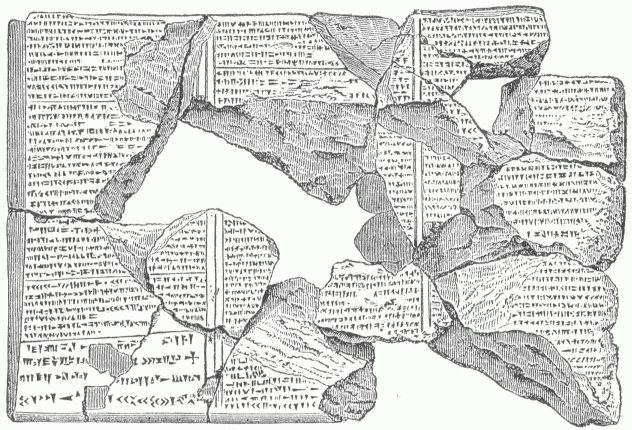
61.—BACK OF TABLET WITH ACCOUNT OF FLOOD.
(Smith's "Chaldean Genesis.")
4. If, therefore, the ancient Babylonian legends of the beginnings of the world will be given here in a connected form, for the sake of convenience and plainness, it must be clearly understood that they were not preserved for us in such a form, but are the result of a long and patient work of research and restoration, a work which still continues; and every year, almost every month, brings to light some new materials, some addition, some correction to the old ones. Yet even as the work now stands, it justifies us in asserting that our knowledge of this marvellous antiquity is fuller and more authentic than that we have of many a period and people not half so remote from us in point of place and distance.
5. The cosmogonic narrative which forms the first part of what Geo. Smith has very aptly called "the Chaldean Genesis" is contained in a number of tablets. As it begins by the words "When above," they are all numbered as No. 1, or 3, or 5 "of the series When above. The property of Asshurbanipal, king of nations, king of Assyria." The first lines are intact:—"When the heaven above and the earth below were as yet unnamed,"—(i.e., according to Semitic ideas, did not exist)—Apsu (the "Abyss") and Mummu-Tiamat (the "billowy Sea") were the beginning of all things; their waters mingled and flowed together; that was the Primeval Chaos; it contained the germs of life but "the darkness was not lifted" from the waters, and therefore nothing sprouted or grew—(for no growth or life is possible without light). The gods also were not; "they were as yet unnamed and did not rule the destinies." Then the great gods came into being, and the divine hosts of heaven and earth (the Spirits of Heaven and Earth). "And the days stretched themselves out, and the god Anu (Heaven.) ..." Here the text breaks off abruptly; it is probable, however, that it told how, after a long lapse of time, the gods Anu, Êa and Bel, the first and supreme triad, came into being. The next fragment, which is sufficiently well preserved to allow of a connected translation, tells of the establishment of the heavenly bodies: "He" (Anu, whose particular dominion the highest heavens were, hence frequently called "the heaven of Anu") "he appointed the mansions of the great gods" (signs of the Zodiac), established the stars, ordered the months and the year, and limited the beginning and end thereof; established the planets, so that none should swerve from its allotted track; "he appointed the mansions of Bel and Êa with his own; he also opened the great gates of heaven, fastening their bolts firmly to the right and to the left" (east and west); he made Nannar (the Moon) to shine and allotted the night to him, determining the time of his quarters which measure the days, and saying to him "rise and set, and be subject to this law." Another tablet, of which only the beginning is intelligible, tells how the gods (in the plural this time) created the living beings which people the earth, the cattle of the field and the city, and the wild beasts of the field, and the things that creep in the field and in the city, in short all the living creatures.
62.—BABYLONIAN CYLINDER, SUPPOSED TO REPRESENT THE TEMPTATION AND FALL.
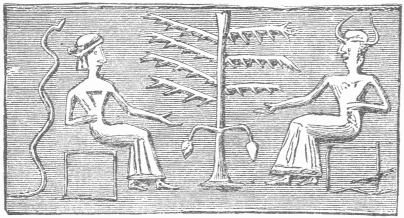
6. There are some tablets which have been supposed to treat of the creation of man and perhaps to give a story of his disobedience and fall, answering to that in Genesis; but unfortunately they are in too mutilated a condition to admit of certainty, and no other copies have as yet come to light. However, the probability that such was really the case is very great, and is much enhanced by a cylinder of very ancient Babylonian workmanship, now in the British Museum, and too important not to be reproduced here. The tree in the middle, the human couple stretching out their hands for the fruit, the serpent standing behind the woman in—one might almost say—a whispering attitude, all this tells its own tale. And the authority of this artistic presentation, which so strangely fits in to fill the blank in the written narrative, is doubled by the fact that the engravings on the cylinders are invariably taken from subjects connected with religion, or at least religious beliefs and traditions. As to the creation of man, we may partly eke out the missing details from the fragment of Berosus already quoted. He there tells us—and so well-informed a writer must have spoken on good authority—that Bel gave his own blood to be kneaded with the clay out of which men were formed, and that is why they are endowed with reason and have a share of the divine nature in them—certainly a most ingenious way of expressing the blending of the earthly and the divine elements which has made human nature so deep and puzzling a problem to the profounder thinkers of all ages.
7. For the rest of the creation, Berosus' account (quoted from the book said to have been given men by the fabulous Oannes), agrees with what we find in the original texts, even imperfect as we have them. He says that in the midst of Chaos—at the time when all was darkness and water—the principle of life which it contained, restlessly working, but without order, took shape in numberless monstrous formations: there were beings like men, some winged, with two heads, some with the legs and horns of goats, others with the hind part of horses; also bulls with human heads, dogs with four bodies and a fish's tail, horses with the heads of dogs, in short, every hideous and fantastical combination of animal forms, before the Divine Will had separated them, and sorted them into harmony and order. All these monstrous beings perished the moment Bel separated the heavens from the earth creating light,—for they were births of darkness and lawlessness and could not stand the new reign of light and law and divine reason. In memory of this destruction of the old chaotic world and production of the new, harmonious and beautiful one, the walls of the famous temple of Bel-Mardouk at Babylon were covered with paintings representing the infinite variety of monstrous and mixed shapes with which an exuberant fancy had peopled the primeval chaos; Berosus was a priest of this temple and he speaks of those paintings as still existing. Though nothing has remained of them in the ruins of the temple, we have representations of the same kind on many of the cylinders which, used as seals, did duty both as personal badges—(one is almost tempted to say "coats of arms")—and as talismans, as proved by the fact of such cylinders being so frequently found on the wrists of the dead in the sepulchres.
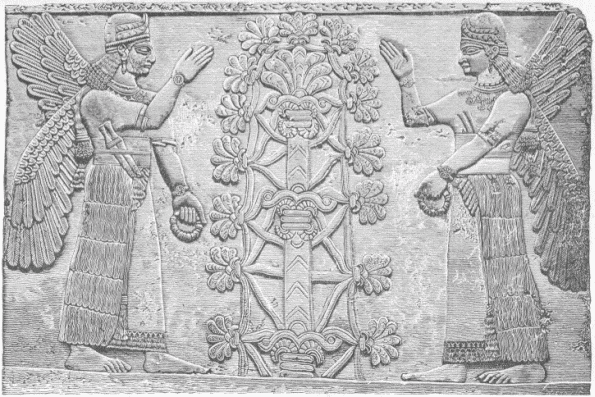
63.—FEMALE WINGED FIGURES BEFORE THE SACRED TREE.
(From a photograph in the British Museum.)
8. The remarkable cylinder with the human couple and the serpent leads us to the consideration of a most important object in the ancient Babylonian or Chaldean religion—the Sacred Tree, the Tree of Life. That it was a very holy symbol is clear from its being so continually reproduced on cylinders and on sculptures. In this particular cylinder, rude as the design is, it bears an unmistakable likeness to a real tree—of some coniferous species, cypress or fir. But art soon took hold of it and began to load it with symmetrical embellishments, until it produced a tree of entirely conventional design, as shown by the following specimens, of which the first leans more to the palm, while the second seems rather of the coniferous type. (Figs. No. 63 and 65.) It is probable that such artificial trees, made up of boughs—perhaps of the palm and cypress—tied together and intertwined with ribbons (something like our Maypoles of old), were set up in the temples as reminders of the sacred symbol, and thus gave rise to the fixed type which remains invariable both in such Babylonian works of art as we possess and on the Assyrian sculptures, where the tree, or a portion of it, appears not only in the running ornaments on the walls but on seal cylinders and even in the embroidery on the robes of kings. In the latter case indeed, it is almost certain, from the belief in talismans which the Assyrians had inherited, along with the whole of their religion from the Chaldean mother country, that this ornament was selected not only as appropriate to the sacredness of the royal person, but as a consecration and protection. The holiness of the symbol is further evidenced by the kneeling posture of the animals which sometimes accompany it (see Fig. 22, page 67), and the attitude of adoration of the human figures, or winged spirits attending it, by the prevalence of the sacred number seven in its component parts, and by the fact that it is reproduced on a great many of those glazed earthenware coffins which are so plentiful at Warka (ancient Erech). This latter fact clearly shows that the tree-symbol not only meant life in general, life on earth, but a hope of life eternal, beyond the grave, or why should it have been given to the dead? These coffins at Warka belong, it is true, to a late period, some as late as a couple of hundred years after Christ, but the ancient traditions and their meaning had, beyond a doubt, been preserved. Another significant detail is that the cone is frequently seen in the hands of men or spirits, and always in a way connected with worship or auspicious protection; sometimes it is held to the king's nostrils by his attendant protecting spirits, (known by their wings); a gesture of unmistakable significancy, since in ancient languages "the breath of the nostrils" is synonymous with "the breath of life."
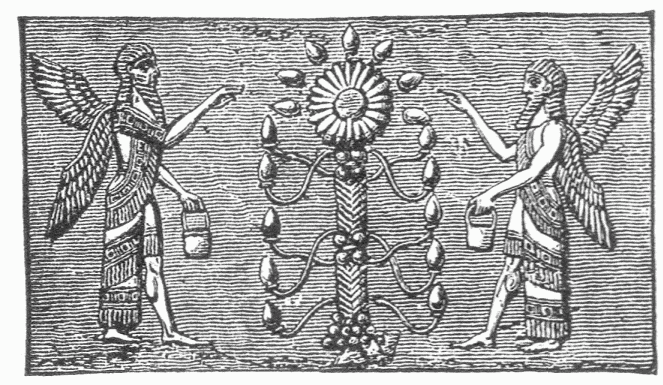
64.—WINGED SPIRITS BEFORE THE SACRED TREE.
(Smith's "Chaldea.")
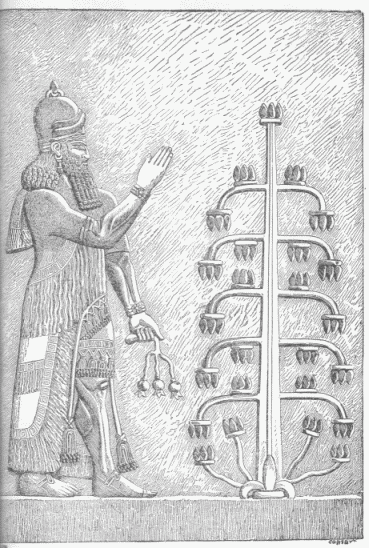
65.—SARGON OF ASSYRIA BEFORE THE SACRED TREE.
(Perrot and Chipiez.)
9. There can be no association of ideas more natural than that of vegetation, as represented by a tree, with life. By its perpetual growth and development, its wealth of branches and foliage, its blossoming and fruit-bearing, it is a noble and striking illustration of the world in the widest sense—the Universe, the Cosmos, while the sap which courses equally through the trunk and through the veins of the smallest leaflet, drawn by an incomprehensible process through invisible roots from the nourishing earth, still more forcibly suggests that mysterious principle, Life, which we think we understand because we see its effects and feel it in ourselves, but the sources of which will never be reached, as the problem of it will never be solved, either by the prying of experimental science or the musings of contemplative speculation; life eternal, also,—for the workings of nature are eternal,—and the tree that is black and lifeless to-day, we know from long experience is not dead, but will revive in the fulness of time, and bud, and grow and bear again. All these things we know are the effects of laws; but the ancients attributed them to living Powers,—the Chthonic Powers (from the Greek word Chthon, "earth, soil"), which have by some later and dreamy thinkers been called weirdly but not unaptly, "the Mothers," mysteriously at work in the depths of silence and darkness, unseen, unreachable, and inexhaustibly productive. Of these powers again, what more perfect symbol or representative than the Tree, as standing for vegetation, one for all, the part for the whole? It lies so near that, in later times, it was enlarged, so as to embrace the whole universe, in the majestic conception of the Cosmic Tree which has its roots on earth and heaven for its crown, while its fruit are the golden apples—the stars, and Fire,—the red lightning.
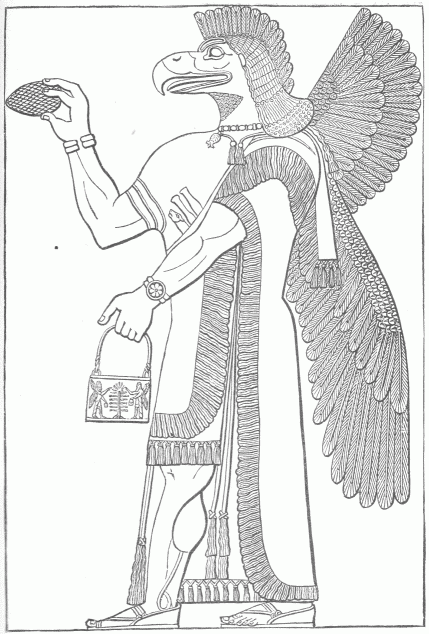
66.—EAGLE-HEADED FIGURE BEFORE THE SACRED TREE.
(Smith's "Chaldea.")
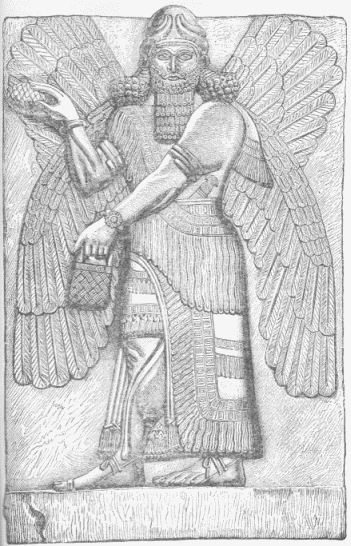
67.—FOUR-WINGED HUMAN FIGURE BEFORE THE SACRED TREE.
(Perrot and Chipiez.)
10. All these suggestive and poetical fancies would in themselves suffice to make the tree-symbol a favorite one among so thoughtful and profound a people as the old Chaldeans. But there is something more. It is intimately connected with another tradition, common, in some form or other, to all nations who have attained a sufficiently high grade of culture to make their mark in the world—that of an original ancestral abode, beautiful, happy, and remote, a Paradise. It is usually imagined as a great mountain, watered by springs which become great rivers, bearing one or more trees of wonderful properties and sacred character, and is considered as the principal residence of the gods. Each nation locates it according to its own knowledge of geography and vague, half-obliterated memories. Many texts, both in the old Accadian and the Assyrian languages, abundantly prove that the Chaldean religion preserved a distinct and reverent conception of such a mountain, and placed it in the far north or north-east, calling it the "Father of Countries," plainly an allusion to the original abode of man—the "Mountain of Countries," (i.e., "Chief Mountain of the World") and also Arallu, because there, where the gods dwelt, they also imagined the entrance to the Arali to be the Land of the Dead. There, too, the heroes and great men were to dwell forever after their death. There is the land with a sky of silver, a soil which produces crops without being cultivated, where blessings are for food and rejoicing, which it is hoped the king will obtain as a reward for his piety after having enjoyed all earthly goods during his life.[AX] In an old Accadian hymn, the sacred mount, which is identical with that imagined as the pillar joining heaven and earth, the pillar around which the heavenly spheres revolve, (see page 153)—is called "the mountain of Bel, in the east, whose double head reaches unto the skies; which is like to a mighty buffalo at rest, whose double horn sparkles as a sunbeam, as a star." So vivid was the conception in the popular mind, and so great the reverence entertained for it, that it was attempted to reproduce the type of the holy mountain in the palaces of their kings and the temples of their gods. That is one of the reasons why they built both on artificial hills. There is in the British Museum a sculpture from Koyunjik, representing such a temple, or perhaps palace, on the summit of a mound, converted into a garden and watered by a stream which issues from the "hanging garden" on the right, the latter being laid out on a platform of masonry raised on arches; the water was brought up by machinery. It is a perfect specimen of a "Paradise," as these artificial parks were called by the Greeks, who took the word (meaning "park" or "garden") from the Persians, who, in their turn, had borrowed the thing from the Assyrians and Babylonians, when they conquered the latter's empire. The Ziggurat, or pyramidal construction in stages, with the temple or shrine on the top, also owed its peculiar shape to the same original conception: as the gods dwelt on the summit of the Mountain of the World, so their shrines should occupy a position as much like their residence as the feeble means of man would permit. That this is no idle fancy is proved by the very name of "Ziggurat," which means "mountain peak," and also by the names of some of these temples: one of the oldest and most famous indeed, in the city of Asshur, was named "the House of the Mountain of Countries." An excellent representation of a Ziggurat, as it must have looked with its surrounding palm grove by a river, is given us on a sculptured slab, also from Koyunjik. The original is evidently a small one, of probably five stages besides the platform on which it is built, with its two symmetrical paths up the ascent. Some, like the great temple at Ur, had only three stages, others again seven—always one of the three sacred numbers: three, corresponding to the divine Triad; five, to the five planets; seven, to the planets, sun and moon. The famous Temple of the Seven Spheres at Borsip (the Birs-Nimrud), often mentioned already, and rebuilt by Nebuchadnezzar about 600 b.c. from a far older structure, as he explains in his inscription (see p. 72), was probably the most gorgeous, as it was the largest; besides, it is the only one of which we have detailed and reliable descriptions and measurements, which may best be given in this place, almost entirely in the words of George Rawlinson:[AY]
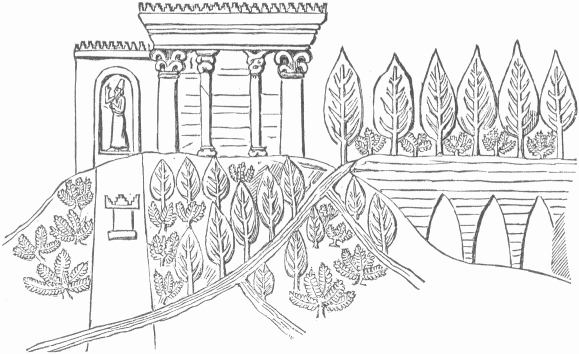
68.—TEMPLE AND HANGING GARDENS AT KOYUNJIK.
(British Museum.)
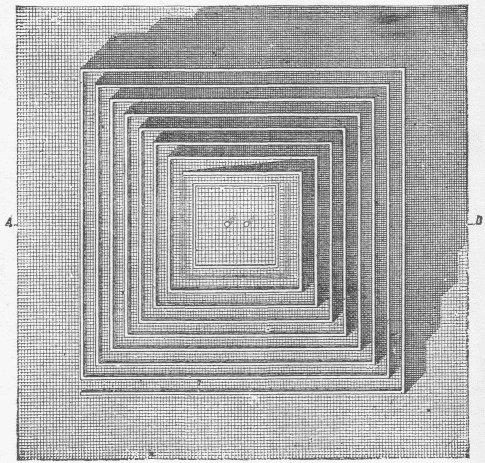
69.—PLAN OF A ZIGGURAT.
(Perrot and Chipiez.)
11. The temple is raised on a platform exceptionally low—only a few feet above the level of the plain; the entire height, including the platform, was 156 feet in a perpendicular line. The stages—of which the four upper were lower than the first three—receded equally on three sides, but doubly as much on the fourth, probably in order to present a more imposing front from the plain, and an easier ascent. "The ornamentation of the edifice was chiefly by means of color. The seven Stages represented the Seven Spheres, in which moved, according to ancient Chaldean astronomy, the seven planets. To each planet fancy, partly grounding itself upon fact, had from of old assigned a peculiar tint or hue. The Sun (Shamash) was golden; the Moon (Sin or Nannar), silver; the distant Saturn (Adar), almost beyond the region of light, was black; Jupiter (Marduk) was orange; the fiery Mars (Nergal) was red; Venus (Ishtar) was a pale yellow; Mercury (Nebo or Nabu, whose shrine stood on the top stage), a deep blue. The seven stages of the tower gave a visible embodiment to these fancies. The basement stage, assigned to Saturn, was blackened by means of a coating of bitumen spread over the face of the masonry; the second stage, assigned to Jupiter, obtained the appropriate orange color by means of a facing of burnt bricks of that hue; the third stage, that of Mars, was made blood-red by the use of half-burnt bricks formed of a bright-red clay; the fourth stage, assigned to the Sun, appears to have been actually covered with thin plates of gold; the fifth, the stage of Venus, received a pale yellow tint from the employment of bricks of that hue; the sixth, the sphere of Mercury, was given an azure tint by vitrifaction, the whole stage having been subjected to an intense heat after it was erected, whereby the bricks composing it were converted into a mass of blue slag; the seventh stage, that of the moon, was probably, like the fourth, coated with actual plates of metal. Thus the building rose up in stripes of varied color, arranged almost as nature's cunning hand arranges hues in the rainbow, tones of red coming first, succeeded by a broad stripe of yellow, the yellow being followed by blue. Above this the glowing silvery summit melted into the bright sheen of the sky.... The Tower is to be regarded as fronting the north-east, the coolest side, and that least exposed to the sun's rays from the time that they become oppressive in Babylonia. On this side was the ascent, which consisted probably of a broad staircase extending along the whole front of the building. The side platforms, at any rate of the first and second stages, probably of all, were occupied by a series of chambers.... In these were doubtless lodged the priests and other attendants upon the temple service...."
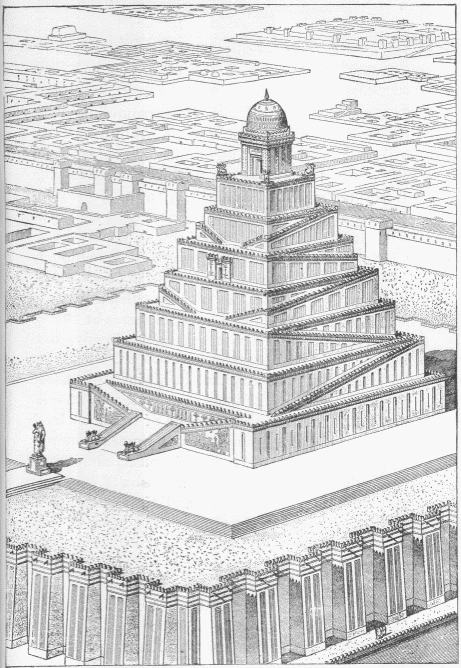
70.—"ZIGGURAT" RESTORED. ACCORDING TO PROBABILITIES.
(Perrot and Chipiez.)
12. The interest attaching to this temple, wonderful as it is in itself, is greatly enhanced by the circumstance that its ruins have through many centuries been considered as those of the identical Tower of Babel of the Bible. Jewish literary men who travelled over the country in the Middle Ages started this idea, which quickly spread to the West. It is conjectured that it was suggested by the vitrified fragments of the outer coating of the sixth, blue, stage, (that of Mercury or Nebo), the condition of which was attributed to lightning having struck the building.
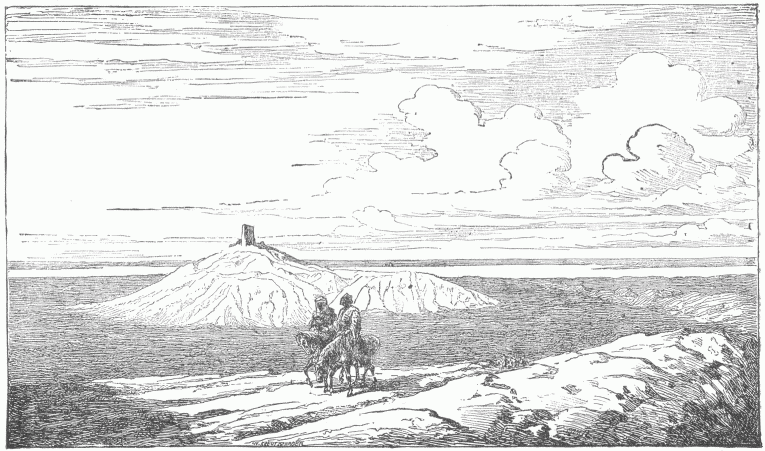
71.—BIRS-NIMRUD. (ANCIENT BORSIP.)
(Perrot and Chipiez.)
13. That the Ziggurats of Chaldea should have been used not only as pedestals to uphold shrines, but as observatories by the priestly astronomers and astrologers, was quite in accordance with the strong mixture of star-worship grafted on the older religion, and with the power ascribed to the heavenly bodies over the acts and destinies of men. These constructions, therefore, were fitted for astronomical uses by being very carefully placed with their corners pointing exactly to the four cardinal points—North, South, East and West. Only two exceptions have been found to this rule, one in Babylon, and the Assyrian Ziggurat at Kalah, (Nimrud) explored by Layard, of which the sides, not the corners, face the cardinal points. For the Assyrians, who carried their entire culture and religion northward from their ancient home, also retained this consecrated form of architecture, with the difference that with them the Ziggurats were not temple and observatory in one, but only observatories attached to the temples, which were built on more independent principles and a larger scale, often covering as much ground as a palace.
14. The singular orientation of the Chaldean Ziggurats (subsequently retained by the Assyrians),—i.e., the manner in which they are placed, turned to the cardinal points with their angles, and not with their faces, as are the Egyptian pyramids, with only one exception,—has long been a puzzle which no astronomical considerations were sufficient to solve. But quite lately, in 1883, Mr. Pinches, Geo. Smith's successor in the British Museum, found a small tablet, giving lists of signs, eclipses, etc., affecting the various countries, and containing the following short geographical notice, in illustration of the position assigned to the cardinal points: "The South is Elam, the North is Accad, the East is Suedin and Gutium, the West is Phœnicia. On the right is Accad, on the left is Elam, in front is Phœnicia, behind are Suedin and Gutium." In order to appreciate the bearing of this bit of topography on the question in hand, we must examine an ancient map, when we shall at once perceive that the direction given by the tablet to the South (Elam) answers to our South-East; that given to the North (Accad) answers to our North-West; while West (Phœnicia, i.e., the coast-land of the Mediterranean, down almost to Egypt) stands for our South-West, and East (Gutium, the highlands where the Armenian mountains join the Zagros, now Kurdish Mountains,) for our North-East. If we turn the map so that the Persian Gulf shall come in a perpendicular line under Babylon, we shall produce the desired effect, and then it will strike us that the Ziggurats did face the cardinal points, according to Chaldean geography, with their sides, and that the discovery of the small tablet, as was remarked on the production of it, "settles the difficult question of the difference in orientation between the Assyrian and Egyptian monuments." It was further suggested that "the two systems of cardinal points originated no doubt from two different races, and their determination was due probably to the geographical position of the primitive home of each race." Now the South-West is called "the front," "and the migrations of the people therefore must have been from North-East to South-West."[AZ] This beautifully tallies with the hypothesis, or conjecture, concerning the direction from which the Shumiro-Accads descended into the lowlands by the Gulf (see pp. 146-8), and, moreover, leads us to the question whether the fact of the great Ziggurat of the Seven Spheres at Borsip facing the North-East with its front may not have some connection with the holiness ascribed to that region as the original home of the race and the seat of that sacred mountain so often mentioned as "the Great Mountain of Countries" (see p. 280), doubly sacred, as the meeting-place of the gods and the place of entrance to the "Arallu" or Lower World.[BA]
15. It is to be noted that the conception of the divine grove or garden with its sacred tree of life was sometimes separated from that of the holy primeval mountain and transferred by tradition to a more immediate and accessible neighborhood. That the city and district of Babylon may have been the centre of such a tradition is possibly shown by the most ancient Accadian name of the former—Tin-tir-ki meaning "the Place of Life," while the latter was called Gan-Dunyash or Kar-Dunyash—"the garden of the god Dunyash," (probably one of the names of the god Êa)—an appellation which this district, although situated in the land of Accad or Upper Chaldea, preserved to the latest times as distinctively its own. Another sacred grove is spoken of as situated in Eridhu. This city, altogether the most ancient we have any mention of, was situated at the then mouth of the Euphrates, in the deepest and flattest of lowlands, a sort of borderland between earth and sea, and therefore very appropriately consecrated to the great spirit of both, the god Êa, the amphibious Oannes. It was so much identified with him, that in the Shumirian hymns and conjurings his son Meridug is often simply invoked as "Son of Eridhu." It must have been the oldest seat of that spirit-worship and sorcerer-priesthood which we find crystallized in the earliest Shumiro-Accadian sacred books. This prodigious antiquity carries us to something like 5000 years b.c., which explains the fact that the ruins of the place, near the modern Arab village of Abu-Shahrein, are now so far removed from the sea, being a considerable distance even from the junction of the two rivers where they form the Shat-el-arab. The sacred grove of Eridhu is frequently referred to, and that it was connected with the tradition of the tree of life we see from a fragment of a most ancient hymn, which tells of "a black pine, growing at Eridhu, sprung up in a pure place, with roots of lustrous crystal extending downwards, even into the deep, marking the centre of the earth, in the dark forest into the heart whereof man hath not penetrated." Might not this be the reason why the wood of the pine was so much used in charms and conjuring, as the surest safeguard against evil influences, and its very shadow was held wholesome and sacred? But we return to the legends of the Creation and primeval world.
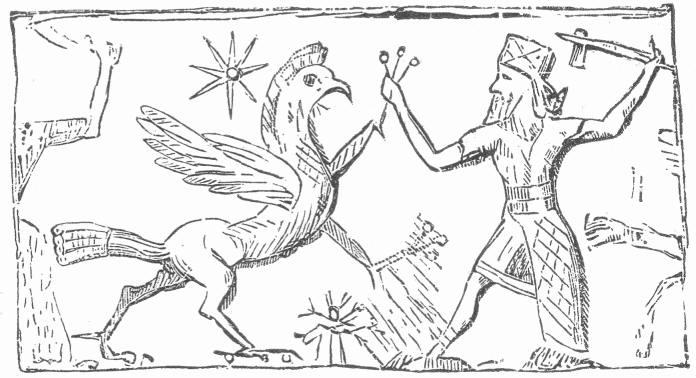
72.—BEL FIGHTS THE DRAGON—TIAMAT (ASSYRIAN CYLINDER.)
(Perrot and Chipiez.)
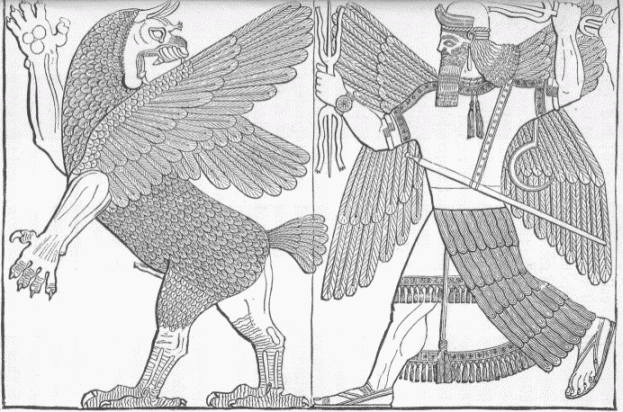
16. Mummu-Tiamat, the impersonation of chaos, the power of darkness and lawlessness, does not vanish from the scene when Bel puts an end to her reign, destroys, by the sheer force of light and order, her hideous progeny of monsters and frees from her confusion the germs and rudimental forms of life, which, under the new and divine dispensation, are to expand and combine into the beautifully varied, yet harmonious world we live in. Tiamat becomes the sworn enemy of the gods and their creation, the great principle of opposition and destruction. When the missing texts come to light,—if ever they do—it will probably be found that the serpent who tempts the woman in the famous cylinder, is none other than a form of the rebellious and vindictive Tiamat, who is called now a "Dragon," now "the Great Serpent." At last the hostility cannot be ignored, and things come to a deadly issue. It is determined in the council of the gods that one of them must fight the wicked dragon; a complete suit of armor is made and exhibited by Anu himself, of which the sickle-shaped sword and the beautifully bent bow are the principal features. It is Bel who dares the venture and goes forth on a matchless war chariot, armed with the sword, and the bow, and his great weapon, the thunderbolt, sending the lightning before him and scattering arrows around. Tiamat, the Dragon of the Sea, came out to meet him, stretching her immense body along, bearing death and destruction, and attended by her followers. The god rushed on the monster with such violence that he threw her down and was already fastening fetters on her limbs, when she uttered a great shout and started up and attacked the righteous leader of the gods, while banners were raised on both sides as at a pitched battle. Meridug drew his sword and wounded her; at the same time a violent wind struck against her face. She opened her jaws to swallow up Meridug, but before she could close them he bade the wind to enter into her body. It entered and filled her with its violence, shook her heart and tore her entrails and subdued her courage. Then the god bound her, and put an end to her works, while her followers stood amazed, then broke their lines and fled, full of fear, seeing that Tiamat, their leader, was conquered. There she lay, her weapons broken, herself like a sword thrown down on the ground, in the dark and bound, conscious of her bondage and in great grief, her might suddenly broken by fear.
73.—BEL FIGHTS THE DRAGON—TIAMAT (BABYLONIAN CYLINDER).
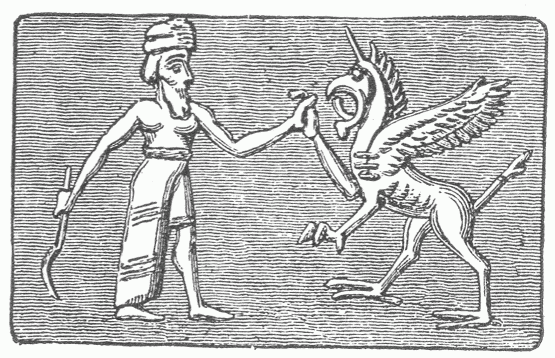
17. The battle of Bel-Marduk and the Dragon was a favorite incident in the cycle of Chaldean tradition, if we judge from the number of representations we have of it on Babylonian cylinders, and even on Assyrian wall-sculptures. The texts which relate to it are, however, in a frightful state of mutilation, and only the last fragment, describing the final combat, can be read and translated with anything like completeness. With it ends the series treating of the Cosmogony or Beginnings of the World. But it may be completed by a few more legends of the same primitive character and preserved on detached tablets, in double text, as usual—Accadian and Assyrian. To these belongs a poem narrating the rebellion, already alluded to, (see p. 182,) of the seven evil spirits, originally the messengers and throne-bearers of the gods, and their war against the moon, the whole being evidently a fanciful rendering of an eclipse. "Those wicked gods, the rebel spirits," of whom one is likened to a leopard, and one to a serpent, and the rest to other animals—suggesting the fanciful shapes of storm-clouds—while one is said to be the raging south wind, began the attack "with evil tempest, baleful wind," and "from the foundations of the heavens like the lightning they darted." The lower region of the sky was reduced to its primeval chaos, and the gods sat in anxious council. The moon-god (Sin), the sun-god (Shamash), and the goddess Ishtar had been appointed to sway in close harmony the lower sky and to command the hosts of heaven; but when the moon-god was attacked by the seven spirits of evil, his companions basely forsook him, the sun-god retreating to his place and Ishtar taking refuge in the highest heaven (the heaven of Anu). Nebo is despatched to Êa, who sends his son Meridug with this instruction:—"Go, my son Meridug! The light of the sky, my son, even the moon-god, is grievously darkened in heaven, and in eclipse from heaven is vanishing. Those seven wicked gods, the serpents of death who fear not, are waging unequal war with the laboring moon." Meridug obeys his father's bidding, and overthrows the seven powers of darkness.[BB]
74.—BATTLE BETWEEN BEL AND THE DRAGON (TIAMAT).
(Smith's "Chaldea.")
18. There is one more detached legend known from the surviving fragments of Berosus, also supposed to be derived from ancient Accadian texts: it is that of the great tower and the confusion of tongues. One such text has indeed been found by the indefatigable George Smith, but there is just enough left of it to be very tantalizing and very unsatisfactory. The narrative in Berosus amounts to this: that men having grown beyond measure proud and arrogant, so as to deem themselves superior even to the gods, undertook to build an immense tower, to scale the sky; that the gods, offended with this presumption, sent violent winds to overthrow the construction when it had already reached a great height, and at the same time caused men to speak different languages,—probably to sow dissension among them, and prevent their ever again uniting in a common enterprise so daring and impious. The site was identified with that of Babylon itself, and so strong was the belief attaching to the legend that the Jews later on adopted it unchanged, and centuries afterwards, as we saw above, fixed on the ruins of the hugest of all Ziggurats, that of Borsip, as those of the great Tower of the Confusion of Tongues. Certain it is, that the tradition, under all its fanciful apparel, contains a very evident vein of historical fact, since it was indeed from the plains of Chaldea that many of the principal nations of the ancient East, various in race and speech, dispersed to the north, the west, and the south, after having dwelt there for centuries as in a common cradle, side by side, and indeed to a great extent as one people.
FOOTNOTES:

VII.
MYTHS.—HEROES AND THE MYTHICAL EPOS.
1. The stories by which a nation attempts to account for the mysteries of creation, to explain the Origin of the World, are called, in scientific language, Cosmogonic Myths. The word Myth is constantly used in conversation, but so loosely and incorrectly, that it is most important once for all to define its proper meaning. It means simply a phenomenon of nature presented not as the result of a law but as the act of divine or at least superhuman persons, good or evil powers—(for instance, the eclipse of the Moon described as the war against the gods of the seven rebellious spirits). Further reading and practice will show that there are many kinds of myths, of various origins; but there is none, which, if properly taken to pieces, thoroughly traced and cornered, will not be covered by this definition. A Myth has also been defined as a legend connected more or less closely with some religious belief, and, in its main outlines, handed down from prehistoric times. There are only two things which can prevent the contemplation of nature and speculation on its mysteries from running into mythology: a knowledge of the physical laws of nature, as supplied by modern experimental science, and a strict, unswerving belief in the unity of God, absolute and undivided, as affirmed and defined by the Hebrews in so many places of their sacred books: "The Lord he is God, there is none else beside him." "The Lord he is God, in Heaven above and upon the earth beneath there is none else." "I am the Lord, and there is none else, there is no God beside me." "I am God and there is none else." But experimental science is a very modern thing indeed, scarcely a few hundred years old, and Monotheism, until the propagation of Christianity, was professed by only one small nation, the Jews, though the chosen thinkers of other nations have risen to the same conception in many lands and many ages. The great mass of mankind has always believed in the personal individuality of all the forces of nature, i.e., in many gods; everything that went on in the world was to them the manifestation of the feelings, the will, the acts of these gods—hence the myths. The earlier the times, the more unquestioning the belief and, as a necessary consequence, the more exuberant the creation of myths.
2. But gods and spirits are not the only actors in myths. Side by side with its sacred traditions on the Origin of things, every nation treasures fond but vague memories of its own beginnings—vague, both from their remoteness and from their not being fixed in writing, and being therefore liable to the alterations and enlargements which a story invariably undergoes when told many times to and by different people, i.e., when it is transmitted from generation to generation by oral tradition. These memories generally centre around a few great names, the names of the oldest national heroes, of the first rulers, lawgivers and conquerors of the nation, the men who by their genius made it a nation out of a loose collection of tribes or large families, who gave it social order and useful arts, and safety from its neighbors, or, perhaps, freed it from foreign oppressors. In their grateful admiration for these heroes, whose doings naturally became more and more marvellous with each generation that told of them, men could not believe that they should have been mere imperfect mortals like themselves, but insisted on considering them as directly inspired by the deity in some one of the thousand shapes they invested it with, or as half-divine of their own nature. The consciousness of the imperfection inherent to ordinary humanity, and the limited powers awarded to it, has always prompted this explanation of the achievements of extraordinarily gifted individuals, in whatever line of action their exceptional gifts displayed themselves. Besides, if there is something repugnant to human vanity in having to submit to the dictates of superior reason and the rule of superior power as embodied in mere men of flesh and blood, there is on the contrary something very flattering and soothing to that same vanity in the idea of having been specially singled out as the object of the protection and solicitude of the divine powers; this idea at all events takes the galling sting from the constraint of obedience. Hence every nation has very jealously insisted on and devoutly believed in the divine origin of its rulers and the divine institution of its laws and customs. Once it was implicitly admitted that the world teemed with spirits and gods, who, not content with attending to their particular spheres and departments, came and went at their pleasure, had walked the earth and directly interfered with human affairs, there was no reason to disbelieve any occurrence, however marvellous—provided it had happened very, very long ago. (See p. 197.)
3. Thus, in the traditions of every ancient nation, there is a vast and misty tract of time, expressed, if at all, in figures of appalling magnitude—hundreds of thousands, nay, millions of years—between the unpierceable gloom of an eternal past and the broad daylight of remembered, recorded history. There, all is shadowy, gigantic, superhuman. There, gods move, dim yet visible, shrouded in a golden cloud of mystery and awe; there, by their side, loom other shapes, as dim but more familiar, human yet more than human—the Heroes, Fathers of races, founders of nations, the companions, the beloved of gods and goddesses, nay, their own children, mortal themselves, yet doing deeds of daring and might such as only the immortals could inspire and favor, the connecting link between these and ordinary humanity—as that gloaming, uncertain, shifting, but not altogether unreal streak of time is the borderland between Heaven and Earth, the very hot-bed of myth, fiction and romance. For of their favorite heroes, people began to tell the same stories as of their gods, in modified forms, transferred to their own surroundings and familiar scenes. To take one of the most common transformations: if the Sun-god waged war against the demons of darkness and destroyed them in heaven (see p. 171), the hero hunted wild beasts and monsters on earth, of course always victoriously. This one theme could be varied by the national poets in a thousand ways and woven into a thousand different stories, which come with full right under the head of "myths." Thus arose a number of so-called Heroic Myths, which, by dint of being repeated, settled into a certain defined traditional shape, like the well-known fairy-tales of our nurseries, which are the same everywhere and told in every country with scarcely any changes. As soon as the art of writing came into general use, these favorite and time-honored stories, which the mass of the people probably still received as literal truth, were taken down, and, as the work naturally devolved on priests and clerks, i.e., men of education and more or less literary skill, often themselves poets, they were worked over in the process, connected, and remodelled into a continuous whole. The separate myths, or adventures of one or more particular heroes, formerly recited severally, somewhat after the manner of the old songs and ballads, frequently became so many chapters or books in a long, well-ordered poem, in which they were introduced and distributed, often with consummate art, and told with great poetical beauty. Such poems, of which several have come down to us, are called Epic Poems, or simply Epics. The entire mass of fragmentary materials out of which they are composed in the course of time, blending almost inextricably historical reality with mythical fiction, is the National Epos of a race, its greatest intellectual treasure, from which all its late poetry and much of its political and religious feeling draws its food ever after. A race that has no national epos is one devoid of great memories, incapable of high culture and political development, and no such has taken a place among the leading races of the world. All those that have occupied such a place at any period of the world's history, have had their Mythic and Heroic Ages, brimful of wonders and fanciful creations.
4. From these remarks it will be clear that the preceding two or three chapters have been treating of what may properly be called the Religious and Cosmogonic Myths of the Shumiro-Accads and the Babylonians. The present chapter will be devoted to their Heroic Myths or Mythic Epos, as embodied in an Epic which has been in great part preserved, and which is the oldest known in the world, dating certainly from 2000 years b.c., and probably more.
5. Of this poem the few fragments we have of Berosus contain no indication. They only tell of a great deluge which took place under the last of that fabulous line of ten kings which is said to have begun 259,000 years after the apparition of the divine Man-Fish, Oannes, and to have reigned in the aggregate a period of 432,000 years. The description has always excited great interest from its extraordinary resemblance to that given by the Bible. Berosus tells how Xisuthros, the last of the ten fabulous kings, had a dream in which the deity announced to him that on a certain day all men should perish in a deluge of waters, and ordered him to take all the sacred writings and bury them at Sippar, the City of the Sun, then to build a ship, provide it with ample stores of food and drink and enter it with his family and his dearest friends, also animals, both birds and quadrupeds of every kind. Xisuthros did as he had been bidden. When the flood began to abate, on the third day after the rain had ceased to fall, he sent out some birds, to see whether they would find any land, but the birds, having found neither food nor place to rest upon, returned to the ship. A few days later, Xisuthros once more sent the birds out; but they again came back to him, this time with muddy feet. On being sent out a third time, they did not return at all. Xisuthros then knew that the land was uncovered; made an opening in the roof of the ship and saw that it was stranded on the top of a mountain. He came out of the ship with his wife, daughter and pilot, built an altar and sacrificed to the gods, after which he disappeared together with these. When his companions came out to seek him they did not see him, but a voice from heaven informed them that he had been translated among the gods to live forever, as a reward for his piety and righteousness. The voice went on to command the survivors to return to Babylonia, unearth the sacred writings and make them known to men. They obeyed and, moreover, built many cities and restored Babylon.
6. However interesting this account, it was received at second-hand and therefore felt to need confirmation and ampler development. Besides which, as it stood, it lacked all indication that could throw light on the important question which of the two traditions—that reproduced by Berosus or the Biblical one—was to be considered as the oldest. Here again it was George Smith who had the good fortune to discover the original narrative (in 1872), while engaged in sifting and sorting the tablet-fragments at the British Museum. This is how it happened:[BC]—"Smith found one-half of a whitish-yellow clay tablet, which, to all appearance, had been divided on each face into three columns. In the third column of the obverse or front side he read the words: 'On the mount Nizir the ship stood still. Then I took a dove and let her fly. The dove flew hither and thither, but finding no resting-place, returned to the ship.' Smith at once knew that he had discovered a fragment of the cuneiform narrative of the Deluge. With indefatigable perseverance he set to work to search the thousands of Assyrian tablet-fragments heaped up in the British Museum, for more pieces. His efforts were crowned with success. He did not indeed find a piece completing the half of the tablet first discovered, but he found instead fragments of two more copies of the narrative, which completed the text in the most felicitous manner and supplied several very important variations of it. One of these duplicates, which has been pieced out of sixteen little bits (see illustration on p. 262), bore the usual inscription at the bottom: 'The property of Asshurbanipal, King of hosts, King of the land of Asshur,' and contained the information that the Deluge-narrative was the eleventh tablet of a series, several fragments of which, Smith had already come across. With infinite pains he put all these fragments together and found that the story of the Deluge was only an incident in a great Heroic Epic, a poem written in twelve books, making in all about three thousand lines, which celebrated the deeds of an ancient king of Erech."
7. Each book or chapter naturally occupied a separate tablet. All are by no means equally well preserved. Some parts, indeed, are missing, while several are so mutilated as to cause serious gaps and breaks in the narrative, and the first tablet has not yet been found at all. Yet, with all these drawbacks it is quite possible to build up a very intelligible outline of the whole story, while the eleventh tablet, owing to various fortunate additions that came to light from time to time, has been restored almost completely.
8. The epic carries us back to the time when Erech was the capital of Shumir, and when the land was under the dominion of the Elamite conquerors, not passive or content, but striving manfully for deliverance. We may imagine the struggle to have been shared and headed by the native kings, whose memory would be gratefully treasured by later generations, and whose exploits would naturally become the theme of household tradition and poets' recitations. So much for the bare historical groundwork of the poem. It is easily to be distinguished from the rich by-play of fiction and wonderful adventure gradually woven into it from the ample fund of national myths and legends, which have gathered around the name of one hero-king, Gisdhubar or Izdubar,[BD] said to be a native of the ancient city of Marad and a direct descendant of the last antediluvian king Hâsisadra, the same whom Berosus calls Xisuthros.
9. It is unfortunate that the first tablet and the top part of the second are missing, for thus we lose the opening of the poem, which would probably give us valuable historical indications. What there is of the second tablet shows the city of Erech groaning under the tyranny of the Elamite conquerors. Erech had been governed by the divine Dumuzi, the husband of the goddess Ishtar. He had met an untimely and tragic death, and been succeeded by Ishtar, who had not been able, however, to make a stand against the foreign invaders, or, as the text picturesquely expresses it, "to hold up her head against the foe." Izdubar, as yet known to fame only as a powerful and indefatigable huntsman, then dwelt at Erech, where he had a singular dream. It seemed to him that the stars of heaven fell down and struck him on the back in their fall, while over him stood a terrible being, with fierce, threatening countenance and claws like a lion's, the sight of whom paralyzed him with fear.
10. Deeply impressed with this dream, which appeared to him to portend strange things, Izdubar sent forth to all the most famous seers and wise men, promising the most princely rewards to whoever would interpret it for him: he should be ennobled with his family; he should take the high seat of honor at the royal feasts; he should be clothed in jewels and gold; he should have seven beautiful wives and enjoy every kind of distinction. But there was none found of wisdom equal to the task of reading the vision. At length he heard of a wonderful sage, named Êabâni, far-famed for "his wisdom in all things and his knowledge of all that is either visible or concealed," but who dwelt apart from mankind, in a distant wilderness, in a cave, amidst the beasts of the forest.
"With the gazelles he ate his food at night, with the beasts of the field he associated in the daytime, with the living things of the waters his heart rejoiced."
This strange being is always represented on the Babylonian cylinders as a Man-Bull, with horns on his head and a bull's feet and tail. He was not easily accessible, nor to be persuaded to come to Erech, even though the Sun-god, Shamash, himself "opened his lips and spoke to him from heaven," making great promises on Izdubar's behalf:—
"They shall clothe thee in royal robes, they shall make thee great; and Izdubar shall become thy friend, and he shall place thee in a luxurious seat at his left hand; the kings of the earth shall kiss thy feet; he shall enrich thee and make the men of Erech keep silence before thee."
The hermit was proof against ambition and refused to leave his wilderness. Then a follower of Izdubar, Zaidu, the huntsman, was sent to bring him; but he returned alone and reported that, when he had approached the seer's cave, he had been seized with fear and had not entered it, but had crawled back, climbing the steep bank on his hands and feet.
75.—IZDUBAR AND THE LION (BAS-RELIEF FROM KHORSABAD).
(Smith's "Chaldea.")
11. At last Izdubar bethought him to send out Ishtar's handmaidens, Shamhatu ("Grace") and Harimtu ("Persuasion"), and they started for the wilderness under the escort of Zaidu. Shamhatu was the first to approach the hermit, but he heeded her little; he turned to her companion, and sat down at her feet; and when Harimtu ("Persuasion") spoke, bending her face towards him, he listened and was attentive. And she said to him:
"Famous art thou, Êabâni, even like a god; why then associate with the wild things of the desert? Thy place is in the midst of Erech, the great city, in the temple, the seat of Anu and Ishtar, in the palace of Izdubar, the man of might, who towers amidst the leaders as a bull." "She spoke to him, and before her words the wisdom of his heart fled and vanished."
He answered:
"I will go to Erech, to the temple, the seat of Anu and Ishtar, to the palace of Izdubar, the man of might, who towers amidst the leaders as a bull. I will meet him and see his might. But I shall bring to Erech a lion—let Izdubar destroy him if he can. He is bred in the wilderness and of great strength."
76.—IZDUBAR AND THE LION.
(British Museum.)
So Zaidu and the two women went back to Erech, and Êabâni went with them, leading his lion. The chiefs of the city received him with great honors and gave a splendid entertainment in sign of rejoicing.
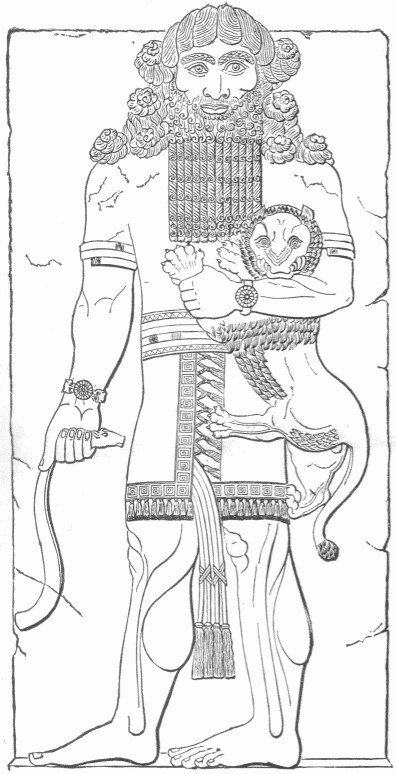
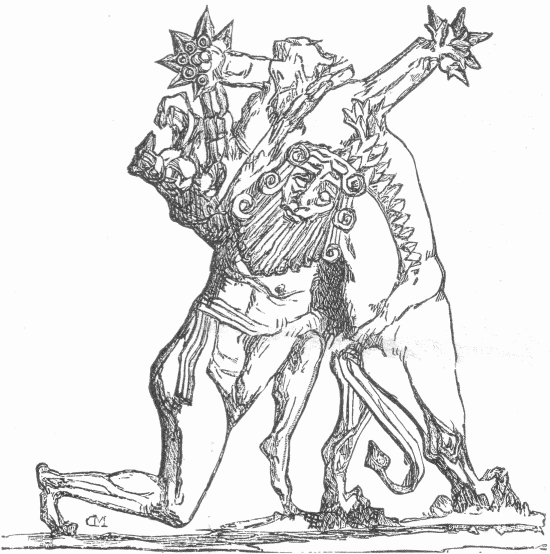
12. It is evidently on this occasion that Izdubar conquers the seer's esteem by fighting and killing the lion, after which the hero and the sage enter into a solemn covenant of friendship. But the third tablet, which contains this part of the story, is so much mutilated as to leave much of the substance to conjecture, while all the details, and the interpretation of the dream which is probably given, are lost. The same is unfortunately the case with the fourth and fifth tablets, from which we can only gather that Izdubar and Êabâni, who have become inseparable, start on an expedition against the Elamite tyrant, Khumbaba, who holds his court in a gloomy forest of cedars and cypresses, enter his palace, fall upon him unawares and kill him, leaving his body to be torn and devoured by the birds of prey, after which exploit Izdubar, as his friend had predicted to him, is proclaimed king in Erech. The sixth tablet is far better preserved, and gives us one of the most interesting incidents almost complete.
13. After Izdubar's victory, his glory and power were great, and the goddess Ishtar looked on him with favor and wished for his love.
"Izdubar," she said, "be my husband and I will be thy wife: pledge thy troth to me. Thou shalt drive a chariot of gold and precious stones, thy days shall be marked with conquests; kings, princes and lords shall be subject to thee and kiss thy feet; they shall bring thee tribute from mountain and valley, thy herds and flocks shall multiply doubly, thy mules shall be fleet, and thy oxen strong under the yoke. Thou shalt have no rival."
But Izdubar, in his pride, rejected the love of the goddess; he insulted her and taunted her with having loved Dumuzi and others before him. Great was the wrath of Ishtar; she ascended to heaven and stood before her father Anu:
"My father, Izdubar has insulted me. Izdubar scorns my beauty and spurns my love."
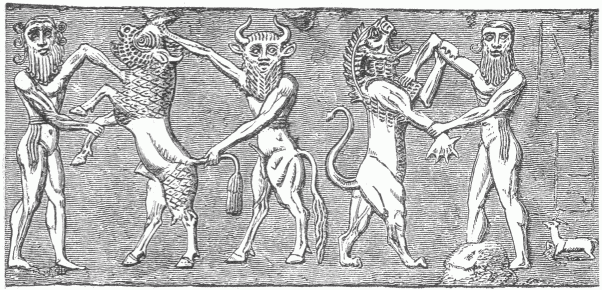
77.—IZDUBAR AND ÊABÂNI FIGHT THE BULL OF ISHTAR.—IZDUBAR FIGHTS ÊABÂNI'S LION (BABYLONIAN CYLINDER).
(Smith's "Chaldea.")
She demanded satisfaction, and Anu, at her request, created a monstrous bull, which he sent against the city of Erech. But Izdubar and his friend went out to fight the bull, and killed him. Êabâni took hold of his tail and horns, and Izdubar gave him his deathblow. They drew the heart out of his body and offered it to Shamash. Then Ishtar ascended the wall of the city, and standing there cursed Izdubar. She gathered her handmaidens around her and they raised loud lamentations over the death of the divine bull. But Izdubar called together his people and bade them lift up the body and carry it to the altar of Shamash and lay it before the god. Then they washed their hands in the Euphrates and returned to the city, where they made a feast of rejoicing and revelled deep into the night, while in the streets a proclamation to the people of Erech was called out, which began with the triumphant words:
"Who is skilled among leaders? Who is great among men? Izdubar is skilled among leaders; Izdubar is great among men."
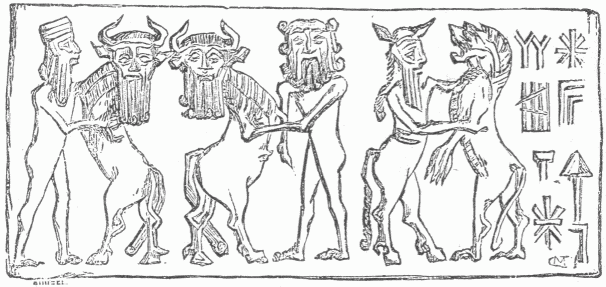
78.—IZDUBAR AND ÊABÂNI (BABYLONIAN CYLINDER).
(Perrot and Chipiez.)
14. But the vengeance of the offended goddess was not to be so easily defeated. It now fell on the hero in a more direct and personal way. Ishtar's mother, the goddess Anatu, smote Êabâni with sudden death and Izdubar with a dire disease, a sort of leprosy, it would appear. Mourning for his friend, deprived of strength and tortured with intolerable pains, he saw visions and dreams which oppressed and terrified him, and there was now no wise, familiar voice to soothe and counsel him. At length he decided to consult his ancestor, Hâsisadra, who dwelt far away, "at the mouth of the rivers," and was immortal, and to ask of him how he might find healing and strength. He started on his way alone and came to a strange country, where he met gigantic, monstrous beings, half men, half scorpions: their feet were below the earth, while their heads touched the gates of heaven; they were the warders of the sun and kept their watch over its rising and setting. They said one to another: "Who is this that comes to us with the mark of the divine wrath on his body?" Izdubar made his person and errand known to them; then they gave him directions how to reach the land of the blessed at the mouth of the rivers, but warned him that the way was long and full of hardships. He set out again and crossed a vast tract of country, where there was nothing but sand, not one cultivated field; and he walked on and on, never looking behind him, until he came to a beautiful grove by the seaside, where the trees bore fruits of emerald and other precious stones; this grove was guarded by two beautiful maidens, Siduri and Sabitu, but they looked with mistrust on the stranger with the mark of the gods on his body, and closed their dwelling against him.
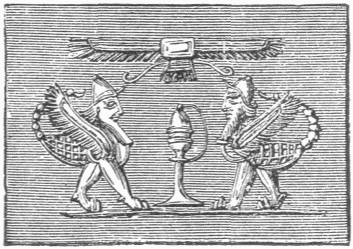
79.—SCORPION-MEN.
(Smith's "Chaldea.")
15. And now Izdubar stood by the shore of the Waters of Death, which are wide and deep, and separate the land of the living from that of the blessed and immortal dead. Here he encountered the ferryman Urubêl; to him he opened his heart and spoke of the friend whom he had loved and lost, and Urubêl took him into his ship. For one month and fifteen days they sailed on the Waters of Death, until they reached that distant land by the mouth of the rivers, where Izdubar at length met his renowned ancestor face to face, and, even while he prayed for his advice and assistance, a very natural feeling of curiosity prompted him to ask "how he came to be translated alive into the assembly of the gods." Hâsisadra, with great complaisance, answered his descendant's question and gave him a full account of the Deluge and his own share in that event, after which he informed him in what way he could be freed from the curse laid on him by the gods. Then turning to the ferryman:
"Urubêl, the man whom thou hast brought hither, behold, disease has covered his body, sickness has destroyed the strength of his limbs. Take him with thee, Urubêl, and purify him in the waters, that his disease may be changed into beauty, that he may throw off his sickness and the waters carry it away, that health may cover his skin, and the hair of his head be restored and descend in flowing locks down to his garment, that he may go his way and return to his own country."
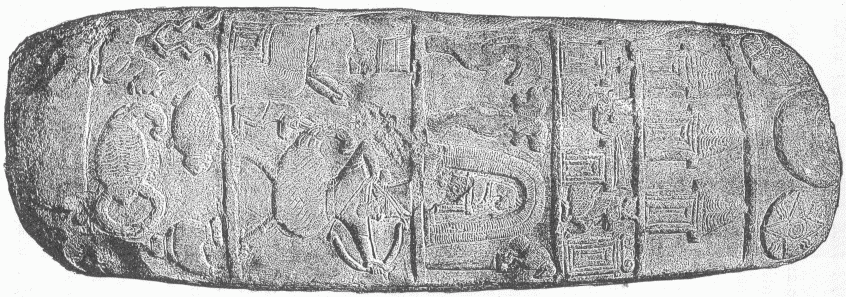
80.—STONE OBJECT FOUND AT ABU-HABBA (SIPPAR) BY MR. H. RASSAM, SHOWING, AMONG OTHER MYTHICAL DESIGNS, SHAMASH AND HIS WARDER, THE SCORPION-MAN.
16. When all had been done according to Hâsisadra's instruction, Izdubar, restored to health and vigor, took leave of his ancestor, and entering the ship once more was carried back to the shore of the living by the friendly Urubêl, who accompanied him all the way to Erech. But as they approached the city tears flowed down the hero's face and his heart was heavy within him for his lost friend, and he once more raised his voice in lamentation for him:
"Thou takest no part in the noble feast; to the assembly they call thee not; thou liftest not the bow from the ground; what is hit by the bow is not for thee; thy hand grasps not the club and strikes not the prey, nor stretches thy foeman dead on the earth. The wife thou lovest thou kissest not; the wife thou hatest thou strikest not. The child thou lovest thou kissest not; the child thou hatest thou strikest not. The might of the earth has swallowed thee. O Darkness, Darkness, Mother Darkness! thou enfoldest him like a mantle; like a deep well thou enclosest him!"
Thus Izdubar mourned for his friend, and went into the temple of Bel, and ceased not from lamenting and crying to the gods, till Êa mercifully inclined to his prayer and sent his son Meridug to bring Êabâni's spirit out of the dark world of shades into the land of the blessed, there to live forever among the heroes of old, reclining on luxurious couches and drinking the pure water of eternal springs. The poem ends with a vivid description of a warrior's funeral:
"I see him who has been slain in battle. His father and mother hold his head; his wife weeps over him; his friends stand around; his prey lies on the ground uncovered and unheeded. The vanquished captives follow; the food provided in the tents is consumed."
17. The incident of the Deluge, which has been merely mentioned above, not to interrupt the narrative by its disproportionate length, (the eleventh tablet being the best preserved of all), is too important not to be given in full.[BE]
"I will tell thee, Izdubar, how I was saved from the flood," begins Hâsisadra, in answer to his descendant's question, "also will I impart to thee the decree of the great gods. Thou knowest Surippak, the city that is by the Euphrates. This city was already very ancient when the gods were moved in their hearts to ordain a great deluge, all of them, their father Anu, their councillor the warlike Bel, their throne-bearer Ninîb, their leader Ennugi. The lord of inscrutable wisdom, the god Êa, was with them and imparted to me their decision. 'Listen,' he said, 'and attend! Man of Surippak, son of Ubaratutu,[BF] go out of thy house and build thee a ship. They are willed to destroy the seed of life; but thou preserve it and bring into the ship seed of every kind of life. The ship which thou shalt build let it be ... in length, and ... in width and height,[B] and cover it also with a deck.' When I heard this I spoke to Êa, my lord: 'If I construct the ship as thou biddest me, O lord, the people and their elders will laugh at me.' But Êa opened his lips once more and spoke to me his servant: 'Men have rebelled against me, and I will do judgment on them, high and low. But do thou close the door of the ship when the time comes and I tell thee of it. Then enter the ship and bring into it thy store of grain, all thy property, thy family, thy men-servants and thy women-servants, and also thy next of kin. The cattle of the fields, the wild beasts of the fields, I shall send to thee myself, that they may be safe behind thy door.'—Then I built the ship and provided it with stores of food and drink; I divided the interior into ... compartments.[BG] I saw to the chinks and filled them; I poured bitumen over its outer side and over its inner side. All that I possessed I brought together and stowed it in the ship; all that I had of gold, of silver, of the seed of life of every kind; all my men-servants and my women-servants, the cattle of the field, the wild beasts of the field, and also my nearest friends. Then, when Shamash brought round the appointed time, a voice spoke to me:—'This evening the heavens will rain destruction, wherefore go thou into the ship and close thy door. The appointed time has come,' spoke the voice, 'this evening the heavens will rain destruction.' And greatly I feared the sunset of that day, the day on which I was to begin my voyage. I was sore afraid. Yet I entered into the ship and closed the door behind me, to shut off the ship. And I confided the great ship to the pilot, with all its freight.—Then a great black cloud rises from the depths of the heavens, and Ramân thunders in the midst of it, while Nebo and Nergal encounter each other, and the Throne-bearers walk over mountains and vales. The mighty god of Pestilence lets loose the whirlwinds; Ninîb unceasingly makes the canals to overflow; the Anunnaki bring up floods from the depths of the earth, which quakes at their violence. Ramân's mass of waters rises even to heaven; light is changed into darkness. Confusion and devastation fills the earth. Brother looks not after brother, men have no thought for one another. In the heavens the very gods are afraid; they seek a refuge in the highest heaven of Anu; as a dog in its lair, the gods crouch by the railing of heaven. Ishtar cries aloud with sorrow: 'Behold, all is turned into mud, as I foretold to the gods! I prophesied this disaster and the extermination of my creatures—men. But I do not give them birth that they may fill the sea like the brood of fishes.' Then the gods wept with her and sat lamenting on one spot. For six days and seven nights wind, flood and storm reigned supreme; but at dawn of the seventh day the tempest decreased, the waters, which had battled like a mighty host, abated their violence; the sea retired, and storm and flood both ceased. I steered about the sea, lamenting that the homesteads of men were changed into mud. The corpses drifted about like logs. I opened a port-hole, and when the light of day fell on my face I shivered and sat down and wept. I steered over the countries which now were a terrible sea. Then a piece of land rose out of the waters. The ship steered towards the land Nizir. The mountain of the land Nizir held fast the ship and did not let it go. Thus it was on the first and on the second day, on the third and the fourth, also on the fifth and sixth days. At dawn of the seventh day I took out a dove and sent it forth. The dove went forth to and fro, but found no resting-place and returned. Then I took out a swallow and sent it forth. The swallow went forth, to and fro, but found no resting-place and returned. Then I took out a raven and sent it forth. The raven went forth, and when it saw that the waters had abated, it came near again, cautiously wading through the water, but did not return. Then I let out all the animals, to the four winds of heaven, and offered a sacrifice. I raised an altar on the highest summit of the mountain, placed the sacred vessels on it seven by seven, and spread reeds, cedar-wood and sweet herbs under them. The gods smelled a savor; the gods smelled a sweet savor; like flies they swarmed around the sacrifice. And when the goddess Ishtar came, she spread out on high the great bows of her father Anu:—'By the necklace of my neck,' she said, 'I shall be mindful of these days, never shall I lose the memory of them! May all the gods come to the altar; Bel alone shall not come, for that he controlled not his wrath, and brought on the deluge, and gave up my men to destruction.' When after that Bel came nigh and saw the ship, he was perplexed, and his heart was filled with anger against the gods and against the spirits of Heaven:—'Not a soul shall escape,' he cried; 'not one man shall come alive out of destruction!' Then the god Ninîb opened his lips and spoke, addressing the warlike Bel:—'Who but Êa can have done this? Êa knew, and informed him of everything.' Then Êa opened his lips and spoke, addressing the warlike Bel:—'Thou art the mighty leader of the gods: but why hast thou acted thus recklessly and brought on this deluge? Let the sinner suffer for his sin and the evil-doer for his misdeeds; but to this man be gracious that he may not be destroyed, and incline towards him favorably, that he may be preserved. And instead of bringing on another deluge, let lions and hyenas come and take from the number of men; send a famine to unpeople the earth; let the god of Pestilence lay men low. I have not imparted to Hâsisadra the decision of the great gods: I only sent him a dream, and he understood the warning.'—Then Bel came to his senses. He entered the ship, took hold of my hand and lifted me up; he also lifted up my wife and laid her hand in mine. Then he turned towards us, stood between us and spoke this blessing on us:—'Until now Hâsisadra was only human: but now he shall be raised to be equal with the gods, together with his wife. He shall dwell in the distant land, by the mouth of the rivers.' Then they took me and translated me to the distant land by the mouth of the rivers."
18. Such is the great Chaldean Epic, the discovery of which produced so profound a sensation, not to say excitement, not only among special scholars, but in the reading world generally, while the full importance of it in the history of human culture cannot yet be realized at this early stage of our historical studies, but will appear more and more clearly as their course takes us to later nations and other lands. We will here linger over the poem only long enough to justify and explain the name given to it in the title of this chapter, of "Mythical Epos."
19. Were the hero Izdubar a purely human person, it would be a matter of much wonder how the small nucleus of historical fact which the story of his adventures contains should have become entwined and overgrown with such a disproportionate quantity of the most extravagant fiction, oftentimes downright monstrous in its fancifulness. But the story is one far older than that of any mere human hero and relates to one far mightier: it is the story of the Sun in his progress through the year, retracing his career of increasing splendor as the spring advances to midsummer, the height of his power when he reaches the month represented in the Zodiac by the sign of the Lion, then the decay of his strength as he pales and sickens in the autumn, and at last his restoration to youth and vigor after he has passed the Waters of Death—Winter, the death of the year, the season of nature's deathlike torpor, out of which the sun has not strength sufficient to rouse her, until spring comes back and the circle begins again. An examination of the Accadian calendar, adopted by the more scientifically inclined Semites, shows that the names of most of the months and the signs by which they were represented on the maps of the corresponding constellations of the Zodiac, directly answer to various incidents of the poem, following, too, in the same order, which is that of the respective seasons of the year,—which, be it noted, began with the spring, in the middle of our month of March. If we compare the calendar months with the tablets of the poem we will find that they, in almost every case, correspond. As the first tablet is unfortunately still missing, we cannot judge how far it may have answered to the name of the first month—"the Altar of Bel." But the second month, called that of "the Propitious Bull," or the "Friendly Bull," very well corresponds to the second tablet which ends with Izdubar's sending for the seer Êabâni, half bull half man, while the name and sign of the third, "the Twins," clearly alludes to the bond of friendship concluded between the two heroes, who became inseparable. Their victory over the tyrant Khumbaba in the fifth tablet is symbolized by the sign representing the victory of the Lion over the Bull, often abbreviated into that of the Lion alone, a sign plainly enough interpreted by the name "Month of Fire," so appropriate to the hottest and driest of seasons even in moderate climes—July-August. What makes this interpretation absolutely conclusive is the fact that in the symbolical imagery of all the poetry of the East, the Lion represents the principle of heat, of fire. The seventh tablet, containing the wooing of the hero by the goddess Ishtar, is too plainly reproduced in the name of the corresponding month, "the Month of the Message of Ishtar," to need explanation. The sign, too, is that of a woman with a bow, the usual mode of representing the goddess. The sign of the eighth month, "the Scorpion," commemorates the gigantic Warders of the Sun, half men half scorpions, whom Izdubar encounters when he starts on his journey to the land of the dead. The ninth month is called "the Cloudy," surely a meet name for November-December, and in no way inconsistent with the contents of the ninth tablet, which shows Izdubar navigating the "Waters of Death." In the tenth month (December-January), the sun reaches his very lowest point, that of the winter solstice with its shortest days, whence the name "Month of the Cavern of the Setting Sun," and the tenth tablet tells how Izdubar reached the goal of his journey, the land of the illustrious dead, to which his great ancestor has been translated. To the eleventh month, "the Month of the Curse of Rain," with the sign of the Waterman,—(January-February being in the low lands of the two rivers the time of the most violent and continuous rains)—answers the eleventh tablet with the account of the Deluge. The "Fishes of Êa" accompany the sun in the twelfth month, the last of the dark season, as he emerges, purified and invigorated, to resume his triumphant career with the beginning of the new year. From the context and sequence of the myth, it would appear that the name of the first month, "the Altar of Bel," must have had something to do with the reconciliation of the god after the Deluge, from which humanity may be said to take a new beginning, which would make the name a most auspicious one for the new year, while the sign—a Ram—might allude to the animal sacrificed on the altar. Each month being placed under the protection of some particular deity it is worthy of notice that Anu and Bel are the patrons of the first month, Êa of the second, (in connection with the wisdom of Êabâni, who is called "the creature of Êa,") while Ishtar presides over the sixth, ("Message of Ishtar,") and Ramân, the god of the atmosphere, of rain and storm and thunder, over the eleventh, ("the Curse of Rain").
20. The solar nature of the adventurous career attributed to the favorite national hero of Chaldea, now universally admitted, was first pointed out by Sir Henry Rawlinson: but it was François Lenormant who followed it out and established it in its details. His conclusions on the subject are given in such clear and forcible language, that it is a pleasure to reproduce them:[BH]—"1st. The Chaldeans and Babylonians had, concerning the twelve months of the year, myths for the most part belonging to the series of traditions anterior to the separation of the great races of mankind which descended from the highlands of Pamir, since we find analogous myths among the pure Semites and other nations. As early as the time when they dwelt on the plains of the Tigris and Euphrates, they connected these myths with the different epochs of the year, not with a view to agricultural occupations, but in connection with the great periodical phenomena of the atmosphere and the different stations in the sun's yearly course, as they occurred in that particular region; hence the signs characterizing the twelve solar mansions in the Zodiac and the symbolical names given to the months by the Accads.—2d. It was those myths, strung together in their successive order, which served as foundation to the epic story of Izdubar, the fiery and solar hero, and in the poem which was copied at Erech by Asshurbanipal's order each of them formed the subject of one of the twelve tablets, making up the number of twelve separate books or chapters answering the twelve months of the year."—Even though the evidence is apparently so complete as not to need further confirmation, it is curious to note that the signs which compose the name of Izdubar convey the meaning "mass of fire," while Hâsisadra's Accadian name means "the sun of life," "the morning sun," and his father's name, Ubaratutu, is translated "the glow of sunset."