Cavity-Nesting Birds of North American Forests (continued 2)
Reading edition
86
Starling
Sturnus vulgaris
L 6″
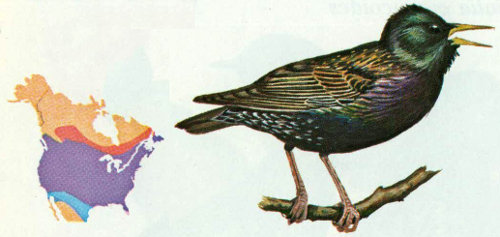
Habitat: Starlings breed in various habitats that provide adequate nestling food (Troetschler 1976) but are perhaps most numerous in suburban and rural habitat where suitable nesting sites abound. Kalmbach (1928) noted that starlings prefer thickly settled agricultural areas and stated that “They are partial to human association....” During establishment in the United States, starlings first settled in lowland areas and are still abundant there (Small 1974, Royall 1966, Bent 1950). In a southeast Ontario test, starlings preferred old field habitat over five other habitats when sufficient nest sites were available (Gibo et al. 1976).
Nest: Cavities in trees, telephone poles, or fence posts, in drainpipes, mail boxes, or buildings, and in haystacks and cliffs have been used for nesting, as have burrows and open nests of other species (Kessel 1957, Bent 1950). Natural nest sites seem to be preferred over nest boxes (Planck 1967). Competition between starlings and native species for nesting cavities usually favors the starling, but most native species seem to breed in some habitats where starlings are not numerous.
Food: Analysis of contents of 2,750 starling stomachs taken in the northeastern states showed 57 percent animal materials such as insects, millipeds, spiders, molluscs, and a few crustaceans. Insects such as weevils, ground beetles, and plant-feeding scarabaeids such as May beetles were especially important. Of the 43 percent vegetable material, wild fruit was most important, but cultivated cherries, vegetable material, grain, and seeds of various sorts were also used (Kalmbach 1928). In other areas, grapes, blueberries, figs, and other fruit, truck crops, sprouting crops, and prepared livestock feed are eaten.
87
Crested myna
Acridotheres cristatellus
L 9″
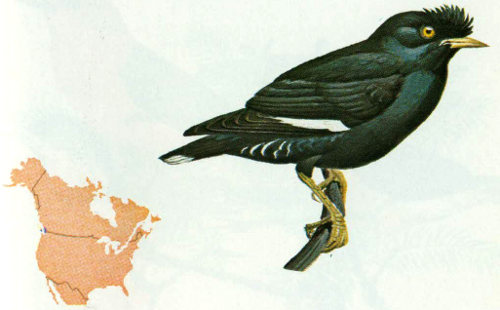
Habitat: The crested myna is native to the plains and lowlands of cultivated southern China, and was introduced in Vancouver, B.C., Canada in the 1890’s. Although the myna has been reported in the states of Washington and Oregon, most of the population is in Greater Vancouver and Vancouver Island. Mynas are apparently dwellers of urban and nearby open field areas (Mackay and Hughes 1963).
Nest: In urban areas, mynas nest in almost any enclosed area, including bird boxes intended for other birds. In wooded areas, holes made by flickers and other woodpeckers seem to be preferred (Bent 1950).
Food: Scheffer and Cottam (1935) examined the contents of 117 adult myna stomachs and found 39 percent animal and 61 percent vegetable matter. Animal matter included flies, moths and caterpillars, wasps, bees, ants, bugs, beetles, grasshoppers, spiders, and earthworms. Vegetable matter included wild varieties of elderberries, cherries, blueberries, crowberries, snowberries, salmonberries, loganberries, and serviceberries. Fruits of cultivated cherries, strawberries, raspberries, and blackberries were also eaten, with some damage done to apples, pears, cabbages, and lettuce.
88
Prothonotary warbler
Protonotaria citrea
L 4¾″
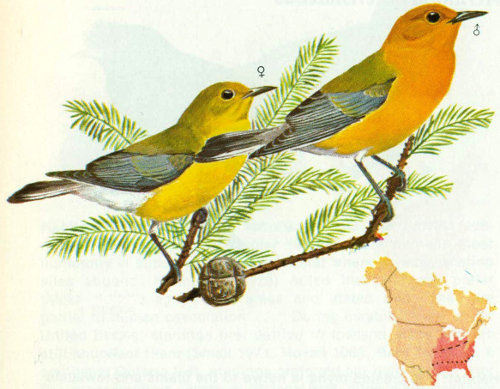
Habitat: The prothonotary warbler is found south of Canada in the eastern deciduous forests of the United States. Other names for this warbler (golden swamp warbler and willow warbler) describe its preference for swamps and periodically flooded areas. The prothonotary often lives near running water with streamside willows (Pearson 1936).
Nest: Nests are almost always in stumps and snags either standing in or near water (Simpson 1969) and often leaning over the water (Pearson 1936). Downy woodpecker and chickadee holes ranging from 2 to 12 feet and averaging 5 feet above the ground are used most often (Pearson 1936). However, the warbler reportedly has a wide tolerance for the type of nesting cavities used. Prothonotaries occasionally even nest in bird boxes and near buildings (Forbush and May 1939).
Food: Prothonotary warblers are primarily insectivorous. They eat ants, spiders, beetles, mayflies, and their larvae. They also will eat the larvae of water insects. This warbler feeds on trunks and branches of trees, shrubs, and fallen logs. They will also perch on rank grasses and water plants and eat small molluscs (Bent 1953).
89
Lucy’s warbler
Vermivora luciae
L 4¼″
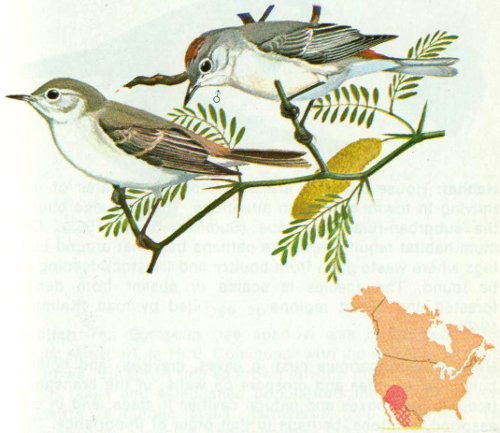
Habitat: This warbler inhabits mesquite woodlands and riparian vegetation with willows and cottonwoods from Nevada to the southwestern United States.
Nest: Nests of Lucy’s warblers are usually located in tree cavities or under loose bark in willows, cottonwoods and mesquite. Ironwood, palo verde, and catclaw have also been used for nest trees (Robbins et al. 1966, Bent 1953, Peterson 1961).
Food: Insects are the major food items in the diet of Lucy’s warbler (Bent 1953).
90
House sparrow
Passer domesticus
L 5¼″
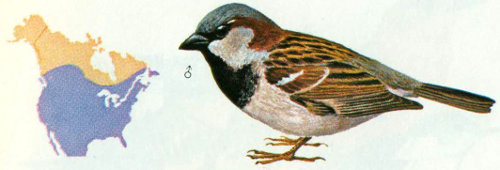
Habitat: House sparrows are well known associates of man, thriving in towns and urban situations. They are also birds of the suburban-rural landscape (Summers-Smith 1963). Optimum habitat requirements are perhaps best met around buildings where waste grain from poultry and livestock feeding can be found. The species is scarce or absent from densely forested and desert regions uninhabited by man (Kalmbach 1940).
Nest: House sparrows nest in eaves, crevices, and holes in buildings; in vines and creepers on walls; in the branches of trees; in nest boxes and natural cavities in trees; and in other assorted locations, perhaps in that order of importance. Open tree nests may be built more often in warmer latitudes, but females seem to prefer hole nests (Cink 1976). Nesting cavities of cliff and bank swallows and house finches may be usurped. Nests are usually at least 6 to 8 feet from the ground, may be as high as 50 feet, and groups or colonies are not uncommon. Nests are domed whether in cavities or the open. House sparrows all too readily accept bird houses erected for purple martins, bluebirds, and other species.
Food: Kalmbach’s (1940) study of the contents of 4,848 stomachs of suburban-rural birds indicated that adult and juvenile (non-nestling) house sparrows take 3.4 percent animal material throughout the year, particularly dung beetles, May beetles, and other Scarabaeidae. Grain from poultry yards, etc., made up the largest percentage of vegetable material (31.5 to 84.2 percent), followed by seeds of grasses and weeds (17 percent), and oats other than that in feed (14.4 percent). Ragweed, crabgrass, smartweed, and pigweed were important plants in the grass and weed category.
91
European tree sparrow
Passer montanus
L 5″
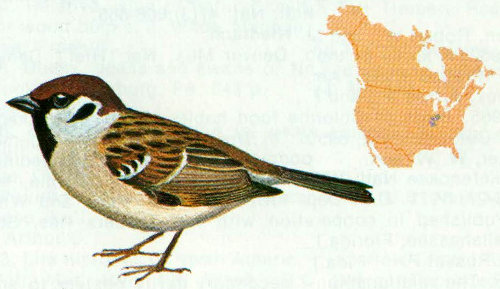
Habitat: The European tree sparrow was introduced in St. Louis, Missouri, in 1870. Coincident with the increase in house sparrows, European tree sparrows left the thickly settled parts of St. Louis and established populations throughout the city outskirts, suburban areas, farmyards, and woodlots. The species now occupies approximately 8,500 square miles in extreme east-central Missouri and west-central Illinois. They appear to be slowly expanding their range northward in western Illinois (Barlow 1973).
Nest: European tree sparrows nest in natural cavities, crevices, and woodpecker holes. They appear to be a weak competitor for available nesting sites. Part of the reason for the extension of tree sparrow range north may be related to large numbers of dead and dying American elms (victims of Dutch elm disease) which have provided an increasing source of nesting sites (Barlow 1973).
Food: Tree sparrows feed primarily on the ground on weed seeds, maize, insects, and spiders.
92