JOHN ALLYNE GADE (continued 5)
Reading edition
The huge pilasters or buttresses of the church which run up east and west of the entire composition are decorated with the enormous imperial shields of Charles V, overshadowing in their vulgar predominance all the exquisitely proportioned and delicate detail adjacent to them.
Some of the bays on the southern side of the Cathedral can be better seen, as a small courtyard separates them from the adjacent building, the episcopal palace. The others are choked by the Capilla del Pulgar, the Royal Chapel and the sagrario.
This side of the church exhibits in its balustrades, its ornamentation and the crocketed terminations and finials to the exterior buttresses, what is far more interesting in the Plateresque style of Spain than the purely borrowed and imitative features of the west and northern fronts. Here appear in jeweled play of light and shade, in all their imaginative and exquisite intricacy, those forms of carved string courses which were developed by the Spanish Renaissance and were essentially Spanish and national. You feel somewhere back of it the Moorish influence. It presents all the richness, the magnificence and exuberant fancy which characterizes the spirit in which its masters worked. The labor it involved must have been enormous. The splendor of the solid lacework ten to twelve feet high is thrown out by contrast with the naked walls which it crowns.
The Capilla del Pulgar, which blocks the most westerly corner of the south elevation, was named in honor of Hernan Peres del Pulgar, the site of whose brave exploit it marks. In 1490, during the last siege of Granada, he determined on a deed which should outdo all feats of heroism and defiance ever performed by Moslem warriors. At dead of night, some authorities say he was on horseback, others that he swam the subterranean channel of the Darro, he penetrated to the heart of the enemy's city and fastened with his dagger to the door of their principal mosque a scroll bearing the words "Ave Maria." Before this insult to their faith had been discovered, he had regained Ferdinand's camp.
A double superimposed arcade faces the southern side of the sagrario: the lower story has been brutally closed and defaced by modern additions, almost concealing its original carving. The upper story, however, which forms a balcony, strongly recalls by its fancifully twisted shafts, elliptical arches and Gothic traceried balustrade, similar early Renaissance work at Blois, where the Gothic and early Italian work were so charmingly blended.
The Royal Chapel is entered through an Italian Renaissance doorway of good general design and decoration, but the Spanish cornice and balustrade crowning the outer walls are much more interesting in details. The principal member consists of a band of crowned and encircled F's and Y's, the initials of the Catholic Kings. It is broken over the window by three gigantic coats-of-arms. To the left is Ferdinand's individual device of a yoke, the "yugo," with the motto "Tato Mota" (Tanto Monta) tantamount, assumed as a mark of his equality with the Castilian Queen; to the right Isabella's device of a bundle of arrows or "flechas," the symbol of union. In the centre is the common royal shield, proudly adopted after the union of the various kingdoms of the Peninsula had been cemented. The Eagle of Saint John the Evangelist and the common crown surmount the arms of Castile and Leon, of Aragon, Sicily, Navarre, and Jerusalem and the pomegranate of Granada.
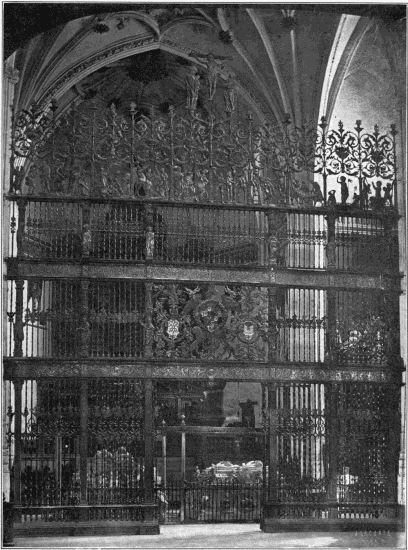
Photo by J. Lacoste, Madrid
CATHEDRAL OF GRANADA The reja enclosing the Royal Chapel and tombs of the Catholic Kings
The various roofs of the Cathedral are covered with endless rows of tiles, which in the furrowed, overlapping irregularity of their surfaces add to the general play of light and shade. Above them all spreads the umbrella-shaped dome which crowns the Capilla Mayor.
At the period when Gothic church-building was disappearing, we find not a few edifices where the old and new styles are curiously blended. A Renaissance façade added in later days might encase a practically complete Gothic interior. In Granada, with the exception of the Royal Chapel, very little of the interior contained traces of the expiring style. In the Cathedral proper, it is principally found in a groined vaulting of the different bays, which is covered with varying and most elaborate schemes of ornamental Gothic ribs, which seem strangely incongruous to the architect as he looks up from the classical shafts in the expectation of finding a corresponding form of building and decoration in the later vaulting.
The general plan of the church is more Renaissance than Gothic, exhibiting rather the form of the "Rundbau" than the "Langbau" of the Latin cross. Its main feature is likewise the great dome rising above and lighting the Capilla Mayor. The Spanish cimborio has at last reached its fullest development in the Renaissance lantern.
The church is divided into nave and double side aisles, outside of which is a series of externally abutting chapels. East and west it contains six bays. The choir blocks up the fifth and sixth bays of the nave, and in the customary Spanish manner it is separated from the high altar in the Capilla Mayor by the croisée of the transept. Back of this, forming the eastern termination, runs an ambulatory.
The vaulting, one hundred feet high, is carried by a series of gigantic white piers consisting of four semi-columns of Corinthian order with their intersecting angles formed by a triple rectangular break. The vaulting springs from above a full entablature and surmounting pedestals, the latter running to the height of the arches dividing the various vaulting compartments. The church is about 385 feet long and 220 feet wide.
The choir is uninteresting; the carving of its stalls and organs in nowise comparing with the "silleria" of Seville or Burgos. The Capilla Mayor, the principal feature of the interior, is circular in form, and separated from the nave by a splendid "Arco Toral." The dome, which rises to a height of 155 feet, is carried by eight Corinthian piers. In general scheme it is pure Italian Renaissance, of noble and harmonious proportions and very richly decorated. At the foot of the pilasters stand colossal statues of the Apostles. Higher up there is a series of most remarkable paintings by Alfonso Cano and some of his pupils. Cano's represent seven incidents in the life of the Virgin,—the Annunciation, Visitation, Nativity, Assumption, etc. Though some of his carvings, and especially the dignified and noble Virgin in the sacristy, are admirable, still, to judge from this series, it was as a painter that he excelled. They show, too, how essentially Spanish he was, like his great master, Montañez. The careless, lazy quality of his temperament is sufficiently apparent, but he cannot be denied a place among the great masters of Spanish painting who immediately preceded the all-eclipsing glory of Velasquez, Murillo, and Ribera.
The lights of the dome which rises over the paintings are filled with very lovely stained glass, representing scenes from the Passion by the Dutchmen, Teodor de Holanda, and Juan del Campo. On the two sides of the choir below are colossal heads of Adam and Eve carved by Cano and kneeling figures of Ferdinand and Isabella.
There are endless chapels outside the outer aisles, but, in spite of some good bits of sculpture and painting here and there, one longs to sweep them out of the way and free the edifice from their encumbrance.
The interior of the great sagrario is an expressionless jumble of the later Renaissance decadence,—and it is a shame that no more fitting architecture surrounds the tomb of the good Talavera, here laid to rest by his friend Tendilla, the first Alcaide of the Alhambra, with the inscription over his tomb, "Amicus Amico."
The general color scheme in the interior of the Cathedral is white and gold. One feels that it is handsome, even harmonious and magnificent, but that all the mystery and religious awe that pervaded the great churches of the previous centuries have vanished forever.
The Royal Chapel, although the oldest part of the building, should be considered last of all, as it is by far the most interesting portion and leaves an impression so vivid as to overshadow all other parts of the great edifice. It is situated between the sagrario and the Sacristia and is entered through the southern arm of the transept. The chapel itself is the very last Gothic efflorescence from which the spirit has fled, leaving only empty form. It consists of a single big nave flanked by lower chapels. The ornamentally ribbed vaulting with gilt bosses and keystones is carried by clustered shafts engaged in its side walls. The shafts are too thin and the capitals too meagre. A broader and more generous string course runs, at the height of the capitals, across the wall surfaces between the upper clerestory and the lower arcades. Portions of this reveal a strong Moorish influence, as the manner in which the great Gothic lettering is employed to decorate the band. Similarly to the invocations to Allah running round the walls of the Alhambra, we read here that "This chapel was founded by the most Catholic Don Fernando and Doña Isabel, King and Queen of the Españos[d], of Naples, of Sicily, and Jerusalem, who conquered this kingdom and brought it back to the faith, who acquired the Canary Isles and Indies, as well as the cities of Ican, Tripoli, and Bugia; who crushed heresy, expelled Moors and Jews from these realms, and reformed religion. The Queen died Tuesday, November 26, 1504. The King died January 25, 1516. The building was completed 1517." Enrique de Egas had, at Ferdinand's order, commenced building two years after Isabella's death. The grandson enlarged it later, finding it "too small for so much glory."
The high altar with its retablo and the royal sarcophagi are separated from the rest of the chapel by the most stupendous and magnificent iron screen or reja ever executed. Spaniards have here surpassed all their earlier productions in this their master craft. Not even the screens of the great choir and altar of Seville or Toledo can compare with it. With the possible exception of the curious Biblical scenes naively represented by groups of figures near the apex, which still tell their story in true Gothic style, it is a burst of Renaissance, or Plateresque glory. It is not likely that the crafts, with all their mechanical skill, will ever again produce a work of such artistic perfection. It represents the labor of an army of skilled artisans,—all the sensitive feeling in the finger-tips of the Italian goldsmith, the most cunning art of the German armorer and a combination of restraint and boldness in the Spanish smith and forger. The difficulty naturally offered by the material has also restrained the artisan's hand and imagination from running riot in vulgar elaboration. The design, made by Maestro Bartolomé of Jaen in 1523, is as excellent as the technique is astonishing. It may be said that in grandeur it is only surpassed by the fame of the Queen whose remains lie below. The material is principally wrought iron, though some of the ornaments are of embossed silver plate and portions of it gilded as well as colored. Bartolomé's design consists in general of three superimposed and highly decorated rows of twisted iron bars with molded caps and bases. Each one must have been a most massive forging, hammered out of the solid iron while it was red hot. The vertically aspiring lines of the bars are broken by horizontal rows of foliage, cherubs' heads and ornamentation, as well as two broad bands of cornices with exquisitely decorated friezes. Larger pilasters and columns form its panels, the central ones of which constitute the doorway and enclose the elaborate arms of Ferdinand and Isabella and those of their inherited and conquered kingdoms. The screen is crested by a rich border of pictorial scenes, of flambeaux and foliated Renaissance scrollwork, above which in the centre is throned the crucified Saviour adored by the Virgin and Saint John. The crucifix rises to the height of the very capitals which carry the lofty vaulting.
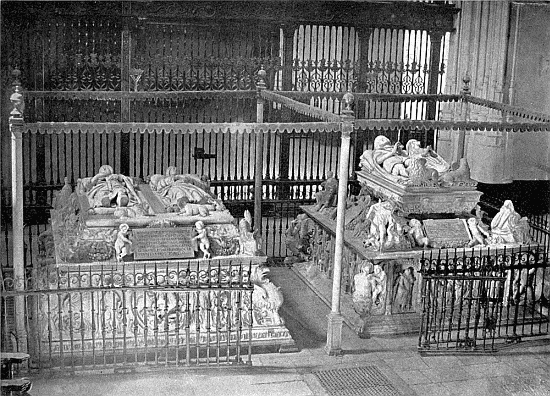
Photo by J. Lacoste, Madrid
CATHEDRAL OF GRANADA The tombs of the Catholic Kings, of Philip and of Queen Juana.
Inside the reja, a few steps above the tombs, rises Philip Vigarny's, or Borgoña's, elaborate reredos. To the Protestant sense this is gaudy and theatrical, a strikingly garish note in the solemnity and grandeur of the chapel. To the right and left of its base are, however, most interesting carvings, among them the kneeling statues of Ferdinand and Isabella. Behind the former is his victorious banner of Castile. The figures are vitally interesting as contemporaneous portraits of the monarchs, aiming to reproduce with fidelity their features and every detail of their dress. There is also a series of bas-reliefs portraying incidents in the siege of Granada,—the Cardinal on a prancing charger, behind him a forest of lances, the lurid, flaming sky throwing out in sharp silhouette the pierced walls and rent battlements. The Moors, very much like dogs shrinking from a beating, are being dragged to the baptismal font;—the gesticulating prelates hold aloft in one hand the cross and in the other, the sword, for the tunicked figures to make their choice. The scene has been described by Sir W. Stirling Maxwell, who tells us "that in one day no less than three thousand persons received baptism at the hands of the Primate, who sprinkled them with the hyssop of collective regeneration."
Again, in another, the cringing Boabdil is presenting the keys of the city to the "three kings." Isabella is on a white genet, and Mendoza, like the old pictures of Wolsey, on a trapped mule. Ferdinand is there in all his magnificence; the knights, the halberdiers and horsemen, all the details of the dramatic moment, full of the greatest imaginable historic and antiquarian interest, perpetuated by one who was probably an eye-witness of the scene.
At the foot of the altar, in the centre of the chapel, stand the tombs of Ferdinand and Isabella and of Philip and Joan. They are as gorgeous specimens of sepulchral monuments as the reja is of an ecclesiastical iron screen. Both sarcophagi are executed in the softest flushed alabaster; that of Ferdinand and Isabella by the Florentine Dominico Fancelli; that of their daughter and her son by the Barcelonian Bartolomé Ordenez, "The Eagle of Relief," who carved his blocks at Carrara. The tomb of poor crazy Jane, and the unworthy, handsome husband whom she doted on to the extent of carrying his body with her throughout the doleful wronged insanity of her later years, is somewhat more elevated than that of the Catholic Kings, though its general design is very similar. Philip of Austria sleeps vested with the Order of the Golden Fleece.
Isabella's celebrated will begins with her desire that her body may be taken to Granada and there laid to rest in the Franciscan monastery of Santa Isabella in the Alhambra, with a simple tomb and inscription: "but should the King, my lord, prefer a sepulchre in some other place, then my will is that my body be there transported, and laid where he can be placed by my side, that the union we have enjoyed in this world, and which through the mercy of God may be hoped for again when our souls are in heaven, may be symbolized by our bodies being side by side on earth." The humble burying-ground designated by Isabella, and where she was first laid to rest with the simple rites she desired, was, however, no fitting place for the grandparents of Imperial Charles. Here, in the Cathedral's principal chapel, he had them laid in the year 1525.
The sarcophagus consists of three stages, containing the ornamental motives so characteristic of the best sculpture of the Italian Renaissance. No other form of statuary brought out their skill and genius so fully as a sepulchral monument. Medallions, statues, niches, saints, angels, griffins and garlands are all woven into a magnificent base to receive the recumbent effigies. Apostles and bas-reliefs of scenes from the life of Christ surround the base, while winged griffins break the angles. Above are the four Doctors of the Church, the arms of the Catholic Kings and the proud and simple epitaph, "Mahometicē sectē prostratores et hereticē pervicaciē extinctores: Fernandus Aragonium et Helisabetha Castellē, vir et uxor unanimes, catholici appelati, marmoreo clauduntur tumulo."[22] In tranquil crowned dignity above lie Ferdinand in his mantle of knighthood, his sword clasped over his armored breast, and Isabella with the cross of her country's patron saint. The recumbent figures are extremely fine; the faces, which are portraits, convey all we know of their prototypes' characteristics. Ferdinand's proud, pursed lips whisper his selfish arrogance, his iron will, and the greatness and fulfillment of his dreams. The hard, masterful jaw confirms the character given him by the shrewd French cynic as one of the most thorough egotists who ever sat on a throne, as well as that of his English son-in-law, who knew enough to call him "the wisest king that ever ruled Spain."
Beside Ferdinand sleeps his lion-hearted consort. It is her lofty soul which broods over the sepulchre and heightens the feeling of reverence already inspired by reja and sarcophagus. She is still the brightest star that ever rose in the Spanish firmament and shone in clear radiance above even the lights of Ximenez, of Columbus, or the Great Captain. Her smile is now as cold and her look as placid as moonlight sleeping on snow.
Noble, tender-hearted and true, dauntless, self-sacrificing and faithful, she rose supreme in every relation of life and the great crisis of her people's history. "In all her revelations of Queen or Woman," said Lord Bacon, "she was an honour to her sex, and the corner stone of the greatness of Spain."
Standing before her tomb, on the battlefield of her victorious armies, the clear perspective and calm judgment of four centuries still declare her "of rare qualities,—sweet gentleness, meekness, saint-like, wife-like government, the Queen of earthly queens."
BOOKS CONSULTED
De Amicis, Edmondo. Spain.
Baedeker, Karl. Spain (Guidebook).
Bermudez, Cean. Descripcion Artistica de la Catedral de Sevilla.
Bermudez, Cean. Noticias de los Arquitectos y Arquitectura de España.
Caveda, José. Ensayo Historico sobre los diversos Generos de Arquitectura.
Didier. Année en Espagne.
Dumas, Alexandre, Père. De Paris à Cadiz.
Ellis, Havelock. Macmillan's, May, 1903 (vol. 88).
Ford, Richard. The Spaniards and their Country.
Ford, Richard. Gatherings in Spain.
Gautier, Théophile. Voyage En Espagne.
Hare, A. J. C. Wanderings in Spain.
Hay, John. Castilian Days.
Hume, M. A. S. The Spanish People.
Hume and Burke. History of Spain.
Hutton, Edward. The Cities of Spain.
Hutton, Edward. Studies in Lives of the Saints.
Irving, Washington. Alhambra.
Junghaendel, Max. Die Baukunst Spanien's.
Lamperez Y Romea, D. Vicente. Estudio sobre las Catedrales Españas.
Lamperez Y Romea, D. Vicente. Historia de la Arquitectura Cristiana Española en la Edad Media.
Lund, L. Spanske tilstande i nutid og fortid.
Lynch, Hannah. Toledo, the Story of a Spanish Capital.
Meagher, James L. The Great Churches of the World.
Moore, Charles Herbert. Development and Character of Gothic Architecture.
Norton, Charles Eliot. Church-building in the Middle Ages.
Orcajo, Don Pedro. Historia de la Catedral de Burgos.
Peyron, Jean François. Essays on Spain.
Prescott, W. H. Ferdinand and Isabella.
Quadrado, D. José Ma. España, sus Monumentos y Artes—su Naturaleza e Historia.
Rudy, Charles. The Cathedrals of Northern Spain.
Rose, H. J. Among the Spanish People.
Rosseeuw de St. Hilaire, E. F. A. Histoire D'espagne.
St. Reynald. La Nouvelle Revue, 1881, "L'espagne Musulmane."
Schmidt, K. E. Sevilla.
Smith. Architecture of Spain.
Street, G. E. Gothic Architecture in Spain.
Wort, Talbot D. Brochure Series of Arch. Illustration, 1903 (vol. 9).
Wyatt, Sir Mathew Digby. An Architect's Note-book in Spain.
(Official Publication). Los Monumentos Arquitectonicos de España.
INDEX
Aaron, 54.
Abel, 110.
Abu Jakub Jusuf, 203, 231.
Abraham, 153.
Acropolis, 240.
Acuna, Bishop of, 48, 49, 62.
Adaja, 67.
Adam, 227, 259.
Adriatic, 201.
Africa, 194.
Aguero, Campo, 184.
Alava, Juan de, 22, 177, 207.
Alcides, 193.
Alcaide, 127, 259.
Alcantara, Bridge of, 123.
Alcantara, Order of, 128.
Alcazar of Avila, 84.
Alcazar of Segovia, 169, 171, 172, 173.
Alcazar of Seville, 209, 230.
Alcazar of Toledo, 123.
Alcazerias, Toledo, 129.
Aleman, Christobal, 228.
Alfaqui Abu Walid, 154.
Alfonso, architect of Toledo, 135, 141.
Alfonso I, 68, 127, 243.
Alfonso III, 37.
Alfonso IV, 129, 130, 156.
Alfonso VI, 5, 7, 37, 61, 68, 69, 91, 96, 127, 220.
Alfonso VII, 155.
Alfonso VIII, 73, 154.
Alfonso IX, 5, 6, 74, 96.
Alfonso X, The Wise, 47, 70, 97, 169, 219, 225, 231.
Alfonso XI, 36, 155, 171.
Alfonso, King, 34.
Alfonso de Cartagena, Bishop, 49, 52, 62.
Alfonsinas, Tablas, 219.
Alhambra, 240, 241, 244, 259, 260, 263.
Alleman, Jorge Fernandez, 207.
Almanzor, 95.
Almeria, 194.
Almohaden, 203, 243.
Almorvides, 243.
Alpujarras, 241.
Alvarez of Toledo, Juan, 44.
Alvaro, Maestro, 23.
Amiens, Cathedral of, 25, 43, 93, 94, 124, 131, 163, 201.
Andalusia, 122, 191, 192, 194, 201.
Andino, Cristobal, 51.
Angelo, Michael, 153, 251.
Angers, Bishop of, 20.
Angevine School, 40.
Anna, Sta., 41, 48.
Antonio, St., 222.
Apostles, 144, 229.
Aquitaine, 7, 10, 15.
Aragon, King of, 48, 127.
Aragon, Province of, 19, 122, 143, 207, 256.
Arge, Juan de, 107.
Arnao de Flanders, 229.
Astorga, 20.
Asterio, Bishop of, 61.
Asturias, 34, 69, 70, 94, 95.
Augustus, Emperor, 94.
Avila, Cathedral of, 65-87.
Aymar, 70.
Ayuntamiento, Toledo, 129.
Azeu, Bernard of, 91.
Bacon, Lord, 265.
Badajoz, Juan, 22, 97.
Bagdad, 127.
Bætica, Provincia, 193.
Bætis, 193, 215.
Baldwin, Maestro, 107.
Banderas, Seville, Patio de las, 201.
Bandinelli, Baccio, 153.
Barcelona, 228.
Bartolomé of Jaen, 261.
Basle, Council of, 49, 62.
Baudelaire, 214.
Bautizo, Seville, door of, 208.
Beatrice of Suabia, 53, 223.
Beauvais, Cathedral of, 93.
Belgium, 162.
Bellini, Giovanni, 162.
Bellver, Riccardo, 208.
Benavente, Cathedral of, 142.
Benedict, St., 5.
Benedictines, 37, 220.
Benilo, 70.
Berenzuela, Queen, 92.
Bermudez, Cean, 44, 45, 69, 134, 199.
Bernard, Archbishop of Toledo, 7, 130, 154, 156.
Berroqueña, 138, 141.
Berruguete, Alfonso, 79, 134, 151, 153, 250.
Berruguete, Pedro, 79.
Blanche of France, 47.
Blas, Gil, 169, 252.
Blasquez Dean Blasco, 74.
Blois, 256.
Boabdil, 243, 262.
Boldan, 227.
Bologna, University of, 6.
Bordeaux, 93.
Borgoña, 224.
Borgoña, Juan de, 79, 134.
Borgoña, Philip, 151, 152, 177, 262.
Boston, 18.
Bourges, Cathedral of, 94, 134.
Brizuela, Pedro, 187.
Bruges, Carlos de, 229.
Brunelleschi, 176.
Brussels, 247.
Bugia, 260.
Burgos, Cathedral of, 30-63, 80, 81, 86, 93, 97, 101, 105, 106, 111, 131, 132, 134, 141, 177, 183, 199, 207, 224, 258.
Burgos, Bishopric of, 122.
Burgundy, School of, 10, 13.
Burne-Jones, 50.
Cadiz, 194.
Cæsar, Julius, 193.
Calderon, 6.
Caliphs, 4.
Calix, 157.
Calatrava, Order of, 128.
Calixtus III, Pope, 8.
Campaña, Pedro, 195.
Campero, Juan, 22.
Campo, Juan del, 259.
Canary Isles, 260.
Cano, Alfonso, 195, 227, 248, 258, 259.
Cantabria, 70.
Capulet, 138.
Capitan, Calle del Gran, 201.
Carlos de Bruges, 229.
Carmona, 82.
Carpentania, 124.
Casanova, 208.
Castanela, Juan de, 44, 45.
Castile, Province of, 6, 19, 30, 33, 34, 68, 72, 74, 92, 95, 122, 127, 135, 136, 143, 159, 171, 172, 178, 207, 215, 219, 243, 244, 256, 264.
Catalina, Toledo, Puerta de Sta., 145.
Catarina, Burgos, Chapel of, 41, 60.
Catharine Plantagenet, Queen, 159.
Catholic Kings, 20, 128, 143, 172, 217, 242, 256.
Caveda, 199, 200.
Cebrian, Pedro, 97.
Celandra, Enrique Bernardino de, 229.
Cellini, 152.
Cervantes, 196.
Cespedes, Domingo de, 134, 150.
Ceuta, 192.
Chambord, 210.
Champagne, 99.
Charles V, Emperor, 45, 46, 71, 137, 153, 171, 172, 173, 225, 251, 254, 263.
Charles, Prince of England, 169, 245.
Chartres, Cathedral of, 40, 93, 94, 102, 109, 141, 201.
Chartudi, Martin Ruiz de, 179.
Chico, Patio, 18, 24, 25.
Christopher, St., 162.
Chronicles, 192.
Churriguera, 28.
Cid, Campeador, 33, 123, 127, 134, 200.
Cisneros, Cardinal, 80.
Cistercians, 40.
Citeaux, 130.
Clamores, 167.
Clara, Sta., 172, 173, 177, 185.
Clement, St., 102.
Cluny, 5, 7, 10, 130, 131, 220.
Cologne, 138, 211.
Colonia, Diego de, 49.
Colonia, Francisco de, 57, 60.
Colonia, Juan de, 49, 60, 62, 101.
Colonia, Simon de, 49.
Columbina Library, 209, 215.
Columbus, 197, 204, 215, 216, 227, 244, 265.
Compero, Juan de, 178.
Compostella, St. James of, 157.
Compostella, Cathedral of, 96.
Comuneros, 71.
Comunidades, 127, 173, 182.
Constable, Burgos, Chapel of, 41, 49, 57, 58.
Constance, Queen, 130, 154, 156, 220.
Constantine, 235.
Constantinople, 219.
Copin, 134.
Cordova, Caliphate of, 5, 194, 195, 203, 204, 230, 231, 242, 243, 247.
Cornelis, 83.
Coroneria, Burgos, Puerta de la, 47, 56.
Corpus Christi, Burgos, Chapel of, 41.
Corpus Domini, Feast of, 219.
Cortes, 36, 125.
Cortez, 197.
Council of the Indies, 197.
Councils, 126, 157.
Covarrubias, Alfonso, 22, 134, 177.
Cristela, St., 86.
Cristobal, Seville, Gate of St., 209.
Cruz, Granada, Hospital of Sta., 247.
Cruz, Valladolid, Colegio de, 247.
Cruz, Santos, 79.
Cubillas, Garcia de, 174, 177, 179.
Cuevas, Monastery of Las, 227.
Dado, Chapel of Nuestra Señora del, 114.
Damascus, 2.
Dancart, 218.
Daniel, 112.
Darro, 240, 255.
David, 3, 48, 112, 158, 254.
Davila, Bishop Blasquez, 74.
Davila, Juan Arias, 171, 177, 184.
Davila, Sancho, 82.
Denis, Abbey of St., 40.
Dominican, 128, 218.
Dominic, St., 6.
Donatello, 152.
Doncelles, Seville, Capilla de los, 229.
Dueñas, Convent of Las, 30.
Duke, Iron, 245.
Durham, 123.
Dumas, Alexandre, 241.
Eden, Garden of, 241.
Edward I, 33.
Egas, Annequin de, 135.
Egas, Anton de, 21, 22, 134.
Egas, Enrique de, 135, 177, 207, 224, 247, 248, 249, 260.
Egypt, 209.
Eleanor of Castile, 33.
Eleanor Plantagenet, 37.
Ellis, Havelock, 214.
Ely, Cathedral of, 148.
England, 33, 124, 149.
Enrique, Architect, 54, 60, 97.
Enrique II, 70.
Enriquez, Beatrix, 215.
Erasma, 167.
Eslava, 214.
Esteban, Burgos, Church of San, 34.
Esteban, Salamanca, Church of San, 30, 44.
Estrella, 72.
Eugenio IV, 74.
Eugenio, St., 141.
Europe, 162, 194, 215.
Eve, 227, 259.
Exodus, 153.
Ezekiel, 192.
Fancelli, Dominico, 263.
Fanez, Alvar, 123.
Ferdinand I, 34, 95.
Ferdinand III, St., 37, 48, 53, 61, 70, 92, 131, 193, 195, 203, 209, 219, 224, 225, 231, 232, 249.
Ferdinand of Aragon, 20, 49, 82, 127, 128, 136, 137, 152, 244, 251, 256, 259, 260, 261, 262, 263, 264, 265.
Ferdinand, Infante, 47.
Ferguson, 206.
Fernandez, Alejo, 195.
Fernandez, Marco Jorge, 218.
Fernandez, Martin, 60.
Flanders, 183.
Florence, 70, 196, 223, 230.
Fonfria, 167.
Fonseca, Bishop Don Juan Rodriguez de, 56, 136.
France, 28, 44, 47, 69, 72, 92, 94, 109, 123, 132, 133, 149, 153, 162, 183, 200, 207.
Francesco de Salamanca, 218.
Francis, St., 137.
Franciscan Monastery, 263.
Frederic of Germany, 92.
Friola, St., 114, 167.
Front of Périgueux, St., 15.
Frumonio, Bishop, 95.
Frutos, St., 174.
Gallichan's Story of Seville, 197, 199.
Gallo, Torre del, 15.
Ganza, Martin, 225.
Garcia, Alvar, 72.
Garcia, Pedro, 207.
Gautier, Théophile, 46, 122, 151, 199.
Gayangos, 231.
Generaliffe, 241.
Germany, 93, 162, 183.
Gever, 231.
Ghiberti, 48, 152.
Gibbon, Grinling, 27.
Gil de Hontañon, Juan, 22, 23, 28, 174, 175, 176, 177, 179, 207.
Gil de Hontañon, Rodrigo, 23, 179, 184.
Giralda, 201, 209, 229, 230, 232, 234, 235.
Giraldo, Luis, 83.
Goethe, 239.
Goliath, 3.
Gomez, Alvar, 136, 141.
Gonzales, Bishop, 97.
Gonzales, Ferdinand, 33, 34.
Gonzalo, Don, 53.
Gorda, 142.
Goya, 162, 201, 226, 227.
Granada, Cathedral of, 182, 216, 224, 237-265.
Granada, Province of, 122, 138, 152, 194, 195, 230.
Granados, José, 248.
Gray, Thomas, 167.
Greco, El, 162, 227.
Gredos, Sierra, 67, 121.
Greece, 153, 197, 223.
Gregory the Great, 126.
Gregory VII, 91, 220.
Guadalquivir, 197, 235.
Guadarrama, Sierra de, 34, 67.
Guarda, Angel de la, 222, 223.
Guas, Juan, 135.
Guzman, 226.
Hagenbach, Peter, 221.
Hannibal, 5, 243.
Hapsburg, 217.
Hare, 264.
Havana, 227.
Hell, Toledo, Gate of, 143.
Henry of Aragon, 159.
Henry II, 53, 155, 160, 178.
Henry III, 155.
Henry IV, 172.
Henry VII, 244.
Henry VIII, 61, 164.
Hercules, 192, 193.
Hermanidad, Dependencias de la, 210.
Hernando, 244.
Herrera, 195, 227.
Hispalis, 194.
Hispania, Citerior, 68.
Hispaniola, 227.
Holanda, Teodor de, 259.
Holando, Alberto, 80.
Holy Office, 196, 243.
Houssaye, La, 151.
Howell, James, 245.
Hoz, Juan de, 207.
Huelva, 194.
Iago, Burgos, Chapel of St., 60.
Iberian Peninsula, 136.
Ildefonso, St., 108, 127, 143, 147, 157, 158.
Ildefonso, Toledo, Chapel of St., 157.
Indies, 128, 260.
Innocent III, 20, 92, 93.
Inquisition, 128, 243, 244.
Irving, Washington, 160, 244.
Isaac, 153.
Isabella, 20, 62, 82, 127, 128, 131, 136, 137, 138, 152, 154, 195, 224, 244, 256, 259, 260, 261, 262, 263, 264.
Isabella, Granada, Monastery of Sta., 263.
Isabella of Portugal, 160.
Isaiah, 48, 106, 192.
Isidore, 126, 220, 221.
Islam, 202, 227, 247.
Isle-de-France, 99, 102.
Italy, 72, 93, 153, 196, 200, 223, 254.
Ixbella, 194.
Jacob, 153.
Jaen, 194, 195, 208, 260.
Jain Temples, 205.
James I, 136.
James, St., 54.
James, Professor, 87.
Janera, Cathedral of, 153.
Jeremiah, 112.
Jeronimo, Granada, Puerta de, 254.
Jerusalem, 29, 214, 229, 256.
Jesse, Tree of, 162.
John, St., 55, 57, 208, 219, 256, 262.
John the Baptist, Toledo, Hospital of St., 153.
John I, 155.
John II, 159.
Jonah, 192.
Joshua, 112.
Juan, Don, 134.
Juan, Bishop of Sabina, 171.
Juan, Toledo, chapel of St., 161.
Juan, Seville, door of St., 208.
Juana, Queen, 21, 225, 263.
Judgment, Last, 126.
Junta, Santa, 71.
Justa, Sta., 226, 232.
Jusquin, Maestro, 101, 110.
Karnattah, 242.
Kempeneer, 222.
Koran, 234.
Lagarto, Seville, door of, 209.
Lamperez y Romea, Señor D., 9, 40, 76, 108.
Lara, Bishop Manrique, 96.
Latin, 126, 187, 193, 232.
Lazarus, 229.
Leander, 220.
Leocadia, Sta., 157, 158.
Leon, Cathedral of, 26, 36, 39, 43, 80, 81, 82, 86, 90, 117, 132, 134, 142, 177, 198, 199, 212, 256.
Leon, Kingdom of, 5, 6, 19, 30, 34, 69, 127, 215.
Lerida, Cathedral of, 133.
Lerma, Bishop Gonzalvo da, 52.
Lions, Toledo, gate of, 144, 161.
Llana, Toledo, gate of, 145.
Lockhart, 245.
Loevgild, 94, 126.
Loja, 241.
Lombardy, 201, 206, 243, 251.
London, 204, 244.
Lonja, Seville, gate of, 209.
Lopez, Pedro, 207.
Lorenzana, 136.
Louis, St., 47, 92.
Lucas of Holland, 152.
Luis, Fray, 6.
Luna, Count Alvaro de, 159.
Luther, 86.
Lusitania, 5.
Madrid, 96, 128, 173, 206.
Madrigal, Tostada de, 79.
Maeda, Juan de, 248, 253, 254.
Magi, adoration of the, 104.
Malaga, 248.
Mancha, La, 93.
Manrico de Lara, Francisco, 23.
Mans, Cathedral of Le, 148.
Mantanzas, D. Juan Ruiz, 156.
Maria, Burgos, gate of Sta., 60.
Maria, de la Encarnacion, Sta., Granada, 246.
Maria, Burgos, Sta. Maria la Mayor, 34, 57, 60.
Maria, Leon, Sta., 92, 96, 98, 116.
Maria del Fiore, Sta., 17, 176, 201.
Maria, de la O., Sta., 246.
Maria de la Sede, Seville, Sta., 203, 207, 213, 214, 219, 228, 230.
Mary, Virgin, 104, 130, 157, 158, 167, 171, 173, 174, 179, 195, 217, 219, 220, 227, 258, 262.
Mary Magdalen, 229.
Marin, Juan, 223.
Marin, Lope, 209.
Marks, St., 12, 15, 230.
Marmont, 30.
Martial, 193.
Martin, 214.
Maurice, Bishop, 37, 46, 49, 54, 61.
Maxwell, Sir W. Stirling, 262.
Medina, Pedro de, 97.
Mediterranean, 122, 193.
Meister Wilhelm, 239.
Mellan, Pedro, 207, 208.
Menardo, Vicente, 229.
Mendoza, Doña Mencia de, 50.
Mendoza, 136, 138, 143, 155, 226, 262.
Merida, 68.
Mesquita, 231.
Mexico, 197.
Micer, 228.
Michael, St., 86.
Miguel, Florentino, 196, 207, 223.
Miguel, San, 172, 173, 185.
Miguel, Seville, Door of St., 208.
Milan, Cathedral of, 138, 204, 206.
Milo, Venus of, 212.
Miserere, 214.
Mohamed, 244.
Molina, Juan Sanchez de, 60.
Montagues, 138.
Montañez, 217, 227, 249, 258.
Moses, 54, 112, 254.
Mogaguren, Juan de, 179, 186.
Munoz, Sancho, 217.
Murillo, 196, 222, 227, 258.
Nacimiento, Seville, doors of, 207.
Nacimiento, Salamanca, door of, 25.
Nantes, 93.
Naples, 191, 260.
Napoleon, 135.
Naranjos, Seville, door of the, 209.
Narbonne, 93, 157.
Nasrides, 243.
Navarre, 72, 92, 256.
Navas de Tolosa, Las, 70, 93, 154.
Netherlands, 196.
Nevada, Sierra, 241, 242.
Ney, 30.
Nicholas, Church of, Burgos, 34.
Nicholas Florentino, 14.
Nile, 209.
Norman, Juan de, 207.
Odysseus, 192.
Oliquelas, 139.
Ontoria, 42.
Orazco, Juan de, 22.
Ordoñez, Bartolomé, 263.
Ordoño, King, 95, 113, 114.
Ouen of Rouen, Cathedral of St., 28.
Oviedo, 34, 196, 198.
Oxford, University of, 6.
Padella, 127, 225.
Palazzo del Goberno Civil, Salamanca, 28.
Pardon, Burgos, Door of, 61.
Pardon, Granada, Door of, 254.
Pardon, Segovia, Door of, 185.
Pardon, Seville, Door of, 209.
Pardon, Toledo, Door of, 126, 143.
Paris, 219.
Paris, University of, 6.
Paris, Cathedral of, 25, 101, 105, 148, 163, 199.
Parthenon, 212.
Pater, Walter, 125.
Paul, St., 30, 54, 62, 85, 142, 209, 164.
Paul's, London, St., 204, 244.
Pedro, Avila, Church of St., 71.
Pedro, Bishop of Avila, Don, 72.
Pedro de Aguilar, 155.
Pedro el Cruel, 127, 225.
Pedro of Castile, Don, 70.
Pedro, Infante, Don, 178.
Pellejeria, Burgos, Door of, 56, 58.
Peninsular War, 246.
Perez, 135.
Perez, Juan, 60.
Perez de Vargas, Garcia, 193.
Périgueux, 7.
Peru, 197.
Pesquera, Diego de, 223.
Peter, St., 30, 54, 62, 85, 142, 209, 164.
Peter's, Rome, St., 205, 224, 251.
Philip, 48.
Philip I (of Austria), 263.
Philip II, 23, 45, 128, 196, 197, 206.
Philip III, 245.
Philip of Burgundy, Sculptor, 44, 45, 48.
Philip, St., 54.
Phœnicia, 197.
Phœnicians, 193.
Piazzetta, Venice, 201.
Pilayo, Bishop of Oviedo, Don, 69.
Pituenga, Florin de, 69.
Pius II, 160.
Pius III, 23.
Pistoja, 230.
Pizarro, 197.
Plaza del Colegio Viejo, Salamanca, 5.
Pliny, 128.
Plutarch, 125.
Poe, 214.
Poitou, 137.
Porcello, Diego, 60.
Poniente, 28.
Portugal, 127.
Prado, 221.
Presentacion, Burgos, Chapel of, 41, 52.
Presentacion, Toledo, Puerta de la, 145.
Psalms, 192.
Ptolemy, 215.
Pulgar, Capilla del, 255.
Pulgar, Herman Perez del, 255.
Pyrenees, 93, 176, 206.
Puy, Notre Dame de, 144.
Quadrado, 178.
Quixote, 134.
Ramos, Alfonso, 101.
Ramos, door of, 25, 29.
Raphael, Angel, 155.
Raymond, Count of Burgundy, 7, 8, 69, 70, 72, 170.
Real, Seville, Capilla, 205, 224.
Reccared, 126.
Reloi, Toledo, gate of, 145.
Rembrandt, 214.
Rios, D. Demetrio de los, 96.
Reposo, Virgin del, 223.
Reyes Nuevos, Toledo, chapel of, 161.
Res, Juan, 83.
Rheims, Cathedral of, 25, 39, 43, 93, 94, 148.
Ribera, 162, 221, 258.
Richard, papal legate, 156.
Richelieu, 136.
Ridriguez, Canon Juan, 174.
Rodan, Guillen de, 97.
Roderick, King, 126.
Rodrigo, architect of Toledo, 135.
Rodrigo, Archbishop, 93.
Rodrigo de Ferrara, 107.
Rodriguez, Archbishop of Seville, 205.
Rodriguez, Bishop, 136.
Rodriguez of Alava, Count Diego, 34.
Rodriguez, Maestro of Seville, 22, 207.
Rodriguez, Sculptor, 151.
Roelas, 227.
Rojas, Gonzalo de, 205, 207.
Romano, Casandro, 69.
Rome, 5, 93, 116, 130, 135, 142, 143, 191, 193, 197, 224.
Roundheads, 61.
Rovera, D. Diego de, 174.
Royal Chapel, Granada, 247, 249, 251, 255, 256, 257, 259.
Rubens, 162.
Rufina, Sta., 226, 232.
Ruiz, Alfonso, 207.
Ruiz, Bishop Francisco, 80.
Ruiz, Francisco, 234.
Sabina, St., 86.
Sacchetti, 26.
Salamanca, city of, 69.
Salamanca, council of, 45.
Salamanca, Cathedral of, 3-30, 44, 163, 170, 174, 175, 176, 177, 179, 184, 198, 213, 248.
Salmantica, 5.
Salisbury, Cathedral of, 131.
Salto, Maria del, 178, 179.
Salvador, Avila, Cathedral of San, 67, 71.
Sancha, Countess, 114.
Sanches de Castro, Juan, 201.
Sanchez, Martin, 135.
Sanchez, Nufro, 216.
Sanchez, Bishop Pedro, 69.
Sanchez, Architect Pedro, 53, 60.
Sancho the Brave, 155.
Sancho the Deserted, 155.
Santander, Diego de, 53.
Santiago, bishopric of, 122.
Santiago, Burgos, chapel of, 41.
Santiago, Leon, chapel of, 99, 107, 115.
Santiago, order of, 128, 135, 159.
Santiago, Toledo, chapel of, 147, 157, 159.
Santo, Andrea del, 153.
Sarabia, Rodrigo de, 22.
Sarmental, Puerta del, 54.
Sarmentos, family of, 54.
Scriveners, Toledo, gate of, 143.
Segovia, city of, 67, 69.
Segovia, Cathedral of, 165-187, 213.
Segundo, St., 86.
Segundo, Avila, church of San, 71.
Sens, Cathedral of, 40.
Seville, Cathedral of, 24, 44, 96, 97, 138, 158, 182, 183, 189-236, 242, 248, 258, 260.
Seville, bishopric of, 122.
Sicily, kingdom of, 19, 143, 256, 260.
Siena, 70.
Sierra Alhama, 241.
Sierra Gredos, 67, 122.
Sierra de Guadarrama, 34, 67.
Sierra Moreña, 198, 235.
Sierra Nevada, 241, 242.
Siloé, Diego de, 49, 248, 249, 252, 254.
Silva, Diego da, 195.
Simon, architect, 97.
Sistine Madonna, 212.
Sofia, St., 12.
Stevenson, R. L., 145.
Suabia, 53, 225.
Tagus, 93, 122.
Talavera, 246, 259.
Tarragon, bishopric of, 122.
Tarragona, Cathedral of, 133.
Tarshish, 192.
Tavera, 136, 141.
Tecla, Sta., 41.
Tendilla, 259.
Tenorio, 136, 141, 163.
Teresa, Sta., 86, 87.
Theotocopuli, Jorge Manuel, 140.
Thiebaut, 30.
Thomas, convent of St., 71.
Tierra de Maria Santissima, 198.
Titian, 162.
Toledo, Cathedral of, 36, 39, 42, 93, 96, 106, 108, 121-164, 170, 177, 182, 192, 198, 204, 207, 212, 216, 218, 223, 247, 260.
Toledo, council of, 8, 126.
Toledo, province of, 23, 169.
Tomé, Narciso, 155.
Tornero, Juan, 22.
Torquemada, 171.
Trajan, 167.
Triana, 232.
Trinity, Boston, church of, 18.
Triolan, San, 104.
Tripoli, 260.
Triumfo, Seville, Plaza del, 201.
Tudela, Cathedral of, 133.
Urraca, Doña, 69.
Vaccæi, 68.
Vadajos, Bishop of, 20.
Vergara, Arnao de, 229.
Vargas, Luis de, 195.
Valdes, 227.
Vallejo, Juan de, 44, 45, 60.
Valencia, See of, 7, 93, 122.
Valencia, Alonzo, 97.
Valladolid, City of, 21, 23, 160, 227, 248, 249.
Valladolid, Cathedral of, 36, 122.
Vega, 240, 245.
Velasco, Don Pedro Fernandez, Count of Haro, 49, 50.
Velasco, Bishop Antonia de, 52.
Velasquez, 196, 258.
Venice, 191.
Vergara, 134.
Viadero, 184.
Vicente, Avila, Church of, 71.
Vico, Ambrosio de, 248.
Vigarny, Philip (Borgoña), 151, 153, 251, 262.
Vignola, 252.
Villalon, Cathedral of, 143.
Villalpando, 134, 154.
Villanueva, 82.
Villegas, Fernando de, 52.
Vincente, St., 86.
Viscaya, 69.
Visitacion, Burgos, Capilla de, 52.
Visquio, Jeronimo, 7, 8, 10.
Vitruvius, 224.
Vittoria, 208.
Voltaire, 245.
Wamba, 126.
Wear, 123.
Wells, Cathedral of, 99.
Westminster Abbey, 149, 198.
Wharton, Mrs., 103.
Williams, Leonard, 183.
Wolsey, 136, 262.
Xenil, 240.
Ximenez, 136, 154, 156, 221, 261, 265.
Ximon, 207.
Yorobo, Diego de, 218.
Zamora, cathedral of, 133.
Zamora, See of, 7.
Zaragoza, bishopric, 122, 248.
Zeres, gate of, 193.
Zimena Doña, 33.
Zurbaran, 195, 227.
FOOTNOTES:
Notes of the transcriber of this etext:
These corrections have been made:
colonnettes => colonettes
Narciso Tome => Narciso Tomé {1}
Vaccaei => Vaccæi {1 index}
Perigueux => Périgueux {1 index}
Baetica => Bætica {1 index}
Baetis => Bætis {1 index}
Dean Blasco Blasques => Dean Blasco Blasquez {1 page 74}
Guadalquiver => Guadalquivir {2 page 197 & 235}
Juan Gil de Houtañon => Juan Gil de Hontañon {1}
Bartolomé of Iaen => Bartolomé of Jaen {1 page 261}
Pellegeria => Pellejeria {1 plan of Burgos Cathedral}
Pintuenga => Pituenga {1 page 69}
Reyos Nuevos => Reyes Nuevos {1 index}
Reyos Catolicos => Reyes Catolicos {1 page 217}
Demetrio de los Reos => Demetrio de los Rios {1 page 96}
Repiso, Virgin del => Reposo, Virgin del {1 index}
Diego de Silhoé => Diego de Siloé {page 48 & index}
Philip Vigarni => Philip Vigarny {page 151, 153, 251, 262 index}
Villalpondo => Villalpando {page 134 & 154}
Ximenes => Ximenez {2 page 265 & index}
Juan de Maedo => Juan de Maeda {1 page 248}
Gayangoz => Gayangos {1 index}
Guaz => Guas {1 page 135}
Maria, de la Incarnacion => Maria, de la Encarnacion {1 index}
Mugaguren, Juan de => Mogaguren, Juan de {1 index}
Rez, Juan => Res, Juan {1 index}
Rojas, Gonsalo de => Rojas, Gonzalo de {1 index}
Sachetti => Sacchetti {1 index}
Salamantica => Salmantica {1 index}
Vaga, Luis de => Vargas, Luis de {page 195 & index}