Front matter (continued 3)
Reading edition

Of the many characteristics of this interesting edifice—the foundation of Remigius—we will note the chief. The building material consists of the oolite and calcareous stone of Lincoln Heath and Haydor, the surface of which, when worked upon with tools, appears to become quite hardened.
Remigius adopted the plan of the church at Rouen as the model of his foundation, which he laid in 1086. It was completed by his successor, Bishop Bloet. The accidental fire that broke out gave his successor, Bishop Alexander, the opportunity of repairing it. To prevent a like occurrence, this prelate conceived and carried out his idea of covering the aisles with a vaulted roof of stone. It had a disastrous effect in that its pressure weighed too heavily upon the walls. It necessitated a thorough overhauling by St. Hugh, a subsequent bishop, in the reign of Henry II. He rebuilt the church upon a plan then newly introduced, and greatly enlarged it by taking down the east end and re-erecting it upon a far bigger scale. Since his time the Cathedral has undergone several alterations and embellishments at the fostering care of several succeeding prelates. On the magnificent central tower there used to be a lofty spire, which was blown down in 1547. The two western towers were also deprived of their spires in 1808 to avert a similar calamity. The approximate dates of the different portions of the Cathedral are:
LINCOLN BY MOONLIGHT
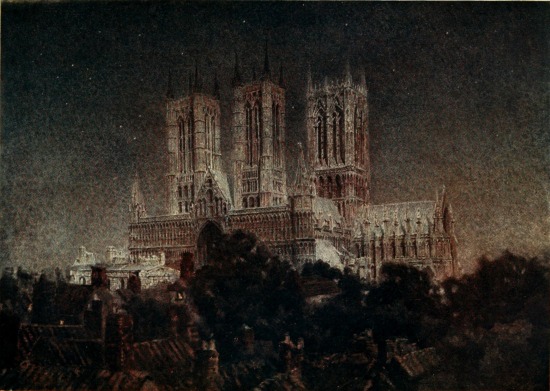
The central west front and the font belong to Remigius' period.
The three west portals and Norman portion of the west tower above the screen to the third story are 1148.
The nave, its aisles, and north and south chapels of the west end were finished in 1220.
The Early English work of the west front and the upper portions of the north and south wings with the pinnacle turrets date from 1225.
The west porch of the main transept is 1220.
The lower courses of the central tower date from 1235, while the upper ones originated in 1307.
The gables, the upper parts of the main transept, the parapets of the south side of the nave, the south wing, the west front, and the screen in the south aisle take us back again to the year 1225. The subsequent additions are:
The west door of the choir aisles in 1240; the south porch of the presbytery in 1256; the choir screens in 1280, and ten years later the Easter Sepulchre. The fine circular window at the end of the north transept, and especially the ones in the south transept, attract considerable attention. They are called respectively "The Dean's Eye" and "The Bishop's Eye," and are supposed to belong to the year 1350. Perhaps they are better known as the rose windows, which were more popular in France than in England. They exhibit a network of interlacing stems in imitation of the freedom of the briar-rose, and show the advanced skill of the workmen upon the plate-tracery they formerly put up as a masterpiece in the close vicinity of the rose windows.
For purposes of fortification, if necessary, Remigius chose the summit of the hill close to the Castle as the site. The Cathedral, dedicated to the Virgin Mary, thus, from its commanding station, forms a magnificent object seen from many miles around, and in the days of pilgrimage must have held out a welcome beacon of hope to the weary pilgrims.
Of the many famous prelates of this see must be mentioned Remigius, Bloet, St. Hugh, and Fleming, who died in 1431. The latter was the founder of Lincoln College at Oxford. Just at the back of this college is situated the well-known college of Brazennose, the foundation of another Lincoln Bishop, namely Smith, who died in 1521.
Again, Polydore Vergil, W. Paley, Cartwright the inventor of the power loom, and O. Manning the celebrated topographer are some of the many capitular members of whom Lincoln may well be proud.
Another attraction that Lincoln possesses in its vicinity is the race-course just beyond Newland.
For the early history of Lincoln we must go as far back as the Saxon days. After the departure of the Romans, Lincoln was the chief city of the district. It was the capital of the kingdom of Mercia, as it now is of the county of Lincolnshire.
Besides being described like other cities as being locally in the county of Lincoln, it is said to be in the wapentake. This is a departure from the "hundred" only in name, not in purpose. In the northern counties of England the wapentakes denoted the usual divisions answering to the hundreds of other counties. The origin of the wapentake is woepenge-toc, woepentac, from the Icelandic vapnatak. It literally means a weapon-taking or weapon-touching, and became an expression of assent. It was anciently invariably the custom to touch lances or spears when the hundreder, or chief, entered in his office. Tacitus, in the "Germania," gives a full description of this interesting rite.
In the Low Countries words very similar appear as the names of streets. At Bruges, in Belgium, there is the "Wapen-makers Straat," which means nothing more or less than that in that street was originally carried on an industry of warlike implements made by "weapon-makers."
In this wise Lincolnshire, Yorkshire, and Nottinghamshire were divided into wapentakes instead of "hundreds."
Another peculiar distinction of this city was its former government by a portreve. The term is now obsolete, but in the old English law it denoted the chief magistrate of a port or maritime town. In its old form it was written "portgerefa," a combined word meaning port, a harbour, and "gerefa," a reeve or sheriff. In the third year of the reign of George I. the city, with a district of twenty miles round it, was erected into a county, under the designation of "The City and County of the City of Lincoln." It was also entered as a maritime county. The extreme flatness of the Lincolnshire coast, with the slow sluggishness of the lower part of the course of the rivers, caused, in remote ages, the inundation of a great tract of land. The feasibility of reclaiming some portion of these fens received the attention of the Romans. They constructed the large drain called the car-dyke, signifying the fen-dyke, carrying it from the river Witham, near Lincoln, to the river Welland on the southern side of the county, with the object of draining the waters from the high grounds and of preventing the inundation of the low grounds. This policy was adopted in subsequent reigns with great success, and is even to this day continued. It has been the means of bringing rich tracts of land into cultivation, and of dispelling the unhealthy miasma which once caused the great prevalency of the ague fever. From fragments of vessels found near its channel it is affirmed that large ships of bygone days could formerly sail up the river Witham from Boston to Lincoln, but now it is only navigable for barges.
LINCOLN THE STEEP HILL
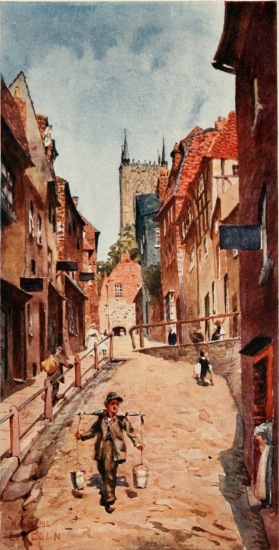
In 1121 Henry I. materially altered the great Foss-Dyke, extending a matter of eight miles from a great marsh near Lincoln to the river Trent, to serve the double purpose of draining the adjacent level and of constructing a high waterway for vessels from the Trent to Lincoln.
For defraying the expenses of draining, it appears that in general a rate was levied upon all lands in the contiguous wapentakes.
With this preface of the general character of the district, we propose to give a history of the city from its commencement.
On the summit of a hill close to the river Lindis, which is now called the Witham, the ancient Britons established a city of considerable importance from the most remote period of the British history. They christened the city after the original name of the river. This, on the invasion of Britain, passed into the hands of the Romans. They made it one of their chief stations in this part of England and established a colony. Instead of calling the city something "cester," they appear to have Latinised the Celtic name, signifying "the hill port by the pool," and called it Lindum Colonia. Through process of time and differences of pronunciation, consequent on the various dialects spoken successively by the Saxons, Danes, and Normans, the title became abbreviated to Lin-coln. The date of the Roman occupation is given as being in the year 100 A.D.
Their plan of the city consisted of the form of a parallelogram about 400 yards in length by the same number of yards in breadth, defended by massive, strong walls and intersected by two streets running at right angles.
Presumably the extremities of these streets pointed to the four cardinal points. They terminated in gates, the sole one of which—an excellent example of Roman architecture in England—is the North Gate, or, as it is generally called, Newport. It is composed of a central arch, with two lesser ones, one on either side, and is on a lower level than that of the street. Through this gate passes the great Roman Road called Ermine Street, out into the country for a distance of about ten miles or so. To the south-west of this entrance is supposed to have been a mint. This seems to be borne out by the discovery of many Roman coins found in the vicinity. The Exchequer Gate is a very fine specimen of the thirteenth century. It bears a carved representation of the Crucifixion, which lends it considerable interest.
At the top of High Street is Pottergate and Stonebow, over which is the Guildhall. The latter is an ancient embattled structure, rebuilt in the reign of Richard II.
Besides the Northgate, the Romans appear, according to remains found, to have contributed the inevitable bath and sudatorium. On their departure from Britain, Lincoln was made the capital of the kingdom of Mercia by the Saxons in 518. Vortimer, who endeavoured to oppose them, was slain and interred here. From 786 Lincoln suffered repeatedly from visitations of the Danes, control being recovered by Edmund II., according to agreement with Canute in 1016. Throughout the whole of this period the only peace the city had enjoyed was when Alfred the Great subdued the Danes. However, Edmund II., better known as Edmund Ironsides, did not live many days longer, being murdered at Oxford. Whereupon, in 1017, Canute took possession of the murdered monarch's territory, in which Lincoln was included. William I. then came along in 1086, swept away close upon two hundred houses to make room for the erection of a castle—on a site which meant the occupation of nearly one-fourth of the old Roman city.
The Castle still has traces of Norman work, the foundations of which were formed of enormous beams of wood and a mixture of thin, coarse mortar, used for pouring into the joints of masonry and brickwork, usually called "grouting."
In that wonderful survey of his—the "Doomsday Book"—fifty-two parishes are stated to have composed this city.
The Castle in 1140 figured in the disputes between the Empress Matilda and Stephen, the latter of whom was crowned here in 1141. Stephen was, however, made prisoner, but was afterwards exchanged, and lived three years later to celebrate Christmas here. But prior to this period Lincoln was for the first time erected into a see in the reign of William Rufus.
LINCOLN THE WEST TOWERS
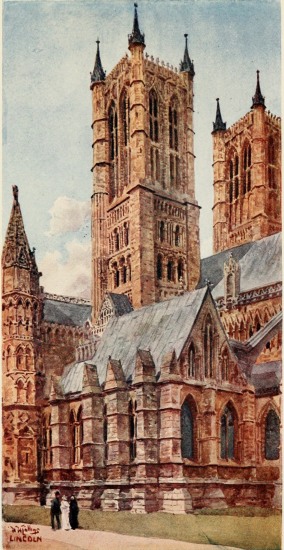
In pursuance of a decree of a synod held at London at this time, that all the episcopal sees should be removed to fortified places, Remigius, the Bishop of Dorchester, determined to establish the seat of his diocese at Lincoln. He built the church and an episcopal palace, but died just before its consecration.
His work was completed by his successor, Robert Bloet. In the reign of Henry II. the Diocese, which once extended from the Thames to the Humber, was curtailed to add a part to form that of Ely. It again suffered diminution in Henry VIII.'s time, when the limits of the Sees of Oxford and Peterborough were defined. In spite of it all, Lincoln's see is fairly extensive, though it suffered again in 1884. Prior to this monarch's reign Lincoln had as many as fifty-two churches, but when he decided upon reformation from Popery their number was greatly diminished. Their names, still preserved, are the sole reminders of their former existence, with the exception of fourteen which remain. These have probably been rebuilt.
Before entering further concerning the See, and the Cathedral founded by Remigius, which was constantly in the hands of the architect even down to recent years, we shall add the chief political events subsequent to Stephen. On the death of this monarch, Henry II., probably not satisfied with his coronation in London, underwent the ceremony again at Wigford, a place just a little to the south of Lincoln city.
John here early in his reign received the homage of David the King of Scotland. During the struggle with the barons in 1216 the citizens remained loyal to their sovereign; but their city was taken at last in 1217, and invested by the barons under Gilbert de Gaunt, afterwards created Earl of Lincoln. After the disaster that overtook John's army in the passage across the Wash, and his death, which took place soon afterwards, his son Henry III. was loyally assisted by the inhabitants against the barons, who had summoned to their aid Louis, the Dauphin of France. The Castle, however, remained for many years in the possession of the Crown. Eventually it became the summer residence of the celebrated John of Gaunt. He was Earl of Lincoln, and in 1396 married here Lady Swinford, who was a sister-in-law to Chaucer.
Several times Parliament was held in Lincoln; namely, twice by Edward I., and in 1301 and 1305; twice also by Edward II.; and in the first year of Edward III.'s reign.
Henry VI. paid a visit, as did also Henry VII., who held a public thanksgiving for his victory over Richard III. at the battle of Bosworth Field.
Throughout the parliamentary war the inhabitants were staunch supporters of the Crown. The city was stormed by Earl Manchester, an indefatigable soldier of Cromwell. The Commonwealth troopers during their occupation created considerable havoc in the ecclesiastical buildings. According to their invariable custom they stabled their horses and housed themselves within the cathedral walls. Not satisfied with that, they damaged the tombs and deprived the niches of their statuary.
To go back a matter of four hundred years to this period, the population of Lincoln rose en masse against the Jews. They were alleged to have crucified a little Lincoln boy, presumably a Christian, at a place called Dunestall in the year 1255. The enraged mob wreaked their vengeance by causing the execution of eighteen Jews, murdering many more, and later on making a saint of the victim, under the name of "little Saint Hugh." The punishment seems to be out of proportion to the crime. In fact little Hugh's crucifixion appears rather to have served as an excuse for the wrongful persecution of the Semitic race than for the proper administration of the law irrespective of creed. Even to this day this regrettable racial feeling is kept alive. In the middle ages this bitter feeling was fostered and brought about chiefly owing to the wonderful success of the Jews in England, who grew rich upon the profits accruing to usury, which they alone might exercise. Among many prominent instances of popular vengeance, besides little St. Hugh's murder, are the tombs of boy-martyrs, shrines which became often the most popular in the Cathedral.
The most characteristic are the records of the burials, attended with great pomp, of St. William of Norwich in 1144, Harold of Gloucester in 1168, Robert of Edmundsbury in 1184, a nameless boy in London in 1244, and St. Hugh of Lincoln in 1255; boys canonised by the populace simply through bitter racial feeling. Remains of the shrine of little St. Hugh are still extant at Lincoln.
Among the many interesting antiquities of Lincoln is a fine specimen of the Norman domestic architecture. It is called the Jews' House, and it is an edifice of curious design. Its mouldings much resemble those of the west portals of the Cathedral, a date which probably would be 1184. The house belonged to a Jewess called Belaset de Wallingford. She was hanged in the reign of Edward I. for clipping the coin.
Besides this are noticeable the ancient conduits of St. Mary le Wigford, which is Gothic, and the Greyfriars Conduit in High Street.
In the cloister garden are preserved a tesselated pavement and the sepulchral slab of a Roman soldier. From the same place the splendidly carved stone coffin lid of Bishop Remigius has recently been removed into the interior of the Cathedral.
In the years 1884 to 1891 excavations were conducted on the site of the old "Angel Inn," when it was discovered that it had been a Roman burial-place. Amongst the débris were found several funeral urns. Under St. Peter's at Gowts was brought to light a Roman altar, and remains of a Roman villa were unearthed at Greetwell. In the same year, that is to say 1884, the Blue Coat School was closed, its endowments were given to the Middle School, and the buildings were sold to the Church Institute.
Within the last few years two memorable events occurred. In the year 1884 the See of Lincoln was deprived of the county of Nottingham, which was transferred from that see to the See of Southwell. This was followed shortly afterwards by the great lawsuit called "The Lincoln Judgment."
Great controversy arose and came to a climax. In the year 1888 Dr. King, the Bishop of Lincoln, was cited before his metropolitan, Dr. Benson, the Archbishop of Canterbury, to answer charges of various ritual offences alleged to have been committed by himself at the administration of the Holy Communion.
The action was brought by certain gentlemen of Lincoln interested in the doings of their prelate. Their religious scruples had been outraged, it appears, on two separate occasions; namely, in the Church of St. Peter's at Gowts on December 4, 1887, and in the Cathedral on December 10 of the same year. An appeal had been made to the Archbishop to restrain these illegal practices. The celebrated ecclesiastical lawsuit was heard in 1888. The judgment was confined to the declarations of the law, which were summarised. No monition or sentence was pronounced against the Bishop of Lincoln for having committed breaches of the ecclesiastical law. The dissension has happily ended. The Bishop of Lincoln has conformed his practice to the Archbishop's judgment from the date of its delivery, and still retains his bishopric. Thus has ended the conflict between the Primate and the Suffragan, which agitated, for a brief space of time, the opponents of offences of ritualism, and brought about the famous Lincoln Judgment.

Baden-ceaster. ("Doomsday Book.")
N the banks of the river Avon, in the County of Somersetshire, is situated the beautiful and ancient city of Bath. Its ecclesiastical history is closely bound up with that of Wells, and at one time with that of Glastonbury, when it figures in the disputes concerning the See. This unseemly quarrelling amongst prelates is now happily laid at rest. Though lacking in all authority, Bath is the joint partner of Wells in the bishopric title.

The origin of the city of Bath takes us far back. Perhaps the strongest link with the Roman days, besides the Roman roads, lies in the present-day existence of the Roman baths, built about 55 B.C.
These baths were probably erected to confine the hot springs, and to enjoy more thoroughly the benefit derived from the medicinal properties of these waters, which are chalybeate and saline.
Though we are told that in all probability it is a mere myth that the British king, Bladud, first founded this city of Bath, yet we are inclined to think that the presence of these springs would influence a settlement of even the nomadic British, prior to the Roman invasion.
When we remember what primitive ideas the early Britons had, we cannot wonder at the non-existence of any vestiges of their occupation. In these days of materialism one loves to respect old traditions, however uncertain they may be in substance. We would therefore give the benefit of the doubt to an early British settlement.
With the arrival of the Romans the approximate date and origin of Bath can be readily ascertained. From excavations on the place since the year 1875, it has been proved that the Romans founded here a city, which they named Aquae Solis, in the reign of Claudius. In 55 B.C. the baths had been constructed for certain. In addition to this they erected a temple to Minerva, with votive offerings, and many other buildings, and carried a line of fortifications and walls around the city. The remains of their marvellous architecture still bear testimony, though they have suffered ill-treatment and undergone restoration, to their former magnificence and grandeur.
On the retirement of the Romans Aquae Solis passed into the hands of the Britons, under the name of Cœr Palladen (the city of the waters of Pallas). During their possession of a century, two attacks made by the Saxon chieftains, Œlla and Cerdic, were repulsed by King Arthur.
The Saxons, by the year 577, having practically subverted the rest of the kingdom, turned their attention to the West. They seized and ravaged Bath. The Roman structures were reduced to ruins. After a while they rebuilt the walls and fortifications upon the original foundations, employing the old materials. The baths also were soon restored. By this time the Saxons had renamed the city, "Hat Bathur" (Hot baths), and "Ace-mannes-ceaster" (City of invalids). The "ceaster" tacked on to the Saxon word is the first evidence we get of the Saxon recognition of the former existence of the Roman occupation of this city.
With the spreading influence of Christianity travelling from the east to the west of England in the seventh century, a nunnery was erected here, in 676, by King Osric. This was destroyed during the wars of the Heptarchy, and on its site a college of secular canons was founded, in 775, by Offa, King of Mercia. This monarch had taken Bath from the King of Wessex, and had annexed it to his own kingdom. Possibly in recognition of this victory he built an abbey in 775.
After this the city evidently increased in prosperity, for it was important enough to witness the coronation of Edgar in 973, as King of England, by Dunstan, Archbishop of Canterbury. At the same time Edgar converted the college of secular canons into a Benedictine monastery. This, with the church, was again demolished by the Danes.
This city of Bath, like all other cities of that time, came under the Norman Survey, and was entered in Doomsday Book as Baden-ceaster. William Rufus had scarce been crowned king when Bath was seized and burnt, the most part by Geoffry, Bishop of Coutances, and Robert de Mowbray. They had jointly risen in support of the claim laid to the throne of England by Robert Duke of Normandy. But under the abbacy of John de Villula it soon recovered prosperity. This abbot, on promotion to the See of Wells, about 1090, purchased the city from Henry I. He built a new church, and removed the See from Wells to this place. Here it remained till 1193, when Bishop Savaricus handed it over to Richard I., in exchange for Glastonbury Abbey.
BATH PULTENEY BRIDGE
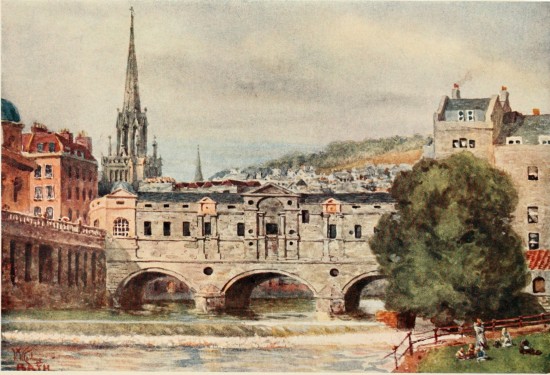
About this time Bath received its first charter as a free borough from this monarch, and was represented in Parliament in 1297. In 1330 the manufacture of woollen cloth was established by the monks. By reason of this the shuttle was incorporated in the arms of the monastery. In 1447, and in 1590, Henry VI. and Elizabeth respectively granted charters, which materially increased the prospects of the city.
This present cruciform Abbey Church dates from 1499. It is dedicated to St. Peter and St. Paul, and forms one of the best specimens of the later style of English architecture. It rests upon the site of the conventual church of the monastery founded by Osric. After a course of eight hundred years it became dilapidated, and was rebuilt from the old materials in 1495, by Bishop Oliver King. He is said to have been admonished in a dream. He did not live to see the completion of the building.
As the citizens refused to purchase it from the Commissioners of Henry VIII., the walls were left roofless till Dr. James Montague, Bishop of the Diocese, with the aid of the local nobility and gentry, procured the necessary funds, and finished it in 1606.
On the west front is sculptured the founder's dream of angels ascending and descending on Jacob's ladder. The church is crowned with a quadrangular tower of 162 feet in height from the point of intersection.
Though the medicinal properties of the springs of Bath attracted from the earliest times the continuous attention of invalids, it was only under the guidance of Beau Nash, the gamester, and the enterprise of John Wood, the architect, that it reached to the highest pinnacle of fame as a place of fashionable resort in the eighteenth century. The works of Fielding, Smollett, Jane Austen, Dickens, Thackeray, and others, give us a clear insight into the meteor-like prosperity of the city, for, after the death of Nash, it gradually relapsed to its normal state, and, in fact, according to statistics, the number of inhabitants has decreased even within the last few years.
A brief sketch of Beau Nash and the means adopted will account in some measure for the marvellous change in Bath in the eighteenth century. Nash was educated at Carmarthen Grammar School, and Jesus College, Oxford. He then obtained a commission in the army. This he soon threw up to become a law-student at the Middle Temple. Whilst there he gained much attention by his wit and sociability. These qualities induced his fellow-students to elect him as the president of a pageant that they prepared for William III. The king was so pleased with Nash that, it is said, he offered him a knighthood. This Nash refused unless accompanied by a pension, which was not granted.
He was much addicted to gambling, which, in addition to a restless spirit and an empty purse, led him in 1704 to try his luck at Bath, a place which then offered opportunities to a gamester. There he soon became master of the ceremonies, in succession to Captain Webster. Under his authority reforms were introduced which speedily accorded to Bath a leading position as a fashionable watering-place. He formed a strict code of rules for the regulation of balls and assemblies; allowed no swords to be worn in places of public amusement; persuaded gentlemen to discard boots for shoes and stockings when in assemblies and parades, and introduced a tariff for lodgings.
As insignia of his office he wore an immense white hat, and a richly embroidered dress. He drove about in a chariot with six greys, and laced lackeys blew French horns. When Parliament abolished gambling it caused a serious check to the visits of fashionable people to the city. However, the Corporation, in recognition of his valuable services, granted Nash a pension of 120 guineas a year, and at his death in 1761 he was buried with splendour at the expense of the town. A year after his demise his biography was anonymously published in London by Oliver Goldsmith.
John Wood, the architect, though hardly as well known to posterity as Nash, must not be overlooked. Till he appeared in Bath in 1728, the city had been confined strictly within the Roman limits. The suburbs consisted merely of a few scattered houses. Wood improved and enlarged the city by his architectural efforts, which led to the quarrying of freestone found existing in the neighbourhood. His successors carried on his enterprise.
The grand Pump-room, erected in 1797, with a portico of Corinthian columns; the King's Bath, with a Doric colonnade; the Queen's Bath; the Cross Bath, so called from a cross erected in the centre of it; the Hot Bath, on account of its superior degree of heat, were once thronged by fashionable gatherings in the eighteenth and nineteenth centuries.
The architecture in the eighteenth century at Bath was an adaptation of the Doric and Ionic orders. Nearly all the principal buildings were constructed after these classic principles. St. Michael's Church belongs to the Doric, with a handsome dome, and was erected in 1744. Even the Greek influence is the prevailing feature of Pulteney Bridge.
In conclusion, amongst eminent men of Bath may be mentioned: John Hales, Greek Professor at Oxford in 1612; and Sir Thomas Bodley, founder of the Bodleian Library at Oxford, was a native of, and received his early education in the Grammar School of this city. Benjamin Robins was born here in 1707; he was a celebrated mathematician, and wrote the account of the voyage of Commodore Anson round the world.
Amongst the tombs in the Abbey are those to the memory of Quin, Nash, Broome, Malthus, and Melmothe.
The hot springs of Bath still continue to alleviate the aches and pains of invalid visitors. The interesting history, the curious mingling of Roman and Later English architecture with the revival of the Ionic and Doric orders in the eighteenth-century buildings, can never fail to be of interest alike to the student and the casual visitor in Bath.

Salisberie. ("Doomsday Book.")
ALISBURY affords a remarkable instance of the complete transference of the cathedral followed by the ultimate desertion of the city in the change from old Sarum, the original site, to New Sarum, another within a short distance—one might almost say within a stone's throw. In the old days of prosperity Old Sarum, now simply a conical mass of ruins, was peopled with the Belgæ, who came from Gaul and ousted the original inhabitants. How this site ever came to be chosen as a desirable place of settlement seems to be rather a mystery, for even in those early days constant difficulties arose with regard to the insufficiency of water. They aptly called it "the dry city," which is supposed to be the meaning of the old name Searobyrig, which later underwent a further contraction—Scarborough. This arid spot, however, received the attention of the Romans, who possibly were attracted by the natural advantages of defence offered by the conical mound rising abruptly, as it does, from the valley. They carried on the old name and Latinised it, as they invariably seemed to have done, or rather made a compromise between the native and their own formation, and arrived at Sorbiordunum. The scarcity of water seems not to have deterred them in any way, as witness the many evidences of their fossæ, extensive ramparts, and fortress—signs which indicate that in their hands Old Sarum was held to be of considerable importance. Roman roads branched out of it, no doubt pointing to the four cardinal points, in accordance with regular custom, though their whereabouts may be difficult to define, seeing that several centuries have passed since the desertion of Old Sarum.

With their passing away the Roman conquerors have left behind them many relics, possibly in their day considered worthless, but the unearthing of which has caused, for many a year, unalloyed joy and given a priceless treasure to the unwearied antiquaries. Another great source of speculation to the archæologists has been the temple of the Druids erected some time at Stonehenge. It lies beyond the city on the great Salisbury plain. This primitive form of architecture takes us back to many years before Christ, when the early Britons wore no clothes, save the skins of animals they slew in the chase, and when they could neither read, write, weave, nor do anything which would be considered nowadays as civilising. They were to all intents and purposes mere savages, kept in control by their priests and lawgivers, the Druids, whom they held in the greatest respect. The Britons, we are told, had the additional discomfort of dwelling in holes burrowed in the ground, or in miserably constructed huts. In view of this poor state of domestic architecture, how they ever managed to erect roofless temples, as at Stonehenge and at the island of Anglesea, and to overcome, what must have been to them a very great engineering feat, the setting up of the heavy blocks of stone in situ, seems marvellous and not easy of explanation.
SALISBURY HIGH STREET GATEWAY INTO THE CLOSE
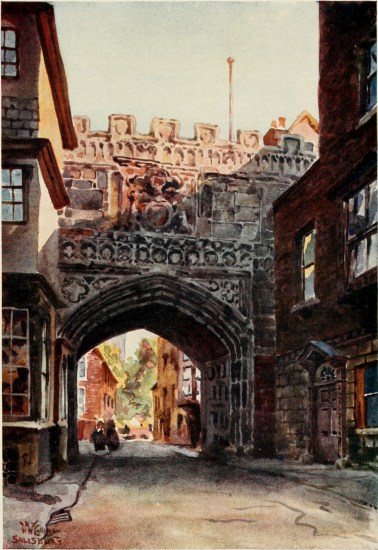
The great veneration in which the Britons held these temples of the Druids is much accentuated by an incident during the second occupation of Britain by the Romans. Suetonius Paulinus, one of their greatest generals, thought that by destroying the temple at the island of Anglesea he would shake the faith of the Britons in their priests, and gain thereby a speedier conquest, much in the same way as when Clive in India knocked down Dupleix's column to undermine the French influence over the natives. In the latter case history has assured us of the ultimate fulfilment of hopes, and it was the same with Paulinus in 61, only on his return to the mainland he all but suffered a reverse from an unexpected rising of Britons under Boadicea. Nevertheless, the power of the Druids was irretrievably broken by the slaughter of their order and the felling of the groves at Anglesea, as Paulinus had foreseen. What the object and origin of these remains at Stonehenge were, still serve as an interesting matter for controversy. Competent authorities, like Geoffrey of Monmouth, Polydore Vergil, and in the eighteenth century Dr. Stukely, arrived more or less at the same conclusions. The first named said that Stonehenge was a sepulchral monument erected by Aurelius Ambrosius, who, according to a tradition, was thus led by the counsel of Merlin to commemorate the slaughter of 500 Britons by Hengist, the Saxon chief, about the year 450 A.D. Polydore Vergil confined himself to the statement that it was the ancient temple of the Britons in which the Druids officiated, whilst Dr. Stukely asserted that the Britons here held their annual meetings at which laws were passed and justice administered. He was also fortunate enough to discover the "cursus," in 1723, in its vicinity. Perhaps it may be thought that Stonehenge is out of place in this account of Salisbury; but in leaving it out it would be as much as to doubt the genuineness of any one's visit to this ancient cathedral city if he had not also seen the Druidical remains.
In the neighbourhood of Old Sarum, Cynric won a victory over the Britons in the year 552. Though it steadily increased in importance, little worthy of notice occurred there till the close of the tenth century. At the small town of Wilton, which is almost three miles distant from Salisbury, the seat of the Diocese was originally established in the first years of the tenth century, and remained under the superintendence of eleven succeeding bishops. The last one of them was Hermannus. On his accession to the See of Sherborne—an ancient and interesting town of Dorsetshire—he annexed it to the Bishopric of Wilton. He thereupon founded, for these united sees, a cathedral church at Old Sarum. This effort of his was afterwards completed by Osmund, who accompanied William the Conqueror to England, and was by him appointed bishop. A matter of sixty years prior to the Norman invasion Old Sarum had fallen a victim in 1003 to the fury of Sweyn, the King of Denmark. This was in accordance with a vow of retaliation he had made when he learnt of the murder of his sister in the general massacre of the Danes, which had taken place the year before. This unhappy period, when many other counties besides Wiltshire suffered extensively, was during the reign of Ethelred the Unready.
SALISBURY THE MARKET CROSS
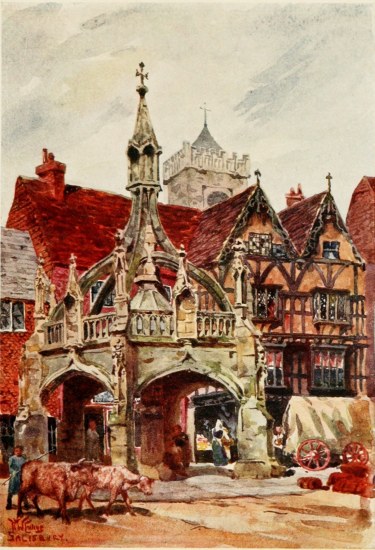
In the great plain of Salisbury the Conqueror, in 1070, passed a review of his army, just flushed with their victories in the neighbourhood. On the completion of his great survey, the "Doomsday Book," in 1086, he here at Salisberie, as he renamed the city, received the homage and oath of allegiance from the English landlords. Till the year 1217 the See remained at Old Sarum, and even after the complete depopulation and the demolition of every house of this ancient Roman site, it still was represented regularly at Parliament by two members till the year 1832.
The reasons that led to the choice of the new site by Bishop Poore were the many advantages offered, especially the abundance of water by New Sarum, as it was called, as set against the exposure to the stormy winds which it was alleged went even so far as to drown the voice of the officiating priest, the congestion of houses within its narrow limits, the difficulty of procuring water, and finally the despotism of the governor at Old Sarum. To rid himself of these inconveniences, Bishop Poore procured the papal authority to the removal of the Cathedral from Old Sarum to its present site in the year 1218, though not till the Reformation was the service discontinued in the old buildings.
By then New Sarum had reaped the full benefit of the new conditions and surroundings. Though only two miles away, the old place, in proportion to the rising of the new township, sank to a few inhabitants, loth perhaps to part with old associations.
The first building to appear in New Sarum, or Salisbury as we shall henceforth call it, seems to have been the wooden chapel of St. Mary, the erection of which was commenced in the Easter of the year 1219. This was followed in the year 1220 by the foundation of the new cathedral as planned by Bishop Poore. It was completed and dedicated to the Blessed Virgin Mary in 1258. The ground-plan is that of a Greek or double cross. With the slight exceptions of the upper part of the tower and the spire, which belong to a later date, the entire fabric represents the purest style of the Early English architecture. The cloisters, built by Bishop Walter de la Wyle, are the largest and most magnificent of any in the kingdom. They are of the late Early English style, and took, with the addition of the Chapter House by the same prelate, from 1263 till 1274 to complete.
SALISBURY THE CLOISTERS
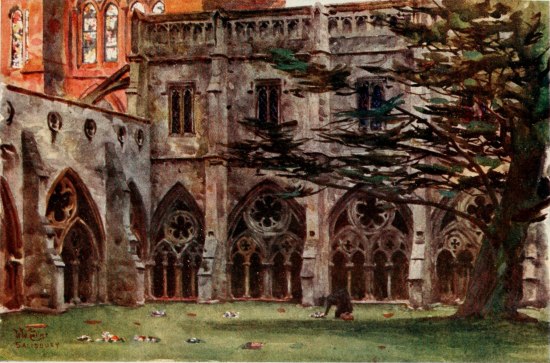
Shortly after, the upper part of the tower was built in the Decorated style by Bishop Wyville, about 1330. Five years later it was capped by the highest spire in England. A marvellous achievement of lightness of design, of slenderness and beauty of proportion, it reaches from base to crown to the remarkable height of four hundred and four feet. Its great height has caused much anxiety from time to time, through the enormous pressure exerted upon the tower beneath it.
This unique example of a spire was followed next by a chapel built by Bishop Beauchamp between 1450 and 1482. Another was carried out by Lord Hungerford in 1476. These two chapels, together with an elegant campanile, were entirely swept away in the restorations that took place under the direction of the architect James Wyatt. No doubt the Cathedral required extensive repairs, but it seems regrettable that any architect should have caused such demolition, instead of endeavouring to make good the ravages of time. As for the old west front, the coloured drawing of Mr. Collins gives an excellent idea of its rich sculpturesque beauty.
The Cathedral is isolated in the centre of an immense lawn, as it were. This again can be kept private by the Close, the area of which extends to half a mile square. Within its limits is a delightful mall shaded with trees, as there are also the Bishop's Palace,—a building of various dates, originated by Poore the founder,—the Deanery, and several other houses. We have said elsewhere that the Cathedral Close of Salisbury may be considered the best example of its kind in England, though that at Wells is not far behind. The close was an enclosure, within the precincts of the cathedral, reserved for the dwellings originally intended for the exclusive domestic use of the Bishop and canons. This, however, is not strictly observed now.
Two or three delightful gateways of ancient character and beautiful design give access to the Cathedral Close of Salisbury. Appended to the Cathedral is the beautiful Chapter House, lighted by lofty windows. It is octagonal in form, the roof of which is upheld by a central clustered column. A frieze in bas-relief, carried round the interior of the building, is ornamented with biblical subjects. At different times numerous monuments, chiefly to the bishops of the See, have been erected, notably those to Bishops Joceline and Roger.
A monument to one of the children of the choir has a sad interest. It was customary during the festival of St. Nicholas for one of the choristers to personate the character of a bishop. In this case the boy-bishop died while performing his rôle.
The other interesting buildings of the town are the parish churches of St. Martin, St. Thomas, and St. Edmond; the banqueting hall of J. Halle, who was a wool merchant in 1470; Audley House, which also dates from the fifteenth century, and which in 1881 underwent a thorough repair. It serves now as the Church House of the Diocese. Elizabeth's Grammar School, St. Nicholas Hospital, founded in Richard II.'s reign, and Trinity House, established by Agnes Bottenham in 1379, are interesting links of mediævalism.
In this period must also be included the Poultry Cross. It is a high cross, hexagonal in form. Its space is well distributed by six arches and a central pillar. Lord Montacute erected it just prior to the year 1335.
The city's prosperity depended upon that of the church. In fact it was laid out according to Bishop Poore's plan. The citizens deserted Old Sarum to settle around the new ecclesiastical establishment at New Sarum. In 1227, by a charter of Henry III., the city enjoyed the same freedom and liberties as those of Winchester. The government of the city became vested in a mayor, recorder, deputy-recorder, twenty-four aldermen, and various other subordinate officers. The charter was confirmed by successive sovereigns till the accession of Anne.
Salisbury, or New Sarum, was first represented at Parliament in 1295. In 1885, by the Redistribution Act, its two representatives were reduced to one. The city itself has also witnessed the assembly of Parliament within its limits on various occasions. For being implicated in a conspiracy for deposing Richard III. to raise Henry Tudor, Earl of Richmond, to the throne, the Duke of Buckingham was in 1484 executed at Salisbury. For a reward of £1000 the Duke was betrayed by a dependent with whom he was in hiding in Shropshire.
SALISBURY THE CATHEDRAL
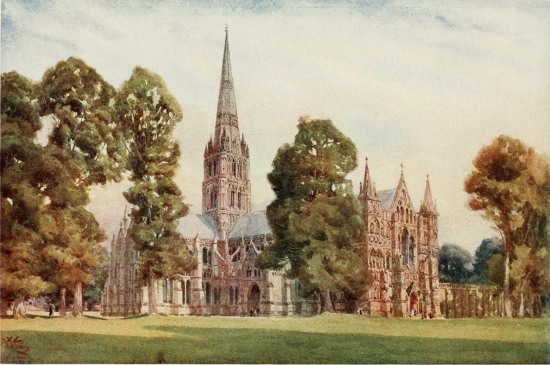
During the Civil War the city was held alternately by both parties. Since then the citizens have been left in comparative peace, intent on their several industries. At one time they were actively engaged in the preparation of woollen articles and in the manufacture of excellent cutlery. These are now declined, and such commodities as boots and shoes take the first rank, whilst the shops depend mainly on the villages and agriculture around. The many places of antiquity in this ancient city of the county of Wiltshire have furnished many interesting palæolithic relics for the reception of which the Blackmore Museum was established. The library was instituted by Bishop Jewal, in 1560 to 1571.
There have been many men of note from Salisbury. The celebrated poet and essayist Addison, born near Amesbury in this county of Wiltshire, was educated at the Grammar School for choristers within the Close. Amongst the many eminent natives of the city are included William Hermann, author of several works in prose and verse; George Coryate, who wrote "The Crudities"; John Greenhill, a celebrated portrait painter; William and Henry Lawes, both musicians and composers; and James Harris, author of "Hermes." But the most conspicuous, or rather the best known, is Henry Fawcett, the politician and economist.
Born in 1833, he was the second son of a draper who, starting as an assistant, became afterwards his own master. He was enabled to afford his son Henry a good education at King's College and Peterhouse, Cambridge, from which he migrated to Trinity Hall. He became Seventh Wrangler and Fellow of his College. At the Cambridge Union, Fawcett gained considerable notice for his oratory. His ambition conceived the idea of attaining the highest honours in the kingdom through the profession of a barrister. For this purpose he entered Lincoln's Inn, but at the age of twenty-five a terrible accident happened to him. His eyesight was lost by two stray pellets from the gun of his father.
Though his plans of advancement were altered, he determined within ten minutes of the catastrophe to continue his old pursuits of rowing, fishing, skating, riding, and even playing at cards which were marked. He became Liberal candidate for Brighton in 1865, and entered Parliament just when Palmerston's career came to a close. He opposed Gladstone's scheme for universal education in Ireland. He was an opponent to Disraeli's Government.
On the return of the Liberal Party to power Fawcett was offered the post of Postmaster-General, though without a seat in the Cabinet. He introduced five important postal reforms; namely, the parcels-post, postal-orders, sixpenny telegrams, the banking of small savings by means of stamps, and increased facilities for life insurance and annuities. He also invented the little slot label, "next collection," on the pillar-boxes.
The employment of women he greatly advocated. The defeat of the scheme for the deforestation of Epping Forest and the New Forest was entirely due to the exertions of this great politician.
After a marvellous career of many years Fawcett died in 1884. From humble origin, and in spite of his blindness, if he did not realise his full ambition, he reached to an exalted position in the State—an achievement never accomplished by any one under like disability.

N the great peninsula that runs out into the Atlantic is Devonshire, adjoining Cornwall, that dwindles to the Land's End, the point eagerly welcomed by visitors to England, the last of the Old Country to which a farewell is given. Through the northern portion of Devonshire meanders the river Exe, having established its source in Somersetshire. Quite ten miles before the river empties its waters at the mouth into the English Channel, on a broad ridge of land rising steeply from the left bank of the Exe, is the old city of Exeter. It is the chief of the county, and has had a varied existence.

For the earliest period of Exeter, Geoffrey of Monmouth supplies much information, which has been greatly borne out by subsequent researches. He considered that Exeter was a city of the Britons some time before the Romans elected to establish their camp. The British named it indifferently Cær-Wisc (city of the water), or Cær Rydh (the red city), from the coloured nature of the soil. When captured by the Romans they made it a stipendiary town. They called it Isca, to which was added Danmoniorum, to avoid confusion with the other Isca, a Latinised name given also to a town on the river (now Usk) in Monmouthshire. Many proofs of Roman occupation have turned up in the shape of numerous coins and other relics.
The year 1778 was especially notable for the excavations which brought to light many important objects. Small statuettes of Mercury, Mars, Ceres, and Apollo, evidently the household gods of the Romans, together with urns, tiles, and tessellated pavements, were unearthed. Exeter at one time went by the name of Augusta, which was due to its having been occupied by the Second Augustan Legion, whose commander, Vespasian, included the city under his conquest Britannia Prima. The same legion, during the period 47 to 52, had also a permanent station at Isca Silurum, as Cærleon-on-the-Usk in Monmouth was called. But as Vespasian continued the conquest, 69 to 79, it seems fair to surmise that the Second Legion of Augusta was advanced or a portion sent from Isca Silurum to garrison Isca Danmoniorum, the present Exeter.
For a considerable time it was the capital of the West Saxon kingdom. It was probably during the Saxon occupation that the city changed its name to Excestre, which would easily be contracted into that of Exeter. In violation of a compact made with Alfred, who was a Saxon monarch, the Danes seized the city. They were, however, compelled to evacuate it, together with the surrender of all their prisoners within the West Saxon territory, by Alfred, in 877. This monarch was again called upon in 894 to relieve the Saxons from their Danish oppressors. The next century witnessed a marked improvement in the prosperity of the city. It had from quite an early period been distinguished for its numerous monastic institutions, so much so that it was said to have been called "Monk Town" by Britons in Cornwall and the heathen Saxons. They were pleased to deride it thus, but when Athelstan came he clearly made them understand that it was no happy state to be without the pale of the Church. He so thoroughly instilled into them the necessity of imbibing the principles of religion that those who were unwilling to become converts were expelled.
EXETER FROM THE PALACE GARDENS
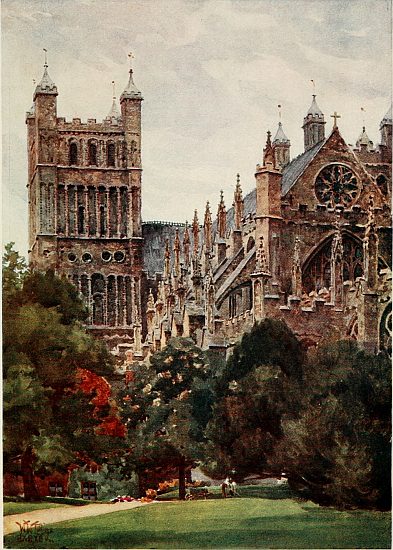
With the exception of a few, we may take it that many embraced Christianity as a matter of compulsion or for expediency's sake, for in those days of hard knocks it was hardly likely that any mass of ignorant peasants would comprehend anything but the most stringent measures. The transition from heathen darkness to the light of Christianity must have meant a severe initiation to two-thirds of the population of Exeter at the time of Athelstan's accession. He came westward about the year 926 and found the Britons and Saxons living amicably and enjoying equal rights. The city had by them already been called Exenceaster, that is, the "cester" or fortified town on the "Exe." Athelstan augmented the number of religious institutions by the foundation of a Benedictine monastery. The building was dedicated to St. Peter, the establishment of which there seems no reason to doubt gave birth eventually to the present cathedral. Besides this he materially increased the importance of the town by appointing two mints and erecting regular fortifications with towers and a wall of hewn stone. Athelstan's monastery was destroyed by the Danes. King Edgar in 968 restored it, and appointed Sydemann to the Abbacy, as it then became. Ultimately this abbot was raised to the Bishopric of Crediton, which was the seat of the Devonshire Diocese about 910. In 1003 Exeter, after a gallant defence of some three months' duration, was betrayed by its governor into the hands of Sweyn. As has been said elsewhere, this king came from Denmark especially to punish Ethelred the Unready for having allowed the massacre of Danes, in which the sister of Sweyn had perished. The monastery of St. Peter was not spared, nor was the city, which did not recover from the terrible visitation till the accession of Canute.
From this time Exeter increased to such importance and wealth that in the reign of Edward the Confessor it was deemed advisable and for better security to make it the head of the Diocese.
For this purpose the Sees of Crediton and St. Germans (Cornwall) were united under one bishop. To uphold worthily the new dignity, the abbey church of St. Peter was erected into a cathedral by the Confessor, who appointed his chaplain Leofric as first bishop of the united see. Leofric had the monks removed to Westminster Abbey, and installed in their stead were twenty-four secular canons. The date of Leofric's installation is about 1040, which is, of course, that of the foundation of the Cathedral. This arrangement was altered on the re-erection of the Cornish See in 1876.
In William the Conqueror's time Githa, the mother of Harold, gave the Normans considerable trouble. It was only on the appearance of that monarch before the city's walls that the citizens surrendered. They were made to pay a heavy fine, whilst Githa escaped with her treasures to take refuge in Flanders. William in the end relented and renewed all their former privileges. Nevertheless he took the precaution to erect a fortress in Exeter, the charge of which was entrusted to Baldwin de Brioniis, who, by virtue of his office, became Earl of Devon and sheriff of the county. The chief remains of the Castle is a gateway tower.
This same castle was held by the partisans of the Empress Matilda for three months, when it was compelled in 1136 through scarcity of water to surrender to Stephen. Contrary to expectation, they were treated very well. Henry II., for their loyalty, was pleased to grant additional privileges.
In 1200 the city for the first time was governed by a mayor and corporation. Subsequently their importance was increased by the charters of Edward III., Edward IV., and Henry VIII., whilst Henry VIII. constituted Exeter a county of itself. These privileges were extended by Charles I.; and in 1684 a new charter of incorporation was granted by Charles II., but not put into effect. In 1770 George III. renewed and confirmed the charter, since when the government has been invested in a mayor assisted by subordinate officers. In the meantime a curious incident occurred in 1824, which greatly interfered with the prosperity of the city, inasmuch as the navigation of the river Exe was obstructed by a dam erected by Hugh Courtenay, at that time Earl of Devon.
Exeter, through its happy situation on the river Exe, had for many years reaped full benefit. At the time of the Conquest it had gained considerable importance through the river being navigable for ships right up to its quays. Among many petty matters that annoyed the Earl the following is alleged to have been the chief. There were three pots of fish in the market-place. The Earl wanted them all. The Bishop likewise. Neither would give way, and the Mayor was called in to adjudicate. He allotted one to the Earl, the second to the Bishop, and the third to the town. This distribution did not suit the Earl. Out of pique he caused a dam to be constructed across the Exe at Topsham. There he built a quay, and had the satisfaction of greatly curtailing the trade of Exeter.
EXETER MOL'S COFFEE TAVERN
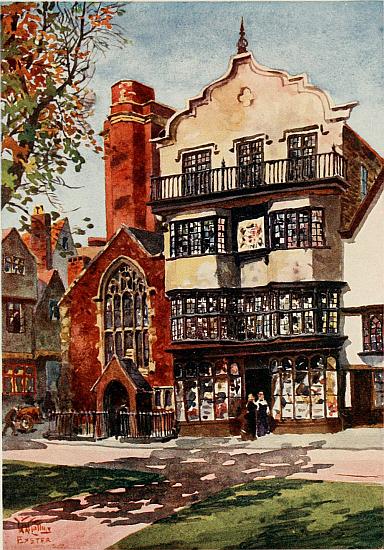
In 1286 Edward I. assembled a parliament at Exeter, whilst in 1371 the Black Prince brought here his royal prisoner of France and stayed several days. The Duchess of Clarence, accompanied by many royal adherents, took refuge within the city walls in 1469. It was besieged by Sir William Courtenay, who eventually raised it on the mediation of the clergy.
The next event of importance not only affected Exeter, but threw into agitation the whole of the British Empire. Of two impostors that laid claim to the Crown which Henry VII. was wearing, the second was a youth called Perkin Warbeck. He bore such a striking resemblance to the Plantagenets that he had been secretly instructed to impersonate Richard Duke of York, the younger brother of Edward V., who it was pretended had escaped from the Tower and from the fate that overtook his brother. So ingratiating was his manner that he successfully enlisted the aid of the Duchess of Burgundy, who was holding her court at Brussels. His first attempt to land in England was in Kent; his second in Ireland. Both ventures being unsuccessful, he tried Scotland. There he convinced King James IV. that he was a true Plantagenet, and through him he raised an army and invaded England. However, the two kings having come to an understanding, Warbeck retired to Ireland. He there received an invitation from the Cornishmen, acting on which he landed at Whitsand Bay in that county.
At Bodmin he was joined by a considerable force of men, with whom he marched and laid siege to Exeter in the year 1497. At the approach of the royal forces his followers were dispersed, whilst he fled to Beaulieu in Hampshire. Two years afterwards he ended his career at Tyburn.
In 1536 Exeter was erected a county of itself. The year 1549 saw the investment of the city by a numerous body of popish adherents, from whom it was relieved by John Lord Russell in August. On the very day of its investment, the second of July, the strange spectacle of Welch being hanged from the tower of his own church, in which he had been accustomed to officiate as vicar, took place. He suffered on the charge of being a Cornish rebel. During the parliamentary war it was taken and retaken, finally to be surrendered to the Roundheads in 1646. Throughout it all the citizens were warm supporters of the Stuarts, as they had always been to the Crown. So much so was their loyalty that in a previous reign, that of Elizabeth, she presented to the Corporation, with many other marks of her royal favour, the motto "Semper Fidelis." During the stay of the parliamentary troops under General Fairfax, the Cathedral was ruthlessly defaced and divided into places of worship for Presbyterians and Independents. The palace adjoining was also turned into barracks, and the Chapter House converted into stables. During these troubles Queen Henrietta Maria, the consort of Charles I., had returned to Exeter from Oxford, believing herself to be in danger from the hatred with which she feared she was regarded by the people. Here she gave birth to her youngest child, the Princess Henrietta. Leaving the infant at Exeter she escaped to France.
In the Guildhall, which is a picturesque Elizabethan building, are two full-length portraits: one depicts the features of General Monk, Duke of Albemarle, painted by Sir Peter Lely; the other was given by Charles II. to the Corporation as some slight acknowledgment of the city's loyalty. It represents the portrait of his sister, Princess Henrietta, then Duchess of Orleans. James II. was the next sovereign to bestow favour, which he did by establishing a mint in 1688. His influence was shortlived, for on the arrival of the Prince of Orange in the August of the same year the inhabitants readily submitted. This prince is credited with establishing a mint at Exeter, or it may be he simply completed or confirmed that of his predecessor. The following year saw him on the throne of the kingdom as William III., which ratified the declaration he had caused to be read by Burnet in the Cathedral of Exeter. Though visited by subsequent reigning princes, their presence may be said to have conferred more honour than to have promoted any material changes to the prosperity of Exeter.
The mainstay of the city is the glorious Cathedral, and the quaintness of some of its houses and streets is unique. They afford a great attraction to visitors, who are willing to go a long railway journey west simply to see and compare the merits and demerits of the Cathedral with the many others dotted throughout Great Britain.
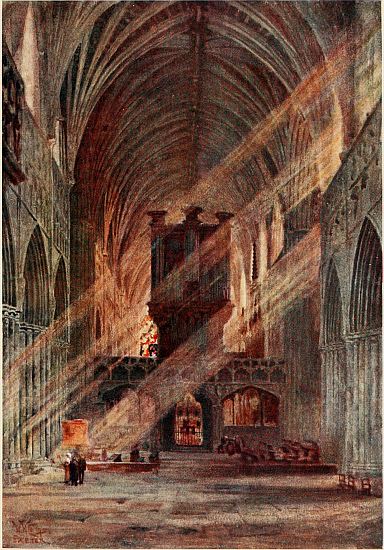
The actual date of the Cathedral is in 1049. Its origin, as we have seen, occasioned no turning of the soil to receive foundations, but merely the conventual church of the monks, removed by Edward the Confessor to his new abbey at Westminster, adapted to meet the requirements of Bishop Leofric and his secular canons appointed to the united Sees of Devon and Cornwall. The head of the Diocese was at Exeter. What was the size and character of the converted monastic church at that time no two authorities seem able to agree. According to an old record at Oxford its lease soon ran out, for in the year 1112 a new church was commenced by Bishop Warlewast, continued by his successors, and finally completed by Bishop Marshall, who died in 1206. They are supposed to have carried out the plan of Warlewast; but as the whole of the fabric, with the exception of the towers, was entirely rebuilt in 1280, the original design is chiefly conjectural. The body of the church probably corresponded in character with the two massive transeptal towers. These are quite a feature in that, with the exception of those at the collegiate church of Ottery in Devonshire, they exist nowhere else in England. This arrangement of the towers did away with the necessity of either a central tower or lantern. It enabled the architect to extend a long unbroken roof throughout the nave and choir. The aisles, with the intervention of richly clustered pillars and pointed arches springing from their caps, range along on either side of the nave. With the sets of ribs starting each from a clustered centre, and spreading out as they soar towards the highest limit of the roof, as grand an exposition of beauty and noble gradations of perspective lines, as conceived by architects of the Decorative period, have been realised. The period of this rebuilding was commenced in 1280 with the Early English style of architecture by Bishop Quivil, and was completed in 1369 in the best years of the Decorated style, just a few years before the Perpendicular came into vogue. It is said that this cathedral served as a model for the church at Ottery. Though this cathedral in miniature resembles the great edifice in Exeter in certain points, notably the transeptal towers, yet, if the principal part of it dates from 1260, it can hardly, with the one exception, have been a copy of the chief church of the Diocese. The Early English work of Ottery church takes, by comparison of dates, priority over that at Exeter by some twenty years.
EXETER INTERIOR OF THE NAVE
The west front, which is one mass of elegant tracery and canopied niches adorned with statuary, is the Decorated period merged into that of the Perpendicular, covering the years from about 1369 to 1394, under the episcopacy of Brantingham. The windows are excellent examples of elegant tracing. Under successive bishops after Quivil, the chief alteration was the lengthening of the nave and the roof vaulted by Grandison. The year 1420 really saw the completion of the building under Bishop Lacey. Time and weather having caused certain decay, Sir G. G. Scott was directed in 1870 to restore it. The undertaking took seven years. A new stall, a reredos, the choir repaved, rich marbles and porphyries used, and stained glass put up mainly by Clayton and Bell, were the chief items of restoration. When erecting the reredos Scott could never have foreseen the little storm it gave rise to, just when he was half-way through with the general renovation. Prebendary Philpotts, the Chancellor, and several others had their conscientious objections, which they laid before the Bishop's visitation court in 1873. It was ruled that the Bishop had the jurisdiction in the matter. He ordered the removal of the reredos in April 1874. In August of the same year Dean Boyd appealed to the Court of Arches, and had the previous decision reversed by Sir R. Phillimore. However, Prebendary Philpotts saw fit to appeal to the Judicial Committee of the Privy Council. They decided that the reredos should remain. Thus in 1875 was ended the controversy; and there rests Sir G. G. Scott's design, open to the criticism of all who are capable of framing an impartial one.
In this same year of 1875 much excitement arose over the church-tax. It was called indifferently "dominicals" and "sacrament money," which were said to be of the nature of tithes. However, the disputes were ended by the distraints for payment.
In the Chapter House is preserved an important manuscript, including the famous book of Saxon poetry presented by Leofric on his accession to the See of Exeter. It is called the "Exeter Book," and is the life of St. Guthlac, by Cynewulf, who was an early English writer. Born somewhere between 720 and 730 at Northumbria, Cynewulf was a wandering bard by profession. Late in life he suffered a religious crisis, and devoted his remaining years to religious poetry. An early work of his is a series of ninety-four Riddles.
It is an example of the effects of Latin influence, which in the end revolutionised the style of Old English literature as a whole. Cynewulf appears to have been a prolific writer. Besides the Riddles, the "Crist" (dealing with the three advents of Christ), the lives of St. Juliana and St. Elene, and the "Fates of the Apostles" are ascribed to him, as well as "The Descent into Hell," "Felix," and the lives of St. Andreas and St. Guthlac. A valuable treasure is that in the possession of Exeter. Many such precious relics are to be found distributed among the various ecclesiastical buildings in England, known only to antiquarians and people with interest akin to theirs. The quaint, picturesque old coffee tavern, with its bow windows of square-leaded panes, ends curiously at the top with a moulded outline so reminiscent of many houses in Belgium.
The tombs are mostly to the memory of bishops who each in his own time maintained the dignity of the See. Of those natives who came to the front through sheer ability may be enumerated the following: Josephus Iscanus, or Joseph of Exeter, a distinguished Latin poet of the twelfth century; his contemporary, Baldwin, Archbishop of Canterbury; John Hooker, author of "A History of Exeter in the Sixteenth Century"; Sir Thomas Bodley, who founded the magnificent Bodleian Library at Oxford; Matthew Lock, a seventeenth-century musical composer of note; and many others.
Amongst many notable institutions is the Grammar School, which dates from the reign of Henry VIII.
The manufactures are few. The woollen trade, at one time only surpassed by Leeds, has now entirely departed from Exeter. If it were not for its glorious minster and the river Exe, up which vessels of three hundred tons' burden can come up right to the city's quay, Exeter would have long ago sunk to mere insignificance.
The river, which decided the early Britons to settle on its banks, the Romans to station the Second Legion of Augusta, the monks to establish their humble monastery, eventually to be absorbed into a see, has from the early times afforded facilities for exports and imports. The ship canal from Exeter to Topsham, which is in the estuary of the Exe, begun in 1564, enlarged in 1675 and again in 1827, materially assisted and rescued commerce from a serious decline. Those vessels that are too deep in the water remain at Topsham, whilst those of still greater tonnage discharge their holds at Exmouth, a port at the mouth of the river.
Norwic. ("Doomsday Book.")
HEN this city first came into being it is puzzling to say. The difficulty is as to where the site was originally fixed. Three miles to the south of Norwich is the village of Caistor (St. Edmunds). Owing to its position on the river Wentsum, or Wensum, it was called Cær Gwent by the Britons, and for the like reason it was named by the Romans Venta Icenorum. It formed their principal station, as it before had served as the residence of the kings of the Iceni. From the ruins of Venta Icenorum gradually arose Norwich. As to when it was firmly established on its present eminence under the name of Nordewic, or North Town, there seems to be no reliable evidence. It first appears by that name in the Saxon Chronicle of the year 1004. It may possibly mean the town north of the old settlement. For one thing it is certain, in proportion as Nordewic rose Caistor sank from an important town to a mere village in ruins. According to an authority, an earlier date is arrived at than the entry in the Saxon Chronicle. He conjectures that the keep, the only remnant of the castle built on the summit of the steep mound by William Rufus, was the Saxon "burh," erected in 767. This, if correct, would clearly indicate that Norwich had already attained considerable importance. According to Spelman, it was the residence of the kings of East Anglia. They established a mint, where it is supposed coins of Alfred and several succeeding monarchs were struck. From its geographical position Norwich was frequently exposed to the attacks of the Norsemen, who could easily land on the Norfolk coast and cover the few intervening miles in a short time. The city was alternately in the possession of the Saxons and the Danes. Against the latter Alfred the Great repaired and fortified the citadel, to whom, however, he eventually handed it over after a treaty of peace. The Saxons afterwards regained it and held it till 1004, when it had to surrender to the Danes under their leader Sweyn. The terrible weak reign of Ethelred II. had earned him the epithet of Unready. His indolence caused his territories to be terrorised, the towns to be racked, and their inhabitants to be massacred by the Danes under Sweyn, who, under pretext of avenging the murder of his sister, took the opportunity of ravaging and laying waste the land. On the accession of Canute, however, though a Dane, the cities began to prosper again. Thus it came about that Norwich, which had remained in a state of desolation till 1018, came again into Danish possession, but under Canute. With this fresh beginning it rapidly rose to great importance. By the time of the Norman Conquest, Norwich was classed as second only to York in extent and prosperity, being described in the "Doomsday Book" as having 1320 burgesses with their families, 25 parish churches, and covering an area of not far short of 1000 acres. It was bestowed by the Conqueror on Ralph de Guaer, or Guader, in 1075, who rewarded his master's kindness by joining a conspiracy formed by the Earls of Hereford and Northumberland against the Crown. After having unsuccessfully defended the Castle, he retired into Brittany, leaving his wife to sustain the siege. The city was very much damaged, and the number of burgesses woefully reduced in numbers, some 560 only being left on the capitulation to the Conqueror. In view of the gallant defence by Guader's wife and garrison of Britons, William granted them all the honours of war and permission to leave the kingdom in perfect security. This siege was a great check to the advancement of the city. At the same time the value of the property must have been considerably lessened. This depreciation after the drawing up of the "Doomsday Book" in 1086 could hardly have suited the views of the Conqueror. To obviate the difficulty it would be necessary to introduce some new element, some attraction that would bring added interest and fresh residents willing to ply their industries in the town. The commencement of a new period of prosperity was soon realised after the establishment of a see at Norwich, though not until the time of William Rufus. One of his followers from Normandy was Herbert de Lozinga, or Lorraine, who having been made Bishop of East Anglia, decided to remove the See from Thetford to Norwich. In addition to the Cathedral, he established an episcopal palace and a monastery to maintain sixty monks, all in the year 1094. It had the desired effect; the city rapidly improved, the number of inhabitants greatly increased, and trade extended. In the reign of Stephen it was rebuilt. In 1122 Henry I. granted Norwich the same franchise as that enjoyed in London, incorporated in a charter. The government of the city was at the same time separated from that of the Castle, and entrusted to the chief magistrate, or Præpositus (provost), as he was styled. Another factor in the city's welfare was the colony of Flemish weavers who settled at Worstead, about thirteen miles from Norwich. They introduced the manufacture of woollen stuffs. A second colony, however, came in Edward III.'s time and settled right in Norwich, when it was made a staple town for the counties of Norfolk and Suffolk.

NORWICH THE MARKET PLACE
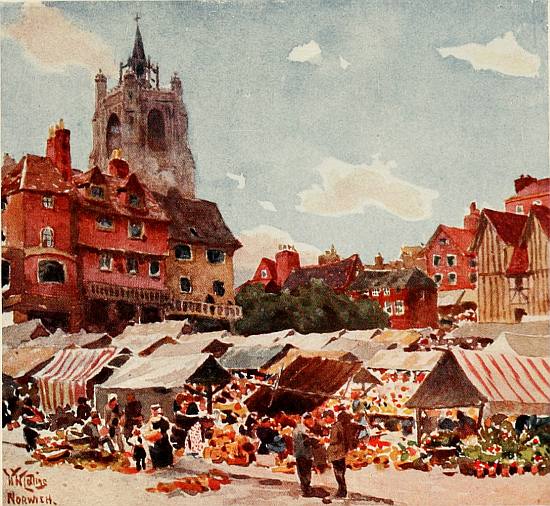
The citizens, in the reign of John, suffered considerable loss from the depredations of the Dauphin, who had been invited from France to assist the barons. In 1272 a riot between the monks and the citizens caused the burning of the priory. The terrible plague, called the black death, that occurred between 1348 and 1349, destroyed two-thirds of the population. The city no sooner was beginning to recover from this terrible visitation than one of its residents, John Listher, a dyer by profession, incited an insurrection called the Norfolk Levellers. They managed in 1381 to do much damage before the rebellion was quelled by the Bishop of Norwich, who defeated Listher and had him executed. From Henry IV. the citizens received permission to be governed by a mayor and sheriffs in 1403, and Norwich was made a county of itself. But in spite of it all the city severely suffered: what with the continued dissension between the monks and the citizens, when the monastic buildings were burnt down, and the tumults by tradesmen all too ready to lay aside their tools and follow some hare-brained leader with a grievance, and later on, after the peaceful period of Elizabeth, the Civil War. The most notable insurrection was that conducted under the reign of Edward VI. by a tanner, Robert Kett, and his brother William. Under the pretence of resisting the "enclosure of waste lands," they contrived to excite a most formidable rising. They seized upon the palace of the Earl of Surrey, and, converting it into a prison, confined many of the aristocracy. They then encamped upon Mouse-hold Heath, where eventually they were routed by the army under the Earl of Warwick in 1549. The two brothers were taken prisoners, Robert being hanged on Norwich Castle, and William suffering a like penalty on the steeple of Wymondham church, the parish from which they had both come. During the reign of Elizabeth a large body of Dutch and Walloons settled in Norwich, and introduced among many other articles the manufacture of bombazine, for which the city soon became noted. These refugees were Protestants, who had sought an asylum in England to escape the persecution of the Duke of Alva, and though many Roman Catholics and even some of the Protestants were unwilling martyrs to the stake at Norwich during this same reign of Elizabeth, the city no doubt appeared to these exiles to offer a better chance of life than that in the Netherlands. By the year 1582 their numbers had increased to five thousand. The Queen, who had encouraged and protected these emigrants, thus laid the foundation of the commercial and manufacturing prosperity of the town, as she had done elsewhere, and on her visit to Norwich was sumptuously fêted. But the Civil War in Charles I.'s reign did much to upset trade in Norwich. It was held by the Parliamentarians, who seem to have got out of control. The Cathedral was barbarously defaced, all its plate and ornaments looted, and the Bishop's Palace greatly damaged. The Castle, on the other hand, was strongly fortified for Cromwell. After the Restoration, Norwich was one of the first to swear allegiance to Charles II., who with his consort paid it a visit. He went away richer than he came, the city having assigned its fee-farm to him, with the presentation of £1000 sterling besides. Since then the citizens have been content to lead a quiet life, and carry on such manufactures as ironworks, mustard, starch, and brewing of ale, though the textile manufacture, once important, has now declined. Printing, which was introduced here in 1570, but discontinued for several years, was revived in 1701, when newspapers began to be printed and circulated. Though, as we have seen, the monks and citizens often did not agree, yet we must not forget that it was mainly owing to the establishment of the See that prosperity came to Norwich. The presence of the Cathedral immediately rescued the city from oblivion, and, more, it raised it above the commonplace. All credit must be awarded to Herbert de Lozinga. For some reason or other he was dissatisfied with Thetford, which was then the seat of the Diocese, and determined to transfer it elsewhere. For this purpose in 1094 he purchased a large plot of ground near the Castle and soon commenced the building of a magnificent cathedral. It was purely Norman. Though it has undergone many alterations, additions, and restorations, Lozinga's plan is still in great evidence, much more so than many other examples of Norman work in England. With the establishment of a Benedictine monastery, Lozinga brought his work to a close, and dedicated it to Holy Trinity in 1101. As presented to us now, it is a spacious cruciform structure, with a highly finished and ornamental Norman tower rising from the centre. This again is surmounted by an elegant octagonal spire of the Later Decorated style, and crocketed at the angles. The spire is 315 feet, and its height is exceeded in England only by that at Salisbury. The west front is of Norman character, with a central entrance, over which was placed a large window in the Later English style. The nave, remarkable for its elaborate 328 bosses, was stone-vaulted in the fifteenth century. The vaulting of the transepts and the chantry of Bishop Nix dates from the sixteenth century. The choir is richly ornamented with excellent design in tracery work of the Later English style, whilst the east end has several circular chapels. The Lady Chapel, which was early English, was unfortunately demolished about 1580. The cloisters are very fine. They are 12 feet wide, and cover an area of 175 square feet, with 45 windows inserted. They were commenced in 1297 and completed in 1430. Though mainly composed of the Decorated period, they range in character from the early years of that style down to the Later English style. The Cathedral, in common with the city, suffered severely. At one time it was very much destroyed by fire. The dome was repaired soon after by John of Oxford, who was the fourth bishop.
NORWICH THE ÆTHELBERT GATE
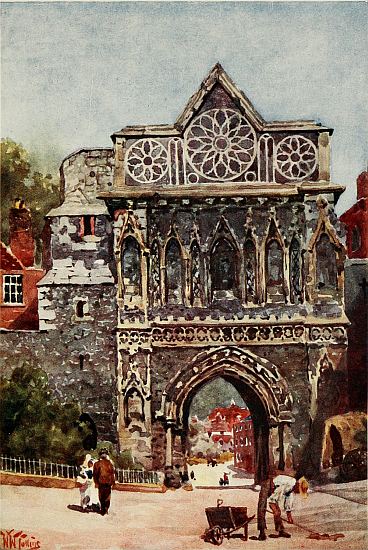
Besides this it received repeated assaults arising from the numerous disagreements between the monks and the citizens. It is always marvellous to think how such great works of art have come down to the present day exhibiting, in spite of fires, Commonwealth defacements, repairs and alterations, so much evidence of the skill of those great masters of mediæval architecture. The Chapter House, usually a great feature of the cathedral, is missing at Norwich, though it once existed. There are two monumental effigies, one to Bishop Goldwell about 1499, and the other to Bishop Bathurst in 1837, the work of Chantrey. Of the mural monuments there is one to Sir William Boleyn. He was the great-grandfather of Queen Elizabeth. His remains were interred on the south side of the Presbytery, in the midst of which once stood the tomb of Herbert de Lozinga, the founder. "Best viewed from the east," wrote George Borrow in "The Lavengro" in a description of Norwich Cathedral. Perhaps the advice of this extraordinary man is the best one to follow. Born at East Dereham, Norfolk, in 1803, of Cornish descent, educated at Norwich Grammar School, which he supplemented with the study of some twenty languages, he passed an adventurous and varied career from running away from Norwich to be a footpad to travelling partly with gypsies over Europe and Asia, the latter part being supposed to account for his disappearance—the veiled period he called it, lasting from 1826 to 1833. In subsequent years he found time between his restless wanderings to write "The Gypsies in Spain" (1841), "The Bible in Spain" (1843), the much delayed auto-biography, appearing in 1851, and "The Romany Rye" in 1857. After another long disappearance, when it was believed he was dead, he came to life again by publishing his "Romano Lavo-Lil" (Gypsy Word-Book) in 1874. From this year till his death in 1881 the famous philologist, traveller, and author spent most of his time in lodgings in Norwich, where he became a familiar figure. The lives of many men can lay a better claim to be recognised by Norwich than Borrow, through virtue of their birthright. In the fourteenth century William Bateman, one time Bishop of Norwich, founded the great college of Trinity Hall at Cambridge. His great example was followed by another native of Norwich, Dr. Kaye or Caius, who established the beautiful college of Gonville and Caius at the same university. Matthew Parker, second Protestant Archbishop of Canterbury, as chaplain attended Queen Anne Boleyn to the scaffold; Robert Green became a popular writer in the reign of Elizabeth. In 1734 Edward King was born here. He gained much recognition as author of a work on ancient architecture entitled "Munimenta Antiqua," and for his many antiquarian researches was admitted Fellow of the Society of Antiquaries. The Reverend William Beloe acquired a reputation by his translation of Herodotus, though possibly only known to classical scholars. The Linnæan Society owes its inception to Sir James Edward Smith, M. D., whose first president he became. This distinguished native of Norwich was also the author of the "Flora Britannica."
The beautiful gate of Erpingham, which was erected in 1420 and faces the west end of the Cathedral, recalls the munificence of Sir Thomas Erpingham, by whom it was built. He greatly distinguished himself at the battle of Agincourt, and was eventually interred in the Cathedral of Norwich, the town of his residence, though not of his birth. Another resident was Sir John Fastof, who lived fighting as a renowned warrior for Henry IV., V., and VI. in their wars in France.
NORWICH FROM THE NORTHEAST
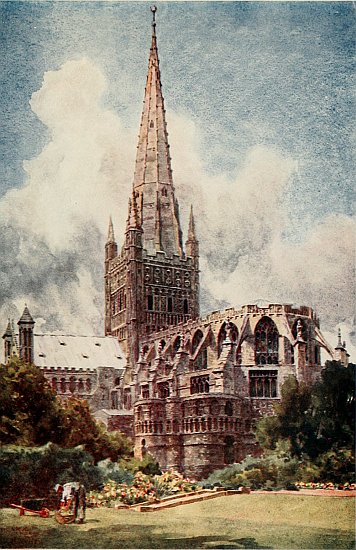
From the old Grammar School came, besides Borrow, Sir Edward Coke, who was born in Norfolk. When only forty years of age he became Attorney-General, and lived in the reign of Elizabeth, always at strife with his dangerous and brilliant legal rival, Francis Bacon. Coke, by his opposition to the royal prerogative of raising money on the validity of the Court of High Commission, and in taking a considerable share in the drawing up of the Petition of Right, and in the debates upon the conduct of Buckingham, earned the dislike of James I. Though treading on dangerous ground, Coke nevertheless received active employment, and appears to have got on quite well in spite of royal displeasure.
Two other scholars were Brooke and Lord Nelson. Brooke entered the East India Company's army in 1819 at the age of sixteen. In his remarkable career he assisted the Sultan of Brunti to reduce the marauding Dyak tribes of Sarawak, and with such success that the Sultan created him rajah of the province of Sarawak in 1841.
A famous school of landscape painting was that at Norwich. It flourished in the first part of the nineteenth century, the principal artists of which were Crome,—who by the way was a native of Norwich,—Cotman, Vincent, and Stark.
Of recent years the Cathedral has undergone extensive restoration, namely, in 1892 and 1900.
Before closing this account we think it would be of interest to outline the causes that embittered the existence of the Jews and led to their persecution through the disappearance of a Christian boy in 1144 from Norwich.
We have had occasion, under Lincoln, to mention the attitude adopted by the citizens towards the Jews. If anything, the feeling was more intense at Norwich. It is uncertain when they first resided in England, though it is supposed they visited before the Conquest for purposes of the slave trade, of which they held a monopoly. The position of the Jews in a Christian State entirely depended upon the attitude of the Church, whose stringent measures effectually precluded any Semitic from the exercise of any public office unless the reception was confirmed by oaths of a Christian character. As this clause was foreign to the tenets of the Hebrew religion, and as the Church regarded the means of loans lent out on interest as prohibited by the Gospel, and as a disreputable calling and unworthy of a Christian, usury became the only means of subsistence to the Jew in England. They were not affected by the views of the Church, and soon made themselves felt. As, however, capital was needed for the building of monasteries, abbeys, and cathedrals by the Church, and the kings of England, especially John and Henry III., found it convenient to extort tallage, the Jews were tolerated. The rate of interest demanded for what was in the first place a trifling loan in a few years increased to a formidable debt. The means adopted by the Christian Church and kings of the middle ages to free themselves from this bondage in no way reflect any honour. The custom appears to have been for the king to seize the whole of the estate, both treasure and debts, of the Jew on his demise, though there may have been sons to inherit. Another was to burn the proofs of indebtedness after having slain the creditors, as the attack against the Jews organised by a set of nobles, who were deep in their debt, is recorded to have taken place at York. For the Jew being a usurer, the estate fell into the hands of the King, who might be influenced to cancel the debt for a much smaller amount. We cannot then wonder that the lower classes followed in the steps of their superiors. But above all, in the twelfth century the Church encouraged the circulation of a suspicion that the Jews sacrificed Christian children in their Passover. However, the suspicion or "blood accusation," as it was called, first took root with a case in which a boy of the name of William disappeared at Norwich. This terrible accusation against the Jews has since been proved to have been founded on the shallowest pretexts, but at the time the myth was nevertheless encouraged by the clergy, since it attracted vast numbers of pilgrims to any cathedral or church which might contain the martyred remains of these boy-saints. The example of Norwich was followed in the same century by one at Gloucester and Edmondsbury, whilst in the following century the supposed martyrdom of Hugh of Lincoln served only to increase and confirm the popular belief. Hence the intense ill-feeling between the Christian and the Jew.

St. Paul's. Si quaeris monumentum, circumspice.
O epitaph more noble and impressive can have possibly been conceived than the simple Latin inscription placed upon the modest tomb of Christopher Wren: "If ye seek my monument, look around." When building this magnificent structure, the great architect was preparing a glorious sepulchre to receive his remains. Some thirty-five years it took Wren to realise this great achievement—an achievement the more astounding when we learn that he was actively engaged throughout the whole time in the planning and personal superintendence of some thirty churches in London, no two of which are alike. Daily he walked around jotting down a sketch of the next detail to be worked upon, deciding, as the work progressed, and maturing his plans, throwing out one day a course, another day realising an idea that had just occurred to him. Thus the fabric rose higher day by day, month by month, year by year. He adhered to no carefully prepared plans; he entrusted nothing to his subordinates; he hugged the entire responsibility. They did not know what phase of work the morrow would bring. On the day each workman would receive a rough section and plan jotted down on the spot, accompanied with verbal instructions. If, even when finished according to his directions, Wren was dissatisfied with this gem of his brain, down it had to come, to be substituted by some other improved idea. Of course Wren had in the first place to submit plans for the proposed cathedral. It is not likely that any committee would engage in anything so important blindfolded. But these plans only formed the shell on which to peg any new suggestions that might crop up in the progress of the work, very much after the fashion of a plastic sketch submitted by the sculptor to a committee, who look wise and generally make foolish comments. The sketch is merely an indication of what is to come after, and is intended as some guarantee. Without this no conscientious committee would commit themselves to any agreement. They control the expenditure of the public subscriptions. If the finished work does not come up to the promised standard of excellence, the committee can fall back upon the sketch and get exonerated of all culpable blame. The artist gets the abuse for the failure or departure from the original. When such necessarily rough sketches are faithfully carried out, they often are failures; for what look well in a rough sketch often become serious blemishes in the completed work. The true artist is never satisfied—that is, that extraordinary being who has a greater love for art than for mere coin—and will alter and improve upon his original design at every suggestion (and they crowd thick upon him) that makes itself manifest, with a total disregard to his own pocket and that punctuality so essential to the successful city man. He has got his ideal, and he is determined to reach it if he has to go through a brick wall.
Very much in the same way, we may be sure, Wren was actuated. His pay was no inducement. He received only £200 a year throughout the whole time of building, and then at one time a certain portion of this miserable pittance was withheld by order of Parliament, because his detractors accused him of delaying the final completion of the work from corrupt motives. Wren's clerk of the works, by name Nicholas Hawksmoor, who afterwards became famous as the builder of several London churches, was paid only twenty pence a day. Tijou, his ironworker, and Grinling Gibbons, the famous carver in wood, were all actuated by the same ideal when they helped to give expression to their master's genius. However, in one or two particulars, which will be mentioned later on, Wren's superior judgment was overruled by his committee. Much to his intense and lasting mortification they carried the day and stamped themselves as incompetent judges. This process of realisation, this seeking after an ideal, sometimes led Wren into strange architectural difficulties, only to be overcome in a masterly way. By discovering these little inconsistencies, the architect's skilfulness in taking advantage of accidents, in turning what appeared an irremediable blunder into a great success, shows what a complete understanding he had in that great branch of art—architecture—and endorses more than ever the great position he will always be accorded.
An example will serve to illustrate his ingenuity.
How many people, when climbing up the stairs that lead to the whispering gallery and elsewhere, have ever noticed any peculiarity about them? Yet there is one. When first they were being built each step was meant to be of the same height, but as they mounted higher, Wren suddenly discovered that the top one would be an ugly tall one to ascend. To avoid this meant one of two things, either to demolish what had already been completed and start afresh, or to turn this accident to good account. The latter alternative was chosen. By gradually reducing the height of the remaining steps, he contrived to overcome the difficulty so successfully that he has tricked the eye and foot, so slight is the difference of each tread. They appear to be equidistant as the ones lower down, and the illusion can only be dispelled by measurement.
If any one is observant on reaching the top of Ludgate Hill, one peculiarity of the great building will strike him. It is that the great west façade does not squarely face Ludgate Hill, but bears considerably to the right. In fact its axis does not run due east and west.
On the advancement of Wren to be principal architect, he was not only commissioned to erect the Cathedral, but was to rebuild the city. His scheme was very thorough. It comprised the widening of the streets; the complete insulation of all important churches; the public buildings were to have good frontages; and the halls of the City Guilds were to form a quadrangle around the Guildhall. To carry these improvements into effect, Government issued orders that none except Wren's rebuilding would be recognised. Unfortunately much valuable time was wasted in an attempt at the restoration of the old cathedral, insisted upon by the committee, against Wren's wishes, and it was only when a portion of the nave fell down that Dean Sancroft was able to obtain the consent of the committee to raze the old walls to the ground and to allow Wren to build from the very foundations. The delay of this decision had in the meanwhile given opportunity to individuals to erect buildings much as they pleased upon their own properties in spite of Government prohibition, with the result that to a great extent streets and boundaries, which existed before the Great Fire, were reproduced. It also caused the loss of a far more spacious frontage than now exists, which we may be sure formed an important item in Wren's design for the Cathedral. The architect, however, by receding the west front from the old site now occupied by the statue of Queen Ann, has cleverly spaced out a noble frontage. Another consideration that determined Wren to alter the axis of the Cathedral was his great aversion to utilising the old foundations. His great ambition was to strike out for himself and to be dependent on no one else's work. In order to realise this he laid the axis of the new work to a point farther north of that of the old cathedral, and the plan by this projection has in a marvellous way covered practically the same ground, whilst at the same time Wren managed to secure fresh ground for his foundations almost throughout the whole church. The plan of St. Paul's is a Latin cross, and is based upon classical lines. The principal front, the west, is composed of a double portico of Corinthian fluted pillars, with two flights of steps leading down to the road-level. In fact the entire body of the ground floor is above the elevation of the street. Overhead is a large pediment, with its panel sculptured in high relief. On either side the west front is flanked by a campanile tower, composed at the summit of grouped circular pillars. Just inside, on the left, is the Morning Chapel, whilst straight on the opposite side lies the Chapel of the Order of St. Michael and St. George. Proceeding eastwards, the nave is flanked by three massive and imposing arches. Then comes the dome or cupola, rising to a height of 365 feet, or 404 feet to the top of the cross. Viewed from the interior the inner dome is 225 feet, and rests at the intersection of the cross. The transepts are carried one arch to the north and one to the south, each of which are bound by semi-circular rows of Corinthian pillars.