Front matter (continued 2)
Reading edition
The Chapter House is a round building with a stone roof resting on a central pillar, and dates from the Late Norman period.
The Refectory belongs to the Decorated, and the Perpendicular style claims the cloisters. The central tower is just over one hundred and sixty feet in height. As can be seen by the drawing, the plan of the building is a pure cross. There are two transept aisles, and only secondary transepts to the choir exist. A noteworthy circumstance is that St. Helen's, Worcester, is the earliest recipient of a chantry (1288).
The most interesting memorial in this cathedral is King John's, in the choir, said to be the earliest sepulchral effigy of an English king in the country. In the Chantry Chapel there is an altar-tomb to Arthur, Prince of Wales and son to Henry VII., who died in 1502. John Bauden, bishop, and author of "Icon Basilike," has a monument. Bishop Hough's memory is perpetuated by the work of Roubillac, and that of Mrs. Digby by the sculpture of Chantrey.
To give a detailed account of the history of the city would be long and unnecessary. Suffice it to say that the city continually changed hands during the civil wars. In 1265, in Worcestershire, close upon the frontier of Gloucestershire, was fought the battle of Evesham, in which Henry III.'s son surprised and defeated Earl Simon de Montford, one time a royal favourite. This result put an end to the confederacy of the barons. Cantilupe, the Bishop of Worcester, was implicated in that he favoured the Earl's cause, who had withdrawn previous to the battle, to the friendly territory of Worcester's See, and had rested at Evesham Abbey. Queen Elizabeth and James II. respectively paid the city a short visit.
It suffered extensively by the dissolution of the monasteries. The parliamentary troops foully defiled the Cathedral, and did considerable damage to the city, which was Royalist.
Here it was that Charles II., with his Scottish army, was defeated by Cromwell, who had taken up a position on Red Hill without the city gates. Fortune and disguise helped Charles to escape, and from here he began his adventurous journey to Boscobel. The cathedral city has since increased steadily in prosperity. Besides the Worcester China Company, founded in 1751, and still flourishing, a Company of Glovers was incorporated in 1661, and is an important industry. These, in addition to hop-growing, help to keep up the trade prosperity of Worcester. The See has enriched the Church of Rome by four saints, and has yielded to the English State several Lord Chancellors and Lord Treasurers.

("Doomsday Book.")
N a geographical account of this city it is given as being locally in "the hundred of Box and Stockbridge, rape of Chichester, county of Sussex." The origin of this term "rape," comes from the Icelandic "hreppr," meaning a village or district. From the Icelandic verb, "hreppa," to catch, obtain, arose the Anglo-Saxon rendering—"hrepian, hreppan," to touch. Rape came thus to be one of six divisions of the county of Sussex, possibly by reason of their nearness to each other. It formed the intermediate between the shire and the hundred. A sketch of the shire and the hundred is treated in the description of Wells. After this slight digression, we will immediately enter upon the history of Chichester.

Its foundation dates, with certainty, from the time when England formed a portion of the Roman Empire. About the year 47 A.D., Flavius Vespasian conquered this part of England. He established a camp on the site of the present city, close to the road now known as Stane Street, throwing up an entrenchment three miles long. This is attributed to be the "Regnum" of the Belgæ, mentioned in the "Itinerary" of Antonine.
There is no reason to doubt this, if it be borne in mind that, situated almost on the south seaboard of England as Chichester is, it might quite conceivably be expected to be classed accidentally as forming a part of the territory of the Belgæ, though geographically wrong. The advantage of a site at the foot of a small spur of the South Downs, within easy distance of the sea, though inland, would offer great attractions to the Roman invader.
The early history of England shows us that invasions took effect generally on the south and east coasts of the island. The conquered tribes travelled westwards, retreating before the fierce invader.
Little seems to have been known about the Roman occupation of Chichester till the accidental turning up of a Sussex marble slab on the site of the present council chamber. This discovery took place about the year 1713. From this a little information is gleaned about the Roman buildings. The slab bears a defaced inscription in Latin, the missing letters of which having been supplied, give a conjectural reading. It appears that Chichester was the seat of a British king, Cogidubnus; and that under the auspices of a certain Pudens, a temple of Neptune and Minerva was erected out of compliment to Claudius. The evidence of this stone seems also to have been borne out by Tacitus, who mentions in his writings the existence of Cogidubnus as a native king possessed of independent authority. This king, also, is said to be the father of Claudia, who figures in the Second Epistle to Timothy. The conjectural reading again leads us to suppose that the city was occupied by a large number of craftsmen, who, in fact, were responsible for the erection of the temple mentioned above, besides the walls and other buildings.
During the early Saxon period in the fifth century the city was destroyed by Œlla. He was succeeded by his son Cissa, who rebuilt it and called it Cissa's Ceaster—Cissa after his own name, and Ceaster in recognition of the Romans having occupied it. The city afterwards became the seat of the South Saxon kings, and remained thus till about the middle of the seventh century. Wulfhere, the Mercian, then invaded it and made Athelwald, its king, prisoner. Upon his conversion to Christianity the king was reinstated. He was afterwards killed in battle by Ceadwalla of Wessex, who conquered the kingdom of the South Saxons. In 803 Egbert managed to make a union of the several Saxon kingdoms. This event caused considerable prosperity to Chichester. From ancient penny-pieces discovered, we learn that King Edgar, in the year 967, had established a mint here, thus clearly indicating the importance of the city.
It suffered a terrible decline through the devastations of the Danes; so much so, that scarcely two hundred houses and only one church existed at the time of the Norman Conquest. However, from 1070 the fortunes of the city began to mend rapidly. This wholesome change was caused primarily by the removal of the See from Selsea, where it had remained for over three hundred years, to Chichester. As first bishop of Chichester, Stigand, the chaplain to William the Conqueror, was appointed. In the reign of Henry I. a cathedral was built and consecrated by Bishop Ralph. It was soon destroyed by fire. On its site the same prelate erected a second structure of far greater magnificence, a considerable portion of which is still extant.
CHICHESTER FROM THE NORTHEAST
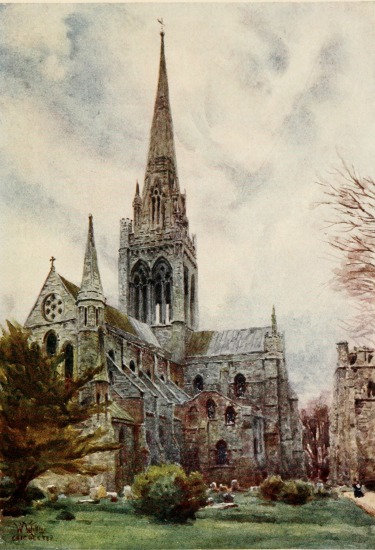
In 1189 the city again suffered from a terrible fire, which also caused great damage to the Cathedral. This building, however, was repaired and greatly enlarged by Bishop Siffed. His efforts, with those of Ralph, form the basis of the present cathedral. It was dedicated to St. Peter. The architecture embraces the Norman and the Early English and Decorated styles.
A beautiful tower arose from the centre, surmounted by an octagonal spire three hundred feet high, with two towers on the west, of which the upper courses of one were destroyed during the parliamentary war. On the north is seen a fine bell-tower and lantern, connected by flying buttresses with octagonal turrets springing from the angles.
In the reign of Charles I., after a stubborn defence by the Royalist citizens, the city was compelled to surrender to Cromwell's troops. In the course of this reign the north-west tower was battered down, and in 1648 Cromwell ordered the destruction of the cathedral cloisters, the Bishop's Palace, the Deanery, and the Canons' houses. The Bishop's Palace was repaired in 1725, and contains a chapel built in the thirteenth century. A general and great restoration of the Cathedral was commenced in 1830, but in spite of every precaution the tower and spire fell down in 1861. Under the guidance of Sir Gilbert Scott the necessary repairs were undertaken. The cloisters were restored about the year 1890.
Besides his grand contribution to the church's architecture, Storey's memory is perpetuated by the very fine octagonal cross in the Decorated English style. It stands fifty feet high, in the centre of the town, from which the four principal streets run out at right angles towards the country. These streets, in olden days, led to four gates in the embattled walls which surrounded the city. The last of these gates was taken down in 1773. Besides the cross, Storey founded in 1497 the Grammar School, where Archbishop Juxon, the learned Seldon, the poet Collins, and Dr. Hurdis, Professor of Poetry at the University of Oxford, received their elementary education.
Amongst other schools founded was one by Oliver Whitby, in 1702, to afford free nautical education to twelve boys; namely, four from Chichester, and four from each of the villages of West Wettering and Harting. Though Chichester is connected by a short canal with the sea, and a certain amount of shipping is done, it can hardly be considered as an important port. It lies fourteen miles north-east of England's greatest naval port, Portsmouth. Curiously enough, Chichester is only five miles south of Goodwood, the famous city for horse-races.
The municipal and parliamentary borough of Chichester, incorporated as city in the year 1213, is almost surrounded by a small stream called the Lavant, and is pleasantly situated at the end of a small spur of the South Down Hills. It is considered as one of the principal cattle markets in the South of England. Accommodation for several thousands of cattle was arranged in 1871 by the Corporation.
There are also the Guildhall, which was formerly the chapel of a convent of Grey Friars; the corn-exchange, the market-house, museum, and infirmary.
Bradwardine and Juxon, both archbishops of Canterbury; Lawrence Somercote, a great canonist and writer; the poets Collins and Hayley, whose memory has been perpetuated by a tablet designed by Flaxman in the Cathedral, were all born in this city. The Diocese of Chichester covers nearly the whole extent of Sussex.
In conclusion we would draw the attention to the quaint design on the Bishop's armorial shield. It depicts the curious device of a mitred prelate holding a sword in his mouth. He is seated, presumably, on a throne, which much resembles a square block of marble, looked at perspectively. Perhaps it is meant for the Holy Stone. Both the Bishop's arms are outstretched. In his left hand an open book is held, whilst his right is palm upwards. Why the Bishop holds the sword in his mouth, when his right hand is free, it is hard to say. Possibly the arms were first drawn up for a warlike bishop, or it may mean that the sword is the sword of Justice. In all probability the correct meaning is conveyed by the twelfth verse in Hebrews iv., wherein it sets forth that the sword in the Bishop's mouth is symbolical of "The Word of the Lord," which is "sharper than any two-edged sword," and the Book of the Law is in his left hand, whilst the right hand is extended in blessing or in supplicating prayer.

Cestre. ("Doomsday Book.")
HIS famous place occupies a singular position. It is a city and county of itself, a municipal county since 1888, and a parliamentary borough, besides being an episcopal city, a seaport, and county town of Cheshire.

Chester is also the capital of the county of Cheshire. It is situated on a rocky elevation, on the north bank of the River Dee, by which the city is partly encircled. Just seventeen miles north of it lies the great manufacturing and seaport town of Liverpool. At one time Chester was a palatine city, enjoying all the privileges peculiar to that dignity. This practically conferred independent authority on a city far situated from the Metropolis. The head of the city was a little king, and enjoyed discretionary power. In a brief sketch of this, in the account of Durham, is clearly shown the mutual advantages accruing, especially in cases of emergency, such as incursions of the enemy, to both the city thus honoured and the Metropolis London.
The geographical position of Chester in the extreme west of England, and its proximity to the restless Welsh, demanded some such power to cope, at a moment's notice, with any unexpected event from that quarter. This nearness to Wales contributed in a great measure to the importance of this city, as will be presently shown.
The earliest authentic history of Chester ascribes its origin to the British tribe called the Cornavii. At the time of the Roman invasion they inhabited that part of England which now is known as the counties of Chester, Salop, Stafford, Warwick, and Worcester.
CHESTER EASTGATE STREET
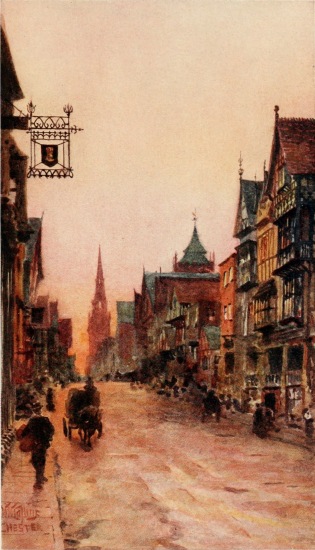
The city they called Cœr Leon Vawr—City of Leon the Great. This name is supposed to have been given out of compliment to Leon, son of Brut Darien, the eighth king of Britain. By some historians this origin is contested. They say that this Welsh name of Cœr Leon Vawr indicated the "city or camp of the Great Legion." They also supply "Cœr Leon," or "Dwfyr Dwy," and render their meaning into "the city of the Legion on the Dee," from its connection with that people. The city was also called Deunana and Deva, after the same river. However, it is conclusively proved that here the Twentieth Roman Legion established a station after the defeat of Caractacus, who, after having made a mighty effort to withstand this second invasion of England by the Romans, was taken prisoner. He and his wife and family were taken to Rome, and, according to custom, were paraded through the streets for the benefit of the public, but afterwards honourably treated. This second occupation of England lasted from 43 A.D. till the Romans finally departed in 446 A. D. The first was a short stay by Julius Cæsar in B.C., some ninety-seven years previous. In 46 A.D., within three years of the landing of the Romans, Chester was established as a Roman camp, during the reign of Claudius, the Roman Emperor.
From the disposition of the four principal streets,—Northgate Street, Eastgate Street, Bridge Street, and Westgate Street, together with the walls surrounding the city, and the selection of a rocky site on the bank of a fair-sized river, Chester gives a good illustration of the principles upon which the Romans went to work. From a determined centre these roads run out to their respective gates in the boundary walls, in the direction of the four cardinal points. The walls of this city are the only ones in England that are perfect in their entire circuit of two miles, though the gateways have all been rebuilt within the last hundred years. On the departure of the Roman soldiery, England reverted to the Britons, who appeared to have been helpless, so long had they relied upon their late conquerors for protection. From them Chester was taken by Ethelfrith, King of Northumbria, who defeated them under the King of Powysland in 607. The Britons, however, regained possession and maintained it till 828, when Egbert, who was then the sole monarch of England, annexed it to his possessions. The Saxons, during their occupation of the city, named it Legancæster and Legecester.
The Danes, in the ninth century, caused severe damages. On their retreat Ethelfreda, Countess of Mercia, repaired the walls. On her death the Britons once more became the city's masters, but were driven out again by Edward the Elder. Athelstan, it is said, revived its mint. About the year 972 Edgar assembled a naval force on the river Dee. To demonstrate his supremacy he caused himself to be rowed by eight tributary kings from his palace on the south bank of the river to the Convent Church of St. John's. To increase the desired effect, we are told that he took the helm,—the symbol of government.
CHESTER THE ROWS
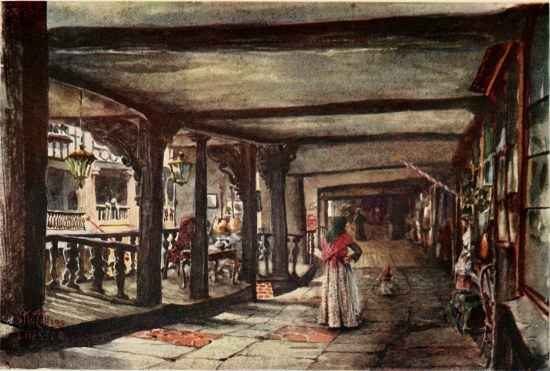
On the division of England, in 1016, between Canute and Edmund Ironside, Canute gained possession of Mercia, in which were included Chester and Northumbria. Chester remained as a city of Mercia, governed by its earl, till the Norman Conquest. William then bestowed it with the earldom on his nephew Hugh Lupus. He was, in view of the proximity of Wales, invested with sovereign or palatine authority over the tract of country now represented by the county of Cheshire and the coast-line of Flintshire as far as Rhuddlan. Chester was made the seat of his government.
At that time it is described in "Doomsday Book" as Cestre, and as possessing four hundred and thirty-one houses within its walls. For over two centuries after the Conquest this city formed an important military station for the defence of the English border against the Welsh. The Norman Earl Ranulph I. granted the first charter, though its purport proves that Chester already enjoyed certain municipal rights. On account of its garrison it was frequently visited by reigning monarchs.
Chester was captured by the Earl of Derby, who held it for the Crown during the war between Henry III. and the barons. The contest was ended with the defeat of the barons at the battle of Evesham, close to Worcester. Here, in 1300, it was that the Welsh chieftains paid homage to the first English Prince of Wales, the infant son of Edward I.
Richard II., by Act of Parliament, erected the earldom of Chester into a principality to be held only by the eldest son of the King. This was rescinded in the next reign. In fact, Richard II. was made captive by Henry of Lancaster, and was imprisoned in a tower over the gateway of the Castle. The city suffered greatly during the Wars of the Roses. It was visited by Queen Margaret of Anjou, the wife of Henry VI. This queen played a prominent part with regard to the claim to the English throne. She was daughter to Réné, who was a relation of the King of France. He was titular king of Sicily, but without territories. Though Margaret brought to Henry a rich dower, he was persuaded to consent to the deduction of a large portion of Maine and Anjou to her father Réné. During the Duke of Gloucester's life, who had strongly opposed the royal marriage, Margaret and her coadjutor, the Duke of Suffolk, had not dared to carry into effect the agreement they had extracted from Henry. The Duke of York, who was regent in France, through his integrity, was also a serious obstacle. She and Suffolk had him recalled, and the regency given to Beaufort, Duke of Somerset, nephew to Cardinal Beaufort. York felt injured, and took revenge by asserting his claim to the Crown.
By his father he was descended from Edward III.'s fourth son. From his mother, the last of the Mortimers, he inherited that family's claim from Lionel, the second son of the same king. On the other hand, John of Gaunt, from whom Henry VI. was descended, was Edward's third son. Thus York, through his mother, had a prior claim. These rival claims caused confusion and tumult throughout England. In the meantime the English possessions in France were lost one after the other, till in 1451 only Calais remained. The misgovernment of the regency in France under Somerset contrasted most unfavourably with that of York.
In these troublous times England looked towards York as the only one to be trusted, who then became Protector during the King's mental weakness. He imprisoned the Duke of Somerset. The latter as soon as he was free assembled an army, and was killed at the battle of St. Albans, the first War of the Roses. His followers, the Lancastrians, were defeated by the Duke of York, and the King made prisoner. Eventually York declared himself. By Act of Parliament he and his heirs were constituted successors to the throne of England after the death of Henry VI. Margaret, however, defeated the Yorkists in battle, in which York was slain. He left behind him three sons,—Edward, George, and Richard,—the first of whom later on deposed Henry VI. and became Edward IV. We have ventured to give this brief sketch of the origin of these rival claims, in that most of the cathedral cities were affected by the fortunes or misfortunes of their favoured party.
Chester, in the years 1507, 1517, and 1550, suffered from a terrible visitation of the sweating sickness. From 1602 to 1605 the plague made it necessary to suspend all the city fairs, and to hold the assizes at Nantwich. This epidemic occurred again with great loss of life to the inhabitants, between 1647-48. During the Civil War this city of Chester endured great sacrifices for its loyalty to Charles I.
The King came there in 1642, when the citizens gave him great pecuniary assistance. Not till after a memorable siege, lasting from 1643 to 1646, did the citizens agree to surrender. The garrison were allowed to march out with all the honours of war, the safety of the persons and property of the citizens with liberty of trade were secured, and the sanctity of the sacred buildings and their title-deeds preserved.
CHESTER ST. WERBURGH STREET
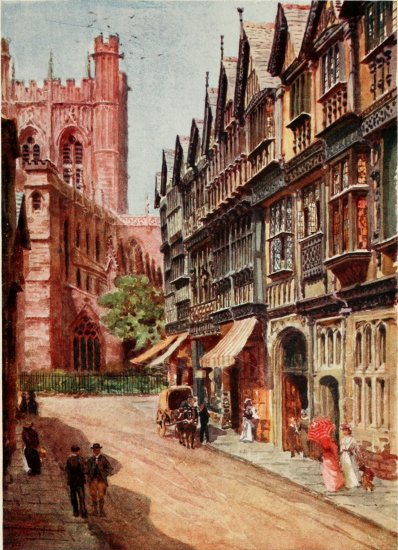
Sir Charles Booth, in 1659, with the aid of the citizens, overcame the garrison of Charles II., then an exile, but was afterwards defeated by Lambert, Cromwell's general.
The presence of the Duke of Monmouth, in 1683, stirred the populace to a tumult. Amongst other excesses the mob spent its fury in forcing the cathedral doors, breaking the painted glass, destroying the font, and other regrettable damage to this building. In 1688 the city was taken by the Roman Catholic lords, Molyneux and Ashton, for James II., who, after all, rendered further efforts useless by his abdication. Under William III. Chester was included in the six cities for the residence of an assay master, and was permitted to issue silver coinage. The last important military event that took place in this city was in the Rebellion of 1745, when it was fortified against the Pretender.
In architecture the great characteristic is the quaint way the houses have been built. The streets have been cut out of the rock below the general surface of the land. The houses appear to have been built into the rock, or rather to have been piled up against it. The shops are level with the streets, and over them runs a balustraded gallery. Steps at certain intervals lead the way down into the streets. These galleries are called by the inhabitants "The Rows." These Rows are houses with shops. Overhanging the shops, like the eaves of a house, are the upper stories, to which additional flights of steps give access.
Two explanations are given for this unusual construction of houses: one, that the Rows, or promenades, are the remnants of the ancient vestibules of the Roman houses; the other that they were probably originated to afford ready defence against the sudden raids of the Welsh. The latter appears the more likely. The Rows, from their position to the streets, would afford the besieged greater facilities of shelter and attack.
In Bridge Street and Eastgate Street the Rows are made pleasant promenades. Though many of the houses have been rebuilt, they still retain the old character. In addition to these interesting buildings there was the castle built by the Conqueror, of which there remains only a large square tower, called "Julius Agricola's Tower." The front has been entirely renewed. This tower served probably as a place of confinement of the Earl of Derby. Here were imprisoned Richard II. and Margaret, Countess of Richmond. Just shortly before the Revolution James II. heard Mass in the second chamber.
Though the Cathedral has been left to the last, its history is no less interesting than the other features of Chester. The Cathedral was originally the church attached to the convent of St. Werburgh, under which name its ecclesiastical site is mentioned in "Doomsday Book." It was first dedicated to St. Peter and St. Paul, but Ethelfrida afterwards transferred their patronage to that of the Saxon saint, Walmgha, the daughter of Wulphen, King of Mercia. Besides this princess the great benefactors were Leofric, Earl of Mercia, and Hugh Lupus, who substituted Benedictine monks for secular canons.
On the dissolution of the abbey, in lieu of the abbot and monks, a dean, prebendaries, and minor canons were appointed, the last abbot being made dean. Here it is as well to remember that a church was called an abbey, whatever its former denomination might have been, if an abbot became its head. In much the same way the name "minster" is derived from a monastery, and cathedral is due to the fact that the bishop had his cathedra, or throne, placed in the sacred building for his own use. At the dissolution the Cathedral of Chester was dedicated to "Christ and the Blessed Virgin." Though there are some interesting remains of the abbey, the present building was built in the reigns of Henry VII. and Henry VIII. The diocese of Chester dates at the period of the kingdom of Mercia. It was afterwards incorporated with that of Lichfield, but in 1075, Peter, Bishop of Lichfield restored the See to Chester. His successor, however, removed it for the second time to Lichfield. Henry VIII., in 1541, created six new sees, in which he included Chester. With a portion of the possessions of the Abbey of St. Werburgh, which was dissolved, he endowed the new see. The first bishop after the dissolution was John Bird. In 1752 the palace of the bishop was rebuilt by Bishop Keene.
The cathedral site is on the eastern side of Northgate Street. Excepting the western end, it presents the appearance of a heavy, irregular pile, when viewed externally. The interior is very impressive, and contains portions in the Norman, and in the Early and Decorated styles of English architecture. It possesses a clerestory in the Later style. Some chapels in the Early English style, are to the east of the north transept. The south transept, separated from the Cathedral by a wooden screen, forms the parish church of St. Oswald. The style of the Bishop's throne, sometimes known as St. Werburgh's Shrine, belongs to the Early period of the fourteenth century. In the eastern walk of the cloister stands the Chapter House, of Early English style, built by Earl Randulph the First. It served as the burial-place of the earls of the original Norman line, except Richard, who perished by shipwreck.
CHESTER BISHOP LLOYD'S PALACE AND WATERGATE STREET
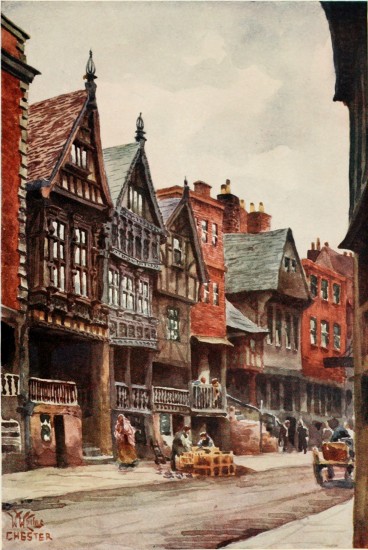
The sacred edifice has from time to time undergone extensive reparations.
As a port Chester was at one time most important, but through the silting up of the Channel in the fifteenth century, it lost a considerable amount of its shipping trade. In spite of the Channel being deepened in 1824, its shipping prosperity cannot be said to have advanced hand in hand with the progress of the city, though it possibly may be greater than it was in the fifteenth century.
The great Chester Canal comes from Nantwich, passes through Chester, and merges into the Ellesmere Canal, which winds up northwards to the river Mersey. Thus the city is connected with Liverpool.
As the crow flies, the country traversed from London to Chester is most interesting. The track passes through the counties of Middlesex, Buckinghamshire, Northamptonshire, Warwickshire, with its famous towns, Stratford-on-Avon, the birthplace of Shakespeare, and Coventry, through Staffordshire, famous for its beautiful old china and its Cathedral at Lichfield, and finally into Cheshire, the county containing Chester and Northwich.
Among the many eminent men born at Chester was Randolph Caldecott, in 1846. He is handed down to posterity as the famous illustrator of the works of Washington Irving. But the achievement that gained him the greatest acclame was a series of coloured books for children. They began in 1878 with "John Gilpin" and "The House that Jack Built," and ended the year before his death, in 1886, with the "Elegy on Madame Blaize" and "The Great Panjandrum Himself." In the crypt of St. Paul's, London, his memory is perpetuated through the great artistic expression of a brother artist, Alfred Gilbert, R. A.
Thus, in this brief sketch, an attempt has been made to give a categorical history of one of England's most ancient cities from its earliest occupation by the British Cornavii, and its subsequent events down to the royal visit in 1869 by the then Prince of Wales, now our King Edward VII., on which occasion he opened the new townhall. It would require far greater space to record every feature of interest in connection with Chester than can be allotted within the present limitations. To the antiquarian Chester furnishes a most interesting and absorbing study, and will in all likelihood continue to do so for many years to come yet.
To those interested in horse-racing the fine race-course attracts annually a great concourse to Chester.

Roucestre. ("Doomsday Book.")
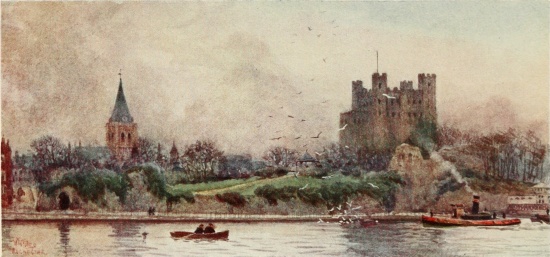
N the illustration is seen to great advantage the temporal and spiritual power of Rochester: the State, as represented by the Norman keep; the Church, as symbolised by the cathedral. Ever since Christianity came to England, these two mighty levers of power have marched, if not always hand in hand, more or less in accord. Though the two have frequently struggled for supremacy, yet their feuds have done more towards the enlightenment of the people than any harmonious concert could have effected. In marked contrast to mediæval times the State and Church of the present day formulate and carry out the will of the people. They are the channels of purpose as determined by the nation. Great as the power of the Church still is, it has nevertheless lost that tremendous authority it once wielded under the popes.
Henry II. set up a strenuous opposition, whilst Henry VIII. dealt it a crushing blow. The dissolution of the monasteries was a terrible check to Roman Catholicism in England, as well as Luther's reforms in Germany. Yet in spite of all this the Church of Rome has more adherents in Europe than any other religion. The menace to the Church of England lies in the lack of absolute obedience to the spiritual head, and the many different sects. The Church of Rome exacts absolute obedience and faith, and by these means is steadily increasing its influence. The Roman Catholic Cathedral recently erected in London is a convincing proof of the untiring energy of the followers of that wonderful religion. It is also curious to notice that the Latin races are the staunchest supporters of the Papacy.
As its name implies, Rochester was a Roman camp. This place formed one of the stipendiary towns of this Latin race, and was called "Durobrivae." Not much information has been preserved concerning their occupation of the town. That it was important, and served as a military basis, is clearly demonstrated by the great Roman Watling Street, which passes through the city, and which bears evidence to their great engineering skill.
The great Roman streets were at that time the chief and only means of quick communication from one camp to another. To read the account of the wonderful system of roads organised by Darius the Persian is as interesting to follow as any modern fiction. He realised that quick communication with the outlying quarters of his possessions meant increased power and security. Along the roads, at proper distances, were blockhouses guarded by soldiers. The messenger on horseback drew rein at each of these wayside places to take refreshment and get a remount, or to hand over the dispatches to a fresh messenger.
In much the same way the Romans constructed their roads for their postmen, and, no doubt, to serve as their first line of defence if a retreat should be necessary. We can almost conjure up the sight of a mounted bearer of important dispatches racing along. Suddenly the horse, almost thrown on to his haunches, is pulled up in front of one of these guardhouses dotted at regular intervals along the great road. A hasty meal is snatched, a fresh horse mounted, and off again, with a clatter and a whirlpool of dust, hurries the messenger, as if a kingdom depended upon his quick dispatch. We cannot attach too much importance to this method of communication, if we remember that it is only within the last two centuries or so that the semaphore came into existence. When first introduced, this medium of conveying rapidly a message by the waving of a wooden arm up and down on a post, which was generally planted on a commanding site, was considered a wonderful invention. Even at sea it was left to Admiral Rodney to construct an efficient code of signals. Of course the most primitive method was the lighting of beacons in times of great danger.
Besides Watling Street, the city of Rochester is known to have been defended by walls built in the direction of the cardinal points, according to the Roman custom. They extended for half a mile from east to west, and close upon a quarter of a mile from north to south. After the Romans had departed, this place came into the possession of the Saxons. They renamed it "Hrove Ceaster," which in process of time became contracted to Rochester.
During the early Saxon period Ethelbert, King of Kent, through the influence of his queen and the preaching of St. Augustine, who had just arrived, became a convert to Christianity. By this king, as we have seen, Canterbury Cathedral was richly endowed. To help carry out the papal instructions given to Augustine, Ethelbert in 600 founded a church in Rochester. By erecting this into a see, he, at the same time, laid the foundation of the future prosperity of the city. The building was dedicated to St. Andrew. A monastery for secular priests was also established, over whom was appointed for their bishop, Justus, who had accompanied St. Augustine and his forty monks into Britain.
This cathedral suffered at many times, in common with the city, from several incursions of the Danes. The city, more especially in 676, was sacked and almost destroyed by Etheldred, the King of Mercia, whilst in 839 the Danes landed at Romney, defeated the troops sent to oppose them, and massacred most of the inhabitants. Again, in 885, they sailed up the Medway under the leadership of Hasting, and laid siege to Rochester. Fortunately for the city it was rescued by the timely assistance of Alfred. Three mints established by Athelstan in 930, two for himself and one for the bishop, and the fact of the city being then recognised as one of the chief ports of England, show with what rapidity it had regained prosperity. This peaceful state was rudely awakened, however, in 999. The Danes reappeared in the Medway, before whom the terror-stricken inhabitants fled and abandoned the city to their fury. At the Conquest, Rochester was given by William to his half-brother, Odo, Bishop of Bayeux, who was also created Earl of Kent. In the reign of William Rufus he was implicated in a conspiracy to dethrone Rufus in favour of Robert Duke of Normandy. Thereby his possessions reverted to the Crown. In this Rochester suffered. In 1130 Henry I. attended at the consecration of the church of St. Andrew by Lanfranc. During the ceremony a fire broke out. The city was almost reduced to ashes.
ROCHESTER CATHEDRAL AND CASTLE
It was again visited, seven years later, by fire, from which it had hardly recovered when a third conflagration occurred and left traces of devastation for ages. In 1141, Robert Earl of Gloucester was placed in the Castle. He was the chief general and counsellor of Matilda, and had been captured prisoner at Winchester after having effected the Queen's escape. He was eventually exchanged for King Stephen. In 1215 the barons seized and held the Castle against King John, who gained it. Henry III. repaired the Castle.
The Castle was again, in 1254, successfully defended for the King by Edward Earl Warren, against Simon de Montford and the barons. In the reign of Richard II. the insurrectionists under Wat Tyler released one of their comrades imprisoned in the Castle.
Rochester has been at different times visited by reigning princes. Henry VIII., with Emperor Charles V., came there in 1521, whilst in 1573 Queen Elizabeth honoured it with her presence. Charles II., on his restoration, passed through the city en route from the Continent to London. In fact Rochester, being also a port, was a convenient place for James II. to embark secretly on board of a trading-vessel lying in the Medway, by which he was conveyed to France.
This Norman castle, which has played such an important part in the history of the city, deserves some notice. Its extensive remains, situated on a commanding site, overlook the right bank of the river. The Castle is supposed to have been built by Gundulph, when Bishop of Rochester, in the latter part of the eleventh century. It preceded by a few years the building of the Cathedral by the same prelate. The architecture of this castle is a striking example of the simplicity of plans generally employed by the Normans. By preference the castle was a rectangular keep in form. The sides varied from twenty-five to a hundred feet in length, and equally so in height. At the corners the walls advanced so as to form square towers, the faces of which were usually relieved by flat pilaster-like buttresses. The walls at the base measure sometimes as much as thirty feet in thickness, and diminish to as much as ten feet at the summit.
The internal arrangements consisted of a store-room, from which a narrow staircase, made into the thickness of the walls, gave access to the rooms of the garrison and those of the owners above, wood being employed for the floor and roof. A well was always dug. The entire building was surrounded by a deep moat filled, if possible, with water. The entrance was small, and was defended by a draw-bridge and portcullis. It was on the thickness of their walls and the moat that the Normans chiefly relied for their impregnability. They seldom departed from this simple form of architecture. Their defence was rarely constructed on a series of fortifications. Local advantages and a lofty site were invariably the Norman idea of a safe stronghold.
Great interest is attached to the Cathedral of Rochester. Its see is the smallest in the kingdom and the most ancient after Canterbury. The two were established, as we have seen, within a few years of each other, under the auspices of St. Augustine and King Ethelbert of Kent.
The present cathedral dates from the commencement of the twelfth century, when it was built by Gundulph. If what we are told about this structure be correct, its importance cannot be too greatly enhanced, for it is claimed that its architecture, though much altered and repaired since, is in the main a copy of Canterbury Cathedral at that time. Thus, in describing the plan of the one in Rochester, a general idea can be gained about the other at Canterbury.
Gundulph's contribution is a spacious and venerable building in the form of a cross, with a central tower surmounted by a spire. The Norman style forms the basis of the architecture, to which the Later English style was added chiefly in the many windows of the nave and other parts of the church. The west front was entirely restored between 1888 and 1889, the Norman style being strictly adhered to. The doorway is a most decorative bit of Norman workmanship. Let into the clustered columns on either side there is, on the right, an effigy of Queen Maud, and on the left another of Henry I. The door is covered with a rich mass of geometrical design in metal.
The crypt, invariably a great feature in a cathedral, is partly the work of Gundulph; that is, the western portion is. The eastern part consists of cylindrical and octagonal shafts with a light vaulting springing from them, and belongs to the same period as the superstructure of the thirteenth century.
There are several chapels, a finely groined roof, and ancient tombs, which all lend interest to this fine cathedral.
The red-veined marble statue of Walter de Merton cannot fail to attract attention. He was the founder of the great scholastic college at Oxford called Merton College. Though small in size, the entrée to it demands high classical attainments.
With regard to commerce, Rochester has a favourable position on the river Medway, in the creeks and branches of which are the oyster fisheries. The Corporation, assisted by a jury of free dredgers, hold a Court of Admiralty, in which they make regulations for the opening, stocking, and closing of the oyster beds.
In conclusion, we cannot help saying that Kent should be a proud county, possessing, as it does, the two most ancient sees in the kingdom, the dioceses of which are separated only by the Medway.

("Doomsday Book.")
N the West Riding of the county of York, twenty-two miles north-west of the city of York and eleven miles north of Harrogate, the ancient city of Ripon is situated at the juncture of the Ure, Laver, and Skell. The narrow and irregular streets and well-built houses, some of which still retain the quaint, picturesque gables so reminiscent of earlier times, envelop the city with that delightful, indefinable air of mediævalism—a something which, tempered with old associations and traditions, no modern city with all its improvements can supply. To saunter through the ancient, ill-lighted streets of an old town at night, when life is dormant and commercialism quiescent, is the time to view unexpected beauties of architecture unfold themselves, and to become oneself imbued with a spirit of romanticism and a feeling of rest. If a figure in mediæval costume and rapier were to come round a corner suddenly, or emerge from some dark nook, it would scarcely startle the senses, so appropriate would it seem with the surroundings, enshrouded in mysterious shadows.
A new city can be admired, but can never be revered till it has survived the many storms of generations, and has emerged with a halo of traditions respected and treasured.
Ripon, in common with other cathedral cities, possesses this charm, and after many vicissitudes presents us with a magnificent cathedral. To revert to the commencement of the city's history, it is supposed to have derived its name from the Latin "Ripa," owing to its situation upon the bank of the river Ure. The earliest authentic record gives it under the name of Inhrypun, in connection with the establishment of a monastery in 660 by Eata, who was then Abbot of Melrose. It was subsequently given by Alfred, King of Northumbria, to Wilfrid, who had been raised to the archbishopric of York. He was afterwards canonised as a saint. Under Wilfrid's administration and influence the town very much increased its wealth and importance. Through the division of the bishopric in the year 678 Ripon became a see.
A great calamity overtook the city in the ninth century. The Danes burnt and plundered it, causing such devastation that it was almost wiped out. From its ruins, however, it recovered so quickly as to be incorporated as a royal borough by Alfred the Great. This happened by the year 886. In the suppression of the insurrections of the Northumbrian Danes it suffered severely through the terrible laying waste of the land which Edred found necessary to subdue them.
Little time was left for the city to regain its former prosperity, when the surrounding country was again laid waste, in 1069, by William the Conqueror after defeating the Northumbrian rebels. This monarch's vengeance so completely demolished the town that it still remained in ruins and the land uncultivated at the time of the Norman survey. The monastery, destroyed by Edred, was rebuilt by Oswald and his successors, who were archbishops of York. It was endowed and made collegiate by Archbishop Aldred somewhere about the time of the Conquest. The city was now enjoying comparative peace, and was regaining lost prestige when it again became a mere wreck. Under Robert Bruce, in the reign of Edward II., the Scots compelled the inhabitants to surrender everything of value they had, and burnt the town. This period of devastation lasted from 1319 till 1323.
RIPON THE CATHEDRAL
By the exertions of the Archbishop of York, ably assisted with donations from the local gentry, the city rapidly recovered by the time a terrible plague compelled Henry IV. to leave London and take up his residence here. The court of necessity followed him.
This royal sojourn did the city immense good, and again it derived benefit some two centuries after by the presence of the Lord President of York in 1617. He had been obliged by a similar plague to remove his court hither.
Ten years later another royal visitor came, namely, James I., who rested a night here on his route from Scotland to London. On this memorable occasion he was presented with a pair of Ripon spurs. From early times till the sixteenth century Ripon was a recognised centre for the manufacture of woollen caps. On the decline of this industry the city acquired such a fame for the manufacture of spurs that it became quite a current phrase to say "as true steel as Ripon rowels." Ben Jonson and Davenant make references in their verses to Ripon spurs. This industry, together with those of manufacturing buttons and various kinds of hardware, flourished till quite recently, when mechanical industries supplanted them.
In 1633 Charles I. also paid the city a visit. During the Civil War the parliamentary troops, under Sir Thomas Mauleverer, took possession of Ripon. After mutilating many of the monuments and ornaments of the church, they were eventually driven out of the town in 1643 by the Royalists, under Sir John Mallory of Studley, a township comprised under Ripon. In recounting the political fortunes of the city little has been said about its chief attraction, the Cathedral, not because it has played no important factor in the welfare of the city, but because it has been considered better to give, apart, the chief characteristics of its architecture.
We have seen how a monastery was established in 660, by Eata, which later came under the patronage of St. Wilfrid. From the ruins of St. Wilfrid's Abbey the present cathedral was founded about 680 A.D., in the reign of Egfrid. With the exception of St. Wilfrid's crypt, called St. Wilfrid's Needle, which tradition says was used for the trial of female chastity, nothing of the original Saxon fabric remains. From the similarity of this crypt, and of another at Hexham, both erected by St. Wilfrid, in formation and arrangement to the catacomb chapels at Rome, it is inferred that this churchman had made himself familiar with their peculiarities during his residence in that Latin city. This is interesting to note.
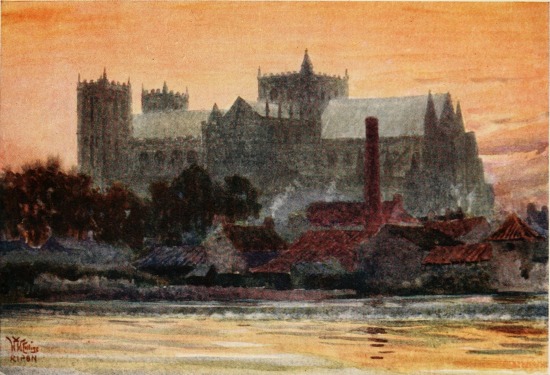
The Cathedral, as it now stands, embraces various styles of architecture, and is dedicated to St. Peter and St. Wilfrid. It is a large cruciform church, with a square central tower and two western towers. They at one time carried spires, each not less than one hundred and twenty feet in height; but the central spire having been blown down in 1660, caused considerable damage to the roof, and it was thought advisable to pull down the others. Their removal accounts for the stunted appearance of these square towers. The construction of the present church was commenced by Archbishop Roger, dating from 1154 to 1181. To this period belong the transepts and portions of the choir. The western front and towers were carried out in the Early English style, most probably by Archbishop Gray, between 1215 and 1255, and near the close of the century the eastern portion of the choir was rebuilt in the Decorated style. The nave and part of the central tower were also rebuilt in the Perpendicular style at the close of the fifteenth century. The fabric was entirely renovated under the guidance of Sir Gilbert Scott, from 1862 to 1876. The episcopal palace is a modern building in the Tudor style, and is about one mile from the town.
The present bishopric dates only from the year 1836. There are several charitable institutions: namely, the Hospital of St. John the Baptist, founded by an archbishop of York in 1109; the Hospital of St. Mary Magdalene, for women, by another prelate of York in 1341; and the Hospital of St. Anne, by some unknown benefactor who lived in the reign of Edward IV. A clock-tower was presented to the town to commemorate Queen Victoria's Diamond Jubilee. There is now, in place of the ancient industries, an extensive trade in varnish, in addition to the manufactories for saddle-trees and leather, but the most interesting industry is that of the Ripon lace. It is a torchon lace much resembling, in uniformity of pattern, the design used in peasant laces in Sweden, Germany, and Russia.

Ely. ("Doomsday Book.")
N the early history of the majority, if not of all of these cathedrals, it is interesting to note the many points of resemblance. It will be observed that most of them had their inception in the seventh century. A most convenient way also of remembering, if actual dates be forgotten, is that the commencement of the same century heralded the arrival of St. Augustine and his forty monks at Canterbury, and the re-establishment of Christianity in England. Whatever previous efforts had been attempted to christianise the natives (prior to this century) pale into insignificance after the landing of this great missionary from Rome. The subsequent important events are invariably five; namely, the devastations of the Danes in the ninth century, the erections of castles to overawe the inhabitants with the ecclesiastical foundations, still extant, after the dreaded millennium had passed, from the Conquest; the dissolution of the monasteries by Henry VIII.; the desecration and mutilation of the churches under Cromwell's Protectorate; and the inevitable restoration, not always happy, of these grand buildings.
The Venerable Bede, in his "Ecclesiastical History," ingeniously attributes the derivation of the name to an eel, called "Elge," on the assumption of the great abundance of this fish in the neighbourhood. At the same time another rendering, by some one else, supposes that the Saxon "Helyg," a willow, which flourished extensively, owing to the marshy nature of the soil round about the city, gave rise to the present contraction. However it may be, Ely dates from the year 673. The subsequent history of the Church and state of this famous place originated in that year from the small foundation of a monastery for monks and nuns by Ethelreda. This princess was the daughter of the King of the East Angles, and the wife of Egfred, the King of Northumberland. She had devoted a great deal of her life to monasticism, and eventually constituted herself as the first abbess of her religious effort. A contradictory account gives it that this lady more likely became the first abbess of a religious house which she had filled with virgins. Their number is not stated. Nothing more is heard or worth relating of the welfare of this royal benefice until the ninth century, when, in the natural order of things, it was destroyed by the Danes. In 879, a matter of nine years after this devastation, it was partially restored by those brethren who had fortunately escaped the massacre. Under the government of provosts they were established and existed as secular priests for nearly a century. At the end of this period of inactivity it received much attention from Ethelwold, Bishop of Winchester. This prelate in 970 purchased the whole of the Isle of Ely from Edgar. He then rebuilt the monastery and endowed it munificently. In it regular monks were placed under the rule of an abbot, to whom Edgar granted the secular jurisdiction of two hundreds within and five hundreds without the Fens. Many other important privileges were bestowed by the same monarch, recognised by Canute, and greatly increased by Edward the Confessor in recognition of part of his education here received. These many marks of royal favour caused it to become the richest in England, and the city participated in its prosperity.
ELY FROM THE WEST FRONT
Soon after the Conquest a determined resistance was made by many of the nobility against what they considered the tyranny of William. Led by such leaders as Edwin, Earl of Chester, Egelwyn, Bishop of Durham, and headed by Hereward, an English nobleman, they contrived to do considerable damage in the surrounding country. They built a castle of wood in the Fens, and made a vigorous stand against the Normans, who besieged the island, constructed roads through the marshes, threw bridges across the streams, and erected, as usual, a strong castle at Wiseberum. With the exception of Hereward, the rebellious subjects were reduced to submission. According to one authority, it is supposed that William's camp was simply an old Roman camp repaired for the occasion. We learn that the field, which contained the ancient site, was known as Belasis in some records of the reign of Henry III. It appears that one of William's generals was called Belasis, and that he was quartered on the monastery, which he had taken possession of after the conquest of the isle. He treated the monks with every mark of courtesy, allowing them to remain under an abbot of his own choosing. At first he laid them under certain restrictions, but subsequently restored the privileges they had previously been accustomed to.
ELY THE MARKET PLACE
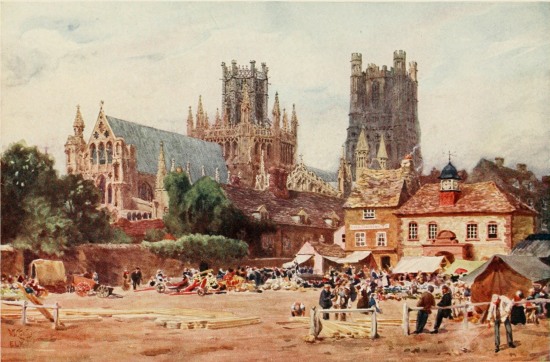
In 1107 the eleventh and last abbot, Richard, employed all his interest with Henry I. and gained the royal sanction to the establishment of an episcopal see at Ely. To this the monarch granted, for a diocese, the county of Cambridge, which had till then been under the jurisdiction of the Bishop of Lincoln. The isle was also invested with sovereign powers. Richard, however, did not live to become the first bishop, an honour which was conferred in 1109 on his successor, Hervey.
By this arrangement the Abbot was superseded by the Bishop, and an entire distribution of the property belonging to the abbey was effected between them. As the abbey became the church of the See, the Abbot was obliged to alter his dignity to that of a prior. A fair, to continue for seven days, commencing from June 20, to commemorate the anniversary of the death of Ethelreda, was instituted by the Bishop. The prelate Nigel, in the reign of Stephen, built a castle here, of which no remains exist, and whose site is now conjectural. The year 1216 witnessed dreadful scenes of spoliation of churches and large sums of money exacted from the inhabitants under the guise of ransom.
The cause of all this devastation being visited upon Ely was John's idea of revenging himself upon the barons. At their hands he had, the year previously, been compelled to undergo the mortification of signing the Magna Charta at Runnymede, a field between Windsor and Staines. Ever since that time the irresolute and mean king had been devising schemes of vengeance against his opponents. Three months spent in the Isle of Wight had enabled him, through agents and the promise of the estates of the barons as plunder, to raise a considerable army of the Brabanters. At their head he suddenly emerged from concealment, and surprised the barons by appearing before Rochester Castle and defeating them.
In the meantime John was well supported at Ely by his general, William Bunk, or rather an unexpected incident hurried on its doom. The elements unkindly betrayed the city into the hands of the Brabanters. At a critical time, the treacherous swamps—the isle's hitherto great natural fortifications—became the city's undoing; for a sharp frost set in and rendered a ready glacial access to the city. The enemy lost no time in reducing the barons to submission and the wretched inhabitants to great misery. The barons, thus reduced to dire extremities, invited Louis, the eldest son of the King of France, to aid them, promising him through his wife the crown of England.
ELY INTERIOR OF THE NAVE
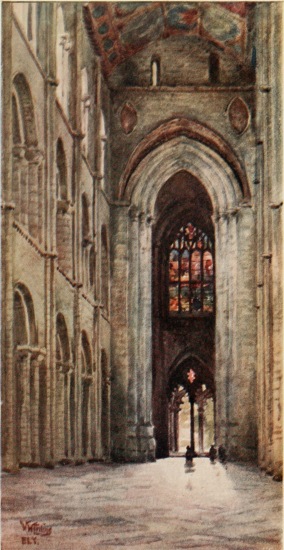
The French landed at Sandwich, retook Rochester Castle, and compelled John to flee. John, crossing over the Wash, in his march from Lynn in Norfolk into Lincolnshire, suffered great loss through the return of the tide swamping the rear of his army, all his money, and stores. He himself escaped to Swineshead Abbey, in the Lincolnshire Fens, where a monk is said to have administered poison to him. With great difficulty and exhaustion the monarch arrived at Newark, where he died in the October of the year 1216.
From this time onward the city enjoyed comparative peace, and exercised the privileges granted by Edgar, Edward the Confessor, and William the Conqueror.
Till the twenty-seventh year of the reign of Henry VIII. the royal franchise of Ely, in several statutes, was recognised as the county palatine of Ely. Henry, by Act of Parliament, remodelled the privileges, and ordered the justices of oyer and terminer, and gaol delivery, and justices of the peace for the Isle of Ely, to be appointed by letters patent under the Great Seal. The dissolution of the monasteries also was the means of converting the conventual church into a cathedral—much more appropriate to the dignity of the Bishop, whose title had been granted, as we have seen, by Henry I. in 1107. This ecclesiastical building, first a conventual and then a cathedral church, was commenced in 1081, and entirely completed in 1534. The dedication to St. Peter and St. Ethelreda was changed to "The Holy Trinity."
It is a magnificent cruciform structure, displaying the many changes that took place in ecclesiastical architecture from the early years of the Norman Conquest down to the latest period of English style.
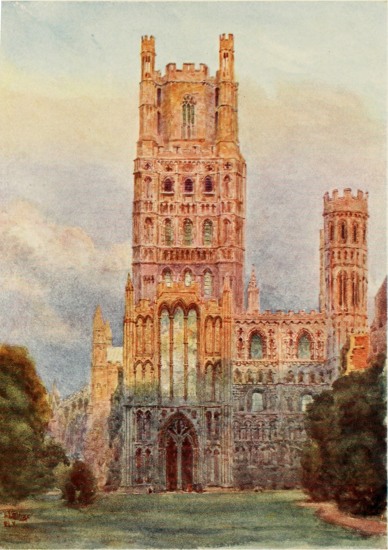
The main feature is the extraordinary variety of arches built according to successive styles. Though this peculiar treatment suggests an unfinished appearance, it cannot rob the church of its wonderful beauty. There is a departure from the general plan of other cathedrals. The nave is continued through an extended range of twelve arches. It belongs to the Late Norman period, and its completion probably dates from about the middle of the twelfth century. From 1174 to 1189 the western tower and the transepts were built by Bishop Ridall. Bishop Eustace, between 1198 and 1215, erected the Galilee or western porch, a noble Early English structure. Much at the same time a curious coincident is noticeable. Bishop Pudsey was busy at Durham building the Galilee or Western Chapel, which is such a noble adjunct to that city's cathedral.
ELY FROM THE FENS
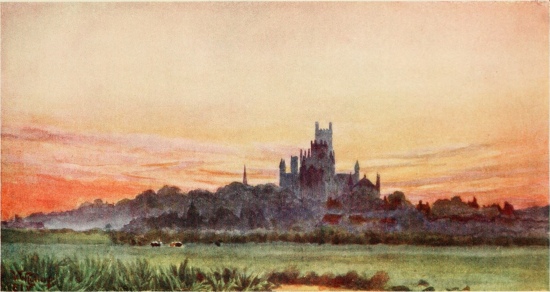
Ely's choir was originally Early Norman, and terminated in an apse. Unfortunately this Norman apse was destroyed. In restoration the church was extended eastward by six more arches under the guidance of Bishop Northwold, about the middle of the thirteenth century. His addition is Early English. The carving is very rich and elaborate.
While Bishop Hotham was engaged upon the building of the Lady Chapel, the Norman tower erected by Abbot Simeon tumbled down in 1321. Hotham immediately replaced it by an enlarged octagonal substitution. On it he placed a lofty lantern of wood, a rich ornament and in good keeping with the rest of the holy edifice. Though this prelate deserves every recognition, yet we are much more indebted to Alan of Walsingham, who designed the Lady Chapel and the octagonal tower and lantern so ably carried out by Hotham. Alan had also made his influence felt in the choir-bays of this same cathedral, where he has so cleverly preserved and combined the old Early English elegance of proportion with richness of detail. Under the superintendence of Sir G. B. Scott the fabric has been extensively restored.
Attached to the Cathedral is the church of Holy Trinity; it was formerly the Lady Chapel of the Cathedral. It was commenced in the reign of Edward II., and is one of the most perfect buildings of that age. Another handsome church is that dedicated to St. Mary, and is partly Norman and partly Early English in character.
At the Grammar School, founded by Henry VIII., Jeremiah Bentham, the celebrated political writer, received the rudiments of his education. The Sessions House, the new Corn Exchange, and Mechanics' Institute are other notable features of Ely.
An historic relic, now preserved at Trinity College, Cambridge, is the "Ely Book." It cannot be passed over without a word. On a page are portrayed Ethelwold and King Edgar, but its chief importance is the record of instructions received by the commissioners to supply details and valuation of property for the "Doomsday Book." The inquiries and answers indicate that England had already been divided up into manors, and furnish besides a variety of most interesting information.
Another incident in the history of Ely, if not of great importance to the city, is nevertheless an interesting insight of the respective position of the Church and State soon after the dissolution.
In the good days of Queen Bess, the Bishop of Ely received a royal rebuke.
In the great struggle between the Protestants, or anti-papal world, and the Catholic reaction, there was little leisure for the clergy to air their grievances. They were compelled to submit to the will of the Queen and her counsellor Cecil, from whom Archbishop Parker of Canterbury received his cue for the government of the Church. Though he enjoyed the personal confidence of Elizabeth beyond any other ecclesiastic of the time, his complaints were unavailing. The supremacy of the lay power over the ecclesiastical was too thoroughly accomplished to allow of the Church to exist apart in the early years of Elizabeth's reign. The Bishop of Ely, for expressing unwillingness to hand over the gardens of Ely house to Sir Christopher Hatton, received a characteristic warning, couched in elegant language, for his temerity. "By God, I will unfrock you!" was the Queen's gracious answer to the daring prelate, if he did not mend his ways.
Through the cultivation of its fertile soil by market-gardeners, Ely offers its produce to the London market.
A considerable factory for earthenware and tobacco-pipes, and numerous mills for the preparation of oil from flax, hemp, and cole-seed, help to furnish the trade resources of this historical town, which is situated on the river Ouse, in Cambridgeshire, and just sixteen miles from the celebrated University of Cambridge.

Glowecestre. "Doomsday Book."
O the long list of "cesters," the Anglicised form of the Latin "Castra" (camp), must be added Gloucester, famous in more respects than one; the city where Henry I. died from a surfeit of lampreys, where Henry II. held a great council in 1175, where the coronation of Henry III. in its abbey took place; the city which the same monarch "loved better than London," the city extolled by Bede as one of the noblest in the land. Prior to the Roman invasion it is held to have been of considerable importance, and to have originated from the settlement of a tribe of Britons, called the Dobuni. This tribe, with that of the Cornavii, also controlled about the same time the destinies of Worcester, now renowned for its beautiful china. By the Dobuni the city was called Cœr Glou, either out of compliment to its founder Glowi, a native, with the meaning, "the city of Glowi," or because the same British words, according to another interpretation and its reputation, can be rendered "the fair city." In the year 47 this stronghold passed into the Roman possession, under Aulus Plautius, and according to Richard of Cirencester, a colony was established. This he styles Glebon, whilst the "Itinerary" of Antonine and other ancient records enter it as Glevum Colonia.
An interesting account upon the Roman classification of towns in England discloses a very important particular. It adds considerable weight to the description of the city by the authors just quoted. Their statements that Gloucester was classified as a colony called Glevum seemed to be borne out by a tombstone found at Rome. It purports to be in memory of a citizen of Glevum. This has given rise to the supposition that "Glevum" was the honourable title bestowed upon an English town of importance made a "colony" by Nerva. This period would be between 96 and 98 A.D. This date in no way combats the original one of 47 A.D. It is only intended to show that Gloucester at the later period had become a colony with a certain amount of self-government, forming a unit of the Great Roman Empire.
The district to the north-east of the present city, called King's Holme, is supposed to have been the actual site of the Roman camp. Close to it was also the palace belonging to the Anglo-Saxon kings of Mercia, which was called Regia Domus. Round about this spot quite a valuable collection of Roman remains has been made, which, besides establishing the fact of their occupation, have helped archæologists to form a correct estimation of the habits and customs of the Latin invaders. When the pressing needs of Rome required the return of all her legions, Gloucester came to be governed by Eldol, who was a British chief. He survived the terrible massacre of the Britons by the Saxons at Stonehenge, and in 489 revenged their memory by killing Hengist, the Saxon chief, at the battle of Mæshill in Yorkshire.
GLOUCESTER INTERIOR OF THE NAVE
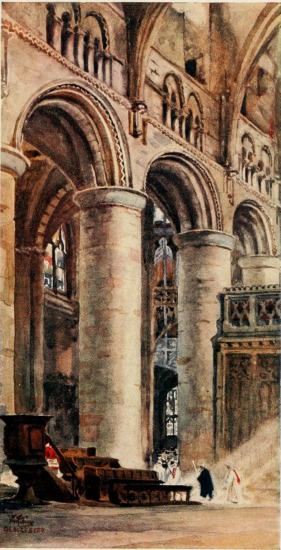
From the Britons the city in 577 was captured by the Saxons. They called it Gleauanceaster, which exists to this day under the contracted form of Gloucester. At that time it was included in the kingdom of Wessex, and was afterwards annexed to that of Mercia. In the meanwhile tradition says that a bishop's see was founded at Gloucester in the second century. Lucius, the first Christian king of Britain, is held to be the founder, and is also supposed to have been buried in the Church of St. Mary de Lode of this city. With all respect to tradition, this can only be accepted with reservation. If true, the present church of St. Mary de Lode deserves far greater recognition than it receives. Though evidently an old foundation much restored, it can hardly lay claim to such antiquity. In all probability a temple to some Roman deity existed, which, by conflicting accounts of historians, gave rise to the supposition of an early established see. Though there is proof that Christianity existed during the Roman occupation of England, it seems more likely that, after their general exodus from the island in 418, a diocese, if any, was soon after established at Gloucester, over which Eldad presided in 490.
This first bishopric, on the subversion of the country by the Anglo-Saxons, must have become extinct; for the next we hear of it is when, as part of the kingdom of Mercia, the entire county of Gloucester is included in the diocese of Lichfield at the time of the introduction of Christianity. However, the first authentic evidence of monasticism appears in the year 679, when the holy brethren founded their establishment. Under the auspices of Wulfhere, then King of Mercia, this priory was dedicated to St. Oswald, and in the same year was annexed to the newly established see of Worcester. It afterwards became the abbey. The city's importance in the same year was considerably increased by the royal patron. The King's brother and successor, Ethelred, nevertheless, completed the ecclesiastical building, which some contend was a nunnery. This the Danes destroyed. It was then refounded for the reception of secular priests in 821, by Bernulf, King of Mercia.
As early as 964, in a charter to the monks of Worcester dated at Gloucester, Edgar styles this a "royal city." Several times it suffered from the incursions of the Danes in the eighth century, and more especially so in the tenth, when it was taken and nearly destroyed by fire in the reign of Ethelred II. This monarch's reign seems to have been a disastrous one for the kingdom. In the first place, through the ambitious schemes of his mother Elfrida, who caused his stepbrother Edward to be murdered, he wrongfully occupied the throne in 979. On account of his tragic death Edward came to be styled "the Martyr." A reign thus inauspiciously commenced proved to be a constant struggle against the Danes. The King acquired the name of Ethelred the Unready; for when the Danes attacked the kingdom, instead of being prepared to repel them, he endeavoured to counteract the evil with large sums of money. As this only served as a further incentive to fresh invasions, Ethelred eventually compounded with them in 994. On condition that these plundering expeditions should cease, he offered them tribute. This is the first mention we get of the "danegelt," as it was called. With the exception of the reign of Edward the Confessor, it continued to be levied almost without interruption till the time of Henry II. The only benefit that Ethelred's reign conferred upon his subjects was the act of atonement made by Elfrida.
To ease her conscience and remorse for the murder of Edward, she caused the foundation of several monasteries, and performed penances. Edmund Ironsides, who succeeded in 1016, was the exact opposite in character to his father Ethelred.
He continued a serious obstacle to Canute and his Danes. After the last of five pitched battles Canute and he agreed to divide the kingdom between them: Canute to have Mercia and Northumberland, and Edmund the remainder. However, through the murder of Edmund a few days after, at Oxford, Canute usurped the throne of England in 1017. During his reign of eighteen years, except for a dispute with Scotland over Cumberland, the country enjoyed peace at home.
This peaceful term, in conjunction with the passing over of the dreaded millennium, when the end of the world had been expected, caused the great building activity which, under the Norman Conquest, attained such wonderful results.
In the meanwhile the trade resources of Gloucester, even before the Conquest, had greatly advanced, and had probably outdistanced in ratio those of more important commercial centres of England. No doubt the natives had learned many hitherto unknown industrial arts from the Romans.
GLOUCESTER THE CATHEDRAL AND OLD PARLIAMENT HOUSE
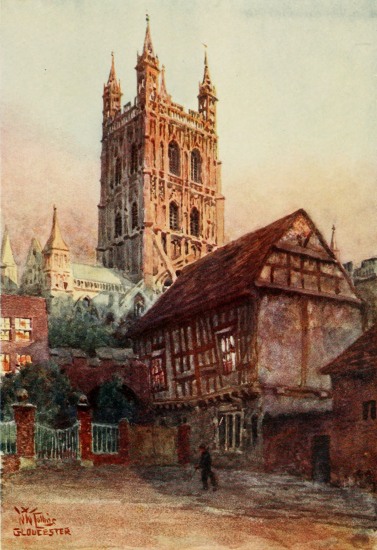
A native art and civilisation existed in the Island, we know, before the Roman Conquest. Great skill in enamelling, claimed by the ancients to be of Celtic origin, and the primitive abundance of gold and tin, worked, as history relates, by the Phœnicians, encouraged a certain degree of native excellence in metal work. Besides this, the gold coinage and other signs of their ingenuity, by remains discovered in Yorkshire and elsewhere, illustrate that various branches of art existed a matter of a century and a half before the Roman Conquest. Yet it is only reasonable to suspect that the inhabitants of Gloucester and of the other camps profited greatly from the far better knowledge and technique brought by the invader from Rome, the acknowledged centre of civilisation at that time. Certain it is that the Roman influence must have left some result. The subsequent history of Gloucester has it that a mint existed at the time of Alfred. It evidently fell into disuse, for a mint was again established in the reign of King John. He also granted the burgesses exemption from toll, and showered other marks of royal favour. As far back as the twelfth century, Long Smith Street derived its name from the numerous artisans who dwelled there.
They were employed in forges for the smelting of ore. Iron-founding and cloth-making were also in full swing. Felt-making, sugar-refining, and glass-manufacture all flourished at one time or another. Pin-making was introduced by a Mr. John Tilsby in 1625, and until quite recently formed the staple trade of the place. Bell-founding, once a feature, no longer is practised. In its career of nearly two centuries close upon 5,000 bells of different sizes had been cast. With the exception of foundries, many modern industries have supplanted the old, and include match works, marble and slate works, saw mills and flour mills, chemical works, rope works, railway wagon and engine factories, agricultural implements, and ship-building yards; for it must be remembered that Gloucester is reckoned as a port. It exports such valuable commodities as iron, coals, malt, salt, bricks, and pottery. The town is also celebrated for its Severn salmon and lampreys.
In discussing the resources of Gloucester, no regard has been paid to the proper distribution of dates. A leap from the eleventh to the nineteenth century has been unavoidably made, and to chronicle the chief events it is necessary to go back to the year 1022, when a change was made in Bernulf's foundation.
This year saw the ejection of the secular priests and the introduction of the Benedictine monks by Canute. In spite of opposition, the new order managed to keep possession of the monastery till the dissolution. The abbey founded by Aldred, Bishop of Worcester, a few years before the Norman Conquest served as the basis of the present cathedral. This transition took place from 1072 till 1104, under Abbot Serle. In 1381 Walter Frocester, its historian, became its first mitred abbot. Here again we have an instance of a Norman building forming the backbone to subsequent periods of Gothic and English architecture. Though each style is distinct, the tout ensemble is in such perfect harmony that it calls for the greatest admiration for the wonderful skill of the several architects. The plan of the Cathedral is the usual symbol of the cross. In the centre there is the beautiful fifteenth-century tower. Its mass of detail and pierced work give it an air of elegance and lightness. The oldest portions are the nave, the chantry chapels, which are apsidal and are on either side of the choir, and the crypt. These are supposed to have belonged to Aldred's abbey, which may thus be taken to have become incorporated in the present building. They are of Norman origin, or rather date a few years before the Conquest. No doubt these parts came, more or less, to be touched up and restored by the Normans. In 1248, the roof of the nave, an Early English addition to the massive Norman nave, was finished by Abbot Henry Foliot. The Chapter House also is Norman. Compared with those at Wells and Lincoln, its simplicity is striking. It differs also in another respect. Belonging, as it did, to a Benedictine church, it follows the shape usually found in churches of that order; namely, the square.
The south aisle was commenced by Abbot Thokey in 1310, and the south transept in 1330. About the same time building operations were commenced for the north transept and the choir. The latter was finished in 1457.
To the north of the nave lie the cloisters. These form a most wonderful Early example of fan-tracery, constructed some time between 1351 and 1390. Here in the south end of the cloisters were set apart a series of stalls, better known as the carrels, in which the monks studied and wrote. They may have undergone great hardships and austerities, but they evidently had a great sense of beauty. They have left us the finest works of architecture possible, which have not been surpassed by any modern erection.
The west front, and the south porch with fan-traceried roof, were added in 1421.
The triforium, carried round in a curve under the great east window, forms a narrow passageway from one side of the choir to the other. This formation, curiously enough, has constituted quite a feature at Gloucester. It is called the "whispering gallery." There is no evidence that the architect intended it. St. Paul's, in London, affords another similar example.
GLOUCESTER FROM THE PADDOCK
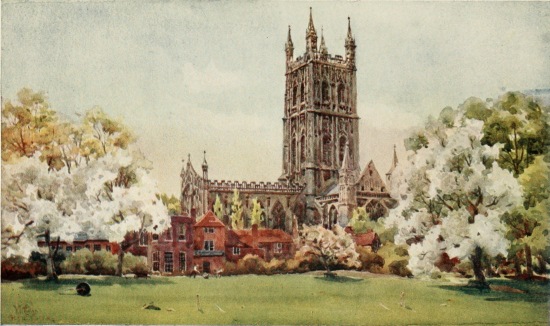
The sculptor's art is represented by many tombs of certain merit. There is the tomb erected by Abbot Parker to the memory of Osric, King of Northumberland, who was one of the founders of the monastery, and who died about the eighth century. In the north aisle leading to the Lady Chapel—which by the way, with its square ending appears like an after-thought, extended eastwards, as it were, from the apsidal termination of the choir—is a monument covering the remains of Robert Duke of Normandy, the eldest son of the Conqueror. He was a benefactor to the old abbey. His effigy in coloured bog oak is disposed in a recumbent attitude on an altar-tomb. There are many others, amongst which that of Dr. Jenner, famous for the introduction of vaccination into general practice, commands great attention. Robert Raikes is also represented. He and the Rev. Thomas Stock, a rector of St. John the Baptist in this city, share the honour of having established the first Sunday school in England, which was held in Gloucester. Some authorities, however, contend that the reverend gentleman was the originator of the Sunday school, though they do not deny that Raikes, through his unwearied exertions, promoted the increase of these institutions throughout the kingdom.
But of all the monuments, that erected by the monks of Gloucester to the memory of Edward of Carnarvon deserves the most attention, not only for its beauty, but because it served as the type for the Gothic sculptors to copy during two centuries. The recumbent effigy is hedged in by a series of elaborately decorated shafts, forming a kind of open-work grille, with pinnacles and niches. Overhead it is covered in with richly ornamented Gothic work.
This shrine, constructed to receive the body of the murdered Edward II., conveyed thither from Berkeley Castle by Abbot Thokey, throughout the greater part of Edward III.'s reign continued to attract vast numbers of pilgrims. Their offerings soon brought in a great revenue, which was spent not on rebuilding the church, but in restoring the surface, in putting new windows in the old walls, and, generally, in adapting the twelfth-century building to the Perpendicular style of the fourteenth century. In this way the original Norman work forms the skeleton to the Perpendicular casing.
In 1541 the Cathedral was separated from the diocese of Worcester by Henry VIII. and made a distinct bishopric.
Besides this magnificent pile, Gloucester possesses four other churches, which deserve some slight notice. There is the Church of St. Mary de Lode, said to contain the remains of Lucius, the first British king. It has an interesting old chancel, and a monument to Bishop Hooper.
St. Mary de Crypt is a cruciform building of the twelfth century, with a beautiful lofty tower. The curfew bell is still rung from the tower of St. Michael, which is said to have been connected with the ancient abbey of St. Peter. St. Nicholas, originally Norman, is now an ancient structure of the Early style of English architecture.
Of schools, one was refounded by Henry VIII. for the education of the cathedral choir. Another was established in the same reign by Dame Joan Cooke, and was called the Crypt School, from the fact of its schoolroom adjoining the church of the same name. Sir Thomas Rich, a native of Gloucester, in 1666 founded the Blue-Coat Hospital, much on the same lines as that of Christ's Hospital, recently removed from London to the country.
During the many years that were taken in beautifying the Cathedral, we must not forget that the city was struggling with varying fortune. It might almost be called a royal city, so often was it visited by princes, were it not that Winchester claims that distinction. In the war between Stephen and the Empress Matilda, Gloucester always accorded a welcome to the Empress. Thither she is said to have escaped after the siege of Winchester, carried in a coffin. If not true, the story is well founded. The city was captured from Henry III. by the barons in 1263. In one of the many Parliaments held at Gloucester, were passed, in 1279, the laws connected with the Statute of Quo Warranto, better known as the Statutes of Gloucester.
In 1327 Edward II. was assassinated in Berkeley Castle by his keeper, Sir Thomas Gournay, and John de Maltravers, Lord Berkeley. From this time Gloucester seems to have enjoyed comparative peace, though its county was the theatre of several important historical events enacted in its cities of Chichester and Tewkesbury. The latter is especially memorable for the great and decisive battle, in which the Lancastrians were totally defeated, in 1471. On that occasion Margaret of Anjou, her son Prince Edward, and her general, the Duke of Somerset, were taken prisoners by Edward IV. After the battle Prince Edward was murdered and the Duke of Somerset beheaded. In the great contest between Charles I. and the Parliament, the city of Gloucester, it is true, became an object of importance to the success of the royal cause. The city was, however, successfully defended for the Parliament by Colonel Massie, till relieved in 1643 by the Earl of Essex. In the meantime Chichester was taken by Prince Rupert.
The subject-matter of this city has unconsciously led us to introduce Tewkesbury and Chichester. Having gone so far we cannot close without first drawing attention to the existence of three other cities that prominently stand out in this same county of Gloucestershire. They are Cheltenham, the home of the famous public school; Tewkesbury, where the decisive battle of the Roses was fought; and Bristol, the great port situated near the mouth of the Severn, the river on the banks of which lies this ancient cathedral city of Gloucester.

Hereford. ("Doomsday Book.")
N the borders of Wales is Herefordshire, and almost in the centre of the county is its ancient capital, Hereford. A Roman station is supposed to have been in the neighbourhood, under the name of Ariconium, which is considered to be identical with the present Kenchester. The present name of Hereford is derived from the pure Saxon. Like Oxford, it had no bridges at first. As the river had to be crossed, the shallowest part was chosen.

This consideration probably determined the site of Hereford to be upon the left bank of the river Wye, and the pass over it was called by the Saxons, Here-ford, or "Military ford." We glean little information of this place till the seventh century. An episcopal see is stated to have existed in this place before the invasion of Britain by the Saxons. From this uncertainty we arrive at something more definite, which took place in 655. Oswy, then King of Mercia, in that year made Hereford part of the diocese of Lichfield, which already wielded jurisdiction over the whole of the kingdom of Mercia.
A few years later it was decided by a synod held here under the presidency of Theodore, then Archbishop of Canterbury, in 673, to make a division of the diocese of Lichfield. Very naturally Wilford, then bishop of that see, refused to recognise the decree, and for this piece of contumacy was subsequently deprived of part of his diocese. His successor, Sexulph, however, was more amenable, and with his consent Hereford was detached from Lichfield and restored to its original independence as a separate diocese. Putta was straightway translated from Rochester See to become the first bishop of Hereford in 680. This instance is one of many such in the history of the Church. The shuffling of dioceses, the enlargement of one at the expense of another, whether from motives of malice or a sense of right distribution, occurs usually in the early years of Christianity in England, and also at the general winding up of the monasteries in the reign of Henry VIII.
Hereford was by no means the only see that suffered these changes. It was simply a unit in the great policy of welding together the churches of the several kingdoms into one whole, which had never been carried into effect till Theodore of Tarsus came to England. He was a Greek monk little known till the Pope elected to fill the vacant archbishopric of Canterbury. Only three bishops were left in the whole of England; of these two were rivals for the See of York, and the third had bought the See of London. The first thing that Theodore did after his arrival was to travel throughout the country. By consecrating new bishops and creating a thorough organisation, he acquired a complete understanding with the Church. He also instituted a system of synods, which he intended should meet annually to discuss the general welfare of the Church. This, however, seems to have fallen into disuse.
In all, Theodore managed to divide England into a matter of fifteen dioceses, through the subdivision of the old dioceses. Truly a great achievement when we remember that the conversion of the English kingdoms mostly depended upon the good-will of their respective kings. Thus it came about that one king in each kingdom had one bishop, generally his chaplain at first, who took his title, not from a see, but from the people. He was either bishop of Mercia, or Northumbria, or some other large kingdom. As we have seen in the collision with Wilford, Theodore's policy did not suit every prelate's views. His influence, however, effected the installation of three bishops in Northumbria, four in Mercia, two in East Anglia, and two in Wessex. Kent already had two since 604.
Thus the result was the complete conversion of England, effected by Theodore from about 673 to 688 A.D.
Prior to the eighth century Hereford is known to have been the capital of the kingdom of Mercia, as it is now of Herefordshire, which is much reduced in size. From the years 765 to 791 Mercia was governed by King Offa. Apart from his connection with the Cathedral of Hereford, his reign must possess some interest to the collectors of coins. For though the die-sinker's art was practised in England as far back as the Roman occupation, and an indigenous coinage came into existence in the seventh century, it is not till this monarch's reign that genuine English coinage was properly in currency. It appears that Offa had to pay an annual tribute of 365 mancuses in coin to the Pope. As a mancus was equal to 30 pennies, the sum was a considerable one.
In the year 782 an event occurred which laid the foundation of the Cathedral. From Marden, the original place of sepulture, the body of Ethelbert, King of the East Angles (who, by the way, is not to be confounded with Ethelbert of Kent, who welcomed St. Augustine), was removed to Hereford. He had been treacherously slain by his intended mother-in-law, the Queen of Mercia. In expiation of the murder King Offa, with munificent donations, enabled a nobleman called Milfride, a viceroy under Egbert, to found the Cathedral about 825. The building was dedicated to St. Mary and St. Ethelbert. It fell into decay in less than two centuries and necessitated a rebuilding during the prelacy of Bishop Athelstan, between 1012 and 1015. It was burnt by the Welsh in 1055, and remained in ruins till 1079, when the first Norman bishop, Robert of Lorraine, was appointed to the See.
He commenced a new edifice on the lines of Aken, now Aix-la-Chapelle. It was carried on, with the exception of the tower left to be erected by Bishop Giles de Braos in the following century, by Bishop Raynelm, in 1107, and eventually completed in 1148 by Bishop R. de Betum.
HEREFORD THE NORTH TRANSEPT
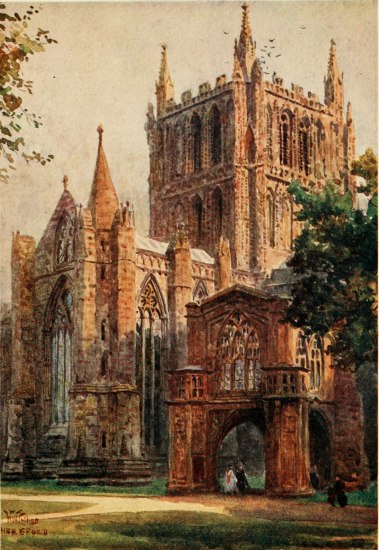
The plan is the usual cross. A lofty tower rises from the intersection, and was formerly surmounted by a spire, taken down for safety's sake. The screen and reredos, the pillars, the arches of naves, and the north and south arches of the choir belong to the Norman period. The Early English claims the triforium, the Lady Chapel, clerestory, and the stone vaulting. The north transept is by Bishop Aquablanca, 1245-1268, whilst the south-east transept dates from the Late Decorated style.
For over 450 years a number of additions and restorations have afforded every facility for the skill of the architect, not always happily taken advantage of. The great western tower unfortunately fell down in 1786, and caused considerable damage to the west front and adjacent work. Mr. Wyatt, during modern restorations, in 1842 and 1863, rebuilt the tower. The west front, soon after its misfortune, was restored in a style different from the original. The whole exterior of this edifice presents a curious variety of architectural style. This capitulation of bishops and dates is possibly dry reading, but it is absolutely necessary to determine the date of the different erections and restorations, and their successive styles of architecture.
Near the choir was the shrine of St. Ethelbert, which was destroyed during the Commonwealth of Cromwell. Another attraction to the pilgrims was the tomb erected to the memory of Bishop Cantelupe, who died in 1282. His heart was brought to Hereford and buried in the north transept of the Cathedral, and he was canonised in 1310. The pilgrims resorted to this place, as it was reputed that no less than four hundred miracles had been performed there. In consequence of this the succeeding bishops altered the quarterings of their ancient arms, which were those of St. Ethelbert, and assumed the paternal coat of Cantelupe. This change constitutes the present arms of the bishopric.
Amongst many other memorials is one to Bishop Aquablanca. A plain marble tablet was also erected to the memory of John Philips, a well-known author of poems entitled "The Splendid Shilling," and "Cyder."
Perhaps the most interesting item, as well as the most curious of all the old maps, is the "Mappa Mundi," preserved in the south choir aisle. It was compiled somewhere about 1275 to 1300, by a monk of Lincoln. How it ever came to Hereford appears to be an enigma. The most likely solution is that the monk may have been transferred from Lincoln to this see.
The "Hereford Map," as it is called, is a great picture, more to be classed as a grotesque work of art than a valuable aid to geography. It is, at least, a gigantic attempt to represent the whole world, with the introduction of the main features, the people, industries, and products of each country. It is one mass of legendary figures, and the farther we get from England, which is hardly recognisable, the more grotesque and improbable become the monsters. The Minotaurs and Gog-Magog of Tartary, the dog-faced, the horse-footed, and flap-eared freaks of nature of the far east, together with the one-legged, one-eyed, four-eyed, headless, and hermaphrodite tribes who fringe the Torrid Zone, give us an interesting idea of the imposition by travellers upon the minds of the people of that period, the thirteenth century. Even the fishes, supposed to be peculiar to each sea, are carefully depicted. Truly it is a wonderful work of imagination, not the less to be respected for that, and quite alone deserves a journey to Hereford.
An epitome of the chief historical events of the city will be a sufficient guide to its status. Except cider making, it has no industries of special note.
To the fortifications erected in the time of Athelstan, and nearly perfected in Leland's time, was added a castle by Edward the Elder. In 1055, two miles from this place, Griffith the Prince of Wales defeated Ralph Earl of Hereford; and the Welsh, having thus taken the city, spent their time in reducing it to a heap of ruins. Harold, afterwards king, attacked and defeated the Welsh, and repaired and enlarged the fortifications in view of further invasions. In the conflicts between Stephen and the Empress Maud, Hereford was successfully defended for the latter by Milo, to be reduced by the King in 1141. At the commencement of the parliamentary war, Hereford was garrisoned for the King, but surrendered, without a blow being struck, to the army of Sir William Waller in 1643. On the retreat of this knight the Royalists occupied it, and under the governorship of Barnabas Scudamore, Esquire, made a stubborn resistance against the Scots, under the Earl of Leven, and obliged them to raise the siege.
The inhabitants, at the Restoration, for their loyalty to the royal cause, received from Charles II. a new charter with extended privileges, and new heraldic arms testifying to their fidelity to the House of Stuart. Previous to this Charles I. had been generous enough to reward the many sacrifices and sufferings of the loyal citizens by granting the city its motto of
Invictæ fidelitatis præmium.

Lincolia. ("Doomsday Book.")
HE commercial importance of Lincoln, whatever it may be now, was at one time considerable. At the time of the Norman survey it commanded sufficient attention to cause the entry of the city in the "Doomsday Book" as one of the leading centres of commerce. This happy state was continued, or rather increased, by the famous Ordinance of the Staple in the reign of Edward III. He was an ambitious monarch, and desired to become master of France. If we recall the battles of Cressy and Poitiers, we can readily understand what an enormous expenditure would be required for the proper conduct of the war. By some means or other the English revenues had to be found. This was met to a great extent by the Ordinance of the Wool Staple, enacted by Edward III., who, besides waging war in France, was keen on the extension of foreign trade. By charters granted to merchants of Gascony, who imported wine and other commodities, and by giving special protection to the Flemish weavers in England, the King enhanced the prospects of trade. But the most important of all his commercial projects was, as we have said, his scheme, finally declared in 1353, by which a staple for English exports was established under the direct control of the Crown. Thus the monopoly of wool, which accrued so advantageously to Bruges and other cities on the Continent, and had become unbearable, was in 1353 transferred to England. For the exclusive sale of wool ten English towns were chosen. They were situated within easy distance of the coast, or the town was in connection with a convenient port. Of these ten towns with corresponding ports, Lincoln with Boston was chosen as a staple town for wool. This with other sources of trade, such as the staple of lead and leather, flourished in Lincoln from Edward III.'s time till the commencement of the eighteenth century, when the trade of the town declined. Through the several plagues prevalent in the fourteenth century, such as the black death and other epidemics similar in death-dealing if not in character at that time, especially about the year 1390, many towns in England were much decayed. Except London, York, Bristol, Coventry, and Plymouth, the afflicted towns did not regain the population they enjoyed in the fourteenth century till the Tudor period, and some, notably Sarum and Leicester, not until late in the reign of Elizabeth. The decline of Lincoln, though progressive, in a way appears to have been truly a gradual decay, and more terrible in its imperceptible undermining than any knock-down blow, for it never recovered its old trade prosperity; whilst Norwich, which before the plagues was next to London, bore relatively and even greater and sharper evidence of the terrible visitation, yet managed somehow to hark back in a measure to days of its former glory. The old saying which ran "Lincoln was, London is, York shall be" indicates, far more than anything else, the change of Lincoln's fortunes. Whatever its shortcomings may be, Lincoln possesses a most interesting record of antiquity. Its minster is truly a gem, for it is not only the earliest example of a pure Gothic building in Europe, but presents a delightful study of every kind of style, from the early Norman down to the Late Decorated.