Chapter XVI
Reading edition
THE UPPER LOIRE
The gateway to the upper valley may be said to be through the Nivernais, and the capital city of the old province, at the juncture of the Allier and the Loire.
After leaving Gien and Briare, the Loire passes through quite the most truly picturesque landscape of its whole course, the great height of Sancerre dominating the view for thirty miles or more in any direction.
Cosne is the first of the towns of note of the Nivernais, and is a gay little bourg of eight or nine thousand souls who live much the same life that their grandfathers lived before them. As a place of residence it might prove dull to the outsider, but as a house of call for the wearied and famished traveller, Cosne, with its charming situation, its tree-bordered quays, and its Hôtel du Grand Cerf, is most attractive.
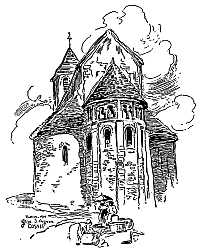
Église S. Aignan, Cosne
Pouilly-sur-Loire is next, with three thousand or more inhabitants wholly devoted to wine-growing, Pouilly being to the upper river what Vouvray is to Touraine. It is not a tourist point in any sense, nor is it very picturesque or attractive.
Some one has said that the pleasure of contemplation is never so great as when one views a noble monument, a great work of art, or a charming French town for the first time. Never was it more true indeed than of the two dissimilar towns of the upper Loire, Nevers, and La Charité-sur-Loire. The old towers of La Charité rise up in the sunlight and give that touch to the view which marks it at once as of the Nivernais, which all archæologists tell one is Italian and not French, in motive as well as sentiment.
It is remarkable, perhaps, that the name La Charité is so seldom met with in the accounts of English travellers in France, for in France it is invariably considered to be one of the most picturesque and famous spots in all mid-France.
It is an unprogressive, sleepy old place, with streets mostly unpaved, whose five thousand odd souls, known roundabout as Les Caritates, live apparently in the past.
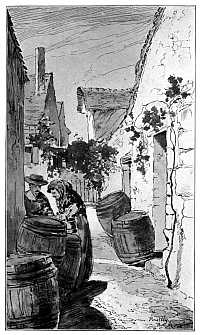
Pouilly-sur-Loire
Below, a stone's throw from the windows of your inn, lies the Loire, its broad, blue bosom scarcely ruffled, except where it slowly eddies around the piers of the two-century-old dos d'ane bridge; a lovely old structure, built, it is recorded, by the regiment known as the "Royal Marine" in the early years of the eighteenth century.
The town is terraced upon the very edge of the river, with views up and down which are unusually lovely for even these parts. Below, almost within sight, is Nevers, while above are the heights of Sancerre, still visible in the glowing western twilight.
Beyond the bridge rises a giant column of blackened stone, festooned by four ranges of arcades, the sole remaining relic of the ancient church standing alone before the present structure which now serves the purposes of the church in La Charité.
The walls which surrounded the ancient town have disappeared or have been built into house walls, but the effect is still of a self-contained old burg.
In the fourteenth century, during the Hundred Years' War, the town was frequently besieged. In 1429 Jeanne d'Arc, coming from her success at St. Pierre-le-Moutier, here met with practically a defeat, as she was able to sustain the siege for only but a month, when she withdrew.
La Charité played an important part in the religious wars of the sixteenth century, and Protestants and Catholics became its occupants in turn. Virtually La Charité-sur-Loire became a Protestant stronghold in spite of its Catholic foundation.
In 1577 it bade defiance to the royal arms of the Duc d'Alençon, as is recounted by the following lines:
"Ou allez-vous, hélas! furieux insensés Cherchant de Charité la proie et la ruine, Qui sans l'ombre de Foy abbatre la pensez! . . . . . . . . . Le canon ne peut rien contre la Charité, Plus tot vous détruira la peste et la famine, Car jamais sans Foy n'aurez la Charité."
In spite of this defiance it capitulated, and, on the 15th of May, at the château of Plessis-les-Tours on the Loire, Henri III. celebrated the victory of his brother by a fête "ultra-galante," where, in place of the usual pages, there were employed "des dames vestues en habits d'hommes...." Surely a fantastic and immodest manner of celebrating a victory against religious opponents; but, like many of the customs of the time, the fête was simply a fanatical debauch.
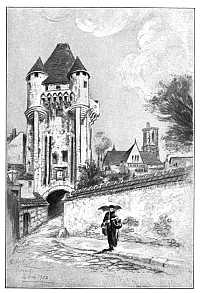
Porte du Croux, Nevers
At Nevers one meets the Canal du Nivernais, which recalls Daudet's "La Belle Nivernaise" to all readers of fiction, who may accept it without question as a true and correct guide to the region, its manners, and customs.
The chief characteristic of Nevers is that it is Italian in nearly, if not quite all, its aspects; its monuments and its history. Its ancient ducal château, part of which dates from the feudal epoch, was the abode of the Italian dukes who came in the train of Mazarin, the last of whom was the nephew of the cardinal, "who himself was French if his speech was not."
Nevers has also a charming Gothic cathedral (St. Cyr) with a double Romanesque apse (in itself a curiosity seldom, if ever, seen out of Germany), and, in addition to the cathedral, can boast of St. Etienne, one of the most precious of all the Romanesque churches of France.
The old walls at Nevers are not very complete, but what remain are wonderfully expressive. The Tour Gouguin and the Tour St. Eloi are notable examples, but they are completely overshadowed by the Porte du Croux, which is one of the best examples of the city gates which were so plentiful in the France of another day.
Above Nevers, Decize, Bourbon-Lancy, Gilly, and Digoin are mere names which mean nothing to the traveller by rail. They are busy towns of central France, where the bustle of their daily lives is of quite a different variety from that of the Ile de France, of Normandy, or of the Pas de Calais.
From Digoin to Roanne the Loire is followed by the Canal Latéral. Roanne is a not very pleasing, overgrown town which has become a veritable ville des ouvriers, all of whom are engaged in cloth manufacture.
Virtually, then, Roanne is not much more than a guide-post on the route to Le Puy—"the most picturesque place in the world"—and the wonderfully impressive region of the Cevennes and the Vivaris, where shepherds guard their flocks amid the solitudes.
Far above Le Puy, in a rocky gorge known as the Gerbier-de-Jonc, near Ste. Eulalie, in the Ardeche, rises the tiny Liger, which is the real source of the mighty Loire, that natural boundary which divides the north from the south and forms what the French geographers call "la bassin centrale de France."
THE END.