Chapter XIII
Reading edition
ANJOU AND BRETAGNE
As one crosses the borderland from Touraine into Anjou, the whole aspect of things changes. It is as if one went from the era of the Renaissance back again into the days of the Gothic, not only in respect to architecture, but history and many of the conditions of every-day life as well.
Most of the characteristics of Anjou are without their like elsewhere, and opulent Anjou of ancient France has to-day a departmental etiquette in many things quite different from that of other sections.
A magnificent agricultural province, it has been further enriched by liberal proprietors; a land of aristocracy and the church, it has ever been to the fore in political and ecclesiastical matters; and to-day the spirit of industry and progress are nowhere more manifest than here in the ancient province of Anjou.
The Loire itself changes its complexion but little, and its entrance into Saumur, like its entrance into Tours, is made between banks that are tinged with the rainbow colours of the growing vine. What hills there are near by are burrowed, as swallows burrow in a cliff, by the workers of the vineyards, who make in the rock homes similar to those below Saumur, in the Vallée du Vendomois, and at Cinq-Mars near Tours.
Anjou has a marked style in architecture, known as Angevin, which few have properly placed in the gamut of architectural styles which run from the Byzantine to the Renaissance.
The Romanesque was being supplanted everywhere when the Angevin style came into being, as a compromise between the heavy, flat-roofed style of the south and the pointed sky-piercing gables of the north. All Europe was attempting to shake off the Romanesque influence, which had lasted until the twelfth century. Germany alone clung to the pure style, and, it is generally thought, improved it. The Angevin builders developed a species that was on the borderland between the Romanesque and the Gothic, though not by any means a mere transition type.
The chief cities of Anjou are not very great or numerous, Angers itself containing but slightly over fifty thousand souls. Cholet, of thirteen thousand inhabitants, is an important cloth-manufacturing centre, while Saumur carries on a great wine trade and was formerly the capital of a "petit gouvernement" of its own, and, like many other cities and towns of this and neighbouring provinces, was the scene of great strife during the wars of the Vendée.
In ancient times the Andecavi, as the old peoples of the province were known, shared with the Turonii of Touraine the honour of being the foremost peoples of western Gaul, though each had special characteristics peculiarly their own, as indeed they have to-day.
After one passes the junction of the Cher, the Indre, and the Vienne, he notices no great change in the conduct of the Loire itself. It still flows in and out among the banks of sand and those little round pebbles known all along its course, nonchalantly and slowly, though now and then one fancies that he notes a greater eddy or current than he had observed before. At Saumur it is still more impressed upon one, while at the Ponts de Cé—a great strategic spot in days gone by—there is evidence that at one time or another the Loire must be a raging torrent; and such it does become periodically, only travellers never seem to see it when it is in this condition.
When Candes and Montsoreau are passed and one comes under the frowning walls of Saumur's grim citadel, a sort of provincial Bastille in its awesomeness, he realizes for the first time that there is, somewhere below, an outlet to the sea. He cannot smell the salt-laden breezes at this great distance, but the general appearance of things gives that impression.
From Tours to Saumur by the right bank of the Loire—one of the most superb stretches of automobile roadway in the world—lay the road of which Madame de Sévigné wrote in "Lettre CCXXIV." (to her mother), which begins: "Nous arrivons ici, nous avons quitté Tours ce matin." It was a good day's journey for those times, whether by malle-post or the private conveyance which, likely enough, Madame de Sévigné used at the time (1630). To-day it is a mere morsel to the hungry road-devouring maw of a twentieth-century automobile. It's almost worth the labour of making the journey on foot to know the charms of this delightful river-bank bordered with historic shrines almost without number, and peopled by a class of peasants as picturesque and gay as the Neapolitan of romance.
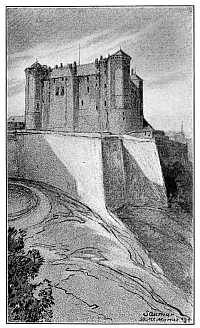
Château de Saumur
"Saumur est, ma foi! une jolie ville," said a traveller one day at a table d'hôte at Tours. And so indeed it is. Its quays and its squares lend an air of gaiety to its proud old hôtel de ville and its grim château. Old habitations, commodious modern houses, frowning machicolations, church spires, grand hotels, innumerable cafés, and much military, all combine in a blend of fascinating interest that one usually finds only in a great metropolis.
The chief attraction is unquestionably the old château. To-day it stands, as it has always stood, high above the Quai de Limoges, with scarce a scar on its hardy walls and never a crumbling stone on its parapet.
The great structure was begun in the eleventh century, replacing an earlier monument known as the Tour du Tronc. It was completed in the century following and rebuilt or remodelled in the sixteenth. Outside of its impressive exterior there is little of interest to remind one of another day.
To literary pilgrims Saumur suggests the homestead of the father of Eugenie Grandet, and the bon-vivant reveres it for its soft pleasant wines. Others worship it for its wonders of architecture, and yet others fall in love with it because of its altogether delightful situation.
Below Saumur are the cliff-dwellers, who burrow high in the chalk cliff and stow themselves away from light and damp like bottles of old wine. The custom is old and not indigenous to France, but here it is sufficiently in evidence to be remarked by even the traveller by train. Here, too, one sees the most remarkable of all the coiffes which are worn by any of the women along the Loire. This Angevin variety, like Angevin architecture, is like none of its neighbours north, east, south, or west.
Students of history will revere Saumur for something more than its artistic aspect or its wines, for it was a favourite residence of the Angevin princes and the English kings, as well as being the capital of the pape des Huguenots.
While Nantes is the real metropolis of the Loire, and Angers is singularly up-to-date and well laid out, neither of these fine cities have a great thoroughfare to compare with the broad, straight street of Saumur, which leads from the Gare d'Orleans on the left bank and crosses the two bridges which span the branches of the Loire, to say nothing of the island between, and finally merges into the great national highway which runs south into Poitou.
Fine houses, many, if not most of them, dating from centuries ago, line the principal streets of the town, which, when one has actually entered its confines, presents the appearance of being too vast and ample for its population. And, in truth, so it really is. Its population barely reaches fifteen thousand souls, whereas it would seem to have the grandeur and appointments of a city of a hundred thousand. The revocation of the Edict of Nantes cut its inhabitants down to the extent of twenty or twenty-five thousand, and it has never recovered from the blow.
In the neighbourhood of Saumur, for a considerable distance up and down the Loire, the hills are excavated into dwelling-houses and wine-caves, producing a most curious aspect. One continuous line of these cliff villages—like nothing so much as the habitations of the cliff-dwelling Indians of America—extends from the juncture of the Vienne with the Loire nearly up to the Ponts de Cé.
The most curious effect of it all is the multitude of openings of doorways and windows and the uprising of chimney-pots through the chalk and turf which form the roof-tops of these settlements.
In many of these caves are prepared the famous vin mousseux of Saumur, of which the greater part is sold as champagne to an unsuspecting and indifferent public, not by the growers or makers, but by unscrupulous middlemen.
Saumur, like Angers, is fortunate in its climate, to which is due a great part of the prosperity of the town, for the "Rome of the Huguenots" is more prosperous—and who shall not say more content?—than it ever was in the days of religious or feudal warfare.
Near Saumur is one shrine neglected by English pilgrims which might well be included in their itineraries. In the Château de Moraines at Dampierre died Margaret of Anjou and Lancaster, Queen of England, as one reads on a tablet erected at the gateway of this dainty "petit castel à tour et creneaux."
Manoir de la Vignole-Souzay autrefois Dampierre Asile et dernière demure de l'heroine de la guerre des deux roses Marguerite d'Anjou de Lancastre, reine d'Angleterre La plus malheureuse des reines, des éspouses, et des mères Qui Morut le 25 Aout 1482 Agée de 53 Ans.
The Salvus Murus of the ancients became the Saumur of to-day in the year 948, when the monk Absalom built a monastery here and surrounded it with a protecting wall. Up to the thirteenth century the city belonged to the "Angevin kings of Angleterre," as the French historians proudly claim them.
The city passed finally to the Kings of France, and to them remained constantly faithful. Under Henri IV. the city was governed by Duplessis-Mornay, the "pape des Huguenots," becoming practically the metropolis of Protestantism. Up to this time the chief architectural monument was the château, which was commenced in the eleventh century and which through the next five centuries had been aggrandized and rebuilt into its present shape.
The church of Notre Dame de Nantilly dates from the twelfth century and was frequently visited by Louis XI. The oratory formerly made use of by this monarch to-day contains the baptismal fonts. One of the columns of the nave has graven upon it the epitaph composed by King René of Anjou for his foster-mother, Dame Thiephanie. Throughout, the church is beautifully decorated.
The Hôtel de Ville may well be called the chief artistic treasure of Saumur, as the châtteau is its chief historical monument. It is a delightful ensemble of the best of late Gothic, dating from the sixteenth century, flanked on its façade by turrets crowned with mâchicoulis, and lighted by a series of elegant windows à croisillons. Above all is a gracious campanile, in its way as fine as the belfry of Bruges, to which, from a really artistic standpoint, rhapsodists have given rather more than its due.
The interior is as elaborate and pleasing as is the outside. In the Salle des Mariages and Salle du Conseil are fine fifteenth-century chimneypieces, such as are only found in their perfection on the Loire. The library, of something over twenty thousand volumes, many of them in manuscript, is formed in great part from the magnificent collection formerly at the abbeys of Fontevrault and St. Florent. Doubtless these old tomes contain a wealth of material from which some future historian will perhaps construct a new theory of the universe. This in truth may not be literally so, but it is a fact that there is a vast amount of contemporary historical information, with regard to the world in general, which is as yet unearthed, as witness the case of Pompeii alone, where the area of the discoveries forms but a small part of the entire buried city.
At Saumur numerous prehistoric and gallo-romain remains are continually being added to the museum, which is also in the Hôtel de Ville. A recent acquisition—discovered in a neighbouring vineyard—is a Roman "trompette," as it is designated, and a more or less complete outfit of tools, obviously those of a carpenter.
The notorious Madame de Montespan—"the illustrious penitent," though the former description answers better—stopped here, in a house adjoining the Church of St. John, to-day a maison de retrait, on her way to visit her sister, the abbess, at Fontevrault.
From Saumur to Angers the Loire passes an almost continuous series of historical guide-posts, some in ruins, but many more as proudly environed as ever.
At Treves-Cunault is a dignified Romanesque church which would add to the fame of a more popular and better known town. It is not a grand structure, but it is perfect of its kind, with its crenelated façade and its sturdy arcaded towers curiously placed midway on the north wall.
Here one first becomes acquainted with menhirs and dolmens, examples of which are to be found in the neighbourhood, not so remarkable as those of Brittany, but still of the same family.
The Ponts de Cé follow next, still in the midst of vine-land, and finally appear the twin spires of Angers's unique Cathedral of St. Maurice. Here one realizes, if not before, that he is in Anjou; no more is the atmosphere transparent as in Touraine, but something of the grime of the commercial struggle for life is over all.
Here the Maine joins the Loire, at a little village called La Pointe: "the Charenton of Angers," it was called by a Paris-loving boulevardier who once wandered afield.
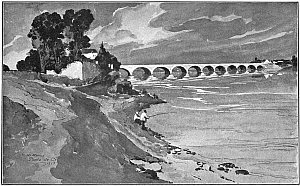
Much has been written, and much might yet be written, about the famous Ponts de Cé, which span the Loire and its branches for a distance considerably over three kilometres. This ancient bridge or bridges (which, with that at Blois, were at one time, the only bridges across the Loire below Orleans) formerly consisted of 109 arches, but the reconstruction of the mid-nineteenth century reduced these to a bare score.
The Ponts de Cé
As a vantage-point in warfare the Ponts de Cé were ever in contention, the Gauls, the Romans, the Franks, the Normans, and the English successively taking possession and defending them against their opponents. The Ponts de Cé is a weirdly strange and historic town which has lost none of its importance in a later day, though the famous ponts are now remade, and their antique arches replaced by more solid, if less picturesque piers and piling. They span the shallow flow of the Loire water for three-quarters of a league and produce a homogeneous effect of antiquity, coupled with the city's three churches and its château overlooking the fortified isle in mid-river, which looks as though it had not changed since the days when Marie de Medici looked upon it, as recalled by the great Rubens painting in the Louvre. Since the beginning of the history of these parts, battles almost without number have taken place here, as was natural on a spot so strategically important.
There is a tale of the Vendean wars, connected with the "Roche-de-Murs" at the Ponts de Cé, to the effect that a battalion, left here to guard any attack from across the river, was captured by the Vendeans. Many of the "Bleus" refused to surrender, and threw themselves into the river beneath their feet. Among these was the wife of an officer, to whom the Vendeans offered life if she surrendered. This was refused, and precipitately, with her child, she threw herself into the flood beneath.
On the largest isle, that lying between the Louet and the Loire, is one vast garden or orchard of cherry-trees, which produce a peculiarly juicy cherry from which large quantities of guignolet, a sort of "cherry brandy," is made. The Angevins will tell you that this was a well-known refreshment in the middle ages, and was first made by one of those monkish orders who were so successful in concocting the subtle liquors of the commerce of to-day.
It is with real regret that one parts from the Ponts de Cé, with La Fontaine's couplet on his lips:
"... Ce n'est pas petite gloire Que d'être pont sur la Loire."
Some one has said that the provinces find nothing to envy in Paris as far as the transformation of their cities is concerned. This, to a certain extent, is so, not only in respect to the modernizing of such grand cities as Lyons, Marseilles, or Lille, but in respect to such smaller cities as Nantes and Angers, where the improvements, if not on so magnificent a scale, are at least as momentous to their immediate environment.
For the most part these second and third class cities are to-day transformed in exceedingly good taste, and, though many a noble monument has in the past been sacrificed, to-day the authorities are proceeding more carefully.
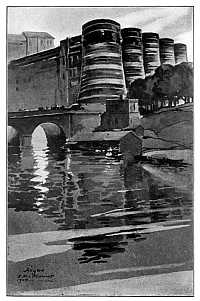
Angers, in spite of its overpowering château and its unique cathedral, is of a modernity and luxuriousness in its present-day aspect which is all the more remarkable because of the contrast. Formerly the Angevin capital, from the days of King John up to a much later time Angers had the reputation of being a town "plus sombre et plus maussade" than any other in the French provinces. In Shakespeare's "King John" one reads of "black Angers," and so indeed is its aspect to-day, for its roof-tops are of slate, while many of the houses are built of that material entirely. In the olden time many of its streets were cut in the slaty rock, leaving its sombre surface bare to the light of day. One sees evidences of all this in the massive walls of the great black-banded castle of Angers, and, altogether, this magpie colouring is one of the chief characteristics of this grandly historic town.
Both the new and the old town sit proudly on a height crowned by the two slim spires of the cathedral. In front, the gentle curves of the river Maine enfold the old houses at the base of the hillside and lap the very walls of the grim fortress-château itself, or did in the days when the Counts of Anjou held sway, though to-day the river has somewhat receded.
Beyond the ancient ramparts, up the hill, have been erected the "quartiers neufs," with houses all admirably planned and laid out, with gardens forming a veritable girdle, as did the retaining walls of other days which surrounded the old château and its faubourg. To-day Angers shares with Nantes the title of metropolis of the west, and the Loire flows on its ample way between the two in a far more imposing manner than elsewhere in its course from source to sea.
Angers does not lie exactly at the juncture of the Maine and Loire, but a little way above, but it has always been considered as one of the chief Loire cities; and probably many of its visitors do not realize that it is not on the Loire itself.
The marvellous fairy-book château of Angers, with its fourteen black-striped towers, is just as it was when built by St. Louis, save that its chess-board towers lack, in most cases, their coiffes, and all vestiges have disappeared of the charpente which formerly topped them off.
Château d'Angers
Beyond the rocky formation of the banks of the Loire, which crop out below the juncture of the Maine and the Loire, below Angers, are Savennières and La Possonière, whence come the most famous vintages of Anjou, which, to the wines of these parts, are what Château Margaux and Château Yquem are to the Bordelais, and the Clos Vougeot is to the Bourguignons.
The peninsula formed by the Loire and the Maine at Angers is the richest agricultural region in all France, the nurseries and the kitchen-gardens having made the fortune of this little corner of Anjou.
Angers is the headquarters for nursery-garden stock for the open air, as Orleans is for ornamental and woodland trees and shrubs.
The trade in living plants and shrubs has grown to very great proportions since 1848, when an agent went out from here on behalf of the leading house in the trade and visited America for the purpose of searching out foreign plants and fruits which could be made to thrive on French soil.
Both the soil and climate are very favourable for the cultivation of many hitherto unknown fruits, the neighbourhood of the sea, which, not far distant, is tempered by the Gulf Stream, having given to Anjou a lukewarm humidity and a temperature of a remarkable equality.
Some of the nurseries of these parts are enormous establishments, the Maison André Leroy, for example, covering an extent of some six hundred acres. A catalogue of one of these establishments, located in the suburbs of Angers, enumerates over four hundred species of pear-trees, six hundred varieties of apple-trees, one hundred and fifty varieties of plums, four hundred and seventy-five of grapes, fifteen hundred of roses, and two hundred and nineteen of rhododendrons.
Each night, or as often as fifty railway wagons are loaded, trains are despatched from the gare at Angers for all parts. When the choux-fleurs are finished, then come the petits pois, and then the artichauts and other légumes in favour with the Paris bon-vivants.
Near Angers is one of those Cæsar's camps which were spread thickly up and down Gaul and Britain alike. One reaches it by road from Angers, and, until it dawns upon one that the vast triangle, one of whose equilateral sides is formed by the Loire, another by the Maine, and the third by a ridge of land stretching between the two, covers about fourteen kilometres square, it seems much like any other neck or peninsula of land lying between two rivers. One hundred thousand of the Roman legion camped here at one time, which is not so very wonderful until it is recalled that they lived for months on the resources of this comparatively restricted area.
Before coming to Nantes, Ancenis and Oudon should claim the attention of the traveller, though each is not much more than a typically interesting small town of France, in spite of the memories of the past.
Ancenis has an ancient château, remodelled and added to in the nineteenth century, which possesses some remarkably important constructive details, the chief of which are a great tower-flanked doorway and the corps de logis, each the work of an Angevin architect, Jean de Lespine, in the sixteenth century. Within the walls of this château François II., Duc de Bretagne, and Louis XI. signed one of the treaties which finally led up to the union of the Duché de Bretagne with the Crown of France.
Oudon possesses a fine example of a mediæval donjon, though it has been restored in our day.
One does not usually connect Brittany with the Loire except so far as to recollect that Nantes was a former political and social capital. As a matter of fact, however, a very considerable proportion of Brittany belongs to the Loire country.
Anjou of the counts and kings and Bretagne of the dukes and duchesses embrace the whole of the Loire valley below Saumur, although the river-bed of the Loire formed no actual boundary. Anjou extended nearly as far to the southward as it did to the north of the vine-clad banks, and Bretagne, too, had possession of a vast tract south of Nantes, known as the Pays de Retz, which bordered upon the Vendée of Poitou.
All the world knows, or should know, that Nantes and St. Nazaire form one of the great ports of the world, not by any means so great as New York, London, or Hamburg, nor yet as great as Antwerp, Bordeaux, or Marseilles, but still a magnificent port which plays a most important part with the affairs of France and the outside world.
Nantes, la Brette, is tranquil and solid, with the life of the laborious bourgeois always in the foreground. It is of Bretagne, to which province it anciently belonged, only so far as it forms the bridge between the Vendée and the old duchy; literally between two opposing feudal lords and masters, both of whom were hard to please.
The memoirs of this corner of the province of Bretagne of other days are strong in such names as the Duchesse Anne, the monk Abelard, the redoubtable Clisson, the infamous Gilles de Retz, the warrior Lanoue, surnamed "Bras de Fer," and many others whose names are prominent in history.
"Ventre Saint Gris! les Ducs de Bretagne n'étaient pas de petits compagnons!" cried Henri Quatre, as he first gazed upon the Château de Nantes. At that time, in 1598, this fortress was defended by seven curtains, six towers, bastions and caponieres, all protected by a wide and deep moat, into which poured the rising tide twice with each round of the clock.
To-day the aspect of this château is no less formidable than of yore, though it has been debased and the moat has disappeared to make room for a roadway and the railroad.
It was in the château of Nantes, the same whose grim walls still overlook the road by which one reaches the centre of the town from the inconveniently placed station, that Mazarin had Henri de Gondi, Cardinal de Retz and co-adjutor of the Archbishop of Paris, imprisoned in 1665, because of his offensive partisanship. Fouquet, too, after his splendid downfall, was thrown into the donjon here by Louis XIV.
De Gondi recounts in his "Mémoires" how he took advantage of the inattention of his guards and finally evaded them by letting himself over the side of the Bastion de Mercœur by means of a rope smuggled into him by his friends. The feat does not look a very formidable one to-day, but then, or in any day, it must have been somewhat of an adventure for a portly churchman, and the wonder is that it was performed successfully. At any rate it reads like a real adventure from the pages of Dumas, who himself made a considerable use of Nantes and its château in his historical romances.
Landais, the minister and favourite of François II. of Bretagne, was arrested here in 1485, in the very chamber of the prince, who delivered him up with the remark: "Faites justice, mais souvenez-vous que vous lui êtes redevable de votre charge."
There is no end of historical incident connected with Nantes's old fortress-château of mediæval times, and, in one capacity or another, it has sheltered many names famous in history, from the Kings of France, from Louis XII. onward, to Madame de Sévigné and the Duchesse de Berry.
Nantes's Place de la Bouffai (which to lovers of Dumas will already be an old friend) was formerly the site of a château contemporary with that which stands by the waterside. The Château de Bouffai was built in 990 by Conan, first Duc de Bretagne, and served as an official residence to him and many of his successors.
In Nantes's great but imperfect and unfinished Cathedral of St. Pierre one comes upon a relic that lives long in the memory of those who have passed before it: the tomb of François II., Duc de Bretagne, and Marguerite de Foix. The cathedral itself is no mean architectural work, in spite of its imperfections, as one may judge from the following inscription graven over the sculptured figure of St. Pierre, its patron:
"L'an mil quatre cent trente-quatre, A my-avril sans moult rabattre: An portail de cette église, Fut la première pierre assise."
Within, the chief attraction is that masterwork of Michel Colombe, the before-mentioned tomb, which ranks among the world's art-treasures. The beauty of the emblematic figures which flank the tomb proper, the fine chiselling of the recumbent effigies themselves, and the general ensemble is such that the work is bound to appeal, whatever may be one's opinion of Renaissance sculpture in France. The tomb was brought here from the old Église des Carmes, which had been pillaged and burned in the Revolution.
The mausoleum was—in its old resting-place—opened in 1727, and a small, heart-shaped, gold box was found, supposed to have contained the heart of the Duchesse Anne. The coffer was surmounted by a royal crown and emblazoned with the order of the Cordelière, but within was found nothing but a scapulary. On the circlet of the crown was written in relief:
"Cueur de vertus orné Dignement couronné."
And on the box beneath one read:
"En ce petit vaisseau, de fin or pur et munde, Repose un plus grand cueur que oncque dame eut au monde. Anne fut le nom d'elle, en France deux fois Royne . . . . . . . . . . . Et ceste parte terrestre en grand deuil nos demure. IX. Janvier M.V.XIII."
In one respect only has Nantes suffered through the march of time. Its magnificent Quai de la Fosse has disappeared, a long façade which a hundred or more years ago was bordered by the palatial dwellings of the great ship-owners of the Nantes of a former generation. The whole, immediately facing the river where formerly swung many ships at anchor, has disappeared entirely to make way for the railway.
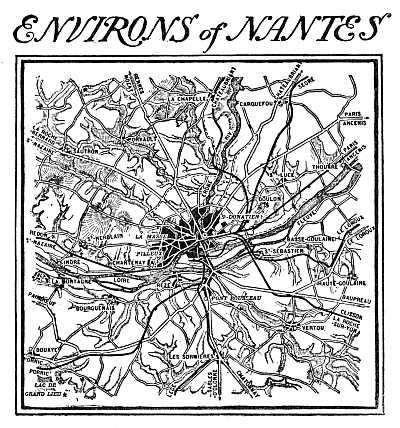
The islands of the Loire opposite Nantes are an echo of the life of the metropolis itself. The Ile Feydeau is monumental, the Ile Gloriette hustling and nervous with "affaires," and Prairie-au-Duc busy with industries of all sorts.
Couëron, below Nantes on the right bank, is sombre with gray walls surrounding its numberless factories, and chimney-stacks belching forth clouds of dense smoke. Behind are great walls of chalky-white rock crowned with verdure. Nearly opposite is the little town of Le Pellerin graciously seated on the river's bank and marking the lower limit of the Loire Nantaise.
Another hill, belonging to the domain of Bois-Tillac and La Martinière, where was born Fouché, the future Duc d'Otranta, comes to view, and the basin of the Loire enlarges into the estuary, and all at once one finds himself in the true "Loire Maritime."
At Martinière is the mouth of the Canal Maritime à la Loire, which, from Paimbœuf to Le Pellerin, is used by all craft ascending the river to Nantes, drawing more than four metres of water.
At the entrance of the Acheneau is the Canal de Buzay, which connects that stream with the more ambitious Loire, and makes of the Lac de Grand Lieu a public domain, instead of a private property as claimed by the "marquis" who holds in terror all who would fish or shoot over its waters. All this immediate region formerly belonged to the monks of the ancient Abbey of Buzay, and it was they who originally cut the waterway through to the Loire. About half-way in its length are the ruins of the ancient monastery, clustered about the tower of its old church. It is a most romantically sad monument, and for that very reason its grouping, on the bank of the busy canal, suggests in a most impressive manner the passing of all great works.
The prosperity of Nantes as a deep-sea port is of long standing, but recent improvements have increased all this to a hitherto unthought-of extent. Progress has been continuous, and now Nantes has become, like Rouen, a great deep-water port, one of the important seaports of France, the realization of a hope ever latent in the breast of the Nantais since the days and disasters of the Edict and its revocation.
Below Nantes, in the actual "Loire Maritime," the aspect of all things changes and the green and luxuriant banks give way to sand-dunes and flat, marshy stretches, as salty as the sea itself. This gives rise to a very considerable development of the salt industry which at Bourg de Batz is the principal, if not the sole, means of livelihood.
St. Nazaire, the real deep-water port of Nantes, dates from the fifteenth and sixteenth centuries, when it was known as Port Nazaire. It is a progressive and up-to-date seaport of some thirty-five thousand souls, but it has no appeal for the tourist unless he be a lover of great smoky steamships and all the paraphernalia of longshore life.
Pornichet, a "station de bains de mer très fréquentée;" Batz, with its salt-works; Le Croisic, with its curious waterside church, and the old walled town of Guérande bring one to the mouth of the Loire. The rest is the billowy western ocean whose ebb and flow brings fresh breezes and tides to the great cities of the estuary and makes possible that prosperity with which they are so amply endowed.