Chapter XXIX · (continued 2)
Reading edition
We must now return to Theodore, who, since he put Mr. Rassam and his companions into irons, had been chiefly stationed at Debra Tabor, in the province of Beguemder. Here he kept his German artisans fully employed in casting guns and mortars, and constructing carriages for their conveyance. His revenues being gone, he obtained subsistence for his army simply by plunder, until the people of Beguemder rose against him, and commenced a desultory warfare against his half-starved soldiers, numbers of whom were continually deserting. The once noble nature of the man was now marred by licentiousness, drunkenness, and cruelty. But when—the resources of the country round Debra Tabor being destroyed by cruel and long-continued rapine—it became necessary to take and act upon a decision, Theodore, it would seem, woke up from his sensual dream, and for a while became himself again. He resolved to return to Magdala, and to transport thither the heavy ordnance that had just been constructed. First setting fire to Debra Tabor, his own capital, he began his march on the 10th of October, 1867, with his European workmen, about 6,000 soldiers, and a host of camp followers. Although the distance to Magdala did not exceed a hundred miles, the difficulties in the way of transporting guns, owing to the want of roads and the mountainous nature of the country, were enormous. Thus labouring on for weeks and months, and conveying his guns and stores without loss on twenty heavy waggons dragged by his soldiers along the roads that he had previously built, Theodore arrived at last (March 25th) on the plateau of Islamgyé below Magdala. On the 29th he came up to Magdala and sent for Mr. Rassam. The interview was very friendly, and the King, who seems to have really liked the envoy, was gracious and affable. His army, through continual desertions, had by this time dwindled down to about 3,000 men. He afterwards told Mr. Rassam that when he was excited he was not responsible for his actions. It is to be hoped that it was so, and that in the fact some palliation may be found for the horrible massacre that he ordered a few days later. On the 9th of April, having on the previous day caused all his native prisoners, 570 in number, to be brought down to Islamgyé from Magdala, he set a considerable number free, including all, or almost all, the women and children. After that he drank deeply and went to lie down in his tent. Those who were retained in captivity, no order having been given to take them back to Magdala, were kept on the barren top of Islamgyé; and having nothing to eat, they began to clamour for food. This enraged him to such a degree that, starting up in a drunken fury, he commanded them all to be put to death, and commenced the butchery by cutting one down with his sword, and shooting two others with his pistols. The rest were hurled alive over the precipice of Islamgyé, and those who showed any signs of life were fired upon by the soldiers stationed below. The massacre lasted from about 4 till 6.30 P.M., and there were no less than 197 victims, only thirty-five of whom were criminals.
Meanwhile the toils were being drawn closer round the doomed King. The 12th Bengal Cavalry and six companies of the 45th Regiment, having been ordered up from the coast by Sir Robert Napier, arrived at the camp on the 8th of April. The 45th accomplished the distance from Mulkutto to the Beshilo River in twenty-five days. The force before Magdala, with these accessions, numbered upwards of 3,700 men, including a rocket brigade consisting of eighty sailors of H.M.S. Dryad. On the 9th of April, the whole force being now concentrated on the Dalanta plateau, the approaches to Magdala were carefully reconnoitred. It was suggested to Sir Robert Napier to send a force round to the saddle connecting Magdala with the Tanta plateau, so as to cut off Theodore's retreat while he was attacked in front. But the Commander-in-Chief deemed that the force at his disposal was not large enough to allow of its being divided with safety. It was finally resolved to attack the position of Magdala by way of the great projecting mass of Fâla, from which the lower terrace of Islamgyé could be easily reached.
Early on the morning of the 10th of April Sir Charles Staveley led the 1st Brigade down the steep side of the Dalanta plateau, forded the Beshilo, and, mounting the bold spur of Gumbaji, proceeded along it in the direction of Fâla. His intention was to choose a suitable site for an encampment, and await the arrival of the 2nd Brigade, led by the Commander-in-Chief, which was to pass the night in the valley of the Beshilo. Meanwhile, Colonel Phayre, with the pioneer force under his command, was moving up the Wark-Waha ravine, parallel with, and to the left of, the march of Sir Charles Staveley, in order to examine the position of the enemy. He ascertained that neither in the ravine, nor on any part of the great open slopes and terraces of which he obtained a view, right up to the ascent of Fâla, was there any trace of a hostile force; and he sent back a message to this effect to Sir Robert Napier, which on its way was read by Sir Charles Staveley. Sir Robert, on receiving Colonel Phayre's report, ordered the Naval Brigade, Colonel Penn's battery of mountain guns, and the baggage of the 1st Brigade, which had been left at the Beshilo by Sir Charles waiting orders to advance, to press forward up the Wark-Waha ravine. They did so, the sailors leading the way. It was about four o'clock when the Naval Brigade, followed by the battery, emerged by a steep ascent from the ravine on to the diversified surface of the Arogé plains, just above which, to their right, on the Aficho terrace, the 1st Brigade was posted. Presently a gun, followed by several others in succession, was fired from the crest of Fâla; the direction being good, and the elevation from which the guns were discharged considerable, the shot came plunging into the ground near the British ranks. Then, from the top of the mountain, rushing down the steep sides of Fâla, came Theodore's warriors in headlong charge. There were about 1,000 musketeers, armed with double-barrel guns, 2,000 men carrying match-locks, and a multitude of spearmen. They reached the bottom of the hill, and began advancing towards the British, part plunging down a ravine called Dam-Wanz on the British left, to attack the baggage train.
With such an inequality of arms as existed between the combatants, no real fighting was possible. The sailors, on seeing the enemy swarming down the hill, quickly got their rocket tubes into position, and opened upon them. Sir Charles Staveley ordered all the infantry of his brigade to come down the steep ascent from Aficho to Arogé, and advance firing against the enemy. Against the Sniders of the British infantry, what was the use of smooth-bore muzzle-loaders and undisciplined valour? The brave chief Gabriyé—Theodore's Fitaurari or Quartermaster-General—after doing all that man could do to encourage his followers, was shot down, and many other chiefs with him. Finding it impossible to get near their enemy, the Abyssinians after a time lost heart and turned to flee. Those who had gone down into the Dam-Wanz ravine were hemmed in there between the Punjab Pioneers and baggage guard in their front, and some companies of the 4th, whom Sir Charles Staveley had sent against their left flank, and mown down with terrible slaughter. As the fugitives retreated up the hill-side, the Naval Brigade advanced, and sent rockets among them with destructive effect. Evening closed in; Theodore, who had watched the action from the top of Fâla, knew that his army was destroyed and his power at an end; the British army seeing its task well-nigh accomplished, but full of anxiety for the fate of the captives, bivouacked that night on the slopes of Aficho and Arogé. The loss of the Abyssinians in this action was estimated at between 700 and 800 killed, and 1,500 wounded. On the English side twenty men were wounded, two mortally.
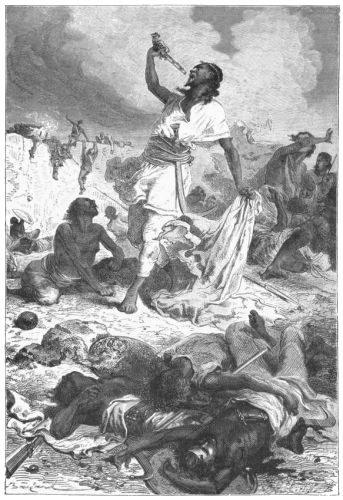
DEATH OF THE EMPEROR THEODORE. (See p. 491.)
Theodore, clearly perceiving all further resistance to be vain, now desired to come to terms with the British general. Early on the morning of April 11th he sent down from Selassyé, where he had passed the night, two of the captives, Lieutenant Prideaux and Mr. Flad, to bear his proposals to the British camp. They were instructed to say that the King now desired to be reconciled with the British. The delight and enthusiasm caused by the presence of Lieutenant Prideaux in the camp may be easily imagined. But the "reconciliation" sought by the King, which would have left him seated on his throne, could not, it was thought, be granted. As far as Britain was concerned, if the captives were all given up, her honour was satisfied, her aims were fulfilled, and her troops might be at once withdrawn. But it was considered by the Commander-in-Chief that the British had been welcomed in their country by the Abyssinians, and that the various chiefs had abstained from impeding or molesting the march, on the tacit but clearly implied understanding that Theodore's power was to be destroyed, and that he was to be a king in Abyssinia no longer. No terms, therefore, could be granted which did not involve his absolute submission and deposition from the throne, and a letter to that effect was conveyed to him, which he haughtily returned, together with a cartel of defiance. After a frustrated attempt at suicide, the King held a council of war, and asked the opinions of the bravest and most influential of the surviving chiefs. Most of them gave counsel, like the soldiers on board St. Paul's vessel, "to kill the prisoners, lest they should escape," and then to fight to the last. It is to the credit of Theodore that he resisted this counsel. Doubtless he thought that their release might be the means of relieving him from further demands, but friendly feeling towards Mr. Rassam, and even towards his poor artisans, had probably much to do with his decision. About four o'clock in the afternoon (Saturday, April 11th) the King sent the Governor of Magdala to Mr. Rassam and the other Europeans with the following message: "Go at once to your people; you can send for your property to-morrow." The prisoners made haste to depart, and descended the steep path from Magdala to the saddle of Islamgyé, and thence to Selassyé, where the King still was. Here Mr. Rassam had a final interview with him. Theodore acknowledged that he had behaved ill to the envoy, but said that it was through the conduct of bad men.
Early on the following morning (Easter Sunday, April 12th) Theodore sent down a letter to Sir Robert Napier, the object of which was to do away with the effect of the defiant letter of the previous day, and to request the acceptance of a present of cows. According to Abyssinian ideas, the acceptance of a present would mean that the receiver was satisfied and granted peace to the giver. This letter on reaching the camp was translated by the bearer from the Amharic into Arabic and from Arabic by Mr. Rassam into English. Sir Robert Napier afterwards declared that he authorised no answer to be given that could have led Theodore to believe that he accepted one jot less than the terms of his first demand; and he ordered a letter to be prepared (which, however, was never sent), accepting the cows provisionally, upon the understanding that Theodore would surrender himself as well as all the Europeans. At the time, he verbally authorised Mr. Rassam—or the latter so understood him—to accept the present of cows. Theodore, upon hearing that his gift had not been spurned, was overjoyed. He believed that life and honour were now safe and that the victorious general would not require of him the intolerable humiliation of a personal surrender. He sent down the present, consisting of 1,000 cows and 500 sheep, being all the live stock that he had in his possession; and in the course of the afternoon he sent down all the remaining Europeans and half-castes, fifty-seven in number, with their baggage, to the British camp.
But on that Sunday evening Theodore was informed by the chief whom he had sent down with the cattle, that the cows had been stopped at the first picket and had not been admitted into the camp. He saw at once that he had been misled and that the British commander intended to abate nothing from the original terms. At dawn the next morning (Easter Monday, April 13th), he called on the warriors who loved him to take nothing but their arms and follow him; the time had come, he said, to seek another home. Followed by four chiefs and a few soldiers, he went up into Magdala, passed through it and out at the other side through the gate leading to the saddle that communicated with the Tanta plateau. But after having gone a little way, his men refused to follow him, and he returned with them into Magdala, and thence went down again to Islamgyé. Meanwhile information had reached the British camp that Theodore had fled from Magdala. The troops were immediately put in motion, while a notice was sent among the Gallas offering a reward for the King's capture. The two brigades scaled the steep ascent of the saddle connecting Fâla with Selassyé, meeting with no opposition whatever. The British regiments slowly advanced until they reached the nearer end of the saddle of Islamgyé. Here they found the greater number of Theodore's guns with their ammunition. A number of chiefs, richly dressed, were seen at the farther end of Islamgyé, galloping wildly about and occasionally firing off their rifles. These in a short time were seen to ascend the steep path leading up into Magdala, pass through the gate called the Koket Bir, and close it after them. About this time authentic information reached the general that Theodore had not escaped, but was still in Magdala. He was one among those who had been just seen to ascend from Islamgyé into the fortress. Sir Robert Napier thought it necessary, in these circumstances, to cannonade Magdala with all the artillery at his disposal. Theodore, and the few followers who remained faithful to him, upon entering the place at the Koket Bir, closed the gate and blocked it up with large stones. This gate stood some distance below the edge of the plateau, at the very brink of which was a second gate. On the rocks, between the two gates, attended by a faithful few, Theodore sat and watched the practice of the English guns. The shells burst all around him; his faithful Minister Ras Engeda and his brother were killed by the same shell.
At 4 P.M. a storming party—consisting of the 33rd Regiment led by Major Cooper, the 10th Company of Royal Engineers, and a company of Madras Sappers—was ordered to attack the Koket Bir. The long line of red-coats wound up the steep pathway, keeping up a hot fire on the hedge and gate above them. A feeble dropping fire was the only reply. For when the bombardment became too hot, nearly all Theodore's followers consulted their safety and fled, taking refuge in the huts on Magdala. The King, and about ten persons who still adhered to him, went down into the Koket Bir when the soldiers commenced to climb the steep, and fired upon them through some rudely constructed loop-holes. Seven men were wounded by this fire. When the soldiers reached the gate, it was found impossible to force it, owing to the large stones with which it had been blocked up; but, after a short delay, a way was made through the hedge on each side of the gate, and the 33rd thus got within the place, removed the stones, and opened the doors to admit the rest of the storming party. The King, meanwhile, had retired up the hill and passed within the second gate. Of his ten companions, six were wounded, more or less seriously. Here he dismissed all his surviving followers, except his faithful valet Walda Gabir, telling them to leave him and save their own lives. "Flee," he said, "I release you from your allegiance; as for me, I shall never fall into the hands of the enemy." As soon as they were gone, he turned to Walda Gabir, and said, "It is finished! Sooner than fall into their hands, I will kill myself." He put a pistol into his mouth, fired it, and fell dead; the ball passing through the roof of the mouth and out at the back of the head.
So ended the career of a man who, if he had inherited a purer and more practical Christianity, and learned to control his passions, might have raised his country's name from obscurity, spread the influences of religion and civilisation through Eastern Africa, and lived in history as one of the benefactors of mankind. Wrath and sensuality were his ruin.
The rest may be briefly told. The huts on Magdala were burnt by order of the British general, and this outpost of Christianity fell again into the hands of the ferocious Gallas. North of the river Beshilo, Sir Robert recognised the authority of the Wakshum Gobazye. Theodore's Queen, Terunesh, and her little boy, Alamayahu, were among the inhabitants of Magdala at the time of its capture, and were consigned to the care of Mr. Rassam. The Queen said that it had been Theodore's last wish that his son should be taken charge of by the British; and this wish was complied with. The boy, who was about ten years old at this time, was placed in charge of the Rev. Dr. Jex Blake, then Principal of Cheltenham College. The unfortunate youth died in 1879. The Queen herself wished to return to her native province, Semyen; but on the way down she died, and was buried at Chelicut near Antalo. The British army commenced its return march on the 18th of April. The arrangements for the march to the coast and the embarkation were made with great judgment and forethought, and the last man of the expedition had left Annesley Bay before the end of June. The landing-piers, wells, roads, and whatever plant had been left behind as not worth removal, came into the possession of the Egyptians, and Abyssinia was sealed up again from intercourse with the outer world, as before the expedition.
Honours were lavished freely on the chief officers in command of the expedition. Sir Robert Napier received the Grand Cross of the Bath and a pension, and was made a peer with the title of Lord Napier of Magdala. General Merewether was made an extra Knight Commander of the Star of India. In moving that the thanks of the House of Commons be given to Sir Robert Napier and his army, Mr. Disraeli, after an eloquent enumeration of the obstacles which they had surmounted, said that that had been accomplished which not one of them ten years ago could have fancied even in his dreams, and they had seen "the standard of St. George hoisted upon the mountains of Rasselas."
Meanwhile Europe was disturbed by those admonitory gusts which portend a coming storm. In France the year passed over uneventfully, but there were many indications of growing discontent. Rochefort began to write in the Lanterne his withering satires against the Imperial Government; and at a public distribution of prizes at the Sorbonne, the son of Marshal Cavaignac, encouraged by his mother and by the sympathy of his fellow-students, refused to receive his prize from the hands of the Prince Imperial. The continual progress of Russia in Central Asia, silent mostly and unmarked, like the rising tide, arrested this year the attention of all Europe, when the news arrived that Samarcand, the ancient capital of Turkestan, and the favourite residence of Timour, had fallen before the arms of General Kaufmann. The Ameer of Bokhara was defeated in several engagements; and Bokhara itself was taken by the Russians, but not permanently occupied, and thenceforward the Cossack advance towards India seriously affected British foreign policy. The Cretan insurrection—which broke out in the summer of 1866, and in which the insurgents, aided by the continual influx of volunteers and supplies from Greece, had resisted for two years and a half the utmost efforts of the Turkish monarchy for its suppression—came to an end at the close of 1868, through the sheer exhaustion of the islanders. To Turkey also the situation of things had become intolerable, and the Turkish Minister at Athens delivered an ultimatum to the Greek Government on the 10th of December, demanding the dispersion within five days of the volunteers enlisted for the Cretan insurgents, and a pledge that no more should be permitted to be enrolled; and requiring Greece to act for the future in conformity with existing treaties. Greece refused the ultimatum, and diplomatic relations were broken off between her and Turkey. The Great Powers interposed, and it was arranged that a conference should be held at Paris early in 1869 to treat of the relations between Turkey and Greece. At this conference, which met on the 9th of January, the discussion lasted over ten days. It was finally decided that Greece should abstain for the future from favouring or tolerating within its territory the formation of bands destined to act against Turkey; and should also take the necessary measures to prevent the equipment in its ports of vessels destined to aid or comfort, in whatever manner, insurrection within the dominions of the Sultan. In Spain, the Bourbon sovereign Isabella, driven from the throne this year by a successful revolution, was compelled to seek as an exile and a suppliant the land that had nursed her ancestors, thanks to the arbitrary régime of her Ministers. A Provisional Government, with Marshal Serrano for President and Prim for Commander-in-Chief, was established. Except that they were not Republicans, the new rulers of Spain proceeded to adopt measures of the usual revolutionary hue. The absolute liberty of the press was decreed; and universal toleration was proclaimed, except for the Jesuits, whose colleges and institutions were ordered to be closed within three days in Spain and the Spanish colonies, the Order itself being suppressed and its property sequestrated to the State. The Republican party was dissatisfied and rose in arms at Cadiz in December. General Caballero di Roda marched against them and persuaded them to submit to the Government. The disintegrating tendency was checked for the moment, only to reappear afterwards in a more virulent form. The general sentiment of the Spanish people was in favour of monarchy, but no monarch could for a long time be found and the search was to involve Europe in short but destructive war.
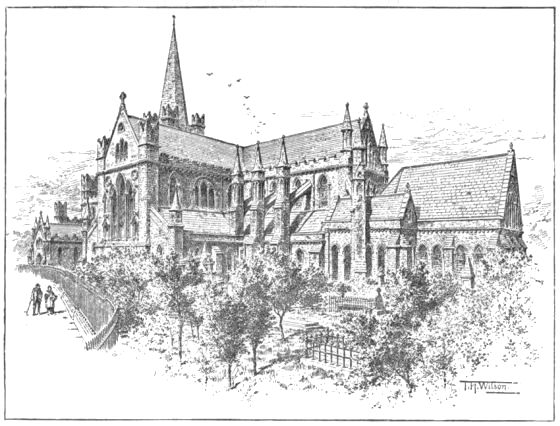
ST PATRICK'S CATHEDRAL, DUBLIN. (From a Photograph by W. Lawrence.)