Chapter XXV · (continued 2)
Reading edition
The dislocation of the Liberal party was so complete that no reasonable prospect remained of a stable Government being formed by any of the fractions into which it had been temporarily shivered. When, therefore, the Queen sent for Lord Derby and requested him to form a Ministry, that statesman, although the Conservative party was in so decided a minority in the House of Commons, accepted without hesitation the responsibility of undertaking the government of the country. Mr. Disraeli became Chancellor of the Exchequer; Mr. Walpole went to the Home Office; Lord Stanley and Lord Cranborne were appointed Secretaries for Foreign Affairs and for India respectively; General Peel and Sir John Pakington accepted the chief posts in the War Office and the Admiralty; Lord Carnarvon became Secretary for the Colonies; and the Marquis of Abercorn accepted the Vice-royalty of Ireland. This, it will be evident, was a purely Conservative Administration; such, however, had not been the desire of Lord Derby, who made overtures to some of the leaders of the recalcitrant Liberals, which were declined. Mr. Lowe was approached, so were Lord Grosvenor and Lord Lansdowne; the last would have joined, had not his sudden death intervened. Lord Shaftesbury also declined, and so did Lord Clarendon, either because, according to Bishop Wilberforce, he "hated Disraeli," or because, according to Lord Malmesbury, the Conservative irregulars were preparing an attack on his foreign policy. The Adullamites would have joined a Government under Lord Stanley, whose explanation of his father's ill success with the dissentient Whigs made a few days later to his constituents at Lynn, was doubtless the true one. "We have not desired," he said, "to form our Administration upon any narrow party basis There are many of the Whig party whose sympathies are well known to be with us, whose support in debate and divisions we have no doubt of receiving, and whose official co-operation, where it has been asked, has only been withheld not on account of any real or wide difference of political opinion, but rather from that natural and honourable scruple which makes men shrink from the appearance of changing their party—of walking, as the phrase is, across the floor of the House—under circumstances where they may possibly appear to be personal gainers by the change."
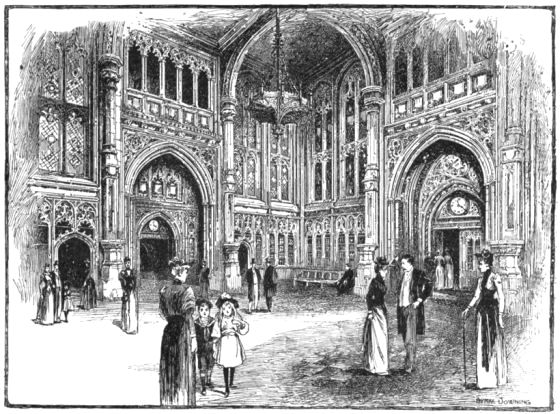
THE LOBBY, HOUSE OF COMMONS.
Mr. Disraeli went down for re-election to his constituents in Buckinghamshire, and there delivered an address that adumbrated with considerable clearness the course which the new Government intended to, and which it actually did, pursue. There was a notion that the Conservatives were more favourable to intervention in the affairs of foreign countries than the Liberals; that in their hands the country was more likely to drift into war; and this notion, so fatal to the popularity of any political party with that pacific generation of Englishmen, Mr. Disraeli took great pains to dispel. "The abstention of England from any unnecessary interference in the affairs of Europe is the consequence, not of her decline of power, but of her increased strength. England is no longer a mere European Power; she is the metropolis of a great maritime empire, extending to the boundaries of the farthest ocean. It is not that England has taken refuge in a state of apathy, that she now almost systematically declines to interfere in the affairs of the continent of Europe. England is as ready and as willing to interfere as in old days, when the necessity of her position requires it. There is no Power, indeed, that interferes more than England. She interferes in Asia, because she is really more an Asiatic Power than a European. She interferes in Australia, in Africa, and in New Zealand, where she carries on war often on a great scale. Therefore it is not because England does not recognise her duty to interfere in the affairs of the continent of Europe, that persons are justified in declaring that she has relinquished her imperial position, and has taken refuge in the otium cum dignitate which agrees with the decline of life, of power, and of prosperity. On the contrary, she has a greater sphere of action than any European Power, and she has duties devolving upon her on a much larger scale." On the subject of Parliamentary Reform Mr. Disraeli was decidedly explicit. He would not for one moment allow that Reform was a Liberal preserve, and that in dealing with the question the Conservatives were poaching on forbidden ground. "I hear very often," he said, "that the subject of Parliamentary Reform is the great difficulty of the present Ministry, and will be their stumbling-block. I am quite of a different opinion. I see no difficulty in the subject at all; and if we stumble, rest assured we shall not stumble over the subject of Parliamentary Reform. If Parliamentary Reform is to be dealt with, I consider the present Government have as good a right to deal with it as any body of statesmen in existence. The great Reform Bill of 1832 was mainly devised by Lord Derby, and was entirely carried by his energy; and with regard to the only measure on the subject, since the great Reform Bill, ever mentioned with respect, why, I myself brought it in. I have remarked, during the recent campaign in the House of Commons, that every division that took place, and every strong manifestation of opinion which was expressed, ratified the principle upon which the Bill of 1859 was founded. And night after night, sitting in that House opposite to me, distinguished Liberals of all hues rose, and, in a tone of courteous penitence, publicly avowed how much they regretted they had voted against the Bill of 1859."
On the 9th of July, the new arrangements having been completed, Lord Derby made a Ministerial statement in the House of Lords, the leading ideas of which were in close agreement with those enunciated by Mr. Disraeli in the speech from which we have just quoted. At this late period of the Session, the Budget for the year having been already discussed and settled, it was out of the question that the new Government should do more than wind up the business of legislation with all possible despatch, and then dismiss the members to their homes. In a considerable section of the large Liberal majority that now crowded the Opposition benches, a determination was apparent to give the new Ministry a fair trial, and neither to join in, nor permit the success of, any factious or precipitate attempt to place them in a minority.
Besides that of the Premier, but one important Ministerial statement was made before the close of the Session; this, which was delivered by Lord Cranborne on the 19th of July, related to the finances of India, and was regarded on both sides of the House as a masterly and lucid exposition. Though so far satisfactory, inasmuch as it showed that, during the last three years, the Indian Government had very nearly succeeded in establishing an equilibrium between receipts and expenditure, it was calculated to occasion some anxiety on account of the proofs which it afforded of the inelastic character of a large proportion of the sources from which the Indian revenue is derived, of the complete failure of the income tax, on the introduction of which such ardent hopes had been founded, and of the degree in which the prosperity of Indian finance was dependent on the rise or fall of the opium tax. The estimate of revenue from this single tax was £8,500,000; and Lord Cranborne reluctantly admitted that "opium had become the essential element in Eastern finance." Yet the general picture which he drew of the material condition of India was eminently satisfactory. The railway expenditure had been a source of enormous success; the Great Indian Peninsula line paid 7 per cent. on its capital, and the East Indian nearly 5 per cent., though neither of them was fully and thoroughly opened. Taking a comprehensive survey of the condition of India, he said that "education was progressing; public works, particularly of irrigation, were going on; railways advancing; the Ganges Canal had been rendered more fitted for its great purposes; and there was much evidence of prosperity."
The administrative skill and prudence of the new Home Secretary were severely tested before the close of the Session. On the committee of the Reform League of London Mr. Edmond Beales and Colonel Dickson were the most influential persons, and in a series of meetings they had taught their audiences to believe that without manhood suffrage and the ballot the British Constitution was one-sided and imperfect. The advent to power of a Conservative Ministry raised the ardour of the Leaguers to a pitch of yet more enthusiastic warmth than before, and it was announced that a great public meeting would be held in Hyde Park, on the evening of the 23rd of July, in order to demand the immediate extension of the suffrage. The authorities feared that the demonstration, occurring at so late an hour, might be taken advantage of by the "roughs" to create a disturbance, under cover of which thefts on a large scale might be perpetrated; it was resolved, therefore, that this meeting should be prohibited. Placards signed by the Chief Commissioner of Police, Sir Richard Mayne, were, early in the afternoon, extensively posted throughout London, stating that the park gates would be closed to the public at five o'clock. The League and its adherents viewed the attempt to suppress their oratory with the deepest indignation, and a written notice was forwarded by the "Demonstration Committee" to the various sub-committees, to the effect that the members were to march in procession to the park, and, if prevented from entering it, were then to form four deep, and proceed by way of Grosvenor Place, Victoria Street, and past the Houses of Parliament to Trafalgar Square. The Procession of Leaguers was formed on Clerkenwell Green, when several speeches of a highly inflammatory nature were delivered before the march was commenced.
The procession set out shortly before five o'clock, and proceeded along Holborn and Oxford Street to the Marble Arch. Here things presented an animated appearance. A force of foot and mounted police, numbering 1,600 or 1,800, had been assembled within the park, under the direction of Sir Richard Mayne and Captain Harris; and at five o'clock the gates were closed. A large number of spectators had previously entered the park, to witness the arrival of the procession; and with these the police did not interfere. Arrived at the Marble Arch, Mr. Beales, Colonel Dickson, and other prominent Leaguers, alighted from the foremost carriages, and going up to the gate, demanded admission to the park from the police. This was refused, on the authority of "our Commissioner;" and then Mr. Beales, re-forming the procession as well as he could in the midst of the dense crowd, led as many as would follow him down Park Lane, and, by the streets already named, to Trafalgar Square. Here several speeches were delivered, but all accounts represent the proceedings as remarkably tame.
Meanwhile the mob that had gathered about the Marble Arch, both in Park Lane and in Bayswater Road, exasperated at the loss of the excitement which the meeting would have afforded them, and partly, no doubt, animated by resentment at what seemed needlessly arbitrary conduct on the part of the police, pressed close up to the park railings; the bolder spirits seized them, shook them; grasped by hundreds of strong hands at once, they swayed—they gave way. In an instant a hundred practicable breaches afforded that admission into the park which the police had denied. Down came the police, horse and foot, upon the invaders; but they were distracted by the multitude of inroads, and disconcerted by the ease with which the railings were laid prostrate in every direction. They used their truncheons freely, and many a head was cut open; but the mob, besides the advantage of overwhelming numbers, took to stone-throwing, and many of the police were severely injured. Sir Richard Mayne, who had himself been wounded, then sent for the military. A detachment of Foot Guards soon arrived, followed by a troop of Life Guards. The mob cheered the soldiers, who posted themselves near the Marble Arch, occasionally marching upon any specially dense assemblage of persons, and compelling them to shift their ground. Speeches were made by excited orators at various points within the park, after the mob had forced their way in; but the confusion that prevailed was such that little attention seems to have been paid to them. On the southern side of the park also, in the Knightsbridge Road, a number of mischievous persons congregated, and broke down two hundred yards of the park railing. After the arrival of the soldiers, the police endeavoured to make a number of arrests, in doing which they met with violent resistance, and were in many cases severely handled. The partisans of order were presently reinforced by a second detachment of Foot Guards, who, with the first detachment, received orders to be in readiness to fire, should it become necessary. Encounters between the police and the mob then grew less frequent, and finally quiet was restored when another body of Life Guards arrived, and assisted in removing the mob from the park. Much stone-throwing was all this time going on in the streets, and the windows of the Athenæum and United Service Clubs, as well as of a number of private houses, were broken. No lives were lost, though a considerable number of persons received severe injuries.
Mr. Walpole, the new Home Secretary, a man of remarkable humanity and gentleness, was afflicted beyond measure by the turn matters had taken. He received a deputation of the Leaguers at the Home Office two days afterwards, and in conversation with them actually shed tears, and came to the somewhat ignominious understanding with them, that Government would cause the police and the military to be withdrawn from the park until the question as to the legal right of the people to claim admission to it had been decided, the League meanwhile undertaking to do its best to prevent any breach of the peace or other misconduct within the park enclosure! The consequence of such deplorable weakness may be conceived. In a London paper of the following week it was stated: "The park is still infested, night after night, by numerous bands of thieves and ruffians, who are left to prey on defenceless passengers or unwary loungers after dusk, without the slightest interference of the park-keepers or the police. Several gross outrages, perpetrated in Hyde Park, about eight or nine o'clock in the evening, since the enclosure was destroyed last week, have been narrated by the sufferers themselves, or by witnesses to the fact, in letters to the daily papers.... A herd of men and boys, estimated at 300 or 400, of the worst class of habitual malefactors, are permitted to assemble and prowl about the ground, waiting for an opportunity of plunder."
In Parliament the conduct of Government in prohibiting the meeting was much canvassed and, by some speakers, severely censured. Mr. Ayrton said that, instead of appealing at once to force, the Home Secretary ought to have met the people in a conciliatory spirit on the matter of right and should have issued a temperate notification explaining how the case really stood. Mr. Mill declared that if the people had not a right to meet in the parks, they ought to have it. He added that, as Government seemed inclined to enrol their names on the list of those who could do more mischief in an hour than others could repair in years, he exhorted them to consider seriously the gravity of what they had done on this occasion. But the majority of speakers on both sides of the House, including statesmen of long experience, were of opinion that Government, though perhaps every step taken by Mr. Walpole might not have been judicious, were substantially justified in what they had done; and Mr. Disraeli declared that "it had never entered the minds of Ministers that the real working man, whose general orderly conduct he cordially acknowledged, would commit acts of riot, but they believed that the scum of the great city would take advantage of such an assemblage, and the justice of their apprehensions was proved by the event."
The Queen's Speech at the close of the Session was read by the new Lord Chancellor (Lord Chelmsford) on the 10th of August. It contained several paragraphs on the Fenian conspiracy, and the doings of the Fenians both in Ireland and in Canada, recording in terms of grateful acknowledgment the good faith and promptitude of the United States Government in checking at the outset "any attempted invasion of a friendly State." It alluded with satisfaction to the fact that, although the late Ministry, in the presence of a financial crisis of almost unexampled severity, had authorised the Bank of England to infringe the letter of the Bank Charter Act of 1844, if such a step were required for the accommodation of their customers, yet no such infringement had actually taken place, the Bank having been able to weather the storm without it. It spoke of the gradual mitigation of the cattle plague, of the late visitation of cholera, and of the successful laying of the Atlantic cable. The murrain had, indeed, continued its ravages during the earlier half of the year; but, fortunately, as time went on, the stringent precautions that had been enforced by the Privy Council produced the desired effect: the cases showed a progressive reduction in number; and by the end of the year the plague, though not extinct, was in a material degree abated. Wales continued almost wholly exempt from the disease; in the South of England its virulence was continually on the decline; only in the north-western counties it seemed to hold its ground tenaciously, and in the dairy farms of Cheshire many ancient pastures were given up in despair to the plough. The total loss to the country from the disease, even in this year of improvement, was computed at not less than £3,500,000 in money.
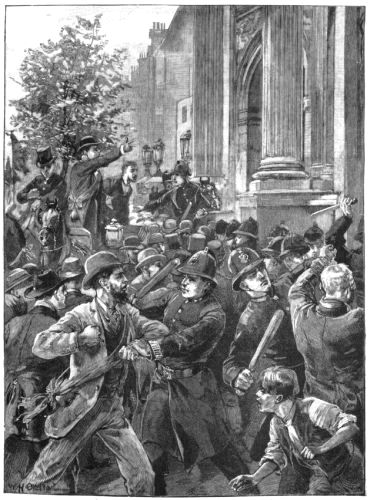
REFORM LEAGUERS AT THE MARBLE ARCH. (See p. 403.)