PARLOUR MAGIC. (continued 2)
Reading edition
TO GET A RING OUT OF A HANDKERCHIEF.
Obtain a piece of gold or brass wire, and bend it into the form of a wedding-ring, seeing first that both ends are sharpened. Borrow from one member of the audience a handkerchief and from another a wedding-ring, unless the performer has previously provided himself with a suitable ring for the trick. At any rate, palm the false ring, and allow the real ring to be inspected by handing it round to the company, and announce that it is to be made to pass through the handkerchief. The performer then takes the borrowed handkerchief, and places his hand underneath it, at the same time substituting the false ring, which had been previously concealed by being palmed, for the actual ring, which will in the meantime have been received back again. The false ring now has to be pressed against the centre of the handkerchief, and an independent person should be desired to hold the ring covered by the handkerchief by closing his finger and thumb through the hoop of the ring. Two other spectators may also here be asked, the one to hold the handkerchief by two of its corners, and the other by the other corners, keeping it as far as possible at full stretch, so that it may be clearly seen that the ring in the handkerchief has not been merely placed in one of its folds. When the audience have had time to satisfy themselves on this point, those holding the corners of the handkerchief may be relieved from their duties, the person holding the ring, however, still retaining his hold. Request now some other person to grasp the handkerchief as tightly as he pleases some two or three inches or more below the ring, the person holding the ring being then asked to let go. Let a hat or some other object be now held by some person other than the performer over that part of the handkerchief that is being grasped and that contains the false ring; the performer then passes his hand under the hat, opens the false ring by bending one of its sharpened points a little asunder, brings that point gently through the fabric of the handkerchief, draws out the remainder, and carefully rubs the hole made thereby in the handkerchief, in order that the hole may be concealed. The actual ring should not be placed outside and over the handkerchief, and upon the hat being removed it will appear to the audience that the ring has been taken from the inside and placed over a portion of the handkerchief. The false ring will, of course before this point of the trick, have been palmed or otherwise got rid of.
In this short account of card, coin, and other conjuring tricks we have purposely avoided describing such tricks as require either a long training or expensive apparatus; but in order to show more clearly what a very simple affair conjuring is, we will here give an account of two professional conjuring tricks that have attained a world-wide celebrity. The first given is a description of the celebrated Gold-fish Trick, as performed by Herr Frikell, which trick, by the way, dates long before Frikell's time, although the charm with which he conjured, by combining the genius of the actor with that of the conjurer, has given him such a pre-eminence in what he undertook as to make old tricks appear to be invested with a new charm. The second description is Robert Houdin's own account of the Cups and Balls Trick, modifications of which have often been published under the title of "The Travelled Balls."
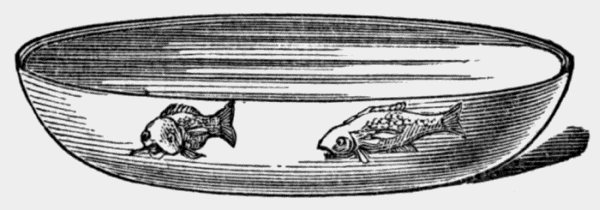
Fig. 1.—Bowl with Gold-fish.
THE GOLD-FISH TRICK; OR, HOW TO BRING BOWLS OF WATER IN WHICH GOLD-FISHES ARE SWIMMING OUT OF AN EMPTY CLOTH.

Fig. 2.—India-rubber Cover.
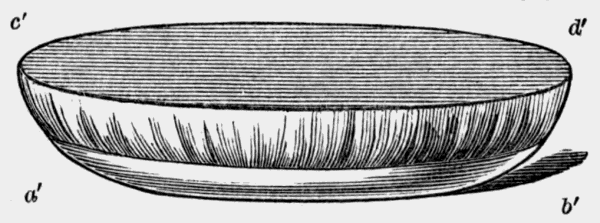
Fig. 3.—The Bowl Covered Over.
The performer advances on the stage, and stands quite apart from any surrounding objects; there is nothing in his dress in any way unusual, and in his hand he holds an ordinary cloth about four feet square, which the audience is permitted to examine. Upon the cloth being returned to him by the audience, he throws it over his left arm and hand, and after a few seconds produces from under it a glass bowl full of water, in which gold-fishes are seen swimming; the cloth is again thrown into the air, shaken, and examined, and the trick is repeated until four large bowls have been produced from apparently nowhere. The following describes how the trick is accomplished:—Fig. 2 represents an india-rubber cover, the diameter (a b) being about the same diameter as the top of the bowl; the whole cover turns over the edge flat about two or three inches, so that the opening (c d) is considerably smaller than the diameter (a b). After the bowl (Fig. 1) has been about three-parts filled with water, and two or three fishes placed in it, the cover (Fig. 2) is stretched over the bowl (Fig. 3); the part of the cover a b (Fig. 2) is, of course, drawn over the rim of the bowl (a´ b´, Fig. 3); and the part c d (Fig. 2) is in contact with the outside top part of the bowl (c´ d´, Fig. 3). The bowl, as now covered, can be turned upside down and carried sideways, without any fear whatever of the water being spilt. The next point is how to conceal it about one's person. Fig. 4 represents a small black bag capable of holding two bowls side by side (i.e., the glass bottom of one in contact with the india-rubber cover of the other), which is tied round the waist, the tail of a dress-coat being amply sufficient to hide it. The sleight-of-hand required in performing the trick is to manage the cloth so that it hides the movement of the right hand and arm in bringing the bowl out of the pocket into position. When the bowl is brought under the cloth, rest the bowl on the right hand, and bring away the left from under the cloth. In taking off the cloth, incline the bowl very slightly towards one end, peel off the india-rubber cover by means of the left-hand finger and thumb inside the cloth. The cover remains in the cloth, and must be conveyed away into any pocket during the public examination of the bowl. The direction of the conjurer's eyes must be with the bowl, as should the eyes rest on the cloth after the bowl has been taken out, people will at once suspect that there is something there, and possibly put awkward questions, or ask to examine the cloth too soon. To bring out the four bowls the conjurer must, after exposing the first two, have the pocket (Fig. 4) replenished by leaving the stage or retiring to one of the wings, and allowing two more to be placed therein, unperceived by the audience, by an assistant.
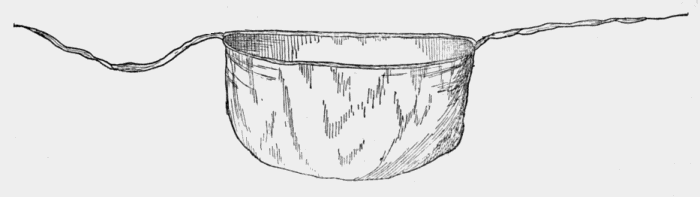
Fig. 4.—The Small Bag for Carrying the Bowls.
HOUDIN'S CUPS AND BALLS CONJURING TRICKS.
The trick of the cups and balls, though one of the oldest known to conjurers, still remains one of the most interesting, by reason of the very slight preparation needed for its exhibition and the simplicity of its mode of performance.
The apparatus required are (1) three cups, (2) a magic wand, (3) six small balls, (4) six large balls, and (5) either a bag or shelf placed secretly on the performer's side of the conjuring table. The cups should be of polished tin; in form they are truncated cones; the top is concave, so as to afford a resting place for at least three of the small balls. The magic wand has been previously referred to, and one is just as good as another. The small balls, or muscades, as Houdin calls them, are made of cork, and should be a trifle more than half an inch in diameter. The large balls are made of horsehair, and covered with leather or woollen cloth. This covering is made of various colours, according to the particular "passes" which the performer intends to exhibit. Some balls are also made parti-coloured, two of the segments being of one colour and two of another. The bag, or gibecière, is made of some tolerably thick material, and is tied round the waist by strings. It has a wide-mouthed opening, allowing the hand to take freely therefrom the various articles needed for the performance of the trick, but it may be dispensed with in the event of a secret shelf being fitted in the performer's side of the table. Conjuring tables of special make have, as a rule, all the essential requirements; but it is not difficult for an ingenious lad to arrange the necessary table for himself out of a common discarded washstand. The sleight-of-hand required for the manipulation of the cups and balls is: (1) To conjure away a small ball, (2) to produce the ball when required at the tips of the fingers, (3) to secretly introduce a small ball under a cup or between two cups, (4) to cause a small ball placed between two cups to disappear, (5) to introduce a large ball under a cup, (6) to execute sundry "feints," hereafter described.
(1) To conjure away a small ball.—To do this proceed as follows:—Hold the ball to be conjured away between the thumb and first finger, as though to show it, close the hand quickly, leaving the thumb still outstretched. The ball is so made to roll to the second joint of the forefinger. Nothing will then be easier than to continue to roll the ball with the thumb as far as the junction of the two fingers before mentioned, which are to be slightly opened to facilitate the introduction of the ball. These two movements are in reality but one, and must be executed with extreme rapidity.
(2) To produce a small ball.—The reverse movement to that last described must be employed: that is to say, roll back the ball with the thumb to the tips of the fingers. Rapidity in effecting the double movement is here also most essential.
(3) To secretly introduce a small ball under a cup.—The ball being hidden in the hand between the middle and fourth fingers, take hold of the cup between the two projecting mouldings, and lift it ostensibly to show that there is nothing beneath it; in replacing it on the table let go the ball, which by reason of its position naturally falls underneath the cup, by which it is instantly covered. If the performer finds any difficulty in releasing the ball, he may facilitate the doing so by a quick contraction of the fourth finger.
(4) To pass a small ball between two cups.—In the act of releasing, as just described, give the ball an upward jerk towards the upper part of the inside of the cup held in the hand, and quickly slip this cup over that on which it is desired that the ball should be found.
(5) To cause the disappearance of a small ball placed between two cups.—When a ball has been placed as above described, it may in the following manner be made to disappear:—Take the two cups in the left hand, putting the fingers of that hand inside the lower cup, and giving a slight upward jerk, as though to send the ball towards the top of the upper cup, quickly withdraw the lower cup, at the same time lowering the upper cup, and so covering and concealing the ball.
(6) To cause the appearance of a large ball on a table.—This effect, which generally produces special astonishment, is produced by the simplest possible means. Lift one of the cups with the right hand, and point to the spot from which it was removed. While the eyes of the audience are directed to that spot bring the cup adroitly to the edge of the table, introduce into it, with the left hand, one of the large balls, and immediately bring the cup and the ball to the middle of the table, keeping the ball in position with the little finger of the right hand. In some cases, in putting the ball into the cup, it may be squeezed in order to make it stick in the bottom; the elasticity of the ball will readily admit of this. When it is desired again to produce the ball it will only be necessary to bring down the cup with a smartish rap on the table.
The "passes" of the cups and balls may be varied indefinitely. Every conjurer arranges a series to suit his own taste, and the examples we have here selected will be sufficient for the guidance of amateurs. It must, however, be admitted that there is but little substantial difference between the passes. The effect is always one or more balls made to appear in one place when the spectators believe them to be in another. It follows that these passes, however varied in point of form, should be exhibited with moderation, so as not to weary the audience, or to put sharp-sighted and curious spectators in the way of discovering how the tricks are performed.
CLAIRVOYANCE OR SECOND SIGHT.
Second Sight is properly classified with Parlour Magic, inasmuch as there is more in it than is intended to meet the eyes or ears of the audience, and "Clairvoyance" now almost invariably forms some part of the entertainment given by the majority of professed conjurers. It is much beyond our province to go into the description of the elaborate training that Robert Houdin and his sons went through before they were able to give their renowned representations; but with them sharp-sightedness, combined with a wonderful power of taking into the mind, at a glance, numerous objects, was of more importance than Second Sight, whatever scientists may decide that faculty to be.
Clairvoyance, or Second Sight, when applied to conjurers' tricks and private entertainments, is the art of telling the name and description of articles by a person whose eyes are blindfolded. Much as Clairvoyance has, from time to time, astonished people before whom it has been represented, but who have not been initiated into its mysteries, and much as it undoubtedly will still continue to mystify, yet, when its first principles are mastered, it will be seen by all that, although it may form the basis of capital entertainments, yet it, like the conjuring tricks we have already described, is not, after all, so wonderful as was imagined. The whole system of presumed Second Sight rests with two persons (or more, if necessary); the one advances to the audience to receive such articles as it may be desired to ask questions about of the other, who is blindfolded, and who is supposed to possess the power or faculty of Second Sight. These questions and answers are arranged into a system which constitutes the art of Clairvoyance. Sometimes, too, confederates with articles already seen by the blindfolded performer take part in the deception as part of the audience; but, in an ordinary way, this is not at all necessary. In our system, which will require some pains and care to carry out, there should be a series of questions, each one of which will denote the answer to be given. The questions should be very simple, so as not themselves to appear strange or leading, and the questions, with the corresponding answers, must be carefully committed to memory by both performers. In order that the manner of the deception may be thoroughly understood, we give just a few illustrations of the system of questions and answers, which will be useful as models to those desiring to draw up a set for themselves. We will suppose that some articles of jewellery have been handed in for the clairvoyant to name. The other performer will proceed, according to the articles handed in, with the following questions, first saying himself, "Now, I have had passed to me some articles of jewellery, which the clairvoyant will describe, and I will proceed to question him about them."
If the article first held up is a bracelet, the question may be—"Let the company know what I hold in my hand."
If a watch—"What is this that you are to describe?"
If a brooch—"Now what do I hold up?"
If an ear-ring—"To what use is this put?"
If a gentleman's watch-chain—"Say, in brief, what I have in my hand."
If a ladies' watch-chain—"Describe, at length, what I have in my hand."
If a gentleman's ring—"Say, what is in my hand now?"
If a lady's ring—"Say now, what is in my hand?"
If a breast-pin—"Say what I hold up now."
If a stud—"What is this for?"
The words italicised should be pronounced with emphasis, as they will give the clue needed; certain articles cannot be so well indicated in the questions, and greater care must therefore be taken in committing the corresponding questions and answers to memory.
Suppose, further, that a brooch has been held up, and that it has to be more fully described, proceed by telling the audience that the blindfolded clairvoyant will say of what metal the brooch is made.
If of gold—Question to put—"If of gold or silver?"
If of silver—"If of silver or gold?"
If neither gold nor silver, but a common imitation—"Of what metal is this brooch made?"
If set with stones—"Is it set with a stone or stones?"
If unset—"How is it set?"
If with a topaz—"Tell the name of the stone."
If with an emerald—"Endeavour to name the setting."
If with pearls—"Please say how set."
If with opals—"Kindly name the setting to the company."
If with diamonds—"Describe the stone with which it is set?"
If with turquoise—"I must trouble you to name the setting."
If with garnets—"Guess the setting."
If with jet—"Just say the nature of the setting."
If with cornelian—"Come, now! what is the setting?"
If with amethyst—"Announce the name of the stone."
And so on, arranging questions for colours, for materials, for miscellaneous articles, such as personal wearing apparel, chimney ornaments, nicknacks, &c. &c.
VENTRILOQUISM AND POLYPHONY.
These are two distinct branches of the same art or science of sounds, which may be cultivated by all, but with a success that will vary according to the special gifts or endowments of the student. Those possessed of ventriloquial powers have the opportunity of considerably annoying their fellow mortals if so inclined, but on the other hand they have also the means of affording them very considerable amusement and entertainment.
Ventriloquism is a vocal mimicry of sounds, by which an illusion is produced on the hearer that the sound comes, not from the mimic, but from some external source. The various descriptions of vocal mimicry are usually treated under two heads, namely:—1st, The simple imitation of the voices of persons, animals, musical instruments, and other sounds and noises of every description, in which no illusion is intended, and which is generally known by the name of Polyphony; 2nd, the imitation of those voices, sounds, and noises not as originating in the mimic, but in some other and appropriate source at a given or varying distance, in any or even in several directions successively, and which goes by the more general designation of Ventriloquism.
The above may be taken as a scientific and fairly accurate definition of the terms in question; and if in the treatment of this subject the distinctions above laid down are not strictly adhered to, they will be departed from only so far as it will be necessary to make the subject interesting to the reader and easily understood by the student. For the encouragement of all, we would say that more or less success as a ventriloquist may be attained by any one. Indeed, Professor Lee states that he attained the art without a single lesson and as the result merely of observation and practice. He says further that the chief requisites for its acquirement are—"A throat and lungs of average strength, ability to retain sounds in the memory, and the faculty of mimicry as to tone, look, and even gait, for these in no small degree contribute to the effect which the artist desires to produce." It is not at all an unusual thing to meet persons able to describe and imitate minutely a conversation carried on between half a dozen persons. To a certain extent this is ventriloquism, and the gift is capable of very considerable development. In short, the young practitioner must have the power of enunciating well, and that as far as possible without any perceptible motion of the lips; of disguising his voice, so as to imitate other voices and sounds, and of adapting the degree to the apparent source of the sound.
The relative properties of sound and capacity of hearing are so little understood, that it is generally supposed a ventriloquist throws his voice somewhere or other, as it is loosely expressed; a ventriloquist is often asked, for example, to throw his voice up a chimney or outside the house. This, of course, is a feat impossible to perform; all the ventriloquist can do is to speak and utter sounds with precisely similar organs to those possessed by every one. A ventriloquist does, however, imitate sounds that strike the ear, as if caused by some object at a distance. For example, a ventriloquist in imitating the music which cats so much delight to indulge in on the roofs during a summer's night, does not trouble himself to make the fearful row the cats make, but only the sound of the row as it comes to the ear subdued by distance and by passing through the intermediate ceilings and walls. It is most important that this distinction between noises as they are and noises as they are heard, should be constantly borne in mind during the practice of ventriloquism, and it should be remembered, as an axiom by all learners of the art, that "near sounds are louder than distant ones, and vice versâ." The fact that loudness as a property of sound is so little understood is one of the main causes of the success of so many ventriloquists. The performer by his speech or his acting leads the audience to expect to hear sounds as from a given quarter, and the sounds being heard as from an unknown quarter are believed to be from the quarter indicated. A strange sound being heard by a roomful of people will elicit cries all round of, "What was that?" hardly two of the company attributing the sound to the same cause, and possibly all to the wrong one. One of the commonest and easiest of ventriloquial deceptions is that of making a man's voice issue as it were from the chimney. As, however, no one present will be likely ever to have heard an actual voice proceeding from a chimney, it will, nine cases out of ten, be the speech or action of the practitioner accompanied by a strange or unknown sound that will give the real force to the deception. As a consequence, therefore, it follows that a ventriloquist, to amuse his audience, must have powers over and beyond those needed for mimicking sounds; he must be somewhat of an actor; and as in conjuring, so in this, he must indulge in abundance of what we then termed "patter." The ventriloquist's deceptions must be well practised and frequently rehearsed, but he must also well prepare and study the discourse of which his ventriloquial powers will be but the illustration.
Baron Mengen, a celebrated ventriloquist, says of himself, that to make sounds appear muffled or to come from a distance he presses his tongue against the teeth, and thus "circumscribes a cavity between the left cheek and the teeth, in which cavity the voice is produced by the air held in reserve." He furthermore adds, that it is necessary to well manage the breath, and to respire as seldom as possible.
The ventriloquist must understand the difference between vocal and other sounds, as embodying the distinction between ventriloquism in its highest development and mere polyphony. Mere sounds, that are not vocal sounds, can be produced in the vocal tube apart from the larynx. Some of them are of a definite and uniform pitch, while others are mere noises, such as rustling, whispering, gurgling, snoring, and many others. On the contrary, phonation, or the production of voice, is a result of actions taking place under mechanical laws of acoustics, combined with the physiological laws of muscular movement. The pitch of the voice essentially depends on the tension of the vocal ligaments, the loudness of their vibration, and the quality depends on the form and size of the vocal tube and the organisation of the larynx. The form and size of the vocal tube may be altered by dilating or contracting the pharynx, by dilating or contracting the mouth, by contracting the communication between the pharynx and the mouth, by altering the form of the mouth's cavity, and in other minor ways; and it will be found that each of these modifications of the vocal tube confers a peculiarity of quality to the voice.
The mimicry of mere sounds will be found by the young practitioner to be a comparatively easy matter, and he may soon be able to entertain his friends with fairly accurate imitations of the buzzing and humming of flies, bees, wasps, and other insects; of knife-grinding, of sawing and planing of wood, of falling objects, of cats mewing, of dogs barking, &c. &c. Instructions as to how to imitate these various sounds would be of little use; each one must find out for himself. In fact, an ear acutely perceptive to the nice distinctions of sound is about the only real qualification needed for the attainment of success in the practice of polyphony, as distinct from ventriloquism.
In treating the higher part of the subject, which deals with these illusions in which the voice counterfeits sounds, and also represents them in such a manner that they appear to issue from their appropriate source, some further remarks are needed on the questions of direction and distance of sounds. A little way back we repudiated the idea that ventriloquists threw their voices anywhere; and we return now to the subject to explain away the delusion, or rather the ignorance out of which the idea has grown. Man does not hear the distance which a sound has travelled; he only judges the distance from experience, by comparing the loudness with which he hears with the known distance and corresponding loudness of similar sounds. Experience proves, as previously stated, that error is generally the result of attempting off-hand to decide either the distance or the direction of an unknown sound. Bearing in mind, then, that near sounds are louder than distant ones, sounds having the same pitch, quality, and duration, may be produced with a graduated reduction or increase of loudness, which, falling in succession on the ear, will suggest to the mind a varying distance of the sound's source. The young practitioner should put this theory into practice, and, at the same time, imitate the sounds of voices and objects heard at different known distances. By these means he will the more readily be able to reproduce such sounds when they are required to form some part of his entertainment. For his encouragement he should also remember that slight defects in the imitation of distant voices and sounds may be expected to pass without question. Further, if the distance from which a sound has travelled is rarely accurately judged, the would-be ventriloquist will be still further encouraged by learning that the judgment as to the direction whence a sound comes is still more fallible. It is notorious, for example, that a person in a house cannot, by the noise made by an approaching carriage, judge with any degree of certainty whether it is coming from the right or the left. The direction whence a sound comes seems to be judged of by the right or left ear receiving the stronger impression; but this, of course, can only be when the sounds come from the level, or thereabouts, of the ear; if above, this mode of judgment, however accurate it may be made by practice, fails; hence it is that professed ventriloquists make so many of their unseen characters speak either from above or below the audience. The practice of holding an apparent conversation with some imaginary person, or persons, on the roof or below the floor, almost invariably forms parts of a ventriloquial entertainment, the performer indicating, either directly or indirectly, the direction from which he wishes his audience to believe the sound is coming. Directly, by asking questions such as "Are you up there?" "Are you down below?" or indirectly, by holding the hand to the ear and straining, as if listening for sounds from above or below, as the case may be. By these and similar means, before a sound is produced, the audience will be prepared to expect it to come from the suggested direction, and the ventriloquist has merely, by his adjustment of the vocal loudness, to indicate the necessary distance, when the error in, or want of judgment of the audience, will complete the illusion which he has thus already commenced. It has been observed by careful students of the art that the effect which is produced on sound by its travelling a distance from any direction is—
1. That its loudness is reduced in proportion to the distance.
2. That its pitch remains unaltered.
3. That its quality or tone is somewhat softened.
4. That its duration remains unaltered.
5. That human speech is somewhat obscured, chiefly in the consonant sounds.
It is very necessary that the student should study and bear in mind the full meaning and bearing of these five observations, and that his action should be guided thereby, remembering that the ventriloquist imitates the sound, not as it is heard at its source, but as it is heard after travelling from its source to the ear, that is, as it strikes the ear. A skilful ventriloquist will effect his imitations without any scarcely perceptible movement of his lips, jaws, or features; but when such movements are absolutely necessary, he will contrive not to let the audience see them, by turning away for the moment, his face from the audience, sometimes even not showing so much as the profile. With a little practice it will soon become easy to speak without moving the jaw, and it is the movements of the jaw which disturb the features. The labial sounds, such as b, p, m, when the jaw is thus fixed, can be made with the slightest possible motion of the lips. During ventriloquy, the lips and jaws being always more or less open, this slight labial movement generally remains unnoticed, unless special attention be directed to it. Practice, too, should be made to produce all the modifications of the voice without distorting the features or moving the lips more than is absolutely necessary.
The preceding outline of the philosophy of ventriloquism is sufficient to exhibit the nature of the art, and we will now proceed with a few hints as to how certain sounds are to be produced, premising, however, that they will not be numerous, as no definite rules can be laid down.
A bass and somewhat sepulchral tone is produced in the lower part of the throat, in much the same manner as when attempting to gurgle, except that the lips should remain closed, and the head kept in its natural position.
The greater the distance from which a sound has apparently to come, the nearer must the tip of the tongue be brought to the front of the mouth, the greater must be the contraction of the muscles, and the articulation must be made in the upper part of the throat.
The natural voice may be easily disguised by wearing a pair of pince-nez spectacles, with a very strong spring. The spring pressing on the air-passages of the nose will considerably alter the tone of the voice.
To make the sound of a voice appear as coming from the other side of a partition, or through a door, it is only necessary to open the mouth slightly, to fix the jaws fast, to draw back and roll the tongue, and then to speak; the sound then, instead of being formed in the mouth, will be formed in the pharynx, and appear to come from beyond such material as may be indicated by the action or natural speech of the performer.
To imitate the sound of the same voice after the door has been opened, or the partition removed, requires somewhat different management. The voice must not, of course, be altered from the original pitch, but must be made in another part of the mouth. To do this, the lips should now be tightly closed, one corner of the mouth (that away from the audience) should be drawn downwards towards the ear, the lips opened at that corner only, and the words to be spoken breathed out of the opening so formed.
To make a sound seem as coming from a distance is accomplished in a similar manner to that in which a sound is made to appear as coming from the other side of a door or wall, except that according to the distance from which the sound is represented as coming, must the palate of the mouth be thrown more or less back towards the pharynx, when the sound will be reflected in the cavity so formed, and appear to come from above or below, or according to the direction in which the ventriloquist holds his mouth and face. The voice, of course, may be made to come nearer or to recede, according to the varying size of the cavity described.
A ventriloquist should always have in his mind the knowledge that distant or muffled sounds are more or less indistinct, and as certain consonant sounds are ventriloquially difficult to utter, they may safely be slurred over, rather than risk the success of the illusion by moving the lips. For example: if the imitated voice is to be made say, "See what you are doing there, you bad boy," it should be spoken as if the labial consonants were omitted, and as if it were written "See 'ot you're doing there, you' ad whoy." A little careful preparation will soon enable the performer to dispense with such consonant sounds as those mentioned, except for his own natural voice.
As a general rule, it may be said that insect-sounds are produced more by the lips than the throat; but most sounds that are not phonetic may be produced in various ways, and the discovery of them must be left to the imitative powers of the reader.
It has already been observed that ventriloquism will be found of great service in making entertainments of parlour magic, clairvoyance, and the like more lively. It is related of Comte, the celebrated French conjurer, that ventriloquism added a great charm to his performances, but that he made the chief use of his powers in that direction when on his travels, as he found that they served as puffs for his public entertainments, and were a great help in attracting crowds. At Tours, for instance, it is stated he induced the people to break in four doors, to rescue a man supposed to be dying of hunger. At another place he renewed the miracle of the prophet Balaam's ass, by making a donkey, carrying an exceedingly stout man, complain of his excessive weight. Upon another occasion, at a fair, Comte saw a countryman driving a pig in order to offer it for sale. The pig was so fat that it could hardly move, and the following dialogue took place:—
Comte: "What's the price of your pig, my good man?"
Man: "A hundred francs, sir, at your service."
Comte: "The price is too much; seventy francs is abundance."
Man: "One hundred francs is the price, neither more nor less; take the pig at that or leave it."
Comte: "Stay (and approaching the animal); I am sure your pig is more reasonable than are you. (Addressing the pig) Tell me on your conscience, my fine fellow, are you worth one hundred francs?"
To which the pig was believed to reply in a hoarse and hollow voice: "You are a long way out; I'm not worth the half—I'm measled, and, if you buy me, you will be taken in."
Finally, we would recommend our young friends to practise those few sounds we have mentioned, and others will soon come naturally; to bear in mind our observations as to sounds from a distance and from various directions; and before attempting anything like a set entertainment, to write out beforehand and to rehearse over and over again the dialogues to be introduced. Strange sounds may sometimes be tried, secretly, in order to try the effect on others; but care must be taken, if ever ventriloquism is used for practical joking, and the nerves and feelings of those against whom the joke is to be directed well considered, or mischief may attend what would otherwise be perfectly innocent.