CARD GAMES. (continued 2)
Reading edition
Having arrived so far in the proceedings, the dealer, beginning with the player on his left, gives two cards, face downwards, to each player; then, beginning again on his left, he gives a third card to each player, face upwards. If the ace of diamonds, which is the best card, be turned up, the possessor of it gains a clear board; but if the same card be merely held in the hand, its value is no greater than that of any other ace. Should the ace of diamonds not be turned up at all, then the king, queen, or next highest card in that suit wins the best chance.
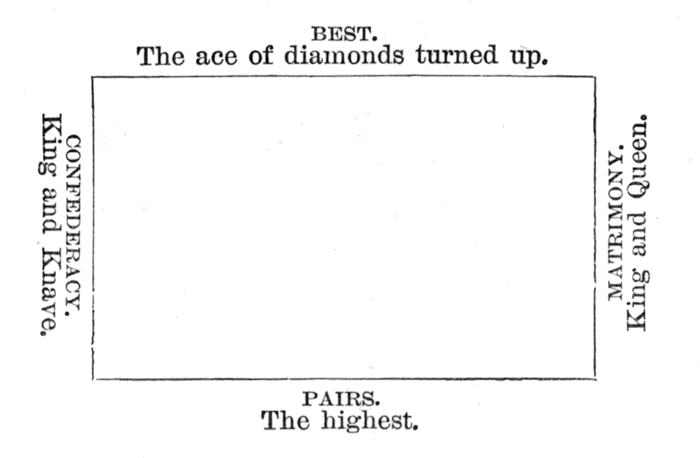
All hands are now turned up, the holders of intrigue, matrimony, &c., taking the stakes placed on these points.
When two or more players happen to hold similar cards, as king and queen, king and knave, &c., the stake is gained by the elder hand, but if any chance be not won, it is left over until the next deal; and on any unclaimed point the stakes may, if thought desirable, be increased. The chances rank, it must be understood, as follows:—
Ace of diamonds (best).
King and queen (matrimony).
King and knave (confederacy).
And any pair (the highest).
ALL FOURS.
The name by which this game is known was, no doubt, given to it because of the four chances, or points, of which it consists—namely, High, which is the name given to the best trump; Low, the smallest trump in the round; Jack, the name of the trump suit; and Game.
The game may be played by either two or four players, but the same rules apply to each.
It would, perhaps, be as well first of all to describe the technical terms used in All Fours, as the game cannot be understood without a knowledge of them.
High.—The highest trump out; the holder scores one point.
Low.—The lowest trump out; the original holder of it also scores one point, even if it be taken by his adversary.
Jack.—The knave of trumps; the holder scores one point, unless it be won by his adversary, in which case the winner scores the point.
Game.—The greatest number that, in the tricks gained, can be shown by either party; reckoning for
Each ace four towards game.
„ king three „
„ queen two „
„ knave one „
„ ten ten „
The other cards do not count towards game; thus it may happen that a deal may be played without either party having any to score for game, by reason of holding neither court cards nor tens.
When the players hold equal numbers (ties), the elder hand (the non-dealer) scores the point for game.
Begging is when the elder hand, disliking his cards, uses his privilege, and says "I beg," in which case the dealer must either suffer his adversary to score one point, saying "Take one," or give each three more cards from the pack, and then turn up the next card for trumps; if, however, the trump turned up be of the same suit as the first, the dealer must go on giving each three cards more, and turning up the next until a change of suit for trump takes place.
Eldest Hand.—This term signifies the player immediately to the left of the dealer.
The following is the method adopted for playing the game:—
The ace is the highest card, and deuce is the lowest.
After having cut and shuffled a pack of fifty-two cards in the ordinary way, the dealer gives six to each player. If there be but two players, he turns up the thirteenth card; but if four players, he turns up the twenty-fifth card, the suit to which the turn-up belongs being trumps. Should the turn-up be a knave, the dealer scores one point.
The elder hand then looks at his cards, and either holds it for play or begs, that is to say, that he must be allowed by the dealer to either score one point, or that all the players should have three more cards given to them, and that a new trump should be turned up.
When the latter plan is adopted, should the turn-up be of the same suit as the last, the dealer must go on giving three more cards until a change of trumps takes place.
The elder hand having decided on his hand, plays a card from any suit he likes, but must not beg more than once, unless a special agreement has been made that he should do so.
The dealer to this plays another card, which, if higher, wins the trick, the winner of it thus becoming the next leader, and so on throughout the six tricks. According to the modern method of playing, the trick need not be headed by one of the same suit; the highest card played wins it.
When the six tricks are played, the points are taken for High, Low, Jack, or Game. Jack counts one to the player who possesses it at the count-up, and not to the player who owned it originally. High and low each count one, the players to whom they were dealt deriving the benefit of them. The deal is taken in turns.
Should no player have either a court card or a ten, the elder hand scores the point for game. In the case of two players having equal points towards game, the elder hand of the two scores. If only one trump should be out, it counts both high and low to the player who first has it. The science of the game consists, as may easily be seen, in first winning the knave; second, making the tens; and third, in taking the adversary's best cards.
BLIND ALL FOURS.
This game is not often played by more than two persons. Six cards are given to each player, the trump card being the first that is played by the non-dealer. The points are generally nine or seven, and there is no begging.
Among some players a rule exists that the sixes and sevens should be rejected, and that the pips on all the cards should be counted for game.
ALL FIVES.
This is a game that requires no small amount of skill to play it well, but when once understood proves to be well worthy of the attention and admiration bestowed upon it.
Instead of nine or eleven points being played for, as in All Fours, sixty-one points constitute the game, the marking of which is generally done on a cribbage-board. The very first card played by the non-dealer is the trump card.
Any one playing the ace of trumps marks four points to himself; for king he marks three; for queen, two; for knave, one; for the five of trumps, five; and for the ten of trumps, ten. When the knave, ten, or five are taken by superior cards, the points belonging to them are scored by the winner.
In counting for game, the five of trumps is reckoned as five; all the other aces, kings, queens, knaves, and tens are counted the same as in All Fours.
POKER.
The game of Poker is better known in the United States than in England. Like many other games, it is so closely associated with betting that its reputation has consequently suffered in no slight degree.
There are several varieties of the game, known as Stud Poker, Straight Poker, Whiskey Poker, Twenty-deck Poker, and Draw Poker; but as the last is the game best known, it will, perhaps, be advisable to describe it first.
DRAW POKER.
A full pack of fifty-two cards are required, and any number of persons may play, though some players think it better that the number should not exceed six or seven.
Before dealing, each player is provided with a certain number of counters, which in America are styled chips. The dealer then places a stake in front of him. A single chip usually constitutes this stake, and is called the ante. Having concluded this preliminary part of the business, five cards are dealt to each player. As in Loo, all look at their hands, and declare in turn what they will do. The choice of three things is given them: They can throw up their hand, and go out of the game for that deal; keep their cards as they are; or they may change as many of their own cards as they like for the same number from the remainder of the pack on the table. In case any one should choose the latter alternative, no one must look at the rejected cards.
When the dealer's turn comes to make his choice, if he determine to play, he is bound to add an equal amount to what he had previously staked. This is called making good the ante; by so doing the dealer places himself on an equal footing with the other players.
Should he rather than raise his stake prefer to go out, the next player is requested to raise; but should he, like the dealer, also prefer to go out rather than raise, the next player is asked, and so on, until some player expresses himself willing to raise. This being the case, the next player has three alternatives: he must either go better, which means stake some larger amount; see the raise, which signifies staking an equal amount; or he must go out. The choice of these three alternatives is given to each player, until after full opportunity has been afforded to all of deciding, no one has gone better, but each of those remaining in has elected to see the raise, the stakes consequently remaining equal.
The person who now is requested to show his hand is the player seated next to him who last saw the raise, though if such player should not have a good hand to show, he may, if he likes, go out without showing his cards.
Perhaps to a greater extent in Poker than in any other card game, the great aim of a good player is to conceal his system of playing; therefore, although a player going out relinquishes all hold upon his stakes, he would rather do that than show an inferior hand.
Many of the technical terms used in Poker being peculiar to the game, a knowledge of them will be found necessary to the learner.
Age.—Same as eldest hand.
Ante.—The stake deposited in the pool by the dealer at the beginning of the game. At Straight Poker each player puts up an Ante.
Blind.—This name is given to the bet made by the eldest hand before the cards are cut to be dealt.
The eldest hand alone has the privilege of starting the Blind, though the player to the left of him may, if he likes, double it, and again, the next player, still to the left, may straddle it, which means double it again.
Any player refusing to straddle thus prevents any one else doing so afterwards.
Bluffing Off.—When a player with a weak hand bets so high that he makes his opponents believe he has a very strong hand, and they are deterred from seeing him or going better.
Brag.—To bet for the pool.
Call.—To call a show of hands is for the player whose say is last to deposit in the pool the same amount bet by any preceding player, and demand that the hands be shown.
Chips.—Another name for counters.
Draw.—To discard one or more cards, and receive a corresponding number from the dealer.
Flush.—Five cards of the same suit, not necessarily in order.
Fours.—Four cards of the same denomination, as four threes or four fives.
Full.—Three cards of the same denomination and a single pair.
Going Better.—When any player makes a bet, the next player to the left may raise him or run over his bet, which means that he may deposit more in the pool than his adversary has done.
Pair.—Two cards of the same denomination, as two queens.
A Straight.—Five cards in numerical sequence, though not of the same suit.
Triplets.—Three cards of the same denomination, as three aces.
Although the ace is the highest card in this game for sequence purposes, it may be counted as next to the two or next to the king, as may best suit the player. The player, however, is not on this account entitled to use the ace as a connecting link between the king and the two, so as to form a sequence between them.
STRAIGHT POKER.
Straight Poker, or Bluff, as it is often called, is played according to the same rules as Draw Poker, though there are one or two particulars in which it differs from that game.
Not only the dealer, but also every player, "antes" before the cards are cut for deal. The winner of the pool has the deal. Any player may pass, and come in again if he chooses to do so, provided that in the meantime no other player has raised. No one is allowed to discard or draw any cards.
In case of mis-deal, or when all the players pass, the eldest hand deals, and a fresh ante is added to the pool by each player making what is called a double header.
To prevent confusion, and to save trouble also, it is sometimes arranged that, instead of each player depositing a fresh ante every time before the cards are cut, one of the players shall take it by turns to chip for all.
When this is done, the best way is to pass round the table, by way of memorandum, a buck. This name is given to any small article which may serve as a reminder, and should in the first instance start with the original dealer. As soon as the dealer has chipped, he hands the buck to his left-hand neighbour, who keeps it until he in turn has chipped for all, when he again passes it on. So to the end the game goes on.
WHISKEY POKER.
Plenty of fun may be extracted from this highly amusing game. To make the pool is the matter that requires the first consideration, and to do this each player contributes one counter or chip. After this, the game is regulated very much by the same rules as those laid down for Draw Poker, the only exception being that the strongest hand gets the straight flush.
Five cards, one at a time, are given to each player, besides which an additional hand, called the widow, is dealt, and laid in the middle of the table.
All the players now look at their hands, and if not satisfied with them, they each in succession have an opportunity of making a little change in them, according to the following explanation.
Should it so happen that the eldest hand, after examining his cards, expresses himself satisfied with them, the next player may, if so inclined, put down his own cards on the table, and take up the widow instead. When he has done so, the other players in turn may select any card they please from the discarded hand in exchange for one of their own, until some one declares himself satisfied by knocking on the table. Even after this, however, the rest of the players are allowed one more chance of drawing before showing the hands.
The strongest hand wins the game.
In case all should declare themselves satisfied without taking the widow, the dealer turns his hand upwards, and every one may draw a card from it.
SNIP-SNAP-SNORUM.
The point aimed at in this game by each player is to be the first to get rid of his cards, as the one who is first out is the winner, and can claim from all the other players the same number of counters as they have cards left in their hands.
We cannot recommend to young people fond of noise and excitement a game more likely to suit them; it is easily learnt, although at the same time the learner will soon perceive that a certain amount of thought and judgment must be exercised in order to play to the best advantage.
Any number may play, from six or seven upwards.
First of all, a whole pack of fifty-two cards is dealt out to the players, the first of whom, after the hands have been examined, begins by putting down any card he likes, at the same time calling out Snip.
Any one holding the next higher card of the same suit now places it upon the first card, and cries Snap; while the person possessing the higher card still calls out, as he plays it, Snorum.
The person holding the next card cries Hi-cockalorum; and should a higher card still be out, the possessor plays it, and cries Jig.
The last word signifies a stop; therefore no one afterwards can continue the sequence.
The ace counts as one (the lowest card); therefore kings are stops.
The player who first succeeds in getting out receives in some instances not only the separate contribution of each player, but also the contents of the pool, which has been formed by united donations from all the players.
When pools exist, by way of enlarging them it will be found advisable to institute fines, the excitement of the game being, of course, heightened by the winner of a sequence coming in for a good large reward.
As it is desirable that the player should keep the lead as long as possible in his own hand, he will find that in order to do so he must not play his cards at random, but must use discretion and forethought.
Cards that cannot be led to, such as aces, or cards immediately following those that have been played, should be brought out early; while kings and all stops should be withheld as valuable until there is the chance of disposing of two or three of them together.
The above is the most common method of playing this game, though another very amusing way is the following:—
Every one places before him five counters, which are considered as stock.
The aim of every one then is to play a card of equal value with that of the next player, which is called snipping. A third player, having a card of like value, snaps; and a fourth player, being equally fortunate, snorums.
By way of illustration, we will imagine the elder hand to have played a queen. The second player also plays a queen, in consequence of which the first player is snipped, and has to place a counter in the pool. The third player then also plays a queen, when his predecessor (the second player) is snapped, and must put two counters into the pool; then if the fourth player also has a queen, the third player is snorumed, and pays three counters.
As each player becomes bankrupt by having had to pay all his counters, he must go out of the game, the pool falling to the lot of the player whose stock holds out the longest.
Every one must snip or snap if he possibly can do so, though no one must play out of turn.
Sometimes the cards are dealt three or four times before the game is decided.
COMMERCE.
This game is well named, for it is carried on throughout simply by a series of exchanges and business transactions.
A full pack of cards is used, which are all dealt one by one to the players.
The ace counts as eleven, tens and court cards for ten each, and the rest of the cards according to the number of their pips.
Before dealing, a pool is formed, by each player contributing to it an equal stake. The eldest hand then begins by exchanging a card with his left-hand neighbour, who again changes with his left-hand neighbour, and so on until some one, finding that he has a hand consisting entirely of one suit, cries out "My ship sails," and thereupon takes to himself the contents of the pool.
The object aimed at by all the players is one of three things: to make what is called a tricon (three cards alike), or a sequence (three cards following each other of the same suit), or a point (which is the smallest number of pips on three cards of the same suit).
The winner of the pool is the player who has the highest tricon; but should no tricon be displayed, the highest sequence has it; or in case of a failure also in sequence-making, then the player who has the best point takes the pool.
In case of ties, the banker or dealer is regarded as the eldest hand, but should he hold a lower tricon or sequence than either of the others, he loses the game, and forfeits a counter to each player higher than himself.
SIFT SMOKE.
A complete pack of cards is required for this game, the value of which is the same as at Whist.
The tricks gained are really of no intrinsic value, though every one must either follow suit or play a trump.
The pack is first divided into two equal parts, one portion of which is placed on the table, while the others are dealt to the players, the last card turned up being the trump.
As each trick is gained the winner of it takes a card from the half pack lying on the table; he who can hold out the longest winning a stake that shall have been agreed upon at the commencement of the game.
LOTTERY.
This well-known game is generally acknowledged to be one of the most amusing that have ever been invented. Any number may play, and a full pack of cards is required: indeed, it is not at all an unusual occurrence for two or three packs to be mixed together when the company is more than ordinarily large.
Counters are given in equal numbers to every player, each of whom contributes something towards a pool.
The cards, containing one, two, or three packs, as the case may be, are then divided into two equal parts. The person on the left of the dealer takes one of these parcels, and out of it any one may draw three cards, which are to be the prizes, and are placed face downwards on the table. The cards in the other parcel are then sold by the dealer for a certain fixed price, perhaps a counter for each card, all payments being placed in different proportions on the prizes. Any cards that are left after all have been supplied are sold to any one wishing to purchase them. The players who have been fortunate enough to purchase cards corresponding with the prizes win the prizes, and also all the stakes that have been placed upon them.
Another way of playing after the counters have been distributed is for one pack of cards to be used as tickets and the other as lots or prizes. Two players then take in their hands the two packs of cards, which must be shuffled, and each one cut by the left-hand neighbour. One of them then deals a card, face downwards, to each player, and these are called the lots. On each lot the players all place as many counters as they like, after which a card to every one is given from the other pack, and these second cards are called tickets.
Supplies thus being concluded, each player must examine his cards to ascertain whether the ticket he possesses corresponds with any of the lots. Any one who finds such to be the case may appropriate the lot or prize that is marked on that card.
At the close of the round any lots that may be left undrawn are carried on to swell the next lottery. The cards are collected, and, after being re-shuffled and cut, are dealt again as before; and thus the game continues until the fund is all drawn out.
QUINCE.
In some parts of the Continent this game of Quince is very highly esteemed, much more so than in England.
The method adopted in playing it is very similar to that of Vingt-un, though in Quince only two persons can play, while in Vingt-un any number of players can join.
Ace is lowest. A full pack of cards is shuffled and cut, after which the dealer gives one card to his adversary and takes one himself.
Should the elder hand not approve of the card with which he has been favoured, he can demand from the dealer as many additional cards as he imagines will enable him to make fifteen.
The aim of both players is to be first in making fifteen; therefore, as in Vingt-un, they must be careful, in taking extra cards, not to overdraw. Should both players overdraw, the game is considered a drawn one, and the stakes already made are doubled for another attempt.
Although this simple and amusing little game is intended for two players only, there is no reason why a large number should not join in it if so inclined.
POPE JOAN.
This really delightful game may be enjoyed by almost any number of players, though it must be remembered that, in addition to the usual pack of cards required for all other card games, a round board must be provided, such as are sold specially for that purpose.
These boards, as will be seen (see figure), are divided into eight compartments, each of which is meant to hold the counters belonging to certain cards or combinations.
The names of these divisions are king, "pope" (which is the nine of diamonds), knave, game, queen, matrimony (which is signified by the king and queen of trumps), ace, and intrigue (the latter represented by the queen and the knave of trumps held in the same hand).
The first important business requiring attention is the dressing of the board; and the fifteen counters necessary for this performance are either supplied by the dealer alone or are contributed by the company, according to arrangement. Six are given to pope, two to matrimony, two to intrigue, and one each to ace, king, queen, knave, and game. The eight of diamonds being taken from the pack of cards, the rest are dealt out equally to all the players, face downwards, the last card deciding for trumps.
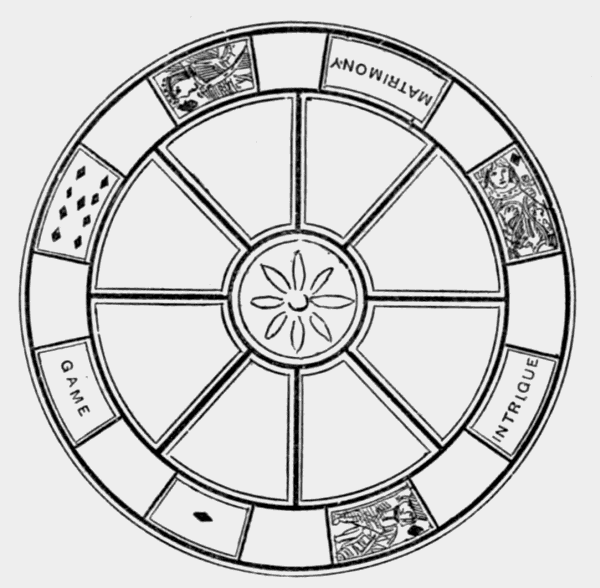
Pope Joan Board.
Should either ace, king, queen, or knave happen to be turned up, the dealer has the privilege of appropriating the counters that have been allotted to their compartments for himself, and if pope be turned up, the advantage gained by him is still greater. He takes both it and game, and also can claim a stake for every card dealt to each player.
In addition to the shares allotted to each player, an extra hand is placed in the middle of the table, to form what is called the stops, and no one but the dealer has the privilege of looking at them. The four kings, which are the last of their suit, and the seven of diamonds, which precedes the eight of diamonds that has been withdrawn, are always fixed stops, the ace counting only as one in the game.
The players have two objects in view—one of which is, to be the first to play out all their cards; and the other, to play those cards that will entitle them to receive the counters with which the board is supplied.
The dealer's left-hand player begins by playing any card he likes, choosing one, if possible, that is one of a sequence, so that he may have the opportunity of ridding himself of, perhaps, several cards at once. Any other player having the next higher card in sequence plays it, then another, until either a king, a seven of diamonds, or some other stop card is played. The person playing a stop always leads next.
At any time during the game, should an ace, king, queen, knave of trumps, pope, matrimony, or intrigue be played, the owner of any of these cards is entitled to receive all the counters in the corresponding compartments of the board. The player who first announces himself to be without cards is the winner of the game, receiving, therefore, all the stakes in that compartment of the board, and also from the rest of the players a counter for each card they may still have in hand. Among these unplayed cards, however, should one of them be pope, the holder of it is excused from paying.
Although in the same hand king and queen make matrimony, and queen and knave intrigue, neither they nor any other good cards entitle the holders of them to the stakes deposited in their particular compartments unless played out; and it must also be remembered that all claims for payment are useless that are not made before the board has been re-dressed for the next deal. Still, in cases where unclaimed stakes are left on from one round to another it is quite a common thing to terminate the game by dealing round the cards, face upwards, and giving to the holders of the various cards or combinations the pools corresponding to them, thus making a clear board.
SPINADO.
The game of Pope Joan, although one of the most interesting of games, is not practicable at all times, simply on account of the necessity always existing for the presence of a board. To such players as are fond of the game, but do not possess a board, the game of Spinado will serve admirably as a substitute.
From a full pack of fifty-two cards all the twos are first extracted, and also the eight of diamonds. As in Pope Joan, the object aimed at by the players is to be first out. The lucky person who thus distinguishes himself is presented with a pool, and also with a counter from every player for every unplayed card they still hold in their hand.
A peculiar arrangement exists with regard to the pool. It is divided into three divisions, one of which is intended for the player who is first out, one for the player of matrimony (which is king and queen of diamonds), and one for intrigue (king and knave of diamonds).
In order to form this combination of pools each player gives three counters to each pool (making nine counters in all), excepting the dealer, who is called upon to contribute two dozen counters. Six of these go to the first out pool, the same number to intrigue, and twelve to matrimony.
The card honoured by being called Spin is the ace of diamonds, and may either be played alone or with any other card. A card played with it thus becomes a stop, and the possessor of it is entitled to take the next lead.
As in Pope Joan, an extra hand is placed by the dealer in the middle of the table to make the stops, and no one must refer to them but the dealer. After dealing and forming the pools, the game begins, all vieing with each other who can first get rid of their cards.
The player of spin can demand, before any other card is played, the payment of three counters from every player; the player of the king of diamonds two counters from each player; and the players of matrimony and intrigue receive each the pools that have been specially prepared for them.
The simple holding of these combinations does not entitle any one to receive the pool; the cards must be played, and payments should all be made at once as soon as they become due. If at the end of the game it is discovered that any one still holds in his hand the spin card, he must pay to every one double for each of his unplayed cards.
OLD MAID.
From a full pack of fifty-two cards take out one queen. Shuffle well the remainder, and deal them, face downwards, equally to all the players until the pack is exhausted.
All must then arrange their cards in a fan-shape, to be held in the hand, and the honour of every one is depended upon not to look at any cards but his own, because the strictest secrecy must be maintained.
The dealer begins by offering his cards to his left-hand neighbour to extract from it any card he likes. The drawer then, looking at the card he has taken, tries to match it with one of those in his hand. If able to do so, he throws the pair out into the middle of the table; but if he cannot do so, he places it among his own, and, following the example of the dealer, offers his own cards in the same way to his left-hand neighbour, that he also may take any card he likes. Thus the game goes on until all the cards are paired, excepting, of course, one card, which is the companion to the banished queen. The unfortunate individual in whose hand the solitary card is left is surely destined to be either an old maid or a bachelor. The trial may, of course, be repeated as many times as agreeable to the company.
Cards specially made for this game are sometimes used instead of Whist cards, and by some players are much preferred. These real Old Maid's cards are composed of white thin cardboard, an inch wide and from three to four inches long, with the end intended for the top of the card made to form a point.
Upon every card at the pointed end a number is written in very legible characters. A couple of cards must be 1, another couple 2, another couple 3, and so on, until as many couples as it is thought will be required have been figured. On a last single card the words The Old Maid must be distinctly written, and before beginning to play the whole must be well shuffled.
SPADE AND GARDENER.
Most young people who have had any experience at all of cards and card playing are well acquainted with the amusing (though, perhaps, not highly intellectual) game of Happy Families.
Special cards, called "Happy Families," can be bought, containing family groups of four; but where such cards have not been provided, the game may be played with quite as much success with a pack of ordinary Whist cards. Indeed, it is more than probable that in the first instance the principles of the game made their appearance originally with cards of this description.
The court cards, aces, and tens of an ordinary Whist pack are selected, and to each king a name is given. Spade the Gardener for one of their Majesties will do as well as any other; still, if any better name suggests itself to the mind of any one, there is no reason why such should not be adopted in preference. Supposing, however, this name to be the one chosen, we should have the king of spades for Spade the Gardener, the queen for his wife, the knave for his son, the ace for his servant, and the ten of spades for his dog, thus forming a complete family group. Three other comic names may easily be imagined for the other three suits, after which the business proceedings must be commenced.
The dealer gives the cards out all round, one after another, face downwards, until the whole pack is exhausted, and the aim of each player must be to win from his friends the whole of the twenty cards.
Supposing the name of "Shah of Persia" to have been given to the king of diamonds, "The Afghan King" to the king of clubs, and "Good Jack Faithful" to the king of hearts; the elder hand then begins by asking from any one of the players he may choose to select a card which he imagines they may have. He himself may have in his own hand three members of one family; if so, he must try to get the other two members, and succeeding in doing so, he must throw the whole family on the table, and devote his energies to the acquisition of the other families. The task, however, devolving upon each player of collecting the different members of the four families is by no means an easy one.
Every time a card is asked for, the player who makes the demand, in doing so, gives to the company a certain amount of information respecting his own hand, because he may not lawfully ask for the Shah of Persia's dog unless he should already possess either the Shah himself or some other member of the family. If the card asked for be given him, he may ask for another card from either the same person who acceded to his request or from any one else; but as soon as he is refused, his privilege passes on to the person who was unable to give him what he asked for, and who may possibly request the return of the very cards he has been called upon to relinquish. Thus the game goes on until one of the players is left without cards, who retires as out. The rest of the players proceed in the same way until another is out, then another, and so on, until at last two players only are left to end the struggle.
HAPPY FAMILIES.
Although, without doubt, the well-known game of Happy Families is nothing but a variation of Spade the Gardener, the rules of the game are not quite the same. In some respects, perhaps, the game of Happy Families may be the better game of the two, for the reason that, in consequence of there being many more cards belonging to it, a great many more players can take part in it. In one of the ordinary Happy Family packs there are eleven families, though, instead of each family containing five members, as in Spade the Gardener, there are usually only four in Happy Families, namely, father, mother, son, and daughter.
A pool is first formed by every player giving a certain number of counters, and the cards are dealt round one by one, face downwards.
On looking at their cards, the player to the left of the dealer begins by asking any one in the company to give him a certain card, which he needs, perhaps, to complete a family or to help to do so, because the object of each player in this game is to secure for himself as many tricks as possible.
If the card he asks for be given him, he may go on asking from the same person or from any one else; but should he be refused, it is the turn of the person who refused to ask.
It is a rule that no one shall ask for a card unless he be already supplied with one card, at any rate, of the same suit, and every one also is bound to produce the card asked for if he can do so.
When the different members of the families are gathered together and united, the player who has taken the greatest number of tricks wins the pool.
BÉZIQUE.
Before describing the game of Bézique, which, under the name of Penuchle, is greatly in favour among the Germans, it will perhaps be advisable to give a list of the technical terms employed in it.
Single Bézique.—The queen of spades and knave of diamonds, which count 40.
Double Bézique.—Two queens of spades and two knaves of diamonds, which count 500.
Brisques.—The aces and tens in the tricks taken count 10 each.
Common Marriage.—The king and queen of any suit but trumps, which count 20.
Bézique Pack.—The same as the Euchre, Piquet, or Écarté pack, composed of thirty-two cards, all under the sevens, except the aces, being discarded.
Quint Major.—Same as sequence.
Royal Marriage.—The king and queen of trumps, which count 40.
Sequence.—Ace, king, queen, knave, and ten of trumps, which count 250.
Stock.-The number of packs of cards corresponding with the number of players, shuffled together, and ready to be dealt.
Talon.—The cards remaining after the dealer has distributed eight to each player.
Declaration.—Showing and scoring any combinations, such as those mentioned above.
Four aces count 100
Four kings „ 80
Four queens „ 60
Four knaves „ 40
Seven of trumps, when turned or played, counts 10.
Exchanging or playing the seven of trumps counts 10.
The last trick counts 10.
This game is most commonly played by two persons with two packs of cards; but there must be a pack for every person playing, so that if four play four packs must be used, from which, as has been said, all cards under seven have been taken out excepting aces. After shuffling and cutting, the dealer gives three cards to his adversary and three to himself, then he gives two, then three again, until both players are supplied with eight cards each. The remainder of the pack, which is called the talon, are left on the table, and the top card of it is turned up for the trump. Should the turn-up happen to be a seven, the dealer is thereby entitled to score ten to himself. After a trick has been made, the holder of a seven of trumps can, if so inclined, exchange it for the trump card, and for the exchange he scores ten.
The value of the cards in making the tricks is as follows: ace (which takes all other cards), ten, king, queen, knave, nine, eight, seven. Trumps are of no special value until the last eight tricks are in the hands of both players.
The player who wins the first trick takes the top card from the talon, thus completing his original number of eight. The person also who has lost the trick does the same; and so on, until all the cards in the talon are exhausted. As in other card games, the winner of a trick is entitled to the next lead.
When cards of the same value are played at the same round, the first that was turned up wins the trick, unless, of course, it should be trumped or beaten by a card higher in value. When a player wishes to declare, he must do so immediately after taking a trick, and before supplying himself with a new card from the talon; and such cards as form a combination, after being declared, should be placed on the table, face upwards; being of the same value as if in the hand, they may be played away as they are needed. When the talon is exhausted, the combinations that have been made are taken into the owner's hand, and the last eight cards belonging to both players are disposed of the same way as in Whist, the second player following suit, and heading the trick, if he can possibly do so, either by trumping or playing a higher card. After Bézique has been declared, the cards forming that combination cannot be employed to form any other. It is wise, therefore, to keep back the queen and knave to help to form other combinations before declaring Bézique, especially when diamonds or spades happen to be trumps. In that case the queen may assist in making a royal marriage, a sequence, or one of four queens, while the knave may help to form a sequence or one of four knaves, both being also used afterwards in the declaration of Bézique. All kings and queens are better kept in hand until they can be married; consequently, should the player be uncertain whether to throw away an ace or a king, if practicable, let it be the former. Although four aces count more than four kings, the declaration of four aces is not an easy matter to accomplish, while it is very probable that an opportunity may arise for marrying a king, when the pair may be thrown into the adversary's tricks. The aces and tens of trumps are better reserved for the last eight tricks, and a player should try to get the lead by taking the trick previous to exhausting the talon. The adversary will thus be obliged to part with his aces and tens by playing them on the cards that are led. The leader, if strong in trumps, may thus secure all the tricks, and may also earn the privilege of making the last declaration.
BÉZIQUE WITHOUT A TRUMP.
This is very much like the ordinary game, the difference being that the trump card is decided, not by the last turned up after the deal, but by the first marriage that is declared. The seven of trumps also does not count ten points.
The Béziques, four kings, four queens, &c., are counted the same as in Bézique when the trump is turned, and can be declared before the trump is determined. It is the same with the other cards which constitute combinations; their value is the same as in the proper game of Bézique.
SNAP.
The game of Snap may either be played with the ordinary Whist cards or with special cards prepared for the purpose, though perhaps when the former are used it is for the simple reason that there are no real Snap cards at hand. The latter are certainly less bewildering and more interesting.
Since the first introduction of Snap, the original figures have been varied and improved upon in many ways, though the rules for playing the game continue the same. Among the later additions, the Floral Snap (if not quite so laughable as some of its predecessors) is at any rate as interesting and artistic.
Each pack consists of about fifty cards, on four, five, or six of which are represented the same object. A similar number of cards depict another object, a similar number again another object, and so on with the whole pack. Thus on four cards may be a rose, on other four a yellow lily, on other four a geranium, on four more a pansy, and on the rest of the cards other flowers.
The whole pack is dealt round, face downwards, to any number of players, who must each place his own cards before him without looking at them. The first player begins by turning up the top card of the pile, the next does the same, and so on, but as soon as any one turns up a card resembling one that has already been exposed, he calls Snap, at the same time winning all the cards that happen to have been turned up by the owner of the card resembling his own. If, however, the owner of the card is fortunate enough to call Snap first, the tables are turned, the first Snapper becoming possessor of the other's cards.
The utmost vigilance is required to play the game at all successfully; every one must be on the strict look-out in order to let no opportunity pass that would entitle him to call Snap, because, as will very soon be discovered, those who do not call Snap frequently will very soon be out, and will only be able to sit by as spectators of the merriment. The quickest of players will, however, in course of time be obliged to retire from the scene of action; one by one they will find themselves destitute of cards, until at last the contest remains to be fought out by two players only.
At this crisis the excitement has generally reached its highest pitch, and the fortunate one of these two players left with the cards in his hand is the winner of the game.
ZETEMA.
In some points Zetema resembles both Cribbage and Bézique; still, in reality, as will be found after a little experience by the player, it is like neither; and, although it may not in the estimation of most card-players be exactly superior to those games, it is quite as interesting and as exciting.
Proper sets of Zetema cards may be bought of any ordinary card dealer, though in the absence of them Whist cards may be made to answer the purpose instead.
The advantage of being supplied with the former, however, lies in the fact that with them is appended a Table of Scores like the following, a knowledge of which is indispensable to the player:—
TABLE OF SCORES.
Assemblies. Points.
For an assembly of the five Kings 100
„ „ Queens 100
„ „ Knaves 90
„ „ Aces 80
„ „ Fives 80
„ „ Any others 60
MARRIAGES. Points.
Declaration of marriage 10
Declaration of imperial marriage, that is, the second marriage of The duplicated suit, after the other has been declared 20
Declaration of two marriages at one declaration 30
Declaration of two marriages at one declaration, of which one is the imperial marriage 40
Declaration of the two marriages of the duplicated, but at one declaration 50
Declaration of three marriages at one declaration 60
Declaration of three marriages at one declaration, of which one is the imperial marriage 70
Declaration of three marriages, of which two are of the duplicated suit, at one declaration 80
Declaration of four marriages at one declaration 100
Declaration of four marriages at one declaration, of which one is the imperial marriage 110
Declaration of four marriages, of which two are of the duplicate suit, at one declaration 120
Declaration of the five marriages at one declaration 150
Declaration of a flush, or of all the cards in hand being of one suit, which must not be the duplicate suit 30
Declaration of a sequence, or when all the cards in hand follow each other in order of value or number 30
TRICKS.
King or queen trick (when made) 50
Knave trick do. 20
Ace trick do. 15
Five trick do. 15
All other tricks do. 5
Penalties for playing out of turn or accidentally exposing a card during play:—
1st.—The card must be left exposed on the table until the player's turn comes round, when it must be played.
2nd.—The player cannot draw, under any circumstances, at that time from the pack to complete his hand, but must continue one card short.
3rd.—If the exposed card be a winning card, the score is lost.
4th.—If not a winning card, it will follow the usual course.
On opening a pack of Zetema cards, it will be seen that they are composed of a full pack of Whist cards, with the addition of a double set of one of the suits. When ordinary cards are used, it is immaterial which suit is chosen to be duplicated; all that is necessary is that before beginning to play the double suit should be declared.
Each trick, therefore, consists of five cards instead of four, and as some of these tricks are much more valuable than others, the aim of every player should be to secure the highest tricks. The combination known as an assembly, and which is mentioned in the score, is simply a trick not yet played, but still held in hand.
Five cards of equal value do not often fall to the lot of any one, therefore this combination does not often occur; and in most cases it is, perhaps, wise for players to be satisfied with something less. Still, when a player holds in his hand two or three kings or two or three queens, he is quite justified in making an attempt to secure the five, in order that he may lay claim to the highest score; because, as will be seen from the list, an assembly, either of five kings or of five queens, counts 100.
When all the six cards in hand are of the same suit, the owner of them can lay claim to a score of thirty, though this combination is not a very common one, because flushes of the duplicated suits do not count. The most likely time to secure a flush is when not many of the same suit have been already played.
The sequence combination is generally the best paying of all, especially when the number of players is only small. The ace may be counted either as one or as best card, whichever will be most advantageous to the player.
Therefore, if one, two, three, four, five, six; four, five, six, seven, eight, nine; or nine, ten, knave, queen, king, ace, be possessed by any one, the owner of such cards may score thirty. Sequence cards must, of course, follow in rotation, but they need not be of the same suit; and after counting a sequence, and also after counting a flush, four of the same cards may be employed in making another sequence or flush.
In Two-handed Zetema, four, or even five, sequences are often counted in the playing of one game. A common marriage, which scores ten, is secured to any one who plays a king and queen of the same suit. The imperial marriage consists of the second king and queen of the duplicate suit. The playing of the first king and queen of this suit constitutes nothing more than a common marriage.
Experience will teach the player that when he holds three or four kings and queens in his hand, he will gain more by keeping them back until he can declare them all at once than by declaring them singly, because the declaration of two or three marriages at the same time score much more in comparison than if declared singly.
With regard to tricks, the player should make every effort possible to secure the knave trick, which scores twenty, and the ace trick and the five trick, which score fifteen each. The person entitled to score the tricks is the one who plays the last or fifth card of the same value; by doing so he gains five. It is only possible to make a king or queen trick when an assembly of one of them has been declared; the others then being played in the same way as the cards lower in value, the trick scores fifty. When four or more persons play at Zetema they must arrange themselves in couples, as at Whist, and sit opposite to each other, one of each couple undertaking to mark the scores, the other turning and collecting the tricks; but when only two or three play every one scores for himself.
When not more than four are playing, the dealer distributes six cards to each player, placing all the cards that remain face downwards on the table. Every one then carefully examines the cards given him, to ascertain what course it would be wise for him to adopt. A study of the rules will enable him to decide which declaration he will most likely be able to make. As in Bézique, every player should always have six cards in his hand. After playing one, therefore, he must take up a card from the over cards on the table to make up his number. This must be done, however, at once, immediately after he has played a card, otherwise he cannot claim it, and must suffer the consequence, which, doubtless, will be that he cannot in that hand score either a sequence or a flush. In attempting to form sequences it is advisable, as in Bézique, to retain, if possible, such cards as would help to make another sequence. The card drawn sometimes happens to be of the same value as one of those held in the hand; in that case one of them may be made to contribute towards an additional sequence.
The player of the fifth card who completes a trick when four cards have already been played cries "Zetema" as he turns the trick, and scores for it. Thus the game goes on until all the over cards have been gradually withdrawn, the taking of the last of these being the signal for the best part of the game to begin. The playing of the last six cards and the making of the rest of the marriages and tricks form usually the most exciting part of the whole affair.
The player most of all to be envied is the drawer of the last card on the table; for this reason, that as every one else must play their card first, he has the opportunity of retaining command of an imperial marriage or of any other good trick until the end of the game.
Although the declaration of two or three marriages is highly advantageous, still there is no danger in playing one of the cards of a marriage in one round, and declaring the marriage in the next round, rather than play them both at once. When there are more than four players, five cards instead of six must be given to each by the dealer, the flushes and sequences being, of course, smaller in comparison. Before attempting to play, a thorough knowledge of the rules must be acquired, and also great care and prudence must be exercised throughout the whole game, in order to ensure success.
FRENCH VINGT-UN, OR ALBERT SMITH.
This lively and amusing game is a variation of the ordinary game of Vingt-un, and is well worthy of the popularity it has gained among most lovers of card games. For a round game it is especially suitable, not only because any number of players may join in it, but for the reason that even while playing it is not necessary for the attention of the players to be so entirely absorbed in the game as to be unable to manifest any interest in anything else that may be going on in the room. It is perhaps longer than most ordinary card games, and should not therefore be entered upon by players who have not plenty of time at their disposal.
In making the necessary preparations for it, a good supply of counters must be provided, and a very excellent plan sometimes adopted is to limit the number staked to three, the dealer having the privilege at any time to double the stakes, should he be so inclined.
The eight rounds of which the game consists are all played differently; the first one resembles the Ordinary Vingt-un. The second round is called Imaginary Tens, and also resembles Vingt-un, excepting that each player, whatever cards have been dealt to him, counts them as ten more than they really are. As in Vingt-un, one card is given to each player, and before receiving it he must make his stake. To this card the imaginary ten is added, and then the players either take more cards or stand, in order as near as possible to make twenty-one. Third round, or Blind Vingt-un, comes next, in which each player, after making his stake, has two cards dealt to him. On these two cards he may either stand or draw more, but whatever decision he makes, it must be arrived at without looking at his cards. In the fourth round, which is known as Sympathy or Antipathy, every one makes his stake, and then announces upon which of the two he will stake, Sympathy or Antipathy, the former being expressed by two cards of the same colour, the latter by two cards different in colour. He then receives from the dealer two cards, which, if corresponding with his choice, makes him winner of the stake; if the contrary, he must pay the dealer. Fifth round, or Rouge et Noir, closely resembles the preceding round, excepting that, instead of two cards, one card only is given to each player, whose stake has reference to nothing more than the colour of the card. In some circles three cards instead of one are dealt. When this plan is adopted the colour is decided by two out of three. In the sixth round, called Self and Company, two cards are put down by the dealer, one of which he names self, and the other company. A stake consisting of a certain number of counters is then placed upon the table by each player, and if the two cards that have been dealt prove to be pairs the dealer wins, but if otherwise he must go on dealing until a card is turned up that pairs with either self or company, the card thus paired being the winner; the dealer receiving or paying, as the case may be. In the seventh round, or Pips, as it is called, there is no staking whatever. The dealer simply gives two cards all round, including himself. He then compares his own with those of each of the company, and every one whose cards are less in value than the dealer's gives him as many counters as will make the difference, while, on the other hand, the dealer has to pay in the same way those whose cards are higher than his. Ties cancel each other, and the ace reckons as one, not as eleven. The last and eighth round is called the Clock. A certain stake being agreed upon, each player lays his counters in front of him. The dealer then begins to deal face upwards, at the same time counting up to thirteen, or rather up to ten, when he says "knave, queen, king." During the counting, should he happen to turn up a card corresponding with the number he is at the time calling out, he wins all the stakes, but if he counts as far as king, that is thirteen, and every card has been different to the numbers he has called, he pays all round the amount that has been staked by each player.
As may be imagined, these eight rounds cannot be played in a very short space of time. When they are completed the deal is transferred to the left of the last dealer, who begins again with the first round.
BEGGAR MY NEIGHBOUR.
This game, although requiring no amount of intellectual power, has been, and no doubt still will be, a source of great amusement. The cards are dealt, face downwards, equally to as many as wish to join in the game. The first player begins by putting down the first card. If it be a one, two, three, or anything but a court card, he continues putting down one after another, until at last he turns up a court card. If this turn-up be a king, his neighbour must pay to him three cards, if a queen two cards, and if a knave one card. When the payment is made, the first player takes up the whole of the cards that have been laid down, and puts them underneath those in his hand.
If, however, among the cards that were paid to the first player the second player should have played a court card, he receives payment in the same way from the third player; and if when the third player is playing he puts down a court card, he receives payment from the fourth player, and so on, the cards being taken up each time by the person who receives his due in ordinary cards.
CATCH THE TEN.
In this game, which in many circles is known as Scottish Whist, the aim of every player is to catch the ten of trumps, or to prevent its falling into the hands of an opponent. Two, three, four, five, or six persons may play, the arrangement of the party depending, of course, upon the number of the players engaged. A party, consisting of four, divide into couples as at Whist. When there are two, three, or five players, each plays upon his own account. When six play, A, C, and E are against B, D, and F, or A, and D, B, and E, C, and F in three partnerships; the partners sitting opposite to each other with an adversary between each two. Out of a full pack of cards, the twos, threes, fours, and fives are thrown out, and, if necessary, for an equal division of the cards, one or more of the sixes. With the exception of the trump suit the cards value the same as at Whist, and the method of playing is also the same. Trumps count as follows: The knave, which is the best, reckons eleven; the ten for ten; ace, four; king, three; and queen, two. The trump suit is reckoned, not as in Whist, by the original possessors of the cards, but to those who may be fortunate enough to take them during the game. The players must of course follow suit, and the penalty for a revoke is the loss of the game. Forty-one is game, the points of which are made by counting the cards in the tricks taken and the honours of trumps. The surest way of saving the ten is to play it in a round of trumps, when one of your partners has played the best trump; or, if you happen to be last player, and have none of the suit led, trump with your ten, if it will take the trick, or if your partner has already taken it. Should the leader happen to have knave and king, or ace and king, he would do wisely to play two rounds of trumps, so that he may have the chance of catching the ten in the second round.
CHEAT.
This lively round game may be joined in by any number of players, who must, first of all, have dealt to them equally a pack of fifty-two cards. As soon as all have examined their hands, the player on the left of the dealer begins by playing the lowest card he has, face downwards (ace counting lowest), at the same time calling out what it is. The next player puts down a card, face downwards, and calls the next number; thus, should the first player play a one, the second player, whatever his card may be, must call out two. As it is not necessary for the card laid down to correspond with the number called, the fun of the game consists in putting down the wrong card. Any one of the company is at liberty, however, to challenge a player to show the card last played, immediately after it has been put down, by calling out Cheat. In this case the player must show his card, and if it should not be what he said it was, he must take all the cards laid down. As the player who first finishes his cards wins the game it is greatly to his disadvantage to have a new number added to his original stock. The player who is cheated recommences the next call.
TRUTH.
For this capital round game two packs of cards must be provided, one of which is handed, complete, to a member of the party who consents to lead the game, and which he must place by his side, face downwards, the other being dealt to the company, card by card, until it is exhausted. The leader then begins by putting any question he likes to the players, the answer to which is obtained by the following method:—When he asks his question, he at the same time turns up the top card of the undealt pack. Whatever this card may be the leader calls for the counterpart to it from one of the players, the one who exhibits it being the one to reply to the question. Ridiculous personal questions are sure to create more fun than anything else. For instance, should the leader ask, "Who is the vainest person in the room?" and, at the same time turn up the queen of hearts, the player unfortunate enough to possess the similar card in the other pack is the ill-fated individual who then proclaims his vanity. As a slight compensation, however, for his ill-luck, he is entitled to put the next question, which may, of course, be as unmerciful as the one asked concerning himself. As each question and answer card are produced they are laid aside; and thus the game proceeds until both packs are finished.