CHAPTER 6. EXPLORATION OF MIDDLE ISLAND OF NEW ZEALAND. (continued 2)
Reading edition
Saturday, 24th. In the P.M. had a Gentle breeze at South-West, which by Dark run us the length of the Eastern Point set at Noon, and not knowing what Course the land took on the other side, we brought too in 34 fathoms about one League from the land. At 8, it falling little wind, we fill'd and stood on until 12, at which time we brought too until 4 a.m., then made Sail. At daylight we saw low land extending from the above point to the East-South-East as far as the Eye could reach, the Eastern Extremity of which appear'd in round Hillocks; by this time the wind had veer'd to the Eastward, which obliged us to ply to windward. At Noon the point above mention'd bore South-West by South, distant 16 miles; Latitude observ'd 40 degrees 19 minutes South. This point I afterwards named Cape Farewell, for reasons which will be given in their proper place.
Sunday, 25th. Winds Easterly; towards Noon had little winds and hazey, with rain. Made several trips, but gain'd nothing to Windward, so that at Noon our Situation was nearly as Yesterday.
Monday, 26th. At 3 p.m. the wind came to North, and we Steer'd East-South-East with all the Sail we could set until dark, when we shortned sail until the morning, having thick Misty weather. All Night we keept the lead going continually, and had from 37 to 48 fathoms. At day light we saw the land bearing South-East by East, and an Island laying near it bearing East-South-East, distant 5 Leagues. This I knew to be the Island* (* Stephens Island.) seen from the Entrance of Queen Charlotte's sound, from which it bears North-West by North, Distant 9 Leagues. At Noon it bore South-East, distant 4 or 5 miles, and the North-West head of Queen Charlotte's sound bore South-East by South, distant 10 1/2 Leagues; Latitude ohserv'd 43 degrees 33 minutes South.
[In Admiralty Bay, Middle Island, New Zealand.]
Tuesday, 27th. Fresh breeze of Wind Westerly, and hazey, Misty weather, with Drizling rain. As we have now Circumnavigated the whole of this Country, it is time for me to think of quitting it; but before I do this it will be necessary to compleat our Water first, especially as we have on board above 30 Tons of Casks empty, and knowing that there is a Bay between the above-mentioned Island and Queen Charlotte's sound, wherein no doubt there is Anchorage and convenient Watering places. Accordingly, in the P.M. we hauled round the Island and into the bay,* (* Admiralty Bay.) leaving 3 more Islands* (* Rangitoto Islets.) on our Starboard hand, which lay close under the West Shore 3 or 4 Miles within the Entrance. As we run in we keept the lead going, and had from 40 to 12 fathoms. At 6 we Anchor'd in 11 fathoms, Muddy bottom, under the West Shore, in the Second Cove within the fore-mentioned Island. At daylight I took a Boat and went to look for a Watering place, and a proper birth to moor the Ship in, both of which I found convenient enough. After the Ship was moor'd I sent an Officer ashore to Superintend the Watering, and the Carpenter with his Crew to cut wood, while the Long boat was employed carrying on shore Empty Casks.
Wednesday, 28th. Winds Westerly, which in the A.M. blow'd a fresh Gale, attended with rain. Employ'd getting on board Wood and Water and fishing; in the Latter we were pretty Successfull.
Thursday, 29th. In the P.M. had a Strong Gale from the Westward. A.M. Variable light Airs from the Eastward and hazey rainy weather the whole day; which, however, did not prevent us getting on board Wood and Water.
Friday, 30th. Winds at South-East, a moderate breeze; the first and middle part dark, Hazey weather, with rain; the latter, fair. In the A.M., as the wind seem'd to be settled at South-East, and having nearly compleated our Water, we warped the Ship out of the Cove in order to have room to get under Sail. Before this was done it was Noon, at which time I went away in the Pinnace, in order to examine the Bay, and to Explore as much of it as the little time I had would Admit.
Saturday, 31st. In the P.M., after rowing a League and a half or 2 Leagues up the Bay, I Landed upon a point of Land on the West side, where, from an Eminency, I could see this Western Arm of the Bay run in South-West by West, about 5 Leagues farther, yet did not see the Head of it. There appeared to be several other inlets, or at least small bays, between this and the North-West head of Queen Charlotte's sound, in every one of which I make no doubt but what there is Anchorage and Shelter for Shipping, as they are partly cover'd from the Sea wind by these Islands that lay without them.* (* There is a maze of inlets and harbours between Admiralty Bay and Queen Charlotte's Sound, a distance of 20 miles.) The land about this bay, at least what I could see of it, is of a very hilly, uneven Surface, and appears to be mostly cover'd with wood, Shrubs, Firns, etc., which renders Travelling both difficult and Fatiguing. I saw no inhabitants, neither have we seen any since we have been in this bay, but met with several of their Huts, all of which appear'd to have been at least 12 Months deserted.
Upon my return to the Ship, in the Evening, I found the Water, etc., all on board, and the Ship ready for Sea; and being now resolv'd to quit this Country altogether, and to bend my thought towards returning home by such a rout as might Conduce most to the Advantage of the Service I am upon, I consulted with the Officers upon the most Eligible way of putting this in Execution. To return by the way of Cape Horn was what I most wished, because by this rout we should have been able to prove the Existance or Non-Existance of a Southern Continent, which yet remains Doubtfull; but in order to Ascertain this we must have kept in a higher Latitude in the very Depth of Winter, but the Condition of the Ship, in every respect, was not thought sufficient for such an undertaking. For the same reason the thoughts of proceeding directly to the Cape of Good Hope was laid aside, especially as no discovery of any Moment could be hoped for in that rout. It was therefore resolved to return by way of the East Indies by the following rout: upon Leaving this Coast to steer to the Westward until we fall in with the East Coast of New Holland, and then to follow the direction of that Coast to the Northward, or what other direction it might take us, until we arrive at its Northern extremity; and if this should be found impracticable, then to Endeavour to fall in with the Land or Islands discovered by Quiros.* (* Quiros, a Spanish navigator, discovered in 1605 Espiritu Santo, the northern island of the New Hebrides, which he supposed to be a part of a great southern continent. Cook, in his second voyage, thoroughly explored the New Hebrides group; and for some of the islands his charts are still the only guide.)
With this view, at daylight we got under Sail and put to Sea, having the Advantage of a fresh Gale at South-East and Clear weather. At Noon the Island, which lies off the North-West point of the Bay, bore East 9 degrees South, distant 10 Miles; our Latitude, by Observation, was 40 degrees 35 minutes South. This bay I have named Admiralty Bay; the North-West point Cape Stephens, and the East Point Jackson, after the 2 Secretarys.* (* The two secretaries of the Admiralty, Philip Stephens and George Jackson, both of whom showed great appreciation of Cook.) It may always be known by the Island above mentioned, which is pretty high, and lies North-East, 2 Miles from Cape Stephens; Latitude 40 degrees 37 minutes South; Longitude 185 degrees 6 minutes West. Between this Island and Cape Farewell, which is West by North and East by South, distant 14 or 15 Leagues from each other, the Shore forms a large deep Bay, the bottom of which we could hardly see in sailing in a Strait line from the one Cape to the other; but it is not at all improbable but what it is all lowland next the Sea, as we have met with less water here than on any other part of the Coast at the same distance from Land; however, a Bay there is, and is known on the Chart by the Name of Blind Bay, but I have reason to believe it to be Tasman's Murderers' Bay.* (* Blind Bay is now also known as Tasman Bay, and Massacre Bay is supposed to be a smaller bay in it, on the north-western side.)
Before I quit this land altogether I shall give a short general discription of the Country, its inhabitants, their manners, Customs, etc., in which it is necessary to observe that many things are founded only on Conjecture, for we were too short a time in any one place to learn much of their interior policy, and therefore could only draw conclusions from what we saw at different times.
[Description of New Zealand.]
SOME ACCOUNT OF NEW ZEALAND.
Part of the East* (* This should be West Coast.) Coast of this Country was first discovered by Abel Tasman in 1642, and by him called New Zeland; he, however, never landed upon it; probably he was discouraged from it by the Natives killing 3 or 4 of his People at the first and only place he Anchor'd at. This country, which before now was thought to be a part of the imaginary Southern Continent, consists of 2 large Islands, divided from each other by a Strait or Passage of 4 or 5 Leagues broad. They are situated between the Latitude of 34 and 48 degrees South, and between the Longitude of 181 and 194 degrees West from the Meridian of Greenwich. The situation of few parts of the world are better determin'd than these Islands are, being settled by some hundreds of Observations of the Sun and Moon, and one of the Transit of Mercury made by Mr. Green, who was sent out by the Royal Society to observe the Transit of Venus.
The Northermost of these Islands, as I have before observed, is called by the Natives Aeheinomouwe and the Southermost Tovy Poenammu. The former name, we were well assured, comprehends the whole of the Northern Island; but we were not so well satisfied with the latter whether it comprehended the whole of the Southern Islands or only a part of it. This last, according to the Natives of Queen Charlotte's Sound, ought to consist of 2 Islands, one of which at least we were to have sail'd round in a few days; but this was not verify'd by our own Observations. I am inclinable to think that they know'd no more of this land than what came within the Limits of their sight.* (* As before remarked, the natives at Queen Charlotte's Sound doubtless were speaking of the large peninsula and the islands which lie west of the Sound. There is a spot at the isthmus where canoes could be hauled over.) The Chart* (* See copy of this chart.) which I have drawn will best point out the figure and Extent of these Islands, the situation of the Bays and Harbours they contain, and the lesser Islands lay about them.
And now I have mentioned the Chart, I shall point out such places as are drawn with sufficient accuracy to be depended upon and such as are not, beginning at Cape Pallisser and proceed round Aeheinomouwe by the East Cape, etc. The Coast between these 2 Capes I believe to be laid down pretty accurate, both in its figure and the Course and distance from point to point; the opportunities I had and the methods I made use on to obtain these requisites were such as could hardly admit of an Error. From the East Cape to Cape Maria Van Diemen, altho' it cannot be perfectly true, yet it is without any very Material error; some few places, however, must be excepted, and these are very Doubtfull, and are not only here, but in every other part of the Chart pointed out by a Pricked or broken line. From Cape Maria Van Diemen up as high as the Latitude of 36 degrees 15 minutes we seldom were nearer the Shore than from 5 to 8 Leagues, and therefore the line of the Sea Coast may in some places be erroneous. From the above Latitude to nearly the Length of Entry Island we run along and near the shore all the way, and no circumstance occurd that made me liable to commit any Material error. Excepting Cape Teerawhitte, we never came near the Shore between Entry Island and Cape Pallisser, and therefore this part of the coast may be found to differ something from the truth; in Short, I believe that this Island will never be found to differ Materially from the figure I have given it, and that the Coast Affords few or no Harbours but what are either taken notice of in this Journal, or in some Measure pointed out in the Chart; but I cannot say so much for Tovy Poenammu. The Season of the Year and Circumstance of the Voyage would not permit me to spend so much time about this Island as I had done at the other, and the blowing weather we frequently met with made it both dangerous and difficult to keep upon the Coast. However, I shall point out the places that may be Erroneous in this as I have done in the other. From Queen Charlotte's sound to Cape Campbell, and as far to the South-West as the Latitude 43 degrees, will be found to be pretty Accurate; between this Latitude and the Latitude 44 degrees 20 minutes the coast is very Doubtfully laid down, a part of which we hardly, if at all, saw. From this last mentioned Latitude to Cape Saunders we were generally at too great a distance to be Particular, and the weather at the same time was unfavourable. The Coast, as it is laid down from Cape Saunders to Cape South, and even to Cape West, is no doubt in many places very erroneous, as we hardly were ever able to keep near the Shore, and were sometimes blown off altogether. From the West Cape down to Cape Farewell, and even to Queen Charlotte's sound, will in most places be found to differ not much from the truth.* (* Cook's open and plain statement as to the comparative accuracy of different parts of his chart is much to be commended. It has been too much the fashion with first explorers to leave such matters to be discovered by the student. But the astonishing accuracy of his outline of New Zealand must be the admiration of all who understand the difficulties of laying down a coast; and when it is considered that this coastline is 2400 miles in extent, the magnitude of the task will be realised by everybody. Never has a coast been so well laid down by a first explorer, and it must have required unceasing vigilance and continual observation, in fair weather and foul, to arrive at such a satisfactory conclusion; and with such a dull sailer as the Endeavour was, the six and a half months occupied in the work must be counted as a short interval in which to do it.)
[Animals, Timber, etc., New Zealand.]
Mention is likewise made in the Chart of the appearance or aspect of the face of the Country. With respect to Tovy Poenammu, it is for the most part very Mountainous, and to all appearance a barren Country. The people in Queen Charlotte's sound--those that came off to us from under the Snowy Mountain, and the five we saw to the South-West of Cape Saunders--were all the inhabitants, or Signs of inhabitants, we saw upon the whole Island; but most part of the Sea Coast of Aeheinomouwe, except the South-West side, is well inhabited; and although it is a hilly, Mountainous Country, yet the very Hills and Mountains are many of them cover'd with wood, and the Soil of the plains and Valleys appear'd to be very rich and fertile, and such as we had an opportunity to examine we found to be so, and not very much incumber'd with woods.
It was the Opinion of every body on board that all sorts of European grain, fruit, Plants, etc., would thrive here; in short, was this Country settled by an industrious people they would very soon be supplied not only with the necessaries, but many of the Luxuries, of Life. The Sea, Bays, and Rivers abound with a great Variety of Excellent Fish, the most of them unknown in England, besides Lobsters, which were allowed by every one to be the best they ever had eat. Oysters and many other sorts of shell fish all Excellent in their kind. Sea and Water Fowls of all sorts are, however, in no great plenty; those known in Europe are Ducks, Shags, Gannets, and Gulls, all of which were Eat by us, and found exceeding good; indeed, hardly anything came Amiss to us that could be Eat by Man. Land fowl are likewise in no great plenty, and all of them, except Quails, are, I believe, unknown in Europe; these are exactly like those we have in England. The Country is certainly destitute of all sorts of beasts, either wild or tame, except dogs and Rats; the former are tame, and lived with the people, who breed and bring them up for no other purpose than to Eat, and rats are so scarce that not only I, but many others in the Ship, never see one. Altho' we have seen some few Seals, and once a Sea Lion upon this Coast, yet I believe they are not only very scarce,* (* There are a good many seals round the southern part of New Zealand, and a regular fishery is now established on Stewart Island. Cook saw nothing of the few natives that occupied the southern parts of the Island.) but seldom or ever come ashore; for if they did the Natives would certainly find out some Method of Killing them, the Skins of which they no doubt would preserve for Cloathing, as well as the Skins of Dogs and birds, the only Skins we ever saw among them. But they must sometimes get Whales, because many of the Patta Pattoas are made of the bones of some such fish, and an Ornament they wear at their breast (on which they set great Value), which are supposed to be made of the Tooth of a Whale; and yet we know of no method or instrument they have to kill these Animals.
In the woods are plenty of Excellent Timber, fit for all purposes except Ships' Masts; and perhaps upon a Close Examination some might be found not improper for that purpose. There grows spontainously everywhere a kind of very broad-bladed grass, like flags of the Nature of Hemp,* (* The New Zealand flax (Phormium Tenax) is now a considerable article of commerce. It furnishes a very strong fibre, and is made into rope, etc.) of which might be made the very best of Cordage and Canvas, etc. There are 2 sorts, one finer than the other; of these the Natives make Cloth, rope, Lines, netts, etc. Iron Ore is undoubtedly to be found here, particularly about Mercury Bays, where we found great quantities of Iron sand; however, we met with no Ore of any Sort, neither did we ever see any sort of Metal with the Natives. We met with some stones at Admiralty Bay that appear'd to be Mineral in some degree, but Dr. Solander was of Opinion that they contain'd no Sort of Metal* (* Gold and coal have been found in New Zealand in large quantities. Gold at Otago and Hokatika in the South Island, and at Thames in the North. The coalfields round the Grey River are enormous, and have no doubt a great future; and this useful mineral is also found in the Bay of Islands, and other places in the North Island. Other metals, as copper, silver, antimony, have also been found and worked.) The white stone we saw near the South Cape and some other parts to the Southward, which I took to be a kind of Marble, such as I had seen on one of the Hills I was upon in Mercury Bay, Mr. Banks--I afterwards found--was of Opinion that they were Mineral to the highest degree; he is certainly a much better Judge of these things than I am, and therefore I might be mistaken in my opinion, which was only founded on what I had before seen not only in this Country, but in other parts where I have been; and at the same time I must observe we were not less than 6 or 8 Leagues from the Land, and nearer it was not possible for us at that time to come without running the Ship into Apparent Danger. However, I am no Judge how far Mineral can be distinguished as such; certain it is that in Southern parts of this Country there are whole Mountains of Nothing Else but stone, some of which, no doubt, may be found to contain Metal.
Should it ever become an object of settling this Country, the best place for the first fixing of a Colony would be either in the River Thames or the Bay of Islands; for at either of these places they would have the advantage of a good Harbour, and by means of the former an Easy Communication would be had, and settlements might be extended into the inland parts of the Country. For a very little trouble and Expence small Vessels might be built in the River proper for the Navigation thereof. It is too much for me to assert how little water a Vessel ought to draw to Navigate this River, even so far up as I was in the Boat; this depends intirely upon the Depth of Water that is upon the bar or flat that lay before the narrow part of the River, which I had not an opportunity of making myself acquainted with, but I am of Opinion that a Vessel that draws not above 10 or 12 feet may do it with Ease. So far as I have been able to Judge of the Genius of these people it does not appear to me to be at all difficult for Strangers to form a settlement in this Country; they seem to be too much divided among themselves to unite in opposing, by which means, and kind and Gentle usage, the Colonists would be able to form strong parties among them.
The Natives of this Country are a Strong, rawboned, well made, Active People, rather above than under the common size, especially the Men; they are of a very dark brown colour, with black hair, thin black beards, and white teeth, and such as do not disfigure their faces by tattowing, etc., have in general very good features. The Men generally were their Hair long, Coomb'd up, and tied upon the Crown of their Heads; some of the women were it long and loose upon their Shoulders, old women especially; others again were it crop'd short. Their coombs are made some of bones, and others of Wood; they sometimes Wear them as an Ornament stuck upright in their Hair. They seem to enjoy a good state of Health, and many of them live to a good old Age.* (* The Maoris were remarkable for longevity, and for health and strength in old age.) Many of the old and some of the Middle aged Men have their faces mark'd or tattow'd with black, and some few we have seen who have had their buttocks, thighs, and other parts of their bodies marked, but this is less common. The figures they mostly use are spirals, drawn and connected together with great nicety and judgement. They are so exact in the application of these Figures that no difference can be found between the one side of the face and the other, if the whole is marked, for some have only one side, and some a little on both sides; hardly any but the old Men have the whole tattow'd. From this I conclude that it takes up some time, perhaps Years, to finish the Operation, which all Who have begun may not have perseverance enough to go through, as the manner in which it must be done must certainly cause intollerable pain, and may be the reason why so few are Marked at all--at least I know no other. The Women inlay the Colour of Black under the skins of their lips, and both sexes paint their faces and bodies at times more or less with red Oker, mixed with fish Oil.
[Clothing of New Zealanders.]
Their common Cloathing are very much like square Thrumb'd Matts, that are made of rope Yarns, to lay at the doors or passages into houses to clean ones shoes upon. These they tie round their necks, the Thrumb'd side out, and are generally large enough to cover the body as low as the knee; they are made with very little Preparation of the broad Grass plant before mentioned. Beside the Thrumb'd Matts, as I call them, they have other much finer cloathing, made of the same plant after it is bleached and prepared in such a Manner that it is as white and almost as soft as flax, but much stronger. Of this they make pieces of cloth about 5 feet long and 4 broad; these are wove some pieces close and others very open; the former are as stout as the strongest sail cloth, and not unlike it, and yet it is all work'd or made by hand with no other Instrument than a Needle or Bodkin. To one end of every piece is generally work'd a very neat border of different colours of 4 or 6 inches broad, and they very often Trim them with pieces of Dog Skin or birds' feathers. These pieces of Cloth they wear as they do the other, tying one End round their Necks with a piece of string, to one end of which is fixed a Needle or Bodkin made of Bone, by means of which they can easily fasten, or put the string through any part of the Cloth; they sometimes wear pieces of this kind of Cloth round their Middles, as well as over their Shoulders. But this is not common, especially with the Men, who hardly ever wear anything round their Middles, observing no sort of Decency in that respect; neither is it at all uncommon for them to go quite Naked without any one thing about them besides a belt round their waists, to which is generally fastened a small string, which they tye round the prepuse; in this manner I have seen hundreds of them come off to and on board the Ship, but they generally had their proper Cloathing in the boat along with them to put on if it rain'd, etc. The Women, on the other hand, always wear something round their Middle; generally a short, thrumbd Matt, which reaches as low as their Knees. Sometimes, indeed, I have seen them with only a Bunch of grass or plants before, tyed on with a piece of fine platting made of sweet-scented grass; they likewise wear a piece of cloth over their Shoulders as the Men do; this is generally of the Thrum kind. I hardly ever saw a Woman wear a piece of fine cloth. One day at Talago I saw a strong proof that the Women never appear naked, at least before strangers. Some of us hapned to land upon a small Island where several of them were Naked in the Water, gathering of Lobsters and shell fish; as soon as they saw us some of them hid themselves among the Rocks, and the rest remain'd in the Sea until they had made themselves Aprons of the Sea Weed; and even then, when they came out to us, they shew'd Manifest signs of Shame, and those who had no method of hiding their nakedness would by no means appear before us.
The Women have all very soft Voices, and may by that alone be known from the Men. The Making of cloth and all other Domestick work is, I believe, wholy done by them, and the more Labourious work, such as building Boats, Houses, Tilling the ground, etc., by the Men. Both men and women wear ornaments at their Ears and about their Necks; these are made of stone, bone, Shells, etc., and are variously shaped; and some I have seen wear human Teeth and finger Nails, and I think we were told that they did belong to their deceased friends. The Men, when they are dressed, generally wear 2 or 3 long white feathers stuck upright in their Hair, and at Queen Charlotte's sound many, both men and women, wore Round Caps made of black feathers.
[War Practices of New Zealanders.]
The old men are much respected by the younger, who seem to be govern'd and directed by them on most Occasions. We at first thought that they were united under one head or Chief, whose Name is Teeratu; we first heard of him in Poverty Bay, and he was own'd as Chief by every one we met with from Cape Kidnappers to the Northward and Westward as far as the Bay of Plenty, which is a great extent of territories for an Indian Prince. When we were upon the East Coast they always pointed inland to the Westward for the place of his residence, which I believe to be in the Bay of Plenty, and that those Hippas or fortified Towns are Barrier Towns either for or against him; but most likely the former, and if so, may be the utmost Extent of his Dominions to the Westwards, for at Mercury bay they did not own him as their Prince, nor no where else either to the Westward or Southward, or any other single person; for at whatever place we put in at, or whatever people we spoke with upon the Coast, they generally told us that those that were at a little distance from them were their Enemies; from which it appear'd to me that they were very much divided into Parties, which make war one with another, and all their Actions and behaviour towards us tended to prove that they are a brave, open, war-like people, and void of Treachery.
Whenever we were Visited by any number of them that had never heard or seen anything of us before they generally came off in the largest Canoe they had, some of which will carry 60, 80, or 100 people. They always brought their best Cloaths along with them, which they put on as soon as they came near the Ship. In each Canoe were generally an old Man, in some 2 or 3; these used always to direct the others, were better Cloathed, and generally carried a Halbard or Battle Axe in their hands, or some such like thing that distinguished them from the others. As soon as they came within about a Stone's throw of the Ship they would there lay, and call out, "Haromoi harenta a patoo ago!" that is, "Come here, come ashore with us, and we will kill you with our patoo patoos!" and at the same time would shake them at us. At times they would dance the War dance, and other times they would trade with and talk to us, and Answer such Questions as were put to them with all the Calmness imaginable, and then again begin the War Dance, shaking their Paddles, Patoo patoos, etc., and make strange contortions at the same time. As soon as they had worked themselves up to a proper pitch they would begin to attack us with Stones and darts, and oblige us, wether we would or no, to fire upon them. Musquetry they never regarded unless they felt the Effect; but great Guns they did, because they threw stones farther than they could Comprehend. After they found that our Arms were so much superior to theirs, and that we took no advantage of that superiority, and a little time given them to reflect upon it, they ever after were our very good friends; and we never had an instance of their attempting to surprize or cut off any of our people when they were ashore; opportunity for so doing they must have had at one time or another.
It is hard to account for what we have every where been told, of their Eating their Enemies killed in Battle, which they most Certainly do; Circumstances enough we have seen to Convince us of the Truth of this. Tupia, who holds this Custom in great aversion, hath very often Argued with them against it, but they have always as streniously supported it, and never would own that it was wrong. It is reasonable to suppose that men with whom this custom is found, seldom, if ever, give Quarter to those they overcome in battle; and if so, they must fight desperately to the very last. A strong proof of this supposition we had from the People of Queen Charlotte's sound, who told us, but a few days before we Arrived that they had kill'd and Eat a whole boat's crew. Surely a single boat's crew, or at least a part of them, when they found themselves beset and overpowered by numbers would have surrender'd themselves prisoners was such a thing practised among them. The heads of these unfortunate people they preserved as Trophies; 4 or 5 of them they brought off to shew to us, one of which Mr. Banks bought, or rather forced them to sell, for they parted with it with the utmost reluctancy, and afterwards would not so much as let us see one more for any thing we could offer them.
In the Article of Food these People have no great Variety; Fern roots, Dogs, Fish, and wild fowl is their Chief diet, for Cocos, Yams, and Sweet Potatoes is not Cultivated every where. They dress their Victuals in the same Manner as the people in the South Sea Islands; that is, dogs and Large fish they bake in a hole in the ground, and small fish, birds, and Shell fish, etc., they broil on the fire. Fern roots they likewise heat over the fire, then beat them out flat upon a stone with a wooden Mallet; after this they are fit for Eating, in the doing of which they suck out the Moist and Glutinous part, and Spit out the Fibrous parts. These ferns are much like, if not the same as, the mountain ferns in England.
They catch fish with Seans, Hooks and line, but more commonly with hooped netts very ingeniously made; in the middle of these they tie the bait, such as Sea Ears, fish Gutts, etc., then sink the Nett to the bottom with a stone; after it lays there a little time they haul it Gently up, and hardly ever without fish, and very often a large quantity. All their netts are made of the broad Grass plant before mentioned; generally with no other preparation than by Splitting the blade of the plant into threads. Their fish hooks are made of Crooked pieces of Wood, bones, and Shells.
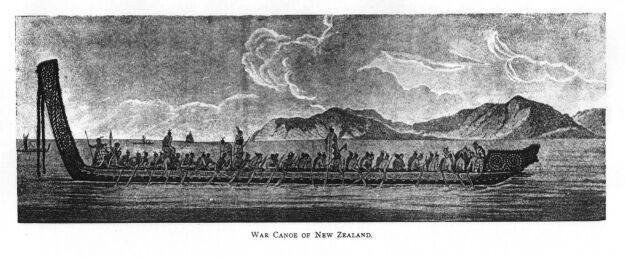
WAR CANOE OF NEW ZEALAND.
[New Zealand Canoes, Houses, etc.]
The people shew great ingenuity and good workmanship in the building and framing their boats or Canoes. They are long and Narrow, and shaped very much like a New England Whale boat. Their large Canoes are, I believe, built wholy for war, and will carry from 40 to 80 or 100 Men with their Arms, etc. I shall give the Dimensions of one which I measured that lay ashore at Tolago. Length 68 1/2 feet, breadth 5 feet, and Depths 3 1/2, the bottom sharp, inclining to a wedge, and was made of 3 pieces hollow'd out to about 2 Inches or an Inch and a half thick, and well fastned together with strong platting. Each side consisted of one Plank only, which was 63 feet long and 10 or 12 Inches broad, and about 1 1/4 Inch thick, and these were well fitted and lashed to the bottom part. There were a number of Thwarts laid a Cross and Lashed to each Gunwale as a strengthening to the boat. The head Ornament projected 5 or 6 feet without the body of the Boat, and was 4 feet high; the Stern Ornament was 14 feet high, about 2 feet broad, and about 1 1/2 inch thick; it was fixed upon the Stern of the Canoe like the Stern post of a Ship upon her Keel. The Ornaments of both head and Stern and the 2 side boards were of Carved Work, and, in my opinion, neither ill design'd nor executed. All their Canoes are built after this plan, and few are less than 20 feet long. Some of the small ones we have seen with Outriggers, but this is not Common. In their War Canoes they generally have a quantity of Birds' feathers hung in Strings, and tied about the Head and stern as Additional Ornament. They are as various in the heads of their Canoes as we are in those of our Shipping; but what is most Common is an odd Design'd Figure of a man, with as ugly a face as can be conceived, a very large Tongue sticking out of his Mouth, and Large white Eyes made of the Shells of Sea Ears. Their paddles are small, light, and neatly made; they hardly ever make use of sails, at least that we saw, and those they have are but ill contrived, being generally a piece of netting spread between 2 poles, which serve for both Masts and Yards.
The Houses of these People are better calculated for a Cold than a Hot Climate; they are built low, and in the form of an oblong square. The framing is of wood or small sticks, and the sides and Covering of thatch made of long Grass. The door is generally at one end, and no bigger than to admit of a man to Creep in and out; just within the door is the fire place, and over the door, or on one side, is a small hole to let out the Smoke. These houses are 20 or 30 feet long, others not above half as long; this depends upon the largeness of the Family they are to contain, for I believe few familys are without such a House as these, altho' they do not always live in them, especially in the summer season, when many of them live dispers'd up and down in little Temporary Hutts, that are not sufficient to shelter them from the weather.
The Tools which they work with in building their Canoes, Houses, etc., are adzes or Axes, some made of a hard black stone, and others of green Talk. They have Chiszels made of the same, but these are more commonly made of Human Bones. In working small work and carving I believe they use mostly peices of Jasper, breaking small pieces from a large Lump they have for that purpose; as soon as the small peice is blunted they throw it away and take another. To till or turn up the ground they have wooden spades (if I may so call them), made like stout pickets, with a piece of wood tied a Cross near the lower end, to put the foot upon to force them into the Ground. These Green Talk Axes that are whole and good they set much Value upon, and never would part with them for anything we could offer.* (* The weapons of greenstone, found in the South Islands, were much prized. This hard material required years to shape into a mere, or short club, and these were handed down from father to son as a most valuable possession.) I offer'd one day for one, One of the best Axes I had in the Ship, besides a number of Other things, but nothing would induce the owner to part with it; from this I infer'd that good ones were scarce among them.
Diversions and Musical instruments they have but few; the latter Consists of 2 or 3 sorts of Trumpets and a small Pipe or Whistle, and the former in singing and Dancing. Their songs are Harmonious enough, but very doleful to a European ear. In most of their dances they appear like mad men, Jumping and Stamping with their feet, making strange Contorsions with every part of the body, and a hideous noise at the same time; and if they happen to be in their Canoes they flourish with great Agility their Paddles, Pattoo Pattoos, various ways, in the doing of which, if there are ever so many boats and People, they all keep time and Motion together to a surprizing degree. It was in this manner that they work themselves to a proper Pitch of Courage before they used to attack us; and it was only from their after behaviour that we could tell whether they were in jest or in Earnest when they gave these Heivas, as they call them, of their own accord, especially at our first coming into a place. Their signs of Friendship is the waving the hand or a piece of Cloth, etc.
We were never able to learn with any degree of certainty in what manner they bury their dead; we were generally told that they put them in the ground; if so it must be in some secret or by place, for we never saw the least signs of a burying place in the whole Country.* (* The burying places were kept secret. The body was temporarily buried, and after some time exhumed; the bones were cleaned, and hidden in some cave or cleft in the rocks. As bones were used by enemies to make implements, it was a point to keep these depositories secret, to prevent such desecration.) Their Custom of mourning for a friend or relation is by cutting and Scarifying their bodys, particularly their Arms and breasts, in such a manner that the Scars remain indelible, and, I believe, have some signification such as to shew how near related the deceased was to them.
[Maori and Tahiti Words.]
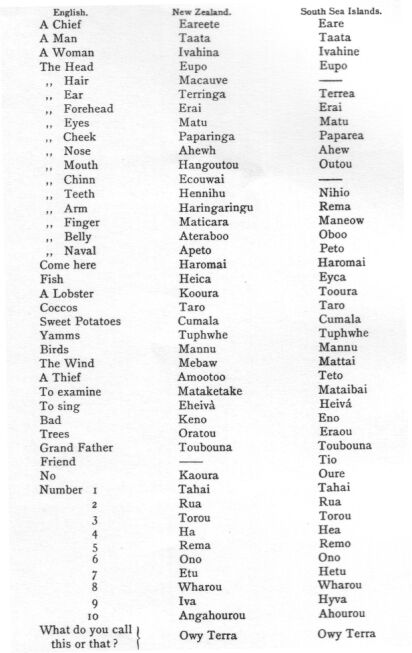
With respect to religion, I believe these people trouble themselves very little about it; they, however, believe that there is one Supream God, whom they call Tawney,* (* Probably Tane-mahuta, the creator of animal and vegetable life. The Maori does not pray.) and likewise a number of other inferior deities; but whether or no they worship or Pray to either one or the other we know not with any degree of certainty. It is reasonable to suppose that they do, and I believe it; yet I never saw the least Action or thing among them that tended to prove it. They have the same Notions of the Creation of the World, Mankind, etc., as the people of the South Sea Islands have; indeed, many of their notions and Customs are the very same. But nothing is so great a proof of their all having had one Source as their Language, which differ but in a very few words the one from the other, as will appear from the following specimens, which I had from Mr. Banks, who understands their Language as well, or better than, any one on board.
[Speculations on a Southern Continent.]
There are some small differance in the Language spoke by the Aeheinomoweans and those of Tovy Poenammu; but this differance seem'd to me to be only in the pronunciation, and is no more than what we find between one part of England and another. What is here inserted as a Specimen is that spoke by the People of Aeheinomouwe. What is meant by the South Sea Islands are those Islands we ourselves Touched at; but I gave it that title because we have always been told that the same Language is universally spoke by all the Islanders, and that this is a Sufficient proof that both they and the New Zelanders have had one Origin or Source, but where this is even time perhaps may never discover.
It certainly is neither to the Southward nor Eastward, for I cannot perswaide myself that ever they came from America; and as to a Southern Continent, I do not believe any such thing exist, unless in a high Latitude. But as the Contrary opinion hath for many Years prevail'd, and may yet prevail, it is necessary I should say something in support of mine more than what will be directly pointed out by the Track of this Ship in those Seas; for from that alone it will evidently appear that there is a large space extending quite to the Tropick in which we were not, or any other before us that we can ever learn for certain. In our route to the Northward, after doubling Cape Horn, when in the Latitude of 40 degrees, we were in the Longitude of 110 degrees; and in our return to the Southward, after leaving Ulietea, when in the same Latitude, we were in the Longitude of 145 degrees; the differance in this Latitude is 35 degrees of Longitude. In the Latitude of 30 degrees the differance of the 2 Tracks is 21 degrees, and that differance continues as low as 20 degrees; but a view of the Chart will best illustrate this.
Here is now room enough for the North Cape of the Southern Continent to extend to the Northward, even to a pretty low Latitude. But what foundation have we for such a supposition? None, that I know of, but this, that it must either be here or no where. Geographers have indeed laid down part of Quiros' discoveries in this Longitude, and have told us that he had these signs of a Continent, a part of which they have Actually laid down in the Maps; but by what Authority I know not. Quiros, in the Latitude of 25 or 26 degrees South, discover'd 2 Islands, which, I suppose, may lay between the Longitude of 130 and 140 degrees West. Dalrymple lays them down in 146 degrees West, and says that Quiros saw to the Southward very large hanging Clouds and a very thick Horizon, with other known signs of a Continent. Other accounts of their Voyage says not a word about this; but supposing this to be true, hanging Clouds and a thick Horizon are certainly no signs of a Continent--I have had many proofs to the Contrary in the Course of this Voyage; neither do I believe that Quiros looked upon such things as known signs of land, for if he had he certainly would have stood to the Southward, in order to have satisfied himself before he had gone to the Northward, for no man seems to have had discoveries more at heart than he had. Besides this, this was the ultimate object of his Voyage.* (* It is conjectured that what Quiros saw was Tahiti, but his track on this voyage is very vague. There are certainly no islands in the latitude given except Pitcairn.) If Quiros was in the Latitude of 26 degrees and Longitude 146 degrees West, then I am certain that no part of the Southern Continent can no where extend so far to the Northward as the above mentioned Latitude. But the Voyage which seems to thrust it farthest back in the Longitude I am speaking of, viz., between 130 and 150 degrees West, is that of Admiral Roggeween, a Dutchman, made in 1722, who, after leaving Juan Fernandes, went in search of Davis's Island; but not finding it, he ran 12 degrees more to the West, and in the Latitude of 28 1/2 degrees discover'd Easter Island. Dalrymple and some others have laid it down in 27 degrees South and 106 degrees 30 minutes West, and supposes it to be the same as Davis's Isle, which I think cannot be from the Circumstance of the Voyage; on the other hand Mr. Pingre, in his Treatise concerning the Transit of Venus, gives an extract of Roggeween's Voyage and a map of the South Seas, wherein he places Easter Island in the Latitude of 28 1/2 degrees South, and in the Longitude of 123 degrees West* (* Easter Island is in longitude 110 degrees West, and is considered identical with Davis' Island.) his reason for so doing may be seen at large in the said Treatise. He likewise lays down Roggeween's rout through those South Seas very different from any other Author I have seen; for after leaving Easter Island he makes him to steer South-West to the height of 34 degrees South, and afterwards West-North-West. If Roggeween really took this rout, then it is not probable that there is any Main land to the Northward of 35 degrees South. However, Mr. Dalrymple and some Geographers have laid down Roggeween's track very different from Mr. Pingre. From Easter Isle they have laid down his Track to the North-West, and afterwards very little different from that of La Maire; and this I think is not probable, that a man who, at his own request, was sent to discover the Southern Continent should take the same rout thro' these Seas as others had done before who had the same thing in View; by so doing he must be Morally certain of not finding what he was in search of, and of course must fail as they had done. Be this as it may, it is a point that cannot be clear'd up from the published accounts of the Voyage, which, so far from taking proper notice of their Longitude, have not even mentioned the Latitude of several of the Islands they discover'd, so that I find it impossible to lay down Roggeween's rout with the least degree of accuracy.* (* Roggeween's track is still unknown.)
But to return to our own Voyage, which must be allowed to have set aside the most, if not all, the Arguments and proofs that have been advanced by different Authors to prove that there must be a Southern Continent; I mean to the Northward of 40 degrees South, for what may lie to the Southward of that Latitude I know not. Certain it is that we saw no Visible signs of Land, according to my Opinion, neither in our rout to the Northward, Southward, or Westward, until a few days before we made the Coast of New Zeland. It is true we have often seen large flocks of Birds, but they were generally such as are always seen at a very great distance from land; we likewise saw frequently peices of Sea or Rock Weed, but how is one to know how far this may drive to Sea. I am told, and that from undoubted Authority, that there is Yearly thrown up upon the Coast of Ireland and Scotland a sort of Beans called Oxe Eyes, which are known to grow no where but in the West Indies; and yet these 2 places are not less than 1200 Leagues asunder. Was such things found floating upon the Water in the South Seas one would hardly be perswaided that one was even out of sight of Land, so apt are we to Catch at everything that may at least point out to us the favourite Object we are in persuit of; and yet experiance shews that we may be as far from it as ever.
Thus I have given my Opinion freely and without prejudice, not with any View to discourage any future attempts being made towards discovering the Southern Continent; on the Contrary, as I think this Voyage will evidently make it appear that there is left but a small space to the Northward of 40 degrees where the grand object can lay. I think it would be a great pity that this thing, which at times has been the Object of many Ages and Nations, should not now be wholy be clear'd up; which might very Easily be done in one Voyage without either much trouble or danger or fear of Miscarrying, as the Navigator would know where to go to look for it; but if, after all, no Continent was to be found, then he might turn his thoughts towards the discovery of those Multitude of Islands which, we are told, lay within the Tropical regions to the South of the Line, and this we have from very good Authority, as I have before hinted. This he will always have in his power; for, unless he be directed to search for the Southern lands in a high Latitude, he will not, as we were, be obliged to go farther to the Westward in the Latitude of 40 degrees than 140 or 145 degrees West, and therefore will always have it in his power to go to George's Island, where he will be sure of meeting with refreshments to recruit his people before he sets out upon the discovery of the Islands.* (* Cook carried out this programme in his second voyage, when he set at rest for ever the speculation regarding the Southern Continent.) But should it be thought proper to send a Ship out upon this Service while Tupia lives, and he to come out in her, in that case she would have a prodidgious Advantage over every ship that hath been upon discoveries in those Seas before; for by means of Tupia, supposing he did not accompany you himself, you would always get people to direct you from Island to Island, and would be sure of meeting with a friendly reception and refreshment at every Island you came to. This would enable the Navigator to make his discoveries the more perfect and Compleat; at least it would give him time so to do, for he would not be Obliged to hurry through those Seas thro' any apprehentions of wanting Provisions.
[Tupia's List of Islands.]
I shall now add a list of those Islands which Tupia and Several others have given us an account of, and Endeavour to point out the respective Situations from Otaheite, or George's Island; but this, with respect to many of them, cannot be depended upon. Those marked thus (*) Tupia himself has been at, and we have no reason to doubt his Veracity in this, by which it will appear that his Geographical knowledge of those Seas is pretty Extensive; and yet I must observe that before he came with us he hardly had an Idea of any land being larger than Otaheite.
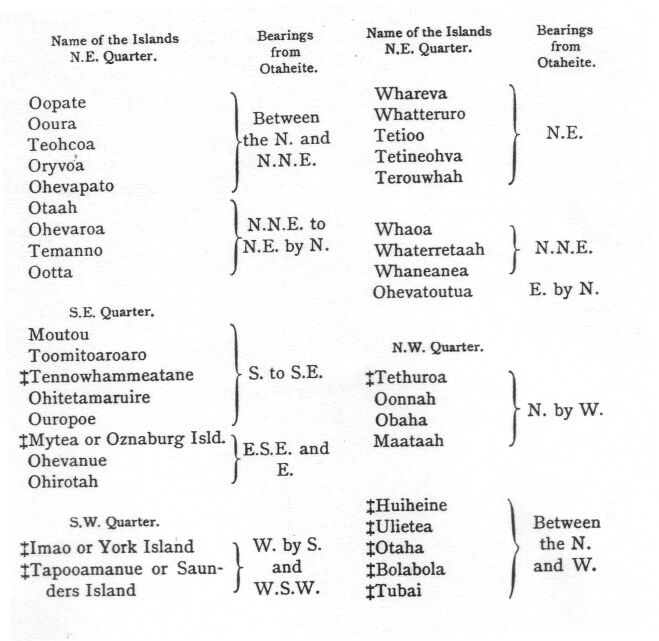
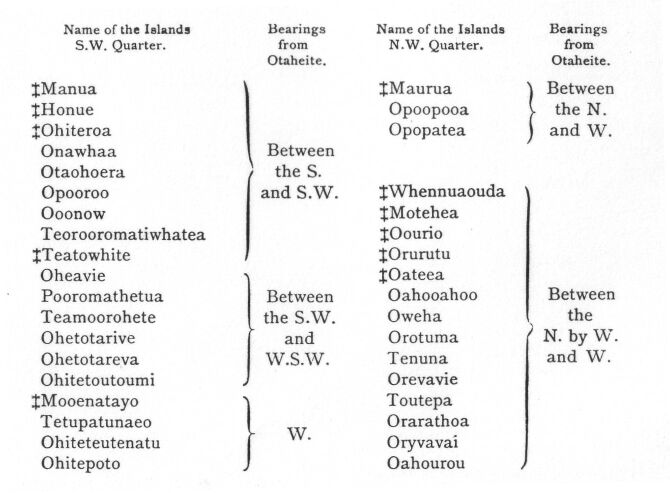
The above list* was taken from a Chart of the Islands drawn by Tupia's own hands. (* This list is hopeless. With the exception of the Society Group (Huiheine, and the names that follow), Imao (Eimeo), Tapooamanuo, Tethuroa, and Ohiteroa, all lying near Tahiti, none can be recognised. Those north and east are no doubt names of the Paumotu Group, low coral islands, disposed in rings round lagoons, whose innumerable names are very little known to this day, and very probably the Tahitians had their own names for them.) He at one time gave us an account of near 130 Islands, but in his Chart he laid down only 74; and this is about the number that some others of the Natives of Otaheite gave us an account of; but the account taken by and from different people differ sencibly one from another both in names and numbers. The first is owing to the want of rightly knowing how to pronounce the names of the Islands after them; but be this as it may, it is very certain that there are these number of Islands, and very Probably a great many more, laying some where in the Great South Sea, the greatest part of which have never been seen by any European.
[Historical Notes on New Zealand.]
NOTES ON NEW ZEALAND.
As already stated by Cook in the Journal, New Zealand was first discovered by Abel Tasman, a Dutch navigator, in the year 1642. Sailing from Tasmania, he sighted the northern part of the Middle island, and anchored a little east of Cape Farewell in Massacre (Golden) Bay, so called by him because the Maoris cut off one of his boats, and killed three of the crew.
Tasman never landed anywhere, but coasted from Massacre Bay along the western side of the North Island to the north point. He passed outside the Three Kings, and thence away into the Pacific, to discover the Friendly Group.
No European eye again sighted New Zealand until Cook circumnavigated and mapped the islands.
The warlike character of the natives is well shown in this Journal. On nearly every occasion they either made, or attempted to make, an attack, even on the ships, and in self-defence firearms had constantly to be used. Nevertheless, Cook's judgment enabled him to inaugurate friendly relations in most places where he stopped long enough to enable the natives to become acquainted with the strangers.
It was not so with other voyagers. De Surville, a Frenchman, who called at Doubtless Bay very shortly after Cook left it, destroyed a village, and carried off a chief. Marion de Fresne was, in 1772, in the Bay of Islands, killed by the natives, with sixteen of his people, and eaten, for violation of some of their customs, and illtreatment of some individuals.
Other outrages followed, committed on both sides, and it is no wonder that, though Cook represented the advantages of the island for colonization, it was not considered a desirable place in which to settle. The cannibalism of the Maoris especially made people shy of the country.
Intermittent communication took place between New Zealand and the new Colony of New South Wales, and at last, in 1814, Samuel Marsden, a clergyman of the Church of England, who had seen Maoris in New South Wales, landed in the Bay of Islands with other missionaries. This fearless and noble-minded man obtained the confidence of the Maoris, and a commencement of colonization was made.
It was not, however, until 1840 that the New Zealand Company was formed to definitely colonize. They made their station at Wellington.
In the same year Captain Hobson, R.N., was sent as Lieutenant-Governor. Landing first at the Bay of Islands, he transferred his headquarters to the Hauraki Gulf in September 1840, where he founded Auckland, which remained the capital until 1876, when the seat of Government was transferred to Wellington.
The North Island, in which all these occurrences took place, contained by far the greater number of the natives, and it seems strange now that the first efforts to settle were not made in the Middle Island, which has proved equally suitable for Europeans, and where the difficulties of settlement, from the existence of a less numerous native population, were not so great. It is not necessary here to follow the complicated history of New Zealand in later years, which unfortunately comprises several bloody wars with the Maoris.
The present prosperous condition of this great colony is well known, but it has not been effected without the rapid diminution of the natives, who have met with the fate of most aborigines in contact with Europeans, especially when the former were naturally bold and warlike.
The Maoris have retained the tradition of the original arrival of their race in a fleet of canoes from a country called Hawaiki, which is by some supposed to be Hawaii in the Sandwich Group. As we have seen, the language was practically the same as that of Tahiti, and there is no doubt that they came from some of the Polynesian islands. The date of the immigration is supposed to be the fifteenth century.
Each canoe's crew settled in different parts of the North Island, and were the founders of the different great tribes into which the New Zealanders were divided. The more celebrated canoes were the Arawa, Tainui, Aotea, Kuruhaupo, Takitumu, and others.
The Arawa claimed the first landing, and the principal idols came in her. One of these is now in the possession of Sir George Grey. A large tribe on the east coast still bears the name of Arawa, and her name, that of the Tainui, and other of the canoes, are now borne by some of the great steamships that run to New Zealand.
Cook, in the voyage with which we have to deal, completely examined the whole group. His pertinacity and determination to follow the whole coast is a fine instance of his thoroughness in exploration. No weather nor delay daunted him, and the accuracy with which he depicted the main features of the outline of the islands is far beyond any of the similar work of other voyagers. It is true that he missed in the south island many of the fine harbours that have played such an important part in the prosperity of the Colony; but when we consider the narrowness of their entrances, and the enormous extent of the coast line which he laid down in such a short time, this is not astonishing.
His observations on the natives and on the country display great acuteness of observation, and had the settlers displayed the same spirit of fair treatment and respect for the customs of the natives, much of the bloody warfare that has stained the annals of the Colony might have been averted; though it is scarcely possible that with such a high-spirited race the occupation of the islands, especially the North island, where the majority of the Maoris were, could have taken place without some disturbances.
New Zealand now contains 630,000 Europeans, and 41,000 Maoris. Its exports are valued at 10,000,000 pounds, and the imports at 6,250,000 pounds. There are 2000 miles of railways open. Such is the result of fifty years of colonization in a fertile and rich island, the climate of which may be described as that of a genial England.