CHAP. III. (continued 2)
Reading edition
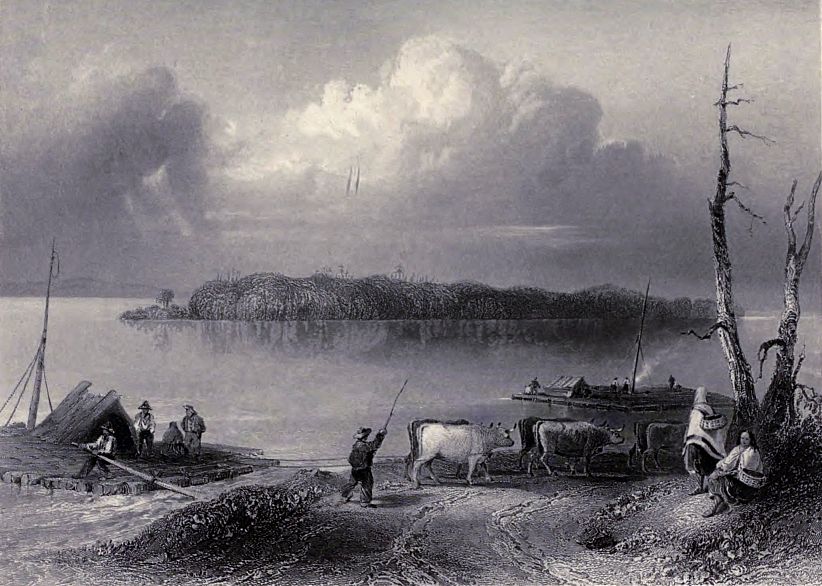
Navy Island (from the Canada side.)
Meantime, intelligence of the first insurrectionary movements reached Britain, where it excited the strongest sensation. A few of the popular leaders exulted in the event itself, and in the anticipation of its triumphant issue; but the nation, in general, by no means shared this sentiment. The Tories, though they accused government of having, by want of energy, prepared this convulsion, expressed their cordial concurrence in all the means suggested for its suppression. As the house was about to rise for the Christmas holidays, ministers proposed, that, instead of postponing their meeting, as usual, till the beginning of February, they should fix it for the 16th of January, when, according to the course of events, suitable resolutions might be adopted.
Parliament had no sooner reassembled, than information arrived, which left no room to doubt that the rebellion would be suppressed without having assumed any formidable character. The aims of the government were therefore directed towards reorganizing the executive on such a footing as, without suppressing Canadian liberty, might secure future tranquillity. But it was considered indispensable, for the present at least, to suspend the constitution of the lower province. A council was to be named by the Queen, which, with the governor, might exercise the functions now performed by the two legislative bodies; but their powers were not to last beyond the 1st of November, 1840, nor were any of their enactments, unless continued by the proper authority, to be valid beyond the 1st of November, 1842.
Sir John Colborne, then acting as provisional governor of Lower Canada, was instructed to carry these measures into immediate execution. The ministry, however, had determined upon a farther step, with a view to the ultimate settlement of the province. The Earl of Durham was solicited and prevailed upon to undertake its government, as well as that of all British America; and also to turn his attention towards an improved plan for its future management. His lordship’s high reputation as a statesman, and the liberality of his views on political subjects, seemed to afford a security that he would act with vigour, and at the same time with a strict regard to national freedom. He was empowered to form a species of representative council, composed of thirteen members from each province, but to use them merely as advisers, and to call and dismiss them at pleasure.
On the 29th of May, 1838, his lordship arrived at Quebec, where he was received in the most cordial manner, for all parties seemed to unite in expecting from him a settlement of those dissensions which had so greatly distracted the country. In his subsequent progress to other districts, and to Upper Canada, as far as Niagara, he met similar expressions of confidence and congratulation. He was soon, however, called to decide upon a delicate and difficult question, which Sir John Colborne had thought it expedient to reserve for his determination. Wolfred, Neilson, Bouchette, Viger, and other individuals of some distinction, were lying in the jail of Montreal, charged with high treason. Some strong punishment was necessary to mark their crime, and deter from its repetition; yet an impartial jury could not be expected for their trial, which besides would have reopened all those party animosities which it was the object of his lordship to appease. Under this view, he adopted the following course: the prisoners, having been induced to make a confession of guilt, were sentenced to be deported to Bermuda, and to be there kept in strict surveillance. If they should ever return to Canada, without leave from the governor, they were to suffer the penalty of death. The same was awarded to Papineau and others implicated in the late rebellion, but who, after its disastrous issue, had fled the country.
As soon as this ordinance was known in Britain, it created an unusual excitement in the legislature. Lord Brougham, in the House of Peers, made a motion, declaring it illegal, as condemning to death without trial, and to transportation to a colony which was not within the jurisdiction of the governor-general; but, under the peculiar circumstances of the case, he proposed a grant of indemnity. This vote, though strenuously opposed by Lord Melbourne, was carried in the Upper House by a considerable majority. Ministers then, having received from the law-officers of the crown an unfavourable report, at least as to the last particular, considered it impossible to make any farther resistance. They annulled the ordinance, but at the same time conveyed to Lord Durham expressions of their regret, of their general approbation of his measures, and of the unaltered confidence with which they regarded his administration.
His lordship, however, was not of a character to brook this interposition. He had, it is true, passed the limits of strict law; but he maintained that these were scarcely applicable in the critical and convulsed state of the province; that the sentence was lenient; and, on the principle of volenti nulla fit injuria, the parties concerned could not be wronged by a decision in which they had cheerfully acquiesced. In short, there being no substantial injustice inflicted, Lord Durham thought he had reason to complain that his scheme was not allowed a fair trial. He had, perhaps, an equal ground of dissatisfaction in reference to the hostile interference of the opposition lords, and more especially because the ministers, his employers, did not resist it to the utmost. Yet it would certainly have been more magnanimous on his part, had he endeavoured, under every discouragement, to have done his best to accomplish his undertaking. He yielded too far to passion and pride, when, even before receiving the official accounts, he publicly announced his intention of throwing up the administration. He did not even follow the established course, of requesting her Majesty’s permission to resign, and waiting till he received it. In announcing, too, the disallowance of the ordinance, he commented on the decision with a severity which was considered irregular, and tending to compromise the royal authority. On the 1st of November his lordship set sail from Quebec, and on the 26th arrived at Plymouth.
Meantime, a fresh storm of rebellion brooded over the province. In the course of the summer, even amid apparent quiet, the burning of a steam-vessel, called the Sir Robert Peel, in the St. Lawrence, and the acquittal of the murderers of Chartraud in the face of the clearest evidence, showed that the spirit of disaffection was still deeply cherished. By the beginning of winter, arrangements had been made for a general rising of the habitans, supported by a numerous body of American citizens, who, under the title of sympathizers, had vehemently espoused their cause. Arms and ammunition had been clandestinely introduced; and a species of association, bound by secret oaths and signs, had been formed along the whole frontier. Lord Durham imputes this movement to the proceedings at home, which had shaken the confidence in his authority, and raised the hopes of the disaffected; but Sir John Colborne considers that those preparations had been actively pursued ever since the preceding June. The government of the United States, though they had no adequate power to prevent the part taken by their subjects, showed a good disposition, by giving the first intimation of what was going on to Mr. Fox, the British ambassador at Washington. The tidings were soon confirmed from other quarters; and Sir John Colborne lost no time in putting the province in a state of defence, and procuring an additional force from Nova Scotia.
On the night of the 3d of November, a concerted rising took place in all the southern counties of Montreal District; but, owing to some failure of arrangement, the stations along the Richelieu were not found supplied with arms according to appointment, so that most of the inhabitants there dispersed and returned to their homes. The chief seat of insurrection was now farther west, between that river and the St. Lawrence. There three arch-rebels, Dr. Robert Nelson, Côte, and Gagnon, had collected about 4,000 men, and established their head-quarters at Napierville. Their first object was to open a communication with their friends in the States, for which purpose 400 men were detached to the frontier. There a body of British volunteers, as brave as loyal, had stationed themselves, by whom the rebels were attacked, and obliged to retreat with great loss. To retrieve this disaster, Dr. Nelson, with upwards of 900 men, marched against the loyalists. The latter, only 200 strong, took post in Odelltown chapel, on which the enemy commenced a brisk attack; but, after two hours and a half, were obliged to retreat, with the loss of one hundred killed and wounded. The defenders had an officer and five men killed, and nine wounded.
Meantime, Major-General Sir James McDonnell, under orders from the governor, with seven regiments of the line, crossed the St. Lawrence, and marched upon Napierville. The rebels, discouraged by former losses, after a vain attempt to unite their forces, dispersed in every direction without firing a shot. They still retained a post at Beauharnois; but Col. Carmichael, with a detachment of regulars, and 1,000 Glengary militia, drove them out, though with the loss of two men killed and the same number wounded. Mr. Ellice, and a party of friends, who had been made prisoners by them at the outset, were allowed to return to Montreal. On the 11th, a week only after the first movement, McDonnell could announce that the insurrection was completely at an end, without the rebels having been able to open any communication with their supporters beyond the frontier.
We must now turn to Upper Canada, where, even before the former outbreak, Sir Francis Head had resigned. The immediate cause was the disapprobation expressed by Lord Glenelg for his removing Judge Ridout, on account of his democratical principles, and his refusing to obey an order to raise to the bench Mr. Bidwell, late speaker of the Assembly, and an opposition leader. He at the same time, in no measured terms, condemned the system of conciliation hitherto pursued in the Colonial Office, whose members he even branded as republicans; insisting that a stern uncompromising maintenance of the monarchical principle, and the exclusion from office of all opposed to it, was the only basis on which Canada could be governed. Ministers unwillingly accepted his resignation; while the loyal inhabitants, among whom he had rendered himself highly popular, expressed on the occasion deep regret and disgust. Col. Sir George Arthur, who had previously held a similar situation in Van Dieman’s Land, was appointed to succeed him.
The new governor soon found himself involved in difficult circumstances; for, early in June, bands to the number of 1,000 or 1,200 Americans crossed the Niagara channel, and endeavoured to excite the people to insurrection. They attacked a party of fourteen lancers posted in an inn, and, by setting it on fire, obliged them to surrender. But no sooner did they learn that Sir George had arrived at Niagara, and that the country was rising against them, than they hastily recrossed the frontier, leaving about forty prisoners, among whom were Morrow and Waite, the first and second in command. In the end of June, a smaller party passed the St. Clair, and invaded the Western District; but finding themselves unsupported, and the militia advancing, they returned, after losing a few of their number, who fell into the hands of the pursuers.
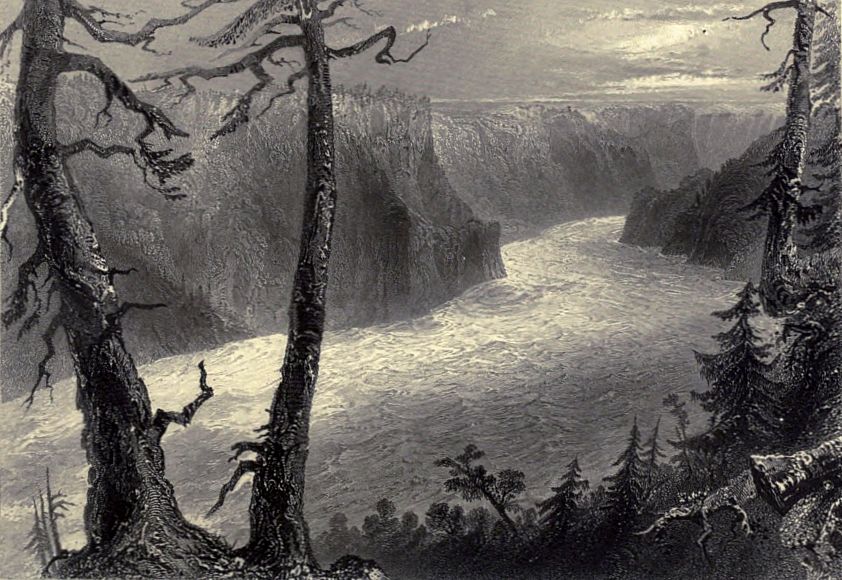
The Banks of the River Niagara (below the falls.)
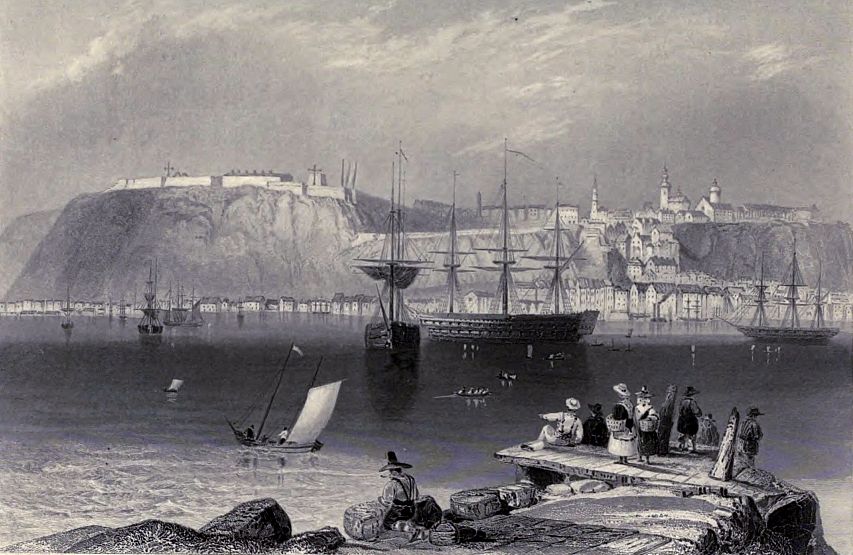
Quebec.
The summer now passed in comparative quietness, though the great movement at the beginning of November continued to be deeply felt along the upper frontier. Almost simultaneously with the rising in Montreal District, a body of about 400 sailed from the vicinity of Sackett’s Harbour, and landed at Prescott. On the 13th, Col. Young, with what force he could muster, and aided by Capt. Sandom, with an armed steamer, compelled a large proportion of them to disperse, while the rest took refuge in a windmill and an adjacent house built of stone, whence they could not be dislodged. Eighteen British were here killed and wounded. In the course of the day, Colonel Dundas arrived with four companies from Kingston, but considered the buildings, the walls of which were three or four feet thick, too strong to be reduced without cannon. A few guns and some additional troops being brought up, an attack was commenced on the 16th, when the party within the stone building, after some stand, sought to escape among the brushwood, but were all captured; upon which those in the mill displayed a white flag, and surrendered at discretion. The whole number of prisoners was 159. The militia, among whom some lukewarmness had been suspected, showed the utmost zeal, and mustered to the extent of 5,000.
The Niagara frontier was found by the enemy so well guarded, that no attempt was made there. But early in the morning of the 4th of December, about 350 organized at Detroit landed near Sandwich, set fire to a steamer and to the barracks, and killed several individuals in cold blood. Being as cowardly as cruel, they were no sooner attacked by a party of militia, than they fled either to the woods or to the American shore, leaving twenty-six killed and twenty-five prisoners.
The captives, on the former occasion, had been treated with extraordinary lenity; but this forbearance not having produced its due effect, and being loudly complained of by the inhabitants, it was judged necessary to exercise greater rigour on the present occasion. A considerable number of the ringleaders were accordingly put to death, and the rest condemned to severe or ignominious punishments.
[4] I extract the chief part of this resumée of Canadian history from the very clever work before mentioned, written for the Edinburgh Cabinet Library, by Hugh Murray, Esq. F.R.S.E. It is on the whole the best work on the subject that I can find, though, as the reader will doubtless see, it is written with a very strong national bias. With the reserve of my own opinion as to his colouring, I take the liberty to make use of the statements of Mr. Murray with little alteration, quite sure that no where else is to be found so able and enlarged a view of the period of history in question.