CANADIAN SCENERY. (continued 2)
Reading edition
A temporary interval of wild licence, of emancipation from all the restraints of dignity and decorum, seems to afford an enjoyment highly prized in all rude societies. Corresponding with the saturnalia and bacchanals of antiquity, the Americans have their festival of dreams, which during fifteen days enlivens the inaction of the coldest season. Laying aside all their usual order and gravity, they run about, frightfully disguised, and committing every imaginable extravagance. He who meets another, demands an explanation of his visions, and if not satisfied, imposes some fantastic penalty. He throws upon him cold water, hot ashes, or filth; sometimes rushing into his cabin he breaks and destroys the furniture. Although everything appears wild and unpremeditated, it is alleged that opportunities are often taken to give vent to old and secret resentments. The period having elapsed, a feast is given, order is restored, and the damages done are carefully repaired.
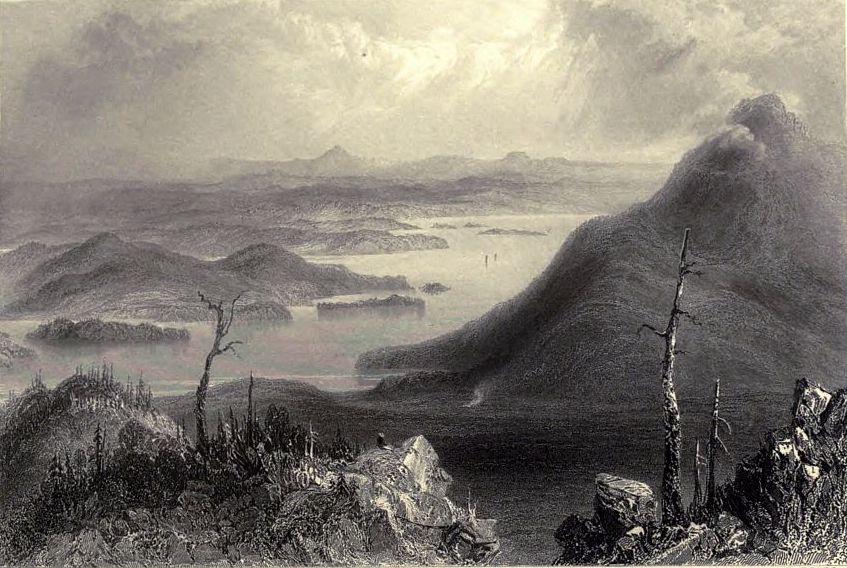
View across the Boundary Line, from the Sugar Loaf.
On the first settlement of Europeans in Canada, that territory was chiefly divided between three great nations,—the Algonquins, the Hurons, and the Iroquois or Five Nations. The first held an extensive domain along the northern bank of the St. Lawrence, about a hundred leagues above Trois-Rivières. Shortly before, they had been the most powerful of all these tribes, and considered even in some degree as masters over this part of America. They are described also as having the mildest aspect, and most polished manners of any. They subsisted entirely by hunting, and looked with proud disdain on their neighbours who consented to bestow on the soil even the smallest cultivation. The Hurons were a numerous people, whose very extensive territory reached from the Algonquin frontier to the borders of the great lake bearing their name. They were also more industrious, and derived an abundant subsistence from the fine territory of Upper Canada. But they were at the same time more effeminate and voluptuous, and had less of the proud independence of savage life, having chiefs hereditary in the female line, to whom they paid considerable deference.
The Iroquois, destined to act the most conspicuous part among all the native tribes, occupied a long range of territory on the southern border of the St. Lawrence, from Lake Champlain to the western extremity of Lake Ontario. They were thus beyond the limits of what is now considered Canada; yet, as all their transactions were completely connected with the interests of that country, we cannot at present avoid considering them as belonging to it.
This people were divided into five cantons, each of which was considered as an independant nation. They were united, however, by the closest alliance; are never found waging war with each other, nor did they often fail to combine their forces when attacked by neighbouring tribes. The following are the names given to them by English and French authors.
ENGLISH.FRENCH.
Mohawks.Aguiers.
Oneidas.Onneyouths.
Onondagoes.Onontagues.
Cayugas.Anniegué.
Senekas.Tsonnouthouans.
We add to these general remarks on the habits and character of the natives of North America, a few anecdotes which were collected by a distinguished soldier in Canada, and which we copy literally from his MS. The first is a legend of the Falls of Shawenagam, river St. Maurice.
Shortly after the Hurons established themselves in the part of the Lower Province to the N. E. of the St. Maurice, that rapid river was fixed as the boundary between this nation and the Algonquins. In one of the many fierce rencontres that took place between these two warlike tribes, the following circumstance occurred, too descriptive of the Indian character to pass unnoticed. A party of Hurons had been hunting on the shores of the St. Maurice, and were returning in loaded canoes down the stream, when, on approaching the head of these falls, they suddenly heard a signal, and on looking up descried a large party of Algonquins half hidden among the thick foliage in the tops of trees. The Hurons had advanced too far to recede; to pull back against the stream was totally impossible, and to land at the head of the falls was only throwing themselves into the hands of the host of enemies waiting to bear their scalps in triumph to their nation. The mind, like the eye, of an Indian is quick and determined. The chieftain in the leading canoe cast one hurried glance on his enemies, and setting up a yell of defiance, steered his frail bark to the edge of the foaming precipice: in this resolute action he was followed by his people, and the whole party were hurried down the dreadful abyss mingled in one mass of wreck and destruction. Scarcely a vestige of these brave men was washed ashore to gratify the vengeance of the disappointed Algonquins.
Tête-de-Bules.—The Indians frequenting the Fur Post of Wemontashingur in the St. Maurice, latitude 47° 55' 58" N. are not numerous, and generally speaking are a very inoffensive people, although some actions of a horrid nature, committed by individuals of the tribe, have come to our knowledge. They are ignorant and superstitious, influenced in all their actions by dreams, which they imagine are sent to them for a good purpose by the Great Spirit: under this cloak they oftentimes commit great barbarities. They are likewise much addicted to ardent spirits.
That cannibalism is occasionally practised to a great extent among the aborigines inhabiting these dreary regions, the many accounts which have reached our ears would lead us to believe; but as these things are generally exaggerated, we know not what degree of credence they deserve. Among the anecdotes of this nature related to us, are the following, which, if true, show to what a degraded state of mind these miserable people are reduced. An Indian Montagnier, whose name is Mocontagan, or Crooked Knife, in a drunken fit confessed having in the course of his life killed and eaten several Indians and Metifs, or half-breeds. When sober, he attempted to deny it; but upon being closely pressed he acknowledged the fact, but said starvation drove him to kill and eat the first man, and that he slew and ate the others from a decided preference of that to any other kind of flesh; and finished his statement by declaring that he would kill any Metif, and eat him, that he should meet alone. He is much feared by the other Indians, who are inclined to believe him to be an evil spirit. He is described as a powerful man, six feet high, and strong built, and possessing what is termed “a bad countenance.” Upon one occasion, about six years since, at Wemontashingur, the Algonquins took courage and rose upon him: he fled for protection to Mr. Hyslop, the resident clerk of the Post, who with Mr. Le Blanc, now at Rat River, advised him to leave the place, as they could not be answerable for his life. This man is still living, much dreaded by the Indians frequenting the St. Maurice.
Another instance was related to us by Mr. Vassal, belonging to the King’s Post company. One day, during the winter, as he was travelling among the mountains, he saw an Indian stretched on the snow. Vassal approached him, and demanded what was the matter. The Indian replied he was sick, doubtless imagining Vassal would be alarmed by the thoughts of fever, and quit the place without entering the cabin: but Vassal, anxious to collect furs, attempted to go in, the Indian pulled him back by the leg; Vassal made another attempt, and succeeded in entering. A fire was burning, and a large kettle was on it, which, to his horror, he found contained a portion of a very young child. The savage acknowledged that it was his grandson, and that hunger had driven him to eat it. This, Vassal says, could not be possible, as there were remains of musk-rats about the place.
With respect to “bad dreams,” there is a Tête-de-Bule belonging to Wemontashingur at present labouring under the delusion. He imagines he shall fail in every undertaking until he has slain some person; and once he actually fired at his brother, but fortunately missed him. He is much feared by the tribe, as they imagine him possessed of an evil spirit, which will not depart until he has spilt blood.
The Indians navigating the St. Maurice have a notion that in a large cavern at the back of the Upper Caribonif Mountain, are a species of wood demons, and that when encamped near the place, they can distinctly hear the screams of children, but where the children come from in these desolate and unpeopled regions, our informant could not tell. The place is certainly very gloomy, but it being our encamping time, we made ourselves comfortable for the night in spite of the wood demons. Before morning, we ascertained the screams of the children to be the hooting and screeching of the owls and night hawks, so numerous in this part of the country.
In one of the deep bays of Lake Kempt, we saw three Indian graves, built in the usual long narrow shape adopted by the Indians, and well defended from wild beasts by an outer covering of split wood, bound together with branches. Within this outer mausoleum was one made of birch bark, and under this rested the body, covered over with the fine white sand forming the shores of the Lake. Opposite one of the graves was a cross. From the information we received, it appears that one of these graves belonged to Menesino’s mother, the second contained the body of his wife, and the third that of his infant child.
We were assured that the mother met with her death from the hands of her daughter, in a quarrel which took place a few years since in one of the sandy bays of Lake Malawin. The wife was slain by Menesino in a fit of jealousy, by striking his axe between her shoulders while she was in the act of stooping. How the infant came to its end, we did not hear. This man Menesino also slew another wife, and shot a Canadian who went to take him. For these murders, and others of which he was accused, Menesino was once taken and conveyed handcuffed to within a short distance of Three-Rivers. His guards being excessively fatigued, fell asleep, which Menesino took advantage of, and plunged into the river. In spite of his handcuffs he succeeded in gaining the opposite shore, whence crossing many large lakes,—God knows how,—and travelling a vast extent of forest covered with thick underwood, he regained his own country, and has never since been taken. Indeed, he is such a powerful man, and in the prime of life, that few would like to make the attempt, although we have since heard that a party are in pursuit of him. He is said to possess unbounded influence, occasioned by fear, over the male part of his tribe; but the female part, as may easily be supposed, have a great repugnance to living with him.
M. Le Blanc, when at Wemontashingur, was compelled to stand all night over an Indian woman whom Menesino wanted to carry off with him into the woods. He is described as a good looking man, and, what is unusual among the Indians, not at all addicted to ardent spirits. From all we heard, it would appear that he is constantly on his guard, fearful of some stratagem; living entirely alone, the sole inhabitant of these dreary waters.
On arriving at the point of the graves in Lake Nemeashingur, we landed to examine them. They were three in number, and similar in construction to those we had seen on Lake Kempt, except that they were more ornamented according to the pagan rites of Indians. Near the principal grave was a pile of wood, a paddle, snow shoes, and a snow shovel, for the use of the departed during his journey to the hunting grounds in the next world. In addition to these articles, on one of the mausoleums was a sword, the emblem of a chieftain. At the foot of this grave was a rude wooden cross. We had an opportunity of becoming acquainted with the history of the parties who were buried here, of which the following is a slight sketch:—
Near the graves are the remains of a log-hut, which had been erected as a temporary receiving place for furs, until a sufficient quantity had been collected to send into the Post at Wemontashingur. This hut was in charge of a man named Tefu, a Bois-Brulé, who was married to a woman belonging to the tribe inhabiting the lake of the two mountains. One day in the year 1816, while Tefu was absent, a brother of Menesino named Kenecabannishcum, accompanied by his wife and mother, went to the hut and demanded of Tefu’s wife some provisions, which she refused. He insisted upon having some, a scuffle ensued, and the villain shot the woman dead upon the spot. They then departed, taking with them a young boy who was living with Tefu. The mother observed, that if the boy met any of the half-breeds who were in the habit of going round to collect furs, he would certainly tell them, in French, of the murder. Kenecabannishcum replied, he would soon settle that, and steered his canoe to the rocky point of an island directly opposite. On his arrival at the point, the ruffian seized the child by his legs, and dashed his brains out against the rock. The murderer’s mother returned to the hut and buried the body of the unfortunate infant. This is the woman who afterwards met her death on Lake Malawin from the hands of her daughter-in-law, and lies buried on Lake Kempt. Some time after the murders had been committed, a quarrel ensued between Kenecabannishcum and his wife and mother; in consequence of this, the two women repaired to the cabin of the wife’s father, a chieftain named Meshenawash, and acquainted him with the crimes of her husband: when this reached the murderer’s ears he vowed vengeance against the old chieftain, who consequently was compelled to secrete himself until the day of his death, which took place a short time after, for he was no match for such a powerful man as his son-in-law. The grave with the sword upon it was this chieftain’s.
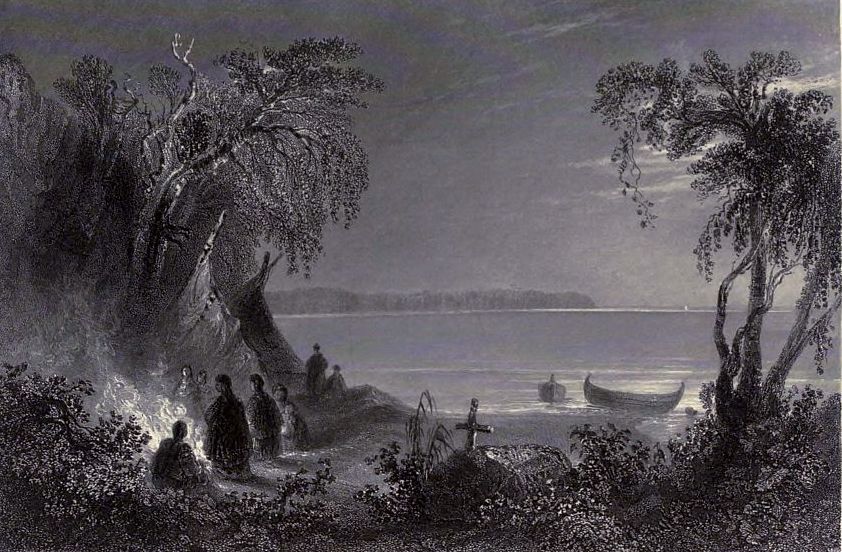
The Squaw’s Grave (Ottawa River.)
In the year 1824, this man came to his end in the following manner. An Algonquin, named Michel, was married to a very handsome woman, whom Kenecabannishcum endeavoured more than once to carry off by force. In the scuffles which ensued, Michel, who was not possessed with the strength of his opponent, was glad to make his escape, and in one instance, he was obliged to swim across a rapid stream, and dive repeatedly to avoid being shot. In the last encounter, which took place in the year above mentioned, each man was armed with an axe, when a fierce conflict ensued. Michel by a lucky blow struck off the nose of his adversary, and the next stroke took off his ear. These wounds so bewildered Kenecabannishcum, that he lost all presence of mind, and before he could recover, Michel struck his axe so deep into his enemy’s skull, that he was under the necessity of placing his foot on the neck of the fallen man to withdraw it. Thus fell this noted character: his body was buried by his brother Menesino on the point near the log-hut, close by his father-in-law and the infant whom he had murdered eight years before in cold blood. The body of Tefu’s wife was never found. Michel was obliged to fly that part of the country, fearful of the vengeance of Menesino, and is now resident at the post on Lac des Sables.
[1] We have to acknowledge our obligations for most valuable information in the following pages, first, to our distinguished friend Col. Cockburn, of the Royal Artillery, long resident in Canada; next, to Hugh Murray, Esq., F.R.S.E. for extracts from his most admirable work on that country; to the Author of “Backwoods of America,” and to many writers, both old and modern, including Charlevoix, Adair, Colden, La Potherie, Rogers, Champlain, Heriot, McGregor, Raynal, Talbot, Hall, and others. From the inconvenience of making these acknowledgments in every instance, we return our thanks simply in this note, and embody the information simply as it comes, without further mark or comment.