Chapter II · THE COLLEGES
Reading edition
The university and the colleges—the collegiate system—eras of college building—Peterhouse—Michaelhouse—collegium and aula—Clare—college statutes—architectural scheme of a college—Pembroke—founders of colleges—Gonville—Trinity Hall—Corpus Christi—Cambridge in 1353—Chaucer at Cambridge—the schools, library, the university printers and the Pitt Press, the senate house—King’s—King’s College chapel—Cambridge college chapels—Queens’—English sovereigns at Cambridge—S. Catherine’s—Jesus—Christ’s—Lady Margaret and Bishop Fisher—S. John’s—Magdalene—King’s Hall and Trinity College—college libraries—gateways—Caius—monks in Cambridge—Emmanuel—Sidney Sussex—Downing—public hostels—nationality of founders and general scope of their foundations—university and college revenues.
THE college is an endowed foundation providing for the residence and maintenance of teachers—masters or graduates, and for the free education of a certain number of poor scholars, to whose company are added, according to the capacity of the building, other students who are able to live at their own charges.
Relation of the college to the university.
Much has been said about the relation of the college to the university. By some it is supposed that the latter is nothing but the aggregate of the former; that somewhere in the time of the Georges “the university” arrogated to itself a separate existence, and that since that time university offices have taken precedence of collegiate offices.[97] The universitas, the corporation of scholars, must and did precede any college foundation: at the same time we cannot distinguish the development of either of our universities from the rise of these foundations, whose history has, ever since, been the history of the academic society. Each college is independent and autonomous, and though the aggregate of colleges does not constitute the university, each collegiate foundation forms part and parcel of it in virtue of its union with the incorporated society of Chancellor Masters and Scholars which formed at first and still forms “the university.”
The college the distinguishing characteristic of Cambridge and Oxford
It is the collegiate system which distinguishes the English universities from all others. Everywhere else in Europe students live in their own private lodgings and have complete control of their lives, subject to no supervision whatever; the university has no rights over them and no means of ensuring their good behaviour during the period in which they choose to attend its lectures. In many parts of Europe the student passes from a school curriculum in which he has been treated as a complete dependent, on whose sense of common fairplay and honour, even, no reliance can be placed, to a curriculum in which he at once becomes his own absolute master. English instinct is against this—against abandoning a young man at a critical moment of his life to his own devices, his own unsupported endeavours, as it is against ruling him by a system of espionage in his school days. It is in favour in both cases of the moral support to be found in an external guarantee for order, orderliness—and of a tacit assistance to good instincts, a tacit resistance to bad; and the result is the university college.
The origin of the college system.
The result, as we say, is an English result, and is the development of a scheme to which shape was first given by Walter de Merton, Chancellor of England and afterwards Bishop of Rochester, and Hugh de Balsham Bishop and formerly subprior of Ely, in the reign of Henry III.[98] An endowed house and college statutes formed part of this fine academic scheme, which, in all its amplitude and completeness, sprang Athena-like from the brain of Walter de Merton, and was destined from the first to be realised in a university. It must, nevertheless, be clearly borne in mind that the original college dwellings—and the college statutes—were designed for adult scholars, they were, in fact, the earliest training colleges for teachers, and it is only later that their advantages were extended in equal measure to the taught.[99]
The era of college building.
College building began in the xiii century and ended with the xvith. The first great period of building, however, belongs to the second quarter of the xiv century, and no less than seven colleges and halls were founded between the years 1324 and 1352. Ninety years elapsed before the second period, which began with the foundation of King’s College in 1441 and ended with the foundation of S. John’s in 1509. The third and last period opened a hundred years after the foundation of King’s and closed with the foundation of the first Protestant colleges fifty years later (1595):
First period.Second period. Third period.
Peterhouse 1284
(28 years) Michaelhouse 1324 Clare 1326-38 King’s Hall 1337 Pembroke 1347 Gonville Hall 1348 Trinity Hall 1350 Corpus Christi 1352 (68 years) King’s College 1441 Queens’ 1448 S. Catherine’s 1473 Jesus 1495 Christ’s 1505 S. John’s 1509 (50 years) Magdalene 1542 Trinity 1546 (Caius 1557) Emmanuel 1584 Sidney Sussex 1595
There were therefore 8 colleges in Cambridge by the middle of the xiv century; when the xvi century opened there were 14, and at its close 12 of the previous buildings remained and 4 new had been added. Downing College (built 1805) must be added to these, making at the present day a total of 17 colleges.
Peterhouse.
Peterhouse was founded by Hugh de Balsham[100] for his Ely scholars whom he had in vain attempted to unite, with a separate endowment of their own, under the same roof as the canons of S. John’s Hospital.[101] In 1284 he removed the Ely clerks to two hostels by S. Peter’s church at the other end of the town, and at his death two years later left three hundred marks for the erection of a hall. This was built in 1290 on the south-west and formed with the scholars’ chambers the only collegiate building at Peterhouse till the close of the xiv century. Here then were the primitive elements of a college; the hostel or scholars’ lodging house to which was added a common meeting and dining room, or hall. The little parish church of S. Peter served for prayers and gave its name to the college. College chapels were not built till considerably later: the example first given by Pembroke College in the next century not being followed for another hundred years. The quadrangle was not begun till 1424. A combination room[102] opening out from the hall, and a library, were added along the south side. Over the former was the master’s room, over the latter the students’ quarters; and all looked upon the ancient lawn, the meadow with its elms beyond and, stretching to the right, with its water gate, Coe fen.
Ye brown, o’er-arching groves, That contemplation loves, Where willowy Camus lingers with delight! Oft at the blush of dawn I trod your level lawn . . . . . . . . . . With Freedom by my side, and soft-eyed Melancholy.[103]
PETERHOUSE FROM THE STREET The Tower of the Congregational Church in the distance.

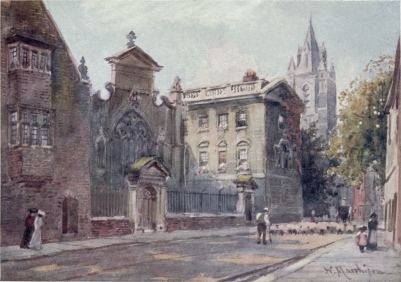
Hostels and church, facing the Trumpington road, were just without Trumpington gate. In 1309 the college area was extended southwards, over the ground occupied by Jesu hostel.[104] The property of the Gilbertine canons was added in the xvi century. The college area covers the space between Trumpington Street and Coe fen, and Little S. Mary’s church and Scroope Terrace; two-thirds of the site of the Fitzwilliam Museum being ground purchased from Peterhouse. The new Gisborne building (1825) is built on the west beyond the hall. The frontage of Peterhouse on Trumpington Street is unpromising; nothing suggests the charm of the buildings on the south side or the open country beyond, stored with historical memories. From the hall, a site unrivalled in the university, opens the panelled combination room,[105] the “Good Women” of Chaucer limned in one of its bays, recalling
The chambres and parlers of a sorte With bay windowes
described by the poet’s contemporary.
Above the xvi century library (of which Balsham’s own books were the nucleus, enriched by Whittlesey, Bottlesham, Arundel, Warkworth, Gray, Perne, and Cosin)[106] a charming corner room in the students’ quarters has been set apart by the present Master for evening study, a veritable solarium where the readers are surrounded by the portraits of the great sons of Peterhouse.
The chapel A.D. 1628.
Old S. Peter’s church was perhaps burnt down in 1338-1340 by a fire which is supposed to have also destroyed the chapel of S. Edmund. On its site rose the present church of Little S. Mary.[107] But in the early xvii century a movement was set afoot at Peterhouse which resulted in the erection of a college chapel. It now stands in the midst of the college buildings, and one of the two ancient hostels, “the little ostle,” was demolished to provide a site. Matthew Wren, uncle of Sir Christopher and then Master of the college, afterwards Bishop of Ely, was the builder. The desire of the fellows of Peterhouse for a chapel of their own coincided with the movement in the English Church for an elaborate ritual. As it stands it is a perfect specimen of a xvii century chapel, with its dark oak stalls, and its east window spared from Commonwealth marauders by the expedient of removing the glass piece by piece and hiding it till the
PETERHOUSE—THE FIRST COURT The entrance to the chapel faces the spectator. On the right is seen the Combination Room (1460) and the Hall. Through the Cloisters we get a view into the street. This is the oldest college in Cambridge.
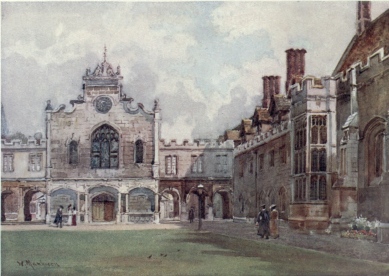
iconoclastic fever had spent itself. But still we have only the shell of the original chapel, the roof of which was adorned with figures of a hundred and fifty angels the statue of S. Peter presiding from the west. Nine years later all this was pulled down by the Commonwealth men and the ritualist movement it embodied came to an end.[108]
Hall portraits.
Peterhouse hall, in common with the halls of all other colleges, contains the portraits of its great men: here, however, they look down upon us not only from the wall above the high table but from the stained glass of the windows. Holbroke Master of the college, chancellor of the university during the Barnwell process, and an early student of science; Cardinal Beaufort scholar of the house who represented Henry V. at the Council of Constance, and was himself, perhaps, papabile; Warkworth writing his Lancastrian Chronicle—are in their doctor’s scarlet: here also are Whitgift, Cosin, and Crashaw, who is depicted as a canon of Loreto; the poet Gray, the third duke of Grafton chancellor of the university and Prime Minister, and Henry Cavendish the physicist. The panel portraits were removed here from the Stone parlour. The painting of Bishop Law by Romney (?) reminds us that many of the Laws were at Peterhouse, including the first Lord Ellenborough. Over the high table is Lord Kelvin the latest famous son of the house. Among these must also be noted Thomas Heywood “a prose Shakspeare,” Hutchinson “the regicide” one of the first Puritan gentlemen and one of the best, Peter Baro, Markland the classical critic, and Sherlock who measured himself against Bossuet.
Peterhouse owes nothing to royal endowments but it has not lived outside the stir of national movements either political or religious. There were fervent Lancastrians within its walls in the xv century, fervent partisans of the Stuarts in the xviith. It was, second to none in England, the anti-Puritan college, numbering among its masters Wren and Cosin, and that Doctor Andrew Perne who was among its most munificent benefactors.[109] Perne was a Petrean first and a theologian afterwards, and, as vice-chancellor, was to be found burning the remains of Martin Bucer and Paul Fagius[110] in order to ingratiate the university with Mary, and signing the Thirty-nine Articles on the accession of Elizabeth. The letters AP AP on the weather cock of his college are said to mean: Andrew Perne, “a Papist” or “a Protestant,” as you will; and in Cantabrigian language a coat that has been turned is a coat that has been perned, and pernare signifies to change your opinions with frequency.
Since the xvii century Peterhouse has been connected with no great movements. In the xv century and again in the early xixth it produced eminent physical and mathematical students; and in the xviii century Sir William Browne, President of the College of Physicians, learnt here his science. Scotchmen have a predilection for the college; and a nucleus of history men is being formed under the present Master’s guidance.
Little S. Mary’s.
The patronage of the historical church which was for three or four centuries the chapel of Peterhouse remains in the hands of the college. It is indeed an integral part of Peterhouse for every Petrean. But its interest does not end here; it reaches across the Atlantic and binds the new continent to the home-hearth of learning in England. A monument in the chapel to Godfrey Washington who died in 1729 bears the arms argent two bars gules, in chief three estoiles—the origin of the Stars and Stripes. The Washington crest is an eagle issuant from a crown—affirming sovereignty or escaping from a monarchy?[111]
Cherry Hinton.
The Rectory of Cherry Hinton two and a half miles south-east of Cambridge, on the way to the village of Balsham, is no less important in the history of the Ely scholars. In the xiv century the endowment of the college was not sufficient for their maintenance all the year round: the college nevertheless had made rapid progress since its separate existence at Peterhouse began, and Fordham Bishop of Ely (1388-1426) decided to confirm to them the greater tithes of Cherry Hinton of which the college is to this day rector; but which had indeed been first assigned them by Bishop Simon Langham as early as 1362.[112]
A visit to this interesting church completes our picture of the college which “his affection for learning and the state of the poor scholars who were much put to it for conveniency of lodging” persuaded Balsham to endow.
Peterhouse lodge.
The lodge of Peterhouse is on the opposite side of Trumpington Street, and is the only example of a lodge outside the college precincts in the university. The house belonged to Charles Beaumont, nephew of the metaphysical poet Joseph Beaumont who was Master of Peterhouse, and was bequeathed by him for the college lodge in 1727.
Peterhouse has always been one of the small colleges. Balsham founded it for a master, 14 fellows, and a few Bible clerks.[113] In the time of Charles I. (1634) it maintained 19 fellows, 29 Bible clerks, and 8 scholars, making with the college officers and other students a total of 106. Sixty years earlier, when Caius wrote, there were 96 inmates, and in the middle of the xviii century, 90. To-day there are 11 fellowships, and 23 scholarships varying from £20 to £80 a year in value.
PETERHOUSE FROM THE FELLOWS’ GARDEN On the right is the Combination Room (1460), while farther back in the picture is the Hall, a continuation of this range of most ancient and picturesque buildings.
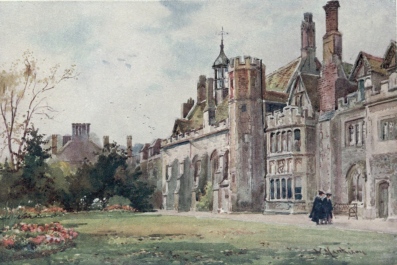
The bishops of Ely have never ceased to be the visitors of the college.
Michaelhouse.
Nearly forty years elapsed before a second college was projected. On September 27 1324 Hervey de Stanton, who like other founders in both universities—like Merton, Alcock, Wykeham, and Wolsey—was a notable pluralist,[114] opened Michaelhouse on the present site of Trinity. His purchases for the site had been made in 1323-4, and as was the case with the foundations preceding and succeeding it, Michaelhouse was an adaptation of edifices already existing. It remained one of the principal collegiate buildings until the xvi century and was successively enlarged by absorbing both Crouched and Gregory’s as students’ hostels.
Domus aula collegium.
As Peterhouse was called “the House-of-Scholars of S. Peter,” so was Michaelhouse called “the House-of-Scholars of S. Michael.” It will be seen that domus and aula were the earliest appellations. As hospitia or diversoria literarum signified the unendowed house, so domus or aula scholarium signified the endowed house. Such compound titles as “house of S. Peter or hall-of-scholars of the Bishop of Ely” precede, as they explain, the later title college. A college denotes not a dwelling but a community: precisely the same distinction is to be drawn between domus and collegium as between monasterium and conventus. Every university domus was intended for a college of scholars, as every religious house was intended for a convent of religious; the transition was easy, though not logical, from “college of the hall of Valense-Marie” to Valence-Marie College, and to-day the word is used indiscriminately to mean both the building and the community.[115]
Clare Hall 1326-1338.
Clare Hall was erected on the site of University Hall, a house for scholars founded during the chancellorship of Richard de Badew who obtained the king’s licence for it on February 20 1326, when he was lodged at Barnwell.[116] In the next reign (1344, 18th of Edward III.) it is referred to as “the hospice belonging to Cambridge university.” This hall, like Peterhouse, originated in two hostels purchased for the university in the street running parallel to the High Street, from the present site of Queen’s to the back gate of Trinity.[117] Twelve years later Elizabeth de Burgh[118] sister and co-heiress of
CLARE COLLEGE AND BRIDGE FROM THE CAM—AUTUMN EVENING
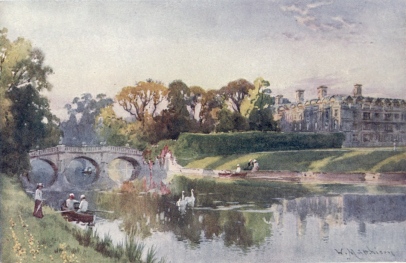
Gilbert Earl of Clare founded her college and in 1340 she obtained possession of University Hall,[119] and decreed in 1359 that it should thenceforth be known as the “House of Clare.”[120]
The scheme of building of Clare Hall was quadrangular; but no college was longer in the building. A hall, combination room, and Master’s room were on the west, while the chapel at the north-east angle was not built till 1535.[121] The scholars had till then kept their prayers in the parish church of S. Zachary and in the south chancel aisle of S. Edward’s. The present chapel was not begun till 1764. As we see it now Clare is a homogeneous piece of work of the time of Charles I., and in its classical beauty is one of the finest in Cambridge. This complete rebuilding occupied twenty-six years—from 1635 to 1661. There is no record of the architect, though an unsupported tradition points to Inigo Jones.
When one pictures Clare Hall it is to recall “the Backs,” the characteristic feature of Cambridge scenery which rivals the beauty of “the gardens” in the sister university. The grounds of the succession of collegiate buildings fronting the ancient High Street, with sloping lawns, bowling green, and fellows’ garden, extend along the backs of the colleges beyond the narrow river over which each college throws its bridge, and beyond again runs the well known road and the college playgrounds.
Clare is supposed to have been the “Soler hall” of Chaucer’s Tale.[122] It has enjoyed the reputation of a fashionable college, and indeed of a “sporting college.” It no doubt enjoyed the former reputation from the first, as a foundation under the patronage of the great house of Clare, and furnished some of the overdressed dandies who flocked to Cambridge in Chaucer’s time, as well as his “pore” Yorkshire “scolers” or others like them. Ralph Cudworth was Master of the college; Tillotson Archbishop of Canterbury, the martyr bishop Latimer, and Whiston the successor of Newton were its fellows; and Nicholas Heath primate of York, Sir George Downing, Cole the antiquary, Townshend, Chancellor of the Exchequer, the first Marquis Cornwallis, Brodrick Archbishop of Cashel, and Whitehead the laureate were its alumni. It was founded for 20 fellows or scholars, 6 of whom were to be in priests’ orders. In 1634 there were 15 fellows and 32 scholars, in all 106 inmates. In the time of Caius there had been 129, and in the middle of the xviii century there were about 100. There are
CLARE COLLEGE AND BRIDGE FROM THE AVENUE King’s College Chapel is seen through the trees.
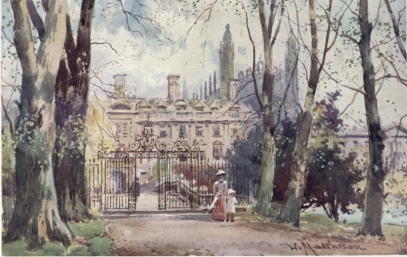
now 18 fellowships and 31 scholarships ranging in value from £20 to £60.
College statutes.
The statutes of Clare Hall were written by the founder in 1359, a year before her death. The statutes of Peterhouse[123] and of Pembroke do not exist in their original form—and those of Hervey de Stanton for Michaelhouse and of Elizabeth de Burgh for Clare must be held to be the two types of Cambridge college statutes. Of these the latter rank as the most enlightened original code framed for a Cambridge college. Stanton’s contain little more than directions for the conduct of a clerical seminary, and this type was followed by the framers of the statutes of Corpus Christi and in their general intention by Gonville in statutes afterwards modified by Bateman. The statutes of King’s Hall framed for Richard II. reverted to the Merton type; Henry VI.’s statutes for King’s follow, as we shall see, the type already laid down by William of Wykeham, while Lady Margaret Countess of Richmond, and John Fisher Bishop of Rochester framed statutes which contain some original elements.
Elizabeth de Burgh’s originality consists in her realisation of the value of learning and of general knowledge for all kinds of men and for its own sake. “In every degree, whether ecclesiastical or temporal, skill in learning is of no mean advantage; which although sought for by many persons in many ways is to be found most fully in the university where a studium generale is known to flourish.”[124] Thence it sends forth its “disciples,” “who have tasted its sweetness,” skilled and fitted, to fill their place in the world. She wishes to promote, with the advancement of religious worship and the welfare of the state, “the extension of these sciences”; her object being that “the pearl of knowledge” “once discovered and acquired by study and learning” “should not lie hid,” but be diffused more and more widely, and when so diffused give light to them that walk in the darkness of the shadow of ignorance.[125]
The statutes of Marie Valence were written twelve years earlier and even in the form in which they have come down to us have a character of their own and conform to none of the three types of Merton, Michaelhouse, or Clare.[126]
Merton’s statutes were issued in 1264, 1270, and 1274, and the 1274 statutes exist in the university library in a register of the Bishops of Lincoln. Mr. J. Bass Mullinger has printed Hervey de Stanton’s in Appendix D. to his “History of the University of Cambridge”; they are contained in the Michaelhouse book in the muniment room of Trinity.
For King’s Hall, founded in 1337, see page 131.
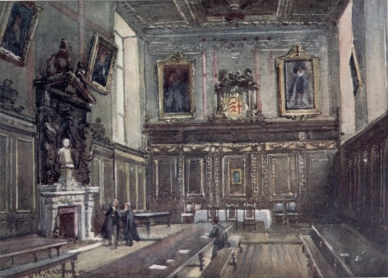
THE HALL OF CLARE COLLEGE The notable features of this interior are the plaster ceiling and the large oak figures over the fireplace, the latter designed by Sir M. Digby Wyatt 1870-72.
Pembroke College A.D. 1347.
Pembroke Hall was founded in 1347 by Marie daughter of Guy de Chatillon comte de Saint-Paul and of Mary grand-daughter of Henry III. She was of the blood of that Walter de Chatillon who in the retreat from Damietta during the 7th crusade, held a village alone against successive assaults of the Saracen; and having drawn forth their missiles from his body after each sally, charged afresh to the cry of Chatillon! Chevaliers!—and the widow of Aymer de Valence Earl of Pembroke the inexorable enemy of Robert Bruce in Edward’s wars against the Scottish king. Pembroke stands opposite Peterhouse and several hostels were destroyed to make room for it. It was called by the founder the hall of Valencemarie, and in Latin documents aula Pembrochiana.
Architectural scheme of a college.
With Pembroke the first college foundation stone was laid in Cambridge. Here for the first time we have a homogeneous collegiate house and not a mere adaptation of pre-existing buildings, and may therefore enquire what was the architectural plan of a college. The principle of the quadrangle, although it underwent considerable architectural development, was recognised with the first attempt at college architecture.[127] The special collegiate buildings at first occupied one side of the court only. Here, facing the gateway, were to be found the hall with its buttery and kitchen, above the hall the Master’s lodging, with perhaps a garret bedroom above it—the solarium. The combination room attiguous to the hall makes its appearance in the next century, and at right angles or parallel to this main block stretch the students’ chambers and studies. A muniment room or treasury is over the gate; the library, occupying a third side,[128] and the chapel, come later; and last of all the architectural gateway is added.[129] Meadows and fields and the Master’s plot of ground are soon developed into the Master’s garden, the fellows’ garden, the bowling green, and tennis court. By the xv century the buildings round a courtyard easily assume the plan of the new domestic dwelling of that epoch, of which the type is Haddon Hall Derbyshire and, in Cambridge, Queens’ College: the college domus of the xiv century becomes the quadrangular manor-house of the xvth and xvith. In such a scheme of public buildings only a few scholars could be lodged in the main court, and smaller quadrangles for their accommodation were therefore added. University Hostel formed one side of such a second court in Pembroke; Clare and Queens’ had also second courts, and their example was followed at Christ’s and S. John’s.
Here then we have a scheme of building which is neither monastic nor feudal. It may with propriety be called scholastic but it is also essentially domestic architecture. The college quadrangle as we see it evolved in Cambridge is the earliest attempt at devising a dwelling which should resemble neither the cloister nor the castle, should suggest neither enclosure nor self-defence—a scholastic dwelling. The college is the outcome of that moment in our history when feudalism had played its part and monasticism was losing its power; it represents what the rise of the universities themselves represents and its architectural interest is unique. No monastic terms are retained; the hall is not a refectory, the one constant monastic and canonical feature, the church, has no part at all in the scheme—the scholars were men not separated from their fellows and they used the parish church.
The first collegiate dwelling houses, like the English manor-house, consciously or unconsciously followed one of the oldest house-plans known to civilisation—the scheme of dwelling-rooms round a court was that of the Roman house. The aula seu domus scholarium had moreover as its starting point—like the earliest domus ecclesiae—a hall in a house; the hall is the nucleus of the college.[130]
The site of Pembroke.
Marie de Saint-Paul, like her predecessor Elizabeth de Burgh, purchased university property for the site of her college. “University hostel” which stood here formed one side of the narrow quadrangle the building of which was at once begun, and a messuage of Hervey de Stanton’s formed the other. Within five years the complete area had been acquired, and it is probable that the south side was also partly built before the founder’s death in 1377. On the west were the hall and kitchen, on the east, abutting on the street, was the gate with students’ chambers on either side of it. With the hostel the founder bought an acre of meadowland which she converted into an orchard—“the orchard against Pembroke Hall” it is called in her lifetime. She also obtained permission from two of the Avignon popes—Innocent VI. and Urban V.—to erect a chapel and bell tower, and these were built, after the middle of the xiv century, at the north west corner of the closed quadrangle. This interesting site was used later as a library and is still a reference library and lecture room. Traces of fresco remain under the panelling, and the chaplain’s room with its hagioscope for the altar is on the east. The lower part of the bell tower also still exists.
In 1389 the college acquired Cosyn’s Place, and later Bolton’s, and in 1451 a perpetual lease of S. Thomas’s hostel. University hostel retained its name till the last quarter of the xvi century, and it was only pulled down in 1659 to make room for the Hitcham building which now forms the south side of the second court. There is nothing left of the xiv and xv century structures. The present lodge, hall, and library and the other new buildings in stone and red brick have all been erected since 1870. The chapel occupies part of the site of S. Thomas’s hostel, and was built by Matthew Wren, Bishop of Ely and Master of
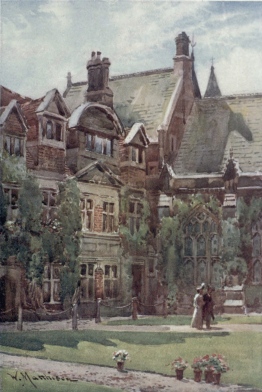
THE OLD COURT, PEMBROKE COLLEGE The Dining Hall is seen on the right of the picture.
Peterhouse, at his own charges; the architect being his nephew Christopher Wren. The bishop had already built Peterhouse chapel and this new work was undertaken in fulfilment of his intention to make some pious offering if he were ever liberated from the Tower, where the Parliament kept him between the years 1642 and 1658. The fine combination room is panelled with the oak from the xvii century hall. The portrait of Marie de Saint-Paul presides in the present hall with that of Henry VI. flanked by busts of Pitt, Gray, and Stokes.
Two spiritual relationships were bequeathed by the founder to the college. One with the Franciscan friars, the other with the Minoresses of Denney. The former connexion ceased almost as soon as it was devised, for the existing edition of the statutes (made after the founder’s death) omits all mention of it.[131]
No college but Trinity outshines Pembroke for the fame of its scholars and none for the antiquity of its fame. Henry VI. in a charter granting lands speaks of it as “this eminent and most precious college, which is and ever hath been resplendent among all places in the university.”[132] The king so favoured it that it was called his “adopted daughter”; and when Elizabeth rode past it on her way to her lodging at King’s she saluted it with one of those happy phrases characteristic of the Tudors: “O domus antiqua et religiosa!” words which sum its significance in university history.
Pembroke is the alma mater of Edmund Spenser,[133] of Gray,[134] of the younger Pitt,[135] of Thixtil, fellow in 1519, whose extraordinary erudition is praised by Caius, of Wharton the anatomist, Sydenham the xvii century physician, Gabriel Harvey the “Hobbinoll” of the Shepherd’s Calendar,[136] Sir George Stokes the mathematician, and Sir Henry Maine.[137] *Grindal and *Whitgift[138] of Canterbury, *Rotherham and *Booth of York, *Richard Fox Master of the college, Bishop of Winchester, and founder of Corpus Christi Oxford, the two Langtons Bishops of *S. David’s and Winchester, *Ridley the martyr Bishop of London, *Lancelot Andrewes Bishop of Ely, then of Winchester, with
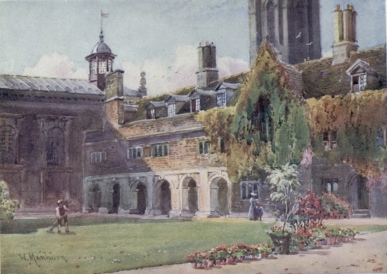
A COURT AND CLOISTERS IN PEMBROKE COLLEGE This represents the First or Entrance Court of the College. Beyond the Cloisters is the Chapel designed by Sir Christopher Wren and completed in 1664.
Felton and *Wren of Ely, are on its honour roll. The second Master was Robert Thorpe of Thorpe-next-Norwich, knighted by Edward III. and afterwards Lord Chancellor.[139] The old college garden, loved by Ridley, is much despoiled, but “Ridley’s walk” remains. Pembroke gave two other martyrs for their religious opinions, Rogers and Bradford.[140] Two fellows of the college[141] in the reign of Edward III. died in Rome where they had gone to obtain from Innocent VI. possession of part of the original endowment of the college; a statute prescribes that mass shall be said for them each July.
In the library are Gower’s Confessio Amantis and the Golden Legend, printed by Caxton. It is this last book which brought him the promise of “a buck in summer and a doe in winter” from the Earl of Arundel, for its great length had made him “half desperate to have accomplished it.” There, too, is Gray’s MS. of the “Elegy.” The college also possesses Bishop Andrewes’ library. Matthew Wren is buried in the chapel, and his staff and mitre are preserved in the college, the latter being a solitary specimen of a post-reformation mitre; it was worn over a crimson silk cap.
The college was founded for 30 scholars, if the revenues permitted.[142] In the time of Caius it housed 87 members; in Fuller’s time 100 (including 20 fellows and 33 scholars); in the middle of the xviii century the number of students averaged 50 or 60. There are now 13 fellowships and 34 scholarships of the value of £20 to £80.
Founders of Cambridge colleges.
The Cambridge colleges are remarkable for the large proportion of them founded and endowed by women. Of the 16 colleges built between the xiii and xvi centuries, now in existence, 6 are due to the munificence of women—Clare, Pembroke, Queens’, Christ’s, S. John’s, and Sidney Sussex. Next as college builders come the chancellors of England, the bishops, and the kings who have each endowed the university with three colleges. Hervey de Stanton, Chancellor of the Exchequer in the reign of Edward II., Thomas Lord Audley chancellor to Henry VIII., and Sir Walter Mildmay Chancellor of the Exchequer to Elizabeth, all founded colleges, two of which still remain—Magdalene and Emmanuel.[143] Hugh Balsham of Ely, Bateman of Norwich, and Alcock of Ely founded three existing colleges—Peterhouse, Trinity Hall, and Jesus.[143a] The kings of England account for some of the finest work in the university, King’s Hall, King’s College, and Trinity College.[144]
The early series of colleges.
In the series of Cambridge colleges the 3 foundations of the early xiv century which followed Peterhouse were all merged in other colleges. Pembroke which was the sixth foundation was the first piece of collegiate building to be carried through in Cambridge, and Corpus Christi must rank as the second.
The colleges from Peterhouse to Pembroke:—
Peterhouse 1284
Michaelhouse 1324(Gonville 1348)
{University Hall 1326(Trinity Hall 1350)
{Clare 1338
King’s Hall 1337Corpus 1352
Pembroke Hall 1347
Michaelhouse and King’s Hall went to swell the greatness of Trinity; University Hall became the foundation stone of Clare: and all of them, with Gonville and Trinity Hall, were incomplete adaptations of earlier buildings at the time when Pembroke and Corpus were finished.
We now come to two colleges which formed an East Anglian corner in the university.
Gonville Hall 1348.
Within a month of the licence granted to Marie de Saint-Paul, Edmund Gonville obtained his for the erection of the hall which is called after him. Gonville was an East Anglian parson, rector of two Norfolk parishes and sometime vicar-general of the diocese of Ely. In one of these parishes his elder brother Sir Nicholas Gonville of Rushworth had already established a college of canons, and Edmund Gonville himself was a great favourer of the Dominicans. Edward III.’s licence enabled him to found a hall for 20 scholars in Lurteburgh (now Free school) Lane, between S. Benet’s and great S. Mary’s, in 1348. In 1352 this site was exchanged with Benet College for another on the other side of the High Street,[145] the present site of Gonville and Caius. The Hall was dedicated in honour of the Annunciation of the Blessed Virgin Mary, and enjoyed a great reputation among East Anglians and various proofs of papal favour up to the eve of the Reformation.[146] Like Corpus its object was the education of the clergy and theology was to be their study. Alexander VI. (1492-1503) licensed annually two of its students to preach in any part of England, apparently a unique permission.[147] Humphrey de la Pole—who resided for many years—and his brother Edward, sons of the second Duke of Suffolk, were students here; so was Sir Thomas Gresham. Gonville was refounded as Gonville and Caius by Doctor Keys (Caius) two hundred years later.[148]
Trinity Hall A.D. 1350.
Edmund Gonville left William Bateman Bishop of Norwich his executor in the interests of his new foundation. Bateman, a notable
TRINITY HALL The nearer building seen in the picture is the old Library, and beyond it are the Latham Buildings.
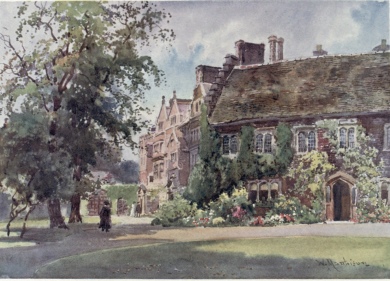
figure in the xiv century, set forth as Edward’s ambassador to the King of France in the month that the Black Death made its appearance in East Anglia (March 1350), and died at Avignon on an embassy from the king to the Pope. In 1350 on his return from France,[149] he founded Trinity Hall, near Gonville, on the site of the hostel of the monks of Ely[150] which he obtained for that purpose.[151]
If Gonville’s foundation was intended for the country parson, Bateman’s was intended for the prete di carriera. Both were designed to repair the ravages in the ranks of the clergy left by the plague, but while Gonville’s clerks were to devote their time to the study of theology Bateman’s were to study exclusively civil and canon law. The college was built round a quadrangle,[152] and the religious services were kept in the church of S. John the Baptist (or Zachary) and afterwards in the north aisle of S. Edward’s church; these two churches being shared with the students of Clare. Indeed it was owing to Gardiner’s policy and Ridley’s advice that Trinity Hall escaped incorporation with Clare College in the reign of Edward VI. The library remains as it was in the early years of Elizabeth’s reign, and was founded by Bateman with the gift of his own collection. The Norfolk men were famous litigants. Doctor Jessopp has shown that neither the Black Death nor any lesser tragedy could hold them from an appeal to the law on every trivial pretext. That the first college of jurists should have been founded by a native of Norwich is certainly therefore a fitting circumstance.
Stephen Gardiner Bishop of Winchester and Chancellor of England was Master of Trinity Hall in the reign of Edward VI. and again in the first year of Mary. He used to say “if all his palaces were blown down by iniquity, he would creep honestly into that shell”—the mastership of Trinity Hall. Other distinguished Masters were Haddon,[153] Master of the Requests to Elizabeth, and Sir Henry Maine who had been fellow and tutor. Bishop Sampson, a pupil of Erasmus, Thirlby, Glisson,[154] Bilney, one of the early reformers, Lord Chesterfield, Bulwer Lytton, and Leslie Stephen were all members of Trinity Hall, which is still the college of the larger number of Cambridge law students. There are 13 fellowships, and about 12 scholarships varying in value from £80 to £21 a year, besides exhibitions of the same value.
In the middle of the xiv century there were two important guilds in Cambridge, the one under the invocation of Corpus Christi “keeping their prayers in S. Benet’s church,” the other dedicated to the
ST. BOTOLPH’S CHURCH AND CORPUS COLLEGE FROM THE STEPS OF THE PITT PRESS, TRUMPINGTON STREET King’s College is seen in the distance.
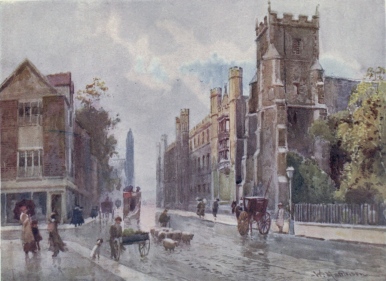
Blessed Virgin “observing their offices in S. Mary’s church.” These guilds or confraternities—which existed all through the middle ages as they had existed in classical Rome with precisely similar features—were to be found, as we know, especially among the artisan class, and took the place of our modern trades unions and mutual insurance societies. Like every enterprise of the ages of faith they had a semi-religious character, were usually attached as its “sisters and brethren” to some church, and owed their members not only material assistance but spiritual, paying for masses to be offered for the repose of the souls of all deceased brethren.
Corpus Christi A.D. 1352.
It was two such guilds which forgetting their differences and laying aside all emulations, joined together in the middle of the xiv century in order to found and endow a college in their town. The brethren of the guilds had been planning this enterprise since 1342, and in the following years those who possessed contiguous tenements in the parishes of S. Benet and S. Botolph pulled them down “and with one accord set about the task of establishing a college there.”[155] “By this means they cleared a site for their college square in form.”[156] Here then, as in the case of King’s Hall and Pembroke, the earliest collegiate buildings designed as such, the plan was quadrangular. Sometimes, as in the case of Trinity Hall, the adjacent buildings for completing the court could not be at once obtained, in others, as at Corpus itself and Clare, the courts are irregular, owing to the same difficulty of getting the foursquare space. Corpus Christi college presents us, indeed, with the unique and perfect example in Cambridge of the ancient college court. By March 1352 a clear space, 220 feet long by 140 wide, had been cleared, and the guilds worked with so much good will that they had nearly finished the exterior wall of their college in the same year. “The building of the college as it appears at the present day,” writes John Jocelyn, “with walls of enclosure, chambers arranged about a quadrangle, hall, kitchen, and Master’s habitation, was fully finished in the days of Thomas Eltisley, the first Master [1352-1376] and of his successor” [1376-1377]. This original court is what we see also to-day: the buildings are in two floors, the garrets were added later. The hall range contains the Master’s lodging with a solarium above it, a door and passage leading thence to the hall. The three other sides were devoted to scholars’ chambers. S. Benet’s served as the scholars’ church, and the gate was on this side of the court.
Before the reign of Henry VIII. there was but little glass or panelling in either story of the building. But in Jocelyn’s time the Master’s and fellows’ rooms were “skilfully decorated” with both. The fellows and scholars together panelled, paved, decorated, plastered, and glazed the public rooms of the college, in one case
THE OLD COURT, CORPUS CHRISTI COLLEGE This is the oldest court in Cambridge. The Tower of the old Saxon Church of St. Benedict is seen in the background.
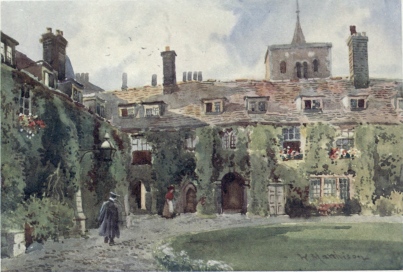
“the college paying for the material and the scholars for the labour.” Thus was this college born of the democratic spirit and the sentiment of union nurtured in the same spirit. The college was called “of Corpus Christi and the Blessed Virgin” but was familiarly known from the close of the xiv century to modern times as Benet College. It lay in the heart of the Saxon town, between the Saxon church of S. Benet and the church of the Saxon Botolph which also served the scholars for their prayers. The former was used until the year 1500, when a small chapel communicating with the south chancel of the church was built. In 1579 Sir Nicholas Bacon gave the college a chapel; and the modern chapel is on its site. Sir Francis Drake was the largest contributor next to Bacon. The queen gave timber, and the scholars of the college again toiled side by side with the workmen.
On March 21, 1353 the guilds made over to their college Gonville’s house in Lurteburgh Lane which they had exchanged with his executor Bateman. More ground was purchased facing the street and in time two large neighbouring hostels S. Mary’s and S. Bernard’s were acquired for students. The second court has all been built since 1823, and contains the modern hall, lodge, library and chapel, and muniment room, and the Lewes collection. The ancient hall serves as the present kitchen.
In the Library is one of the most valuable collections of MSS. in the country, the spoils of the dissolved monasteries gathered together by Archbishop Parker. Here is the oldest or “Winchester” Anglo-Saxon Chronicle (to A.D. 892), and Jerome’s version of the four gospels sent by Gregory to Augustin—“the most interesting MS. in England.” Here is the splendid Peterborough psalter and “bestiary”; a penitentiale of Archbishop Egbert’s (A-S. translation); a Pontifical, probably written before 1407; a xv century MS. Homer rescued by Parker from the whilom baker of S. Augustine’s Abbey; Matthew Paris’ own copy of his history; the Sarum missal of 1506, and a copy of the great English bible of 1568. Here also is the first draft (1562) of the Articles of Religion, 42 in number, scored over by Matthew Parker’s red chalk; the 3 articles which were finally omitted (dealing with the state of the departed, the last containing the statement “That all shall not be saved”) are here struck out by Parker. The clause concerning the transubstantiation of the eucharist he has similarly overscored.
Corpus also houses some of the most interesting plate in the university.
Candle rents. Corpus Christi procession. College arms.
The college was the chief sufferer in the peasant revolt of 1381 principally on account of the wealth which accrued to it from “candle rents,” a tax chargeable on the tenants of all houses which had been guild property.[157] On the festival of Corpus Christi—the
ST. BENEDICT’S CHURCH FROM FREE SCHOOL LANE Its Saxon tower is the oldest building left in Cambridge, and close by is the oldest piece of College building, the wall of Corpus Christi.
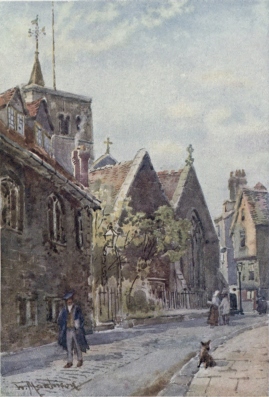
Thursday in the Octave of Trinity—a great procession which included the officers of the united guild, the civic dignitaries, and the university authorities, perambulated the town from Benet Church to the bridge, the Master bearing the pyx under a rich canopy. Even after the dissolution of the guild the Master of Corpus continued the procession until it was abolished by Henry VIII. in the 27th year of his reign (1535/6). The ancient arms of the college consisted of the shields of the two guilds—the emblems of the Passion for Corpus Christi; the triangle symbol of the Trinity for the guild of the Blessed Virgin, above, Christ crowning the Madonna and below, the guilds dedicating their college. Exception was taken to them in Parker’s time as too papistical, and he got the heralds to change them. The new arms still however recorded the two guilds: quarterly, gules and azure, in the first and fourth a pelican, with her young, vulning herself; in the second and third three lilies proper
Signat avis Christum, qui sanguine pascit alumnos; Lilia, virgo parens, intemerata refert.
Among its great names Corpus counts Sir Nicholas Bacon the father of Francis Lord Bacon, Matthew Parker who was Master of the college and its great benefactor in later times, Christopher Marlowe and Fletcher, Archbishop Tenison, Sir William Paston and a group of xvii century antiquaries, and Boyle ‘the great earl’ of Cork. Roger Manners was a considerable benefactor. In the time of Henry VII. Elizabeth Duchess of Norfolk founded a bible clerkship and a fellowship, and placed the buttresses of the college.[158]
The college soon maintained 8 fellows, 6 scholars, and 3 bible clerks. All the inmates were destined by the founders for priests’ orders, this being one of the four foundations in Cambridge due in whole or in part to the dearth of clerks consequent on the black death.[159] In the time of Caius Corpus held 93 persons and in Fuller’s time 126. In the xviii century about 60. There are to-day 12 fellowships, about 15 scholarships varying from £80 to £30 in value, 3 sizarships worth £25 each, and 6 exhibitions for students from S. Paul’s school, Canterbury, and the Norwich Grammar school varying from £18 to double this sum.[160]
The building of Corpus Christi marks an historical and closes an architectural epoch at Cambridge. The university had indeed two golden ages—the reign of Edward III. and the reign of the Tudors. It has not been sufficiently realised that Cambridge had no European rival in scholastic activity in either period. In Edward’s reign six colleges were built there—King’s Hall, Clare, Pembroke, Gonville, Trinity Hall, and Corpus; only one college—Queens’—was founded at Oxford during the same time. Three of these six foundations signalise local enterprise, but the three earlier are a record of the affection of Edward’s house for the university; and it is their preference for Cambridge in the xiv century and the preference of the Tudors for it in the xvth and xvith which marks its two great epochs.
Cambridge in 1353.
Let us look at the university as it was in the middle of the xiv century, and let it be the year 1353. It is 250 years since Henry I. began to reign; 150 before Erasmus lived here, and 550 before our own time. It is the eve of that great change in the mental and moral venue of humanity which ushered in the modern world. The Oxford friar Occam, and with him scholasticism, had died four years before, Petrarch was mourning Laura, and Chaucer was walking the streets of Cambridge the man who was to be our link with the early Italian renascence and to clasp hands across the century with Erasmus. Lastly, it was at this moment in our history that the final adjustment of Norman and Saxon elements went hand in hand with the creation of an English language—a period of which Chaucer is our national representative. The town and university were just emerging from the havoc wrought by the “black death,” but the royal and noble foundations which had sprung up on all sides before the appearance of the scourge had already attracted the youth round Edward’s court to Cambridge; necessitating in 1342 Archbishop Stratford’s injunction against the curls and rings of the young coxcombs studying there.
Cambridge had in fact the reputation of the fashionable university, while its fame is extolled by Lydgate—a younger contemporary of Chaucer who had himself studied at Oxford—in words which show that at this date it was believed also to be the older university.[161] Let us suppose that Chaucer is returning from his first walk to Grantchester, along the Trumpington road, past the scene he describes in the Reeve’s Tale, and let us follow him up the Saxon High street. He skirts Coe fen and reaches Peterhouse, its greater and its “little ostle” on the street, with Balsham’s hall behind; and as he proceeds he sees on either hand conspicuous signs of the love of the Edwards for Cambridge—to the right the narrow quadrangle of Pembroke, beyond it, off the high road, past S. Botolph’s and two hostels, lay the limestone walls of Corpus which had just passed under the protection of Henry of Lancaster;[162] its old court, then the newest of new courts at Cambridge, nestling against the Saxon church of S. Benet. Behind lay the Austinfriars, and across the road the Whitefriars from which Austin’s Lane led to Austin’s hostel, occupying with Mill street the site of the future King’s College and King’s College chapel. To the north of S. Benet’s he sees the university church of Great S. Mary’s, just rebuilt after the fire, and opposite are the schools begun a few years previously, with University, Clare, and Trinity Halls behind, and “le Stone house” of Gonville. Then still to his left, where now we see the buildings of Trinity, he beholds the “gret colledge” King’s Hall which Edward III. has just built, Michaelhouse with Crouched hostel which passed into its possession in the February of this year, and its satellite hostels Ovyng’s and Garret’s.
Just beyond King’s Hall is the building which forms the nucleus of the university in the Norman town—the hospital of S. John, bordering on Bridge street. As soon as this road is reached, which leads to the Great Bridge, we see the crusaders’ round church of S. Sepulchre, and following the road to the right we come to the Greyfriars, to the site of the future God’s House, and past Preachers’ street to the Friars Preachers or Blackfriars. On our left, across in the Greencroft, we have left the Benedictine nunnery of S. Rhadegund. Returning past S. Sepulchre’s we cross the river and come to the heart of the Norman town—the Conqueror’s castle with the Norman manor house bought by Merton in its shadow, and the churches of S. Giles and S. Peter.
Many of the hostels had recently disappeared to make room for the colleges, but they were still as regards these latter nearly in the proportion of three to one—and these latter, with the sole exception of Peterhouse, had all arisen in the previous thirty years.
The sights and sounds in the streets suggested a new epoch—something already achieved and something about to be achieved. Something of stir before an awakening. The English language which was to prove in the hands of its masters one of the finest vehicles of literary expression began everywhere to be heard in place of the French of Norfolk and Stratford-atte-Bowe. The softer southern speech prevailed over
KING’S COLLEGE GATEWAY AND CHAPEL—TWILIGHT EFFECT The Gateway and Screen on the left hand, and beyond it the Chapel. In the distance the Senate House, Caius College, and the Tower of St. John’s College Chapel.
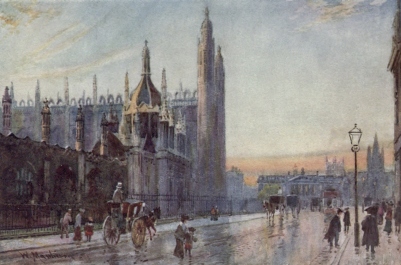
the northern, but the dialects of East Anglia and the Ridings of Yorks were perhaps most frequently heard. The canons of S. John and S. Giles, from the Norman side of the town, might be met in their black cloaks, the Gilbertine canons, from the Saxon side, all in white with the homely sheepskin cape. The Carmelites had already exchanged their striped brown and white cloak—representing Elijah’s mantle singed with fire as it fell from the fiery chariot—for the white cloak to which they owe their name of Whitefriars. The Romites of S. Austin wore a hermit’s dress.[163] Benedictine monks from Ely and Norwich could certainly be seen in the streets of Cambridge,[164] and the Benedictine nuns of S. Rhadegund rode and walked abroad in the black habit as it was the universal custom in that great order for nuns to do. The Dominicans looked like canons in their black cappa, the Franciscans like peasants in their coarse grey tunic roughly tied with cord.
Besides the Carmelites and Austinfriars there were the Bethlemite friars in Trumpington street and Our-Lady friars by the Castle; the former could be distinguished at a distance by the red star of five rays on their cloaks with a sky blue circle in its centre—the star of Bethlehem; but both these communities wore the habit—black over white—of the Dominicans. Scholars poor and rich jostled each other in the schools and in the public ways, wearing the long and short gowns of the day, the cote which had just come into fashion, or the habit of their order. There were doctors in the three faculties wearing scarlet gowns and the doctor’s bonnet or camaurum, and there was a sprinkling of doctors and of students from Orléans, Padua, Pavia, and Paris.
A large number of the inmates of the colleges round, and of the scholars walking the streets, wear the clerical tonsure, many scores have the coronal tonsure of the friar—yet the feeling in the air is secular. Cambridge has always suggested a certain detachment; neither zeal—perfervid or sour—nor the pressure of tradition upon living thought has had its proper home there. It has not represented monastic seclusion nor hieratic exclusion, and it did so at this moment of its history less than ever. The dawn of the coming renascence shone upon the walls at which we have been looking. The modern world has been born of the birth-pangs which have since convulsed Europe, and the walls which were then big with the future are now big with the past. But it is the greatness of Cambridge that amidst the multiple suggestiveness of its ancient halls of learning, tyranny of the past has no place. About it the dawn of the renascence still lingers; and the early morning light which presided at its birth still defines the shadows and seems to temper the noon-day heat, as light and shade alternate in its history.
Chaucer at Cambridge.
We have taken it for granted that Chaucer was walking the streets of Cambridge with us. We have no direct evidence as to where Chaucer studied; but our indirect evidence is sufficient. In the “Canterbury Tales” Chaucer introduces us to two Cambridge scholars and to a clerk of Oxenforde; and if one considers what would nowadays be called the internal evidence of the Reeve’s Tale it is difficult to resist the conclusion that Chaucer was at Cambridge. How else should he know Trumpington so well? Its brook, its bridge, its mill, its fen? He knows about the “gret colledge” which had risen a few years previously; he knows that its Master is called “the warden,” that its scholars are also its “fellaws.” He has learnt there the dialect of Yorkshiremen, and reproduces not only their turns of speech but characteristic terms—as bete, kime, jossa—in the East Anglian dialect. If we turn to the Miller’s Tale all this local colouring is to seek. A “clerke of Oxenforde,” indeed, was no unfamiliar figure in the xiv century, especially to a Londoner. Familiarity with the aspect of Cambridge and its neighbourhood was a very different matter.
Chaucer was probably himself of East Anglian origin. His grandfather Robert and John his father were both of Ipswich and London, and when he was kidnapped by his mother’s family “Thomas Stace of Ipswich” is the kidnapper. There are two events of his young life known to us, and both suggest that he was at Cambridge. One of these we hear about from his evidence in the famous Scrope and Grosvenor suit in 1386. An upstart knight—Sir Robert Grosvenor—whose name Chaucer had never heard before, had displayed the arms of the Scropes, and Chaucer testifies in the Court of Chivalry action which ensues that he had often seen Henry le Scrope use the proud armorials “azure, a bend or” in the French wars where they had been companions in arms twenty-seven years before (1359). Now this great Yorkshire family were connected with Cambridge from Chaucer’s time: Richard le Scrope, the son of his old comrade, was chancellor of the university in 1378.[165] Two members of the same family were chancellors in the next century, and the intermarriage of the Scropes with the Gonvilles is recorded there to this day in Scrope or “Scroope Terrace.”[166] Is it not probable that Geoffrey Chaucer knew Henry Scrope at Cambridge and formed there the friendship which moved him to testify in his behalf thirty years later?
This conjecture does not become less probable when we turn to the other incident in his early life, which came to light in 1866 with a fragment of the household accounts of the wife of Lionel Duke of Clarence. Here the name of Geoffrey Chaucer is mentioned (in 1357) as that of a junior member of her household. His early connexion with the house of Edward is therefore an historical fact like his later friendship with John of Gaunt. Now in 1352 Lionel Plantagenet had married Elizabeth de Burgh the grand-daughter and namesake of the founder of Clare Hall Cambridge. The “gret colledge” about which Chaucer tells us in the Reeves Tale is called “Soler Hall” and “Soler Hall,” so Caius records, was the ancient name for Clare. Remembering, however, the incomplete condition of Clare and of other foundations at this date the present writer supposes the “gret colledge” to have been King’s Hall, the first imposing architectural undertaking in the university and the building which must par excellence have attracted attention in the middle of the xiv century.[167] It may also have been Chaucer’s own college, and in this connexion it is worthy of notice that with the exception of the half-dozen “minor scholars” at Pembroke, King’s Hall was at this time the only college which educated lads in their teens.
Assuming the year of the poet’s birth to have been 1340 he would have been going to the university, according to the custom of those days, about the year 1353, and his place in Elizabeth de Burgh’s household was probably already assured him when he went to Cambridge.[168] He was back in her service in his seventeenth year and therefore could not have had time to study at both universities: and we may add to this that although his general knowledge, which he had no time to acquire in later life, suggests that he received a university education, there is not a tittle of evidence to support the idea that Chaucer went to Oxford.
One more conjecture: had he got his information about prioress’s French from the religious of the convent of S. Leonard of Stratford-atte-Bowe whom we find owning land in Cambridge from the days of Edward I.?
The Schools. The High Street and School Street.
It is to this period of the history of Cambridge that the first university buildings as distinguished from collegiate buildings belong. During the chancellorship of Robert Thorpe, Knight, Master of Pembroke (1347-64) and Lord Chief Justice of the Common Pleas, afterwards Chancellor of England, the “schools quadrangle” was projected in that street of colleges, unrivalled in Europe, which prolonging the Trumpington Road as King’s Parade or Trinity Street or S. John’s Street was anciently known as the “School street” of the university. It was also the high street of the Saxon town of which S. Benet’s tower was the nucleus, but whether the original Saxon town lay on this side of the river, or whether, as frequently happened in the xi century, the Saxon population retreated here leaving the Castle district to their Norman conquerors, we have no means of determining.[169]
There were, then, no public buildings up to the xiv century. The Greyfriars or the Austinfriars gave hospitality to the university on public occasions, and the only brick and mortar evidence of a university lay in the hostels and colleges. The “Schools” now erected were halls for lecturing and scholastic disputations; the north, west, and east sides were completed by the middle of the next century, the south side being added in accordance with a decision taken in 1457 to build “a new school of philosophy and civil law, or a library.”[170] This was erected on university ground (on the south) next to the school of canon law (west). Over this last was the original library room (the “west room” 1457) and “a chapel of exceeding great beauty.” The quadrangle contained the Divinity school (north) with the Regent and non-regent houses; opposite was the Sophisters’ school with the libraria communis or magna; on the entrance side were the Chancellor’s (Rotherham’s) Library, Consistory court and Court of the Proctors and Taxors; and facing this the Bachelors’ school and the school of Medicine and Law; the old “west room” having been converted into a school, by grace of the Senate, in 1547.[171]
The university library.
The schools remained untouched till the opening years of the xviii century when the Regent House was pulled down to build the present university library. This is the oldest of the three great English libraries, and stands on ground which has always been university property. The early xv century library which was lodged in the Schools quadrangle originated in gifts of single volumes by private donors until 52 had been collected; and books which were bequeathed in 1424 are still preserved. Fifty years later (1473) the proctors Ralph Sanger and Richard Tokerham made a catalogue of 330 books.[172] Rotherham Archbishop of York next presented 200 tomes, and Tunstall Bishop of Durham was another donor: many of these last gifts
GATEWAY OF KING’S COLLEGE, KING’S PARADE This is one of the most picturesque views in Cambridge. On the right are the Gateway and Screen and other portions of King’s College; on the left are some ancient houses.
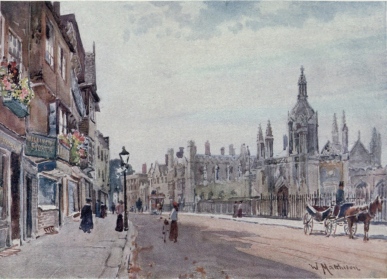
were “embezzled” by “pilferers” before the middle of the xvi century,[173] and the libraries of three successive Cambridge archbishops of Canterbury, Parker, Grindal, and Bancroft, formed the chief treasure of the university until 1715 when George I. purchased and presented the library of Moore Bishop of Ely which is the nucleus of the modern collection.[174]
There are 400,000 volumes on open shelves among which the student can wander at will and get his own books without applying to the library officials; a convenience which Lord Acton, the late Professor of Modern History, used to say made this the only serviceable library in Europe. Another privilege, which is possessed by all masters of arts, is that books may be taken home. Undergraduates, if in academic dress, have also free access. The university library is one of the three copyright libraries in England.[175]
The Pitt Press.
A printing press was set up at Cambridge, early in the xvi century, by Siberch who said of himself that he was the first in England to print Greek—7 small volumes in the Greek character were printed by him at the university. Carter, however, tells us that an Italian Franciscan, William of Savona, printed a book at Cambridge in 1478, four years after Caxton had printed the first book in England. Lord Coke pointed out that this university enjoyed before Oxford the privilege of printing omnes et omnigenas libros, “all and every kind of book” (1534). This included the right to appoint 3 stationers or printers.
Siberch’s printing place was on the present site of Caius. In 1655 the university obtained from Queens’ College a lease of the ground at the corner of Silver street and Queens’ lane—the historic Mill street district—now the site of the lodge and garden of S. Catherine’s. In 1804 the present site was obtained for the university press, with a further “messuage fronting upon Trumpington street and Mill lane”; the remaining properties in Trumpington street, between Silver street and Mill street, being bought in 1831-3. The Pitt Press, a church-like structure, stands opposite to Pembroke (Pitt’s) College, and owes its name to the fact that the surplus funds of the Pitt monument in Westminster abbey were a donation to the university towards defraying the cost. The building also contains the offices of the university Registrary.[176]
The Senate House was not founded till 1722, and lies on the north of the library.[177]
King’s College. A. D. 1441.
Ninety years passed after the building of Corpus before Henry VI. founded King’s College, and Margaret of Anjou, his consort, founded
KING’S COLLEGE CHAPEL AND THE ENTRANCE COURT, FROM THE FELLOWS’ BUILDINGS A portion of the Chapel is seen on the left of the picture with Great St. Mary’s tower in the distance. The Screen and Gate are on the right.
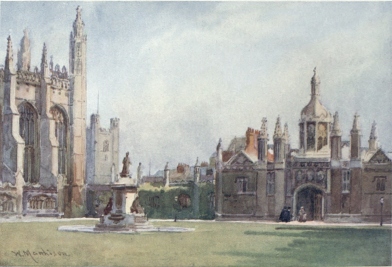
Queens’. It was in 1443 that the charter of the double foundation of Eton at Windsor and King’s College at Cambridge was signed—the one “our royal college of S. Mary of Eton,” the other “our royal college of S. Mary and S. Nicholas”; for Henry dedicated his college to his patron saint Nicholas “of Bari” the patron of scholars. The king laid the foundation stone himself (p. 112) in the presence of John Langton chancellor of the university, the keeper of the Privy Seal, the chancellor of the Exchequer, and the bishops of Lincoln and Salisbury.[178] The king’s father had intended to build a college at Oxford; Henry VI. carried out his intention in endowing a college but decided that the university should be Cambridge. A small college called God’s House which had just been founded,[179] together with Mill Street (acquired in 1445) and Augustine’s hostel (in 1449) and the church of S. John Zachary, were pulled down to clear a space: but the original plan for the college was never carried out, and the buildings we now see were erected in the first quarter of the xviiith and in the xixth centuries.[180]
The chapel.
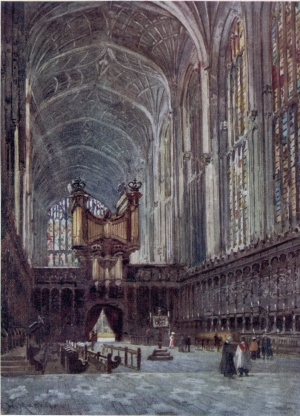
The only portion of the original plan executed was the chapel. The importance of King’s College chapel is not only architectural; is due not only to the fact that it was begun before the Italian classical revival as a monument of English Gothic, and completed in the full blaze of the renascence, but that it marks a chapter in the history of English religion. The church built for the old worship was consecrated for the new; the first stone was laid by Henry VI. in the presence of great catholic prelates, the oaken screen—perhaps the finest woodwork in the country—bears the monogram of Henry VIII. and Anne Boleyn[181] twined with true lovers’ knots. In the third place “this immense and
KING’S COLLEGE CHAPEL AND THE FELLOWS’ BUILDINGS The South door of the Chapel is seen to the right in the picture, and the Fellows’ Buildings, constructed in 1723, are on the left. The Fountain with a statue of the founder, Henry the Sixth, was designed by H. A. Armstead, R. A.
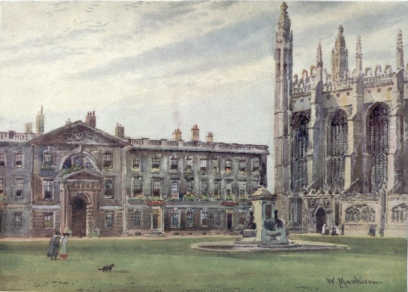
glorious work of fine intelligence,” as Wordsworth calls it, remains one of the very finest monuments of Perpendicular architecture; and that beautiful English feature the fan-vaulting, which is to be seen in the Tudor chapel at the Guildhall, in Henry VII.’s chapel at Westminster, and at S. David’s (now ruinous), is here carried out over a larger area than anywhere else.[182]
That branching roof Self-poised, and scooped into ten thousand cells Where light and shade repose, where music dwells Lingering, and wandering on as loth to die— Like thoughts whose very sweetness yieldeth proof That they were born for immortality.
So writes Wordsworth; and the stained glass windows, the most ‘complete and magnificent series’ in the country says Carter, probably inspired Milton’s
—storied windows richly dight, Casting a dim religious light. There let the pealing organ blow, To the full voic’d quire below, In service high, and anthems clear, As may with sweetness through mine ear, Dissolve me into ecstasies, And bring all Heav’n before mine eyes.
On the death of the Lancastrian monarch, Edward IV. sequestrated the building funds, but returned a thousand pounds later, and Richard III. contributed £700; but it is Henry VII. who brought the work to completion.
King’s is the only college in the university which receives only those students who intend to read for honours, and until 1857 its members could claim the B.A. degree without presenting themselves for examination.[183] The college was, almost immediately upon its foundation, exempted not only from archiepiscopal and episcopal control but also from the general jurisdiction
KING’S COLLEGE CHAPEL INTERIOR FROM THE CHOIR
of the university. It was endowed for the accommodation of a Provost, 70 poor scholars, 10 secular priests, 16 choristers, and 6 clerks—a total of 103. Eton was designed for 132 inmates.[184] 24 of the 48 scholarships of King’s are now open. Each of these scholarships is of the annual value of £80. There are also 46 fellowships. The most celebrated Etonians have not however been educated at King’s, among whose eminent sons have been Croke, Cheke (of S. John’s) Provost, Woodlark the founder of S. Catherine’s, third Provost of the college and also its benefactor, Sir John Harrington, Robert and Horace Walpole, Sir Francis Walsingham, Lord Stratford de Redcliffe, Conisby, Haddon, Giles Fletcher, Waller, Fleetwood, Oughtred an Etonian on the first foundation, Whichcote (of Emmanuel) Provost, Upton, Cole, and Charles Simeon who was a life fellow. Nicholas Close (1551) and Aldrich (1537) both bishops of Carlisle, the former one of the original six fellows, the latter the intimate of Erasmus, Rotherham of York (1467) a fellow and a donor to the chapel fund, Fox of Hereford (1535), William and George Day bishops of Winchester and Chichester, one provost of Eton the other of King’s, Wickham of Lincoln and Winchester,[185] Nicholas West (Bishop of Ely 1515) the friend of Fisher and More and Richard Cox (1559) both scholars of the college, Oliver King of Exeter, then of Bath and Wells (1492), Alley of Exeter, Guest of Rochester and Salisbury (1559), Goodrich of Ely (1534), Pearson, and Sumner, are among its prelates. Henry and Charles Brandon, heirs of their father the Duke of Suffolk, and nephews of Henry VIII. and both proficient scholars, died of the sweating sickness while in residence here in the reign of Edward VI. Cardinal Beaufort was a princely benefactor to the college, and John Somerset, physician to Henry VI., who came to Cambridge as an Oxford sophister and here graduated, was one of the chief instruments in its foundation, and drew up its statutes.[186]
The college has produced several great schoolmasters, and is now gradually acquiring a reputation for historical studies, about one third of the students being history men. The dedication to S. Nicholas is only retained in formal descriptions: King’s College has been by common consent regarded as the fitting title for this truly royal foundation, and it recalls that still older King’s Hall which is now merged in Trinity.[187]
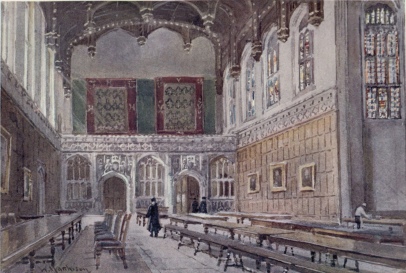
THE HALL OF KING’S COLLEGE This was built by Wilkins 1824-28. On the walls are several portraits by Sir Hubert Herkomer, R.A.
The Cambridge College chapels.
The importance of King’s College chapel in university history since the xv century leads us to consider the rôle played in Cambridge by collegiate chapels. Every college chapel, and every church which has an historical connexion with the university, has served—as all early Christian edifices have served—other purposes than those of religious worship. What we have to remark in Cambridge is that this ancient custom continued there longer than elsewhere. The “Commencements” which took place later in the Senate House used to be held, as we have seen, in the famous church of the Greyfriars or in that of the Austinfriars. The University church—Great S. Mary’s—was used by the university for its assemblies in the xiii century and was the scene of all great civic functions; disputations were held in it on Elizabeth’s visit in 1564. The college chapels were everywhere used for the transaction of important business; the Provost of King’s and other Masters are still elected in the chapel, documents are still sealed in the chapel of King’s and Trinity, and the Thurston speech is still pronounced in the chapel of Caius. The choir of King’s was used for degree examinations as late as 1851, and declamations are even now held in the chapel at Trinity. Indeed the “exercises of learning” “used” in the chapels was the reason given by the Corpus men to Lord Bacon’s father when asking for a church to themselves; and Queen Elizabeth witnessed the Aulularia of Plautus in King’s chapel on Sunday August 6th 1564, as the abbess and her nuns had assembled for Hrostwitha’s play in the abbey church of Gandersheim six hundred years earlier. The building of colleges adjoining a parish church is a feature peculiar to Cambridge. Merton is the one exception at Oxford, and Pembroke is, as we have seen, the only early exception to this rule at Cambridge.[188]
List of pre-reformation colleges built with chapels:—
1.Pembroke 1355-63 (the existing chapel is xvii c.)
2.King’s 1446-1536 (the existing chapel).
3.Queens’ 1448 (defaced at the reformation and restored. But a xix c. chapel is now used).
4.Jesus 1495 (The then existing xii c. monastic chapel was rebuilt by the founder.)
5.S. Catherine’s 1475 (the existing chapel is xvii c.)
6.Magdalene 1483 (completely restored in the middle of the xix c.)
Existing pre-reformation chapels:—
King’s xv c. Queens’ xv c. (restored). Jesus xv c. Trinity Hall xv c. Magdalene (restored) xv c.
Colleges built without chapels and with (generally) post-reformation chapels:—
1.Peterhouse (xvii c.) [188a]
2.Michaelhouse (none).
3.King’s Hall (chapel built temp. Edw. IV., and Ric. III. The site of the present chapel of Trinity College).
4.Clare (1535. The existing chapel is 1764). [188b]
5.Gonville. [188c]
6.Trinity Hall 1474.
7.Corpus 1500, and 1579 (the existing chapel is on the site of the latter, and was erected 1823).
Existing xvi c. chapels:—
Christ’s 1505 (the original chapel, but defaced); Trinity, completed 1564-7.
At Caius, the present chapel is on the site of the xvi c. chapel; and at S. John’s a xix c. structure replaces the xvi c. one, near the same site.
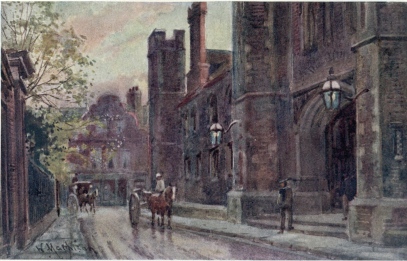
ENTRANCE GATEWAY, QUEENS’ COLLEGE This old gateway forms the principal entrance to the College from Queens’ Lane.
The oldest ecclesiastical site and building incorporated with a Cambridge college is therefore the chapel of Jesus (but cf. S. John’s p. 126); the site of the earliest college chapel is at Pembroke—but it is a site merely; the oldest existing college chapel is King’s.
Queens’ College. A.D. 1448.
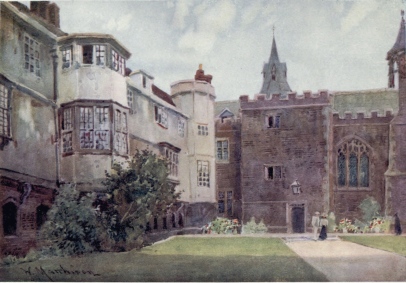
The charter for the foundation of Queens’ College is dated 15 April 1448, but by this date its north and east ranges were already built. Queen Margaret of Anjou had been so impressed with the beauty and majesty of the plans for King’s College that she could find no rest till she had projected her own foundation—Queens’; to endow and perfect which she set to work with holy emulation; dedicating it in her turn to her patron saint, Margaret the legendary Virgin and Martyr whose body is shown at Montefiascone, and to Bernard of Citeaux. Two years previously the principal of S. Bernard’s hostel had founded a college of S. Bernard, the site of which he changed in 1447 to the present site of Queens’. This formed the moral nucleus of the queens’ college; but she obtained the larger part of the ground, near King’s, from the Carmelites. This is one of the three colleges in Cambridge built of red brick, S. John’s and S. Catherine’s being the others. The Queens’ quadrangle is, as Messieurs Willis and Clark tell us, the earliest now remaining which claims attention for its architectural beauty. It is 99 feet east and west by 84 north and south.[189] The plan is not only a very perfect example of college architecture, but is a model of the xv century English manor-house, of the type of Haddon Hall;[190] so that Queens’ College is as homogeneous a structure as King’s is heterogeneous. The hall is on the west, adjoining it is the combination room, above, the President’s lodging with a bedchamber over it. The north side is kept for the chapel and for the library which is on the first floor. The chambers are on the east and south sides, the gateway being in the former. As in other colleges the passage to the grounds (or, as in this case, to the second court) is between the hall and the butteries. The west side of the quadrangle which was gradually cloistered forms the east side of the second court, and is washed by the Cam. The beautiful gallery on the north has formed part of the lodge since the xvi century,[191] and connects the old
AN OLD COURT IN QUEENS’ COLLEGE This is the Cloister Court. In the quaint sixteenth century buildings on the left is the Gallery, and facing the spectator is the doorway into the First Court. The Hall is seen on the right of this doorway.
president’s lodging with a set of rooms on the west side, among which is the audit room now used as a dining room.
Queens’, like King’s, was originally built with a chapel, and in both instances the foundation stone of the chapel was that of the college. A new chapel and buildings now lie beyond the President’s garden on the north. There is a small court on the south of the cloister court which contains the rooms occupied by Erasmus, overhanging the college kitchen. Besides Erasmus, who lived here for at least four years, Fisher was there as President of the college until 1508, and Old Fuller was another of its worthies. Henry Bullock, the opposer of Protestantism and friend of Erasmus, was a fellow, so was Sir T. Smith; Bishop Pearson[192] and Ockley alumni. Henry Hastings Earl of Huntingdon, whose portrait hangs in the audit room, Manners Earl of Rutland, George Duke of Clarence, Cecilia Duchess of York, and Maud Countess of Oxford, were among its benefactors. But its chief benefactor was Andrew Doket, a friar (of what order is not known) and its first President, who saved the fortunes of the college after the fall of the House of Lancaster.[193] The picture of principal interest is also to be found in the lodge—Holbein’s portrait of Erasmus which was painted during a visit made at the scholar’s request to England.
The college was originally endowed for a president and 4 fellows, and their principal study was to be theology. There are now 11 fellowships, and about 18 scholarships which vary in value from £30 to £60.
Queens’ College is a monument of peace. The Yorkist queen Elizabeth Woodville continued Margaret of Anjou’s work, and the two queens are the co-founders of the college. It is Elizabeth Woodville whose portrait looks down upon us in the hall, and it was she who changed Queen Margaret’s dedication and called their joint work Queens’ College.[194] It is also a monument to the unambitious but well-defined revival of learning that marked the reign of Edward IV., of which Woodville Earl Rivers, the queen’s brother, Tiptoft Earl of Worcester, and Caxton himself are the representatives.
Kingly visitors to the university.
Both King’s and Queens’ Colleges have offered hospitality on several occasions to English sovereigns. Henry VI. came to lay the foundation stone of King’s in 1441 and was at King’s Hall in 1445-6 (when he laid the foundation stone of his second college?), in 1448-9 and in 1452-3.[195] Edward IV. visited the university in 1463 and 1476.
QUEENS’ COLLEGE FROM THE RIVER FRONT On the left is seen the garden front of the President’s Lodge. The wooden bridge designed by Etheridge (1749) is known as the Mathematical Bridge. In the distance are the two old mills—the King’s Mill and the Bishop’s Mill.
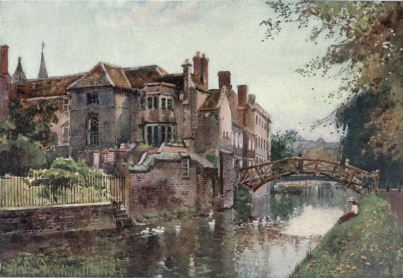
Henry VII. paid five visits to Cambridge and stayed at Queens’ in 1498 and again in 1506 when he occupied a chamber near the audit room. It was on this occasion that he attended the service for the eve of S. George’s day in King’s College chapel clad in the robes of the Garter. Henry VIII. was by his father’s side during this visit, and came again in 1522. Mary came as far as Sir Robert Huddleston’s when Jane Grey was proclaimed. Elizabeth was entertained in the Provost’s lodge of King’s, and it was when repairing to her rooms there after the solemn service in the chapel that she thanked God “that had sent her to this university where she was so received as she thought she could not be better.” James I. visited Cambridge twice in 1615 and was again at Trinity College in 1623 and 1624; Charles I. (who had been Nevile’s guest in 1613) was entertained there in 1632 and 1642; and Charles II. in the long gallery at S. John’s in 1681. Anne was there in 1705, George I. in 1717, and George II. in 1728. Queen Victoria came in 1843 and again in 1847 when the Prince Consort was installed as Chancellor; and Edward VII. visited the university in February 1904.
John had been in Cambridge the month before his death, September 1216; Henry III. was there in the second year of his reign (1218); Edward I. was there as Prince of Wales in 1270, and lodged again in the castle in 1294. Edward II. was the guest of Barnwell priory in 1326. Edward III. was there in September 1328. Richard II. was also lodged at Barnwell in 1388.
The Conqueror had been at Cambridge in 1070.
Matilda is the first queen-consort whom we can picture visiting the university town; Eleanor of Castile was frequently at Walsingham with Edward,[196] and she gave as we shall see a “chest” to the university. Margaret of Anjou was never there, but Elizabeth Woodville came in 1468. The mother of Henry VII. also came to see her college in 1505 and again with the king in 1506. Elizabeth of York accompanied Henry VII. in 1498; Catherine of Aragon slept at Queens’ in 1519; and Henrietta Maria was with the king in 1631-2.
The erection of King’s and Queens’ Colleges opened a period of college building which lasted sixty years, and closed with the foundation of S. John’s (in 1509).
S. Catherine’s College, 1473.
In 1473 Robert Woodlark chancellor of the university and third provost of King’s, and one of the original scholars of that foundation, built a small college dedicated to the Glorious Virgin Martyr S. Catherine of Alexandria, with the object of extending “the usefulness of Church preaching, and the study of theology, philosophy, and other arts within the Church of England.” The present red brick structure was erected two hundred years later, this being the only college except Clare which has been entirely rebuilt since its foundation. S. Catherine’s, or “Cat’s” as the
GATEWAY OF ST. CATHERINE’S COLLEGE This is a view of the old Renaissance Gateway (1679), being the entrance to the College from Queens’ Lane.
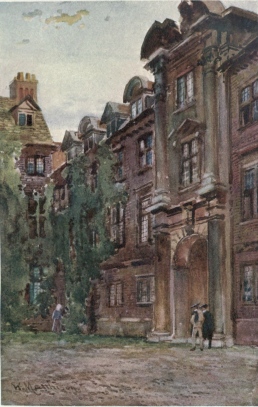
undergraduate familiarly calls it, is remarkable for the number of bishops it has educated, among whom were Archbishop Sandys, May of Carlisle, Brownrigg of Exeter, all of whom were Masters of the college, as was Overall of Norwich who migrated from S. John’s: John Lightfoot, the orientalist, was its 16th Master, and Strype (who came here from Jesus), James Shirley the last of the dramatists,[197] Ray the naturalist, and Addenbrooke the founder of the well known hospital of that name at Cambridge, were also educated here.
The hall[198] was founded for a master and 3 fellows, and now maintains 6 fellows and 26 scholars.
Jesus College 1495.
The next college is a solitary instance of the adaptation of monastic architecture to collegiate purposes in Cambridge. Alcock Bishop of Ely and joint lord chancellor with Rotherham obtained from Alexander VI. (1496/7) the dissolution of the ancient Benedictine nunnery of S. Rhadegund, and founded there a college which he dedicated to the Blessed Virgin Mary, S. John Evangelist, and the glorious Virgin S. Rhadegund. Its name of Jesus College records the growing cult of the name of Jesus, and the substitution was approved by the founder himself.[199]
If at Queens’ we are in a xv century manor-house, at Jesus we are in a monastery; and might well imagine ourselves for a moment back in one of the busiest centres of old Cambridge if we pace the cloisters just before hall time when the stir is suggestive of the life of a great monastery. Even the legend “Song Room” over a doorway falls in with the illusion. James I. said that if he lived in the university he would pray at King’s, eat at Trinity, and study and sleep at Jesus.
The chapel is the original conventual church[200] as rebuilt by Alcock. It contains xii century work, and represents the transition from Norman to Early English. The character of the college has been consistently evangelical in spite of the fact that Bancroft the Laudian archbishop before Laud, was here, and that he migrated here from Christ’s on account of the latter’s reputation for Puritanism. Cranmer was scholar, and fellow until his marriage, and was readmitted fellow when his wife died a year later. Archbishops Bancroft and Sterne, Laurence Sterne, Bale Bishop of Ossory, Strype, Fulke Greville, Fenton, Fawkes (the poet), Hartley, and S. T. Coleridge were members. The college which was founded for 6 fellows and 6 scholars, now maintains 16 fellows and some 20 scholars. The statutes
GATEWAY OF JESUS COLLEGE
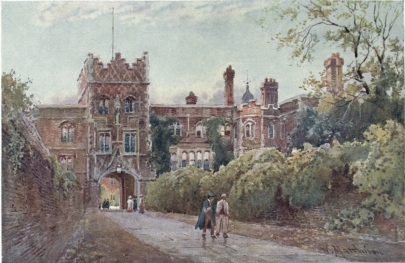
were indited by James Stanley Bishop of Ely, stepson of Lady Margaret, and modified by his successor Nicholas West. Jesus College scholars were commended by the founder to the perpetual tutelage of the bishops of Ely, who when they lie there are said to lie in their own house.[201]
Christ’s College A.D. 1505.
Ten years later a most interesting foundation was made. A college called God’s House had, as we have seen, been founded in the reign of Henry VI. and was appropriated by that monarch as part of the site of King’s College. The foundation was a far-off echo of the plague in the previous century, and when the king took possession of the site he appears to have intended to endow a considerable college in its place in the parish of S. Andrew where he erected another God’s House.[202] It was this design, left unfulfilled (for the house only supported four of the sixty scholars whom Henry VI. had himself proposed to maintain there) that John Fisher, chancellor of the university and Bishop of Rochester, brought to the notice of Lady Margaret Beaufort, daughter of the first Duke of Somerset, Countess of Richmond and Derby, the wife of Edmund Tudor and mother of Henry VII.; and on the site of God’s House she erected her own Christ’s College, and made John Sickling its Proctor first Master. The quadrangle was encased in stone in the xviii century, but the gateway with its statue and armorials of the founder, and the oriel over the entrance to the Master’s lodge recall the founder’s time. Facing the gateway are the hall, the old combination room, and the lodge, and above were a set of rooms reserved for the founder’s own use; a turret staircase led therefrom to both hall and garden, as was the custom in a master’s lodge. On the east of this “Tree court” is a building in the renascence style, thought to be one of the finest examples in England, and to have been the work of Inigo Jones (1642). The gold plate of the college was a bequest of Lady Margaret’s and there is none finer in the university. Christ’s is also noted for its gardens.
No college has been richer in great men. Milton was here for seven years, Henry More the Platonist, Latimer the scholar-bishop and martyr, Leland the antiquary, Nicholas Saunderson, Paley of the “Evidences,” Archbishops Grindal and Bancroft, Bishop Porteous,
THE GATEWAY OF CHRIST’S COLLEGE FROM ST. ANDREW’S STREET The Gateway is coeval with the founding of the College, and dates from the first decade of the sixteenth century.
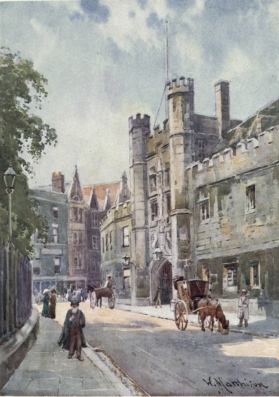
Sir Walter Mildmay,[203] Charles Darwin, and Sir John Seeley. Lightfoot the great Hebraist of his century, and Cudworth, were both Masters in the xvii century; and in the previous century Exmew the Carthusian martyr (1535) and Richard Hall (afterwards Canon of Cambray), Fisher’s biographer, were inmates. Here Milton wrote his hymn on the Nativity, and here he formed his friendship with Edward King—fellow of the college—in whose memory Lycidas was written.
The college was endowed for 12 fellows at least, half of whom were to hail from those northern counties in which both Lady Margaret and Fisher were interested; the total endowment was for 60 persons. There are now 15 fellowships, 30 scholarships (£30 to £70) and some 4 sizarships of the value of £50 a year.[204]
Grammar, the original study of God’s House,[205] and arts were to be studied in addition to theology, but excluding law and medicine; and for the first time in college statutes lectures on the classical orators and poets are provided for, an attention to polite letters for their own sake which is supposed to have been due to the influence of Erasmus.
The Lady Margaret.
The Lady Margaret, for with this title alone her memory is preserved at both universities, has, perhaps, no rival in Cambridge as both an interesting and an important figure in its history. She appears to have been one of the first in that age to understand that the university was to replace the monastery as the channel of English learning, and to endow colleges rather than religious houses. The two splendid foundations which owe their existence to her bear upon them a stronger personal impress than others. Alone of non-resident founders she retained for her own use a lodge in the college she founded. An anecdote when she was staying at Christ’s, preserved for us by Fuller, comes across the centuries vivid with her personality. There is no episode in any university to compare with the scholastic partnership of Lady Margaret and Bishop Fisher, her chaplain, perpetual chancellor of the university, and Master of Michaelhouse. Both were in their measure “reformers before the reformation,” both joined to the spirit of piety an abounding appreciation of the spirit of knowledge. At Cambridge and Oxford she founded those readerships in theology known as the Lady Margaret Professorships, and at Cambridge she instituted the Lady Margaret preachership. She died on 29 June 1509, and Erasmus wrote her epitaph in Westminster Abbey.[206]
Cardinal Fisher, Bishop of Rochester, and perpetual chancellor of the university.
Fisher lived many years after her, and completed the foundation of S. John’s. He pronounced that discourse at her obsequies which is our chief source of information about her.[207] Fisher was imprisoned, like Thomas More, for refusing to admit the