Chapter II · THE COLLEGES (continued 2)
Reading edition
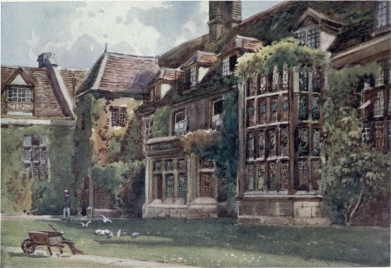
THE FELLOWS’ BUILDING IN CHRIST’S COLLEGE This building is in the Second Court. The design is attributed to Inigo Jones. Through it we pass into the Fellows’ Garden, where we shall find the famous mulberry tree sacred to Milton.

royal supremacy in things ecclesiastical; covered with rags, and worn with neglect and ill-treatment, but consoled by a filial and courageous letter from his sons at S. John’s, he was led out to die on June 22, 1534, the New Testament in his hand open at the words: “This is eternal life, to know Thee the only true God.” He stands alone among the bishops of England to give his life for the principle for which the layman Thomas More laid down his. Pole in a letter to Charles V. narrates that Henry VIII. had said he supposed “that I” (Pole) “had never in all my travels met one who in letters and virtue could be compared to the Bishop of Rochester.”
S. John’s College, A.D. 1509.
We next come to the most splendid foundation hitherto realised at Cambridge. The site chosen for a college which held its place through the xvi century as the first and most brilliant society in the university, could not have been more appropriate. It was that of S. John’s Hospital, the first home of Cambridge students, the nucleus of the university, erected soon after the Conquest in the heart of the Norman town, and whence the first endowed scholars in christendom set forth to found a college.[208]
The whole history of the university is epitomised in the street which has S. John’s at one end of it and Peterhouse at the other: the bishops of Ely have firm hold of either end, and lying against S. John’s is that Pythagoras House which Merton bought from the Dunnings when he was planning his famous foundation in the xiii century. We have seen that it was at S. John’s Hospital that Balsham introduced secular scholars in the same century, who should become unum corpus et unum collegium with the canons. The experiment did not succeed, and the canons saw the scholars depart with great relief to the other end of what was to prove the great street of colleges, whose limits were determined by this early conflict between seculars and religious.
In what year the Ely scholars were settled at S. John’s remains uncertain, although there is no more important date in Cambridge history. Simon Montacute, Bishop of Ely, “who knew very well” as the historian of S. John’s observes, says that the scholars had continued there per longa tempora, and Baker
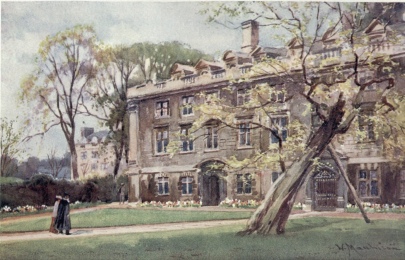
MILTON’S MULBERRY TREE IN THE FELLOWS’ GARDEN, CHRIST’S COLLEGE King James I. is said to have introduced the culture of the mulberry tree, and it is probable that the one in this garden is the last survivor of a number bought in 1609. Milton was admitted to this College in 1625.
considers that in no construction of words can this be understood otherwise than as referring to the beginning of Hugh Balsham’s prelacy at Ely.[209] The licence permitting the seculars to be engrafted on the old stock with their own endowment, is dated the ninth year of Edward I. (1280)[210] and the transference to Peterhouse took place three years after; but the date of the royal licence is no proof that the work to which it refers was initiated rather than completed and crowned in that year; Margaret of Anjou, for example, obtained her licence when three sides of the quadrangle at Queens’ were nearing completion.[211] In any case the few months intervening between December 23, 1280 and the decision to remove to Peterhouse could not be described as a “long time,” and as Balsham had become bishop of the diocese in 1257 it is most probable that he at once set about what it must certainly be supposed he had at heart while still subprior of Ely.
With S. John’s we have the first of the large colleges. Henceforth Trinity and John’s are “the big colleges” the others are “the 14 small colleges.” It now consists of four large courts, three of which are of brickwork. The first court was erected between 1509-1616 on the pattern of the quadrangle at Christ’s. The founder’s grandson Henry VIII., whose coronation she lived to witness, not only sequestrated a large part of the funds she had destined for the building, but fifteen years later beheaded Fisher her executor. The latter himself subscribed to the fund and was able before he died to erect a college for a Master and 21 fellows—the original design being for 50 fellows. But what thus fell short of the spirit of the earlier design has since been amply repaired, and a series of benefactors have made the college one of the most useful in England, with that large influence on the nation and large power of helping poorer students which its founders had so greatly at heart.
The Second Court was built chiefly at the expense of Mary Countess of Shrewsbury in 1595-1620. The Third Court was begun in 1623, with funds provided by Williams then Bishop of Lincoln, and finished by benefactors some of whom remained anonymous. The last Court was built in 1826 and is joined to the college by the “Bridge of Sighs.” Beyond this is the beautiful “wilderness” commemorated by Wordsworth.
—— Scarcely Spenser’s self Could have more tranquil visions in his youth
he tells us, than he had had loitering in Cambridge nights under a “fairy work of earth,” a certain lovely ash, wreathed in ivy. This is the site of the infirmary of the canons, the only portion of whose Hospital to be preserved was adapted as a college infirmary and was at the north side of the First Court: it was destroyed in 1863 when the present large chapel was built, which is the work of Gilbert Scott, and is 193 feet long. The large hall
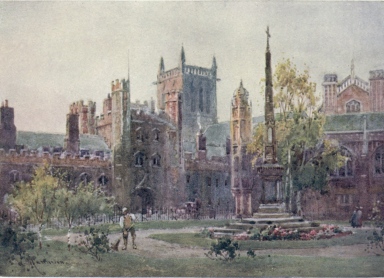
THE GATEWAY AND TOWER OF ST. JOHN’S COLLEGE The Kirke White memorial is seen in the foreground, and behind it are the Divinity Schools; to the left is the Gateway of St. John’s, with the Tower behind it. The enclosed space in the foreground was formerly the site of All Saints’ Church, pulled down in 1865.
measures 108 feet, and the portrait of Lady Margaret presides over the high table. The new combination room, which is now entered from the second court, was built in 1864, and is 93 feet long. The west side of the Third Court is cloistered, and from here leads the covered bridge, called from its resemblance to the bridge at Venice “the Bridge of Sighs.” The stone bridge near it supplanted the old timber bridge in 1696. As at Queens’, there is a long gallery on the first floor of the Second Court. Nowhere has the original modest “master’s lodging” undergone more change than here. The lodging—two rooms over the old combination room, with an oriel, on the first court—was gradually extended, again as at Queens’, along the gallery, and ran along part of the next court. Finally Scott built the present lodge, outside the courts altogether.
Christ’s and S. John’s are both profusely ornamented with the Tudor and Beaufort badges of the founder, and with her name-device the marguerite.[212] The ancient gateway has a canopied statue of the Evangelist. To the north and south of the new chapel porch are statues of Lady Margaret and of Fisher, and 16 statues of the benefactors and great members of the college: Mary Cavendish Countess of Shrewsbury, Sarah Alston Duchess of Somerset, Williams Archbishop of York, and Linacre who founded the Physics lecture here and at Merton Oxford, appear among the former. Among the latter are Roger Ascham (fellow) (those asterisked are effigied); Sir John Cheke (fellow); *Bentley; *Cecil Lord Burleigh; *Lucius Lord Falkland[213]; Fairfax, the parliamentary general; *Wentworth Lord Strafford; *Stillingfleet, *Overall,[214] *Gunning, and Selwyn, prelates; *William Gilbert; *Brook Taylor the naturalist; *Clarkson the opponent of the slave trade; Cave the ecclesiastical historian; Metcalfe the most brilliant of its masters[215]; Matthew Prior, Grindal the classic, Cecil Lord Salisbury, Ben Jonson, Wordsworth, Kirke White, Rowland Hill, Henry Martyn the missionary, Horne Tooke, Castlereagh, Palmerston, Wilberforce, Erasmus Darwin, Colenso, Herschell, Liveing, Adams the discoverer of Neptune, Benjamin Hall Kennedy, and *Baker the historian of the college. Fisher arranged a small chapel leading from the college chapel for his own resting place.[216] The site of S. John’s chapel is as old an ecclesiastical site as Jesus chapel: the xvi century edifice was constructed close to the xii century canons’ church, and the fine modern chapel is on the same site.
The licence for the college dates from 1511; the building was opened in 1516; and the statutes were drawn up by Fisher.
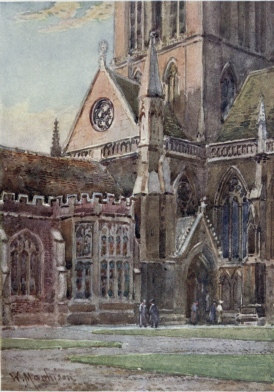
ENTRANCE TO ST. JOHN’S COLLEGE CHAPEL FROM THE FIRST COURT In the corner on the right is seen the Doorway of the Chapel, with the tower rising above it. On the left is part of the Hall with a fine oriel window.
There are now 56 fellowships, 60 foundation scholars each receiving £50 annually, and 9 sizars £35 annually.
The next college which claims our attention must rank among the more interesting foundations on account of its origin rather than of its subsequent history.
Magdalene College, A.D. 1542.
Near S. John’s Hospital there was a site traditionally connected with the lectures of Abbot Joffred’s monks in 1109, and which in fact was afterwards Crowland Abbey property. When a monastic order possessed no convent in a university town, the monks were obliged to reside in lodgings, and this led, as we have already seen (i. p. 49) to the foundation of monastic hostels for their reception. There were two such hostels at Cambridge—Ely hostel and Monks’ hostel. Ely hostel was the direct outcome of Benedict XII.’s Constitution in 1337[217] which reconfirmed an earlier injunction of Honorius III. 1216-27 requiring the Benedictines and Augustinians to send students in rotation from the monastery to the university, and provided that monks should live at the universities under a prior of Benedictines. It was purchased in 1340 (or earlier) by John de Crawden prior of Ely for the Ely monks and was made over to Bateman Bishop of Norwich seven years later for his foundation of Trinity Hall.
Ely then had been the pioneer in providing this accommodation, which served for Ely monks alone, and which, as we see, was speedily abolished. Those few Houses which still elected to send their monks to Cambridge[218] maintained them there thenceforth under the care of “the prior of students”; and it was owing to the energy of one of these Cambridge priors that Monks’ hostel was projected in 1428, at a time when, as is then stated, no house existed for Crowland or other Benedictine monks, and the religious either shared the hostels with seculars or lived in lodgings in the town. The site for Monks’ hostel consisted of two messuages granted in that year to the abbot of Crowland by the Cambridge burgesses. Crowland, Ely, Ramsey, and Walden each built portions for their own students.[219] Nearly a hundred years later, on the eve of the Reformation, Edward Stafford Duke of Buckingham refounded this hostel as Buckingham College. It was not
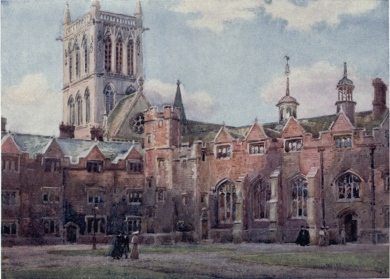
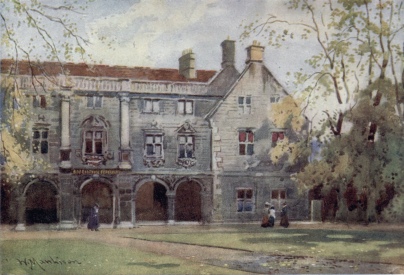
THE SECOND COURT OF ST. JOHN’S COLLEGE The doorway on the right leads into the First Court. The Dining Hall is in the building on the right and the Combination Room on the left of the picture. In the background is the Chapel Tower with the sunset light upon it
completed at the time of his attainder two years afterwards (1521) and the property escheated in due course as a cell of Crowland Abbey to the crown.[220]
How soon Monks’ hostel became “the monks’ hostel of Buckingham” is by no means clear. That the Dukes of Buckingham were early patrons must be admitted on the evidence; for even if the house was not known as Buckingham College in 1465, it was known as “the hostel called Bokyngham college” in 1483 while it was still Crowland property, and both hall and chapel were probably the gift of “deep revolving, witty Buckingham” the second Duke Henry.
“I have in this world sustained great damage and injury in serving the king’s highness, which this grant shall recompense.” So wrote Lord Chancellor Audley in a letter begging for a share of the plunder when Henry had determined on the suppression of the monasteries. The share he wanted and got was Walden Abbey in Essex on the borders of Cambridgeshire, and here he established himself on the site which his son was to transform into the mansion of Audley-End. He did more; he proposed to himself, apparently, some sort of expiation to balance the “recompense,” and in 1542 changed Buckingham into Magdalene College which he re-endowed. We have seen that Walden Abbey was itself one of the builders of Monks’ hostel.
The mastership of the college is in the gift of the owner of Audley-End (now Lord Braybrooke). Nothing of the xv century building remains. A window of Pugin’s adorns the chapel[221] replacing the old altar-piece which is now in the library. The combination room leads from the musicians’ gallery of the pleasant hall, the only instance of this arrangement in Cambridge.[222] In the time of Fuller, Magdalene was a college of reading men: “The scholars of this college, though farthest from the schools, were in my time the first to be observed there, and to as good purpose as any.”[223] Twenty years ago it was the fashionable college, and its members lived in private lodgings, attending neither hall nor chapel. Magdalene is in the parish of S. Giles, and it has been conjectured that it occupies the site of the house of the canons of S. Giles before they removed to Barnwell. There is however no evidence for this, and there are no documents at Magdalene earlier than Stafford’s time.[224]
Archbishop Grindal,[225] Robert Rede chief justice in 1509, Cumberland Bishop of Peterborough, and Kingsley were educated here. So was Pepys, the diarist, who bequeathed to the college his extraordinary collection
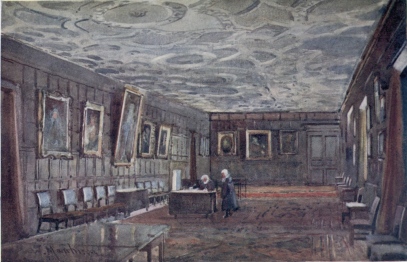
THE COMBINATION ROOM, ST. JOHN’S COLLEGE This Gallery is used by the Fellows and is 93 feet long. It contains portraits of many College worthies. The approach to it is by a Turret Staircase in the Second Court. Its panelled walls and rich plaster-work ceiling make it one of the finest specimens of its kind left in England.
of books, engravings, maps, and plans. The Pepysian library is now preserved in a separate hall, in the donor’s own bookshelves constructed after a plan of his own. It is by far the most interesting thing in the college, and would be unique anywhere. It is to be hoped we may soon have an official catalogue of its contents.
Magdalene is a small college, it has about 40 inmates, of whom 5 are fellows. In Fuller’s time it held 140 persons, 11 being fellows and 22 scholars, the rest being as usual the college officers, domestics, and students.
Trinity College A.D. 1546.
With Trinity College are joined together in indissoluble matrimony the two great periods of college building, and the culminating point of the renascence is reached: so that Trinity, alone, represents Cambridge architecturally and morally in its historical character of a university of the rebirth from its dawn to its meridian.
King’s Hall A.D. 1337.
When Henry VIII., whose effigy adorns the great gate, proposed to make a vast college on this site, he was proposing to expand the “great college” built by Edward III. whose effigy graces the older gateway within the court. Edward II. had maintained thirteen students at Cambridge as early as 1317 and the number was increased later to thirty-two: it was however left to his son to carry out the design of a “House-of-Scholars of the King.”[226] We have already had frequently to refer to this building, in which new interest has been awakened since the restoration (in 1904-6) of part of the old Hall lying behind King Edward’s gateway towards the bowling green, and presenting architectural features fully justifying its xiv century fame as the most considerable collegiate enterprise thitherto undertaken. The Hall lay to the north west of the present quadrangle, covering the space now occupied by the ante-chapel,[227] Edward’s gate, and the Master’s lodge. The acquisition of the site affords a most interesting glimpse into contemporary Cambridge history: for no site represented such various interests and recalled so many of the great local names. The first plot of ground obtained was a messuage of Robert de Croyland’s in 1336. Eight years later Edmund Walsyngham’s house was purchased; the house of Sir John de Cambridge who was knight of the shire and alderman of the guild of S. Mary was sold to the college in 1350 by his son Thomas; and the next year saw the purchase from Thomas son of Sir Constantine de Mortimer, of a waste parcel of land next the river and S. John’s Hospital, called the Cornhythe, which abutted on the last named property. Croyland’s and Walsyngham’s houses were first adapted, and formed a small irregular quadrangle. Later in the xiv century a new (irregular) court was constructed on the north of the present chapel. The original entrance was situated where the sundial now is; here stood the Great Gate, the present
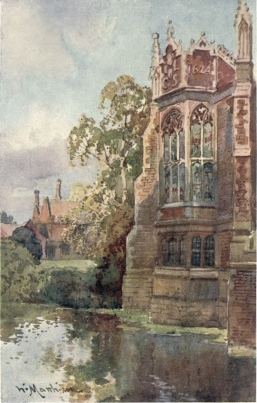
THE LIBRARY WINDOW, ST. JOHN’S COLLEGE, FROM THE BRIDGE OF SIGHS From this spot beautiful views are obtained up and down the river.
Entrance Gate being built as late as 1535 to give King’s Hall a frontage on the High Street. The Hall rebuilt in the later xiv century and added to in the xvth was however only the nucleus of Henry VIII.’s college. To the south west stood Michaelhouse; this too was absorbed in the new building, and its second dedication to the holy and undivided Trinity was retained in Henry’s college. Seven other buildings—all university hostels—were also absorbed—Gregory’s, Crouched, Physwick, S. Margaret’s, Tyled, Gerard’s, and Oving’s. The present kitchen occupies part of the site of Michaelhouse; Physwick stood between the Queen’s Gate and Trinity Street; and the other hostels were grouped round these in S. Michael’s and King’s Hall Lanes.[228]
The work which had been begun by Lady Margaret at Christ’s and S. John’s—the final substitution of the college for the monastery school—was now completed by her grandson, the great despoiler of the monasteries, who appears to have designed Trinity College as a splendid atonement for the destruction of so many homes of learning. It was largely endowed with abbey lands, and Henry’s undeniable interest in erudition seems to have found its ultimate satisfaction in a foundation into which there entered every element of that “new learning” which was humanistic before it was Protestant. That provision was here to be made for a wider field of knowledge than any hitherto contemplated in or out of a university, seems amply proved by the words of the founder; who, after declaring that the college is intended for the “development and perpetuation of religion” (a well-chosen form of words?), continues thus: “for the cultivation of wholesome study in all departments of learning, knowledge of languages, the education of youth in piety, virtue, self-restraint, and knowledge; charity towards the poor, and the relief of the afflicted and distressed.” The programme was so liberal that Mary herself endowed the college with monastic property, and Elizabeth completed the chapel which her sister had begun.
No building, indeed, in either university suggests in the same way and in the same degree that delightful mental combination of form and space which is the mark of the “Cambridge mind” in science if it is not so in literature. As we pass into the great court the buildings we see neither shut out the light nor hem in the thoughts. The enclosure they suggest is that formal enclosure of point and line which enables us to make propositions about infinity. Of all scholastic buildings in the world the great court of Trinity is that which best suggests the majesty and spaciousness of learning. Here one receives an impression of adequacy, balance, clearness, spaciousness, elevation, serenity, a certain high power of the imagination—the mathematical qualities, the qualities of the seeker after truth: an impression of the simple force of what is simply clear, the simple grandeur of that which can dispense with the mysterious; of the dignity which accompanies those who have looked upon things as
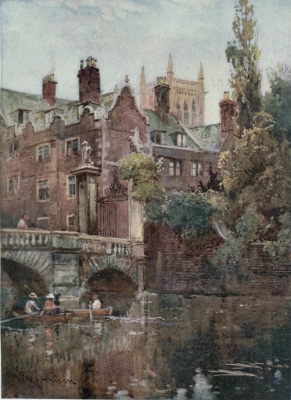
OLD GATEWAY AND BRIDGE These buildings form part of St. John’s College, and look on to the river. The Tower of the College Chapel is seen in the background.
they are in themselves, and have nothing adventitious to offer, yet what they offer holds a curious power of satisfying.
Does a man see all this as he walks into Trinity and learn from it the lesson which Cambridge spreads before him, or does he take it with him under the gateway and let Trinity Great Court represent for him what he already knows of Cambridge? What does it matter whether it suggests so much or is allowed to represent so much?
Trinity Great Court covers more than 90,000 square feet—an area of over 2 acres—and is the largest in any college. The building, carried out under Edward VI., received considerable modification during the mastership of Nevile (1593-1615) dean of Canterbury, who arranged the court on its present plan, erected the “Queen’s gateway” and the fine renascence fountain, enlarged the original lodge, and built the hall and kitchen. On the west side, facing us as we enter, is the hall (1604) which was modelled on that of the Middle Temple. Next it are two combination rooms—the centre for generations of Cambridge fellows who first had their assembling room in King’s Hall hard by[229]—but the façade here was spoiled in the xviii century when the oriel and frontage of the old hall of Michaelhouse were removed. A Jacobean porch leads us into the lodge, which occupies the site of King’s Hall lodge. The great scholar Bentley, Master from 1700 to 1742, built the staircase and otherwise left his mark here. His excursions into the classical were, however, curtailed during the mastership of Whewell (1840) when Alexander Beresford Hope subscribed to restore the Gothic character of the front and built the picturesque oriel.[230] The inscription stating that he had restored its ancient aspect to the house during the mastership of Whewell gave rise to the following amusing paraphrase:—
This is the House that Hope built. This is the Master, rude and rough, Who lives in the House that Hope built. These are the seniors, greedy and gruff, Who toady the Master, rude and rough, Who lives in the House that Hope built.[231]
A.D. 1555-1564.
The chapel, on the north, was built by Mary, and
PEPYS’ LIBRARY, MAGDALENE COLLEGE This range of old buildings houses the Pepysian Library. The style is seventeenth century.
is one of the few churches erected in her reign, as Trinity College is itself one of the few places where her name is held in affection. Though it has none of the greatness of King’s chapel, it yields to none in interest. The site is that of the chapel of King’s Hall built for the scholars by Edward IV., the materials of which, with stone from the Greyfriars’ house, the fen abbey of Ramsey, and Peterhouse, and lead from the Greyfriars and Mildenhall, were used in the construction. Elizabeth completed it nine years later (1564). The ante-chapel contains the statue of Newton,
—— with his prism and silent face, The marble index of a mind for ever Voyaging through strange seas of Thought, alone
a work of Roubiliac’s considered by Chantrey to be the noblest of English statues. Bacon, Barrow, Macaulay, and Whewell have also statues here, while Richard Porson is commemorated by a bust. Along the wall which faces us as we enter are sixteen memorial brasses chiefly to remarkable fellows of the college who have died within the last twenty years.
The great court leads in the usual way, by hall and butteries, to Nevile’s court, another work of Dr. Nevile’s, and here the library—to the building of which Newton contributed—was erected by subscription, the foundation stone being laid on February 26, 1676. The architect was Wren who also designed the bookcases of the “stately library” as those who had determined on its foundation had called it in anticipation. The wood of the cases is Norway oak which has been stained to imitate cedar. The building is very rich with decoration inside and out; the length is 194 feet as compared with the chapel 210 feet and the hall 100 feet. The staircase and pavement are of marble. Pedestals with busts of members of the college line the room on either side. The library contains 90,000 volumes, with 1900 MSS. including a Sarum missal on vellum of 1500, Milton’s rough draft notes of “Paradise Lost,” the Codex Augiensis of Paul’s Epistles, four MSS. of Wyclif’s bible, and the Canterbury psalter.[232]
A New Court, to which George IV. contributed, was erected in the first quarter of the xix century and Dr. Whewell built, at his own expense, the Master’s Court. Upon the site of Garret’s hostel, the then bishop of Lichfield erected in 1670 a small building known as “Bishop’s hostel” which is used as students’ quarters, and the proceeds of letting it are spent according to the founder’s direction in the purchase of books for the library. Macaulay “kept” here when he first went up to Cambridge.
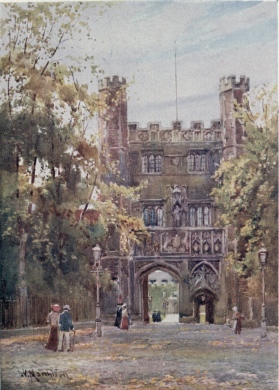
THE GATEWAY OF TRINITY COLLEGE The Great Entrance Gate, constructed about 1518-35. The panels over the arch commemorate King Edward the Third and his six sons. The Master’s lodge is seen in the distance through the gateway.
The Mastership.
The Mastership of Trinity has been, ever since the Reformation, one of the most important offices in the university; but it is rendered still more distinguished by the great men who have successively filled it. The last Master of King’s Hall became the first Master of Trinity and has had among his successors Isaac Barrow, William Bill, Whitgift, Wilkins, Bentley, and Whewell. Its chief benefactor Nevile was eighth Master.
Trinity has been equally great in literature and science, and has effected more for both in the three hundred and fifty years of its existence than any other centre of learning. Among its fellows it counts Newton, Adam Sedgwick, Ray, Barrow, Porson, Roger Cotes, Macaulay, Whewell, Westcott, Airy, Clerk Maxwell, Cayley, Hort, Thirlwall, Jebb. Among lawyers Bacon, Coke, and Lyndhurst; among prelates Tunstall,[233] Whitgift, Lightfoot. Among other famous alumni are Robert Devereux, Cotton, Spelman, Thackeray, Granville (M.A. 1679), Peacock, Kinglake, Trench, De Morgan, F. D. Maurice, and the late Duke of Rutland (Lord John Manners). Among poets, Byron, Dryden, Andrew Marvell, Tennyson, Donne, Cowley, George Herbert, Monckton-Milnes. Another historic friendship like that between Spenser and Kirke at Pembroke, Milton and King at Christ’s, and Gray and Walpole, grew up in the shadow of Trinity—the friendship of Tennyson and Arthur Hallam commemorated in In Memoriam.
There are 60 fellowships, 74 scholarships worth each £100 a year, and 16 sizarships of the value of £80 each. The students of Trinity number one-fourth of the undergraduate population. The college is not only the largest but the most important scholastic institution in the world: “being at this day” writes Fuller, “the stateliest and most uniform college in Christendom, out of which may be carved three Dutch universities.” Among the college livings are the university church of S. Mary’s, S. Michael’s (the old church attached to Michaelhouse) Chesterton Vicarage and several rectories and vicarages in the dioceses of Ely, York, Lincoln, Lichfield, London, Peterborough, and Carlisle, which include most of those belonging to King’s Hall and Michaelhouse, with the exception of the Norwich benefices.[234]
Gateways.
The gateway of Trinity with its four towers, the two interior being the larger and furnished with staircases, reminds us that the ornamental gateway was the last architectural addition to the college quadrangle. The first ornamental archway was the great gate built for King’s Hall in 1426.[235] It was copied in the turreted gateway of Queens’ College, and afterwards in the old gateway of King’s,[236] and in the present gateways of
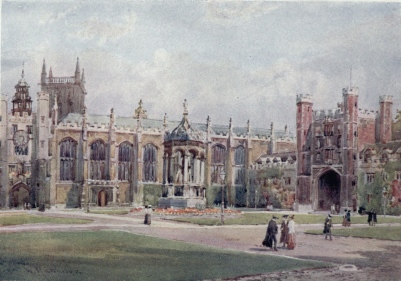
THE GREAT COURT, TRINITY COLLEGE The largest at either University or in Europe. We see the Great Gate in the picture on the right, facing us—the Chapel. To the left of the Chapel is seen King Edward’s Gate, fourteenth century. The beautiful Fountain in the middle of the picture is in the Renaissance style, and was built by Nevile in 1602, and rebuilt in 1716.
Christ’s and S. John’s, and even in that second gateway of King’s Hall which is the present entrance gate of Trinity.[237] The only gateway in Cambridge which varies completely from these models is Alcock’s at Jesus, which is much lighter in character. The xvi century gateways of Caius are “the first specimens of the revival of stone work.”[238] The ornamental gateway is a distinctive feature of Cambridge college architecture. The room over the gate was used as a muniment room; in S. John’s the chamber in the tower serves this purpose.
Caius College A.D. 1557.
In 1557 Doctor John Keys (whose name was Latinised as Caius) built and incorporated with Gonville Hall a college for scientific research and medical studies—the illustrious society which has since been known as Gonville and Caius College.
Keys or Caius was one of the great physicians of the xvi century; physician to Edward VI., Mary, and Elizabeth, and President of the College of Physicians. He was a Yorkshireman by race but a native of Norwich, and had been Principal of Physwick hostel which was at that time attached to Gonville Hall. Italian universities had turned his mind from the study of divinity to that of medicine and he became a doctor in that faculty at Padua in 1541, two years after leaving Cambridge. At Padua he lived with one of the earliest anatomists—Vesalius; and he himself lectured for twenty years on anatomy to the surgeons in London, at the request of Henry VIII.[239] He was Master of the college of which he was co-founder, but regularly spent the emoluments on fresh buildings at Caius. He was not only a great naturalist, the first English anatomist, a great physician, and an eminent classic,[240] but also a distinguished antiquary, and to him we owe one of the most valuable histories of the university. He had withal “a perverse stomach to the professors of the gospel,” and clung like Metcalfe of S. John’s and Baker of King’s to the old religion and the old ways of worship.[241] He is buried in the college chapel, and the simple words Fui Caius are inscribed over him. The foundation-stone of Caius he had himself inscribed: Johannes Caius posuit sapientiae; “John Caius dedicated it to knowledge.”
He built his college in two parallel ranges, east and west; a chapel and the Master’s lodge occupying the north side. On the south was a low wall with a gateway. “We decree,” he writes in the statutes of Caius, “that no building be constructed which shall shut in the entire south side of the college of our foundation, lest for lack of free ventilation the air should become foul.” This appreciation of the all-importance of air and sun to living organisms was more than three hundred years in advance of his time. If his instructions be not carried out, he says, the health of the college will be impaired, and disease and death will ensue. Closed quadrangles had been built in Cambridge ever
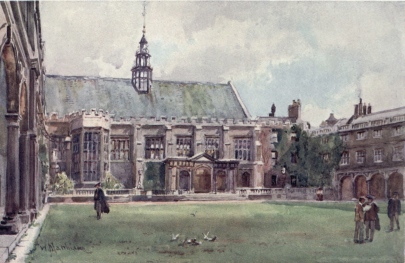
THE HALL OF TRINITY COLLEGE FROM NEVILE’S COURT This is sometimes called the Cloister Court, and was built at the expense of Dr. Nevile about 1612. The principal building in this picture is the Dining Hall with its beautiful oriel window. Passing up the steps and through the passage we enter the Great Court, where we get another fine view of this Hall. Lord Byron occupied rooms in Nevile’s Court.
since the erection of Pembroke College, but no more were built there after the time of Caius.[242] Andrew Perne of Peterhouse was a contemporary stickler for hygienic conditions in the colleges; he saw to it that only pure water should be available “for the avoiding of the annoyance, infection, and contagion ordinarily arising through the uncleanness” of King’s Ditch “to the great endammaging” of health and welfare.
The college founded by Gonville is still known as Gonville Court in the joint college; but the other buildings are entirely new and make a modern show at the corner of King’s Parade not necessarily justified by the modernness of the science pursued within their walls.
In the xv century Gonville was peopled with monastic students: it is said that when Humphrey de la Pole and Gresham were studying there the other scholars were nearly all religious. If the monks of Ely, Crowland, Ramsey, and Walden lived at Monks’ hostel, the monks of Norwich priory had been allowed by a special papal exemption to continue to frequent Gonville and Trinity Halls, as they had done since Bateman’s time.[243] The Suffolk monks of Butley, black Benedictines from Bury, Cistercians from Lewes, and Austin canons from Westacre in Norfolk were also to be found there.[244] Gonville Hall was always regarded as the papal favourite at Cambridge; yet by 1530 Nix Bishop of Norwich in a letter to the primate Warham asserts that not one of the clerks at Gonville but “savoured of the frying pan.”
Caius has always been a doctors’ college; Harvey, Glisson the anatomist, and a long roll of eminent surgeons and physicians here received their education. Jeremy Taylor and Sir Thomas Gresham the only one of the Merchant Adventurers known to have been at a university, and founder of the Royal Exchange, were also sons of this house; as was Samuel Clarke (b. Norwich 1675) the metaphysician, “the lad of Caius.”
There are 22 fellows and some 36 scholars and exhibitioners, the value varying from £100 down to £20. There are also two chapel-clerkships (£38 for one year), and the Tancred medical studentships each worth £100 a year.
Emmanuel 1584.
We now come to the last two colleges to be founded in the xvi century. Emmanuel was founded by Sir Walter Mildmay, Chancellor of
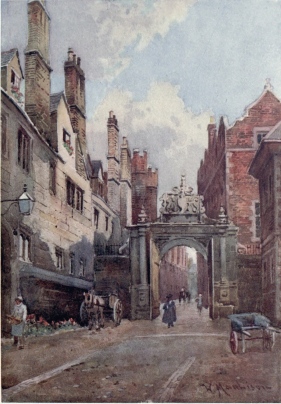
NEVILE’S GATE, TRINITY COLLEGE To the left are the College kitchens and on the right is Bishop’s Hostel. The buildings on the left are among the most ancient in this college. Through the picturesque old gateway we see up the lane into Trinity Street.
the Exchequer to Elizabeth, in 1584, his object being to plant the seed of Puritanism in the university. The site he chose was the suppressed house of the Dominicans, and Ralph Symons, the architect who worked with so much skill and judgment at S. John’s and under Nevile at Trinity, converted the friary buildings into the Puritan college. The friars’ church is now the college hall and the library which at one time served as a chapel was it is said the convent refectory. The college chapel was built, from Wren’s designs, by Sancroft Archbishop of Canterbury (1668-78); and the college itself was rebuilt in the xviii and xix centuries. Emmanuel has preserved an evangelical character, the relic of its original Calvinism in doctrine and Puritanism in discipline; and the clerical students of Ridley Hall are recruited chiefly from here. “In Emmanuel College they do follow a private course of public prayer, after their own fashion”; the chapel used was unconsecrated, the communion was received sitting. The contrast must have been all the greater at this time—the beginning of the xvii century—when incense was burning and Latin was sung in other Cambridge chapels.
The name of Emmanuel College recalls the movement with which it was connected later in that century: when Whichcote, Cudworth, Smith, and Culverwell of Emmanuel, and More of Christ’s led the van of philosophic thought.[245] Besides Cudworth, Emmanuel has nurtured at least four eminent representatives of learning and science, Flamsteed, Wallis, Foster, Horrox; and one great statesman, Sir William Temple; and as a representative churchman, Sancroft who was also Master of the college. Samuel Parr was here; and William Law, the author of the “Serious Call,” was a nonjuring fellow. Harvard went from Emmanuel to America where he founded the university which bears his name.
There are 16 fellowships, 30 scholarships, and 4 sizarships.
Sidney Sussex 1594.
Sidney Sussex, the last of the xvi century colleges, was also built in Elizabeth’s reign, on the site of the Greyfriars’ as Emmanuel rose on the site of the Blackfriars’ house. Frances Sidney, daughter of Sir William Sidney and wife to the third Earl of Sussex, bequeathed the money for the foundation, and her executors purchased the property from Trinity College. The ubiquitous Ralph Symons was the architect; but the college was modernised in the early xix century. There are two courts: the hall and lodge in one, the chapel and library in the other. In this last is a x century pontifical from a northern diocese, probably Durham. The character of the college has always remained Protestant, this and Emmanuel being the first Protestant foundations in the university. Oliver Cromwell was enrolled a member the day of Shakespeare’s death, and Fuller the ecclesiastical historian was here for many years. Sterne the founder of the
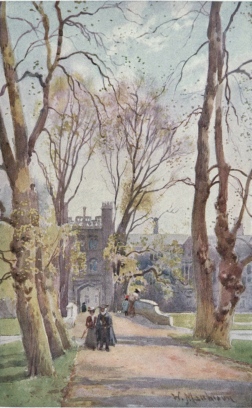
TRINITY COLLEGE BRIDGE AND AVENUE, WITH GATE LEADING INTO THE NEW COURT The Bridge was built in 1763 by Wilkins. The trees in the Avenue in foreground were planted in 1671-72.
Irish College of Surgeons, Archbishop Bramhall, Henry Martyn,[246] May the poet, and Seth Ward are among its worthies. Edward Montague, Earl of Manchester, of whom the historian writes that he “loved his country with too unskilful a tenderness” was a member of this college, and carried out Cromwell’s destructive programme at his university. No one mentions the founder of Sidney Sussex without saying that she was aunt to Sir Philip, and it is a title of honour even for the founder of a college: did not Fulke Greville have himself described in his epitaph as “Frend to Sir Philip Sidney”?
There are 10 fellows and 36 scholars on the foundation, besides sizarships of the value of £27 a year.
Downing 1803.
One college has been built at Cambridge in modern times. The founder, who bequeathed his property for the purpose, was Sir George Downing of Gamlingay Park, Cambridgeshire, whose father was a graduate of Clare. Wilkins (the architect of the modern portions of King’s and Corpus and of the New Court of Trinity) began the structure in 1807, but he only completed the west and east sides. The town has since grown up to the college, which has large pleasure grounds. A “Downing” professorship of law and another of medicine were also endowed by the founder. Six of the 8 college fellowships must be held by students of law or medicine; and there are 10 scholars on the foundation.
Taking the place of the older hostels, but inversely as regards their relative proportion to the colleges, there are now 6 hostels, colleges in all but university status, with resident students reading for the usual university examinations. There are also two post-graduate hostels. The oldest of these are Newnham (1871) and Girton (1873) which are described in another chapter. Cavendish College on the Hills Road was opened in 1876 by the County College Association and admitted students from sixteen years old. It was recognised as a public hostel (November 9, 1882) but was closed nine years later.
Ridley Hall was erected in 1880 for theological students who have taken their degree. Its object is the maintenance of Reformation principles.
Selwyn College was founded in 1882, by subscription, in memory of Bishop Selwyn, and for the maintenance of Church of England principles, to whose members it is restricted. This institution occupies a somewhat anomalous position in the university, for it is the only hostel on avowedly “denominational” lines publicly recognised by and therefore forming part of the academic society. Cambridge has set its face against the recognition of colleges intended to meet the interests of one religious section of the community to the exclusion of others, on the ground that members of all religious communities may now receive instruction in any of the colleges, and suffer no interference with their religion, and also in pursuance of the main principle that a university education is of greater use
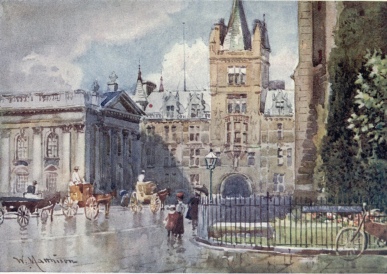
CAIUS COLLEGE AND THE SENATE HOUSE FROM ST. MARY’S PASSAGE On the left is the Senate House, built 1772-30. The building facing the spectator is the South Front of Gonville and Caius College by Waterhouse (1870). Through the railings on the right is the Tower of Great St. Mary’s. The street is King’s Parade.
and value when young men are not classed and separated according to their religious divisions. Thus when the Catholic hostel of S. Edmund applied for recognition in 1898, the “grace” was refused, in spite of the fact that many members of the university unconnected with any religious denomination, voted in its favour. S. Edmund’s House was founded by the Duke of Norfolk in 1897, and is for clerical students working for a tripos or other advanced work recognised in the university. It ranks as a licensed lodging house. A Benedictine hostel, Benet House, was founded in the same year, and supported by the father of the present abbot of Downside. A few professed monks, who are entered as members of Christ’s or some other college, pursue there the usual university course.
Westminster College is a post-graduate college for the Presbyterian Church of England, founded in Cambridge in 1899 (removed from London).
Cheshunt theological College, founded by the Countess of Huntingdon in 1768, has just been removed to Cambridge, and is there lodged in temporary premises. Undergraduate and post-graduate students are received, the former being non-collegiate members of the university. Students and staff must be of the Evangelical Reformed faith, but are free to enter the ministry of the established or any Free Church responding to that description.
These four last are the result of the abolition of the test act (1871) which kept our universities closed both to catholics and nonconformists: but Benet and S. Edmund’s houses were projected when the prohibition to catholics, maintained by Cardinal Manning, was withdrawn.
A note on the nationality of Cambridge founders.
Hugh de Balsham, founder of Peterhouse, 1284, Cambridge. Ob. 1286, bur. before the high altar, Ely.
Hervey de Stanton, founder of Michaelhouse, 1324. Ob. York 1327, bur. in S. Michael’s church near his college.
Richard de Badew, founder of University Hall, 1326, Chelmsford, Essex.
King’s Hall, Edward II. and Edward III., 1337.
Elizabeth de Clare, founder of Clare Hall, 1338 b. at Acre of Norman settlers in England, Wales and Ireland; married to two Irishmen. Ob. 1360, bur. Ware, Herts.
Marie de Chatillon, founder of Pembroke Hall, 1347. French, married a Welsh earl. Ob. 1377, bur. in the choir of Denney Abbey.[247]
Edmund Gonville, founder of Gonville Hall, 1348. East Anglian. Ob. 1351.
William Bateman, founder of Trinity Hall, 1350, East Anglian (b. Norwich). Ob. 1354, bur. Avignon.
Two Cambridge guilds, founders of Corpus Christi College, 1352.
William Byngham co-founder with Henry VI. of God’s House, 1439, 1448 (Rector of S. John Zachary, London; Proctor of the university in 1447) (Fuller pp. 150, 161).
King’s College, Henry VI., 1441.
Margaret of Anjou, founder of Queens’ College, 1448, French. Ob. 1482, bur. at the cathedral of Angers.[248]
Elizabeth Woodville, co-founder of Queens’. Northants. Ob. 1492, bur. at Windsor, near Edward IV.
Robert Woodlark, founder of S. Catherine’s, 1473, b. Wakerly near Stamford, Northants. Ob. 1479.
John Alcock, founder of Jesus College, 1495, b. Beverley, Yorks. Ob. 1500, bur. at Ely.
Margaret Beaufort, founder of Christ’s and S. John’s Colleges, 1505, 1509, b. Bletsoe, Beds.[249] Ob. 1509, bur. Westminster Abbey, in the south aisle of Hen. VII.’s chapel.
John Fisher (her coadjutor) b. Beverley, Yorks. Beheaded 1534, bur. in the Tower.
Magdalene College [first founded by the Fen abbeys and Walden 1428] Henry and Edward Stafford 2nd and 3rd Dukes of Buckingham, then Thomas first Baron Audley of Walden 1544. The two former (whose family came from Staffordshire) were beheaded 1483 and 1521, and bur. at Salisbury, and Austinfriars, London.[250] Lord Audley b. Essex, ob. 1544, bur. Saffron Walden.
Trinity College, Henry VIII., 1546.
John Caius, founder of Caius College 1557. Yorks, but b. Norwich, ob. 1573, bur. in the college chapel.
Sir Walter Mildmay, founder of Emmanuel College, 1584, Chelmsford, Essex. Ob. 1589, bur. at S. Bartholomew the Great, London.
Frances Sidney, founder of Sidney Sussex College, 1595, Kent (the family came from Anjou with Henry II.). [Her father and husband were both Lords deputy for Ireland, and her father also President of Wales.] Ob. 9th March 1589, bur. Westminster Abbey.
Sir George Downing, founder of Downing College, 1803, Cambridgeshire. Ob. 1749, bur. Croydon, Cambridgeshire.
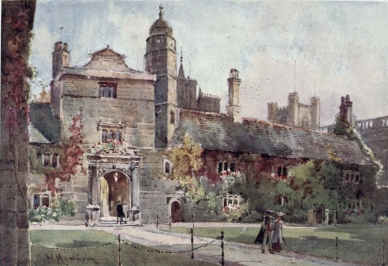
THE GATE OF VIRTUE, GONVILLE AND CAIUS COLLEGE This picture represents the Court built by Caius, who refounded the College. The Gate of Humility faces the spectator. This is the west side, and over the gate are the words Io CAIVS POSVIT SAPIENTIAE 1567. These words are taken from the inscription on the foundation stone.
It will be seen that the university owes most to Cambridge itself and East Anglia; and next to two counties which have always been in strict relation to it, Yorkshire and Essex. Two of the founders of colleges were French. Both Welsh and Irish names have been from the first represented, but Cambridge owes nothing to Scotland.[251] Even as late as 1535 when Henry issued the royal injunctions to the university during the chancellorship of Cromwell, there were students from every diocese and district of England, and from Wales and Ireland, at Cambridge, but Scotland is not mentioned.[252] Of the 4 countesses who founded colleges, one was twice married to Irishmen, and two married Welshmen.
Of the 14 (non-royal) men founders (including the third Duke of Buckingham and Fisher) 5 were East Anglian (3 Cambridgeshire), 3 were East-Saxons, 3 Yorkshiremen, one a Northamptonshire man, and one came from Staffordshire. To Beverley the university owes Fisher and Alcock, to Chelmsford Badew and Mildmay, to Norwich Bateman and Caius.
Of the 6 women founders, two were French (Chatillon and Queen Margaret) one was of French extraction (Sidney), the Clares were Normans, Elizabeth Clare and Chatillon were Plantagenets through Henry III. and Edward, Margaret Beaufort and Buckingham by descent from Edward III.; Elizabeth Woodville was half French through her mother Jaquetta of Luxembourg, daughter of Peter Comte de Saint-Paul. Thus, curiously enough, two of the women founders hailed from Anjou (Margaret and Frances Sidney) and two from Saint-Paul (Chatillon and Elizabeth Woodville).
The colleges they founded favoured different provinces.
Scope of their foundations.
Marie Valence, wished French fellows to be preferred to others of equal merits, and, failing these, scholars from the college rectories.[253]
Gonville wished to benefit East Anglian clergy.
Bateman wished chiefly to benefit clergy of the diocese of Norwich.
Henry VI. decided that failing scholars from the parishes of Eton or King’s, Buckinghamshire and Cambridgeshire should have the preference.
Margaret of Anjou’s college was, by Andrew Doket, allied with the Cambridge Greyfriars.
Margaret Beaufort and Fisher favoured the northern districts of Richmond, Derby, Northumberland, Cumberland, Westmoreland, York, Lancashire, and Nottingham, from which half at least of the scholars were to come.
Sidney Sussex College was, by its “bye-founder” Sir Francis Clerk, endowed for students from Bedfordshire.
The special character given to Peterhouse by Balsham was the studious pursuit of letters, arts, Aristotle, canon law or theology. There were to be 2 scholars for civil and canon law, and one for medicine; and poor bible-clerks were to be instructed in grammar.
Hervey de Stanton founded Michaelhouse for clergy, and for the study of theology.
Marie Valence founded Pembroke for the study of arts as well as theology.
Elizabeth de Burgh founded Clare for general learning. Three poor boys were to be instructed in grammar, logic, and singing.
Edmund Gonville made the 7 Arts the foundation for a theological training. (Bateman abolished its theological character.)
William Bateman founded Trinity Hall for the study of law only.
The two Guilds of Corpus Christi and the Blessed Virgin founded their college for scholars in sacred orders, and for the study of theology and canon law.
William Byngham established God’s House for the study of grammar among the clergy of the north-eastern counties.
Henry VI. required all the scholars of King’s to be candidates for sacred orders, and made theology and arts the principal but not the exclusive faculties.
Margaret of Anjou made theology the principal study at Queens’, and in her college law was only tolerated. The master of arts must either teach the trivium and quadrivium for 3 years, or devote the same time to the liberal sciences or Aristotle.
Robert Woodlark made his fellows restrict their studies by vow to “philosophy and sacred theology”—his college of S. Catherine was founded to promote Church interests exclusively.
John Alcock required that the scholars of Jesus College when they had graduated in arts, should devote themselves to the study of theology. Canon law was prohibited, but one out of the 12 fellows might be a student of civil law.
Margaret Beaufort founded Christ’s for the study of grammar, arts, and theology, but law and medicine were excluded.
Edward III. and Henry VIII. founded King’s Hall and Trinity College for general learning.
John Caius founded his college for the pursuit of science.
Sir Walter Mildmay founded Emmanuel for clergy who should maintain the principles of the Reformation.
Sir George Downing founded his college for the study of law and medicine.
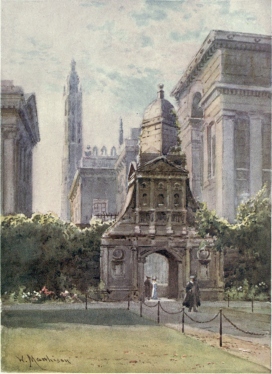
THE GATE OF HONOUR, CAIUS COLLEGE In the background on the right appear the buildings of the University Library, one of the Turrets of King’s Chapel in the distance, and the Senate House is seen on the left.
Hence Michaelhouse, Gonville, Corpus, God’s House, King’s, Catherine’s, Jesus, and Emmanuel were destined for a clerical curriculum only.
Bateman contemplated the union of the diplomatic career with the clerical; and although there were many jurists’ hostels his is the only college founded and endowed for the exclusive study of law. Caius is the only college founded and endowed for the natural sciences and medicine; but in the xiii century Balsham, in the xvith Caius, and in the xixth Downing, all provided for medical studies. Similarly in the xiii, xiv, and xvi centuries Balsham, Edward III., Elizabeth de Burgh and Henry VIII. each founded a college for the pursuit of general knowledge.[254]
Wealth of the university. Sources of revenue.
Throughout the xiiith, xivth, and xvth centuries the university was certainly a very poor corporation. It took a hundred years to build three sides of the Schools quadrangle, and the money for the important schools of Philosophy and Civil Law collected by Chancellor Booth in the xv century was only got together by taxing the university.
The university as distinguished from the colleges has never been a wealthy society, and its sources of revenue are now much the same as they have always been. There are the capitation fees of members of the university. Fees for matriculation, for the public examinations, and for graduation, and proctors’ fines.
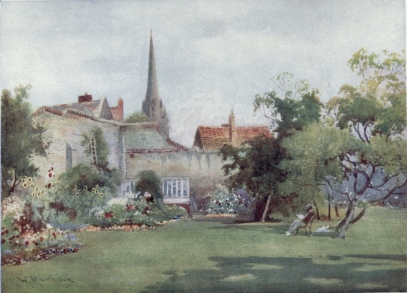
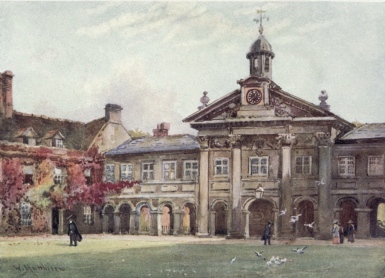
THE FIRST COURT OF EMMANUEL COLLEGE
The income of Burwell rectory and of a farm at Barton, The trading profits of the University Press; and one new source of income—the annual contribution from each of the colleges, in proportion to its revenues, provided for by statute in 1882. The vice-chancellor delivers an annual statement of expenditure, which includes the upkeep of the Senate House and Schools, of the University church, the Registrary’s office, the observatory, museums and lecture rooms, and a yearly contribution to the library: the salaries of professors and public examiners, and the stipends and salaries of university officers and servants.[255]
College wealth and property.
The original property of colleges was in land, benefices, and plate. The portable property was laid by in a chest kept in the muniment room: here title deeds, charters, rare books, college plate, and legacies in specie were treasured; the last being drawn upon for the purpose for which they were bequeathed until exhausted. Benefactors to a college presented it with a “chest,” and hence the “University Chest” is still the name for its revenue. Queen Eleanor presented a “chest” of a hundred marks to the university in 1293 (“The Queen’s Chest”); and Elizabeth, Duchess of Norfolk, enriched the public treasury with a thousand marks in the reign of Henry VII. when the “chests” had been “embezzled to private men’s profit”; a gift “which put the university in stock again.”[256] The “Ely Chest” was given in 1320 by John sometime Prior of Ely and Bishop of Norwich, and the other principal givers were country parsons, university chancellors, a “citizen of London” in 1344, and Thomas Beaufort, Duke of Exeter (“Exeter’s Chest”) in 1401.
The wealth of the colleges differs greatly. Trinity college has a gross income of over £74,000 and the next richest college is S. John’s. The poorer colleges have gross incomes varying from 4 to £9000.[257] The proportion contributed at Cambridge and Oxford for the royal loan of 1522 is interesting. At Oxford, New College and Magdalen contributed most, more than eight times as much as Exeter and Queens’ (£40) which gave least.[258] At Cambridge, King’s College and King’s Hall were the richest corporations and contributed the same sums as New College and Magdalen Oxford.
THE OLD COURT IN EMMANUEL COLLEGE The large stained-glass window of the Hall is seen on the right, and beyond that the window of the Combination Room. The Dormer window of Harvard’s room is seen on the extreme left.