Chapter Twentieth.
Reading edition
COMMOTION IN THE POLITICAL ELEMENTS—CALIFORNIA A STATE—SLAVERY PROHIBITED—POLITICAL CAMPAIGN, AND THE RAINY SEASON—SPEECH OF A WOULD-BE-GOVERNOR—ENTHUSIASM AND BRANDY—ELECTION DISTRICTS—BALLOT-BOXES AND UMBRELLAS—MINERS IN A TRANSITION STATE—PREPARATIONS FOR THE RAINY SEASON—PRIMITIVE HABITATIONS—TRADE IMPROVING—ADVENT OF THE RAINY SEASON—ITS TERRIFIC EFFECTS—RAPID RISE OF THE RIVER—MACHINES DESTROYED—ARRIVALS—MY STORE AND BED—A BUSINESS SUIT—DISTRESSING GROANS—THE BOTTLE A CONSOLATION—SEVERAL STRANGE SPECIMENS OF HUMANITY COOKING BREAKFAST—THE SCURVY—A DEATH.
We now, for the first time, had a commotion in the political elements, which resulted in erecting California into a State and placing her, the “bright particular star,” in this glorious constellation. An election was ordered, and delegates selected to draft a Constitution for the State. They met at Monterey, and after a few days’ deliberation passed upon the Constitution which is hereunto annexed, and which was eventually ratified by an almost unanimous vote of the people. The greatest unanimity prevailed at the Convention, the deliberations conducted with the utmost dignity, each seeming desirous to act for the best interests of the country. The clause prohibiting slavery, or involuntary servitude, passed by a unanimous vote, although many of the delegates were interested in slave property in the States. The nominations were made for State officers, and, although party lines were not strictly drawn, every preparation was made for a vigorous campaign.
The election was to take place on the 15th day of November, and by the time the nominees were ready to take the “stump,” the rainy season was upon us. Just picture to your imagination a would-be-governor, in a slouched India rubber hat, a poncho, and high boots, standing near a tent on the side of the mountain holding forth to a highly patriotic audience of six, the rain pouring down in torrents. Nothing could dampen the ardor of the speaker; he had enlisted in the cause of the dear people, and nothing could induce him to swerve from the performance of his duty. The gist of his remarks was as follows:—“Fellow citizens, you have rights to protect. [Hurrah! Three cheers and two drinks of brandy.] I’ll spend my last breath in the vindication of those rights. [Three more!!] The mineral lands ought to be given to the people. [Three times three!!! Three cheers and six drinks.] Have not the sovereign people made this country what it is? [Yes! Yes!! and great cheering.] If I am elected I will use my influence to have this immense tract of country, now claimed by Sutter, divided among the people.” [Immense sensation and cheering.] After order was again restored, the speaker was invited to step out of the puddle of water that had dripped from his poncho, and take something to drink. The meeting was conducted with much spirit, and resulted in securing the votes of a majority present for the would-be-Governor.
At this time, this district of country, called the Minerva district, had become so populous that municipal officers had been elected, and now it was regularly divided into election districts, and arrangements made to open polls wherever it was deemed necessary. The qualification for an elector was to be an American citizen. The most prominent candidates for Governor were Judge Burnett, H. S. Sherwood and Rodman M. Price, of whom the former was elected. On the day of election the ballots were deposited in a hat, over which one of the inspectors held an umbrella.
The middle of October finds the miners in a transition state. There has not a drop of rain fallen during the entire summer, and the earth, six feet below, is as dry as on the surface; one cannot move without being enveloped in dust; and vegetation is as crisp as if it had just been taken from the oven. There has been no haze to shield the earth from the sun, and at night the stars have twinkled with unwonted brilliancy; but now the sun has grown dim and pale, and the stars have fled to their hiding-place. Miners are admonished that it is time to prepare for an untried winter, and on every hand is evinced a disposition not to be taken unawares. Here on the side of the mountain is a habitation, three logs high, covered with canvas, the crevices well “mudded,” all the light used being admitted through the door. There is a cave, walled and roofed with rocks, the canvas closing the entrance being the only indication that it is a tenement. An army tent is also seen, which is well secured, as if in momentary expectation of the approaching blast; dirt has been thrown well over the foot, to prevent the winds from searching out the occupant. In front is a tree, under which is a camp-kettle and frying-pan, and near are a few dying embers, the smoke curling up and mingling with the foliage. It seemed hard that one accustomed to the luxury of a comfortable home, should be doomed to spend the winter in this forlorn condition. Climbing up the side of the mountain, are seen mules heavily laden with provisions and mining utensils, which are destined to some favorite spot in the mountain gorges. Trade begins to improve, miners are laying in their supplies for the winter, and merchants find their stocks exhausted, and are driven to town to replenish. The sun assumes a peculiar color, and where it is reflected in the water is a “royal” purple. Its rays had become very dim, and on the 27th of October the deluge burst upon us.
General Winchester and company had just placed their quicksilver machine, and commenced successful operations on the bar, but one night destroyed their works, carrying one of their machines, laden with twenty-five pounds of quicksilver, a distance of three miles, destroying it, and emptying its valuable contents into the river. The rise of the river was so rapid that those on the opposite side, when it commenced to rain, found it impossible to recross six hours after. The scene was most terrific; the mountain on either side of the river, rose almost perpendicularly, and the torrents rushed down, undermining huge rocks, which, after making a few leaps, would come in contact with others of equal dimensions, when both, with one terrific bound, would dash into the chasm below.
Mining operations were, for the time, suspended, and miners, many of whom were destitute of even the protection of a tent, were hovering about their fires in a most desponding mood; many were entirely destitute of means, and cooking, perhaps, their last day’s supply. Teams were constantly arriving with miners fresh from the States, who would descend the mountain
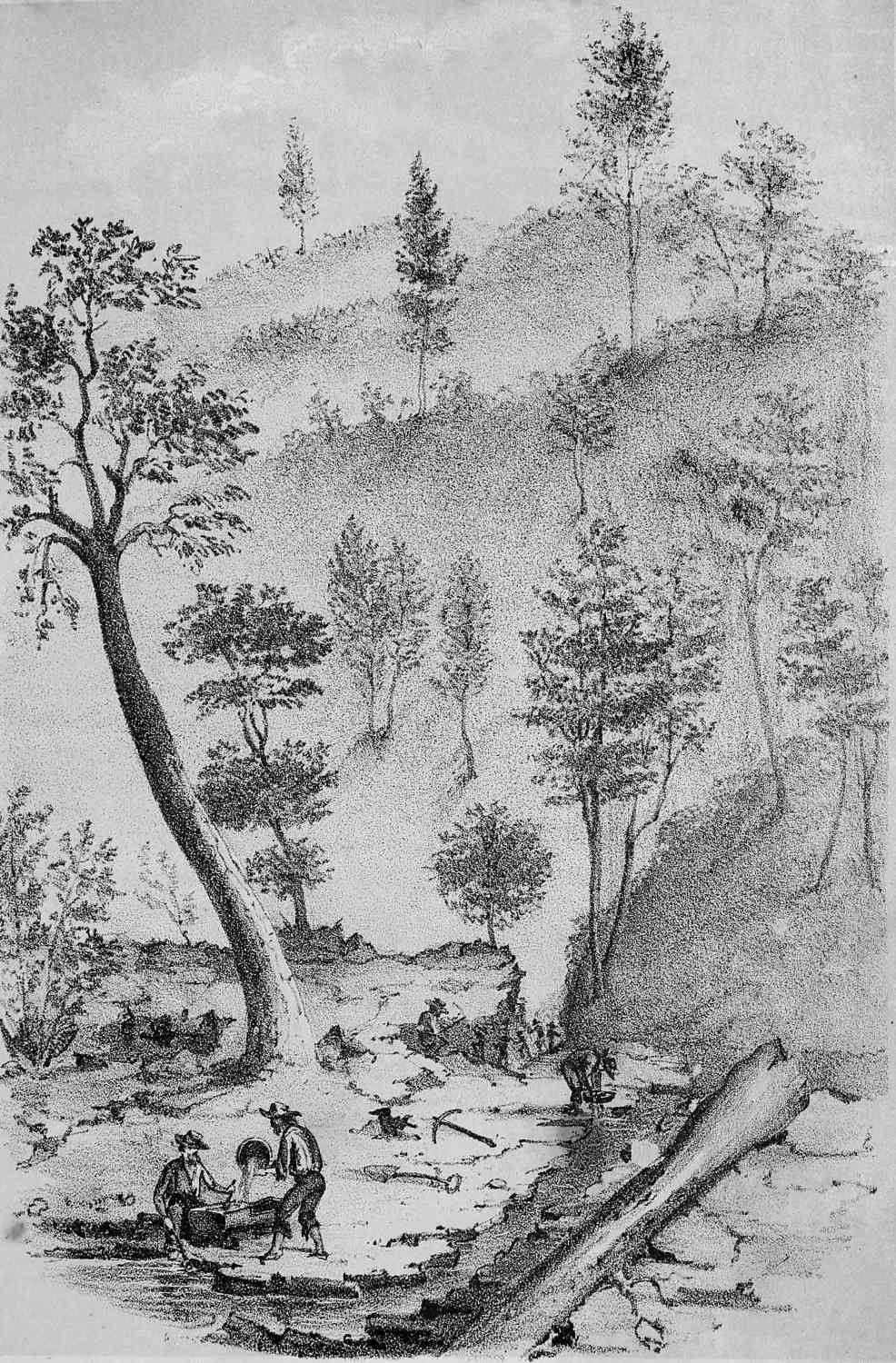
G. V. COOPER DEL. ON STONE BY J. CAMERON LITH. of G. W. LEWIS III NASSAU ST. N. Y. LOOKING DOWN THE BIG CANON.
with high hopes, having been so fortunate as to fall in with some one who had directed them to this particular spot. They were generally well supplied with provisions, and notwithstanding the drenching rain, one hour after their advent would find them busily engaged with the pan and pick-axe.
The store I occupied was made by driving stakes into the ground, and inclosing with common unbleached muslin; the roof flat, covered with the same material. It had answered a good purpose during the summer, but for the rainy season, I am not prepared to say it was exactly the thing. I do not know that the rain fell faster inside than out, but some of my neighbors insinuated that it did. I could keep tolerably dry by wearing an India rubber cap, poncho, and long boots, with the aid of a good umbrella, in short, this was my regular business suit. For a bed, I had a scaffold made of poles, on which I had a hammock stuffed with grass and straw, using a pair of blankets as covering. In order to keep my bed dry I had a standard at the head and foot, on which was a pole running “fore and aft,” serving as a ridge-pole, over which was thrown an India rubber blanket. On going to bed I would throw up one corner of my India rubber blanket, holding my umbrella over the opening, and after taking off my boots, I would crawl in feet first, throw back the rubber to its place, then tying my umbrella to the head standard I was in bed. My friends, Fairchild, Tracy, Jones, and Dean were not so fortunate. They would lay down on the ground in their blankets, and in one hour would be drenched to the skin; in this condition they were obliged to spend the balance of the night. Jones (formerly of the Cornucopia, New York) had a severe cough, his lungs being much affected, and he thought he was fast declining with the consumption. After becoming drenched and chilled his cough would set in, which, together with his distressing groans, would render night hideous, and cast a gloom over the most buoyant spirit. On rising in the morning, the bottle was our first consolation; it would elevate our spirits, and drive the chilly sensation from our limbs. A few large sticks had been thrown together and set on fire, around which would be seen a dozen strange-looking specimens of humanity, one with a red flannel shirt, part of a glazed cap, and torn unmentionables; another with a woolen-blanket, that could boast of having secured, on the previous night, what rain had fallen in its immediate vicinity; another with an India rubber poncho and a hat that had been used both sides out, and, as if to assume a ferocious appearance, it had adopted the color of the grizzly bear. All hovering around the fire, some with pieces of pork on the ends of sticks, others with something in a frying-pan, covered with a tin plate; one is stirring flour and water together, while his companion is trying to turn the cakes; about every other one is disposed to go into the fire.
A disease at this time manifested itself, the symptoms of which were of a peculiar nature. It was called the “land scurvy,” and was caused by a want of proper vegetable diet. The blood of the system became thick and turgid, and diminished in quantity; there was but little circulation at the extremities, or near the surface of the body, the fleshy parts becoming almost lifeless; the gums became black and not unfrequently the teeth would fall out, the gums having so entirely wasted away. The malady became fearfully prevalent, and no remedy could be obtained; vegetables were not to had, there were none in the country. There had been a few, a very few, potatoes in the market, at prices varying from four shillings each to a dollar and a half per pound, but the supply was too scanty to arrest the disease, and many had become almost entirely disabled.
On the 28th of October, a man from Illinois fell a victim to this dreadful malady, and on the 29th, it was our painful duty to bear him to that lonely hill and consign him to the tomb. A board was placed at his head, on which was cut his brief epitaph. What a strange commentary upon the vicissitudes of human life. He was once an infant, fondled and caressed by an affectionate mother, a youth counseled by a doting father, and embraced and loved by sisters and brothers. He grew to manhood, pledged his hand and heart to the one he loved, combatted, perhaps, with adversity, and finally bade farewell to his own offspring, to die a stranger in a strange land.