Chapter Fifth.
Reading edition
FIRST RAPID—AN UNFORTUNATE INDIVIDUAL—A STEP BACKWARDS—SEVERAL INDIVIDUALS IN A STATE OF EXCITEMENT—TIN PANS NOT EXACTLY THE THING—A BREAKFAST EXTINGUISHED—SPORTING—MONKEY AMUSEMENTS—A “FLASH IN THE PAN”—TWO FEET IN OUR PROVISION BASKET—POVERTY OF THE INHABITANTS AND THEIR DOGS—ARRIVAL AT GORGONA.
Monday morning, having an early breakfast, we were again under way. We shot several alligators, and at 10, A.M., arrived at the first rapid. We uncorked a bottle of brandy and prepared for hard work. As Mr. Hush did not help work the boat, (it was not safe to give him a pole) it was suggested that he should walk. We commenced the ascent, and after an hour of hard labor, gained the summit. We drew up along shore, and Mr. H. attempted to jump on board. His feet, as usual, taking the wrong direction, he stumbled and caught hold of an India rubber bag for support, which not being securely fastened, went overboard. The current being strong it passed rapidly down, and there was no alternative but to follow it with the boat. We soon found ourselves going with the greatest velocity, down the rapid we had just toiled so hard to ascend. We overtook the bag at the foot, and making fast to the shore, we held a very animated colloquy, which was embellished with an occasional oath by way of emphasis. Mr. H. suspected that he was the subject of our animadversions, but there was nothing said.
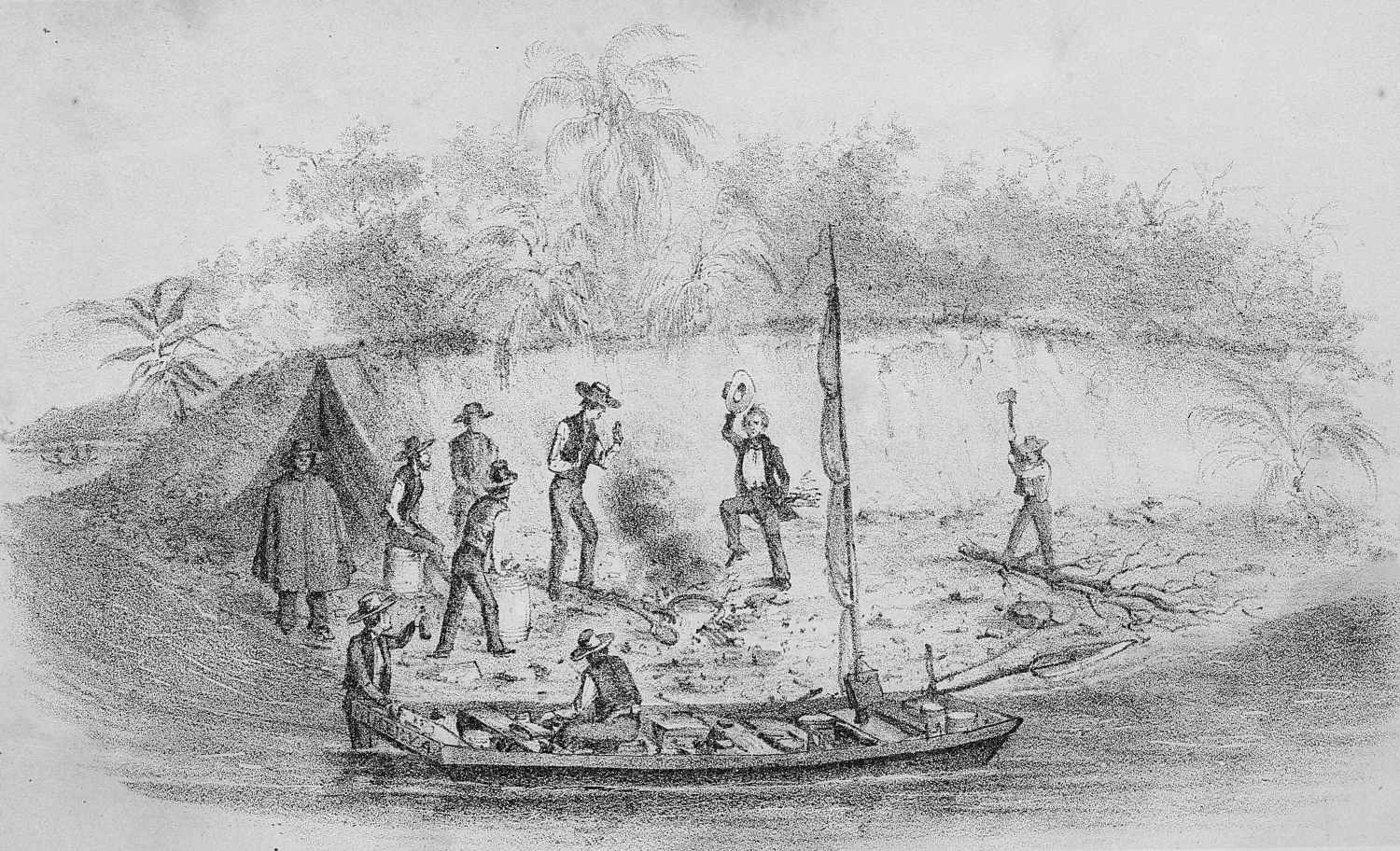
We again ascended the rapid, and worked on until rain and night overtook us. We were obliged to encamp on an unpleasant rocky shore, and cook supper in the rain. We passed an uncomfortable night; and in the morning it was still raining in torrents. We were furnished with India rubber ponchos and were making preparations to start while Mr. Cooper and Mr. Beaty were preparing breakfast. It was difficult to get fuel, and still more difficult to make it burn. They however succeeded in kindling the fire. We usually boiled our coffee-water in the camp-kettle, but this being full of game, we filled a large tin pan with water, and placed it over the fire, supported by three stones. The ham was frying briskly by the fire, our chocolate dissolving, and every thing going on swimmingly, when one of the stones turned, capsizing the tin pan, putting out every particle of fire, and filling the chocolate and ham with ashes. (See plate.) Mr. Cooper was frantic with rage, doffing his hat, throwing the ham into the river, kicking over the chocolate cup, cursing every thing in general, and tin pans in particular, while Mr. Beaty, with a most rueful countenance, clasped his hands, exclaiming, “Oh! my!!!”
Mr. Dodge came to the rescue, and we had a warm breakfast, and were soon under way. At ten, the sun came out, and we had a pleasant run, using our sail. We encamped in a delightful place on the left bank of the river, and had a comfortable night’s rest. When we awoke in the morning, the air was filled with parrots, toucans, tropical pheasants, etc. Our guns were immediately brought into requisition, and we soon procured a full supply, including seven pheasants. One of the party and myself finding a path that had been beaten by wild beasts resolved to follow it, and penetrate more deeply into the forest. After going some distance we heard a strange noise, which induced my companion to return. Being well armed I proceeded on, and soon came upon a party of monkeys taking their morning exercise. There were about twenty of them, in the top of a large tree. The larger ones would take the smaller and pretend they were about to throw them off; the little ones, in the mean time, struggling for life. There was one very large one, with a white face, who appeared to be doing the honors of the occasion, viz., laughing when the little ones were frightened. If I had been within speaking distance of his honor, I would have informed him that his uncouth laugh had diminished the audience on the present occasion by at least one half. I did not break in upon their sports, but, following the path, soon found myself at a bend of the river.
A native was passing, who informed me that there were turkeys on the other side. I stepped into his canoe, and in a
G. V. COOPER DEL. ON STONE BY J. CAMERON LITH. of G. W. LEWIS III, NASSAU ST. N.Y. PREPARING BREAKFAST on the Chagres River.
moment we were climbing the opposite bank. When within shooting distance I raised my gun; it missed fire, and the turkeys flew away, the native exclaiming “mucho malo.” We recrossed, and I soon reached the encampment. Our game was cooked, and the party ready to embark. We shoved out, but, unfortunately, Hush had forgotten his bowie knife. We floated back, he ascended the bank, and succeeded in finding it. In returning, he found it difficult to reach the boat; the bank being quite abrupt, he, however, determined to jump, and, after making a few peculiar gyrations with his arms, he did jump, and landed both feet in our provision basket, breaking several bottles, and in his effort to extricate himself kicked the basket overboard. He would have followed it, had it not been for timely assistance.
The day was excessively hot, the river rapid, and our progress slow. In the after part of the day, we passed a rancho where there were a few hills of corn, the first sign of industry we had seen along the river. One can hardly conceive of a country susceptible of a higher cultivation. They have a perpetual summer; tropical fruits grow spontaneously; they have the finest bottom lands for rice, tobacco, cotton, corn, or sugar plantations perhaps on this continent; yet, with the exception of a very little corn and sugar, nothing is cultivated. The enterprise of the States would make the country a paradise.
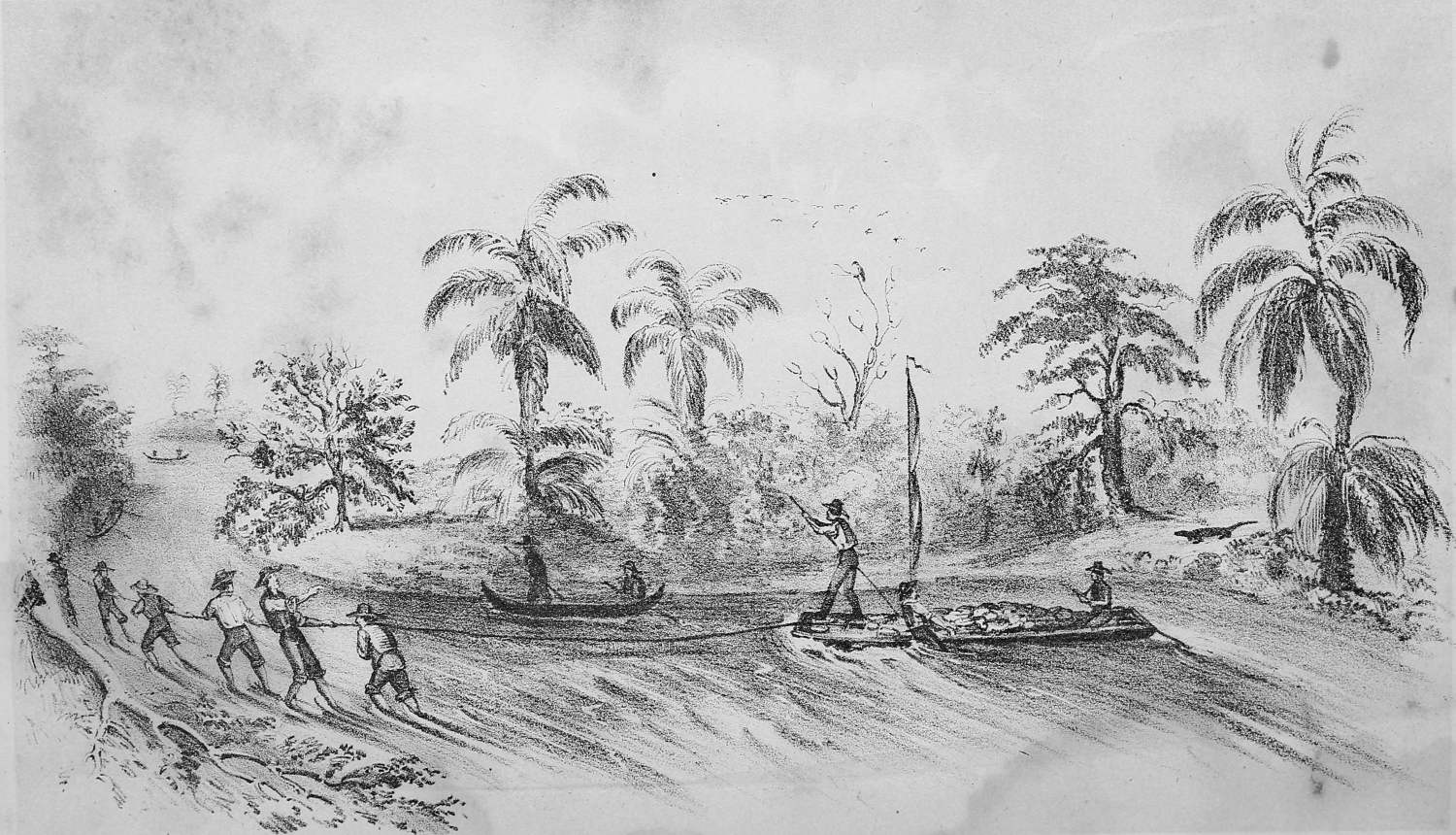
We encamped at night where the river had a peculiar bend, forming a horse-shoe, and one of the most delightful spots I ever saw. I selected it for my own use—as a rice and sugar plantation—but have not yet had the title examined. In the middle of the night a canoe passed down in which was the man suspected of having borrowed my vest. He spoke to one of our party, said he was on his way to Chagres, on business, but would return to Gorgona immediately. We took an early start in the morning, and at nine stopped at a rancho to purchase cigars. Such a squalid family I never saw. There were three women, two or three young ladies, and half a dozen children—none of them were dressed, excepting a little boy who had on a checked palm leaf hat. We asked for cigars, they had none, but would make some for us, “poco tiempo,” (little time). We couldn’t wait. We were much struck with the appearance of the dog, which was so poor that, in attempting to bark at us, it turned a summerset. We were now not far from Gorgona, and exerted every nerve to reach our destination. At noon, while at dinner, a young native approached us from the forest, and proposed to help work the boat up to Gorgona. As he was a tall, athletic young fellow, and didn’t charge anything, we accepted his proposition, and gave him his dinner. We were now six miles from Gorgona, and with the aid of our native there was a prospect of arriving in good time. The river was shallow, with frequent rapids, and, although our boat drew only nine inches water, we were frequently obliged to get out and tow it up. (See Plate). Your humble servant is standing on the bow of the boat with a long pole. Cooper is “boosting” at the side. Hush is doing duty—the first on the rope. Dodge is in a passion and in the act of addressing some emphatic remark to gentlemen on board. Natives are seen in their canoes, and just above, seated on the limb of a tree, is a monkey who appears to be looking on enjoying the scene. As we passed under the tree he came down upon one of the lower branches, and seemed disposed to take passage. An alligator is seen on the bank below, and in the air innumerable parrots. The noise of these is one of the annoyances of this country, their screeching incessant and intolerable. Late in the afternoon we arrived within half a mile of Gorgona, which was behind a bend of the river, where our native wished to land. We soon passed the bend, when the town was in full view, and in a few moments our labors were at an end. Our friends had felt some solicitation for us. Seven days was an unusual passage at this season of the year, and if they had wished to effect an insurance on us it is doubtful whether it could have been done in Gorgona at the usual rates.
G. V. COOPER DEL. ON STONE BY J. CAMERON LITH. of G. W. LEWIS III NASSAU ST. N.Y. PASSING A RAPPID, on Chagres river.