G. Manville Fenn (continued 6)
Reading edition
Mr Hasnip was, I found, looking at me, and I felt a choking sensation as he shook his head at me sadly.
Then I glanced at Mercer, and found he was looking at me in a horrified way, and I let my eyes drop as I said to myself,—
“Poor fellow! I shall not have to speak; he’ll confess it all. I wish I could save him.”
And all the while the usher was unlocking the padlock, taking it from the staple, and throwing open the great lid back against the whitewashed wall, every click and grate of the iron and the creak of the old hinges sounding clear and loud amidst the painful silence.
“Will you come and look, sir?” said Mr Rebble.
“No,” said the Doctor sternly. “Is there a rabbit-skin there, as this boy described?”
“Yes, sir.”
“Take it out.”
Mr Rebble obeyed, and once more I met Mercer’s eyes gazing at me wildly, and, as I interpreted the look, imploring me not to speak.
The miserable stuffed distortion was brought out, and I felt half disposed to laugh at it, as I thought of my school-fellow’s queer ideas for a group in natural history. But that was only a flying thought, succeeded by a mental pang that was most keen, as the rabbit was laid on the floor, and, acting on the Doctor’s instructions, Mr Rebble went down on one knee, held the stuffed animal with one hand, and began to draw out the tow with the other.
A great patch came out, and Mr Rebble pressed it together and then opened it out, and I fancied I heard the Doctor sigh with satisfaction at nothing being found.
“It’s further in, sir,” cried Dicksee eagerly.
“Ah! you seem to know a great deal about it, Dicksee,” said the Doctor.
“Yes, sir; I saw him put it in.”
Mr Rebble thrust in his hand again, and my spirits sank lower as he drew out another tuft of tow, compressed it, and then, frowning heavily, began to tear it open.
“There is nothing there, then, Mr Rebble?” cried the Doctor eagerly.
“I am sorry to say, sir, there is,” said the usher, as he laid open the tow till it was like a nest, with the little silver watch lying glistening in the middle; and the Doctor drew a long breath, his forehead now full of deeply-cut lines.
“Burr major,” said the Doctor huskily. “Have the goodness to look at that watch. Is it yours?”
My school-fellow stepped to the Doctor’s side and looked.
“Yes, sir,” he said eagerly. “That’s the watch I lost.”
“How do you know, sir?”
“My father had my initials cut in the little round spot on the case, sir. There they are.”
The Doctor took the watch, glanced at the letters, and laid it down.
“Yes,” he said sadly, “that is quite right.—Mercer!” Tom started as if he had received a blow, and looked wildly from one to the other.
“Come here.”
“Oh, poor, poor Tom!” I sighed to myself, and I looked at him pityingly, while he glanced at me.
“Hah!” ejaculated the Doctor; “there seems to be some understanding between you. Now, sir, that bin has been used by you for some time, has it not, for your collection?”
“Yes, sir,” faltered Mercer.
“You and Burr junior have, I noticed, always been companions.”
“Yes, sir.”
“He joined you in collecting natural history objects?”
“Yes, sir; a little.”
“Could he obtain access to that bin when he wished? Had he a key?”
“He could always get the key, sir, when he liked.” The Doctor sighed, and there was silence once more, while I glanced at Mercer wildly, and if he could have read my eyes, he would have known that they said, “Speak out now. Confess, and ask the Doctor to forgive you for giving way to this terrible piece of covetousness.”
“Now,” said the Doctor, and we both started at the firm, sonorous tones, “speak out frankly, sir. This is no time for trying to conceal the truth so as to screen your friend, for I tell you that it would be an unkind act, and you would be injuring his future by such a mistaken policy. Tell me, did you know that the watch was hidden there?”
Mercer was silent.
“Speak, sir,” cried the Doctor. “I insist!”
“No, sir,” faltered Mercer, after another appealing look at me; and in my agony, as I heard his words, I started forward.
“Burr junior!” roared the Doctor; and I stopped as if fascinated.
“Now, Mercer,” he continued, “tell me. Did you know that your school-fellow had that watch in his possession?”
“Oh no, sir!” cried Mercer eagerly. “I’m sure he hadn’t.”
“Humph!” ejaculated the Doctor. “That will do.—I wish, gentlemen,” he continued, turning to the two masters, “to make this painful business as short as possible.”
I turned to him quickly, and as I met his eyes, I thought at first that he was looking at me sadly and pityingly, but his face was very stern next moment.
“You are sure, Thomas Mercer,” he said, “that you did not know the watch was in that bin—hidden away?”
Tom looked at me again wildly, and then, with his brow all wrinkled up, he said in a hopeless tone full of sadness,—
“No, sir—no, sir; I didn’t know it was there.”
My hands clenched, and a burst of rage made me turn giddy for the moment. For I felt as if I could have dashed at him, dragged him to his knees, and made him speak the truth.
But that passed off as quickly as it came, and a feeling of pity came for the boy who, in his horror of detection, had felt himself bound to save himself at another’s expense, and I found myself wondering whether under the circumstances I should not have done the same.
These thoughts darted through my mind like lightning, and so did those which followed.
“I want to save him,” I said to myself, in the midst of the painful silence during which the Doctor stood thinking and softly wiping his forehead and then the palms of his hands upon his white pocket handkerchief; “but I can’t take the credit of it all. It is too horrible. But if I tell all I know, he will be expelled, and it will ruin him. Oh, why don’t he confess?—why don’t he confess?”
It was as if the Doctor had heard these last words as I thought them, for he said now in a deep, grave voice, as he turned to me, just as I was feeling that it would be too cruel to denounce my companion,—
“This is a sad—a painful affair, Burr junior. I wanted to disbelieve in your guilt, I wanted to feel that there was no young gentleman in my establishment who could stoop to such a piece of base pilfering; but the truth is so circumstantially brought home through the despicable meanness of a boy of whose actions I feel the utmost abhorrence, that I am bound to say to you that there is nothing left but for you to own frankly that you have been led into temptation—to say that you bitterly repent of what you have done, and throw yourself upon my mercy. Do this at once, boy, for the sake of those at home who love you.”
I felt my face twitch at these words and the picture they evoked, and then, numbed as it were, I stood listening, slightly buoyed up by the feeling that Mercer would speak directly and clear me.
“You were entrusted to my care, Burr junior,” continued the Doctor, “as a youth who was in future to enter upon one of the most honourable of careers, that of a soldier; but now that you have disgraced yourself like this—”
“No, no, sir!” I cried. “Don’t—pray don’t think I took the wretched watch!”
There was so much passionate agony in my voice that the Doctor paused for a few moments, before, in the midst of the solemn silence which ensued, he said coldly,—
“Do you deny that you took the watch?”
“Yes, yes. Indeed, indeed I did not take it, sir!” The Doctor sighed.
“Do you deny that you were seen by Dicksee this morning with the watch in your hands?”
“No, sir; that is true,” I said, with a look at Mercer, who hung down his head.
“Then I am bound by the statements that have been made, painful as it is to me, to consider that in a moment of weak impulse you did this base thing. If I am wrong, Heaven forgive me, for humanum est errare. The truth, however, seems too clear.”
“I—I found it there,” I panted.
The Doctor shook his head.
“It is like charging your school-fellow with stealing the watch. Do you do this?”
I was silent.
“Mr Rebble,” said the Doctor, “you came here as a gentleman to aid me in the training of these youths. Can you do anything to help me here?”
“I—I,” said Mr Rebble huskily, “would gladly do so, sir, if I could. I wouldn’t trust Dicksee’s word in anything. He is as pitiful and contemptible a boy as ever came under my charge, but I am afraid he has spoken the truth here.”
“I fear so,” said the Doctor. “Mr Hasnip, you have—been but a short time among us, still you have learned the disposition of the pupils. Can you help me—help us?—for it is terrible to me to have to pass judgment in such a case.”
“Doctor Browne,” cried Mr Hasnip warmly, and I saw the tears start to his eyes, “I would give anything to be able to say it is all a mistake.”
“But you feel that you can not?”
Mr Hasnip shook his head, and turned away to hide the working of his face, while I stood wondering at the feeling he displayed.
There was again a painful silence, and I stood there, shrinking, but with a hot feeling of anger swelling within me, waiting for Tom Mercer to speak out and save me from disgrace. And with this hot tide of bitterness and rage that I should be so doubted and suspected, came a feeling of obstinacy that was maddening, while something within me seemed to say, “They would not believe you if you spoke.”
“No,” said the Doctor at last, “I am afraid that you cannot; and I now address myself to you, Burr junior. Do you confess that you are guilty?”
“No, sir,” I cried angrily, “I am not!” and again there was silence.
“I think I will give you time for reflection,” said the Doctor. “Mr Rebble, I place Burr junior in your charge. Of course he must be secluded. I, too, want time for reflection before sending word to the unhappy lad’s friends—a most painful task—a most painful task.”
He walked slowly toward the steps, and a fresh feeling of excitement surged up within me. I wanted to speak now—to say something in my own defence, as I thought of the Doctor’s letter going to my mother, and of her agony, then of my uncle learning this, and coming over. It seemed too terrible, and I tried to call the Doctor back, but no words would come. I saw him descend slowly, and Mr Hasnip sign to the boys to follow, after which, giving me a sad look, he too descended, leaving me alone with Mr Rebble, whose first words were so stern and harsh that I could not turn to him and confide and ask his sympathy and help.
“This way, sir,” he said sharply, and without a word I followed him down and across the stable-yard, passing cook at the door ready to give me a pitying glance for being in disgrace.
Then, as if it was all a dream, I was led into the house, and up-stairs to a small room containing only one bed—a room whose window looked out away toward the General’s estates.
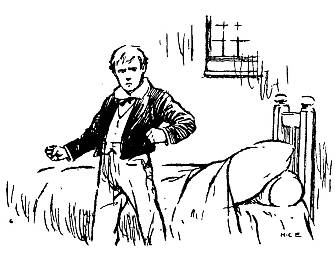
The door was closed behind me without a word, and as I stood there I heard it locked and the key withdrawn, followed by Mr Rebble’s footsteps along the passage, and then I threw myself down on the bed in a passion of rage against Mercer.
“You coward!” I cried, and as I ground my teeth I indulged in a wish that I could have him there.
“Oh!” I cried, “only for half an hour, and then—” I did not finish my sentence, but bounded off the bed to stand up there alone, unconsciously enough in the position Lomax had taught me, and with my left hand raised to strike.
Chapter Twenty Seven.
It was very different to be a prisoner now alone. I longed for Mercer’s companionship, but it was so that I might punish him for what I again and again called his miserable cowardice, which seemed to me to make his crime ten times worse. And so I walked up and down the little room restlessly, thinking over the times when my school-fellow had talked about the watch, and his intense longing to possess it, or such a one.
Nothing could be plainer. He had given way at last, and taken it on that unlucky day when he was hanging about talking to me as I lay on the grass with my head throbbing, and then walking away toward the tent or to where he could get a good look at the cricketers.
“Too much for him,” I said,—“too much for him, and I am to take the credit of his theft. But I will not. If he is such a mean coward as to let me take his stealing on my shoulders, he is not worth sparing, and he shall take the credit for himself—upon his own shoulders and not mine.”
“Oh, what an ass I have been ever to make friends with such a fellow!” I cried, after a pause. “I ought to have known better. Never mind, I do know better now, and to-morrow morning I’ll ask to see the Doctor, and I’ll tell him everything, and—get him expelled!”
That set me thinking once more about his people at home, and as I did, I began to waver, and call to mind how terrible it would be, and that I liked him too well in spite of all.
For I did like him. I had never had a brother, and he had seemed to fill his place, so that now, for the first time, I fully understood how we two lads had become knit together, and how terribly hard it would be to speak out.
I sat down by the window at last, to let the cool breeze play upon my aching temples, and as I leaned my head against the side, the cheery voices of the boys in the field floated up to me, to make me more wretched still.
“It’s nothing to them,” I said to myself. “Nobody there cares, and Eely and Dicksee were only too glad to have their revenge upon me. I don’t know, though,” I said; “they both thought I took the watch, and believed all they said. But it was a triumph for them.”
I sat thinking.
“I wonder what Lomax will say? Will he believe that I am a common thief?
“What is Tom doing now? Out at play, I suppose, and glorying in his escape. He knows I would not be such a sneak as to tell, and thinks I shall bear it all patiently—too ready to spare him, or too cowardly to say a word.”
I was interrupted by steps, and in my misery I hoped that they would pass the door, but a key was thrust in, and I caught a glimpse of Mr Rebble, who waited outside while one of the maids brought in my tea on a tray,—a plain mug, and a plate of bread and butter; then she gave me a look of commiseration, making my cheeks burn, as I wondered whether she knew that I was shut up because people thought I was a thief, and unfit to associate with the other boys. But no word was spoken; she passed out, the door was shut and locked, and I rested my aching head once more against the side of the window, the very sight of food making me feel disgust; and there I stayed for how long I cannot say, but at last I started up, puzzled and wondering, to find that I must have dropped asleep, regularly wearied out, and that it was growing dusk, and the moon, like a thin curved streak, was sailing down in the faint glow of the heavens, not far from where the sun had gone.
I shivered a little, for I was cold, but my head was better, and I began to go over the events of the afternoon again, wondering whether the Doctor would send for me in the morning, to say that Mercer had confessed, and that he was glad to be able once more to take me by the hand.
Just then I heard a faint sigh, apparently coming up from the garden, and I involuntarily looked down, but could see nothing.
The sigh rose again, and now I was able to locate it in a clump of evergreens at the edge of the lawn. But I could see nothing save green leaves; and started again and drew back a little a few minutes later, as the sigh was again repeated, this time followed by a faint whisper, and I heard my name.
“Frank—Frank Burr. Hist!”
“Yes; who called?” I said.
“Me. Can’t you hear? Tom—Tom Mercer.”
I was silent, and stood, feeling hot and angry, gazing down into the grounds.
“Frank!” came up again. “I say!”
I remained silent.
“Have you got any string? Let a piece down.”
I knew what that meant. He had been to the kitchens and was going to send me up some supper. In other words, he was going to try and smooth over his despicable behaviour.
“A coward! A sneak! I hate him!” I muttered, as I stood there close to the window, as if unable to drag myself away, but listening greedily all the while, as Mercer went on in an excited whisper, insulting me, as I called it.
“Oh, I say, do speak, Frank,” he said. “I can’t stop long, and there’d be a row if any one knew I came to you. I am so sorry, Frank. I’ve been down to Polly Hopley’s, and bought a lot of her turnovers and some sweet tuck. I want to send it up to you. Haven’t you any string?”
I made no reply.
“Frank! I say: I know: tear up your handkerchiefs. I’ll give you some of mine to make up. Tie the bits together so as to make a long string, and let it down. Frank!”
“Go away, you miserable, cowardly sneak!” I cried passionately; “and never dare to speak to me again.”
He was silent for a few minutes, as if stunned by my fierce words. Then he began again.
“Oh, I say,” he whispered, “don’t turn on a chap like that when he was going to stick to you. I couldn’t help it.”
I knew that the temptation had been too strong for him, but I was none the less bitter against him, and my wrath reached its climax soon after, when he said eagerly,—
“I say, Frank, I am indeed so sorry! and I’d have said it was I did it, if it would have got you off; but they wouldn’t have believed me.”
Bang!
That was the window, which, in my passion at his coolness, I shut down with all my might, and then went and threw myself on the bed, with my head aching violently, and the sensation of misery increasing, so that at times I felt as if I must try and break open the door, creep down in the night, and run away somewhere—anywhere, so as to end the trouble I was in.
I never knew when, but I suppose the throbbing in my head must have lulled a little, and I once more dropped off to sleep, to wake up with a start in the darkness, wondering where I was, and whether I had been having a confused dream about a watch being stolen, and some one getting into trouble. Who it was I could not quite tell, for my head ached, I felt sick, and everything was confused and strange.
While I was trying hard to collect myself, I suppose I must have dropped to sleep again, for when I next opened my eyes, the sun was shining brightly, and, light-hearted and eager, I jumped off the bed to run and open the window, but, as my feet touched the floor, memory began to come back with its heavy load of misery.
Why was I dressed even to my boots? Why was I in a fresh room? Where was Tom Mercer?
The answers to my questions came, and I stood there with a sinking sensation of misery, increasing moment by moment, till with a sigh I roused myself a little and went toward the window.
“Where is Tom Mercer?” I said to myself again, with a bitter laugh. “Safe, and I am to take the blame for his miserable acts. Where’s Tom Mercer?”
I was opening the window as I spoke, and there he was hiding behind a clump of Portugal laurel, where he had been watching, quite ready to spring up eagerly now, and begin to make signs, as he showed me a school bag with something heavy inside.
I knew what it meant, of course, but the bitter feeling against him was too intense for me to accept aid in any form, and I drew back without noticing him further; and, as I did so, my head felt clearer for my night’s rest, and I began to see the course that was open to me.
I could not turn upon Tom and become his accuser, for, if the crime was brought home to him, it would be terrible, and I knew I should never forgive myself for saving my own credit by denouncing my companion. No; I had fully made up my mind, in those few minutes since rising, to deny firmly and defiantly the charge of taking the watch. Even if they expelled me, and I was sent away, they might call it in disgrace, but it would not be. And even if Doctor Browne and the masters believed me guilty, I knew there was some one at home who would take my word at once, indignant at such a charge being brought against me.
Yes, that was my course, plain enough: to maintain my innocence firmly, but to say no more. They might find out about Tom Mercer. I would not betray him.
A stubborn feeling of determination came over me now, and all seemed to be as plain as could be. I was actually beginning to wonder that I should have taken it all so much to heart. “She will believe me,” I said; “and they will have to at last.”
I had just arrived at this point in reasoning out my position, when I was brought to a sudden check by a fresh thought—one which made me turn cold. It was, “What will uncle say?”
I was thrown back into a state of the greatest misery again directly by this. For my uncle was so stern a disciplinarian that in advance I saw with horror the impression such a charge hanging over me would make upon one who had so often impressed upon me the duties of him who would grow up to be a gentleman, and who was to occupy the position of an officer in a gallant service.
“Shall I dare to hold out?” I asked myself; “shall I be able to clear myself without accusing Tom?”
I started, for there was a thud at my window, as if something moderately soft had struck the frame.
But I could see nothing, and I was sinking back into my musing fit again, when something struck me on the back, and then fell with a dull sound upon the floor and rolled under the wash-stand.
I stooped and picked it up, to find that it was one of the solid indiarubber balls we used for our games at rounders, and tightly fastened around it was a piece of thin twine, the strong, light string we used for kites. The twine hung out of the window, and I knew that Mercer had thrown it up, and the second time sent it right in at the open sash,—no difficult task for him, as he was one of the most skilful throwers we had in the school, and he could generally hit a boy running fast when we were engaged in a game, while at cricket, the way in which he could field a ball, and send it up to the wicket-keeper, made him a special acquisition in a game.
“I’m not going to be bribed into silence!” I cried; “I’d sooner starve;” and, going quickly to the window, I hurled the ball down, before drawing back, and then approaching the opening again to peer down from behind one of the white dimity curtains, where, unseen myself, I could watch Mercer slowly winding up the string till the indiarubber ball reached his hands, when, after a doleful look up, he ducked down behind the bushes with the school bag and walked cautiously away.
Chapter Twenty Eight.
Human nature is a curious thing, and the older one grows the more strange and wonderful it seems. There was I watching Tom Mercer from the window, and the minute before I felt as if I would have given anything to have him there alone with our jackets off, to put in force the old sergeant’s teaching, knowing that I could in my passion nearly knock his head off. The next minute, as I saw him walk dejectedly away with his head down, evidently bitterly hurt and disappointed, I found myself sorry for him, and wanting to call him back.
And this was from no desire to partake of the good things he had, I was perfectly sure, in the bag, for in my misery I had no appetite or desire to eat anything, but from honest liking for the boy who had been my companion from the first.
But I was too proud to call him back, and in my anger I mentally called him a contemptible, cowardly thief, and vowed that I would never speak to him again.
Boys always keep those vows, of course—for an hour or two, and then break them, and a good thing too. They would be horrible young misanthropes if they did not.
So Tom Mercer was gone, with his bagful, string, and indiarubber ball, and I plumped myself down on a chair by the window, rested my crossed arms on the inner ledge, and, placing my chin upon them, sat staring out over the beautiful Sussex landscape, thinking about what was to come.
But, mingled with those thoughts, there came plenty of memories of the past; as my eyes lit on the woods and fields, with a glint of one of the General’s ponds where we boys had fished.
Oh, how lovely it all looked that sunny morning, with the rays flashing from the dewy grass and leaves, and how impossible it seemed that I could be so unhappy, shut up there like a prisoner, and looked upon by every one as a thief!
What should I do? Wait for the truth to come out, or behave like any high-spirited boy would,—high-spirited and gallant from my point of view,—set them all at defiance, wait for my opportunity, and escape—go right away and seek my fortune?
No, I did not want any fortune. My uncle wished me to be a soldier, as my father had been, and that meant study for years, then training perhaps at Woolwich, and at last a commission.
“I will not wait for that,” I said to myself; “I’ll be a soldier at once. I’ll go and enlist, and rise from the ranks, and in years to come, when I am a captain or a major, I will go back home, and tell them that I was perfectly innocent, and they’ll be sorry they believed that I was a thief.”
These romantic thoughts put me in better spirits, and I began to plan what I would do, and how I could get away, for I could not see in my excitement what a young donkey I was to fill my head with such nonsense, and what a mean, cowardly thing it would be to go off, and make my supposed guilt a certainty with my uncle, break my mother’s heart, and generally throw all my future to the winds—always supposing it possible that I could have found any recruiting sergeant who would have taken such a slip of a boy, as, of course, I could not; for to a certainty I should have been laughed at, and come away like a frightened cur, with my tail between my legs.
I was mentally blind then, puffed up with vanity, and as bitter and angry as it is possible for a boy to be, and all I can say in extenuation is that I had had good cause to be upset by the trouble I had gone through.
“I’ll go,” I said excitedly. “To-night as soon as it is dark, and—”
I stopped short, for I saw a familiar figure going along the road in front of the great house. It was Lomax, having his morning pipe and walk before going back to his garden, and the sight of the old sergeant made me feel sorry for my determination. He had been so friendly, and under his stiff military ways there had been so much kindliness. He had been so proud of the way in which I had acquired the things he taught; and as he went on, tall, upright, and manly-looking, I began to wonder what he would say, and I exclaimed eagerly,—
“He’ll know that I have gone off to join the army, and say I have done well.”
Down came a wet blanket.
“No,” I said dolefully; “he will think I have run away because I was a thief.”
“I can’t go. It is impossible for me to go,” I said passionately, as I began to pace the room, and sheets torn up and tied together with counterpane and blankets, to make out the rope down which I was to slide to liberty, fell away as if they were so much tinder; while the other plan I had of unscrewing the lock of the door, and taking it off with my pocket-knife, so as to steal down the stairs, tumbled to nothing, as soon as I thought that I must steal away.
Just then I started, for there was a tap at the door—a very soft, gentle tap, and then a hoarse whisper.
“Master Burr! Master Burr!”
“Yes,” I said sourly. “Who is it? What do you want?”
“It’s me, my dear. Cook. I’m just going down. Are you dressed yet?”
“Yes.”
“I heard last night that you were shut up. Whatever is the matter?”
I was silent.
“Master Mercer came and told me, and asked me for something to eat for you, because he said he knew they’d only give you bread and water.”
“Master Mercer!” I muttered to myself angrily; “and I’m to suffer for him!”
“There, I won’t bother you, my dear, but I’m very sorry, and I don’t suppose it’s anything much. Have you broken a window?”
“No, Cook.”
“Now don’t say you’ve been stealing apples, because I’d have given you lots if you’d asked.”
“No,” I said softly, for the woman’s voice sounded so pleasant and sympathetic that I wanted her to stay.
“Then I know: you’ve been breaking bounds. Oh dear, boys will be boys, and it’s quite natural, my dear, for you to want to get away, and run where you like. I don’t wonder, shut up as you all are, like being in a cage. There, don’t you fret, and it’ll all come right. I’ll see that you have something beside bread and water. Bread and water, indeed! Such stuff as is only to cook with. Why, they might just as well feed you on flour.”
“What time is it, Cook?” I asked.
“Just gone six, my dear; and there: I mustn’t stop gossiping, for I’ve my fire to light, my kitchen to do; but I hate people to be miserable. I can’t abide it. There’s plenty of worries with one’s work, as I told missus only yesterday. There, good-bye, and don’t you fret.”
I heard the rustling of her dress as she went along the passage, and I stood by the door till it died away, feeling sad but pleased, for it was satisfactory to know that there were people about the place who cared for me. But I felt more low-spirited directly as I thought of what she might say as soon as she knew the real cause of why I was a prisoner.
The bell rang for rising, and I heard some of the boys soon after out in their gardens; then, as I stood back from the window, I caught sight of one or two, and after a while heard the increasing hum and buzz of voices, and knew that some of them must be getting up lessons that had been neglected over-night. And as I listened, I thought of the times when I had murmured and felt dissatisfied at being obliged to give so much time to such work, whereas now I was envying the happy boys who were seated at study, with no greater care upon their minds.
Perhaps I was learning a great lesson then, one that I did not know.
The time went on very slowly, and it seemed many hours since I awoke, when the breakfast-bell rang, and I sat picturing the scene, and fancying I could hear the boys talking and the mugs and spoons clattering, as the great piles of bread and butter disappeared.
I was just thinking this when there were steps in the passage, and soon after the key was rattled in the lock, Mr Rebble appeared, and with him one of the maids, with a tray on which was a mug and a plate of bread and butter.
He did not look at me, only admitted the maid to set down the tray, saw her out, and I was locked in again.
It was very much like the old time, but Tom Mercer was not there to lighten my loneliness.
As the door closed, I noticed that the mug was steaming, and found that I was not to have prison fare though I was a prisoner, for my breakfast was precisely the same as that of the other boys.
“I can’t touch it,” I said, “It is impossible to eat.”
But I was feverishly thirsty, and I took up the mug of milk, just made warm by the addition of some boiling water. It was pleasantly sweet, too, and I half fancied that Cook had put in an extra quantity of sugar.
More from habit than anything else, for I felt sick and full of distaste for food, I broke off a piece of bread and butter and began to eat it mechanically, and now knew that I was right, for, instead of the salt butter we generally had, this was fresh and sweet. Cook had certainly been favouring me, and that scrap led to the finishing of the slice, and finally to the disappearance of all that was on the plate, while the last drop of milk and water was drained from the big mug.
As soon as the breakfast was finished, a morbid feeling of vexation came over me. I was angry because I had touched it, and wished that I had sulked, and shown myself too much injured to go on as if nothing had happened. But it was too late then.
After a while, Mr Rebble came back, looking very severe. He watched the maid as she took the tray, but the girl gave me a sympathetic look, and then I was once more left alone.
Hard people think they do not,—they say, “Oh, he’s only a boy; he’ll soon forget,”—but boys suffer mentally as keenly, or more keenly, than grown people. Of course they do, for everything about them is young, tender, and easily wounded. I know that they soon recover from some mental injury. Naturally. They are young and elastic, and the sapling, if bent down, springs up again, but for the time they suffer cruelly.
I know I did, shut up there in disgrace, and, as I sat or walked about my prison, it made no difference to me that it was a plainly furnished, neat bedroom, for it was as prison-like to me in my vein as if the floor had been stone, the door of iron-clamped oak with rusty hinges. And as I moved about the place, I began to understand how prisoners gladly made friends with spiders, mice, and rats, or employed themselves cutting their names on the walls, carving pieces of wood, or writing long histories.
But I had no insects or animals to amuse me, no wood to carve, no stone walls upon which to chisel my name.
I had only been a prisoner for a few hours, you may say.
Quite true, but, oh, what hours they were, and what agony I suffered from my thoughts!
I spent most of my time at the window, forcing myself to think of how things were going on in school, and I pictured the boys at their lessons—at the Doctor’s desk at Mr Rebble’s, and Mr Hasnip’s. It was German day, too, and I thought about our quaint foreign master, and about Lomax drilling the boys in the afternoon. He would be asking them where I was; and the question arose in my mind, would the boys tell him, or would they have had orders, as we did once before, about a year back, when a pupil disgraced himself, not to mention the affair outside the school walls.
My spirits rose a little at this, for it would be horrible for Lomax to know, and go and think it over. And I seemed to know that he would take it more to heart about me than if it were any other boy, for I was to be a soldier, and, as he would have expressed it, “One of ours.”
Dinner-time at last—the bell ringing, and the shouts and cries of the boys, “All in! all in!” though we used to want very little calling for meals.
After a time, my dinner was brought up, as my breakfast had been, in silence, and I felt then that I should have liked Mr Rebble to speak, if it had only been to bully. But he did not so much as look at me, only stalked into the room and out again.
Who was going to eat and enjoy a dinner, brought like that?
“It’s like an animal in a cage being fed,” I said angrily; and I was quite angry because the roast beef, potatoes, and greens smelt so nice that I was obliged to sit down and eat and enjoy the meal, for I was very hungry.
After the tray had been fetched, I made up my mind that at any minute now the Doctor might send for me, to give me a severe examination, and I shivered at the idea of being forced to speak out, and say everything I knew. I wished now that it was dark, so that I might have attempted to escape, if only to avoid that meeting. But it was impossible. Even if I could get off the lock, I should be seen, for certain, and brought back in an ignominious fashion, that would be terrible.
But the afternoon wore away, as I sat listening to the shouts of the boys at play, thinking bitterly of how little they thought of me shut up there; and I began wondering where Mercer was, little thinking that he was watching me; but he was, sure enough, for, just close upon tea-time, I caught sight of him, lying down upon his chest, where he had crawled unseen among the shrubs, and there he was, with his elbows on the ground and his chin in his hands, watching me, just as a faithful dog might his master.
I shrank away from the window, as soon as I saw him, and then waited till the bell rang for tea, when I peeped out again, to see that he was gone, but I could trace him by the movement of the laurels, bays, and lilacs, whose branches were thrust aside as he crept through.
“He’ll come back again after tea,” I thought, and I was right. I had only just finished my own, brought up as before, when, glancing from the window, there I saw him, gazing up at me like a whipped dog, asking to be taken into favour once again.
“Why hasn’t the Doctor sent for me?” I asked myself; but I could find only one reason,—he meant me to come to his study quite late in the evening.
But he did not, and that dreary time passed slowly away, as I watched the darkness come on, and the stars peer out one by one. Then I saw the moon rise far away over the sea, shining brightly, till the sky grew cloudy, as my life seemed now to be.
But no footstep—no summons to go down to the Doctor’s room, and, though I kept on fancying that I heard steps on the stairs, I was always deceived, and it was not until I heard the bell ring for prayers and bed, that I knew I should not have to meet the Doctor that night.
There were steps enough now in the corridors and on the stairs, and I sat near the door, for the sake of the company, naming the boys to myself, as I recognised the voices. But I shrank away once, as two boys stopped by my door, and I heard them say,—
“Wonder how old Burr junior’s getting on?”
“Ah! he’s in for it now. Don’t talk, or he’ll hear us.”
They passed on, and I heard their door close, after which there was a loud scuffling and bumping from the other sides accompanied by smothered laughter and dull blows.
I knew directly what was going on, and sighed, as I recalled how many times I had engaged in the forbidden joys of a bolstering match.
Their merriment only made me feel the pain the more bitterly, and I was glad when I heard a familiar cough at the end of the passage, and the tapping of a stick on the floor.
All was silent in an instant, and by degrees every murmur died away, and I lay down and slept heavily, for mine was weary trouble. There was no guilty conscience to keep me awake.
Chapter Twenty Nine.
I was up in good time next morning, to find that Tom Mercer was beforehand with me, waiting in the shrubbery, and making signs now as soon as he saw me; but I turned away, and with a disconsolate look, he dropped down among the bushes, and crouched where he would be screened.
He disappeared at breakfast-time, but he was back there before dinner, and for a time after, but he suddenly rushed away, and I supposed that some of the boys were coming round to that side of the great house.
Then came another weary time of waiting, and I was beginning to think that I should escape again, when there were steps on the stairs—the decided, heavy steps of Mr Rebble, who always stamped when he came up by the boys’ bedrooms—to give him importance, we used to say.
It was not a meal-time, so I felt that at last I was to be taken down to the Doctor’s library. Then the door was unlocked, thrown open, and the master said loudly, “Burr junior, the Doctor wishes to see you in his room.”
My heart began to beat heavily as I followed him down-stairs, and then through the door on to the front staircase with its thick carpet. The hall was reached, and Mr Rebble crossed to the library, waited till I was on the mat, threw the door wide-open and seemed to scoop me in.
A low murmur of voices fell on my ear as the door was opened, and I knew that I was not to see the Doctor alone, but I did not anticipate facing such a gathering as I gazed at wildly, with my heart throbbing, my cheeks hot, and a film coming over my eyes.
For there before me were the Doctor and his lady, Mr Hasnip, and Mercer, Burr major, and Dicksee. I saw them at a glance, my eyes hardly resting upon them, for there were three strangers in the room, and I divined now why it was that I had not been fetched before.
I was to meet those who had placed me at the school; while beside my mother and my uncle there stood the old General, gazing at me with a very severe scowl.
For a few moments no one spoke, and I felt giddy. A mist was before my eyes, and everything looked blurred and strange, but through it all I could see my mother’s eyes gazing yearningly at me, and she half rose from her seat to take me to her heart, but my uncle laid his hand upon her arm and said firmly,—
“Wait, dear. Let us know the whole business first.”
And then, as my mother sank back into her seat, I saw Mrs Doctor take a seat by her side, whisper something, and my mother took her hand.
“Now, Doctor Browne, if you please,” said my uncle in his sharp, quick, military way, “we are all attention, and want to hear the truth of this miserable business before the boy himself.”
“Certainly, Colonel Seaborough,” said the Doctor rather nervously, but he spoke firmly directly after. “I thought it my duty first to ask you to come, as I naturally was most loth to proceed to extremities.”
“Naturally, sir, naturally,” said my uncle sharply. “A prisoner’s allowed a fair court-martial, eh, Rye?”
“Yes, yes, of course,” said the General, and he opened a gold box and took snuff loudly.
As soon as I could tear my eyes from my mother’s, I looked across at the three boys defiantly: at Burr major, who turned his eyes away uneasily; at Dicksee, who was looking at me with a sneering grin upon his countenance, a grin which faded directly into a very uncomfortable look, and he too turned away, and whispered something to Burr major; but by this time my eyes were fixed fiercely upon Mercer, who met my gaze with a pitiful expression, which I read directly to mean, “Don’t, pray don’t say I did it. They’d never forgive me. They will you. Pray, pray, don’t tell!”
I turned from him with a choking sensation of anger rising in my throat, and then stood listening, as all the old business was gone through, much as it had been up in the loft, but with this exception, that in the midst of Burr major’s statement the General gazed at him so fiercely that my school-fellow faltered, and quite blundered through his answers.
“One moment, Doctor Browne,” said the General. “Here, you, sir; you don’t like Frank Burr, do you?”
“Well, sir, I—”
“Answer my question, sir. You don’t like him, do you?”
“N–no, sir.”
“Thrashed you well, didn’t he, for bullying?”
“I had an encounter with Burr junior, sir.”
“Yes, and he thrashed you well, I know.”
“I beg your pardon, Sir Hawkhurst,” said the Doctor warmly. “My pupil here, Burr major, has, I am well aware, been exceedingly tyrannical to his schoolfellows, and when it reached my ears by a side wind that he had been soundly thrashed by his fellow pupil here, I must own to having been glad; but as his tutor it behoves me to say that he is a boy of strictly honourable feelings, and I do not believe he would speak as he has done if he did not believe the truth of all he has said.”
“Humph!” said the General. “Quite right, Doctor, quite right. I’m afraid I was unjust.”
Then Dicksee, who looked green, made his statement, and before he had done, the General thumped his stick down on the floor loudly.
“Here, Doctor: this fellow won’t do at all. He’s a sneak and a miserable, malicious scoundrel. You can see it all over his face. You’re not going to take up the cudgels for him, are you?”
“I am sorry to say I cannot,” replied the Doctor gravely; “and if this sad business rested upon his word alone, I should not have acted as I have; but, as you have heard and will hear, Sir Hawkhurst, we have terribly strong evidence. I wish it were otherwise.”
And again the weary business went on, with my mental agony increasing as I saw my mother’s eyes fixed upon me. At first imploringly, then they seemed to be full of pain, and later on it seemed to me as if she, were suffering from a sorrow that was too hard for her to bear.
Then she would flush up angrily, and turn a reproachful look upon my uncle, as he questioned the boys and the masters, entered into what seemed to be angry controversies with the Doctor, and generally went against me all through, until I began to look at him with horror, as the greatest enemy I had in the room.
That I was not alone in my opinion was soon evident, for I heard the Doctor sigh, and look reproachfully at him, while twice over Sir Hawkhurst uttered a gruff,—
“No, no, sir. Oh, come, come, Seaborough, be just.”
“I am trying to be just,” said my uncle sternly, after the General had said this last again. “Recollect, sir, I stand in the position of this boy’s father. He is my dear sister’s only child, and it has been my great desire to have him brought up as a worthy successor to his brave father,—as a soldier and a gentleman,—and because I speak firmly and feel warmly upon the subject, you say, ‘Be just.’”
“Well, well,” cried the General, “you have struck me several times as being hard.”
“Yes, Sir Hawkhurst,” assented the Doctor; “perhaps too hard.”
“Absurd, gentlemen!” cried my uncle. “I’m not the boy’s mother, to forgive him after a few tears, and tell him he must be a good boy, and never do so again.”
“Colonel Seaborough,” cried Mrs Doctor reproachfully, “and pray who is to forgive, if it is not a mother?”
“A beautiful sentiment, madam,” cried my uncle; “but you forget that, after building up my hopes on this boy’s success in life, I am suddenly summoned, not to come ready to defend him from the foul charge, but to have it literally forced upon me that my nephew— No, I’ll discard him. If this really is true, and he is proved to be a pitiful, unmanly, contemptible thief, I have done with him for ever.”
“No, no, sir,” said the Doctor. “You shall not say that. You are a Christian, and you belie your own belief.”
“Belie it or no, sir, I cannot bear this!” cried my uncle fiercely. “Now, Frank, speak out. Did you take that contemptible toy?”
“No, uncle,” I said firmly.
“Come: that’s something. That’s the truth or a lie. That wretched fellow says he saw you with the watch in your hand: is that true?”
“Yes, uncle.”
“That he saw you hide it in the box?”
“Yes, uncle.”
“You locked it up there?”
“Yes, uncle.”
“Another question: did you know whose watch it was?”
“Yes, uncle.”
“And that it was stolen?”
“Yes, uncle.”
“And you were not going to speak about it being in your possession?”
“No, uncle.”
There was a terrible pause, and in the midst of the silence, my uncle went on.
“One word or two more, sir. On the day the watch was missed, you refused to play?”
“Yes, uncle.”
“And you went and lay down near the tent?”
“Yes, uncle; I had been very ill.”
There was another pause, followed by a low murmur among those present, and then, in a fierce voice full of contemptuous rage, my uncle thundered,—
“Now, sir, have you any more to say?” and my mother sank back in her seat with a low moan.
Chapter Thirty.
“Now, sir, have you any more to say?”
A simple enough question, but when spoken to me sternly before those present, in my uncle’s fierce, military voice, and accompanied by looks that seemed crushing in their contempt, they were very hard to bear in that strange silence which followed.
There they all stood and sat about me, while I felt like a prisoner at the bar before my judge. It was terrible, and I wavered.
Should I speak, and accuse poor, weak, amiable Tom Mercer, and send him away in disgrace, or should I suffer now, and wait till the truth came out by and by?
I was deciding on the latter, when I heard a sob which seemed to echo in my throat, and I looked up quickly from where my eyes had rested on a particular spot in the pattern of the library carpet, to see my mother’s convulsed face and yearning eyes fixed upon me, as Mrs Doctor stood by her side, holding her hand quite affectionately.
That look decided me.
“Poor Tom,” I said to myself, “I must throw you over for her sake;” and my lips parted to speak, when my uncle checked me by his stern, harsh voice.
“Silent! The silence of guilt!” he cried bitterly. “I have—”
“Stop a moment, Seaborough,” cried the General. “Let me have a word, for poor dead Burr’s sake. Frank, boy, I’ve always liked you, and believed in you, as the bright, manly son of a dear dead friend. Don’t let me go away feeling that I can never trust any one again. I won’t believe it—I can’t believe it—that the blood and breed in your young veins would let you stoop to be a miserable, contemptible thief, and for the sake of a paltry silver watch. Why, my dear boy, you must have known that, as soon as you were old enough to want a watch, you could have had a gold one of the very best. Why, hang it all, sir, for your father’s and mother’s sake, I’d have hung you all over watches. Come now, speak out before us all like a man, and tell us what all this mystery means. Tell us that you did not steal this watch.”
“Why, of course he didn’t!” cried a familiar voice, and as I started round at these hopeful words, which seemed to give me life, I saw Cook busily tying the strings of her best cap, the one my mother had sent her, before untying and snatching off her apron, as if she had come to the library in such a hurry that she had not had time to prepare.
“Cook!” exclaimed Mrs Doctor sternly.
“Oh, yes, ma’am, I know,” cried Cook defiantly, as she reached back and caught somebody’s arm just outside the door. “Here, you come in, Polly ’Opley; there’s nothing to be ashamed of, my dear. You come in.”
Polly Hopley, dressed in her best, suffered herself to be dragged in, and then, after whispering, “Do adone, do, Cook,” began to make bobs and courtesies to everybody in turn.
“Er—rum!” coughed the Doctor. “My good woman,” he cried severely, “what is the meaning of this intrusion?”
“You may call it what you like, sir,” cried Cook sharply; “and you too, mum,” she continued, turning to Mrs Doctor, “and give me my month, or distant ismissal if you like.”
Cook meant to say, “instant dismissal,” but she was excited, and, giving a defiant look round, she went on,—
“I don’t care, and I says it’s a shame, not alone to keep the poor boy locked up like a prisoner, and badly fed, as does a growing boy no end of harm; and I will say it, mum,” she continued, turning to my mother, “as dear and good a boy as ever came into this school, but to go and say he was a thief, as he couldn’t be, sir. You look in his eyes and see.”
This to the Doctor, who coughed again.
“My good woman, I must insist upon you leaving the room.”
“A moment, Doctor,” cried my uncle eagerly; “this person seems to know something. Stop!”
“I wasn’t a-going, sir,” said Cook sharply, “not till I’ve spoke out what I’ve come to say.”
“Then, for goodness’ sake, speak, woman, and go,” cried the Doctor angrily. “We are engaged.”
“Which well I know it, sir, and I’m going to speak,” said Cook, with dignity; “and if I’d known before Polly ’Opley—your keeper’s wife’s daughter, Sir Orkus,” she continued, turning to the General.
“Oh yes, yes, yes, I knew Polly when she was a baby,” said the old gentleman, nodding at the girl, who courtesied to him; “but if you know anything about this—this terrible affair, speak out.”
“Which I will, sir, and if I lose my place, and you do happen to want a good plain—”
“Cook, Cook, pray speak out,” cried Mrs Doctor.
“Which I’m trying to, ma’am, only you all flurry me so. You see I knowed as Master Burr was shut up, something about some trouble or scrape—as boys will be boys, and always was, but being busy in my kidgen, and plenty to do, and the young gentlemen all forbid to say what it was about, so as I never knowed till this morning, when Polly ’Opley comes and tells me all about it, as Mr Lomax goes and tells her father—your keeper, sir—and Polly only this morning, and she never knowed it before, and then came on and told me something as’ll make you all ashamed of treating a poor boy like that.”
“Yes, yes, yes,” said my uncle impatiently; “but do you know anything about the watch?”
“Which I’m telling you, sir,” cried Cook, “though not a word did I know till Polly ’Opley comes just now, when I see it all as plain as pie-crust, and I says to her, ‘Polly,’ I says, ‘they’re all in the libery now, and you shall come and tell ’em the whole truth.’”
“Then you know, Polly, my child?” said the General eagerly.
“Yes, Sir Orkus, please, Sir Orkus,” said Polly, blushing.
“Then, then, tell us all at once, there’s a good girl.”
“Yes, Sir Orkus. Not as I ever encouraged him a bit to come to our cottage.”
“Humph!” said the Doctor; “you always bait your trap with sweets to get the boys to come, girl.”
“Please, sir, I didn’t mean the young gentlemen, I meant Dick Magglin.”
“Eh, what?” cried the General.
“Please, Sir Orkus, if I’ve ordered him away once, I’ve done it fifty times, and father’s threatened him and beat him, but he would come.”
“What! did he want to marry you?”
“Yes, Sir Orkus, but I wouldn’t demean myself to listen to him.”
“Of course not! a poaching vagabond. Go on, go on.” Every eye was fixed on Polly, whose cheeks were scarlet, as she gave me a sharp look, full of encouragement.
“Yes, Sir Orkus, and he was always bringing me his rubbish, and wanting me to have it, hankychies, and ribbings, and a gilt brooch, as you could see wasn’t gold.”
“And you wouldn’t take them?”
“No, Sir Orkus, never nothing, and then he said it was because I was too proud, and thought they wasn’t good enough for me, and then he didn’t come any more till one day when he brought me a silver watch.”
A curious murmur ran through the room, and my mother ran to my side and threw her arms about my neck.
“Yes, go on, Polly,” said the General, rubbing his hands. “What sort of a watch was it?”
“A little one, sir, with a fancy face and two letters cut in a round spot on the back.”
“What letters were they?” said the General.
“A Hee and a B, sir.”
“Eliezer Burr,” said the Doctor loudly. “Hah!” and he took off his gold-rimmed spectacles, rubbed them, and began to beam.
“Should you—” began my uncle.
“No, no, no, Seaborough; allow me,” said the General. “My turn. I was coming to that. Now, Polly, be careful, and don’t say anything rash, because this is very serious.”
“Oh yes, Sir Orkus.”
“Dear me, Doctor,” said the General apologetically, “I am sorry we have no h’s here.”
“Pray go on, Sir Hawkhurst,” said the Doctor, smiling, and aspirating both in the name forcibly.
“Now, Polly, should you know that watch?”
“Oh yes, Sir Orkus; both the hands were together at twelve o’clock, and the glass was a bit scratched, and I told him I didn’t believe he came by the watch honest, and that if ever he dared to come near the place again to want me to accept his rubbish, I’d take father’s gun down out of the slings and give him a charge of shot in his legs.”
“Then, Polly, you didn’t take the watch?”
“Me, Sir Orkus!” cried Polly indignantly; “I should think not, indeed. I told him to be off, and he went away in a huff.”
“In a what?”
“A huff, Sir Orkus, a huff—a passion.”
“Oh, I see. And now tell me—be careful. Give me the—the—thank you. Now, Polly, is that anything like the watch?”
“Oh yes, Sir Orkus, that’s the very one. If you open it, you’ll hear it shuts with a very loud snap.”
“So it does,” said the General, putting it to the test. “And now, tell me, when was this? You don’t recollect?”
“Oh yes, I do, Sir Orkus. It was nex’ day after the cricket match, because I was cleaning my best shoes, as I wore at the match, when he come.”
“Very good, Polly,” said the General, rubbing his hands.
“Excellent!” said my uncle; “but that does not prove the man stole it.”
“Why, he must have crept along the ditch behind the tent,” I cried involuntarily, “and pushed his arm through. Yes, I know,” I said, getting more excited, as my mother’s arm tightened about me. “I saw him that evening with his face all stung by nettles.”
“That ditch is full of nettles,” cried Mr Hasnip.
“Good! good!” cried the General.
“But how came the watch hidden in that bin?” cried my uncle sternly.
“I know,” said Cook. “Why, of course, he was afraid to keep it; and it’s just like him.”
“I do not follow you,” said my uncle.
“Why, when he was at work in our garden, my smelling-bottle o’ salts was stolen, and when I made a fuss about it, some one found it hid away behind the scullery door, where he put it.”
“Then you think this man hid it there?” said my uncle.
“I’m sure of it, sir. Why, didn’t I catch him one morning early coming out of the stable, and, ‘What are you doing there?’ I says. ‘Looking for the top of my hoe,’ he says, ‘as I left here when I was at work. Ain’t seen it, have you?’ he says. ‘No,’ I says, ‘but I see the gardener just now coming to work, and I’ll call him.’ ‘Never mind, mum,’ he says, and he went off, and nobody’s seen him about here since. Oh, look there! Poor dear!”
I just saved my mother from falling, and she was helped into a chair, clinging to my hand, though, all the time, as she burst into a hysterical fit of sobbing. But she calmed down after a few minutes, and the gentlemen, who had been talking in a low voice earnestly together, now resumed their places, the Doctor clearing his voice loudly.
“Burr junior,” he said in his most magisterial tones, and then he stopped short, coughed again, blew his nose, and was silent.
“Forgive me, gentlemen,” he said at last. “This has been a great trouble to me—I feel moved—I have painfully hurt the feelings of a dear, sweet lady, to whom I humbly apologise, and I—I make no favourites here, but I have wrongfully suspected—but on very strong evidence, gentlemen,” he said, with an appealing look round; “and you agreed with me, Mr Rebble—Mr Hasnip?”
“Yes, sir. Yes, sir,” they murmured.
“Wrongfully suspected a boy to whom my wife and I were warmly attached. Burr junior—I—er—Frank, my boy, come here!”
I went up to him, flushed now and trembling.
“Shake hands, my boy,” said the old man, “and thank God with me that the truth has at last prevailed. But tell me, Burr, we do not know all yet. You have been very reticent. You denied the charge stoutly, but your manner always impressed us with the belief that you knew more. Now let us clear up this sad business once for all. You will speak out now, will you not?”
“Yes, sir,” I said huskily, and my cheeks burned with shame as I glanced at Mercer, who was now making horrible grimaces at me to indicate his joy.
“Then there was something?”
“Yes, sir,” I said, and I glanced at my mother, whose face was now pale with fresh alarm. “Dicksee did see me find the watch there and hide it again.”
“Yes; go on.”
“Ever since Burr major had that watch, Mercer longed for it, and he was always talking about it, and wishing he had one.”
“Well, I couldn’t help that, Frank,” cried Mercer; “but of course I wouldn’t have taken it.”
“No, Tom,” I said, with a gulp, and my voice changing in spite of my efforts to be firm, and, a thorough schoolboy and companion once more, I blundered out, “but I was such a beast, I thought you had stolen it, and I wouldn’t speak to save myself for fear you should be expelled.”
“Oh!” cried Mercer in the midst of the silence which now fell.
Then, drawing a long breath, he went on,—
“You thought I took it and hid it?”
“Yes, Tom.”
“Oh, I say, Frank, when it was all at the worst, and you were locked up, I never thought a word against you; but—” He paused for a moment, and then, forgetting that we were not alone, he rushed at me and caught my hands.
“Then you forgive me?” I said.
“Why, of course,” he cried. “Oh, Frank, I am glad!”
The Doctor coughed loudly, and our action seemed to have given the gentlemen present colds. Then the Doctor signed to his wife, whispered to her, and she left the room with Cook and Polly Hopley. Next he signed to Mr Rebble and Mr Hasnip, who both came and shook hands with me, bowed to the General and my uncle, and they too left the room, with Burr major and Dicksee.
“Mercer,” said the Doctor then.
“No, no,” cried the General; “let him stop. Come here, sir: over here.”
The General spoke in so severe a voice, and frowned so much, that Mercer looked at him shrinkingly, and the harder as the old man brought his hand down heavily upon his shoulder—Tom’s face seeming to say, “What have I done now?”
“So, sir, you have been longing for a watch all this time, have you, eh?”
“Yes, Sir Hawkhurst,” said Tom slowly. Then, with animation, “But I did always try very hard not to want one.”
“Then you shall have one, as good a one as money can buy.”
Mercer’s face was a picture of astonishment, changing to doubt and then to delight as he fully realised that the General meant it.
“Do you hear, Frank? Oh, I say!” Then, catching the old man’s hand in both of his; he cried, “May I have a hunter?”
“You shall, my boy. And Frank Burr, you shall have one too.”
“No,” said my uncle, “that’s my present. Frank, my lad, we’ve all been wrong; but I can’t apologise, for you led us astray.”
“Oh, that’s enough, Seaborough,” cried the General. “The boys don’t want to hear another word. Eh?—you were going to speak, Doctor.”
“Only a few words, sir. Colonel Seaborough, Mrs Burr, I cannot tell you how grieved I am for this painful episode—believe me.”
My mother went to the Doctor and placed her hand in his.
“Pray say no more,” she said gently.
“I will not, my dear madam, for your looks tell me that I am forgiven for my share of the mental agony I have caused you.—Of course, you will take your son away and place him in another school?”
“Eh? What for?” said the General sharply. “You don’t want him to go, do you, stuffy boy?”
“Oh no, sir,” cried Mercer.
“Do you want to go, Frank?”
“No, sir,” I said eagerly; “I should like to stay.”
“Of course,” cried the General. “He’s to stop, eh, Seaborough?”
“I should regret it, if he left,” said my uncle.
“To be sure you would, and I should miss him. Don’t expel him, Doctor.”
“I? I should only be too glad if he stays.”
“Then that’s all right,” said the General. “Ah, here is Mrs Brown.”
He crossed to place a chair for her, and then stood looking from one to the other.
“Yes,” he said, “that’s it. Ladies, will you honour a solitary old man with your company to dinner at my place this evening? Doctor, will you bring your wife? Seaborough and Mrs Burr, pray come over with me now, and, if the Doctor does not mind, I should like to take these two boys back with us.”
Consent was given directly, and the rest of that day was spent in a manner which made me pretty well forget the troubles which had gone before.
Chapter Thirty One.
The General pressed so hard that my mother and my uncle remained at his place for a couple of days longer, driving over in the General’s carriage on the third day to say good-bye to me before returning home, and, to Mercer’s great delight, a packet was placed in his hand after he had been fetched, with strict orders not to look at it till the carriage had gone. I already had one in my pocket, and in addition a smaller one that I was charged to deliver elsewhere.
Then the farewell was said, and, as soon as the carriage was out of sight, I looked at Mercer, he at me, and with a unity of purpose that was not surprising, we rushed off to the yard and up the rough steps to the loft, where we laid our packets down, and hesitated to cut the strings.
Again we looked at each other, and Mercer at last said huskily,—
“Hadn’t we better open ’em? I am hungry, but they’re rather small and square for cakes.”
“Get out!” I said. “Cakes indeed! Here, let’s see.”
“Whose shall we open first?” whispered Mercer.
“Yours.”
“No, yours.”
“Both together then.”
“Right. Draw knives—Open knives—Cut!”
The strings were divided to the moment, and then the sealing-wax which fastened the brown paper further was broken, and two white paper packets were revealed, also carefully sealed up. This wax was broken in turn, and with trembling hands we removed the white paper, to find within something hard and square wrapped in a quantity of tissue paper.
We paused again, feeling breathless with excitement, and looked at each other.
“Ready?” I said, and we tore off the tissue till a couple of little morocco cases were revealed, and again we paused before unhooking the fastenings, and opening little lids lined with white satin, while below, in crimson velvet, tightly-fitting beds, lay a couple of bright silver watches.
Oh, the delight of that first watch! It fixed itself so in my memory that I shall never forget it. The bright, dazzling look of the engine turning, showing different lights and seeming to be in motion as the position of the watch is changed; the round spot in the ring where the spring was pressed for the case to fly open and show the face with its Roman numerals; and then the ticking—that peculiar metallic sound like nothing else. Words will not describe the satisfaction we boys felt as we stood examining our presents.
“Why, they’re both exactly alike,” said Mercer at last. “I say, take care, or we shall get ’em mixed.”
There was no fear of that after the first few minutes, for further examination showed that they were numbered, and those numbers were burned into our memories at once.
“Oh, I say,” cried Mercer at last, “talk about watches! these are something like. Why, one of ’em’s worth a dozen of old Eely’s.”
“Don’t talk about it!” I said, with a shiver; and after carefully opening mine so as to gaze at the works, Mercer of course following suit, the watches were carefully returned to their cases and placed in our pockets.
“What shall we do now?” asked Mercer; “go and show them to the boys?”
“No; it will only make them disappointed. Let’s go down at once to Bob Hopley’s.”
“What for?”
“To take this.”
Mercer looked at the smaller packet I had for a few moments.
“What is it?” he said.
“A present from my mother for Polly.”
“Oh! Why, it must be a watch.”
“No,” I said; “I think it’s a brooch or a pair of earrings.”
“Oh, won’t she be pleased!”
We walked down to the lodge, where Polly met us at the door, eager to point to a tin of jam pigs which she had just drawn from the oven.
“I was wishing some of you young gentlemen would come,” she said. “They’re red currant and raspberry. You’re just in time.”
Polly’s ideas of our visits to the cottage were always connected with tuck, and she looked at me wonderingly when I said we had not come for that.
“There aren’t nothing more the matter, is there?” she cried, as she set down her tin.
I set her mind at rest by taking the packet from my breast.
“Is—is that for me?” she said, with her face flushing with excitement.
“Yes; open it.”
I saw her little red, rough hands tremble as she untied the string, and after removing one or two papers, all of which she carefully smoothed out flat, she came upon a thin morocco case.
“Oh, it’s earrings!” she cried; “and you two have bought ’em for me, because I—because I—because I—How do you open it? Oh my! It’s a little watch.”
“Yes,” I said, “a watch.”
“Yours, Master Burr junior?” she cried. “Oh, it was good of you to come and show it to me!”
“No, Polly,” I cried, looking at it eagerly. “I told you. It’s for you.”
“But—but—it can’t be.”
“Yes,” I said, pointing to a little three-cornered note. “Open that and see what it says.”
Polly’s trembling fingers hurriedly opened the paper, which she read, and then handed to me, Mercer looking over me as I held it out and read these simple words:—
“For Mary Hopley, with a mother’s thanks.”
I saw the tears start to the girl’s eyes, and there was something very charming in her next act, which was to carefully fold the note and kiss it before placing it in her bosom.
“I shan’t never part with that,” she said softly; and then she stood gazing down at the watch, till a shadow darkened the door, and big Bob Hopley came striding in.
“Hullo, young gents!” he said; “how are you? Why Polly! What’s—”
“A present, father, from Mr Burr junior’s mar. Ought I to take it?”
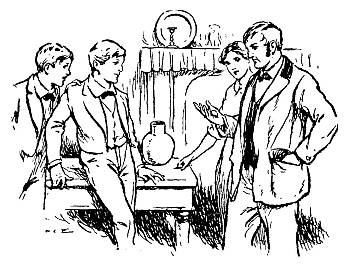
“Yes,” I cried eagerly, “of course. You don’t know how happy you made me by what you said. She is to keep it, isn’t she, Bob Hopley?”
“Well,” said the big fellow, holding the little watch carefully and admiringly in his great brown hand,—“well, seeing, my lass, how it’s give, and why it’s give, and who give it, and so on, I almost think you might.”
Chapter Thirty Two.
A man once said to me that our brains are very much like a bee’s honeycomb, all neat little cells, in which all our old recollections are stored up ready for use when we want them. There lie all our adventures and the results of all our studies, everything we have acquired in our lives.
Perhaps he was right—I don’t know—I never saw my brains; but, if he is, some of us have got the cells so tightly packed together, and in so disorderly a way, that when we want some special thing which we learned, we cannot find it; it is so covered up, so buried, that it is quite hopeless to try and get at it. This is generally the case with me, and, consequently, there are no end of school adventures during my long stay at “Old Browne’s” that I cannot set down here, for the simple reason that I cannot get at them, or, if I do, I find that the cell is crushed and the memory mixed up all in a muddle with wax.
I suppose I did not pack them into the comb properly. Oddly enough, my recollections are clearest about the part of my days which preceded the trouble over the watch.
After that, life seemed to go on at such a rapid rate that there was not time to put all the events away so that they could be found when wanted for further use.
Still, I recall a few things which preceded my leaving the school for Woolwich.
There was that hot June day down by the river—little stream it really was—that ran through a copse about half a mile from the school. It was on Farmer Dawson’s land, down in the hollow of the valley, up one side of which lay his big range of hop-gardens.
The Doctor paid him a certain rent for the right of the boys going down to this place, where a great dam had been built up of clay and clinkers. It was not all new, but done up afresh after lying a couple of hundred years or so untouched. All round it, Farmer Dawson used to send his men in the winter to cut down the coppice, trimming the ash and eating chestnut trees down to the stumps to make the young growth into hop-poles; but when the Doctor offered to take it and repair the dam, the hop-poles were left to grow and form a beautiful screen round this dell.
I remember what interest we boys took in it during one winter, when the Doctor had set a lot of men who were out of work to dig and wheel the clinkers and clay, a barrowful of one, and then a barrowful of the other, along the dam; and with old Lomax to give orders, we all marched and counter-marched in our thickest boots over the top of the dam, to trample it all down strong and firm.
You will think, perhaps, that it was easy enough to get clay, and so it was, for a thick bed lay only a few yards from the stream; but what about the clinkers?
I’ll tell you. There was quite a mine of them, hard, shiny fragments, some of which had run just like so much black or brown glass.
How did they get there, looking like so much volcanic slag? Why, they were the refuse from a huge iron furnace that used to be in full blast in the days of Queen Elizabeth or King James, and the dam we were repairing, after it had been grown over with trees, and the water reduced to a little stream, belonged to one of the old hammer ponds whose waters were banked up to keep a sufficiency to turn the big wheel that worked the tilt-hammers and perhaps blew the iron furnace till it roared.
For that peaceful rural part of Sussex was in those days a big forest, whose wood was cut down and made into charcoal. The forest is gone, and only represented now by patches of copsewood saved for cutting down every ten years or so for poles; but the iron lies there still in great veins or beds, though it is no longer dug out, the iron of to-day being found and smelted north and west, where coal-pits are handy; and the ironmasters of Sussex, whose culverins and big guns were famous all the world round, have given place to farmers and hop-growers, where grimy men used to tend the glowing metal and send it running into form and mould.
I have mentioned before how there used to be a furnace by Sir Hawkhurst’s penstock pond, where the embankment was still firm, but there had been a far more extensive one here, and the refuse went, as I have said, to repair the dam.
When this was done, the Doctor had a long low shed built and thatched and supplied with form-like seats, and a diving-board arranged, beside steps down in the shallow part for the younger boys, and the whole when finished made a glorious long pool of about an acre in extent, very deep by the dam, and sloping gradually up to a few inches only of water where the stream trickled in. And there, on the hot sunny afternoons, beautifully shut in by green waving trees, and with the water when we came to bathe so clear that you could see every stone on the gravelly bottom, we boys used to collect for a regular water frolic. But, as you may suppose, the water was not so clean when we had done, the paddling of the little fellows in the shallows discolouring it from end to end.
That special hot June afternoon cricket had been voted too tiring, and we had all gone down to the bathing-place, the non-swimmers having strict injunctions not to pass a couple of posts about half-way between the stream and the dam.
It was always Lomax’s duty to come down with us at bathing times, and, with his walking cane under his arm, he used to stride to and fro along the bank, barking out orders to the lesser boys, who were constantly breaking the rules, and getting toward the deeper water.
By that time I was a pretty fair swimmer, and had got over my natural nervousness to the extent that I was ready to dive off the board into the deepest part, and go anywhere with ease. Mercer was better than I, and Hodson better still; Burr major, from being so long, bony, and thin, was anything, as Mercer used to say, but eely in the water,—puffing and working hard to keep himself afloat; while Dicksee, though naturally able to swim easily from his plumpness, was, I think, the greatest coward we had there.
The water was delightfully warm that afternoon, but it soon got to be very thick, though that did not trouble us in the least, and we were in the full tide of our enjoyment, swimming races, diving, and playing one another tricks, while all the time, sharp and short from the bank, Lomax’s orders would be snapped out.
“You, young Jenkins, what did I tell you? Phibbs, you’re the wrong side of the posts. Mullins, if I have to speak to you again, I shall report you. Wilson, if you don’t go up into the shallows, I shall fetch you out.”
“Can’t,” cried the impudent young dog.
“Then I’ll send a big boy to fetch you, sah. How dare you, sah! What do you mean, sah?”
Then there would be the pad, pad, pad, pad of naked feet, as a boy ran along the diving-board, sprang out, and then splash he would be into the water.
And so it went on, with some tiring, and going and sitting in the sun, which played the part of warm towel, till they would come in again, for it was declared to be the most delightful day we had had.
Then Mr Rebble and Mr Hasnip came down to see how we were getting on, and stood cheering and encouraging the timid ones, who were loth to get duckings by learning to swim.
I had been trying for some time, right out in the middle, to float without moving, while Mercer and Hodson in turn had their tries. Burr major was swimming from side to side, blowing like a grampus, and other boys were about us unnoticed, for we were too much occupied over our own efforts to heed them, when all at once, as I lay back with the water nearly all over my face, and my hands right down paddling softly, a wave turned me a little on one side; I raised my head, and a horrible yell sent a cold chill through me.
“What is it? the matter?” cried Mercer.
“Help! help!” shrieked Burr major, who was only a few yards away, splashing the water heavily as he swam with all his might for the side.
But he only shrieked out, “Help! help!” in a horror-stricken voice, and we all swam toward him as he made for the shore, all the lesser boys splashing out as fast as they could, to congregate shivering on the bank.
“What is it? What’s the matter?” cried Mr Rebble, hurrying along the path, while Lomax came running round from the other side, for he had crossed the dam to act the part of water shepherd over some of his wet lambs.
But Burr major only kept on shrieking, “Help! help!”
“What’s the matter, boys?” cried Mr Hasnip, who was now standing on the bank just where Burr major would land.
“Don’t know, sir.”
“He’s frightened, sir.”
“Got the cramp.”
This, and half a dozen other replies, came in a confused chorus, as we swam on in a half circle behind Burr major ready to help him if he ceased to swim.
But he was striking out strongly, though his voice grew hoarser and more weak as he neared the edge, where, ghastly-looking and shivering, he snatched at Mr Rebble’s hand, and allowed himself to be helped out.
“Don’t make that noise, Burr major,” cried the master. “What’s the matter with you? Speak.”
“Gone down—drowning! Oh—oh!”
He said this last in a husky whisper, and with white rings showing round his wide-open eyes, he turned and pointed toward the middle of the great pool.
“Who—who has?” cried Mr Hasnip frantically, and we looked eagerly from one to the other, but no one seemed to be missing.
“Speak, sir. Who is? Where?” cried Mr Rebble, seizing Burr major by his wet shoulders and shaking him. “Don’t go on like that. Speak.”
But Burr major made one gesticulation, and then his limbs seemed to double up beneath him, as he dropped fainting on the grass.
“What is it? cramp?” cried Lomax, coming up, and taking off his coat. “I’ll soon put that right.”
“No; he says some one is drowning.”
“What?” roared Lomax wildly. “One of my lads! Here, who’s missing?”
There was no answer, and the boys all gazed in a frightened way at each other.
“Here, Burr major, rouse up,” cried Mr Rebble, shaking the long, thin lad, as he knelt down on one knee. “Who was it? Any one with you?”
The boy’s eyes opened a little, he looked up wildly, and, trying to rise, pointed again to the middle of the pool.
“Was—by me,” he moaned—“went down.”
“Never mind who it is,” roared Lomax, literally tearing off his clothes. “Now, boys—divers. In with you!”
His loudly-spoken command acted like magic upon us, and Mercer, Hodson, and I dashed into the water abreast, and swam for the middle of the pool, where in turn we began to dive down and try if we could find our luckless school-fellow, whoever he might be, but without result.
“That’s right,” cried Lomax, as I came up, for he had joined us in an incredibly short space of time. “Keep trying. This way.”
He stretched out his arms, joined his hands as high as he could above his head, so that their weight should help to sink him, and he slowly went down out of sight, while, as fast as our efforts would allow, we boys went down and tried to search about, gradually extending the distance from each other in obedience to the orders shouted to us from the bank.
I suppose it was in ten feet water, about thirty yards from the great embankment, where we dived down most, but our attempts became more feeble, and I found myself at last swimming heavily close to Lomax, whose fierce-looking head suddenly rose close to my hand.
“Does nobody know anything about where the boy went down?” he roared; but there was no answer, and he panted out,—
“Take care of yourselves, boys. Don’t overdo it. We must keep on, but it’s unkind work.”
We dived again and again, till I felt that I could do no more, and once more I was close up to Lomax, who had been down till he was almost completely exhausted.
“Oh, my lad! my lad!” he groaned, as he began to tread water slowly, “I’d have given anything sooner than this should have happened. Here, you, Burr junior, you’re spent, boy. Swim ashore.”
“I’m not,” I said. “I’m going down again.”
“I’m done,” groaned Lomax. “I seem to have no more strength.”
Shouts and orders came from the bank.
“They’re saying we don’t dive,” said Mercer piteously.
“Not diving?” cried Lomax. “Well!”
As he spoke, he sank again, and the water closed in a swirl over his head, while, after taking a long breath, I dived under into the depths, with the water thundering in my ears, as, during what seemed to be a long space of time, though less than a minute, of course, I groped and swam about till a curious sensation of confusion came over me, and, frightened now, I touched something and clung to it wildly, believing in my startled state that it was Lomax.
The next instant I was at the surface, surprised to see the old sergeant making a rush at me, as he uttered a shout. Then he seized something by me, and I knew that I had brought one of my schoolfellows to the surface.
We swam ashore, to reach it soon after Lomax, who had borne the white, limp figure we had rescued into the dressing shed.
“Boys who can run!” shouted Mr Rebble. “Blankets, quick!”
A dozen boys dashed off, and Lomax panted,—
“You two—work him like this—gently. I’ll relieve you directly.”
He left the two masters rubbing and moving the boy’s arms to their full extent, and pressing them to his sides, while he hurried on some clothes, and, shivering with horror and exhaustion, we followed his example, while, with my ears ringing, I heard Mercer gasp out,—
“Poor old Dicksee! Oh, Frank, I hope he ain’t drowned.”
But as, after our hurried dressing, we saw him lying there rigid and cold, it seemed as if the boy would never say another unkind word to a soul.
By this time Lomax had relieved the two masters, and with all the vigour of his strong arms he was trying to produce artificial respiration somewhat after the fashion that has of late been laid down as a surgical law, but apparently without avail.
The blankets had been brought, the boys, all but we few elder ones, sent back to the school, and a messenger had gone for the nearest medical man, so that nothing more could be done than was in progress.
“I’m afraid it’s a hopeless case,” said Mr Rebble, with a groan.
“Never say die, sir,” cried Lomax. “I remember a lad of ours in my regiment was swept with his horse down the torrent below where we were fording a river away yonder in India. He seemed to be quite gone when we got him ashore half a mile lower down, but we rubbed and worked him about for quite three hours, taking it in turns, before he gave a sign of life. But he opened his eyes at last, and next day he was ’most as well as ever. What time do you expect Doctor Browne back, sir?”
“Not till quite late to-night. And what news for him!—what a shock for them both!”
“Shock!” said Lomax. “Here, you take a turn now, Mr Hasnip; we mustn’t stop for a moment.”
Mr Hasnip, whose coat was off and sleeves turned up, sprang to his side and went on.
“I’ll relieve you again soon, sir,” said Lomax, wiping his dripping forehead. “But how was it, Mr Burr major?”
“I—I don’t know,” said my school-fellow, starting. “I think he suddenly remembered it was so deep, and he turned frightened, for he went under all at once and right down, and then I cried for help.”
“Better have lent him a hand,” said Lomax gruffly. “Well, Mr Hasnip, sir, feel him coming to?”
“No, no,” said the second master dolefully. “He is dead! he is dead!”
“Not he, sir,” cried Lomax roughly. “We’re going to bring him round; all we’ve been doing has helped him, and it’s a long way off three hours. Here, let’s have him out in the sunshine, please. I believe in the sun.”
The poor fellow was carried out, the two masters each taking a corner of the blanket on which he lay, Lomax and I the others.
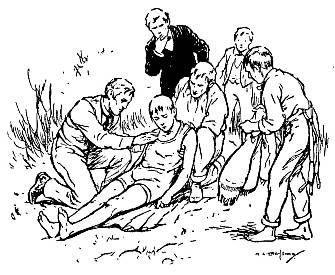
It was quickly done, and then Lomax recommenced rubbing, working the boy’s chest so as to make it contract and expand, and all the time with perspiration dropping from his brow. Mr Rebble and Mr Hasnip both relieved him, and we boys did our best to help; but the afternoon glided on, no doctor arrived, and we felt chilled and hopeless, till all at once, after a rest, Lomax had begun again apparently as fresh as ever, and to our horror he suddenly began to whistle a merry tune.
“Lomax!” cried Mr Hasnip.
“What’s the matter, sir?”
“For goodness’ sake—at a time like this—it is too—”
“Why, haven’t I got cause to whistle, sir?” cried the sergeant merrily. “What did I tell you? Only wanted time and plenty o’ muscle.”
“What! is he reviving?”
“No, sir, he’s revived,” said Lomax. “Look at the colour coming, and his eyelids quivering. He’ll be sitting up directly. Here, you can feel his heart beating now.”
Mr Rebble went down on one knee and laid his hand upon Dicksee’s breast; then, jumping up again, he caught Lomax by the wrist.
“Heaven bless you for this!” he cried, and Mr Hasnip forgot his dignity as a master, and, taking off his hat, joined us boys in a hearty, “Hip! hip! hip! hooray!” which seemed to give the finishing impetus to our treatment, for Dicksee opened his eyes wide, struggled up into a sitting position, stared about him for a few moments, and then cried, in a harsh, unpleasant tone,—