G. Manville Fenn (continued 4)
Reading edition
“And now,” said the General, “Doctor Browne here—my neighbour—will tell them not to do so any more—eh, Doctor, eh?”
“Certainly,” said the Doctor. “I’m sure it will not occur again.”
“No, no, of course not,” said the General. “Hopley, you can go. Stop! that ferret belongs to the boys, I think.”
“To you, Frank?” said my uncle.
“No, uncle, it’s his,” I said. “But I was helping to use it.”
“Hah! that’s better,” said my uncle sharply.
“I bought the ferret,” said Mercer, speaking for the first time, “but I don’t want it. I’ll give it to you, Bob.”
“Yes, yes, very wise of you, my lad. There, go now, Hopley,” said the General.
The keeper touched his forehead, and gave a look all round, then winked solemnly at Mercer and me, and left the room.
“Hah!” said the General; “then that little bit of business is settled, Doctor, eh? Just a word or two.”
“A few admonitions, my dear sir,” said the Doctor blandly. “And now, if you will excuse me for a while, I will retire with Mercer here.”
Tom gave me a look so full of appeal, that I ran across to the Doctor.
“Don’t punish him, sir!” I said imploringly. “We were both alike.”
“What’s that, Frank?” said my uncle.
“I asked the Doctor not to punish Tom Mercer, uncle.”
“No, no, no: of course not!” cried the General; “I endorse that appeal. Here, you sir, come to me. Gentlemen don’t do such things as that; and now we all know better, I’ve got some capital fishing in my ponds and lakes, and I shall be happy to see you two at any time. There, shake hands.”
Tom jumped at him, and it was pleasant to see how delighted he looked as he turned and shot a grateful glance at the General before the door closed on him and the Doctor.
Then the two old officers began chatting eagerly together about past times, while I sat by my mother as she held my hand, and I told her the history of my escapade, which was hardly finished when my uncle said,—
“I’m sorry to come down and find you in disgrace, Frank. Not the conduct of one who means to be an officer and a gentleman by and by.”
“No, no: don’t say any more,” said the General. “The boy behaved very well. Liked a bit of sport; all boys do. He shall have a bit of rabbiting now and then.”
“Then I shall say no more,” said my uncle. “Try and be like your name, my boy, and you will find me ready to forgive your scrapes; but you must always be a gentleman.”
“Amen to that,” said the General, rising. “And now, my dear Mrs Burr, I will not say good-bye, but au revoir. Seaborough here tells me you are both going to stay in Hastings for a few days. I shall drive over and see you. Good-bye.”
He showed the same courtly respect to her again, and was rising to go when the Doctor re-entered, and they parted the best of friends.
“No, no, no,” cried the General, as the Doctor was coming out with him, “stay with your visitors. Odd meeting, wasn’t it? Here, you, Frank Burr, come and see me off. Good-day, Doctor, good-day. You and I must be better neighbours.”
“I shall be proud,” said the Doctor, and then I went to the cart with the General, who stood holding my hand at the step, and I could feel a coin therein.
“For you two boys,” he said. “There, good-bye, Frank Burr. You must grow up into a brave gentleman like your father. A thorough soldier, sir. God bless you, my boy! Good-bye.”
He took the reins and got in, the groom left the horse’s head and mounted beside him, and as the cart was driven off, and I stood there with a sovereign in my hand, Bob Hopley, who was in his place behind, gave me another solemn wink, while, after noticing the hired carriage in which my mother and my uncle had driven over from Hastings, I went back into the room and stayed with them, and afterwards went to show them the building and grounds.
An hour after, they were gone, while I hurried off to find Mercer and show him the sovereign.
“Well,” he said, “that’s all right. But, I say, don’t some things turn out rum! What are you going to do with all that money?”
“Half’s yours,” I said.
“Oh, is it? Well, let’s make a bank. It’ll do to pay old Lomax and lots of things.”
Chapter Sixteen.
My mother and my uncle came over to see me twice during their stay at Hastings, and during one of the visits my uncle spoke to the Doctor about the drill-master, and, after expressing a wish that I should pay attention to that part of my studies, with fencing, asked if this instructor had been in the foot or horse.
“Oh, he was in the cavalry, uncle,” I said.
“Good; then, if Doctor Browne does not object, I should like him to give you a few preliminary lessons in riding, so as to get a military seat while you are young, boy.”
The Doctor expressed his willingness, but he said with a slight cough,—
“Would not a horse be necessary, or a pony?”
“Well, yes,” said my uncle dryly, “I think it would, sir; but that difficulty will be got over. Sir Hawkhurst Rye has offered the boy the use of a stout cob. One of the grooms will bring it over two or three times a week; and, if you would allow me, I should like to have a few words with the old sergeant.”
The Doctor was perfectly agreeable; and when they were going, I had the pleasure—for it was a pleasure—of taking them down to Lomax’s little, neatly-kept place, where the old sergeant stood ready to draw himself up and salute, with his eyes lighting up, and a proud look of satisfaction in his hard face.
My uncle took him aside, and they remained talking together, while my mother walked up and down with me, holding my hand through her arm, and eagerly whispering her hopes—that I would be very careful, that I would not run into any danger with the riding, and, above all, mind not to do anything my uncle would not like.
Of course I promised with the full intention of performing, and soon after my uncle marched back with Lomax—they did not seem to walk. Everything had apparently gone off satisfactorily, and after plenty of advice from my uncle, he handed my mother into the carriage, followed and they were driven off.
I stood watching the carriage till it was out of sight, and then turned to Lomax, who was standing as upright as if he were on parade, till he caught my eye, and then he gave himself a jerk, thrust one hand into his pocket, and gave the place a slap.
“You’re a lucky one,” he said, “to have an uncle like that, sir. Hah! there’s nothing like a soldier.”
“How am I lucky?” I said rather sourly, for I was low-spirited from the parting I had just gone through.
“Lucky to have a fine old officer like that to want me to make a man of you, and teach you everything you ought to know to become an officer and a gentleman.”
“Oh, bother!” I said. “Look here, Lomax; you’re to teach me riding. Can you?”
“Can I?” he said, with a little laugh; “wait till the horse comes round, and I’ll show you, my boy.”
“I can ride, you know,” I said; “but not military fashion.”
“You? you ride, sir?” said the old soldier scornfully. “Rubbish! Don’t talk to me. I know how you ride—like a sack of wool with two legs. Knees up to your chin and your nose parting the horse’s mane all down his neck.”
“Oh, nonsense, Lom!”
“Fact, sir, fact. Think I don’t know? A civilian rides, sir, like a monkey, bumping himself up and down, and waggling his elbows out like a young chicken learning to fly. There, you be easy, and I’ll teach you how to ride same as I did how to fight.”
“But I don’t know that you have taught me how to fight. I haven’t tried yet.”
Lomax chuckled.
“Wait a bit,” he said. “You don’t want to fight. It’s like being a soldier—a British soldier, sir. He don’t want to fight, and he will not if he can help it. He always hangs back because he knows that he can fight. But when he does—well, I’m sorry for the other side.”
“Then you think I could lick Eely if he knocked me about, or big Dicksee?”
“No, I don’t think anything about it, my boy. You wait. Don’t fight if you can help it, but if you’re obliged to, recollect all I’ve shown you, and let him have it.”
I did not feel in any hurry, and when I talked to Tom Mercer about what I had said to Lomax, he agreed with me that he felt a little nervous about his powers, and said that he should like to try a small boy or two first; but I said no, that would not do; it would be cowardly.
“So it would,” said Mercer; “besides, it would let the cat out of the bag, wouldn’t it? Look here, I know: we ought to have a quiet set to up in the loft some day.”
“But that would only be boxing,” I said.
“Why not make a fight of it?” suggested Mercer.
“But we couldn’t fight without there was a genuine quarrel.”
“Let’s quarrel, then.”
“What about?”
“Oh, I don’t know. Anything. You call me a fool, and I’ll hit you, and then you go at me again, and we should know then what we could do.”
“Get out!” I said. “I shan’t call you a fool; but if I did, you wouldn’t be such a beast as to hit me, and if you did, I should be so sorry that I shouldn’t hit you again. That wouldn’t do.”
Tom Mercer scratched his head.
“No,” he said dryly, “that wouldn’t do. It seems precious rum, though.”
“What does?”
“That I shouldn’t care to hit you. I feel as if I couldn’t hit a fellow who saved my life.”
“Look here,” I said angrily, “you’re always trying to bring up that stupid nonsense about the holding you up on the penstock. If you do it again, I will hit you.”
“Boo! Not you. You’re afraid,” cried Mercer derisively. “Who pulled the chap out of the water when he was half drowned, and saved him? Who—”
I clapped my hand over his mouth.
“Won’t do, Tom,” I said. “It’s all sham. We can’t fight. I daresay old Lom’s right, though.”
“What do you mean?”
“That we shall be able to knock Eely and Dicksee into the middle of next week.”
“But it seems to me as if they must feel that we have been learning, or else they would have been sure to have done something before now.”
“Never mind,” I said, “let’s wait. We don’t want to fight, as Lom says, but if we’re obliged to, we’ve got to do it well.”
The occasion for trying our ability did not come off, though it was very near it several times; but as I grew more confident, the less I felt disposed to try, and Mercer always confessed it was the same with him, though the cock of the school and his miserable toady, Dicksee often led us a sad life.
One morning, soon after the last visit of Uncle Seaborough, Lomax came to the schoolroom door, just as Mr Hasnip was giving me a terrible bullying about the results of a problem in algebra, on to which he had hurried me before I had more than the faintest idea of the meaning of the rules I had been struggling through.
I suppose I was very stupid, but it was terribly confusing to me for the most part. I grasped very well the fact that a plus quantity killed a minus quantity if they were of equal value, and that a little figure two by the side of a letter meant its square, and I somehow blundered through some simple equations, but when Mr Hasnip lit a scholastic fire under me, and began to force on bigger mathematical flowers from my unhappy soil in the Doctor’s scholastic hothouse, I began to feel as if I were blighted, and as if quadratic equations were instruments of torture to destroy boys’ brains.
On that particular morning, I was, what fat Dicksee called, “catching it,” and I was listening gloomily to my teacher’s attempts at being witty at my expense.
“How a boy can be so stupid,” he said, “is more than I can grasp. It is perfect child’s play, and yet you have gone on getting the problem into a hopeless tangle—a ridiculous tangle. You have made a surd perfectly absurd, and—”
“Mr Hasnip!” came from the other end of the great room. Mr Hasnip looked up.
“The drill-master is here. The horse has arrived for Burr junior’s riding lesson. Can you excuse him?”
“Certainly, sir,” and Mr Hasnip looked at me, showing his teeth in a hungry kind of smile, as if a nice morsel were being snatched from him, and I stood with my heart beating, and the warm blood tingling in my cheeks, conscious that all the boys were looking at me.
“Here, take your book, Burr junior,” said my tutor. “Very glad to go, I daresay. Now aren’t you?”
I looked up at him, but made no reply.
“Do you hear me, sir?”
“Yes, sir.”
“I said, ‘Aren’t you glad to go?’”
“Yes, sir.”
“Of course. There, be off. You’ll never learn anything. You are the stupidest boy I ever taught.”
My cheeks burned, and as I turned to go, there was fat Dicksee grinning at me in so provoking a way, that if we had been alone, I should in my vexation have tried one of Lomax’s blows upon his round, smooth face. But as it was, I went back to my place, where Mercer was seated, with his hands clasped and thrust down between his knees, his back up, and his head down over his book, apparently grinding up his Euclid, upon which he kept his eyes fixed.
“Oh ho!” he whispered; “here you are. Without exception, sir, the stupidest boy I ever taught.”
“I’ll punch your head by and by, Tom, if you’re not quiet,” I said.
“Who made the surd absurd?”
“Did you hear what I said?”
“Yes. Oh, you lucky beggar! Who are you, I should like to know, to be having your riding lessons?”
“Less talking there, Burr junior.”
This from Mr Rebble, and I went out, passing close to Burr major, who looked me up and down contemptuously, as he took out his watch, and said to the nearest boy,—
“Rank favouritism! if there’s much more of it, I shall leave the school.”
But I forgot all this directly, as I stepped out, where I found Lomax standing up as stiff as a ramrod, and with a walking cane thrust under his arms and behind his back, trussing him like a chicken, so as to throw out his chest.
He saluted me in military fashion.
“Mornin’, sir. Your trooper’s waiting. Looks a nice, clever little fellow.”
“Trooper?” I faltered in a disappointed tone. “What do you mean? I thought it was the horse come.”
“So it is.”
“But trooper?”
“Of course. Well, charger, then. Officers’ horses are chargers; men’s horses, troopers.”
“Oh!” I cried, brightening up, but with a feeling of nervousness and excitement making my heart beat more heavily still. “Where is it?”
“Paddock!” said Lomax shortly, and without the slightest disposition to be conversational. In fact, he became more military every moment, and marched along by me, delivering cuts at nothing with his cane, as if he were angry with the air.
Then all at once he glanced at me, looking me up and down.
“Humph! No straps to your overalls,” he said snappishly.
“Overalls?”
“Well, trousers, sir. They’ll be crawling all up your legs. Get some buttons put on by next time.”
He turned into the field devoted to the Doctor’s cows and to the junior boys’ football, and there I saw the General’s groom holding a fiery, untamed-looking steed, as it seemed to me, arching its neck and snorting, as it stood champing its bit till the white foam flew from its mouth.
The groom touched his hat to me as we came up.
“Master’s compliments, sir, and as he wants me,” he said, “would you mind riding the cob back to the house?”
“Oh yes, of course,” I said, glancing at the fierce-looking animal, and mentally asking myself whether he would allow me to ride him home. “Is—is he quiet?”
“Quiet, sir! why, he’s like a lamb. Bit playful sometimes, but no more vice in him than there is in an oyster. Mornin’, sir.”
The man touched his hat and went off, leaving Lomax and me with the horse, which looked enormous then.
Lomax strode round the animal, examining it, and making remarks as he went on.
“Very well groomed,” he said. “Saw your old friend Magglin before breakfast. Good legs. Like to get taken on again, he says. Tail wants topping—too long. Lucky for him he didn’t get before the magistrates. Doctor won’t have him again. Very nice little nag, but too small for service. I told him that all he was fit for was to enlist; some sharp drill-sergeant might knock him into shape in time. He’s no use as he is. Now, then, ready?”
“Yes,” I said shrinkingly, “I suppose so.”
“That’s right,” cried Lomax, and, lifting up the flap of the saddle, he busied himself, as I supposed, tightening the girths, but all at once they dropped to the ground, and, with the rein over his arm, Lomax lifted off the saddle and placed it upon the hedge.
“Now then,” he cried, “come along and I’ll give you a leg up.”
“But you’ve taken the saddle off.”
“Of course I have. I’m going to teach you how to ride.”
“Without a saddle or stirrups?”
“Of course. A man wants to feel at home on a horses, so does a boy. Now then, I’ll give you a leg up.”
I was like wax in his hands. On lifting one leg as he bade me, the next moment I was sent flying, to come down on the horse’s back astride, but so much over to the right that I had to fling myself forward and clutch the mane.
“Bravo! Well done!” cried Lomax sarcastically.
“I’m all right now,” I cried.
“All right! Here, come down, sir. Do you know what would have happened if that had been some horses?”
“No,” I said, dismounting clumsily.
“Well, then, I’ll tell you. They’d either have sent you flying over their heads, or bolted.”
“I’m very sorry,” I faltered.
“Sorry! I should think you are. Got up like a tailor, sir, and you’ve come down like one. Bah! It’s horrible.”
“Well, but you’ve got to teach me better,” I cried.
“True. Good lad. So I have. Now then, give me your leg. That’s it. Steady. Up you go.”
“That’s better,” I cried, settling myself into my place.
“Better! No, it isn’t. It’s not so bad only, sir. Now, then, sit up so that a line dropped from your temple would go down by your heel. Better. Get your fork well open.”
“What?”
“Sit close down on the horse’s back, then. No, no, you don’t want to scratch your ear.”
“Well, I know, that,” I said, laughing.
“Then what did you cock up your knee that way for? Let your legs hang down. That’s better. Toes up and heels well down.”
“What for, Lomax?”
“Don’t ask questions. Do as I tell you. Well, there you’re right. Toes up so that they just rest in the stirrups.”
“But I haven’t got any stirrups.”
“Then act as if you had.”
“But why don’t you let me have some?”
“Silence in the ranks, sir. Now then, keep your balance. Advance at a walk.”
The horse started.
“Halt!” shouted Lomax, and the horse pulled up so short that I went forward.
“What are you doing, sir? You don’t want to look into the horse’s ears.”
“I wasn’t trying to,” I said sharply.
“What were you going to do, then?—whisper to him to stop?”
“I say, don’t tease me, Lom,” I said appealingly; “you know I couldn’t help it.”
“Right, my lad, I know. But ’tention; this won’t do. I’ve got to teach you to ride with a good military seat, and we’re not friends now. You’re a private, and I’m your riding-master.”
“Yes, but one minute, Lom—”
“Sergeant Lomax, sir.”
“Yes, Sergeant Lomax. I say, do let me have a saddle.”
“What for, sir?”
“It’s so much more comfortable.”
“A soldier, sir, is a man who scorns comfort and takes things as they come. You’ve got to learn to ride.”
“Of course. Then where’s the saddle?”
“When you can ride well without a saddle, you shall have one. Now: no more talking. ’Tention! By your right—March!”
The horse started off without my influencing him in the slightest degree, but before we had got ten yards, the sergeant’s stern “Halt!” rang out again, and the horse stopped as suddenly as before, but I was aware of it this time, and gripped him hard with my knees.
“Good. Well done. But you went too far forward. Take a good hold with your knees. And that’s not the way to hold your reins. Look here, one rein—no, no, not the curb—the snaffle—that’s it now—one rein outside your little finger and one in, and the rest of the rein through your hand, between your forefinger and thumb. Good. Now pick up the curb rein off your horse’s neck and let it rest lightly in your hand.”
“What for?”
“Don’t ask questions. Because it’s right. Ready for use if the horse pulls too much or bolts.”
“Is he likely to pull too much or bolt?”
“Don’t ask questions. No, he isn’t. Soldiers generally ride on the curb, but a horse like this don’t want it. He has been ridden with cavalry, too. Now then, once more at a walk—March!”
The horse started again, with his soft, warm back feeling terribly slippery, but I sat quite stiffly upright, and he walked straight up the paddock, and seemed as if he were going to leap the hedge, making me wonder which side I should fall; but just as we were close up, the sergeant’s voice rang out,—
“Right wheel!”
The horse turned to the right instantly, and had gone a dozen yards when the sergeant shouted again, “Right wheel!” and directly after, “Forward!” with the result that we were now facing him, and went slowly down the paddock, till the sergeant shouted, “Halt!” just as I was beginning to feel a little more comfortable, and not as if I must slide off right or left at any moment.
“Well, that’s pretty fair, sir,” cried Lomax, as the horse stopped short. “Chest out more, back hollow. Keep your knees well in. Capital horse for you to learn on. Knows all his work. Well, we won’t waste time walking. You shall do that now at a trot.”
“Without a sad—”
“’Tention. No talking in the ranks.”
The horse didn’t want to be turned, but came round quickly, almost on a pivot, very much disturbing my equilibrium again; but by gripping tightly with my legs I managed to hold on, and looked anxiously at Lomax.
“Ah,” he shouted, “eyes straight for the horse’s ears! Now then, you will sit firm, elbows close to your sides. ’Tention! The squadron will advance at a walk. Forward—tr–r–r–ot!”
The horse had only walked a few paces when the second order came, and he broke directly into a trot, which sent me bumping up and down, now a little inclined to the right, then more to the left, then my balance was gone. I made a desperate effort to save myself, and then, perfectly certain that the horse would trample me to death beneath his feet, down I went on my back, and began to scramble up, with my mount stock still beside me.
“Not hurt a bit!” cried Lomax, running up and handing me my cap, which had come off.
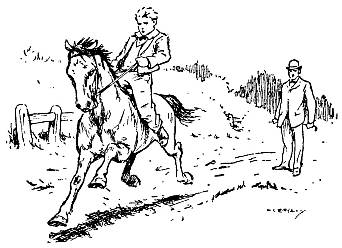
“No,” I said, beginning to feel myself all over; “I don’t think anything is broken.”
“And I’m sure there isn’t,” cried Lomax. “Now then, I’ll give you a leg up.”
“Am I to get up again—now?” I faltered.
“Without you want to say you haven’t pluck enough to learn to ride.”
“No,” I said; “I haven’t pluck enough to say that.”
“Not you. Up you go. There. Now that is better. Stick on this time.”
“I could if I had stirrups,” I said, “and a saddle.”
“No, you couldn’t, sir, so don’t talk nonsense. You’ve just learnt the finest thing a lad who wants to ride can learn—the thing that gives him plenty of confidence.”
“What’s that?” I asked; “that it’s very hard to keep on?”
“No; that it’s very easy to come off and roll on the ground without hurting yourself a bit. Off you go again. Forward—trot!”
The horse snorted and went on, shaking me almost to pieces, and sometimes I was nearly off on one side, sometimes nearly off on the other, but I kept on.
“Right wheel!” came from the other end of the field, then, “Right wheel!” again. “Forward!” and the horse was taking me—for I had nothing whatever to do with him—back toward where the sergeant stood.
I kept my balance pretty well, but my trousers were running up my legs, and I felt as if everything belonging to me was shaken up. Then once more my balance was gone, and off I went on to my back, and over and over a few yards from the sergeant, who ran up, the horse once more stopping short by my side.
“Bravo!” cried Lomax, as I sat up. “You’re getting on.”
“I thought I was getting off,” I said dolefully.
“Rubbish, sir; improving fast. Here, up with you again. It’s all strange to you at first, but you’ve got to grow to that horse’s back, till it’s like one animal—horse and man. You’ve got to learn to grip him till you feel as if you can’t tumble off.”
“But I never shall,” I cried.
“Don’t tell me. I’ll make you. Now then; there you are. Now you just trot down to the bottom and back without coming off like a sack of shavings. Never mind the reins. Let him have his head, and you put all your sperrit into your knees. Keep your position and preserve your balance.”
“I know I shall fall again soon.”
“Very well, then, fall. But I don’t believe you will. Now then, once more.”
He gave the order, the horse walked a few steps, then at the second order broke into a trot, and, to my utter astonishment, as I drove my knees into the warm soft sides, away we went, wheeled to the right, then to the right again, and trotted back to the sergeant, who shouted,—
“Halt! Bravo! There, what did I say? Make much of your horse.”
The lesson was kept on for fully two hours, and then, to make up, I suppose, for a good deal of bullying, my instructor was loud in his praise, and, opening the gate after replacing the saddle, he signed to me to mount, but I tried and could not, for my legs felt stiff and stretched, my back ached, and there was a peculiar sensation of soreness about the knees.
“Shall I trot him back?” said Lomax.
“If you would, please,” I said. “I do feel so stiff.”
“I will, my lad. To-morrow morning same time; and I’ll get some of that stiffness out of you.”
“Thank you,” I said rather dolefully; and then I could not help watching the old dragoon with a feeling of envy as he placed one foot in the stirrup, drew himself up till he stood upright, then deliberately threw the right leg over the horse’s back, slowly dropped into his place as upright as a dart, and trotted steadily out into the road and away out of sight, while, after closing the gate, I began to retrace my steps in the direction of the school, just as the boys came trooping out for their regular run till the room was ventilated, and the cloth laid for dinner.
“Oh, I say, it’s rank favouritism!” came from the middle of a group. “I shall speak to the Doctor about it.”
Some one answered this, but I did not hear the words, and I hobbled to the door, and went up to my room, wondering how any one could be envious of the sensations I was experiencing then.
Chapter Seventeen.
“How are your sore knees?” said Mercer one morning soon after my long first lesson in riding.
“Oh, dreadful!” I cried. “They get a little better, and then the riding makes them bad again.”
“But why don’t he let you have a saddle?”
“He does now,” I said—“that is, he did yesterday; but it’s worse riding on a saddle, it’s so slippery, and he will not let me have any stirrups.”
“When are you going again?”
“To-day, I suppose. The Doctor says I’m to get on as fast as possible, and make up with my other studies afterwards.”
“Wish I was going to learn to ride.”
“You wouldn’t much like it if you had to,” I replied. “Oh, I don’t know. It looks very nice to see you going along. But, I say, it does make Burr major so wild. I heard him tell Dicksee he should make his father send him a horse, and Dicksee said he ought to, and I laughed.”
“Did he hear you?”
“Yes, and gave me such a clip on the head with a cricket stump. Feel here.”
I placed my hand where he suggested, and there was a good-sized lump.
“What a shame!” I cried indignantly. “Didn’t you hit him again?”
“No; I only put it down. We’re going to pay it all back some day.”
“Yes; but when?” I cried.
Mercer shook his head.
“I say,” he continued, “I saw old Magglin this morning before breakfast.”
“What was he doing here?”
“Dunno. Wanted to see me, I suppose, and borrow a shilling.”
“Did you lend him one?”
“Yes; I felt obliged to.”
Just then Burr major came by us, and looked us both over sharply.
“Haven’t you two got any lessons to get ready?” he said.
“Yes,” I replied.
“Then go in and get them ready before I report you both to Mr Hasnip. Do you hear?”
“Yes,” I said; “but I’m going to have my riding lesson.”
“Your riding lesson!” he sneered; “you’re always going to have your riding lesson. I never saw such a school as it’s getting to be. It’s shameful! I shall go and ask Mr Hasnip if we boys are to be kept always at work, while you and Tom Mercer are idling about and enjoying yourselves.”
“All right,” said Mercer oracularly, in a whisper to me, as Burr major walked off importantly for a few yards, attended by his satellites, and then stopped, drew out his watch with a flourish, looked at it, and put it back with an air that he intended to be graceful.
“Look here, you, Tom Mercer—do you hear, Jollop? You’re not going to have riding lessons. I give you five minutes to get back to your work, and if you are not there then—you’ll see.”
“All right,” said Mercer again; and then, as Burr major was out of hearing, “Any one would think he was the Doctor. Oh, I should like to—” he continued, grinding his teeth. “Think we could, Frank?”
“I don’t know,” I said hesitatingly; “but when he talks like that, it makes me feel horribly mad, and as if I should like to try.”
“Never mind. Wait a bit; the revolution isn’t ripe yet,” said Mercer darkly. “Wish I’d got a watch like that.”
I was very angry, but my companion’s sudden change from thoughts of revenge to covetousness seemed exceedingly droll.
“What are you laughing at?” he said.
“At you about the watch.”
“Well, I can’t help it, Frank. That watch seems always staring at me with its round white face, and holding out its hands to me. I dream of it of a night, and I’m always longing for it of a day. You can’t tell how bad it makes me feel sometimes.”
“You shouldn’t think about it, Tom.”
“I can’t help it. I don’t want to, but the thoughts will come, dreadfully. I say,” he whispered darkly, “I don’t wonder at chaps stealing sometimes, if they feel like I do.”
“What nonsense!” I cried: “I say, here’s Eely coming back.”
“Is he?” said Mercer sharply. “Then I’m off in.”
“Why, you’re never going to be such a coward as to be bullied into obeying his orders.”
“Oh yes, I am,” replied my companion. “Time isn’t ripe yet. But when it is—oh!”
He gave vent to that exclamation with peculiar force, though it was only a low hiss, and I followed him with my eyes, half disposed to think that Tom Mercer would prove a rotten reed to lean upon if I wanted his support in a struggle against our tyrant; though, truth to tell, as Burr came rolling along with half a dozen boys about, all ready at a word from him to rush at me, I did not feel at all confident of being able to resist his authority, and I began to move off.
“Hullo!” he cried. “Here’s the gallant horseman, boys. Let’s go and see him ride.”
“Yah! he can’t ride,” cried Dicksee; “he’ll tumble off.”
“Not he,” said Burr major. “Old Lom ties his ankles together under the horse. But he does look an awful fool when he’s on board. I say, Burr junior, you don’t think you can ride, do you?”
“No,” I said quietly.
“And you never will. I say, boys, what an ugly beggar he grows! I know why he’s learning riding.”
“Do you? Why?” cried Dicksee.
“They’re going to make a groom of him.”
The blood flushed up in my face, and I began to feel as if the time must be getting ripe.
“Why, he was bragging about going to be a soldier!” cried another boy.
“Him! A soldier! Ha, ha, ha!” cried Burr major. “They wouldn’t even have a big-eared-looking fellow like that for a parchment-whopper.”
“He said a horse soldier.”
“Horse sneak,” said Burr major scornfully. “A soldier! Ho, ho, ho! Ha, ha, ha! I say, boys—a soldier!”
He burst into a yell of laughter, all forced, of course, and his satellites roared too, some of them, to curry favour, beginning to dance about him, and look eagerly in his face, as if for orders.
Of course it was very absurd to mind, but I could not help it, and tingled all over.
“Oh, I wish Mercer was here!” I thought to myself.
“The time must be ripe;” and I suppose my face showed something of what I felt, for Burr major cried,—
“Look at the puppy, boys; he looks as if he wanted to bite. Did you ever see such an impudent beggar? I don’t believe his name’s Burr at all. It’s only a bit of a show-off.”
At that moment there was a hail from the paddock, and the school bell rang for the first lesson.
“There, groom, you’re wanted,” said Burr major sneeringly. “Go on and learn to ride, and mind you don’t hurt yourself.”
“Yah! Go on, ugly!” cried Dicksee, and the boys roared.
“Do you hear, sham sodger? Be off, and don’t stand staring like that,” cried Burr major again. “I told you to go.”
“Go yourself,” I retorted, now thoroughly roused, and feeling reckless. “Go in to school and learn your lessons, and mind the Doctor don’t cane you.”
“What?” cried the tall, thin fellow, flushing up, as he advanced upon me menacingly, while the bell was rapidly getting toward its last strokes,—“what’s that you say?”
“Go in and get to your lessons, and take that fat-faced booby with you.”
“Well!” cried Burr, “of all!” and he looked astounded.
“That’s it, is it? Cheeking me because you know I can’t stop now. But all right, I shan’t forget it. If I do, Dicksee, you remind me after lessons that I’ve got to warm Jollop and this groom boy. The Doctor’s been spoiling them both lately, and they want taking down.”
“All in, all in, to begin!” was shouted from the doors.
“Oh yes, we’re coming soon,” said Burr major, throwing up his head. “Wait a bit, you, sir, and I’ll teach you to insult your seniors.”
“All in, all in!”
“Here, Dicksee, go and hit that fellow on the mouth for shouting.”
“All in, all in!” came again, directed at our group.
“Coming,” cried Burr major. Then to me: “After morning studies, you sir. I don’t suppose I shall forget.”
“If you do, I shan’t, bully,” I said, and he turned upon me more astonished than ever, and then burst into a fit of derisive laughter.
“He’s mad,” he cried. “Here, boys, Senna’s been gammoning him into taking some of his physic, and he don’t know what he’s saying.”
“Dicksee—Burr major. Come, boys.”
Mr Rebble was standing in the schoolhouse doorway, and all but Burr major ran off. He took out his watch, and walked away importantly after the others, while I felt a peculiar nervous thrill run through me, and began wondering whether I had been too bold, as I went off hurriedly now to where Lomax was waiting with the horse.
“I don’t care,” I said; “he may thrash me, but I won’t be bullied like that, and insulted, without a try.”
“Come, young gentleman,” cried the sergeant. “I began to think you were going to shirk it.”
“Not I, Lom,” I cried, and, feeling peculiarly excited, I went up to the horse’s head and patted him, while the sergeant removed the stirrups. Then he gave me a leg up, and I was hoisted into my seat, and went through my lesson—walk, trot, and gallop, with the saddle seeming less slippery, and without coming off once.
The sergeant, I noticed, was very severe, and barked and shouted at me and the horse, keeping us doing the same things over and over again, and growing more exacting as we went on. But I hardly noticed him, for my head was all in a whirl, and I was thinking about after lessons, and what would happen then. So occupied was I with my thoughts that I never once felt nervous, but as if all I had to do was to sit still and let the horse obey the orders.
Lomax finished me off with a canter round the paddock, which was taken at a pretty good pace, and very easy the horse’s pace was, but I was thinking of Burr major’s sneering face all the time, and his long arms and bony white hands. Then about Mercer, and what he would say—what he would do.
“Are we both to have a good thrashing?” I asked myself, as the horse cantered on, and “Right wheel—left wheel—forward!” rang in my ears. “Are we to be made more uncomfortable than ever?” I thought; “and shall we forget all about what old Lom taught us?”
My arms did not move, my left hand held the reins on a level with my imaginary waist-belt, about which the sergeant talked, and my right hand hung steadily down just by my leg, but all the time I was on guard, and keenly on the watch for blows from those white bony hands that seemed to be flourished before me. Then I fancied concussions and dizziness, and felt blows, and rolled over upon the grass, but not off the horse, for it was all fancy; and I was just seeing in my mind’s eye poor Tom Mercer going down before a heavy blow from Dicksee’s fat fist, when there rang out the word, “Halt!” and the horse stopped short.
Lomax strode up in his stiff military fashion, and patted the cob on the neck.
“Well?” he said sharply. “What am I to say to you now?”
“I—I don’t know,” I faltered. “Shall we go through it again.”
“No, no let the trooper breathe a bit. He has been kept at it pretty tightly. Well, how do you feel—stiff?”
“No,” I said, flushing a little, full of a feeling of regret for my neglect in my lesson.
“Bit sore about the knees, eh?”
“Oh yes, my knees keep very sore,” I faltered.
“Of course they do. Never so hard worked before. Soon get better. Let me see, this makes just a month you’ve been at it, eh?”
“Yes, this is the end of the fourth week.”
“Then don’t you think I deserve a bit of credit?”
“Oh yes!” I cried eagerly. “You have taken great pains over me, Lom. I wish I had not been so stupid.”
“So do I,” he said drily. “Saddle feel very slippery this morning?”
“Oh no, I didn’t notice it,” I replied.
“Didn’t long for the stirrups?”
“I didn’t think about them.”
“Felt as if you belonged to the horse now, eh, and could let yourself go with him?”
“Oh yes,” I said.
“Well, then, all I’ve got to say, my boy, is, ‘Brayvo!’ You went through it all wonderfully this morning, and quite astonished me. Seemed as if you and the horse were one, and you never showed the white feather once. Why, in another two or three months your uncle shall be proud of you.”
“Then I went through my lesson well?” I said.
“Splendidly, boy, splendidly. Couldn’t have done better. Now, trot the nag down home. Stop, you shall have the stirrups.”
“No, not to-day, Lomax,” I said. “I’ve got an—an engagement to keep. Please take him down yourself.”
“Right. I will. Hah! we’ve been longer than I thought, for the boys are coming out of school. Then down you come, and good morning.”
I leaped off the horse, not feeling a bit stiff. Lomax replaced the stirrups, mounted, and went off again in the upright, steady way I had before admired, while I stood there listening to the shouting of the boys, and thinking of the thrashing I was bound to receive.
Chapter Eighteen.
I had not been standing in the field many minutes, shut in by the hedge, and trying to rouse myself to go, before I heard a familiar voice calling me, and I answered with a feeling of relief, for anything was better than that sensation of shrinking expectancy, and, drawing a deep breath, I prepared myself for the plunge.
“Oh, here you are!” cried Mercer, running up to me excitedly. “I say, here’s a go! You’ve got to come up into the loft directly.”
“The loft!” I said, feeling that here was something fresh. “What for?”
“Eely wants us. He sent Dicksee to me to say that we were to go to him directly.”
“Do you know what for?” I said huskily.
“Yes, Dicksee told me. He said he was going to punch our heads for being cheeky. But I say, Frank, we’re not obliged to go, are we?”
I was silent for a few moments, and then said, with an effort,—
“Yes, I suppose we must.”
“But he isn’t everybody.”
“If we don’t go, they’ll come and fetch us.”
“But you’re not going to let him punch your head, are you?”
“I suppose so,” I said dismally, for my anger had faded away, and I was quite cool.
“But I’m sick of being knocked about.”
“So am I.”
“Then don’t let’s have it. The time isn’t anything like ripe, I know, and I don’t believe a bit in being able to fight, but—”
“But what?” I said, after a pause.
“I don’t know. I hate fighting.”
“So do I, Tom,” I said dismally. “I wish they’d leave us alone.”
“I wish they only would.”
“But why does Burr major want us to go into the loft? Why couldn’t he come here?”
“Because he thinks he can lick us quietly up there, with only a few of his chaps with him, and two to be scouts. Oh dear me, school ain’t nice!”
“Come on, Tom,” I said, “and let’s get it over.”
“What? do you mean to go?”
“Yes,” I said gloomily, “I suppose so.”
“And do you mean to fight?”
“If I’m obliged. You may just as well have a few cracks at him as take it all for nothing. You’ll come?”
“Oh, all right, but we shall get an awful licking,” said Tom huskily. “I can’t fight a bit. It’s all gammon—that poking out your left arm and fending with your right. I like to hit out with my right arm.”
“I don’t like hitting out at all,” I said gloomily.
“But shall you try?”
“I don’t know, Tom,” I replied in a desponding tone. “Oh, I do wish boys wouldn’t be such beasts! Come on.”
“All boys ain’t,” said Mercer, as we moved off toward the yard. “Oh, don’t I wish the time had been quite ripe, and we could have astonished ’em! It’s always the way. I make such jolly plans, and think they’re going to turn out all right, but they don’t. Never mind. I never told you what I’ve got saved up in my box ready in case of accidents.”
“No,” I said; “what is it?”
“Some of the stuff my father uses for bruises. I bought some—leastwise I got Lom to buy some for me at the chemist’s when he went into the town.”
“What is it?” I said carelessly, for I did not feel eager to know.
“Arnica. It’s in a bottle, and you soak rags in it, and—”
“Here they are,” greeted us in chorus, and we were literally taken into custody by about a dozen boys, who hurried us round to the back, where Burr major, Dicksee, Hodson, Stewart, and three more were waiting like so many conspirators.
I may as well own to it; my heart sank, and I felt as if I were going out to execution, or at the least to be severely punished, for Burr major was laughing and chatting to the boys about him, and turned sneeringly to us as we came up.
“Oh, here they are, then,” he cried contemptuously. “Bring them up, boys;” and he turned off, entered the old stable, and went up the worn steps into the loft, while we were dragged and pushed unnecessarily till we were up at the top, to find Burr major seated on the big bin, swinging one leg about carelessly—acting as if he were judge and we were two criminals brought up before him.
“Two of you keep the lower door and give notice if any one’s coming,” said Burr major sharply.
“Oh,” cried one of the boys, “don’t send us down, please. We shan’t see none of the fun.”
Nice fun for us, I thought, and then wondered whether it would hurt much.
“All right, then,” cried Burr major. “I don’t want to be hard. You can keep a look-out from the window.” Then, turning sharply,—
“Now, you two,” he cried, “what have you got to say for yourselves?”
“Nothing,” I said.
“More have I,” cried Mercer defiantly.
“Oh, very well,” said Burr major. “More cheeky than ever. What shall I do, boys? give ’em stick or let ’em stand up and take it?”
“A fight, a fight!” rose in chorus.
“All right. I’ll dress the groom boy, and Dicksee shall give the other chap his dose.”
A curious sensation of trouble and bewilderment came over me, as I gave a quick glance round at the bare loft, with its cob-webbed windows and eager little crowd of boys, all expectant and flushed with desire for the scene.
“Ah, look out! he’s going to bolt,” shouted Hodson.
“I wasn’t,” I cried indignantly.
“He’d better,” said Burr major, coolly taking off his jacket and beginning to fold it up and lay it on the bin. “Now then, major-general of cavalry, off with your duds. I won’t keep you long. Just time before dinner.”
“But I say,” cried Dicksee, “we ain’t going to fight both together?”
“No,” said Burr major; “you shall dress Jollop down first, and I’ll second you.”
“No; you do yours first.”
“Do as I tell you,” cried Burr sharply, “and don’t waste time. I shall have to wash after thrashing that dirty groom.”
I gave him an angry glance in return for his insult, and then turned to Tom Mercer, who was standing with his brow all wrinkled up, slowly taking off his jacket, which he threw over a beam, and turning up his shirt sleeves above his sharp elbows.
“I’m going to get such a licking,” he whispered.
“No, no; do win!” I whispered back.
“Can’t. He’s so soft you can’t hurt him. He’s just like a big football that you mustn’t kick.”
“His head isn’t soft,” I whispered; “hit that.”
“Now then, ready!” cried Burr, and we faced round, to find Dicksee with his sleeves rolled up, and Burr patting him on the shoulder and giving him instructions.
“Now, then, young Mercer, come up to the scratch,” cried Burr. “Stand back, you boys, and make a better ring.”
Then a shuffling of feet, a few suppressed sounds of excitement, and the boys who were to look out turned from the windows.
“Remember old Lom,” I said, feeling very nervous and doubtful as I whispered to my principal. Then the boys were opposite to each other, Dicksee throwing his head about, dancing from leg to leg, and feinting a rush in, while Mercer stood well balanced on his legs, his brow wrinkled, and his fists up in the attitude we had been taught.
“Now, Dicksy, give it up. Go in at him. Look sharp!”
“All right; wait a moment,” cried the boy, dancing and dodging about as if to avoid blows that had not been struck at him.
“Go it, Fatty, go it!” shouted the boys.
“Hush! not so much row,” cried Burr. “Go on, Fatty. Now then.”
“All right; wait—”
But Burr would not wait, for he gave his principal a heavy thrust, sending him forward right on to Tom, who contented himself with thrusting his antagonist back.
“Oh, I say, that ain’t fair,” cried Dicksee. “You wouldn’t like it yourself. You spoiled my plans.”
“Go on, then, and finish him off; I want my turn.” Then there was a burst of eager incitements, and, unable to defer the attack any longer, seeing, too, that Mercer did not mean to begin, Dicksee gave a final dance, which included a dodge to right and left, and then he rushed in at Mercer, who seemed just to shoot his left shoulder forward with his arm extended, when there was a dull sound, and Dicksee seated himself very suddenly on the floor.
“Hallo! slip?” cried Burr, helping him up,—rather a heavy job,—while a look of perfect astonishment was in the fat face.
“Yes—boards—awkward,” he babbled. “Ca–ca–can’t we go on the grass?”
“No, no. Go in again.”
“Eh?” said Dicksee, with his hand to his face.
“Well done, Tom!” I whispered; “that’s it.”
“It was right, wasn’t it?” he said.
There was no time for more. Incited, almost driven by his second, Dicksee came on again, aimed a blow or two wildly, and was sent down again by Mercer almost without an effort.
And now the wind of favour began to change, so that in the next round boys shouted encouragement to Mercer.
“Hold that row!” cried Burr savagely; “do you want the Doctor to hear? Now, Dicksee, give it him this time.”
I must do the fat fellow the credit of saying that he now came on fiercely, swinging his arms wildly, and striking out with all his might, but not one blow took effect, and I had the satisfaction of seeing the triumph of Lomax’s instructions, gaining confidence all the while, as Tom delivered a blow here and a blow there, and then one which sent his antagonist down to bump his head upon the boards.
There was quite a little burst of cheers now.
“Will you stop that row!” cried Burr fiercely. “Silence! You, Dicksee,” he whispered, as he helped his principal up, “if you don’t go in and lick him, I’ll lick you.”
“Tom,” I was whispering, “you’re sure to win.”
“Am I?” he said stolidly; “but I don’t like knocking him about—he can’t fight at all.”
“Serve him right; he’ll remember it in future. Now then. Ready!”
The pair were facing each other again, and the encounter which followed was a little longer, but it ended in Mercer giving his adversary a sharp blow on the cheek, and directly after another on the nose, and Dicksee again seemed to sit down suddenly as if to wipe it, a duty which had certainly become necessary.
“Silence!” cried Burr major, as a burst of cheers followed this last round, for it was seen that the fat lad did not intend to get up again. “Dicksee isn’t well to-day; I believe old Jollop has given him something.” Then in a whisper, as he half-dragged his principal back, “You beggar!” he said; “I’ll serve you out for this.”
“Hooray!” cried a small boy at the window; “old Senna has licked—”
“Will you mind and watch that window,” cried Burr. “It’s all right, boys; I shall have to dress Jollop down as soon as I’ve done the groom. Here, Hodson, you must second me.”
“Oh, Tom,” I whispered, with my heart beating, “I wish I could fight like you!”
“So you can,” he replied; “better. Look out, he’s ready. Take it coolly; never mind his show. I wish I was going at him instead of you. I’m nice and warm now.”
“I wish you were,” I said.
“No, you don’t.”
The next minute I was facing my tall adversary, who looked down at me contemptuously, after a smiling glance round at the boys, which seemed to say,—“Now you shall see.”
There was a faint cheer at this, followed by a smothered howl, which drew attention to Dicksee, who was now rocking himself to and fro as if in pain.
Then there was what seemed to me a peculiarly ominous kind of silence, and I felt shocked and frightened, not so much of my adversary as at myself. The feeling was mingled with shame, for I began to think that I must be a terrible coward, and I found myself wondering what my uncle would say if he knew how unfit I was to be trained to become a soldier.
These thoughts were momentary, long as they take to describe, and I began to wonder whether it would be best to apologise to Burr major, and ask him to let me off, but as I thought that, I felt that I could not, and that I would sooner he half killed me. This brought up thoughts of my mother’s sweet, gentle face, and how she would suffer if she knew what was going on.
Lastly, I began to think I must fight, and that I had better prepare to take care of myself, for Burr major deliberately threw himself into a graceful attitude and addressed me.
“Now, you young sniveller,” he said haughtily, “you have brought this on yourself. I am going to give you a lesson that will teach you to behave yourself in future, and you too, Senna Tea. You’re fond of physic; you shall have such a dose. Mind, you boys, that old Jollop doesn’t sneak off.”
“All right!” rose in chorus; “he shan’t go.”
“Mind he don’t lick you, Eely,” cried one of the boys at the window.
“Mind Tommy Wilson don’t sneak off either,” said Burr major. “All right, Tommy, I can’t fight you, but I can stretch those ugly great ears for you.”
“Ow how! ow how!” cried the little fellow, sparring a peculiar yelling noise, but indulging in a broad grin to his nearest companion. “Oh, my poor ears! I say, Burr junior, you lick him, and then you can take care of me.”
I did not speak, for my antagonist had begun sparring at me, making feints and trying to throw me off my guard, but, as if by instinct now, I dropped into the positions and practice Mercer and I had been learning so long, and, as I thought, without avail; but I did begin to find out that it had been good advice to stand on my guard and to let my adversary show-off and tire himself.
I felt very cool, and not so much alarmed now, when the first blow came, intended for my lips, but which I easily stopped, and so I did another and another, the round ending by Burr major making a fierce dash at me, over-reaching himself, and going down without my having delivered one blow.
“How slippery these boards are!” said Burr, jumping up.
“That’s right!” whispered Mercer; “keep on as quiet as that, and wait your time.”
Then we began again, and I felt very much disinclined to hit out hard, as I felt that I could have done, for fear of hurting my antagonist—for the feeling of animosity and the memory of the insults, blows, and annoyance from which I had suffered had faded away. But all at once, as we stood eyeing each other, Burr’s fist came sharply in contact with my lips, there was a dull pain, a sensation of a tooth being loosened, a nasty faint salt taste in my mouth, followed by a short struggle, and I was thrown heavily.
Burr major walked back and sat down on his second’s knee, smiling round at the cheering boys, who began to crowd round him, while, as I rose, feeling painful throbbings in one elbow and arm, I was drawn down on Mercer’s knee, and he whispered,—
“Never mind. Don’t get excited over it. Be quite cool. Now then, he’s ready again.”
So was I, for there was a buzzing in my temples and a hot feeling in my throat as I once more stood up before my adversary, who was still smiling contemptuously as he began sparring and then dashed forward, but stopped suddenly, and stood back, shaking his head, while I tightened my hand and saw the blood start from one of my knuckles.
“Go on, Burr. Give it him. He’s nearly done. Go on, go on!” was chorused on all sides; and, looking very vicious now, Burr came at me with his fists wide apart, and then he rushed at me as if he meant mischief, but to his great surprise as much as to mine, he seemed to run his nose right on to my left fist, and dropped down on the floor.
He was up again, though, directly, amid a buzz of excitement, and I felt that now he was going to avenge himself thoroughly, but, as I struck out with my left exactly as Lomax had instructed me, somehow Burr major went down again.
It almost puzzled me. I could hardly believe it, but it was forced upon me, and the blows which I seemed to deliver at the right time in the most effortless of ways, had a terrible effect, my antagonist going down three times to my once.
And now some of the tide began to set in my direction—the tide of popularity. First of all, little Wilson took heart and gave me a cheer, then he began to grow excited, and to cry in an eager whisper,—
“Well done, Burr junior! Hooray! That’s it. Give it him. Hooray! down again.”
Burr major got up, looking fierce as well as confused, and sat panting on his second’s knee; and as I sat on mine, Tom Mercer gave me a hug.
“Splendid!” he whispered. “Hooray for old Lom! You’ll beat him if you keep quiet. You boys, hold that row.”
There was a hush directly, and we two faced each other once more.
The confident contempt for me had gone now, and there was no laughing looking round at the boys for their approval, but, pale, excited, and with marks beginning to show in an ugly way, Burr major seemed to be prepared to do his best to crush me by a fierce attack.
For my part, I had been so much hurt that it was as if the shrinking was all knocked out of me, and I was no less eager to begin than he. But we stood facing each other now, with the hum of excitement that greeted our coming forward hushed once more to silence.
I could feel that I might now commence the attack, but my master’s lessons all came clear and vivid before me, and knowing that, as the weaker, it was my duty to act on the defensive, I waited, while we watched each other cautiously, my adversary evidently expecting that I should begin.
But, as I did not, he attacked again, and, though I managed to give him several telling blows, he closed with me before I could avoid him, and in the tussle which followed I went down heavily, my head coming in violent contact with the floor.
Everything passed away then for a few moments except sparks dancing before my eyes, but I was conscious directly of Mercer’s voice, as he whispered to me excitedly,—
“Oh, don’t let him lick you, Frank!—don’t let him lick you, pray!”
“No,” I panted, with my breath coming rather short, “he isn’t going to, but I’m so giddy.”
“Had enough of it?” cried Burr major, and the giddiness passed away directly as I rose and faced him.
Satisfied by the result of his last manoeuvre, he tried it again, but this time I was prepared, and, stepping on one side, I gave him, or rather my fist of itself seemed to give him, a stinging blow on the ear, which had so staggering an effect that, as he swung round and came on again, I was able to follow up my blow with three or four more, and the poor fellow went down crash.
It was his turn to look dazed and heavy now, and quite half the boys crowded round, giving me advice, bidding me “go it,” and working themselves up to a tremendous pitch of excitement.
Then we were facing each other again, with all pity and compunction gone, and, after receiving one or two blows, I forgot everything but the fact that there was something before me that I must hit, and hit it I did, my deliveries, as it happened, being quite in accordance with Lomax’s teaching, which somehow came natural to me; and then I found myself standing over Burr major who was seated on the floor, and with half a dozen boys all wanting to shake hands with me at once.
“Here, I say, Burr major,” cried one of his chief parasites, “ain’t you going to lick old Senna now?”
I felt sorry for him, for he looked around dazed and despairing, but my blood was up again directly, as I saw the miserable cur of a fellow who had spoken go closer, double his fist, and shake it so close to Burr major’s face that he tapped his nose.
“Serve you right!” he cried. “Always knocking other people about. How do you like it now?”
“You let him alone,” I cried hotly.
“I shan’t. Mind your own—”
“Business,” I suppose he meant to say, but my fists had grown so excited by the fight that one of them flew out, and sent the miserable cur staggering against Mercer’s chest.
Then I stood upon my guard, but the boy only held his hand to his face, while the others set up a cheer, and I turned to Burr major, who was still seated on the floor.
“I’m very sorry, Burr,” I said apologetically. “I didn’t want to knock you about so much. You’ll shake hands, won’t you?”
He looked up at me with rather an ugly expression upon his face, but he made no movement to take my hand, only turned away.
“Help me up, Stewart,” he said huskily. “I want to go to my room and wash, and—”
“What is the meaning of all this, pray?” said a cold, harsh voice, and we all looked round to see Mr Rebble’s white face just above the trap-door.
“Burr Major and Burr Junior been having it out, sir,” cried half a dozen voices at once, and the colour began to burn in my cheeks as I met the usher’s eye.
Chapter Nineteen.
Mr Rebble stepped up into the loft, closely followed by Mr Hasnip, who stared from one to the other with a peculiar smile upon his lip.
“Fighting, eh?” said Mr Rebble. “Disgraceful! Why, Dicksee and Dean have been fighting too, and—yes—Mercer.”
“Yes, sir,” cried little Wilson. “Mercer and Dicksee had theirs first, then Burr major and Burr junior. Bill Dean hasn’t been fighting. It was only that Burr junior gave him a wipe.”
I felt as if I were the chief offender, and as I heard these words, I longed not to deliver wipes, but to have a good wash.
“Disgraceful!” exclaimed Mr Rebble. “Who began it? You, I suppose, Burr.”
My first instinct was to disclaim this excitedly, but I thought it would be cowardly, so I held my tongue, leaving it to Burr major to answer.
To my surprise, though, he remained silent, and little Wilson squeaked out,—
“No, sir, please, sir, it wasn’t Burr junior, sir. Eely Burr sent for Burr and Mercer to come and be licked; but,” added the boy, with a malicious grin, “he hasn’t licked them yet.”
“Disgraceful! disgraceful!” cried Mr Rebble. “Well, the Doctor will decide what is to be done. Quick, boys, the dinner bell will.—Ah, there it goes!”
There was a hurried rush off at this, the boys being only too glad to get beyond hearing of the usher’s scolding, and we who were left hurriedly scrambled on our jackets in a shamefaced way.
“This matter will have to be thoroughly investigated,” said Mr Rebble; “but be quick now and make yourselves presentable. I shudder at what the Doctor would say if he saw you all in this condition. Come, Hasnip.”
They both descended like pantomime demons through the trap, and we followed, Burr major going first, with his brow knit and his bruised face looking sulky and sour, while Dicksee turned to give Tom Mercer a savagely vindictive look which was not pleasant to see.
“Won’t you shake hands?” I said, as my adversary was about to descend.
He gave me a quick look, but made no answer. Hodson however, spoke as we reached the stable.
“Why, Burr,” he said, “I didn’t know that you could fight like that.”
“No,” I said, “and I did not know either.”
Then we hurried in and ran up to our room, where I was glad to get soap and towel to my bruised face.
“Oh, you are lucky, Tom!” I panted, as I hurriedly bent over the basin, fully expecting to be reported for coming up to the dormitory out of hours. “Why, you don’t show a bit.”
“Nor you neither,” he replied.
“Oh!” I gasped, as I looked in the glass.
“Well, not so very much,” he said.
“But—but I don’t hardly know myself,” I said despondently. “What a face!”
“Well, it does look rather like a muffin,” he cried.
“Ah, you may laugh,” I said. “My eyes are just like they were when I was stung by a bee, and my lip’s cut inside, and this tooth is loose, and—Oh dear, it’s all growing worse!”
“Yes, it’s sure to go on getting worse for a day or two, and then it will begin to get better. Ready?”
“Ready! No,” I cried, as I listened to his poor consolation. “I’m getting horrid. I daren’t go down.”
“You must—you must. Come and face it out before you get worse.”
“But I don’t seem to have got a face,” I cried, glaring out of two slits at my reflection in the glass. “It’s just as if some one had been sitting on it for a week. Oh, you ugly brute!”
“So are you.”
“I meant myself, of course, Tom.”
“Never mind, never mind. Hooray! hooray!” he cried, dancing round the room and snapping his fingers; “we’ve licked ’em—we’ve licked ’em! and you’re cock of the school. Hooray! hooray!”
“But I half wish I hadn’t won now,” I said.
“You will not to-morrow. Oh dear! poor old Eely! didn’t he squirm! Oh, I say! I wish I had given it to old Dicksee ten times as much.”
I couldn’t help laughing, but it hurt horribly, and I was serious again directly.
“I say,” I said painfully, “old Lom did teach us well!”
“Teach us! It was splendid. I feel as if I could go down and fight the Doctor.”
“Do you?” I said dolefully. “I feel as if he is going to fight us.”
“Not he; come on. You can’t afford to be afraid of anything now.”
“Hadn’t I better stop?” I suggested, with another look in the glass.
“No; you must come. If you don’t, the Doctor is sure to send for you, and that will make it worse. I say!”
“Well?”
“People who fight used to take the spoils of the vanquished. I wish I could have taken old Dicksee’s four-bladed knife, with the lancet and corkscrew to it, and you could have taken old Eely’s watch.”
“I don’t want his watch,” I said snappishly.
“I do, and I’d have changed with you. Come on.”
We ran down-stairs, and, feeling very nervous, hurried to the schoolroom, from whose open windows came the clatter of knives and forks.
Fortunately for us, we had to enter at the opposite end to where the Doctor would be seated, nominally taking his meal with us, and of course the ushers knew that we must be late, so with heads bent down we hurried in, conscious that every eye was upon us, and that the temporary cessation of the rattle on the plates was due to the boys leaving off eating to stare at our injuries.
I saw both Mr Rebble and Mr Hasnip look up and frown as they caught sight of my damaged face, and I was congratulating myself on escaping the Doctor’s eye, when he looked up, frowned, and went on with his lunch.
“It’s all right,” whispered Mercer, scuffling into his place beside me, the boys around, to my great surprise, seeming to look at my marks with quite respectful eyes, and evidently as a conqueror’s honours or laurels, when there was a sharp tapping on the table from the Doctor’s knife-handle.
Profound silence ensued, Mercer just gripping my knee and whispering,—
“Oh, crikey!”
“Mr Rebble,” said the doctor in deep tones.
“Sir?”
“To the commercial man punctuality is the soul of business; to the gentleman it is the soul of honour; and to the scholastic pupil it is the soul of er—er—the soul of er—er—er—duty. Be good enough to see that Mercer and Burr junior have impositions. Er—rum! Er—rum!” The Doctor finished by coughing in a peculiar way, and the clatter of knives and forks began again.
“He don’t know yet about the fights,” I whispered; “and, I say, look!”
“What’s the matter?”
“Eely hasn’t come down yet.”
“Fatty has. I say, just look at his eyes.”
“Horrid!” I whispered. “He looks fatter than ever. But Eely—oh, I hope he isn’t very bad!”
“I hope he is,” said Mercer maliciously. “He’s been fagging me these three years. I know he’s twice as bad as you, and serve him right.”
We began our dinners, but Mercer’s appetite was as bad as mine. The salt made my mouth smart, and every bite hurt my loose tooth. But there were congratulatory smiles from all round whenever I looked up, and every boy who could reach me with his foot gave me a friendly kick under the table, Mercer coming in for his share. In fact, I found that I had suddenly become the most popular boy in the school, though I did not at all appreciate the honour then.
“Look: there’s Eely,” whispered Mercer, as a tall thin figure now appeared at the door, then suddenly grew shorter by the lad bending down as low as possible, and creeping toward his place by Stewart and Dicksee.
But it was all in vain, the clatter of the knives and forks ceased, and the boys watched him, and whispered, drawing the Doctor’s attention to the bent figure; and once more, after fixing his gold eyeglasses on the bridge of his nose by the hinge, and watching till my late adversary had crept into his place, he tapped the table with his knife-handle loudly.
“Young gentlemen,” he rolled out in sonorous tones, “have the goodness to button up your pockets, and to be on the qui vive. I just saw the door darkened by a sinister-looking figure, which crept in as if to commit a burglary, a petty larceny, a scholastic form of shop-lifting, or some crime of that kind, so be upon your guard. Did any one else see the figure?”
There was a pause, then Dicksee spoke with a malicious grin upon his fat face.
“Please, sir, I did. It was Burr major.”
“Dear me! Indeed? Mr Burr, have the goodness to stand up and explain this extraordinary conduct.”
Oh, poor old Eely! I thought sympathetically, as poor Burr major stood up, hanging his head, and looking much shorter than usual, and I heartily wished that Mercer had punished Dicksee more.
“Dear me! Burr major, what is the er—er—eh? I beg your pardon, Mr Rebble.”
The Doctor bent toward his first lieutenant with great dignity, and the latter said a few words in a low tone.
“Dear me! Indeed? Oh, I see!” said the Doctor. “Burr major, you can sit down. You will come to my room directly after dinner, and—er—er—what names did you say Mr Rebble?”
“Oh dear! It’s coming, Frank,” whispered Mercer.
“Exactly!” said the Doctor, after a conference in a low tone with Mr Rebble. “I see. Er—rum! Dicksee, Hodson.”
“Please, sir, I wasn’t fighting,” cried Hodson excitedly.
Mr Rebble whispered to the Doctor.
“An accessory, it seems, Hodson,” said the Doctor. “You will come to my room directly after dinner, with Mercer and Burr junior. I have not heard the names of the other boys who were present,” continued the Doctor.
“Please, sir, Wilson was one,” cried Dicksee.
“Thank you, Dicksee,” said the Doctor drily, as he fixed him with his glittering glasses; “I am obliged to you. History repeats itself. There has always been one in every confederation ready to betray his fellows to save his own skin. I am afraid, Dicksee, that your skin will not be safe. Were you present, Wilson?”
“Yes, sir,” said the little fellow.
“Fighting?”
“No, sir, I wasn’t fighting; but—”
“But?” said the Doctor; “well, what?”
“Please, sir, I couldn’t help liking it.”
“Humph!” ejaculated the Doctor. “Well, you need not come this time. To resume, I do not know the names of the boys who were present, and I do not want to know. Dicksee was in too great a hurry. Now proceed with your dinner.”
The meal went on, but my face felt more stiff, and my appetite was decidedly worse.
I was longing to go and do as a dog would under the circumstances,—go and curl up somewhere out of sight till I got better, for my head ached, so did my heart; my face throbbed and felt stiff; and altogether I was, like Mercer, as “miserable as mizzer,”—so he put it,—when the Doctor tapped the table again, we all rose, grace was said, and the words of doom came rolling through the place:
“In a quarter of an hour’s time, young gentlemen.”
Then the Doctor marched sedately out of the room, the masters followed, and the boys trooped into the ground, and we had to go too, feeling doleful in the extreme, but that did give way to a sense of pride, for there was a rush made for us directly; and as I was surrounded by a crowd, all eagerly congratulating me on my conquest, there was poor Burr major almost alone on the other side of the ground, dejected, deposed. Not quite alone, for Hodson and Wilson both went and stood by his side.
It may appear strange, but, of course excepting Mercer, I felt as if I liked those two boys at that moment better than any one in the school, for, young as I was, I could not help thinking that if ever Burr major and I had another encounter, and I were to be beaten, they would all turn from me as quickly as they came over to my side.
I was soon tired of hearing the same praise over and over again, and being asked to show this one and that one how I managed to hit out so well. But Mercer and I had a quiet understanding that we would keep our own counsel about the matter, and let any one who wanted to learn how to box think it out for himself.
I was not kept waiting long to muse over my position, and be stared at by all the boys, who took the greatest interest in my swellings, cuts, and marks, for Mr Rebble came to the door, and shouted,—
“Now, young gentlemen, the Doctor is waiting.” I felt a curious shiver run through me, as I glanced round for Tom Mercer.
He was close at hand, ready to whisper,—
“It don’t matter what he says, Frank; he can’t undo what we have done, and old Eely will never dare to tackle you again.”
“Or you.”
“Oh, I didn’t say that. Come on.”
We went up to where Mr Rebble was standing, and found that Mr Hasnip was there too.
As we went in, Mr Hasnip came close to my side. “Nice object you look for a gentleman’s son, sir! Going to be a soldier, eh?”
“Yes, sir!”
“Then keep your fighting for the enemy, not for your schoolfellows.” Then in a lower voice—“Gave him a thorough good thrashing, didn’t you?” he said.
“Yes, sir: I suppose so.”
“Humph! serve him right. He wanted his comb cut. Getting insufferable with his conceit!—By the way, you needn’t tell any of your schoolfellows I said that, for, of course, you had no business to fight.”
“I didn’t want to, sir, but Burr major made us fight. He sent a lot of the boys to bring us into the loft, ‘to take the conceit out of us,’ he said.”
“And you took the conceit out of him instead, eh? Well, I daresay he wishes he had not sent for you now.”
“I’m afraid he does.”
“Yes. Well, here we are. I’m a terrible tartar to you over your lessons, but I’m not angry with you. Had some fights too, when I was your age. Now then, speak up like a man.”
The door was thrown open, and we had to walk in, the two ushers standing on either side of the door, like policemen dealing with culprits, and then ranging us before the Doctor’s table, behind which he sat, leaning back in his great leather-covered chair.
“Er—rum!” he coughed. “Sit down, Mr Rebble—take a chair, Mr Hasnip. Let me see,” he continued, adjusting his gold-rimmed eyeglasses. “Burr major, Burr junior,—humph! ought to be Burr minor,—Natural History Mercer who loves poaching the General’s rabbits, Dicksee, and Hodson.”
The Doctor looked severe, but not very, as he inspected us all.
“Hah!” he ejaculated at last; “four as disreputable-looking fellows as it would be possible to find in the lowest town in Sussex. Aren’t you ashamed of yourselves?”
“No answer, eh?” said the Doctor, after a pause. “Well, Hodson, you are not like these four. You did not fight, I suppose.”
“No, sir. I was Burr major’s second.”
“That’s almost as bad as the fighting. Come, you shall speak out. Who was in the wrong?”
“Please, sir, I’d rather not give an opinion.”
“Please, sir, I know!” cried Dicksee.
“Thank you. I would rather take some other boy’s opinion,” cried the Doctor sarcastically. “Your eyes don’t look as if you can see clearly. There, it is plain enough to me that you were all in the wrong, and I feel greatly annoyed to find my young gentlemen conducting themselves like the disreputable low boys who frequent the fairs and racecourses of the county. Look at yourselves. Did you ever see such a ghastly sight? Burr major, your face is horrible. As for you, Dicksee, I am ashamed of you. Suppose any of your relatives presented themselves at this moment, and wanted to see you. What could I say? There, actually, as I speak, I can hear wheels coming up the road, and, as they are light wheels, they must either be those of visitors, or of the butcher’s cart—I—er—mean some trade-person’s cart, which is not likely at this time of day. Fighting, young gentlemen, is a brutal practice, dating back to the very earliest ages of mankind, and no doubt imitated from the wild beasts whom they saw around them. Whereas you live in these later days, in the midst of civilisation in its highest, most cultivated forms, so that there is no excuse whatever for your acts.”
The Doctor coughed, and the two ushers looked at each other and nodded their approval.
“Look at yourselves,” continued the Doctor; and we all turned sharply to gaze in a small circular mirror at the end of the library.
“No, no,” said the Doctor blandly, “I did not mean at your bodily disfigurations in the glass, but at the mental blurs in your natures. I— There, boys!” he cried suddenly; “I am not in the vein to moralise in this way, so I must speak plainly. I am ashamed of you, and, occupying as I do toward you the temporary position of parent, I honestly declare that if I did my duty by you, I should get a cane or a rod, and flog you all severely, but—”
“May I come in?” said a pleasant voice, and the door was slightly opened.
“Yes, my dear. No! engaged. What is it?”
“That lady and gentleman have driven over from Rye about their sons,” said Mrs Doctor, coming right in; “and— Oh, my dears! what have you been doing?”
“There, there, Matilda!” cried the Doctor hastily. “Go back! I’ll come in a few minutes;” and he hurried the pleasant old lady out of the room, before turning to us.
“There! you see,” he cried,—“you see the effect your appearance has upon one who always takes the greatest of interest in you, and, er—Mr Rebble, I feel disposed to be lenient this time, as the boys have pretty well punished themselves. I leave it to you. Moderate impositions. There, go at once and shut yourselves up in your dormitories. No, more fighting, mind, or I shall be as severe as the sternest tyrant you read of in your classic studies.”
He hurried out of the library, and the ushers took us all into custody again, and led us out into the playground.
“There!” said Mr Rebble; “you heard the Doctor’s orders. Go to your rooms. Not you, Hodson. Come to my desk, and I’ll set your imposition at once. Nice and easily you have got off. You can come down to-morrow morning, I suppose.”
The two masters went off with Hodson, and we four made our way to the back staircase so hurriedly, that we nearly wedged ourselves at the foot, with the result that we were once more face to face, Mercer and I against Burr major and Dicksee, as in the fight.
I felt shocked now and more sorry than ever for Burr major, as I fully realised how terribly I had knocked him about. My hand twitched, and I was about to raise it, and offer to shake hands, or say something about being sorry; but he checked it at once by giving me a virulent look, and saying,—
“Wait a bit; I’ll pay you out for all this,” and, thrusting me aside, he sent me staggering against the wall, and rushed up-stairs, but only to trip and fall sprawling.
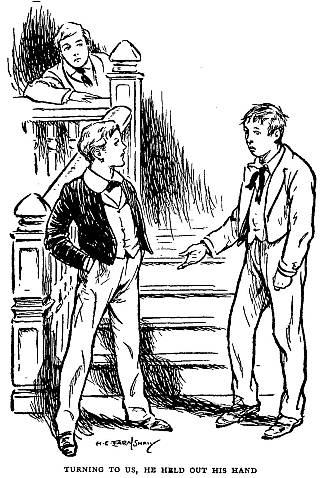
“Serve you right,” cried Dicksee. “Yah!” Then, turning to us, he held out his hand. “Here, I’ll be friends with you both.”
Chapter Twenty.
Nearly a week had gone by before I saw Lomax, and of course there had been no more riding lessons. Mr Rebble had given us our impositions, and we had taken our punishment patiently enough, for, as the smarting and pain went off, we could not help feeling proud and satisfied. The boys had all turned wonderfully friendly, and I was evidently a great authority. In fact, I had completely succeeded to Burr major’s throne in the boys’ estimation, while he went about the place almost alone, Hodson being the only fellow who tried to associate with him.
As for the Doctor, he never alluded to the encounter again.
The week, then, had passed, and Mercer and I had nearly grown respectable again, when one night, as we were going to bed, my companion turned to me.
“I say,” he whispered, “let’s get up early to-morrow morning, and go and see old Lom.”
I shook my head.
“I’ve had lessons enough in boxing,” I said; “I don’t want to fight any more.”
“I didn’t mean a lesson,” said Mercer. “I want to go and tell him all about how we got on.”
I agreed that I should like to do that; and I awoke at sunrise, roused Mercer, and, leaving the other boys sleeping, we started for the lodge.
“Oh, I say, what a lovely morning!” cried Mercer. “Look at the dew on the leaves; it’s all colours like a rainbow. When are we going fishing again? and I want some birds to stuff; and to go rabbiting, and collecting, and all sorts, and we seem to have done nothing lately.”
“Hallo, Magglin!” I cried, as we turned a corner, and came suddenly upon that individual, looking as if he had just come from the big yard.
“Why, what are you doing here?” said Mercer.
“No sir; on’y wish I was. Just came up to see if the gardener’s about, and he’d give me a job.”
“You know he wouldn’t,” I said. “The Doctor will not have you about the place again.”
“And it’s very hard,” he whined. “Everybody’s agen me, and takes ’vantage of me, even young gents as owes me money and won’t pay.”
“Why, who owes you money, Magg?”
“You do, sir; four shillin’, which I wouldn’t ask you for, but—”
“I don’t, Magg; I paid you everything I owed you,” cried Mercer.
“Oh no, sir; don’t you go for to say that which you know aren’t true. It’s four shillin’, and I wouldn’t have asked you, only I’m that hungry as never was.”
“But I don’t owe you anything; do I, Frank?”
“No; he paid you,” I said.
“Oh, sir! Master Burr junior knows as it’s wicked to tell a lie. I likes mates to stick up for one another, but it ain’t right to get a trampling down of the pore. Do pay me, Master Tom Mercer. It’s four shillin’.”
“I don’t owe you a penny, Magg; and you’re a cheat.”
“Nay, sir, that I aren’t. Well, pay me two on it, and I’ll go on trusting you the rest.”
“But I’m sure I paid you everything I owed you, Magg.”
“Oh no, sir. That’s the way with you young gents. You forgets, that’s what you does. I’ve lost lots o’ money through the Doctor’s boys; and it’s very hard on a pore fellow who’s trying his best to get a honest living, but as every one’s agen.”
“Ah, that’s all gammon, Magg!” cried Mercer. “See how you left us in the lurch over our ferreting.”
“I was obliged to, sir; every one’s agen me so. Nobody believes in me. Do pay me the two shillin’, sir.”
“I won’t. It’s all humbug, and you don’t deserve it,” cried Mercer.
“There, hark at him, Master Burr junior! Aren’t he hard on a pore fellow, who was always doing him kindnesses? Look at the times I’ve sat up o’ nights to ketch him rats and mice or mouldy-warps. Didn’t I climb and get you two squirls, and dig out the snake from the big bank for you?”
“Yes; and cut his tail off with the spade,” cried Mercer. “You spoiled him.”
“Well, I couldn’t help that, sir; and I must go now, ’fore the gardener comes along.”
“Why, you said you wanted to see him.”
“So I did, sir; but I don’t think I will. Everybody’s so agen me now. Pay me the two shillin’ you owe me.”
“I won’t. I don’t owe you a penny.”
“Then pay a shilling of it now, sir. I wouldn’t ask you, sir, but I am so hungry, sir.”
“Let’s give him a shilling, Tom,” I said; “I’ll be half.”
“Oh, very well,” cried Mercer; and as I was banker that time, I placed a shilling in the man’s very dirty hand.
“Thank-ye, sir,” he said. “Then that makes three left, but I won’t ask you for them to-day.”
“That’s the worst of getting in debt,” said Mercer, “and not keeping account of it. I know I’ve bought things of him, and he has made me pay for ’em over and over again. I wonder what he was doing about here so soon.”
We watched Magglin go off in a furtive way, with his head down and his back bent, so that people should not see him above the hedge, and then turned along down the path, with the gilt hands and figures of the clock looking quite orange in the morning sun. In a few minutes after, we could smell tobacco smoke, and found Lomax bending his stiff back over one of the beds in his garden, which he was busily digging.
“Ah! Mornin’, young gentlemen,” he shouted. “Come for a quiet lesson?”
“Not this morning, Lomax,” cried Mercer.
“Going for a walk, then?”
“Only as far as here,” I replied, looking at him merrily.
“Eh? What? Why, hallo!” he cried. “I didn’t know. They said you were under punishment for something, but I didn’t know what. Why, yes: both of you. Look at your eyes. You’ve been fighting!”
I nodded, and Mercer laughed.
“We’ve come to tell you all about it.”
Lomax drove his spade down into the ground and left it standing in the bed.
“Here, come along,” he cried excitedly, and he led the way into the lodge, placed chairs for us, and re-lit his pipe, before standing smoking with his back to the fire. “Now then,” he cried, “let’s have it.”
We described our encounter, and the old soldier laughed and chuckled with satisfaction.
“Yes, that’s it,” he cried, as we came to an end, first one and then the other carrying on the thread of the narration to the conclusion. “That’s science; that is just the same as with a well-drilled regiment, which can beat a mob of fifty times its size. Well, I’m glad you won, and were such good pupils. Shows you remembered all I taught you. Now take my advice, both of you. Don’t you fight again till you are regularly obliged.”
“Not going to,” I said.
“That’s right, boy. You’ll be like a man now who has got a blunderbuss in his house. Thieves all about know that he has got one, and so they leave him alone. Well when are you going to have another riding lesson?”
“Let’s begin again at once,” I said; and he promised to send or go down to the General’s, to ask the groom to bring up the horse in the morning.
“I’ll go myself if I can,” said Lomax, “and ride him up pretty quickly. He’ll have had such a rest that he’ll be quite skittish.”
All this being settled, and it being yet early, we had time for a walk, and the discovery of sundry objects, which Mercer looked upon as treasures, and carefully placed in boxes and pieces of paper.
The first was an unhappy-looking stag beetle which seemed to have been in the wars, for one of its horns was gone, while not a dozen yards farther on we came upon a dissipated cockchafer, with a dent in his horny case, and upon both of these Mercer pounced with delight, transferring them to a flat tin paste-blacking box, inside which we could hear them scratching to get out.
The next thing to attract his attention was a fat worm, which, after a crawl in the cool, dewy night, had lost his way back to his hole, and was now crawling slowly by the roadside, with more sand sticking to him than could have been comfortable.
“Oh, what a big one!” cried Mercer. “I say, I must have him.”
“For a bait for an eel or carp?” I said.
“No. To preserve.”
“Let the poor thing be,” I cried, and, thrusting a piece of stick under the worm, I sent it flying amongst the wet grass.
“Ugh! you cruel wretch!” cried Mercer.
“Come, that’s nice,” I said. “Better than letting you put it in a box, and carrying it in your hot pocket to kill.”
“I shouldn’t kill it, I should keep it in a pot of earth.”
“Which would dry up, and the poor thing would crawl out and be trodden upon. Come along.”
But he would not come along, for Tom Mercer was a true naturalist at heart, and found interest in hundreds of things I should have passed over. For instance, that morning, as we strolled a little way along the lane, we stopped to peer over the gate into a newly ploughed field at some round-looking birds which rose directly with a loud whirr, and then went skimming along, to glide over the hedge at the bottom and disappear.
“Partridges,” cried Mercer. “Daresay they’ve got a nest somewhere not far from here. Oh, I do wish we had bought Magglin’s gun. It is such a handy one. You see we could keep it up in the loft, and take it to pieces and bring it out without any one knowing, and shoot our own birds to stuff.”
“Mustn’t shoot partridges. They’re game,” I said.
“Oh, I don’t know,” he replied. “We shouldn’t want them to eat, only to stuff, and— Hallo, look there! I haven’t found one of those for ever so long.”
He climbed over the gate, and picked up something cream-coloured from the hollow between two furrows.
“What is it?” I said, as he came back.
“Worm-eater,” and he opened his hand.
“Why, it’s a slug,” I said. “Throw the nasty slimy thing away.”
“’Tisn’t slimy,” he said, as I looked on with disgust at him poking the long-shaped creamy creature with one finger, as it lay in the palm of his left hand. “You feel it. Quite cool and dry.”