Volume 7 — BULLETIN OF THE NUTTALL ORNITHOLOGICAL CLUB. VOL. VII. April, 1882. No. 2.
Reading edition
ON A COLLECTION OF BIRDS LATELY MADE BY MR. F. STEPHENS IN ARIZONA.
BY WILLIAM BREWSTER.
Early in 1881 I wrote to Mr. Stephens asking him to get me some Arizona birds during the following spring and summer. He replied that he was on the point of starting by wagon for California, but that being provided with a camping outfit, and feeling under no necessity of hurrying by the way, he was willing to give his whole attention, for several months at least, to collecting in my interest. It was accordingly arranged that the journey should take in as great a variety of country as possible, and, that the most productive points should be thoroughly worked. The energy, intelligence, and conscientiousness with which this plan was carried out are sufficiently attested by the material results upon which the present paper is based.
The route traversed was substantially as follows: Leaving Galeyville on March 3, Mr. Stephens drove southward to Cave Creek, where a few days’ collecting yielded a limited number of birds. At the end of this time he retraced his steps to Galeyville, and continuing northward, passed Camp Bowie, and crossed to the western side of the Chiricahua Mountains. Here a halt was made at Morse’s Mill, after a journey of seventy miles by wagon-road from Cave Creek, although the distance is less than twelve 66miles in an air line. This place is described in the notes as being at the head of a cañon, in a sort of basin, elevated about seven thousand feet above the sea, and encircled by mountains which rise from two to three thousand feet higher.
From some further remarks on the general character of the range, I quote the following: “The Chiricahua Mountains are situated in the southeast corner of Arizona, some of the foot-hills even reaching the line of New Mexico and the Mexican state of Sonora. Several small streams run east and west from their summits, those of the former division emptying into the San Simon Valley; of the latter into the Sulphur Spring and San Bernardino Valleys. The first two water-sheds are comprised in the Rio Gila system, while the San Bernardino Valley stretches southward, and water from it flows into the Pacific near Guaymas.”
“These valleys are usually grassy plains, but there are scattering bushes, mostly mesquite, in some of them. The scrub oaks begin with the foot-hills; they are evergreen, the leaves being insensibly replaced with new ones in May. A little higher the juniper (called ‘cedar’ by the people here) comes in. Still higher, on the north side of the hills, there is a little piñon and scrub pine, while the summits are heavily timbered with red and black pines. In the gulches some fir grows, and on the hillsides, mostly near the summits and facing the north, occasional patches of aspen.”
At Morse’s Mill three weeks were very profitably spent, and on April 1 a start was made for Tucson, the next objective point. The route led through Sulphur Spring Valley, Tombstone, and Cienega Station, and at all these places, as well as at some intermediate points, a longer or shorter stay was made for the purpose of collecting. These delays consumed so much time that Tucson was not reached until April 18.
The country lying about this town and the neighboring station, Camp Lowell, proved so rich in desirable birds that it engaged Mr. Stephens’ attention for nearly the whole of the two succeeding months, during which, however, a brief visit was paid to the Santa Rita Mountains, where some important observations were made.
The season practically ended with June, for the wagon-journey, begun on the 29th of that month, across the arid plains and scorching deserts of middle and western Arizona, was attended 67with such privations, and often positive suffering, that little attention could be paid to birds. Mr. Stephens arrived at Yuma on July 15, and by August 1 reached his final destination, Riverside, California.
The entire trip yielded about six hundred and fifty skins besides a fairly large number of nests and eggs. Under the terms of our agreement I had all the birds, a representative series of the nests and eggs, and the field notes relating to both. This collection, embracing the results of four months’ uninterrupted work in a region as yet only imperfectly known, seems to me too complete in itself to be merely skimmed of its cream. Accordingly in preparing the following paper I have included every species which is represented among the specimens or mentioned in the collector’s notes. It should be understood, however, that the latter were not kept with reference to this plan, and it is not unlikely that certain common birds, which are known to occur in Arizona, were inadvertently omitted. For similar reasons, the number of specimens obtained can seldom be taken as an exponent of the relative abundance of the species to which they belong, as a decided preference was given to the rarer kinds. Three species new to the “North American” fauna have already been announced (this Bulletin, Vol. VI, p. 252.).
A few technical points require explanation. The catalogue numbers are usually those of the collector’s field-book, but in certain cases—as of specimens taken as types, or with birds obtained by Mr. Stephens before starting on the present trip—I have used my own numbers, either alone or in connection with the original ones. This double system need cause no confusion, however, for the field-numbers never reach 700, while those of my general catalogue are always above 5,000. Of the measurements, the length and stretch were taken in the field, the others from the dry skins. The biographical matter is of course based on Mr. Stephens’ notes, which are sometimes paraphrased, sometimes literally quoted, as convenience dictates. The frequent quotations of Mr. Henshaw’s experience or opinions are always, unless otherwise stated, from his Report in Volume V of “Explorations and Surveys West of the One Hundredth Meridian.”
1. Turdus unalascæ Gmel. Dwarf Thrush.—The only Hermit Thrush in the present collection is unmistakably referable 68to var. unalascæ. In fact it gives nearly the same measurements as the smallest extreme in the large series examined by Mr. Henshaw.[40] Mr. Stephens marks it as the first which he has seen in Arizona where, however, it was found sparingly by Mr. Henshaw in October, 1873.
283, ♀ ad., Tucson, April 25. Length, 6.40; extent, 10.10; wing. 3.26; tail, 2.61; culmen, .52. “Bill dark brown, yellowish at base of lower mandible; legs pale brownish; iris brown.”
2. Turdus ustulatus Nutt. Russet-backed Thrush.—Under this heading I include with some hesitation, a Thrush killed May 17, in the Santa Rita Mountains. The specimen unfortunately was one of three or four which were accidentally destroyed while in the collector’s possession, but Mr. Stephens is positive that it was referable to the above variety. As he is perfectly familiar with ustulatus, having previously met with it in California, there can, I think, be little doubt of the correctness of his determination. This record, if accepted, will make the first for Arizona.
397, ♀ ad., Santa Rita Mountains, May 17. Length, 6.90; extent, 10.70; “Iris dark brown; bill black, brownish at base of lower mandible; legs very pale brown.”
3. Turdus migratorius propinquus Ridgw. Western Robin.—Robins were met with only in or near the Chiricahua Mountains, where perhaps a dozen individuals were seen. The one mentioned below is typical of the slightly differentiated, but still apparently constant western race.
75, ♂ ad., Morse’s Mill, March 20. Length, 10; extent, 16.40; wing, 5.38; tail, 4.36. “Iris dark brown.”
4. Oreoscoptes montanus (Towns.) Baird. Mountain Mockingbird. There is no mention of this species among the notes made during the late trip.
6313 (author’s coll.), ♀ ad., San Pedro River, Dec. 25, 1880. Length, 8.90; extent, 12.40.
5. Mimus polyglottus (Linn.) Boie. Mockingbird.—“Generally distributed and common, but not as abundant as in Southern California” (Camp Lowell). “Common in the valleys; they are found but a short distance up the foot-hills of the mountain ranges” (near Tombstone).
181, ♀ ad., near Tombstone, April 8. Length, 9.80; extent, 13.10; wing, 4.30; tail, 5.03.
69550, ♂ ad., Camp Lowell, June 20. Length, 10.20; extent, 14.10; wing, 4.40; tail, 5.20. “Iris golden brown; bill and legs black.”
6. Harporhynchus bendirei Coues. Bendire’s Thrasher.—Mr. Stephens’ notes contain few references to this species, and judging from the limited number of specimens which he obtained, it must be less abundant in Arizona than either H. crissalis or H. curvirostris palmeri, a status which is in strict accordance with Mr. Henshaw’s experience. About half of the skins collected during the past season are labeled either Camp Lowell or Tucson, while the remainder were taken at various points directly north or south of the latter place, and not over twenty-five miles distant in either direction. Outside the limits of this desert region the bird was not anywhere met with, although it was common at Phœnix in February, 1880.
A nest taken June 16 near Tucson, and identified by the capture of one of the parent birds, was placed in a “cat-claw mesquite” at a height of about five feet from the ground. It is a deeply-hollowed, smoothly-lined structure, composed of fine grasses and soft, hemp-like vegetable fibres, which are protected externally, in a manner common to the nests of nearly all Thrashers, by a bristling array of interlaced twigs and thorny sticks. The interior cup measures two inches in depth by three in width. The two eggs which it contained, like those described by Dr. Coues, are readily separable from eggs of H. palmeri by their grayish-white instead of dull green ground-color. They are faintly marked with reddish-brown and lavender, the spots being confined chiefly to the larger ends, where many of them assume the character of blotches or dashes of color. These eggs measure respectively 1.02 × .79 and .96 × .79. The greatest number of eggs found in any of the several nests examined by Mr. Stephens was three, but two seemed to be the usual complement.
Of the birds before me four are in first plumage, a stage which, if I am not mistaken, has never been previously examined. The first of these (No. 426, twenty-five miles south of Tucson, May 22) was unable to fly, and was taken from the nest. It differs from the adult in the following particulars: The upper parts, with nearly the same ground-color, have a tinge of reddish-brown which, on the rump, wing-coverts, and tips and outer webs of the primaries and secondaries, shades into brownish-chestnut. The sprouting rectrices are also tipped with the same color. The under parts generally are warm fulvous, which becomes nearly pure cinnamon on the sides and crissum, and along the median line pales to 70fulvous-white. The breast and abdomen are everywhere thickly but finely spotted with dull black, these markings becoming finer and fainter where they border on the anal region. The remaining three (Nos. 538, ♀; 539, —; and 540, ♂: twenty-five miles north of Tucson, June 16) have the wings fully developed, and were all out of the nests when shot. They are apparently of about the same respective ages, but nevertheless exhibit a good deal of individual variation. No. 538 has the breast and sides finely spotted with dark brown, but a central space extending forward along the abdomen nearly to the breast is entirely unmarked. No. 535 has large, rounded, but indistinct blotches of light brown, thickly and evenly distributed over the entire under parts, excepting the throat, anal region and crissum. No. 539 has a cluster of faint, sagittate spots on the centre of the breast, but otherwise is entirely immaculate beneath. All three are essentially similar above, and differ from No. 426 in having the crown, nape, back, wing-coverts and outer webs of the secondaries pale reddish-brown, which, on the rump, is only tinged with chestnut. The primaries are dark brown edged with hoary; the rectrices, dull black with a terminal band of pale reddish-chestnut crossing both webs of all the feathers, but most broadly those of the outer pairs.
The adults making up the rest of this series vary a good deal with the season at which they were taken. A specimen killed in February is clear grayish-brown above, with the breast and abdomen thickly spotted; and one or two others shot early in May are nearly as deeply colored and distinctly marked. But most of the breeding birds are either entirely immaculate beneath, or with only a few faint specks scattered here and there upon the abdomen. Several of the latter are nearly as pale as my specimens of H. lecontei, and equally devoid of any special markings. This condition apparently is due mainly to the wearing off of the tips of the feathers, although the continued action of the sun’s rays doubtless lends its aid, and still further bleaches the plumage.
453, ♂ ad., Camp Lowell, May 30. Length, 10.30; extent, 13.30.
4987, (author’s coll.) ♂ ad., Tucson, Feb. 28, 1880. Wing, 4.25; tail, 4.84; culmen (chord), .99.
423, ♂ ad., twenty-five miles south of Tucson, May 21. Length, 10.40; extent, 14.20; wing, 4.30; tail, 4.92; culmen, 1.06.
425, ♂ ad., same locality, May 22. Length, 10.30; extent, 13.10; wing, 4.01; tail, 4.96; culmen, 1.05.
455, ♂ ad., Camp Lowell, May 30. Length, 10.18; extent, 13.30; wing, 4.20; tail, 4.96; culmen, 1.05.
537, ♂ ad., twenty-five miles north of Tucson, June 16. Length, 10.10; extent, 12.70; wing, 4.14; tail, 4.78; culmen, 1.01.
583, ♂ ad., Camp Lowell, June 24. Length, 10.50; extent, 13; wing, 3.99; tail, 4.95; culmen, 1.05.
454, ♀ ad., Camp Lowell, May 30. Length, 10.10; extent, 12.70; wing, 3.95; tail, 4.43; culmen, 1.
529, ♀ ad., twenty-five miles north of Tucson, June 16. Length, 10.20; extent, 12.10; wing, 3.63; tail, 4.50; culmen, 1.01. “Iris yellow; legs dull bluish.”
71557, ♀ ad., Camp Lowell, June 21. Length, 10; extent, 13.20; wing, 4.10; tail, 4.60; culmen, .95.
426, ♀ juv. first plumage, twenty-five miles south of Tucson, May 22. Length, 6.10; extent, 9.40; “Iris light gray; bill dark brown, lighter below; legs pale bluish.” Taken from the nest; wings and tail only partly developed.
538, ♀ juv. first plumage, twenty-five miles north of Tucson, June 16. Length, 10.10; extent, 12.50; wing, 3.77; tail, 4.59; culmen, .96.
539, — juv. first plumage, same locality and date. Length, 9.80; extent, 12.70; wing, 3.92; tail, 4.67; culmen, .92.
540, ♂ juv. first plumage, same locality and date. Length, 10; extent, 12.80; wing, 3.90; tail, 4.55; culmen, .95.
7. Harporhynchus curvirostris palmeri Ridgw. Palmer’s Thrasher.—During the present trip this Thrasher was met with at various points in the desert region about Tucson and Camp Lowell, where it was one of the most abundant and characteristic summer birds. Its favorite haunts were barren wastes covered with cactuses and stunted mesquites; but, like many other desert species, it occasionally visited the more fertile valleys to drink at the springs and water-holes. At these latter places specimens were obtained without much difficulty, but on all other occasions they were exceedingly shy and wary. In February, 1880, Mr. Stephens found Palmer’s Thrasher at Phœnix, and he also took winter specimens along the San Pedro River.[41]
Numerous nests were taken. The one before me was placed in a cholla at a height of about seven feet. It is composed outwardly of large twigs, and is lined with bleached grasses. Although by no means a rude structure, it suffers by comparison with the nest of H. bendirei, its construction being simpler, and all the materials much coarser. The three eggs which it contained were only slightly incubated on June 14. They measure respectively 1.05×.82, 1.09×.82, and 1.08×.83. They are pale greenish-blue, finely and very evenly spotted with brown and lavender. The number of eggs making up this set was not exceeded in any of the others examined by Mr. Stephens.
The series of skins embraces no less than twenty-two examples, and very fully illustrates all the variations of age and season. Among the number are several in the hitherto undescribed first plumage. The
72youngest of these (No. 480, ♂?, Camp Lowell, June 2), although well feathered, has the wings and tail undeveloped, and was taken from the nest. Its entire upper plumage is rusty brown with a chestnut tinge which deepens on the rump and outer webs of the secondaries to decided chestnut brown. The general coloring of the under parts is pale fulvous with a strong tinge of rusty chestnut across the breast, along the sides, and over the anal region and crissum. The breast is obsoletely spotted, but the plumage elsewhere, both above and below, is entirely immaculate. An older bird (No. 577, Camp Lowell, June 23) with the wings and tail fully grown out, differs in having the back (excepting a narrow anterior space bordering on the nape), with the exposed webs and coverts of the wings, and a broad tipping on the tail feathers, bright rusty;—while in a third of about the same age (No. 614, ♂, Camp Lowell, June 28), the rusty color, although paler, is uniformly distributed over the entire upper surface save upon the wings and tail feathers, which are only edged and tipped with that color. This last example is so faintly marked beneath that the plumage at first sight appears immaculate; but a closer inspection reveals a few spots here and there among the central feathers of the breast. A fourth (No. 487, Camp Lowell, June 3), although apparently no older, has the breast and sides spotted more sharply than in any of the adults, while the rusty tinge above is chiefly confined to the rump, posterior half of the back, and the outer webs of the wing feathers.
Several of these young birds are so nearly similar to specimens of H. bendirei in corresponding stages that they can be separated only with great difficulty. The stouter bill and entirely black lower mandible of palmeri may, however, always be depended upon as distinguishing characters; and, moreover, the pectoral spotting of bendirei is usually (but not invariably) finer and sharper, and the rusty tinge above paler and less extended.
The adults present a good deal of variation, most of which is apparently seasonal. Winter specimens have the lower abdomen, with the anal region and crissum, rich rusty-fulvous, while the markings beneath are similar in character to those of true curvirostris, and the spots equally distinct, numerous and widely distributed. With the advance of the season, and the consequent wear and tear of the plumage, the spots gradually fade or disappear. Indeed some of the June specimens are absolutely immaculate beneath, although most of them, like Mr. Ridgway’s types, have a few faint markings on the abdomen. In this condition the general coloring is also paler and grayer, and the fulvous of the crissum and neighboring parts often entirely wanting.
But although the evidence of this series tends to demolish several of the characters upon which palmeri has been based, enough remain to separate it from its ally the true curvirostris of Mexico and the Rio Grande Valley in Texas. The best of these, perhaps, is to be found in the different marking of the tail feathers. In curvirostris the three outer pairs are broadly tipped with pure white which, on the inner web, extends twice as deep, basally, as on the outer one, and has its boundaries everywhere 73sharply defined; in palmeri the outer rectrices are, at the most, barely tipped with pale brown, which either extends squarely across both webs, or fades insensibly into the darker color of the feather. The bill of palmeri, also, is usually longer and more curved than that of curvirostris.
8. Harporhynchus lecontei Bonap. Leconte’s Thrasher.—The great rarity of Leconte’s Thrasher, even in the heart of the desolate regions where alone it has so far been found, is still further attested by Mr. Stephens’ experience during the past season, for although he searched for it carefully in all suitable places between Camp Lowell and Riverside (California), he met with only two individuals. These occurred about fifteen miles west of Maricopa, Arizona, in a locality which the accompanying notes describe as follows: “Near the middle of ‘Forty-five-mile Desert,’ between Maricopa Wells and Gila Bend. No chollas or other cactuses in the immediate neighborhood, but some giant cactuses about a mile away in the hills; a few mesquites and much scattering low brush in the vicinity; nearest water twenty miles away.”
Dr. Cooper is said to have found the species “rather common” in the desert between Fort Mohave and the San Bernardino Mountains, California, but Mr. Stephens has thrice traversed this route without seeing a single specimen. In a recent number[42] of the American Naturalist, however, Mr. E. Holterhoff, Jr., speaks of seeing the bird “on the Colorado desert, at a station called Flowing Wells,” and gives an interesting description of a nest and set of eggs taken there. “The nest was placed in a palo verde tree, and was a very bulky affair, measuring externally nine inches in depth and six in width; the hollow of the nest was fully three inches in depth. It was so awkwardly situated that much of the base of the nest had evidently been filled in to firmly support the structure. The two eggs were somewhat smaller than those of H. redivivus, lighter in color, and marked all over with finer reddish spots, thicker at the larger end.”
I am inclined to consider the Maricopa specimens above referred to as adults, although this is not so clear in the case of the male, portions of whose plumage suggest that of a young bird. Both are in worn, ragged condition, but there is no indication of any moult, save upon the wings and tail, where many of the feathers have been replaced by new ones which are conspicuous among the others by their fresher coloring.
74On a former occasion[43] I urged the specific distinctness of this Thrasher from H. redivivus, and to this conviction I still hold, although a comparison of additional specimens of both species inclines me to believe with Dr. Coues that Leconte’s Thrasher is, on the whole, more nearly related to redivivus than to any other United States form.
616, ♂ ad., near Maricopa Wells, July 5. Length, 10.80; extent, 12.30; wing, 3.85; tarsus, 1.27; tail, 5.35; culmen (chord), 1.30; bill from nostrils, .91; width below posterior angle of nostrils, .23.
617, ♀ ad., same locality and date. Length, 10.60; extent, 12; wing, 3.78; tarsus, 1.32; tail, 4.91; bill (chord of culmen), 1.32; bill from nostril, .94; width below posterior angle of nostril, .24. “Iris reddish-brown; bill black; legs nearly black. Stomach contained a small species of katydid and some ants.”
9. Harporhynchus crissalis Henry. Crissal Thrasher.—Not uncommon near Tombstone, Tucson and Camp Lowell.
Dr. Coues, comparing this species with Le Conte’s, Palmer’s, and Bendire’s Thrashers, concludes:[44] “and we are led to infer that when the ‘topography’ of the other three species is fully determined, it will be found no less extensive. For there is nothing peculiar in the economy or requirements of any one of the four in comparison with the rest.” This view, however, is hardly supported by the testimony of observers who have had the best opportunities of studying these birds. The Crissal Thrasher, according to Captain Bendire,[45] “appears to prefer damp localities near water-courses, and confines itself principally to spots where the wild currant is abundant.” Mr. Henshaw says: “According to my experience, it is not a bird of the plains, but inhabits by preference the rough sides of rocky cañons or the hillsides covered with broken débris, interspersed with straggling bushes.” Mr. Stephens’ evidence is not less explicit. He found the Crissal Thrasher in copses in valleys, and along streams. It was especially fond of well-shaded undergrowth, and spent much of its time on the ground, searching for food under the bushes. It never occurred among cactuses, and the only place where he saw it actually associating with Bendire’s and Palmer’s Thrashers, was at Camp Lowell, where the latter species, with other desert birds, came to drink at a water-hole and thus occasionally mingled with the Crissal Thrashers which inhabited the neighboring thickets. The contrast which these traits afford 75when compared with the ones characterizing the other three species named by Dr. Coues, is sufficiently apparent.[46]
A nest received from Mr. Stephens is precisely similar to those found by Captain Bendire. The three eggs which it contained measure respectively, 1.14×.76, 1.14×.75, and 1.08×.77. Like all the specimens which have been previously reported they are entirely unspotted, and both in size and color closely resemble eggs of the common Robin.
Juv., first plumage (♀, No. 546, Camp Lowell, June 20). Above dull reddish-brown. Rump and a broad tipping on the tail, brownish-chestnut. Under parts nearly uniform, brownish-fulvous. Crissum chestnut, of nearly the same shade as in the adult. Maxillary stripes dusky brown. No trace of spots or other dark markings either above or beneath.
Five other young birds in the series are essentially similar and call for no special comment. I cannot find any description of the first plumage of either H. redivivus or H. lecontei, but with the exception of these, H. crissalis is the only North American species in the sub-family Miminæ whose young are entirely unmarked beneath. It is interesting to note that with respect to the color of the upper parts, especially that of the rump, they resemble the young of both H. bendirei and H. palmeri.
The individual variation presented by the adults before me is chiefly confined to the relative length and curvature of the bill, the general coloring of all being nearly uniform, although the breeding birds are slightly paler than those taken early in the season.
166, ♂ ad., near Tombstone, April 5. Length, 12.10; extent, 12.30; “Iris light brown. Stomach contained insects and a small lizard.”
251, ♂ ad., Tucson, April 21. Length, 12.60; extent, 12.60; wing, 4.11; tail, 6.25; chord of culmen, 1.56. “Iris light gray,—almost white.”
278, ♂ ad., Tucson, April 25. Length, 12.10; extent, 12.50; wing, 3.84; tail, 6.20; culmen, 1.47.
309, ♂ ad., Tucson, April 30. Length, 11.70; extent, 12.70; wing, 4.05; tail, 5.85; culmen, 1.53.
434, ♂ ad., Tucson, May 25. Length, 11.20; extent, 12.30; wing, 4.02; tail, 5.52; culmen, 1.43.
503, ♂ ad., Tucson, June 8. Length, 11.40; extent, 12.10; wing, 3.85; tail, 5.85; culmen, 1.46.
578, ♂ ad., Camp Lowell, June 23. Length, 11.60; extent, 12.60; wing, 4.05; tail, 5.75; culmen, 1.45.
437, ♂ juv., first plumage, Tucson, May 26. Length, 11.30; extent, 12.40; wing, 3.92; tail, 5.50; culmen, 1.18.
76595, ♂ juv., first plumage, Camp Lowell, June 25. Length, 11.60; extent, 12.50; wing, 3.84; tail, 6.18; culmen, 1.35.
596, ♂ juv., first plumage, Camp Lowell, June 25. Length, 11.80; extent, 12.60; wing, 3.86; tail, 6.12; culmen, 1.40.
436, ♀ ad., Tucson, May 25. Length, 11.80; extent, 12.40; wing, 3.90; tail, 5.90; culmen, 1.55. Parent of No. 435.
435, ♀ juv., first plumage, same locality and date. Length, 11.30; extent, 12.20; wing, 4.02; tail, 5.55; culmen, 1.20.
546, ♀ juv., first plumage, Camp Lowell, June 20. Length, 11.60; extent, 12.40; wing, 4.95; tail, 6.02; culmen, 1.38.
555, ♀ juv., first plumage, Camp Lowell, June 21. Length, 11.30; extent, 12.20; wing, 3.73; tail, 5.65; culmen, 1.42.
10. Cinclus mexicanus Swains. American Water Ouzel.—The following notes relate to the only specimen met with:
“My attention was called to the song of some bird which came from the mountain brook running past camp. There was a steep, rocky wall on the further side, and the notes echoing from it, and mingling with the purling of the water, sounded exquisitely sweet. On looking for the author, I noticed some ripples rolling out from behind the willows that fringed the nearer shore, and soon discovered an Ouzel dabbling in the shallow water. My shot wounded the bird, but did not disable its wings, for it repeatedly dived, using them as propelling agents when beneath the surface. The sun shining on the air-bubbles that clung to its plumage made it look like a ball of silver flying through the water. On the surface it paddled along very much in the manner of a Phalarope.”
79, ♂ ad., Morse’s Mill, Chiricahua Mountains, March 20. Length, 7.90; extent, 12.10; wing, 3.85; tail, 2.50. “Iris hazel. The flesh was dark and tough with a fishy smell. The inside of the skin looked like that of a small Wader. Stomach contained insects.”
11. Sialia mexicana Swains. Western Bluebird.—A single pair, taken in the Chiricahua Mountains in March, are accompanied by the note, “abundant in all kinds of timber.”
12. Sialia arctica Swains. Arctic Bluebird.—This species is noted as “rare in the low valleys” among the Chiricahua Mountains. A small flock was also seen near Galeyville on “grassy plains,” where “they flew from one weed-stalk to another.” They were “restless and rather shy.” The single specimen obtained was shot on this latter occasion.
13. Myiadestes townsendi (Aud.) Caban. Townsend’s Solitaire.—Three specimens were obtained in the Chiricahua 77Mountains, where they occurred sparingly among piñons. “They are rather tame, and have a habit of sitting perfectly still for several minutes at a time. Flight slow. Food insects.” A fourth, taken May 13, in the Santa Rita Mountains, completes the series.
14. Phaïnopepla nitens (Swain.) Scl. Black-crested Flycatcher.—The life history of this singular bird has been so fully given by Dr. Coues in “Birds of the Colorado Valley,” that there is little chance of adding anything new. Most of the specimens obtained by Mr. Stephens are from Camp Lowell and Tucson, but he did not find it abundant at either of these points. He speaks of it as having “a sweet but not loud song,” and remarks on its known fondness for mistletoe berries. “Iris red.”
15. Polioptila cærulea (Linn.) Scl. Blue-gray Gnatcatcher.—Eight specimens, representing the following localities: Chiricahua Mountains (two ♂, two ♀, April 1–6); Tombstone (♂, April 5); Cienega Station (♂, April 16); Tucson (♂, April 20); Santa Rita Mountains (♂, May 20).
16. Polioptila plumbea Baird. Black-capped Gnatcatcher.—This Gnatcatcher was observed at Tucson, Camp Lowell, and near Yuma, specimens being taken in all these localities. A female shot at the first-named point on April 23 had evidently finished laying, but a nest found June 27 near Camp Lowell contained a perfectly fresh egg, while another taken at Yuma, July 15, had a single egg of its owner and one of the Dwarf Cowbird. These dates indicate that the species breeds at least twice during the season.
The Yuma nest, although a delicate structure, will not compare with that of P. cærulea. It entirely lacks the exterior coating of lichens so effectively employed by the commoner bird, and in its general appearance closely resembles the Redstart’s well-known domicile, being similarly felted of soft bark strips and hemp-like vegetable fibres. It is lined with down from plants, a few feathers, and the hair of some small quadruped. Externally it measures 2.25 in width by 1.55 in depth; internally 1.45 by 1. The egg is pale greenish-blue, coarsely and very evenly spotted with reddish-brown. Its measurements are .53×.42. This nest was placed in a bunch of mistletoe, at a height of about eight feet from the ground. It is accompanied by the male parent, who revealed its position by repeatedly entering the mistletoe. 78and showing other signs of anxiety respecting its contents. The position of the Camp Lowell nest is not mentioned.
Juv., first plumage, ♀ (No. 619, Yuma, July 15). Crown pale cinereous; rest of upper parts faded brown. The wings are uniform with the back, but all the primaries and secondaries have a broad white edging on their outer webs. The tail is dull black, with white areas on the outer rectrices corresponding in extent and purity with those of the adult. Beneath, pale ashy-white.
A study of the large series of Gnatcatchers collected during the past season confirms the views which I lately advanced (this Bulletin, Vol. VI, p. 101) regarding the affinity of P. plumbea and P. “melanura,” and also affords additional evidence of the assumed specific distinctness of P. californica. The Yuma examples of P. plumbea are quite as typical as those taken at Tucson and Camp Lowell, while seven specimens of californica, collected at Riverside after Mr. Stephens’ return to that place, still further attest the constancy of most of the characters which I assigned to the latter bird. That relating to the brown edging of the secondaries will, however, have to be abandoned, for plumbea proves to be similarly characterized when in worn breeding dress; the supposed shorter tail of californica also is now shown to be an inconstant feature. All of the three young males taken at Riverside have black lateral crown-stripes like those of immature plumbea.
267, ♂ ad., Tucson, April 23. Length, 4.60; extent, 5.80; wing, 1.85; tail, 2.15; bill (from nostril) .25; tarsus, .67. “Iris dark brown;” lores ashy mixed with black; eyelids white.
500, ♂ ad., Tucson, June 7. Length, 4.60; extent, 5.80; wing, 1.81; tail, 2.12; bill (from nostril), .25; tarsus, .65. Lores ashy mixed with black; upper eyelid white.
564, ♂ ad., Camp Lowell, June 22. Length, 4.55; extent, 5.80; wing, 1.84; tail, 2.19; bill (from nostril), .25; tarsus, .70. Lores black; both eyelids white.
567, ♂ ad., Camp Lowell, June 22. Length, 4.40; extent, 5.60; wing, 1.84; tail, 2.16; bill (from nostril), .26; tarsus, .70. Lores and superciliary line white mixed with black.
581, ♂ ad., Camp Lowell, June 24. Length, 4.40; extent, 5.80; wing, 1.98; tail, 2.20; bill (from nostril), .28; tarsus, .70. Lores ashy.
618, ♂ ad., Yuma, July 15. Length, 4.40; extent, 5.80; wing, 1.90; tail, 2.15; bill (from nostril), .26; tarsus, .68. Lores, with broad superciliary lines meeting across the forehead, white.
621, ♂ juv., first plumage, Yuma, July 16. Length, 4.40; extent, 5.60; wing, 1.76; tail, 2.13; bill (from nostril), .26; tarsus, .72. Sides of head ashy-white; ill-defined, black, lateral crown-stripes partially concealed.
272, ♀ ad., Tucson, April 23. Length, 4.50; extent, 5.50; wing, 1.78; tail, 2.21; bill (from nostril), .27; tarsus, .68. “Had just finished laying.”
458, ♀ ad., Camp Lowell, May 31. Length, 4.50; extent, 5.50; wing, 1.86; tail, 2.13; bill (from nostril), .26; tarsus, .68.
79601, ♀ ad., Camp Lowell, June 27. Length, 4.60; extent, 5.50; wing, 1.74; tail, 2.18; bill (from nostril), .27; tarsus, .70. “Taken with the nest and one fresh egg.”
619, ♀ juv., first plumage, Yuma, July 15. Length, 4.40; extent, 5.60; wing, 1.86; tail, 2.12; bill (from nostril), .26; tarsus, .70.
566,—juv., first plumage, Camp Lowell, June 22. Length, 4.40; extent, 5.60; wing, 1.85; tail, 2.22; bill (from nostril), .27; tarsus, .68.
For comparison I add measurements of the seven specimens of P. californica above mentioned.
656, ♂ juv., fall plumage, Riverside, Sept. 16. Length, 4.55; extent, 5.70; wing, 1.67; tail, 2.20; bill (from nostril), .29; tarsus, .75.
658, ♂ juv., fall plumage, same locality and date. Length, 4.70; extent, 5.80; wing, 1.89; tail, 2.21; bill (from nostril) .26; tarsus, .75.
688, ♂ juv., fall plumage, Riverside, Sept. 23. Length, 4.50; extent, 5.90; wing, 1.73; tail, 2.11; bill (from nostril), .30; tarsus, .75.
657, ♀ juv., fall plumage, Riverside, Sept. 16. Length, 4.60; extent, 5.80; wing, 1.85; tail, 2.14; bill (from nostril), .30; tarsus, .72.
686, ♀ juv., fall plumage, Riverside, Sept. 23. Length, 4.45; extent, 5.90; wing, 1.92; tail, 2.17; bill (from nostril), .30; tarsus, .75.
687, ♀ juv., fall plumage, same locality and date. Length, 4.50; extent, 5.80; wing, 1.85; tail, 2.20; bill (from nostril), .28; tarsus, .70.
655, ♀ juv., fall plumage, Riverside, Sept. 16. Length, 4.45; extent, 5.75; wing, 1.86; tail, 2.15; bill (from nostril), .28; tarsus, .75.
17. Regulus calendula (Linn.) Licht. Ruby-crowned Kinglet.—“Common among the Chiricahua Mountains, especially in deciduous timber. I think a few summer and breed.” The following specimens are identical with eastern ones:
28, ♂ ad., Cave Creek, Chiricahua Mountains, March 8. Length, 4.60; extent, 6.50; wing, 2.32.
122, ♂ ad., Morse’s Mill, March 28. Length, 4.20; extent, 6.90; wing, 2.38.
18. Lophophanes inornatus (Gamb.) Cass. Plain Titmouse.—Mentioned in Mr. Stephens’ notes as rare on the foot-hills of the Chiricahua Mountains, but no specimens are included in his collection.
19. Lophophanes wollweberi Bonap. Wollweber’s Titmouse.—This species was abundant in the Chiricahua Mountains, where a fine series was collected. They were usually seen in flocks of six or eight, and often associated with other small birds. They were rarely met with excepting in the groves of “scrub oaks,” but their food appeared to be wholly insects. A single pair taken in the Santa Rita Mountains in May are unaccompanied by any special remarks.
20. Parus meridionalis Scl. Mexican Chickadee.—In a late number of the Bulletin (Vol. VI, p. 252) I briefly 80announced this important addition to the North American fauna. The series obtained by Mr. Stephens comprises nine specimens, all of which were taken near Morse’s Mill. They occurred upon the sides or summits of the surrounding mountains, at elevations varying from seven to ten thousand feet, and were usually found in pairs, although they not unfrequently associated with other birds, among which are mentioned Psaltriparus plumbeus, Lophophanes wollweberi, Sitta pygmæa, and Peucedramus olivaceus. They were for the most part silent, but occasionally uttered a “chee-wee-wee,” as well as notes resembling those of P. montanus.
Previous writers have compared this species with P. atricapillus, but to me it seems nearer related to P. montanus. With the latter it agrees in certain peculiarities of size and proportions, while the general coloring and markings of the two are so similar that almost the only appreciable points of difference are presented by the white forehead and head-stripes of montanus. These characters are, of course, enough to instantly separate the birds, but their importance is somewhat weakened by the fact that one of my specimens of meridionalis (No. 124) possesses a head-stripe which, though ill-defined and considerably shorter, is nevertheless similar in appearance and position to that of montanus. While it would be rash to argue any varietal affinity on the strength of this single specimen, the outcropping of such a well-marked characteristic certainly shows a close relationship between the two species, unless indeed No. 124 be regarded as a hybrid.
65, ♂ ad., Morse’s Mill, March 18. Length, 5.20; extent, 8.50; wing, 2.74; tail, 2.60. “Iris dark brown. Stomach contained insects.”
82, ♀ ad., Morse’s Mill, March 21. Length, 5.10; extent, 8.10; wing, 2.73; tail, 2.62.
83, ♂ ad., same locality and date. Length, 5.10; extent, 8.50; wing, 2.90; tail, 2.69.
99, ♀ ad., Morse’s Mill, March 24. Length, 4.70; extent, 7.90; wing, 2.63; tail, 2.42.
100, ♂ ad., same locality and date. Length, 5.10; extent, 8.60; wing, 2.76; tail, 2.65.
104, ♂ ad., Morse’s Mill, March 25. Length, 5.10; extent, 8.30; wing, 2.75; tail, 2.40.
105, ♂ ad., same locality and date. Length, 5.10; extent, 8.20; wing, 2.66; tail, 2.56.
124, ♂ ad., Morse’s Mill, March 29. Length, 5.10; extent, 8.70; wing, 2.85; tail, 2.68.
125, ♂ ad., same locality and date. Length, 5; extent, 8.20.
21. Psaltriparus plumbeus Baird. Lead-colored Tit.—Of the eight specimens of this species which are included in the collection, seven were taken in the Chiricahua Mountains, the 81remaining one being from the Santa Rita Mountains. Mr. Stephens does not appear to have found it elsewhere, and in his notes characterizes it as rather uncommon. It was oftenest seen among the oaks of the foot-hills, where it associated with Wollweber’s Titmouse, the Ruby-crowned Kinglet, and several other small birds.
22. Auriparus flaviceps (Sundev.) Baird. Yellow-headed Tit.—Mr. Henshaw while in Arizona met with but few specimens of this curious little species. He attributed their apparent rarity to the lateness of the season at which his observations were made, and doubtless this explanation is the true one; for during the past spring Mr. Stephens found them in abundance both at Cienega Station and Tucson. Nevertheless it is probable that some individuals pass the winter in Arizona, for one of my specimens is dated November 29, and another was killed early in March. A nest taken at Tucson contained three fresh eggs on April 20.
23. Sitta carolinensis aculeata (Cass.) Allen. Slender-billed Nuthatch.—This Nuthatch was common in the pine forests of the Chiricahua Mountains, but the notes do not mention its occurrence elsewhere.
24. Sitta pygmæa Vig. Pygmy Nuthatch.—Equally common with the preceding species in the same locality.
25. Certhia familiaris mexicana (Gloger) Ridgw. Mexican Creeper.—Various writers have attributed the Mexican Creeper to our fauna, either on purely inferential grounds, or from a misconception, which at one time prevailed, regarding the relationship of the form found in California; for up to the present time no undoubted specimens of mexicana have been taken within our boundaries. It accordingly gives me much pleasure to announce the actual occurrence in Arizona of this well-characterized race, of which the specimen mentioned below is perfectly typical. It is the only Creeper which Mr. Stephens met with during the past season, but in the previous year two others, which I have not examined, but which he considers identical with this, were taken in the same locality. All the Arizona specimens obtained by Mr. Henshaw were referred to our eastern form.
66, ♀ ad., Morse’s Mill, Chiricahua Mountains, March 18. Length, 4.80; extent, 7.10; wing, 2.45; tail, 2.25; culmen, .50. “Iris dark brown.”
8226. Campylorhynchus brunneicapillus (Lafr.) Gray. Cactus Wren.—I notice little of special interest among the notes accompanying the eight skins which Mr. Stephens collected. He found the bird abundant in all suitable localities, and took several nests and sets of eggs. The unsophisticated young were easily shot, but the adults, even when breeding, were shy and hard to secure.
27. Salpinctes obsoletus (Say) Caban. Rock Wren.—Mr. Stephens makes no mention of finding this species in Arizona during the past season, but he sends me a single specimen taken December 25, 1880, on the San Pedro River.
28. Thryomanes bewicki leucogaster Baird. White-bellied Wren.—The collection includes five specimens of this form, which was apparently met with only in the Chiricahua Mountains and about Tucson. In the former locality it was common along the banks of streams where, however, it kept so closely hidden among the weeds and brush that it was oftener heard than seen. The examples before me are typical.
29. Troglodytes aëdon Vieill. House Wren.—The only House Wren taken is absolutely indistinguishable from many of my Massachusetts specimens, and I accordingly refer it here. Furthermore, I fail to find the characters supposed to distinguish var. parkmani, in any of the several California specimens included in my series. If the latter form really possesses any constant differential characters, I believe they have yet to be defined.
169, ♀, near Tombstone, April 6. Length, 4.80; extent, 6.40; wing, 2.10. “Iris dark brown. Shot among low brush. Not common.”
30. Anthus ludovicianus (Gm.) Licht. American Titlark.
271, ♀ ad., Tucson, April 23. Length, 6.50; extent, 10.60. “Bill brown, paler at base below; legs brown.” Several seen in marshes along the stream.
31. Helminthophila luciæ (Coop.) Ridgw. Lucy’s Warbler.—Although this diminutive Helminthophila has been known to ornithologists for nearly twenty years, few specimens have found their way into the cabinets of private collectors, and up to the present time the species has remained a very rare one. On this account the acquisition of a good series of skins was among the main objects of Mr. Stephens’ trip, and the success which rewarded his labors is very gratifying.
83The first specimen was shot April 15 at Cienega Station, where, during the succeeding three days, six more were obtained. They frequented large willows along the banks of a stream and, like Kinglets, spent much of their time searching for food at the extremity of the branches. Although active and restless, they were not at all shy. The only note heard here was a sharp “tseep.” On April 18 Mr. Stephens reached Tucson, where almost the first birds met with were Lucy’s Warblers. During the early part of his stay they were more abundant among the mesquites than any other species, and their “tseeping” could be heard on every side. They were continually in motion, flying from tree to tree, and occasionally visiting some low brush in the vicinity. By the 28th their numbers became perceptibly diminished, but many remained to breed in the surrounding country. The presence of the species at Camp Lowell is attested by a single young specimen, barely large enough to fly, which was taken there on June 1st, but which is unaccompanied by any special remarks. An adult male from the Santa Rita Mountains, however, comes to me with the following comments, under date of May 19:—“This is the only one of the species which I have seen here. It was near the banks of a stream below the mouth of a cañon, where there were a few mesquites interspersed among the oaks. I watched it for some time. It lingered among the mesquites, seeming to prefer them to the oaks, in which, however, it occasionally alighted for a moment.”
In addition to the above, Mr. Stephens’ notes supply some very important information regarding the previously doubtful nesting habits of this species. A female taken April 25, proved on dissection to be about to lay, but no eggs were actually taken until May 8, when a full set of five was found near Tucson. After that date many nests containing either eggs or young were examined. Their sites were variable; the characteristic place, like that of the specimen discovered by Captain Bendire, was behind the loosened bark of a large tree, but use was frequently made of old Woodpeckers’ nests, knot-holes, and in short all sorts of crevices. A brood of nearly fledged young (one of which is before me) was actually taken from the deserted domicile of a Yellow-headed Titmouse, which had been appropriated by the new tenant without any apparent repairs or alterations. Among Helminthophilæ this Wren-like mode of nidification is, I believe, peculiar to this species.
84I have the Tucson nest just alluded to. It is composed outwardly of twigs and weed-stalks; inwardly of hemp-fibres; while there is a scanty lining of horse-hairs and feathers. Like most hole nests it is rather flat, and the rim is thin in places where the walls of the cavity encroached on the space within. The eggs are white, handsomely wreathed about the larger ends with reddish-brown and umber spots, a few of which are also scattered over their general surfaces. They measure respectively .58×.46; .58×.46; .62×.46; .60×.47. The notes accompanying this set are as follows:—“Nest about six feet above the ground in a crevice nearly covered by bark. The bottom of the hole contained an old nest; over this were droppings of wood-rats, and the whole filled the cavity nearly to its top. The tree (a mesquite) stood within twenty feet of a frequented road. Female sitting. Eggs fresh; one had been broken and crowded in behind the nest by the parent bird.” None of the other sets found by Mr. Stephens contained more than three eggs and the present clutch is probably an exceptionally large one.
Juv., first plumage (♀ No. 471, Camp Lowell, June 1).—Wing-coverts and inner secondaries broadly tipped and edged with pale brownish-fulvous. Primaries and rectrices edged and tipped with hoary white. Rump and upper tail-coverts yellowish-chestnut. No chestnut on the crown. Otherwise colored like the adult.
Among a number of adults before me the range of individual variation is very limited, and is chiefly confined to the females. While it is true that some of the latter are indistinguishable from the brightest males, the majority have the rump and crown-patches considerably duller, the chestnut being either diluted in shade, or mixed with the color of the back. In No. 206 the crown-patch is concealed, the chestnut being restricted to the basal portion of the feathers.
225, ♂ ad., Tucson, April 18. Length, 4.40; extent, 6.70.
229, ♂ ad., Tucson, April 19. Length, 4.40; extent, 6.80.
231, ♂ ad., Tucson, April 19. Length, 4.40; extent, 7; wing, 2.35; tail, 1.93.
232. ♂ ad., Tucson, April 19. Length, 4.30; extent, 6.80; wing, 2.35; tail, 1.95.
253, ♂ ad., Tucson, April 21. Length, 4.40; extent, 6.70; wing, 2.21; tail, 1.87.
254, ♂ ad., Tucson, April 21. Length, 4.30; extent, 6.70; wing, 2.21; tail, 1.95.
255, ♂ ad., Tucson, April 21. Length, 4.50; extent, 7.10; wing, 2.23; tail, 1.93.
280, ♂ ad., Tucson, April 25. Length, 4.40; extent, 7; wing, 2.25; tail, 1.95.
85299, ♂ ad., Tucson, April 28. Length, 4.40; extent, 6.70.
326, ♂ ad., Tucson, May 4. Length, 4.30; extent, 7; wing, 2.20; tail, 1.93.
340, ♂ ad., Tucson, May 7. Length, 4.40; extent, 7; wing, 2.21; tail, 1.93.
410, ♂ ad., Santa Rita Mountains, May 19. Length, 4.10; extent, 6.90; wing, 2.22; tail, 1.82.
516, ♂ ad., Tucson, June 10. Length, 4.30; extent, 7; wing, 2.12; tail, 1.85.
524, ♂ juv., first plumage, Tucson, June 11. “Taken from nest, which also contained a young Molothrus ater obscurus.”
197, ♀ ad., Cienega Station, April 15. Length, 4.10; extent, 6.40; wing, 2.12; tail, 1.78. “Iris dark brown; bill black above, bluish beneath; legs black.”
206, ♀ ad., Cienega Station, April 16. Length, 4.40; extent, 6.50; wing, 2.17; tail, 1.80.
208, ♀ ad., Cienega Station, April 16. Length, 4.20; extent, 6.60; wing, 2.09; tail, 1.82.
217, ♀ ad., Cienega Station, April 17. Length, 4.30; extent, 6.70; wing, 2.21; tail, 1.84.
218, ♀ ad., Cienega Station, April 17. Length, 4.10; extent, 6.60; wing, 2.10; tail, 1.85.
228, ♀ ad., Tucson, April 19. Length, 4.30; extent, 6.70; wing, 2.10; tail, 1.85.
230, ♀ ad., Tucson, April 19. Length, 4.30; extent, 6.70; wing, 2.07; tail, 1.84.
256, ♀ ad., Tucson, April 21. Length, 4.20; extent, 6.60.
260, ♀ ad., Tucson. April 22. Length, 4.30; extent, 6.60; wing, 2.08; tail, 1.85.
261, ♀ ad., Tucson, April 22. Length, 4.30; extent, 6.70; wing, 2.25; tail, 1.92.
279, ♀ ad., Tucson, April 25. Length, 4.30; extent, 6.70; wing, 2.10; tail, 1.82. “About to lay.”
433, ♀ ad., Tucson, May 25. Length, 4.50; extent, 6.50. “With nest and three eggs; set completed.”
449, ♀ ad., Tucson, May 29. Length, 4.40; extent, 6.90; wing, 2.11; tail, 1.77. “With nest and three eggs; set completed.”
439, ♀ juv., first plumage, Tucson, May 26. Nearly feathered, but unable to fly. “Taken from a deserted nest of Auriparus flaviceps.”
471, ♀ juv., first plumage, Camp Lowell, June 1. Length, 4.20; extent, 6.60; wing, 2.10; tail, 1.71. Fully feathered.
32. Helminthophila celata lutescens Ridgw. Western Orange-crowned Warbler.—A few were seen late in April near Tucson.
Although not perfectly typical of lutescens, both of the Orange-crowned Warblers obtained by Mr. Stephens are clearly referable to that race. They are not quite as yellow beneath as Nicasio (California) specimens, but they come within a shade of it, and are brighter by many shades than any of the same sex among my eastern examples; while in the vividness of the 86olive-green on the upper parts, they fully equal any of the California females. The supposed difference in the tail markings of these races does not hold in the series before me, for a male from Nicasio has the edging on the inner webs of the rectrices quite as broad and pure as that of any of the Florida ones. The loss of this character, however, would be of little consequence, as the two forms could be readily separated by the wide difference in their general coloring. Mr. Henshaw considers his Arizona specimens true celata, and lutescens is now for the first time announced from that Territory.
290, ♀ ad., Tucson, April 26. Length, 5; extent, 7.30; wing, 2.45; tail, 2.10. “Iris dark brown; bill black, lighter at base below; legs dark brown. Not common.”
291, ♀ ad., same locality and date. Length, 4.70; extent, 7.10; wing, 2.37; tail, 2.09. Same remarks.
(To be continued.)
NOTES ON THE OS PROMINENS.[47]
BY FREDERIC A. LUCAS.
My attention was first directed to this bone by Dr. Shufeldt’s article in this Bulletin for October, 1881, and subsequently by Mr. Jeffries’ paper in the number for January, 1882. With the view of ascertaining in what birds the os prominens is present, and what is its use, I have since examined quite an extensive series of birds. Lack of time has prevented as extended an examination as could be wished for; and as regards discovering any special use for this sesamoid, it must be confessed that the results of the investigation are not wholly satisfactory, being rather negative than positive in their character. But such as they are, they are submitted, in the hope that they may prove of service to some better skilled physiologist.
Through a lack of good material Dr. Shufeldt failed to discover the existence of the os prominens in any of the Owls, but it would seem to be specially characteristic of the Bubonidæ, since it is present in one particular shape, and with a constant mode of articulation, in the following species of that family: Ketupa ceylonensis, K. javanensis, Bubo ignavus, B. bengalensis, 87B. virginianus, Scops brasilianus, S. asio, Nyctea scandiaca, Ninox albigulare, Asio otus, Syrnium nebulosum, and S. uralense. It is not present in Strix flammea or S. perlata, and should it prove to be present in other genera of the Bubonidæ than those noted above, it may serve as an additional, though trivial, point of distinction between the families Bubonidæ and Strigidæ.
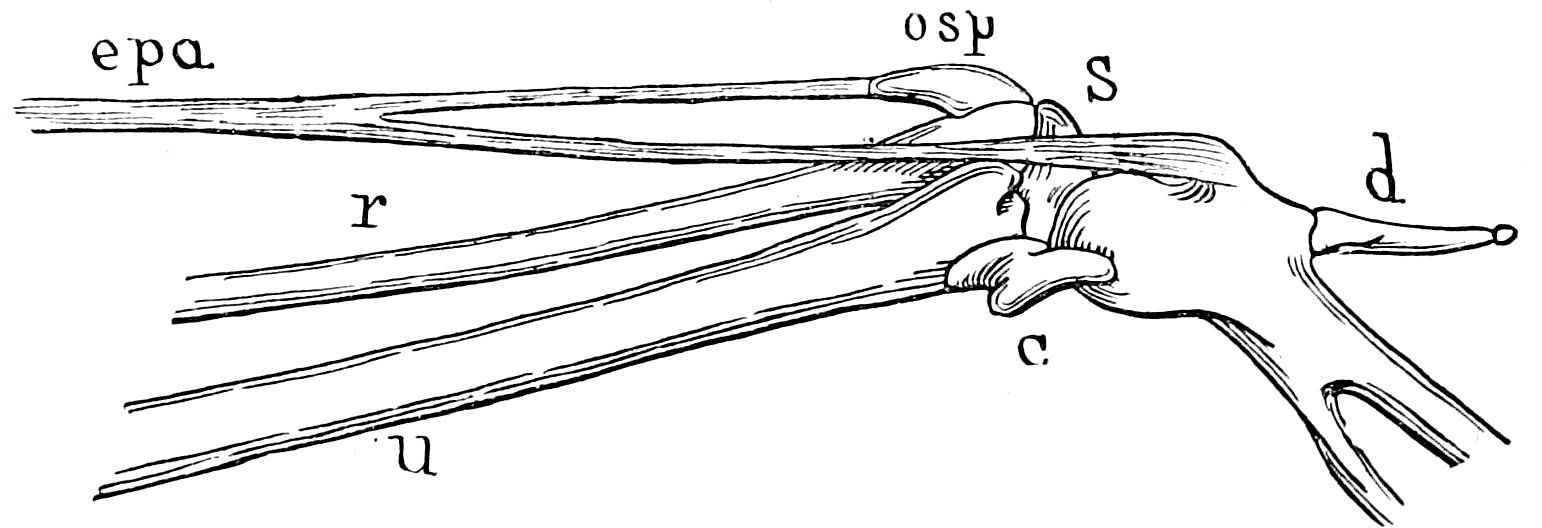
Left wing of Bubo virginianus, from below (reduced one third). r, radius; u, ulna; c, cuneiform; s, scapho-lunar; os p, os prominens; epa, tendon of extensor patagii longus.
The accompanying cut, drawn from a fresh specimen of B. virginianus, explains the form and position of the os prominens.
It will be noticed that it is situated on the anterior surface of the distal end of the radius, and runs almost parallel with that bone, instead of standing erect as in the Falconidæ. The radial portion of the tensor patagii longus terminates in the os prominens, and is not continued to the first metacarpal.
Apart from the Owls above noted, this bone has been found in Otogyps calvus, Heterospizias meridionalis, Buteo melanoleucus, B. pennsylvanicus, B. lineatus, Circus gouldi, Asturina pucherani, and Haliæetus albicilla.
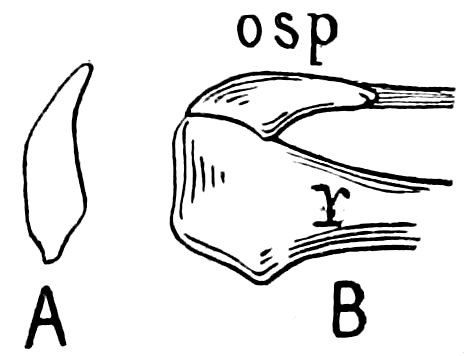
A. Os prominens of Otogyps calvus, full size. B. Os prominens of Bubo virginianus, seen from above to show articulation with radius, full size.
88It is absent in Polyborus tharus, Milvago chimango, and the following peculiar forms which were examined to see if they would throw any light upon the subject: Nyctibius, Strigops, Nestor, Megapodius, Ocydromus, and Atagen. Neither was any trace of it to be found in two specimens of Pandion haliæetus from N. Africa and the Duke of York group. Dr. Shufeldt’s theory that the os prominens is for the purpose of extending the wing area struck me, as it did Mr. Jeffries, as being untenable, from the fact that the increase of surface thus obtained was too slight to be of any value.[48]
The first proposition of Mr. Jeffries’ summary is that the bone serves to keep the friction of the extensor patagii longus from the carpus. Were this the case it ought surely to be present in the Albatross and Gull, birds which in a fresh breeze are continually flexing and extending their wings according to the direction of their flight and the varying force of the wind. But in both these birds the os prominens is absent,[49] and moreover, as we see in the Owls, it may be so situated as not to prevent the friction of the ulnar portion of the tendon. Second, that it serves only to a limited extent to increase the power of the extensor patagii longus to abduct the thumb, is shown by the fact that in the majority of cases that tendon is inserted in the first metacarpal. The exceptions to this, so far observed by me, are in Otogyps calvus and Haliæetus albicilla, where there is a strong tendon running from the os prominens to the first phalanx of the thumb. The third proposition has already been considered, and the fourth (that it protects the carpus) must be rejected, both for the reason given by Mr. Jeffries, and because as we see it in Owls it frequently does not lie over the carpus at all. Only in Otogyps calvus does the os prominens seem to exist as a simple sesamoid, and in that bird it is imbedded in the tendon of the extensor patagii longus, and glides over the scapho-lunar. Were I to venture a suggestion it would be that 89by its serving as a point of attachment for the tensor patagii longus, that tendon is freed from all duties save that of “puckering up” the anterior margin of the wing; but, as stated before, that theory is by no means entirely satisfactory to me.
A LIST OF BIRDS FROM THE LOWER MISSISSIPPI VALLEY, OBSERVED DURING THE SUMMER OF 1881, WITH BRIEF NOTES.
BY O. P. HAY.
During the summer of 1881 the writer and two companions spent a little more than a month in the South, especially in the State of Mississippi, travelling and studying its zoölogy. Our primary object was to collect fresh water fishes; and to this we devoted the greater part of our time and efforts. Incidentally, however, we collected and made observations on other animals. Hence this list of birds and the few notes concerning them. I did not intend to publish this list until I had opportunity to make additions to it; but the recent publication by Dr. F. W. Langdon of his field notes on birds observed by him, early in the spring, at a point a little farther south, has made it seem proper that I should contribute my little toward making known the ornithology of this region.
Our observations and collections were made of course under difficulties, and no attempt was made to secure nests and eggs, or, in any special manner, notes on the breeding habits of birds. Still, on account of the season when our trip was made, this list may be of some value as indicating that the birds observed are summer residents. The number of species recorded is not large, but I include only birds that I am reasonably sure were seen. In nearly all cases the birds were shot, and identified by means of descriptions. Others were seen, but as they were not identified with certainty, they are not included in the list.
The birds noted as found at Memphis, Tenn., were really seen in Arkansas just across the river from Memphis. Most of our other notes were obtained at Vicksburg and Jackson, Miss.
90The nomenclature adopted is that of Mr. Robert Ridgway, issued by the U. S. National Museum, 1881.
1. Hylocichla mustelina (Gmel.) Baird. Wood Thrush.—This species was seen and specimens were shot at Memphis and at Vicksburg. Its song was frequently heard; and it would appear to be quite common.
2. Mimus polyglottus (Linn.) Boie. Mockingbird.—Very abundant at all points visited. At the time we were at Vicksburg, July 1, the young had not yet left the nest, as negro boys were offering them captured in their nests for sale. In the “History of N. A. Birds” Dr. Brewer has stated that the Mockingbird in the South nests early in April, and that the young birds appear a month later. If this is the case these birds must remain in the nest six weeks or two months. I was informed that a law in Mississippi prohibits the keeping of these birds in confinement.
3. Galeoscoptes carolinensis (Linn.) Caban. Catbird.—This bird was quite common at Memphis. I did not note it at any point farther south.
4. Harporhynchus rufus (Linn.) Caban. Brown Thrush.—A single specimen seen at Jackson.
5. Sialia sialis (Linn.) Haldem. Bluebird.—Seen in considerable numbers at Memphis, Vicksburg, and Jackson.
6. Lophophanes bicolor (Linn.) Bonap. Tufted Titmouse.—Specimens of this species were obtained at Memphis and at Jackson. It may be worth noting here that it occurs as far north as Indianapolis, and I have seen it here during the present winter.
7. Parus carolinensis Aud. Carolina Chickadee.—Seen only at Memphis.
8. Thryothorus ludovicianus (Gm.) Bonap. Carolina Wren.—We observed this active bird at Memphis and at Jackson, at both of which places it appeared to be very abundant.
9. Mniotilta varia (Linn.) Vieill. Black-and-white Creeper.—Observed at Memphis and Jackson. It will probably be found to breed at both these points.
10. Protonotaria citrea (Bodd.) Baird. Prothonotary Warbler.—Specimens of this species were shot at Memphis, and others were seen at Jackson.
11. Parula americana (Linn.) Bp. Blue Yellow-backed Warbler.—This was found to be one of the most common of the smaller birds at Memphis, Vicksburg, and Jackson. We were constantly shooting them while hunting for other species. In the “History of N. A. Birds” it is said to be nowhere abundant; but a day’s hunt in the Mississippi lowlands would, I think, convince any ornithologist that this is an error. I have no doubt whatever that it breeds all through the South, although we found no nests. Audubon was probably correct in saying that it breeds in Louisiana, however much he may have erred in regard to the structure of the nest.
9112. Oporornis formosa (Wils.) Baird. Kentucky Warbler.—This sprightly little bird was observed, and specimens were handled, at both Vicksburg and Jackson.
13. Geothlypis trichas (Linn.) Caban. Maryland Yellow-throat.—A specimen was shot at Memphis; others were seen.
14. Myiodioctes mitratus (Gmel.) Aud. Hooded Warbler.—Specimens, male and female, of this bird were obtained at Jackson. It appeared to be moderately common.
15. Setophaga ruticilla (Linn.) Swains. American Redstart.—During our stay at Hopefind, Ark., opposite Memphis, a number of specimens of the Redstart were seen. Afterwards, while at Jackson, about July 10, a male and a female were killed. Their presence so far south at this season, and in such numbers, would indicate that they breed here. Up to this time I am not aware that it is known to breed south of the Potomac River and Illinois. The finding of the nest and eggs in Mississippi may be expected.
16. Vireosylvia olivacea (Linn.) Bonap. Red-eyed Vireo.—Very abundant at all the stations visited. Its clear, musical notes could be heard everywhere in the deep forests. A specimen was shot at Vicksburg, which had apparently just become fledged. Memphis, Vicksburg, Jackson.
17. Vireo noveboracensis (Gmel.) Bonap. White-eyed Vireo.—Specimens of this Vireo were obtained at Memphis and at Jackson.
18. Lanius ludovicianus Linn. Loggerhead Shrike.—A specimen of Shrike was seen at Jackson; but, as it was not shot, I am unable to say whether it belongs to this variety or to excubitorides.
19. Progne subis (Linn.) Baird. Purple Martin.—Common about Vicksburg.
20. Hirundo erythrogastra Bodd. Barn Swallow.—This species was observed to be quite common about Jackson together with the next.
21. Tachycineta bicolor (Vieill.) Caban. White-bellied Swallow.—Seen flying about the outskirts of Jackson.
22. Cotile riparia (Linn.) Boie. Bank Swallow.—Seen at various points along the Mississippi River near Memphis.
23. Pyranga æstiva (Linn.) Vieill. Summer Redbird.—A male of this species was shot at Memphis, another at Vicksburg, and a male and a female at Jackson. It is apparently a very common bird.
24. Spizella pusilla (Wils.) Bonap. Field Sparrow.—A single specimen of this species was shot at Jackson. Its occurrence there at that season was hardly to be expected. This individual may have been left behind in its winter quarters by its migrating comrades; or it may be that the species will be found to breed even as far south as Jackson.
25. Cardinalis virginianus (Briss.) Bonap. Cardinal Grosbeak.—One of the most conspicuous birds at every point visited.
26. Passerina cyanea (Linn.) Gray. Indigo Bunting.—The Indigo Bird was observed at Memphis, and again at Jackson.
9227. Passerina ciris (Linn.) Gray. Painted Bunting.—This beautiful bird was seen at the crossing of the Vicksburg and Meridian R. R. over the big Black River, and again at Jackson. Females were shot at both places, but the males eluded capture. They seem to be quite common.
28. Spiza americana (Gm.) Bonap. Black-throated Bunting.—Seen in the lowlands along the river in Louisiana opposite Vicksburg.
29. Agelæus phœniceus (Linn.) Vieill. Red-wing Blackbird.—Very abundant in the swamps in the vicinity of Vicksburg.
30. Sturnella magna (Linn.) Swains. Meadow Lark.—Not many were seen. One specimen at Vicksburg, and another along the railway while en route to Jackson.
31. Icterus spurius (Linn.) Bonap. Orchard Oriole.—Many of these were observed, and some shot, in Louisiana opposite Vicksburg.
32. Icterus galbula (Linn.) Coues. Baltimore Oriole.—Quite common at Memphis and at Vicksburg.
33. Quiscalus purpureus (Bartr.) Licht. Purple Grackle.—Common at Memphis and at Vicksburg.
34. Corvus frugivorus Bartr. Common Crow.—Seen at Memphis, Vicksburg, and at several intermediate points along the river.
35. Cyanocitta cristata (Linn.) Strickl. Blue Jay.—A common bird at Memphis and Vicksburg.
36. Tyrannus carolinensis (Linn.) Temm. Kingbird.—A very common bird at Memphis and Vicksburg.
37. Myiarchus crinitus (Linn.) Caban. Great Crested Flycatcher.—Seen at all points visited. Apparently more common than at the North.
38. Contopus virens (Linn.) Caban. Wood Pewee.—This bird was found to be quite common at Memphis and at Jackson.
39. Empidonax acadicus (Gmel.) Baird. Acadian Flycatcher.—A specimen was shot at Jackson.
40. Trochilus colubris Linn. Ruby-throated Hummingbird.—A single specimen was shot at Vicksburg.
41. Chætura pelasgica (Linn.) Baird. Chimney Swift.—Seen flying about at Jackson.
42. Chordeiles popetue (Vieill.) Baird. Night Hawk.—Observed at Jackson.
43. Campephilus principalis (Linn.) Gray. Ivory-billed Woodpecker.—No specimens of this species were seen, but their existence in the denser and less frequented forests in the neighborhood of Vicksburg and at other points, was confirmed by hunters and trappers. It is possible that the bird referred to here is the Logcock (Hylotomus pileatus), but as special mention was made by my informant, a professional hunter, of the white bill, I think the Ivory-billed Woodpecker must have been seen. Doubtless the other bird also occurs.
44. Picus pubescens Linn. Downy Woodpecker.—A single individual of this species was obtained at Vicksburg.
9345. Melanerpes erythrocephalus (Linn.) Sw. Red-headed Woodpecker.—This Woodpecker is apparently not so common as at the North, but it was observed at Memphis, Vicksburg, and Jackson.
46. Colaptes auratus (Linn.) Sw. Yellow-shafted Flicker.—A not uncommon bird about Vicksburg.
47. Ceryle alcyon (Linn.) Boie. Belted Kingfisher.—Quite common. Seen at Memphis and Vicksburg and intermediate points along the river.
48. Coccyzus americanus (Linn.) Bonap. Yellow-billed Cuckoo.—Apparently common. A specimen was secured at Vicksburg.
49. Conurus carolinensis (Linn.) Kuhl. Carolina Parakeet.—None were seen by ourselves. Inquiry concerning this rapidly disappearing species was made of various persons, and especially of hunters. It is still occasionally seen; but, for the most part, it maintains itself in the dense cane-brakes and forests, away from contact with man. I heard of its having been seen recently along the Mississippi River, about half-way down the state of Mississippi; also that it had been seen in southeastern Arkansas. A gentleman in Jackson stated that he had, within a year or two, seen a flock of Parakeets pass over that city. These items, together with the information obtained by Dr. F. W. Langdon, communicated in his recent paper, would indicate that this bird has not yet disappeared from the Mississippi Valley.
50. Scops asio (Linn.) Bonap. Little Screech Owl.—A single individual of this species, in the shabbiest of plumage, was shot along the Big Black River between Vicksburg and Jackson.
51. Buteo lineatus (Gm.) Jard. Red-shouldered Hawk.—A specimen of this hawk was shot and brought to me by a hunter at Jackson.
52. Cathartes aura (Linn.) Illig. Turkey Buzzard.—A common bird everywhere. Seen in great numbers at Jackson in company with the next.
53. Catharista atrata (Wils.) Less. Carrion Crow.—Not observed at any place but Jackson, although doubtless common everywhere. Readily distinguished from the Turkey Buzzard by its smaller size and its manner of flight.
54. Zenaidura carolinensis (Linn.) Bonap. Mourning Dove.—Common everywhere. Memphis, Vicksburg, Jackson.
55. Meleagris gallopavo americana (Bartr.) Coues. Wild Turkey.—None were seen, but hunters stated that they were quite abundant, even in the immediate vicinity of the city of Jackson. In the spring of 1880 I saw a fine gobbler that had been shot by a party of hunters in the pine woods of Kemper County, near the eastern border of the State.
56. Ortyx virginiana (Linn.) Bonap. Bob White.—The call notes of these birds were frequently heard as we passed down the river. At Vicksburg they appeared to be abundant in the bottom lands. We were extremely sorry that we could procure none of their skins.
57. Ardea herodias Linn. Great Blue Heron.—Several of these birds were seen flying about in the swamps near Vicksburg.
9458. Herodias alba egretta (Gmel.) Ridgw. American Egret.—A number of this snow-white species were observed in the swamps across the “lake” from Vicksburg. One was shot, and was found to have the long dorsal train of plumes.
59. Oxyechus vociferus (Linn.) Reich. Killdeer.—Observed only at Vicksburg. Will probably be found to breed here.
60. Philohela minor (Gmel.) Gray. American Woodcock.—One specimen was shot at Vicksburg.
61. Sterna antillarum (Less.) Coues. Least Tern.—This beautiful little Tern was very abundant on a sandy point across the “lake,” or old bend of the river, opposite Vicksburg. We were told that these birds lay their eggs on the bare sand, and that these eggs hatch in an extraordinarily short time.
IMPRESSIONS OF SOME SOUTHERN BIRDS.
BY WILLIAM BREWSTER.
Looking back on my first winter in the South I can recall no pleasanter experience than that of a stay of some four weeks at St. Mary’s, a town situated on the very border line of Southern Georgia. This place was then scarcely known to Northerners, although the crowded Florida steamers, on their way across Cumberland Sound, passed within sight of it and occasionally even touched at its wharf for some chance freight or a supply of fuel. But the village still retained a primitive quiet and simplicity that was all the more restful from its contrast with the bustling world outside. Now there are rumors of a railroad and daily trains from Savannah, with all the accompanying desecrations. It is a pity that the march of modern improvements cannot spare a few such peaceful spots, but the “levelling process” seems universal and inevitable.
A Northerner passing his first spring in the South will miss the marked distinction between the seasons upon which he has been accustomed to rely. The vegetation does indeed take a partial rest during the winter months, but it is checked rather than suppressed, and the reign of summer begins without that interval of preparation which we call spring. Most of the trees 95are evergreen, but some of them, curiously enough, assume bright autumn tints and cast their leaves in April. This at least is true of the live-oaks and magnolias: during my stay at St. Mary’s one of the latter, a remarkably fine tree which I often passed in my daily walks, was at one time nearly denuded, while the ground beneath was strewn with scarlet and orange-tinted leaves.
By the middle of April the fields and forests wore that mature appearance which we associate with August and early September. At noonday cicadas shrilled in the sultry woods, and crickets chirped all night long in the shrubbery about the house. Yet few birds had begun to nest, and many of the northern ones still lingered. I saw Yellow-rumped Warblers, Blue Yellow-backed Warblers and Cedar Birds nearly to the end of April, and a White-throated Sparrow as late as May 2. Many of the Blue Yellow-backed Warblers remained to breed, or rather were breeding, for long before this (on April 9) I had found a nearly finished nest. The local birds, however, did not mingle with the strangers, the former being found in pairs, and only where the trees were hung with Spanish moss; while the latter occurred in all kinds of timber, and in flocks made up largely of Redstarts, Kinglets, Black-poll Warblers and other northern species. The same was true of the Catbirds, Brown Thrushes, Pine Warblers, Towhees and several others. It was especially marked in the case of the Towhees, for the resident individuals belonged to a different and readily recognizable race.
One needed but to pass the boundaries of St. Mary’s to be fairly in the country, for the village had not then overflowed its limits, and the few outlying plantations were scarcely less wild and unkempt than the woods which surrounded them. One of my favorite haunts was the “Bay-gall” (I could never learn the origin of this name), a tract of swampy forest less than a quarter of a mile distant from the house at which we were staying. This place was sure to be alive with birds, and I rarely entered it without making some pleasing discovery. My first visit was on April 6, the day after our arrival. As I approached the woods a Red-bellied Woodpecker started from a solitary tree within a few feet of my head, and alighting at the base of one near by scrambled hurriedly up, dislodging the scales of loose bark in his ascent. He was immediately joined by his mate and 96the two began a game of hide-and-seek around the trunk and among the branches, uttering a rolling wor’r’r’roo very like that of a Flicker.
Forcing my way through the brambly outskirts, I entered the swamp and paused a moment to look around. Grand old wateroaks and sweet-gums thickly hung with Spanish moss cast a dense shade over the ground beneath, and the few sunbeams that struggled through flickered in the gloom like dying torches. There was little undergrowth, and the eye could penetrate far in every direction. In the branches above Blue Yellow-backed Warblers were singing incessantly, and occasionally the note of a Great-crested Flycatcher echoed sharply among the trees. There were other sounds; the rolling tapping of Woodpeckers, the shrill cry of the Blue Jay; and, from the clearing outside, pleasantly softened by distance, the songs of Mockingbirds and Cardinal Grosbeaks.
Passing deeper into the forest I came to an opening where the morning sun lay warm on a thicket of bushes that surrounded a shallow pool. Here I found an interesting little company of tired migrants resting after the fatigues of their last night’s journey and preparing for that still before them. There were six or eight Hooded Warblers, all males in full spring livery, a number of Worm-eating Warblers, a female Prothonotary Warbler, and several Ruby-crowned Kinglets and Redstarts. All were busily engaged in catching insects, but occasionally one of them would pause to sing a few notes in a listless undertone. The Prothonotary was the first that I had ever met with, and it was the only one that I saw at St. Mary’s. The Hooded and Worm-eating Warblers were common for a week or more afterwards, when all departed for some more northern breeding-ground.
During subsequent visits to the “Bay-gall” I met many interesting birds, several of which were new to me. Occasionally I would startle a Chuck-will’s-widow from its noonday slumbers on some mossy knoll, and if a chance shot through the leaves succeeded in stopping its erratic, bat-like flight, there was the pleasure of smoothing its soft plumage and admiring the rich brown coloring before consigning the bird to the paper wrapper that formed its temporary tomb. I believe I never shot one without indulging myself in this way. There is much to be learned, too, from the examination of a freshly-killed bird. For instance, 97I had never known the wonderful beauty of this Goat-sucker’s eye until I held the bird in my hand, and the size of its mouth would hardly be suspected from the examination of a dried skin.
On April 17 the Acadian Flycatchers arrived. I was first made aware of their presence by their emphatic queep’ éep which so closely resembled that of Traill’s Flycatcher that I immediately suspected the identity of the singers, although it was some time before I could get a sight at one. They had another note also which was much like the whistling of wings. I afterwards satisfied myself that this sound was a vocal one.
I never left the “Bay-gall” without reluctance in the days when I was perhaps the only invader of its secret recesses; and now, in recalling it, the feeling is scarcely less strong. But the country about St. Mary’s held other attractions which must not be neglected. The open space surrounding the town was bordered on the north by a pine forest that stretched an indefinite number of miles into the interior, and my walks often tended in this direction. Following some grass-grown road that wandered aimlessly among the trees, I often paused to watch the gambols of the Brown-headed Nuthatches which fairly swarmed in these woods. They are exceedingly social little birds, and it was no uncommon thing, even in the middle of their breeding season, to see five or six rollicking together. In their motions they closely resemble Sitta canadensis, and they have the same habit of exploring the ends of the pine branches and hanging head downward, like Titmice, among the tufts of pine needles. But they are decidedly more active, and their notes are shriller, more varied and altogether unlike those of either the Red or White-bellied species. Whick-whick-whee’e’e’ whick-whicker-whicker is the usual utterance, but when several come together their shrill excited piping altogether baffles description. These little companies were by no means wholly composed of Nuthatches, but usually included a more or less numerous escort of Pine Warblers, Bluebirds, Titmice and Woodpeckers. As the motley troop rambled through the woods, its members were continually chasing one another from tree to tree, chirping, calling and singing as their various moods dictated. I noticed that the Bluebirds usually led the van, while the Woodpeckers invariably brought up the rear.
Unlike the Red-bellied, Downy, Hairy and Golden-winged species, which inhabited all sorts of timber, the Red-cockaded 98Woodpecker was exclusively a bird of the pines. It was not common about St. Mary’s and I had difficulty in getting as many specimens as I wanted. Its notes to my ear almost exactly resembled those of Sitta pusilla. On the 1st of May I started a female from her nesting-hole, which was about thirty feet above the ground in a large and apparently perfectly sound pine. I was unable to climb the tree but the bird acted as if her eggs had already been laid.
The pine lands of the South have an open park-like character that is a continual surprise to one accustomed only to New England forests. The trees rarely stand in close proximity to one another, and they are often so widely scattered that the general effect is that of an opening rather than a forest. Unless a hummock interrupts the view, the eye may sometimes roam for half a mile in every direction over a perfectly level plain, interspersed with occasional trees whose tufted heads throw waving shadows upon the bright green beds of saw-palmetto that cover most of the ground beneath. Were it not for the half-wild cattle that range at will through the country, the palmetto would probably usurp every inch of ground; but these creatures keep it within reasonable limits, and many spaces of closely cropped grass and stunted blueberries intervene. About such places I used to find the Bachman’s Finch, a retiring little bird which might easily be overlooked by one unacquainted with its habit of skulking among the herbage and lying concealed until nearly trodden on. But no one with the slightest ear for bird music can long remain in ignorance of its presence after the breeding season has set in, for the male possesses vocal powers of a very rare order. His song is a prolonged, leisurely chant composed of several distinct bars or sets of notes, with brief pauses between, as if the bird stopped to take breath. The final notes of each bar have sometimes a rising, sometimes a falling, inflection, and the tone is varied in the most subtle manner. Now it has a full bell-like ring that seems to fill the air around; next it is soft and low and inexpressibly tender; now it is clear again, but so modulated that the sound seems to come from a great distance. The whole performance is very simple and I hardly know the secret of its charm. To be fully appreciated it should be heard in the soft twilight of an April evening, when the still woods are filled with dusky shadows. At such times it has moved me more deeply than I care to confess.
99The male always sings from an elevated perch, usually a dead twig close to the trunk of a southern pine. He sits perfectly motionless and is unaccountably hard to see. I have often stood directly beneath one for several minutes, vainly straining my eyes in the direction from whence the sound came, and perhaps finally discovered him within ten feet of my head in plain view. The ventriloquous character of many of his notes increases this difficulty. If disturbed in the midst of his song, he pitches to the ground beneath and at once seeks shelter in the grass.
Another characteristic inhabitant of these grassy openings was the Meadow Lark. It was much tamer than our northern bird, and its notes had a wild, ringing inflection that harmonized well with the surroundings.
In the thicker groves I often heard the voice of the Summer Tanager (Pyranga æstiva). His song is rich, flowing, and not unlike that of the Rose-breasted Grosbeak, although some of its notes recall those of the Robin. The call-note used by both sexes is a peculiar chuck’l-chuckl’ut. The bright colors of the male make him a conspicuous object among the branches of the southern pine which, at least in Georgia, is his favorite tree.
The Yellow-throated Warbler also was sure to be met with in these walks. His song to my ear has a far-a-way sound, even when the bird is near at hand. It is simple and monotonous, but nevertheless sweet and plaintive. This bird has all the habits of the Pine Warbler, with which it often associates.
A totally different phase of bird life was presented when, as was often the case, I visited the plantations. The fields themselves rarely offered anything more attractive than Yellow-winged Sparrows, Grass Finches and, late in April, migratory troops of Bobolinks that settled among the last year’s weeds for a moment before resuming their northward journey with rollicking snatches of song. But the fence corners and similar neglected places around the outskirts of the cultivated lands were filled with bushes over which trailed Cherokee roses, trumpet-vines and other luxuriant creepers. In these places I was sure to find Mockingbirds, Cardinals, Catbirds, Brown Thrushes, White-eyed Vireos and the brilliant little Painted Buntings.
Next to the always self-assertive Mockingbird the White-eyed Vireo was perhaps the most conspicuous inhabitant of such thickets. Not that he was often seen, but at almost any time of 100the day one might hear his emphatic, jerky little strain, coming from half a dozen points at once. I noticed that the note varied considerably from that which we hear in New England, and, moreover, scarcely two of the southern birds sang exactly alike. Some individuals even seemed to have a talent for mimicry. One that I remember imitated the note of the Loggerhead Shrike so closely that I was completely deceived. The nest of this bird is a wonderfully delicate and beautiful structure. One that I got at St. Mary’s contained its complement of four eggs on April 26. I discovered it twelve days previously when the birds were busily employed on the framework. The male took an equal part in this task and it was amusing to see him try to sing with his bill full of moss or bark.
The Painted Buntings or Nonpareils, as they are universally called by the townspeople, arrived April 23 and through the remainder of the month were abundant. I used to find them in flocks about the openings where they spent much of their time on the ground. They were timid rather than shy, flying to the thickets upon the slightest alarm, but when once conscious of being pursued, it was difficult to get a shot at one. The brilliant plumage of the adult male makes him a conspicuous object either on the ground or in green foliage, but it is no easy matter to see one among the flowers of the trumpet-vine where they often seek refuge, apparently fully conscious of the protection afforded by the clusters of scarlet blossoms. The young males during the first year are colored precisely like the females. They sing, and for aught I know, breed, while in this condition. The song is a low, pleasing warble very un-Finch-like in character. I should compare it to that of the Canada Flycatcher, but the notes are less emphatic, though equally disconnected. The bird almost invariably sings in the depths of some thicket, and its voice ceases at the slightest noise. Both sexes have a sharp chirp of alarm which closely resembles that of the Indigo Finch. Most of the Nonpareils left St. Mary’s by May 1, but a few pairs remained up to the time of my departure, when they were apparently preparing to breed. Another familiar inhabitant of these thickets was the Towhee Bunting. Two distinct races of this bird were to be met with during the same walk, but never, so far as my observation went, actually in company. The Red-eyed or northern form, erythrophthalmus proper, apparently occurred only as a winter 101visitor, while var. alleni represented the resident or local race. The latter was chiefly a bird of the oak scrub, although it was also to be found in open pine woods where it haunted the beds of saw-palmetto. Its note differed widely from that of erythrophthalmus; the “chewink” was shorter and harsher, and in addition to this cry, both sexes occasionally uttered a sharp, clear whistle that sounded like a sportsman’s call to his dog. I am not sure that I heard the song, or at least identified it. These Towhees were hard to obtain, for they were shy and retiring, rarely venturing far from their secure retreats. The irides of all the specimens that I examined were brownish-yellow or dull, opaque amber; never white, as is said to be the case with examples from Southern Florida.
It would be difficult to find a plantation in the South that did not have one or more pairs of Mockingbirds. About St. Mary’s they were especially abundant, and nowhere more so than in the gardens of the village. Here they were half-domesticated, building their nests in the shrubbery that surrounded the houses, and hopping about, like Robins, upon the grass-plats and gravelled walks. An orange tree directly in front of the windows of my room was appropriated by a remarkably fine singer. There is a noticeable difference in the performances of most males, but the voice of this bird possessed a compass and perfection of tone that I have never heard equalled. His repertoire included the notes of nearly all the birds of the surrounding region besides many of the characteristic village sounds, and most of the imitations were simply perfect. Moreover he was continually adding to his accomplishments. An interesting instance of this occurred one afternoon, when several of us were sitting on the veranda. A Greater Yellow-leg passing over the town was attracted by my answering whistle, and circled several times above the house reiterating his mellow call. The Mockingbird up to this time had been singing almost uninterruptedly, but at the sound of these strange notes he relapsed into silence and retreated into the thickest foliage of his favorite tree; after a while we heard him trying them in an undertone. The first note came pretty readily, but the falling inflection of the succeeding three troubled him. Whenever I ventured to prompt he would listen attentively, and at the next attempt show an evident improvement. Finally he abandoned the task, as we thought in 102despair, and at sunset that evening for the first and only time during my stay his voice was missing in the general chorus. But at daylight the next morning the garden rang with a perfect imitation of the Yellow-leg’s whistle. He had mastered it during the night, and ever afterwards it was his favorite part. The discomfiture of the rival males in the neighborhood was as amusing as it was unmistakable. Each in turn tried it, but not one of them succeeded.
Another frequenter of the village shrubbery was the Orchard Oriole. His flute-like voice, which bears some resemblance to that of the Fox Sparrow, could be heard almost any time after April 10. Our garden offered especial attractions to these Orioles, for the hedge of wild olive trees that bordered it on two sides was overrun with Cherokee roses and trumpet-vines among which they found a congenial shelter. They were fond, too, of sipping the honey from the trumpet-flowers, and it was no uncommon thing to see half a dozen collected about a single cluster. In this occupation they were almost invariably joined by numerous Hummingbirds;—and such a group, with its setting of green leaves and scarlet and white blossoms, formed the prettiest picture imaginable.
To our garden also came the Blue Jays; bold, familiar birds very different in bearing from the outcast that boys and would-be sportsmen pursue so relentlessly in the northern woods. Everywhere at the South this Jay is as much an inhabitant of the cultivated grounds as of the forests, and if not actually encouraged, it is universally tolerated. In Jacksonville I have heard them screaming among the live-oaks that shade the busiest streets, and at St. Mary’s they were scarcely less tame and confiding than the Mockingbirds.
The average Georgian is indifferent to the shooting of most of the birds that inhabit his plantation; but it is little short of a crime in his eyes to take the life of either a Turkey Buzzard or a Mockingbird. The killing of one of the former is considered an offence against the State, which protects them on account of their services as scavengers. But the Mockingbirds are treasured as personal property, and any interference with them is sure to be promptly resented. The natural result of this sentiment is that both species are universally abundant and familiar. The Buzzards, especially, are ubiquitous. At 103all hours of the day, in every kind of weather, they float over the cities, villages, plantations, pine woods, hummocks, cypress swamps, salt marshes and even the beaches of the Sea-islands. Go where you will, it is almost impossible to look upward without seeing the picturesque forms drifting about in the sky. Some are soaring almost beyond the reach of human vision. Others at a lower elevation cross and recross each other in interminable mazy lines; while still others glide across the landscape passing just above the tops of the trees. Both species occurred at St. Mary’s, but the Black Vulture was much the less common. It associated freely with the Turkey Buzzards, among which it could be recognized at almost any distance by its different color, shape and manner of flying. The tail is so short as to be altogether out of proportion with the body and wings, while its square tip gives it the appearance of having been cut off. This bird’s flight is heavy, awkward and generally straight forward, although it occasionally soars. The wings are flapped every few seconds in a hurried, nervous manner that seems to betoken a lack of power or confidence. The flight of the Turkey Buzzard, on the contrary, is a picture of repose in motion. The bird rarely moves its wings, save to alter their inclination, and its dark form drifts through miles of space without the slightest perceptible effort. The impression of entire freedom from exertion which its movements convey, is curiously in accord with the general enervating influence of southern life and its surroundings. Its impassive flight may perhaps be regarded as the most characteristic feature of a southern landscape, as it certainly is one of the most attractive. But the observer who would keep this impression untarnished will be wise to refrain from looking too closely into the useful side of the bird’s character.
The Buzzard’s flight will not bear comparison however with that of the Swallow-tailed Kite. The latter is equally easy and graceful of wing, and, in addition, its movements are characterized by a certain dash and energy of purpose that one looks for in vain in the calm, emotionless flight of the Vulture. I hardly know a more attractive sight than that presented by one of these Kites playing about an opening in the woods. For a moment it floats motionless, as if suspended by an invisible wire; the next, it glides close over the ground crossing and recrossing every yard 104of space. The long, thin wings, firmly set, cleave the air like knife-blades and the forked tail, spread to its fullest, is inclined to one side or the other as the bird changes its swift course. When it turns, the snowy head and breast are contrasted against the green background and its steel blue back glances in the sunlight. Finally rising to a level with the tree-tops it is gone as it came, like a beautiful vision.
But my space is exhausted, although many interesting birds remain to be mentioned. Perhaps at some future time I may take up the threads where this sketch leaves them.
NOTES ON SOME OF THE RARER BIRDS OF SOUTHERN NEW BRUNSWICK.
BY MONTAGUE CHAMBERLAIN.
1. Sialia sialis. Bluebird.—About the middle of March, 1877, Mr. Harold Gilbert saw one at Mount Pleasant, a suburb of St. John. Some time early in June, 1879, Mr. J. W. Banks saw one at Milledgeville, with food in its mouth, apparently for its young. On April 26, 1881, Mr. Henry Gilbert shot one at Rothesay, nine miles north of St. John.
2. Dendrœca pennsylvanica. Chestnut-sided Warbler.
3. Dendrœca castanea. Bay-breasted Warbler.
4. Dendrœca blackburnæ. Blackburn’s Warbler.—These three species are but rarely found here. In my note-book is a record of one of each taken during the summer of 1881, and I can learn of none others having been seen or heard.
5. Vireo noveboracensis. White-eyed Vireo.—Mr. Harold Gilbert shot one specimen of this bird at South Bay, a few miles northwest from St. John, on May 24, 1877, and this is the only known instance of its occurrence in this vicinity.
6. Pyranga rubra. Scarlet Tanager.—I saw an adult male of this species sitting on a fence in the suburbs of St. John on June 20, 1879, and have examined two specimens taken near Hampton during the summer of 1880.
7. Ammodromus caudacutus. Sharp-tailed Finch.—On June 21, 1881, five individuals of this species were taken by Mr. H. A. Purdie, Mr. Fred. W. Daniel and myself, on a marsh near Hampton. This marsh is watered by the Kenebecasis, a tributary of the St. John, and lies some twenty-five miles up the former river. The junction of the two rivers 105takes place about five miles from the mouth of the St. John. The marsh is some twenty miles, air line, from the nearest point on the Bay of Fundy shore, and at the time we visited it, the water running past it did not taste in the least brackish.[50]
8. Pipilo erythrophthalmus. Towhee.—A specimen, now in the collection of the Natural History Society of St. John, was shot at Irishtown on May 8, 1881, by Mr. J. Belyea.
9. Zamelodia ludoviciana. Rose-breasted Grosbeak.—I have examined the skin of one of this species taken near Hampton in June, 1879.
10. Passerina cyanea. Indigo Bunting.—There is a skin in the collection of James McGivern, Esq., said to have been taken about six miles north of St. John in June, 1880. I can learn of no other occurrence of this bird near here, though I have frequently seen specimens taken on the western, or Bay of Fundy shore of Nova Scotia.