Volume 7 — BULLETIN OF THE NUTTALL ORNITHOLOGICAL CLUB. VOL. VII. April, 1882. No. 2. (continued 2)
Reading edition
11. Zenaidura carolinensis. Mourning Dove.—This bird has been but rarely met with here; one taken at Hampton in June, 1880, one at Rothesay on September 30, 1881, and one at Milkish on October 17, 1881, are the only specimens I have heard of.
12. Ardetta exilis. Least Bittern.—Between the spring of 1877 and the fall of 1880 there were five individuals of this species taken on the Bay of Fundy shore, about ten miles to the eastward of St. John.
13. Micropalama himantopus. Stilt Sandpiper.—The only known occurrence of this bird in this vicinity is of three seen by Mr. F. W. Daniel on the sand flats back of St. John on September 8, 1881. He secured one of them, which is now in the museum of the Natural History Society.
14. Recurvirostra americana. Avocet.—Mr. William Ellis of St. Martins, a village on the shore of the Bay of Fundy, says he has shot one or more of these birds each year for the last five years, usually meeting two together. A specimen taken by him in 1880 is in the museum of the Natural History Society.
15. Himantopus mexicanus. Black-necked Stilt.—I procured one of this species in September, 1880, from Mr. John Ellis of Mace’s Bay, an arm of the Bay of Fundy, lying some thirty miles to the westward of St. John, and was told by Mr. Ellis that several had been taken there during former years.
16. Ionornis martinica. Purple Gallinule.—Since obtaining the male, announced by Mr. Wm. Brewster in this Bulletin for July, 1881, I have had the good fortune to get possession of a female which was shot near Gagetown, a village on the St. John River, about forty miles from its mouth. The bird was taken in the early part of September, 1880.
17. Chen hyperboreus. Snow Goose.—One of these birds was taken at Gagetown in December, 1880, and sent by me to Mr. E. O. Damon of Northampton, Mass.
18. Anas boscas. Mallard.—A pair in the museum of the Natural History Society were shot near Hampton by the late Col. Otty some fifteen years ago. The only late occurrences of this species are of one mounted 106by J. H. Carnell, taxidermist, and a flock of some six or eight seen by Mr. Henry Gilbert on the Kenebecasis River in August, 1880, from which he obtained a male and female.
19. Æthyia vallisneria. Canvas-back.—Carnell has mounted one of this species taken within the Province, and E. C. Sutton, Esq., of Sutton, who is familiar with their appearance, saw a flock on the St. John River, about four miles from the city, several times during the fall of 1879.
20. Pelecanus erythrorhynchus. American White Pelican.—One of these birds in the collection of the Natural History Society was shot on the shore of the Gulf of St. Lawrence near Pt. du Chene by Mr. Robert Bustin, and I have very good authority for announcing the occurrence of another at Cape Spencer, some five miles east of St. John, during the first week in April, 1881.
NOTES ON THE SUMMER BIRDS OF THE UPPER ST. JOHN.
BY CHARLES F. BATCHELDER.
During the spring of 1879 Messrs. W. A. Jeffries and J. Amory Jeffries spent some time at Grand Falls, New Brunswick, collecting and studying the birds of that neighborhood; and at about the same time Mr. J. Dwight, Jr., and myself were similarly engaged at Fort Fairfield, Aroostook Co., Maine.
Owing to the limited time of our stay the number of species observed was not large, but as it included almost all the commoner summer residents,—the species really characteristic of the fauna of the region—it has been thought worth while to lay the results of our observations before the public, especially as the fauna is in some respects peculiar. One might be led to expect, from the latitude of the region, that the fauna would be thoroughly Canadian in its character. Our experience shows, however, that it has a strong tinge of the Alleghanian.
Grand Falls is situated on the right bank of the St. John River at about N. Lat. 47° 03′, and W. Long. 67° 50′. The river below the falls runs through a narrow valley, almost all of which is under cultivation. On the higher land above the falls and about the town are farms devoted chiefly to hay, potatoes and buckwheat. The country is hilly, and is scantily watered, the few 107rapid streams and brooks draining directly into the river. There are no lakes or ponds, except a few insignificant puddles, although there are occasional cedar swamps and “barrens.” The tributary streams below the falls have cut narrow*, steeply walled ravines in their passage to the river. These were cold and damp, and apparently without birds.
In some places forests of hard woods exist, tall maples, elms and birches that have no doubt stood there for ages. There is but little underbrush in these woods, and they have a rather park-like aspect. The second growth and the woods on the low lands along the river consist of firs, spruces and hemlocks of all sizes, and often have an almost impenetrable underbrush. Where fires have spread large tracts are stripped of their woods, and are covered with fallen trunks overgrown with vines, with here and there tall dead “stubs” still standing.
Mr. W. A. Jeffries’ observations extended from May 21 to June 19. He was joined by his brother on the 9th of June. During the ten days following this latter date the weather was cold—there was a frost June 15, and rain fell every day except the 9th and the 15th.
Fort Fairfield is twenty miles south of Grand Falls. It is situated on the Aroostook River, about five miles in an air line west of its junction with the St. John. It is in a rolling country containing but few ponds and swamps, and watered merely by small brooks which empty into the Aroostook River. The river itself is broad, with a rapid current, and flows between banks which though not very high, are yet never swampy. Much of the original forest has been removed, especially in the neighborhood of the town and along the river, where the stretches of wooded land are interspersed with clearings, pastures and cultivated fields, large crops of buckwheat and potatoes being raised on the fertile soil. The woods are mostly evergreen—the several species of Abies and the arbor vitae—intermingled, of course, with a few yellow birches and an occasional maple, but few tracts being wholly covered by deciduous trees.
Our collecting was done mostly within two or three miles of the town. Our notes were made between June 14 and July 1. On our arrival we found the trees by no means in full leaf, and were told that the season was very backward, and had been very wet. Heavy frosts occurred on the 15th and 19th of the month.
108The nights were generally cold, the days warm—even hot during the latter part of our stay.
Fort Fairfield is 415 feet above the sea, and has a mean annual temperature of 38.11° F.
Through the kindness of Mr. H. A. Purdie I have been enabled to supplement our observations by extracts from some manuscript notes on the birds occurring at Houlton, Maine, made by Mr. Robert R. McLeod. These notes were written in 1877, and are based on his experience during a residence of four years at Houlton.
This town is in the southeastern part of Aroostook County, on the Meduxnekeag River about twelve miles from its junction with the St. John. It is forty-five miles south of Fort Fairfield, its Latitude being 46° 8′. I quote the following from Mr. McLeod’s notes: “The country round about is well watered with lakes and streams. Much of the land is under cultivation, but where it is not, the old forests are standing in great tracts of many miles in extent. The first snow falls about the 10th of November, and it generally remains on the fields till the middle of April, and in the woods until the last of May.”
At each locality several species, that would doubtless have been much more abundant had local conditions been favorable, were absent or represented by but few individuals.
All statements are given on the authority of both the observers at the locality to which they refer, except in some few cases, in which the initials of the observer are appended. All references to Houlton are, unless otherwise stated, on the authority of Mr. McLeod.
1. Turdus migratorius Linn. Robin.—Rather common at Fort Fairfield. At Grand Falls it was abundant everywhere.
2. Turdus fuscescens Steph. Wilson’s Thrush.—Rare at Grand Falls. On June 16 a nest with four fresh eggs was found on top of a stump. Not met with at Fort Fairfield. Mr. McLeod says that it appears at Houlton by May 15, and by the 10th of June becomes common. Breeds.
3. Turdus pallasi Caban. Hermit Thrush.—Common. One nest taken May 30 at Grand Falls was about three feet from the ground in a small fir tree.
4. Turdus ustulatus swainsoni (Caban.) Coues. Olive-backed Thrush.—Common at Grand Falls, especially in the hard woods and more open fir woods. At Fort Fairfield it appeared to be rather common, though seldom seen. Common and breeding at Houlton.
1095. Mimus carolinensis (Linn.) Gr.. Catbird.—At Houlton “very rare. A pair has bred in this vicinity each year since I have been here” (R. R. McL.). Not met with at Fort Fairfield or Grand Falls.
6. Sialia sialis (Linn.) Hald. Bluebird.—At Grand Falls they were frequently seen, as many as seven or eight in the course of a day. Apparently not common at Fort Fairfield. At Houlton “very rare,” one pair breeding.
7. Parus atricapillus Linn. Black-capped Chickadee.—At Grand Falls it was not uncommon. Some days four or five pairs would be seen, on others none at all. At Fort Fairfield it was not very common, though seen occasionally. At Houlton “very common.”
8. Parus hudsonicus Forst. Hudsonian Chickadee.—About half a dozen were seen at Grand Falls, mostly in hardwood brush or small woods. It was not seen at Fort Fairfield.
9. Sitta carolinensis Gmel. White-bellied Nuthatch.—Common in the hard woods at Grand Falls. Breeding.
10. Sitta canadensis Linn. Red-bellied Nuthatch.—One shot at Fort Fairfield. Both species are said to be common at Houlton.
11. Certhia familiaris Linn. Brown Creeper.—Seen occasionally at Fort Fairfield. Breeds. Rare at Grand Falls. “Common” at Houlton.
12. Troglodytes aëdon Vieill. House Wren.—At Grand Falls one pair was noticed which had a nest in the frame work of a barn.
13. Anorthura troglodytes hyemalis (Vieill.) Coues. Winter Wren.—This species is common at Houlton,[51] and no doubt occurs throughout this region; it was seen and heard at Grand Falls, but not observed at Fort Fairfield.
14. Mniotilta varia (Linn.) Vieill. Black-and-white Creeper.—We saw several at Fort Fairfield. Not seen at Grand Falls.
15. Helminthophaga ruficapilla (Wils.) Bd. Nashville Warbler.—Apparently not very common at Fort Fairfield. It was not observed at Grand Falls.
16. Dendrœca æstiva (Gmel.) Bd. Yellow Warbler.—Rather common at Fort Fairfield. Not met with at Grand Falls.
17. Dendrœca cærulescens (Linn.) Bd. Black-throated Blue Warbler.—Rather common at Fort Fairfield. At Grand Falls it was common in hard woods where the underbrush was thick.
18. Dendrœca coronata (Linn.) Gray. Yellow-rumped Warbler.—It was common at Fort Fairfield. At Grand Falls it was rare during May. All had left before the 9th of June.
19. Dendrœca maculosa (Gm.) Bd. Black-and-yellow Warbler.—Common.
20. Dendrœca pennsylvanica (Linn.) Bd. Chestnut-sided Warbler.—Common.
21. Dendrœca blackburnæ (Gm.) Bd. Blackburnian Warbler.—This bird was seldom seen while we were at Fort Fairfield, and was not met with at Grand Falls.
22. Dendrœca virens (Gm.) Bd. Black-throated Green Warbler.—Rather common at Fort Fairfield. Not met with at Grand Falls.
11023. Dendrœca tigrina (Gm.) Bd. Cape May Warbler.—I shot a male at Fort Fairfield, June 23, in a thick second growth of spruces on the edge of a path.
24. Siurus auricapillus (Linn.) Swains. Golden-crowned Thrush.—Rather common at Fort Fairfield. At Grand Falls it was seen only in the hard woods, where it was not common.
25. Siurus nævius (Bodd.) Coues. Water Thrush.—Breeding at Fort Fairfield, but not very common. It was not met with at Grand Falls.
26. Geothlypis philadelphia (Wils.) Bd. Mourning Warbler.—Common in suitable places. It was almost sure to be found in “burnt lots,” where the fallen trunks lay, half hidden by a luxuriant growth of tall weeds, or thickly overrun with vines. Under the shelter thus afforded they undoubtedly nested, safely screened from the most searching eyes.
27. Geothlypis trichas (Linn.) Caban. Maryland Yellow-throat.—Common.
28. Myiodioctes pusillus (Wils.) Bp. Wilson’s Black-cap.—At Fort Fairfield this bird was common. We usually found them in thickets of willow bushes, often in rather wet places. The birds were apt to go in companies of three or four or more. June 23 Mr. Dwight caught a young bird, just able to fly two or three yards at a time. The nest was no doubt close at hand, but the ground among the willow bushes was covered so deeply with brush that a diligent search for the nest showed nothing—except that it was not built in the bushes. The youngster showed in the most marked way the energy of disposition and restless activity that characterize the adults. The species was not common at Grand Falls.
29. Myiodioctes canadensis (Linn.) Aud. Canada Flycatching Warbler.—Rare at Grand Falls, but common at Fort Fairfield.
30. Setophaga ruticilla (Linn.) Swains. Redstart.—This species was exceedingly abundant at Grand Falls wherever there were hard woods. It was a common bird at Fort Fairfield.
31. Hirundo erythrogastra Bodd. Barn Swallow.—Common.
32. Tachycineta bicolor (Vieill.) Caban. White-bellied Swallow.—At Grand Falls it was common in suitable localities. None were seen about the town. It was abundant at Fort Fairfield.
33. Petrochelidon lunifrons (Say) Lawr. Eave Swallow.—Common at Grand Falls. Abundant at Fort Fairfield.
34. Cotile riparia (Linn.) Boie. Bank Swallow.—Common.
35. Progne subis (Linn.) Bd. Purple Martin.—Common, breeding in martin-houses at Fort Fairfield. This bird seems to be generally distributed throughout eastern Maine and the adjoining parts of New Brunswick, where there are settlements. While on our way to Fort Fairfield we noticed it at a number of places between Bangor and Woodstock, N. B., as well as at various points along the St. John River between Fredericton, N. B., and Fort Fairfield. It is also common at Houlton.
36. Ampelis cedrorum (Vieill.) Bd. Cedarbird.—It was not uncommon at Grand Falls. At Fort Fairfield we found it common.
11137. Vireo olivaceus (Linn.) Vieill. Red-eyed Vireo.—Common.
38. Vireo philadelphicus Cass. Philadelphia Vireo.—Taken only at Grand Falls in May, singing in the hard woods.
39. Vireo solitarius Vieill. Solitary Vireo.—This species was apparently not very common at Fort Fairfield. It was not seen at Grand Falls. Mr. McLeod gives it in his notes as “quite common” at Houlton.
40. Pyranga rubra (Linn.) Vieill. Scarlet Tanager.—Not rare in the hard woods at Grand Falls. The people there call them “war-birds.” We did not see them at Fort Fairfield, though we have reason to think that they occur. At Houlton Mr. McLeod says they are “rare. They arrive May 29. I have not found the nest, but have a young one taken here. They remain all summer.”
Recent Literature.
Dr. Coues’ New Check List and Dictionary.[52]—Judging from advance sheets lately received, this new treatise by Dr. Coues will occupy a previously unclaimed place among ornithological works; for, as its title indicates, it is much more than a catalogue of North American birds. Its novel feature is a dictionary of etymology, orthography and orthoëpy of scientific names, to which is devoted the lower portion of each page of the running list. In this department the generic, specific and varietal names—duplicated from the text above with the addition of the diacritical marks for quantities, accents and division of syllables—are exhaustively treated; their derivation and meaning being explained, their construction scrutinized, their spelling revised, and their applicability in each particular case carefully considered. The erudition and scholarly research involved in this undertaking must be apparent to the most casual reader. The practical value of the work is equally plain, and perhaps it is not too much to say that it calls for a fuller measure of gratitude on the part of ornithologists than anything which its versatile author has hitherto produced.
A detailed consideration of the Check List proper must necessarily be deferred until the appearance of the complete work; pending this, we may simply say that the plan followed by Dr. Coues is essentially to make a second edition of his original list, with all the required additions and corrections to date, and such revision of nomenclature as seemed desirable 112and practicable. Ten species are subtracted, and one hundred and twenty added, while names are changed for various reasons in probably more than a hundred cases. A simple system of reference numbers forms a concordance of the present and original edition, as well as with Baird’s list of 1858 and Ridgway’s of 1880. The total number of species and varieties enumerated is eight hundred and eighty-eight.
It should be mentioned that the introductory portion of the work includes an analysis of the present list as compared with that of 1874, and an important chapter entitled “Remarks on the use of names.” The latter is devoted to a general consideration of the technique of Greek and Latin scientific names and the principles governing their derivation, spelling and pronunciation.
The book ends with a catalogue complete to date of the author’s ornithological publications. We understand that the edition will be offered to the public before the close of the present month. May it meet with the cordial reception which it so richly merits.—W. B.
Nests and Eggs of Ohio Birds.—It is always a pleasure to record the progress of this notably meritorious work—a pleasure which we trust will be ours until the completion of the design which the authors have thus far carried out so successfully. As we have before remarked, there has been nothing since Audubon in the way of pictorial illustration of American Ornithology to compare with the present work—nothing to claim the union of an equal degree of artistic skill and scientific accuracy. We have no knowledge of the financial aspects of the case; but, as such a work is necessarily expensive, we can only trust that it continues to receive the support it so richly deserves. It is, we believe, sold only by subscription. The last number which has reached us is a double one, being parts 10 and 11, dating Oct. 1881 and Jan. 1882, containing Plates XXVIII-XXXIII, and pages 107–118. Plate 18 is perhaps the first in which the authors have introduced a bird—being the head of the Purple Martin protruding from the orifice of the C gourds so frequently put up in the South for its accommodation. This figure shows that Mrs. Jones can draw and paint a bird as well as its nest and eggs—and we should not be surprised if other birds appeared with their nests in future numbers. The temptation thus to enlarge upon the original plan of the work must be at times almost irresistible. Plate 29 is Euspiza americana, the simple nest of which gives less scope for the artist’s skill than the elaborately finished surroundings of the Song Sparrow’s nest of Plate 30. The extremes of size and coloring of the eggs of Melospiza are well portrayed, as are those of the Thrasher, the rough exterior of whose nest fairly bristles on Plate 31. One of the most artistic pictures of the whole series is the lowly nest of Helminthophaga pinus (Plate 32), with its characteristic surroundings at the foot of a slight bush clump. It is interesting to note in this case the curious “protective mimicry” by which the nest resembles a bunch of dead leaves and dried bark strips blown and caught among the roots of a bramble. One would have sharp eyes who would 113at first glance see it was something else. The last plate (33) represents the nest of the Summer Tanager, furnishing a good illustration of a “saddled” nest—by which we mean one placed directly upon a large horizontal bough, only confined by a few slight upright twigs. The text consists, as usually heretofore, of a folio to each plate, and continues to be prepared by Dr. Howard E. Jones. We find it to be a perfectly reliable account of the objects represented. The authors evidently have spared no pains or expense in maintaining the high standard of excellence they set for themselves at the beginning.—E. C.
Prof. Macoun’s Report of Exploration.[53]—We hear so seldom from our friends of the Dominion, as far as ornithology is concerned, that the present contribution would be welcome as an index of their activity, even were it of less importance than we find it to be. It is difficult to cite the brochure correctly, as it has no title-page and bears no date or place of publication, and may be an “extra” of a portion of some more extensive government publication. However this may be, the pamphlet which reaches us through Professor Macoun’s kind attentions is the report of the Surveyor General to the Minister of the Interior, consisting chiefly (pp. 8–40) of Professor Macoun’s own report of his explorations during the summer of 1880 of that portion of the Souris River Valley lying within British Territory and of the adjoining region to the west and north—that is to say, north of our territories of Dakota and Montana. The region is one seldom examined even incidentally in the interests of ornithology, and the present paper possesses decided value, as the observer appeared to have paid special attention to the distribution of birds in the wide area traversed. After a résumé of the leading ornithological features of the region is presented an annotated list of the species secured, 109 in number. This list may be profitably examined in connection with the article on the birds observed along the parallel of 49° by the Northern Boundary Commission in 1873 and 1874. We feel at liberty to call attention to some manuscript alterations made by the author in our copy. For Coturniculus passerinus read Zonotrichia albicollis; for Myiarchus crinitus, read Tyrannus verticalis; for Archibuteo lagopus, read A. ferrugineus, the range of which is thus carried beyond any point hitherto given; for Tringa canutus read T. bairdi; for Podilymbus podiceps, read Podiceps californicus. We could wish the report were better printed; but poor presswork is the usual fate of public documents, English or American.—E. C.
Knowlton’s Revised List of the Birds of Brandon, Vermont.[54]—This is a briefly annotated list of 149 species occurring in the immediate 114vicinity of Brandon. The author says: “A few more species doubtless occur, especially among the Waders and Swimmers, but as they have never been actually noted, they have been rigidly excluded.” An examination of the List shows that, with perhaps one or two exceptions, he has succeeded in adhering to this principle, the result being a very reliable list as far as it goes. The further application of this rule doubtless accounts for the fact that many of the species are not stated to breed that yet no doubt do so.
The chief interest of the List lies in its bearing upon the extent of the Alleghanian fauna in the Champlain valley. The breeding of such species as Dendrœca striata and Zonotrichia leucophrys, the occurrence of Perisoreus canadensis and Picoides arcticus, and the absence of Ortyx virginiana and one or two other species, are almost the only exceptions to an otherwise strictly Alleghanian fauna.
A number of species, especially among the migrants, would seem, from what the writer says, to be by no means numerous at this locality, and no doubt his statements are strictly in accordance with his experience. We have reason to believe, however, that a more thorough search might reveal greater numbers of some of these species.
It is to be regretted that Mr. Knowlton’s List could not have appeared elsewhere than in the columns of a newspaper, both for the sake of giving it a more permanent form, and of avoiding the typographical errors inevitable under such circumstances. It may be worth while here to mention that by a slip of the pen Mr. Knowlton has recorded Wilson’s Plover (Ochthodromus wilsonius) instead of Wilson’s Snipe.—C. F. B.
Krukenberg on the Coloring Matter of Feathers.[55]—This paper, the first of a series, seems to be the product of more careful work than previous publications on the subject. The author first states positively that the color may change after growth, the feather becoming lighter or darker as the case may be, but postpones deciding whether the change is the result of external or internal causes. Judging from the effects of stimulants upon Canaries with fully grown feathers, I have no doubt that internal changes play an important part. At least, almost white Canaries will become very yellow, gray sometimes appearing, if properly fed.
Turacin, a red or purple-violet pigment, found in the feathers of the Musophagidæ is first considered. Attention was first called to this pigment by Verreaux, who found that the purple-violet in the wing feathers of Corythaix albicristatus was destroyed by wetting, but returned on drying. Later it was observed that the water in which these birds bathed became colored dark red. Facts worthy of consideration by all systematic ornithologists. Turacin is soluble in weak alkalies, insoluble in acids, and slightly soluble in water, especially if warm. It may be precipitated as an amorphous red powder by the action of acids. In solution the 115spectrum of Turacin is marked by two absorption bands, between D and E, much resembling those of oxyhemoglobin. Carbon dioxide and oxygen, however, have no effect on the color or the spectrum. As to its chemical composition the author differs from his predecessors in that he denies the presence of nitrogen, though copper and iron are both present in considerable quantities. By the action of concentrated sulphuric acid two products are formed, named α Turaceïn and β Turaceïn by the author.
Zoönerythrin, another red pigment of much wider distribution, is found in red feathers, as those of the Flamingo and the Cardinal Grosbeak. It is soluble in alcohol, ether, bisulphide of carbon, and the like, from which it can be precipitated by evaporation. The solution of this pigment is often favored by first digesting the feather in a trypsin or pepsin solution. Unlike Turacin, Zoönerythrin has no absorption bands, but all is absorbed beyond E.
Zoöfulvin, a yellow pigment of much the same solubility as the preceding, occurs in the yellow feathers of the European Oriole, the Canary, and the like. The spectrum has two bands between F and G which vary in position according to the solvent used.
As yet Dr. Krukenberg has been unable to extract any green, blue, or purple pigment from feathers, so that he agrees with Bogdanon that blue feathers have no pigment as proved by transmitted light. Of this any one can at once convince himself by holding the feather of a Bluebird immersed in water between himself and a window.—J. Amory Jeffries.
Minor Ornithological Papers.—161. The Ruddy Duck (Erismatura rubida). By Spencer Trotter, Chicago Field, Vol. XIII, p. 23.—Brief general account, including reference to their occasional great abundance in Chesapeake Bay.
162. Bibliographical Manuals of American Naturalists. Chapter II. Dr. Elliott Coues, U. S. A. By William Hosea Ballou. Ibid., XIII, pp. 92, 103, 123, 189, 205, 221.—Rather more than 400 titles of papers and works, relating mainly to ornithology.
163. Nomenclature of the North American Grouse. By Spencer Trotter. Ibid., XIII. pp. 314, 315.—Common and scientific names of North American Grouse, with their principal synonymy and habitats.
163. The California Quails in Missouri. By H. Clay Ewing. Ibid. XIII, p. 413.—Six or seven pairs, turned out near the junction of the Missouri and Osage Rivers in March 1879, raised broods the following season near where they were liberated.
164. Bibliographical Manual of American Naturalists Chapter III. The Literature of Prof. Edward D. Cope. By Wm. Hosea Ballou. Ibid. XIV, pp. 19, 20.—Contains a few ornithological titles.
165. Can the Pinnated Grouse be successfully propagated? By H. W. Merrill. Forest and Stream, XVI, Feb. 10, 1881, p. 28.—Believes they can be “successfully propagated” with proper “regard to cover, food and range.”
166. Pine Grosbeak (Pinicola enucleator, L., V.) and Robin (Turdus migratorius, L.) in Winter [in Nova Scotia]. By. J. Matthews Jones. 116Ibid., XVI. March 13, 1881, p. 86.—The former “quite common”; small flocks of the latter frequent the spruce woods every winter, in Point Pleasant Park, Halifax peninsula.
167. The “Crane’s Back.” By J. C. Merrill. Ibid., XVI, March 10, 1881, p. 105.—A Cree Indian account of the napite-shu-utle, a bird said to migrate by taking passage on the backs of Cranes. The bird is believed to be a Grebe.
168. A Hawk new to the United States. By Robert Ridgway. Ibid., XVI, Apr. 14, 1881, 206.—From Oyster Bay, Fla., provisionally referred to Buteo fuliginosus. (See this Bull., VI, Oct. 1881, p. 207.)
169. The Pine Grosbeak. By Chas. E. Ingalls. Ibid., XVI. Apr. 14, 1881, pp. 206, 207.—Observations on its habits in winter in Massachusetts.
170. Our unique Spoon-billed Sandpiper, Eurinorhynchus pygmæus (Linn.). By Tarleton H. Bean. Ibid., XVI, Apr. 21. 1881, p. 225.—Brief general history of the species, with record of its capture at Plover Bay, Eastern Siberia, and Point Barrow, Alaska.
171. Domesticated Quail. By Henry Benbrook. Ibid., XVI, May 5, 1881, p. 266.—Ortyx virginianus successfully reared in captivity to the third generation. Believes that under favorable circumstances they could be bred “as easily as Turkeys.”
172. Great Carolina Wren. By William Dutcher. Ibid., XVI, July 14, 1881, p. 473.—Record of its capture at Greenville, N. J., within four miles of New York City.
173. The Rail we shoot. [By George B. Grinnell.] Ibid.. XVII, Sept. 22, 1881, pp. 146, 147.—Classification, diagnoses and habitats of the Rallidæ of the United States.
174. Range and Rotary Movements of Limicolæ. By W. Hapgood. Ibid., XVII, Oct. 20, 1881, pp. 225–228.—An important and suggestive paper on the migrations and range of American Limicolæ. The greater part of the species of this group are noticed at length. The paper relates especially to the winter haunts of these birds, and the conclusion is pretty fairly sustained that many of them pass beyond the tropics to winter in the Southern Hemisphere.
175. Migration of Shore Birds. By M. H. Simons. Ibid., XVII, Nov. 10, 1881, p. 288.—Apropos of Mr. Hapgood’s paper (see No. 174). the writer calls attention to the fact that many kinds of Shore Birds winter in Florida and the other Gulf States. “Didymus.” under the same caption, has some pertinent suggestions in reference to Mr. Hapgood’s paper.
176. The Herring Gull and the Ring-bill on Georgian Bay. By Rev. J. A. Langille. Ibid., XVII, Nov. 17, 1881, p. 307.—On the habits, etc., of these species at their breeding haunts in Georgian Bay.
177. Beechnuts and Woodpeckers. By C. Hart Merriam, M.D. Ibid., XVII, Dec. 1, 1881, p. 347.—A reply to several pseudonymous articles in previous numbers of this journal (Forest and Stream) in reference to the Red-headed Woodpecker’s habit of eating beechnuts. Other notes on the same subject, by various contributors, follow in this and succeeding numbers.
117178. The Enemies of Game Birds. By Adolphe B. Covert [and others]. Ibid., XVII, Dec. 8, 1881, p. 366, Dec. 22, p. 407, and Dec. 29, p. 428.—Various enemies are mentioned, among whom the Red Squirrel is prominent.
179. Habits of Woodpeckers. By W. Beeke [and others]. Ibid., XVII, Dec. 15, 1881, p. 387.—In reference to their laying up stores of beechnuts for winter use, particularly refers to the Red-headed Woodpecker.
180. Inquiries about the Snow Grouse [lege Goose]. By William Dutcher. Ibid., XVII, Dec. 22, 1881, p. 407.—In reference to the distribution of Anser hyperboreus on the Atlantic coast, and to the change of plumage in the Blue Goose (A. cærulescens) in captivity.
181. The Sparrow Curse in Australia. Ibid., XVII, Dec. 22, 1881, pp. 407, 408.—Abstract of a “progress report” of a government commission appointed to investigate “alleged injuries caused to fruit growers, gardeners, farmers and others by [the imported] Sparrows.” The analysis of the testimony taken is suggestive reading in its bearing upon the “Sparrow Pest” of our own country.
182. The Snow Goose and Blue Goose. By C. S. Wescott. Ibid., XVII, Jan. 5, 1882, p. 447.—Respecting their specific diversity, and on the occurrence of the Snow Goose in Delaware Bay. This is followed by a communication (under the same caption) from Arthur Edward Brown, who states that seven Blue Geese have lived seven years in the Philadelphia Zoölogical Garden without showing any material change of color.
183. Der Schwalbenweih (Nauclerus forficatus). Von H. Nehrling. Ornithologisches Centralblatt, VI. No. 2, 15 Jan. 1881, pp. 9, 10.—Account of its habits, etc., as observed in Texas.
184. Der Gelbkopfstärling oder Gelbkopftrupial (Xanthocephalus icterocephalus Baird). Von H. Nehrling. Ibid., VI, No. 11. 1 Juni, 1881, pp. 81–84, No. 13, 1 Juli, 1881, pp. 97, 98.—General history.
185. Die Wandertaube [Ectopistes migratorius]. Von Chas L. Mann. Ibid., VI, No. 21, 1 Nov. 1881, pp. 164–166. (Aus: Jahresber. des Naturhist. Vereins in Wisconsin 1880–81.)—On the great numbers destroyed by pigeon hunters for the market. Contains interesting statistics of the slaughter and the manner in which it is prosecuted.
186. Zwei amerikanische Prairiefinken. Von H. Nehrling. Monatsschrift des Deutschen Vereins zum Schuke der Vogelwelt, VI Jahrg., No. 3, März, 1881, pp. 58–64.—General account of the “Lerchenfink (Chondestes grammica Bp.)” and the “Savannenfink (Passerculus savanna Bp.).”
187. Ornithologische Beobachtungen aus Texas. II. Von H. Nehrling. Ibid., VI, No. 5, Mai, 1881, pp. 111–121. (See this Bulletin, VI, p. 109.)
188. Nordamerikanische Vögel im Freileben geschildert. Von H. Nehrling. Die gefiederte Welt. Zeitschrift für Vogelliebhaber, -Zuchter und -Händler, X Jahrg., 1881.—Under this title Dr. Nehrling contributes a series of well-written popular articles on various North American birds. In the present volume are the following: (1) Das Rubingoldhähnchen (Regulus calendula Lichtst.), l. c. pp. 14–16, 24–26. (2) Der blauköpfige 118oder Brewer’s Stärling, Scolecophagus Breweri, Nehrl. (S. cyanocephalus Cab....) pp. 44–46, 57, 58. (3) Der Kentuckysänger oder Buschsänger (Sylvia-Opornis [sic.]—formosa Wils. ...), pp. 100–102. (4) Die Einfiedlerdrossel (Turdus Pallasi Cab. ...), pp. 173, 174. (5) Der Gold- oder Kukukspecht (Colaptes auratus Swns. ...), pp. 228–230, 240, 241, 251–253, 265, 266. (6) Der Scherentyrann, Scheren- oder Gabelschwanz (Milvulus forficatus, Swains. ...), pp. 325, 326, 333–335. (7) Der blaugraue Fliegenfänger oder Mückenfänger (Polioptila cærulea Scl.), pp. 368–370, 380, 381, 393. (8) Der Satrap oder das Gelbkrongoldhähnchen (Regulus satrapa, Lichsts. ...), pp. 435, 436. (9) Die Bergdrossel (Oreoscoptes montanus Brd. ...), pp. 528–530.
189. Rocky Mountains-Hüttensänger oder Steinschmätzer (... Sialia arctica Swns.) Eine Vogelstudie aus den Felsingebergen. Von Fr. Trefz. Ibid., p. 81.
General Notes.
Description of a Nest of the Water Ouzel.—The nest of the Water Ouzel (Cinclus mexicanus) is perhaps not so well known as to make the following description of one wholly uninteresting. The nest when found was in good condition, and had evidently been used the past season. It was built under a slightly overhanging wall of limestone, on a ledge projecting seven or eight inches from the wall, and about four feet above low-water mark, the deepest part of a swift mountain stream flowing directly beneath. The material of construction was a bright green moss, forming a rather conspicuous object for some distance along the opposite bank. The nest has a nearly spherical interior seven inches in diameter. The entrance is triangular, one side of the triangle forming the top and being three and one-half inches across and three inches above the lower angle. The most exposed side of the nest varies from three to four inches in thickness, the top and remainder being only an inch and a half through. At time of finding, the interior of the nest was perfectly clean, but outside, just below the opening, the rock was discolored for some distance by excrement of the birds. Side by side with this nest was an older one partially destroyed, and I fancied I could see traces of still another on the same ledge not far off. The birds had evidently lived in the locality for some time.—R. S. Williams, Gold Run, Montana.
The Short-billed Marsh Wren in New Hampshire.—On the 24th of August, 1881, while investigating the recesses of a fresh water marsh at Rye Beach, N. H., I found a colony of Short-billed Marsh Wrens (Cistothorus stellaris) in a small meadow about a mile from the sea. One bird was shot, and five or six others seen and heard.
119Mr. Wm. Brewster in 1872 found this bird in the same vicinity, but in a locality about five miles farther inland.
These two records extend the northern range of the Short-billed Marsh Wren, and give it a place among the birds of New Hampshire.—Henry M. Spelman, Cambridge, Mass.
Early Arrival of the Yellow-rump in Southern Maine.—This morning—March 21, 1882—I found a solitary Yellow-rumped Warbler (Dendræca coronata) flitting about in a straggling growth of spruces, on Cape Elizabeth. His arrival is unprecedentedly early for this vicinity. The Yellow-rumps usually reach Portland in the last week of April, sometimes not until after May 1, and up to to-day I have never seen one before April 21, which was the date of their appearance in 1879. My little friend of this morning was probably only an accidental and temporary visitor. Snow still lies from two to three feet deep in the woods, and much blustering, wintry weather must be expected, before the earliest Warblers come to us in earnest.—Nathan Clifford Brown, Portland, Maine.
Late Stay (probable Wintering) of Dendrœca pinus in Massachusetts.—A few individuals of the Pine-creeping Warbler remained so late with us the last season, that their courage deserves a record. I found four of them on December 5, 1881, in company with Chickadees, in a rocky run thickly set with maples and alders. There were no pines, but a small bunch of them not far away. I shot one, according to rule, to make sure of the species. Being desirous of ascertaining if they proposed to spend the winter in that cheerful company, on January 1, 1882, I sent a young friend, who is well posted and a good observer, to the locality, and he reported seeing two of the Warblers so near at hand, perhaps twenty feet, as to make the identification positive. I intended to look for them again in February, but was unable to do so.—F. C. Browne, Framingham, Mass.
The Hooded Warbler in Western New York.—From various points in the dense forest, on the balmy days of May, comes the common and familiar song of the Hooded Warbler,—che-reek, che-reek, che-reek, chi-dì-eê, the first three notes with a loud bell-like ring, and the rest in very much accelerated time, and with the falling inflection. Arriving early in May, this is one of our common summer residents throughout the dense upland forests, occupying the lower story of the woodland home, while the Cœrulean Warbler occupies the upper. Here let me say that in addition to its alarm note, a sharp whistling or metallic chip which is very clearly characterized, the Hooded Warbler has two distinct songs, as different as if coming from different species. Never shall I forget how I was once puzzled by this trick. I was strolling in a thick forest, near the corner of a slashing, in an evening twilight in June, when I was surprised by a strange whistling melody.—whee-reeh, whee-ree-eeh—with 120a marked emphasis on the second syllable, and a still more marked one on the last. Part of the time this utterance was somewhat varied, a few notes being sometimes added, and again a few being dropped. My curiosity was greatly excited, for I had supposed myself familiar with the voices of all the birds in the neighborhood; but it became too dark to identify the bird. For nearly a week I went to that spot every day, always hearing the song, but never being able to get a clear sight of the bird. It seemed exceedingly shy. In vain did I crawl on hands and knees among the undergrowth to get near to it; for just as I would seem about to gain a good view of it the song would cease at the point under observation and come from one more distant. Just as I was about to give the matter up one evening, down came the singer, stage by stage through the thick foliage, and alighting within a few feet of me and in clear sight, gave the full effect of his whistling song. I have since heard the same song a number of times and in different places from the Hooded Warbler. So I conclude that in the case of this species there are, occasionally at least, two distinct and altogether different songs.
The Hooded Warbler is one of those which make their home on or near the ground. Here it keeps itself for the most part well concealed among the foliage of the thick undergrowth, having a rather slow and dignified movement for a bird of its kind.
It builds its nest from a foot to eighteen inches from the ground, generally in the upright or somewhat leaning fork of a little bush. I once found it on a beech limb, lying on the ground, but still retaining the dry leaves. It is somewhat bulky, but quite neat, the lower part being of dry or skeleton leaves, the upper part, especially the high and well-defined rim, of long fibrous bark, as that of the grape vine, ash, basswood, or elm, laid almost as nicely as coiled cords, the whole structure being bound together by a webby material, and lined with fine grasses, bark-fibres, and horse-hair. In location, material, and structure, it is quite unique, and, like most other birds’ nests, is a much more certain means of identification than the eggs themselves. These, two to four in number, varying from .63×.52 to .75×.50, are clear white, delicately specked and spotted, sometimes even blotched, with reddish, brown, and lilac. In form and coloration the eggs are very variable. They may be found fresh from the last week in May till the middle of June. A second set may be found in July. The male aids in incubation.
Confined to the eastern part of the United States, and barely entering the southern part of New England, Western New York, and Central New York where it is quite common, must be about the northern limit of this species.—J. H. Langille, Knowlesville, Orleans Co., N. Y.
Breeding of the Pine Grosbeak (Pinicola enucleator) in Lower Canada.—Last summer I had the rare good fortune to accompany, as his guest, the Hon. Judge H. E. Taschereau (Chief Justice Supreme Court of Canada) on his annual salmon fishing excursion to the Godbout River, which empties into the St. Lawrence from the north, about six miles from the Pointe des Monts where the river widens into the Gulf.
121One rainy afternoon about the middle of July, while the Judge was catching salmon at the famous “Upper Pool” on the Godbout, Mr. Nap. A. Comeau and I climbed a high and densely wooded hill that rises from the western border of the pool, and when near the summit saw a Pine Grosbeak, in the slate and golden plumage, hopping about amongst the branches of a large Balsam (Abies balsamea). I was within twenty feet from the bird, but having only a rifle was unable to secure it. Mr. Comeau, who lives at the mouth of the Godbout, told me that this species was by no means rare here, and that he regarded it as a resident. He has since written me that he shot several after I left, and that “the bird is quite common here both summer and winter.” Although he has never taken its nest, he says “I have no doubt they breed here, and I have often seen them in the early part of the fall while out trapping. They seem to be fond of keeping near streams and lakes.”
Dr. Coues found the Pine Bullfinch breeding on the Labrador Coast, and I have no doubt that it breeds all along the north shore of the Gulf of St. Lawrence, and perhaps extends even as far west as the Saguenay, along the north shore of the St. Lawrence River. It is asserted, on high authority, that it breeds in some parts of Northern New England.—C. Hart Merriam, M.D., Locust Grove, N. Y.
Coturniculus lecontei, C. henslowi, and Cistothorus stellaris in Florida.—Mr. C. J. Maynard has kindly placed at my disposal the following notes made during his recent trip to Florida. In November, 1881, he spent three weeks collecting at Rosewood, a small settlement on the northern edge of the Gulf Hummock, about eighteen miles northeast of Cedar Keys. Around the outskirts of this town were a number of old fields, grown up to rank grass and tall weeds, but nevertheless perfectly dry. Here he found Leconte’s Buntings, Henslow’s Buntings, Yellow-winged Sparrows, and Short-billed Marsh Wrens, associating together in comparative numbers ranking in the order in which their names are mentioned. The first C. lecontei was shot November 4. Shortly afterwards they became so abundant that as many as twenty were sometimes seen in a day, but notwithstanding their numbers, it was by no means easy to obtain specimens. The chief difficulty arose from their excessive tameness, for they could rarely be forced to take wing, while in the long grass it was impossible to see them at a greater distance than a few yards. Indeed so very fearless were they that on several occasions Mr. Maynard nearly caught them in his insect net. All four species were apparently established for the winter.
The detection of Leconte’s Bunting at Coosada, Alabama, by Mr. Brown,[56] and more recently in Chester County, South Carolina, by Mr. Loomis,[57] has prepared us to expect it almost anywhere in the Southern States, but I believe that this is its first Florida record. The occurrence 122of Henslow’s Bunting is also of importance, as confirming Audubon’s more or less discredited statement that it wintered numerously in Florida; while that of the Short-billed Marsh Wren is interesting from the exceptional character of the locality and the distinguished society in which the little bird was found.—William Brewster, Cambridge, Mass.
Ammodramus caudacutus.—A somewhat inland Record on the Atlantic Coast.—On June 21, 1881, in company with my friends Messrs. Chamberlain and Daniel, of St. John. N. B., I found a few pairs of Sharp-tailed Finches in the tall grassy marshes bordering the Kenebecasis River at Hampton, which is about twenty miles to the north of the above named city and the Bay of Fundy, and about at the head of tide water. The birds were singing, and undoubtedly breeding, but a severe hunt for their nests was unsuccessful. Although a closely allied variety (nelsoni) is known to occur in certain western States, I think our maritime form has not before been observed away from the immediate coast on the Atlantic seaboard. It might however be looked for up our rivers and creeks as far as or a little above the flow of tide water. See this Bulletin. II pp. 27, 28; III, pp. 48, 98; V, p. 52.—H. A. Purdie, Newton, Mass.
The White-throated Sparrow in Winter near Worcester, Mass.—I saw White-throated Sparrows (Zonotrichia albicollis) at different dates during December, 1879. I also saw some on January 1, 1880. I, myself, had not observed it before, though possibly it may not be uncommon.—J. A. Farley, Worcester, Mass.
Peucæa ruficeps eremœca.—In Gillespie County, Texas, which adjoins Kendall Co. on the north, where Mr. Nathan C. Brown’s specimens were taken, I collected on April 24, 1878, a pair of Sparrows which Mr. J. A. Allen identified as Peucæa ruficeps. From the fact that Mr. Brown collected no typical ruficeps it is more than likely that my specimens were var. eremæca.
My specimens were sent to the late Greene Smith, Esq., Peterboro, New York, and are Nos. 961 and 962 in his Museum.—G. H. Ragsdale, Gainesville, Texas.
The Canada Jay at Portland, Maine.—A specimen of the Canada Jay (Perisoreus canadensis) was killed in Scarborough on October 15, 1880, by Mr. Luther Redlon, of Portland, and delivered into my hands a few hours after its capture. The specimen is worth noting from its being the first that I have ever known to occur in the vicinity of Portland, although its kind is said by Professor Verrill (Proc. Ess. Inst., Vol. III, p. 151) to winter commonly at Norway, Maine, only forty miles farther north.—Nathan Clifford Brown, Portland, Maine.
The White-throated Swift Breeding on Belt River, Montana.—About the middle of last July, while hunting on Belt River, I happened to approach the edge of the high limestone cliffs which rise above the 123stream for several miles after leaving the mountains. Watching the Violet-green and Crescent Swallows, which were abundant, for some time, I was about to leave, when I noticed a Swift evidently flying directly towards me. It passed only a few yards overhead, displaying at the same time the extensive white throat-patch of Cypselus saxatilis. Further search revealed some half a dozen altogether. A small opening in the rock which a bird of this species was seen to enter and reappear from several times, I approached, near enough to hear a vigorous twittering at each visit of the parent bird, from which I presume the young were well advanced. This is the only species of Swift I have yet seen in the Territory.—R. S. Williams, Gold Run, M. T.
Capture of the Golden Eagle (Aquila chrysaëtus canadensis) near Columbus, O.—December 13, 1881, I received a male specimen of the Golden Eagle, killed five miles west of the city.
This bird, according to information which I have gathered from various sources, had caused the farmers in the neighborhood in which it was killed a great amount of annoyance. A reward was offered, and published in our city papers, for the capture of a “Bald Eagle” (as they called it), which had killed several young calves. By further inquiry I ascertained that the bird was seen eating at two of the calves, but was not seen in the act of killing them.—Oliver Davie, Columbus, O.
The Little Blue Heron in Maine.—During the summer of 1881 a small white Heron took up his abode in a dense swamp bordering the eastern side of Scarborough Marsh. He foraged regularly about the neighboring ponds and rivers, and before autumn had been seen and unsuccessfully shot at by many covetous gunners. In September, however, he fell captive to the wiles of Mr. Winslow Pilsbury, and now reposes in the cabinet of Mr. Chas. H. Chandler, of Cambridge, Mass. Upon writing Mr. Chandler, to ascertain the species represented by his specimen, I learned that Mr. Henry A. Purdie[58] had seen the bird and pronounced it the Little Blue Heron (Florida cærulea). No previous instance of its occurrence in Maine is on record.—Nathan Clifford Brown, Portland, Maine.
Baird’s Sandpiper on Long Island, N. Y.—A Correction.—In the Bulletin for January, 1882, p. 60, it is stated that the record of a specimen of this species from Long Island is apparently its first from any point south of New England. A note to the editors from Dr. E. A. Mearns calls attention to a previous record of the species for Long Island in an article by Newbold T. Lawrence, entitled “Notes on Several Rare Birds Taken on Long Island, N. Y.,” published in “Forest and Stream,” Vol. X, No. 13, p. 235, May 2, 1878, as follows:—
124“Tringa bairdii, Baird’s Sandpiper.—Four specimens taken at Rockaway. The first two in September, 1872, shot on a small piece of meadow, out of a flock of Tringa minutilla. The third was taken August 26, 1873, while snipe shooting on a low strip of sand that separates the ocean and bay. My attention was first called to it by hearing a peculiar long-drawn whistle, and soon after I perceived a small snipe flying very high. The next moment it darted down and settled among my decoys, where I secured it. The fourth was taken in the same locality as the first two, September 20, 1874. Three of the above specimens were males.”—Edd.
Pelidna subarquata on the Maine Coast.—I have to thank Mr. C. H. Chandler of Cambridge, for allowing me to view a mounted specimen of the Curlew Sandpiper, which he shot on the beach at Pine Point, Scarborough, Cumberland Co., on September 15, 1881. The plumage is immature—probably a bird of the year. It was in company with Peeps, but its larger size and lighter coloration were noticed, hence this visit to American shores is registered. The species is new to the Maine fauna, at least this is the first instance of actual capture within the limits of that State.[59]—H. A. Purdie, Newton, Mass.
The King Rail in New England.—It seems that in making up the New England record of the King Rail (Rallus elegans)[60] I overlooked a note on this species, published in “Forest and Stream” of March 11, 1880. In this note Mr. Jno. H. Sage announces the capture of a female specimen at Portland, Conn., September 19, 1879.—Nathan Clifford Brown, Portland, Maine.
Purple Gallinule (Ionornis martinica) in Rhode Island.—Mr. Newton Dexter states that some years ago Mr. P. W. Aldrich showed him a fine Purple Gallinule just received in the flesh from Westerly, R. I. Mr. Dexter bought, and now has the bird. He is not able to give the exact year, but thinks it was in 1857.—Fred. T. Jencks, Providence, R. I.
Note on the Habits of the Young of Gallinula galeata and Podilymbus podiceps.—Mr. N. R. Wood, who collected quite a number of young Grebes and Gallinules this summer at Montezuma Marsh, near Clyde, N. Y., tells me that the little Gallinules use the thumb to aid them in moving about. The thumb in the young of this bird is quite long and sharp, and the nestlings, when unable to walk, hook it into any yielding substance, and drag themselves along. The young Grebes are more vigorous than the Gallinules, and progress by little hops.—Frederic A. Lucas, Rochester, N. Y.
125Rhynchops nigra.—An early Record for the Massachusetts Coast.—Champlain,[61] while cruising along the sandy shores of Cape Cod on a voyage of exploration in July, 1605, makes mention of the Black Skimmer, as his narration, p. 87, shows.
“We saw also a sea-bird with a black beak, the upper part slightly aquiline, four inches long and in the form of a lancet; namely, the lower part representing the handle and the upper the blade, which is thin, sharp on both sides, and shorter by a third than the other; which circumstance is a matter of astonishment to many persons, who cannot comprehend how it is possible for this bird to eat with such a beak. It is of the size of a pigeon, the wings being very long in proportion to the body, the tail short, as also the legs, which are red; the feet being small and flat. The plumage on the upper part is gray-brown, and on the under part pure white. They go always in flocks along the seashore, like the pigeons with us.”
That this species was found on our shores early in this century is proved by the older natives of the Cape telling me, since the bird’s recent occurrence, that “them cutwater or shearwater birds used to be with us summer times.” Also Mr. Brewster informs me that Nantucket fishermen assert that Skimmers bred on Muskegat Island fifty years ago.—H. A. Purdie, Newton, Mass.
Notes on the Habits of the Kittiwake Gull.—Some fishermen whom I lately employed to get a few Kittiwake Gulls on the winter fishing grounds off Swampscott, Massachusetts, gave me the following interesting account of the habits of this species, and the way in which my specimens were procured.
A number of small schooners sail from Swampscott every winter morning, and reach the fishing banks, which are some twelve miles off shore, about daybreak. The men then take to their dories, and buckets of bait—generally cod-livers or other refuse—are thrown out to attract the fish to the spot. Of this custom the Kittiwakes—or “Pinny Owls,” as these men invariably call them—are well aware, and swarms of them quickly collect around the boats to pick up the morsels before they sink. They are very tame, and if one of the flock is shot the others hover over it as Terns will do on similar occasions. The usual way of taking them, however, is with hook and line, the bait being allowed to float off on the surface, when it is quickly seized by one of the greedy horde. In this manner great numbers are annually taken by the fishermen, who either skin and stew them or use the flesh for bait. I was assured that a “Pinny Owl” stew is by no means an unpalatable dish.
After the morning fishing is at an end the vessels start for their anchorage in Swampscott harbor, and the fish are dressed on the way. This gives the Gulls another chance which is not neglected, for the entire flock 126follows closely in their wake. When the catch has been a large one, and the work of cleaning the fish is continued at the anchorage, they remain about the spot for hours picking up this offal directly under the sides of the vessels. Here again the poor birds are often mercilessly slaughtered by city gunners who shoot them for sport or practice, leaving the dead and wounded to float out to sea with the ebbing tide. The fishermen admit that their numbers have greatly diminished of late years, but they are said to be still very abundant through the winter months.—William Brewster, Cambridge, Mass.
Sterna forsteri breeding off the Eastern Shore of Virginia.—An impression seems to prevail among ornithologists that Forster’s Tern breeds only in the interior of North America. At least I cannot learn that Dr. Coues’ comparatively recent ruling[62] to that effect has been publicly corrected, or that it is generally known that the bird nests on the Atlantic Coast.[63] On this account it may be worth while to state that during a visit to Cobb’s Island, Va., in July, 1880, I found Forster’s Terns breeding in moderate numbers on all the neighboring islands. They nested apart from the other Terns, but often in company with Laughing Gulls, on the salt marshes or on marshy islets, where their eggs were almost invariably laid on tide-rows of drift-weed that fringed the muddy shores. The largest colony seen in any one place comprised perhaps twenty-five pairs, but it was more usual to find from six to a dozen mingled with a countless number of Gulls. I was late for the eggs, but secured a few far advanced in incubation, besides several downy young and many adult birds in full nuptial dress.—William Brewster, Cambridge, Mass.
Note on the Foot of Accipiter fuscus.—On the plantar surfaces of each foot of the Sharp-shinned Hawk two papillae may be noticed, which differ from the others, more properly described as pads, in their greater length and more symmetrical form. These pads are placed at the second phalangeal joint of the third toe, and at the third phalangeal joint of the fourth toe, that is, at the bases of the penultimate phalanges of the third and fourth toes. These papillae are shown to be modified pads, the same as those at the other two joints, by the less developed papillae of Circus, Astur, and others. This transition can readily be traced in the sketches of the feet given in the systematic works on Hawks, though the special prominence of the papillae in the Sharp-shinned Hawk does not seem to be particularly noted. On removing the skin, however, a marked difference at once comes in view. While all the pads are nearly obliterated, the papillae still remain as solid cones of connective tissue (?), having much the same shape and sizes as the entire papillae. These cones 127or cores are internally connected with the superficial fascia of the toes and seem to straddle the flexor tendons running below.
On noting the structural difference, the cause or function of these papillae at once becomes a point of interest. Why have these two pads been modified into long papillae (.12 inch in a dried specimen), and provided with a solid core? Now the foot of Accipiter is so constructed that the first toe opposes the second toe, and their claws move in nearly parallel arcs. This is not the case with the third and fourth toes, which are longer and not opposable to one another. Thus the claws can be opposed to nothing except the middle portions of the toes to which they belong. But when the claw is thus flexed a small space well adapted for grasping twigs and feathers is formed by the papillae, the penultimate phalanx and the claw, the point projecting beyond resembling the feet of certain crustacea and lice. Hence the function of the papillae would seem to be to aid the third and fourth claws in grasping small objects, and it is an interesting point to notice that the foot of Accipiter fuscus is thus drawn in North American Birds, by Baird, Brewer and Ridgway.
How far the same considerations hold in other species I cannot say, but as mentioned above, allied forms seem to possess the character to a less degree.—J. Amory Jeffries, Boston, Mass.
Supplementary Notes on two Texas Birds.—In a recent paper[64] on a collection of birds made in southwestern Texas, I referred a series of Hylocichla unalascæ to the restricted form, with the remark that several specimens closely approached var. auduboni. Upon reading the article, an esteemed correspondent wrote me that one of these aberrant examples, which had passed into his hands, appeared to him to be true auduboni. In this opinion, after a reëxamination of the specimen, I concur. The bird in question has a wing of 3.82 inches, which, though decidedly under the average of auduboni, is more than should be allowed unalascæ proper.[65] Here, then, is another species, besides those previously cited, which is represented by two distinct varieties in the tract of country explored.
The single specimen of Coturniculus passerinus taken in the same locality represents the western variety perpallidus, under which, by an oversight, it was not included.—Nathan Clifford Brown, Portland, Me.
128Addenda to the Preliminary List of Birds ascertained to occur in the Adirondack Region, Northeastern New York.[66]—
178. Dendrœca striata (Forst.) Baird. Black-poll Warbler.—In the collection of the late A. Jenings Dayan (of Lyons Falls, N. Y.) is a female of this species that he killed in the town of Lyonsdale in Lewis Co., May 23, 1877.
179. Dendrœca pinus (Wilson) Baird. Pine-creeping Warbler.—Mr. Dayan took a full-plumaged male D. pinus at Lyonsdale, Lewis Co., May 8, 1877. I have never observed the species within the limits of the Adirondack Region, and it must be regarded as a rare bird here.
180. Asio accipitrinus (Pallas) Newton. Short-eared Owl.—I have seen two specimens of the Short-eared Owl that were taken within the limits of the Adirondack Region, in Lewis County. They were both killed east of the Black River Valley—one in the town of Greig, and the other in Lyonsdale.
181. Nyctiardea grisea nævia (Bodd.) Allen. Night Heron.—I have seen a Night Heron that was shot at Crown Point (in Essex Co.) on Lake Champlain. There were two of them together, and both were killed.
182. Calidris arenaria (Linn.) Illig. Sanderling.—On the 5th of October, 1881 Mr. O. B. Lockhart killed, from a flock, four Sanderlings at Lake George, in Warren Co. (Dr. A. K. Fisher.)
183. Chen hyperboreus (Pallas) Boie. Snow Goose.—Dr. A. K. Fisher writes me that he saw a flock of one hundred and fifty or two hundred Snow Geese on Lake George (in Warren County) Nov. 19, 1881. In company with Mr. O. B. Lockhart he rowed out to within a hundred yards of them, when they were frightened by another boat and took flight, showing plainly the black tips of their primaries as they left.
184. Phalacrocorax dilophus (Sw. and Rich.) Nuttall. Double-crested Cormorant.—Mr. F. H. Knowlton, from Brandon, Vermont, writes me: “I shot, on September 24, 1879, at St. Regis’ Lake [Franklin County], two miles from Paul Smith’s, a young female example of Graculus dilophus. The bird was not wild and was easily shot from the shore.”
185. Dytes auritus (Linn.) Ridgway. Horned Grebe.—On Little Tuppers Lake (Hamilton Co.), Oct. 22, 1881. Dr. A. K. Fisher and I saw about eight Horned Grebes and I killed one of them. While crossing Raquette Lake, the same day, Dr. Fisher shot another. At Big Moose Lake (in Hamilton and Herkimer Counties) we saw this species every day from Oct. 26 to Nov. 8, 1881. Nov. 5 I shot one out of a flock of nine. They were all in the plain fall dress, so that the size alone enabled us to distinguish young from old. In all the iris was of a bright orange red. They are excellent divers and can remain under water an astonishingly long period.—C. Hart Merriam, M.D., Locust Grove, N. Y.
Errata.
In Vol. VII, page 26, line 6, for “An indistinct, dusky” read “A black.” Same page, foot note, for “οὐκέω” read “οἰκέω.”
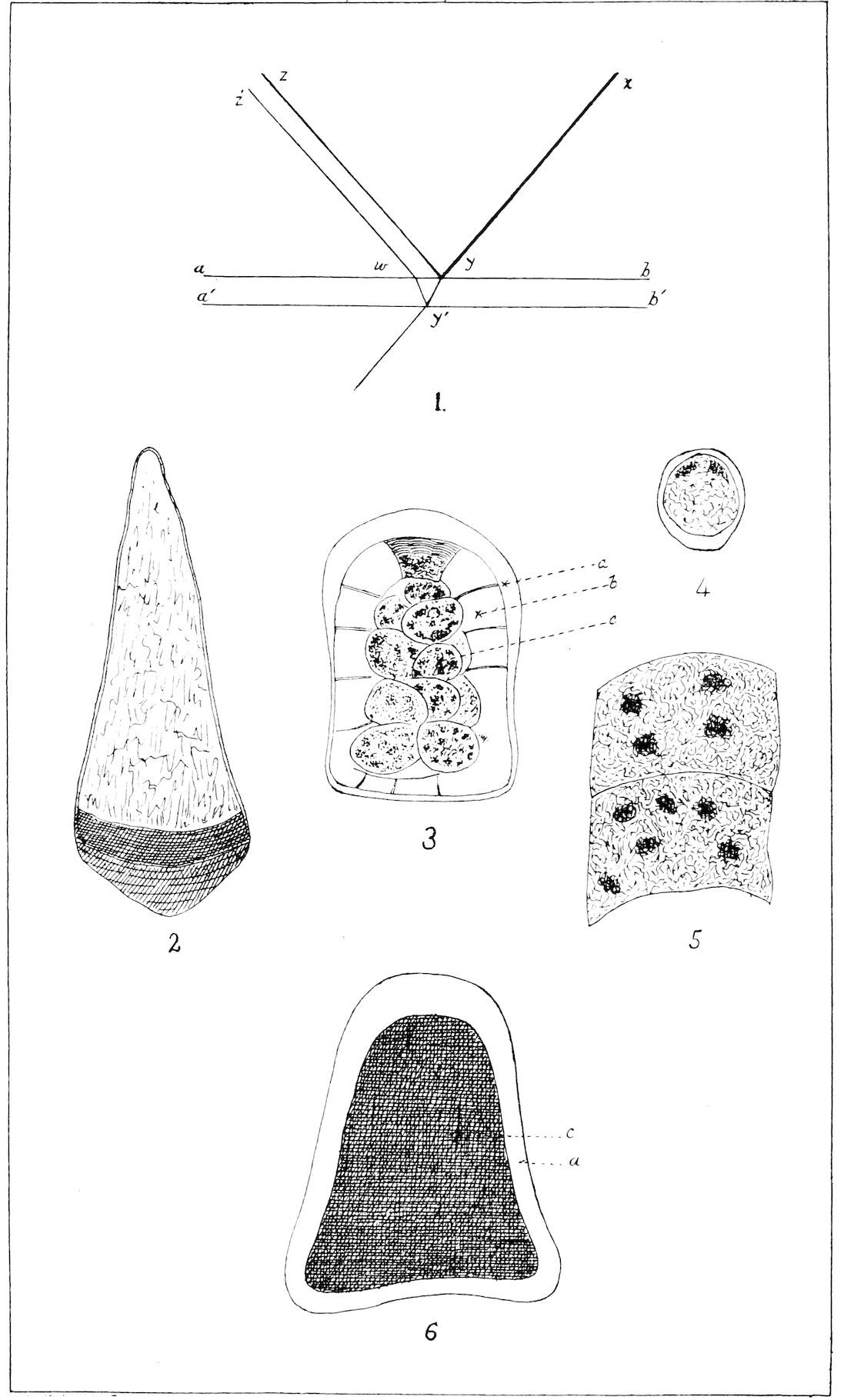
Bull. Nutt. Ornith. Club., Vol. VII., No. 3. Plate 7. Jeffries & Blake, del. The Heliotype Printing Co. 211 Tremont St. Boston
129