BUCK PETERS, RANCHMAN (continued 5)
Reading edition
Greatly as he wished for the journey's end, Pickles rode with judgment. The first doubt assailed him as he neared the Jill: would Swallow take the water? He was not kept long in doubt. Swallow knew better than to refuse. A master rider had put him through this stream, close to that very spot, in the dark of a not long distant night. The sight of the water sent the horse's ears pricking forward; he entered readily and swam for the opposite bank the moment the ground left his feet. Pickles shouted his delight; it would have broken his heart to have been compelled to go back to the ford. Swallow scrambled out onto the bank with little trouble and stretched out once more in his sweeping gallop; he knew now where he was bound and pulled impatiently against the restraining touch. The pace was a source of wonder to Pickles; seven miles and a swim at the end of it and here he was asking for a loose rein, demanding it, and going faster than ever. "Darned if I believe he can get tired," said Pickles; "go on then," and he gave him his head and smiled a tired smile to note how the powerful limbs quickened their action and the horse gathered pace until Pickles was travelling faster than ever before in his life. Only the smoothness of the motion gave him confidence in his own ability to hold out. "I could never 'a' made it on th' Goat," he reflected. "Go on, boy! Eat 'em up!" One slender black ear slanted toward him and away again. Swallow was eating 'em up the best he knew how.
* * * * *
Having made her decision, Rose listened carefully to Dave's advice. The more he talked the better she understood the situation; and Dave had scarcely mounted to ride away before she began her own preparations. They appeared to be very simple, merely the apparelling for a ride and keeping watch after Dave to see that he kept on his way.
Dave's disappearance sent her hurrying to the stable. She was surprised to find her bridle missing. On the next peg was Pickles' bridle, the only one ready for instant use. She hesitated a moment at sight of the heavy bit, but took it down and hastened to the edge of the pasture, sending a clear call for Swallow as she ran. There came no answering hoof-beats and she waited to reach the fence before calling again. A glance to right and left and she put her hands to her mouth and sent forth a ringing summons that carried to the far corner of the enclosure. The wait of a few seconds told her that Swallow was not in the pasture. Vexed and wondering she glanced from one to another of the animals near her: two draft horses, a brood mare, its long-legged colt close by, all watching her with that spell-bound intensity of gaze frequently accorded the sudden appearance of a human among domestic animals running free. Swallow would never be turned in the same field as these; then where was he? Jean was riding the only saddle pony—no, there was the Goat. Suspicion awoke in Rose: was it possible Pickles had dared to ride away on Swallow!
The Goat had ideas of his own; he had positively no use for a bridle just then, but Rose had ideas of a distinctly superior order of intelligence and but little time was lost before the Goat was plunging away to where Pickles should be, carrying Rose astride and bareback. Her suspicions were confirmed in part: Pickles was not where he should be. She swung the Goat through a half circle on his hind feet and started back for the barn with a rush. Ten minutes later, the Goat, properly saddled, turned short out of the farm road with a cat-like scramble onto the Twin River trail. He had not carried so much weight since his old master rode him and he did not like it, but knew better than to shirk; he had tried that, and the spurs, two of them, clanking loosely on Rose's small boots, had ripped his sides with quite an old-time fervor. Rose had found time to adjust them after saddling; the last hole barely held them but they served. How she longed for the free-striding gallop of Swallow! The tied-in gait of the Goat was irksome to her but she kept him to his work and Twin River drew rapidly nearer. With Dave's instructions in mind she knew there was plenty of time but it would be foolish to lessen the margin of safety by loitering.
A quarter of a mile from the ford she passed the stage from Wayback. The driver was just whipping up to enter Twin River in style and the stage occupants had opportunity to appraise Rose as she forged ahead. "My heavens, what a beauty!" exclaimed a young lady on the seat beside the driver, herself no mean specimen of God's handiwork. "Who is she?"
The driver shifted his whip and swept off his hat with a flourish. He gazed admiringly after the rider. "That, ma'am, is the French Rose; an' this is certainly my lucky day. I ain't seen two such pretty women before in one day, not in a dog's age. I ain't never seen 'em," he amended with enthusiastic conviction.
The coach cut through the ford to the hiss of the swirling water and turned into the straight in time for them to see a man run out from the Sweet-Echo to meet Rose, standing with his hand on the bridle while Rose leaned forward in what looked suspiciously like a warm greeting.
Another exclamation escaped the young lady on the stage: "Whitby!" and the blush called forth by the driver's frank admiration paled as she watched the two whom they rapidly approached.
"Know him, ma'am?" asked the driver politely; but his companion was oblivious to all but the scene before her.
Rose's imperious gesture and call had brought Whitby running. They had achieved a warm regard for each other during Rose's numerous visits to the Double Y, made at Dave's instigation; visits that had not ceased until the arrival ef Hopalong and Mary, when Dave had declared it was no use to try longer. Whitby grasped the significance of Rose's hurried words in very brief time. "By Jove!" he exclaimed, thinking rapidly. "By Jove! he will do it, too. They can't refuse to honor his check, you know. Buck is the only one can stop it. Lucky Pickles was gone and you came here instead of going to the Wayback bank. Buck has n't long left me. I can catch him." He ran around to the shed at the rear and was going fast when he turned into the trail, astride his pony. His reassuring wave of the hand to Rose stopped in mid-air as he caught sight of Margaret McAllister, standing on the footboard of the coach and looking at him with an expression he did not in the least understand. He made as if to pull up, thought better of it, and sweeping off his hat, dug the spurs into his pony and shot out over the Big Moose trail at a speed that promised to get him somewhere very soon.
* * * * *
Dave had not left the LaFrance cabin far behind when he pulled up with an oath and after a short period of consideration, turned back, riding at fair speed. He found cause to congratulate himself in starting early: it gave him time to go back to Rose and furnish her money in case of need. He saw her sooner than he expected. Turning a slight bend in the trail, he had full view of the Goat, not two hundred yards away, and saw him bound forward like a racer as the spurs ripped into him; Dave gripped a shout in his throat at sight of this act: why was Rose in such a hurry? Suspicion ebbed and flowed in his mind. If she were in such a hurry, why was n't she on Swallow? But the spurring had been for speed, not for punishment. Maybe she was saving Swallow for the longer journey. But if content to tell her father by letter of her going, who in Twin River needed a personal call? She could not be going farther than Twin River—to the Double Y, for example: there was not time for that. And why should she want to go there, either? Dave shook his head impatiently. Either she was square or she was n't. If she was n't, there would be a group of hard-riding boys pounding along the trail in time to cut off Schatz at the bank. He decided to ride to within a short distance of town, lay off the trail, and wait. If no one showed up, he would stick to the original plan. If Rose played crooked, he would take a train East. If too hard pressed, he could use the relays south in place of Denver Gus. Denver might put up an argument but he had one answer to all arguments that had always silenced opposition the moment he produced it. "Get on, bronc," he commanded, heading for Wayback.
* * * * *
Buck had got farther south than Whitby suspected; so far, that Whitby was beginning to hope he had not struck off from the trail, when he sighted him. Buck was riding head on shoulder, as if he had heard the coming of his pursuer, and he pulled up at the other's wild gesture. "What's eatin' him?" said Buck, smiling for the thousandth time at Whitby's manner of riding; it was a constant wonder to Buck that a man could sit a horse like that and stick to the worst of them as Whitby did. "He shore ain't meanin' to swim the Black Jack to get to the Fort." The smile faded as he suddenly realized the appeal in the Englishman's frantic waving; he rode forward rapidly and they were soon near enough together for Whitby to be sure his words would be heard and understood.
"Twin River, Buck! Twin River! And ride like h—l!"
Buck's quirt bit into his pony's flank. Never before had he known the Englishman profane; it must be serious. Whitby turned and raced ahead of him, rapidly over-taken by Buck who rode a fresher and speedier mount. As they ran side by side, Whitby rapidly repeated Rose's news.
"I can make it, Whit," declared Buck. "They won't try to work th' game till closin' time at th' bank. Train bound west is due at Wayback about then. Wish I had Allday under me. So long."
Whitby slowed to a lope and Buck drew away rapidly. His duty accomplished, the Englishman's thoughts turned to the puzzling expression on Margaret McAllister's face, as he had last seen it. He tried in vain to analyze it and unconsciously pressed his tired horse into a faster pace in his anxiety for an explanation.
Buck did not spare his pony. He must be at the bank before the money was paid over. The stringing up of Schatz by Judge Lynch would not bring the money back; and Buck had grave doubts of his ability to accomplish this retribution. Schatz appeared to grow stronger the more he knew of him. Nobody but a man very sure of himself and his power would dare such deviltry. Well, it would come to a personal straightening of accounts. Buck's grim face was never sterner. But first he must get to the bank. Resolutely putting aside all other considerations he gave his whole mind to his horse. Presently he shook his head: "Never make it," he muttered; "have to relay at Twin." Even as he said it he saw ahead of him another rider approaching at an easy lope; an expression of gratified pleasure appeared on Buck's face as he saw the other dismount and begin to lengthen the stirrup leathers. It was Rose. "By G—d! What a woman!" exclaimed Buck. "She thinks as quick as Cassidy an' never overlooks a bet."
He urged his pony to its best speed. With a fresh mount in sight, his object was practically assured. As he drew near, Rose called out: "Horse wait for you at Two Fork Creek."
He pulled short beside her in two jumps. "Rose, I love you," he declared, his eyes sparkling with pleasure; "you 'd oughta been a man!" He sprang to the ground while speaking and was astride the Goat at a bound, turning in his saddle to call back to her: "But I 'm most mighty glad yo 're not." A wave of his hand and he faced about, settling in his seat for the run to Two Fork, five miles beyond Twin River.
The crimson flood that burned in her face at his first remark, to recede at his second, returned in full tide as she stood with lips apart and eyes wide, watching him ride away. A trembling seized her, so that she clung to the saddle for support. The moving figure became blurred as the tears gathered in her eyes; she brushed them away impatiently with the back of her hand. "He is not mean it that way," she murmured; "it is only that he is glad I think about the horse."
She mounted and rode soberly toward Twin River. The pony, awaiting the customary notice to attend to business and finding it long in coming, began to entertain a sneaking affection for skirts, which until then he had regarded with suspicious hostility.
CHAPTER XXI
PICKLES TRIES TO TALK
Mary sat at the window sewing—a continuous performance with her these days. The sound of a horse approaching caused her to glance up just as a faint call for "Buck" reached her. One look and the sewing fell to the floor as she sprang to her feet, crying out for Jake as she ran. With Swallow nuzzling at her dress, she supported Pickles until Jake came to aid; he lifted the boy from the saddle and carried him into the house.
Mary hastily got out the whiskey and Pickles gulped down a mouthful before he realized what it was. He choked, and pushed away the cup. "Don't want it," he declared, weakly; "ain't never goin' to drink."
"Good boy," encouraged Mary, patting his head. "You stick to that."
"Where 's Buck?" asked Pickles.
"He ain't come back yet," answered Mary.
"Where is he?" insisted Pickles.
"I don't know," was the patient reply.
"I gotta find Buck," the boy declared, starting to rise.
Mary pushed him back. "How can you find him when you don't know where he is?"
"Ain't he som'er's on th' range?"
"No; him an' Whit rode off Twin River way this mornin' an' they ain't neither of 'em back yet."
"Well, I gotta find him, an' I gotta find him now," declared Pickles. "Lemme go."
"What's eatin' you?" demanded Jake. "You ain't fitten to ride no place an' I 'm mortally certain you can't walk."
"Shut yore trap, Woolly-face. What's a sheep like you know, anyhow? Nothin'! Can't even dig holes less 'n yo 're prodded with lead. Lemme go."
The whiskey was having an effect on Pickles or he never would have shown malice like this. Besides, it was not true and Pickles knew it. To all questions he had but one answer and Mary was in despair when Hopalong strode into the room. Hoppy wanted to know things—"Where'd you get that horse?" he asked, sharply.
"Huh?" queried Pickles.
"Where 'd you get that horse—that horse you was ridin'?"
"That's Rose's horse—where 's Buck?"
"Rose who?"
"Huh? French Rose. Say, where's Buck?"
"French Rose, hey? Say, Mary, that's th' horse got away from me with that cow-killin' screech-owl th' other night."
"That horse? Rose LaFrance's horse? Oh, Billy!"
It seemed that Mary was deeper in Buck's confidence than his old friend Hopalong, in this matter, at all events.
"Say you, blast you! Where's Buck? Lemme go! What's eatin' you? Ah, h—l!" Pickles relaxed under the grasp of Jake's hands and limply essayed to retrieve his reputation. "I asks yore pardon, ma'am. I promises Buck I won't never swear afore a lady an' here I goes an' does it, first time I 'm mad."
Hoppy eyed the penitent keenly. "Say, Bud; what's wrong?" he asked, quietly. "Buck ain't got no better friend than me and I 'll find him for you; but there ain't no good huntin', less 'n I got somethin' to say when I get there."
"Will you? Bully for you! Tell Buck th' Dutchman 's goin' to get all th' money—then Dave 's goin' to get it—it's in th' bank—on'y Schatz don't know who it is—nobody catches Dave runnin' into a blin' trail thataway—then Dave takes th' money to th' Dutchman—but right here 's where he fools him—he don't take it—he keeps it—an' he marries Rose on th' train to Helena—Rose rides Swaller to Jackson to get th' train—on'y she has got to get another horse 'cause I rode Swaller here. D 'you get me?" Pickles stared expectantly at Hopalong, who turned to Jake.
"Put that horse in th' barn. Saddle Allday. Rope a cayuse an' set that smoke a-rollin'—take a blanket an' ball th' smoke three times at th' end o' every minute—go through th' Gut an' up th' north side. Pronto!"
Jake went out of the door on the jump. He moved fast for Buck on occasion—rare, it is true—but there was a volcanic danger in Hopalong's eye that put springs in Jake's boot-heels.
"That's th' way to talk," sighed Pickles, happily. Hopalong went to the rack and took down his rifle. "Reckon yo 're goin' to want that?" asked Pickles.
"Reckon I might," admitted Hopalong, gravely. "You see, after I find Buck I 'm a-goin' to look for Dave an' th' Dutchman."
"Jiggers! I shore hopes you find 'em. I 'd sooner you get Dave than any man I know, 'ceptin' me."
"Well, I sorter count on gettin' Dave. So long, Pickles."
"So long," echoed the boy.
Mary followed her husband outside. "Don't get hurt, Billy-Red," she warned him.
"That sort o' vermin never hurt me yet, Mary. When th' boys get here send 'em after me to Wayback. Tell Ned, rifles. Let me have all th' money you got; if I miss Buck I might want it."
Mary watched him until he rode by on Allday, waving to him from the corner of the house. Then she went indoors to Pickles.
"That's a bully man, that Hopalong, ain't he?" was his enthusiastic greeting.
"He shore is; an' you 're a bully boy, Pickles," replied Mary. She took up her sewing again. The boy watched her curiously and was about to ask a question, when Sleep floated past and Pickles forgot to ask it.
CHAPTER XXII
"A MINISTERING ANGEL"
Mrs. Blake surveyed her surroundings with the surface calm which comes from seeing and disbelieving. These were depths to which she never had expected to descend. She allowed herself half a moment of speculation on the possibility of there existing, somewhere in the world, a real lack of accommodations as appalling as her imagination could now conceive. "I have often thought Mr. Blake somewhat careless in his choice of a hotel during our wanderings, but the worst of them never even suggested—Margie, did you ever in your life imagine such a room could exist?"
"It is only for an hour or so," returned Margaret, listlessly.
"Oh, I don't complain, my dear. You are an equal sufferer. And I am distinctly relieved at the thought of removing some of this terrible dust before we—before—we—"
Her voice trailed off into silence as she caught sight of a motto over the door; it was one of those affairs worked in colored worsted over perforated cloth; the colors had been chosen with less regard to harmony than is usually exhibited by an artist; perhaps it was contrast that was sought; as a study in contrasts it was a blasting success. Mrs. Blake glared at it with the fascinated interest of a spectator within the danger zone of a bursting bomb. "'God bless our home,'" she read, in awed undertone. "Perhaps He will, but it is more than it deserves." She mounted laboriously onto a chair and turned the motto to the wall, hastily facing it about again with a suppressed scream: if the front were chaos the back was a cataclysm. In a spasm of indignation she jerked it loose from its fastening and dropped it out of sight behind the evil-looking washstand. In this position her glance fell on the crude specimen of basin provided. She picked it up doubtfully and struck it against the side of the washstand. "Tin!" she exclaimed. "A dishpan!" and went off into peals of laughter, banging the pan and calling "Dinner!" in an unnaturally deep voice, when she could speak from laughing.
Margaret turned a sullen face from the window. She had seen the French Rose in animated conversation with a tall, good-looking man in flannel shirt and overalls, who had ridden away up the road, evidently in obedience to her orders; while Rose, herself, rode in the direction taken by Whitby. The soft, broad-brimmed hat, the waist but little different from the flannel shirt of the man, the ill-fitting skirt, the mannish gloves and clumsy boots—the superb health of the splendid figure proclaimed itself through all these disadvantages. The woman was a perfect counterfoil for Whitby, and Margaret hid the ache in her heart under a sullenness of demeanor that a less astute companion might have attributed to the annoyances and inconveniences of the journey.
"For heaven's sake, Aunt, don't make such a noise," she insisted; "my head aches as if it would split."
"Your head aches! I 'm sorry, my dear. Still, there are worse things than head-aches, now are n't there?"
Margaret stared. "No doubt," she admitted, tartly; "but it is the worst I have to submit, at present. When a greater evil befalls me I will tell you."
"Why, that's honest," said Mrs. Blake, cheerfully; "and as long as we are to be honest, you are sure it is not your conscience that is at fault?"
"My conscience?" asked Margaret. "What has my conscience to do with a head-ache?"
"First class in Physical Geography, rise. Jessie, what is the origin of the islands of head-aches that vex the pacific waters of the soul? They are due to volcanic action of bad conscience."
"Oh, Aunt! how can you be so absurd?"
"I would rather be absurd than unjust, Margaret."
"I don't understand you."
"You understood me very well. Because you see Whitby talking to a pretty woman, is that a reason to condemn him?"
"Talking! He kissed her before my very eyes, in the public street."
"You cannot say that, Margaret. I saw the meeting as plainly as you did."
"How could you? You were inside! Why has he never mentioned her in his letters?"
"Has he ever mentioned anything but business? He would scarcely mention her to George, and you know he has not written to you."
"No, he had something better to do. This is an unprofitable discussion. I am utterly indifferent to Mr. Booth's actions, past, present, and to come, as well as the reasons for them. If you intend to use that basin for something other than a dinner-call, do so. I 'm not hungry, but we might as well get it over with. We have a long drive before us."
"With all my heart, my dear; unless the water is on a par with the other—er—conveniences."
* * * * *
"Seems like Buck Peters might be in a hurry," observed Slick Milligan, sufficiently interested to come from behind the bar and walk out onto the porch. "Which it's th' first time I see him use a quirt."
"None o' thea punchers think aucht o' a horse," was Sandy's opinion, based on a wide experience.
If Margaret had chanced to overhear Slick's remark it would have explained much. Mrs. Blake was resting, preparatory to sallying forth on the last stretch of their journey, and Margaret was about to make inquiries regarding a conveyance, when the rapid drumming of a horse's feet drew her to the window as Buck went past. Margaret had never met Buck but she was far too good a horsewoman to fail to recognize the pony. She had noted every detail when she had first seen Rose and you may be sure no point, good or bad, of the Goat as a saddle pony, had escaped her critical judgment. Her first thought, as the Goat went past, was one of surprise that he should make so little of the weight of his rider, a full-grown man and no light-weight, either; lean and hard as Buck was, Margaret's estimate of the number of pounds the pony carried was very near the mark; and then, in a flash, she knew him: the very animal that the French Rose had ridden. Margaret knew it to be out of the question that he had travelled to the Double Y ranch and back; they must have exchanged horses on the road. But, why?
The consideration of this enigma and the many possibilities it offered as collateral questions, occupied her fully, to the very grateful content of Mrs. Blake, who was genuinely tired and ashamed to say so. It was a consideration so perplexing that Margaret was prepared to allow Whitby to explain, when he was so unfortunate as to appear in company with Rose. He had overtaken her, a half-mile down the trail, but Margaret could not, of course, know this. They remained in earnest conversation for two or three minutes, when Rose went on and Whitby went around to the shed to put up his pony. Margaret ran down stairs and went out onto the porch. She felt better able to face him in the open.
It was thus that Whitby, coming in at the back door, was directed out through the front one. Rapidly as Margaret moved, she was too great an attraction to escape instant notice. Whitby advanced with outstretched hand. "Ripping idea, taking us by surprise, Miss McAllister. Awful journey, you know, really."
"We wished to avoid giving trouble. You are looking very well, Mr. Booth."
"Fit as a fiddle, thank you. But—I say—you 'll excuse me,—but are n't you feeling a little—ah—seedy, now? I mean—"
"I quite understand what you mean. Am I looking a little—ah—seedy, Mr. Booth?"
"No, certainly not! Very stupid of me, I'm sure. I—ah—rather fancied—but of course I 'm wrong. This confounded dust gets in a chap's eyes so—"
"Do you mean that my eyes look dusty, Mr. Booth?"
"Oh, I say! Now you 're chaffing me. As if—"
"Not in the least. Chaffing is an art in which I fail to excel. But if you mean that I look a little pale and dragged with the journey, you must remember that I do not pretend to have the vitality of a cow-girl."
"Ah! Just so. And Mrs. Blake—she is with you, I presume."
"The presumption is justified. Aunt's vitality was even less equal to the journey than my own. She is resting and begs to be excused until she can say 'How do' at the ranch."
"Why—ah—how did Mrs. Blake know I called in?"
Margaret bit her lip. "I happened to be looking from the window as you rode up," she explained, carelessly.
"Ah! Just so. Miss McAllister, you don't know me very well, not really; perhaps no better than I know you. I 'm no good at this sort of thing, this fencing with words, you know; I discovered that long ago; and I long ago adopted the only other method: to smash right through the guard. My presumption does n't presume so far as to imagine you are jealous; I am not seeking causes; all I know is, you made me a promise when I came West, a conditional promise, I grant you: I was to make good. Well, I have n't done half bad, really. I fancy Mr. McAllister would admit as much. Buck Peters admits more; and one has to be something of a man, you know, to merit that from Peters. He 's the finest man I ever knew, myself, bar none. It is very good of you to hear me so patiently. I 'm coming to the kernel of the difficulty just now:
"Rose LaFrance, the cow-girl you mentioned, is the right sort. She brought word this morning that will save Peters a goodish bit of money; incidentally Mr. McAllister, also. Buck had to be in Wayback at the earliest possible moment and I was fortunate enough to overtake him. Miss LaFrance not only was thoughtful enough to ride to meet Buck and give him a fresh mount and to send a man ahead with whom Buck will change again, but she insists that we follow him, which is a jolly good idea; these fellows are very careless with their fire-arms and he might require help. If the blackguard he is after succeeds in withdrawing the entire deposit from the bank and it is given to him in cash, before Peters gets there, he will certainly require help. I leave you to reflect on these facts, Miss McAllister. Give my kindest regards to Mrs. Blake."
He stalked back the way he had come, in the characteristic wooden manner which precluded any appeal, if Margaret had felt like making one; but her mind was too fully occupied with what she had heard to understand that he was actually leaving. He was splashing through the ford before she realized the significance of this part of his defence. Thoughtful, and without resentment, she went to rejoin Mrs. Blake.
Whitby pushed his horse sufficiently to overtake Rose who, he knew, was riding slowly. Just outside the town he met Cock Murray, astride the Goat; the Goat was a very tired pony and showed it.
"My dear man! Why are n't you following Peters?" asked Whitby, in surprised remonstrance.
"My dear Brit! I sorta allowed it was n't healthy," answered Cock. "I tells you th' same as I tells th' French Rose: 'When Buck says "Scoot for th' ranch an' tell Cassidy to hit Wayback pronto an' he 'll get news o' me at th' bank,"' it 'pears like, to my soft-boiled head, that's what I oughta do."
"I beg your pardon. Of course. Rather odd Peters didn't tell me."
"He meant to. I 'm sorry he did n't. So long."
"So long," echoed Whitby, mechanically. He pulled up to shout after Cock: "You won't get far on that horse; he 's done, you know."
"I ain't goin' far on that 'oss," Cock shouted back; "an' they 're never done till they 're down, you know."
"Impudent beggar, but a good man. They grow 'em good out here. I fancy the bad-plucked ones don't last." And Whitby hastened on to overtake Rose.
He had left Two Fork Creek four miles behind him before sighting her; in her impatience she had gone faster than she knew. Whitby had almost caught up, when he saw Rose bend forward, wave to him, and then dash away, as if she were inviting him to a race.
"Buck!" exclaimed Whitby, with intuitive conviction. "It's Buck as sure as little apples Kesicks." Fifty yards' advance showed him that he was right. The figure lying huddled in the road was certainly Buck, and beside him was his dead pony. Rose flung herself from the saddle and ran to him; and Whitby, wearing the terribly savage expression of the man slow to anger, was not far behind. Together they laid the unconscious figure at full length.
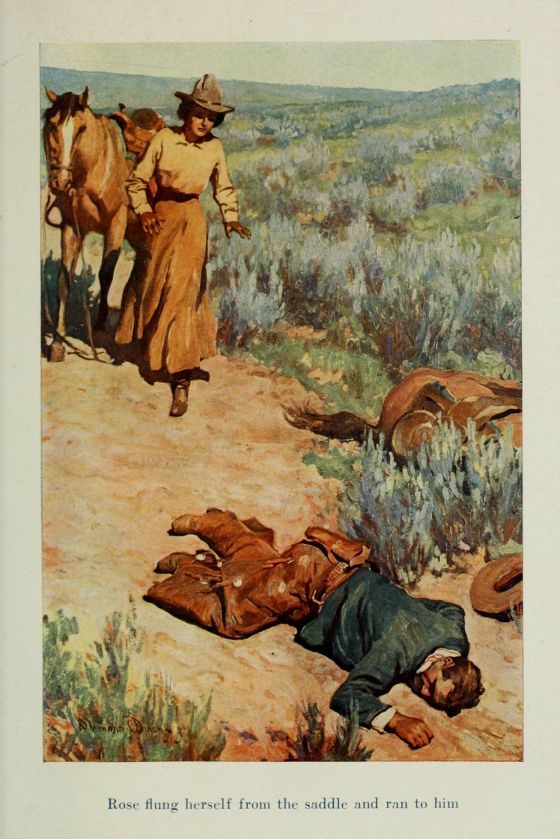
Rose flung herself from the saddle and ran to him
"It is there," said Rose, dully, pointing to the right thigh.
"Ah," breathed Whitby, in a sigh of relief. He cut the cloth but forbore to tear it away, the coagulated blood having stopped the bleeding. "Drilled through!" he exclaimed. "Why, the swine must have been near enough to do better than that. How ever did he miss? We 'll bandage this as it is, Miss LaFrance, and do it properly at—now, should you say take him to the doctor at Wayback?"
"No. He is a drunken beast. I will nurse him."
"Very well. A good nurse is better than a drunken doctor. Just cut this sleeve from my shirt, will you?"
Rose took the knife and cut, instead, a three-inch strip from the bottom of her skirt, Whitby meanwhile producing a flask, from which he carefully fed Buck small quantities of whiskey. Rose tendered him the bandage. "Well rolled, Miss LaFrance! Have you been taught this sort of thing?" Rose silently nodded her head. "My word! Buck is in luck. You apply the bandage then, while I give him this. You 'll make a better job of it than I should."
Buck slowly opened his eyes to see Whitby's face bending over his. "Got away, Whit," he whispered, weakly; "ambushed me, by G—d," and relapsed into unconsciousness.
"Much blood! He have lose much blood," murmured Rose.
"Yes," assented Whitby. "How shall we carry him? He can never ride."
"Travois," said Rose. "I show you."
Buck again regained consciousness and his voice was distinctly stronger. "Get after him, Whit. He must n't get away."
"Oh, nonsense, Buck. They know the cat's out of the bag by this time and they will never be such asses as to try it on now. As for Dave, he can't get away. The agency will be jolly glad to do something for the money they have had by turning over Dave if I ask it of them. And McAllister will think you are worth a good bit more than the money, I lay. I know I do."
Buck was attempting feeble remonstrance when Rose returned from her survey of the timber available and swiftly placed her hands over his lips. "Do not talk," she commanded. "It is bad to talk, now."
"What price the nurse—eh, Buck? Oh, you lucky beggar!"
"Rose," murmured Buck. "Why, that's right kind."
Admonishing him with raised forefinger, Rose gave instructions to Whitby and he hastened away to gather material for the travois.
* * * * *
When Margaret returned to Mrs. Blake she was carrying a pair of driving gloves and a jaunty sailor hat which Mrs. Blake knew had been packed in one of the trunks. "Are we going to start, Margie?" she asked, with languid interest.
"I am going to start but I am going the other way. We shall not be able to leave for the ranch before morning, probably."
Mrs. Blake sat up with a suddenness that surprised even herself. "The morning!" she echoed. "If you think that I shall stay in this horror of a room until morning, Margaret, you are mistaken. I will go, if I walk."
"It's a long walk," commented Margaret, carelessly.
"And may I ask why you are going the other way and when you purpose to return?"
"I am going to Wayback to telegraph. Some thief has planned to get all of papa's money from the bank there, and of course he will try to escape on the train. We shall catch him by telegraphing to the officers at the next town."
"If you do he is a fool. And who are 'we'? How did you learn all this?"
"Whitby told me."
"When?"
"Just now."
"Was Whitby here?"
"Yes."
"And never asked for me?"
"I told him you begged to be excused."
"You told him I—now see here, Margaret. There is such a thing as going too far, and this is an example of it. 'Beg to be excused'! What will he think of me? Where is he now?"
"He has gone on to Wayback. But he never will have the sense to telegraph. That is why I am going."
"Did you quarrel?"
"Well—we were n't exactly friendly."
"Oh!—oh!—oh!" The three exclamations were long-drawn, with pauses between them and in three different keys.
"Aunty!" cried Margaret, furiously, stamping her foot. "How dare you insinuate—I said I was going to telegraph!"
"All right, my dear. Have it your own way. I 'll immolate myself on the altar of friendship: in this case, a particularly uncomfortable bed. Please remember, Margaret, as you speed away on your errand of avarice, I said a particularly uncomfortable bed."
Margaret went out and slammed the door. Mrs. Blake chuckled until she laughed, and laughed until she gasped for breath and was obliged to loosen her corsets. "I am as bad as Margie," she sighed; "I don't know when I am well off. Now I shall have to stay marooned in this pesky room until Margie returns. I never can fasten these outrageous things without help."
In her fetching gown of figured brown cloth, bordered with beaver fur, with slanting drapery of plain green, above which a cutaway jacket exposed a full vest, and topped by a high beaver toque—with flush due to the recent passage-at-arms still in her cheeks and the fire of indignation in her eyes—Margaret presented a chic daintiness that met with the entire approval of the burly Sandy, who hastened from the bar-room at the sound of her descent.
"I want a hitch of some kind," requested Margaret; "something with speed and bottom, and the sooner the better."
"A hitch?" queried Sandy. He had ominous visions of the dainty figure being whirled to destruction behind a pair of unruly bronchos.
"A horse, a team, a rig, something to drive, and at once," explained Margaret, impatiently.
"Oh, ay! I ken ye meanin' richt enough. I ken it fine; but I hae doots o' yer abeelity."
"Very well, then I will buy it, only let me have it immediately."
"It's no' th' horses, ye ken. What would I tell yer mither, gin ye 're kilt?"
"Bosh!" said Margaret, scornfully. "I can drive anything you can harness."
"Oh, ay! Nae doot, nae doot. But it willna be ane o' Sandy's, I telt ye that."
Here a voice was heard from out front, roaring for Slick and demanding a cayuse, in a hurry.
"Losh! yon 's anither. They must theenk I keepit a leevery," and Sandy hastened out to the porch to see who was desirous of further depleting his stock. When he saw the condition of the Goat his decision was quick and to the point: "Ma certes! Ye 'll no run th' legs of ony o' my cattle, Cock Murray, gin ye crack yer throat crawin'. Tut, tut! Look at yon!" He shook his head sorrowfully as he gazed at the dejected appearance of the Goat.
"Won't, hey!" shouted Cock, slapping back the saddle, "then I 'll borrer Dutch Fred's, an' Buck Peters 'll burn yore d—d ol' shack 'bout yore ears when he knows it." A man, watching interestedly from the bar-room, left by the hall exit, running.
"Buck Peters! Weel, in that case—Slick, ye can lend him yer ain."
"I was just a-goin' to," declared Slick, hurrying off; "which yore d—very generous when it don't cost you nothin'."
Cock loosened the cinch. "Generous as—Miss McAllister!" he exclaimed, aghast.
"Why, of all the people! How delightful! What on earth are you doing out here?" Margaret ran down to him, extending both hands in warm greeting.
Cock took them as if in a dream. "Miss McAllister—Chicago—Oh, what a fool I 've been!"
The man who had left the bar-room tore around the corner of the hotel on a wicked-looking pinto which lashed out viciously at the Goat when brought to a stop, a compliment the Goat promptly returned, though with less vigor. "Here y' are, Cock. He 'll think he 's headin' for th' Cyclone an' he 'll burn th' earth." The Cyclone puncher pushed the straps into Murray's hand and led away the Goat to a well-earned rest.
"I have to go, Miss McAllister. See you at the ranch. I 'm punching for the Double Y. They call me Cock Murray. It—it's a name I took."
"I 'll remember. Cock Murray: it fits you like a glove," and Murray mounted to her ripple of laughter. "We shall be out there to-morrow. Aunt is with me," she called to him, while the pinto worked off a little of its superfluous deviltry, before getting down to its work. She watched him admiringly, Cock sitting firm and waiting, until presently the pony straightened out and proceeded to prove his owner's boast. "Tip-top, Ralph," praised Margaret; "but you always could ride." She turned and faced the dour Sandy. "See here! Do you ever intend to get out that rig?"
"Weel—gin ye 're a relative o' Buck Peters, I jalouse ye 'll gang yer ain gait, onyway," and he went grumbling through the hall to do her bidding.
A roaring volley of curses, instantly checked and rolling forth a second time with all the sulphur retained to add rancor to the percolator, drew Margaret curiously to overlook the cause. Seeing, she thought she understood Sandy's reluctance to let his team to her: a pair of perfectly matched bays, snipped with white in a manner that gave to their antics an air of rollicking mischief, they were lacking the angularity of outline Margaret already had come to expect in Western ponies, and their wild plunging seemed more the result of overflowing vitality than inherent vice. Drawn by the uproar, Slick appeared beside her.
"No team for a lady to drive," he declared, shaking his head.
"Ridiculous!" asserted Margaret. "Go help them." A devitalized imprecation from Sandy hastened his steps. Margaret was in doubt which amused her most: the trickiness of the ponies or Sandy's heroic endeavor to swear without swearing. She understood him far better than either of the others, who worked silently and with well directed efforts.
With Slick's invaluable assistance their object was soon accomplished, the team being hitched to a new buckboard that was the pride of Sandy's heart. "'T is a puir thing," he protested, eying it sourly. "I hae naething better."
"Why, it is perfect," declared Margaret, "but I shall want a whip."
"Ye 'll want nae whup," denied Sandy, shaking his head ominously.
The Cyclone puncher at the head of the nigh horse called to her: "Take 'em out o' th' corral, miss? They 'll go like antelopes when they start."
Margaret laughed in gay excitement. "No, no! please don't," she entreated, drawing on her gloves. "I could drive that pair through the eye of a needle."
Sandy glanced from her to the team and back again.
"Havers! I 'll gie ye ma ain whup," he promised. He was back in half a minute with a lash whip whose holly stock never grew in America.
"What a beauty!'" exclaimed Margaret. She ran down the steps, gathered up the lines, and sprang into the buckboard, bracing herself for the inevitable jerk. "Ready," she warned. "Let go."
It was lucky for Mrs. Blake that she had loosened her corset strings and was confined to her room; had she seen the start—and she knew Margaret's skill as well as any one—she certainly would have burst them in her fright. With the three men it was otherwise; they vented their admiration in a ringing cheer. The ponies, gathering speed in the short stretch to the ford, were coaxed over so near the I-Call that Dirty Snow tumbled precipitately from his box and fled around the corner of the saloon; missing the box by a foot, the wheels began a wide arc toward the water through which the rig whirled in an avalanche of spray, to shave the front of the Why-Not as closely as it had the I-Call. To the delighted astonishment of Twin River—by this time the entire inhabitants, excepting only Mrs. Blake, were more or less interested in the proceedings—the team was no sooner going in the straight than Margaret cracked the lash to right and left and the startled ponies bellied to the ground in their efforts to escape an unknown danger. Sandy guffawed in pride of ownership; Slick gazed with his soul in his eyes; the puncher danced up and down in his joy, thumping first one and then the other.
"Did you see it?" he demanded, "Did you see it?" The others admitted eyesight equal to the occasion. "Say," asseverated the puncher, "if I owned all Montany, from here to th' line, I gives it to get that gal. That's th' kind of a hair-pin I am. You hear me!"
* * * * *
Margaret's sudden exclamation hastened the speed of the ponies but she drew them firmly in and approached the group on the trail at an easy lope. Whitby ran up from the river bank as she pulled the team to a stand.
"Who is it, Miss LaFrance? How did it happen?" asked Margaret, guessing the answer to her own questions.
"It is M'sieu Peters, ma'am'selle. He is wounded," replied Rose.
"Just in time, Miss McAllister," said Whitby, coming up at that moment. "We 'll commandeer that wagon as an ambulance."
"Miss McAllister!" exclaimed Buck, wonderingly. Then, energetically: "Whit, you get after that pole-cat. I can get to th' ranch, now. Get a-goin'."
"Buck, I 'm like Jake: 'sot in my ways.' There is no necessity to follow that pole-cat, as you so aptly call him. And you are not going to the ranch, you know. Miss LaFrance has kindly volunteered expert service in nursing and I intend that you shall get it. Miss McAllister, Miss LaFrance, whose services you already know; and Mr. Peters, your father's partner."
"You must not think of going on to the ranch, Mr. Peters," persuaded Margaret. "I only hope it is not too far to Miss LaFrance's home. If we could lift you—I 'm afraid these horses won't stand."
"Lift! I reckon I got one good laig, Miss McAllister—" he fell back with a grunt.
"Dash it all, Buck! Do you want to break open that wound? 'Pon my word, I don't envy you your patient, Miss LaFrance. You lie still, you restless beggar. I 've packed more than one man with a game leg and gone it alone. Do you think you can manage those dancing jackasses?" He looked doubtingly from them to Margaret.
Margaret dimpled. "Ask Sandy," she advised, demurely.
"Ou, ay!" quoth Whitby and Margaret broke into bubbling laughter that reflected from Rose's face in the faint shadow of a smile.
"Too bad of me to be laughing this way, Mr. Peters," apologized Margaret, correctly interpreting the expression of Rose, whose glance had turned to Buck; "but I have so much cause to be merry when I least expected it that I forgot for the moment you are wounded."
She resolutely avoided looking at Whitby who, thus unobserved, displayed a grin more fittingly adapted to the countenance of the famous Cat of Cheshire. Rose glanced swiftly from Whitby to Margaret and the two women were already aware of that which the men would never guess in each other.
"Shucks! I been shot up worse 'n this, Miss McAllister," assured Buck; "if that pig-headed Britisher would on'y take orders like he oughta. He 's obstinater nor a cow with a suckin' calf."
"Right-o!" assented Whitby, who had finished his preparations for the lift. "Now, Miss LaFrance."
He had managed to pass the blanket under Buck's middle, looping it over his own neck; while this arrangement eased but little weight from Rose, it had the advantage of keeping Buck comparatively straight. Whitby, backing up into the buckboard, his hands tightly grasping Buck beneath the arms, was ably assisted by Rose, who moved and steadied her load without apparent effort. Margaret was genuinely surprised. "How strong you are!" she exclaimed, admiringly.
"Gentle as rain," commended Buck. "If you got that flask handy, Whit, I 'd like to feel it."
CHAPTER XXIII
HOPALONG'S MOVE
Hopalong, nursing Allday with due regard to the miles yet to be travelled, was disagreeably surprised to recognize Cock Murray in the horseman approaching. The explanation offered did not improve his temper. He turned on Murray a hard stare that was less a probe than an exponent of destruction to a liar. There was that about Hopalong which spelled danger; no strong man is without it; and few men, honest or not, fail of the impression when in the presence of it. Cock Murray was no coward. He was distinctly not afraid to meet death at a moment's notice or with no notice at all, if it came that way; yet he was grateful to be able to face that stare with an honest purpose in his heart.
"Murray, down Texas way h—l-raisin' on a range means sudden death. It's a-goin' to stop on th' Double Y. Which side are you on?"
"If it depends on my say-so, th' Double Y is as peaceful as a' Eastern dairy from this out."
"Let 'er go at that. How 's that cayuse?"
"Good, an' fresh as paint. I on'y breathed him, comin' from Twin."
"Swap. This bay has come along right smart for twenty miles. I ain't goin' to lose you much, either. Th' boys is after us but they won't catch you."
Hopalong was well past the Sweet-Echo before the pinto was recognized. Slick let out a yell of surprise. The Cyclone puncher sauntered to the window, where Slick was pointing, glanced up the trail and laughed. "That's a friend o' Buck's," he explained, "an' he 's certainly aimin' to get there, wherever it is, as quick as he can."
"Ain't that yore pinto?" queried Slick.
"Less 'n I 'm blind," agreed the cow-punch.
"Seems to me there's a lot o' swappin' goin' on som'ers along th' Big Moose," hazarded Slick. "Which they can't all be backin' winners," he added, thoughtfully.
They were still seeking light in useless discussion when the long-striding Allday went past. Slick shouted to Murray for news but Cock waved his hand without speaking. Twin River was beginning to show a languid interest. Day-and-night habitués of the I-Call lounged out into the open and gazed after Cock inquiringly, irritated Pop Snow into a frantic change of base by their apparently earnest belief in his knowledge of these events and their demands for information, and lounged back again; Dutch Fred soothed the peevish old man by talking "like he had some sense"; having sense proved an asset once more as Dirty, no one being near, suddenly discovered a thirst. Ike, wise old wolf, though unable to solve the riddle, smelled a killing. "Stay around," he advised several of his own trustworthy satellites. Little Nell alone, who looked on and read as the others ran, came near to supplying the missing print: "The French Rose has shook Dave," she decided. "Dave has pulled his freight and the Double Y is on the prod after him. Smiler ought to show for place but the minute he looks like a winner the Texan 'll pump him full of lead. The Double Y will win out. Maybe Ned—" Little Nell's wild heart had regretted bluff, kindly Ned, these many days.
The passing of the Double Y punchers, strung out half a mile, confirmed Nell's guess. The Cyclone puncher, hurriedly throwing the leather on the Goat, loped along beside Slow Jack, the last in the string, obtaining from him such meagre information as only whetted his curiosity. He returned to the Sweet-Echo and Slick, disdaining to reply to the I-Call loungers. Ike was too wise to risk a rebuff; he already knew enough from what he had seen. "Pickin's, boys," was his laconic comment; and soon a company of five Autolycus-minded gentlemen took the Big Moose trail, openly. The break-up of this chance foray was largely due to the simple matter of direction.
Hopalong, knowing nothing of the wagging tongues at Twin River, drove the pinto for every ounce there was in him. A vague uneasiness, risen with the delivery of Buck's message by Cock Murray, rode with Hopalong; he could not shake it off. Ten minutes beyond Two Fork he saw the buckboard and the curse in his throat had its origin in a conviction as accurate as Whitby's had been. He turned and rode beside them. "Well, they got you, Buck," was his quiet comment.
"Shore did," admitted Buck. "Ambushed at four hundred—first shot—bad medicine. I lit a-runnin' an' caves in just as th' next ball drops th' bronc. I lays most mighty still. He thinks I kicked th' bucket but he 's afraid to find out. I was hopin' he 'd come to see. He gets away quiet an' I lay an' bleed a-waitin' for him. Rose an' Whit here wakes me out of a sweet dream." He smiled up at Rose whose anxiety was evident.
"Too much talk," she warned him.
"Dave?" asked Hopalong, looking at Whitby, who nodded.
"How far?"
"Two miles; possibly less," answered Whitby.
"I 'll get him," said Hopalong, with quiet certitude. "So long, Buck."
"So long, Hoppy. Go with him, Whit. Can't afford another ambush."
"Very well, Buck. You will find a medicine-chest in my kit, Miss McAllister."
Whitby turned and rode hard after Hopalong who, nevertheless, arrived at the dead pony considerably in advance, and after a searching look around, rode straight to the ambush. The signs of its recent occupancy were plain to be seen. Hopalong got down and squatted under cover as Dave must have done, from which position his shrewd mind deduced the cause of the poor shot: a swinging limb, which had deflected the bullet at the critical moment. The signs showed Dave had led his horse from the spot, finally mounting and riding off in a direction well to the east of Wayback. Minute after minute Hopalong tracked at a slow canter; suddenly his pony sprang forward with a rush: even to the Englishman's inexperienced eyes there was evidence of Dave having gone faster; very much faster, Whitby thought, as he rode his best to hold the pace, wondering meanwhile, how it was possible to track at such speed. It was n't possible: Dave had set a straight line for Wayback and gone off like a jack rabbit. Hopalong was simply backing his guess.
Exhaustive inquiries in Wayback seemed to show that Hoppy had guessed wrong. No one had seen Dave. No one had seen Schatz, either; the bank president had gone to Helena and his single clerk, single in a double sense, was an unknown number of miles distant on a journey in courtship. The station agent declared Dave had neither purchased a ticket nor taken any train from the Wayback station. Whitby became downcast but Hopalong, with each fruitless inquiry, gathered cheerfulness almost to loquacity. It was his way. "Cheer up, Whit," he encouraged: "I'd 'a' been punchin' cows an' dodgin' Injuns in th' Happy Hunting Grounds before I could rope a yearlin' if I 'd allus give up when I was beat."
Whitby looked at him gloomily. "I 'm fair stumped," he admitted. "D' you think, now, it would be wisdom to go back and follow his spoor?"
"Spoor is good. He came to Wayback, Whit, sure as yo 're a bloomin' Britisher. Keep a-lookin' at me, now: There 's a bum over by th' barber's has been watchin' us earnest ever since we hit town; he 's stuck to us like a shadow; see if you know him. Easy, now. Don't scare him off."
Whitby won his way into Hopalong's heart by the simplicity of his manoeuvre. Taking from his lips the cigar he was smoking, he waved it in the general direction of the station. "You said a bum near the barber-shop," he repeated. His pony suddenly leaped into the air and manifested an inexplicable and exuberant interest in life. When quieted, Whitby was facing the barber's and carefully examining the bum. Hopalong chuckled through serious lips. Whitby had allowed the hot end of his cigar to come in contact with the pony's hide. "No, can't say I do; but he evidently knows me. Dashed if he does n't want me to follow him," and Whitby looked his astonishment.
Hopalong's eyes sparkled. "Get a-goin', Whit. Here's where ye call th' turn. What'd I tell you?" He wheeled and rode back to the station. Whitby followed the shambling figure down the street and around the corner of a saloon, where he discovered him sunning himself on a heap of rubbish, in the rear.
"Well, my man; what is it?" asked Whitby.
The crisp, incisive tones brought him up standing; he saluted and came forward eagerly. "Youse lookin' f'r Dave?" he responded.
"What of it?"
"I seen him jump d' train down by d' pens. She wuz goin' hell-bent-f'r-election, too. Wen Dave jumps, I drops. Dave an' me don't pal."
"Why not?"
"Didn't he git me run out o' Twin? Youse was dere. Don'tcher 'member Pickles an' Dutch Onion—Pickles' old man—an' dat Come Seven guy w'at stopped d' row? Don'tcher?"
"Yes; I do. Are you the man who shied the bottle?"
"Ke-rect. I 'd done f'r him, too, but dey put d' ki-bosh on me."
"And are you sure it was Dave? Did the train stop?"
"Stop nothin'! 'T was a string o' empties. Dave jumped it, all right. An' I 'd hoof it all d' way to Sante Fe to see him swing."
"Deuced good sentiment, by Jove. Here, you need—well, a number of things, don't you know."
Boomerang gazed after the departing Englishman and blinked rapidly at the bill in his hand. Did he or did he not see a zero following that two? With a fervent prayer for sanity he carefully tucked it out of sight.
Whitby returned to Hopalong as much elated as previously he had been cast down. "We have the bally blackguard," was his glad assurance.
"Where?" asked Hopalong; "in yore pocket, or yore hat, or only in yore mind." Whitby explained and Hopalong promptly appealed to the station agent.
It was a weary wait. Whitby, a patient man himself, found occasion to admire the motionless relaxation of Hopalong, who appeared to be storing energy until such time as he would require it. To Whitby, who was well acquainted with the jungle of India, it was the inertia of the tiger, waiting for the dusk.
The station door opened again but this time with a snappier purpose that seemed promising. Whitby turned his head. The railroader nodded as one well satisfied with himself. "Got your man," he announced, with a grin of congratulation. "He dropped off at X——. Don't seem a whole lot scared. Took a room at th' hotel. Goin' to turn him over to the sheriff?"
"No," answered Hopalong, "an' I don't want nothin' to get out here, sabe? If it does, yo 're th' huckleberry. When 's th' next train East?"
"It's past due, but it 'll be along in twenty minutes."
"I 'll take a ticket," and Hopalong rose to his feet and followed him into the station. He returned shortly, to apologize for leaving Whitby behind. "I know you 'd like to go, Whit, but you ought to find out about that money. Better stay here an' see them bank people in th' mornin'."
Whitby acknowledged the wisdom of this and agreed to call on Buck at Jean's on his way back to the ranch. "You tell Buck Dave is at X——," said Hoppy. "An' that's where he stays," he added, grimly. "Here she comes."
Long before this, the usual crowd of idlers had gathered; and now the rest of Wayback began to ooze into the road and toward the station. As the train drew in it attracted even a half-shaved man from the barber's, hastily wiping the soap from his face as he ran; after him came the barber, closing the razor and sticking it in his pocket. The first man off the cars was a fox-faced little hunchback, whose deformity in no way detracted from his agile strength; after him, with studied carelessness, came Tex. Hopalong grunted, turned his head as the clatter of hoofs sounded through the turmoil, and signalled Chesty Sutton, first man of the rapidly arriving Double Y punchers.
"Don't you stray none, screech-owl, or I 'll drop you," he warned the captive, who shot one impish glance at the speaker and froze in his tracks. "Chesty, tell Ned to take this coyote to th' ranch, an' don't let him get away, not if you has to shoot him."
"Hold hard, stranger. He looks mighty like Big Saxe to me, an' if he is, I wants him. I got a warrant for him in my clo'es." The deputy sheriff started forward.
"Wait!" commanded Hopalong. The deputy waited. "Tex, hold that train. You an' me are goin' th' same way. Mr. Sheriff, I got a warrant ahead o' yourn an' I wants him. You 'll find him at th' Double Y ranch when I gets through with him."
Slow Jack, the last of the Double Y punchers, loped up to the station, swung from his saddle and joined the interested group surrounding the disputants.
"If that's Big Saxe I wants him now an' I 'm goin' to take him."
"Don't you, son." Kind as Hopalong's tone sounded, the deputy halted again. "Bow-Wow, hit th' trail an' have eyes in th' back of yore head. Straddle, boys." The crowd scattered as the mounted punchers moved their ponies about, to open a clear space. Hopalong met the eye of the hunchback, whose clear, shrewd glance recognized the master of the moment. "Screechy! that pinto 's a-waitin' for you an' if any son-of-a-gun gets there first, you won't need no bracelets. Git!"
Struggling between indecision and duty, the deputy saw the group of punchers, the pinto in advance, turn into the Twin River trail. "Looky here!" he began fiercely to Hopalong, "'pears to me—"
"Bah! Tell it to Schatz"; and Hopalong sprang up the steps, followed by Tex, to the outspoken regret of Wayback's citizens there assembled.
CHAPTER XXIV
THE REBELLION OF COCK MURRAY
The buckboard, wheeling off the trail, was lost to view almost as soon as Murray saw it. Rose and Margaret he had recognized at a glance but whose figure had been the second in the wagon? Suddenly misgiving assailed him. Forgetting Hopalong and his orders, he turned and followed them. Every step of his horse increased his anxiety and urged him forward; and twin-born with it smouldered a growing anger that held him back: he hesitated to have his fears confirmed in the presence of two women, one of whom—well, that was done with but it had left a scar that was beginning to throb again with the old pain. He rode slowly but gaining steadily on the trio ahead. When they reached the cabin, Rose called; receiving no answer she was about to go for help when she saw Murray and pointed to him. Margaret motioned and he hurried to obey the summons.
He recognized Buck while still some distance away and the smoulder burst into a blaze. This was the game then? Schatz had emphatically stated it was to be one of freeze-out; when they found it would n't work then the good old way was good enough. The jauntiness of carriage which had earned him his nickname (he was responsible for the surname only) was gone when he joined the others; the gay insolence of his speech was gone also, and some of his good looks. The successful concealment of his feelings had lost him much but it had gained him more: Margaret thrilled to a sense of power she had not expected in him. Rose's gesture of finger to lips was superfluous: Murray never felt less like talking.
"How'd you get here, Cock?" asked Buck, dully. The strain of the drive was telling even upon his iron frame.
"Orders," answered Cock, briefly; and Buck was not sufficiently interested to inquire further.
The team was effectually secured and they got Buck from the wagon and into the cabin with but little difficulty; Murray, though he did not look it, was a far stronger man than Whitby; and Buck was laid gently in the bunk, his head brushing the spot where Pickles had muffled his breathing a few hours before.
The removal of the bandage brought a gasp to the lips of Margaret, who pressed her hand to her heart and stared with horrified eyes. She touched Rose on the shoulder: "Can you—can you dress the wound without me?" she asked, breathlessly.
"But certainly," answered Rose, mildly surprised.
"Then I will go—back—and send on the medicine chest. I am sure you will need it."
"That is good," commended Rose, looking curiously after Margaret, who swayed as she went out of the room.
Murray hurried after her. "It is nothing, Miss McAllister, except for the pain and possible fever. Buck will tell you so himself. Drink this."
The cold water made her feel better. "I never realized before—what fighting means," she murmured. "It may be nothing but it looks—terrible."
"Nothing dangerous, I assure you, and perfect health will bring him through. Shall you go on out to the ranch?"
"Why, I must send the medicines."
"Then wait for me to join you at Twin River. I shall not be long."
He controlled the restive team until she was ready and watched her start. When he returned to Rose she had bared and was bathing the wound from which but little blood came, now. When a fresh bandage had been put in place she turned to him with expressive gesture: "Remove all," she commanded, indicating Buck's clothing. She left the room and Murray heard her moving about in the attic while he busied himself in obedience to her orders.
"Who was it, Buck?" he asked, sombrely.
"Did n't see him. Dave, I reckon."
"Was it Dave you was after?"
"That's him. Did n't you know?"
"No." Murray slit viciously through the waist band of the trousers and raised Buck with one powerful arm while he eased away the severed cloth. He said nothing more until Rose came with a garment such as Buck had not worn for more years than he liked to remember. When it was donned and Buck made comfortable, Murray spoke with decision. In his earnestness he unconsciously reverted from the slip-shod manner of speech to which he had habituated himself.
"I have a confession to make," he began; "and I want to make it now. I don't think it will harm you to hear it."
"Let 'er go," said Buck, with awakened interest.
"I am a hypocrite. I am indirectly responsible for the loss of your cattle. I have been taking your money and working for another man. I am not at all proud of it. In fact, as things have turned out, I 'm d—d sick of it. All that I can say for myself is that I honestly thought the other man was in the right; now I know better. If it will be any satisfaction to you I would give my life this minute rather than have it known by—by certain people who are bound to know of it if you talk. So it has not been easy to tell you. I have only one thing more to add: I can't be treacherous to the other man although he has been treacherous to me; but if you are not afraid to trust me, I guarantee to make the Double Y sound on the inside, at least—that is, if they don't kill me."
"By th' Lord!" breathed Buck. "I 'm right glad I got that pill. Trust you? You bet!" He reached out his hand to Murray and the grip he felt confirmed his belief that the canker was surely healed on the Double Y.
Softly as Buck spoke, the sound of his voice brought Rose to the door. She looked sternly at Murray: "You must go," she declared; "So much talk bring fever."
"All right, ma'am," assented Murray, carefully keeping from her his tell-tale face, "sure you won't need help?"
"No, my father come soon." She advanced to the bunk and improved comfort and appearance with a few deft touches.
"Good-day, then, ma'am. So long, Buck. I 'm ridin' to th' ranch with Miss McAllister."
"So long, Cock. Get at it, son. Th' Double Y needs you, you bet," and the smile on the stern face was so winning that Murray left hastily, with long strides.
CHAPTER XXV
MARY RECEIVES COMPANY
Mary's heart skipped a beat and then pulsed ninety to the minute as her first suspicion became a certainty: a wagon was coming through the dark to the ranch. With a prayer for her husband on her lips she went slowly to the door. She recognized Murray's voice and Jake's in conversation and stood with her hand on the door until Jake's rough command was followed by the sound of the wagon going to the stable. No one wounded! Her relief was so great that she walked unsteadily in crossing back to her chair. Mary was nervous and easily upset, these days.
Surprise acted as a tonic when the two ladies entered, followed by Murray. A glance at Margaret's face stirred memories in Mary. She stammered: "Why—why—I know—who—"
Murray supplied the name: "It is Miss McAllister, Mrs. Cassidy."
"Why, of co'se," said Mary; "I 'd know Miss McAllister anywhere; she favors Frenchy like she was his own daughter."
"Did you know Uncle John?" asked Margaret, breathlessly.
"Yes, indeedy. I took to him first sight," and Mary smiled at the girl's eagerness.
"Aunt Jessie! Isn't that just glorious? Mrs. Cassidy, this is my aunt, Mrs. Blake—and I want you to tell me everything you can remember about Uncle John."
"Now you have done it," declared Mrs. Blake. "You will get no peace from Margaret while she thinks there is a wag of your tongue left about her Uncle John."
"Margaret—that's a right sweet name. But I 'm afraid Billy would insist—" she flushed a dull red as Mrs. Blake sharply addressed Murray: "Ralph, see that some one gets those trunks in, will you? That is, if they did not drop off into the bosom of this blessed wilderness, somewhere en route."
"They did n't. But it's all Montana to an incubator Jake took them to the stable," and Murray promptly vanished.
"Certainly he would insist," agreed Mrs. Blake, resuming the thread of Mary's unconscious soliloquy. "And quite right, too. It would have to be—what did you say your name is, my dear?"
"Mary "—the shy smile made her seem very unlike the self-reliant H2 girl.
Mrs. Blake took her in her arms and mothered her. "Mary is every bit as sweet as Margaret," she declared. "And now you must came over here and sit down. That is six for me and a half dozen for myself. How I shall rejoice to land in a seat that neither shakes nor bumps!"
"I shore begs you-all 's pardon; but I ain't got over my surprise yet."
"Shall we put you to very much trouble, Mrs. Cassidy?" asked Margaret. "Perhaps if you get that lazy Murray to help—"
"Why, Murray ain't lazy. There ain't none of the boys lazy, 'cept maybe Jake. An' it's shore a pleasure to have you here."
"May heaven forgive my vegatative emotion in the cessation of motion," and Mrs. Blake carefully refrained from moving her foot forward one enticing inch: it was good enough as it was.
"You ain't use' to travelling, Mrs. Blake," suggested Mary.
"On the contrary, my dear," that lady assured her. "Mr. Blake hauled me over the entire country from the Mississippi to the Atlantic; but he never subjected me to the churning discomfort of a devil-drawn buckboard driven by a heartless madcap in petticoats." Mrs. Blake shifted the faintest imaginable distance to the left and back again immediately: the first position was the more comfortable, as she might have known.
The two younger women exchanged a smile, Margaret's a merry one, Mary's more sober as she thought how easily the buckboard might have carried a load indifferent for all time, to jolts. "Did you see anything o' th' boys?" she asked.
"I saw them all, I believe," answered Margaret. "They went through Twin River just before we started."
"Cock Murray came back with you. Did you see my husband? He started out to find Mr. Peters."
"Mr. Cassidy and Mr. Booth went after that Dave brute."
"Where was Buck?"
"He was wounded, Mrs. Cassidy. Not badly, they say. Dave shot him from ambush. We found him lying in the road."
"Oh! I ought to go to him," and Mary started from her seat.
"Certainly not," declared Mrs. Blake. "It is quite evident that you do not appreciate the comforts of inertia. Besides, from what Margaret tells me, he is well taken care of."
"Oh! and I forgot the medicine chest," exclaimed Margaret. "Yes, he has an attentive nurse, Mrs. Cassidy. We took him to the LaFrance place. And I must get that medicine chest from Whitby's kit and send it over. Where are Whitby's things, Mrs. Cassidy?"
"They 're in th' bunk-house. Murray will get them for you. So Buck is there? Did you see the French Rose, Miss McAllister?"
"Yes, haven't you? She is lovely; so serious and calm and strong. In some way she makes you feel that she is sure to do the right thing at the right time. Oh, I like her, immensely."
"Liking goes by contrasts," sleepily reminded Mrs. Blake. Mary smiled no less at Margaret's grimace than at Mrs. Blake's pointed sarcasm.
"She has n't been to the ranch since we-all came," said Mary. "Buck says she rid over quite often afore that. I 'm glad Rose is 'tendin' him; from what I hear of her he could n't be in better hands."
"Mr. Peters seemed glad, too," said Margaret, suggestively; "and Miss LaFrance did not seem at all sorry."
Before Mary could respond to Margaret's unspoken question, the door opened with a bang and Pickles rushed in. "Been a-helpin' them sheep with th' trunks," he informed them. "Where's Hopalong? Did he find Buck? That cacklin' Murray has forgot how to crow; he on'y grunts."
"Hopalong has gone after Dave. He shot Buck," answered Mary.
"Not dead!" Pickles was aghast.
"No, only wounded."
"I just got to kill that Dave. Rose has got to lemme off on that promise. I bet she will now he 's gone an' shot up Buck."
Mrs. Blake stirred in her chair and opened one eye. "Out of the mouths of babes and sucklings—"
"Sucker yoreself!" retorted Pickles. "Reckon you think I don't know nothin'. You wait." He slammed the door behind him and stamped off, greatly incensed. His advice to Jake, who told him to open the other door while he carried in a trunk, was impossible to follow, involving a journey from which no one, not even Jake, would ever be likely to return.
When Margaret, insisting that Mary direct operations from her chair, was satisfied with domestic arrangements, she asked Murray's advice about sending the medicine chest to Rose. Obeying Whitby's wishes seemed the most important thing in life at present. Cock demurred to her plan of sending him before morning; and he was opposed to leaving the ranch at all before Buck himself took charge again. Margaret was vexed at his stupidity. They had gone together to the bunk-house and argued the matter with the object of dispute on the floor between them. Glancing at them from his own especial bunk was Pickles, trying in vain to make sense from a jumble of sounds unlike any he had ever heard. Pickles' vocabulary was very limited. His snort of disgust as he gave it up and turned his back on the disputants, gave Cock an idea. "Pickles," he said, "Buck's sick and he needs this box. Buck told me to stay at the ranch. Will you take it if I saddle Swallow?"
"Shore will," and Pickles shoved one entirely nude leg from the bunk; before he could follow it with the other, he was much surprised and more embarrassed to find himself swooped upon, seized and swiftly kissed by Margaret, whose brown-clad form fled through the door like the flirt of a wood-thrush, vanishing into the dim recesses of the forest.
* * * * *
Ned Monroe and the boys, Big Saxe with them, came straggling up to the bunk-house in the early hours of the morning, Ned having acquired a change of mounts at Twin River. They secured their prisoner by the simple expedient of tying him in a lump—and a cow-punch makes knots that are exceedingly hard to struggle out of. Big Saxe did n't try.
Cock Murray was first out and he awoke Ned. In the open, safe from being overheard, they held conference, Monroe nodding his head understandingly as Cock made his points. After breakfast, Monroe delivered a speech, short and to the point, and when they separated to their duties, Cock and Slow Jack rode away together. Big Saxe, very effectually hobbled at the ankles, was put in charge of Chesty Sutton who tersely informed him that the first false move he made he would find himself humpbacked all the way to his feet.
Cock bent his powers of persuasion to the converting of Slow Jack. It proved an easy task. Secretly admiring Cock and his ways, Slow Jack also perceived the trend of events to be putting Schatz out of the running. The unbending will of Hopalong was over them all and Slow Jack was not averse to throwing his services to the winning side.
It was the middle of the afternoon when Whitby appeared. The women listened to his news with varying degrees of interest. Buck was doing well and had declared it would not be long before he was at the ranch; in the meantime, as he was obliged to be quiet, he seemed well contented where he was. Pickles had arrived safe and had constituted himself body-guard and messenger-at-need for Rose. As for Hopalong he could tell them no more than they had already learned from Monroe. Mary was not worried. She had supreme confidence in Hopalong's ability to take care of himself and would have smiled if any one had suggested danger.
The end of Whitby's budget was punctuated with a huge sigh from Jake, whose ear had never been far from the kitchen door. He now entered diffidently and addressed himself to the Englishman: "I wrastled some chuck for you, Whit; reckoned you might want some." His lumbering exit was closely followed by Whitby's, whose strangled appetite slipped the noose at Jake's invitation.
In the lively conversation of the three women, Margaret's voice groped about in Whitby's consciousness like a hand searching in the dark for a hidden spring; her sudden ringing laugh awoke him to his purpose and hastily finishing his meal he made his way to the barn. After an hour's delay, spent in selecting a pony for Margaret and taking the edge off the temper of the quietest—a favor that Margaret would have repudiated with scorn—he appeared at the house again with the offer to show her over the range if she cared to go.
It was the very thing Margaret most wanted to do and they set out with but little time lost. When she become accustomed to the saddle she suggested a race but Whitby had no intention of running any such risk. He easily held her interest in another way.
"I say, Miss McAllister, there 's one thing I did n't mention just now," he began.
"Not bad news?" questioned Margaret.
"Can't say it's good. That beastly German had the cheek to get away with the money after all. He checked against the blessed lot yesterday forenoon. I was at the bank this morning. It's right enough. They produced the check. Seems a bit odd, you know, they should be carrying that amount and pass it over in cash. I said as much; but the president—rummy chap, by the way—he explained it; something about big shipments of cattle. However, it's gone."
"Dear me! it seems very careless of somebody. Papa ought to know. What shall you do?"
"Oh, I notified the agency at once; they 've taken it in hand. But it won't do any good, you know. That bounder Schatz has it all planned out and if he loses it, why, there you are, you know."
"Yes, so it seems; but, to all intents and purposes, he steals it. Do you intend to let him triumph in such brazen robbery?"
"I rather fancy I shall have very little to say in the matter. That Cassidy chap who is trying to catch Dave, went off without knowing the money was gone. My word! I should n't care to be Schatz when Cassidy hears of it. Deuced odd no one saw him in Wayback but the banking people. However, the German will have to go. I wrote the Governor and Mr. McAllister this morning. Between them they can come to an agreement with Peters and we can buy the German out—or perhaps I should say his heirs. It's a good sporting chance that it will be his heirs. Cassidy has a proper amount of suspicion in his character and no one will ambush him, I 'll lay."
"Good gracious! But you can't afford to lose all that money, can you?"
"It is a bit of a facer. But what of it? The range can stand it. In twenty years it will bring ten times the money for farm land, or I 'm much mistaken. I 'm sure the Governor will chance it and Buck will be glad to have me an active partner. He said as much."
"Mr. Booth, did n't you advance the money to Peters in the last partnership agreement?"
"Oh, I say! Did they tell you that? Then you should know it was my advice that brought on his loss. But Buck is n't obliged to put up any money with us; his experience and services are quite equal to the money I shall put up. I fancy Mr. McAllister will agree with me in that. All Buck wants is fair play, don't you know."
Margaret pulled her pony so that she had the advantage of a few feet nearer the house when she spoke. "Whitby," she said, very clearly, "you are a dear."
Both ponies swung their noses towards home in the same moment. The burning blush on Margaret's face streamed from it on the air-currents and settled on Whitby's determined countenance, to leave him and float away to the rose clouds in the western sky. Whitby had the faster mount but Margaret rode a far lighter weight and the chase might have been a long one had she been very anxious to keep away. As it was a short half mile found them on even terms. Whitby's arm went about the girl's waist as the ponies ran stride for stride and she felt herself leaving the saddle. With reckless abandonment to the law of might she yielded and lay in his arms; their pace slowed to a walk, Whitby looking solemnly into the brilliant eyes that mockingly regarded him.
"The good old rule, the simpler plan, that he shall take who hath the power," quoted Margaret.
"And he shall keep who can," capped Whitby. "I can, Margaret, and I will," he declared, a deep note of earnestness in his voice.
Margaret reached up and covered the steady eyes whose searching threatened the unconscious secrets of her heart. But her voice reached him, fainter, fraught with the vibration of sureness: "Whitby, you are a dear."
CHAPTER XXVI
HUNTERS AND HUNTED
A string of empty cars backed onto the siding at X——, bumping and grinding and squealing as the engine puffed softly; a running rattle and crash told of the shivering line coming to rest and the sibilant sighs of the engine seemed to voice its protest at being side-tracked for the passing of an engine of a higher caste. While it panted and wheezed, its crew taking advantage of the opportunity to look to and oil journals and rods, a man made his way through the brush several hundred yards down the track, swearing mildly as he brushed cinders and dust from his clothes. His only possessions besides his clothes were a revolver swinging in its buttoned holster, and a tightly rolled and securely tied gunny sack, to which he clung in grim determination.
"H—l of a ride," he growled as he headed in a circuitous course for the town a short distance away. "But it breaks th' trail. They 'll figger I went north to cross th' line, or up to Helena. Lucky they told me Denver Gus's relay was relieved. Brains, says Smiler—huh, devil a lot of good his brains done him. He is out of it, an' so is Peters, d—n 'em. Brains!"
He entered the town, looking for a place to put up. The Come-Again looked good and he entered it, securing a room on the second floor, which was under the roof. He was explicit to the proprietor: "It's got to be a back room, an' I want it for a couple of days, an' I don't want no noise,—I'm out here for my cussed nerves an' as soon as I can get a good job we 'll see about terms. Oh, I expect to pay in advance—will two days' pay keep you from layin' awake nights?"
"Reckon somebody made a mistake," replied the proprietor. "Yore nerves is purty strong."
"Have a drink and forget it," Dave smiled. When he had paid for the drinks he asked a question: "Who's got th' best horse in town? I'm a-goin' to buy it if it's good enough."
The proprietor looked him over and nodded toward a table in the farther corner: "That's him."
Dave sauntered over to the lone drinker: "Just been told you got th' best horse in town. That right?"
The other looked up slowly: "I might," he replied.
"I want to buy him. I don't give a d—n about th' price if he's good. Interested? Thought you'd be."
The other also looked the cocky stranger over: "Yes—I 'm interested—a little. I ain't h—l-bent for to sell that horse. He 's th' best ever came to these parts—that's why he 's good—he came here."
Dave was impatient: "Is he where I can see him?"
"Shore," drawled the horseman, arising languidly. "Come along an' you can see him if yore eyes is good."
The owner of the "best horse in town" studied Dave as they walked along and his mental comment was not flattering to the protégé of the late Herr Schatz. "Fake cow-puncher," was his summing up. "He don't know a hoss from a hoss—but he thinks he does."
When they came to the corral the owner pointed to a big gray in the corner: "That's him, stranger. He 's part cow-horse an' part Kaintuk, an' too good to be out here in this part of the country. That's th' hoss Bad Hawkins rid from Juniper Creek to Halfway in ten hours—one hundred an' forty miles, says th' map, an' Hawkins weighed a hundred an' seventy afore they got him. He weighed so much he broke off th' limb of th' best tree they could find. Why, he 's th' cuss what held up th' Montana Express down at Juniper Creek bridge—reckon you are a stranger to these parts."
"He don't look like no miracle to me," asserted Dave, closely scrutinizing the horse.
"No? Mebby you ain't up on miracles. If you want a purty hoss why did n't you say so? Dolly 's slick as silk an' fat as butter—you can have her if you wants her. Cost you about twenty-five dollars less. But you won't save nothin' on her if you wants a hoss for hard ridin', one that gets there quick, an' gets back quick."
"I ain't said nothin' 'bout savin' no money," retorted Dave. "An' it seems to me yo 're purty d—n high in yore prices, anyhow."
"Well, I sees you wants a hoss right bad; an' when a man wants a hoss bad he wants a good hoss—an' good hosses come high. Dolly 's gentle as a kitten," shrewdly explained the owner. "Big Gray, there, he 's some hard to ride, onless you can sit a saddle good as th' next."
"How much for Big Gray?" snapped Dave.
"One hundred dollars."
"I ain't buyin' a herd," remonstrated Dave.
"I ain't sellin' a herd," smiled the owner. "I told you good hosses come high. Mebby Dolly 'd suit you better. She 's my daughter's hoss."
"Here 's th' hundred," replied Dave, nettled. "Got a bridle or halter or piece of rope? An' I want to buy a saddle—one that's been broke in."
"There's a halter on him—good enough? All right; I got a saddle that's in purty fair shape—don't need it, so you can have it for twenty."
When Dave rode from the corral he was headed for the general store and bought a rifle, a rope, and sundry other necessaries, including food. Returning to the hotel he put his horse in the corral, had a drink, and went to his room carrying the saddle, the gunny sack, and his other purchases with him. The gunny sack had not been from under his arm an instant while he had been in town. The erstwhile owner of Big Gray drifted back to his table shortly after Dave's return and settled himself for another drink.
"Did you sell him one?" asked the proprietor, digging down for change.
"Yep," was the reply.
"Fifty, sixty, seventy-five—there 's yore change. I wonder who he is an' where he's goin'?" remarked the proprietor, in lieu of something better.
"Dunno; but he ain't no cow-punch, an' likewise he ain't no tenderfoot. Looks like a tin-horn to me. His fingers was purty slick gettin' th' bills off his roll. They was so slick I counted 'em to be sure he was n't robbin' hisself. But there was n't no folded bill there. Here, have a drink with me—business is pickin' up."
* * * * *
When the east-bound accommodation pulled into X—— at dusk two men jumped off and started toward the nearest hotel. The proprietor of the Come-Again assigned them a room and spoke of supper, to which they intimated their ability to do justice to "anythin' you got." As they turned away carelessly toward the "washroom" one of them halted: "We're expectin' a friend," and he gave a concise description of the third man.
"Why, he 's upstairs now—first door to th' left at th' top of th' flight—got in this afternoon. But he said he did n't want to be bothered none," hastily warned the proprietor.
"That's right—you can let that go for th' three of us," replied Hopalong, smiling.
"Said his nerves was all stampeded," commented the host, dubiously.
Hopalong winked, grinning: "Did n't act none that-a-way, did he?"
"Oh, I told him somebody was stringin' him," laughed the proprietor.
"Reckon we 'll go up an' hustle him down to his feed," Tex remarked, leading the way, with Hopalong stepping on his heels.
The proprietor studied the three names on his register, and spoke to the horseman, who now was playing solitaire in a negligent way. "Wonder what's up, Dick?"
"Dunno," replied Dick, holding aloft a queen of hearts and studying the layout. "Reckon you better let this deal go by. Keep yore chips out, Joe; don't like th' looks of th' pair of 'em. That red-head looks like a bad customer, if his corn 's stepped on. Mebby their nervous friend has did somethin' they don't like."
The knocking upstairs now reverberated through the house and a peevish voice threatened destruction to the door unless it opened speedily.
"That's th' red-head," remarked Dick. "What did I tell you?"
The proprietor hastened from behind the bar and went up the steep, narrow stairs with undignified haste. "Don't bust that door!" he cried. "Don't you bust it!"
"Aw, close yore face!" growled a voice, and Dick nodded his head wisely. "Both of 'em bad customers," he mumbled.
There was a crash and the sound of splintering wood, followed by disgusted exclamations. Dick arose and sauntered up to see the show: the host was nervously clutching a bill large enough to pay for several broken doors. The red-head was looking out of the open window while the other man rapidly searched the room.
"He dropped his belongings first," audibly commented the man at the window. "Then he dropped." He turned quickly to the proprietor: "Did he have a horse?"
"Yes; bought one first thing after he registered."
"We want one apiece," crisply demanded Hopalong, "with speed, bottom, an' sand. Got 'em? No? Then where can we get 'em to-night?"
"What'd he do?" blundered the host, rubbing the bill with tender fingers and looking for information instead of giving it.
"He dropped out th' winder," sharply replied Tex. "We never stand for that."
"Never, not under no circumstances," endorsed his friend. "It allus riles us. How 'bout them horses?"
"I reckon I can fix you up," offered Dick. "I sold him th' hoss he 's got. He wanted th' best in town, which he didn't get for bein' too blamed flip. But he paid for it, just th' same. I got a roan an' a bay that 'll run Big Gray off 'n his feed an' his feet. If yo 're comin' back this way I 'll buy 'em back again at a reduction—I 'd like to keep them two. I don't reckon I 'll get no chance to buy back th' other."
The horseman fell in behind the descending procession and lined up with it against the bar on Hopalong's treat. Then they left the proprietor to swear at the cook while they departed for the corral.
Dick chuckled. "Th' gray I sold yore missin' friend carried Bad Hawkins from Juniper Creek to Halfway in fourteen hours—ten miles an hour. Th' roan an' th' bay did it in ten hours even—which puts a period after th' last words of Hawkins. Bad Hawkins weighed less 'n you," he said to Tex, "an' th' gray shore sprains a laig a-doin' it. It don't show—that is, not when he was sold it did n't. That feller was too d—d flip—one of them Smart Alecks that stirs my bile somethin' awful."
Tex wearied of his voice: "Yore discernment is very creditable," he replied, with becoming gravity.
The horseman glanced at him out of the corner of his eye: "Yes—I reckon so," he hazarded.
When they reached the corral the two strangers looked in critically. Nearly a score of horses were impounded, among them several bays and roans. Hopalong pointed to one of the roans. "That looks like th' horse," he remarked, quietly, at the instant his friend singled out the bay.
"Them 's th' hosses—they 'll run th' liver out of Big Gray even if his laig does hold out," smiled their owner, glad that his first customer had not been as wise as either of these two men. The horses were cut out and accepted on the spot.
"How much?" demanded Hopalong, brusquely.
"Eighty apiece."
"That's a lot of money. But we got to have 'em. How 'bout saddles? We can do without 'em if we has to, but we ain't hankerin' very strong to do it."