BUCK PETERS, RANCHMAN (continued 4)
Reading edition
While this did not take long it was too late when finished, and the men too weary, to break camp; but the next morning saw the chuck wagon piled high with barrels and caldrons on the way to the ranch house. Some of the extra men, having in mind the wording of the guarantee of a full month's pay, cherished the hope that there was no further use for their services and that they would be paid off and told to leave. They were disappointed, for instead of loafing or leaving, half of them were set to planting posts for the fence which it was found necessary to erect along the creek, while the others rode over the range on the look-out for cows with signs of itch. A small herd of about a hundred, found scattered along and near the creek, were dipped as a precautionary measure, and after a week had elapsed without finding further signs of the disease, Buck ordered the second squad to begin the Spring or calf round-up; the fence division patrolled the creek to effect a quarantine until the wire arrived. They had a two-strand fence extending along Blackfoot Creek from its source to the river, when the round-up was half over, and were immediately put to work with the others. When the last calf was branded, the extra force was let go and Buck waited for some new deviltry. It came, and turned his hair grayer and deepened the lines of care on his face. Calves had totalled up well and proved to him that there was lots of money to be taken out of the Double Y under fair conditions, but the next blow cut into his resources with crushing effect and made him waver for a moment.
CHAPTER XV
THE SLAUGHTER OF THE INNOCENTS
The round-up was still under way when Cock Murray was taken off and sent to Twin River in a chuck wagon to get provisions for the ranch. He had loaded his wagon and left town behind him when he saw Dave riding hard to overtake him. He drew rein and nodded when the horseman pulled up beside him.
"Howd'y, Dave."
"Howd'y, Murray," replied Dave. "Spring round-up over yet?"
"Nope; 'bout half."
"Itch all cured good?"
"Can't find no more signs of it. That dippin' play was a winner an' it's a good thing to remember."
"I 've got a little job for you an' Slow Jack," Dave remarked, after a moment's thought.
"Yeh? Hope it's better'n some o' yore schemes."
"What do you mean? I never had no schemes."
"All right—my mistake," drawled Murray. "What's th' new one?"
"New nothin'. I just want you an' Slow Jack to drive a couple o' thousand head up in th' Hog Back country some 'rs an' hold 'em hid till I can take care o' 'em."
"If yo 're goin' to start up in business for yoreself, I 'd keep away from th' Hog Back," replied Murray gravely. "Better try down on th' southeast corner. There ain't no itch hangin' 'round there."
"Business nothin'!" snapped Dave, not liking his companion's levity. "I 've got somethin' in my head that 'll make a fortune for you an' Slow Jack. I don't want no profits—just th' joy o' takin' a good punch at Peters 'll do for me. But you two ought to split 'bout twenty thousand dollars a-tween you."
"Music to my ears!" chuckled Murray. "Slow Jack's goin' to work on a salary basis on this job—th' profits 'll be mine. Whereabouts is this gold mine located, did you say?"
Dave did not heed him but continued hurriedly: "There 's a good pasture atween th' Hog Back an' th' river, an' th' only way to it or out of it is up that ravine. You an' Slow Jack can drive cows to it whenever you gets a chanct, an' a couple o' ropes acrost th' ravine 'll hold 'em in. When you get a couple o' thousand there we 'll drive 'em north o' th' Cyclone's line to Rankin, put 'em on th' cars there an' get 'em south into Wyoming. There 's good money in it, Murray."
The driver was staring at his companion, blank amazement on his face. "Gosh! That sounds easy! 'Bout as easy as me an' you capturin' th' Fort an' makin' th' Government pay us a big war indemnity. Slow Jack 's goin' to get th' wages an' profits, too. I 'm too generous to cut in an' spoil his chance to make a fortune. I suppose we 're goin' to tie th' herd to balloons an' get 'em to Rankin that way?"
"You collect th' herd an' I 'll attend to all th' rest o' it," declared Dave. "I 've got this thing all worked out an' it's goin' through."
"Can't be did, Dave," emphatically replied the driver, dazed by the signs of insanity manifested by his companion.
"You say that because it ain't never been done," retorted Dave, angrily. "It can be done, an' I 'm goin' to do it. Put that in yore pipe."
"All right—you ought to know," responded Murray, tactfully. "Who are th' miracle-men that are goin' to get th' herd off that table-land an' to Rankin without bein' seen or leavin' a trail?"
"Big Saxe, th' hunchback, is one," Dave explained. "Th' trail we 'll leave ain't botherin' us any. They won't be missed till it's too late to look for tracks—an' by that time th' cows 'll be sold."
Murray thought of one objection that would kill the plan without mercy: the railroad was not in the habit of accepting unaccredited cows for shipment; curiosity would be shown as to the brand, where it came from, who owned it, and other pertinent facts. But Dave was so hopeful, so earnest, that Murray decided to talk the matter over with Schatz before dispelling Dave's dream.
"Well, that's true, Dave," he soberly replied. "When you think it over ca'm like, it ain't so plumb foolish. Me an' Slow Jack 'll see what we can do—let you know as soon as we can. I got to poke along. But say, Dave; it's shore death to anybody tryin' to fool with Cyclone cows along th' river—tell th' boys so they won't try to throw over any more scabby cattle on us. Kinkaid is some peevish 'bout his north range gettin' th' itch. Got any more plans you want to tell about? All right—don't get mad at me, Dave; I 'm only foolin'. So long."
Murray had crossed the north line of his ranch before he emerged from his trance. Then he shook himself, laughed and looked around, urging the team to livelier efforts. He nursed his secret until after dark and then slipped away from the ranch and struck out toward Twin River. When he had gone a mile in this direction he wheeled sharply and urged his pony toward the trail along the Little Jill. Arriving at the Schatz domicile he reconnoitred a little and then slipped up to the kitchen door and drummed lightly on it. Schatz opened it and dragged the visitor inside.
"You must nod come to see me more as iss necessary," began the German. "It iss such carelessness as puts peoples in chails. Vat iss it dis time?"
Murray, grinning, unfolded Dave's plans to the astonished German, who could only grunt his surprise and disgust. Suddenly Schatz brightened and a faint twinkle came into his eye. "Dot iss a goot plan, Murray. A very goot plan. Aber it goes too far. Dose railroad peoples vould spoil it quick. You get der herd like Dave says, more if you can; und hold it till I say somet'ing. Neffer mind vat Dave say—he iss ein verruchter Mensch. But ven I say somet'ing, den you do it. Verstanden?"
"All right, Schatz," agreed Murray, smiling. "I 'll back yore play to th' limit, every time. But what 'll I say to Dave when he gets anxious?"
"He von't ged anxious. I vill speak der vord before he haf time to ged anxious. I vill tell vat to do mit dot herd, und it von't be vat Dave vants."
"Then I 'll tell Slow Jack that th' collection takes place. Anything else?"
"Nein—careful you go. Alvays you must be careful. Goot nacht!" and the door closed quickly.
"Ach! Dot Dave!" ejaculated Schatz, his hands upraised.
* * * * *
Slow Jack must have been told of Schatz's wishes, because during the week following Murray's visit to the German's house, cattle had been disappearing from the southwestern part of the range; this was not strange enough to cause worry even if it had been observed, because cows go where they please; and it was not observed by any one but Cock Murray and Slow Jack. The fence, extending to within a short distance of the south line, was regarded as barrier enough to keep the cattle off the infected range, and Buck gave no particular thought to it. Slow Jack rode along the fence every few days to see that there were no breaks in it and as Cock Murray had the south line under his care, it was an easy matter to round up small herds and drive them over the Hog Back, down the ravine on the river side, and hold them on the plateau pasture by the means Dave had suggested. The grass was heavy and the water plentiful along the line patrolled by Murray and there were always large numbers of cows grazing there—so many, in fact, that those driven off could not be missed under ordinary circumstances. Thus the hidden herd grew rapidly and it was not long before a large herd grazed close to the edge of the precipitous cliffs frowning down on the cold, hard-looking Black Jack.
Murray, fussing around the horse corral, had put in a hard day's riding and had no desire to stray far from the bunk-house that chilly, windy night. He had been engaged in driving cattle onto the range he had been thinning, so as to cover the missing cows, and over five hundred extra head grazed near the springs that made the swampy headquarters of the creek.
Slow Jack was getting nervous because Schatz had not been heard from and he was grouchy and touchy even to his partner in the business on hand. He and Murray would be likely to have unpleasant questions asked of them if the herd should be discovered. They were in charge of that part of the range and it would not be easy to excuse the presence of so many cows on the infected section. The fence was intact and if it were not, then it would be squarely up to them; Buck would be profanely curious how it was that a respectable herd had managed to get past Murray and go around the end of the fence. And it would be hard to explain how the cattle willingly left the best grass on the ranch and wandered up the Hog Back, all finding the ravine and herding on the cliff-top pasture. And if the rope or the tracks of the two punchers' horses should be seen, gun-play would follow with deadly certainly.
"D—n that Dutchman!" growled Slow Jack to Murray, as they met and strolled away a short distance; "Seems like we ain't got enough cows up there to suit th' hog. He wants that pasture covered with 'em, I reckon. Word or no word, them cows has got to get back on th' range. An' th' itch is among 'em, too, Murray."
Murray smoked in silence for a while and then looked up, a frown on his face. "Smiler has got to be quick. Dave, th' fool, was out to see me again to-day. I asked him when he was goin' to rustle that bunch an' he says he 's got it all fixed—mebby th' first black night. Is it black to-night?" he asked, ironically.
"Black as h—l!" growled Slow Jack. "If Dave beats th' ol' man to it, an' gets away with that herd, I 'll be plumb tickled to death. An' if he gets away with it good an' clean, without bein' caught, it 'll go down in th' history o' cattle-stealin' as th' greatest miracle since th' Dead Sea was walked on. Holy Gripes! Would n't it be a sensation?"
"Th' laurels will remain with th' Dead Sea," grunted Murray. "Dave 's shore goin' to be fertilizer for th' daisies some o' these days if he don't get sane." After a moment he growled: "An' if he don't stop comin' to see me like he has, Smiler 'll have to dig up another ass to be father to."
"He was lookin' for me, yesterday," grinned Slow Jack, "but I seen him first. He ain't goin' to sic no lead my way if I can help it."
"Jack, did you ever figger out why Smiler lets Dave mess around like he does?" suddenly asked Murray. "Th' Dutchman is one clever individual, but every clever crook makes one mistake that ropes him. I hereby prophesy that Dave is Smiler's mistake an' will make th' Dutchman lose. Want to bet on it?"
"What you allus lookin' for shore things for?" jeered Jack. "You ain't got no sportin' blood in you! In course I know it—an' that's just th' reason I've got my stuff ready to move quick an' my trail all mapped out. I might want to leave before breakfast some day. Tell you one thing—you can drive cows over th' Hog Back but I 'm all through! D—n if I drive another one!"
"I 'm th' good little boy, too, from now on," replied Murray. "An' I 'm goin' to be awful busy farther east on that line. Savvy? I ain't goin' to be able to even guess how they got over th' Hog Back, an' I 'll take th' blame for bein' careless. I 'd ruther lose my job than house any lead under my skin. Aw! I 'm goin' in an' get some sleep."
"Me, too; I 'll come right soon," and Slow Jack drifted off into the darkness as his companion started for the bunk-house.
When Slow Jack entered the bunk-house half an hour after Murray, he paused in the door and looked at the western sky, where lightning zigzagged occasionally. The barely audible roll of thunder told him how far off the storm was and he noticed that the wind was blowing less steadily, coming in gusts from varying points. Even while he stood, the sound of the thunder increased in volume and the long, thin lightning reached out nearer to him, a livid whip that lashed the heavens into roaring anger.
"Huh! Reckon Spring is shore nuff here now," he muttered. "Fust real lightnin' I seen this year." Five minutes later he was asleep.
* * * * *
The Hog Back loomed up like a condensation of the surrounding night, its huge bulk magnified and made soft in its rugged outlines. A restless wind scurried like a panic-stricken animal, sighing through the brush and whispering through the rocks. At intervals the silence was so intense that the scraping of a twig, yards away, could be plainly heard; and at other times the bellow of a steer would have been lost in a few rods.
Something moved across the plain, slowly and carefully as if feeling its way, and toiled up the precarious trail, rolling pebbles clattering down; in the noise of their fall was lost the soft thudding that marked the course of the moving smudge. The lightning in the western sky flashed nearer and gave brief illumination of the scene. Four men rode single file up the dark trail, silent, intent, wary, the leader picking his way as though he knew it well; in reply to a low-voiced question from his nearest companion, he stretched out an abnormally long arm in a sharp gesture. He did not like to have his ability doubted.
Reaching the top, the procession strung along and finally dipped into a ravine, following the steeply slanting water-course until stopped by a lariat stretched across the way. Tossing aside the rope, the leader led the force onto the walled-in pasture where each man went swiftly to work without instructions. The fire at the leader's feet, fanned by the high wind, leaped from him through the sun-cured bunches of grass in a rapidly widening circle, the heavy smoke rolling down upon the restless cattle in pungent clouds, sparks streaming through them. Every cow on the pasture was on its feet, pawing and snorting with fear at this most dreaded of all enemies. While they stood, seemingly hypnotized for a moment by the low flames, the darkness to the east of them was streaked with spurts of fire and the cracks of revolvers on their flank sent them thundering toward the river. The confusion of the stampede was indescribable as the front ranks, sensing the edge of the cliff, tried in vain to check itself and hold back against the press of the avalanche of terror-stricken animals behind. The change was magical—one moment a frenzied mass of struggling cows lighted grotesquely by the burning grass, and then only the edge of the cliff and the swishing grayness of the river below. The wind was blowing the flames toward the edge of the cliff and they would die from lack of material upon which to feed, though the four cared little about that. Their horses stumbled with them along the ravine, leaving behind a blackened plain across which sparks were driven by each gust of wind, to glow brilliantly and die. Below, once more wrapped in impenetrable darkness, swished the Black Jack, cold, cruel, deep, and fugitive, its scurrying, frightened cross currents whispering mysteriously as they discussed the tragedy. Suddenly the rain deluged everything as if wrathful at the pitiable slaughter and eager to wash out the stain of it.
* * * * *
In the middle of the forenoon of the following day Slow Jack loomed up in the fog of the driving rain and the vapors arising from the earth and slid from his saddle in front of the ranch house, his hideous yellow slicker shining as though polished. Buck opened the door and instinctively stepped back to avoid the wet gust that assailed him. "There 's a lot o' cows floating in the backwater o' th' Jack where th' creek empties in—I roped one an' drug it ashore. Just plain drowned, I reckon. There was signs of itch, too," Slow Jack reported.
Buck hastened into his storm clothes, got Monroe from the corral, and started through the storm to see for himself. When he reached the river he saw a score of Double Y cows drifting in circles in the backwater, and at intervals one would swing into the outer current and be caught in the pull of the rushing river to go sailing toward Twin. The stream was rising rapidly now, its gray waters turning brown and roiled. Sending Monroe to follow the stream to town, he and Slow Jack rode close to the water toward the hazy Hog Back. When he met Monroe at the ranch house that afternoon he learned that most of the inhabitants of Twin River were swarming upon the point behind Ike's saloon, busily engaged in roping and skinning the cattle as fast as they drifted by; the count varied from one hundred to five hundred, and he knew that the fight was on again.
There had been no clues found upon which to base action against the perpetrators. True, the pasture behind the Hog Back had been burned since he last saw it, but Slow Jack's tardy memory recalled that one morning, several days before, he had detected the smell of grass smoke in the air. He was going to investigate it but hesitated to go through the quarantined range for fear of bringing back the itch. During the day the smell had disappeared and he had seen no signs of smoke at any time. He had meant to speak of it when he returned to the bunk-house but had forgotten, as usual.
When left alone Buck stared out of the window, not noticing that the storm had ceased, burning with rage at his absolute helplessness. The loss of the cows was not great enough to cripple him seriously but this blow, following hard upon the other, showed him what little chance he had of making the Double Y a success without a large outfit of tried and trusted men. Even while he looked at the plain with unseeing eyes his cattle might be stolen or driven to death in the swollen waters of either river—and he was powerless to stop it.
To his mind again leaped the recollection of Ned's warning regarding Schatz: he was a "hard nut," Ned had said. Buck was beginning to think he would have to crack him on suspicion. He looked in the direction of the German's cabin and a curse rumbled in his throat.
Whitby opened the door and reported that everything was all right on his part of the range and asked for orders for the next day. After a few minutes' conversation he moved on to the bunk-house, troubled and ill at ease at the appearance of his employer. In a way Whitby had certain small privileges that were denied to the other members of the outfit. He was a gentleman, as Buck had instantly realized, and he could make time pass very rapidly under most conditions. He paused now and finally decided to thrust his company upon Buck for the evening; in his opinion Buck would be all the better for company. He had almost reached the ranch house door when behind him there was a sound of furious galloping and Bow-Wow flung himself from his horse and burst into the room excited and fuming, Whitby close upon his heels.
"They 've shot a lot of cows on th' southeast corner, close to th' Jill. I 'd 'a' been in sooner only I went huntin' for 'em. Lost their tracks when they swum th' river. Three of 'em did it, an' they dropped nigh onto fifty head." Winded as he was, Bow-Wow yet found breath for a string of curses that appeared to afford him little relief.
A look came into Buck's face that told of a man with his back to the wall. The piling on of the last straw was dangerously near at hand. His fingers closed convulsively around the butt of his Colt and he swayed in his tracks. No one ever knew how close to death Whitby and Bow-Wow were at that moment, by what a narrow margin the range was spared ruthless murder at the hands of a man gone fighting mad. The Texan was cut to the heart by this last news, and only a swift reaction in the form of the habitual self-restraint of thirty years saved him from running amuck. The grayness of his face gave way to its usual color, only the whipcord veins and the deep lines telling of the savage battle raging in the soul of the man. He waved the two men away and paced to and fro across the room, fighting the greatest battle of his eventful life. One man against unknown enemies who shot in the dark; his outfit was an unknown quantity and practically worse than none at all, since he had to trust it to a certain extent. He thought that Ned Monroe was loyal, but his judgment might have become poor because of the strain he had undergone; and was not Monroe one who had lost when the ranch was turned over to its rightful owners? Bow-Wow was more likely to be honest than otherwise, but he had no proof in the puncher's favor. Chesty Sutton had no cause to be a traitor, but the workings of the human mind cause queer actions at times. Cock Murray and Slow Jack could be regarded as enemies, but there was not enough proof to convict them: they had been in charge of the western part of the ranch when the herd had been stampeded into the Black Jack—yet Buck realized that two men could hardly handle so large a tract of land; and again, the stampede had occurred at night while they were asleep in the bunkhouse. If he got rid of every man he could find reason to doubt, he would have no outfit to handle the routine work of the ranch. There remained Jake and Whitby. The cook could be dismissed as of no account one way or the other, since he was a fool at best and never left the ranch house for more than a few minutes at a time. The Englishman seemed to be loyal but there was no positive assurance of it; while he had undoubtedly killed the itch, it was so dangerous a plague that every man's hand should be turned against it.
When he tried to reason the matter out he came to the conclusion he had reached so often before: the only man in Montana whom he trusted absolutely was Buck Peters. If he had some of his old outfit, or even Hopalong, Red, or Lanky, one man in whom he could place absolute trust, he felt he could win out in the end—and he would have them. He ceased his pacing to and fro and squared his shoulders: He would give his outfit one last tryout and if still in doubt of its loyalty, he would send a message to Hopalong and have him pick out a dozen men from the Bar-20 and near-by ranches and send them up to the Double Y. Lucas, Bartlett, and Meeker could spare him a few men each, men friendly to him. It would be admitting preliminary defeat to do this but the results would justify the means.
When he thought he had mastered himself and was becoming calm and self-possessed, Chesty Sutton and the foreman entered with troubled looks on their faces. Monroe spoke: "Chesty reports he found a dozen cows lyin' in a heap at th' bottom of Crow Canyon, and Murray says th' fence has been cut an' stripped o' wire for a mile on th' north end."
Buck lost himself in the fury of rage that swept over him at this news. The fence had been intact that noon when he rode out to look over the floating cows in the Jack; this blow in daylight told him that the battle was being forced from several points at once; and again he realized how absolutely helpless he was—there was no hope now. When Ned and Chesty returned to the bunk-house, drawing meagre satisfaction from the clearing weather, they left behind them a man broken in spirit, weak from fruitless anger, who shook his upraised arms at Providence and cursed every man in Montana. A desperate idea entered his head: he would force the fighting. He slipped out of the corral, roped his horse and led it around back of the ranch house, where he tethered it and returned to the house to wait for night. Night would see him at Schatz's cabin, there to choke out the truth and strike his first blow.
Jake came in, muttering something about lights and supper, to retreat silently at the curt dismissal. The long shadows stole into the room, enveloping the brooding figure, and deepened into dark. The time was come and Buck arose and went out to his horse. With his hand on the picket he paused and listened. Across the Jill a broad moon was beginning to cast its light and from the same direction, a long way off, came the sound of singing. The singer was coming toward him and Buck stepped into the house again to await his arrival. He might be the bearer of some message.
While he paced restlessly the singing died down and in a few minutes the squeaking of a vehicle caught his ear. He wondered who cared to drive over that trail when there were so many good saddle horses to be had for the asking and he started toward the door to see. Suddenly he stopped as if shot and gripped his hat with all his strength as another song came to his ears. He doubted his senses and feared he was going crazy, hoping against hope that he heard aright. Who in Montana could know that song!
"'Th' cows go grazin' o'er th' lea—
Pore Whiskey Bill, pore Whiskey Bill.
An' achin' thoughts pour in on me
Of Whiskey Bill.
Th' sheriff up an' found his stride,
Bill's soul went shootin' down th' slide—
How are things o'er th' Great Divide,
Oh, Whiskey Bill?'
"Hello th' house! Hey, Buck! Buck! O, Buck! Whoa, blame you—think I'm a fool tenderfoot? Hey, Buck! BUCK!"
Buck leaped to the door in one great bound and ran toward the creeping buckboard, yelling like an Indian. The bunk-house door flew open and the men tumbled through it, guns in hand, and sprinted toward the point of trouble. Bow-Wow led and close upon his heels ran Whitby, with Murray a close third. When the leader got near enough he saw two men wrestling near a buckboard and he manoeuvred so as to insert himself into the fracas at the first opportunity. Then he snorted and backed off in profound astonishment, colliding with the eager Englishman, to the pain of both. The wrestlers were not wrestling but hugging; and a woman in the buckboard was laughing with delight. Bow-Wow shook his head as if to clear it and began to slip back toward the bunk-house. This was against all his teachings and he would have no part in it. The idea of two cowmen hugging each other!
Whitby strolled after and overtook the muttering puncher. "I fancy that's one of those Texans he 's been talking about; or, rather, two of them. Perhaps we shall see some frontier law up here now—and God knows it is time."
Slow Jack veered off and swore in his throat. "Texas law, huh? We 'll send him back where he come from, in a box!" he growled.
He stopped when he heard Buck's laughing words, and sneered: "Hopalong Cassidy an' his wife, eh? She 'll be his widder if he cuts in this game. But I wonder if any more o' them terrible Texas killers is comin' up? Huh! Let 'em come—that's all."
CHAPTER XVI
THE MASTER MIND
For a while, at least, Buck seemed to cast his troubles to the four winds and was a picture of delight; his happiness, bubbling up in every word, kept his face wreathed in one vast smile. At last he had a man whom he could trust. Jake was summoned and prepared the best meal he could and the three sat down to a very good supper, Buck surprised to find how hungry he had become. His visit to Schatz was forgotten as he listened to Hopalong and Mary chatter about old times and people he wished he could see again.
After a little, Hopalong noticed how tired his wife was and sent her to get a good night's rest. The long railroad journey and the ride in the buckboard had been a great strain on her.
When left alone, Buck demanded to know all about the Bar-20 and its outfit and laughed until the tears came as he listened to some of the tales. "What deviltry has Johnny been up to since I left?" asked Buck.
"Well, it's only been six months," replied Hopalong, "so you see he ain't really had much time; but he 's made good use o' what he did have. He fell in love again, had th' prospectin' fever, wanted to go down to th' Mexican line an' help Martin. I had th' very devil of a time stoppin' him. Him an' Lucas had their third fight an' Lucas got licked this time; then they went off to Cowan's an' blew th' crowd, near havin' another scrap 'cause each wanted to pay. He dosed Pete's cayuse with whiskey an' ginger, chased Lee Hop clean to Buckskin, so we ain't got no cook. Red licked him for that, so Johnny tied all th' boys together one night, tied chairs an' things to 'em an' then stepped outside an' began shootin' at th' stars. It was some lively, that mess in th' dark, judgin' from th' hair-raisin' noises; it scared th' Kid all th' way to Perry's Bend—leastways, we has no news for a week, when we hears he 'd pulled stakes there, leavin' th' town fightin' an' th' sheriff locked up in his own jail. Th' Bend has sent numerous invitations for him to call again. From there he drifts over to th' C80, wins all their money an' then rides home loaded down with presents to square hisself with th' boys. He wanted to fight when I made Red foreman while I was away—it's Red's first good chance to get square."
"That's th' Kid, all right," laughed Buck. "Lord, how I wish he was up here!"
"Red, he's th' same grouch as ever but he's all right if Johnny 'd let him get set. As soon as Red calms down th' Kid calls his attention to somethin' excitin' an' th' trouble begins again. They all wanted to come up here an' give you a hand till you got things runnin' right. I told 'em I could get a better crowd in two days, so they stayed home to spite me. From what I 've heard I wish I 'd told 'em they could come—things 'd run smoother for you with them wild men buckjumpin' 'round lookin' for trouble. Like to turn Red an' Johnny loose up here with a good grudge to work off. Th' railroad would report that Montana was jumpin' east fast."
"What was that your wife called you?" asked Buck, curiously.
"Billy-Red," laughed Hopalong. "That 's her own name for me."
"Billy-h—l!" snorted Buck. "Billy-goat would suit you better."
"Say, Buck, Pete saw som'ers there was lots o' money in raisin' chickens, so he borrows all our money, gets about a hundred head from th' East, an' starts in. For a week there was lots of excitement 'round our place—coyotes got so they 'd get under our feet an' th' nights was plumb full o' hungry animals with a taste for chicken. We put up a bomb-proof coop but they tunnelled it th' first night an' got all that was left o' th' herd 'cept about a dozen what was roostin' high. Pete, he was broken-hearted an' give up. He makes Mary a present o' what was left of his stock, an' what do you think she give him for 'em? Two day's work diggin'. He dug a ditch, four-sided, for th' foundations of a new coop. Then he has to sink posts in it in th' ground an' fill th' ditch with stones. Johnny got th' stones in th' chuck wagon from th' creek, so as to square hisself with Mary, an' she give him a whole apricot pie for it. He 's been a nuisance ever since. Well, th' posts rose four feet above th' ground an' when that hen-corral was roofed over, you could see, any moonlight night, plenty o' coyotes trottin' 'round it, prayin' for somethin' to happen. We got some fine shootin' for a while. But I got other things to talk about, Buck—Texas can wait."
"Kind of a dry job, Hoppy," replied Buck, going to a cupboard and returning with a bottle.
"Better stuff than Cowan ever sold," smiled the visitor, and then plunged into what he considered real news.
"When we got off th' train at Wayback, I went huntin' for a wagon an' purty soon we was on our way to Twin River. I knowed we 'd have to spend th' night there: Mary could n't stand forty miles in a buckboard after that train ride. We had n't got very far from town when I hears a hail an' looks around to see Tex Ewalt comin' up. He spotted me when I left th' train but he did n't want to show he knows me there."
"What!" exclaimed Buck, in great surprise. "Tex Ewalt! Why, I thought he went East for good."
"He thought so, too, at th' time," and Hoppy gave a brief history of their friend's movements. "When he got back to th' ranch he was restless an' decided to come up here an' help you. He 's been very busy up here in a quiet way. He tells me he knows th' man that put th' itch on yore range. Tex says he could 'a' stopped it if he knew enough to add two an' two. But he says there 's another man behind him, slicker 'n a coyote. Tex 's been hopin' every day to rope an' tie him but he ain't got him yet."
"Who is it?" asked Buck, with grim simplicity.
"Tex won't tell me. He says you can't do no good shootin' on suspicion. He's tried watchin' him but he might as well be goin' to church when he does leave home, his travels is that innocent."
"Why didn't Tex come here? I been wantin' one man I could trust, an' me an' Tex could 'a' wiped out th' gang."
"He says different—an' he was afraid o' bein' seen. You see, that would kill his usefulness. Just as soon as he could get to th' bottom o' th' game an' lay his fingers on th' real boss, then he 'd 'a' come out for you in th' open, put th' boss in th' scrap-pile for burial, an' burned powder till you had things where you wanted 'em. We about concluded you ain't makin' good use o' th' punchers you got, Buck, though I shore hates to say it."
"How can I make use o' men I don't trust? You don't know th' worst, Hopalong—"
"About th' couple o' thousand head went swimmin'? I ain't heard much else in Twin River. How 'd it happen?"
Buck ran over the day's occurrences graphically and without missing a single point. Hopalong's thoughtful comment was characteristic of the man upon whom Buck had unconsciously leaned in crises not a few.
"The two men on yore south pasture is liars," he declared. "Yore foreman is some doubtful: 'pears like to me if he 's honest an' attendin' to business, no point o' yore range ought to go shy o' him for long. Th' Britisher 's white: it's no part o' his business to help you, th' way Tex tells me; if he ain't square he just does his work an' don't offer no suggestions. Th' other two is all right if they ain't just fools what 'll do as th' foreman says 'cause he 's th' foreman, right or wrong. That's how I reckons you stand. Now we got to prove it."
"Fire away," said Buck, earnestly. "I agrees to every word. Provin' it's th' horse I ain't been able to rope."
"Th' outlyin' free range don't count. You ain't missed no cows in th' round-up, has you?"
"No, they tallied high."
"Goes to show there 's a head to th' deviltry. You don't get no losses on'y right on yore home range. Now, we divide th' range in sections, a man to each section, an' work 'em that way a few days. There won't be no night ridin' at first. Then we set 'em night ridin' when they ain't expectin' it an' shift th' men every night. We soon know who to trust, don't we?"
"Yo 're right—plumb right—an' it's so simple I ought to be fed hay, for a cow. I got a map som'ers—or I 'll make one. We 'll lay out them sections right now."
"That's th' talk! There ain't no time like right now for doin' most things, Buck."
They were not long in laying out and perfecting their plans and had said good-night when Buck suddenly remembered the picketed pony. He turned it into the corral and went to bed. Smiler Schatz, sleeping the sleep of the very wicked and the very innocent, did not dream how near he had come to an incident more exciting than any he had ever passed through.
CHAPTER XVII
HOPALONG'S NIGHT RIDE
Hopalong, passing the bunk-house on his way to the stable, paused to listen. Through the open window Pickles' voice had reached him quite clearly: "I don't guess I 'll ever get him, Whit, but if I do, it 'll be for keeps, you betcher."
Hopalong was interested. The death of Gottleib Gerken was an old story and so many things of pressing moment having occurred about the time of Hopalong's arrival, he had not been told of this. The finality of decision in Pickles' murderous intention was so evident that Hopalong wondered how the boy came to conceive so deadly a hatred. He stepped to the window and stood looking at the two figures within. They neither saw nor heard him.
Both were deep in thought. Whitby's inherent regard for due process of law had received numerous shocks since he left Chicago. Like many another square man finding his niche in a raw country, he was beginning to see that right must be enforced by might, until such time as wrong became subdued by the steady march of the older civilization. And this face-about in opinion is not accomplished in a day, even when on the spot and a personal sufferer. It was this new feeling that led him to listen with respect to Pickles' confidences, boy though he was. Boys imbibed men's ideas early in this country; too early, thought Whitby, recalling his own play-time at this lad's age. He stole a look at the glum face beside him and began to draw circles with the point of the switch he held in his hand—he was never without one. "It's a pity," he said, "a pity."
"What's a pity?" asked Pickles, a note of indignation in his voice at the implied suggestion.
Whitby ignored the tone. "It's a pity you never heard of the Witch's Spell," he explained, reminiscently.
"What's that?"
"But then, of course," reasoned Whitby, "if you can't find a Witch's Ring, you can't work the Spell; and I rather fancy there is n't a Witch's Ring in all the world outside of Yorkshire."
"What's it like?" demanded Pickles, with the practical insistence of Young America.
"Why, the Old Witch makes it, you know. She runs around in a ring and blows on the grass and it never grows any more. Inside the Ring and outside, the grass is just the same, but the Ring is always bare."
Pickles was silent. He was picturing to himself the process of the Ring in the making. So was Hopalong. It seemed very matter-of-fact as Whitby told it; still, there was something—
"What's she do that for?" asked Pickles—the very question Hopalong was asking himself.
"It's the bad fairies, you know, and Wizards, and that sort of thing; she 's afraid of them. But they can't pass the Ring, no matter how deep they dig, so the Witch is quite safe, you know. They 're a bad lot, those others, no end. But the Old Witch is quite a decent sort. She lives inside the Ring, under the ground, and that's where you go to get your wish."
Pickles pondered. His eyes began to glow. "Any wish?" he questioned, in subdued excitement.
"All sorts," declared Whitby. "There was Jimmie Pickering: he always got his wish; he told me so, himself; and Arthur Cooper: he wished to be a minister and he got his wish; and George Hick: he wished to see the world and he 's always travelling up and down the earth; and Allen Ramsey, who wished to be an athlete, strong, you know: he got his wish; then there was Maggie Sheffield, who wished to marry a soldier: she married a soldier; and Vi Glades, who wished to be a singer: she can sing tears into your heart, lad, so sweet you 're glad to have them there; so she got her wish. And ever so many more: they all got their wishes. She was a rare good one, that Witch."
"Did you get yore wish, Whit?"
"I could only count to seven," explained Whitby.
Pickles' lips moved silently. "How many do you have to count?" he asked, dubiously.
"Nine," said Whitby, with a regretful sigh. "You run around the Ring nine times, holding your breath and saying your wish to yourself over and over again. Then you run into the middle and lie down. You must n't breathe until you lie down. When you put your ear to the ground you can hear the Old Witch churning out your wish. 'Ka-Chug! Ka-Chug! Ka-Chug!' goes the churn, away down in the earth. Then you know you will get your wish."
Pickles straightened up and looked fixedly at Whitby. His voice was very solemn: "Whit, I take my oath there's a Witch's Ring right here on the range!"
"Nonsense!"
"Hope I may die! I 'll show you, to-morrow. An' I 'm a-goin' to wish—"
"I say! You must n't tell your wish, you know. That breaks the Spell. If ever you tell your wish, it does n't come true."
"Jiggers!—I won't tell. Nine times 'round the Ring an' hol' yore breath an' say yore wish fast an' then to th' middle—"
Hopalong lost the rest as he continued on his way to the stable. Pickles' Ring puzzled him only for a moment, for as he turned away from the window, he was chuckling. "Means some place where th' Injuns used to war-dance, I reckon," was his conclusion. "But that Britisher seems like he believed it himself."
Two minutes later and he was in the saddle and riding south, edging over toward Big Moose trail. He melted into the surrounding darkness like a shadow, silence having been the evident aim of his unusual preparations earlier in the evening. Not a leather creaked; an impatient toss of his pony's head betrayed no clink of metal on teeth; the velvety padding of the hoofs made as little noise as the passing of one of the larger cats, in a hurry. Hopalong meant to quarter the section of range allotted him like a restless ghost and, if the others did as well, he had a strong conviction that night-deviltry would lose its attractions in this particular part of the country.
It was not long before he began to test his memory. To a man of his experience this guard duty would have presented but little difficulty in any case, but Hopalong had been careful to make a very complete mental map of this section when riding it by daylight. He went on now like a man in his own house.
He turned abruptly to the left, heading for the Jill and taking the low ground between two huge buttes. Just short of the Big Moose trail he halted, listening intently for five minutes, and then, turning west again, began to quarter the ground like a hound, gradually working south. With the plainsman's certainty of direction his course followed a series of obliques, fairly regular, though he chose the low ground, winding about the buttes, to the top of which he lent a keen scrutiny. He stopped for minutes at a time to listen and then went on again.
It was during one of these pauses that he espied a dark shape at rest not far from him. He eyed it with suspicion. It should be a cow but there was something not quite normal in its attitude. He rode forward cautiously, being in no way desirous of disturbing the brute. Circling it at a walk a similar object loomed up, some little distance from the other. "Calf!" he decided. A few steps nearer and he changed his mind. "No, another cow. I don't know as I ever see cattle look like that. 'Pears like they was shore enough tuckered out—an' I bet they ain't drifted a mile in twenty-four hours." They were very still. There was no reason why they should not be and yet—the wind being right, he hazarded a few steps nearer.
And then there came to his ears a sound that stiffened him in his saddle. His pony turned its head and gazed inquiringly into the darkness. "Injuns!" breathed Hopalong, doubt struggling with conviction. He slipped to earth and ran noiselessly to the nearest recumbent figure. A single touch told him: it was a dead cow; warm, but unquestionably dead.
With his horse under him once more, Hoppy crept forward. Careful before, his progress now had all the stealth of a stalking tiger. There it came again: the unmistakable twang of a bow-string. The pony veered to the left in response to the pressure of Hoppy's knee, when there sounded a movement to the right and he straightened his course to ride between the two. His spirits began to rise with the old-time zest at the imminence of a fight to the death. Mary, back yonder in the ranch house, with her new proud hope, Buck and his anxieties, Tex in his indefatigable hunt for evidence, the far-distant Bar-20 with its duties and its band of loyal friends, all were forgotten in the complete absorption of the coming duel. Indians! Rebellious and treacherous punchers were foemen to beware of, but these red wolves, savage from the curb of the reservation and hungry with a blood lust long denied—a grin of pure delight spread over his features as he foresaw the instant transformation from cattle-killing thieves to strategic assassins at the first crack of his Colt.
The odds could not be great and he expected to reduce them at the opening of hostilities. Warily he glanced about him as he moved slowly forward, casting, at the last, a searching look off to the right. He saw that which brought him up standing, his breath caught in his distended lungs; it escaped in a long sigh of pleased wonder: "Great Land of Freedom! Please look at that," he pleaded to his unresponsive country.
Broadside on, head up and facing him with ears pricked forward, alert yet waiting, stood a horse that filled Hopalong's soul with the sin of covetousness. So near that the obscurity failed to hide a line, the powerful quarters and grand forehand betrayed to Hopalong's discerning eyes a latent force a little superior to the best he had ever looked on. "An' a' Injun's!" sighed Hoppy, in measureless disgust. "But not if I sees th' Injun," he added hopefully. Wishing that he might, his thought back-somersaulted to Pickles and Whitby and the Witch's Spell. A whimsical smile wrinkled the corners of his mouth and at this very moment the thing happened.
A nerve-racking screech, the like of which no Indian ever made, lifted the hair on Hoppy's head, and his pony immediately entered upon a series of amazing calisthenics, an enthusiastic rendering no doubt enhanced by the inch or two of arrow-head in his rump. Hopalong caught one glimpse of a squat, mis-shapen figure that went past him with a rush and let go at it, more from habit than with the expectation of hitting. When he had subdued his horse to the exercise of some little equine sense, the rapidly decreasing sound of the fleeing marauder told him that only one had been at work and with grim hopelessness he set after him. "Might as well try to catch a comet," he growled, sinking his spurs into the pony's side and momentarily distracting its attention from the biting anguish of the lengthier spur behind.
The pony was running less silently than when he left the ranch. Portions of unaccustomed equipment, loosened in his mad flurry, were dropping from him at every jump. This, and the straining of Hopalong's hearing after the chase, allowed to pass unnoticed the coming up of a third horseman, riding at an angle to intercept the pursuit. The first intimation of his presence Hopalong received was the whine of a bullet, too close for comfort, and Hopalong was off and behind his pony to welcome the crack of the rifle when it reached him. "Shootin' at random, d—n his fool hide!" snorted Hoppy; "an' shootin' good too," he conceded, as a second bullet sped eagerly after the first. Hoppy released a bellow of angry protest: "Hey! What 'n h—l do you reckon yo 're doin'?"
There was an interval of silence and then a voice from the darkness: "Show a laig, there: who is it?"
"Show you a boot, you locoed bummer! It's Cassidy." He mounted resignedly and waited for the other to ride up. "Could n't 'a' caught him, nohow," he reflected. "Never see such a horse in my life, never. Hope to th' Lord it don't rain. Be just like it."
The unknown rode up full of apologies. Hopalong cut him short. "What d' they call you?" he asked, curtly.
"Slow Jack," was the answer.
Hoppy grunted. "Well, you camp down right here," he ordered, "an' don't let nobody blot that sign. I 'm a-goin' to be here at daylight an' foller that screech-owl th' limit. Good-night."
He headed for the ranch house, satisfied that his section of range would remain undisturbed during the next few hours, at the least.
* * * * *
"Sweet birds-o'-paradise! Would you—would you oblige me by squintin' at that!"
Straight north, from the few dead carcasses where the trail started it led to the creek bank, east of the ranch house; and like hounds with nose to scent, Hopalong, Buck, and Ned had followed it from the point where Slow Jack had been found doing sentry-go and sent, in profane relief, to breakfast and sleep. Hoppy was in the lead and as he came to the creek he raised his eyes to look across at the other bank for signs of the quarry's exit from the water. It was the sign on the north bank, coupled with that on the somewhat higher bank where they stood, that had made him exclaim.
Ned Monroe's face cleared of the frowning perplexity that had darkened it at first sight of the hoof prints they tracked. "Must be a stranger," he affirmed. "Dunno th' country or he 'd never jump when he could ride through."
"Jump!" exclaimed Buck, startled. "Why, of course," he conceded. "Hoppy, that's shore one scrumptious jump"; and the dawning admiration grew to wonder as he mentally measured the distance.
Hoppy nodded his head. "I never see th' horse could do it right now; an' that bird flew over there last night. He was right on it afore he knew an' he did n't stop to remember how deep it was; he just dug in a spur an' lifted him at sight of th' breakin' bubbles: they 'd show purty nigh white last night—an' th' horse, he does n't know how much he has to jump, so he jumps a good one—a d—n good one, though Ned, here, don't think it so much. Mebby you know a horse as could do it right easy, eh, Ned?"
With Hopalong's sharp eyes on his face, Ned shook his head in denial, gazing stolidly at the sign. "Too good for any in these parts; would n't be no disgrace for a thoroughbred."
Buck glanced quickly at Ned and then, pulling his hat low over his eyes, struck up the brim with two snappy blows of the back of his hand.
"Well, Buck, I reckon I 'll leave you an' Ned to foller this. I got a feelin' I 'm wanted at th' ranch. So long." Hopalong rode off in obedience to one of the signals that had helped to simplify affairs among the Bar-20 punchers.
Buck had signified his desire for Hoppy's absence. He pushed Allday to the creek and set off at a lope. "Easy as follerin' a wagon, Ned," he remarked.
"Yep," agreed Ned.
"Stopped here," observed Buck. "Listenin', I reckon. Goin' slower, now."
"Some," replied Ned.
"Right smart jump acrost that creek," said Buck, questioningly.
"Uh-huh!" consented Ned, with non-committal brevity.
They rode a couple of miles before Buck hazarded another remark. "Seems like I oughta know that hoof," he complained. "Keeps a-lookin' more 'n more like I knowed it. Durn thing purty nigh talks."
Ned threw him a startled glance and then gazed steadily ahead. "Be at th' Jill in a minute," he announced.
"Yeah. Thought he was driftin' that-away. Lay you ten to two he don't jump th' Jill, Ned."
"Here 's Charley," was the irrelevant response. The Indian was a welcome diversion. Buck slowed to a walk, raised his eyes and waved Charley an amiable salute. The Cheyenne promptly left the trail and rode to join them.
"Hey, Charley, whose horse is that?" asked Buck, pointing to the hoof prints.
The Indian barely glanced at them. "French Rose," he declared. "Cross trail, swim river before sun. Heap good horse."
"Where goin', Charley—ranch?" asked Buck, evenly. He did not question the Cheyenne's conclusions. He knew. Buck was satisfied of that.
Charley grinned sheepishly and shifted uneasily under Buck's stare. "That's all right," assured Buck, "tell Jake to give you—no, wait for me. I 'll be there as soon as you are." He turned away and Charley accepted his dismissal in high good humor, riding off with cheering visions of a cupful of the "old man's" whiskey, which was very different from that dispensed over the bar in Twin River.
"Well, Ned," said Buck.
"Well, Buck," returned Ned.
"You knew it was Rose's horse."
"I was a-feared."
"You knew it, you durn ol' grizzly."
"Look a-here, Buck. You ain't goin' to tell me as how Rose—"
"Not by a jugful! That's a flower without a stain, Ned, an' I backs her with my whole pile."
"Here, too," coincided Ned, in hearty accord.
"We lost th' trail, Ned."
"You bet!"
"In th' Jill."
"Took a boat," suggested Ned, solemnly.
Buck concealed his amusement. "Or a balloon," he offered.
"Mebby," assented Ned. "Could n't pick her up agin, nohow."
"Not if we 'd had a dog," declared Buck.
"Or a' Injun," supplemented Ned. They gazed at one another for a second and, of one mind, spun their horses around and off for the ranch like thoroughbreds at the drop of the flag.
"I just thought o' Charley," explained Buck.
"Here, too," grunted Ned.
"Might talk," said Buck.
"You bet."
Charley heard them coming. When he saw them, the explanation to his untutored mind was a race. Determined to be in at the finish, he laid the quirt to his pony with enthusiastic zeal, casting a rapid glance over his shoulder, now and then, to see if he were holding his own. It was a sight to see the tireless little pony wake up under punishment. He had covered twenty miles that day and over forty the day before, but he shot forward on his wiry legs like a startled jack-rabbit and in one-two-three order they thundered up to the ranch house with a noise that brought Mary to the door.
"Well, Buck Peters!" she exclaimed, "ain't you never goin' to grow up? Yo're worse'n that loco husband o' mine, right now."
Buck grinned at the abashed Ned and winked knowingly at Mary. He and Mary were very good friends, Buck long ago having gauged her sterling worth and become aware of her mischievous propensity for teasing. As he led Charley indoors he asked for Hopalong and learned that he had set off for Twin River soon after his arrival at the ranch house.
* * * * *
Hopalong had taken his cue from Buck without question but not without curiosity. On his way to the house he decided, not without a longing thought in the direction of Red Connors, foreman pro tem of the Bar-20, that Tex Ewalt would be all the better for a knowledge of recent events. Therefore he paused only long enough to inform Mary of his intention before starting in search of him. At Twin River he pulled up at the Why-Not and went in for a drink. Tex was standing at the bar and ten minutes after Hopalong left, Tex had overtaken him on the Wayback trail. They struck off through the undergrowth until secure from observation, and Tex was soon acquainted with the latest attempt at stock reduction.
He listened silently until Hopalong mentioned the kind of man who had done the killing. "Big Saxe," he exclaimed. "So, that's his game. Well, we got 'em now, Hopalong. I can lay my hands on that cow-killer right soon, an' he 'll squeal, you bet. An' I got a long way to go. Adios."
"Blamed grasshopper!" grumbled Hopalong. "Never even guessed where that horse come from. If Big Saxe is on him yet, you shore got a long journey, Tex."
CHAPTER XVIII
KARL TO THE RESCUE
Dave, harboring a fermenting acerbity beside which the Spartan boy's wolf was a tickling parasite, lay hidden behind a stunted pine, his glasses trained on the Schatz cabin. Sourly he reviewed his several plans, each coming to nought as surely as if Peters had been made aware of it in its inception. The last grand coup, from which he had expected to derive immediate benefit, had arrived prematurely and mysteriously at its unexpected denouement; and that fool Saxe, upon whom he had relied to create a diversion, must needs keep himself hidden, to turn up when his efforts would be worse than useless. And then to come to Dave to be paid for making a fool of himself! He cursed aloud at the recollection. "It was a good scheme, too," he asserted savagely. No use telling him all those cows had stampeded and hurled themselves to destruction—"When the money for 'em was as good as mine." It had never been his real intention to allow Murray and Jack to divide the profits and by a curious mental strabismus he readily saw how he had been robbed. But losing the money was not the only nor the greatest blow. The injury to his sorely tried vanity hurt the most. He had been beaten, not so much by the enemy as by one of his friends.
Clouded by that same vanity his reason had acquitted all those who might have betrayed him, excepting Schatz. Rose, a woman who loved him—he had dismissed the thought with scorn; Comin', Cock Murray; they had all to lose and nothing to gain by treachery: and all the others were bound to him by ties, the weakest of which was stronger than any Buck could have formed in the time. Schatz alone might prove a gainer. He did not know in what way, but purposed to discover. That was why he was watching now. He knew Schatz was at home: he had seen the smoke of his breakfast fire. "Allus is home," he grated. He anticipated the calling of Schatz' agents at the cabin and when Schatz came out and finally rode off on the Twin River trail, Dave was disconcerted. He followed with much care, making good use of his glasses. The sight of Schatz turning off the trail and riding toward the Double Y ranch house filled him with a cold fury.—He determined to intercept him on his return and have it out on the spot.
But Dave, intent upon the unconscious back of Karl, had been careless of the surrounding country; and only his luck in choosing to wait in a place remote from cover, saved him just then from a rude awakening. Dodging about in the vain effort to approach to a point of vantage, was Pickles; he had finished certain mystic incantations involving the running at speed in circles, and was returning to await the fulfilment of his wish. Filled with awe as he was at this swift response, it did not prevent him from acting upon it.
His arrival at the nearest possible point showed him that Dave was still out of range. For the first time a doubt of Buck's omniscience assailed him: it was no part of wisdom to arm a man with a rifle of that sort. With cautious speed he retraced his steps, mounted the Goat, and scurried for the ranch by a roundabout route. There was nothing haphazard about this; his ideas were clearly defined: did n't Red Connors always borrow Hopalong's Sharps for long range? That showed. Pickles had implicit faith in the rifle. All that worried him was that Dave might not wait long enough.
Karl rode leisurely up to the ranch house and called. Mary came to the door and behind her Buck, whose brow was wrinkled in the effort of composing a letter to McAllister. It was not an easy letter to write and Buck had enlisted Whitby's services. He asked Karl to climb down and come inside. Mary had disappeared with a promptitude due to instinctive dislike. Karl was not a man to invite the admiration of any woman at the best of times and now his appearance gave abundant proof of its being long past "chipping-time."
Karl entered with the unexpected lightness of step so often a compensating grace in fat men, shook hands with Whitby, accepted the proffered chair, and plunged into the reason of his visit with but little preamble. Whitby sat making idle marks with his pen; soon he began to write swiftly.
"Big lot of cows you loose, ain'd it?" he asked.
"A few," replied Buck.
"Vat you t'ink: stampede?"
"Looks like it."
"Look like it? Donnerwetter! Look like a drive."
"You seen it?"
Karl nodded. "Look like a drive," he repeated.
"Would n't surprise me none," admitted Buck. "We had Injuns shootin' 'em on th' range last night."
"Himmel! Vat fools!"
"Looks like they 're tryin' to drive me off 'n th' range."
"Yah, aber not me. Ten years und no trouble come."
"Huh! Well, what would you do?"
"Fight," advised Karl. "I vill fight if you let me in. I haf a plan."
"In where?" asked Buck, in some wonder.
"In der ranch—a partner. Look! Cows you must haf, money you must haf, brains you must haf: I bring dem. I bring shust so much money as you und your partner togedder. Der money in der bank geht. You buy der cows, goot stock, besser as before. Goot cows, goot prices, ain'd it? You pay for everyt'ing mit der money in der bank. I stay here und stop dot foolishness mit precipices und parasites und shooting. Vat you dink?"
"Let me get you. You want to buy in on the Double Y, equal partners. I put in so much, McAllister puts in so much, and you put in as much as both of us. Th' money goes in th' bank an' I have th' spendin' of it. You do yore share o' th' work an' yo 're dead certain you can stop th' deviltry on th' range. Is that it?"
"Yah!" assented Karl, emphatically.
Buck was astounded at the audacity of the proposal. His gaze wandered to Whitby, whose pen was moving over the paper with a speed that impressed Buck, busy as his mind was. Outside, a horseman clattered up to the house and Mary, from the kitchen door, motioned Hopalong to come in that way. The door had no sooner closed behind him than Pickles sped from the security of the stable, slipped Hoppy's rifle from the saddle holster, and half a minute later the Goat went tearing away, bearing the triumphant boy and the coveted rifle to another scene of operations. For tenacity of purpose and facility of execution, Pickles was already superior to most men.
Buck recovered his wits and faced the expectant Schatz. "I just been a-writin' to McAllister," he informed him. "You 'll have to give me time to see what he says. Let's liquor."
* * * * *
Buck stood in the door watching Karl ride away; the expressionless face gave no hint of his feelings unless it were found in a certain cold hardness of the gray eyes in their steady stare, fixed upon the broad back of the receding German. Leaving this mark, his glance fell on the horse, waiting patiently for its late rider, and he turned back into the room and called: "Hoppy!" Hopalong came in from the kitchen and Buck met his entry with the question: "What do you think that Dutch hog come for?"
Hopalong glanced meaningly at Whitby, who still appeared to be writing against time. "That's all right," asserted Buck, "I 'm a-copperin' my bets from now on. Schatz wants to buy in as a partner an' reckons he can stop th' Double Y from losin' any more stock, long 's he 's in on th' deal."
"What 'd you say?" asked Hopalong.
"Nothin'. I wanted a chance to get my breath."
"Well, I would n't flirt with that proposition, not any."
"Why, curse his fool hide, what do I want with him or his money? If he can stop th' deviltry mebby he 's at th' bottom of it; an' if he is, it won't be long afore we know it. Next time he comes I 'll tell him to go plumb to h—l."
"I would n't, Buck."
"What's that?" asked Buck, staring hard at Whitby.
"I would n't," repeated Whitby. "I fancy it's time you learned what I know. This German chap, now. You can't fight him yet, Buck; you can't, really."
"Oh, can't I!" exclaimed Buck. "What do you know about it?"
"I know all about it, I should say all that can be found out. Do you mind if we have in Mrs. Cassidy? Clever woman, Mrs. Cassidy."
He left the room while Buck and Hopalong eyed each other helplessly. "D—d if he ain't tellin' me what kind of a wife I 've got," complained Hopalong. Mary came in, followed by Whitby.
"Now if you two boys 'll only listen to Whitby, you 'll learn somethin'," promised Mary.
"It began in Chicago," said Whitby. "Beastly hole, Chicago. I was n't at all sorry to leave it, except—but that's neither here nor there. McAllister is a friend of mine and he rather thought Buck under-rated the difficulties here; so he asked me to run out and look it over. I soon found it was jolly well too big for me so I wrote to the Governor—my father, at home you know—and he said he 'd foot the bills. So I put it in the hands of a detective agency; very thorough people, 'pon my word. They tell me this German chap is at the bottom of the mischief but they can't prove it. He is always behind somebody else. If Ned Monroe had not been honest and given up, McAllister would never have won his case in that court: Schatz owns the judge, so they tell me. Amazin' country, is n't it? And then he is far too clever to wage a losing fight: you would have won at the last, despite his efforts. Now he 's come with his offer of partnership. Clever idea, really. He 'll jolly well use you if he can't beat you; and no doubt he expects to trick you, Buck, in some way, perhaps lending you money—then, you out of it, he has McAllister at a disadvantage.
"My idea is this: take Schatz in as a partner and he 'll grow less careful. We shall be able to trip him up. Remarkable man, really. Not one of those he employs can be made to talk; they 're entirely loyal. But sooner or later he will make a mistake: rogues all do, even the cleverest of them; and if they continue to escape, it is merely because no one happened to be watching and catch them at it. I 'll lend you the money, Buck—"
"But what in—what do I need money for, Whit? Ain't th' range an' th' cattle enough?"
"Of course they are. But the German wants to see some cash capital and it will do no harm to give him plenty of rope, will it now?"
"But, Whit," objected Hopalong, "if yo 're shore it's th' Dutchman, we can drive him out of th' country so quick he 'll burn his feet. Men 's been shot for less 'n he 's done."
"You can't do it, Cassidy. The agency has n't been able to get a bit of proof. And McAllister is set against anything rash. I thought at one time he had put on another man. There 's a chap who makes his headquarters at Twin River who 's busy, no end. The agency rather suspected he was one of Schatz's men. Sharp chap, that. And he can't be working on his own hook, can he?"
He glanced at Buck as if expecting a reply.
"That's Tex Ewalt, Whit," informed Mary. "He 's on our side."
"Ah! do you know, I thought as much. My word, I 'm thirsty; wish I had a brandy and soda here." He paused to take a drink of water, shaking his head when Buck motioned to the whiskey. "I 'm afraid I shall never get used to that rye of yours," he declared, mournfully.
Buck turned to Hopalong. "What do you make of it?" he asked.
"If it depended on you alone, Buck, it would be easier to answer. But McAllister is in th' game an' it shore ain't Frenchy: we both know what he 'd 'a' done. What does McAllister think o' this partnership deal?" he asked Whitby.
"He has n't heard of it, but I 'm sure he would agree with me."
"All right!" exclaimed Buck. "We'll let Mac make th' runnin'. If it looks like he 's goin' to lose th' race it will be all th' easier to drop th' winner if we got him in gun range. But I shore hates to pay big interest, like I must, a-puttin' up money that way."
"Let me lend it you, Buck," advised Whitby. "The Governor will cable it fast enough when I ask for it. You won't have to pay me a penny interest. And when things settle down a bit you can turn it over to McAllister. I shall stop in this country. I like it, by Jove! And I 'm jolly well sure McAllister will sell out to me, particularly if—I say, Buck, have I made good out here in the West?"
Buck laughed as he grasped Whitby's hand. "Made good!" he repeated. "Yo 're th' best Britisher I ever knew an' I 've met some good ones in my time." With Hopalong's slap on his shoulder and Mary smiling at him from her chair by the window, Whitby felt that it was likely to prove a very pleasant country "when things settled down a bit."
"Let's get at that letter to Mac," suggested Buck. "Th' sooner I hear from him th' easier I 'll be in mind."
"I 've written it," answered Whitby. "If you like I 'll get it to Wayback to-night and stop over until morning."
"Go ahead," agreed Buck.
When he had left, Hopalong turned to his wife with the query: "How did he find out yo 're a clever woman, Mary?"
"Because he 's a clever man, only he hides it," replied Mary. "He was a-gassin' 'bout you an' Buck an' I naturally found out a thing or two myself. That's how he came to tell you. He regular confided in me an' I advised him to tell you-all."
"It was a safe bet you 'd find out more 'n you 'd let go," complimented Hopalong.
"Oh, you Billy-Red!"
* * * * *
When Pickles, mounted on the Goat, had left the ranch by a roundabout way he headed for the bottom of one of the range's many depressions and followed it until close to the Jill, where he turned south and began edging nearer and nearer to the place he had seen Dave. Pickles had listened to many tales of hunting and as his associates had been grown men, experienced in stalking, the boy had absorbed a great deal of healthy knowledge which he made use of in his playing, in the great outdoors. With a grave thoughtfulness beyond his years he now proceeded to put his knowledge to a sterner use and worked cautiously toward his objective without loss of time. When he rode up the bank of a draw, alert and wary, and saw the solitary horseman still keeping his patient vigil, he swiftly dismounted, picketed the Goat and, taking the heavy rifle, crept forward, crouching as he went.
He had come to the edge of the cover and saw Dave still very far away; and after vainly trying to find some way to get closer to the man he was after, he carefully opened the breech of the heavy Sharps to be again assured it was loaded. A bigger cartridge than he had ever used confronted him: four inches of brass and lead, throwing a 600-grain bullet by the terrific force of one hundred and twenty grains of powder. The forty-five Sharps Special raised Hopalong another notch in Pickles' estimation—truly it was a man's weapon.
"Gosh!" he gloated, and then glanced thoughtfully across the open plain towards the horseman. "Twelve hundred, all right," he muttered, regretfully, for one hundred would have suited him better. But a swift smile chased away the scowl. The rifle belonging to Hopalong never missed—he had Buck's word for that—and besides, he had made his wish. One last look around for a cover nearer to Dave, and the big sight was raised and set. The gun went to his shoulder and the heavy report crashed out of a huge cloud of gray smoke as the Sharps spoke.
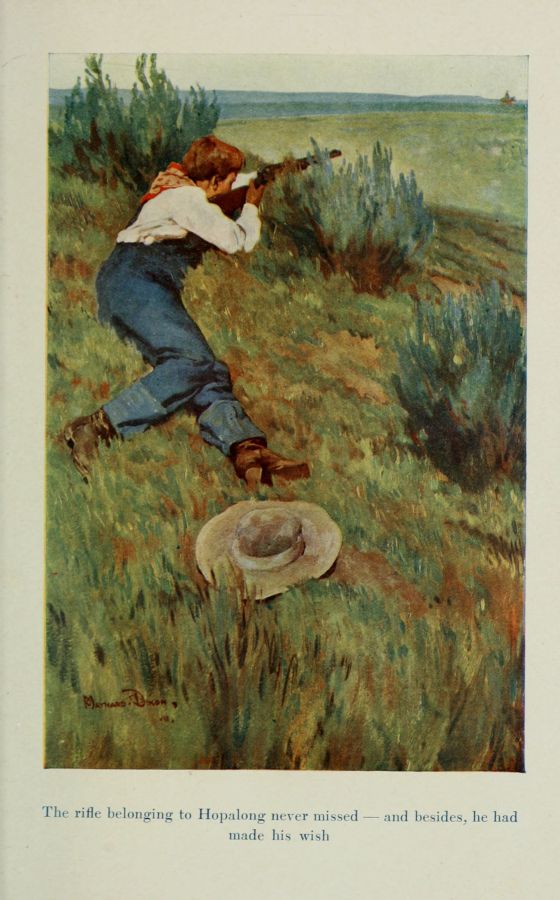
The rifle belonging to Hopalong never missed—and besides, he had made his wish.
Dave's sullen temper was rudely jogged into fierce and righteous anger. Something hit his face. Something else screamed past him, struck a rock and whirred into the sky with a sharp, venomous burr. The pony, resenting Dave's painful appropriation of part of his ear, went up into the air and came down on stiff legs, its back arching once as it landed. The instant the hoofs were firmly on the ground it stretched out and ran as it never had before, Dave helpless to check it. The heavy, sharp report of the huge rifle in Pickles' hand had no sooner reached him than he had all he could do to hold his seat. But the sound of that bullet passing him, lingered in his mind long after he had regained control of his terrified mount.
Pickles, swallowing hard and holding one shoulder with a timidly investigating hand, blinked his dazed eyes as he looked about, inquiringly. He remembered pulling the trigger—and then the Goat had reached out thirty feet and kicked him in the neck—and if it wasn't the Goat, who threw the rock? Dave! He sat up and then struggled to his feet, looking eagerly out to see the remains of Dave scattered carelessly over the landscape. Dave was fast getting smaller, a cloud of dust drifting to the south along his trail.
"D—n it!" cried the boy, tears of vexation in his eyes. "He got away! I missed! I missed!" he shouted. "Buck lied to me! Th' old gun ain't no good!" and in the ecstasy of his rage he danced up and down on the discredited weapon. "Whitby's witches ain't no good! Nothin's no good; an' I missed him!"
Meanwhile his injuries were not becoming easier: his head displayed a large, angry lump, and ached fit to burst; his shoulder was n't broken, he decided, as he exercised it tentatively, but not far from it; and a piece of skin was missing from his bleeding cheek.
"I ought to 'a' got him," he muttered sullenly, picking up the rifle and moving slowly back to where his horse was picketed. "Well, anyhow, he was awful scared—I knowed he was a coward! I knowed it! If this old gun was as good as its kick I would 'a' got him, too." Pickles had gauged the distance perfectly and his hand had not even quivered when he pulled the trigger—but he had yet to learn of windage and how to figure it. Dave owed his life to the wind that swept the dust of his pony's feet southward.
When Pickles had turned the horse into the pasture he reloaded the rifle before slipping it back into its long leather scabbard. It must be found as he had found it and, besides, he was plainsman enough to realize how serious it might be for Hopalong if he believed the weapon was loaded and found it empty in a crisis.
"Never missed, hey?" he growled savagely as he moved away. "Huh! Next time, I 'll use Buck's gun!"
CHAPTER XIX
THE WEAK LINK
The little buckskin pony stood with wide-planted feet and hanging head; his splendid bellows of lungs and powerful abdominal muscles sent the wind in and out of the distended nostrils in the effort to overcome the effect of that last mad burst of speed demanded of him; in his eyes alone, battling against the haze, shone his unconquerable spirit. Bearing saddle and bridle Dave strode away from him to the cabin.
Straight in from Wayback, without a stop, the game little buckskin had carried Dave. Jealousy consumed him. Rumors of Smiler's defection were floating about the town and, though no one but those intimately concerned, knew the actual agreement made, the presence of the principals and their several places of call had been noted and fully commented upon. From such premises the town's deductions came near the truth.
The facts as known were enough for Dave. Whatever Schatz might be planning, Dave was satisfied that he had no part in it. That Schatz intended to treat him fairly was beyond the angle of his narrow mind. He was very calm over it, his face smooth of wrinkles, his movements slow and assured. He had passed through all the stages from irritation to rage—and beyond: Calm is always beyond.
"Mein gracious, Dave, you vas in a hurry?" asked Schatz, as Dave entered.
He hung saddle and bridle on a peg in the kitchen and strode through into the other room before replying. "No," he drawled, dropping into a chair and stretching his legs full length.
"No? Schust try to kill a horse, vas?"
"Yes. Played a trick on me this mornin' an' I 'm showin' him who 's boss."
"Dummer Esel! Und vor a trick you kill him! Den no more tricks, vas?"
"Oh, to h—l with th' cayuse! What's all this I hear o' you an' Peters in a lovin' match?"
"Ach! 'Nun kommt die Wahrheit'! If you not come to-day, I send for you. Vy you stay avay like dot?"
"I 'm busy tryin' to make Peters good an' sick o' th' range, tryin' to drive him back to Texas, where he come from. What are you doin': payin' his passage or backin' him to win?"
"Paying his passage, Dave; vere, I am not sure. Look: here iss Herr Peters," stabbing a finger into the palm of his extended right hand, "und here iss McAllister," duplicating with his left; "und ven I do so," closing both hands tightly, "nobody iss left but Schatz."
"Easy as that, eh?" said Dave, sceptically.
"Schust so easy like dot. Look! I make me a pardner by der Double Y."
"Fine," drawled Dave, with hidden sarcasm.
"Vine as gold. Peters, he get all der money vat he can. McAllister, he send der same as Peters. Me, I got dot money, already. Der money vas in der bank. Der range iss my property schust so much as Peters und McAllister."
"Fine," repeated Dave.
"Peters, he dink he spend der money. Soon he go to buy cows. Now iss de point: to-morrow I go by der bank, I dake oud all der money. Four men iss guard. I say I go over by der Bitter Root vere der Deuce Arrow herd for sale iss; und I take all der money. Because dot bank in Vayback too small. I leave der bank und stop by der Miner's Pick saloon. Ve drink. A man vot vears a mask comes in. He cover us mit a gun. He take der money, ride away to Coon River by der Red Bluff. Dere iss man und boat. Der man mit der boat take horse und ride to first relay und pretty soon he iss in Rankin. A relay every ten miles. Der man mit der money go down river in der boat five mile und dere iss man mit two horses; he ride to Vayback und den here mit der money. Vat you tink?"
"Fine," said Dave, for the third time. "An' who 's goin' to do all that ground an' lofty tumblin' with th' money?"
"Dave Owens," replied Schatz, with an air of conferring a great favor.
"Me!" exclaimed Dave. He laughed cynically. "Why, Karl, if I had somebody to do all th' hard work, I can make plans like that, myself. Talk sense."
"Hard vork! It iss easy, like a squirrel up a tree. Everybody iss by der station ven der train comes. You take all der guns und ve not make noise, aber some thief know you got all der money und catch you first und rob you. Ve got no horses ven ve go by train, und must run, get horses to run after you. So you get avay. You come here mit der money und who know it?"
"Who's makin' th' blind trail?"
"Denver Gus."
"I don't envy Gus none."
"Vy? I pay him goot. He vas go to Texas, anyvay, pretty quick."
"How you goin' to get out of it?"
"I don't get out of it. Peters, he gets sick und I say: 'Vell, some money I got yet, I buy you out'; aber he tink it iss a trick und get mad. Four men I got, gun-men, all. Dey shoot him so soon he get mad."
"An' then McAllister jumps on you with both feet for takin' that money out o' th' bank in th' first place."
"Ach! Vat you dink? Am I a fool? Ain'd I a pardner already?'
"What's that got to do with it?"
"I have schust so much right to take der money as Peters. I don't steal der money—it iss steal avay from me. Can I help it?"
"Is that th' law?"
"Der law iss my part. For der law, brains you must haf. Brains I got. To ride, you know. Vat you dink?"
"I go you," declared Dave. "But you shore take a big chance with th' money. I might get plugged an' have to drop it."
"Mein lieber Gott!" moaned Schatz, in despair. "Brains! Brains!" he roared. "Ach! Vat use? Alvays it iss der same. Von day Canada iss der United States; so England iss gebunden; South America iss Deutchland; soon all der continent iss Deutchland. Vat fools! No Verstand—blos for money. Und to make money iss der little part. Vat fools!"
"Wake up! Who 's th' fool if I drop that bundle an' somebody on a good horse gets away with it? Because you can bet yore whole pile I ain't aimin' to stop an' stand off th' beginnin' of a Judge Lynch party, not any."
"Dave, if a veek you sit und a veek you tink, und schust about von ting, you know somethings about it, vas?"
"Shore would."
"Und mit your head you must tink. Many days mit my head I tink und tink, everythings, possible und not possible. Den ven der plans iss made, you mit your head mistakes find. Der money vat you steal, it iss no matter, aber don't lose it—besser you burn it, as lose it."
"Burn it?"
"Yah! Paper it iss, schust paper."
"Paper!" Dave stared in doubt. "Paper," he repeated, struggling to grasp the idea. He gave it up and quite humbly asked for light. "What th' blazes am I a-goin' to run away with paper for?"
"Maybe somebody smarter as I tink. Two men, already, much questions ask. Maybe Peters take all der money before me. So I go by der bank und get der money first. Dey can't help it. It iss my bank anyvay und der check iss dere."
"You 've got th' money!"
"Yah, here in der house I got it. Everythings iss vollkommen. All der mistakes vat come I know, possible und not possible. Noding can slip, noding can break."
"Yo 're a wonder!" congratulated Dave, "th' one an' only original, sure-fire, bull's-eye wonder." He leaned forward suddenly, head bent in listening. "Somebody outside," he warned, softly. Gun in hand, he sprang to the door and passed out. The gloom of the coming night lay in wait in the valleys but it was light enough to detect any skulker. Dave made a systematic search, satisfying himself that no one was within a mile of the cabin, before returning. "It's all right," he assured, as he entered the room again. A deafening roar followed his words. Schatz gave a convulsive start and slid slowly from his chair to the floor; on his face was an overwhelming surprise.
"Huh—Huh! Huh!—" the grunting laugh spoke immeasureable contempt. "Brains!"
* * * * *
The half-open drawer of the sideboard revealed in the lamplight a number of packages, the wrappings of several being torn open. Dave sat thoughtfully contemplating them. He had removed them from their hiding place and put them in the drawer before lighting the lamp, both acts due to precaution: spying upon Karl had discovered to Dave the hiding place; he was distinctly opposed to finding himself in the same predicament regarding his suddenly acquired wealth. The still figure, resting under two feet of earth, close to the river bank, gave him no concern whatever. His mind was busy with the best way to pack the money; small bills were difficult to trace but bulky to carry. He shoved the drawer to with his foot and re-lit his pipe. His plans were already made. He had reasoned them out swiftly while hunting the supposed skulker. The disappearance of Karl would be associated with the disappearance of the money. The bank would maintain that the money had been drawn on the day the check was dated, which necessarily must be to-morrow. The four men who were to act as guards would conclude some difficulty had arisen and await further orders; it would be the same with all the others involved. The way was clear for him. There remained only Rose. He knocked the ashes from his pipe and went to bed.
CHAPTER XX
MISPLACED CONFIDENCE
Pickles was hungry. He cocked his eye anxiously at the sun and sighed. He gazed in discouragement over the widespread furrowed earth where his best efforts left so small a trace and dropping the hoe, sighed again. With all his soul he wished he had not fled from the Double Y. Sudden resolution armed him. He shoved his hands in his pockets and marched manfully in the direction of the house. He refused to go hungry for anybody.
Topping a rise, his head barely showed against the sky-line when he dropped as if shot. The horseman making for the house might be Jean; his glance had been too hasty for recognition. Flat against the earth, Pickles pushed himself backward until he felt it safe to turn and gallop clumsily down grade on hands and feet. Far enough, he sat and thought. He could gain the barn unseen and if he ran, would have time to dash into the house, grab some chuck, and get away again before the horseman got there. He sprang to his feet and ran like a long-horn steer, gazed upon by the stock in pasture with interest: they were not accustomed to this style of locomotion in trousers.
Pickles made excellent time on the level but when he turned to breast the slope it was harder going; and Pickles was tired; he had been at work since sun-up with a short rest at breakfast. He gained the barn winded but went through and crossed to the house without pausing. Back of the house he stopped to listen. He had cut it too fine. The horse was coming up to the door. "Darn it!" said Pickles, with bitter emphasis.
The snap of the catch on the front door and Rose's voice told him she had gone outside. Maybe the rider was n't coming in; they could n't see the end window if they did and if he were quick—he squirmed over the ledge, dropped noiselessly to the floor, sped through the doorway—and almost dislocated his spine with the ferret-like turn he made in trying to get back into the room the same instant he left it: he had barely escaped the other's entry; if Rose came to the bedroom she would be certain to exclaim at sight of him. Pickles breathed a short—a very short—prayer. He put his hands to the window ledge—and stiffened.
"No, I can't stay. Rose, I 'm pullin' my freight. How soon can you come along?"
It was Dave—he was going away—and he wanted Rose to go, too. Pickles knelt silently by the bunk and muffled his rapid breathing in the blankets, while he listened.
"Where?" asked Rose.
"Anywhere you say. I 'm a-goin' to clean up a gold mine in a few hours an' yo 're goin' to help me spend it. We 'll get married first stop."
"A gold mine?"
"More money than you ever saw."
"And you want—me—to go with you?"
"Not with me. I got to get th' money first. I 'll get th' train to Helena to-night. You get on at Jackson. You can make it easy on Swaller."
"I must know more. Perhaps you tell true. Perhaps you run away. Tell me."
"Got a good opinion o' yore future husband, ain't you? Quit foolin', Rose. Have I got to show you the cards afore you take a hand?"
"Yes," was the decisive answer.
"All right. It's this way: Schatz deals to Peters from a cold deck. He gets all th' money out o' the bank, Peters', McAllister's, an' his. Then he lets me lift it, him not knowin' who I am, o' course. I do th' mysterious disappearance act an' Schatz makes foolish noises too late. A posse takes after me an' runs into a blind trail. I circle back to town. Right there is where I fool Schatz. He thinks I 'm driftin' along the Big Moose trail to hand th' money over to him graceful. 'Stead o' that I 'm snortin' along the track to Helena with you. Schatz dassent make no holler an' we leave him an' Peters to fight it out. Do you get me?"
"They will kill you."
"Oh, not a whole lot, I reckon. I 'm gettin' so used to bein' killed thataway, I sorter like it. Talk sense. Where's th' ole man?"
"I will leave a letter for him."
"Hip hooray! Mighty nigh kissin'-time, Rose. Would be, on'y I can't leave this blasted cayuse: 'fraid to trust him. Which way you goin'? Don't show in Wayback. Hit th' river farther west."
Pickles had heard enough. His exit through the window was rapid and silent. His retreat from the house, made along two sides of a triangle, was prompted by his knowledge of the positions of Rose and Dave and he manoeuvred so they should not be able to see him. Nevertheless the security of the barn was very welcome, although he gained it only to recall that the Goat was at pasture. Then Swallow must be in the corral. He looked from the rear door. Yes, there he was, close to the fence, gazing across the grass at the field stock and no doubt wishing he were with them. Whimpering with suppressed delight the boy ran silently to his rope, hanging in long loops over two pegs in the wall; he coiled it ready to hand, crept out the door, and was at Swallow with the rush of a bob-cat. The great stallion made one mighty bound, lashed out one foot and stood with flattened ears; he knew the meaning of a rope in that position as well as any cow-pony in Montana and the indignity vexed while it subdued him. Pickles never bridled and saddled so rapidly in his short life. Keeping the barn between him and the house, he rode a mile or more out of his course before he dared to turn; then he took his bearings, set a straight line for the Double Y ranch, and gave Swallow his head. The good horse, scarcely feeling the boy's light weight, went forward with a rush, but responded to the light hand on the bridle and settled down, travelling mile after mile with the tireless stride and ease of movement that had won him his name.