"Brownsmith's Boy" (continued 6)
Reading edition
I finished my task in the peach-house, and then went to see how the celery was getting on, for I found that when Mr Solomon gave me a task he expected me to continue to watch, whatever it was.
“So that I may feel that when I have put anything in your hands it will be properly done,” he said more than once; so, feeling that I was responsible for the success of the celery plants, I was on my way to the bottom garden by the pond, thinking of the encounter I had when I was busy watering there that day, when, as I turned down one of the alleys of the garden, I saw a man in the distance digging up a piece of ground with a broad spade, and turning over the soil in that easy regular way, levelling it as he went, that experienced gardeners acquire.
There was something in his way of digging that seemed familiar, and I stopped and stared. The man stopped too, and glanced in my direction; but he only scraped his spade and went on, while, as soon as I had seen his profile I ran up to him and held out my hand.
“Why, Ike!” I cried, “is that you?”
He paused for a few moments, ran his hand over his nose, involuntarily, I’m sure, glanced down at first one leg, and then the other, after which he went on digging.
“Yes,” he said; “it’s me.”
“Why, what are you doing here?”
“Digging,” he said gruffly, and, turning up a spadeful of earth, he gave it a blow with the spade, as if he were boxing its ears, and levelled it smoothly.
“I know that,” I cried; “but how is it you’re here?”
“Got took on.”
“Oh! I am glad,” I cried.
He looked up at me sidewise, and drove his spade in again.
“No, you ain’t,” he said gruffly.
“Indeed I am, Ike,” I cried, “though you wouldn’t say good-bye.”
“Now—now—now—now!” he cried; “don’t go on that how.”
“Did you come this morning?” I said.
“Been here ’most a week.”
“And I didn’t know! But why did you leave Mr Brownsmith?”
“I left Old Brownsmith because I wanted to leave him.”
“Did you have a quarrel, Ike?”
“Quarrel? No! What should I want to quarrel for?”
“But why did you leave?”
“’Cause I liked. Man ain’t a slave, is he?”
“I am glad you’re here, though, Ike,” I cried.
“Not you,” he said sourly, as he thrust and chopped and levelled the soil.
“Indeed but I am,” I cried. “Yes, sir, coming,” I shouted, for I heard Mr Solomon asking for me.
I went to him, and he set me to water the pots that had been plunged under the big wall; but on going to the pump in the middle of the big walk, where the well was that we used for this garden, I found the handle swing loosely up and down.
I went and told Mr Solomon that there was no water to be had there.
“I thought as much!” he cried angrily. “I saw those boys jerking the handle about yesterday. Here, Bunce!”
Bunce was sent off with a message, and I went about some other task, glad to find that Ike was there at work, for somehow I liked him, though I did not know why, since he was always very gruff and snappish with me. But still it seemed as if he had come to Hampton because I was there.
The next morning, after breakfast, as I went down the garden I found that Mr Solomon was by the well talking to a man who carried a basket of tools.
As I approached he put them down, Mr Solomon helped him, and together they lifted up a great stone in the pathway, which covered the mouth of the well.
There is something very attractive and yet repellent about a well, at least to me. I always want to look down it and listen to the peculiar echoing noise, and the whispers that seem to creep about its green wet sides.
It was so here, and while the man stood talking to Mr Solomon I went down on one knee and peered into the well, to see, far down, a glistening round of what looked like a mirror with my face in it, but in a blurred indistinct way, for there was a musical splashing of water falling from the sides, and as I bent lower the air seemed cold and dank, while above it was sunny and warm.
I started up suddenly, for just then I heard a laugh, and recalling the way in which I had been thrust into the pond I did not care to risk a kick from him who laughed, or from his companion.
For, attracted by Bunce, who was carrying a long ladder, they asked him if he was going to gather fruit, and on learning that the well was being opened they, to use their own words, came to see the fun.
Bunce laid the ladder along the path and went off again to his work, while the two boys seemed to ignore my presence, and stood talking to one another and waiting, Philip throwing stones, while Courtenay amused himself by kicking a coil of rope that lay upon the path.
“Here, Grant,” cried Mr Solomon, turning upon me suddenly. “Run to the cottage and get a candle and a box of matches.”
“Yes, sir,” I said, going.
“Yes sir, certainly sir, yes sir,” said Philip in a mocking tone.
“And, Grant,” shouted Mr Solomon, “bring one of the men with you.”
“Bunce?” I said.
“No, he’s busy. Bring that new man, Isaac.”
I ran off to the cottage for the candle and matches, and Mrs Solomon asked what they were for.
“To see down in the well, I think,” I said.
“Oh yes, to be sure! the pump is broken. Tell master to be very careful. Wells are very dangerous places. I once knew of a well where four men tumbled down and never came up again.”
“We’ll take care not to tumble,” I cried laughing; and I ran off to find Ike, who was digging away near where I had seen him before.
“Eh! Good mornin’!” he said sourly. “Is it? I didn’t know. Mornin’s seems always all alike to a man as has to dig.”
“But how well you’re doing it, Ike! It’s better dug than our men generally dig it.”
“Be it?” he said dubiously: “Well, I have punished it pretty well. Ground’s very foul and full o’ bear-bine.”
“Put down your spade and come along with me,” I cried; “they’re doing something to the well.”
“All right, I’ll come!” said Ike sourly. “Pay me my wage and I’m ready. Night work or day work, it’s all the same to me, and such is life. ’Tis a rum set out.”
“Don’t grumble, Ike,” I said, “on a morning like this.”
“Grumble! That ain’t grumbling. But I say, young ’un, are you glad I come?”
“Why, of course I am, Ike.”
“So am I then. I s’pose I come o’ purpose to work along o’ you; but I miss my hoss a deal. I say, Old Brownsmith didn’t like it a bit; but here I am; and did you know about young Shock?”
“No: what about him? Have they caught him and sent him away?”
“No: they’ve caught him and give him a decent suit of clothes, so stiff he can’t hardly move in ’em, and he’s took on.”
“Shock is?”
“To be sure he is; and if he behaves decent his fortun’s made.”
“Oh, look here, my man,” said Mr Solomon as we came up, “you had better stop here and help. Lower down that ladder.”
Ike took hold of the ladder as if it were an enemy, gave me a nod, and I went and stood at the foot, so as to hold it down, while Ike raised it erect, and then, taking it by the rounds with his strong brown hands, he lifted it as if it had been a feather, and, walking to the mouth of the well, let the ladder glide softly down till he held the top in his hands; then, swinging it about, he found a resting-place for the bottom upon a piece of wood such as were fixed across the well every ten or a dozen feet to support the pipe and other gear of the pump.
“That do, master?” said Ike.
“Yes,” said Mr Solomon. “Now, Mr Grinling, you had better try her. Here, stop, what are you going to do?”
“Going down,” said Courtenay.
“Do you know that well is perhaps very foul?” cried Mr Solomon.
“Then it’s your place to keep it clean,” said Philip sharply. “Go on down, Court, or else I shall.”
“You won’t, neither of you, go down while I’m here,” said Mr Solomon stoutly.
“What right have you to interfere?” cried Courtenay:
“Same right as any man has to interfere when he sees a young goose going to throw away his life.”
“Oh rubbish!” said Courtenay. “Just as if I couldn’t go down a ladder. Here, stand aside.”
Mr Solomon did not stand aside, and he looked so very sturdy and firm that Courtenay gave up and drew back with his brother, whispering and waiting his opportunity.
During this time the plumber had been rattling his tools in his basket, and Mr Solomon turned to him again.
“Ain’t you going to try her?” he said. “That well hasn’t been open these two years.”
“Oh! she’s right enough,” said the plumber sourly. “It ain’t the first time I’ve been down a well.”
“But I don’t think it’s safe,” said Mr Solomon. “What do you say?” he continued, turning to Ike.
“Looks right enough,” said Ike, kneeling down and looking into the well. Then rising, “but I wouldn’t go down unless I didn’t want to come up no more.”
“Tchah!” ejaculated the plumber; and I knelt down once more to look for the danger, but could see nothing but the dark whispering hole, with, at a great depth below, the round disc of light representing the mouth of the well.
Just then something passed my head and fell down with, after a while, a strange hollow plash from below.
“That’ll do,” said Mr Solomon angrily. “No more of that, please.”
“You mind your own business, Browny. Anyone would think you were the master here.”
“Master or no, here’s Sir Francis coming. Let’s see whether he likes you to be throwing stones down the well.”
Mr Solomon uttered a sigh of relief, for, as Sir Francis came along a neighbouring path, the two lads slowly walked away.
“That’s a blessing,” he said. “Now we can work in peace. You’ll try her first—won’t you, plumber?”
“All right, gardener. What are you scared about?”
Mr Solomon looked at him angrily and then said:
“I don’t know that I’m scared about you, my man; but I don’t want to risk my life, or to send down one of my men to fetch you out.”
The plumber grunted, and I looked on wondering what the danger was, for I knew nothing then about chemistry or foul gases; and I stared all the more when the plumber took a ball of thin string from his jacket pocket, tied the candle with a couple of half hitches, and then struck a match and lit the wick. Then as soon as it was burning brightly, sheltered by his hands from the breeze, he stooped down and held it in the well and then lowered it down.
We stood round watching the candle swing gently and the flame dance as the plumber slowly unrolled the ball of string.
At first the light looked very pale; but it grew brighter as it left the sunshine near the mouth of the well and lit up the dark slimy-looking old bricks, the rusty iron pipe, and the cross pieces of timber, while far down I could now and then catch sight of the cylinder of the pump as the candle began to swing now like a pendulum. It was very indistinct, just gleaming now and then, while the walls glistened, and I realised more and more what a horrible place it would be for anyone to fall into.
I was full of imaginings of horror, and I fancied the fearful splash, the darkness, the rising to the surface, and then the poor wretch—myself perhaps—striving to get my fingers in between the slippery bricks, and getting no hold, and then—“There!—what did I tell you?” said Mr Solomon.
“She’s a foul un, and no mistake,” growled Ike.
“Oh! that’s nothing,” said the plumber. “I’ve been down worse wells than that.”
I was puzzled, for it seemed to me that the candle must be bad. As I had watched it the flame grew brighter and brighter as it reached the darkness, and then it burned more palely, grew smaller, and then all at once it turned blue and went out.
He drew it up, lit it again, and lowered it once more, and it seemed to go down a little lower before it went out.
He drew it up again, relit it, and once more sent it down; and this time it went as far as the cylinder of the pump—which was fixed, I saw, on a sort of scaffold or framework where the foot of the ladder rested.
I was able to see all this before the light went out and was drawn up again.
“All right in a few minutes,” said the plumber; and he unfastened the candle, lowered down his basket of tools by means of the string, and made it lodge on a bit of a platform close by the works of the pump.
It was all very interesting to me to see how low down the pump was fixed, and that the handle worked an iron rod up and down—a rod of great length.
The plumber took off his jacket and rolled up his sleeves, after sticking the candle in his waist and the matches in his pocket, and prepared to descend.
“Why, you are not going down like that—are you?” said Mr Solomon.
“I always do go down like that,” said the man with a laugh. “How should you go down-head first?”
“No,” cried Mr Solomon angrily; “but with a rope fastened to my waist, and a couple of men to hold it.”
“D’yer think I’m a baby?” said the plumber, “or a little child?”
“Worse,” said Mr Solomon shortly. “You can make them do what’s right.”
“Tchah! I know what I’m about, just as well as you know how to bud roses.”
“I dare say you do,” said Mr Solomon sternly; “but that well’s got a lot of foul gas in it, and you’re not going down without a rope to hold you.”
“Rubbish!” said the plumber, laughing; “I am.”
“And who’s going to use the water agen if you’re drowned in it?” said Ike seriously. “It’ll be all full o’ white-lead and putty, and kill the plarnts!”
“You’re very clever,” said the plumber sharply; “but just mind your own business.”
As he spoke he sat down with his legs in the well, but Mr Solomon seized him by the collar.
“You stop,” he cried; “I won’t have it. You don’t go down that well without a rope round you. Fetch Bunce,” he said, addressing Ike.
“If I can’t do my work my own way,” said the plumber sharply, “I sha’n’t do it at all.”
He started up, threw on his jacket, and went off after Ike, while Mr Solomon stood thinking.
“Such idiocy!” he exclaimed. “The well isn’t safe, and he wants to run unnecessary risks. I suppose he’ll come back,” he muttered. “Perhaps I shall have to fetch him. Here, Grant, you stop here and don’t leave the mouth of the well for fear anyone should go near.”
He went after the men, and I lay down gazing into the dark hollow place, wondering what the foul gas was like, and whether I could see it down below; and I was just wishing that I had the candle and string to try experiments, and wondering how far the light would go down now, when I uttered a cry.
My heart seemed to give a great leap, for somebody gave me a rough push and it seemed as if I were going to be thrust down the well.
“There’s a coward!” cried Philip jeeringly. “Did you ever see such a cur, Court? Thought he was going down.”
“Perhaps I did,” I replied warmly, as I glanced from one to the other, wondering whether it was to be war again; but they paid no further attention to me, and began arguing between themselves.
“You daren’t!” said Philip.
“Daren’t!” cried Courtenay. “Why, I went down last time hanging to a rope when it was cleaned out, and there was no water at the bottom.”
“But there is water now—twenty or thirty feet, and you daren’t go down.”
“Yes I dare.”
“Bet you sixpence you daren’t.”
“Done!” cried Courtenay. “Mind I shall make you pay.”
“You daren’t go.”
“All right; you’ll see!” cried Courtenay; and to my horror he went close to the mouth and looked down.
“You can’t go down,” I said; “the well isn’t safe.”
“Who spoke to you, pauper?” cried Philip sharply. And then with a sniggering laugh, “It ain’t safe, Courtenay. You can’t go down, and you’ll have to pay me all the same.”
“I’m going down,” said Courtenay.
“You can’t,” I cried. “It’s full of foul air.”
“You mind your own business, pauper,” cried Courtenay.
This repetition of the word pauper so enraged me that for the moment I felt tempted to let him go down, but the next moment I shuddered at the thought and cried:
“It is my business. I was to keep everyone from going near.”
“Don’t take any notice of the workus boy, Court. Go on down, if you dare.”
“I dare,” he said, laughing.
“I tell you it isn’t safe,” I cried.
“Do you want a punch on the head?” said Philip menacingly.
“Yes, but you daren’t give it me,” I cried fiercely.
“Never mind him,” said Courtenay. “Look here, I’m only going to the bottom of the ladder. I’m not going to slide down the pipe to the water.”
As he spoke he sat down on the edge with his legs dangling over the side.
“Ha, ha, ha!” laughed Philip, seating himself opposite to him and kicking at his brother’s feet. “You daren’t go.”
“You say I daren’t go again I’ll take you by the scruff of the neck and make you go down instead. I say, let’s send the pauper down to swallow the foul air.”
“There, I knew you daren’t go,” cried Philip.
“I dare.”
“You daren’t.”
“He shall not go,” I cried; and I caught the lad by the collar.
He gave himself a twist, and as he freed himself he struck me a savage blow with his elbow right in the lower part of the chest.
The blow took away my breath and made me stagger back in agony, and gasping, while by the time I had recovered myself he had stepped on to the ladder, gone down several rounds, and his head disappeared.
“There, coward, what do you think of that?” cried Philip.
I ran to the side with my heart throbbing painfully, and I felt as if my eyes were wild and staring as I saw the lad go down about a dozen feet and stop.
“I say, Phil,” he cried, with his voice echoing and sounding hollow, “come down. It is so jolly and cool.”
“I’ll go down when you’ve come up,” said his brother. “That isn’t far enough. I don’t call that anything.”
“Wait a bit. Don’t be in a wax.”
“Come up, sir, pray come up,” I cried. “There’s foul air lower down. The candle wouldn’t burn.”
“Pitch him down if he don’t hold his tongue, Phil,” cried Courtenay. “Here goes for a slide.”
He grasped the sides of the ladder, took his feet off the round on which he stood, and throwing his legs round he began to slide slowly down.
“I say, it’s as cool as eating ices, Phil,” he cried. “Come on down.”
Philip made no answer, but glanced at me, and I suppose my blanched and horrified countenance startled him, for he too suddenly turned white and exclaimed:
“There, you’ve won, Court. I give in. Come back now.”
Too late! Courtenay slid slowly on for a few moments, then faster, and then we saw his arms relax and he fell over backwards, while as I stood on the brink gazing down I felt as if I had suddenly been turned to stone.
Chapter Twenty Six.
“What shall we do?”
I seemed to be standing there some time, but Mr Solomon afterwards told me it was not a moment, before I looked up, and seeing him returning with the plumber, ran towards them swiftly, shouting for help.
The two men started running directly, and as we reached the well together there was Philip lying upon the ground beside the path, face downwards, and with his fingers thrust into his ears.
“Now, then,” shouted Mr Solomon to the plumber, as Ike came running up straight across beds, bushes, everything. “Now, then, you said the well was safe; go down and fetch him up.”
The plumber went upon one knee, seized the top of the ladder, and got up again shaking his head.
“I can’t afford it,” he said. “I’ve a wife and bairns at home.”
“I—I daren’t go down,” groaned Mr Solomon. “Man, man, what shall we do?”
“It scares me,” growled Ike hoarsely; “but I’ve got no wife and no bairns; and if Master Grant here says, ‘Go,’ I’ll go, though,” he added slowly, “it’s going down into one’s grave.”
“Can you see him, Grant?” cried Mr Solomon.
“Yes; down on the wood,” I said in a hoarse whisper; “he’s lying across a beam with his head down. What shall we do?”
As I asked this piteously I raised my head, to see Philip close by me kneeling on the gravel, his eyes half closed, his face of a yellowish grey, his hands clenched, and his teeth chattering.
No one spoke, and as I looked from one man to the other every face was pale and stony-looking, for the men felt that to go down into that carbonic acid gas was to give up life.
I felt horribly frightened, and as if I were sinking somewhere. I glanced round, and there was the beautiful garden all flowers and fruit, with the glorious sunshine over all. Below me that terrible pit with the falling whispering water, and a chill seeming to rise out of its depths.
As I looked I saw Shock coming towards us at a run, as if he divined that something was the matter, and the sight of him made me think of Mr Brownsmith’s garden and my happy life there, and I gave a low sob as my eyes filled with tears.
I tell you I felt horribly frightened, and all this that has taken so long to describe seemed to pass in a flash—almost as I started from gazing down the well to my feet.
“Tie the rope round me,” I said huskily. “You can pull me up if I fall.”
“Well done, young un!” shouted the plumber, catching up the coil of rope. “I like pluck, I do.”
“You stand aside,” cried Ike, snatching the rope from him and giving him a rough thrust with his elbow. “I’ll do this here.”
He ran the rope rapidly through his hands, and secured one end about my chest.
Then he made a running noose at the other end.
“Look here,” he cried. “You take this here noose in your hand, my lad; there’s plenty of rope to reach down double. When you gets to him put it over his arm or his leg, or anywhere, and pull it tight. I’ll take care o’ you, my boy, and have you up again like a shot.”
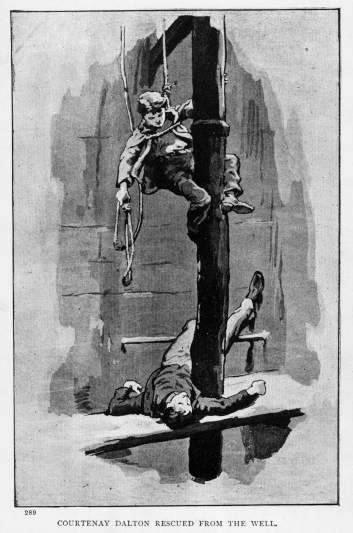
“Shake hands, Ike,” I said, all of a tremble.
“Ay, I will, boy.”
“Go, and God help you!” groaned Mr Solomon; and the next instant, with the noose in my hand and just feeling the rope drag on my chest, I stepped on to the ladder, clasped it as Courtenay had done, and let myself slide down.
As I went I looked up, and it seemed dark, for there was a ring of heads round the top; but below as I looked it was still darker.
Down, down, with a curious catching of the breath, and a strange sensation of this not being real seizing me. Then I seemed to wake up and find myself where the water was dripping, and the well whispering, and still I slid down till I was on the slimy platform where the foot of the ladder rested, but young Dalton was not there, but some ten feet down, on the next crosspiece of timber.
“Lower me down,” I cried, and hanging by the rope I felt myself lowered more and more, and that I was slowly spinning round; but as I swung to and fro I caught at something I could dimly see, and found it was the great slippery pipe that went down into the water, and guided myself by that.
Only about ten feet; but the distance in that curious state of dread that made me feel as if my breath was painful and difficult, seemed ten times as great. The rope seemed to be compressing the bones of my chest tighter and tighter, and twice over I felt that I was in amongst the foul air that I believed would kill me before I reached the crosspiece on which the lad hung.
The next minute I was seated astride the slippery piece of oak with the water about half a dozen feet below me, and I saw that the least touch would send Courtenay off.
I remembered my lesson though, and, forgetting my dread in the excitement, I slipped the rope over the hanging arm nearest to me, right up to the shoulder, and was in the act of drawing it tight, when, as I bent down, a curious choking sensation seized me, and all was blank.
Ike told me what took place afterwards, for I knew nothing more till I opened my eyes, and found that I was lying down, and several people whose faces looked misty and confused were about me.
I felt sick, and my head throbbed violently. There was a weight over me too, and a curious feeling of confusion, in the midst of which a cool hand was laid upon my fore-head, and I heard some one say:
“He’s coming round fast.”
I lay quite still for some time, and at last I exclaimed:
“What’s the matter—is anyone hurt?”
“Lie still, my lad,” said a strange voice.
“I know,” I cried excitedly. “Did you get him out?”
“Yes, yes, he’s all right, and so are you, Grant, my lad,” said Mr Solomon; and just then the room seemed to be darkened, and I heard Ike’s voice:
“Is he coming to?”
“Yes. He’s all right.”
Then I felt that I was wrong about some one else, and that it was that accident with the cart tipping up at Old Brownsmith’s, and it was I who was hurt.
That all passed away like a cloud, and my full senses seemed to come back.
“Did you get Master Courtenay out?” I said.
“Yes, my lad, he is quite safe,” said a quick sharp voice, which its owner seemed to me trying to make gentle, and turning my head I saw Sir Francis.
I tried to get up, but turned giddy.
“Lie still, my lad,” he said kindly. “Don’t disturb him, Brownsmith. Good-bye, my lad! I’ll see you again.”
He shook hands with me and went to the door.
“Well,” he said sharply, “are you going to shake hands with the brave fellow who saved your brother’s life?”
The next moment I saw young Philip at my side, and he took my hand in his, which felt cold and damp like the tail of a cod-fish.
“If he seems to change in any way,” said the voice I had heard before, “send for me directly; but I think he will be all right in an hour or two. I’m going up to the house.”
“Who’s that?” I said sharply.
“The doctor, my lad,” said Mr Solomon.
“But I’m not ill,” I said. “What was it? Did I fall into the water?”
“Foul air overcame you, my lad. How do you feel?”
“Yes, how do you feel?” said Mrs Solomon gently, as she took my hand.
“I’m all right,” I said, sitting up, and this time I didn’t feel giddy. “Only something seems to hurt my chest.”
“The rope cut you a bit, that’s all. It will soon go off.”
Through the open door I could see Ike standing watching me attentively, and as soon as he caught my eye he began to jerk his arm in the air as if he were crying “Hooray!”
Just then a head came slowly round the door-post, and I saw Shock staring in at me; but as soon as he saw that I was looking his head was snatched back.
“How is he now?” said the plumber, coming to the door.
“Oh, I am quite well,” I said, in an irritable tone that was new to me, and I got up; “I’m going out now.”
“You’re well out of it, my lad,” said the plumber. “I knowed a case once where five chaps went down one after the other to save him as had gone first, and they all fell to the bottom and died.”
“There, for goodness’ sake, man, don’t talk like that to the lad after what he has gone through,” said Mrs Solomon.
“All right, mum,” said the plumber; “but as I was going to say, I don’t think I shall have the heart to go down today, but I’ll see how the air is whether or no.”
“You’re not going out,” said Mrs Solomon.
“Yes, please; it will do me good,” I said; and the air did seem to refresh me, as I followed them back to the well, where the plumber tried it again by lowering down the lighted candle, to find it burn brightly till it was down by the cross piece on which young Dalton had lain, after which it went out directly.
He tried it again and again, always with the same result.
“It’s got lower and lower,” he said. “By to-morrow there won’t be much in. That young gent couldn’t have been overcome by the bad air,” he continued. “It’s my belief as he fell out of being frightened, and it’s lucky for him that he stopped where he did. If he’d gone a foot lower, that doctor wouldn’t have brought him round.”
“Well,” said Mr Solomon rather impatiently, “what are you going to do?”
“Kiver up the well for to-day, and come on tomorrow.”
“But we want water.”
“Can’t help it; I couldn’t go down and work there to-day. My nerves is shook.”
“Suppose we put a rope round you.”
“Bless your heart, Mr Brownsmith, sir, I couldn’t go down if you put two ropes round me. I’m just going to lift out this here ladder, and then p’r’aps your man will help me put on the stone.”
Mr Solomon grunted, and I looked on, shivering a little in spite of the hot sunshine as I saw the ladder lifted out and laid down beside the path by Ike, after which Mr Solomon himself helped to put the stone back in its place before walking with the plumber towards the gate.
“How was it all, Ike?” I said eagerly.
“Oh, you’d better ask young Shock here.”
Shock, who was in a stiff suit of corduroys, looked at him sharply, spun round, and ran off.
“Y’ever see the likes o’ him?” said Ike chuckling. “Puts me in mind of a scared dog, he do, reg’lar.”
“But tell me,” I said; “how was it? I don’t remember.”
“Well, it were like this, you see,” said Ike. “I were holding the rope tightly and watching of you, and I see you slip on the noose, and tightened it, and then all at once I shouted to the others, ‘Hook on,’ I says, ‘it’s got him.’
“I was on the watch for it, you see, and ready, and hauled at once. Thank goodness, I am strong in the arm if I ain’t in the head. So I hauled, and they hauled, and so had you both up a few feet directly, one at each end of the rope, and you two couldn’t be civil to each other even then, but must get quarrelling.”
“Quarrelling! Nonsense, Ike! I was insensible, and so was he.”
“I don’t care; you was quarrelling and got yourselves tangled up together, and the rope twissen round and round under one of them bits o’ wood as goes acrost.”
“Yes, I know,” I said excitedly, for the thought made me shudder.
“Well, there you was; and the more you was pulled the tighter you was, just below the bottom of the ladder.”
“And what did you do, Ike?”
“Well, I was going down, and was about handing the ropes to Old Brownsmith’s brother, when young Shock hops in on to the ladder like a wild monkey a’most. Down he goes chattering like anything, and it was no use to shout to him to have a rope. Afore we knowed it a’most, he was down and lying flat on his stum. ‘Lower a bit,’ he shouts, and we lowered, and he untwisted you two and guided you both clear, and stopped till you were both out, when he came out whistling as if nothing was the matter.”
“A brave fellow!” I cried warmly.
“That’s what I said,” cried Ike; “but the plumber said it was because he didn’t know there was any danger.”
“Well, Ike, what then?”
“Oh, there’s no more to tell, only that Sir Francis come and a doctor was fetched, and the guv’nor said it would be a warning to them two boys; and young shaver who went down’s up at home getting all right, and you’ve got all right, and that’s all.”
That was not all, for I went down the garden—and found Shock, to thank him for what he had done, but he only turned his back on me and then walked away; while, feeling faint, I turned to go up to the cottage and lie down till the sick sensation had gone off.
I had gone about a dozen yards, when, thump! a worm-eaten baking pear, half-grown, hit me on the back, and I did not need telling that it was thrown by Shock.
Chapter Twenty Seven.
At the Sand-Pit.
The plumber came and repaired the pump next day, going down the well with a couple of men to hold the rope he had round his waist, and I heard Mr Solomon grumbling and laughing a good deal about the care he was taking.
“If he does meet with an accident, Grant,” he said, “it won’t be his fault this time. Why, you look poorly, my lad. Don’t you feel well?”
“I don’t indeed, sir,” I said; “my head swims, and things look strange about me.”
“Ah! yes,” he said. “Well, look here; you have a good idle for a day or two.”
“But there are so many things want doing in the houses, sir,” I said.
“And always will be, Grant. Gardeners are never done. But let that slide. I can get on without you for a day or two.”
“Have you heard how Mr Courtenay is?” I asked.
“Yes, ever so much better, young whelp! Sir Francis has been giving his brother a tremendous setting down, I hear; and I think they are going to school or somewhere else at once.”
That day, as I was wandering about the kitchen-garden after a chat with Ike, who had settled down to his work just as if he belonged to the place, and after I had tried to have a few words with Shock, who puzzled me more than ever, for he always seemed to hate me, and yet he had followed me here, I heard some one shout, “Hi! halt!”
I turned and saw Sir Francis beckoning to me, and I went up to him.
“Better? Yes, of course. Boys always get better,” he said. “Look here. Behaved very well yesterday. Go on. I’ve said a word to Brownsmith about you; but, look here: don’t you tease my lads. Boys will be boys, I know; but they are not in your station of life, and you must not try to make companions of them.”
I made no answer: I could not, I was so taken aback by his words; and by the time I had thought of saying that I had never teased either Courtenay or Philip, and that I had always tried to avoid them, he was a hundred yards away.
“They must have been telling lies about me,” I said angrily; and I walked on to where Ike was digging, to talk to him about it and ask his advice as to whether I should go and tell Sir Francis everything.
“No,” he said, stopping to scrape his spade when I had done. “I shouldn’t. It’s kicks, that’s what it is, and we all gets kicked more or less through life, my boy; but what of it? He wouldn’t think no better of you for going and telling tales. Let him find it out. Sure to, some day. Feel badly?”
“Yes,” I said, rather faintly.
“Ah! sure to,” said Ike, driving his spade into the ground. “But you don’t want no doctor. You swallowed a lot of bad air; now you swallow a lot of good, and it’ll be like lime on a bit o’ newly dug ground. Load or two would do this good. There’s the ganger hollering after you.”
“Yes!” I cried, and I went towards where Mr Brownsmith was standing.
“Look here, Grant,” he said, looking very red in the face. “Sir Francis has given me this to buy you a watch by and by. He says you’re too young to have one now, but I’m to buy it and keep it for you a year or two. Five pounds.”
“I’m much obliged to him,” I said rather dolefully; but I did not feel at all pleased, and Mr Solomon looked disappointed, and I’m afraid he thought I was rather a queer boy.
At the end of the week I heard that Courtenay was better, but that he was to go with his brother down to the seaside, and to my great delight they went; and though I thought the lad might have said, “Thank you,” to me for saving his life, I was so pleased to find he was going, that this troubled me very little, for it was as if a holiday time had just begun.
The effects of my adventure soon passed away, and the days glided on most enjoyably. There was plenty to do in the glass-houses, but it was always such interesting work that I was never tired of it; and it was delightful to me to see the fruit ripening and the progress of the glorious flowers that we grew. Mr Solomon was always ready to tell or show me anything, and I suppose he was satisfied with me, for he used to nod now and then—he never praised; and Mrs Solomon sometimes smiled at me, but not very often.
The autumn was well advanced when one day Mr Solomon told me that he had arranged for Ike, as he was a good carter, to go with the strongest horse and cart to a place he named in Surrey, to fetch a good load of a particular kind of silver sand for potting.
“It’s a long journey, Grant,” he said; “and you’ll have to start very early, but I thought you would like to go. Be a change.”
“I should like it,” I said. “Does Ike know I’m going?”
“No; you can tell him.”
I went down to Ike, who was as usual digging, for he was the best handler of a spade in the garden, and he liked the work.
“Hullo!” he said surlily.
“I’m to go with you for the sand, Ike,” I cried.
“Think o’ that now!” he replied with a grim smile. “Why, I was just a-thinking it would be like going off with the old cart and Bonyparty to market, and how you and me went.”
“With Shock on the top of the load,” I said laughing.
“Ay, to be sure. Well, he’s a-going this time to help mind the horse. And so you are going too?”
“Yes,” I said mischievously, “to look after you, and see that you do your work.”
“Gahn!” he growled, beginning to dig again. Look here, though; if you ain’t ready I shall go without you.
“All right, Ike!” I said. “What time do you start?”
“Twelve o’clock sees me outside the yard gates, my lad. Five arter sees me down the road.”
“Do you know the way, Ike?” I said.
“Do I know the way!” cried Ike, taking his spade close up to the blade and scraping and looking at it as if addressing it. “Why, I was born close to that san’-pit, and put Old Brownsmith’s brother up to getting some. I can show him where to get some real peat too, if he behaves hisself.”
The trip to the sand-pit kept all other thoughts out of my head; and though I was packed off to bed at seven for a few hours’ rest, Mr Solomon having promised to sit up so as to call me, I don’t think I slept much, and at last, when I was off soundly, I jumped up in a fright, to find that the moon was shining full in at my window, and I felt sure that I had overslept myself and that Ike had gone.
I had not undressed, only taken off jacket, waistcoat, and boots; and I softly opened my door and stole down in my stocking feet to look at the eight-day clock, when, as I reached the mat, a peculiar odour smote on my senses, and then there was the sound of a fire being tapped gently, and Mrs Solomon said:
“I think I’ll go and wake him now.”
“I am awake,” I said, opening the door softly, to find the table spread for breakfast, and Mr Solomon in spectacles making up his gardening accounts.
“Just coming to call you, my lad,” he said. “Half-past eleven, and Ike has just gone to the stable.”
“And Shock?” I said.
“The young dog! he has been sleeping up in the hay-loft again. Ike says he can’t keep him at their lodgings.”
I ran back upstairs and finished dressing, to come down and find that Mr Solomon had taken out two basins of hot coffee and some bread and butter for Ike and Shock, while mine was waiting.
“Put that in your pocket, Grant,” said Mrs Solomon, giving me a brown paper parcel.
“What is it?” I asked.
“Sandwiches. You’ll be glad of them by and by.”
I took the packet unwillingly, for I was not hungry then, and I thought it a nuisance; for I had no idea then that I was providing myself with that which would save my life in the peril that was to come.
It was ten minutes to twelve when I went down to the yard, where all the dogs were standing on their hind legs and straining at their chains, eager to be patted and talked to, and strongly excited at the sight of the horse being put to in the strong, springless cart.
They howled and yelped and barked, begging in their way for a run, but they were nearly all doomed to disappointment.
“Just going to start without you,” cried Ike in his surly way.
“No, you were not,” I said. “It isn’t time.”
“’Tis by my watch,” he growled as he fastened the chains of the cart harness. “I don’t pay no heed to no other time.”
“Bring as good a load as you can, and the coarser the better; but don’t hurry the horse,” said Mr Solomon. “Give him his own time, and he’ll draw a very heavy load.”
“All right, master. I’ll take care.”
“Got your shovel and pick?”
“Shovel. Shan’t want no pick; the sand comes down as soon as you touch it. Now, then, Mars Grant, ready? May as well take a couple more sacks.”
The sacks were put in, and we were ready for a start, when a yelp took my attention, and I said:
“I suppose you wouldn’t like us to take Juno, sir?”
“Oh, I don’t know. Do the dog good. Do you want to take her?”
“Yes,” I said eagerly.
The handsome, black, curly-haired retriever barked furiously, for she saw that we were looking at her.
Mr Solomon nodded, and I ran and unbuckled the dog’s collar, having my face licked by way of thanks.
As I threw the chain over the kennel Juno bounded up at the horse and then rushed at the gate, barking furiously. Then she rushed back, and charged at all the other dogs, barking as if saying, “Come along, lads, we’re off.”
But the big gates were set open, Juno rushed out, there was a final word or two from Mr Solomon, who said:
“I sha’n’t be surprised if you are very late.”
Then the dogs set up a dismal howl as the cart rumbled out over the stones, and in chorus they seemed to say:
“Oh what a shame!”
Then I looked back, and saw Mr Solomon in the moonlight shutting the gates, and I was trudging along beside Ike, close to the horse; and it almost seemed, in the stillness of the night, with the cart rattling by us and the horse’s hoofs sounding loud and clear on the hard road, that we were bound for Covent Garden.
“But where’s Shock?” I said all at once.
Ike gave his head a jerk towards the cart, and I ran and looked over the tailboard, to see a heap of sacks and some straw, but no Shock. In one corner, though, there was a strongly made boot, and I took hold of that, to find it belonged to something alive, for its owner began to kick fiercely.
“Better jump in, my lad,” said Ike, and we did so, when, the seat having been set right so as to balance the weight, Ike gave a chirrup, and we went off at a good round trot.
“Let him be,” said Ike as I drew his attention to the heap of straw and sacks. “He goes best when you let him have his own way. He’ll go to sleep for a bit, and I dessay we can manage to get on without him. His conversation isn’t so very entertaining.”
I laughed, and for about an hour we trotted on, the whole affair being so novel and strange that I felt quite excited, and wondered that Ike neither looked to right nor left, but seemed to be studying the horse’s ears.
The fact was his thoughts were running in one particular direction, and I soon found which, for he began in his morose way:
“Just as if I should overload or ill-use a hoss! Look at old Bonyparty.”
“What do you mean?” I said.
“Why, him talking like that afore we started. I know what I’m about. You’d better lie down and cover yourself over with some sacks. Get a good sleep; I’ll call you when we get there.”
“What, and miss seeing the country?” I cried.
“Seeing the country! Lor’, what a baby you are, Mars Grant! What is there to see in that?”
I thought a great deal; and a glorious ride it seemed through the moonlight and under the dark shadows of the trees in the country lanes. Then there was the dawn, and the sun rising, and the bright morning once more, with the dew glittering on the grassy strands and hedgerows; and I was so happy and excited that Ike said, with one of his grim smiles:
“Why, anybody’d think you was going out for a holiday ’stead of helping to load a sand cart.”
“It’s such a change, Ike,” I said.
“Change! What sort o’ change? Going to use a shovel ’stead of a spade; and sand’s easy to dig but awful heavy. Here, get up; are you going to lie snoring there all day?”
He leaned over me and poked with the butt of the whip handle at Shock, but that gentleman only kicked and growled, and so he was left in peace.
Just before eight o’clock, after a glorious morning ride through a hilly country, we came to a pretty-looking village with the houses covered in with slabs of stone instead of slates or tiles or thatch, and the soft grey, and the yellow and green lichen and moss seemed to make the place quaint and wonderfully attractive to me; but I was not allowed to sit thinking about the beauty of the place, for Ike began to tell me of the plan of our campaign.
“Yon’s the sand-hill,” he said, pointing with his whip as he drew up at a little inn. “We’ll order some braxfass here; then while they’re briling the bacon we’ll take the cart up to the pit and leave it, and bring the horse back to stop in the stable till we want him again.”
The order was given, and then we had a slow climb up a long hill to where, right at the top, the road had been cut straight through, leaving an embankment, forty or fifty feet high, on each side, while, for generations past, the sand had been dug away till the embankments were some distance back from the road.
“Just like being on the sea-shore,” said Ike. “I see the ocean once. Linkyshire cost. All sand like this. Rum place, ain’t it?”
“I think it’s beautiful,” I said as the cart was drawn over the yielding sand, the horse’s hoofs and the wheels sinking in deep, while quite a cliff, crowned with dark fir-trees, towered above our heads. The face of the sandy cliff was scored with furrows where the water had run down, and here it was reddish, there yellow or cream colour, and then dazzlingly white, while just below the top it was honey-combed with holes.
“San’-martins’ nesties,” said Ike, pointing with his whip. “There’s clouds of ’em sometimes. There they go.”
He pointed to the pretty white-breasted birds as they darted here and there, and on we still went, jolting up and down in the sandy bottom, where there was only a faint track, till we were opposite to a series of cavern-like holes and the sand cliff towered up with pine-trees here and there half-way down where the sand had given way or been undermined, and they had glided down a quarter—half—three parts of the distance. In short, it was a lovely, romantic spot, with a view over the pleasant land of Surrey on our right, and on our left a cliff of beautiful salmon-coloured sand, side by side with one that was quite white.
“You won’t get better sand than that nowheres,” said Ike, standing up and getting out of the cart, an example I followed. “Here we’ll pitch, Mars Grant, and—”
Quickly and silently, as he gave me a comical look, he unhitched a chain or two, unbuckled the belly-band, and let the shafts fly up.
The result was that Shock’s head went bang against the tail-board, and then his legs went over it, and he came out with a curious somersault, and stared about only half awake, and covered with straw and sacks.
He jumped up angrily, and as soon as he saw that we were laughing at him, turned his back, and kicked the sand at us like a pawing horse; but Ike gave the whip a flick at him, and told him to put the sacks in the cart.
“No one won’t touch them. Come along, old horse,” he cried; and, leading the way, the horse followed us with the reins tucked in its pad, and we waded through the sand in which Juno rolled and tried to burrow till we were out once more in the hard road, where the dog had to be whistled for, consequent upon her having started a rabbit.
We found her at last, trying to get into a hole that would have been a tight fit for a terrier, and she came reluctantly away.
The most delicious breakfast I ever tasted was ready at the little inn; but Ike saw to his horse first, and did not sit down till it was enjoying its corn, after a good rub down with a wisp of straw. Then the way in which we made bread and bacon disappear was terrible, for the journey had given us a famous appetite.
Shock would not join us, preferring the society of the horse in the stable, but he did not fare badly. I saw to that.
At last after a final look at the horse, who was to rest till evening, we walked back to the sand-pit, climbing higher and higher into the sweet fresh air, till we were once more by the cart, when Ike laid one hand upon the wheel and raised the other.
“Look here, lads,” he said; “that horse must have eight hours’ rest ’fore tackling her load, and a stop on the way home, so let’s load up at once with the best coarse white—we can do it in half an hour or so—then you two can go rabbiting or bird-nesting, or what you like, while I have a pipe and a sleep in the sand till it’s time to get something to eat and fetch the horse and go.”
“Where’s a shovel?” I cried; and Shock jumped into the cart for another.
“Steady, lads, steady,” said Ike; “plenty of time. Only best coarse white, you know. Wait till I’ve propped the sharps and got her so as she can’t tilt uppards. That’s your sort. She’s all right now. We don’t want no more berryin’s, Mars Grant, do we? Now, then, only the best white, mind. Load away.”
He set the example, just where the beautiful white sand seemed to have trickled, down from the cliff till it formed a softly rounded slope, and attacking this vigorously we were not long before Ike cried:
“Woa!”
“But it isn’t half full,” I cried.
“No, my lad. If it was,” said Ike, “our horse couldn’t pull it. That stuff’s twice as heavy as stones. There, stick in your shovels, and now be off. Don’t go far. You ought with that dog to find us a rabbit for dinner.”
Shock’s eyes flashed, and he looked quite pleased, forgetting to turn his back, and seeming disposed for once to be friendly, as, with Juno at our heels, we started up the sandy bottom on an expedition that proved one of the most adventurous of our lives.
Chapter Twenty Eight.
Lost!
Purple heath, golden gorse, and tufts of broom. Tall pines with branches like steps to tempt you to climb. Regular precipices after climbing above the sand-pit, from which you could jump into the soft sand, and then slide and roll down to the bottom. Once I jumped upon a little promontory high above the slope, and it gave way, and I slid down on about a ton of matted root and earth and sand.
Then we climbed to the sand-martins’ nests, and slipped down or rolled down, and climbed again, and along ledges, and thrust in our arms, but nesting was over for the year, and the swift little birds made their nurseries beyond our reach, for we did not find the bottom of one single hole.
Shock was full of fun, and shouted and threw sand at Juno, who barked, and made believe to bite him, and rolled over and over with him down some slope, to be half buried in the sand at the bottom.
We soon forgot all about Ike, but we once smelt a whiff of tobacco, which seemed to be mingled with the sweet scent of the pines in the hot sunshine.
There were butterflies, too, red admirals, that came flitting into the sandy bottom, and settled on the face of the sandy cliff, but always sailed away before we got near. Then we went out on to the wild heathery waste to the south, and chased lizards in the dry short growth. Then Shock uttered an excited cry and drew back Juno, who was sniffing, and struck two or three rapid blows at something, ending by stooping and raising a little writhing serpent by the tail.
“Nedder,” he said, and he crushed it beneath his heel.
There were grasshoppers, too, by the thousand, and furze, and stone-chats flitting from bush to bush, while sometimes a dove winged its way overheard, or uttered its deep coo from the pine-wood at the foot of the hill.
Delicious blue sky overhead; a view all about that seemed to fade into a delicious bluey pink; and the sweet warm odour of the earth rising to be breathed and drunk in and enjoyed; the place seemed to me a very paradise, and the dog appeared to enjoy it as much as I.
Shock rarely spoke to me, but he did not turn his back. The boy was as excited as the dog, going down on all-fours to push his way amongst the heath and broom, and scratch some hole bigger where it was evident that a rabbit had made his home. Then he was after a butterfly; then stalking a bird, as if he expected to catch it without the proverbial salt for its tail; and I’m afraid I was just as wild.
I don’t know that I need say afraid, for our amusement was innocent enough, and you must remember that we were two boys, who resembled Juno, the dog, in this respect that we were let loose for a time, and enjoying the freedom of a scamper over the hills.
We had gone some distance through the pines, when, as we turned back and came to where they suddenly ended, and the earth down the slope seemed to be covered with pine needles, and was all heather and short fine furze, I sat down suddenly on the soft fir leaves, taking off my cap for the sweet fresh breeze to blow through my hair. Shock flung himself down on his chest, and the dog couched between us with her eyes sparkling, her mouth open, and her tongue out and curled up at the end, as she panted with fatigue and excitement.
“I say,” cried Shock all at once, with his face flushed, and his eyes full of excitement, “don’t let’s go back—let’s stop and live here. I’ll find a cave in the sand.”
“And what are we to live on?” I said.
“Rabbits, and birds, and snails, and fish—there’s a big pond down there. Let’s stop. There’ll be nuts and blackberries, and whorts, and pig-nuts, and mushrooms. There’s plenty to eat. Let’s stop.”
He looked up at me eagerly.
“I can make traps for birds, and ketch rabbits, and—look, there she goes.”
He started to his feet, for there was a bound and a rustle just below us, as a rabbit suddenly found it was in danger, and darted away to find out a place of refuge lower down the hill.
“Hey, dog! on, dog!” cried Shock, clapping his hands; and Juno took up the scent directly, running quickly in and out amongst, the furze and heath, while Shock and I followed for about a quarter of a mile, when, panting and hot, we came upon Juno carrying a fine rabbit in her mouth, for this time she had overtaken it before one of the burrows was reached.
“Good dog!” cried Shock. “Dinner;” and, taking the rabbit by the hind legs, the dog wagged her tail as if asking whether she had not done that well, and followed us as we went back to where we had seen the holes in the sandy cliff.
We avoided the cut near which we knew that Ike would be having his nap, and, making our way to the bottom of the cliff, we selected one of the biggest of the holes, stooped and went in, and found that it widened out to some ten or a dozen feet, and then ran back, thirty or forty.
It seemed to be partly natural, partly to have been scooped out by hand, while it certainly seemed just the place for us.
“We’ll stop here,” cried Shock. “You go and get a lot of wood from up a-top, where there’s lots lying, while I skins the rabbud.”
“What are you going to do?” I said.
“Make a fire and cook him for dinner.”
I was in no wise unwilling, for it seemed very good fun, and going out I climbed up through a narrow gully and into the fir-wood, where I soon found a good armful of wood, carried it to the edge of the cliff, just over the mouth of the hole, and went back and got another and another.
When I climbed down again I found Shock busy finishing his task, and as I entered Juno was making a meal of the skin peppered with sand.
Shock came out after sticking his knife in the cliff wall for a peg on which to hang the rabbit, and we soon put the wood inside the hole, where, Shock being provided with matches, we soon had a fire burning, and from the way in which it drew into the cave it seemed as if there must be a hole somewhere, and this I found in the shape of a crack in the roof, through which the smoke rose.
The novelty of the idea kept me from minding the smoke, and I entered into the fun of keeping up the fire, feeding it with bits of wood, while Shock skewered the rabbit on a neatly cut stick, and placed it where the fire was clear of smoke, so that it soon began to hiss and assume a pleasanter colour than the bluish-red that a skinned rabbit generally wears.
The fire burned freely, and Shock lay down on his chest and kicked his heels about after the fashion practised when he was on the top of the market cart.
His face was a study, as he watched the progress of his cookery; while Juno took the other side of the fire, couched, and watched the hissing sputtering rabbit too, as if calculating how much she would get for her share.
I looked at them for a few minutes, and then, finding the smoke rather too much for me, not being such an enthusiast about cooking as Shock, I began to explore the sand-cave, to find it ended about a dozen paces in from the fire, and that there was nothing more to see, while the place was very smoky and very hot.
“Here, come and watch the rabbud while I go and get some more wood,” shouted Shock to me.
“No, thank you,” I said. “You may watch the cooking. I’ll get some wood.”
I hung my jacket on a stone that stuck out of the wall and went out for the wood, glad to be away from the heat and smoke, and after climbing up among the firs I collected and brought back a good faggot, with which the fire was fed till Shock declared the rabbit done.
“Are you ready?” he said.
“Ready!” I replied, as I looked at the half-raw, half-burned delicacy. “No: I don’t want any, Shock. You may have it.”
“You don’t want none?” he said, staring at me with astonishment.
“No: I’ve got some sandwiches in my pocket, and I shall eat them by and by.”
“Oh, all right!” he said; and, taking his pocket-knife, he cut off the rabbit’s head and held it out to the dog.
“There’s your bit,” he said. “Be off.”
Juno took the hot delicacy rather timorously; but she seemed to give the donor a grateful look, and then trotted out into the sunshine, and lay down to crunch the bones.
The fire was nearly out, the fir-wood burning fiercely and quickly away; but though it was a nuisance to me it seemed to find favour with Shock, who set to work, like the young savage he was, tearing off and devouring the rabbit, throwing the bones together, ready for the dog when she should come back. I felt half disgusted, and yet hungry, so, going to where I had hung my jacket, I thought I would get out the sandwiches Mrs Solomon had cut for me; but as I turned round and looked at Shock I felt that I should enjoy them better if I waited till he had done.
So I leaned against the rough side of the sand-cave, watching him tear away at the bones, holding a piece in one hand, the remains of the rabbit in the other.
I remember it all so well—him sitting there with just a faint blue curl of smoke rising from the embers, and beyond him, seen as it were in a rugged frame formed by the low entrance of the hole, was the lovely picture of hill and vale, stretching far as the eye could reach, and all bright in the sunshine, and with the bare sky beyond.
I was just thinking what a rough-looking object Shock seemed as he sat there just in the entrance to the hole, and wishing that, now he had a good situation and was decently clothed, he would become like other boys, when I saw Juno come slowly towards Shock, wagging her tail and showing her teeth as if asking for more bones, but she suddenly whisked round and darted away, as, with a noise like a dull clap of thunder, something seemed to shut out the scene from the mouth of the hole, I felt a puff of heat and smoke in my face, and all was darkness.
I stood there as if petrified for a minute, I should think, quite unable to make out what was the matter, and panting for breath.
Then the thought came like a flash, that a quantity of sand had fallen, and blocked up the mouth of the cave.
For a moment or two I felt as if I should fall. Then the instinct of self-preservation moved me to act, and with my hands stretched out before me I went quietly towards the entrance.
“Shock! Shock!” I cried, but there was no reply, and it sounded as if my voice was squeezed up in a narrowed space; then I seemed to hear a rustling noise as I stepped forward, I was kicked violently in the shins and fell forward with my hands plunging into a mass of soft sand, and to my horror I found that I was lying upon my companion, who was half buried.
The perspiration stood out all over me as I leaped to my feet; and then went down again to find that Shock was kicking frantically, and a moment’s investigation told me that he could not extricate himself.
Seizing one of his legs, which as I grasped by the ankle and clasped it to my side, kept giving spasmodic jerks, I dragged with all my might, and found I could not move him; but as I dragged again he seemed to give a tremendous throb, and I went backwards, followed, it seemed to me in the darkness, by a quantity of soft sand; but Shock was free, for I could feel him by me lying on his face, and as I turned him over he uttered a groan.
And now a horrible sensation of fear came over me as I thoroughly realised that I was buried alive in that sand-cave. I felt that my climbing about on the top of the cliff had loosened or cracked the compressed sand. Shock and I had jumped about over it when we threw down the wood we had gathered, and that seemed to be the explanation of the mishap.
But I had no time to think of this now, for the thought that perhaps Shock was killed, suffocated, came over me with terrible force, and I bent over him, feeling his face, his heart, and hands.
His heart was beating fast, and his hands were warm, but though I spoke to him over and over again, in the darkness, there was no answer, and with a cry of despair I threw myself on my knees, when all at once he shouted:
“Hullo!”
“Shock,” I cried, “I’m here.”
“What yer do that for?” he cried fiercely.
“I didn’t do anything.”
“Yes, yer did,” he cried. “Yer threw a lump o’ sand on my head. I’m half blind, and my ears is full. Just wait till I gets hold on yer, I’ll pay yer for it.”
Then he began panting, and spitting, and muttering about his eyes, and at last—“Here, where are yer?”
“I’m here, close by you,” I said. “Don’t you understand? The sand has fallen and shut us in.”
There was silence for a few minutes—a terrible painful silence to me, as I felt that I was face to face with death. Then Shock seemed to have grasped the situation, for he said coolly enough:
“Like the rabbuds. Well, we shall have to get out.”
“Yes, but how?” I cried.
“Same’s they do. Scratch yer way, and make a hole. I don’t mind, do you?”
“Mind!” I said, “it’s horrible.”
“Is it?” he replied quietly. “Why?”
“Don’t you see—”
“No,” he said sharply, “not werry well. I can a little.”
“But I mean, don’t you understand?” I cried in an awe-stricken choking voice, “that if we don’t get out soon, we shall die.”
“What, like when you kills a rabbud or a bird?”
“Yes.”
“Get out!” he cried in contemptuous tones. “I hadn’t finished my rabbud, and my eyes is half full of sand still.”
“Never mind the rabbit,” I said angrily, “let’s try and dig our way out.”
“Let Ikey do it,” he said, “he’s got the shovels.”
“But will he find out where we are,” I cried, for I must own to being terribly unnerved, and ready to marvel at Shock’s coolness.
“Why, of course he will,” said Shock. “I say, don’t you be frightened. You don’t mind the dark, do you?”
“I don’t mind the dark,” I replied, “but it’s horrible to be shut in here.”
“Why, it’s only sand,” he said, “only sand, mate.”
“But it nearly smothered you,” I cried. “It would have smothered you if I hadn’t pulled you out.”
“Yes, but that was because it fell atop of my head and held me down, else it wouldn’t. I thought it was your games.”
I had never heard Shock talk like this before. Our mutual distress seemed to have made us friends, and I felt ready to shake hands with him and hold on by his arm.
“I say,” he cried, his voice sounding, like mine, more and more subdued—at least so it seemed to me—“I say, I weren’t looking; it didn’t go down on the dog too—did it?”
“No, Shock, I saw her run away.”
There was a few moments’ silence and then he said:
“Well, I am glad of that. I likes dorgs, and we was reg’lar good friends.”
“Hark!” I said; “is that Ike digging?”
“No,” he said; “it was some more sand tumbled down, I think.”
I knew he was right, for there was a dull thud, and then another; but whether inside or outside I could not tell. It made me tremble though; for I wondered whether I should be able to struggle out if part of the roof came down upon my head.
All at once Shock began to whistle—not a tune, but something of an imitation of a blackbird; and as I was envying him his coolness in danger I heard a scratching noise and saw a line of light. Then there was another scratch and a series of little sparkles. Another scratch, and a blue flame as the brimstone on the end caught fire; and then, as the splint of wood burned up, I could see in the midst of a ring of light the face of Shock, looking very intent as he bent over the burning match, and held to it the wick of a little end of a common tallow candle.
“I allus carries a bit o’ candle out of the lanthorns,” he said, showing his teeth; and then he held up the light, and I could see that the opening to the cave was completely closed up, just as if the roof had all come down, and the cave we were in was not half the size it was at first, a slope of sand encroaching on the floor. I felt chilled, for I felt that it would be impossible to tunnel through that sand.
“Now, then,” said Shock coolly, “that there’s the way—ain’t it? Well, we don’t want no light to see to do that; so you put it out ’case we wants it agen, and put it in yer pocket. I’ll go down on my knees and have first scratch, and when I’m tired you shall try, and we’ll soon get through it. We won’t wait for Ike.”
I longed to keep the candle burning, but what Shock said seemed to be right; so I put it out, and as I did so I saw the boy begin to scratch away as hard as he could at the sand in the direction of the entrance, and then in the dark I could hear him panting away like some wild animal.
“I say,” he cried at last.
“Yes,” I said.
“It don’t seem no good. More you pulls it away, more it comes down. It’s like dry water, and runs all through your hands.”
“Let me have a try,” I said.
“All right. You go where I did, and keep straight on.”
Keep straight on! It was, as he said, like grasping at water; and the more I tore at it, in the hope of making a tunnel through, the more it came pouring down, till in utter despair I gave it up and told Shock it was no good.
“Never mind,” he said. “It’s dry and warm. I’ve been in worse places than this is, where you couldn’t keep the rain out. Let’s sit down and talk. I say I wish I’d got the rest o’ my rabbud.”
I didn’t answer, for, hot, weary, and despairing at our position, I was lying down on the sand with my hands covering my face.
I don’t know how long a time passed, for I felt confused and strange; but I was aroused by Shock, who exclaimed suddenly:
“Here, I want to get out of this. Let’s have another try at scratching a hole.”
I heard him move, and then he struck a light again so as to see where to begin.
“Must know, you see,” he said. “If I get scratching at the wrong side, it would take so long to get out.”
In spite of my trouble I could not help feeling amused, there seemed to be something so droll in the idea of Shock burrowing his way right into the hill and expecting to get out; but the next moment I was listening to him and watching the tiny spark at the end of the burned match die out.
Rustle, rustle, rustle, he went on, and every now and then there was a loud panting such as some wild animal would make. Then I uttered a cry of fear, for I felt a quantity of sand strike me and I bounded aside, for it seemed that the top was coming down.
“What’s matter?” cried Shock, stopping short.
“Nothing,” I said as I realised the cause of my fright. “Some of the sand hit me.”
“What! some as I chucked behind me?”
“Yes.”
The scratching and tearing went on again, and I felt the sand scattered over me several times, but the fear did not attack me again.
All at once there was a soft rushing noise, and Shock uttered a yell which seemed to make my heart leap.
“Shock!” I cried, “Shock!” but there was no answer, only a scuffling noise. “Shock! where are you?”
The scuffling noise continued, and their there was a loud panting, a cry of “Oh!” and my companion staggered by me.
“Shock!” I cried.
“Oh! I say,” he groaned, “I’ve got it all in my eyes agen. A lot come down and buried me. I sha’n’t do it no more.”
He uttered a series of strange gasps and cries, shaking himself, spitting, and stamping on the ground.
“I swallowed lots o’ sand, I think, and it come down on my back horrid. You try now.”
I hesitated, but felt that I must not be cowardly if I wished for us to escape; and so I asked him to light a match again.
He did so, and by its feeble light I saw where to work, and also that, the place seemed to be filling up with the sand, and that we had not half so much room as we had at first.
Then out went the light, and with a desperate haste I went down on my hands and knees and began to tear at and throw the sand behind me, filling up our prison more and more, but doing nothing towards our extrication, for as fast as I drew the sand away from the tunnel more came; and at last, just as I began to think that I was making a little progress, I heard a rustling, dribbling sound, some hard bits of adhesive sand fell upon my head, and I instinctively started back, as there was a rush that came over my knees, and I knew that if I had remained where I was, tunnelling, I should have been buried.
“What, did you get it?” cried Shock, laughing.
I was so startled that I did not answer.
“Oh! he’s buried!” cried Shock in a wild tone; and he threw himself by me, and began to tear at the sand. “Mars Grant, Mars Grant,” he cried excitedly. “Don’t leave me here alone.”
“I’m not there, Shock,” I said. “I jumped back.”
“Then what did yer go and pretend as you was buried in the sand for?” cried the boy savagely.
I did not reply, and I heard him go as far from me as he could, muttering and growling to himself, and in spite of my position I could not help thinking of what a curious and different side I was seeing of Shock’s character. I had always found him so quiet and reserved, and yet it was evident that he could talk and think like the best of us, and somehow it seemed as if in spite of the way in which he turned away he had a sort of liking for me.
This idea influenced me so that I felt a kind of pity for my companion in misfortune. That was a good deal in the direction of liking him in return. I felt sorry that I had frightened him, and at last after a good deal of thinking I said to him:
“Shock!”
“Hullo!”
“I’m sorry I made you think I was buried.”
“Are yer?”
“Yes. Will you shake hands?”
“What for?”
This staggered me, and I could make no reply, and so we remained silent for some time.
“Here, let’s see,” said Shock all at once. “Where’s that there candle?”
“Here it is,” I said, and as he struck a light I held the scrap of little more than an inch long to the flame, and it burned up so that we could examine our position, and we soon found that our prison was reduced to about half its size.
“It’s of no use to try and dig our way out, Shock,” I said despairingly, as I extinguished the candle. “We shall only bring down more sand and cover ourselves in.”
“Like Old Brownsmith’s toolips,” said Shock, laughing. “I say, should we come up?”
“Don’t talk like that,” I said angrily. “Don’t you understand that we are buried alive.”
“Course I do,” he said. “Well, what on it?”
“What of it?” I said in agony, as the perspiration stood upon my brow.
“Yes, what on it? They’ll dig us out like we do the taters out of a clamp. What’s the good o’ being in a wax. I wish I’d some more rabbud.”
I drew in a long breath, and sat down as far from the sealed-up opening as I could get, and listened to the rustling trickling noise made by the sand every now and then, as more and more seemed to be coming in, and I knew most thoroughly now that our only course was to wait till Ike missed us, and came and dug us out.
“And that can’t be long,” I thought, for we must have been in here two or three hours.
All at once I heard a peculiar soft beating noise, and my heart leaped, for it sounded like the quick strokes of a spade at regular intervals.
“Hear that, Shock?” I cried.
“Hear what?” he said, and the noise ceased.
“Somebody digging,” I cried joyfully.
“No. It was me—my feet,” he said, and the sound began again, as I realised that he must be lying in his old attitude, kicking his legs up and down.
If I had any doubt of it I was convinced the next moment, for he burst out:
“I’ve been to Paris, and I’ve been to Do-ho-ver, I’ve been a travelling all the world o-ho-ver. Over and over, and over, and o-ho-ver, So drink up yer licker and turn the bowl o-ho-ver.”
“Don’t, don’t, don’t, Shock,” I cried passionately. “I can’t bear it;” and I again covered my face with my hands, and crouched lower and lower, listening to the trickling of the sand that seemed to be flowing in like water to take up all the space we had left.
Suddenly I started, for a hand touched me.
“Is that you, Shock?”
“Yes. Mind my coming and sitting along o’ you? I ain’t so werry dirty now.”
“Mind? no,” I said: “it will be company.”
“Yes,” he said. “It’s werry dark and werry quiet like, ain’t it?”
“Yes, very.”
“Ain’t Ike a long time?”
“Yes,” I said despairingly, for I began to wonder whether we should be found.
“I’d ha’ came shovelling arter him ’fore now. I say, ain’t you tired?”
“Tired!” I said. “No, I never thought of feeling tired shut up in this horrible place. Let’s try if we can’t get out by the way the smoke went.”
“I’ve been trying,” said Shock; “but it’s too high up. You can’t reach it.”
“Not if you stood on my shoulders?”
“No,” he said. “I looked when you had hold of the candle, and if you did try you’d only pull the sand down atop of your head.”
I knew it, and heaved a deep sigh.
Then there was a long silence, and I was roused out of thoughts about how we had enjoyed ourselves that morning, and how little we had imagined that we should have such a termination to our holiday, by a heavy breathing.
I listened, and there it was quite loud as if some animal were near.
“Do you hear that, Shock?” I whispered.
There was no answer.
“Shock!” I said, “do you hear that noise?”
No answer, and I understood now that in spite of our perilous position he had fallen fast asleep.
Chapter Twenty Nine.
Finding a Treasure.
“Can’t be time to get up yet,” I thought, and I turned over on my soft bed. It was too dark, and I was dozing off again when a loud snorting gasp made me start and throw off the clothes that lay so heavy on me.
Then I stopped short, trembling and puzzled. Where was I? It was very dark. That was not clothes, but something that slipped and trickled through my fingers as I grasped at it. My legs felt heavy and numbed, and this darkness was so strange that I couldn’t make it out.
Was I asleep still? I must have been to sleep—heavily asleep, but I was awake now, and—what did it mean?
A curious feeling of horror was upon me, and I lay perfectly still. I could not stir for some minutes, and then it all came like a flash, and I knew that I must have lain listening for some time to Shock breathing heavily, and then insensibly have fallen asleep, and for how long?
That I could not of course tell, but so long that the sand had gone on trickling in till it had nearly covered me, as I lay nearest to the opening. It had been right over my chest, and sloped up and away from, me, so that my legs were deeply buried, and it required quite a struggle to get them free, while to my horror as I dragged them out from beneath the heavy weight more sand came down, and one hard lump rolled down and up against me sufficiently hard to give me pain.
There was the same terrible silence about me, and it seemed to grow deeper. A short time before I had heard Shock breathing hard, but now his breath came softly, and then seemed to cease.
That silence had lasted some time, when all at once it was broken by my companion as I knelt there in the soft sand.
“Mars Grant! I say. You awake?”
“Yes.”
“What yer doing of?”
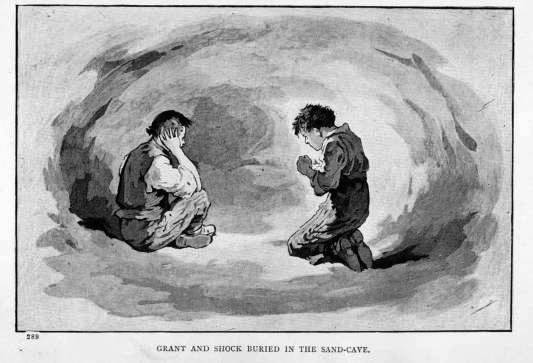
“I am saying my prayers.”
There was another silence here, and then Shock said softly:
“What yer praying for?”
“For help and protection in this terrible place,” I cried passionately; and I crouched down lower as I bowed myself and prayed that I might see the sunshine and the bright sky once again—that I might live.
Just then a hand was laid upon my shoulder, and I felt Shock’s lips almost touch my ear as he whispered softly:
“I say—I want to say my prayers too.”
“Well,” I said sternly, “pray.”
There was again that silence that seemed so painful, and then a low hoarse voice at my side said slowly:
“I can’t. I ’most forgets how.”
“Shock,” I cried, as I caught at his hands, which closed tightly and clung to mine; and for the first time it seemed to come to me that this poor half-wild boy was only different to myself in that he had been left neglected to make his way in life almost as he pleased, and that in spite of his wilful ways and half-savage animal habits it was more the want of teaching than his fault.
I seemed to feel brighter and more cheerful as we sat together soon after, discussing whether we should light the candle again, and all at once Shock exclaimed:
“I say.”
“What, Shock?”
“I won’t shy nothing at you no more.”
“It does not seem as if you will ever have the chance, Shock,” I cried dolefully.
“Oh, I don’t know, mate,” he said; and at that word “mate” I seemed to feel a curious shrinking from him; but it passed off directly.
“Shall I light the candle?” he said after a pause.
“Yes, just for one look round,” I said. “Perhaps we can find a way out.”
The candle was lit, and I started as I saw how much the sand had crept in during the time that we had been asleep. It had regularly flowed in like water, and as we held the candle down there was one place where it trickled down a slope, just as you see it in an egg-boiler or an old-fashioned hour-glass.
We looked all round; went to the spot where the hole ended in what was quite hard sandy rock. Then we looked up at the top, where we could dimly make out the crack or rift through which the smoke had gone, but there was no daylight to be seen through it, though of course it communicated with the outer air.
Then we had a look at the part where we had come in, but there the sand was loose, and we had learned by bitter experience that to touch it was only to bring down more.
“I say,” said Shock, as we extinguished the scrap of candle left, part of which had run down on Shock’s hand; “we’re shut up.”
“Shut up!” I said indignantly; “have you just found that out?”
“Well, don’t hit a fellow,” he cried. “I say, have a bit?”
“Bit of what?” I cried, as I realised how hungry I had grown.
“Taller,” he said. “Some on it run down. There ain’t much; two or three little nobbles. I’ll give yer a fair whack.”
“Why, you don’t mean to eat that, you nasty fellow,” I cried.
“Don’t!” he said; “but I do. Here’s your half. I’ve eat worse things than that.”
“Why, Shock,” I cried, as a flash of hope ran through me, “I forgot.”
“Forgot what?” he cried. “Way out?”
“No,” I said gloomily; “but my sandwiches—bread and meat Mrs Solomon cut for me.”
“Bread and meat!” he shouted. “Where is it?”
“In my jacket. I hung it on a stone in the side somewhere here. Light a match.”
Crick—crick—crack went the match; then there was a flash, and the sputtering bubbling blue flame of the sulphur, for matches were made differently in those days, when paraffin had not been dreamed of for soaking the wood.
Then the light burned up clearly, and Shock held the splint above his head, and we looked round.
“There ain’t no jacket here,” said Shock dolefully. “What did yer say bread and meat for?” he continued, as the match burned out and he threw it down. “It’s made me feel so hungry. I could eat a bit o’ you.”
“I can’t understand it, Shock,” I said.
“I wish I’d got some snails or some frogs,” he muttered. “I could eat ’em raw.”
“Don’t,” I said with a shudder.
“I knowed a chap once who eat two live frogs. Put ’em on his tongue—little uns, you know—and swallowed ’em down. He said he could feel ’em hopping about inside him after. Wasn’t he a brute?”
“Don’t talk to me,” I cried, as I went feeling about the wall, with my head in a state of confusion. “I know I had the jacket in here.”
“Have you got it on?” he said.
“No—no—no! I hung it on a bit of sharp stone that stuck out of the wall somewhere, and I can’t feel the place. It’s so puzzling being in the dark. I don’t know which is front and which is back now.”
“Front’s where the soft sand is,” said Shock.
“Of course,” I cried, feeling half stupefied all the time. “Then this is the front here. I hung it on the stone and it was just above my head.”
I walked about on the soft sand, feeling about above my head, and all over the face of the cave side for a long time in vain; and then with my head swimming I sank down in despair, and leaned heavily back, to utter a cry of pain.
“What’s matter?” cried Shock, coming to me.
“I’ve struck the back of my head against a sharp stone,” I cried, turning round to feel for the projecting piece.
“Why, it’s here, Shock. This is the piece I hung my jacket on, but it has sunk down. No, no,” I cried; “I forgot; it is the bottom of the hole that has filled up. The sand has come up all this way. Keep back.”
I had turned on my hands and knees and was tearing out the sand just below the projecting piece of sand-rock.
“What yer doing?” cried Shock. “You’ll make more come down and cover us up.”
“My jacket is buried down here,” I cried, and I worked away feeling certain that I should find it, and at last, in spite of the sand coming down almost as fast as I tore it out, I scratched and scraped away till, to my great delight, I got hold of a part of the jacket and dragged it out.
“Hurrah!” I cried. “I’ve got it.”
“And the bread and meat?” cried Shock. “Oh, give us a bit; I am so bad.”
“No,” I said despairingly.
“What! yer won’t give me a bit?” he cried fiercely.
“It isn’t here,” I said. “It was in my pocket, but it’s gone. Stop!” I cried; “it was a big packet and it must have come out.”
I plunged my arms into the soft sand again, and worked away for long, though I was ready to give up again and again, and my fingers were getting painfully sore, but I worked on, and at last, to my great delight, as I dug down something slipped slowly down on to the back of my hands—I had dug down past it, and the sand had brought it out of the side down to me.
“Here it is!” I cried, standing up and shaking the sand away from the paper as I tore it open.
Shock uttered a cry like a hungry dog as he heard the paper rustle, and then I divided the sandwiches in two parts and wrapped one back in the paper.
“What yer doin’?” cried Shock.
“Saving half for next time,” I said. “We mustn’t eat all now.”
Shock growled, but I paid no heed, and gave him half of what I had in my hands, and then putting the parcel with the rest right at the end where the sand did not fall, I sat down and we ate our gritty but welcome meal.
We tried round the place again and again, using up the candle till the wick fell over and dropped in the sand; and then first one match and then another was burned till we were compelled to give up all hope of escaping by our own efforts.
Refreshed and strengthened by the food, Shock expressed himself ready for a new trial at digging his way out.
“I can do it,” he said. “I’ll soon get through.”
Soon after he was clinging to me, hot, panting, and trembling in every limb, after narrowly escaping suffocation, and when I wanted to take up the task where he had left off, he clung to me more tightly and would not let me go from his side.
“Yer can’t do it,” he said hoarsely. “Sand comes down and smothers yer. Faster yer works, faster it comes. Let Ike bring the shovels.”
There was no other chance. I felt that, and sat down beside Shock and talked and tried to cheer him up; and when I broke down he roused up and tried to cheer me. Then I talked to him about stories I had read, where people had been buried alive, and where they were always dug out at last, and when I was weary he took his turn, showing me that in his rough way he could talk quickly and in an interesting way about catching birds and rats. How at times he had caught rats with his hands, and had been bitten by them.