"Brownsmith's Boy" (continued 4)
Reading edition
I was not afraid of them, for I was too angry for that, and nothing would have given me greater satisfaction than to have come to blows. But that would not do, I knew.
I glanced round and saw that there were plenty of people about, but they were all too busy with their own affairs to take much notice of me, so that if I wanted to free myself from the pack of young ruffians I must act for myself.
The attack went on, and I should have fared worse, only that it soon became evident that ammunition was running short; and failing this, the boys began to throw words, while the two most daring kept making rushes at me and then shrank back ready to throw themselves down if I should strike at them.
All at once I thought of Ike’s great cart-whip, and in the full confidence that I could make it crack as loudly and as well as its master I determined to give it a good whish or two in the air.
It was stuck high up in one of the staples in the front of the cart, and, determined to climb up and reach it down, I turned and raised one foot to a spoke of the great wheel, when the two foremost boys uttered a yell and made a furious onslaught upon me.
They were too late, for in an instant I had seen the object of their advance. There was no doubt about it. They were keeping my attention from what was going on upon the other side, where one of their companions had been stealing along under cover of some baskets, and was just in the act of untying one of the coils of nearly new rope, which had not been required and hung from the ladder.
The young thief had that moment finished, and slipped his arm through, catching sight of me at the same time, and darting off.
I did not stop to think. In one flash I realised that I had been left in charge of the cart, and had been so poor a sentry that I had allowed the enemy to get possession of something that I ought to have protected, and thinking of what Ike would say, and later on of Old Brownsmith, I ran off after the thief.
Chapter Sixteen.
An Exciting Chase.
But not without shouting to Shock, whom I suddenly remembered.
“Shock—Shock!” I cried; “look out for the cart.” Not that I supposed that the boys I left behind would run off with it and the old horse; but there were more coils of rope swinging from the ladder, and there were the sacks and Ike’s old coat and whip.
I thought of all this in an instant as I ran, followed by the yells of the young plunderer’s companions.
I was not far behind, but he was barefoot, used to the place, knew every inch of the ground, and while I slipped and nearly went down twice over, he ran easily and well, pad—pad—pad—pad over the stones. He doubled here and went in and out of the carts and wagons, dodged round a stack of baskets there, threaded his way easily among the people, while I tried to imitate him, and only blundered against them and got thrust aside. Then I nearly knocked over a basket of peas built up on the top of other baskets like a pillar, and at last nearly lost my quarry, for he darted in at the door of a herbalist’s shop; and as I went panting up, sure now of catching him, I suddenly awakened to the fact that there was a door on the other side out by which he had passed.
As luck had it, when I darted round I just caught sight of him disappearing behind a cabbage wagon.
This time, as he disappeared, I tried to bring a little strategy to bear, and running round another way by which I felt sure he would go, I was able to make up all my lost ground, for I came plump upon him.
“Stop, you young thief!” I panted as I made a snatch at the rope and his arm.
It was like catching at an eel. Just as I thought I had him he dodged aside, dived under a horse, and as I ran round the back of the cart, not caring to imitate his example, he was a dozen yards away, going in and out of stalls and piles of vegetables.
I lost sight of him then, and the next minute saw him watching me round a corner, when I again gave chase, hot, panting, and with a curious aching pain in my legs; but when I reached the corner he had gone, and I felt that I had lost him, and, thoroughly disheartened, did not know which way to turn. I was about to go despondently back to the cart, when, giving a final glance round, I saw him stealing away beyond some columns.
He had not seen me, and he was walking; so, keeping as much out of sight as I could, and rejoicing in the fact that I had recovered my breath, I hurried on.
All at once I heard a shrill warning cry, and looking to my right saw the two young ruffians who had been the most obnoxious, while at the same moment I saw that the warning had taken effect, the boy I chased having started off afresh.
“I will catch you,” I muttered through my teeth; and, determined not to lose sight of him again, I ran on, in and out among carts and vans, jostling and being jostled, running blindly now, for my sole thought was to keep that boy in view, and this I did the more easily now, that feeling at last that he could not escape me in the market, he suddenly crossed the road, ran in and out for a minute in what seemed like an archway, and then ran as hard as he could along a wide street and I after him.
Suddenly he turned to the right into a narrow street, and along by a great building. At the end of this he turned to the right again, past the front and nearly to the bottom of the street, when he turned to the left and followed a wide street till it became suddenly narrow, and instead of being full of people it was quite empty.
Here he darted into a covered way with columns all along the side, running very fast still, and I suppose I was too, and gradually overtaking him, but he reached the end of the street before I could come up with him, and as he turned the corner I felt quite despairing once more at seeing him pass out of sight.
It was only a matter of moments before I too turned the corner, and found myself in the dirtiest busiest street I had ever seen, with unpleasant-looking people about, and throngs of children playing over the foul pavement and in the road.
My boy seemed quite at home there and as if he belonged to the place. I noticed that as I ran after him, wondering whether it would be of any use to call to them to stop him, though if I had determined that it would be I had not the breath, as I panted on at a much slower rate now, and with the perspiration streaming down my face.
I kept losing sight of him, there were so many people grouped about the pavement along which he ran, while I kept to the road, but he went in and out among them as easily as a dog might have run, till all at once I saw him dive in amongst a number of men talking at the entrance of a narrow archway with a public-house on one side, and as I ran up I found that it was a court, down which I caught a glimpse of the boy with the rope still over his arm.
I stopped for nothing but dashed in after him, the men giving way at first, but as I blundered in my haste against one rough-looking fellow, he roared out savagely:
“Now, then, where are you running to?” and made a snatch at my collar.
I eluded him by making quite a bound in my alarm, and nearly falling over the leg of another, who thrust it out to trip me up. I escaped a fall, however, and entered the court, which seemed to be half full of children, just in time to see my boy slip into a house nearly at the bottom, on the left.
He stopped for a moment to look back to see if I was coming, and then he disappeared, and my heart gave a bound, for in my excitement I felt that I had succeeded, and that I had traced the young thief to his lair.
I did not think about anything else, only that the children all stopped their games and set up a kind of yell, while it seemed to me that the men who were at the entrance of the court were all following me slowly with their hands thrust down low in their pockets, and it struck me for the moment that they were all coming down to see the capture of the thief.
I was in happy ignorance just then that I had followed the boy into one of the vilest and most dangerous parts of London in those days,—to wit a Drury Lane court, one of the refuges of some of the worst characters in that district.
In this ignorance I was still observant, and noticed that the doors on each side of the dirty court stood wide open, while the yell set up by the children brought people to some of the open windows.
That was all seen in a glance, as I made for the open door at the end, before which a boy of my own size ran as if to stop me; but even if I had wished to stop just then I could not, and I gave him a sharp push, the weight of my body driving him back into a sitting position as I stumbled in from the pavement, up a couple of stone steps, and on to the boards of the narrow passage, which seemed, by contrast to the bright sunshine outside, quite dark.
I did not stop, but went on as if by instinct to the end, passed a flight of steps leading down to the cellar kitchen, up which came a noisome odour that turned me sick, and began to ascend the stairs before me.
Then I paused for a moment with my hand on a sticky balustrade and listened.
Yes! I was quite right, for up above me I could hear the stairs creaking as if some one was going up; and to make me the more sure that the boy had not entered a room I could hear his hoarse panting, accompanied by a faint whimpering cry, as if every moment or two he kept saying softly, “Oh!”
That satisfied me, and as fast as I could I went up one flight and then another of dirty creaking stairs and found myself on the first floor. Then up another flight, dirtier, more creaking, and with the woodwork broken away here and there.
Up another flight worse still, and by the light of a staircase window I could see that the plaster ceiling was down here and there, showing the laths, while the wall was blackened by hands passing over it. On the handrail side the balusters were broken out entirely in the most dangerous way; but all this seemed of no consequence whatever, for there was the boy still going on, evidently to the very top of the house.
All at once there was silence above me, and I thought he must have gone, but he was only listening, and as he heard me coming he uttered a faint cry, and went on up whimpering, evidently so much exhausted by the long chase that he could hardly drag himself up higher.
By this time I was up to the second floor, where there were a couple of battered doors and another staircase window nearly without glass, the broken panes being covered with paper pasted on, or else, fortunately for the inhabitants of the noisome place, left open for the air to blow through.
I ought to have stopped; in fact I ought never to have gone; but I was too much excited by my chase to think of anything but getting hold of that boy and shaking him till he dropped our new rope; and now as I began to toil breathlessly up the last flight I knew that my task was done, for my young enemy could hardly crawl, and had begun to sob and whine, and I could just make out:
“You’d best let me be—I—I—ain’t—I ain’t done—done—”
I heard no more, only that doors were being thrown open, and there was a buzz of voices below, with heavy footsteps in the passage.
Still that did not seem to have anything to do with me, so intent was I on my pursuit up those last two flights of stairs, which seemed to be steeper, more broken, and more difficult to climb than those which had gone before. In fact the boy above me was dragging himself up, and I had settled down into a walk, helping myself on by the dirty hand-rail, and panting so hoarsely that each breath came to be a snore. My heart, too, throbbed heavily, and seemed to be beating right up into my throat.
I had gained on my quarry, so that we were on the last flight together, and this gave me the requisite strength for the last climb, for I knew that he could go no further.
Half-way up and there was a sloping ceiling above, in which was a blackened skylight, across which was a string and some dirty white garments hanging to dry, while to right and to left there were doors that had been painted black for reasons full of wisdom; and as my head rose higher I saw the boy who had literally crawled up on to the landing, rise up, with the rope still upon his arm, and fling himself against the farthest of these two doors.
It flew open with a crash, and then seemed to be banged to heavily, but it was against me, for, summoning up all my remaining strength, I reached the top, and imitating the boy’s action, the door came back upon my hands, and was dashed open again.
I almost tumbled in, staggering forward, and hardly able to keep upon my legs, so that I nearly reached the middle of the room before I was aware that the boy was cowering down in a corner upon our rope, and that a big scowling stubble-chinned man had just risen dressed from a bed on which he had lain, to catch me by the shoulders in a tremendous grip, and hold me backwards panting like some newly captured bird.
I noticed that the man wore a great sleeved waistcoat, breeches, and heavy boots, and that his low forehead was puckered up into an ugly scowl, with one great wrinkle across it that seemed like another mouth as he forced me right back against the wall, and held me shivering there.
“Here, shet that there door, Polly,” he said in a low harsh growl, like the snarl of a wild beast. Then to me:
“Here, what d’yer mean a-comin’ in here, eh?”
He accompanied his words with a fierce shake that made the back of my head tap against the wall.
For a few moments the man’s savage look seemed to fascinate me, and I felt horribly alarmed, as I could think for the moment about nothing but the Ogre and Hop-o’-my-thumb, and wonder whether he was going to take out a big knife and threaten me. I was still panting and breathless with my exertions, and there was a curious pain in my legs, mingled with a sensation as if they were going to double up under me, but I made an effort to be brave as the great heavy-browed scoundrel gave me another shake, and said:—
“D’yer hear? What d’yer mean by banging into my room like that ’ere?”
I glanced at a sad-faced dull-eyed slatternly woman who had closed the door, and then at the boy, who still crouched close up under the window, whimpering like a whipped dog, but keenly watching all that was going on with his sharp restless dark eyes; then, making a determined attempt to be braver than I looked, I said as stoutly as I could:
“I want our new rope. He stole our new rope.”
“Who stole yer noo rope!” cried the fellow, giving me another shake; “what d’yer mean?”
“He took our rope off the cart in Covent Garden this morning,” I cried, feeling angry now.
“Why, he ain’t been out o’ the court this morning,” said the fellow sharply; “have yer, Micky?”
“No, father,” said the boy.
“Jest up, ain’t he, missus?” continued my captor, turning to the heavy-eyed woman.
“Yes, just up,” said the woman in a low mechanical voice, and then with more animation, “Let him go, Ned.”
“You mind yer own business,” said the fellow savagely; then to me, “Now, then, d’yer hear that?”
“I don’t care; he did,” I said firmly. “He stole our rope—that’s it, you give it me directly.”
“What! that?” he cried. “You’re a nice un, you are. Why, that’s my rope, as ’longs to my donnerkey-cart. Don’t you come lying here.”
“I tell you that’s our rope, and I saw him steal it,” I cried, growing stronger now. “You let me go, and give me my rope, or I’ll tell the police.”
“Why, you never had no rope, yer young liar!” he cried.
“It’s my master’s rope,” I said, struggling to get free. “I will have it.”
“What! yer’d steal it, would yer? Yer’d tell the polliss, would yer!” growled the fellow, tightening his grip; “I’ll soon see about that. Here you, Micky, bring that there rope here.”
The boy struggled to his feet, and came slowly to us with the rope, which the man scanned eagerly.
“I don’t want to make no mistakes,” he growled. “Let’s see it. If it’s your rope, you shall have it, but—now then! d’yer hear?”
This was to the boy, who took advantage of my helpless position to give me a couple of savage kicks in the leg as he stood there; but as he had no shoes on, the kicks did not do much harm.
“Why, o’ course it is our rope,” growled the fellow. “Gahn with you, what d’yer mean by coming here with a tale like that?”
He gave me a shake, and the woman interfered.
“Let him go, Ned,” she said, “or ther’ll be a row.”
The man took one hand from my shoulder, and doubled his great fist, which he held close to the woman’s face in a menacing way. Then turning sharply he made believe to strike me with all his might right in the mouth, when, as I flinched, he growled out with a savage grin:
“Ah! yer know’d yer deserved it. Now I dunno whether I’m going to keep yer here, or whether I shall let yer go; but whichever I does, don’t you go a sweering that this here’s your rope, a cause it’s mine. D’yer hear, mine?”
The door was kicked open at that moment, and a couple of the rough-looking fellows I had seen at the entrance to the court stood half inside, leaning against the door-posts and looking stolidly on.
I was about to appeal to them for help, but my instinct told me that such an application would be in vain, while their first words told me how right I was.
“Give it him, Ned. What’s he a-doin’ here?” said one.
“See if he’s got any tin,” said the other.
“Ah! make him pay up,” said the first.
“’Ow much have yer got, eh?” said my captor, giving me a shake, which was the signal for the boy to kick at me again with all his might.
“Gahn, will yer,” cried the man, “or I’ll wrap that rope’s end round yer.”
The woman just then made a step forward and struck at the boy, who dodged the blow, and retreated to the far end of the room, the woman shrinking away too as the man growled:
“Let him alone; will yer?”
I seized the opportunity to wrench myself partly away, and to catch hold of the rope, which the man had now beneath one of his feet.
“Ah, would yer!” he shouted, tearing the rope away from me. “Comes up here, mates, bold as brass, and says it’s his’n.”
I felt more enraged and mortified now than alarmed, and I cried out:
“It is our rope, and that boy stole it; and I’ll tell the police.”
“Oh! yer will, will yer?” cried my captor. “We’ll see about that. Here, what money have yer got?”
“I’ve only enough for my breakfast,” I cried defiantly. “Give me my rope and let me go.”
“Oh yes, I’ll let yer go,” he cried, as I wrestled to get away, fighting with all my might, and striving to reach the rope at the same moment.
“Look out, Ned,” said one of the men at the door, grinning. “He’ll be too much for yer;” and the other uttered a hoarse laugh.
“Ah, that he will!” cried the big fellow, letting me get hold of the rope, and, tightening his grasp upon my collar, he kicked my legs from under me, so that I fell heavily half across the coil, while he went down on one knee and held me panting and quivering there, perfectly helpless.
The boy made another dart forward, and I saw the woman catch at him by the head, but his shortly-cropped hair glided through her hands, and he would have reached me had not the man kicked out at him and made him stop suddenly and watch for another chance.
“Who’s got a knife?” growled the man now savagely as he turned towards the two fellows at the door; “I’ll soon show him what it is to come here a-wanting to steal our cart-ropes. Chuck that there knife here.”
He rose as he spoke, and planted one foot upon my chest. Then catching the pocket-knife thrown to him by one of the men at the door, he opened it with a great deal of show and menace, bending down to stare savagely in my eyes as he whetted the blade upon the boot resting on my chest.
Of course I was a good deal alarmed, but I knew all the while that this was all show and that the great ruffian was trying to frighten me. I was in a desperately bad state, in an evil place, but it was broad daylight, and people had seen me come in, so that I did not for a moment think he would dare to kill me. All the same, though, I could not help feeling a curious nervous kind of tremor run through my frame as he flourished the knife about and glared at me as if pondering as to what he should do next.
“I wish Ike were here,” I thought; and as I did so I could not help thinking how big and strong he was, and how little he would make of seizing this great cowardly ruffian by the throat and making him let me go.
“Now, then,” he cried, “out wi’ that there money.” For answer, I foolishly showed him where it was by clapping my hand upon my pocket, when, with a grin of satisfaction, he tore my hand away, thrust in his great fingers, and dragged it out, spat on the various coins, and thrust them in his own pocket.
“What d’yer say?” he cried, bending down again towards me.
“The police shall make you give that up,” I panted.
“Says we’re to spend this here in beer, mates,” he said, grinning, while the woman stood with her eyes half shut and her arms folded, looking on.
The two men at the door laughed.
“Now, then,” said the big fellow, “since he’s come out genteel-like with his money, I don’t think I’ll give him the knife this time. Get up with yer, and be off while your shoes are good.”
He took his great boot off my chest, and I started up.
“I wouldn’t give much for yer,” he growled, “if yer showed yer face here agen.”
He accompanied this with such a menacing look that I involuntarily shrank away, but recovering myself directly I seized the coil of rope and made for the door.
“What!” roared the great ruffian, snatching the rope, and, as I held on to it, dragging me back. “Trying to steal, are you?”
“It’s mine—it’s ours,” I cried passionately.
“Oh! I’ll soon let yer know about that,” he cried. “Look here, mates; this is our rope, ain’t it?”
“Yes,” said one of them: “I’ll swear to it.”
“It’s mine,” I cried, tugging at it angrily.
“Let go, will yer—d’yer hear; let go.”
He tugged and snatched at it savagely, and just then the boy leaped upon me, butting at me, and striking with all his might, infuriating me so by his cowardly attack, that, holding on to the rope with one hand, I swung round my doubled fist with the other and struck him with all my might.
It must have been a heavy blow right in the face, for he staggered back, caught against a chair, and then fell with a crash, howling dismally.
“Look at that, now,” cried the big ruffian. “Now he shall have it.”
“Serves him right!” said the woman passionately.
“Let the boy go, Ned, or you’ll get into trouble.”
“I’ll get into trouble for something then,” cried the fellow savagely, as he hurt me terribly by jerking the rope out of my hand and catching me by the collar, when I saw the two men at the open door look round, and I heard a familiar growl on the stairs that made my heart leap with joy.
“Ike!—Here!—Ike!” I shouted with all my might.
“Hold yer row,” hissed the great ruffian in a hoarse whisper, and clapping one hand behind my head he placed the other upon my mouth.
He dragged me round, half-choked and helpless, and then he said something over his shoulder to the woman, while I fought and struggled, and tried hard to shout again to Ike, whose heavy feet I could hear in the midst of a good deal of altercation on the stairs.
As I struggled to get free I saw that the window was opened and the rope thrown out. Then the window was quickly shut, and I was dragged towards the door.
“Here, you be off outer this,” whispered the great ruffian, with his lips close to my ear. “You cut; and don’t you—”
He stopped short, holding me tightly, and seemed to hesitate, his eyes glaring round as if in search of some place where he could hide me, not knowing what to do for the best.
“Shut the door, mates,” he said quickly; and the two men dragged the door to after them as they stood outside.
“Just you make half a sound, and—”
He put his lips close to my ear as he said this, and closed the great clasp-knife with a sharp click which made me start; while his eyes seemed to fascinate me as he bent down and glared at me.
It was only for a moment, though, and then I managed to slip my face aside and shouted aloud:
“Ike!”
There was a rush and a scuffle outside, and the woman said in an ill-used tone:
“I told yer how it would be.”
“You hold—”
He did not finish, for just then one of the men outside growled—plainly heard through the thin door:
“Now, then, where are yer shovin’ to?”
“In here,” roared a voice that sent a thrill of joy through me.
“Now, then, what d’yer want?” cried the big fellow, thrusting me behind him as Ike kicked open the door and strode into the room.
“What do I want?” he roared. “I want him and our cart-rope. Now, then, where is it?”
There was a fierce muttering among the men, and they drew together while the boy and the woman cowered into one corner of the attic.
“Oh! you’re not going to scare me,” cried Ike fiercely. “There’s the police just at hand if I wants help. Now then, where’s that rope?”
“What rope?” growled the ruffian. “I don’t know about no ropes.”
“They threw it out of the window, Ike,” I cried.
“That’s a lie,” snarled the man. “There ain’t never been no ropes here.”
“There has been one,” I cried, feeling bold now; “but they threw it out of the window.”
“Well, of all—” began one of the men, who had crossed the room with his companion to the big ruffian’s side.
“You go on down, my lad,” whispered Ike in a low deep voice. “Go on, now.”
“But are you coming?” I whispered back.
“You may depend on that,” he said, as if to himself, “if they’ll let me. Go on.”
I moved towards the open door, when one of the men made a dash to stop me; but Ike threw put one leg, and he fell sprawling. At the same moment my enemy made a rush at Ike, who stepped back, and then I saw his great fist fly out straight. There was a dull, heavy sound, and the big ruffian stopped short, reeled, and then dropped down upon his hands and knees.
“Quick, boy, quick! You go first,” whispered Ike, as I stopped as if paralysed; “I’ll foller.”
His words roused me, and I ran out of the room.
Chapter Seventeen.
What Became of the Rope.
I nearly fell headlong down as I reached the stairs, for my foot went through a hole in the boards, but I recovered myself and began to run down as fast as I dared, on account of the rickety state of the steps, while Ike came clumping down after me, and we could hear the big ruffian’s voice saying something loudly as we hurried from flight to flight.
There were knots of women on the different landings and at the bottom of the stairs, and they were all talking excitedly; but only to cease and look curiously at us as we went by.
There was quite a crowd, too, of men, women, and children in the court below as we left the doorway; but Ike’s bold manner and the decided way in which he strode out with me, looking sharply from one to the other, put a stop to all opposition, even if it had been intended.
There were plenty of scowling, menacing looks, and there was a little hooting from the men, but they gave way, and in another minute we were out of the court and in the dirty street, with a troop of children following us and the people on either side looking on.
“But, Ike,” I said in a despairing tone, “we haven’t got the rope after all.”
“No,” he said; “but I’ve got you out o’ that place safe, and I haven’t got much hurt myself, and that’s saying a deal. Talk about savages and wild beasts abroad! why, they’re nothing.”
“I didn’t see any policemen, Ike,” I said, as I thought of their power.
“More didn’t I,” he replied with a grim smile. “They don’t care much about going down these sort o’ places; no more don’t I. We’re well out of that job, my lad. You didn’t ought to have gone.”
“But that boy was running off with the best cart rope, Ike,” I said despondently, “and I was trying to get it back, and now it’s gone. What will Mr Brownsmith say?”
“Old Brownsmith won’t say never a word,” said Ike, as we trudged on along a more respectable street.
“Oh, but he will,” I cried. “He is so particular about the ropes.”
“So he be, my lad. Here, let’s brush you down; you’re a bit dirty.”
“But he will,” I said, as I submitted to the operation.
“Not he,” said Ike. “Them police is in the right of it. I’m all of a shiver, now that bit of a burst’s over;” and he wiped his brow.
“You are, Ike?” I said wonderingly.
“To be sure I am, my lad. I was all right there, and ready to fight; but now it’s over and we’re well out of it, I feel just as I did when the cart tipped up and all the baskets come down atop of you.”
“I am glad you feel like that,” I said.
“Why?” he cried sharply.
“Because it makes me feel that I was not such a terrible coward after all.”
“But you were,” he said, giving me a curious look. “Oh, yes: about as big a coward as ever I see.”
I did not understand why I was so very great a coward, but he did not explain, and I trudged on by him.
“I say, what would you have done if I hadn’t come?”
“I don’t know,” I said. “I suppose they would have let me go at last. They got all my money.”
“They did?”
“Yes,” I said dolefully; “and then there’s the rope. What will Mr Brownsmith say?”
“Nothin’ at all,” said Ike.
“But he will,” I cried again.
“No he won’t, because we’ll buy a new one ’fore we goes back.”
“I thought of that,” I said, “but I’ve no money now.”
“Oh, all right! I have,” he said. “We may think ourselves well out of a bad mess, my lad; and I don’t know as we oughtn’t to go to the police, but we haven’t no time for that. There’ll be another load o’ strawb’ys ready by the time we get back, and I shall have to come up again to-night. Strawb’ys sold well to-day. No: we’ve no time for the police.”
“They deserve to be taken up,” I said.
“Ay, they do, my boy; but folks don’t get all they deserve.”
“Or I should be punished for letting that boy steal the rope.”
“Hang the rope!” he said crustily. “I mean, hang the boy or his father, and that’s what some of ’em’ll come to,” he cried grimly, “if they don’t mind. They’re a bad lot down that court. Lor’ a mussy me! I’d sooner live in one of our sheds on some straw, with a sack for a pillow, than be shut up along o’ these folk in them courts.”
“But they wouldn’t have hurt me, Ike?” I said.
“I dunno, my lad. P’r’aps they would, p’r’aps they wouldn’t. They might have kept you and made a bad un of yer. Frightened you into it like.”
I shook my head.
“Ah! you don’t know, my lad. How much did they get?”
“Two shillings and ninepence halfpenny,” I said dolefully.
“And a nearly new rope. Ah, it’s a bad morning’s work for your first journey.”
“It is, Ike,” I said; “but I didn’t know any better. How did you know where I was?”
“How did I know? Why, Shock saw you and followed you, and come back and fetched me, when I was staring at the cart and wondering what had gone of you two.”
“Where is he now?” I asked.
“What, Shock? Oh, I don’t know. He’s a queer chap. P’r’aps they’ve got him instead of you.”
I stopped short and looked at him, but saw directly that he was only joking, and went on again:
“You don’t think that,” I said quickly; “for if you did you would not have come away. Do you think he has gone back to the cart?”
“Oh, there’s no knowing,” he replied. “P’r’aps when we get back there won’t be any cart; some one will have run away with it. They’re rum uns here in London.”
“Why, you haven’t left the cart alone, Ike,” I cried.
“That’s a good one, that is,” he exclaimed. “You haven’t left the cart alone! Why, you and Shock did.”
“Yes,” I said; “but—”
“There, come and let’s see,” he said gruffly. “We should look well, we two, going back home without a cart, and old Bonyparty took away and cut up for goodness knows what and his skin made into leather. Come along.”
We walked quickly, for it seemed as if this was going to be a day all misfortunes; but as we reached the market again I found that Ike had not left the cart untended, for a man was there by the horse, and the big whip curved over in safety from where it was stuck.
“Seen anything of our other boy?” said Ike as we reached the cart.
“No,” was the reply.
“Hadn’t we better go back and look for him?” I said anxiously.
“Well, I don’t know,” said Ike, rubbing one ear; “he ain’t so much consequence as you.”
“I’ve been to Paris and I’ve been to Do-ho-ver.”
“Why, there he is,” I cried; and, climbing up the wheel, there lay Shock on his back right on the top of the baskets, and as soon as he saw my face he grinned and then turned his back.
“He’s all right,” I said as I descended; and just then there was a creaking noise among the baskets, and Shock’s head appeared over the edge.
“Here y’are,” he cried. “That there tumbled out o’ window, and I ketched it and brought it here.”
As he spoke he threw down the coil of nearly new rope, and I felt so delighted that I could have gone up to him and shaken hands.
“Well, that’s a good un, that is,” said Ike with a chuckle. “I am ’bout fine and glad o’ that.”
He took the rope and tied it up to the ladder again, and then turned to me.
“Come along and get some breakfast, my lad,” he said. “I dessay you’re fine and hungry.”
“But how about Shock?”
“Oh, we’ll send him out some. Here, you, Shock, look after the cart and horse. Don’t you leave ’em,” Ike added to the man; and then we made our way to a coffee-house, where Ike’s first act, to my great satisfaction, was to procure a great mug of coffee and a couple of rolls, which he opened as if they had been oysters, dabbed a lump of butter in each, and then put under his arm.
“He don’t deserve ’em,” he growled, “for coming; but he did show me where you was.”
“And he saved the rope,” I said.
Ike nodded.
“You sit down till I come back, my lad,” he said; and then he went off, to return in a few minutes to face me at a table where we were regaled with steaming coffee and grilled haddocks.
“This is the best part of the coming to market, my lad,” he said, “only it’s a mistake.”
“What is?” I asked.
“Haddocks, my lad. They’re a trickier kind o’ meat than bloaters. I ordered this here for us ’cause it seemed more respectable like, as I’d got company, than herrin’; but it’s a mistake.”
“But this is very nice,” I said, beginning very hungrily upon the hot roll and fish, but with a qualm in my mind as to how it was to be paid for.
“Ye–es,” said Ike, after saying “soup” very loudly as he took a long sip of his coffee; “tidyish, my lad, tidyish, but you see one gets eddicated to a herring, and knows exactly where every bone will be. These things seems as if the bones is all nowhere and yet they’re everywhere all the time, and so sure as you feel safe and take a bite you find a sharp pynte, just like a trap laid o’ purpose to ketch yer.”
“Well, there are a good many little bones, certainly,” I said.
“Good many! Thick as slugs after a shower. There’s one again, sharp as a needle. Wish I’d a red herrin’, that I do.”
“I say, Ike,” I said suddenly, as I was in the middle of my breakfast, “I wish I could make haste and grow into a man.”
“Do you, now?” he said with a derisive laugh. “Ah! I shouldn’t wonder. If you’d been a man I s’pose you’d have pitched all those rough uns out o’ window, eh?”
“I should have liked to be able to take care of myself,” I said.
“Without old Ike, eh, my lad?”
“I don’t mean that,” I said; “only I should like to be a man.”
“Instead o’ being very glad you’re a boy with everything fresh and bright about you. Red cheeks and clean skin and all your teeth, and all the time to come before you, instead of having to look back and think you’re like an old spade—most wore out.”
“Oh, but you’re so strong, Ike! I should like to be a man.”
“Like to be a boy, my lad, and thank God you are one,” said old Ike, speaking as I had never heard him speak before. “It’s natur’, I s’pose. All boys wishes they was men, and when they’re men they look back on that happiest time of their lives when they was boys and wishes it could come over again.”
“Do they, Ike?” I said.
“I never knew a man who didn’t,” said Ike, making the cups dance on the table by giving it a thump with his fist. “Why, Master Grant, I was kicked about and hit when I was a boy more’n ever a boy was before, but all that time seems bright and sunshiny to me.”
“But do you think Shock’s happy?” I said; “he’s a boy, and has no one to care about him.”
“Happy! I should just think he is. All boys has troubles that they feels bad at the time, but take ’em altogether they’re as happy as can be. Shock’s happy enough his way or he wouldn’t have been singing all night atop of the load. There, you’re a boy, and just you be thankful that you are, my lad; being a boy’s about as good a thing as there is.”
We had nearly finished our breakfast when Ike turned on me sharply.
“Why, you don’t look as if you was glad to be a boy,” he said.
“I was thinking about what Mr Brownsmith will say when he knows I’ve been in such trouble,” I replied.
“Ah, he won’t like it! But I suppose you ain’t going to tell him?”
“Yes,” I said, “I shall tell him.”
Ike remained silent for a few minutes, and sat slowly filling his pipe.
At last, as we rose to go, after Ike had paid the waitress, he said to me slowly:
“Sometimes doing right ain’t pleasant and doing wrong is. It’s quite right to go and tell Old Brownsmith and get blowed up, and it would be quite wrong not to tell him, but much the nystest. Howsoever, you tell him as soon as we get back. He can’t kill yer for that, and I don’t s’pose he’ll knock yer down with the kitchen poker and then kick you out. You’ve got to risk it.”
I did tell Old Brownsmith all my trouble when we reached home, and he listened attentively and nodding his head sometimes. Then he said softly, “Ah!” and that was all.
But I heard him scold Master Shock tremendously for going off from his work without leave.
Shock had been looking on from a distance while I was telling Old Brownsmith, and this put it into his head, I suppose, that I had been speaking against him, for during the next month he turned his back whenever he met me, and every now and then, if I looked up suddenly, it was to see him shaking his fist at me, while his hair seemed to stand up more fiercely than ever out of his crownless straw hat like young rhubarb thrusting up the lid from the forcing-pot put on to draw the stalks.
Chapter Eighteen.
The Gardener Surgeon.
“People sneer at gardening and gardeners, Grant,” said the old gentleman to me one day. “Perhaps you may take to some other occupation when you grow older; but don’t you never be ashamed of having learned to be a gardener.”
“I’m sure I never shall,” I said.
“I hope you will not, my boy, for there’s something in gardening and watching the growth of trees and plants that’s good for a lad’s nature; and if I was a schoolmaster I’d let every boy have a garden, and make him keep it neat. It would be as good a lesson as any he could teach.”
“I like gardening more and more, sir,” I said.
“That’s right, my boy. I hope you do, but you’ve a deal to learn yet. Gardening’s like learning to play the fiddle; there’s always something more to get hold of than you know. I wish I had some more glass.”
“I wish you had, sir,” I said.
“Why, boy?—why?” he cried sharply.
“Because you seem as if you’d like it, sir,” I said, feeling rather abashed by his sharp manner.
“Yes, but it was so that I should be able to teach you, sir. But wait a bit, I’ll talk to my brother one of these days.”
Time glided on, and as I grew bigger and stronger I used now and then to go up with Ike to the market. He would have liked me to go every time, but Mr Brownsmith shook his head, and would only hear of it in times of emergency.
“Not a good task for you, Grant,” he used to say. “I want you at home.”
We were down the garden one morning after a very stormy night, when the wind had been so high that a great many of the fruit-trees had had their branches broken off, and we were busy with ladder, saw, and knife, repairing damages.
I was up the ladder in a fine young apple-tree, whose branch had been broken and was hanging by a few fibres, and as soon as I had fixed myself pretty safely I began to cut, while when I glanced down to see if Old Brownsmith was taking any notice I saw that he was smiling.
“Won’t do—won’t do, Grant,” he said. “Cutting off a branch of a tree that has been broken is like practising amputation on a man. Cut lower, boy.”
“But I wanted to save all that great piece with those little boughs,” I said.
“But you can’t, my lad. Now just look down the side there below where you are cutting, and what can you see?”
“Only a little crack that will grow up.”
“Only a little crack that won’t grow up, Grant, but which will admit the rain, and the wet will decay the tree; and that bough, at the end of two or three years, instead of being sound and covered with young shoots, will be dying away. A surgeon, when he performs an amputation, cuts right below the splintered part of the bone. Cut three feet lower down, my lad, and then pare all off nice and smooth, just as I showed you over the pruning.
“That’s the way,” he said, as he watched me. “That’s a neat smooth wound in the tree that will dry up easily after every shower, and nature will send out some of her healing gum or sap, and it will turn hard, and the bark, just as I showed you before, will come up in a new ring, and swell and swell till it covers the wood, and by and by you will hardly see where the cut was made.”
I finished my task, and was going to shoulder the ladder and get on to the next tree, when the old gentleman said in his quaint dry way:
“You know what the first workman was, Grant?”
“Yes,” I said, “a gardener.”
“Good!” he said. “And do you know who was the first doctor and surgeon?”
“No,” I said.
“A gardener, my boy, just as the men were who first began to improve the way in which men lived, and gave them fruit and corn and vegetables to eat, as well as the wild creatures they killed by hunting.”
“Oh, yes!” I said, “I see all that, but I don’t see how the first doctor and surgeon could have been a gardener.”
“Don’t you?” he said, laughing silently. “I do. Who but a gardener would find out the value of the different herbs and juices, and what they would do. You may call him a botanist, my lad, but he was a gardener. He would find out that some vegetables were good for the blood at times, and from that observation grew the whole doctrine of medicine. That’s my theory, my boy. Now cut off that pear-tree branch.”
I set the ladder right, and proceeded to cut and trim the injury, thinking all the while what a pity it was that the trees should have been so knocked about by the storm.
“Do you know who were the best gardeners in England in the olden times, Grant?” said the old gentleman as he stood below whetting my knife.
“No, sir,—yes, I think I do,” I hastened to add—“the monks.”
“Exactly. We have them to thank for introducing and improving no end of plants and fruit-trees. They were very great gardeners—famous gardeners and cultivators of herbs and strange flowers, and it was thus that they, many of them, became the doctors or teachers of their district, and I’ve got an idea in my head that it was on just such a morning as this that some old monk—no, he must have been a young monk, and a very bold and clever one—here, take your knife, it’s as sharp as a razor now.”
I stooped down and took the knife, and hanging my saw from one of the rounds of the ladder began to cut, and the old gentleman went on:
“It must have been after such a morning as this, boy, that some monk made the first bold start at surgery.”
I looked down at him, and he went on:
“You may depend upon it that during the storm some poor fellow had been caught out in the forest by a falling limb of a tree, one of the boughs of which pinned him to the ground and smashed his leg.”
“An oak-tree,” I said, quite enjoying the fact that he was inventing a story.
“No, boy, an elm. Oak branches when they break are so full of tough fibre that they hang on by the stump. It is your elm that is the treacherous tree, and snaps short off, and comes down like thunder.”
“An elm-tree, then,” I said, paring away.
“Yes, a huge branch of an elm, and there the poor fellow lay till some one heard his shouts, and came to his help.”
“Where he would be lying in horrible agony,” I said, trimming away at the bough.
“Wrong again, Grant. Nature is kinder than that. With such an injury the poor fellow’s limb would be numbed by the terrible shock, and possibly he felt but little pain. I knew an officer whose foot was taken off in a battle in India. A cannon-ball struck him just above the ankle, and he felt a terrible blow, but it did not hurt him afterwards for the time; and all he thought of was that his horse was killed, till he began to struggle away from the fallen beast, when he found that his own leg was gone.”
“How horrible!” I said.
“All war is horrible, my boy,” he said gravely. “Well, to go on with my story. I believe that they came and hoisted out the poor fellow under the tree, and carried him up to the old priory to have his broken leg cured by one of the monks, who would be out in his garden just the same as we are, Grant, cutting off and paring the broken boughs of his apple and pear trees. Then they laid him in one of the cells, and his leg was bound up and dressed with healing herbs, and the poor fellow was left to get well.”
“And did he?” I said.
“Then the gardener monk went out into the garden again and continued to trim off the broken branches, sawing these and cutting those, and thinking all the while about his patient in the cell.
“Then the next day came, and the poor fellow’s relatives ran up to see him, and he was in very great agony, and they called upon the monks to help him, and they dressed the terrible injury again, and the poor fellow was very feverish and bad in spite of all that was done. But at last he dropped off into a weary sleep, and the poor people went away thinking what a great thing it was to have so much knowledge of healing, while, as soon as they had gone the monk shook his head.
“Next day came, and the relatives and friends were delighted, for the pain was nearly all gone, and the injured man lay very still.
“‘He’ll soon get well now,’ they said; and they went away full of hope and quite satisfied; but the monk, after he had given the patient some refreshing drink, went out into his garden among his trees, and then after walking about in the sunny walk under the old stone wall, he stopped by the mossy seat by the sun-dial, and stood looking down at the gnomon, whose shadow marked the hours, and sighed deeply as he thought how many times the shadow would point to noon before his poor patient was dead.”
“Why, I thought he was getting better,” I said.
“Carry your ladder to the next tree, Grant,” said the old gentleman, “and you shall work while I prattle.”
I obeyed him, and this time I had a great apple-tree bough to operate upon with the thin saw. I began using the saw very gently, and listening, for I seemed to see that monk in his long grey garment, and rope round his waist, looking down at the sun-dial, when Old Brownsmith went on slowly:
“He knew it could not be long first, for the man’s leg was crushed and the bone splintered so terribly that it would never heal up, and that the calm sense of comfort was a bad sign, for the limb was mortifying, and unless that mortification was stopped the man must die.”
“Poor fellow!” I ejaculated, for the old man told the story with such earnestness that it seemed to be real.
“Yes, poor fellow! That is what the monk said as he thought of all the herbs and decoctions he had made, and that not one of them would stop the terrible change that was going on. He felt how helpless he was, and at last, Grant, he sat down on the mossy old stone bench, and covering his face with his hands, cried like a child.”
“But he was a man,” I said.
“Yes, my lad; but there are times when men are so prostrated by misery and despair that they cry like women—not often—perhaps only once or twice in a man’s life. My monk cried bitterly, and then he jumped up, feeling ashamed of himself, and began walking up and down. Then he went and stood by the great fish stew, where the big carp and tench were growing fatter as they fed by night and basked in the sunshine among the water weeds by day; but no thought came to him as to how he could save the poor fellow lying in the cell.”
Old Brownsmith stopped to blow his nose on a brown-and-orange silk handkerchief, and stroke two or three cats, while I sawed away very slowly, waiting for what was to come.
“Then he went round by where one apple-tree, like that, had lost a bough, and whose stump he had carefully trimmed—just as you are going to trim that, Grant.”
“I know,” I cried, eagerly; “and then—”
“You attend to your apple-tree, sir, and let me tell my story,” he said, half gruffly, half in a good-humoured way, and I sawed away with my thin saw till I was quite through, and the stump I had cut off fell with such a bang that the cats all jumped in different directions, and then stared back at the stump with dilated eyes, till, seeing that there was no danger, one big Tom went and rubbed himself against it from end to end, and the others followed suit.
“All at once, as he stood staring at the broken tree, an idea flashed across his brain, Grant.”
“Yes,” I said, pruning-knife in hand.
“He knew that if he had not cut and trimmed off that branch the limb would have gone on decaying right away, and perhaps have killed the tree.”
“Yes, of course,” I said, still watching him.
“Isn’t your knife sharp enough, my lad?” said Old Brownsmith dryly.
“Yes, sir,” I said; and I went on trimming. “Well, he thought that if this saved the tree, why should it not save the life of the man?” and he grew so excited that he went in at once and had a look at the patient, and then went in to the prior, who shook his head.
“‘Poor fellow,’ he said; ‘he will die.’
“‘Yes,’ said the young monk, ‘unless—’
“‘Unless—’ said the prior.
“‘Yes, unless,’ said the young monk; and he horrified the prior by telling him all his ideas, while the other monks shook their heads.
“‘It could not be done,’ they said. ‘It would be too horrible.’
“‘There is no horror in performing an act like that to save a man’s life,’ said the young monk; ‘it is a duty.’
“‘But it would kill the poor fellow,’ they chorused.
“‘He will die as it is,’ said the young monk. ‘You said as much when I came in, and I am sure of it.’
“‘Yes,’ said the prior sadly, ‘he will die.’
“‘This might save his life,’ said the young monk; but the old men shook their heads.
“‘Such a thing has never been done,’ they said. ‘It is too horrible.’
“‘And even if it saved his life he would only have one leg.’
“‘Better have no legs at all,’ said the young monk, ‘than die before his time.’
“‘But it would be his time,’ said the old monks.
“‘It would not be his time if I could save his life,’ said the young monk.
“But still the old monks shook their heads, and said that no man had ever yet heard of such a thing. It was too terrible to be thought of, and they frowned very severely upon the young monk till the prior, who had been very thoughtful, exclaimed:—
“‘And cutting the limb off the apple-tree made you think that?’
“The young monk said that it was so.
“‘But a man is not an apple-tree,’ said the oldest monk present; and all the others shook their heads again; but, oddly enough, a few minutes later they nodded their heads, for the prior suddenly exclaimed:—
“‘Our brother is quite right, and he shall try.’
“There was a strange thrill ran through the monks, but what the prior said was law in those days, Grant, and in a few minutes it was known all through the priory that Brother Anselm was going to cut off the poor swineherd’s leg.
“Then—I say, my boy, I wish you’d go on with your work. I can’t talk if you do not,” said Old Brownsmith, with a comical look at me, and I went on busily again while he continued his story.
“When Brother Anselm had obtained the prior’s leave to try his experiment he felt nervous and shrank from the task. He went down the garden and looked at the trees that he had cut, and he felt more than ever that a man was, as the monks said, not an apple-tree. Then he examined the places which looked healthy and well, and he wondered whether if he performed such an operation on the poor patient he also would be healthy and well at the end of a week, and he shook his head and felt nervous.”
“If you please, Mr Brownsmith,” I said, “I can’t go on till you’ve done, and I must hear the end.”
He chuckled a little, and seating himself on a bushel basket which he turned upside down, a couple of cats sprang in his lap, another got on his shoulder, and he went on talking while I thrust an arm through one of the rounds of the ladder, and leaned back against it as he went on.
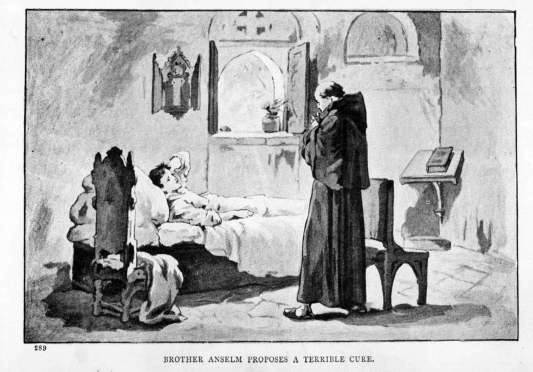
“Well, Grant,” he said, “Brother Anselm felt sorry now that he had leave to perform his experiment, and he went slowly back to the cell and talked to the poor swineherd, a fine handsome, young man with fair curly brown hair and a skin as white as a woman’s where the sun had not tanned him.
“And he talked to him about how he felt; and the poor fellow said he felt much better and much worse—that the pain had all gone, but that he did not think he should ever be well any more.
“This set the brother thinking more and more, but he felt that he could do nothing that day, and he waited till the next, lying awake all night thinking of what he would do and how he would do it, till the cold time about sunrise, when he had given up the idea in despair. But when he saw the light coming in the east, with the glorious gold and orange clouds, and then the bright sunshine of a new day, he began to think of how sad it would be for that young man, cut down as he had been in a moment, to be left to die when perhaps he might be saved. He thought, too, about trees that had been cut years before, and which had been healthy and well ever since, and that morning, feeling stronger in his determination, he went to the cell where the patient lay, to talk to him, and the first thing the poor fellow said was:—
“‘Tell me the truth, please. I’m going to die, am I not?’
“The young monk was silent.
“‘I know it,’ said the swineherd sadly. ‘I feel it now.’
“Brother Anselm looked at him sadly for a few minutes and then said to him:—
“‘I must not deceive you at such a time—yes; but one thing might save your life.’
“‘What is that?’ cried the poor fellow eagerly; and he told him as gently as he could of the great operation, expecting to see the patient shudder and turn faint.
“‘Well,’ he said, when the monk had ended, ‘why don’t you do it?’
“‘But would you rather suffer that—would you run the risk?’
“‘Am I not a man?’ said the poor fellow calmly. ‘Yes: life is very sweet, and I would bear any pain that I might live.’
“That settled the matter, and the monk went out of the cell to shut himself up in his own and pray for the space of two hours, and the old monks said that it was all talk, and that he had given up his horrible idea; but the prior knew better, and he was not a bit surprised to see Anselm coming out of his cell looking brave, and calm, and cool.
“Then he took a bottle of plant juice that he knew helped to stop bleeding, and he got ready his bandages, and his keenest knives, and his saw, and a bowl of water, and then he thought for a bit, and ended by asking the monks which of them would help him, but they all shrank away and turned pale, all but the prior, who said he would help, and then they went into the poor fellow’s cell.”
Old Brownsmith stopped here, and kept on stroking one of the cats for such a long time, beginning at the tip of his nose and going right on to the end of his tail, that I grew impatient.
“And did he perform the operation?” I said eagerly.
“Yes, bravely and well, but of course very clumsily for want of experience. He cut off the leg, Grant, right above where the bone was splintered, and all the terrible irritation was going on.”
“And the poor fellow died after all?” I said.
“No, he did not, my lad; it left him terribly weak and he was very low for some days, but he began to mend from the very first, and I suppose when he grew well and strong he had to make himself a wooden leg or else to go about with a crutch. About that I know nothing. There was the poor fellow dying, and there was a gardener who knew that if the broken place were cut Nature would heal it up; for Nature likes to be helped sometimes, my boy, and she is waiting for you now.”
“Yes, sir, I’ll do it directly,” I said, glancing at the stump I had sawn off, and thinking about the swineherd’s leg, and half-wondering that it did not bleed; “but tell me, please, is all that true?”
“I’m afraid not, Grant,” he said smiling; “but it is my idea—my theory about how our great surgeons gained their first knowledge from a gardener; and if it is not true, it might very well be.”
“Yes,” I said, looking at him wonderingly as he smoothed the fur of his cats and was surrounded by them, rubbing themselves and purring loudly, “but I did not know you could tell stories like that.”
“I did not know it myself, Grant, till I began, and one word coaxed out another. Seriously, though, my boy, there is nothing to be ashamed of in being a gardener.”
“I’m not ashamed,” I said; “I like it.”
“Gardeners can propagate and bring into use plants that may prove to be of great service to man; they can improve vegetables and fruits—and when you come to think of what a number of trees and plants are useful, you see what a field there is to work in! Why, even a man who makes a better cabbage or potato grow than we have had before is one who has been of great service to his fellow-creatures. So work away; you may do something yet.”
“Yes,” I cried, “I’ll work away and as hard as I can; but I begin to wish now that you had some glass.”
“So do I,” said the old gentleman.
“There!” I said, coming down the ladder, “I think that will heal up now, like the poor swineherd’s leg. It’s as smooth as smooth.”
“Let me look,” said a voice behind me; and I started with surprise to find myself face to face with a man who seemed to be Old Brownsmith when he was, if not Young Brownsmith, just about what he would have been at forty.
Chapter Nineteen.
Brother Solomon.
The new-comer went slowly up the ladder, looked at my work, and then took out a small knife with a flat ivory handle, came down again, stropped the knife on his boot, went up, and pared my stump just round the edge, taking off a very thin smooth piece of bark.
“Good!” he said as he wiped his knife, came down, and put the knife away; “but your knife wanted a touch on a bit o’ Turkey-stone. How are you, Ezra?”
Old Brownsmith set down some cats gently, got up off the bushel basket slowly, and shook hands.
“Fairly, Solomon, fairly; and how are you?”
“Tidy,” said the visitor, “tidy;” and he stared very hard at me. “This is him, is it?”
“Yes, this is he, Solomon. Grant, my lad, this is my brother Solomon.”
I bowed after the old fashion taught at home.
“Shake hands. How are you?” said Mr Solomon; and I shook hands with him and said I was quite well, I thanked him; and he said, “Hah!”
“He has just come up from Hampton, Grant—from Sir Francis Linton’s. He’s going to take you back.”
“Take me back, sir!” I said wonderingly. “Have—have I done anything you don’t like?”
“No, my lad, no—only I’ve taught you all I can; and now you will go with him and learn gardening under glass—to grow peaches, and grapes, and mushrooms, and all kinds of choice flowers.”
I looked at him in a troubled way, and he hastened to add:
“A fine opportunity for you, my boy. Brother Solomon is a very famous gardener and takes prizes at the shows.”
“Oh! as to that,” said Brother Solomon, “we’re not much. We do the best we can.”
“Horticultural medals, gold and bronze,” said Old Brownsmith, smiling. “There!—you’ll have to do so as well, Grant, my lad—you will have to do me credit.”
I crept close to him and half-whispered:
“But must I go, sir?”
“Yes, my lad, it is for your benefit,” he said rather sternly; and I suppose I gave him such a piteous look that his face softened a little and he patted my shoulder. “Come,” he said, “you must be a man!”
I seemed to have something in my throat which I was obliged to swallow; but I made an effort, and after a trial or two found that I could speak more clearly.
“Shall I have to go soon, sir?”
“Yes: now,” said Old Brownsmith.
“Not till I’ve had a look round,” said Brother Solomon in a slow meditative way, as he took out a handkerchief and wiped his hands, staring about him at the trees and bushes, and then, as a cat gave a friendly rub against his leg, he stooped down after the fashion of his brother, picked it up, and held it on his arm, stroking it all the time.
I had not liked the look of Brother Solomon, for he seemed cold, and quiet, and hard. His face looked stiff, as if he never by any chance smiled; and it appeared to me as if I were going from where I had been treated like a son to a home where I should be a stranger.
“Yes,” he said after looking about him, as if he were going to find fault, “I sha’n’t go back just yet awhile.”
“Oh no! you’ll have a snap of something first, and Grant here will want a bit of time to pack up his things.”
Old Brownsmith seemed to be speaking more kindly to me now, and this made me all the more miserable, for I had felt quite at home; and though Shock and I were bad friends, and Ike was not much of a companion, I did not want to leave them.
Old Brownsmith saw my looks, and he said:
“You will run over now and then to see me and tell me how you get on. Brother Solomon here never likes to leave his glass-houses, but you can get away now and then. Eh, Solomon?”
“P’r’aps,” said Brother Solomon, looking right away from us. “We shall see.”
My heart sank as I saw how cold and unsympathetic he seemed. I felt that I should never like him, and that he would never like me. He had hardly looked at me, but when he did there was to me the appearance in his eyes of his being a man who hated all boys as nuisances and to make matters worse, he took his eyes off a bed of onions to turn them suddenly on his brother and say:
“Hadn’t he better go and make up his bundle?”
“Yes, to be sure,” said Old Brownsmith. “Go and tell Mrs Dodley you want your clean clothes, my boy; and tell her my brother Solomon’s going to have a bit with us.”
“And see whether your boy has given my horse his oats, will you?” said Brother Solomon.
I went away, feeling very heavy-hearted, and found Shock in the stable, in the next stall to old Basket, watching a fine stoutly-built cob that had just been taken out of a light cart. The horse’s head-stall had been taken off, and a halter put on; and as he munched at his oats, Shock helped him, munching away at a few that he took from one hand.
I was in so friendly a mood to every one just then that I was about to go up and shake hands with Shock; but as soon as he saw me coming he dived under the manger, and crept through into old Basket’s stall, and then thrust back his doubled fist at me, and there it was being shaken menacingly, as if he were threatening to punch my head.
This exasperated me so that in an instant the honey within me was turned to vinegar, and I made a rush round at him, startling our old horse so that he snorted and plunged; but I did not catch Shock, for he dived back through the hole under the manger into the next stall. Then on under the manger where Brother Solomon’s horse was feeding, making him start back and nearly break his halter, while Shock went on into the third stall, disturbing a hen from the nest she had made in the manger, and sending her cackling and screaming out into the yard, where the cock and the other hens joined in the hubbub.
As I ran round to the third stall I was just in time to see Shock’s legs disappearing, as he climbed up the perpendicular ladder against the wall, and shot through the trap-door into the hay-loft.
“You shall beg my pardon before I go,” I said between my teeth, as I looked up, and there was his grubby fist coming out of the hole in the ceiling, and being shaken at me.
I rushed at the ladder, and had ascended a couple of rounds, when bang went the trap-door, and there was a bump, which I knew meant that Shock had seated himself on the trap, so that I could not get it up.
“Oh, all right!” I said aloud. “I sha’n’t come after you, you dirty old grub. I’m going away to-day, and you can shake your fist at somebody else.”
I had satisfied myself that Brother Solomon’s horse was all right, so I now strode up to the house and told Mrs Dodley to spread the table for a visitor, and said that I should want my clean things as I was going away.
“What! for a holiday?” she said.
“No; I’m going away altogether,” I said.
“I know’d it,” she cried angrily; “I know’d it. I always said it would come to that with you mixing yourself up with that bye. A nasty dirty hay-and-straw-sleeping young rascal, as is more like a monkey than a bye. And now you’re to be sent away.”
“Yes,” I said grimly; “now I’m to be sent away.”
She stood frowning at me for a minute, and then took off her dirty apron and put on a clean one, with a good deal of angry snatching.
“I shall just go and give Mr Brownsmith a bit of my mind,” she said. “I won’t have you sent away like that, and all on account of that bye.”
“No, no,” I said. “I’m going away with Mr Brownsmith’s brother, to learn all about hothouses I suppose.”
“Oh, my dear bye!” she exclaimed. “You mustn’t do that. You’ll have to be stoking and poking all night long, and ketch your death o’ cold, and be laid up, and be ill-used, and be away from everybody who cares for you, and and I don’t want you to go.”
The tears began to run down the poor homely-looking woman’s face, and affected me, so that I was obliged to run out, or I should have caught her complaint.
“I must be a man over it,” I said. “I suppose it’s right;” and I went off down the garden to say “Good-bye” to the men and women, and have a few last words with Ike.
As I went down the garden I suddenly began to feel that for a long time past it had been my home, and that every tree I passed was an old friend. I had not known it before, but it struck me now that I had been very happy there leading a calm peaceable life; and now I was going away to fresh troubles and cares amongst strangers, and it seemed as if I should never be so happy again.
To make matters worse I was going down the path that I had traversed that day so long ago, when I first went to buy some fruit and flowers for my mother, and this brought back her illness, and the terrible trouble that had followed. Then I seemed to see myself up at the window over the wall there, at Mrs Beeton’s, watching the garden, and Shock throwing dabs of clay at me with the stick.
“Poor old Shock!” I said. “I wonder whether he’ll be glad when I’m gone. I suppose he will.”
I was thinking about how funny it was that we had never become a bit nearer to being friendly, and then I turned miserable and choking, for I came upon half a dozen of the women pulling and bunching onions for market.
“I’ve come to say good-bye,” I cried huskily. “I’m going away.”
“Oh! are you?” said one of them just looking up. “Good luck to you!”
The coolness of the rough woman seemed to act as a check on my sentimentality, and I went on feeling quite hurt; and a few minutes later I was quite angry, for I came to where the men were digging, and told them I was going away, and one of them stopped, and stared, and said:
“All right! will yer leave us a lock of yer hair?”
I went on, and they shouted after me:
“I say, stand a gallon o’ beer afore you go.”
“There’s nobody cares for me but poor Mrs Dodley,” I said to myself in a choking voice, and then my pride gave me strength.
“Very well,” I exclaimed aloud; “if they don’t care, I don’t, and I’m glad I’m going, and I shall be very glad when I’m gone.”
That was not true, for, as I went on, I saw this tree whose pears I had picked, and that apple-tree whose beautiful rosy fruit I had put so carefully into baskets. There were the plum-trees I had learned how to prune and nail, and whose violet and golden fruit I had so often watched ripening. That was where George Day had scrambled over, and I had hung on to his legs, and there—No; I turned away from that path, for there were the two brothers slowly walking along with the cats, looking at the different crops, and I did not want to be seen then by one who was so ready to throw me over, and by the other, who seemed so cold and hard, and was, I felt, going to be a regular tyrant.
“And I’m all alone, and not even a cat to care about me,” I said to myself; and, weak and miserable, the tears came into my eyes as I stopped in one of the cross paths.
I started, and dashed away a tear or two that made me feel like a girl, for just then there was a rustle, and looking round, there was one of Old Brownsmith’s cats coming along the path with curved back, and tail drooped sidewise, and every hair upon it erect till it looked like a drooping plume.
The cat suddenly rushed at me, stopped short, tore round me, and then ran a little way, and crouched, as if about to make a spring upon me, ending by walking up in a very stately way to rub himself against my leg.
“Why, Ginger, old fellow,” I said, “are you come to say good-bye?”
I don’t think the cat understood me, but he looked up, blinked, and uttered a pathetic kind of mew that went to my heart, as I stooped down and lifted him up in my arms to hug him to my breast, where he nestled, purring loudly, and inserting his claws gently into my jacket, and tearing them out, as if the act was satisfactory.
He was an ugly great sandy Tom, with stripes down his sides, but he seemed to me just then to be the handsomest cat I had ever seen, and the best friend I had in the world, and I made a vow that I would ask Old Brownsmith to let me have him to take with me, if his brother would allow me to include him in my belongings.
“Will you come with me, Ginger?” I said, stroking him. The cat purred and went on, climbing up to my shoulder, where there was not much room for him, but he set his fore-paws on my shoulder, drove them into my jacket, and let his hind-legs go well down my back before he hooked on there, crouching close to me, and seeming perfectly happy as I walked on wondering where Ike was at work.
I found him at last, busy trenching some ground at the back of Shock’s kitchen, as I called the shed where he cooked his potatoes and snails.
As I came up to the old fellow he glanced at me surlily, stopped digging, and began to scrape his big shining spade.
“Hullo!” he said gruffly; and the faint hope that he would be sorry died away.
“Ike,” I said, “I’m going away.”
“What?” he shouted.
“I’m going to leave here,” I said.
“Get out, you discontented warmint!” he cried savagely, “you don’t know when you’re well off.”
“Yes, I do,” I said; “but Mr Brownsmith’s going to send me away.”
“What!” he roared, driving in his spade, and beginning to dig with all his might.
“Mr Brownsmith’s going to send me away.”
“Old Brownsmith’s going to send you away?”
“Yes.”
“Why, what have you been a-doin’ of?” he cried more fiercely than ever, as he drove his spade into the earth.
“Nothing at all.”
“He wouldn’t send you away for doing nothing at all,” cried Ike, giving an obstinate clod that he had turned up a tremendous blow with his spade, and turning it into soft mould.
“I’m to go to Hampton with Mr Brownsmith’s brother,” I said, “to learn all about glass-houses.”
“What, Old Brownsmith’s brother Sol?”
“Yes,” I said sadly, as I petted and caressed the cat.
“He’s a tartar and a tyrant, that’s what he is,” said Ike fiercely, and he drove in his spade as if he meant to reach Australia.
“But he understands glass,” I said.
“Smash his glass!” growled Ike, digging away like a machine.
“I’m going to-day,” I said after a pause, and with all a boy’s longing for a sympathetic word or two.
“Oh! are you?” he said sulkily.
“Yes, and I don’t know when I shall get over here again.”
“Course you don’t,” growled Ike, smashing another clod. I stood patting the cat, hoping that Ike would stretch out his great rough hand to me to say “Good-bye;” but he went on digging, as if he were very cross.
“I didn’t know it till to-day, Ike,” I said.
“Ho!” said Ike with a snap, and he bent down to chop an enormous earthworm in two, but instead of doing so he gave it a flip with the corner of his spade, and sent it flying up into a pear-tree, where I saw it hanging across a twig till it writhed itself over, when, one end of its long body being heavier than the other, it dropped back on to the soft earth with a slight pat.
Still Ike did not speak, and all at once I heard Old Brownsmith’s voice calling.
“I must go now, Ike,” I said, “I’ll come back and say ‘Good-bye.’”
“And after the way as I’ve tried to make a man of yer,” he said as if talking to his mother earth, which he was chopping so remorselessly.
“It isn’t my fault, Ike,” I said. “I’ll come over and see you again as soon as I can.”
“Who said it war your fault?”
“No one, Ike,” I said humbly. “Don’t be cross with me.”
“Who is cross with yer?” cried Ike, cleaning his spade.
“You seemed to be.”
“Hah!”
“I will come and see you again as soon as I can,” I repeated.
“Nobody don’t want you,” he growled.
“Grant!”
“Coming, sir,” I shouted back, and then I turned to Ike, who dug away as hard as ever he could, without looking at me, and with a sigh I hurried off, feeling that I must have been behaving very ungratefully to him. Then there was a sense as of resentment as I thought of how calmly everybody seemed to take my departure, making me think that I had done nothing to win people’s liking, and that I must be a very unpleasant, disagreeable kind of lad, since, with the exception of Mrs Dodley and the cat, nobody seemed to care whether I went away or stayed.
Chapter Twenty.
A Cold Start in a New Life.
Brother Solomon loitered about the garden with Old Brownsmith, and it was not until we had had an early tea that I had to fetch down my little box to put in the cart, which was standing in the yard with Shock holding the horse, and teasing it by thrusting a barley straw in its nostrils and ears.
As I came down with the box, Mrs Dodley said “Good-bye” very warmly and wetly on my face, giving as she said:
“Mind you send me all your stockings and shirts and I’ll always put them right for you, my dear, and Goodbye.”
She hurried away, and as soon as my box was in the cart I ran down the garden to say “Good-bye” to Ike; but he had gone home, so I was told, and I came back disappointed.
“Good-bye, Shock!” I said, holding out my hand; but he did not take it, only stared at me stolidly, just as if he hated me and was glad I was going; and this nettled me so that I did not mind his sulkiness, and drawing myself up, I tried hard to smile and look as if I didn’t care a bit.
Brother Solomon came slowly towards the cart, rolling the stalk of a rosebud in his mouth, and as he took the reins he said to one of the chimneys at the top of the house:
“If I was you, Ez, I’d plant a good big bit with that winter lettuce. You’ll find ’em go off well.”
I knew now that he was talking to his brother, but he certainly seemed to be addressing himself to the chimney-pot.
“I will, Sol, a whole rood of ’em,” said Old Brownsmith, “and thank ye for the advice.”
“Quite welkim,” said Brother Solomon to the horse’s ears. “Jump up.”
He seemed to say this to Shock, who stared at him, wrinkled up his face, and shook his head.
“Yes, jump up, Grant, my lad,” said Old Brownsmith. “Fine evening for your drive.”
“Yes, sir,” I said, “good-bye; and say good-bye to Ike for me, will you, please?”
“Yes, to be sure, good-bye; God bless you, lad; and do your best.”
And I was so firm and hard just before, thinking no one cared for me, that I was ready to smile as I went away.
That “God bless you!” did it, and that firm pressure of the hand. He did like me, then, and was sorry I was going; and though I tried to speak, not a word would come. I could only pinch my lips together and give him an agonised look—the look of an orphan boy going off into what was to him an unknown world.
I was so blinded by a kind of mist in my eyes that I could not distinctly see that all the men and women were gathered together close to the cart, it being near leaving time; but I did see that Brother Solomon nodded at one of the gate-posts, as he said:
“Tlck! go on.”
And then, as the wheels turned and we were going out of the gate, there was a hoarse “Hooroar!” from the men, and a shrill “Hurray!” from the women; and then—whack!
A great stone had hit the panel at the back of the cart, and I knew without telling that it was Shock who had thrown that stone.
Then we were fairly off, with Brother Solomon sitting straight up in the cart beside me, and the horse throwing out his legs in a great swinging trot that soon carried us past the walls of Old Brownsmith’s garden, and past the hedges into the main road, on a glorious evening that had succeeded the storm of the previous night; but, fast as the horse went, Brother Solomon did not seem satisfied, for he kept on screwing up his lips and making a noise, like a young thrush just out of the nest, to hurry the horse on, but it had not the slightest effect, for the animal had its own pace—a very quick one, and kept to it.
I never remember the lane to have looked so beautiful before. The great elm-trees in the hedgerow seemed gilded by the sinking sun, and the fields were of a glorious green, while a flock of rooks, startled by the horse’s hoofs, flew off with a loud cawing noise, and I could see the purply black feathers on their backs glisten as they caught the light.
The wheels spun round and seemed to form a kind of tune that had something to do with my going away, while as the horse trotted on and on, uttering a snort at times as if glad to be homeward bound, my heart seemed to sink lower and lower, and I looked in vain for a sympathetic glance or a word of encouragement and comfort from the silent stolid man at my side.
“But some of them were sorry I was going!” I thought with a flash of joy, which went away at once as I recalled the behaviour of Ike and Shock, towards whom I felt something like resentment, till I thought again that I was for the second time going away from home, and this time among people who were all as strange as strange could be.
At any other time it would have been a pleasant evening drive, but certainly one wanted a different driver, for whether it was our crops at Old Brownsmith’s, or the idea that he had undertaken a great responsibility in taking charge of me, or whether at any moment he anticipated meeting with an accident, I don’t know. All I do know is that Mr Solomon did not speak to me once, but sat rolling the flower-stalk in his mouth, and staring right before him, aiming straight at some place or another that was going to be my prison, and all the while the sturdy horse trotted fast, the wheels spun round, and there was a disposition on the part of my box to hop and slide about on the great knot in the centre made by the cord.
Fields and hedgerows, and gentlemen’s residences with lawns and gardens, first on one side and then on another, but they only suggested hiding-places to me as I sat there wondering what would be the consequences if I were to slip over the back of the seat on to my box when Mr Solomon was not looking, and then over the back of the cart and escape.
The idea was too childish, but it kept coming again and again all through that dismal journey.
All at once, after an hour’s drive, I caught sight of a great white house among some trees, and as we passed it Mr Solomon slowly turned round to me and gave his head a jerk, which nearly shook off his hat. Then he poked it back straight with the handle of his whip, and I wondered what he meant; but realised directly after that he wished to draw my attention to that house as being probably the one to which we were bound, for a few minutes later, after driving for some distance by a high blank wall, he stuck the whip behind him, and the horse stopped of its own accord with its nose close to some great closed gates.
On either side of these was a brick pillar, with what looked like an enormous stone egg in an egg-cup on the top, while on the right-hand pillar there was painted a square white patch, in the centre of which was a black knob looking out of it like an eye.
I quite started, so wrapped was I in thought, when Mr Solomon spoke for the first time in a sharp decided way.
“Pop out and pull that bell,” he said, looking at it as if he wondered whether it would ring without being touched.
I hurriedly got down and pulled the knob, feeling ashamed the next moment for my act seemed to have awakened the sleepy place. There was a tremendous jangling of a great angry-voiced bell which sounded hollow and echoing all over the place; there was the rattling of chains, as half a dozen dogs seemed to have rushed out of their kennels, and they began baying furiously, with the result that the horse threw up his head and uttered a loud neigh. Then there was a trampling, as of some one in very heavy nailed boots over a paved yard, and after the rattling of bolts, the clang of a great iron bar, and the sharp click of a big lock, a sour-looking man drew back first one gate and then the other, each fold uttering a dissatisfied creak as if disliking to be disturbed.
The horse wanted no driving, but walked right into the yard and across to a large open shed, while five dogs—there were not six—barked and bayed at me, tugging at their chains. There was a large Newfoundland—this was before the days of Saint Bernards—a couple of spotted coach-dogs, a great hound of some kind with shortly cropped ears, and looking like a terrier grown out of knowledge, and a curly black retriever, each of which had a great green kennel, and they tugged so furiously at their chains that it seemed as if they would drag their houses across the yard in an attack upon the stranger.
“Get out!” shouted Mr Solomon as the sour-looking man closed and fastened the doors; but the dogs barked the more furiously. “Here, come along,” said Mr Solomon to me, and he took me up to the great furious-looking hound on whose neck, as I approached, I could see a brass collar studded with spikes, while as we closed up, his white teeth glistened, and I could see right into his great red mouth with its black gums.