Britanny and Its Byways. (continued 3)
Reading edition
The battle was fought on the marshy plain by the side of the muddy river Alrée. It is fully described by Froissart. In the two armies were assembled all the chivalry of England, France and Brittany. The Breton-English were commanded by Sir John Chandos; the French, by Du Guesclin; with de Montfort were also Sir Robert Knollys, Sir Hugh Calverley and Olivier de Clisson; with Charles of Blois, Du Guesclin, the Comte d'Auxerre, the Viscomtes of Rohan and Tournemine, and Charles de Dinan. At the moment of the battle, the white greyhound of Charles of Blois deserted his master and ran to his rival de Montfort, who was on horseback, and caressed him, standing on his hind paws. De Montfort recognised the dog by his collar, ornamented with the arms of Brittany, and this incident passed through his army as a favourable omen. The dog was known to have been the gift of a witch to Duke John the Good, who bequeathed it to his niece Jeanne, wife of Charles of Blois.
Both armies heard mass, confessed themselves, and received the Communion before they opened the battle. The war cry of Charles was, "In the name of God and St. Ives," Montfort repeated the motto of his family, "Malo mori quam fœdari" (better to die than be sullied), and his troops [pg 162] advanced to the onset to the cry of "Malo." Both chiefs wore the ermines emblazoned on their armour and their standards; and relatives and friends were ranged in battle array against each other. Following the tactics which had been successful at Cressy and Poitiers, Chandos quietly awaited the impetuous attack of the Franco-Breton army, which was unable to shake their antagonists, who returned the charge. The melée was fearful, but the battle was in favour of the English. Charles performed prodigies of valour. In vain Rohan and Laval rallied round him with the flower of the Breton knights; the prince was a prisoner, and an English soldier despatched him by plunging a dagger into his throat. Du Guesclin sustained all the force of the fight with his heavy steel mace, his battle-axe and his sword; but his mace was broken, the handle of his axe carried away, his sword shivered, and he had no other weapon left but his gauntlets, and was nearly overpowered by numbers, when Chandos, who fought with a battle-axe, entreated him to surrender, "Messire Bertrand, rendez-vous, cette journée n'est pas vôtre; il faut céder à la fortune, une autre fois vous serez plus heureux." Convinced of the truth of Chandos' words, Du Guesclin surrendered to him the handle of his sword. Beaumanoir was among the prisoners; and Clisson, who never left the field, lost an eye in the conflict.
[pg 163]
A hair shirt was found, with thick knotted cords round the waist, upon the body of Charles, for he delighted in deeds of mortification. He often used to place pebbles in his shoes, and once walked two leagues barefoot in the snow to visit the relics of St. Ives, in consequence of which he was laid up for three months. He was buried at Guingamp, and his widow and children desired his canonisation; but de Montfort, fearing such a step would render him unpopular in Brittany, persuaded Pope Gregory XI. to refuse it.
Du Guesclin, after he recovered his liberty, was destined, three years later, to be a second time the prisoner of the English at Navarrete, when the Black Prince replaced on his throne the cruel, perfidious Don Pedro. When Sir Hugh Calverley asked for the freedom of Du Guesclin, he was met by the reply, "Il ne faut pas lâcher ce dogue de Bretagne, si fatal aux Anglais." It was represented to the Black Prince that report ascribed his detention to fear or jealousy; upon which he sent for Du Guesclin, who told him he was tired of listening to the squeaking of the mice in his prison, and longed to hear the nightingales of Brittany. He named his own ransom at 100,000 florins, the Black Prince reduced it to 60,000; and the Princess of Wales contributed 20,000. It was paid by Charles V. "Had it been ten millions," says his biographer, [pg 164] "France would have paid it all." In the Musée des Archives at Paris is preserved an order of Charles V. to his treasurer, to prepare 30,000 Spanish doublons, to be paid to the Prince of Wales for the ransom of Du Guesclin, adding, "il touche notre honneur grandement." This is the most ancient royal autograph in the collection. Charles calls him Bertran de Caclin. The Constable, in a deed of gift of the Château of Cachant to the Duke of Anjou, signs "Bertrain."
A school for deaf and dumb occupies the Chartreuse, directed by the Sœurs de la Sagesse. We were shown round by a deaf and dumb guide, who made us write on his slate what we could not explain on our fingers, and he also wrote his reply. He showed us a series of paintings, copies of Le Sœur's Life of St. Bruno in the Louvre, which are said to have been executed by the monks of the Chartreuse. Attached to the church is a sepulchral chapel containing the bones of the victims of the unfortunate descent on Quiberon, when the immense armament of French royalists who were landed in British ships, perished. They were commanded by d'Hervilly, an old officer of the Constitutional Guard of Louis XVI., and he had for lieutenant Count Charles de Sombreuil, whose sister had rendered the name illustrious by her heroism in the Reign of Terror. They landed at Carnac, [pg 165] where Georges Cadoudal and a band of Chouans awaited their arrival. Hoche, at the head of a republican army, hastened to meet them. Every thing depended upon their rapidity of action, but three days were lost in disputes about the command among the emigrant generals. They took possession of the peninsula of Quiberon, a strip of land about six miles long by three wide, united to the mainland by a narrow tongue of sand a league in extent, called the Falaise. Fort Penthièvre, placed on the plateau of a steep rock, and bathed on each side by the sea between the peninsula and the Falaise, defends the approach by land. The emigrant army was protected by the English fleet which lay in the bay of Quiberon, one of the safest and most sheltered on the coast. The defence of Fort Penthièvre was entrusted to some republican soldiers taken from the English prisons. In a night encounter d'Hervilly was killed. Hoche marched upon Fort Penthièvre, which was given up to him by the traitor soldiers. La Puisaye threw himself into a boat and gained the English fleet. The emigrant army was thrown into the greatest disorder; the "Bleus," as the republican soldiers were called, pressed close upon them, and Sombreuil, driven to the water's edge, and deserted by his troops, offered to capitulate, on the condition that the lives should be spared of all save himself. "Yes," cried [pg 166] the republicans with one voice. They demanded that the fire of the English corvette should cease, and there being no boat at hand, Gesril du Papeu swam to the English ship, and having delivered his message, returned and surrendered himself prisoner. It is said that Hoche considered the capitulation sacred, but Tallien arrived armed with full powers from the Convention to treat the emigrants according to law. The prisoners had been conducted to Auray; Hoche, unwilling to be the witness of acts he could not prevent, returned to Brest. Not one French officer would consent to be a member of the military commission who were to try, or rather condemn, the captives. It was composed of Belgians and Swiss, and it was difficult to induce the soldiers to execute the sentence. Sombreuil and a few others were shot at Vannes. The execution of the rest took place in a field now called the Champ des Martyrs. They were brought out in twenties, and placed before a trench, dug beforehand, and shot. The massacre lasted three weeks. In all there were 952 victims. Two chapels have been erected; the one attached to the Chartreuse, and the other on the Champ des Martyrs. That in the Chartreuse has inscribed over the front, in letters of gold, "France in tears has raised it." The interior walls are overlaid with black and white marble, with two marble bas-reliefs by David of Angers: one representing [pg 167] the Duc d'Angoulême praying over the bones of the victims in 1814, when they were transferred from the Champ des Martyrs to the Chartreuse; the other, the laying of the first stone of the mausoleum by the Duchesse d'Angoulême in 1823. In 1829 the solemn inauguration of the expiatory monument took place; and it must have been touching to the spectators to have assisted at the ceremony with the Duchesse d'Angoulême, daughter of Louis XVI. and Marie Antoinette, niece of the martyr saint the Princess Elizabeth, and herself long subjected to imprisonment and indignities. Only one year after this ceremony she again took the road to exile, where she ended her troublous life, a pattern of piety and resignation—
“Sa mort fut le soir d'un beau jour.”
In the centre of the mausoleum is the vault containing the bones, and over it a sarcophagus on a pedestal, upon which are inscribed the names of the victims. On the sarcophagus are busts of Sombreuil and the other chiefs of the expedition; and a profile of Monseigneur d'Hercé, Bishop of Dol, one of the victims. Of the bas-reliefs on the mausoleum, one represents the heroic act of Gesril du Papeu, with the words "I hoped in God, and shall not be afraid;" the other, the landing of the emigrants on the shore of Carnac, with "All my brothers are [pg 168] dead for Israel;"—these inscriptions are all in Latin. Others are round the monument:—"Unworthily slain for God and the King;"—"Precious before God is the blood of his saints;"—"For our lives and our laws;"—"You will receive a greater glory and an eternal name." Our deaf and dumb guide let a light down into the vault to show us the bones of the victims, collected in one common sepulchre. The Chartreuse convent therefore commemorates two great tragedies of history: in ancient times the battle of Auray, which caused the death of Charles of Blois, the captivity of Du Guesclin, and the slaughter of the flower of Breton chivalry by the swords of their fellow Bretons. In modern days, the massacre of the royalists at Quiberon—both the horrible consequence of civil war.
We then repaired to the "Champ des Martyrs," where took place the execution of the royalists. At the end of an avenue of silver firs is the expiatory chapel, with a granite portico, in the Doric style. Above is inscribed, "It is here they fell," and "The memory of the just shall be eternal."
On the tomb is written, "Tombeau des royalistes courageux defenseurs de l'autel et du trône, ils tombèrent martyrs de leurs nobles efforts. Quel Français pénetré des droits de la couronne ignore ce qu'il doit à ces illustres morts."
The inn Pavilion d'en Haut is particularly comfortable [pg 169] and reasonable, and the people very obliging. Wishing to taste the crêpes we had seen before, they procured some, and gave them to us hot—we thought they resembled a greasy crumpet.
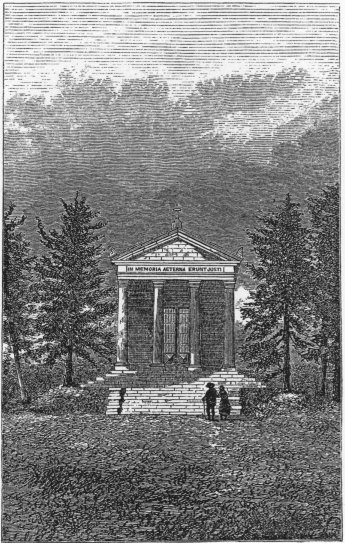
34. Champ des Martyrs. Auray.
Auray is a good central point for visiting the Celtic remains:—menhirs, dolmens, cromlechs, all of which are as plentiful here as are calvaries, shrines, and churches in Léon. They seem all concentrated [pg 170] on these dreary wild landes, sometimes covered with furze bushes, at others strewn along the coast.
Next day we drove to Locmariaker, nine miles from Auray, through Crach. On the right is the river or estuary of that name; over which a bridge is contemplated at La Trinité, to communicate with Carnac. Locmariaker is at the extremity of the peninsula formed by the rivers of Crach and Auray, at the entrance of the Morbihan. It must have been a place of some importance in the time of the Roman occupation of Gaul, as there are the remains of a circus, whose walls now enclose the cemetery, of a Gallo-Roman house, with baths, frescoed walls, and marble pavement. We picked up some fragments of Roman bricks which lie strewn upon the ground in great abundance. Midst these Roman remains are gigantic menhirs, barrows, and dolmens, vestiges of a still more ancient race. Locmariaker has two large tumuli, both vast tombs.
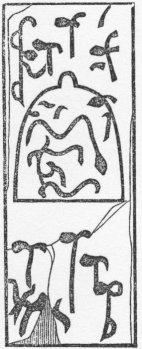
35. Sculptured Stone. Manné er Hroëck. Locmariaker.
We first visited the Manné-er-Hroëk, the Montagne de la Fée, or de la Femme, which bears in the marine charts the name of "Butte de César," for it was the fashion with antiquaries to attribute to Cæsar and the Romans every Celtic monument, although bearing no resemblance whatever to any work of these conquerors. The Montagne de la Fée is a galgal or tumulus of elliptic form, about thirty feet high, formed of dry stones. It was [pg 171] opened in 1863, and found to contain a sepulchral chamber or dolmen, outside of which lay a granite stone above three feet long, inscribed with various figures, and, in the middle, a cartouche, with hatchet-shaped characters. There were also found a number of celts (stone hatchets or knives), a green jasper necklace, and some glass beads, which have been transferred to the museum at Vannes. The guide who furnished the light and showed us the grotto is the widow of a Polish officer. She had a Scotch terrier, which she wanted us to accept. The legend of the mound is this:—A widow had the misfortune of losing her only solace, her son, compelled by law to embark for foreign lands. Years rolled by; he did not return. All said he was lost; but the heart of a mother hopes for ever, and the sad Armorican went every day to the point of Kerpenhir, whence she surveyed the ocean, and searched the depths of the horizon with tearful eyes for the purple sail16 which was to bring joy and peace to her dwelling. One day, when she was returning sad as [pg 172] usual to her desolate home, she was accosted by an old woman, who enquired the cause of her troubles; and, on hearing them, advised her to heap a pile of stones, so that, mounting on the summit, she might see to a greater distance, and perhaps discern the long looked-for vessel. During the whole night the two women worked, and carried in their aprons the stones they gathered on the heath. In the morning their task was finished, and the Bretonne was scared to see the enormous heap that had been piled together; but the other quieted her fears, and helped her to climb to the top, whence soon the happy mother beheld the vessel of her son. The fairy, her assistant, had disappeared. This story evidently bears a vague tradition of this tumulus having been raised by a woman, and of some maritime expedition made by him for whom it was probably destined. The name of fairy is attached in Brittany to everything—mountains, springs, grottoes, rocks; every accident in nature is explained by a fairy origin.
The next object we saw is also attributed to the fairies, the great menhir, called Men-er-Groách, or stone of the fairies. It is the largest menhir known, but it has been broken into three pieces, some say by thunder. Put together, it measures about 67 feet in length, and is 16 feet in diameter. The wonder is how it was placed there, for it is little less [pg 173] than the obelisk of St. Peter's, which took 800 to 900 men and 70 horses nearly a year to raise,—a work which was the great triumph of Fontana the engineer. The menhir is estimated to be one-third the height of Notre Dame at Paris.
Lying also prostrate on the ground, by the side of it, is a smaller menhir, which is, however, above 30 feet long.
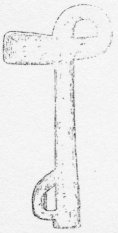
36. Hatchet-shaped Sculpture. Dol des Marchands. Locmariaker.
Close to these gigantic menhirs is the large dolmen (Breton, daul, table, and mœn, stone), known as the "Table de César," or the "Dol des Marchands." We walked under it to see the curious hatchet-shaped figure sculptured on one of the upper stones. The common belief is that these dolmens or table-stones were Druidic altars, and the guides will show you the furrows for the blood of the human sacrifice to run down; but human bones having been found under some of these dolmens, lead one to suppose they were tombs. In the Scandinavian countries the peasants call them "Giants' Graves."
The other great tumulus of Locmariaker is the Mont Heleu or Manné-Lud, also opened in 1863, and supposed to have been the sepulchre of a number of persons, perhaps of a whole generation. It has, like the Montagne de la Feé, a galleried chamber [pg 174] or dolmen, the floor formed of an enormous slab across the centre, on which is a sculpture resembling a celt; other sculptured stones were found in the same chamber. At the other end of the dolmen was an avenue of stones, some supporting the skeletons of horses' heads. This tumulus was probably the tomb of some great warrior: the horses' skeletons were the remains of a sacrifice, and the human bones of beings who had been immolated to accompany the earthly remains of their great chief to another world.
We took a boat for Gavr' Inis, or the Goat Island, and embarked on the Morbihan (Breton, Little Sea), an inland sea, that gives its name to the department. Shut out from the ocean by the two peninsulas of Locmariaker and Rhuys, which form a narrow gully between the points of Kerpenhir and Port Navalo, this sea contains an archipelago of islands, numbering, according to tradition, as many as the days in the year. Of these, the Ile aux Moines is the largest. The arms of the sea forming the rivers of Auray and Vannes run into it. The navigation of the Morbihan is very dangerous, the ocean entering it by this narrow opening in three distinct currents; it is an endless labyrinth of rocks and water; its granite shores, torn by the sea, are indented with creeks, capes, and inlets.
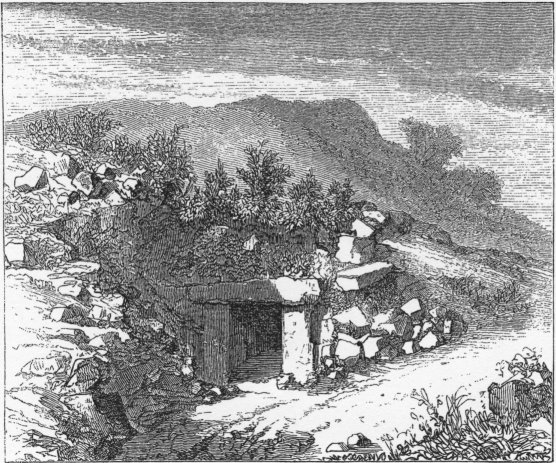
37. Entrance to the Tumulus of Gavr' Inis.
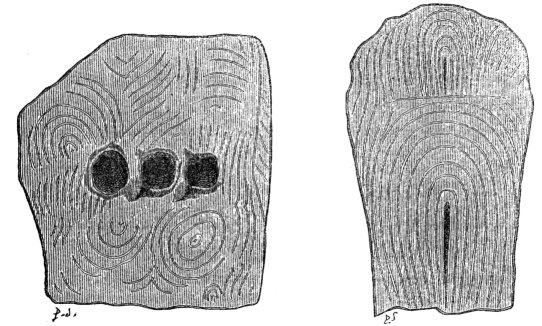
Fig. 38/39. Sculptured Stones. Gavr' Inis.
Gavr' Inis is a small island, surmounted by a tumulus, [pg 175] which forms a conspicuous object, seen from all the mounds and dolmens around. It is a galgal of heaped stones, in the centre of which is a dolmen or galleried chamber, which was opened in 1832, and is the most curious monument in the Morbihan. The gallery, with its square sepulchral chamber at the end, is above fifty feet long and about five wide, composed of two rows of granite menhirs, or upright stones, which form the sides, with horizontal stones resting on them, ending in a chamber consisting of eight menhirs, with an enormous slab, thirteen feet [pg 176] long, placed over them horizontally to form the roof, and another, nearly as large, to form the floor. These stones are of granite, and no cement is used to unite them. They are covered with incised figures of unknown meaning: sculptures in concentric whorls or circles, as if tattoed like the cheek of a New Zealander; and the only forms to be distinguished are serpent-like figures, and the representation of an axe, similar to those to be seen in the Grotte des Fées, the Dol des Marchands, and the Manné-Lud. In one of the side stones of the chamber are two handle-looking projections, with a recess behind, said, probably erroneously, to be the place where the victims were bound. No celts or other objects of antiquity were found in the grotto, which must have been previously rifled of its contents. [pg 177] These sculptures cannot have been executed without the use of metal instruments. There are also Celtic remains in the Ile aux Moines and other islands of the Morbihan, but our guide did not encourage us to extend our sail to visit them. The current between the island and Port Navalo is sometimes of great rapidity and violence.
Next day we went to Carnac to see its marvellous avenues of menhirs. The Celtic remains here are of a different character from those of Locmariaker. Here there is quantity, at Locmariaker size. The monuments of the last are covered with strange characters and signs; in Carnac they are all plain and silent, according to the laws of the Druids, who prohibited writing, in the fear of thereby divulging their mysteries, and also that the people might not neglect to cultivate their memories.
“Tout cela eut un sens, et traduisit
Une pensée; mais la clé de ce mystère,
Où est elle? et qui pourrait dire aujourd'hui
Si jamais elle se retrouvera?”—Cayat Delandre.
Before reaching Carnac, we stopped at Kermario on the left, and got out of the carriage to inspect the army of large menhirs about the windmill. They are arranged in eleven rows, some sixteen feet high, placed with the small end in the ground. They are all of a sombre grey, many of them clothed with straggling lichens of various species. [pg 178] This wild heathy tract was covered with the blue flower of the dwarf gentian, and strewed all over with menhirs. Before arriving at Carnac, the road passes the avenues of Menec, all running in the same direction as those of Kermario, from east to west: among these are some of the largest stones. The third large group, at Erdeven, we saw on our way from Carnac back to Auray by another road.
“D'un passé sans mémoire incertaines reliques,
Mystères d'un vieux monde en mystères écrits.”
Lamartine.
We do not pretend to enter into the various explanations attempted of this wonderful monument. The legend at Carnac is, that St. Cornély, pursued by an army of pagans, fled towards the sea; finding no boat at hand, and on the point of being taken, he transformed the soldiers into stones.
“Les soldats de deux rois idolâtres
Poursuivaient notre saint dejà l'ami des pâtres,
Et sur un chariot trainé par de grands bœufs
Le bons vieux Cornéli se sauvait devant eux;
Or, voici que la mer, terrible aussi l'arrête;
Alors, le saint prélat, du haut de sa charrette
Tend la main: les soldats, tels qu'ils étaient rangés,
En autant de menhirs, voyez! furent changés.
Telle est notre croyance, et personne n'ignore
Que le patron des bœufs c'est ici qu'on l'honore;
Aux lieux où la charrette et le saint ont passés,
Le froment pousse encor plus vert et plus pressé.”
Brizeux.
St. Cornély is the patron of bullocks. When a [pg 179] beast is ill, his owner buys an image of St. Cornély, and hangs it up in the stable till its recovery. In the church of Carnac is a series of fresco paintings portraying the principal events of his life, and outside, a sculpture representing him between two bullocks. The head of St. Cornély is preserved here; the pulpit is of forged iron, and in the sacristy is shown a silver gilt monstrance of the Louis XIV. period, with a representation of the Supper at Emmaus, chased in relief round the foot. We walked to the Mont St. Michel, a tumulus of stones with sepulchral dolmen, opened in 1862, but now closed. It was found to contain objects of the "Stone" age, a number of jade celts from four to sixteen inches long, some perforated beads and pendents for a necklace, and there were traces of burnt bones. Like most monuments of Celtic origin, these tumuli were regarded with religious veneration; and the first teachers of Christianity, to enlist the old worship to the cause of truth, marked each of these monuments with the symbol of the new faith. Thus the cross was placed on the menhir, and a chapel built upon Mont St. Michel, and, as we have before seen, on Mont Dol, and other high places of Druidic worship. The little chapel dedicated to St. Michel, which surmounts the tumulus, forms a conspicuous landmark from every point, and commands a most extensive view over the stones of Carnac ranged in [pg 180] their eleven lines, on a treeless plain, the Morbihan, and the long dreary peninsula of Quiberon.
Returning by another route, we alighted at the inn at Plouharnel to see a collection of jade celts, gold torques, and necklaces of beads, found in the neighbourhood, belonging to the landlord, M. Bail, who has them all arranged in a frame. They were discovered in a group of dolmens near the village, opened in 1830, consisting of three grottos or allées couvertes, a kind of triple dolmen, covered over with a mound. The central grotto and gallery had been opened before. The second dolmen had also a grotto or allée couverte, in which was found an earthen pot, containing ashes and three gold necklaces. In the third were some fragments of pottery. Three gold necklaces, composed each of a single plate of metal, an inch and a half wide, with fragments of the earthen vessels in which they were found, together with stone celts and some pieces of bronze, extracted from the dolmen, we afterwards saw exhibited in the "Musée du Travail" of the Universal Exhibition of 1867. These dolmens belong to a much later period of civilisation than those of Locmariaker—to the "Bronze" Age.
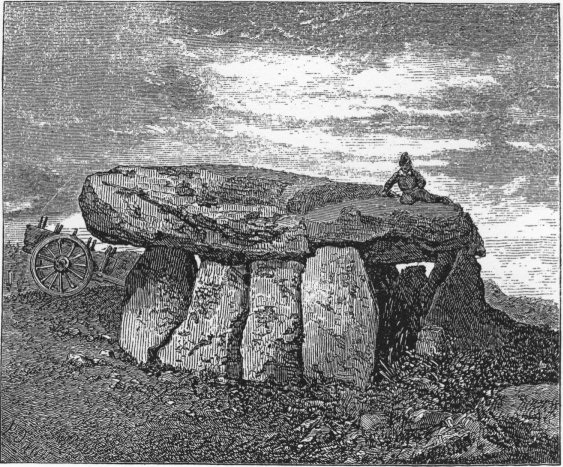
40. Dolmen of Corcorro.
The number of dolmens in the Morbihan is estimated at 250. In the department of Finistère they are set at double the number. All are supposed to have been originally covered with earth. The bodies [pg 181] are more frequently buried than burnt. The dolmens contain implements of stone and bone, occasionally gold and bronze, but never iron. To judge from the comparative quantities found in the different departments, it may be assumed that they are the work of people who have entered France from the west, and have gradually worked their way by the rivers and valleys further up the country. In this secluded spot we found a large English family located, ten in number; they had been living there several months. Before reaching Erdeven, at Kerserho, on a large lande or heathy plain, we arrived at another series of the great Carnac army of stones, of which they are a continuation. They are arranged in nine parallel rows, as may be clearly distinguished by standing upon one of the stones; but the lines are rather interrupted by hedges and ditches. Some are menhirs planted vertically on the end, others enormous blocks simply laid upon the soil. They extend half a league from north to south, more numerous than Carnac, but generally not so tall, the highest from ten to twelve feet, but very large. The road is strewed with Druidic monuments. At Corcorro, between Plouharnel and Erdeven, on a farm, a short distance off the road, is a dolmen, the largest in the Morbihan. Its original length appears to have been 45 feet; the part preserved is 24 feet by 12 feet wide, and is covered with two slabs: one of [pg 182] these is enormous, about six feet wide. It is used as a cart-shed, and, when we saw it, contained bundles of hemp and a hemp-breaker. One of the top stones overhangs the others, showing the dolmen to have been originally larger. A number of ragged children clustered upon the top, as if they had been accustomed to group themselves for a picture. They effectually prevented any of us sketching the dolmen, for, as soon as we began to draw, they all, in number about forty, came down from their height and pressed closely around us. From Auray we took a [pg 183] carriage to Vannes, a tidal port, one league from the gulf of Morbihan, and capital of that department.
Its people, the Veneti, were the head of the Armorican confederation, and commanded the fleet in time of war. Their vessels had sails of prepared skins, their cables were chains of iron. They traded with the Scilly Islands, and brought back tin, copper, skins, slaves, and dogs, objects of traffic with other nations. The Armorican confederation made a vigorous resistance against Cæsar, who sent round for the Roman fleet and beat them in a naval battle in the Morbihan sea. The Romans had attached to their ships large sharp scythes which mowed down masts and rigging, and a dead calm rendering the enemy's ships immovable, they were soon taken, burnt, or sunk. This battle ended the war with the maritime states of the west. Cæsar showed little mercy to the conquered: all the senators were put to death, and the rest of the population sold by auction to furnish the slave-markets of Italy.
We walked to the promenade, called the "Garenne," where Sombreuil, Renée de Hercé, bishop of Dol, and twenty-two others of the emigrants, were shot. Sombreuil was about twenty-six or twenty-seven years of age, a native of Périgord. He always persisted in the same account of the capitulation. His last words were:-"Si j'avais pu imaginer que des militaires pussent manquer à leur parole [pg 184] donnée sur le champ de bataille, je n'aurais jamais consenti à une capitulation; elle me cause des regrets amers qui me suivront jusqu'au tombeau. Adieu, Messieurs, nous trouverons justice et clémence devant un tribunal où la fraude des hommes ne saurait jamais parvenir." A republican officer offered to bandage his eyes: "Non," he exclaimed, "je veux voir mon ennemi jusqu'au dernier instant." Requested to kneel, Sombreuil answered: "Je le veux bien; mais je fais observer que je mets un genou pour mon Dieu, et l'autre pour mon roi." Thus ended the most ill-fated expedition that history has ever had to record.
The cathedral of Vannes has a richly-sculptured north porch of Kersanton stone, and another, facing the Rue des Trois Duchesses. Also, a Renaissance chapel, called the Chapelle du Saint Sacrament or du Pardon, with a hideous roof replacing the original. Adjoining are the remains of the elegant cloisters of the cathedral, with basket-handled arcades of the fifteenth century. In the cathedral is also the chapel of St. Vincent Ferrier, the great preacher of the fifteenth century, whose labours extended over almost every country of Europe—Italy, Germany, France, Switzerland, and Great Britain. San Vicente Ferrar, a Dominican monk, was the son of an attorney, originally of Valencia, in Spain, of which city he is the tutelar saint. In Spain he led the way in [pg 185] preaching a crusade against the Jews and Moors, who were persecuted by the Inquisition with the most cruel bigotry. Invited to Brittany by Duke John V., he fixed himself at Vannes, where, after having evangelised the province, he died in 1419. He was buried in the cathedral. The Duchess Jeanne de France, daughter of Charles VI., was present at his deathbed, and insisted on laying him out. By her own desire, she was buried at his feet. Philip II., King of Spain, desired his relics, but did not succeed in obtaining them. The little house in which St. Vincent Ferrier lived is preserved (No. 13, Rue des Orfèvres). A tiny room, up a narrow staircase, is now converted into a chapel, in which are shown the stone which served him as a pillow, his lamp, and other relics.
The Maison du Parlement or Château Gaillau is a curious old building, with its entrance by a stone staircase and turret. Vannes was the usual residence of Dukes John IV. and V., and had formerly three châteaux: La Motte, of which the Hôtel de la Préfecture occupies the site; Plaisance, half a mile out of the town, where Duke Francis I. died; and La Hermine, scene of John IV.'s treacherous imprisonment of the Constable Clisson, which was razed in 1614. It had two towers—one demolished in 1770, the other still standing, called the "Tour du Connétable," because it was within its walls he imprisoned Clisson. [pg 186] The Duke had resolved on his death, to prevent the marriage of Clisson's daughter Marguerite to Jean de Bretagne, Count de Penthièvre, son of Charles of Blois.17 The story is well related by d'Argentré.
The Duke of Brittany summoned his barons and knights to a council at Vannes, and entertained them in the Castle de la Motte. He behaved in the most friendly manner, and invited the Constable, the Lords of Laval and de Beaumanoir, to see the castle of Hermine he was building. He led the Constable by the hand through the chambers, and when they arrived at the keep, said, "Sir Oliver, there's not a man who understands masonry so well as yourself; enter and examine the walls well, and if you say it is properly built, it shall remain." The unsuspecting Constable ascended the staircase, when the door was closed upon him and he was seized and loaded with three pairs of fetters. The Duke ordered him to be put into a sack, his hands and feet tied, and to be [pg 187] thrown secretly at night into the sea. But the Constable owed his life to the loyalty of Jean Bazvalen, who, like another Hubert, did not obey his master's commands, the laws of his sovereign being less sacred in his eyes than the dictates of humanity and honour. Clisson was set at liberty, on agreeing to pay 100,000 livres and to surrender the town of Jugon and some other fortresses. This perfidious attempt occasioned a war of three years, and was retaliated by Clisson's daughter and grandsons upon Duke John V.
The Tour du Connétable, which formed the north-east angle of the Château de la Hermine, is now used as a museum of Celtic antiquities, and contains various objects collected in the tumuli of the Morbihan. We observed one very large jade celt, eighteen inches long, found, we understood, in the Butte de Tumiac. At Vannes the States of Brittany held their sittings, and here took place the union of that province with France, 1532.
About twelve miles from Vannes is Korn-er-hoët, demesne of the Princess Baciocchi, cousin of the Emperor. It was formerly surrounded by woods and the interminable lande of Lanvaux, which stretches its desolate length along the Morbihan from Baud to Rochefort. This district had been, from time immemorial, the abode of some eighty families of gipsies, who lived there in clay huts under the rule of a chieftain. The sight of this barren [pg 188] wilderness had so impressed the Princess Baciocchi, in a tour she made in Brittany in the year 1857, that she obtained the sanction of the Emperor to reclaim it. She caused a temporary châlet to be built for her occupation at Kern-er-hoët, and, superintending the works herself, in a few years effected a wonderful transformation. A model village has been formed, with church and schools, a well-ordered agricultural population organised, farm-buildings erected, roads macadamised, the barren lande drained and reclaimed, and the château surrounded by a well-wooded park.
Great attention has been paid to the details of the dairy farm; all the disposable milk is made into Dutch cheese. The cows are those of Brittany and Ayrshire; the pigs from England. The whole demesne comprises about 1300 acres, and the benevolent Princess resides entirely on the scene of her labours, among the people whose condition she has so ameliorated.18
From Vannes we made an excursion into the peninsula of Rhuys, on the south of the Morbihan Sea. We first stopped at Sarzeau, where Lesage, the amiable author of 'Gil Blas,' was born, of whom it was written on his epitaph:—
“S'il ne fut pas ami de la fortune,
Il fut toujours ami de la vertu.”
Then on to the ducal fortress of Sucinio, situated [pg 189] on the borders of the ocean. It is a magnificent ruin, built in 1250, by Duke Jean le Roux, to deposit his treasures, in case an invasion of the French should compel him to leave his duchy. The position is well chosen, its situation on the seashore enabling him easily to embark his treasures.
This formidable "coffre fort" was a favourite residence of the Dukes of Brittany, who came here as a relief from the cares and ceremonies of a Court. Its name, of which Sucinio is a corruption, Soucy-ny-ot, synonymous with the Sans-Souci of the great Frederick, shows its intention. This locality was long celebrated for its fine air, and its peaceful character. Louis XIV. used to say to his courtiers—
“Désirez vous un pays de repos et de délices?
Allez habiter l'île de Rhuys.”
Partly demolished, Sucinio presents a mass of now only picturesque ruins, a curious type of the architecture of the thirteenth century. Five of the eight enormous battlemented towers remain, and the flamboyant window of the chapel on the upper floor of the building is still preserved. Traces of the portcullis and drawbridge are visible. Over the gallery is an escutcheon, with a couchant lion holding the arms of Brittany, between two stags, also couchant, at the foot of a tree. The sea that [pg 190] bathed the walls of the castle has been driven back by the accumulation of mud and the crumbling of the walls.
Here was born Arthur III., Comte de Richemont, Constable of France, and afterwards Duke of Brittany. This illustrious man, equally great as a warrior and politician, does not take his merited place in the page of history, owing probably to the partiality of French historians, who were always jealous of the glory of Brittany. Except Du Guesclin, no other constable has rendered greater service to France.
A prisoner at Agincourt, where he commanded the van, he fought with the Maid of Orleans,19 at Beaugeney, took Talbot captive at Patai, reconquered almost the whole of Normandy, entered Paris in 1436, and finally expelled the English by the crushing victory of Formigny, having staked his honour to drive them out of the kingdom. [pg 191] Seven years after, he succeeded to the ducal crown; but such was the confidence of Charles VII. in his loyalty, that he retained the supreme command of the French army with his new dignity. He reigned only fourteen months. Richmont always caused two swords to be carried before him when he appeared in presence of the King; a naked sword, as Duke of Brittany, and the other sheathed and the point turned downwards, as Constable of France. The title of Earl of Richmond, styled by the French Comte de Richmont, dates from the Conqueror. Alan Rufus, son of the Earl of Brittany, accompanied Duke William to England, and commanded the rear of the army at the battle of Hastings. For these services, he was rewarded with the hand of the Conqueror's daughter, and all that northern part of Yorkshire, now called Richmondshire, where he built, on the river Swale, the town and castle of Richmond. The title passed through Alice, daughter of Constance of Brittany, to Pierre de Dreux, and descended through him to all the Dukes of his house, until John IV., having gone over to the King of France, was deprived of the earldom by Act of Parliament, in the reign of King Richard II.; but Henry IV. again conferred the title upon his stepson Arthur, afterwards the celebrated Constable and Duke of Brittany.
[pg 192]
We returned to breakfast at Sarzeau; then on to the Abbey of St. Gildas de Rhuys, founded on this inaccessible coast by St. Gildas, an English saint, the schoolfellow and friend of St. Samson of Dol and St. Pol de Léon, and which counted among its monks our Saxon St. Dunstan, who, carried by pirates from his native isle, settled on the desolate shores of Brittany, and became, under the name of St. Goustan, the patron of mariners.
St. Gildas built his abbey on the edge of a high rocky promontory, the site of an ancient Roman encampment, called Grand Mont, facing the shore, where the sea has formed numerous caverns in its rocks. They are composed chiefly of quartz, and are covered to a great height with innumerable small mussels. The tide was too high to admit of our entering into any of the grottoes, but the piles of dark rocks beaten into every form by the violence of the waves, rising sometimes to the height of sixty feet, are very imposing. St. Gildas, in the twelfth century, had Abelard for superior, who, on his appointment, made over to Eloise the celebrated abbey he had founded at Nogent, near Troyes, which he called the Paraclete or Comforter, because he there found comfort and refreshment after his troubles, but his peace soon ended on his arrival in Brittany. His gentle nature was unable to contend [pg 193] against these coarse, ferocious, unruly, Breton monks. As he writes in his well-known letter to Eloise, setting forth his griefs:—
“J'habite un pays barbare, dont la langue m'est inconnue et en horreur: je n'ai de commerce qu'avec des peuples féroces; mes promenades sont les bords inaccessibles d'une mer agitée; mes moines n'ont d'autre règle que n'en point avoir. Je voudrais que vous vissiez ma maison, vous ne la prendriez jamais pour une abbaye: les portes ne sont ornées que de pieds de biche, de loups et d'ours, de sangliers, des dépouilles hideuses des hiboux. J'éprouve chaque jour de nouveaux périls; je crois à tout moment voir sur ma tête un glaive suspendu.”
But if Abelard hated the monks, they equally detested him, and one day tried to poison him, but he escaped through a gate in the garden wall, still pointed out, to the sea shore, where his friend and protector, the Count de Rhuys, awaited him in a boat.
The abbey is now in the occupation of twelve sisters of the "Charité de St. Louis," who have a school for poor girls, and, in the summer, take in families to board who come here for the benefit of the bracing air of this fine wild coast. There is a kind of establishment for bathing in the little bay below the abbey. The board and lodging is moderate, three francs and a half a day, wine, tea, and sugar, not included. Boys are admitted up to thirteen, but the men are sent into the town.
Part of the abbey church is Romanesque: a semi-circular choir, with three round chapels and the [pg 194] transepts. The nave and tower are of modern date. The pavement is covered with tumulary stones. Four children of Duke John III. le Roux are buried here, and one of Joan of Navarre and John IV. In the Treasury are several pieces of plate, among which is a Renaissance chalice, with six canopied statuettes of Apostles forming the knop; and a cross of the same period, a châsse of St. Gildas, his head and arm both encased in silver reliquaries. His tomb is in the church. Encrusted in the wall outside the church are the figures of two knights on horseback in mailed armour, conical Norman helmets, long pointed shields, and lances in the attitude of combat. The church and convent of St. Gildas belonged to the family of Bisson, whose self-devotion is commemorated by a statue at Lorient. He passed here many years of his early life, and wishing to preserve the buildings from ruin, gave them as a present to the parish. St. Gildas is called by the Bretons St. Feltas. There is a rude coloured print in the church relative to the legend of Comorre, or Comor, the Breton "Blue Beard," in which St. Gildas plays a conspicuous part. The story, as told by Emile Souvestre, is this:—Guerech, Count of Vannes, the country of white corn, had a daughter, Triphyna, whom he tenderly loved. One day, ambassadors arrived from Comorre, a Prince of Cornouaille, the country of the black corn, demanding [pg 195] her in marriage. Now this caused great distress, for Comorre was a giant, and one of the wickedest of men, held in awe by every one for his cruelty. As a boy, when he went out, his mother used to ring a bell to warn people of his approach. He shot a child in order to prove his gun; and, when unsuccessful in the chase, would set his dogs on the peasants to tear them in pieces. But most horrible of all, he had had four wives, who all died one after the other, under suspicion of having been killed by either the knife, fire, water, or poison. The Count of Vannes, therefore, dismissed the ambassadors, and advanced to meet Comorre, who was approaching with a powerful army; but St. Gildas went into her oratory, and begged Triphyna would save bloodshed, and consent to the marriage. He gave her a silver ring, which would warn her of any intended evil, by turning, at the approach of danger, as black as the crow's wing. The marriage took place with great rejoicings. The first day six thousand guests were invited; on the next as many poor were fed, the bride and the bridegroom serving at table, a napkin under their arms. For some time, all went on well. Comorre's nature seemed changed, his prisons were empty, his gibbets untenanted; but Triphyna felt no confidence, and every day went to pray at the tombs of his four wives. At this time there was an assembly at Rennes of the [pg 196] Breton Princes, which Comorre was obliged to attend. Before his departure, he gave Triphyna the keys, desiring her to amuse herself in his absence. After five months he unexpectedly returned, and found her occupied in trimming an infant's cap with gold lace. On seeing the cap, Comorre turned pale; and when Triphyna joyfully announced to him that in two months he would be a father, he drew back in a rage and rushed out of the apartment. Triphyna saw that her ring had turned black, which betokened danger, she knew not why. She descended into the chapel to pray; when she rose to depart it was midnight, and she saw the four tombs of Comorre's wives open slowly, and they all issued forth in their winding-sheets. Half dead with fear, Triphyna tried to escape; but the spectres cried, "Take care, poor lost one! Comorre seeks to kill you." "I," says the Countess, "what evil have I done?"—"You have told him that you will soon become a mother; and, through the Spirit of Evil, he knows that his child will kill him, and that is why he has murdered us, when we told him what he has just learned from you." "What hope then of escape remains for me," cried Triphyna."—"Go back to your father," answered the phantoms. "But how escape when Comorre's dog guards the court?"—"Give him this poison which killed me," said the first wife." "But how can I descend this [pg 197] high wall?"—"By means of this cord which strangled me," answered the second wife. "But who will guide me through the dark?"—"The fire which burnt me," replied the third wife. "And how can I make so long a journey?" returned Triphyna.—"Take this stick which broke my skull," rejoined the fourth spectre. Armed with these weapons, Triphyna sets out, silences the dog, scales the wall, sees her way through the darkness, and proceeds on her road to Vannes. On awakening next morning, Comorre finds his wife fled, and pursues her on horseback. The poor fugitive, seeing her ring turn black, turned off the road and hid herself till night in the cabin of a shepherd, where was only an old magpie in a cage at the door. Comorre, who had given up the pursuit, was returning home that road, when he heard the magpie trying to imitate her complaints, and calling out "Poor Triphyna!" he therefore knew his wife had passed that way, and set his dog on the track. Meanwhile, Triphyna felt she could proceed no further, and laid down on the ground, where she brought into the world a boy of marvellous beauty. As she clasped him to her arms, she saw over her head a falcon with a golden collar, which she recognised as her father's. The bird came to her call, and giving it the warning ring of St. Gildas, she told it to fly with it to her father. The bird obeyed [pg 198] and flew with it like lightning to Vannes; but, almost at the same instant, Comorre arrived; having parted with her warning ring, Triphyna, who had no notice of his approach, had only time to conceal her babe in the cavity of a tree, when Comorre threw himself upon his unhappy wife, and with one blow severed her head from her body. When the falcon arrived at Vannes, he found the King at dinner with St. Gildas; he let the ring fall into the silver cup of his master, who recognising it, exclaimed, "My daughter is in danger; saddle the horses, and let St. Gildas accompany us." Following the falcon, they soon reached the spot where Triphyna lay dead. After they had all knelt in prayer, St. Gildas said to the corpse, "Arise, take thy head and thy child, and follow us." The dead body obeyed, the bewildered troop followed; but, gallop as fast as they could, the headless body was always in front, carrying the babe in her left hand, and her pale head in the right. In this manner, they reached the castle of Comorre. "Count," says St. Gildas, "I bring back your wife such as your wickedness has made her, and thy child such as Heaven has given it thee. Wilt thou receive them under thy roof?" Comorre was silent. The Saint three times repeated the question, but no voice returned an answer. Then St. Gildas took the new-born infant from its mother, and placed it [pg 199] on the ground. The child marched alone to the edge of the moat, and picking up a handful of earth, and throwing it against the castle, exclaimed, "Let the Trinity execute judgment." At the same instant the towers shook and fell with a great crash; the walls yawned open and the castle sunk, burying Comorre and all his fellow partners in crime. St. Gildas then replaced Triphyna's head upon her shoulders, laid his hands upon her, and restored her to life, to the great joy of her father.—Such is the history of Triphyna and Comorre.
On our way back to Vannes we saw on our left the Butte de Tumiac, or Butte d'Arzon, the largest tumulus of the Morbihan. It was opened in 1853, and found to enclose a chamber full of pulverised bones and various curious objects. From Vannes we also visited the stately castle of Elven, about four miles from the station of that name; not built on a lofty site, for, in the fifteenth century, the barons had descended from their heights to places more convenient of access, and where water was more easily obtained. The Breton feudal lords of Rohan, Rieux, Clisson, and Penthièvre, no longer required fortified places as means of defence against the French and English, but, in consequence of their own internal divisions, to defend them in their wars with their duke or among themselves. The castle of Elven is situated in an insulated coppice wood, in [pg 200] the midst of the lande of Elven. It was the chief place of the lordship of l'Argoët (in Breton, "upon the wood"), and is also called the fortress of Largoët.
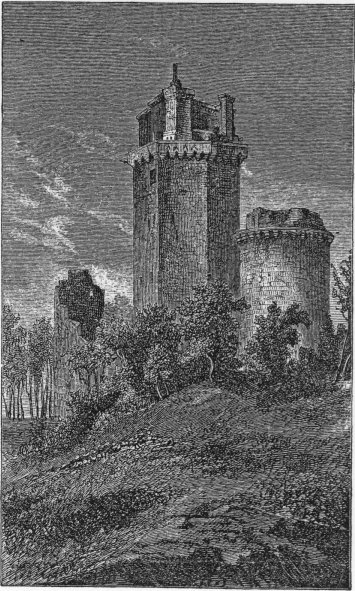
41. Castle of Elven.
The ruins, which occupy a large enclosure, consist chiefly of two towers; the principal one, 130 feet high, is octagonal; the other, which is not above 100 feet in height, is split from top to bottom. The [pg 201] battlemented walls are nearly 20 feet thick at the base. A wide deep moat surrounded the castle, and it was furnished with subterranean passages and everything requisite to make it a model of the military architecture of the fifteenth century. The donjon has two granite staircases; one leads to the top, whence may be seen Vannes and the Morbihan, with its islands. Here, in 1793, the Royalists established signals. In the castle of Elven, Henry of Richmond, then only fifteen, with his uncle, Jasper Tudor, Earl of Pembroke, were detained by Duke Francis II. for fifteen years. Fugitives after Tewkesbury, they were thrown by a tempest upon the shores of Brittany. Henry was claimed both by King Edward IV. and Louis XI., and was kept by Duke Francis as a pledge of the good faith of Edward towards Brittany. Perhaps also Francis may have entertained some ill-feeling towards Henry from his bearing the title of Earl of Richmond, which had been held for more than three hundred years by the Dukes of Brittany. Francis revived the claim to the title which Henry VI. had conferred (1452) on Edward Tudor, father of Henry. Subsequently, on the assurance of the King of England that he only required the release of Henry to invest him with the Order of the Garter and to give him his daughter, the Princess Elizabeth, in marriage, Duke Francis made over the Prince to the English Ambassador, [pg 202] and he was about to embark at St. Malo for England, when the Duke's Grand Treasurer (Landais) arrived, warned Henry of his danger, and helped him to take refuge in the sanctuary of the church, whence he afterwards withdrew him again to place him in honourable captivity for twelve more years, till King Edward's death. A party being formed in England, aided by the Duchess of Brittany, Françoise de Foix, Henry attempted a descent; but the plan being discovered, after seeing the English coast, Henry was obliged to return to Brittany and his ships were scattered in a storm. Again within his power, Landais listened to the offers of King Richard III., and agreed to give him up; but Henry, informed in time, left Vannes, threw himself into the forest, and escaped to France, where he obtained from the regent, Anne de Beaujeu, the assistance which enabled him to mount the English throne.
The castle of Elven, with those of Rieux and Rochefort, belonged to the Maréchal de Rieux. Elven was rebuilt by him with the materials of the old; but they were all dismantled by the orders of the Duchess Anne in 1496, to punish her guardian for his revolt. Yet Rieux acted as he thought best for the welfare of his late master and his daughter, whose cause he defended against the interested views of the King of France. Rieux had that keen sense of honour which is one of the characteristics of the [pg 203] Breton gentleman. When he reproached Anne de Beaujeu, regent, to her brother Charles VIII., for having instigated the King to attack Nantes, contrary to his engagements, Anne replied, "He had no written promise." "Et quoi, Madame!" he indignantly exclaimed; "la parole d'un roy, ne vaut elle pas mille scellez?" Louis de Rieux, the last of the race, was shot on the Champs des Martyrs. True to the motto of his house, "A toute heure, Rieux," he showed himself ready "at any hour" to die for the altar and the throne.
Elven is the scene of M. Octave Feuillet's "Roman d'un jeune Homme pauvre;" and the keeper who shows the ruins points out the spot whence the "Hero of Romance" took the leap to prove his loyalty, and which gained him the hand of the lady.
Next morning we started early by rail to Questembert, to meet the diligence for Ploërmel, twenty miles from this station, passing through Malestroit. We saw quantities of chestnuts on our road, and were told they were largely exported to England. They come principally from the neighbourhood of Redon and other places in the department of Ile-et-Vilaine, where they grow as abundantly as described by Madame de Sevigné, when writing from the Château des Roches, in the same department: "Pour nous, ce sont des châtaignes qui font notre ornement. J'en avois l'autre jour trois au quatre [pg 204] paniers autour de moi. J'en fis bouillir, j'en fis rôtir, j'en mis dans mes poches, on en sert dans les plats, on marche dessus, c'est la Bretagne dans son triomphe."
Ploërmel derives its name (plo-ermel, land or territory of Armel) from an anchorite of the sixth century, who treated a dragon which ravaged the country in the time of King Childebert in the same manner as St. Pol de Léon disposed of the monster at Batz.
The façade of the church of Saint Armel has a number of grotesque carvings—the sow playing the bagpipes, the cobbler sewing up the mouth of his wife, &c.; but it is principally remarkable for its eight painted windows of the sixteenth century, lately restored, and the monumental effigies of two Dukes of Brittany; the one, John II., who was killed at Lyons, where he went to settle some differences with his clergy, on the occasion of the coronation of Pope Clement V. A wall, loaded with spectators, fell, and the Duke was crushed in its ruins; the Pope escaped with being only thrown from his mule.
The other effigy is that of Duke John III., or the Good, whose death was the signal for the War of Succession. He died at Caen. These tombs were formerly in the Carmelite convent founded by John II., who, on his return from the Holy Land, established the first Carmelite convent in Brittany, [pg 205] and brought monks from Mount Carmel to inhabit it.
The tombs were destroyed in the Revolution, but the two statues were saved. They are of white marble, and are placed on a monumental slab, side by side, with this inscription: "De tous temps la fidélité Bretonne rendit hommage à ses souverains." Duke John II. is represented in a hauberk of mail, the hood turned back, with cotte d'armes, shield, and sword. Duke John III. has his head encircled by the ducal crown, his hair long, his genouillières, cuissarts, &c., of plate armour. His shield and cotte d'armes are semé of ermines, and by his side is the dagger of miséricorde, which served to kill the fallen enemy unless he cried for mercy. When James II. passed through Ploërmel after the Battle of the Boyne, a fugitive and a dethroned monarch, the Carmelite monks would not take him in; but he found in the little village of Penfra the hospitality they had refused him. Here is an establishment, directed by a brother of Lamennais, the celebrated author of 'Paroles d'un Croyant,' where people of all nations—Indians, negroes from Senegambia, and others—are educated and taught trades of every kind, and sent back to their own countries.
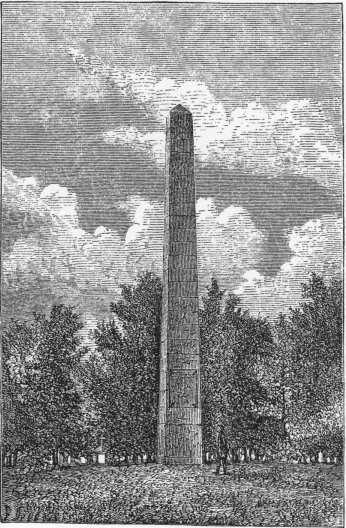
42. Column of the Thirty.
The people about Ploërmel and Josselin speak French instead of Breton, the prevailing language of the Morbihan department. It is nearly seven miles [pg 206] between Ploërmel and Josselin. Equally distant from each, at Mi-voie, in the centre of a star formed by avenues of firs and cypresses, is an obelisk set up to commemorate the famous "Combat des Trente," which took place on this spot in 1351, and on which are inscribed the names of the thirty who fought on the French side. It was during that period of the War of Succession when hostilities were carried on by the two Jeannes, Marshal Beaumanoir, the Breton [pg 207] commander of the garrison of Josselin for Jeanne de Penthièvre, gave a challenge to Bembro', as he is called, the English captain who held Ploërmel for Jeanne de Montfort and her infant son, in consequence of an alleged infraction by the latter of a truce, agreed upon between the Kings of France and England, in which it had been stipulated that the peasants and those not bearing arms should be unmolested. In spite of this compact, the English soldiers devastated the country and committed every kind of excess. Jean de Beaumanoir repaired to Ploërmel to remonstrate, and it was agreed to settle the dispute by a fight between thirty warriors from each camp. The prophecies of Merlin were consulted, and found to promise victory to the English. The appointed place of meeting was by a large oak, the "Chêne de Mi-Voie," on a lande or large plain, half way from each town. The battle began with great fury, at first to the disadvantage of the Bretons, when Bembro' was killed, which threw dismay among the English; but a German, who succeeded in the command, rallied their courage, and the melée became thicker than ever. Beaumanoir was wounded, and his loss of blood and his long fast produced a burning thirst, and he asked for water. "Bois ton sang, Beaumanoir, ta soif se passera," was the reply of Geoffroy du Bois; and Beaumanoir, forgetting his thirst and his wound, continued the fight. The [pg 208] English kept their ranks close, till Guillaume de Montauban broke them by a stratagem and threw them into confusion. He mounted his horse and pretended to fly, then suddenly turned upon the English with such force that he threw seven down and broke their ranks:—
“Grande fut la bataille et longuement dura:
Et le chapple (carnage) horrible est deçà et delà;
La chaleur fut moult grande, chacun si tressua (sua);
De sœur et de sang la terre rosoya (rougit).
A ce bon samedi Beaumanoir si jeuna;
Grand soif eut le baron, à boire demanda;
Messire Geoffrey du Bois tantôt répondu a:
'Bois ton sang, Beaumanoir, la soif te passera;
Ce jour aurons honneur, chacun si gagnera
Vaillante renommée, ja blâme ne sera.'—
Beaumanoir le vaillant adonc s'évertua,
Tel deuil eut et telle ire que la soif lui passa;
Et d'un côté et d'autre le chapple commença:
Morts furent ou blessés, guères n'en échappa.”—Brizeux.
Sir Robert Knollys, Sir Hugh Calverly Croquart, and others were made prisoners, and thus ended the Battle of the Thirty; gained, however, in a most disloyal manner, Montauban getting the aid of a horse, when all the other combatants fought on foot.
The Breton knights returned to Josselin, their helmets decorated with branches of the broom—
“In every basnet a bright broom flower;”
the place where the battle was fought running, according to the French poem,
“Le long d'une génetaie qui était verte et belle.”
[pg 209]
Josselin is celebrated for its château, where died, 1407, Olivier du Clisson, the contemporary and brother of arms of Du Guesclin, whom he succeeded in the dignity of Constable of France, which no one for some time would accept, not thinking themselves worthy of replacing him. Both differed widely in position and character. Du Guesclin, though of a noble family, had not the advantage of fortune like Clisson, who had immense wealth and landed possessions, which made him a kind of sovereign in the duchy. He willed away a million of money. Clisson was a statesman, Du Guesclin's sole glory was in arms. Clisson was cruel, intriguing, and insatiable for riches; Du Guesclin was humane, loyal, and disinterested. Both were equal in bravery and physical force: the lance of Du Guesclin and the axe of Clisson20 carried all before them. Clisson joined with Du Guesclin in freeing the country from the "Great Companies," and his most celebrated action was the defeat of the Flemings at Rosbecq. Few subjects have been so powerful, or have filled so important a part, as Olivier du Clisson. He was true to his sovereign after his reconciliation, and to [pg 210] his children after him. John IV. had scarce closed his eyes when the daughter of Clisson, wife of Jean de Penthièvre, came to her father and said, "It depends only on you that my husband receives the inheritance of Brittany." "How?" asked the Constable. "By your ridding yourself of the children of De Montfort." "Ah! cruel and perverse woman," exclaimed Clisson; "if you live long, you will destroy the honour and property of your children;" and he accompanied his words with such violent menaces, that, seized with affright, she fled from his presence, and falling down, broke her thigh. The prophecy of Clisson was fulfilled, as we shall later relate. The ancient château in which he died was destroyed by Henry IV.; the present building was raised by Alain IX., Vicomte de Rohan, through Alain VIII., who married Beatrix, eldest daughter of the Constable, by which Josselin descended to the Rohans,21 a house yielding to none in antiquity and illustration, being descended from the ancient sovereigns of Brittany, and allied with all the crowned heads of Europe,—"Princes of Bretagne" they were styled. But the Rohan family became unpopular in the duchy, when John II. attached himself to [pg 211] Louis XI. and France, for the bribe of 8000 livres to himself and 4000 to his wife.
At the battle of St. Aubin du Cormier, which sealed the fate of Brittany, the Vicomte du Rohan betrayed his brother-in-law Duke Francis and the national cause, and fought on the side of France. He afterwards marched at the head of the French troops, and besieged Guingamp, where its brave defenders declared, "As long as there is a duchess in Brittany, we will not give up her towns." But they took Pontrieux and Concarneau, and in 1491 the Vicomte du Rohan was appointed by Charles VIII. Lieutenant-General in Lower Brittany. He was called by his countrymen the "Felon Prince;" and so detested was he and his race, that it passed into a proverb to say of a mean, treacherous, dishonest person, "Il mange à l'auge comme Rohan,"—"He eats at the manger (that is, the table of the King of France) like Rohan." "Un peu de jactance," therefore, justly observes Daru, in the proud motto of the Rohans:—22
“Roi ne puis,
Prince ne daigne,
Rohan je suis.”
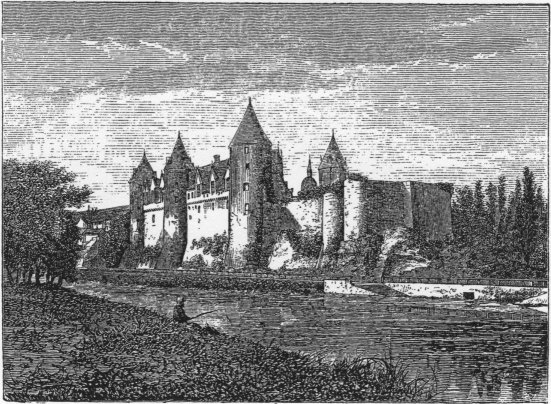
43. Château of Josselin.
The château of Josselin stands by a river, on which side it presents piles of towers and fortifications [pg 212] covered with slate, a severe specimen of military architecture; while on the other side, the cour d'honneur, we see one of the handsomest châteaux of the Renaissance yet remaining in Brittany. This façade is richly ornamented with sculptures of varied and fanciful design. Immense gurgoyles, in the form of serpents, stretching from the roof to the base, pierced balustrades or galleries of lace-like delicacy, in which are introduced, according to the fashion of the period, the initial letters of the Vicomte Alain, A and V interlaced. The old Rohan motto, "À plus," and the escutcheon of gules, nine mascles or lozenges, occur in every part of this gorgeous [pg 213] front, and also on the finely-carved chimneypiece of the reception room (salle d'honneur). The whole of the château is in course of restoration by the Prince de Léon.
In the church of Josselin is the tomb of the Constable Clisson, with that of Marguerite de Rohan his wife; both statues were mutilated in the Revolution, but are now restored: they are of white marble on a black slab. Clisson is in armour, Marguerite has her hair plaited and confined in a network of pearls; she wears a long robe, with a surcoat above, furred with ermine. The motto, "Pour ce qu'il me plest (plait)," is in an oratory which belonged to Clisson, expressing his haughty and overbearing will. This same motto appears on his seal, affixed to a letter preserved in the archives of the empire, and he is recorded to have had it inscribed upon his Constable's sword, which, like Du Guesclin, he always wore unsheathed, to show he was ready at all times to fight the enemies of the crown.
There hangs in the church a picture of the finding of the image Notre Dame-du-Roncier, of which we relate the legend:—
Long before Josselin was a town, a poor labourer had remarked, on the spot where now stands the church of Notre Dame, a bramble bush, which the frost and snow of the roughest winters never deprived [pg 214] of its leaves, but it always remained fresh and green. Surprised at this strange phenomenon, he dug the soil under the bramble, and discovered a wooden statue of the Virgin. A marvellous light played round the head of the image. The man carried it home; but next morning, to his surprise, he found the statue under the same bush whence he had taken it. The miracle was repeated several times, and soon attracted crowds of devotees. A chapel was built to deposit the sacred image, houses followed next, and a little town gradually formed, which the Comte de Porhoët surrounded with walls, and Josselin, his son, endowed with his name, 1030. Such was the rise of Josselin. A celebrated pilgrimage still exists to Josselin on Whit Tuesday, resorted to by crowds of "aboyeuses" or barkers, people possessed with this kind of epilepsy, said to be hereditary in several families, and which is accounted for from the circumstance of a party of washerwomen having refused a glass of water to the Vierge du Ronçier, who went to them disguised in the garb of a beggar. The merciless creatures set their dogs upon the pretended mendicant, and thus brought down upon themselves and their posterity this fearful malediction. The disease is supposed to return periodically about Whitsuntide, and only to leave the afflicted when they are carried forcibly to the sanctuary of Notre Dame to press with their foaming [pg 215] lips the fragments still remaining of the ancient miraculous statue which was burnt upon the public Place in the time of the French Revolution.
We left Ploërmel at four o'clock in the morning for Montfort-sur-Mer, passing through Plélan; while the horses baited at a little auberge we got some hot coffee, and found a good fire in the kitchen. The landlady, shut in her "lit clos," did not disturb herself, but occasionally put out her head to give directions for our breakfast. On the left of the road is the forest of Paimpont, which formerly extended from Montfort to Rostrenan, a kind of neutral desert land, called Brocéliande, and famous, under that name, in the history of King Arthur. It was the theatre of the fairies' most wondrous enchantments. Here was the fountain of Youth and also that of Barenton, where they came every day to draw water in an emerald basin. Here, too, the enchanted Merlin has lain sleeping for centuries, enthralled by his pupil the fairy Viviana, who has cast a spell upon her master she knows not how to break.
Montfort, where we joined the railway, is celebrated for the legend of the duck and its ducklings, and was the residence of the De Montfort family until Guy Comte de Laval and Sire de Montfort married Françoise de Dinan, widow of the unfortunate Gilles de Bretagne, when the Montforts left [pg 216] their paternal demesne for the châteaux of Laval, Vitré, and Châteaubriant.
The railway took us to Rennes, an uninteresting modern French town, the old town was burnt down in 1720, and straight streets have risen up, with no traces of its having been once the ancient capital of Brittany. Indeed, so French is it altogether, that the saying runs—"Bon Breton de Vannes, bon Français de Rennes." It was here that Constance, heiress of the duchy, held her court, with Geoffrey Plantagenet, who, with their unfortunate son Arthur, were the only Plantagenets, dukes of Brittany. On the murder of Arthur, his sister Alice carried the ducal crown to her husband, Pierre de Dreux (called Mauclerc, from his animosity to the clergy), and from them descended the dukes of Brittany down to Queen Anne, whose double marriage conveyed the duchy to France and the Valois.
When Henry IV. made his solemn entry into Rennes, the Governor presented him with the three silver-gilt keys of the city, of rich workmanship; upon which the King observed, "Elles étaient belles, mais qu'il aimait mieux les clefs des cœurs des habitants."
The following year we made a tour along the banks of the Loire, and at Angers embarked on board the steamer for Nantes. The scenery down the Loire is rich, and the hills covered with vineyards, [pg 217] islands planted with willows, and sunny villages, or occasionally a gloomy fortress comes to view. Ingrandes is the frontier town, half in Anjou and half in Brittany, between the modern departments of Loire Inférieure and Maine-et-Loire. Lower down is St. Florent (Maine-et-Loire), with its recollections of the wonderful passage of the Loire by the Vendean army, so graphically related by Madame de la Rochejacquelin, and near the island of Meilleraie, where their brave General Bonchamps expired, after the fatal engagement of Chollet; his last act being the saving the lives of four thousand prisoners shut up in the church, and about to be executed by the exasperated Vendeans. "Grâce aux prisonniers" were his dying words. Opposite St. Florent is Varades, where the Vendeans landed after crossing the Loire. Only a feeble post opposed them. Had the republicans lost less time, and sent a force after their victory at Chollet, much calamity would have been spared to Brittany, and the Royalists themselves would have been saved the terrible defeats of Le Mans and Savenay.
Passing Ancenis, which rises in an amphitheatre on the vine-clothed hills, and, with its suspension-bridge, is one of the most picturesque points in the river, we reached Oudon, with its tall octagonal tower; on the left, in the department of Maine-et-Loire, nearly opposite, stands the ruined castle of [pg 218] Champtoceaux, where Duke John V. was kept a prisoner by the implacable enemies of his house, the Penthièvre family.
Marguerite de Clisson, widow of Jean de Bretagne, Comte de Penthièvre, lived in retirement in her stately fortress of Champtoceaux, with her three sons, Oliver, Count of Blois, and his brothers. Marguerite inherited the pride, hatred, and cruelty, of her father, without his chivalrous loyalty and magnanimity. The kingdom was filled with troubles, and she thought it a favourable moment for reviving the pretensions of her family. John V. held his court at Nantes. She sent Oliver there to assure the Duke that his mother and brother were ready to do him homage; and he swore, on his own part, "de le servir envers et contre tous ceux qui peuvent vivre et mourir." John, delighted, made the young man share his bed, and treated him with the greatest distinction. Oliver expressed his regret that the age and infirmities of his mother prevented her going to court, and timidly insinuated the honour she would feel at a visit from the Duke. The Duke consented, and, sending off his plate to Champtoceaux, started with his brother-in-law, Count Oliver, and his attendants. Having passed the little river which separates Anjou from Brittany, they saw a man throwing the planks of the bridge into the water, and thus preventing the Duke's suite from following. [pg 219] At the same time, Charles de Penthièvre, Margaret's second son, issued suddenly from a wood with an escort of lances and surrounded the Duke. There was no kind of indignity they did not make him suffer. He was tied upon his horse like a criminal, and conducted first to Clisson, Oliver leading him with a halter round his neck. The Penthièvres, who would not let the place be guessed where they held their captive, conducted him at night, sometimes on foot, from fortress to fortress, from dungeon to dungeon; at the same time circulating the report that they had drowned him in the Loire. As a last insult, they took him to Champtoceaux, where Marguerite visited him in prison to exult over his misfortunes. Meantime the Breton barons, indignant at the treason of which their Sovereign was the victim, raised an army for his deliverance, and civil war broke out with redoubled fury. His heroic wife, Jeanne de France, showed an untiring energy to save him. Undaunted by the threats of the Penthièvres,—who sent word to her, if she did not desist from hostilities they would cut her husband in pieces, nor by the messages from the Duke himself assuring her that her zeal would cost him his life,—she induced her brother, the Dauphin, to order the Penthièvres not to attempt the life of their prisoner; she besieged, one after the other, all their castles, and at last compelled Marguerite to capitulate to save [pg 220] her own life. Finding herself and family in a perilous position, Marguerite agreed that the Duke should be released (he was at Clisson), and that she and her sons should retire where they wished, on their promise to appear at the summons of the Breton nobles. Immediately on his liberation, Duke John ordered the destruction of Champtoceaux. A parliament assembled at Vannes in 1424, condemned Marguerite and her sons to capital punishment, and declared all the Penthièvre possessions to be forfeited to the State. But the culprits had all escaped the kingdom, except the youngest son, William, a child only ten years of age, who had been given as a hostage for the appearance of his mother and brothers, and was condemned to languish for twenty-seven years in prison, where he lost his eyesight—a victim to crimes in which he had not been an accomplice. John had made a vow, during his detention, to give, if he regained his liberty, to the church of Notre Dame at Nantes, his weight in gold; and most conscientiously did he perform his promise, for we read, "He placed himself in his war armour in the balance, and caused the opposite scale to be filled with gold till it had attained the weight of the first; that is to say, three hundred and eighty marks, seven ounces"—which sum was delivered over to the church. Vows of this nature are not unfrequently recorded. When Don Carlos, the ill-fated [pg 221] son of Philip II., lay ill, he vowed to give to the Virgin, on his recovery, four times his weight in gold plate, and seven times his weight in silver. The vow was fulfilled; but the Prince was placed in the scale in a damask robe and fur coat, and weighed only seventy-six pounds—so much was he reduced by his long illness.
Nantes is a cheerful, busy, handsome city, but wanting in the picturesque characteristics of the towns of Lower Brittany. Quimper, Vannes, Rennes, and Nantes, have all been successively capitals of the duchy, but Nantes was the usual residence of its dukes.
The cathedral contains its principal artistic monument, the tomb of Duke Francis II. and his second wife, Marguerite de Foix, called "sein de lys," from the beauty of her complexion. It was erected by their daughter, the Queen-Duchess Anne, and was executed by Michel Colomb, a sculptor of St. Pol de Léon, originally a herd-boy. This monument, considered a masterpiece of the Renaissance, is not copied from any Italian original, but is entirely the offspring of the artist's own fancy. There is much simplicity in its design and execution. The tomb, about five feet high, is of white marble, diapered with ermine and the letter F. On a black slab repose the effigies of the Duke and Duchess, and at their feet are lying a lion and a greyhound, holding [pg 222] their several escutcheons. Four large allegorical figures are at each angle of the tomb, representing the cardinal virtues. Justice carries the book of the laws, and the sword by which she makes them respected. This figure is said to be the portrait of the Duchess Anne. Temperance, in a monastic dress, is characterised by a bit and a lantern. Prudence, double faced, holds a mirror and a compass, and has a serpent at her feet. This figure is in the costume of a peasant girl of St. Pol; the second face, that of an old man, is also in the dress of Lower Brittany. Strength or Fortitude, handsome, resolute, and calm, strangles a dragon with his grasp.
Upon the principal sides of the tomb are the twelve Apostles, and below, in niches, sixteen mourners (pleureuses) in monastic habits, the faces and hands white, the rest of the body black. The beautiful attitude of these figures is much admired. Some are kneeling, others are seated—all in the attitude and expression of prayer. This monument was originally in the church of the Carmelites, whence it was transferred to the cathedral.
Besides the remains of Duke Francis and his two wives, it formerly contained the heart of his daughter, the Queen-Duchess Anne, enshrined in a golden case in the form of a heart, surmounted by a crown, and surrounded by a cordelière; but the tomb was [pg 223] rifled during the Reign of Terror. It now holds the remains of the Constable Duke Arthur III.
Duke John IV. also died at Nantes, after his long eventful reign, having acquired a military glory which earned him the name of Conqueror, and equalled that of Du Guesclin and Clisson. Twice he lost and twice he regained his crown. He alienated Du Guesclin and his faithful subjects by his partiality to England. The Bretons rose, and he fled to Edward III.; but when Charles V. entered the duchy, with the intention of confiscating it to the crown of France, the Bretons all united to defend their nationality against the ambition of the French King, and recalled their Sovereign. So great was the enthusiasm on his arrival at St. Malo, that the nobles plunged into the water to approach his ship; and even the widow of his rival, Charles of Blois, went to welcome him. His cowardly attempt against the Constable Clisson again compromised his reputation, and was disgracefully avenged upon his son by the implacable daughter of Clisson.
The old ducal castle still rises on the left bank of the river. It was here Anne of Brittany was born, and here she married, 1499, her old admirer, the chivalrous Duke of Orleans, then King Louis XII., according to her stipulation, that the King, "viendra l'espouser en sa maison de Nantes." Left at the age of eleven, by the death of her father, a prey to [pg 224] claimants to her hand, which carried with it the powerful duchy of Brittany, Anne was a prize worth a king's seeking, even at a time when there were so many other rich heiresses undisposed of—Mary of Burgundy, Elizabeth of York, Isabella of Castille, and Catherine de Foix. Anne is described as handsome, but slightly lame, generous, and gentle, but grave and proud in her demeanour. Louis XII. called her his "fière Bretonne," and allowed her the uncontrolled government of Brittany, "tout ainsi que si elle n'estoit point sa femme."
Though the wife of two Kings of France, Anne never forgot the interests of her duchy, whose nationality she always strove to maintain with the pertinacity of a true Breton, and showed herself, by her spirit and independence, to be the most worthy of all her race to wear the ducal crown. Jean Marot addresses her as "Royne incomparable, deux fois devinement sacrée, Anne Duchesse de Bretagne."
Like most of the ladies of her age, Anne was an accomplished linguist. She understood Latin and Greek, and most of the European languages. She corresponded with her husband in Latin verse. Her letters, still extant, breathe the most tender affection. One, written to him (1499) during the Italian wars, begins, "Une épouse tendre et chérie écrit à son époux encore plus chéri, l'objet à la fois de ses regrets et de son estime, conduit par la gloire loin de sa [pg 225] patrie. Amante infortunée, il n'est pour elle aucun instant sans alarmes. Quel malheur affreux que celui d'être privé d'un Prince que l'on aime, d'un Prince plus amant qu'époux."
It was in this castle that Henry IV. signed his celebrated Edict of Nantes, so fatally revoked by Louis XIV.
The Duc de Mercœur, when governor of Brittany, made Nantes a regular fortified town. Having married Marie de Luxembourg, heiress of the house of Penthièvre, he sought to secure to himself the duchy of Brittany, while his brother, the Duke de Guise, aimed at the crown of France. Head of the League in that province, he looked upon it as a means of attaining his end: his wife joined him in his plans of ambition, and they by turns tyrannized and caressed the Nantais, amusing them with fêtes, in which the Duchess condescended to dance with the townsfolk. For twenty years Mercœur held the province; but a peace was eventually signed between him and Henry IV., through the mediation of Gabrielle d'Estrées, whose son César de Vendôme, then four years of age, was affianced to the Duke de Mercœur's daughter, then only six. When Henry IV. made his entry into Nantes after the pacification, he observed, on surveying the fortifications, "Ventre Saint Gris, les Ducs de Bretagne n'étaient pas de petits compagnons."
[pg 226]
Nantes has been the scene of many an act of vengeance on the part of the Kings of France.
The Place du Bouffay, the place of execution, was the scene of the tragic death of the young Henri de Talleyrand, Comte de Chalais, executed by Louis XIII. for his part in the conspiracy which bears his name. Its object was the death of the Cardinal, and to place the crown on the head of the feeble Gaston, who was celebrating his marriage at Nantes at the time that his victim Chalais was paying the penalty of his crime.
The restless, intriguing Cardinal de Retz was imprisoned in Nantes Castle during the minority of Louis XIV., and made a wonderful escape by letting himself down from the walls to the river, where a boat awaited him. It was also at Nantes that the same monarch caused Fouquet to be arrested, not, as alleged, for his malpractices in office, but because his ambition and pomp offended the pride of his royal master.
For their part in the conspiracy of Cellamare, the Marquis de Poncallec and three other Breton gentlemen suffered on the Place du Bouffay, and the Vendean chief, La Charette, was also there shot in 1795.
Not far from the castle is the Rue Haute du Château. At the Maison Juigny, in this street, the Duchesse de Berri was arrested, after having [pg 227] remained sixteen hours concealed in an aperture behind a chimney on the third floor, scarcely a foot and a half high and four feet long. The police, having information of her being in the house, through the treachery of a Jew, had made a fruitless search, but had left a watch behind. The soldiers lighted a fire in the chimney, and the Duchess, with her three attendants, sallied out, her dress completely scorched. They had endured the heat, but were unable to bear the suffocation.
Nantes has some fine promenades and boulevards, planted with trees. In the Cours Saint Pierre and St. André are statues of the Duchess Anne and of the three Breton constables, Du Guesclin, Clisson, and Richmont.
One of the leading characteristics of Nantes is its numerous bridges: a regular chain of them form a continuous line across the river and canals, and others unite the islands which form the suburbs to the town itself.
The Museum contains a large collection of pictures, which the bequest of the Duke de Feltre (Maréchal Clarke) has increased considerably. These consist mostly of sketches by Paul Delaroche, and the charming Italian subjects of Léopold Robert.
"L'enfant charitable"—a nun on her deathbed embracing a child who is standing by her side, an angel behind—is a touching composition of Ary [pg 228] Schäeffer. Another, by Paul Baudry, represents the death of Marat: Charlotte Corday's open, handsome face, looks incapable of the crime she has just perpetrated. There is one by Ziegler—Daniel in the lion's den—an angel staying the lions from molesting him. The atmosphere of light surrounding the angel is wonderful and unearthly. These two are in the general collection, together with numerous examples of the old masters.
Near our hotel is one of the curiosities of Nantes, the Passage de la Pommeraye, consisting of three stories of iron galleries or arcades, uniting the Rue de Crébillon with the Rue de la Fosse. The second arcade communicates by a flight of stairs with the third, called the Galerie de la Fosse, opening upon the street of that name.
The Garden of Plants is beautifully laid out; groves and avenues of magnolias in full flower, with rocks, waterfalls, rustic bridges, all most picturesquely disposed, making it one of the prettiest gardens and public promenades in France.
We descended the Loire by steamer, passing by vast granite buildings, built as magazines for colonial imports, called Les Salorges, in front of which the horrible noyades of Carrier took place, and these warehouses served as a temporary place of confinement for the victims. We next steamed past the island of Indret, the great manufacture of steam-engines [pg 229] for the State. Here we landed some market women, in caps of the same form, with high combs, as those of clear muslin worn by the Nantaises, only of a coarse material, and edged with black. On the right was Couëron, where Duke Francis II. died in consequence of a fall from his horse. The battle of St. Aubin-du-Cormier had decided his fate and that of his daughters,—a humiliation from which he never recovered. His faithful friend Rieux, who commanded his army, defeated by the youthful Louis de la Trémouille; the chivalrous Louis of Orleans, a prisoner in an iron cage in the "Grosse Tour" at Bourges; and the safety of his daughters at the mercy of King Charles VIII., or worse, of his imperious sister, the Regent Anne de Beaujeu, who would have committed some act of spoliation, had not the Chancellor Rochefort saved the duchy by his integrity, declaring to Anne that "a conqueror without right is but an illustrious robber."
At Les Pellerins, barges were loading with hay, and heaps of it standing on the river's edge ready for embarkation. On the left bank is Paimbœuf, where diligences run to Pornic, a favourite little watering-place south of the Loire.
St. Nazaire is a bustling seaport town, now the point of departure of the transatlantic steamers for the West Indies and Mexico. A Mexican, in his picturesque costume, all the seams of his dress fringed [pg 230] with hanging silver buttons, was living in the same hotel with ourselves. St. Nazaire has now a large floating basin, opened in 1858, capable of holding 200 ships of large size, and another is in course of construction.
It was from St. Nazaire that Prince Charles, the young Pretender, sailed on the adventurous expedition of '45, furnished with a frigate and a ship of the line by Mr. Walsh, of Nantes. Among the noble cavaliers who had sacrificed everything to follow the Stuarts into exile was the Walsh family, originally from Ireland. They had shared the wandering fortunes of Charles II., returned with him at the Restoration to find the greater part of their property confiscated; but they did not hesitate to sacrifice the rest when James II. abdicated the throne, and a Walsh commanded the ship which carried the King to France. Sent on a secret mission to England, he was recognized, denounced, and arrested. James II. created him an Earl at St. Germain. Two of his sons had retired to St. Malo and Nantes, and engaged in commercial speculations, endeavouring thereby to restore the fortunes of their house. Commerce was strictly forbidden to the Breton nobles; but, when war or misfortune had reduced their fortunes, they were allowed to enter into commerce, or any other profession, without derogating from their rank, provided they first deposited their swords with [pg 231] the Parliament, to be again claimed when their circumstances were improved. All will remember the anecdote in the 'Sentimental Journey.' As a book, called 'The State of Nobility in Brittany,' published in 1681, sets forth: "When nobles are engaged in commerce, their noble blood sleeps; but when the derogatory works are over, it revives. It is never lost but in death." But to return to the Walsh family. One of the brothers had embarked the remains of his little fortune in the business of "armateur"—a kind of shipowner, or one who fits out and charters ships, and sometimes commands them himself—the profession of Jean Bart and Duguay Trouin.23 It was to this Anthony Walsh, and a banker of Dunkirk, that Prince Charles addressed himself to fit out an old worm-eaten seventy-gun man-of-war, the 'Elizabeth,' they had just obtained from Government for his expedition. True to the hereditary loyalty of his family, Mr. Walsh not only devoted all he possessed to the armament of the frigate, but also fitted out a brig, called the 'Doutelle'—both intended as privateers to cruise against the English—and took the command of her himself. On the [pg 232] 28th June, 1745, furnished with about 4000l. of money, Charles Edward embarked on the Loire, in a fisherman's boat, to join the 'Doutelle' at St. Nazaire, and the 'Elizabeth' at Belle-Isle. He passed for a young Irish priest, and wore the habit of a student of the Scots' College at Paris. The ships encountered an English man-of-war, the 'Lion.' At the sound of the first shot, the Prince rushed on deck and asked for a sword. Mr. Walsh, by virtue of his authority as captain, took him by the arm and said to him sternly, "M. Abbé, your place is not here; go below with the passengers." The Prince obeyed, night separated the combatants, and on the 18th of July he was safely landed in Scotland. On Michaelmas Day, the following year, the disasters of Culloden again threw him an exile on the shores of Brittany.
From St. Nazaire we took a carriage for Guérande, to visit that remarkable district called the Canton de Croisic, and consisting chiefly of that place and the Bourg de Batz. We first came to Escoublac, a corruption of Episcopi lacus, deriving its name from a lake belonging to the bishop of the diocese.
The old town has been entirely buried by the moving sands which have blown over it, and, in 1779, its inhabitants transferred their houses to the present site. Hills of sand surround it in every direction.
[pg 233]
Here we left the high road, and turned off to the left to Poulignan, a little white bay, as its name implies; a charming retreat, with beautiful white sands and picturesque rocks. This is a favourite watering-place with the Nantais. Its whole population appeared to be in the water. A row of small wooden châlets are built along the shore for the bathers, no machines are used.
From Escoublac begins the large extent of salt-pans in which consist the riches of this country. They reach to Batz and Le Croisic, the peninsula which forms this district having formerly been an island which gradually has been transformed into a marsh.
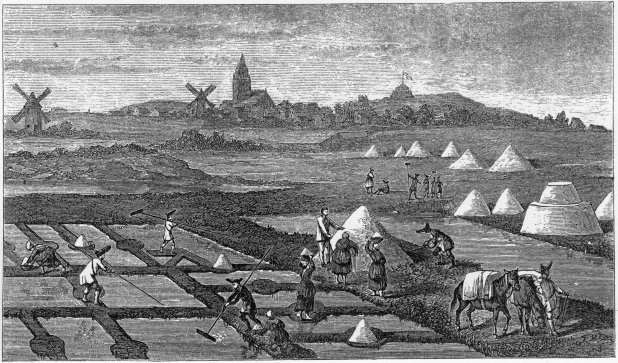
44. Salt-pans, with Le Croisic in the distance.
These salt-pans, cut out into small squares, have the appearance of one great chess-board, interspersed with occasional hamlets and woods. The working of them employs the whole population of the district.
They consist of large basins, dug at different depths, into which the water of the sea is introduced, and are divided into squares called "œillets." The salt-water is turned upon the marsh by canals styled "étiers," edged with narrow paths or roads called "bossis," elevated, some of them, three or four feet above the marsh; on these the newly collected salt is generally laid. The water passes by a subterranean conduit, the "coëf," into the "vasière," [pg 234] where the first evaporation takes place; and then successively into the "cobiers," "fares," and "adernemètres," until it flows finally into the "œillets," where the salt is definitively formed. Each "œillet" is about 20 feet by 30. The heat of the sun and the wind effect the evaporation, which the paludier assists by stirring the water from time to time. The salt which forms on the surface resembles a kind of white cream, and exhales an agreeable perfume resembling violets. This is the finest salt; that which falls to the bottom of the salt-pan is of a greyish cast. The salt when formed is then scraped off, drained, and the women collect it and stack it on the "bossis" into conical heaps, which they cover with a coating of clay, to render them impervious to weather. In the salting season, the salt marshes with their innumerable hillocks of white salt have the appearance of a vast tent-covered camp. Each "œillet" produces about 150 lbs. of salt. The same salt-pans are worked from century to century by the same "paludiers" or their descendants. The proprietors may change, but the workmen remain, considering the salt-pans their prescriptive inheritance. For payment, they receive one-fourth of the salt. The dress of the paludier is a smock-frock of irreproachable whiteness, with pockets, white shoes, gaiters, and linen breeches, an enormous black flap hat turned up on the side in a point or horn. The [pg 235] [pg 236] [pg 237] young man wears the point over the ear, the married turns it behind, and the widower in front. We reached the Bourg de Batz in time for vespers, and had an opportunity of seeing the people in their Sunday dress. The men wear three or four cloth waistcoats, all of different lengths, so as to let the various colours, red, white, and blue, with which they are bound, appear one above the other in tiers, a muslin turnover collar, full plaited breeches [pg 238] of fine cloth tied at the knee by garters of floating ribbon, white woollen stockings with worked clocks and light yellow shoes, their flap hats ornamented with a roll of chenille of varied colours. The headdress of the women is singular and most intricate. The hair, in two rolls, twisted round with white tape, forms a kind of coronet across their heads; over this, a piece of net is drawn tight, forming a sort of cap, describing a peak behind, and crossing in front like a handkerchief.