Britanny and Its Byways. (continued 2)
Reading edition
We next passed through Pontrieux, a pretty, small town, seated in a deep valley, the river Trieux flowing through it. The river here is famous for salmon, and there is a considerable commerce in its little port.
La Roche-Derrien on the Jaudy, during the War of Succession in Brittany, was a castle of some celebrity. It was here Charles of Blois was taken prisoner by the English, who, under Sir Thomas Dagworth, were in possession of the place. Charles [pg 083] of Blois assembled a large army, and attacked them by night. Three times was he rescued, and three times retaken; he had received eighteen wounds, and was at last compelled to surrender. Jeanne de Montfort, like all women who hate, was very vindictive, and caused her illustrious prisoner to be ignominiously dragged to Quimperlé, Vannes, and Hennebont, whence he was transferred to London, and confined in the Tower. It was nine years before he regained his liberty. Meanwhile his heroic wife, Jeanne de Penthièvre, became head of his party, as Jeanne de Flandre was that of the De Montfort. The "War of the two Jeannes" continued for nine years, during which they fought with fierceness and courage, and ruled with ability. Curious,—the history of France was illustrated in this century by five heroines of the name of Jeanne: Jeanne d'Arc, Jeanne Hachette of Beauvais, and the Jeannes of Penthièvre, Flandre, and Clisson, who made themselves famous in Brittany. On his release, Charles of Blois gave La Roche-Derrien to Du Guesclin. The castle was demolished, but a calvary has been built on the site.
Not far from La Roche-Derrien is the church of Langoat, which contains the monument of Ste. Pompée (1370), mother of St. Tugdual. On the granite tomb reposes her marble effigy, and around it bas-reliefs in Gothic niches represent the life of the [pg 084] saint. In all the churches in this district, tressels are placed in the nave ready for funerals. The gravestones have in each a little hollow well, to contain water for sprinkling over the grave, or in some a small basin is set upon the gravestone, with a sprig of box laid by the side, for the same pious purpose.
Every one must be struck by the excellence of the roads in Brittany, as indeed throughout France; in no instance does the French administrative talent more fully display itself. The roads are of three classes: the "routes impériales," under the care of the Government; "départementales," kept entirely at the expense of the department; and the "chemins vicinaux," which belong to the communes or parishes, and which all the inhabitants are called upon to support. To each lieue de poste (two and a half miles), is appointed a "cantonnier" or road-keeper, who is responsible for the condition of the length of road assigned to his care.
We stopped at Kermartin, a farmhouse near Tréguier, to see the bed said to have belonged to St. Ives, the favourite saint of the Bretons, and whose name is borne by the majority of the inhabitants of the district of Tréguier and St. Brieuc. Charles of Blois held him in great veneration. He gave part of a rib of St. Ives to the church at Lamballe, and carried the relic in procession barefooted to [pg 085] the church. Before the battle of Auray, he ordered his men to march "in the name of God and St. Yves."
St. Ives, or Yves Hélory, was one of the most remarkable characters of the thirteenth century. He studied law in the schools of Paris, and applied his talents in defending the cause of the poor; hence he was called "the poor man's advocate;" and so great to this day is the confidence placed in his justice, that, in the department of the Côtes-du-Nord, when a debtor falsely denies his debt, a peasant will pay twenty sous for a mass to St. Yves, convinced that St. Yves will cause the faithless creditor to die within the year. His truthfulness was such, he was called St. Yves de Verité. He is the special patron of lawyers, and always represented in the "mortier," or lawyer's cap, with an ermine-trimmed scarlet robe.
“Saint Yves était Breton,
Avocat et pas larron,
Chose rare, se dit-on.”
Lawyers, says a writer, take him for a patron, but not for a model. Philip le Hardi, in acknowledgment of his worth, granted him a pension of six deniers a day—in those times a considerable sum.
Over this house is a marble tablet with this inscription:—
[pg 086]
“Ici est né le 17 Oct^r 1253, et est mort le 19 Mai 1303,
Saint Yves,
Officiel de Tréguier, curé de Tredretz et de Lohannec. Sa maison, qui a subsisté jusqu'en l'année 1834, ayant été alors demolie à cause de vetusté, Mg^r Hyacinthe Louis de Quelen, Arch^vque de Paris, et propriétaire des domaines de Kermartin, a fait placer cette inscription, afin qu'un lieu sanctifié par la presence d'un si grand serviteur de Dieu ne demeurât pas inconnu (1837).”
The house is a good specimen of a Breton dwelling; by the side of the fire, in the one room of which most of these cottages consist, fixed against the wall like the berth of a ship, stands the bedstead or "lit clos" of old oak, shut in by carved and well-waxed sliding panels, often inscribed with the sacred monogram. The two mattresses, paillasse, and "cossette de plume," are piled up to such a height as barely to admit of its tenants creeping into the bed. In front is the customary chest, containing the family wardrobe, answering the double purpose of a seat and the means of ascending into the bed. Often we have seen cupboards on each side of the large chimney with two shelves, which served as beds for the juvenile members of the family. Forms and a polished table complete the furniture; the last has frequently little wells hollowed in the top, used, instead of plates, to hold the soup. Over the table, suspended by pulleys, are two indispensable articles in a Breton dwelling—a large circular basket [pg 087] to cover the bread, and a kind of wooden frame or rack, round which the spoons are ranged. Forks they do not use. Festoons of sausages, with hams, bacon, candles, skins of lard, onions, horse-shoes, harness, all hang suspended from the ceiling, which consists of fagots of hazel suspended by cross-poles. The floor is of beaten earth. One narrow window admits the light, and there are no outhouses. The manure-heap is generally at the house-door, and the pigs and poultry seem on an equally intimate footing as they are in our Irish cabins. The Breton's cottage has often no garden, to occupy his leisure hours; and the men, after their daily work, resort to the cabaret to spend their time and their earnings. Agriculture is very backward in Brittany, but the land produces abundance of corn. It is thrashed out direct from the field, on a clay floor (aire). Beet-root and clover grow very luxuriantly, and in some fields the pretty red clover (Trifolium incarnatum) carpets the country with its crimson flowers.
Near the farmhouse of Kermartin is the parish church of Minihy-Tréguier, formerly a chapel founded by St. Ives and attached to the "manoir." The will of St. Ives is framed and hung up in the church, and his breviary is also preserved here; but the guide said it was now kept at the priest's house, as people were in the habit of taking away a leaf as a [pg 088] relic. Minihy, i. e. Monk's House, is a name given to those places which, through the intercession of some saint, had the right of sanctuary. They were marked with a red cross, and, how great soever the crime, were regarded as inviolable. In 1441 the right of sanctuary was restricted to churches; before, it was extended to towns and districts. Tréguier had the privilege within a radius of twelve miles from the town. St. Malo also possessed the right of sanctuary. Tréguier is one of the four bishoprics that formed the ancient divisions of Brittany. The others were Léon, Cornouaille, and Vannes. The "pays de Tréguier" answers exactly to the present department of the Côtes-du-Nord; Léon to the territory or arrondissement of Brest and Morlaix; Cornouaille has Quimper and Carhaix for its principal towns; and Vannes, the country of Celtic remains, is to the south.
Tréguier is prettily situated on a hill, at the confluence of the rivers Jaudy and Guindy; its principal building is the beautiful, imposing cathedral, with its elegant spire, begun in the thirteenth century by St. Yves, and dedicated to St. Tugdual, whose name, like St. Yves, is often given in baptism to the Breton children. St. Yves is buried here, and also Duke John V., who founded the Chapelle du Duc, and desired to be interred at the feet of St. Yves, for whom he had a special regard, and to whom he [pg 089] erected a magnificent tomb, for three centuries the object of veneration in Brittany. The Duke paid for it his own weight in silver (389 marks 7 oz.), in 1424, to Maistre Jacques de Hougue. The victories of his father John the Conqueror were chased in bas-relief round the tomb, which was destroyed in 1793. Duke John V. was a contemptible prince, who eight times changed his party from weakness rather than policy, and on whom Margaret de Clisson and her sons retaliated the cowardly seizure of her father, the Constable Clisson, by Duke John IV. One of the towers of the cathedral is called the tower of Hastings, but its date is evidently subsequent to that of the Norman freebooter. The cathedral has preserved its beautiful cloisters, the work of the fifteenth century, although it has been ravaged by the Normans of the ninth century, the English in the fourteenth, the Spaniards in the sixteenth, and by the Revolutionists of 1793. It was the port chosen by the Constable Clisson, 1387, for the invasion of England, an expedition proposed and projected by himself. His hatred against the English was so great, though educated in England, he was termed the "boucher des Anglais." When the Duke of Brittany gave Chandos the château of Gavre, which was within a league of Clisson's château of Blain (Loire Inférieure), "I will never," he exclaimed, "be the neighbour of the English," [pg 090] and accordingly he sallied out one morning and burnt the castle to the ground. Chandos complained to the Black Prince, who sent a letter of remonstrance to Clisson, but it was only replied by a challenge to the Prince to meet him in single combat. Clisson caused his own ship to be built at Tréguier, and had constructed a tower or framework of large timber, to be put together on his landing in England, for the lords to retreat to as a place of safety, and to be lodged therein securely in the event of a night attack. This tower, Froissart says, was so constructed, that when dislodged it could be taken to pieces, and many carpenters and other workmen were engaged, at very high wages, to go with it to England to superintend the putting of it together. Four thousand men-at-arms and 2000 cross-bowmen were in readiness for the expedition, with horses, vessels laden with wine, salted provisions, and other necessaries. All these formidable preparations were rendered useless by the arrest of the Constable the day before his embarkation. We went to the Cemetery, which has its ossuary, reliquary, or bone-house, an inseparable appendage to a Breton churchyard. It is the custom in Brittany, after a certain time, to dig up the bones of the dead, and preserve their skulls in little square boxes, like dog-kennels, with a heart-shaped opening through which the skull is [pg 091] visible. They are all ticketed with the names and dates of the deceased, as "Ci gît le chef de * * * D. c. D. (décédé) le * * * * *. Priez Dieu pour son âme."
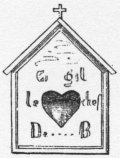
21. Skull-box.
These boxes sometimes occupy prominent places inside the churches or porch, on window sills, the capitals of columns, and other ledges; but more often are ranged in the ossuaries or charnel-houses built in the churchyards to receive them, with a row of death's-heads carved in the stone outside. The large bones are also placed in the ossuaire. The rich are buried in "enfeux" or arched recesses in the chapels or abbeys they have founded.
We continued our carriage to Lannion, our driver not very clear of his way, and in Brittany the road is very difficult to be discerned; for on each side are high earthen banks, sometimes eight or ten feet high, and on the top of these are planted timber-trees, such as oak, elm, and ash, which often meet at the top, entirely intercepting the view, making these narrow lanes a perfect slough and most intricate to thread. Sometimes they are cut in irregular steps in the solid rock, and serve for the bed of a stream. Each field is also surrounded by these hedgerow-trees, which are cut every four or five years.
[pg 092]
We drove to Perros Guirec, a lovely little watering-place built on a small promontory with a safe harbour, whence wheat, hemp, and cattle are exported to England; it is six miles from Lannion. A dangerous rock, called Roche Bernard, is at its entrance. The view is lovely. From Perros we scrambled over a hilly cart-road to Ploumanach, about three miles distant—a wonderful spot, huge round erratic blocks of pink granite flung over land and sea in the wildest confusion. The whole coast is one sea of boulders, a chaos of rocks of all sizes cover the soil in every direction, and in many places there is no soil at all, and the loose masses rest on a bare bed of rock, stretching, in unbroken extent, to a great distance. "A wanderer," says Mr. Trollope, "amid this strange and silent scene might fancy himself the only living thing in the midst of a world turned to stone. In every possible variety of uncouth form and capricious, strange positions, the endless masses were around us."
“All is rocks at random thrown,
Black waves, bare crags, and banks of stone."”
Lord of the Isles.
One rock, surrounded at high water by the tide, is a square block of red granite of thirty to forty feet high, placed on the top of a still higher mass, on which it rests upon a very small base. It is called the "Roche Pendue," and serves as a landmark [pg 093] for the fishermen. We took a small boat full of fish resembling codlings or small cod, called "lieu," and were rowed by the fishermen through a sea of granite boulders to the opposite side of the Trégastel estuary, to see the "pierre pendue," or rocking-stone (Breton, rouler), the largest in Brittany. These stones are so nicely poised that they can be moved with the slightest impulse by any one knowing the exact point at which to touch them. They were used in early times as proving-stones, and called "Pierres de verité."
“Firm as it seems,
Such is its strange and virtuous property,
It moves obsequious to the gentlest touch
Of him whose breast is pure; but to a traitor,
Though e'en a giant's prowess nerved his arm,
It stands as fixed as Snowdon.” —Mason.
Or, as Sir Walter Scott alludes to them,—
“Some, chance-poised and balanced, lay
So that a stripling arm might sway
A mass no host could raise,
In nature's rage at random thrown,
Yet trembling like the Druid's Stone,
On its precarious base.” —Lord of the Isles.
The council of Nantes, in the seventh century, ordered the bishops to have the rocking-stones destroyed. The coarse rose-coloured granite of this coast resembles the Egyptian.
We rowed back to the little inn at Ploumanach, [pg 094] and had some eggs and a hot langouste or rock-lobster. This kind is more plentiful on the coast of Brittany than the common, but these rocky shores abound in both sorts. The village of Ploumanach is built nearly into the sea, in the midst of rocks overhanging the harbour. It is almost exclusively frequented by fishermen; in the front is a group of rocks or islands called Les Sept Iles; the Ile aux Moines, the most important among them, is strongly fortified, and is directly opposite Ploumanach. At the inn we found a German artist employed in making sketches in oil of this strange coast. It was late when we reached Lannion, a town prettily situated in the valley of Leguer; it contains no remarkable buildings except a few houses of the period of Henry IV. and Louis XIII. in the market-place. The mackerel and other fisheries are carried on from here, the grande and petite pêche, the "lieu" is taken in shoals and salted. The seaweed or wrack (Fucus vesiculosus) called goëmon, is extensively collected along the coasts of Brittany for fertilising the lands and also for fuel, which last is so scarce that even cow-dung is collected and dried against the walls for the same use. The gathering of goëmon takes place in March and September, and employs the whole population of the district. Souvestre says, that on the appointed day for gathering the crop, horses, oxen, cows, dogs, [pg 095] every animal, and every machine, is put into requisition. Women and children all are assembled in the bays, sometimes to the number of 10,000 persons; but, to allow the poor to have the full advantage, the custom is, on the first day, to admit only the necessitous of the parish. These borrow their neighbours' vehicles, and collect a good crop. It is called "the day of the poor." The goëmon grows on rocks at a distance from the shore, and the peasants not having sufficient boats to collect it tie the heaps together with cords on to branches of trees and form a raft, on which the whole family is launched; a barrel is attached at the end, and the unsteady craft often rolls over and its cargo is precipitated into the water. The fine sands of the sea shore are also carted and laid on the heavy lands to divide the soil. Ascending the valley of the Leguer, about eight miles from Lannion, on the opposite side of the river, we turned down a muddy lane, and getting out into a field saw in front of us the imposing castle of Tonquédec, perhaps the finest remains in Brittany of military architecture, dating from the fourteenth century. It crowns the summit of a hill, wooded down to the river's edge, with water-mills and a little village at the foot, the bright sparkling river running through the deep wild valley; nothing can exceed the picturesque effect of these ruins when seen from the [pg 096] opposite bank. Tonquédec has belonged from time immemorial to the Viscomtes de Coêtmen, who held the first rank among the nobles of Brittany, but one of them espousing the cause of the Constable Clisson against Duke John IV. saw his fortress demolished. It was restored under Henry IV., and again dismantled by order of Cardinal Richelieu, who hated castles and their nobility. The castle is an irregular four-sided figure. It had an outer enclosure, and was entered by a drawbridge, and furnished with every imaginable fortification. Three sides were surrounded by dwellings, among these a fine roofed salle d'armes remains. A flying bridge led to the keep, which was of four stories, but the entrance on the first story, so that in case of siege the garrison might retire to the keep, and hold out till want of provisions or ammunition compelled them to surrender. The towers and walls remain, the latter are ten feet thick.
On our way to Plouaret we drove up to the château of Kergrist, a square edifice with pepper-box towers at each angle, in good preservation, occupied by a lady of the name of Douglas. Our driver could not find the way to the "Chapelle des Sept Saints," built over a dolmen, which lay near the station at Plouaret, whence we proceeded by rail, and, entering the department of Finistère, [pg 097] shortly after reached Morlaix over its magnificent granite viaduct, the most important among the many which occur between Rennes and Brest. The railway runs parallel to the coast, and traverses, not far from their mouths, the streams which abound in this "pays accidenté." This gigantic work is one-sixth of a mile (292 yards) long, and consists of two tiers of arches, fourteen in the upper line and nine below.
Morlaix is picturesquely built on the sides of three ravines, so steep that the saying goes, "De la mansarde au jardin, comme on dit à Morlaix." It is situated on a tidal river, about eight miles from the sea, ascended by small vessels, which give the place a lively appearance. Few towns have so many beautiful timbered houses of the fifteenth and sixteenth centuries remaining. One of the most curious is that belonging to a miller, No. 19, in the Rue des Nobles, a street where the houses are built one story projecting over the other, so that the top stories of the opposite houses nearly touch each other and exclude the light. The fronts, gable-shaped, have their enormous beams richly carved, and supported by brackets and statues of St. Yves or other favourite saints; some are overlaid with lozenge-shaped slates, and finished at the point with a leaden "épi," or ornamental terminal. All have a kind of hall, panelled and sculptured to the roof, the staircases [pg 098] richly sculptured and supported by a pillar carved from top to bottom with statues of saints or grotesque figures superposed one over the other. Among the statuettes in the house, No. 19, are the figures of St. Roch and his dog; St. Christopher carrying the infant Jesus, St. Michael, and various others. On another staircase, in better preservation, but not so richly carved (at the Veuve Perron's, No. 14, Grande Rue), are female saints,—the Virgin, St. Catherine, and St. Barbara.
Morlaix gave a grand reception to the Queen-Duchess Anne, when on her pilgrimage through Brittany in 1505. The town presented her with a little ship of gold, bearing the arms of the city, and enriched with precious stones, and a tame ermine with a diamond collar round its neck. Anne received the ermine, and caressed the little animal, who returned her endearments, and, at length, suddenly concealed itself in her bosom, which unexpected proceeding startled the Queen, when the Seigneur du Rohan, who was by her side, exclaimed, "What do you fear, madam; is not the ermine your cognisance?" No less enthusiastic was the reception given by the citizens of Morlaix forty years later (1548) to Mary Stuart, then only five years old, on her landing in France. She was lodged in the convent of the Jacobins, and assisted at the Te Deum in the church of Notre Dame-du-Mur. [pg 099] When passing through one of the gates on her way back, the drawbridge, overloaded with spectators, gave way, and several persons were thrown into the water. Mary's Scottish attendants cried out "Treason!" but the Seigneur de Rohan, who was on horseback by the side of the royal litter, indignantly exclaimed, "Jamais Breton ne fit trahison." The loyalty and good faith of the Bretons is proverbial. "En tout chemin, loyauté," is a Breton motto,8 and it is one of the virtues attributed to them by a Breton writer, who assigns to them four virtues and three vices. Their virtues consist in a love of their country and their home, resignation to the will of the Almighty, loyalty to each other, and hospitality. Their vices are avarice, contempt for women, and drunkenness. Their love of country and home is carried to an extent, rivalling, if not exceeding, that of the Swiss. The Breton not only loves the village where he was born, but he loves the field of his fathers, the hearth and the clock of his home, even the bed on which he was born, and on which he hopes to close his eyes. The conscript and sailor are often known to die of grief when away from their native land. Brittany possesses for its children an inconceivable attraction, and there is no country in the [pg 100] world where man is more attached to his native soil.
“O landes! ô forêts! pierres sombres et hautes,
Bois qui couvrez nos champs, mers qui battez nos côtes,
Villages où les morts errent avec les vents,
Bretagne, d'où vient l'amour de tes enfants?” —Brizeux.
The Bretons are brave soldiers and good sailors; their disposition is hasty and violent, and even ferocious in anger. When the people of Nantes rose up in rebellion against Duke Francis, his brother-in-law, the Comte du Foix, sent to pacify them, said to him on his return from his mission, "J'aimerais mieux être prince d'un million de sangliers que de tel peuple que sont vos Bretons"—Brittany has always been the theatre of great virtues and great crimes.
On Sunday we went to the Welsh Baptist Chapel, to hear Mr. Jenkins preach in the Breton language. He has been there thirty years zealously labouring among the peasants, to convert whom he was sent by the Welsh Baptist Missionary Society. From his thorough knowledge of the French and Breton languages, he is eminently fitted for the task. He travels about the surrounding country preaching, and establishing schools, and has revised the Breton9 translation of the New Testament for the Society, and circulated, by means of colporteurs, from eight [pg 101] to nine thousand Bibles, besides above 100,000 tracts. The task of acquiring the Breton language is less difficult for a Welshman, for the similarity between them is so great that the two people are able to make themselves understood to each other. The labours of Mr. Jenkins have lately awakened the attention of the Breton Roman Catholic clergy, who have publicly denounced him from their altars, but without causing him to slacken in the good work he has undertaken. Persecuted by a tyrannical priesthood, who hold dominion over a peasantry bigoted in proportion to their ignorance, his position is one of difficulty and danger; but he goes on with undrooping energy, convinced that, though the progress is slow, the good seed has not been sown in vain, and will, in due time, bear fruit, though those who first sowed it may have passed away. There were about a dozen Bretons at the evening service; they seemed to be constantly going in and out, as if unable to keep up their attention to so long a service. There are also English Protestant chapels at Morlaix and Quimper, and French at Brest and Lorient.
We saw a christening in the cathedral, of a child about eighteen months old; the mother wore a wonderful conical cap of lace.
A few houses from our hotel a ball was going on, given every week for the workpeople of the town. [pg 102] The clatter of their iron-pointed wooden shoes seemed quite to drown the music.
Next day we walked to the Fontaine des Anglais, so-called from the slaughter of a body of English at that place. Jealous of the prosperity of Morlaix, Henry VIII. sent a fleet up the river to attack the place, and the commander, being informed by a spy of the absence of the chief nobles at Guingamp, and of the townsmen at the fair of Pontivy, landed with a force which entered Morlaix, burnt it, and returned laden with booty to their boats. Six or seven hundred men, who were intoxicated, fell asleep in the wood, where they were attacked by the nobles, who had hastened from Guingamp to the assistance of the town, and were all massacred. The neighbouring fountain, said to have been tinged with the invaders' blood, received in memory of the event the name of "Fontaine des Anglais." It was on this occasion the town of Morlaix added to its arms, a lion (emblem of vigilance), encountering a two-headed leopard (for England), with the punning motto, "S'ils te mordent, mors-les" (Morlaix).
Emile Souvestre, author of 'Le Foyer Breton,' and 'Les Derniers Bretons,' the ablest portrayer of Breton manners, customs, and superstitions, was a native of Morlaix; he died in the Protestant Communion, 1854.
[pg 103]
We were recommended to sail down the Morlaix River to its mouth, as the scenery is very picturesque, but we had not time to effect it. The great beauty of Brittany generally consists in its river scenery, the Rance, to Dinan; the rivers of Quimper and Quimperlé; the Aven, Elorn, and Blavet, are all highly picturesque and worth visiting. Our next drive was to St. Pol de Léon, partly along the bank of the river, passing under the church of Notre Dame-de-la-Salzette and the convent below of St. François. The tall steeples of St. Pol are seen at a great distance, and looking behind is the best view of the Mené-Bré, an insulated conical mountain, one of the Mené-Arré chain, situated near the station of Belle-Isle-Bégard. A chain of mountains runs through the Côtes-du-Nord, and, at the western end of the department, forks off into two branches which traverse the whole of Finistère,—the Mené-Arré, or northern chain, and the Montagnes Noires, or southern.
St. Pol looks like a town of the Middle Ages. "The holy city," as it is called by the Léonnais, one of the four bishoprics10 into which Brittany was divided, comprising the modern districts of Morlaix and Brest. The Pays de Léon is remarkable for [pg 104] the number of its religious monuments, its fine churches, its bone-houses, calvaries, way-side crosses, and shrines. Crosses are set up in every direction, and of every description, from the plain unpretending simple cross of wood or stone, to the huge crosses flaunting in green paint, with tears of gold—specimens of the taste of the maire or priest of the district. No Breton passes the sacred symbol without kneeling to salute it, and making the sign of the cross—evidence that the piety of those who first raised them has not degenerated in their posterity. The country is rich and varied. The Léonnais is tallest of all the Breton race; his dress is generally black or blue, with a coloured scarf round his waist, his hair is worn very long, and his broad-brimmed hat has a silver buckle. He is grave, of a calm confiding faith, which nothing can shake or alter, and of intense religious feeling. The church is the place of meeting, where all his business is transacted, all his aspirations centered. Throughout Brittany the priesthood are low and ignorant. Like the Irish, the Breton farmer's great ambition is to make his son a priest. In no part of France are they more uneducated than in Brittany.
St. Pol is still and melancholy, the grass grows in the streets, the city looks as if it had not awakened since its palmy days of the fourteenth [pg 105] century. Its churches, calvaries, cemeteries, all silent as death—
“A deep, still pool in the ocean of life.”
Its lively neighbour, Morlaix, offers a strange contrast: its inhabitants may well say they are three hundred years in advance of St. Pol.
The pride of St. Pol de Léon is the church of Notre Dame-de-Creizker. Its steeple, nearly 400 feet high, was said by Vauban to be the boldest piece of architecture he ever beheld. It is built in the centre of the church, entirely of granite, cut in the shape of tiles and open work, to within eighty feet from the base. According to the legend, on the spot where the church now stands, there lived in the time of St. Génévroc, a young girl, whom the saint found, when passing her house on the fête of our Lady, employed at her needle. He reproached her gently with her impiety, yet she went on sewing, saying "she required food on Sundays as well as on work days." But the girl has hardly finished speaking, when all her body became cold and motionless as a stone. She was completely paralysed. Asking pardon of St. Génévroc, he made the sign of the cross upon each of her limbs, and the power of motion returned. Grateful for her recovery, she gave to the saint, her house, which was situated in the middle of the town (as its name implies), as a [pg 106] site for his church. It is said to have been built by an English architect, invited to Brittany by Mary Plantagenet, daughter of Edward III., and first wife of Duke John IV.11
The axis of the nave is inclined to the left, a mystic allusion to the position of the head of the expiring Saviour on the cross. Et inclinato capite, emise spiritum, "And He bowed his head, and gave up the ghost." The north porch of the Creizker is beautifully sculptured with leaves of the mallow, the vine, and mulberry. It was all under repair when we saw it.
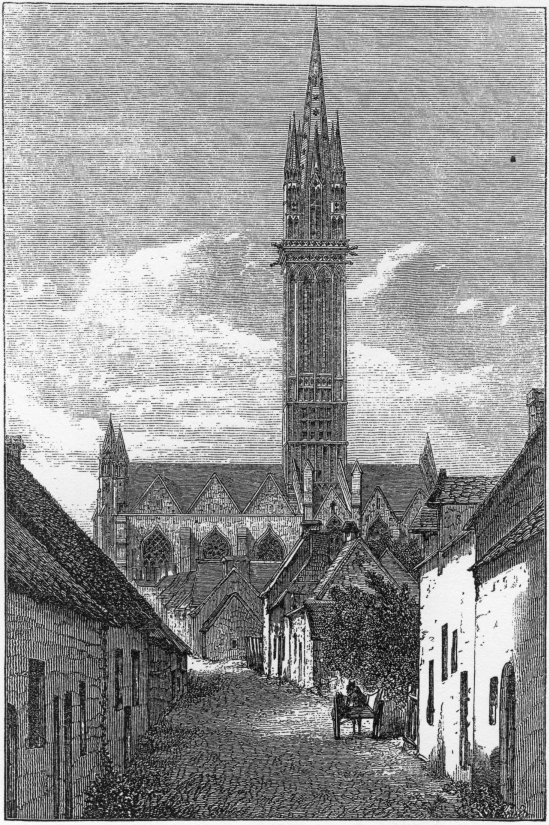
22. The Creizker.
The cathedral has two fine towers with spires, and a magnificent rose window of the fifteenth century in the south transept, with, above, the "fenêtre d'excommunication." The fine porch, lightly and delicately sculptured, is surmounted by a balustrade, whence the episcopal benediction was given. Over the high altar is a large wooden crosier, gilt, from which to suspend the ciborium, similar to that we saw in the cathedral of Dol. A black marble slab, at the foot of the steps of the high altar, marks the grave of St. Pol de Léon, who died 570. St. Pol, the patron bishop and founder of the cathedral, was [pg 107] [pg 108] [pg 109] one of the clergy of Great Britain who emigrated to Brittany in the sixth century; he landed in the island of Ouëssant, and passed on to the country of Léon, where he founded a monastery. The island of Batz was, at that time, infested by an enormous dragon, sixty feet long; the saint, accompanied by a warrior, entered the cavern of the monster, tied his stole round its neck, and gave him to his companion to lead, St. Pol following, beating him with his stick, till they arrived at the extremity of the island, when he took off the stole, and commanded the dragon to throw itself in the sea, an order the animal immediately obeyed. St. Pol is always represented with the dragon by his side, the stole round its neck. We were shown a little bell, said to have belonged to the saint. It appears he had repeatedly asked the king to give him this bell for his new church, but had always been refused. When one day some fishermen brought him a large fish taken off the island of Batz, and in its mouth was the coveted bell. It is certainly very ancient in form, a kind of square pyramid about four inches wide and nine high, of beaten red copper mixed, we were told, with a considerable quantity of silver. It is now rung over the heads of the faithful on pardons, as a specific against headache and earache—a singular remedy! The cathedral has a fine marble tomb of Bishop Visdelou, preacher to Queen Anne of [pg 110] Austria; he is represented in a half reclining posture, in his pontifical garments. In every part of the cathedral are the little boxes of skulls.
Adjacent is the Ursuline convent, where is preserved a small figure of the Virgin in jet; brought from a church in the Iles Sainte Marguerite, taken from the Spaniards in the seventeenth century. It is supposed to possess miraculous powers, and is sent round to the sick as a specific.
We breakfasted at the little inn (Hôtel de France), commanding a pretty view of the coast from its windows and garden. The Léon country was governed by Viscounts, who boasted, among several manorial rights, the "droit de motte," which empowered them, if a vassal (they were "serfs de motte") attempted to live out of his demesne, or to enter the service of another lord, to bring him back to his "motte," a cord round his neck, and inflict upon him corporal punishment. By virtue of the same right, if the demesne of a lord was so placed that it had no natural height from which to survey its extent, his vassals were made to bring sufficient cart-loads of earth to raise a mound or "motte" of the requisite elevation. The other privilege was the droit de "bris," equivalent to our flotsum and jetsum, so lucrative that a Léon Viscount is recorded to have said, when a noble was exhibiting his casket of gems, that he possessed a jewel more precious than all [pg 111] they were admiring—alluding to a rock famous for its shipwrecks. Duke John the Red, taking advantage of the misdeeds of one of these lords of Léon, seized his rich possessions and united them (1276) to the crown. The viscounty of Léon fell by alliance, in the fourteenth century, to the house of Rohan, in whose favour is was raised in the sixteenth to a principality.
We continued our drive to Roscoff, three miles distant, a little sea-port town, formerly one of the three great dens of corsairs and smugglers, all under the protection of St. Barbe,—the other two being Camaret and Le Conquet. Roscoff was the emporium of considerable contraband trade with England. Tea, wine, and brandy were brought over in small casks, which the smugglers tied together and threw into the sea, when near the coast, and landed at night. The whole country round is now one extent of kitchen-garden, the light sandy soil, dressed with the goëmon, produces an incredible quantity of vegetables, onions, cabbages, parsnips, asparagus, artichokes, cauliflowers, &c. Of onions, 2,000,000 lbs. are said to be sent every year to England alone. The people here wear black caps, those of the men are stocking-knit. The gardeners of Roscoff will carry their produce above a hundred miles for sale. The chief vegetable consumed by the Bretons themselves is the cabbage, of which the quantity [pg 112] raised is enormous. The kind grown is mostly the Jersey or cow-cabbage, which grows with stalks from five to six feet high, and has large leaves at every joint. They use them for their cattle, as well as for their own eating. Avenues of cabbages, stacked five or six feet high, are to be seen in most Breton markets. Bread or porridge of buckwheat (blé noir) with cabbage-soup is the customary diet of the country. The recipe is simple, consisting of a cabbage-leaf, over which a little hot water is thrown, and a "soupçon" of butter added to give it a flavour. These ingredients compose the national soup which always appears at the tâble d'hôte, with the inevitable "ragoût," i. e. harricoed mutton. The little town of Roscoff has some historic importance. It was here that John de Montfort sailed to England to do homage to King Edward III. for the duchy of Brittany, and returned by the same port. Here also the child-princess Mary Stuart landed in 1548 to marry the young Dauphin, afterwards Francis II. In commemoration of the event, she afterwards caused the little chapel of St. Ninian to be built close on the water's edge. It is not more than fifty feet long, and has an eastern flamboyant window, with others in the side walls. The arches are fast going to decay, the stone altar is also sculptured. When we saw it, the interior was filled with bundles of broom-branches and poultry. [pg 113] It is strange this little chapel, built by the Queen of two Kingdoms, should be suffered to fall to ruin for the lack of a trifling outlay.
Here, two hundred years later, Prince Charles Stuart landed after Culloden, in the French frigate the 'Heureux,' sent by the French Government to facilitate his escape, having eluded, through the chances of a fog, the pursuit of the English cruisers; and here he knelt, in the chapel of his ancestress, to return thanks for his deliverance.
The church of Roscoff has a curious pierced steeple, like many of those in Finistère, and some alabaster bas-reliefs of the fourteenth century, with numerous boxes of skulls. A ship rudely sculptured by the porch, and another by the east window, show that the fishermen and ship-owners contributed to the building of the church. By the shore is a rock of grotesque form, and opposite, about three miles from Roscoff, is the pretty island of Batz, which derives its name—Breton "batz," a stick—from the rod used by St. Pol de Léon to work his miracle.
People were busily employed in boats collecting the goëmon, which they pile in heaps along the shore. The great curiosity of Roscoff is its enormous fig-tree, in the garden of the Capucine convent, said to be two centuries old. It is supported by stone pillars, and is, we were informed, above 300 feet in circumference.
[pg 114]
We returned that evening to Morlaix: the viaduct by moonlight had a most picturesque appearance. Next morning we proceeded by rail to the station of St. Thégonnec, where nothing in the shape of a vehicle was to be had to convey us to the town—nearly a mile and a half distant—but the ricketty two-wheeled mail cart. At the little cabaret, which bears the important name of Hôtel de la Grande Maison, we procured breakfast. The church has been restored. It is rich in carvings, spoiled by gilding, the altars and canopied pulpit especially. Opposite to the last are two coloured "retables." The high altar, with two side altars and two smaller ones behind, are gorgeously carved, coloured and gilt, and extend to the roof. The painted-glass windows are the gifts of various persons. At the entrance of the churchyard is a Renaissance porch, or triumphal arch, dated 1581, with a sculpture representing St. Thégonnec, a bullock and car by his side. Adjoining, is the ossuary, or reliquary, bearing the date 1676, also in the same elaborate style, destitute of bones, but having below a crypt containing a group of life-sized figures representing the Entombment, with this inscription:—
“Tu le vois mort, pécheur, ce Dieu qui t'a fait naître:
Sa mort est ton ouvrage, et devient ton appui.
A ce trait de bonté, tu dois au moins vivre pour lui.”
In the churchyard is also a calvary; the name given [pg 115] to those monumental sculptures peculiar to Brittany, consisting of the crucifix, surrounded by the chief witnesses of the crucifixion, together with minor groups representing passages in the life of our Saviour. This calvary, executed in Kersanton stone, is dated 1610; the numerous figures are all in the grotesque costume of the period, with ruffs, toquets, trained gowns, and scalloped jackets.
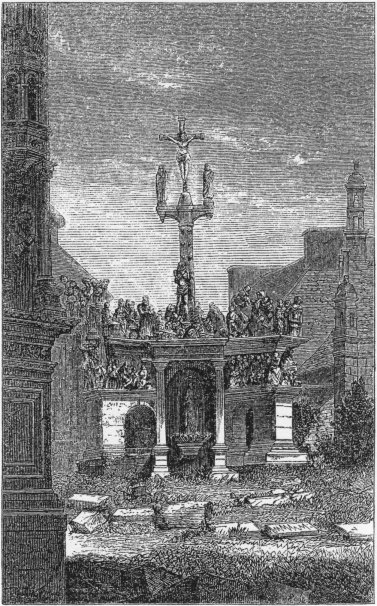
23. Calvary, Guimiliau.
We took a carriage for Guimiliau, passing on our road to the left, a grotto. The church of Guimiliau partly dates from the Renaissance; it has a finely sculptured porch, and contains within carvings of great beauty; the pulpit, supported on a column, is dated 1677; the organ-loft is enriched with splendid bas-reliefs in oak panels,—one represents a triumphal march, after Le Brun, the others, King David and St. Cecilia. But the grand monumental carving is the magnificent baptistery or baptismal font, surmounted by a baldachin or canopy, supported by eight twisted columns interlaced with vines, grapes and flowers, with graceful little birds pecking the fruit. On the top of the canopy is a dolphin, and above, two figures of Fame, trumpet-mouthed, surmounted by a royal crown and the letters S. V. This baptistery and the organ-loft are both in the style of Louis XIV., and are said to have cost 30,000 francs. In the churchyard are a triumphal arch and a reliquary, both inferior to those of St. Thégonnec, but [pg 116] the calvary of Guimiliau is one of the most extensive in Brittany. It is of the sixteenth century. It consists of a solid platform, ascended by a staircase, and raised upon arches; upon it, sculptured in Kersanton stone, are the three crosses, the centre one beautifully carved with St. John and the Virgin [pg 117] Mary by the side. The four Evangelists are placed at each corner, and all the passages in the life of Christ are represented by groups of little figures in the costume of the sixteenth century. This singular monument bears two different dates, those of 1581 and 1588.
Guimiliau is close to the railway, but there is no station there. We returned to St. Thégonnec. The peasants along the road were threshing their buckwheat on the open ground; women as well as men were at work. They threshed in a circle, keeping good time with their strokes, and laughing merrily while they flourished their flails,—they appeared a most joyous party,—
“Ho! batteux, battons la gerbe,
Compagnons, joyeusement.”
Buckwheat, their "blé noir," is the Breton's chief food, and is cultivated to a large extent. With its coral-red stalks and snowy flowers it has a very pretty appearance growing, and is the first care of the Breton farmer—
“Ah! que la sombre nue aux funestes lueurs,
Planant sur la campagne,
Epargne les blés-noirs, les blés aux blanches fleurs,
Ce pain de la Bretagne."” —Stéphane Halgan.
This plant, a native of Asia Minor, was evidently, from its French name, "sarrazin," introduced into Europe by the Saracens or Moors. We proceeded [pg 118] by rail to Brest, passing under the foot of the abrupt rock upon which stand the picturesque ruins of the ancient castle of La Roche Maurice and the church of La Roche. The rail runs along the banks of the Elorn through a narrow wooded valley; the windings of the river are very picturesque, and formerly a steamer ran from Landerneau to Brest, affording the opportunity of seeing them.
Brest, the first harbour in France, is Breton only in name and locality; it is built in an amphitheatre on the slopes of two hills divided by the river Penfeld, which forms the port. On the right is the suburb Recouvrance, on the left Brest proper. This irregular site often causes the second floor of the houses in one street to be on a line with the ground floor of another. Brest is clean and well built, and consists of three long parallel streets. The principal one, called the Rue de Siam, in commemoration of the Siamese Ambassadors sent to Louis XIV., who landed here, runs the whole length of the town, ending at the fine iron bridge called the Pont Impériale, the largest swing-bridge ever constructed. You descend by a flight of steps from the Rue de Siam to the lower streets. Running along the bay, of considerable extent, and well planted with trees, is the magnificent promenade called the Cours d'Ajot, from the name of the officer of the Engineers by whom it was laid out [pg 119] and planted a century back. Well sheltered by its trees and refreshed by the sea breezes, it commands a fine view over the new "port de commerce," and the whole extent of the harbour of Brest, which is capable of containing 500 ships of the line, and is, with the exception of those of Rio Janeiro and Constantinople, the largest and most beautiful in the world.
Brest harbour has only one entrance, which is to the west, through a narrow channel called Le Goulet, less than a mile in width, and cut into two by the Mingant rock. In the year 1796 the 'Republican' was lost here. Sailing out of the harbour, with a contrary wind and snow, the pilot thought he had passed the Mingant rock, when the ship struck, and went down with 800 men on board. Brest Castle in the Middle Ages was a place of such strength and importance that John IV., who had four times besieged it fruitlessly, when it was under the English dominion, was wont to say "Ce n'est duc de Bretagne, qui n'est pas sire de Brest." It had been held by Sir Robert Knolles against the army of the King of France under Du Guesclin, who was obliged to raise the siege. The donjon was built by King Richard II. during the War of Succession. The making Brest an important naval station was the thought of Richelieu, and the work of Louis XIV., who built the arsenal.
[pg 120]
Next day we made an excursion to see the church of Notre Dame-du-Folgoët or the Fool of the Wood, celebrated in legendary lore: the tale is so old and often told, we have some scruples in repeating it.
Towards the middle of the fourteenth century, there lived in the woods of Lesneven, a poor idiot boy, called Salaun (Solomon), better known under the name of the Fool of the Wood (Folgoët). He was miserably clad, had no bed but the ground; no pillow, but a stone; no roof, but the tree which gave him shelter. He went every day to Lesneven to seek his daily bread, but he never begged; he uttered the simple words "Ave Maria! Solomon could eat bread," and returned with whatever pittance was given him to his tree near the fountain, into which he dipped his crusts, and plunged even in the depth of winter, for his bath, always repeating the words, "Hail, Maria!" One day a party of marauding soldiers accosted him. In answer to their questions, he replied, "I am neither for Blois nor Montfort, I am the servant of the Lady Mary." This simple life he led for nearly forty years, when at last he fell ill and died, repeating his favourite words "Ave Maria." He was found dead near the fountain, and was buried by his neighbours. After a time, when the memory of the poor idiot boy had nearly passed away, there suddenly sprung up from his grave a white lily with the words "Ave Maria" [pg 121] inscribed in letters of gold upon its petals. The news of the miracle spread throughout all Brittany, Duke John sent commissioners; the grave was opened, and it was found the lily proceeded from the mouth of Salaun,—"ceste royale fleur sortait par sa bouche du creux de son estomach"—a testimony of the innocence and piety "du plus beau mignon de la reine des Cieux." Duke John vowed to erect a church to our Lady over the fountain of the poor mendicant, whose faith had been thus recognised;12 and, faithful to his promise, the first stone was laid by him in 1366, as a thank-offering for his success the previous year at the battle of Auray, which had fixed the crown upon his head. His wife, Joan of Navarre, not only made a pilgrimage to the Folgoët in 1396, but also contributed to the building of the church. It was completed by John V., about 1419. The Queen-Duchess Anne of Brittany went there in pilgrimage [pg 122] after the recovery from illness of Louis XIII. Anne of Austria founded six masses at the Folgoët, in gratitude for the birth of Louis XIV., and several popes granted indulgences to those who made pilgrimages to this shrine. This church is one of the finest in Brittany. Its colour is sombre; it is the oldest monument in Brittany in which the Kersanton stone is employed. This stone is a volcanic rock called hornblende, of very fine grain, with minute specks of mica. There is a large quarry near St. Pol de Léon; but it is found principally on the west of the harbour of Brest, near a village from which it takes its name. Kersanton stone is of a dark-green colour, approaching to bronze, gives out a metallic sound when struck, and is easily worked in the quarry, in blocks of from twenty to forty feet cube, but hardens on exposure to the air. Time has no destructive effect on it; the most delicate, lightest, and most ornamental sculptures executed in it remain uninjured, while the hardest granites, erected at the same time, are friable and decomposed. The Kersanton stone cuts glass like a diamond.
The architecture of the Folgoët is distinguished for the elegance and richness of its ornamentation: the softness of the Kersanton stone, when fresh taken from the quarry fits it specially for the deeply cut, lace-like works of the artists of the flamboyant [pg 123] school, and the church is remarkable for the skill with which the productions of the vegetable kingdom are represented both within and without. It has no transepts, but to the south is a projection formed by the treasure chamber. The modern pulpit has a series of medallion bas-reliefs representing the legend of Solomon.
The jubé, or roodloft, is a perfect lacework of stone. Above three arches, decorated with vine-leaves, is an open-worked gallery of pierced quatre-foils surpassing in exuberance of ornament any other known.
To the east are five altars, all of Kersanton stone, most delicately sculptured—the under-cutting of the foliage most wonderful. They are in the shape of tombs or sarcophagi, the form generally adopted for altars in the sixteenth century. Round the "autel des anges," richest of them all, is a row of eighteen niches, filled in with the figures of angels, holding alternately phylacteries and escutcheons; round the top is a cornice of thistle-leaves—on the cut stalk of one hangs a dew-drop perfect to nature.
The high altar is decorated with vine-leaves, birds pecking the grapes, and the ermine, with its motto "À ma vie," introduced. The altar of the rosary has also a cornice of vine-leaves modelled evidently after the high altar.
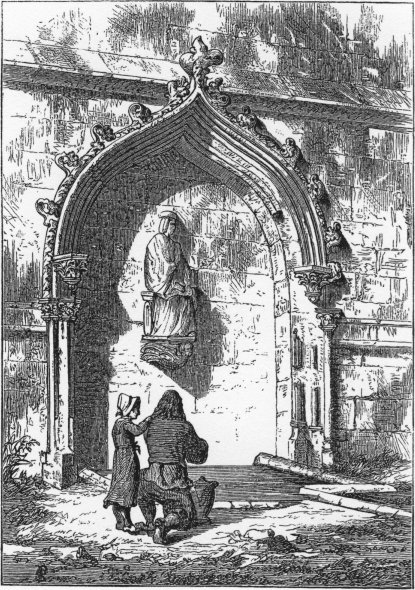
24. The Fool's Well, Folgoët.
The fine flamboyant rose window at the east of [pg 124] the church resembles that of St. Pol de Léon, and below it is the fountain of Salaun. The spring is concealed under the high altar, and flows into a basin without, preserved by a kind of Gothic porch sculptured with thistle-leaves and crockets, and within it, on a bracket, is a delicately chiseled image of the Virgin. Some children round the fountain [pg 125] offered us pins, the use of which we did not understand. We afterwards learned that it is the custom in Brittany for girls to take a pin from their bodice, and throw it into a sacred well, to ascertain, by its manner of sinking, when they would be married. If the pin falls head foremost, then there is no present hope of matrimony, but if the point goes first, it is a sure sign of being married that year.
On the new year, in some parts of Brittany, pieces of bread-and-butter are thrown into the fountains, and from the way in which they swim the future is foretold. If the buttered side turns under, it forebodes death; if two pieces adhere together, it is a sign of sickness; and if the piece floats, it is an assurance of long life and happiness.
The veneration for springs and healing wells is of very ancient date, and was prohibited by early councils of the Church; but the worship of that element from which suffering humanity seeks for relief in all its ailments has passed through succeeding creeds, and that which was held sacred a thousand years back is still the object of reverence and affection.
Nor is the sculpture outside the church less remarkable than the interior. The west door, now fallen to decay, has an arch with double entrance separated by a column containing a bénitier. A wreath of curled leaves runs round the arch, and on [pg 126] a bracket of thistle-leaves formerly stood a statue of John V.
The north side has little ornament. The great richness is in the south, where is the fine porch of Bishop Alain de la Rue, who consecrated the building, and more splendid still, is, at the angle formed by the projecting sacristy facing the west, the Porch of the Apostles. The twelve Apostles are ranged on each side, under rich canopies; the whole porch one mass of floral decoration, vine-leaves and mallows, interspersed with dragons, birds, and insects. On the right of the porch is a crouching figure with a label inscribed: "Bn soiez venz,"—"Bien soiez venuz" or "Soyez les bien venus"—an invitation to the faithful to enter into the church. On the lintel of the two doors are ermines passant, and the motto of the Dukes of Brittany, "À ma vie," and towards the south are the remains of a whole cornice of ermines, running through the rings of a long scroll inscribed with "À ma vie." This motto was first taken by Duke John IV. (who instituted the order of the Ermine) to imply that he had conquered Brittany, and would maintain it, even at the cost of his life, "à ma vie."13
[pg 127]
The collar consisted of a double chain, in each of which were four ermines, and two more hung suspended from two chains, surmounted by coronets. The motto "À ma vie" was placed round each of these ten ermines. The Père Lobineau quotes a history of Duke John, in which the order is thus spoken of:—
“Lors fit mander tous les Prélats,
Abbés et Clercs de tous Estats,
Barons, Chevaliers, Escuyers,
Qui tous portoient nouveaux Colliers
De moult bel port et belle guise;
Et étoit nouvelle Dévise
De deux Rolets brunis et beaux,
Couplés ensemble de deux fermeaux;
Et au dessus étoit l'Ermine
En figure et en couleur fine,
En deux Cedules avoit escript
À ma vie, comme j'ai dit;
L'un mot est blanc, l'autre noir,
Il est certain, tien, pour le voir.”
In the churchyard is a cross erected by Cardinal de Coëtivy (died 1474), who is represented kneeling at the foot; it is said to be the work of Michel Colomb, sculptor of the celebrated monument raised by Queen Anne of Brittany to her parents, now in the Cathedral at Nantes. Next day, we went to Le Conquet, returning by St. Mathieu. We crossed the swing-bridge to the suburb Recouvrance, so called from the chapel of our Lady, to whom [pg 128] shipwrecked mariners addressed their petitions to recover (recouvrir) their property. On our left we saw the islet rock of Bertheaume, about 200 feet high, distant from the coast 150. Until lately, the communication with the mainland was by means of a kind of cradle drawn on two cables, about nine mètres in circumference.
Le Conquet14 is a little seaport built on the slope of a steep hill. Formerly it was of some importance, and a great resort of pirates. Sir Walter Manny took the town for the Countess of Montfort, during the war of the two Jeannes, and it was attacked by the fleets of Henry VIII. and his daughter Mary. Opposite is a beautiful beach, called the Blancs Sablons, accessible at low water by walking across the harbour. Here is the point of communication with the island of Ouëssant, about seventeen miles distant, by means of a steamer, weather permitting, as the Chenal du Four, which separates this group of islands from the continent, is covered with rocks and is very dangerous in rough weather. Its men are all seamen or fishermen, the women perform the agricultural labour. They bring in their produce to Brest at the monthly fairs, and are not so cut off from the world as Gresset describes them:—
[pg 129]
“Sous un ciel toujours rigoureux
Au sein des flots impétueux,
Non loin de l'Armorique plage
Habitacle marécageux,
Moitié peuplé, moitié sauvage,
Dont les habitants malheureux
Separés du reste du monde,
Semblent ne connoître l'onde
Et n'être connus que des cieux.”
Gresset.—Carême impromptu.
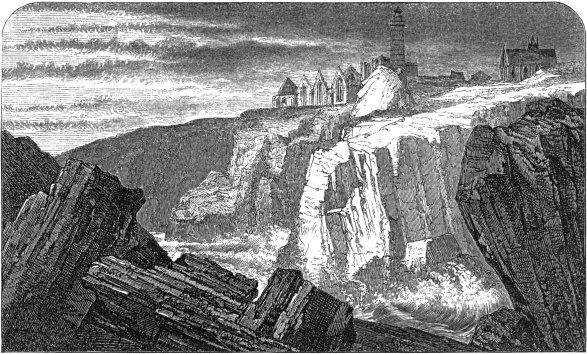
25. Abbey of St. Mathieu.
We now reached the Abbey of St. Mathieu, situated on the extreme point of Brittany and of France, on the top of a promontory, well called Finistère. Here in the sixth century was built a monastery in honour of St. Matthew the Evangelist, whose head had been stolen in Egypt by some Breton navigators, and been brought to land at this point, which long bore the name of "St. Mathieu de fin de terre" (Finistère). In the twelfth century the monastery was converted into a Benedictine abbey, which is a beautiful example of the Early English style. The formidable rocks at its feet are called Les Moines. The monks of St. Mathieu kept a beacon for the safety of mariners on these dangerous shores. The modern lighthouse quite masks the sight of the abbey, and is a great disfigurement to the view, which, in other respects, is most grand; the imposing granite ruins of the abbey church on the very edge of these weather-beaten cliffs, worn and torn by the ocean with its unwearied [pg 130] waves; on the right, the reefs of the Passage du Four, which appear to unite the islands of Ouëssant and its satellites to St. Mathieu; on the left the elongated point of the Bec du Raz, which no one, according to the Bretons, ever passed without grief and suffering. In sight of Saint Mathieu, the English in 1504, with eighty ships, attacked Hervé de Porzmoguer, a Breton captain, with only twenty. His own ship the 'Cordelière,' which had been built and fitted out by Anne of Bretagne, at her own expense, took fire; it held 1200 troops besides the ship's company. Porzmoguer grappled the 'Cordelière' to the ship of the English admiral, the 'Great Harry;' and both vessels, driven by the north-west wind to the entrance of the Goulet, were burned together, and above 2000 men perished in the two ships. Porzmoguer mounted the mast followed by the raging flames, and cast himself from the main-top, in full armour, into the sea.
In 1597, the fleet sent by Philip II. to take possession of Brittany for Spain was dispersed in a storm off Point St. Mathieu, and, out of a hundred and twenty ships, scarcely one remained.
On our way home, we passed a little town called La Trinité, from three springs all issuing from the same fountain, at which washerwomen with their wooden bats were hard at work, beating the clothes to rags on the stones.
[pg 131]
[pg 132]
[pg 133]
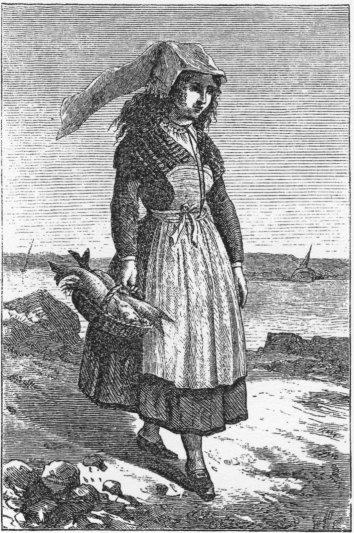
26. Peasant Girl of Ouëssant.
Next day was the monthly fair at Brest, which brought in many of the country people in their picturesque costumes. Most conspicuous among them were the peasants of Ouëssant, last type of the Celtic women, in their singularly Italian-looking head-dress, their hair streaming over their shoulders; and the Plougastel men, in red caps, with coats and trowsers of white flannel.
Most of the market-women were furnished with [pg 134] enormous umbrellas, red, blue, and green. In this rainy province, they are indispensable, and the acquisition of an umbrella is a great object of ambition to the Breton peasant.
We left Brest by the steamer for Pont Launay and Châteaulin, a four hours' sail in the harbour of Brest. On the right we passed the Point des Espagnols, where Frobisher, sent by Queen Elizabeth to the assistance of Henry IV., received his death wound. Leaving on our left Plougastel, where we were unable to visit the celebrated calvary, we passed near the "Anse du Fret," whence Joan of Navarre, then widow of Duke John IV., sailed to England to marry Henry of Lancaster, 1403. Henry, when Earl of Derby, had visited Nantes to ask the assistance of his uncle in returning to England, and Joan had favoured his expedition, but Duke John died the same year (1399). When Queen Dowager of England, she saw the children of her two husbands arrayed against each other, and her son Arthur, who had been invested by King Henry IV. with the Earldom of Richmond, made prisoner at Agincourt by his half-brother King Henry V., who confined him in the Tower, and afterwards in Fotheringay Castle. Joan received hard treatment from her stepson. Accused of being a sorceress—a reputation she inherited from her father, Charles the Bad of Navarre—Henry caused her to be confined in [pg 135] Leeds and Pevensey castles, and deprived her of her property. It was only on his approaching death that he restored her to liberty. She retired to Havering Bower in Essex, where her grandson, the unfortunate Gilles de Bretagne, was reared and educated with Henry VI. She died in 1437, and the memory of "Joan the witch queen" was long held in awe by the people of Havering Bower.
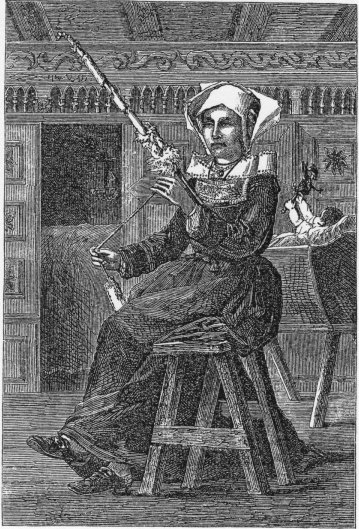
27. Peasant Girl, Châteaulin.
On the left is the hamlet of Kersanton, which gives its name to the stone so called. At the entrance of the Aulne,15 to the right, we passed the ruins of the abbey of Landévenec, the most ancient monastic establishment in Brittany. At Pont Launay an omnibus took us to the railway station at Châteaulin, celebrated for its slate quarries, a drive of three quarters of an hour. From here we proceeded by rail to Quimper, capital of Cornouaille. The district of Cornouaille—Cornu-Galliæ, expressing its position at the horn or extremity of France—is most varied in character. The part on the north is enclosed between the two chains of mountains, which, running nearly parallel with each other, traverse the department of Finistère, the Mené-Arré, and the Montagnes Noires. A single chain passes through the Côtes-du-Nord, [pg 136] and forks off, at the edge of the department, near Callac, whence the northern range, the Mené-Arré, runs westwards to Faou harbour; while the Montagnes Noires incline to the south-west, and reach the sea near Crozon. The country between these chains is dreary and bare—barren plains and black mountains; to the south it is cultivated and productive. The stormy rock-bound coast is wild and desolate. One-third of the department consists [pg 137] of landes, marshes, and sandy shores (grèves). The people are the Irish of Brittany. Their wants are restricted to a tub of salted pork and a provision of cider, with rye, or black corn, to make their "galette." They are simple in their manners, kind to the poor, and enduring of suffering. Respect for the misfortunes of others, and patience under their own, is one of the Breton characteristics.
In the days of Conan Meriadec there lived a holy man, called Corentin, who retired to a solitude for prayer and meditation, near a fountain in a forest. Every morning a little fish came to him from the fountain; he cut a piece off it for his daily pittance and threw it again into the water, and in an instant the fish became whole. The miracle was repeated every morning. One day King Gradlon, who held his court at "Kemper," was in the forest near the hermitage of St. Corentin, with some of his suite, and asked him if he could give him something to eat. The saint immediately ran to his fountain and called his little fish, cut off a piece, which he gave to the maître d'hôtel to prepare for the king and his attendants. The chef laughed when he took the slice; but, to the surprise of everybody, the fish multiplied so as to completely satisfy the hunger of the king and his party. Gradlon threw himself on his knees at the feet of St. Corentin, and gave him the forest, with a "maison de plaisance," which St. Corentin [pg 138] converted into a monastery. The king afterwards erected Quimper into a bishopric, to which he nominated St. Corentin:—
“Voici dans le fond la ville de Kemper,
Asise au confluent de l'Oded et du Ster.
Comme sa cathédrale, aux deux tours dentelées,
S'élève noblement du milieu des vallées,
O perle de l'Oded, fille du roi Grallon,
Qui de saint Corentin portes aussi le nom,
Rejouis-toi, Kemper, dans tes vielles murailles!
Vois avec quelle ardeur, ô reine de Cornouailles,
Tes fils de tous les points de l'antique évêché,
Pêcheurs et montagnards, viennent à ton marché!
Cornouillais! en passant près de sa basilique,
Du bon saint Corentin adorez la relique.
Que tous ceux d'Elliant et des mêmes chemins
Boivent à sa fontaine et s'y lavent les mains;
Non pas les Léonards, eux de qui les ancêtres,
Voici quelque mille ans, hommes jaloux et traîtres,
Volèrent le poisson dont notre Corentin
Coupait pour se nourrir un pen chaque matin,
Et qui chaque matin, ô pieuse merveille!
Nageait dans sa fontaine aussi frais que la veille:
Eh bien! les Léonards volèrent ce poisson,
Mais Kemper n'oublie jamais leur trahison;
Sans jouir de leur crime, ils en portent la peine,
Et toujours le poisson nage dans la fontaine.”
Les Bretons—Brizeux.
Quimper, or Quimper-Corentin, is prettily situated at the junction of the rivers Odet and Stheire; its Breton name, Kemper, signifying confluence. It was long called Kemper-Odet. On the opposite side of the river the hills, consisting of a mass of rocks, [pg 139] covered with trees, rise to some height, and are ascended by well-kept walks. The river runs straight through the town, like a canal, edged by stone quays and crossed by iron bridges, with avenues of trees on each side. Trout can be seen in the sparkling stream; and we watched a boy with a hook at the end of a reel of black silk, hanging over the bridge, with a piece of kneaded bread for bait. With this simple tackle he contrived to hook a trout of tolerable size, and let it run out the length of his silk line till he had tired it out and landed it. The scenery of the river below Quimper, flowing through a bed of granite blocks, is, we were told, lovely, but we had no time to visit it further down. The view from the top of the wood-covered heights on the opposite side is very extensive, looking down upon the town, with its cathedral towers rising above, the promenade, and the course of the river. At the end of the town there is a manufactory of coarse pottery; but formerly it produced ware of a finer quality.
The beautiful cathedral is the largest of the four episcopal churches of Lower Brittany (Vannes, St. Pol, Quimper, and Tréguier), and was principally built in the fifteenth century. On the platform over the finely sculptured porch, rich in foliage like the Folgoët, placed between the two towers, is the equestrian statue of King Gradlon, to whom is attributed the introduction of the vine into Brittany. The statue [pg 140] was decapitated in 1793, but restored ten years back. On St. Cecilia's day companies of musicians used to mount on the platform. While they sang a hymn in praise of King Gradlon, one of the choristers, provided with a flagon of wine, a napkin, and golden hanap, mounted on the crupper of King Gradlon's horse, poured out a cup of wine, which he offered ceremoniously to the lips of the statue and then drank himself, carefully wiped with his napkin the moustachios of the king, placed a branch of laurel in his hand, and then threw down the hanap in the midst of the crowd below, in honour of the first planter of the grape in Brittany. To whoever caught the cup before it fell, and presented it uninjured to the Chapter, was adjudged a prize of two hundred crowns.
The two spires of the cathedral are modern, and were built by an annual subscription of a sou for five years, called the "sou du St. Corentin:" more than 600l. was thus raised. They have only been lately finished.
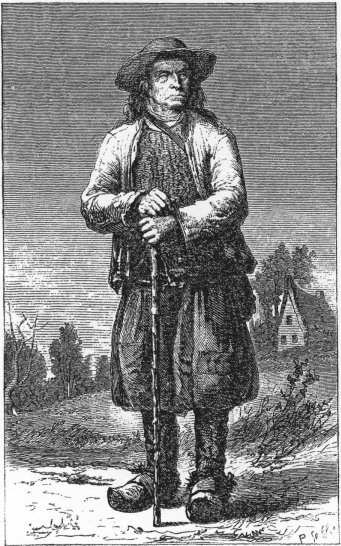
28. Beggar. Quimper.
The men about Quimper all wear the national costume—enormous bragou-bras, or breeches of a kind of white sail-cloth, a broad-brimmed felt hat, long hair, falling over the shoulders, wooden shoes, and a broad belt with metal buckle. Their woollen jacket and waistcoat are edged with gay colours, and have sometimes the itinerant tailor's name and the [pg 141] date of the making of the garment, embroidered in wool upon the breast. On gala days brown or blue cloth bragous are worn, tied with coloured ribbons at the knees, black leather gaiters with buttons, and the sabots are replaced by leather shoes and costly silver buckles. The national costume is more preserved in Cornouaille than in the other parts of Brittany. The pen bas or cudgel, with a large [pg 142] knob, like the Irish shillelah, is always ready at hand:—
“Comme une conque immense ouverte au bord des eaux,
En Cornouaille est un port, il y vient cent bateaux.
Un sable jaune et fin couvre ses côtes plates,
Mais un infect amas de rogues, de morgates,
D'ossements de poissons sur le rivage épars,
La saumure qui filtre entre ses deux remparts,
Soulèvent tous les sens quand cette odeur saline
Arrive au voyageur qui tourne la colline,
Laissant derrière lui les taillis de Melven,
La belle lande d'or qui parfume Aven,
Et ces mouvants aspects de plaines, de montagnes
Que déroulent sans fin nos sauvages campagnes.
Plus de batteurs de seigle ici, plus de faucheurs,
Mais des canots chargés de mousses, de pêcheurs,
Partant et revenant avec chaque marée,
Et sur les quais du pont versant à leur rentrée,
Des sardines en tas, des congres, des merlus,
Des homards cuirassés, de gros crabes velus;
Et, du fond des paniers, mille genres énormes,
De toutes les couleurs et de toutes les formes,
Avec leur œil vitreux et leur museau béant,
Tous enfants monstrueux du grand monstre Océan.
Aussitôt le pressier les sèche, les empile,
Et quand leur grasse chair a degorgé son huile,
De Nantes à Morlaix cherchant les acheteurs,
On voit bondir sur mer les hardis caboteurs."”
Les Bretons—Brizeux.
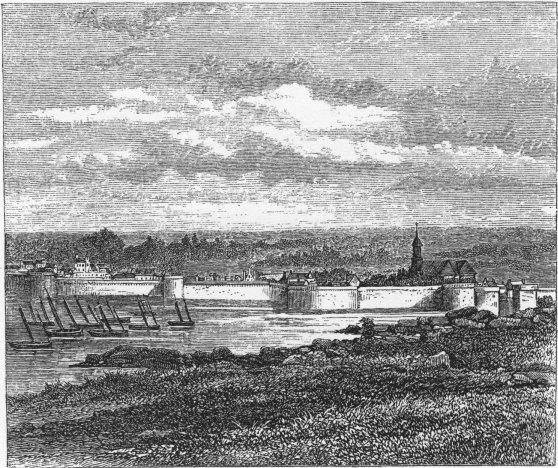
29. Concarneau, with Sardine Boats.
Thus the Breton poet describes Concarneau, a little fortified town, which has been called the St. Malo of Cornouaille, and is celebrated for its sardine fishery. The road lay through a wooded country, with steep hills and valleys, intersected by streams: [pg 143] on the right a view of the Bay of La Forêt, where extensive oyster-culture is going on. After a tedious journey with miserable horses, we reached Concarneau at nine, a distance of little more than thirteen miles, having set off a few minutes after four. Concarneau proper is on a rocky island, surrounded by fortifications, with eight or nine towers and thick walls, and communicating with the mainland by means of a drawbridge. This is called the "Ville Close." It consists of only one street. When Duke John IV. embarked from here for England, he left [pg 144] Sir Robert Knollys governor of the duchy. The constable Du Guesclin, after the surrender of Hennebont and Quimperlé, took Concarneau by storm and slew all the English garrison, except the captain, who received quarter.
Opposite the island is the faubourg Sainte Croix, which is more populous than the Ville Close, and where all the business of the place is carried on. The sardine fishery, from June to November, occupies two-thirds of the population. From three to four hundred vessels are employed with five men to each boat. Calm weather is most favourable for fishing. The sardines are taken in large seine nets, one side floating with corks on the surface of the water, the other falling vertically. The sardines, attracted by the bait, try to force themselves through the meshes of the net, and are caught by their gills. The bait used is called "rogue:" the best is composed of the roe of the cod-fish, pounded and steeped in salt water for several days; sometimes the roe and flesh of the mackerel is used. Rogue is made in Norway and Denmark, but principally at Drontheim, and is very expensive, costing about sixpence the lb.; hence an inferior bait is substituted, composed of shrimps and other small crustacea, with fish salted, and the heads of anchovies, all pounded and putrified together. But this kind of decomposed bait is forbidden by the fishery laws. The employment of it [pg 145] accounts for the rareness of good sardines, as the remaining of such a substance in the body of the animal cannot fail of corrupting it. It is a pretty sight to behold the little fleet employed in the sardine fishery return in the evening, laden with the results of the day's work. The fish, when landed, are counted out into baskets, shaken in the water, and taken up to one of the curing-houses: of these there are about sixty in Concarneau. In the first shed we saw above fifty women employed in taking off their heads—"detêter" it is called—an operation they effect with great dexterity. With one cut at the back of the neck the head is separated and the fish "éventré" at the same time.
The sardines are next placed in little wire trays, with divisions like a double gridiron, and fried or dipped in boiling oil, an operation principally performed by the women of Pont l'Abbé, who are supposed, like the Germans of our baking and sugar-refining houses, to be peculiarly constituted to resist heat. The gridirons are then hung up to drain. The sardines are next packed in tin boxes, cold oil poured over them, and the boxes soldered down. From 800 to 900 boxes are placed in a boiler and boiled for half an hour to test the boxes, and those which leak are put aside. They are of English tin, and the making of them is the winter's occupation. Finally, the boxes are stamped with [pg 146] the name of the establishment, and packed in deal cases for exportation. The sardine is a very delicate fish, and easily decays. It is only taken out of the net with a rake (raquette); in summer, numbers are spoiled from being heaped in the boats, and at whatever hour the boats come in the fish go through the whole process of curing, as they will not keep till the next day. Concarneau exports from 15,000 to 20,000 barrels of sardines annually. [pg 147] Only a part are "anchoitée," that is, preserved like the anchovies of the Mediterranean, the others are salted in casks; and quantities, only slightly salted, are packed in baskets, to be sent to the provincial markets. It is estimated that twelve hundred million fish have been caught this year. The sardine fishery extends along the whole western coast of Brittany from Douarnenez to the Loire.
One of the curiosities of Concarneau is its aquarium, under the direction of M. Guillon. It consists of six cisterns, made by the blasting of the solid rock, and comprising an area of large extent, within a walled enclosure. In these cisterns the water is renewed at each turn of the tide through narrow openings in the wall. Three of these reservoirs are reserved for fish, the others for crustacea—lobsters and langoustes. Of these they keep from 10,000 to 15,000 at a time, and send them off daily, when fattened, to Paris and the principal markets of France. It was curious to see the dread shown by the common lobster to the langouste. They all were adhering to the sides of the reservoirs as if afraid to encounter their more powerful companions. Quantities of turbot, also reared for sale, were in one of the cisterns, darting with the greatest rapidity in the water when the keeper threw in pieces of sardines for them to eat. At the end of these cisterns is a building, with every arrangement for [pg 148] the culture of fishes—rows of little troughs, and other vessels, to contain them. Many of the fish are so tame, they came immediately to the keeper on his making a noise in the water with his fingers. Here are fish of every description, and naturalists have every facility of studying their habits. Among others, we saw the graceful little sea-horse or hippocampus, a native of the seas of Brittany as well as of the Mediterranean.
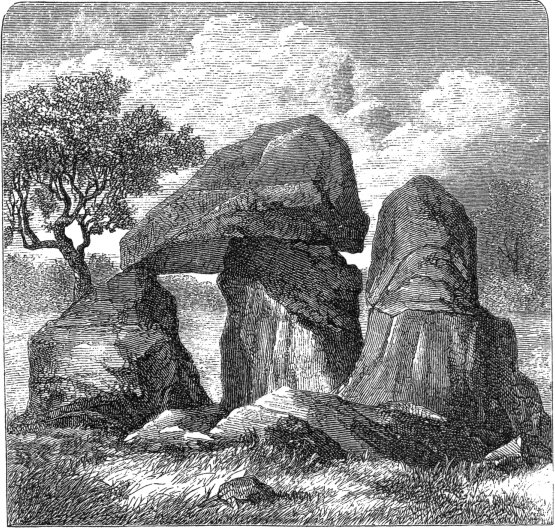
30. Dolmen. Trégunc.
From Concarneau to Quimperlé is a distance of above eighteen miles. The road runs near the sea, [pg 149] over a large tract of land covered with furze (ajonc), which, in Brittany, grows from five to six feet high, forming a solid impenetrable mass. Huge blocks of granite are scattered about in every direction, jutting out from among the furze—menhirs, cromlechs, and dolmens—a perfect wilderness of Celtic remains. We drove over an extent of several miles of furze-covered hills and heathy land. Before we reached the village of Trégunc we stopped to see a large dolmen on the side of the road, and further to the right a rocking-stone, twelve feet long and nine feet thick, standing about fifteen feet from the ground, the second largest in Brittany. It is poised by a little projection, like an inverted cone, upon another rock lying half-buried in the ground. The upper block can easily be set in motion by the hand. It is called by the country people "La pierre aux maris trompés," and was formerly consulted by husbands to test the fidelity of their wives. Even now the partner of a faithless wife is said to be incapable of giving to the stone the rocking motion it so easily receives from another.
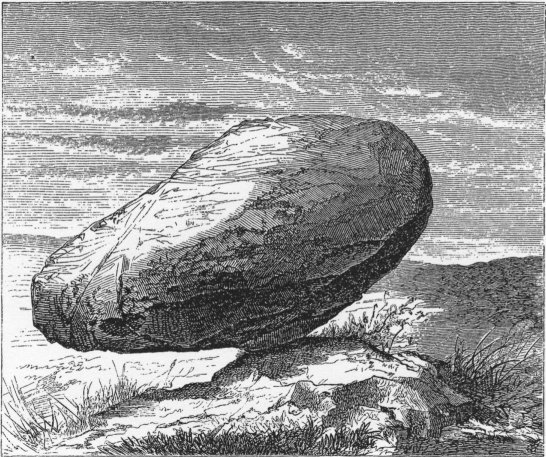
31. Rocking Stone. Trégunc.
On the left we passed the majestic ruins of the castle of Rustéphan, i. e. Run, mound, of Stephen, having been built by Stephen Count of Penthièvre at the beginning of the twelfth century. It belonged in the thirteenth to Blanche of Castile, the mother of St. Louis. The present edifice dates from the [pg 150] fifteenth. One of the sides remaining has a cylindrical tower with pinnacled doorway, and the windows have stone mullions.
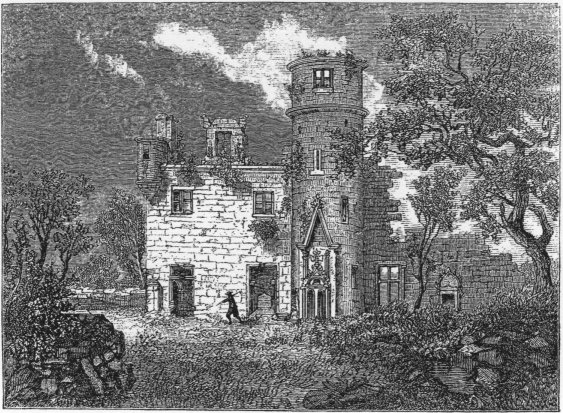
32. Château of Rustéphan.
Pursuing our road through blocks of granite, we descended into the valley of Pontaven, the town of millers, according to the old saying—
“Pont Aven, ville de renom;
Quatorze moulins, deux maisons;”
a little port built upon rocks, at the foot of two elevated mountains, over which are scattered masses of granite boulders, obstructing the course of the river which bounds over them. The banks are lined with woody slopes; wooden bridges cross the [pg 151] river at intervals; mills are established on the ledges of the rocks on its sides; and the noise of the mills, with that of the sparkling river tumbling through the rocks in waterfalls, keep up a perpetual din. Pontaven is celebrated for the quantity of its salmon: so much is taken, that it used to be said that the millers fattened their pigs upon this fish, which was literally true, as they took the small salmon, called glésils, in nets (poches) for that purpose. Salmon now is very dear. At the mouth of the Pontaven river was a castle, whose proprietor had the privilege of firing upon the fishing-boats which returned up the river without giving to the castellan their finest fish, which his steward went down to select. Pontaven is seven and a half miles from Bannalec, the nearest railway station. After remaining a few hours we drove on to Quimperlé—in Breton, Kemper (confluence) Ellé—so called, because it is at the confluence of two rivers, the Elle and Isole:—
“Vous reverrai-je encore, ô fleuve de l'Ellé,
Vous, Izôle, où mon cœur est toujours rappellé!
Les eaux sombres de l'Ellé, claire ceux de l'Izôle;
De ces bords enchantés je dirais chaque saule.”
Brizeux.
Quimperlé is a great resort for fishing, the Quimperlé salmon and trout being renowned throughout Brittany, and even at Paris. This town is beautifully situated, surrounded by high hills, in a valley, watered [pg 152] by these bright rivers, the hills covered with gardens, orchards, the Ursuline, Capucine, and other convents, and crowned by the steeples of the Gothic church of St. Michael. Its principal building is the church of St. Croix, formerly that of a Benedictine abbey, celebrated for its riches. The island of Belle-Ile-en-Mer then belonged to it. It is a most singular edifice, built in the eleventh century, after the model of the church of the Holy Sepulchre at Jerusalem. In 1862 it fell down, but is at present in course of restoration, after its original plan. The old abbey buildings are now occupied by the Prefecture. We were given permission to pass through the convent garden—the workmen and building materials having blocked up the other entrances—to see the crypt in which is the tomb of Saint Gurloës, first abbot of Quimperlé. His effigy, with crosier in hand, his feet resting on a dragon, lies upon a monument, about three feet high, with an opening in the lower part. The saint—Saint Urlose, as the Bretons call him—is invoked principally for the gout, and persons so afflicted crawl through the hole under the tomb, where, suspended by chains, is an iron hook. They twist a lock of their hair round this hook, and tear it off with violence, hoping to propitiate the saint by this mortification—evidently a remnant of heathen times, when hair was sacrificed to deities or to the memory of departed friends.
[pg 153]
At Quimperlé was buried John de Montfort, rival of Charles of Blois for the ducal crown. Sent to Paris under a safe-conduct by the Dauphin John, Philip of Valois had him shut up in the Louvre, whence he escaped, after a captivity of three years, to England. Edward III. espoused his cause and granted him some troops. After an unsuccessful attack upon Quimper, De Montfort died (1345) at Hennebont, and was buried in the church of the Dominicans at Quimperlé. He appointed Edward III. guardian of his son, and Edward immediately occupied Quimperlé and caused money to be struck in his name. Lord Lewis of Spain, on the side of Charles of Blois, made a descent upon Quimperlé at the head of 6000 men, and pillaged the whole country. On the news reaching Sir Walter Manny, he hastened to meet the enemy, took possession of their fleet, and made such carnage of the soldiers, that they were all killed or taken prisoners, and Lewis of Spain escaped with difficulty. The country about Quimperlé is beautiful—wood and water in every direction. The department of Finistère is traversed by three hundred streams, and has an extent of nearly four hundred miles of coast. We were advised to go and see the rood-screen of the chapel of Rosgrand, but had no time. We visited the ruins of the church of St. Columban. Above a round-arched doorway is a beautiful flamboyant [pg 154] window, between two canopied niches. We next walked up to the Place near St. Michel, where a cattle-market was being held. The Breton peasants, with their long shaggy uncombed hair hanging round their shoulders—they comb and wash only on fête days—their dirty canvas bragou bras, patched coats, and sabots with tufts of straw crammed in, looked more dirty than it is possible to imagine. Cleanliness is the last of the Breton virtues. The market and the fair are the two great events of the country, and people flock from great distances to sell their merchandise. But of all extraordinary animals is the Breton pig, as tall as a donkey; a lean, long-necked, ragged, bristly, savage-looking beast, as ill kept as its master, and it runs like a greyhound when approached. The Breton cow is very small, small as the Kerry cows of Ireland, very pretty and very productive. The Breton butter is proverbially good, and is given out most liberally, in lumps as big as loaves, at the tables-d'hôte. It is brought to market in jars which the women carry upon their heads. It is to the Queen-Duchess that Brittany, and indeed all France, owes the privilege of eating butter in Lent. It was forbidden as animal food by the laws of the Church, and oil, a vegetable production, ordered as a substitute. In 1491, Anne solicited of Rome, for herself and household, permission to eat butter on fast-days, alleging, [pg 155] as a plea, that Brittany did not produce oil. Encouraged by this favour, Brittany obtained the same indulgence, and it was acquired successively by the other provinces of France; but all are originally indebted for the privilege to the good Queen-Duchess Anne.
Next day, leaving the department of Finistère, we entered that of Morbihan, and went by rail to Lorient on the river Scorff, here joined by the Blavet. It was formerly the seat of the French East India Company; it is now one of the five military ports of France and the residence of a maritime Prefect. In the Place Bisson is the statue of a young officer of the French navy, a native of Guemené-sur-Scorff (Morbihan). When commanding, in 1827, a brig in the Greek Archipelago, he was attacked by two pirate vessels. Nine out of his fifteen men were killed and himself wounded; the enemy crowded on the deck. Desiring the survivors of his crew to jump overboard, "Now," cried he to the pilot, "is the moment for revenge!" and, setting fire to the powder-magazine, he blew up himself, his ship, and the pirates who had boarded her. Next morning the bodies of seventy Greeks lay on the sea-shore, showing the success of his self-devotion. The pilot, who, with four sailors, was saved, received the decoration of the Legion of Honour. On the pedestal of Bisson's statue is an inscription, concluding with [pg 156] these words: "Mort en héros, pour son roi et sa patrie, ses amis le pleurent, la France le regrette, et ses frères d'armes envient son sort."
From here we proceeded to Hennebont (Breton, "old bridge"), famous, in the War of Succession, for its heroic defence by Jeanne de Flandre, during the captivity of her husband, Jean de Montfort, who had been taken prisoner at Nantes and carried off to Paris. Jeanne, who, as Froissart says, had the courage of a man and the heart of a lion, placed herself at the head of his party. Like another Maria Theresa, she presented herself before the Breton lords, with her infant son in her arms, and received their oaths of allegiance. She then joined in the defence of Hennebont, which was invested by Charles of Blois. Clothed in armour and mounted on a war-horse, she galloped up and down the streets, encouraging the inhabitants. She ordered the ladies of her suite and other women of the place to cut short their "keytels," carry the stones to the ramparts, and transport pots of quick-lime to throw down upon the enemy. At the head of 300 horsemen, the Countess, who rode better than any squire, sallied out of the town, attacked and burnt the enemy's camp, retreated to Auray, and, a few days after, re-entered Hennebont, with banners flying and trumpets sounding. But the blockade was so close that provisions were wanting, and the garrison compelled her to agree to [pg 157] a capitulation, unless within three days assistance arrived from England. The time was on the point of expiring, and a herald had approached the gate of the city to receive the keys in the name of Charles of Blois, when the Countess, from her window, perceived at sunrise the English fleet entering the port in full sail. She exclaimed, "We are saved!" The siege was raised, and the Countess, says Froissart, kissed Sir Walter Manny and all his companions, one after the other, two or three times, like a noble and valiant dame. "Better," observed Charles, when he heard the news, "that Jeanne, instead of her lord, had been shut up in the Louvre." He left the carrying on of the siege to Lewis of Spain, and proceeded to Vannes and Auray. Some fragments of walls are all that remain of Jeanne de Montfort's castle, which was situated on a height on the other side of the river in the "Vieille ville." The town on the left bank of the Blavet is called the "Ville neuve" and the "Ville close," being surrounded by walls. Large vessels ascend the Blavet to Hennebont. It is traversed by a light and elegant railway viaduct of twelve arches. We saw on the quay a quantity of red iron-ore from Bilbao.
Hennebont is a very pretty town; the principal building is the church of Notre Dame-de-Paradis, of the sixteenth century, with a fine square stone tower, surmounted by a beautiful spire, and a tall porch, [pg 158] forming one side of the tower. This handsome church has lately been restored. The scenery about the Blavet is very pretty—the banks wooded, and fertile fields. We took a boat and rowed up the river, passing the ruined Abbaye de la Joie, where a hideous château has been built. This was a Cistercian convent, founded in the thirteenth century by Blanche of Navarre, wife of Duke John I. (le Roux). The chapel of Notre Dame-de-Paradis formerly belonged to the convent; but when the parish church was demolished, the Abbey ceded this chapel to the town, reserving the privilege of a separate seat for the Abbess, who, on the Sunday after St. John's day, had her crosier carried before her in state by one of her vassals at high mass and vespers.
From Hennebont we went by rail to Auray, and established ourselves for some time in the Pavillon d'en Haut, a most comfortable hotel. Auray is situated on the slope of a hill, the streets narrow and steep.
Our first drive was to Ste. Anne d'Auray, one of the most famous places of pilgrimage in Brittany, on account of its miraculous well and church. It has been called the Mecca of Brittany. Here, according to the legend in the seventeenth century, Ste. Anne appeared to a countryman, and directed him to dig in a certain field, where he would find her image, and to build a chapel there. Guided by [pg 159] a miraculous light, Nicolazic discovered the statue, and erected a chapel on the site.
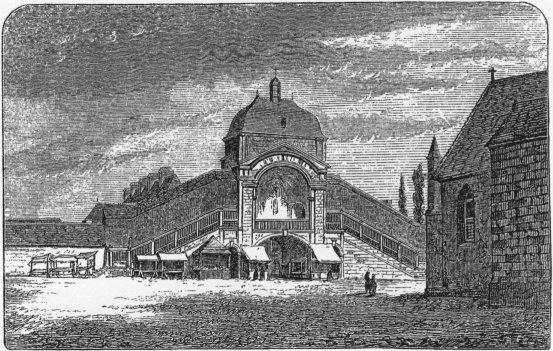
33. Scala Sancta. Ste. Anne d'Auray.
The spring where Ste. Anne first appeared is now enclosed in a large basin of cut stone. Near it is the church, in course of reconstruction. It stands in a court surrounded by covered galleries for the shelter of the pilgrims. Two flights of steps, called the Scala Sancta (after that of St. John Lateran), lead to a platform over the three entrance gates, upon which is an altar surmounted by a cupola, where mass can be heard by 20,000 persons. The steps are ascended by the pilgrims barefooted, as they do at Rome. The fête of Ste. Anne is celebrated on the 26th of July, when pilgrims arrive from all parts of Brittany to visit the miraculous statue, to [pg 160] ascend the holy staircase, and to drink or wash in the sacred fountain. It was a fête day when we visited Ste. Anne. There was a large assemblage of people, and booths were erected round the court, where were sold rosaries and the wire brooches, with scarlet and blue tufts of worsted, called épinglettes, worn by the Bretons in their hats as a token of their having made a pilgrimage. We saw exhibited the photograph of a young lady, said to have lately recovered from paralysis after bathing in the holy well. So world-wide is the fame of Ste. Anne d'Auray that a traveller mentions having seen at her shrine an embroidered altar-cloth of Irish damask, with "Irlande: Reconnaissance à Sainte Anne, 1850," woven into the pattern. The convent, with its enclosure, the Scala Sancta, fountain, and miraculous bush, all date from the seventeenth century. There is a railway station for Ste. Anne, within two miles of the church.
Returning to Auray, we went to the Chartreuse, which owes its origin to the chapel of Saint Michel-du-Champ founded (1382) by John de Montfort, afterwards Duke John IV., on the spot where, in 1364, he gained the battle of Auray, which obtained for him the duchy of Brittany. The chapel is close to the railway station. In the fifteenth century it was given to the Chartreux, and became a monastery of the order which existed until the [pg 161] Revolution. The present church was built at the end of the reign of Louis XV.