VII. General Instructions (continued 3)
Reading edition
Ploeuc (C.N.) chl. arr. S. Brieuc. Several menhirs, but some of them are broken. The church is of 1752. Ploeuc lies high.
Plaintel. A remarkable menhir 15 feet high planted point downward. Church of 1759.
Plouagat (C.N.) chl. arr. Guingamp, near Châtelaudren. In the churchyard a Christian lech bearing the inscription VORMVNI. Ruins of the priory of N.D. des Fontaines, some portions of which go back to Romanesque, but the major portion belongs to the 15th cent.
Goudelin. The Chapel of N.D. de l'Ile was founded in the 15th cent. and contains a statue of S. Eligius dressed in Breton bragou-bras.
Lanrodic. Le Vieux Château de Perrun is a good example of a camp, probably of the Northmen invaders and devastaters of Brittany or of the Merovingians. The embankment was revetted with blocks of quartz not set in mortar. The new château is a fine mediæval ruin. It is surrounded by a deep moat and possesses a cylindrical tower with machicolation. All the rest of the original castle has disappeared, but in the midst of the court is a château built at the time of the renaissance, but that was burnt and gutted at the Revolution. It has, however, preserved its façade and some of its fine chimney-pieces. Among the fallen masses of sculpture may be seen a fragment of a verse of Virgil. "Quid pius Æneas tanto dabit indole dignum."
S. Pever. Ruins of the Château of Avauguer on a promontory above the Trieux and the lake. The chapel is of the 13th and 14th cents. and contains remains of an alabaster retable of the 16th cent.
* PLOUARET (C.N.) chl. arr. Lannion, at the junction of the branch line to Lannion. A prettily situated little town in a well-wooded country and with charming walks about it up the rocky broom-covered valleys. The neighbourhood teems with objects of interest, and it makes excellent headquarters for interesting excursions. The church is curious. It consists of nave and side-aisles all under one enormous roof and lighted through aisle windows under gables. It is flamboyant and has a square E. end that contains a fine window of geometric tracery, but not of 2nd pointed date, apparently, judging from the stiffness and lack of skill in the treatment. It looks like an attempt of a flamboyant architect to revive the earlier style. The tower is dated 1554, when it was begun, but in style it is later, and is an admirable example of a renaissance tower at its best period. The mountain, visible to the south is the Menezbré, from the top of which the Seven Saints cursed Conmore, with the result that the Usurper of Domnonia was deserted on all sides as one "fey" and was killed in 555.
Loquivy-Plougras. The fine Chapel of S. Emilion, the largest example of its kind in the Department, is of the 16th cent. It was begun in 1516 and the tower added in 1566.
For the beautiful chapel of Keramanachx, see under Plonevez Moedec, and for Tonquedec, see Lannion.
Trégrom. At Keranscot is a menhir 19 feet high called Menbras. At 300 paces from it is another 10 feet high. The church (S. Brendan of Clonfert) has been judiciously restored. It is 2nd pointed and is very prettily situated. The S. aisle was intended to be vaulted, but only the vaulting shafts remain. The S. porch has good 2nd pointed mouldings, and over it is an interesting statue of the Irish traveller-saint who discovered Madeira and the Canaries. The W. turret is for two bells. A quaint four-light square-headed window lights the baptistery. Brendan was forced to leave Ireland, owing to his having accidentally caused the death of a pupil, and he spent seven years in exile. Following the sun at midsummer, he reached Iceland, but did not remain there. The story of his voyages was embroidered by fancy, and converted into an Irish version of Sinbad the Sailor; but the greater part of his time of exile was spent in Brittany, where he founded two monasteries, one on the isle of Cézambre opposite S. Malo, and the other in the land of Heth, the site of which is not determined, but it was probably Lanvellec, which is also dedicated to him. The church there is modern, but in the churchyard is an elegant 16th cent. ossuary. Near the road from Plouaret to Keramanach is the curious chapel of S. Carré, built in 1697. It is a typical example of the period, all the detail is Italian, but the Gothic feeling is present in the main lines. E. of it is the Holy Well of the same period, well preserved. The P. at S. Carré is on Whitsunday.
Vieux Marché. The church is a huge modern flamboyant structure, successful except for the mean, pinched tower. The flamboyant doorway of the original church has been inserted at the west end of the new church, and some quaint carvings are preserved at the N. doorway. A pretty walk up the glen of about three miles leads to the chapel of the Sept-Saints, a cruciform structure erected in 1702, with a S. transept over a dolmen that serves as crypt, and with an altar in it to the Seven Sleepers. At S. Marcel at some little distance from Plouaret is a mutilated statue of a Roman horseman trampling on a half human monster, that receives a religious cult. Although the heads have been knocked off, and the clergy set their faces strongly against this devotion, the peasantry still have recourse to the image. Those paralysed are hoisted upon the back of the horse, and quite as well authenticated cases of cure are produced there as at some of the approved shrines.
Ploubalay (C.N.) chl. arr. Dinan. Modern church. Ruins of the Château de Crochais.
S. Jacut-de-la-Mer. The site of an ancient abbey founded by Gwethenoc and Jacut, brothers of S. Winwaloe, at the beginning of the 6th cent. The brothers in Breton mythology replaced the Heavenly Twins of classic mythology, and were wont to be seen when invoked steering a vessel that was in danger of being overwhelmed and wrecked at sea. The abbey was given over in commendam to favourites at court, and the few monks left in it without supervision led such idle and worthless lives that the feeling of the country was roused against them, and when the Revolution broke out, the peasants tore down the monastery to its very foundations so as to leave of it no trace whatever. There is now a conventual establishment at S. Jacut that receives boarders for the bathing season. The tower of Ebihens on an island was built in 1697.
Trégon. An allée couverte called Les Vielles Hautières is near the high road, and is 48 ft. long. Fourteen uprights sustain seven capstones. About 400 paces from this is a fallen dolmen. A vulgar modern church takes the place of an early Romanesque structure.
Château de Guildo. The old Castle is a ruin, in which Gilles de Bretagne was playing a game of tennis when snatched away, by order of his brother, Francis I., to be starved to death at La Hardouinais.
* PLOUDALMEZEAU (F.) chl. arr. Brest. The church was rebuilt in 1857, but the tower remains of 1775. Ploudalmezeau is in the old Pays d'Ach, and the British refugees swarmed hither, landing in the estuaries of the Aber Vrach, Aber Benoit, and the Aber Iltut. P. of S. Bridget, 15th August.
Lampaul Ploudalmezeau. Remains of an allée couverte, and by the roadside from Ploudalmezeau a menhir trimmed into shape and surmounted by a cross between two others of very early character. The church (S. Pol de Léon) is very charmingly situated among trees, and the tower is not of the type of renaissance so common. It more resembles that of Pleyben, and is remarkably well proportioned and dignified. It has a gallery above the porch, another at the summit of the tower, and curious flying buttresses support the turrets at the angles, and a cupola in the centre surmounted by a lantern on three stages. The church itself is late flamboyant. The porch is wide and enriched with Ionic pillars, within it is vaulted, and the groins meet in a pendant. A curious statue in the S. transept represents the Virgin and child. She is trampling on the Devil, who tauntingly upholds the fatal apple. Good metal-work encloses the baptistery. The N. aisle has been rebuilt. There is a Holy Well, but without character, in the churchyard.
Landunevez. La Four is a rock rising 200 ft. above the sea, and is supposed to indicate the point where the Ocean begins and the Channel ends. Fine ruins of the castle of Trémazan, where was born Tanguy du Châtel, who died 1449. He was one of the Generals of Charles VI. and Charles VII. After the Battle of Agincourt, things did not run as smoothly as represented by Shakespeare. The French Court was torn by factions. At the head of one was Jean sans Peur, Duke of Burgundy; at the head of the other the Armagnacs, the partisans of the Dauphin. In place of combining against the victorious English, they were engaged in murderous affrays between themselves. One night the Burgundians fell on and slaughtered the Armagnacs in the streets of Paris, and the Dauphin was only saved by Tanguy du Châtel, who smuggled him off to Milan. The Constable of France and the Chancellor were both murdered, and the massacre lasted three days. Richard, fourth brother of Duke John V. of Brittany, at great risk secreted and carried off Marie d'Anjou, wife of the Dauphin. The Duke of Brittany entered Paris and put a term to the horrors that were being perpetrated. Meanwhile the English were advancing, and burning the towns on their march. At length the Duke of Burgundy and the Dauphin agreed to meet and come to terms at Montereau. But no sooner were they face to face than they burst into mutual recrimination. This so exasperated Tanguy, that with an axe he split the skull of the Duke. This fresh crime threw the Burgundians into the arms of the English. The war was concluded by the Treaty of Amiens, 1423. At Landunevez are a dolmen, and at Argenton a menhir 18 ft. high. Patronal feast 3rd Sunday in Sept., P. of Kersaint Ascension Day and Aug. 15th; P. of S. Gonvel, 2nd Sunday in Sept., and P. of S. Samson, 3rd Sunday in July.
Plourin. The church (S. Budoc) is entirely modern, but excellent, the tower and spire are specially well proportioned. The E. flamboyant window is very good. Two old picturesque houses are near the church. Within the church is the pulpit from the old church of carved oak representing scenes from the legend of S. Azenore and her son Budoc. At Kergraden are two menhirs, one 30 ft. high, the other 24 ft. P. Sunday nearest to Aug. 7.
Plouguin. Modern church. The château of Lesven possesses a painting over the altar in which is represented S. Gwen, her three breasts disguised by the central breast being made into a gilded disc, dressed in the costume of a lady of the beginning of the 17th cent. presenting her son Winwaloe to S. Corentin, who gives him the habit. Fragan, husband of Gwen Teirbron, is also represented in the painting as a knight in armour. The parish takes its name from Gwen, and her husband gives his name to the neighbouring parish of S. Fragan. In a marsh are the ruins of an oratory, where, according to local tradition, Winwaloe as a child practised the ascetic life. For Lanrivoaré see S. Rénan.
Plouescat (F.) chl. arr. Morlaix. A menhir, 21 ft. high.
Plounevez Lochrist. In this parish is the interesting chapel of Lochrist with its 13th cent. tower, bold and massive, and surmounted by a spire very different in character from the flimsy barley-sugar constructions of the 16th cent. and the beginning of the 17th. The chapel itself is modern.
Plouguenast (C.N.) chl. arr. Loudéac. New and bad parish church, but happily the old one has been left, and contains some old glass, representing the Crucifixion, Entombment, and Pentecost. The altar rails are made out of the old roodloft gallery front, and bear representations of the apostles. Chapel of the Rosary 16th cent. Château de Touche Brondineuf, a stronghold of the 15th cent.
Plémy. A menhir, 12 ft. high, near Drény, on the road to Uzel. Two more of 9 ft. high at 300 paces thence. An old maison forte of the 16th cent. at Vaucles. At Ville Pierre remains of an Huguenot preaching station, a platform sustained on cylindrical pillars. Some of the great nobles of Brittany, casting covetous eyes on the church property, embraced the reform and encouraged the Calvinist preachers. But the people would have none of them.
Langast. The Church (S. Gall) of the 16th cent. has some old glass in the east window.
Plouha (C.N.) chl. arr. S. Brieuc. Modern uninteresting church. Four kilometres off is the Chapel of Kermaria, erected at different times. The first four arches belong to the 13th cent. The others as well as the S. porch and transept are flamboyant. This chapel contains a Dance of Death, in fresco, but now sadly faded. There are twenty-two subjects, each figure is attended by a skeleton. Above the Dance are eight prophets, seated. The chandeliers are of hammered iron.
Lanleff has a circular Romanesque church in ruins. It belongs to the 11th or early 12th cent. A portion of the external wall has fallen, exposing the arcade. Much fanciful stuff was published relative to this church early last century. It was supposed to have been a pagan temple. Near it is a well, the water issues from a three-lobed opening. Above is a stone marked with seven circles. The story goes that a woman here sold her child to the devil for seven pieces of silver, of which these circles are the memorial.
Plouigneau (F.) chl. arr. Morlaix. A menhir and a prehistoric camp. P. Ascension Day followed by dancing and a fair. P. at the chapel of S. Eloi 3rd Sunday in June.
Plougonven. A calvary of the 17th cent. A fallen dolmen and three menhirs.
Plouzévede (F.) chl. arr. Morlaix. In this commune is the very interesting chapel of Berven, with a beautiful tower. It stands by the highway from S. Pol de Léon to Lesneven, which runs mainly over the old Roman road, and was that taken by S. Paulus Aurelianus when he came from the land of Ach to the town that now bears his name. The entrance to the churchyard is by a triumphal arcade, the arches separated and sustained by Corinthian pillars. The beautiful tower and spire were built in 1567. The rood screen is late, 17th cent., and on it are four panel paintings. The tower sustains two galleries and superposed bell chambers. The whole surmounted by a lantern. It is of the same type as that of Rorcoff, but is more elegant. It is later than the church.
Plouvorn. The church is modern, but the chapel of Lambader is most interesting, as containing the only 16th cent. flamboyant screen that has been spared in the department. It is singularly rich and delicate. The date is 1481. The tower and spire resemble those of Creisker, but on a smaller scale and with the same fault. The chapel has been carefully restored. P. on Whit-Monday.
S. Vougai. Church (S. Fiacc of Stetty) of the 16th cent. The château of Kerjean is a fine example of a late flamboyant and renaissance castle. After having been in ruins, it has been repurchased by a descendant of the ancient family to which it originally belonged, and is being gradually restored. One wing was destroyed by fire in the 18th cent., the rest was wrecked at the Revolution. It is called the Versailles of Finistère.
Pluvigner (M.) chl. arr. Lorient. This was the centre of a vast district comprising nine parishes, that formed the "plou" of Fingar, an Irish settler, who, after having established himself here with a number of colonists, returned to Ireland to fetch more, but was carried by contrary winds into S. Ives' Bay in Cornwall, where the native prince Tewdrig fell on him and murdered most of the party. The place where he was killed is Gwinear. The church of Pluvigner is a vast building erected in 1545. The tower and spire, however, date from 1781. Numerous lechs are in the churchyard, and one is at the door of the mairie. The Holy Well of S. Guinger (Fingar) is of the 16th cent., a little way out of the village. According to the legend Fingar was hunting when he came to the well, and looking in saw his face reflected in the water. "On my word," said he; "I'm an uncommonly handsome man, too good-looking to be anything but a saint," and this effected his conversion. He renounced the world and dedicated his beauty to religion. The chapel of S. Fiacre is of 1453, with additions of 1640. In the transept is a richly carved flamboyant altarpiece. The chapel of S. Beuzy marks the spot where that favourite disciple of Gildas, flying with a mortal wound in his head, passed the night on his way to Rhuys. The chapel is of 1593.
* PONT-AVEN (F.) chl. arr. Quimperlé. The costume of the women in this district is peculiarly charming. The broad quilled collars and the white coiffe, with a pink ribbon behind the lace, serve to show off a pretty face to advantage. Pont-aven is a favourite resort of artists, and some of their work may be seen in a much frequented hotel there. Moreover, the scenery about Pont-aven is pleasing, and it serves as a better headquarters than Concarneau, where the smell of the sardine pickling is offensive, and produces in some stomachic trouble. Pont-aven is picturesquely situated on the Aven, the same name as our Affon, Awne, and Avon, and at the foot of two hills crowned with granite rocks that have been rounded by the action of the weather, which dissolves the silicate of potass in it, when the other matters, mica, felspar, hemblend, and quartz fall away in gravel and sand. A huge rock in the river facing the quay is called la Roche Forme. Below Pont-aven the river widens into an estuary and forms a port. Near the mouth of the river is the sanatorium of Kerfarny. There are two menhirs in the commune, one 15 feet and the other 16 feet high, one at Kérangosquer, and the other on the lande de Kervéquilen. About four kilometres down the river is the château du Hénan of the 15th and 16th cents. At Riec are some dolmens.
Nizon. Here are the fine 15th cent. ruins of the castle of Rustéphan flanked by turrets. Several dolmens are scattered over the neighbourhood, and menhirs as well, of which one is 21 feet high.
Nevez. About two miles to the east of the village are the important remains of the château of Hénan, of the 15th cent., much altered in the 16th cent., with a keep some 75 feet high, machicolated. A dolmen is here whose capstone measures 45 feet in length, and 27 feet in breadth, and 6 feet thick. It has been converted into a smith's shop. At Nizon there are two Pardons, that of N.D. de Kergomet on the 1st Sunday in May; the other at N.D. de Trémalo on the 2nd Sunday in September. At Pont-aven the patronal feast is on the 3rd Sunday in September, and the P. of S. Mathurin on the 2nd Sunday in May. At Nevez the patronal feast is on the 2nd Sunday after Easter; the Pardon de S. Barbe, the 2nd Sunday in August; that of S. Nicolas the 1st Sunday of September; that of Trémorvézen the 2nd Sunday in September. The P. of S. Mathieu on the last Sunday in September: that of the Rosary Sunday in October, and there are fêtes and a fair on the Monday following. Perhaps the best is that of Bélon on the river of that name, which flows into the sea close to the mouth of the Aven. Here is a grand procession on Sept. 8th, and very picturesque costumes may be seen. Near Belen is N.D. de Lanriot, a fine chapel; and in a most lovely situation is de Moustoir. Between Pont-aven and de Trinité in a wood is a dolmen. It is actually in the parish of Moëlan or Maelon, in which the Pardon of S. Roch is held on Aug. 15, and that of S. Philibert on the second Sunday after. Excursions may be made by boat from Pont-aven to the isles of Glenan, a veritable archipelago, and to the more distant Ile de Groix. This was the island to which Gunthiern, the first settler at Quimperlé, was wont to retire, and where there is a chapel that contains a statue of him. He was a native of Southern Wales, and his name is identical with Vortigern. But who he really was is very uncertain. In summer there is communication daily by a little steamboat with Lorient. An arm of the sea called le Coureau separates the isle from the mainland. The population is composed entirely of fishermen, and it has a little harbour, the port Tudy. The island coast is honeycombed with caves; it also possesses numerous prehistoric monuments. On the N. the tumulus of Moustéro and the menhir of Quelhuit, and the dolmens more or less ruined of S. Tudy and of Porte Mélite. On the E. the menhir of the Fort de la Croix. On the S. the dolmens of Locmaria and S. Nicolas and the tumulus of Kervédan, surmounted by a menhir, and near Kervédan on the shore the remains of an enclosure called the fort des Romains. As there are hotels on the island, a day or two can be very comfortably spent there.
Le Pouldu (the Black Pool) is a bathing place, where the climate is singularly warm, and plants that flourish in the south of France here stand the winter.
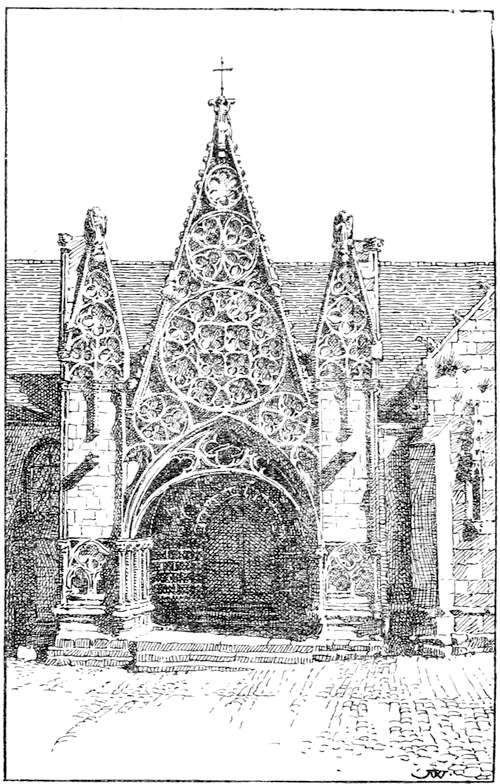
PONT-CROIX
* PONT-CROIX (F.) chl. arr. Quimper. This little town is far more attractive than Audierne, and is better suited to stay at for a visit to the numerous objects of interest in the peninsula. It is built about a remarkable abbey church, one of the finest in Finistère, and with the noblest tower and spire in Brittany. Most of these towers and spires look like hot-house growths, and are over-weighted by their spires. But the tower of Pontcroix is solid and in perfect proportion to its spire. The church also presents admirable examples of 2nd pointed architecture, notably its unique S. porch. The spire is of the same period. The S. transept had a window of the same, circ. 1380, but the tracery has been hacked away and replaced by feeble weedy flamboyant. Of the other flamboyant windows, one is well designed, two are under acute gables. The church has an apse (flamboyant) with six windows. On entering the sacred building, the surprised visitor finds himself in a Romanesque church, but of a late period, 1160. The pillars are spindly and tall, and sustain round arches. It is Romanesque at its last gasp, and without its original vigour and massiveness. A very ugly feature is the inner member of the arch, which is sustained on corbels resting on the capitals. The arcade of the sanctuary is of the 13th cent. The piers supporting the central tower were Romanesque, but were encased at a late period, when the spire was added. Some stained glass is of the 15th cent.
A walk or drive may be taken to N.D. de Confort on the Quimper road; it is 16th cent. with a graceful spirelet above a double gallery and a turret at the side to give access to the bells. The Calvary is of the same period, purer in design and better in detail than the overcrowded Calvaries of Guimiliau and Plougastel. In the chapel is a Wheel of Fortune set with bells, which the pilgrims set in motion so as to summon the Saint to hearken to their prayers. At Meilars is another Calvary, also a dolmen. Half-way between N.D. de Confort and Poullan is the admirable Chapel of Kerinec with its Holy Well and a Calvary consisting of a cross above a preaching platform. The great charm of this chapel lies in its interior, which is very beautiful. Further on is Poullan buried in trees (S. Cadvan), a transition church between flamboyant and renaissance, with a thin oblong tower and a good porch. There is no chancel arch. Nave and aisles have boarded ceilings. The granite capitals are rudely carved. The side aisles very narrow, the pillars tall, sustaining small pointed arches. An octagonal 17th cent. baptistery. There is a menhir near the seamark at Kermenhir, and there are dolmens in the parish. The country is barren, planted with Austrian pine, but is being brought under cultivation by the use of sardine heads as manure. The coast to Cap Sizun is bold and fine. Beuzec Cap Sizun. Church (S. Budoc) with tower of the 16th cent. A fine coast. P. at N.D. de Confort, 1st Sunday in July. P. of Kerinec, 3rd Sunday in July. P. at Poullan, 1st Sunday in Sept. P. at N.D. de Clarté in Beuzec, on the Eve of Rogation Sunday.
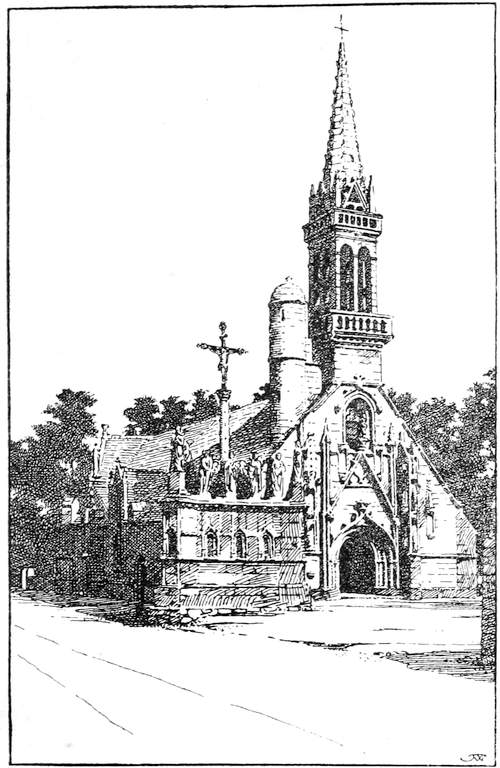
N.D. DE CONFORT
* PONTIVY (M.) chl. d'arr. A busy town, very modern and vastly ugly in its modern portion, but with a few picturesque bits in the old town. In the new Pontivy is the hideous Church of S. Joseph, about as bad in architecture as the perversity of ignorance could design. The church in the old town in decadent flamboyant, is bad of its kind. The tracery had been removed from the windows, and has been replaced by new stuff of no character except feebleness. The W. tower is octagonal with a spire surmounting it. The castle has been in part destroyed, but two faces remain with singularly low drums of towers. In it is now the museum. The costume of the neighbourhood of Pontivy in the women is not remarkable, but that of the men is picturesque, white jackets bordered and ornamented with black velvet.
In the cemetery outside Pontivy is a menhir surmounted by a cross. The spire of N.D. de la Houssaye beyond the cemetery is an interesting specimen of the flamboyant architecture of the beginning of the 15th cent. It was built in 1438, but the tower, which is quite in the Breton renaissance character, was actually built as late as 1750. It is curious as showing to how late a date the Gothic feeling hung on in Brittany.
Noyal-Pontivy. The church has a 14th cent. tower and spire. The porch is flamboyant. On one side within are apostles, on the other, curious subjects, The Baptism, an Angel holding a pair of blue breeches whilst Christ is in the water, a naked man carrying his head upside-down, and some other subjects not easily made out. The church has been carefully restored. The early flamboyant E. window has the date cut on the splay. The vaulting of nave and chancel is modern. In the N. transept is fine old glass representing the Annunciation, Nativity, Shepherds and Angels, Adoration of Shepherds, Circumcision, Flight into Egypt, Massacre of the Innocents; also the Bearing of the Cross, the Veronica, Crucifixion and Entombment from another window. In the nave is a curious painted retable of S. Maurice de Clohars, who d. 1191, and who was born in this parish. Noyala was one of the largest parishes in the diocese of Vannes, and Pontivy was a chapelry in it. S. Géran, now a daughter church, was probably originally the head of a plou of Geraint, King of Domnonia. But now he is forgotten and replaced by S. Guirec. In this parish the canal between Nantes and Brest forms a series of backwaters and lochs. The Chapel of SS. Dredeneau is near the line and the canal. It is a cruciform building of flamboyant period, but of no architectural interest. It however contains a good 16th cent. statue of S. Bridget, and statues of the Brothers Dredeneau. According to the legend they were two princes who were murdered, and their bodies thrown into a marsh on the further side of the canal, where they were found by a pig. The figures are rude; one holds a book on which is written: "Ce Saint à combatu jusqu'à la mort pour la loi de Dieu, et n'a pas craint les menaces des infidèles parceque sa foi etait fondée sur la pierre." The Holy Well of the saints is in very good order and bears their statues. P. 4th Sunday after Easter; at S. Géran, 3rd Sunday in October; at Noyala, July 6th.
Stival. At the entrance to the village is the Holy Well of S. Meriadoc, late flamboyant to renaissance. The church is cross-shaped with a slated spire, and has no aisles. It has a boarded and painted roof, and the chancel is covered with paintings representing the legend of S. Meriadoc. The fine stained glass is in a deplorable condition. The E. window contains a Jesse tree. There are saints in the other windows. In the churchyard are a large late cruciform chapel and an ossuary.
Locmalo. The superb Chapel of N.D. de Quelven is an object of one of the most popular Pardons in Morbihan, on August 15. W. tower, transepts and gabled apse are all of late flamboyant. In the tower is a very fine rose window to the bell-chamber. The proportions of tower and spire are not however satisfactory, and the chapel imposes on one by its rich detail rather than by its broad features. It resembles S. Nicodème in Plumilliau, but the tower is very inferior. There are three porches, one under the tower and two to the south. The tower is half a century older than the body of the church. Choir and transepts are vaulted. There is a plain stone gallery for the minstrels in the S. aisle. In two windows in the choir is fine contemporary glass, a Jesse tree and the apostles. The rest of the glass is modern garish rubbish. The granite carving of the church is poor owing to the coarse quality of the stone.
Pont Scorff (M.) chl. arr. Lorient. The Scorff divides the town into two parts, the upper and the lower towns, united by two bridges. The Church of S. Albin is of 1610 with additions in 1710. One town was the religious, the other the secular. The religious one was Les-Albin (the Court of Albin), and here was born S. Albinus, who became Bishop of Angers in 529 and died in 550. P. 1st S. in March. P. of S. Yves, Sunday after 10th May. P. of S. Nicodème 3rd Sunday in September.
Quevin (Coet-quen, the white wood). A menhir 16 ft. high, to the west a Calvary with fifteen figures. A Holy Well, and Chapel of S. Eloi, 16th cent., in the village, but altered in 18th cent. The parish church is modern. S. Nicodème, late flamboyant chapel of 1578. La Trinité, 16th cent., but with a tower of 1771. P. 7th Sunday after Trinity.
Port Louis (M.) chl. arr. Lorient. The Church of N.D. was built in 1665. The Chapel of S. Pierre contains a statue of S. Elisha found in the sea at the beginning of the 17th cent., to which the Pope accorded sundry indulgences. Port Louis was but a small fishing village called Locperan till the beginning of the 17th cent. It possesses a citadel and a marine hospital. P. at Locmalo 26th July.
Questembert (M.) chl. arr. Vannes. Here, in 888, Alan I., Count of Vannes, encountered the Northmen and slaughtered 12,000 of them. Hardly 400 escaped to their ships. In consequence of this victory, Alan was proclaimed Duke of Brittany. Some crosses mark the spot where the battle raged. La Croix Rochue has a weapon like a halbert cut on it. La Croix Tuaint is marked with five nail heads and a small cross. La Croix à la Poèle also has nail heads. The parish church is modern, 1863. In the churchyard a fine Calvary. The Chapel of S. Michel is flamboyant. In the Chapel of N.D., an old Templar church, is a Romanesque font employed as a bénitier. The town possesses some old houses and halles of 1675; also a cylindrical tower with two heads on it called Quest and his wife.
Quiberon (M.) chl. arr. Lorient. A favourite watering place on a sandy strip of land, some twelve miles long, and only one and a half wide. The sea has gained considerably here. An alignment of menhirs now leads into the water. The granite rock is everywhere under blown sand that shifts with every gale. A menhir is at the point of Beg-conguel, and there are remains of a cromlech (stone circle) at Beg-lann, and ruins of two dolmens at Manémeur. Two dolmens at Kerniscot, an allée couverte at Croh-collé, and the remains of an alignment at the Mill of Kerbournec, and two more dolmens at Port-blanc. But what is most interesting here is the prehistoric necropolis at Belle-vue, Be-ker-Nôz and another in the Isle of Thénec. The graves are stone chests, in which the skeletons are crouched, but occasionally extended. The sand has preserved the bones, which have lost nothing but their gelatine. An early Christian cemetery has also been discovered at Kerné. In 1795 an English squadron disembarked 3000 émigrés here, and they were joined by numerous peasants. Hoche defeated them, and swept the peninsula, driving together all who remained. The prisoners were then all shot down in cold blood, some at Quiberon, some at Auray, and the rest at Vannes.
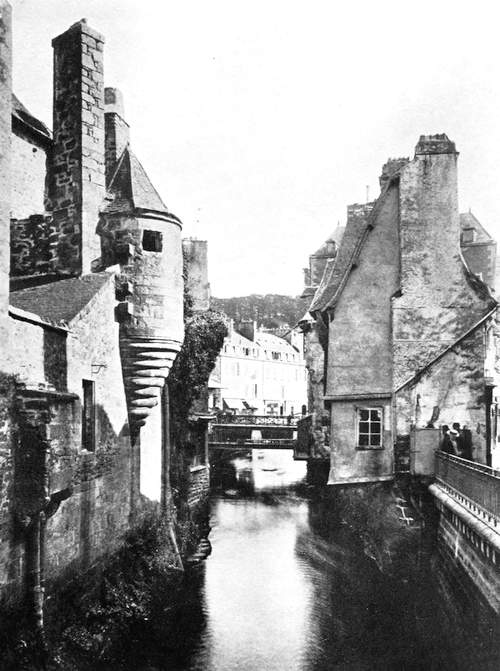
IN QUIMPER
* QUIMPER (F.) chl. d'arr. This beautiful town is situated at the junction of the Stier and the Odet, and is the seat of a bishop. The diocese of S. Pol de Léon has been united to that of Quimper. It is at a distance of fifteen miles from the sea, but has a small port. It is a bright and thriving city, and is the seat of the manufacture of the Breton faience, a pretty ware copied from old Rouen, but with original developments. The old walls are almost gone. Quimper is dominated on the south by a lofty well-timbered hill. It has charming esplanades by the sides of the Odet. In the town are several old houses. The great glory of the place is however the Cathedral of S. Corentin. The choir dates from the end of the 13th cent. The transepts and nave belong to the 15th. The twin spires are modern and excellent. The architect, M. Bigod, took that of Pontcroix as his pattern, and could not have done better. The erection of these spires was due to the town folk consenting to a duty of a sou a pound being charged on all the butter brought into market. The choir leans considerably to the left, and the junction with the transepts is awkwardly effected. It is said that this deflection was due to the spongy nature of the soil which did not allow of the choir being built in the same axis as the nave. This, however, does not explain it, as the nave was erected subsequent to the choir. At the summit of the W. gable is a statue of King Grallo. This W. front is fine, but the modern filling in of the doorway is weak. A S. side entrance is altogether exquisite. There is, however, nothing really characteristic of a local school in the cathedral; it follows the traditions of the Isle of France, but has not the loftiness, often exaggerated, of some of those magnificent cathedrals. The beautiful lady-chapel is in the purest geometrical style. The choir has an apsidal termination. The clerestory windows are filled with old glass representing saints, but the modern glass is detestable. The third chapel on the N. side contains memorials of a supposed miracle, a crucifix that emitted drops of blood when a man perjured himself before it. The high altar is a mass of silver gilt, decorated in a style suitable to a restaurant rather than to a church. There is a good, restored, bishop's chapel. The Church of S. Mathieu has been rebuilt and has a modern spire. The fine stained glass representing the scenes of the Passion in the east window has been retained; it is of the 16th cent. The musée should be visited. Besides containing an admirable collection of paintings, many by Breton artists, it has a large group of lay-figures dressed in the various costumes of Léon and Cornouaille, representing a marriage. Nor should the visitor omit a call on M. Villard, who has an extensive collection of really artistic photographs of Breton costumes and architecture. Quimper market should be visited on Saturday, when various costumes may be seen, the white quilted collars of the Pont-aven district, and the curious head dresses of the Bigauden women.
Locmaria is only a stroll down the left bank of the Odet, and there may be seen a very beautiful example of a Romanesque church with central tower, transepts and apse.
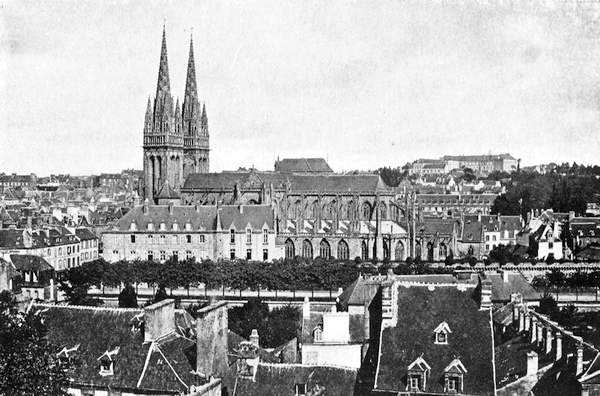
THE CATHEDRAL, QUIMPER
Quimper forms an admirable centre for a number of excursions, as branch lines run thence to Pont l'Abbé and to Pont Croix and Audierne. The great horse fair is on April 15. The patronal feast at the cathedral is on August 15; the P. at Locmaria is on the Sunday after December 12.
Plogonnec, a very interesting late flamboyant church with a renaissance tower. It has magnificent old glass in the windows, representing the Last Judgment, the Story of the Cross, the Transfiguration, and some Celtic Saints, S. Cadoc with a bell, S. Edern, son of Vortigern, riding on a stag, and S. Theilo, Bishop of Llandaff, also mounted on a stag. There is a pretty flamboyant Chapel of S. Theilo in the parish, and this last window was removed from it. P. at S. Thegonnec's Chapel, Ascension Day; at that of Loretto, 2nd Sunday in August; at that of S. Albin on the last Sunday in September; the P. at the parish church on the last Sunday in July.
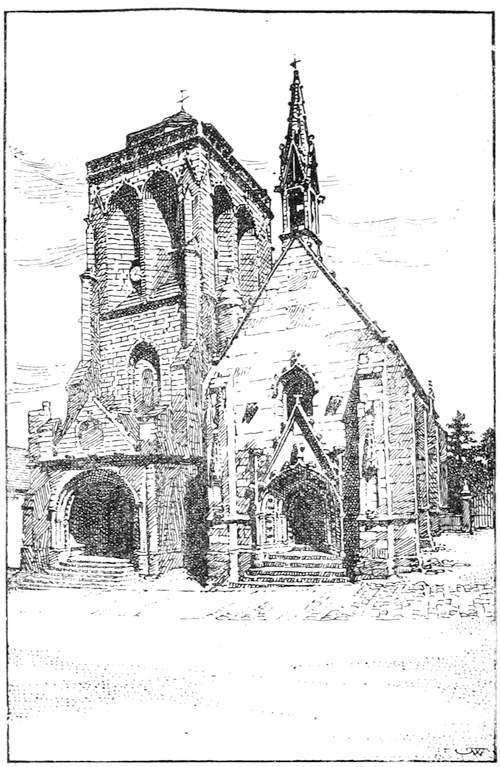
LOCRONAN
Locronan. Once a thriving little town living on its looms, but since weaving has been done by steam, its prosperity has gone, and many houses are in ruins. Those that remain occupied are all of granite, and some, if not all, old. The church has the Chapel of S. Ronan on its south side opening out of it by a couple of arches. All is flamboyant. The church had a spire that was struck by lightning in 1806 and fell, carrying away pinnacles and the lace-like parapet on the N. side. On this N. side is a little chapel with a graceful flamboyant window in the gable, and saints in niches at the sides. The E. window of the chancel is full of old glass in confusion, but is about to be restored. On the pulpit is the legend of S. Ronan in ten compartments. The mouldings of the arcades and of the great belfry windows are poor. The P. is on Trinity Sunday, but every sixth year is the Grand Tromenie, which is observed with great concourse of people from all parts. A procession leaves the church at 2.30 P.M. and winds with banners and hymn-singing round the mountain on the slope of which Locronan is built. Descending a narrow street leads to the renaissance Chapel of S. Eloi and a Holy Well of the same date. The tomb of S. Ronan is in the chapel beside the parish church.
Plonevez-Porzay has a very villainous modern church that has replaced one that was old and full of interest. The porch has however been preserved. P. 2nd Sunday in August. Ste. Anne-de-la-Palue in this parish is a great resort of pilgrims, and the Pardon there is largely attended. It is on the last Sunday in August. The P. of N.D. de la Clarté is on the 2nd Sunday in September.
Quéménéven. The Chapel of Kergoat is an object of pilgrimage, and the Pardon there is very greatly thronged, and interesting costumes may be seen there. The P. is on the Sunday after August 15.
S. Venec, a chapel half-way between Quimper and Châteaulin, is interesting. It contains a statue of the Threebreasted Gwen, and of her sons, Gwethenoc, represented as a Knight, and Winwaloe. There are also here a good Calvary and a pretty Holy Well.
Ergué Gaberic. A fine menhir. A chapel of the Templars. The P. at Kerdevot is greatly frequented. It is on the 2nd Sunday in September.
Pluguffan. Only deserving of a visit on the occasion of its Pardon, which is on the 2nd Sunday in September, where fine costumes may be seen.
* QUIMPERLÉ (F.) chl. d'arr. An interesting and picturesque town on the Laïta formed of the junction of the Ellé and the Isole. The abbey church of Ste. Croix and the town about it is in the basin, but the Church of S. Michel and the upper town is on the hillside with steep streets, some ascended by steps. The buildings of the abbey have been converted into municipal offices and Mairie. The church is circular and Romanesque. A tower had been constructed on the four central drums, but they showed signs of giving way, and the tower had to be taken down and the church rebuilt, but exactly on the ancient lines. There is a crypt beneath the lady-chapel. The carved corbels outside the apse are curious. A fine renaissance retable has been mutilated and plastered against the west wall. In the crypt is the tomb of S. Gurlois. S. Michel stands up boldly on the summit of the hill, on the right side of the Laïta, sustained on massive substructures. The nave is 2nd pointed. There are no aisles to the nave. The grand central tower and choir with its aisles are flamboyant. There is an exquisite window of that style on the N. side and a superb N. porch, but the E. window is in very bad renaissance. The east end is supported on two huge buttresses that are pierced with arches for the roadway. The west end of the church is built against, with houses, and does not seem ever to have had a western entrance.
Some quaint bits of street architecture may be found by penetrating into the narrow lanes. The Church of S. Columbanus is in ruins. A pretty walk out of the town leads to the little chapel of the Château of Rosgrande, with apse at each end. It contains a renaissance roodscreen, with subjects from sacred history and pagan mythology indiscriminately carved on it. In the chapel are two 14th cent. statues of S. Cadoc and S. Yhuel, the grandson of Gildas, afterwards Bishop of Llandaff, who spent his youth in Brittany. Fishing and charming walks are to be had in the valleys of the Ellé and Isolle. The visitor will find this the best headquarters for excursions to Le Faouët, 21 kilometres, and down the river to Pouldu. Patronal Feast at Quimperlé on the 2nd Sunday in May and on the 3rd September. P. at Lothea, Easter Tuesday and Trinity Sunday. Pardon des Oiseaux at Toulfouen, Whitsun Monday.
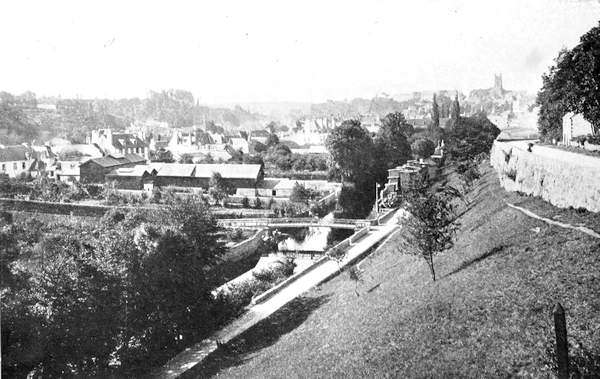
QUIMPERLÉ
The forest of Clohars-Carnoet envelops the ruins of one of Conmore's castles, but it was rebuilt in the 15th cent. On the right bank of the Laïta, in a sheltered position, are the fine ruins of the Abbey of S. Maurice, founded in 1170. The chapter house is of the 14th cent. and 15th cent. A chapel that has been restored contains a good bronze Christ of the 17th cent. P. Whitsun Monday. P. at Clohars on the 15th August.
* QUINTIN (C.N.) chl. arr. S. Brieuc. In pretty woodland country. A menhir called La Roche-longue in a field near the town, 21 ft. high. The church is modern, but it retains some old glass. In the street of N.D. is a granite house of 1611. Another old house dates from 1560. Remains of the castle built in the 15th cent., which was replaced by another, never completed, in the 17th cent. The modern château contains a fine gallery of family portraits and Gobelin tapestries. In the cemetery is an ossuary of the 17th cent.
Redon (I.V.) chl. d'arrond. Above the junction of the Vilaine and Oust, at the foot of a hill, commanded by the ruined Château de Beaumont. Redon was a great abbey founded by King Nominoe and S. Convoyon. Here was held the council that deposed the Frank bishops of Rennes, Nantes and Vannes. The church was ruined at the Revolution, and all that remains of it are the W. tower and spire and the choir with a portion only of the nave. The tower now stands isolated. The nave is of the 14th cent. It was originally Romanesque. A transept is of the 12th cent. and there is a stunted central tower at the crossing. The choir ends in an apse and is of the 13th cent. and is fine. The high altar and the pulpit were given to the church by Richelieu. On the N. side of the choir is a fortified chapel of the 15th cent. In one of the side chapels is a tomb supposed to be that of Duke Francis I. The abbey buildings are occupied by the Institute of S. Sauveur. The cloisters are of the 17th cent. The canal from Nantes to Brest cuts the town in two and is crossed by a bridge.
The centre of the chestnut trade, the "marron." The trees are kept small and pruned, and are not suffered to exhaust themselves in producing a superabundance of fruit. The marron is much larger than the common "châtain."
* RENNES (I.V.). Capital of the Department, and the ancient capital of the duchy of Brittany. It is composed of two towns separated by the Vilaine. On the right bank is the Upper Town. Rennes was burnt down in 1720, and was rebuilt in the ugly style of the period, and in grey granite. The river has been embanked and carried in a straight course through the town. There are no fine buildings on the embankments. The most pretentious structure on the left bank, between the station and the river, is the lycée, with a chapel in a nondescript style. Several bridges, all mean in character, cross the river. On the right bank are the most important buildings. The cathedral is a hideous structure commenced in 1787 and completed in 1844. The two side doors and the niches at the west end belong to the earlier building and are renaissance. Within, the arch has been studiously avoided. Eight enormous red marble pillars on each side of the nave sustain the heavy vault and the clerestory. Their bases are but 6 feet apart. The interior has been richly decorated with gold and colour, but nothing can relieve the cumbrousness and gloom of the internal appearance.
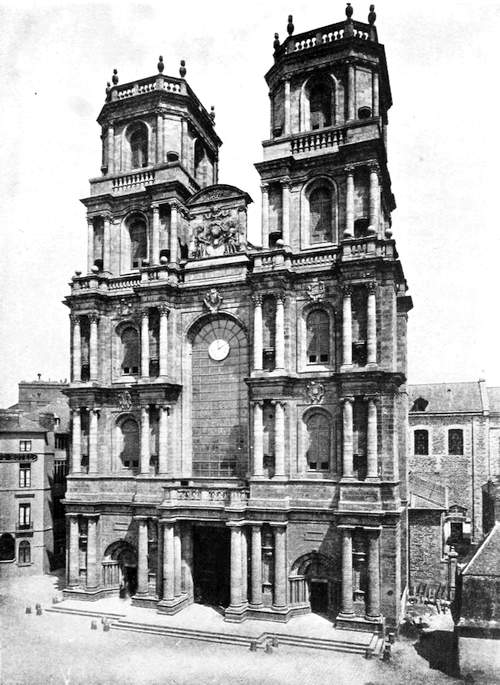
THE CATHEDRAL, RENNES
One of the old gates of the town, the Porte Mordelaix, remains, but it is not particularly picturesque, and a few old houses escaped the fire and have not yet been pulled down. To the east of the cathedral is the Church of S. Sauveur, even more ugly than the former. In a small street opening from the river opposite the Hotel Moderne is the one architectural gem possessed by the town, the Chapel of S. Yves, now desecrated into a store-house. It is of the end of the 15th cent., and all the details, where not broken, are of exquisite beauty. Observe the N. door with its niches and the W. front. The Church of S. Germain is late and poor flamboyant, much altered in late renaissance times. The springing of the nave vaulting remains, and has been grotesquely finished off with scrolls. There is fine old glass, but in utter confusion, in the E. window. The large window of the S. transept contains fine glass representing the life of the Virgin below and saints and legendary incidents above in a series of 24 subjects.
S. Melaine is the church of a once famous abbey. Transepts and choir-arch are early Romanesque. The nave is 2nd pointed. The base of the tower is early 1st pointed, but has been refaced in the worst taste in baroque times; to this has been added in modern days an octagonal lantern and dome, and to complete the unsightliness and absurdity of the whole composition, the cupola is surmounted by an enormous gilt statue of the B. Virgin. Within may be noted the clumsy junction of the older and newer work in the second arch on the south side. The tracery in the side aisles of the nave has been cut away, but the clerestory windows of one light are delicate and refined. The clerestory of the choir is earlier, the E. wall and window have been reconstructed, and the tracery in the side aisles restored or modern. In the S. transept is a wax figure of S. Severina, whose bones from the Roman catacombs are preserved in this church. This wax figure receives a considerable cult. Adjoining the church is the Thabor with pleasant walks and grounds, on the highest point of the town. The botanical gardens adjoin. The Palais de Justice was begun as the seat of the Parliament of Brittany in 1618 and was completed in 1654. The façade is of the Tuscan order. The decoration of the interior was confided to four eminent artists in the reign of Louis XIV., and it has undergone rich decoration of late years. Rennes possesses good open places, as well as the broad esplanades by the river banks. Its museums and library are also well stored. The picture gallery contains a large collection of paintings, some really good, a Jordæns, a Paul Veronese, and a De Crayer.
Retiers (I.V.) chl. arr. Vitré. Four miles to the S.E. is a menhir called La Pierre de Richebourg.
La Roche-Derrien (C.N.) chl. arr. S. Brieuc, is prettily situated on the Jaudy, at the highest point to which the tide reaches. Of the castle hardly anything remains. The church has a spire of late 13th cent. The S. porch, formerly adorned with statues, is bold. The church has vast double transepts of 1435, and flamboyant windows and extraordinary gargoyles. Inside is a barbarous elaborately carved oak altarpiece of late renaissance and of no merit. La Roche was the scene of the battle fought in 1347, when Charles de Blois was taken prisoner by the English.
Near La Roche is Langoat, the church like a converted railway station, but it contains the tomb of Alma Pompeia, the mother of S. Tugdual, who died in the 6th cent., but the tomb was erected in 1470. She is represented on it recumbent; and at the sides are subjects in bas-relief relative to her story. These have been reproduced in bad modern glass in the E. window. In the church may be seen a statue of S. Tugdual habited as a pope. This is due to a curious blunder. His monks were wont to call him Pabu, or father. A late writer of his legend supposed that this meant that he was papa—the pope, and so fabricated a story to explain it, how that Tugdual went to Rome and arrived when the see was vacant, and was elected pope; how that after a very few years he wearied of the burden, and a flying horse was sent from heaven which conveyed him through the air back to Brittany.
Prat. The Château of Coatelan is a rectangular building of the beginning of the 16th cent., and is an interesting, well-preserved example of a maison forte of the period. Within are some good chimney-pieces. At the top of one of the turrets is an oven for baking bread.
Pommerit Jaudy. On the Coat-nevez, a conical hill, is a camp, probably of the Northmen invaders. The château is mainly of the 16th cent, and has granite chimney-pieces.
Cavan. The church (S. Cheron) is of the 15th cent, and has a spire flanked by two stair-turrets surmounted by domes. This is of 1684.
Berhet. The church (S. Bridget) is modern. The Chapel of N.D. de Confort has flamboyant windows, the tracery in those at the side forms hearts. Within is a carved oak retable representing the Passion, Resurrection and Assumption. In the chapel is a Sant-e-roa, or Holy Wheel, hung with bells, and this is rung during mass, and by pilgrims desirous of calling the B.V. Mary's attention to their petitions. Similar wheels are at Quemperven, Locarn, Laniscat in the Côtes-du-Nord, at S. Nicolas de Prissiac in Morbihan, and at N.D. de Confort, near Pontcroix in Morbihan. P. last Sunday in September.
* ROCHEFORT EN TERRE (M.) chl. arr. Vannes. A picturesquely situated little town on schist rocks above the Arz. The scenery of the valley is pleasing and it has become, like Pont-aven, headquarters of artists. Considerable ruins of the castle exist, and there are several old houses in the town. Rochefort was never walled in. Nevertheless it was furnished with gates in the 18th cent. The Church of N.D. de la Tronchaye having been erected on a slope to the south causes the N. side to appear buried. This side was altered in 1533. In the choir are oak stalls of 1590 and 1592. S. Roque, on a height near the town, was erected in 1527 in consequence of a vow made by the people who were decimated by a plague. It was ruined at the Revolution, but has been rebuilt, 1854. A fair is held at Rochefort on the 2nd Tuesday in every month. Rochefort affords good quarters whence excursions may be made to visit the prehistoric monuments scattered over the Lande de Lanvaux and Haut Branbien. The menhirs are for the most part higher than those of Carnac, but unhappily a great many of them are fallen. These collections of megalithic remains have never been properly investigated and planned, and have not been visited like those of Carnac and Locmariaquer and Erdeven.
Pluherlin on the Lande de Haut Branbien, N. of Rochefort, has many of these strewn over the commune. A menhir 15 feet high is in the Lande de Lanvaux beside the road to Pleucadeuc. Great havoc has been wrought throughout this neighbourhood among the churches; the interesting old structures have been wantonly torn down to make place for the exhibition of the incompetence of Vannes architects.
Rosporden (F.) chl. arr. Quimper. In a pretty situation by a lake that is, however, traversed by the line from Quimper to Vannes, and that from Rosporden to Carhaix. The church has a fine tower and well-proportioned spire of the 13th cent. On the S. side is a porch, one of the oldest in Finistère. The church contains a rude statue of Our Lady, much venerated. It was turned out of the church into the graveyard in 1870, to make way for one more artistic; but the parishioners rose in indignation and forced the curé to replace it. A statue of S. Barbara is erected on a fragment of the ancient Calvary that has been destroyed. P. of S. Eloi, 2nd Sunday in July. Patronal Feast, Aug. 15.
Rostrenen (C.N.) chl. arr. Guingamp, on the slope of a hill, with a great square in the midst, about which are old houses of the 16th and 17th cents. The parish church is modern, but retains a transept of the 14th cent. and a choir and tower of the 18th. The S. porch has in it statues of the apostles.
Glomel. The finest menhir in the Department is near the hamlet of Menhir, and is 25 feet high. Another is in the Bois de Coatcourcaral, 10 feet high. The church is of the 14th cent. with a flamboyant east window. Side windows under gables. N.D. de Trégernan has lost its tower, pulled down in 1842. The chapel has some good glass in it and possesses a Calvary.
Kergrist-Moelo. The parish church is of the 16th cent., with a square pinnacled tower and a rich porch of 1554.
Saint Aubin d'Aubigné (I.V.) chl. arr. Rennes. On the line from Dol to Rennes, a place devoid of interest.
Saint Aubin de Cormier (I.V.) chl. arr. Fougères. The church has a nave of the 14th cent. The rest is of the 16th. This was the scene of the battle fought in 1488, which dealt the last blow to the independence of Brittany. The Sire d'Albret at the head of 14,000 men entered the duchy as one of the suitors for the hand of Anne of Brittany, and he was supported by Henry VII. of England. Maximilian, King of the Romans, another pretender, hastened to enforce his claims as well. The King of France sent an army into the duchy which took Châteaubriant and Fougères and encountered that of Francis II. of Brittany at S. Aubin on the 28th July 1488. The French cavalry broke the ranks of the Breton infantry. Six thousand of these latter fell. The Duke of Orleans, afterwards Louis XII. and the Prince of Orange were taken prisoners. They were shut up in a cellar still shown under the Hôtel du Commerce.
Saint Brice-en-Cogles (I.V.) chl. arr. Fougères. Here are two châteaux, one La Roche Portal of the time of Henry IV.
* SAINT BRIEUC. Capital of the DEpartment of Côtes-du-Nord. Is a dull town situated on the Gouet to which a long descent leads and where is the tidal port. The estuary is between steep hills. The city is the seat of a bishop. It contains a number of picturesque old houses of carved wood with plaster between. The cathedral is low and disappointing externally, but not without dignity within. The only remains of the earlier church is the wall from the apse to the transepts that has been pierced to form chapels. In it are half pillars with capitals of a Romanesque character. The tower of S. Brieuc was formerly fortified and still preserves its loopholes for bowmen, but they have been blocked. This is of the 13th cent. The apse is of the 14th cent. with a triforium. The date is 1335-55. The lady-chapel is of the same period. The fine rose window of the S. transept is of the 15th cent., so is the Chapel of S. Guillaume, composed of two bays separated by tall cylindrical pillars without capitals but with the vaulting ribs springing out of them. The southern tower, with indications of fortification, belongs to the same century. The rose window between the towers is of the 16th cent. The stained glass and mural decorations in the spandrils of the arches of the apse are bad as bad can be. The organ case is composed of panels dated 1540. The plain leaded windows are far more pleasing than the garish stuff with which they are being replaced. In the church is the tomb of S. William, bishop of S. Brieuc. He was the son of Oliver Pinchon and was born at Saint Alban near Lamballe. He was elected bishop in 1220, and soon quarrelled with Pierre Mauclerc, Duke of Brittany, who drove him from his see, and he was obliged to take refuge at Poitiers. He returned to his diocese in 1230, and at once began the rebuilding of his cathedral, but died in 1234. He was an amiable, harmless man, and very considerate to the poor and suffering.
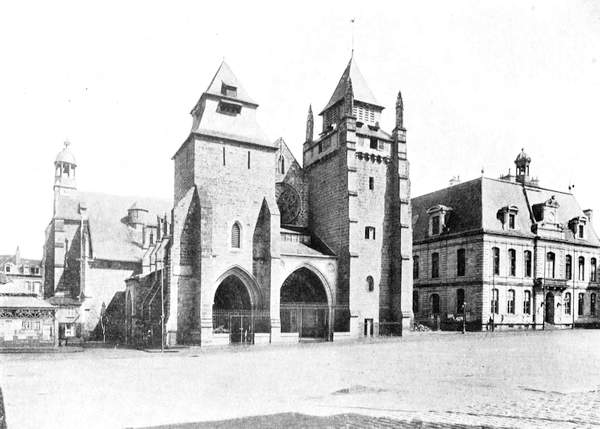
S. BRIEUC
The chapel and fountain of S. Brieuc, on the height to the N.W., are flamboyant and picturesque. On the S. side of the altar is a descent to the cave to which the Saint was wont to retire for prayer. Brioc was the son of an Irish occupant of Cardigan and a Saxon wife. He was educated by the Armorican S. Germain, a nephew of S. Patrick, who afterwards became Apostle of the Isle of Man. On the expulsion of the Irish from S.W. Wales Brioc left with a large number of followers and arrived at the mouth of the Gouet, where a kinsman, by marriage, Rigual had already settled, and he gave him the land where is now the city of S. Brieuc, and where had been a Gallo-Roman town. He died about the middle of the 6th cent. In the Rue Fardel is a house dated 1572. The modern churches in the town are architectural monstrosities. The Chapel of N.D. de l'Esperance is vastly pretentious, but wretched architecturally. The clerestory is filled with stained glass representing Breton Saints. Patronal Feast, S. Brieuc, 1st May. The valley of the Gouet may be followed down to the mouth, and an ascent made to the Tour de Cesson, which has Roman substructions, but was built up and altered at various times.
At Ploufragan is an allée couverte, buried in brambles. The church is modern with a spindly tower and spire.
At La Méaugon is a fine railway viaduct in two stages. The church has in one window a small but admirably drawn representation of the patron saint S. Meugaint, and a carved granite Calvary in the churchyard. Some remains of the screen removed to the west end.
Pledran. A vitrified fort. The vitrification was done by fires lighted in the depth of the wall. As the result was not satisfactory, the face outwards was subsequently banked up.
Saint Jean Brévelay (M.) chl. d'arr Ploermel. On the side of the road to Vannes, near Kerdramel, are two menhirs. A kilometre west of le Moustoir, on the Lande de Coh-Coet, a large dolmen formed of three blocks only; the coverer is 18 feet long. It has the ruins of an allée couverte leading to it. A kilometre south of it is a menhir 18 feet high. The natives of this district fled to England from the Northmen in the 9th cent., and brought back with them, when returning some relics of S. John of Beverley, Archbishop of York, who died in 721.
Plumelec. Between Trégoët and Kersimon is an allée couverte. In the coppice of Château Béauce a large dolmen called Migourdy, which on being explored yielded fragments of a figure of Venus Anadyomene, and a coin of Diocletian, showing that it had been utilised for some unknown purpose in historic times. It is supposed that the place owes its name to S. Meletius, B. of London, who died in 624, and that the refugees to England brought back his relics. But this is not probable; it must have been called plou after a founder of the clan, and the title of plou would hardly have attached to relics. The church is modern; the Chapel of S. Aubin is of 1513, and has some curious carving on the capitals, a fox preaching to geese, etc. Above the N. transept rises a slated spire.
Guéhenno. A modern church, but the porch of 1547 has been preserved. In the graveyard is a fine Calvary of the 16th cent., the finest in Morbihan. On it are numerous single figures as well as groups. It was taken down and buried at the time of the Revolution, so as to preserve it, and was restored in 1855. The Republican ruffians burnt the church. P. on 1st Sunday in September.
Saint Malo (I.V.) chl. d'arr. Occupies the old island of S. Aaron. It is now united to Rocabey by an embankment, the Sillon, along which runs a tramline. The town is walled in and a pleasant walk is on them; the circuit of the walls may thus be made. The castle is of the 15th cent.; it is square with flanking towers. Six gates give admission to the town, in which the streets are very narrow and odorous, and the houses lofty. At the highest point of the island, but smothered among houses, is the Chapel of S. Aaron (Aelhaiarn). This Welsh hermit occupied the island when S. Malo arrived. The cathedral is of the 14th cent. The choir is very English in character, with a square east end. The nave is of the 12th cent. but W. front and sides have been entirely Italianised. The fine central spire was added in 1859, and was the gift to the town of Napoleon III. The tide at S. Malo rises to an extraordinary height. At ebb by a causeway the islets of le Grand and le Petit Bey can be reached. On the nearest are ruins of a castle, and the tomb of Châteaubriant. On the further is a fort that is not occupied. In the offing is the island of Cézambre. Here S. Brendan, when obliged to quit Ireland, founded a monastery, in or about 524; and when S. Malo arrived about a quarter of a century later, he was well received by the abbot and monks on it. There are a cave and a chapel of S. Brendan on the island. But the Government has extended the fortifications on Cézambre and no one without a special authorisation is now allowed to set foot on the island. In S. Malo there are a little museum and a passable library in the Hôtel de Ville. The Breton museum in the Cassino should be visited. It contains good specimens of local carved oak, and chambers fitted with lit-clos, and figures in costume. A flying bridge invented by a native, who invested all his capital in it, connects S. Malo with S. Servan. S. Servan, Dinard, Paramé, are watering places.
S. Servan. The cité marks the site of the ancient city of Aleth and the substructions of the early cathedral have been discovered there. The seat of the bishopric was removed from Aleth to S. Malo by S. John of the Grate, the Bishop in 1142. The reason for the change was the insecurity of Aleth, whereas it was possible to thoroughly fortify the island of Aaron.
Paramé is a watering place, with a low shelving shore, facing north and miserably cold in winter, dusty in summer, and detestable at all times, except to such as frequent the gaming tables.
Saint Méen (I.V.) chl. arr. Montfort. A dull town in uninteresting country. It was the seat of an abbot, head of an important abbey in the Middle Ages. In 1554, S. Samson of Dol, who was engaged in working up a revolt against Conmore the Regent of Domnonia, sent his nephew Mevan across the great central forest to Vannes, probably to consult with Gildas, and to ascertain whether any assistance could be obtained from Count Weroch. On his way, Mevan lighted on a clearing in the forest, where now stands the little town bearing his name. In this clearing lived a British colonist, named Cadvan, who welcomed him and invited him to establish a lann hard by and take over the religious charge of his colony. Mevan agreed, and when Cadvan died, as he had no children, he bequeathed the whole of his plou to Mevan as well as the lann already granted. This was the origin of the abbey, and around the abbey grew the town. The abbey is now turned into a petit séminaire. The nave of the church was pulled down in 1771. The tower belongs to the end of the 12th cent. The transept is of the 13th cent. The choir is of the 14th cent. In the church is the tomb of S. Méen or Mevan, a granite sarcophagus. A pretty chapel of the 12th cent. turned into a sacristy. A Holy Well of S. Méen.
* SAINT NAZAIRE (L.I.) chl. d'arr. Is the seventh most important port in France and is situated at the extremity of a promontory of a gneiss rock that runs along the bank of the Loire. There is nothing of antiquity in the place, which is wholly modern and built on a stiff and formal plan, the houses rivalling each other in ugliness. But there is one curious object in it, an enormous dolmen in the midst of a square, that has been spared, and has given its name to the street leading to it. Five lighthouses guard the entrance of the Loire. From S. Nazaire a visit may be paid to La Grande Brière, a vast turf deposit, once an inland lake. The peculiar costume has almost disappeared, only the women retaining their coiffe. The population of all this district is British, and the descendants of the very earliest immigrants. The hair is for the most part fair, the eyes grey or blue. Formerly the Breton tongue was spoken throughout this district, but it is now spoken by only about 400 persons in the neighbourhood of Batz by Croisic. Curiously enough, the villagers of Batz regard themselves as of different blood from the rest, and to be descendants of Scandinavian pirates who were suffered to settle there. Till quite recently it was an unheard of event for a young man of Batz to marry a girl of what he regarded as the Breton villages. That in colour of hair and eyes there should be no distinction does not militate against the tradition, for the pure blooded Celt is as fair as the Scandinavian.
Saint Nicolas du Pélem (C.N.) chl. arr. Guingamp. A menhir in the forest of Kerhuel, and another near Kerhuel, 9 ft. high. In the valley of Prat-roury another, fusiform, about 11 ft. high. The old Roman road from Aleth to Carhaix ran through this parish, and it remains in fairly perfect condition in several places. On a height is the camp of Dzillon near Kerimard, circular with a tump hollowed out within, certainly a Norseman burh. The Château de Pélem is in ruins, but two of the towers are standing. The Church of S. Nicolas has got very fine restored stained glass of the 14th cent., representing in twenty-four medallions scenes from the gospel story; at the bottom of the window the donors are represented kneeling. Another window contains fragments of medallions representing the life of the Baptist. The roodscreen was wantonly destroyed in 1861. The Chapel of S. Eloi has a fine flamboyant east window with remains of stained glass in it. The Chapel of Riolon is mainly of the 15th cent., and has an east window of the renaissance with stained glass in it representing the Eternal Father seated in the midst of a rose, surrounded by the evangelists, the prophets, and angels playing instruments of music. Another window has fragments of stained glass in it representing saints.
Canihuel. A huge menhir called Coz-resto, 23 ft. high, has been split by lightning. It is in a line with other menhirs at Kergornec, Saint Gilles-Pligeaux, and Crech Ogel in the old bourg of Quintin. At Botquelen is another menhir 13 ft. high.
The parish church was built in 1474, burnt in 1595 and repaired in 1598; it is almost wholly of the 16th cent. with a flamboyant E. window.
Kerpert. Church of the flamboyant period; in the E. window glass of the 16th cent. representing the life of S. Peter; ossuary.
Lanrivain. Ossuary and Calvary of 1548. On the platform are several figures; there are three crosses, the principal one sustains a group of eleven figures carved in one block.
Peumerit-Quintin. Near the hamlet of Pempoul a ruined allée couverte. The Chapel of S. Jean du Loch is mainly of the 15th cent. but retains some portions of the earlier 12th cent. building.
S. Connan.. Near the Mill of Kerdic a ruined allée couverte. Dolmen in the Parc-an-Neurn.
S. Gilles Pligeaux. Two menhirs at Kergornec, one in the Parc-er-Pélem, is 22 ft. high and leans. The other at four hundred paces from it, near the bottom of the valley in Parc-ar-golven, is 13 ft. high. They seem to belong to a system of which only some remain, as Crech Ogel in Vieux Bourg, Coz-resto in Canihuel, and one in the Lande de Bohan in S. Mayeux. Dolmen called Roc-ar-Velcien, the table supported by three uprights. The coverer is almost circular, about 23 ft. in diameter. The church is of the 16th cent., tower and porch of 1644. In the cemetery a chapel dedicated to S. Laurence, with an entombment in the crypt of terracotta of the 17th cent. Date of chapel 1538.
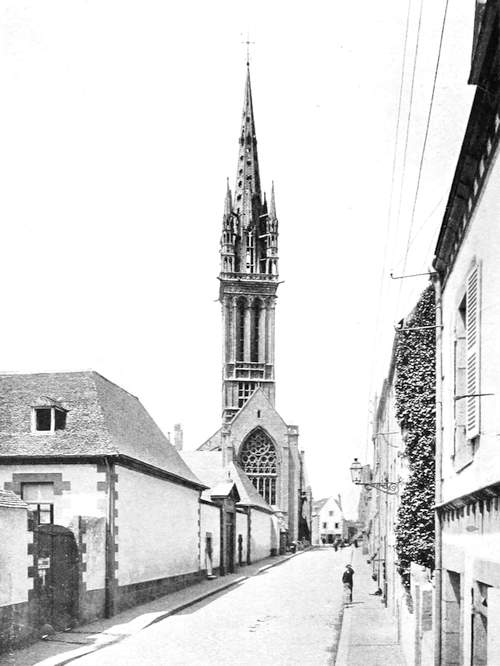
LE KREISKER, S. POL DE LÉON
* S. POL DE LÉON (F.) chl. arr. Morlaix. An ancient cathedral town, but the diocese has been united to that of Quimper. The cathedral has two western towers and spires and façade of 1st pointed. The nave is entirely 2nd pointed and has a very beautiful arcade. The cleristory is quite simple, mostly with 1st pointed windows. The side aisles have an arcade under the windows. The transepts are double, i.e. with aisles to the east, fine 2nd pointed. The E. aisle of the S. transept contains very bad flamboyant windows. The choir, ending in an apse, is flamboyant 1431-50, and contains fine carved oak stalls of 1512. The choir has double aisles, N. and S. On the N. side is the Chapel of S. Paul, with his skull, hand, and bell in shrines. The pillars and vaulting of the S. aisle may be noticed.
The Chapel of Kreisker possesses a tower and spire that are supposed by Bretons to be the glory of Finistère. It is badly proportioned; the spire and spirelets overload the summit of the tower. It may be regarded as curious and a clever bit of architecture, but it is not pleasing. This tower is central. The windows are all flamboyant but affect an earlier type. The chapel has triforium and circular cleristory windows on the S. side but none on the N. There is a noble N. porch very richly carved. A very rich W. window. The E. window contains bad modern glass reproducing old figures of Breton saints. The S. side has an arcade under the windows with small lights pierced at intervals. There is a good piscina in the S. aisle. The Church of S. Pierre is now turned into a cemetery chapel. It is 15th cent. but has a baroque west front. Ossuaries (small) are in the wall surrounding the cemetery. On the way to Roscoff, just beyond the railway, is an allée couverte or dolmen.
Roscoff is a quaint place, with an old house or two, situated near the sea, and commanding the Island of Batz. The church has a very remarkable renaissance tower and spire (1550), more fantastic than pleasing, with ships carved on it and cannons or culverins as gargoyles. It is in three stages with galleries. The church is late flamboyant. There are two ossuaries; one is very rich. In the church are preserved the panels of an alabaster retable of the 15th cent. of Flemish work. The Chapel of S. Ninian in the street is in ruins; it was erected by Mary Stuart to commemorate her landing at Roscoff, 1548. The hospital dates from 1573. A Chapel of Ste. Barbe is on a height. P. of Santec, 2nd Sunday after Trinity. P. of Ste. Barbe, 3rd Monday in July. P. in the parish church, August 15.
Sibiril. The Château of Keronzéré erected in 1458 was restored in 1602.
Ile de Batz. It takes a quarter of an hour to cross from Roscoff to the island, and is only to be attempted when the sea is calm. The tide here rises 30 ft. But a visit hardly repays the trouble. When Paulus Aurelianus, a native of Glamorganshire, landed on the west coast of Finistère, he heard that a kinsman, Withur, was living in these parts, and had made himself count or chieftain. He went to visit him, and found him on the Isle of Batz, very old, busy making a copy of the Gospels with his own hand. Withur received him cordially, and advised him to settle among the ruins of an old Roman town on the mainland. Paulus did so, and hence the city of S. Pol de Léon. Legend says that there was a dragon on the island, which S. Paul tamed by binding his stole about its neck and then bidding it precipitate itself into the sea. This is an allegorical way of saying that he put an end to paganism in Batz. The Toul-ar-Sarpant, where the dragon is supposed to have haunted, is pointed out, and the stole of S. Paul, a piece of Byzantine work, is preserved in the church. It is a silk tissue, with a blue ground worked over with white and yellow, to figure a set of warriors facing each other, with a sort of turban head-dress and holding falcons on their wrists, and with a dog between the legs of each horse. A Romanesque chapel stood on the site of S. Paul's monastery on the island. This is called the Peniti; the chapel is ruinous and half-buried in sand. There is a lighthouse on the island.
Saint Rénan (F.) chl. arr. Brest. Pleasantly situated in a woody basin, through which flows the little stream of the Aberildut. The church has a Romanesque choir, and a tower and spire, ill proportioned, of 1772. There are some old and picturesque houses.
Lanrivoaré. The church has a tower in two stages and spire of the usual type but erected in 1727. The church itself is flamboyant. The chancel is Italian. In the N. transept is a singularly uncouth flamboyant window. Above the arches into the choir, transept and nave, the twelve apostles are painted. On the south side of the church is a walled-in quadrangular space where, according to tradition, a whole Christian population was massacred by pagans. No certain details exist, and it is probable that the pagans were the Northmen, who committed frightful atrocities in Brittany in the 10th cent. In the midst of the enclosure is the graveyard of the unnamed saints, laid down with polygonal and various shaped pieces of granite. It is enclosed by a dwarf wall overlaid with pieces of slate. At the east end is a sort of altar sustaining a cross and some fragments of carving. Before the altar lie eight rolled boulders. These are popularly supposed to have been loaves turned into bread. S. Huarvé asked a woman to give him bread, and she refused. As a judgment for her hardheartedness all her loaves were petrified. Actually these pebbles are "cursing stones," and such boulders exist in several chapels in Ireland, and are used for calling down disease or destruction on an enemy. The person invoking the curse, after a certain number of prayers turns the stone round seven times. That these pebbles have been so employed is probable, as the under surfaces of the stones are well rubbed. But happily this pagan usage is no longer in resort, and the stones remain with only the childish legend attached to them to explain their presence. S. Rivoaré, the patron of the church, was a priest, brother of Rivanon the mother of S. Huarvé or Hérvé, the blind bard saint. It is not unusual to see pilgrims, also the parishioners of Lanrivoaré enter the enclosure, take off their shoes and stockings, kneel, and recite prayers and then pace on the slates thrice about the burial place, taking care to step on each slab of slate, and omit none. In the village is a curious stone cross with a clothed figure of Christ upon it. A short walk from Lanrivoaré leads to the ruined Château of Kergroades, situated in beautiful woods, with avenues of oak and chestnut. It is difficult to find, and a guide must be taken. The château is in a charming position; it is of renaissance architecture throughout, and the court of honour front is in fair condition. But the gates are locked and admission is not easily obtained. The patronal feast at Lanrivoaré is on the 3rd Sunday in October, and P. at the Chapel of Lanvennec the 4th Sunday in September.
Saint Servan (I.V.) chl. arr. S. Malo; see S. Malo.
Sarzeau (M.) chl. arr. Vannes. Sarzeau is the principal village or town on the peninsula that bears its name, which divides the sea of Morbihan from the ocean. That peninsula is some 20 miles long and 6 across, but it has been much diminished in width by the sea which has eaten away much of the coast. It is granitic on the west, and schist on the east, and the granite is of a soft quality, allowing the sea to decompose and break it up. Thus a parish church of S. Demetri has been engulfed. A second was built further inland, and that is now almost entirely surrounded by the sea and threatens shortly to disappear in the waves. Formerly a forest covered the promontory, now it is sparsely wooded and trees only flourish on the side toward the inland sea. But the climate is equable, and vines are cultivated; this is the most northern point reached by vineyards. Yet wine can only be made once in about three years, and is not of a good quality. At Cohports is a menhir 12 ft. high, and a circle of standing stones at Croen-Linden, and dolmens, more or less ruined, at Noédic, Prat-Fetén, Trest, Kergilét, Brillac, and Kerbley. An allée couverte 30 ft. long at Clos-Rodus. Gildas coming from Glastonbury about 520 founded a monastery at Rhuys, and a cell or peniti at Coetlann, afterwards called the Priory of S. Pabu, but this has disappeared. In the town is the house in which Le Sage was born, the author of "Gil Blas" (b. 1668, d. 1747). The church is a horrible structure, begun in 1670 and ended in 1683. It was formerly one vast hall, but a couple of ranges of columns were introduced in 1883 sustaining arcades, and qualifying somewhat the internal ugliness. Externally, the pinnacles are composed of little pyramids resting on balls.
The Castle of Sucinio was occupied in 1218 by Duke Pierre de Dreux, and in 1238 their son, Jean I., confined within it the baron Olivier de Lanvaux, who had rebelled against him. This prince was fond of the place and several of his children were born there. He took in the forest about the priory of Coetlann or Saint-Pabu, and the greater part of the castle that now stands was erected by him. His son John II. continued the works, and put his treasure in its vaults. During the War of Succession it was occupied by Charles de Blois, then taken by Jean de Montfort, and retaken by Du Guesclin. John IV. greatly repaired the castle, and within its walls was born Arthur of Richemond, future Constable of France. In 1474 the Earls of Pembroke and Richemond were imprisoned within its walls. The castle forms an irregular pentagon. It had eight towers, but of these only six remain. The entrance to the east is preceded by a drawbridge, and is defended by two large towers, one of which contains the chapel. The castle, occupied in 1795 by the Royalists, was sold as national property, and the peasant who purchased it despoiled it of its roof and staircases, and let it fall into complete ruin. A fee of one franc per head is charged for admission, the money being devoted to the relief of the poor of Sarzeau.
S. Gildas de Rhuys. Near the ocean; here precipitous cliffs receive the lashing of the Atlantic rollers. Near the drained marsh of Kerver is a menhir 12 ft. high. Near the hamlet of Net four others, and the remains of an allée couverte 70 ft. long and 12 ft. wide; at Clos-er-Bé a dolmen called Meen-platt, and near Largneven a fallen menhir 15 ft. long. The Abbey of S. Gildas was founded about 520. Gildas was the son of Cau, prince of Alcluyd or Dumbarton; Cau and all his family were driven south by the Picts and Saxons, and took refuge in N. Wales, where Maelgwn Gwynedd gave them lands, and the sons for the most part entered into religion. Not so Hywel, the eldest, a quarrelsome man, who fell out with King Arthur, and lost his life in the quarrel. Arthur was forced to surrender some lands in Radnorshire to the family as blood-money, and then Gildas gave him the kiss of peace. Gildas was a married man and had several sons, amongst whom the most noted was Kenneth, hermit of Gower, but who came to Brittany with his father and became a founder there. When aged thirty Gildas settled at Rhuys, and here he wrote his scurrilous letter against the princes and clergy and people of Britain, reviling in it in outrageous terms Maelgwn, who had treated his family with kindness and generosity. Gildas was on good terms with Weroch, Count of Vannes, and with Conmore, Regent of Domnonia, and this latter richly endowed his houses. This did not prevent Gildas from turning against him and heading a revolt which caused the death of his benefactor. It was whilst Gildas was at Rhuys that he was visited by S. Brendan. Although the Irish travellers arrived in cold and snowy weather Gildas refused them hospitality; but the Irishmen broke down the gates and forced themselves upon the sour British abbot. Gildas died in 570, and, according to his desire, his body was placed in a boat and thrust forth to sea. Two months after the body was washed ashore at Arzon, at the extremity of the headland, on March 11th, on which day a procession leaves S. Gildas, annually, and visits the site where it was found. In 818 the monks of Rhuys were forced by Louis the Pious to adopt the Rule of S. Benedict and abandon their Celtic practices. In 919 they were forced to fly from the Northmen. They hid some of the bones of Gildas in sand in his tomb, but carried away most of his relics, and took refuge in Berry. In 1008, at the request of Geoffroi, Duke of Brittany, Felix, monk of S. Benoït-sur-Loire, with six others came to Rhuys to restore the ruined abbey. He rebuilt the church which was consecrated in 1032, and much of this edifice remains. The church, in the form of a Latin cross, is composed of two distinct parts, the nave, rebuilt in 1699, and the choir and N. transept built by S. Felix 1010-32. The choir is apsidal, with the tomb of Gildas behind the high altar. It is surrounded by Romanesque columns with stilted arches, surmounted by small 11th cent. windows. The N. transept also possesses an apse to the east, and under a low arcade in the N. wall the tombs of S. Felix and S. Gulstan. On the N. side of the choir on the outside let into the wall is a curious carving representing two knights on horseback tilting at each other. The Romanesque capitals rejected when the nave was rebuilt have been in three cases utilised, by being inverted and turned into bénitiers; another is thrown outside. A beautiful statue of Gildas by Vallet stands over the tomb. It is that of a sweet and placable saint, not of a rancorous and revengeful man. In the S. transept, which was destroyed by a storm and has been rebuilt, is a huge barbaric retable. The treasury contains a silver bust containing part of the skull, and reliquaries for arm and thigh bones of the Saint; some of these reliquaries are of the 15th cent. There is also a mitre of the 15th cent. which is erroneously supposed to have been that of Abelard. The conventual buildings are of the 18th cent. and are occupied by a religious order which receives female paying guests during the season. Abelard, born in 1079, became a Benedictine monk in 1117, and was elected abbot of S. Gildas de Rhuys in 1125. But the strictness of his rule roused the monks against him. "The life of the monks," he wrote, "was indisciplined and frightful. The abbey gates were decorated with the feet of stags, bears and boars. The monks were roused from their slumbers by no other signal than the hunter's horn and the baying of hounds. The natives were barbarous and disorderly." The community revolted against any attempt to bring it to discipline, and Abelard believed that his life was in danger; he accordingly fled in 1138 and died at Cluny in 1142.
By following the road behind the church, along the convent walls, the Chapel of S. Bieuzy is reached, and a path to the right leads to the little Baie de Portas, where in the rock is an impression like that of a horse's hoof. Legend says that Gildas left the Isle of Houat on a flying horse that landed at this spot. A stair cut in the rock leads to the Baie de Saint Gildas, where is a spring and over it a statue of the Saint.
Arzon has a modern church surmounted by a spire, and two stained glass windows recording a vow made in 1673 by some sailors of the place to S. Anne, during the war with Holland. The Chapel of Er Hroez marks the spot where the body of Gildas was found. There are circles of stones at Er-Lannig, and a good many fallen menhirs. At Graniol is a tumulus containing an allée couverte. Another at Bilgroéz. The Butte de Tumiac was explored and a covered avenue found in it, but was so slovenly dealt with that the stones have collapsed.
Scaer (F.) chl. arr. Quimperlé. A dull town, with a vulgar modern church. At S. Jean, about two miles distant, on a lande, is a fine menhir. An abundant spring of Ste. Candide supplies the town, but it has no architectural character. The Chapel of Coatdry is an object of resort from all the neighbourhood on the occasion of the Pardon, 1st Sunday after Trinity, and again the last Sunday in September, when very interesting collections of costumes may be seen.
Le Sel (I.V.) chl. arr. Redon, is without much interest. The church is modern. The tumulus of Chalonge is covered with trees and surrounded by a moat.
Sizun (F.) chl. arr. Morlaix. The church (S. Sulien) has a fine spire of more simple character than those usually met with in Finistère. The porch is renaissance. There are in the parish chapels of S. Cadoc and S. Illtyd. The great Pardon is on the last Sunday in July. The P. of S. Cado the last Sunday in September, and at Loc Ildut on Corpus Christi Day. The Chapel of S. Cado is on the Monts d'Arrée.
Commana. A fine allée couverte measuring 50 ft. A dolmen and a menhir. In the church are some gorgeously barbaric altarpieces, a mass of carving, gilding and colour, of very late renaissance or baroque. P. last Sunday in July. Those interested in prehistoric remains would do well to investigate the Monts d'Arrée, over which many are scattered. A map of the district with the monuments thereon is published in the Bulletin de la Soc. d'emulation des Côtes-du-Nord, T. xxxv. (1897).
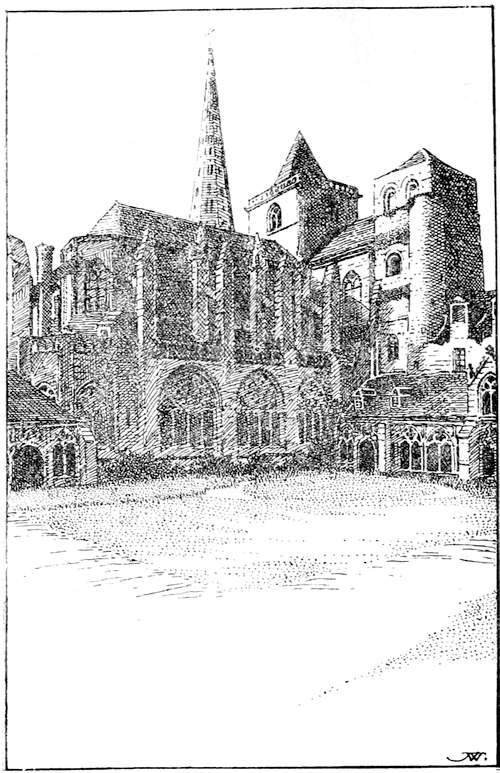
TRÉGUIER CATHEDRAL
Plouneour-Menez. The very interesting abbey church of le Relecq lies near a tarn, one of the sources of the river of Morlaix. The abbey was founded on the site of the last battle fought between Judnal and Conmore, usurper of Domnonia, 555. It takes its name from the "religou" or bones which were found in great numbers on the battlefield. The original settler here was S. Tanguy, disciple of Paul of Léon, but the present church dates from 1132. The interior is a most interesting example of 12th century work. The west front was rebuilt in the 18th cent. On the N. side are the remains of the cloister of other monastic buildings. P. 15th August.
Tinténiac (I.V.) chl. arr. S. Malo. Reached by a tramline from Rennes. Prettily situated. The church is modern. There are some old houses. A menhir called La Roche du Diable.
At Tréversien is the Château de la Fosse aux Loups, where the scene is laid of Paul Féval's novel "Rollan Pied de Fer."
Les Iffs and the Château of Montmuran may be visited from Tinténiac (see Becherel).
* TRÉGUIER (C.N.) chl. arr. Lannion. An old cathedral city at the junction of the Jaudy and the Guindy. The town is on rising ground but runs down to the water side to a little point. On the highest ground is the cathedral, of nave and side aisles and two transepts. The church was almost altogether constructed in the 14th cent. It was begun in 1339. It has, however, preserved an 11th cent. tower on the N. side called de Tour de Hasting. It has the characteristic round-headed windows and pillasters of the period. The N. transept is in this tower and the pillars there with the Byzantine capitals and round arches proclaim that they belong to the beginning of the 11th cent. The bases are rudely carved, and bear the appearance of having been earlier capitals reversed and employed as bases. But this is probably in appearance only. What is of special interest to the visitor is the fact that Tréguier cathedral belongs almost wholly to the Middle Pointed or Geometrical period, which is not abundantly represented in Brittany. The W. porch sustains a gallery, and the entrance is through a double opening, a slender pillar supporting trefoils and sustains a quatrefoil between them, all pierced. Above is a 2nd pointed W. window of no particular merit: a pair of turrets with spirelets flank the western façade. The cathedral has three towers, the northern Romanesque Tour de Hastings, a central tower of the 14th cent. not finished, and with a stunted cap on it, and the S. tower, above the transept of the same date, but furnished with a naked, ridiculous spire added in the 18th cent. The flamboyant window inserted in the transept is of the finest quality, as are also those at the side of the transept. Happily, the S. front of the cathedral furnishes a good object lesson in the study of the development of tracery. Beginning at the W. end of the nave we have two windows of the earliest description of tracery, two lights sustaining a circle, all uncusped. The third window has two trefoil headed lights sustaining a trefoil, but all rather clumsy in design. Then we have the fourth window vastly in advance of the other; each cusped light sustains a trefoil and both trefoils support a quatrefoil. It must be mentioned, by the way, that a S. porch has been converted into a baptistery, and the tracery in its window is modern. If we pass on to the choir we have three windows; the first is very good, geometric in design, but the second and third are of supreme richness and beauty, revealing the style at its very best. Then look at the side clerestory lights of the S. transept and its large S. window and we see flamboyant or 3rd pointed also at its best. Then step within and look at the second window from the west in the N. aisle of the nave, and you see flamboyant in its decadence, when cusping was abandoned. The S. porch is set below the flamboyant window of the S. transept and is original, and, it must be admitted, far from pleasing. It has a vaulted roof, the exterior being thus treated, and within sustained by three ribs, between which is open tracery through which the eye pierces to the vault above. The doorway into the church has statuary about it much mutilated. The church within is fine. It is not over lofty as are the great churches of the Isle of France and Normandy. The pillars of the nave vary, and the moulding of the first two arches is richer than the others. The triforium is plain till it reaches choir and S. transept, where it is greatly enriched. The clerestory windows are tall and good. The Romanesque pillars and stilted arches in the N. transept should not be passed over. The choir ends in an apse, and is seated with carved oak stalls. According to the cathedral accounts, these were presented in 1648, but in style they appear much older. On the gospel side of the high altar is a statue of S. Tugdual, the founder of the see, with the appropriate inscription, "Etsi aliis non sum apostolus, sed tamen vobis sum. Scitis quod precepta dederim vobis per Dominum Jesum." S. Tugdual was son of Hoel and Pompeia; Hoel was the son of Emyr the Armorican, who fled from Brittany to South Wales in the 5th cent. Here he founded a Church, Llanhowell, near Solva in Pembrokeshire, a very early curious structure resting on cyclopean foundations, probably as old as the 5th cent. Tugdual and his mother came over to Armorica, and first settled with S. Brioc, the uncle of Tugdual, at Trebabu, not far from Brest. But Brioc returned to Wales, where a plague was raging, to comfort the panic-stricken inhabitants, and when he came back to Trebabu, the monks refused to receive him, preferring the rule of a young man to one advanced in age, whereupon Brioc departed and founded S. Brieuc. Tréguier when Tugdual settled there was undoubtedly an ancient fortress, standing in the fork between two rivers. He must have been a man of extraordinary energy, for he scattered "lanns" or ecclesiastical centres throughout Northern Brittany. But though Tugdual was the apostle to this district and the founder of the church, he has been completely eclipsed by S. Yves, whose monument has been reconstructed in the nave. It had been smashed to pieces at the Revolution. The reconstruction is eminently successful. S. Yves is, perhaps, the most popular saint in Brittany. He was born at Kermartin, near Tréguier, in 1253, and became ecclesiastical judge in the diocese. His, at that time, unheard of probity in refusing bribes, and his consideration for sick and poor gained general respect. He died on May 19th, 1303, on which day his Pardon at Tréguier is celebrated. Every peasant who considers that he has been wronged, who nurses a grievance, who is engaged in a lawsuit, has recourse to S. Yves, as promptly as he who has a sick horse flees to S. Eloi. On the N. side of the church is the Chapel du Dûc, opening out of the aisle by three arches. An altarpiece is made up of fragments of old carved oak. N. of the choir, entered either through a door in the Tour de Hastings or through a gateway east of the church, is the cloister. This was erected in 1468, and is therefore flamboyant, but without weakness. The tower of S. Michel, 15th cent., stands outside the town on a height. The church has been pulled down. There are some old houses in the city, notably at the port, where is an eminently picturesque group of two towers and two houses; one in the street is a study in slated fronts.