VII. General Instructions (continued 2)
Reading edition
Lantec. The parish church (S. Oswald) is a mean modern structure. How the great Northumbrian king should come to be here commemorated is hard to understand. He is represented over the altar as a chubby, smirking boy. The Chapel of N.D. de la Cour is a noble structure of 1460, of the finest and purest flamboyant, before it became degenerate and adulterated with Italian detail. Chancel and side aisles are vaulted. The nave has modern wood vaulting. The superb east window is filled with the finest stained glass, silvery in tone, with the colour set in it as jewels, after the English school, and entirely different from the prevailing Breton character of glass which, like the French, is overladen with colour. The modern glass in some of the windows is bad as bad can be. The tracery of the chancel windows is admirable. There is a second stained window, old, in the S. transept. In the chapel is the tomb of Guillaume de Rosmadec, 1608, in kersanton stone. P. 16th August, when pilgrim fishermen make the circuit of the chapel barefooted and in their shirts alone.
S. Quay is a watering place.
Le Faou (F.) chl. arr. Châteaulin, at the head of a long arm of the sea. It is reached from Henvec station. The church is of the 16th cent. late flamboyant, with a slender unsatisfactory tower, 1626-40. The porch is of 1593, with statues of the apostles.
Rumengol. The story goes that as King Grallo was riding with S. Winwaloe from Is, which had been overwhelmed by the sea, and reached the hill that commanded the valley, he saw a fire on the height opposite, and found that the pagan inhabitants were holding a sacrifice on the rou-men-goulon, the Red Stone of the Dawn. He vowed to build there a church. This is represented in the E. window. The church is late flamboyant with renaissance detail. The porch is of the usual type and contains, over the door, an adoration of the Magi. A hundred paces to the east is the Holy Well. In the little structure is a bas-relief of the Annunciation, and statues of S. Winwaloe and S. Fiacre. One of the most largely attended Pardons of Brittany takes place here on Trinity Sunday, the pilgrims arrive over night and sleep in the church.
* LE FAOUËT (M.) chl. arr. Pontivy. Fine timber and slate Halles. The church of the 16th cent. is of little interest, but the chapels of Ste. Barbe, S. Fiacre, and S. Nicolas in Prisiac, are well deserving of a visit and a study. Ste. Barbe is planted on a rock above a pretty valley, and is reached by a staircase of stone. A bridge connects the upper platform with another chapel, that of S. Michel. The wooden belfry is on the platform above. The chapel of Ste. Barbe is of fine flamboyant work, 1489. The structure is curious: there is no nave, it is composed of long transepts and a small budding chancel. It was vaulted in 1512. Some very fine old glass remains, side by side with some very villainous modern stuff. Below, in the valley, is the well of Ste. Barbe. The P. of Ste. Barbe is on the last Sunday in June.
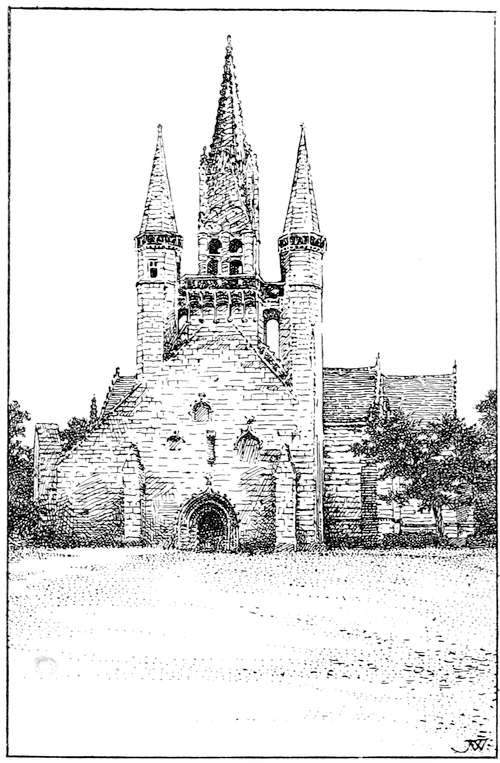
S. FIACRE
S. Fiacre is a superb example of the architecture of the 15th cent. The main spire, with its flamboyant gallery, is corbelled out on the west gable and is tied by two flying buttresses to two smaller towers with spirelets. The S. porch is vaulted and has niches within. The chapel contains very fine glass of 1550, but falling to pieces and fragments detaching themselves with every storm. The subjects represented are the Nativity, the Passion, and the legend of S. Fiacre. A roodscreen of 1480 has been badly "restored" and painted. The condition of the magnificent glass is disgraceful. The chapel is a "monument historique," so that the curé can do nothing to it, and the State will do nothing for its preservation. The foliage carving in granite is admirable for its boldness. The Chapel of S. Nicolas in Prisiac has a very fine roodscreen, quite perfect and untouched, covered with curious paintings; it is, however, later than that at S. Fiacre. There is here also some good old glass. The chapel is in a sad condition of neglect. It possesses a broken wheel set with bells for ringing by pilgrims to call the attention of the Saint to their prayers. Le Faouët may be reached from either Gourin or Quimperlé. The P. at S. Fiacre is on the 4th Sunday in July. S. Caradec Trégomel, a splendid late Gothic chapel, one of the finest monuments of 15th cent. in Brittany.
* FOUESNANT (F.) chl. arr. Quimper, with nice sands. A pleasant holiday resort. The costumes of the women are very pretty. The church is Romanesque, but was frightfully maltreated in the 18th cent., when large round-headed windows were introduced. The tower was struck by lightning and rebuilt at the same time. The piers are 11th cent. From above them rise pilasters that sustain relieving arches under which are the clerestory windows. The capitals have byzantine-looking work on them. The Chapel of Ste. Anne, in the midst of trees, was built in 1685, and has a tower for two bells and spire between two detached turrets surmounted by cupolas. This chapel is the object of visit when the Pardon takes place on July 28. Peasants and girls in white arrive by water in boats with their crosses and banners.
S. Evarzec. Here was a commandery of the Knights of Malta at Moustoir (13th cent.). A dolmen and menhir.
Goueznach. A ruined allée couverte. Chapel of N.D. de Bonsecours, P. Sept. 8. Chapel of S. Cado, P. Sept 25; that of Ste. Barbe, P. June 5.
Benodet. A favourite bathing resort. The church (S. Thomas à Becket) was erected in his honour in 1241, seventy-one years after his death. But it has undergone much alteration and enlargement. All that remains of the original church are two bays of the apse. The foliage of the capitals has all the freshness and charm of work of that period.
Perguet (S. Bridget) was formerly the mother church of Benodet, but now the relations are reversed. Externally, on the N. side may be seen Romanesque work, and the small windows of the period. The S. side has been completely transformed by the addition of a little ossuary and a porch and a transept of the 16th cent. But on entering the church the early character of the building becomes manifest. The arcades of the nave and the chancel arch are of the 12th cent. The three bays on the north are bold and rectangular, and, as at Fouesnant, support relieving arches that enclose the clerestory windows. This is all 11th cent. But the chancel arch shows distinct signs of the coming on of the reign of the pointed style. The choir is flamboyant. Here also the Byzantine character of the ornamentation of the 11th cent. capitals may be observed. The east window contains 16th cent. glass, and represents the Crucifixion. Among the statues in the church are S. Bridget and S. Patrick, but the latter has been altered into S. Paternus. In this church is a fireplace for warming baptismal water. The tower is of 1595. On the highway from Quimper to Benodet is the Holy Well of N.D. de Drenec. The basin is surmounted by a niche containing a statue of Our Lady of Pity. In times of drought the parishioners of Ergué Armel come here to pray for rain; but those of Clohars Fouesnant go in quest of it to Petit Ergué.
La Forest Fouesnant. This pretty little church is planted near the sea. The spire is bracketed out above the west gable, and contains a stone cage for bells. The Calvary is the earliest in the Department and is of the 16th cent. In the presbytère is a noble chalice of the first half of the 16th cent.
* FOUGÈRES (I.V.) chl. d'arrond. Picturesquely situated on a hill above the Nançon. Originally a frontier town between Brittany and France, it has preserved its venerable fortifications, but they are crowded in by buildings. The castle was founded in the 11th cent., destroyed in 1166, rebuilt in 1176, has been restored. It is planted on a rock, and was flanked by ten towers including those that commanded the entrance. It is divided into four distinct portions, the avantcour, the main court, the donjon, and the postern court. The entrance is between three towers of the 12th cent. The keep was destroyed in 1630. It rose in the midst of the second court, flanked by three towers that still remain, that of Melusine dates from 1242. The Church of S. Sulpice was rebuilt in 1410, but the nave and tower were not completed till 1490. The slate spire leans. The choir, begun in the 16th cent., was not completed till 1765. The Church of S. Leonard was erected 1407-44, but underwent alterations in 1586-1637, and contains fragments of old glass. Altogether Fougères is a most interesting place, and rivals Vitré.
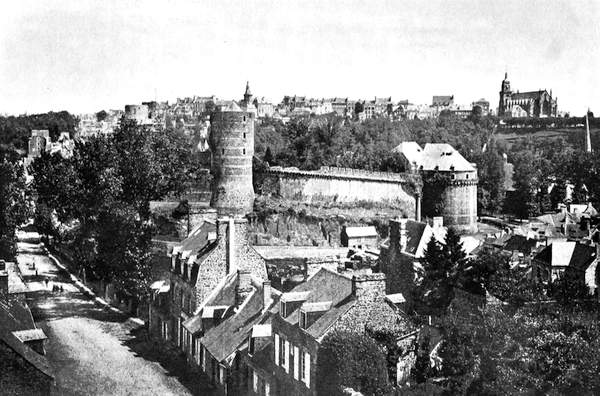
FOUGÈRES
In the Forest of Fougères is a fallen dolmen, Pierre du Tresor, also an alignment of 80 stones, called Le Cordon des Druides, near the ruins of a convent founded in 1440.
La Gacilly (M.) chl. arr. Vannes. Near the town on the road to Malestroit, a menhir 15 ft. high, La Roche Piqué, and near it another of the same height but fallen. On the Lande de Signé E. of Gacilly a circular camp and the slope of the hill is pitted with excavations. The parish church was formerly chapel to the castle and was of 14th cent., but was altered and enlarged 1626-31.
The Chapel of S. Jugon, 4 kilometres W.N.W. Jugon was a peasant boy who led a devout life. P. Whitsun-Monday. Peasants take little bags of seed to have it blessed at the end of Mass. This is then mingled with what is to be sown.
Cournon. A fine dolmen, La Tablette. One of the coverers was broken in 1820. W. is a menhir 9 ft. high, further W. other blocks that may be the remains of an alignment.
Les Fougerêts. A pretty gorge with grottoes in the sides called Les Chambres du Coucou.
S. Congard (Cyngar) near Bignac. An allée couverte measuring 43 ft. long and 4 ft. 6 in. high within. It has five coverers, of which one only has fallen. A menhir near the wood of Misny. The Chapel of N.D. de Quimper is an object of pilgrimage on Whitsun-Monday, and here, possibly, may still be heard the barking of the pilgrims, an hysterical phenomenon, that formerly accompanied the Pardon of Josselin. At Wesley's revivalist meetings a similar phenomenon was noticed.
* GUINGAMP (C.N.). A pleasantly situated town in green surroundings, with the little river Trieux flowing through it. The finest view of the town with the towers of the church is from the garden of the Hôtel de France, whence water, foliage and old buildings group admirably. The Church of N.D. de Bonsecours is indebted to a miraculous image for the lavish expenditure upon it. This image stands in the N. porch, and has been accorded a gold crown from the Pope, and has been profusely "indulgenced." The church was formerly the chapel of the Counts of Ponthièvre. It was rebuilt in the 14th and 15th cents. and added to in the 16th. The church consists of a nave with four aisles, double transepts and an ambulatory round the choir. The transept and S. transept front are of the 12th cent. The central tower and spire of the 13th. To the same period belong the tower and turret on the N.W. The arcade on the N. of the nave is of the 13th cent. On the S. side the arcade is renaissance. In the spandrils are the cardinal virtues sculptured in relief, and corbels support statues. Above the arcade is a triforium consisting of three ranges. Above the arcade on the north side the triforium is of the 14th cent. The choir is composed of four bays of the 15th cent. The apse is of the same date. A curious feature is the carrying of the triforium across the church above the chancel arch. The transepts are lighted by rose windows of the 14th cent. The principal porch containing the miraculous image is closed by a grating and converted into a chapel; it contains modern statues of the apostles. The W. doorway is a magnificent specimen of renaissance work. Owing to the windows being all filled with modern coloured glass overloaded with colour, the interior cannot be well seen except on sunny days. The vaulting of the choir is sustained by flying buttresses within the church. The fine S.W. tower is an excellent but unfinished work of the renaissance. In the market-place is a leaden fountain of the renaissance. A few picturesque old houses remain. The P. is on the 1st Sunday in July. A procession with torches takes place on the Saturday night, and bonfires are lighted in the Place. After the religious ceremonies follow dances. N. of Guingamp on a height is the little Chapel of S. Lambert with some early 11th cent. work, but for the most part it was transformed in the 18th cent. The abbey of Ste. Croix is of the 16th cent., but the church has the piers of the transept of the 13th.
Grâces. The church is entirely flamboyant of 1508, and a typical specimen. All the aisle windows are under gables. The baptistery is of the end of the 16th cent. The relics of Charles de Blois are preserved here.
Pedernec. A menhir 25 ft. high. On one face three cup-hollows. The church was rebuilt in 1847, but the S. side aisle and arcade and a good rose window in the transept, of the 16th cent., have been preserved. Also a delicately carved roodscreen, out of its proper place.
Coadout. An allée couverte at Pen-poul-ar-hus, destroyed in 1863, except for three stones, has one much polished. On this, according to local tradition, S. Illtyd and S. Briac were wont to meet and pray together, and it contains hollows supposed to have been worn by their knees.
Pommeret-le-Vicomte. Remains of a dolmen at Kerbic, one coverer and four supports still in situ. The church is of various periods. The oldest portion is the east end, and is of the 14th cent. with a large window. The tower and spire of 1712. In the graveyard a Calvary of the 15th cent. with a pulpit at its base. The Chapel of N.D. du Paradis is interesting, 16th cent., with a Calvary of the same period, with the apostles carved in relief on the octagonal base.
Gourin (M.) chl. arr. Pontivy. An unattractive spot with poor hotel accommodation. Hence conveyances may be had to Le Faouët. At Kerbiguet a menhir 12 feet high and two others prostrate. The parish church is of 1500 with a tower of 1745. Numerous chapels are scattered over the parish: that of S. Hervé to the N.E. is of the 16th cent. and has stained glass representing saints, and scenes in our Lord's life.
Langonnet. A menhir at Bodéro, 13 feet high. The parish church has flamboyant windows and doorways, but a few pillars of the 12th cent. remain. The tower is modern. On the S. side of the church is an ossuary. In the cemetery a lech. The chapel of the Trinity, 1500-68, with fine old glass representing the Jesse tree, the Passion, and the Last Judgment, and the Life of the Virgin. The abbey of Langonnet was founded in 1130 and is on the bank of the Ellé. It is converted into a reformatory. Chapel of N.D. de la Pitié, P. 15th Aug.
Le Saint (S. Samuel). Partly Romanesque, but with flamboyant windows. The chapel of S. Adrian is an object of pilgrimage.
Grand-Champ (M.) chl. arr. Vannes. On the north the Lande de Lanvaux, which was once crowded with megalithic remains. Many still are to be seen. A fine dolmen is on a rocky elevation a kilometre N. of Locperet. The capstone measures 16 feet long. Numerous menhirs further on in the direction of Croix-de-bois, perhaps the relics of an alignment. The church (S. Tugdual) has been destroyed and replaced by a structure of 1866. At Locperet is a flamboyant Chapel of S. Bridget. Another of N.D. de Burgo is of 1528 and 1538, and near it a Holy Well. P. at Locmaria-Grandchamp on Aug. 10th; at Moustoir des Fleurs on the 4th S. in August. At Grand-Champ itself on the 2nd S. in Sept.
Locqueltas. A menhir, called Le Fuseau de la Femme de Gargantua, 15 feet high. At Plaudren another 18 feet high, and bearing the same name. It is near the road to Josselin on the Lande. The whole neighbourhood is strewn with remains of dolmens and with fallen menhirs.
Guéméné (M.) chl. arr. Pontivy. Anciently Kemenet-Guegnant, owes its origin to a castle of Guegnant, nephew of Alan Canhart, who erected it. The fief passed to the family of Rohan. The castle was converted into a prison for English soldiers in 1792. It is now a ruin.
Silfiac. A Chapel of S. Laurent of the 16th cent. with curious carvings; near it the Holy Well of S. Nodez, which is supposed to cure corns, and other maladies of the feet.
Langoelan. A dolmen on the E. of the hamlet of Villeneuve and in an islet of the Scorff. The church is flamboyant. Le Merzer marks the spot where Selyf or Solomon, King of Devon and Cornwall, coming to Armorica to see his domains there, encountered the pagan natives and was murdered by them. He was son of Geraint, who fell at Langport in Somersetshire in 522, fighting against the Saxons. His wife was S. Gwen, sister of Nonna, mother of S. David, and he was the father of S. Cuby. The Chapel of S. Solomon has been destroyed.
* GUÉRANDE (L.I.) chl. arr. S. Nazaire. An interesting town surrounded by its machicolated walls of granite, erected in 1431 by John V., and flanked by ten towers. There are four gates; that of S. Michel is a veritable fortress in itself defended by two lofty towers. The Church of S. Aubin is of the 12th and 16th cents., and has two porches, and an external pulpit of stone of the 16th cent. Within the church the pillars have carved Romanesque capitals. There is good glass of the 16th cent. N.D. la Blanche is a graceful chapel, erected in 1348 by Jean de Montfort. A menhir with cup-markings at Escoblac. Dolmens at Kerléour, Kerlo, and Sandun. A circle of stones at Kerbourg. Guérande is a good place for a botanist to stay at who desires to study the flora of the saltmarshes on one hand, and of the Grande Brière on the other. The production of salt goes on largely in the salines, and is carried on by private owners. It requires about 40 consecutive dry days between June and September to evaporate the water. The annual production averages 6600 tons. The Grande Brière is divided into 17 communes, and is a vast freshwater peat bed occupying the basin of an ancient lake.
S. Lyphard was a Roman station at the point where the lake of La Brière formerly discharged into the sea. The church is of the 11th cent. The peasants of the Bruyère wear a peculiar costume, and are true Bretons.
La Guerche (I.V.) chl. arr. Vitré. The church, of which portions belong to the 13th and 14th cents., contains some old stained glass. At 2 kilometres to the S. is the Church of Rannée, in part Romanesque.
Guichen (I.V.) chl. arr. Redon. Old chateaux at Gaylieu and Gressillonnoye.
Hédé (I.V.) chl. arr. Rennes. Ruins of the castle on a rock. The church is Romanesque. S. Gaudran, good glass of the 17th cent. in the church, and two silver reliquaries of the 12th cent.
Hennebont (M.) chl. arr. Lorient. Prettily situated on the river Blavet. The town is divided into the Ville Clos within its ancient walls and the new town. A bridge connects them. The old town was fortified by Duke Jean I. (1237-86). It played a signal part in the War of Succession. Jean de Montfort had secured the place. At the end of May 1342, Charles of Blois laid siege to it. Within was the Countess Jeanne, who held out with determination, set fire to the camp of the enemy, and leaving the town unperceived threw herself into Auray, where she gathered reinforcements which she introduced into Hennebont without the feeble Charles being aware what she was about. At last provisions failed, and the magistrates insisted on capitulation. The countess entreated for a couple of days' delay, and at the last moment saw gleaming in the west on the sea the sails of an English fleet sent to her relief. Charles hastily retreated, but again a few months later laid siege to the place. He was, however, again repulsed. The parish church (N.D. de Paradis) on the further side of the river. It is the principal monument in Hennebont, and was erected in 1514-24, and is consequently flamboyant before it sank in debasement. The W. front is light and graceful and has a porch and a tower flanked by a couple of turrets tied to it by galleries sustained on flying buttresses. The spire rises to 150 feet. The choir ends in an apse lighted by two stages of windows. A procession takes place on the last Sunday in Sept. in commemoration of the cessation of an epidemic in 1699. The chapel of S. Antoine is partly Romanesque.
Kervignac. A fine dolmen near the road from Hennebont to Landévant. On the south, near Kermadio, is another. A third, small, near Lopriac. This is one of the most ancient parishes in the diocese of Vannes. It is mentioned as early as the 6th cent. At this time a cloud of locusts came down on the country, and the Count Weroch, fearing famine, sought Gunthiern, a refugee king of Gwent, who had settled at Quimperlé and was in great repute for his austerities. Gunthiern gave water he had blessed to the envoys of Weroch, and this drove the locusts away. In return for this favour, Weroch granted to Gunthiern the plou of Vineac. The Chapel of N.D. de la Clarté is of the 15th cent. That of S. Laurent contains some remains of the screen. A Holy Well of S. Gildas is still in request in the hamlet of Kanden.
* HUELGOAT (F.) chl. arr. Châteaulin. A picturesquely situated townlet at the extremity of a lake that discharges amongst masses of granite down a ravine. The ruinous condition of the granite is not due to earthquake or to glacial action as supposed by some, but to its composition. It contains a large amount of soluble silicate of potass. This disappears under the action of the rain and the granite crumbles away. Huelgoat is four miles from the nearest railway station. The road is through the valley of the Argent, between pine-clad hills. The granite here encounters the schist. The church is a mean renaissance structure, but the Chapel of N.D. des Cieux is more interesting. It is of the 16th cent. and contains some old glass of the period. A camp on a height above the town is attributed to King Arthur.
S. Herbot. A chapel in the parish of Loqeffret is a picturesque structure at the roots of the Monts d'Arrée. A stream here falls in a pretty cascade 400 feet over rocks, and at no great distance from the chapel are the inconsiderable remains of the renaissance Château de Rusquec. The Chapel of S. Herbot is actually a large church and merits attentive study. It possesses a fine square tower without spire or pinnacles. The date is 1516. The W. front is fine. Throughout, the carving of the granite is admirable, the foliage is treated with great boldness. The tower of S. Herbot seems to have served as a model for that of Carhaix, which is a few years later. On the south is a deep porch also well sculptured, with the apostles within, and 24 little statues in the arcade of the entrance. The date of the porch is 1498. The apse is flamboyant like the rest of the church, but the buttresses are later additions in 1618 and 1619. The interior is adorned with a beautiful renaissance screen and returned stalls, but no roodloft. On the W. face the twelve apostles, on that inside the minor prophets and the sibyls. In the chancel is the tomb of the Saint, a hermit of whom nothing authentic is known. It is a work of the 15th cent. There are some old stained glass windows. That on the S. at the E. end represents S. Yves between a rich man and a poor suitor. The date is 1556. The central window contains the story of the Passion, that on the N., S. Laurence on the gridiron. The date 1556, which is also probably that of the central window. Outside the screen are two altars piled up with cows' tails. These are offered to the Saint. Formerly they were hung about the sanctuary. There is a little ossuary on the W. side of the porch. The E. window is of earlier character than the rest in the church, and is of the same character as that of Pont l'Abbé with a transom supporting a rose. Most of the windows testify to the decline of flamboyant, when the flames assume a tadpole form and the lights are uncusped. In the churchyard is a Calvary.
Brennilis has a church with tower and W. façade of 1485. There are two windows of good old glass representing the Conception, S. Christopher, and a monk. Also the life of the Virgin. The church possesses a processional cross of 1650.
Janzé (I.V.) chl. arr. Rennes. The church is partly Romanesque. In the suburbs a menhir with a hole cut in the face to receive an image of the B.V.M.
Essé. Here is one of the finest covered avenues in Brittany. It consists of a main structure with an ante-chamber, and is divided within into compartments. The total length is 43 feet.
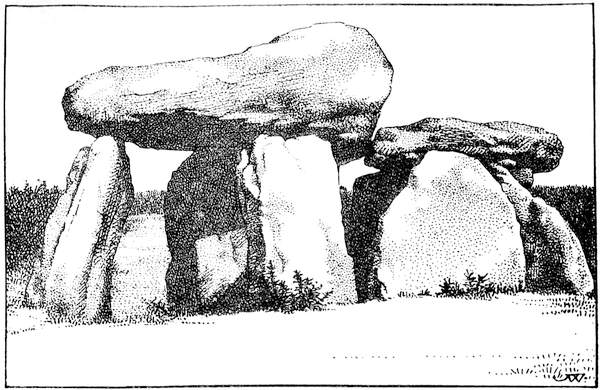
LA ROCHE AUX FÉES, ESSÉ
Josselin (M.) chl. arr. Ploermel. The capital of the ancient county of Porhoet (Poutre-coet = the land beyond the wood). The story goes that once upon a time a workman here found an image of the Virgin in a bramble bush. As it soon established its character as miraculous, a town sprang up about the sanctuary. Guethenoc, Count of Porhoet, planted a castle here and called it after his son, who completed his father's work in 1053. The castle became the headquarters of the counts and then dukes of Rohan. The original castle had been taken in 1168 by Henry II. of England, and utterly destroyed, but it was rebuilt by Eudes II. in 1173, and was held throughout the War of Succession by the partisans of Charles de Blois. In 1370 it was acquired by Olivier de Clisson, when fresh fortifications were added, notably the keep. Alan IX. Viscount, (1429-62) constructed the beautiful front towards the court. Richelieu had the towers and about half the castle blown up, in 1629, and in 1760 the duke himself pulled down two more towers. What remains of the castle has been most carefully and tastefully restored by the present duke, who graciously allows it to be shown to visitors. The front to the river which bathes its walls is furnished with three towers resting on the rock, and gives some idea of what the castle must have been when complete. The inner façade that looks upon what was the Cour d'honeur is a superb example of domestic architecture in the 15th cent., already under the influence of renaissance ideas. The ten gables of the dormer windows are connected by a balustrade of the richest design, greatly varied, but repeating the device of the Rohans, A Plus. The Church of Notre Dame was originally late Romanesque, and still retains pillars and a window of the period, but the bulk of the church is much posterior. The choir and lateral chapels and the crossing of the transepts date from 1390-1407. The rest of the church is later still. The N. transept was added in 1491. In this church, in 1351, the Franco-Breton company of Thirty made their communion before meeting in deadly combat the Anglo-Bretons of the same number at the cross of Mi-voie. They made a vow before the statue of S. Cadoc that still remains in the church. In Notre Dame is the tomb of Olivier de Clisson, 1507, who married Marguerite de Rohan. An "indulgenced" procession takes place here on Whitsun-Monday. Formerly it was accompanied by barking women, taken with hysterical excitement which made them utter sounds like the barking of dogs. This phenomenon first appeared in 1728 and was renewed annually. Nothing of the sort takes place now. The bold square tower is of the 17th cent. with picturesque slate cap. A new tower and spire are being added at the E. end. This is well enough, if the old tower be left, and the grouping will be effective; but if the latter be pulled down as is proposed, the new spire will be a poor substitute. Inside the church on the right hand is a niche containing a skull to which the peasants make offerings of grain, to cure headaches. None know whose skull it is, but it has recently been enclosed in a wooden silvered bust of S. Laurence.
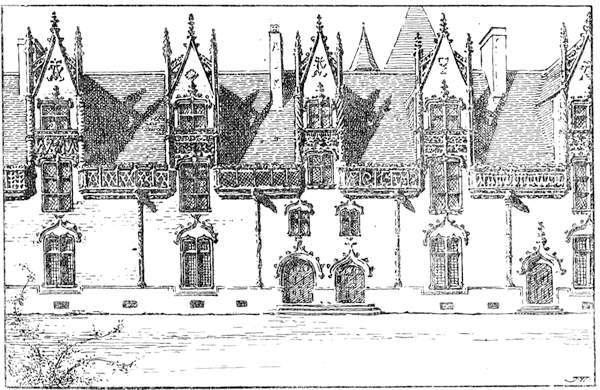
THE COURT, JOSSELIN
The priory church of Ste. Croix is of the 11th cent. Romanesque. S. Martin's was erected in the 12th cent. and is now a ruin. In 1793 the Republican garrison of Josselin swept the country to capture the priests, and was fallen upon and defeated by the exasperated peasantry. In 1795 they burned the church of Guegon and smashed the Calvary, but were again attacked and driven off by the peasants.
The famous Battle of the Thirty took place on the Lande de Mi-Voie, between Ploermel and Josselin. The English-Bretons were under Captain Bramber or Bemborough, and the French-Bretons under the Sire de Beaumanoir, governor of Josselin. Although it has been regarded as a battle between English and French, there were actually but three or four of English nationality on the De Montfort side, the rest were Gascons, Angevins and Flemings. Success would perhaps have been with the Anglo-Bretons, had not one of the French perfidiously violated the rules laid down before the engagement, mounted his horse and by this means broke the Anglo-Breton line.
The country around is well-wooded and pretty. The town is dirty and ruinous.
Guegon. The church is in the late Romanesque of the 12th cent., when the style was in transition to 1st pointed. The south aisle is of 1560 and late flamboyant. In a window is stained glass representing the apostles; it is of 1563. The tower and spire were the loftiest in the diocese, but were struck by lightning in 1705.
S. Servan. To this parish Gobrian, Bishop of Vannes, retired in 717 and here died in 725. He was buried in his oratory. A village grew up about his tomb that bore his name. This is now a chapelry, and the chapel is of the 11th cent. with additions of the 15th cent. The nave is floored, forming an upper chamber which served as a hospital for the sick seeking health at the tomb of the Saint.
Jugon (C.N.) chl. arr. Dinan. A prettily situated town at the junction of two valleys, each occupied formerly by a lake and dominated by a strong castle at the fork. One of the lakes has been drained and the castle has been destroyed. The church has nave and S. tower, 2nd pointed and good. There is a curious W. doorway. Choir and transepts are flamboyant. The church has been "restored" in execrable taste. The road from Jugon to Dinan runs over high and dreary country, moors only partially reclaimed.
Lamballe (C.N.) chl. arr. S. Brieuc. A little town in a plain dominated by a ridge of granite that runs to the east and is crowned at its W. termination by the beautiful Chapel of Notre Dame, and by a windmill at the E. termination. In Lamballe are some picturesque old houses, and there is a haras for the improvement of the breed of horses in Brittany. The town possesses three churches, one of which is Notre Dame, and was a chapel of the counts of Penthièvre, and is by far the finest in the town, but it is now only occasionally that divine service is performed in it.
The parish church of S. Jean is of the late middle pointed style, 1425, with an octagonal tower of 1420 at the base, but much later at the crown. The church has been atrociously mutilated, all the tracery cut out of the windows in the 18th cent. to be replaced by an iron framework to sustain the glass. The Church of S. Martin was of early Romanesque of the beginning of the 11th cent., but the arches to the east show the beginning of the pointed style. The S. transept possesses a good middle pointed geometric window. The tower was begun in 1551 and became purely renaissance before completion. The quaint wooden porch was added in 1519.
The Church of Notre Dame is a magnificent structure, and richly repays a close study. The most ancient portions are the N. transept, with lancet windows, the noble gateway and the W. front, together with the arcade of the nave. But the side aisles are late flamboyant. The choir and S. transept were erected by Charles de Blois and are admirable examples of 2nd or middle pointed architecture at its very best. The choir is vaulted but not the nave. To sustain the vault on the S. side are buttresses within the church forming side chapels and pierced with delicate tracery. There is a double triforium. The choir has a square end lighted by a noble E. window, very tall and of only four lights. The clustered pillars on the S. side of the choir and the piers sustaining the central tower are remarkably fine. There is a little flamboyant screen with a renaissance organ-case above it in the S. aisle of the choir.
S. Aaron. On the Lande du Chêne-hut is an allée couverte composed of 13 stones, three of which are coverers, and two others lie in the soil. The whole is 30 feet long.
Meslin. Five allées couvertes on the Lande du Gras. One is in the middle of the Lande, one just below the mill, a third in the Champ des Caves, a fourth at Bourdonnais. In the Lande du Gras is a menhir 10 feet high.
* Landerneau (F.) chl. arr. Brest. An excellent centre for many interesting excursions. The town is commercial and thriving. It possesses a few old houses and a quaint mill. The Church of S. Houardon has been rebuilt, but the beautiful tower and superb porch have been preserved. The date of the porch is 1604, and the tower is of much the same date. Landerneau was a great artistic centre in the 16th and 17th cents., and its architects and sculptors erected the splendid work in the Elorn valley and the region around. The style they created is very original and deserves attention. They delighted in adorning the churches with noble porches, bold, and often with the gable crowned with a spirelet. Within, niches hold statues of the twelve apostles. When all other detail is Italian, the foliage remains of flamboyant character. The second church in Landerneau is that of S. Thomas à Becket, 1607, small and uninteresting. To the W. is an ossuary of 1632 converted into a habitation. The valley of the Elorn presents many scenes of considerable beauty. The rocks are of white quartz breaking through the leafy covert of the hills.
Pencran. A steep ascent of a mile leads to this very interesting church, with fine porch and two calvaries and a spire. The date of the porch is 1553. The sculpture here in Kersanton stone is peculiarly rich and delicate. Among the groups of figures may be distinguished Adam and Eve, and the serpent, the expulsion from Paradise, Cain and Abel, Adam delving whilst Eve spins, the Ark and the drunkenness of Noah. In the tymphanum is the Nativity, much mutilated. Within the church are the Descent from the Cross and the Mater dolorosa, groups carved in 1517.
La Roche Maurice. In a most picturesque situation, the church embowered in trees on a height above the river, and a ruined castle on a rock of white quartz. The castle belonged to the dukes of Rohan whose eldest sons bore the title of Princes de Léon, on account of the large family possessions in Léon. The church has a slim tower with double galleries and two sets of open bell cages, and is an excellent typical example of a style very common in the Department of Finistère. Its date is 1589. The porch with some fine foliage in Kersanton stone is of 1530-40. In the churchyard is a good ossuary of 1640. On it is represented Death darting at all sorts and conditions of men, with the inscription "Je vous tue tous." At the entrance to the churchyard are three pillars that support the cross of Christ and the two thieves. Within the church the magnificent east window with its stained glass of 1539 at once arrests the eye. It represents the story of the Passion and reproduces that in S. Mathieu at Quimper, and that in the church of Tourch. After the stained glass, the screen attracts attention. It is renaissance and is the sole example left in its proper position in a parish church in the dioceses of Léon and Quimper. P. Ascension Day. But at Pontchrist, a ruined renaissance church by the river in a picturesque situation, on the 4th S. in July.
La Martyr. This was the scene of the murder of Solomon, King of Brittany, in 874. Solomon had assassinated his cousin Erispoe, who was king, before the altar of the church of Penpont, and so won the crown for himself. He was a contemptible creature. He proceeded to buy off the Northmen and to promise to pay tribute to Charles the Bald, and undertook to undo all the ecclesiastical organisation formed by Nominoe and surrender the jurisdiction over the Breton sees to the Archbishop of Tours, if the Pope would absolve him of the murder. But this was too much for the Bretons to endure, they rose in revolt, headed by Pasquitien, son of the assassinated king, and Solomon, finding himself deserted on all hands, fled with his son towards the coast, hoping to take refuge in England. But he was overtaken where is now La Martyr, where he had taken sanctuary in the church, dragged forth along with the boy and both were killed (874). For some unaccountable reason the Bretons have regarded this despicable murderer as a saint. The tower of the church belongs to the 13th cent. The entrance to the churchyard is by a triumphal arch adorned with statuary. This is the earliest of the kind in the country and belongs to the 16th cent. The porch is remarkable for its style and for the delicacy and richness of the sculpture. It belongs to the latter part of the 15th cent. The ossuary is of 1619 and is attached to the porch. The interior of the church is of the 14th cent. It had originally a fine screen in Kersanton stone, that has been destroyed, but the basement of the parclose screens remains. Four stained windows of 1567 represent the Passion, the Crucifixion, the Resurrection, the Noli me tangere, the apparition of the risen Christ to His mother, and the Ascension. Also the death, assumption and coronation of the Virgin, and a Jesse tree. The Duke and Duchess of Rohan are represented as the donors. The church possesses a magnificent reliquary of the renaissance period. P. on the 2nd S. in July. A great horse fair follows, lasting three days.
S. Divy. This church possesses a ceiling painted with a series of subjects from the life of S. David. P. Sunday after Ascension and 2nd S. in September.
Dirinon (S. Nonna). The name signifies the steps of Nonna. The church stands on very high ground. It is in the usual style of transition between flamboyant and renaissance (1588-93). A chapel in the churchyard contains the tomb of S. Nonna, mother of S. David, and wife of Sandde, grandson of Ceredig, who drove the Irish out of S.W. Wales and gave its name to Cardigan. The tomb, however, is a work of the 15th cent. At a little distance from the village is her well (1623). At the further end of the village is that of S. David. P. 2nd S. after Trinity.
Plougastel. The costumes of this district are very picturesque. The men wear blue or violet jackets and three waistcoats and sashes. The church is modern, but in the churchyard is a marvellous Calvary (1602-4) consisting of an arcade under a platform crowded with statues, and a frieze surrounds it, carved with subjects in bas-relief. P. at La Fontaine Blanche, Easter Monday and the 15th August; at S. Jean on the 24th June. By the Chapel of S. Guénolé is a rude stone, against which barren women rub themselves in the hope of becoming mothers.
* LANDIVISIAU (F.) chl. arr. Morlaix. A small town on the high road from Morlaix to Brest. It forms an excellent starting point for several interesting excursions. The church is modern, but has a tower and spire of 1590, partaking of the fault of all those in Léon and Cornouailles of this period. It is thin and pinched. The date of the superb porch is 1554. It is an interesting study, as it serves as a link between those of pure flamboyant and such as are true renaissance. About the great arch are subjects from the Old Testament. Within are the twelve apostles; the corbels supporting them are curious and varied; symbolical. For instance, one represents two drunken soldiers carrying off two girls, one carrying a mirror, another a sceptre, signifying that damsels with vanity or arrogance fall an easy prey. In the cemetery outside the town is an ossuary, date about 1620. In the town is the Holy Well of S. Divisiau, almost buried among houses. It supplies a large public washing basin. Two ranges of an arcade surmount it, containing ten panels that have come from some tomb of the 16th cent. Landivisiau, with its comfortable hotel, is a good starting-place for excursions to places where the accommodation is not all that could be desired.
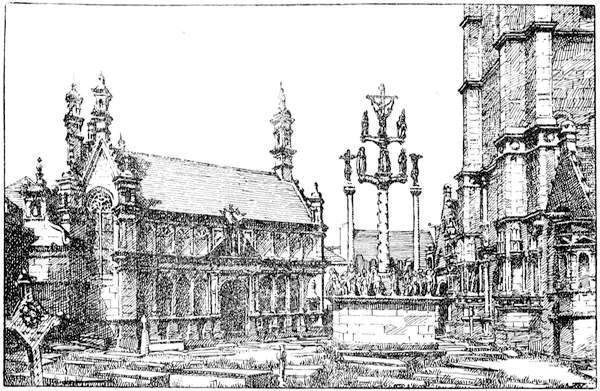
CALVARY AND OSSUARY, S. THÉGONNEC
S. Thégonnec. This place is richly deserving of a visit with its church, and churchyard overcrowded with piles of granite, Calvary and ossuary and triumphal arch. The last mentioned is of 1587 and is cumbrous but effective. These triumphal arches first made their appearance at the close of the Gothic period. This is wholly Italian in character. The ossuary adjoins it and belongs to a later period, but is far purer in design, 1676-7. The façade is very rich and beautiful. Within in a crypt is a Holy Sepulchre, life sized figures of 1702. The Calvary dates from 1610 and represents scenes of the Passion. The oldest portion of the church is the west doorway with the little bell-turret rising above it; this dates from 1563. At a later date the huge tower was erected on the south with a porch in its basement, built between 1599 and 1610, the statues added in 1632. Above the porch is the statue of S. Thégonnec (To-quessnac, a disciple of Paul of Léon). The window tracery is modern and does not faithfully represent the old tracery. The nave was built in 1777. The furniture of the church is interesting. The pulpit, though late, is fine. A niche with shutters painted with scenes from the Saint's life contains a statue of the patron. Opposite is another statue of the B.V.M. with painted shutters. The tower is heavy, and the effect of chamfering the angles very unpleasing. To support the gallery the angles of the tower are very massive, buttresses are added and between them the wall is reduced, and the gallery sustained on heavy corbels. The platform is surmounted by a dome and lantern and little side pepper-boxes. The interior effect of the church is rich and harmonious in gold and colour, if somewhat barbaric.
Locmelar is reached by ascending a pretty valley that contains an affluent of the Elorn. The church is late flamboyant, with apse and gables. The porch is of the common type of the period and contains statues of the apostles. There is a Calvary. The tower dates from 1656. Over a side altar is a painting representing in a series of groups the legend of S. Hervé, a blind bard saint who contributed greatly to the downfall of Conmore, acting in conjunction with Gildas and S. Samson.
Bodilis. The tower of this church was erected when Gothic architecture was in its decline. It is surmounted by a spire with spirelets at the angles rising from a gallery. The porch is of 1570, and is of unusual beauty. Within are the apostles; below the niches runs a band of marvellous richness of sculpture and great variety. The font is surmounted by a baldachin in Kersanton stone of 1680. P. on Ascension Day.
S. Servais. This church has an early renaissance tower with double galleries and two bell cages, the whole surmounted by a spire and pinnacles. The body of the church is of the latter half of the 17th cent. The graveyard cross has sculptured scenes on it, and there is an ossuary like that at Landivisiau.
Guimiliau. Annually numerous tourists visit this village to see its very remarkable ecclesiastical monuments, its church, porch, sacristy, calvary, and the little Chapel of Ste. Anne. The porch rivals that of Bodilis and Landerneau. The doorway into the porch has a series of biblical scenes in sculpture in the mouldings. The date is 1617. The voluted keystone alone proclaims the abandonment of Gothic for Italian architecture. To the west side of the porch is attached an ossuary, the roof supported by columns. The sacristy was erected in 1683. The Calvary consists of a mass of masonry, pierced by arches in the angle buttresses, the whole sustaining a frieze covered with sculptured figures, and the platform above crowded with statues. The whole surmounted by the cross with SS. Mary and John at the sides. The groups are very curious and represent soldiers and peasants of the close of the 16th cent. The Calvary was erected in 1581. Near the Calvary is the mortuary chapel of Ste. Anne, 1648. The interior of the church contains a magnificent baldachino over the font in carved oak; it was constructed in 1675. The organ case is of much the same date, the pulpit of 1677. The church possesses two embroidered banners of 1678. Guimiliau (Vicus Miliai) has as patron Miliau, King of Cornouaille, who was basely assassinated by his brother Rivold in 537, who also mutilated his nephew Melor, by amputating a hand and a foot, and finally by having him murdered by his foster-father, whom he had bribed to do the deed.
There is a Holy Well of S. Miliau outside the village.
Lampaul-Guimiliau. The great tower of this church (S. Paul of Léon) was founded in 1573, and is very lofty and surmounted by a spire which has remained incomplete. The porch is fifty years older. Within are the apostles in very quaint niches. The sculpture of the Holy Water Stoup and of the inner doorway is remarkably rich. The font is of 1651, and is surrounded and surmounted by a baldachino of 1650. The pulpit, that is late, is a fine piece of wood carving. The east end of the choir terminates in an apse with gables. The Calvary, triumphal arch, and ossuary belong to 1668. P. 1st S. in May. At the Chapel of S. Anne, S. after 15th August.
See also Lambader and Plouneour-Menez.
* LANMEUR (F.) chl. arr. Morlaix. The church surmounts a crypt that is very curious and rude, and is attributed to the 10th cent. In this crypt was once the tomb of S. Melor (see under Guimiliau), whose body was transferred in the 9th cent. by refugee Bretons to Amesbury. There is a fountain in the crypt. Of the upper church only four piers and a small door belong to the original building. Near the church is the Romanesque Chapel of Kernitron (12th cent.). It is a cross church with a bold central tower. Some of the windows are late. The P. of Kernitron is on the 15th August.
S. Jean du Doigt is a complete and interesting collection of structures such as were wont to be grouped about a parish church. There is first the monumental church itself, in the midst of a graveyard entered by a triumphal arch, a Holy Well, a Calvary, an ossuary, and an open oratory, where mass is celebrated before an enormous crowd on the occasion of the Pardon, and, finally, the church possesses a rare collection of precious ornaments, such as belong to no other parish in the diocese. The triumphal arch is of the 15th cent. The Holy Well is in the churchyard, and is a noble renaissance structure composed of a large basin, with two superposed vessels, from which heads of angels spout water. The whole is surmounted by a group representing the Baptism of Christ. Almost in face of this is a pretty oratory of 1574, very elaborately and quaintly sculptured. The tower is surmounted by spire and spirelets covered with lead. The east end of the church has in it a noble rose window. At the foot of the tower is an ossuary, and a second of 1618 is on the S.W. The S. porch has a parvise chamber above the doorway. The interior is rich, and the inner doorway is surmounted by a statue of the Baptist in a Gothic niche with wings. The church was commenced in 1440, and was completed in 1513, so that it belongs to an excellent period of flamboyant, of which unfortunately examples are few. Internally the exaggerated height of the pillars as compared with the arches deserves notice. The treasury is extraordinarily rich in chalices, reliquaries, and a processional cross of the 16th cent. A reliquary of the finger of S. John is of 1429. The P. is on the 24th June, and draws vast crowds of pilgrims. The object of the cult is a finger of the Baptist, which is supposed to have its nail pared annually. It was stolen from some chapel in Normandy by a native of Plougasnou, who successfully conveyed it to his native village. There is, of course, not a particle of evidence worth a rush that substantiates the relic as genuine.
Plougasnou has an interesting church on a storm-beaten coast. The interior is Romanesque, but the exterior dates from 1574. It has a tower of 1582. A curious Chapel of N.D. de Lorette with caryatides is shaped like an old Lycian tomb.
Guimaec. Here are two cromlechs or stone-circles.
Lannilis (F.) chl. arr. Brest. The church modern and bad. The tower is of 1774, in the true Léon style, and interesting as showing to how late a date the style continued. It has two galleries for four bells, and spire with ample spirelets. The line is carried on to the sea, where there is a watering place at Abervach. The coast is not remarkable, but there are good sands.
Plouguerneau. On the east is the site of Tolente, a town that was completely destroyed by the Northmen in 875. P. of Tréminach on 1st S. after the 10th Aug. P. of S. Cava on the last S. in August; at S. Michel on the last S. in September.
Locbrévelaire. The valley of the Abervach is here pretty. The place is mainly of interest to the geologist. The whole hill on which Locbrévelaire stands is composed of Tertiary Oligocene, the ruins of granite, and is of a spongy nature, full of kaolin and with lumps and bands of quartz undissolved, and much mica. It is quarried for road-making, but the quartz alone is of value for that purpose. Almost certainly below this spongy mass a bed of kaolin would be found. The church (S. Brevelaire = S. Brendan) lies on one side of the valley in a lap of the hills, and opposite are the noble woods and park of the Château de Liscoat. The church contains an arcade of the 11th cent., very rude. The S. wall is 17th cent. The tower of the same. There is, in the churchyard wall, a Holy Well surmounted by a statue of the Saint. S. Brendan, afterwards Abbot of Clonfert, was forced to leave Ireland in 520, owing to his having unintentionally caused the death of one of his pupils, and he spent seven years away from it, during which time he founded a monastery on the island of Cézambre, opposite S. Malo, and another in a different part of Brittany. This latter may be Locbrévelaire.
* LANNION (C.N.) chl. d'arr. A picturesquely situated town on the Guer that reaches the sea seven kilometres below. The tide reaches as far as Lannion, and it has a little port. The Church of S. Jean de Balay consists of a nave and four aisles under one roof, and without clerestory and without transepts. It is lighted through side windows under gables. These windows are of various periods. One is of the 14th cent., others of the 16th, and there are instructive examples of the debased tracery of the 17th. In the market place are some picturesque old houses. By the river is a fine pile of buildings now used as a hospital. Particularly noticeable is a rich late window, an attempt—and an expiring one—to design a rose with flowing and beautiful tracery. In another twenty or thirty years, as may be seen in the windows of S. Jean de Balay on the N. side, the skill was wholly lost. Divided from Lannion by a deep valley is the Church of Brévelenz. The east part and crypt are Romanesque. There is a good early pointed porch. An ossuary and a mortuary chapel are in the graveyard. The pinnacles, one a chimney to the fireplace for heating baptismal water, at the porch are peculiar.
Loquivy is in a charming situation. The church (S. David) is interesting. In the churchyard is a noble renaissance fountain, and outside the graveyard a Holy Well, flamboyant, surmounted by a statue of the patron saint of Wales. The church is of the 16th cent. An old carved oak retable representing the Adoration of the Magi and a crowd of other figures is in the baptistery.
Ploubezre. The church was rebuilt in 1851, but the fine tower is of 1577. Within have been preserved two Romano-byzantine capitals from the old church, and one window of the 14th cent. remains. The chapel of Kerfons is flamboyant, and is in the form of a T. One of the gables bears the date 1559. The magnificent roodscreen is of 1533. It is a beautiful example of good flamboyant work, with apostles and other figures on the gallery on one side, and tracery on the other. The castle of Coetfrec occupies the summit of a hill above the Guer. Four towers remain, and the castle is in a tolerable condition. The court is looked into by the windows of the state apartments, in one of these, a fireplace with bold chimney-piece, remains. The Château de Kergrist is a ruin, complete. Tonquedec is another old castle in a most picturesque situation. On the N. is the donjon, which is reached by a door high up in the wall. The Chapel of S. Gildas is of 15th cent., with the legend of the Saint within in sculptured oak.
Lanvollon (C.N.) chl. arr. S. Brieuc. Reached by carrier from Châtelaudren, is a dull town with one curious old house in it at the junction of two streets; it is of wood and plaster, the wood covered with carving. The church (S. Vollon = Foelan) belongs internally to the 14th cent., and has a good E. window, but externally the church has been sadly maltreated by incompetent "restorers."
* LESNEVEN (F.) chl. arr. Brest. An uninteresting place in itself, but headquarters to one attending the Pardon at Folgoët. Its fine halles of the 15th or 16th cent. has been destroyed to make way for a "place" with a statue in the midst of a General Floh, of bronze. When this statue was sent down, and the Mayor opened the case, to his dismay he found it was green. So he set his wife, cook, and house-maid to sandpaper and scrape it, till it shone as gold, and then had it hoisted to its pedestal, and it was solemnly unveiled. But the artist, who beheld it thus burnished, was furious, and complained to the prefêt and the authorities at Paris, and orders came to the Mayor to take down the statue and restore to it the green rust. He was obliged accordingly to re-erect the scaffold and crane, and have General Floh transferred to his own house again, where he expended some barrels of cider over him to reinvest him in verdigris. The church is very ugly, but it has a late renaissance porch in the basement of the tower on the N. side.
The branch line is carried on to Brignogan, which is a watering-place, and where there is a fine menhir 30 ft. high, the most remarkable in the Department. At Plounéour-trez the church is new, but the old tower and spire are retained till they also can be pulled down and replaced by something more in proportion with the new church. The windows represent scenes in Breton history. The coast is not fine, the sandy shore slopes very gently into the waves. But the good bathing is an advantage.
Folgoët. This famous pilgrimage church was founded in the 14th cent. when an imbecile youth died who could say no other words than Ave Maria, Salaun a zepre bara, or Salaun wants bread. A lily grew out of his grave and it was concluded accordingly that he was a saint. This was in 1358. At the west end are two towers. That on the north is admirably proportioned with spire and angle spirelets of the period, 1365, when Jean de Montfort laid the first stone. That on the S. was never finished. It is surmounted by an upper stage with Ionic pillasters added in the 17th cent. The S. side has a noble porch and transept, the E. wall of which is a continuation of that of the choir. The E. and S. transept windows are examples of the geometric style in Brittany, a rose resting on a transom. Within the stone screen is formed of three compartments, and though fine, is certainly inferior to such as are in wood. A spring wells up under the high altar and is conveyed to a Holy Well outside. La Doyenne is a picturesque building with turrets erected by Anne of Brittany, converted into Mairie and school. The P. is on the 7th and 8th September, and begins with vespers and a procession bearing candles; many beautiful costumes may be seen on this occasion.
The processions arrive with banners for High Mass, singing this hymn.
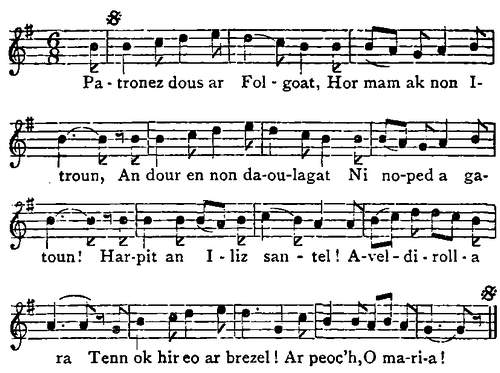
Patronez dous ar Folgoat, Hor mam ak non Itroun, An dour en non daoulagat Ni noped a gatoun! Harpit an Iliz santel! Aveldirolla ra Tenn ok hir eo ar brezel! Ar peoc'h, O maria!
Goulven. The church is late flamboyant with a fine renaissance tower and porch within which are the apostles. Side by side may be seen a doorway of the earlier and of the later periods. There is a fine painted 16th cent. reredos in the church to a side altar. The gallery of the roodscreen has been made into a west gallery. About a mile distant is the Holy Well, with a stone trough at the side in which patients were placed and given a bath in the miraculous water. No such an attempt to recover health has however been made of late years. There is a chapel at the Peniti of S. Goulven at a little distance. A double dolmen at a junction of two lanes has been much injured, several of the stones that composed one of the chambers, and perhaps an enclosing circle, have been employed for the hedge. The P. is on June 30, the costumes then seen are very rich, and the parish possesses very fine old embroidered banners then produced.
Treflez. Tomb of 16th cent. of S. Elfleda or Ediltruda, daughter of Oswy, King of Northumberland, and Abbess of Whitby. She died in 715, but how her body comes to be at Treflez passes knowledge.
Guiseny. Church of S. Sezni (Setna or in Cornwall, Sithney) renaissance. There is a N. late flamboyant porch. Curious early Calvary with four figures on the branches. P. 3rd Sunday in September.
Lézardrieux (C.N.) chl. arr. Lannion, on a little tidal port, between Pampol and Tréguier. An excursion may be made to the Ile Modez. See Bréhat.
Locmariaquer (M.) com. in arr. Auray. A most interesting place that seems to have been crowded with monuments of the prehistoric dead, and although destruction has been carried on for two thousand years, many still remain. Locmariaquer is situated on a spit of land between the estuary of Crach and the Rivière de la Trinité, but it is itself split by the creek of S. Philibert. The shores that are low are covered far inland at the high tides, and the sea has gained considerably on the land. Roman constructions noted in 1727 are now permanently under water. A camp in the hamlet of Lannbric is now eaten into by the waves. The principal prehistoric monuments are the Mané-er-hroeg, south of the village; a tumulus containing a dolmen that was explored in 1863 and yielded 103 polished stone axes, a collar of callais, and a jade ring. Near it was found a slab on which are mysterious markings representing cartouches, celts with handles, and other symbols unexplained. On the summit of the tumulus were found coins of Tiberius and Trajan. The tumulus of Mané Lud to the N.E. of the village contained two skeletons, one a case of carnal interment, the other had been burnt. At the W. end of the tumulus is a sepulchral chamber led to by a passage, and here also are carvings. Between this tumulus and the village is the huge dolmen called Table des Marchands. On the stone at the back are also carvings. Close to this is the longest menhir known. It is 64 ft. long, but was struck by lightning, thrown down and broken into four pieces. In a field near the village is the Mein Rutal, another dolmen of considerable size. West of the village and near the sea are the remains of an allée couverte, 74 ft. long, called Les Pierres plates. On this also are inexplicable carvings, next to those on Gavr Inis, the most remarkable in the country. There are smaller dolmens at Pont-el-leu, Kercadoret-er-Gal, Coetcourzo, Kerhan, Porher, Kerlud, Locperhet, Pont-er-vel, Kervéres, Kerdaniel, Kervoch, and Cocordeau; and menhirs at Kerpenhir, Bronso, Porher, Mané-er-hroeg, Kerguelvan and Lannbric. Locmariaquer was a Roman station. P. 1st Sunday in July; that of S. Philibert on the 3rd Sunday in August.
Locminé (M.) chl. arr. Pontivy (Locus Monachorum). A considerable district was here made over to Gildas who founded a monastery where now stands the village of Moustoir. Owing to the ravages of the Northmen the monks of S. Gildas de Rhuys and of Locminé fled into Berry. They returned in 1001, and set about restoring their ruined monasteries, but the old site at Moustoir was not rebuilt upon; the abbey was transferred to Locminé. The parish church and the Chapel of S. Columbanus are side by side, in communication through an arch. The latter owes its origin to some relics of S. Columbanus having been brought hither. The chapel is late flamboyant, but has a 17th cent. tower, under it an earlier doorway with mutilated tracery above it. The parish church has a slated spire, that of S. Columbanus is surmounted by a small cupola. A quaint ossuary of good renaissance work is on the N. side. The east window of the chapel contains 16th cent. glass representing the life of S. Columbanus in four groups, but in a very poor condition. East of the chapel is the beautiful Chapel of N.D. de Plasquer, of the finest flamboyant work. The W. doorway has disengaged pinnacles and some curious carving. The E. window tracery forms three fleurs-de-lys. Within is a pretty flamboyant credence in the N. chapel under the tower. In a corner thrown aside is a noble carved oak statue of S. Gildas of the 15th cent. with his symbol, a snarling dog, at his side. P. 31st June, but that of Locminé is the Sunday nearest 27th June and lasts three days.
Remungol has a Holy Well near the church, a work of the 16th cent.
Lorient, chl. d'arr. A port. The town is composed of Lorient itself, a fortified place, and the Faubourg of Kérentrech, where a suspension bridge crosses the Scorff. Lorient owes its origin to the East India Company. That company, created in 1664, was in quest of a port. The Duc de la Meilleraye offered Port Louis, and in 1666 royal authority was granted to the company to form there quays, factories and storehouses. The village founded by La Compagnie de l'Orient took thence its name. The company having got over a financial crisis in 1669 bought up land in the neighbourhood. In 1712 the settlement comprised 700 families; it was raised to be a parish in 1709. In 1717 the company began to build and lay out quays and form basins on a grand scale, and in 1739 Lorient attained the dignity of being accounted a town. In 1745, the company had reached its highest point of prosperity, and had become a veritable maritime power, with 35 frigates in the harbour. Its flag was blue charged with a fleur-de-lys or, and it had as device Florebo quocunque ferar. English jealousies were aroused, and in 1746 an English fleet anchored in the Bay of Pont-du. Seven thousand men were disembarked under General Sinclair and summoned the town to surrender. As this was refused it was besieged, but after a few days General Sinclair withdrew without having effected anything. Curiously enough, the garrison had resolved on surrender, and sent to notify their purpose to the general, but found that the English had departed. The company failed, partly through internal dissension, mainly through the loss of Bengal, which was secured by the English in 1753. From this time the fortunes of the company declined, and at last it became bankrupt in 1769. It was then that Lorient passed to the Crown. The town is supremely uninteresting, and no visitor will stay in it except under constraint.
Port Louis. The Church of N.D., 1665. The citadel of the 18th cent., at one time served as a prison to Louis Napoleon.
Ploemeur. A circle of standing stones 20 ft. in diameter surrounds a tumulus, on the top of which is a dolmen fallen, thrown down by clumsy excavators. Near Kerroch a dolmen, the table sustained by three uprights, and near it the supporter of another. On the S. some menhirs, the remains of an alignment. At Kerpape, near the powder mill, another dolmen. At the Pointe du Tallut a menhir 12 ft. high, and near it another fallen. Ploumaur, the Great Tribe, was one of the largest parishes in the diocese; it was settled by S. Ninnoc, supposed to have been a daughter of the King of Brecknock. Her double monastery for both sexes was destroyed by the Northmen, and it was not rebuilt till the 12th cent. The church contains Romanesque work, but the tower was built in 1686, and the chancel was altered and disfigured in 1783. P. 1st Sunday in May. The Chapel of N.D. de Larmor was built in 1506, the tower and spire added in 1615. It was a great place of pilgrim resort till S. Anne d'Auray drew away the seamen who were wont to resort to Larmor. The benediction of the sea takes place on the 24th June.
Plouhinec. On the N. near Kerfourches two ruined dolmens and a menhir. The W., near the mill of Keronsine, alignments running parallel with the coast. Near Kersur a small menhir and four dolmens. At the mill of Gueldro the alignments recommence in seven or eight rows, and run on to Keroué and Kervelhué. At Magouer a tumulus with a dolmen and a group of menhirs, most of them fallen, and others have been split and used for building purposes.
Kervignac. On the N. a fine dolmen near the road to Hennebont. Another to the south near Kermado.
Nostang. S. of the village near the river Etel an alignment of 19 menhirs. For Ile de Groix, see under Pont-aven.
Louvigné du Desert (I.V.) chl. arr. Fougères. Church (S. Padarn) of the 15th cent. with a tower of 1702. A circle of upright stones. The Château of Monthorion with tombs of Raoul II. de Fougères (1194) and Françoise de Foix in the chapel.
Malestroit (M.) chl. arr. Ploermel. The castle is on an islet of the Saudraye; it was constructed in the 11th cent. No traces of it now remain, or none of any importance. The town, built under the shadow of the castle, was fortified in 1463. It was attacked with fury by the League, but always resisted the enemy, till a third siege by Mercœur in 1592, but two months later it was retaken by the Royalists. Now all the walls are gone. The place retains a number of old houses, one of these near the parish church has on it grotesque figures, as a sow spinning, a hunter playing the horn, with beside him a hare performing on the biniou; a man beating his wife, etc. The church (S. Giles) consists of two churches side by side and in different styles. One retains remains of a Romanesque original. The rest is of 1511-31, and some good glass is in the windows, representing Jesus among the Doctors, the Baptism, the Passion, etc. The Chapel of S. M. Magdalen is partly Romanesque.
Matignon (C.M.) chl. arr. Dinan. The parish church is modern but the Chapel of S. Germain is the old parish church and has a Romanesque doorway.
S. Cast, a watering place with good sands. In 1758, the English fleet under Admiral Howe, after having bombarded S. Malo and burnt Dol, disembarked a body of men here. The Duc d'Aiguillon, then governor of Brittany, hastened to the spot, and in spite of the fire of the fleet defeated and almost exterminated the invaders. A monument marks the site of the windmill in which the duke watched the engagement.
Pléboulle. The Templar church is of the 16th cent. except the apse which is earlier. Remains of the octagonal tower of Montbrun on a rock, commanding a sweep of the river Frémeur.
Plévenon. In this commune is the noble headland of Cap Fréhel, of old red sandstone. Here is a lighthouse. The Fort de Latte is on a point of rock in the sea 5 kilometres from Cap Fréhel, and entered by two bridges cast over precipices 300 ft. deep. Facing the fort is a rude stone 9 ft. high surmounted by a cross, probably a menhir.
Mauron (M.) chl. arr. Ploermel. Stands on high ground, watered by the Yvel and Doeft, which unite above Ploermel in the pretty lake of Le Duc. In 1352 the Castle of Mauron was held by Bentley with a body of Anglo-Bretons. The Marshal d'Offemont, at the head of an army of the adherents of Charles de Blois, resolved on taking the place. Bentley marched out against him and obtained a complete victory. Thirteen lords fell, among them the Marshal and the Viscount de Rohan. A hundred and forty knights also succumbed. The Parish Register, 1591, is headed:—"Baptismal Register of Mauron made after the Prince of Darkness with the English and the lancequenects of his company had passed. They spent the Sunday here, September 8, 1591, pillaged and plundered all they could lay hands on in the church, and carried off the baptismal register—on which account this book is now begun." The church is modern but retains some old carving in panels of the 16th cent. near the porch on the S. side, and in the sacristy is a painting of the crucifixion of 1682.
S. Lery. A church of the 15th cent. except the chancel which is modern. In a chapel of the S. transept of flamboyant date is some fine old glass representing the marriage of the Duchess Anne with Charles VIII. of France. On the north of the nave is the tomb of S. Lery, and on it the Saint is represented with a pastoral staff in his hand, a book in the other, and his feet resting on a hare. S. Lery was a native of Wales who crossed over to Armorica and was well received by Judicael. As he desired a retreat, the Queen turned Ilogan, an Irish saint, out of his, and gave his lair warm to Lery, who had no compunction in receiving it. He died in the 7th cent.
Merdignac (C.N.) chl. arr. Loudéac, stands on the road from Loudéac to S. Méen. West of the town is the fortified enclosure of the Vielle Court. Excavations have shown that the wall was vitrified.
S. Launeuc near a pretty lake. Here are the ruins of the Castle of Hardouinaye almost destroyed, where Gilles de Bretagne was starved to death in 1450. Gilles had been left by his father a sum of money, and he complained to his brother, Duke Francois I., and asked to be given some fief in the duchy. But Francis refused his request and threw in his teeth that he favoured the English rather than the French. Gilles married the heiress of Châteaubriant and Dinan. Arthur de Montauban, Marshal of Brittany, who had desired the heiress for himself, was thereby made his mortal enemy. He determined on his destruction, and to effect this spread calumnies against Gilles, to the effect that he was purposing to introduce the English into Brittany, and he obtained leave from Francis to arrest him in his Castle of Guildo. This he effected whilst Gilles was engaged on a game of tennis. He carried him off to Dinan, where was Francis, who refused to see his brother. Francis I. requested the parliament of Brittany to condemn Gilles unheard. At its refusal to do so, he handed him over to Arthur de Montauban to make away with, and the Marshal hurried him away to Hardouinaye and left him to die of starvation in its dungeon.
Muzillac (M.) chl. arr. Vannes. Church of Bourg Peaul with side aisles, Romanesque, and with a slated tower. Chancel 1505. The very rich and curious Calvary was restored in 1894.
Billiers. Here are the remains of the Cistercian Abbey of N.D. de Prières, founded in 1252. The church was pulled down in 1715 to make way for a hideous structure in the taste of the period.
Noyal Muzillac. The church (S. Noyala) was rebuilt in 1850, but the transepts and chancel of the 15th cent. remain. The tower was struck by lightning in 1630 and rebuilt. The Château de Keralio, of the 15th cent., is in ruins.
Montauban (I.V.) chl. arr. Montfort. A modern church. The castle on the edge of the forest is of the 14th and 15th cents., and was once the seat of a powerful family to which it gave its name.
Montcontour (C.N.) chl. arr. S. Brieuc, still possesses remnants of its ancient walls. The church (S. Mathurin) is mainly of the 16th cent.; the spire is covered with lead. Six windows retain magnificent old glass representing the life of the Saviour, that of S. John Baptist, the legend of S. Barbara, that of S. Yves, remains of a Jesse tree, and the legend of S. Mathurin (1535). Montcontour lies on very high ground, and commands a magnificent view. S. Mathurin is much sought by pilgrims who have the highest belief in his powers. The P. is on the eve of Whitsunday with procession carrying lights, and on Whitmonday, with dancing.
Trébry. A dolmen at Ville-Valen, consisting of four supports and a coverer.
Trédaniel. The Chapel of N.D. du Haut is mainly of the 14th cent., and has a fine porch of the 16th.
Montfort (I.V.) chl. d'arr. At the junction of the Mieu and the Garun. A great round tower of the 15th cent. and a portion of wall adjoining are all that remain of the ancient ramparts. The Church of S. Jean Baptiste is modern, but contains retables of the 17th cent. The remains of the Abbey of S. Jacques, founded in 1152, has a church of the 14th cent. and buildings of the 18th. In the hospital of S. Lazare is an altar of the 13th cent. To the S.E. of the tower on the edge of the forest of Coulon is a prostrate menhir called Le Grés de S. Méen.
Mordelles (I.V.) chl. arr. Rennes, on the Meu.
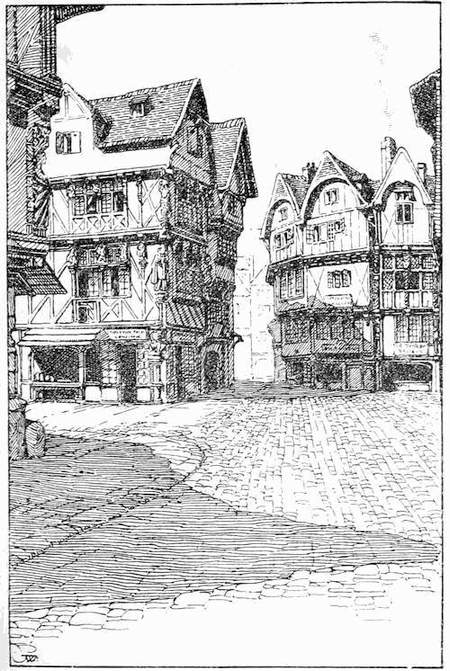
MORLAIX
* MORLAIX (F.) chl. d'arr., is situated in a deep cleft valley at the junction of the Jarlot and Qufflent, and has a tidal port. The town is spanned and dwarfed by the magnificent viaduct of the railway to Brest. The town has only one interesting church, S. Melaine (1489-1574). A flight of steps leads to the west door. The S. porch is fine. The baldachino of the font is of 1660, and the organ and gallery are of about the same date and rich. Morlaix contains a number of picturesque houses with galleries about interior courts. The newels of the stairs are often effectively carved. Admission to some may be obtained by application at the door. In the Rue des Nobles is the house of the Duchesse Anne, erected in 1500. The church of the Dominican Convent, founded in 1237, is desecrated. A floor has been introduced at the height of the capitals of the pillars, the basement is made into a lumber chamber, and the upper storey into a museum. It possesses a beautiful window of the 13th cent., a transom sustaining a rose, lights below the transom cusped and sustaining trefoils. This window deserves a study. By descending the Rue des Vignes and turning to the right, the Rue des Fontaines is reached where are two Holy Wells. At N.D. des Fontaines a wall is enriched with tracery under an arch, above which is a delicately beautiful rose window. At this spot, according to legend, S. Drennael, disciple of Joseph of Arimathea, preached, and set up an image of the B. Virgin. The chapel, which formed a portion of a Carmelite church, has been ruined along with the church. The tower of S. Mathieu was built in 1548. On the right bank of the river is the Fontaine des Anglais that marks the spot where, in 1522, six hundred English, who had disembarked to attack the town, were surprised when asleep, and killed. The town was taken by the English in 1532. To guard against surprise, the castle of Le Taureau was constructed on an island at the entrance to the estuary.
For objects of interest in the neighbourhood, see under Taulé.
Mur (C.N.) chl. arr. Loudéac. Two menhirs by the road from Mur to Corlay, one at Botrain is a rude quartz block, square and tapering to a point 12 ft. high. The church is modern. The Chapel of Ste. Suzanne, 1760, has the legend of the Saint painted on the ceiling.
Caurel. By the road from Pontivy to Guingamp, at the hamlet to Belaire, is a menhir of slaty schist 15 ft. high. On the Lande de Caurel another slate menhir 10 ft. high, and five others prostrate. Another on the same Lande 15 ft. high and shaped like a rectangular blade, a niche has been cut in it and a cross planted on the top. On the Lande de Belaire an allée couverte of slate rock 25 ft. long, composed of six slabs set on end supporting three coverers. There are others in ruins hard by. The church dates from 1654.
S. Guen. Church of the 18th cent. A Calvary of the 15th cent. with a stone seat at the foot. The Chapel of S. Tugdual of the 14th cent. contains the remains of a rood screen.
Paimpol (C.N.) chl. arr. S. Brieuc. An important fishing place, the headquarters of the Iceland fleet. The whole of this portion of Côtes-du-Nord facing east formed anciently the county of Goelo. The "Icelanders" fleet starts on February 20, and is absent till the autumn. As many as 180 vessels leave Paimpol and the other little ports on the Bay of S. Brieuc for this annual fishing in the polar seas. The blessing of the fleet takes place with solemnity before it departs. Paimpol is the scene of Pierre Lotti's novel, "Pécheur d'Islande." The church of 1525 has a fine flamboyant east window. There are several old houses in the streets. The isle of Bréhat may be visited, see under Bréhat.
Kerfot. The oldest parts of the church are of the 14th cent., but the rest from 1514 to 1682. Remains of the roodscreen have been converted into a pew.
Kerity. Fine ruins of the Abbey of Beauport, an unique example in Brittany of a monastic establishment that has preserved its original buildings of the 13th cent. All the rest were rebuilt in the 17th and 18th cents. The roof of the church has fallen in. The abbey consists of a series of buildings about a cloister; on the N. are kitchen and refectory over the cellars; S. is the church; E. the dormitory and infirmary of the monks and the chapterhouse; W. the abbot's house.
Le Palais (M.) chl. arr. Lorient, in the island of Belle Ile. It has a citadel constructed by Vauban. The old walls remain. A military hospital and a reformatory for young criminals are at Le Palais. The castle of Foulquet commands the little port of that name. The church (S. Géran) bears as its dedication the name of the heroic king of British Domnonia, who fell at Langport in Somersetshire in 522 fighting the Saxons. He had a fleet in the Severn, and his wife was the beautiful Enid, whose story has been revived by Tennyson in the Idylls of the King. The Bretons having forgotten who he was have identified him now with S. Senan of Iniscathy and then with S. Curig, and represent him as a bishop.
* PERROS GUIREC (C.N.) chl. arr. Lannion. The church has a Romanesque nave with semi-circular arches resting on the N. side on capitals with cable mouldings. The arcade on the S. side is somewhat later. The chancel is early pointed, with an extraordinary east window of the 17th cent., an instance of the complete extinction of the skill to design and power to execute stone tracery. There is a Romanesque S. door. Of the windows one is middle pointed, one flamboyant, and one debased 17th cent., all in the S. aisle. The tower at the W. end and the porch under it with open tracery are quaint.
N.D. de la Clarté is a delightful example of flamboyant work at its best, 1414. The little harbour of Perros Guirec is illumined by five lighthouses on account of its dangerous character, and there are five more on the Sept Iles. The sandy cove of Trestraou has a town built round its lap that lives only in the bathing season, at all other times it is uninhabited.
S. Quay. The church has no side aisles but double transepts, and is good 2nd pointed. The W. tower is good renaissance of 1732.
Ploumanach, a fishing village among rocks, is only curious on account of the oratory of S. Kirec (Curig) on a rock in the bay, surrounded at every tide. The pillars and pillasters are of the 11th cent.
Trégastel. The village is situated about a mile from the coast, which is composed of masses of weather-worn granite in strange forms, among and against which modern residences have been run up for the accommodation of lodgers during the bathing season. On the highest point of ground inland a Calvary has been erected of masses of granite piled up, surmounted by a cross, whence a fine view is obtained of the coast and the Sept Iles. The Church of Trégastel is of the 13th cent. with work of the 16th, and a very villainous, debased window at the east end of the 17th cent. The pretty ossuary adjoining the porch is renaissance.
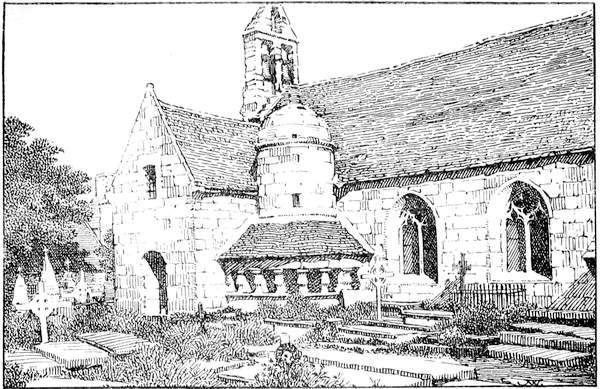
CHURCH AND OSSUARY, TRÉGASTEL
Pleumeur-Bodou. Beside the road from the village to Ile Grande is a fine menhir 24 ft. high, the summit shaped into a cross, and the face sculptured with the instruments of the Passion. In the Ile Grande is an allée couverte, composed of fourteen supporters and two coverers. It is surrounded by a circle of stones. The Chapel of S. Samson is of the 16th cent. with a spirelet on an octagonal turret. The E. window is flamboyant.
Trébeurden. Nine menhirs within sight of one another. One is a hundred paces (S.) from the windmill of Trévern, and is 7 ft. high; another is on the Lande de Véades of the same height; a third is a hundred paces from this, and is 12 ft. high; a fourth at the Château de Kerrariou, 7 ft. 6 in. high; a fifth between Kerrariou and the windmill, broken; a sixth near Bologne, 10 ft. high; a seventh W. of the preceding and at the edge of the shore, 10 ft. high; the eighth near Bonne Nouvelle, 7 ft.; the last is near the peninsula of Toënnou, about the same height. There is a fine dolmen on the Ile Milliau, measuring 28 ft. long, covered by three slabs on eleven supporters; another is on the shore at Prajou-menhir, half fallen, 34 ft. long, composed of twenty-one supporters and four coverers; a third is at Kevellec, four stones support a single coverer; a fourth in ruins is near the Chapelle du Christ. The chapel has a lancet window of the 12th cent. The parish church is very villainous, 1835.
Trévou-Tréguignec. Three menhirs in the Ile Balanec, and a partly ruined dolmen near the modern Château de Boisriou. Seven uprights support two coverers.
Pipriac (I.V.) chl. arr. Redon. A dull, uninteresting place.
Guipry. At Fougères is an alignment of seven upright stones. In the Lande de Godier is an ancient camp. N.D. de Bon-Port, 1644, is resorted to by pilgrims.
Saint Just. On the Lande de Cojoux several megalithic monuments, and on that of Tréal an allée couverte, called La Grotte aux Fées, 40 ft. long.
Plancoet (C.N.) chl. arr. Dinan. Pleasantly situated on the tidal Argenton, which above the turn flows through a pleasant picturesque valley. Plancoet (Plou-lann-coet = the Clan of the Church in the Wood), has a modern vulgar church. In a little lake 3 kilometres from the town are the scanty remains of the Château de la Tour de la Vache, 13th cent., consisting of one square tower. From Plancoet several interesting excursions may be made.
Crehen. The allée couverte of La Ville-Génouan is 42 ft. long, and is composed of eleven supporters on the N. and twelve on the S., and five covering stones. It is the finest example in the Department, and is in private grounds.
Landebia. The church has been restored. It possesses a curious bénitier of granite supported by human figures, and has animals carved on the bowl. A house has a fine portal of the 16th cent. A Calvary of the same date with several groups of figures. Another cross dated 1545, called la Croix de S. David. In the village is a house called Presbytère des Templiers.
The visitor will probably start from Landebia to visit the Château de la Hunaudaye in the parish of Plédeliac. The ruins of this magnificent castle are extensive. The castle dates from 1578, except one tower that is over a century earlier. It is a pentagon flanked by five towers at the angles, and surrounded by deep ditches. Why so strong a pile should have been planted where the ground does not in any way lend itself to defence is hard to see. The state hall and staircase were especially fine, but are far gone in ruin. The earliest tower has about the entrance from the court some rude carvings, executed perhaps by a prisoner on the jamb of the door on which light fell. The date of this carving is early 17th cent. Near the hamlet of Hazardine is a coarse menhir 16 ft. high and 30 ft. in circumference. The ruins of the Abbey of Saint Aubin des bois are scanty. The chapel is of the end of the 15th cent.
Pleine-Fougères (I.V.) chl. arr. S. Malo. Destitute of interest.
Plélan le Petit (C.N.) chl. arr. Dinan. On high bleak country, mostly moor and only partially reclaimed.
Pléneuf (C.N.) chl. arr. S. Brieuc, reached from Lamballe. In the parish is the favourite seaside resort of Val-André. Except the sea and the coast, there is nothing of interest at Pléneuf.
Erguy. An old Roman station, Rheginea, and numerous substructures of Gallo-Roman times have been uncovered here, also a mosaic pavement found and destroyed in 1835 by the boor to whom the land belonged. Numerous finds of Roman coins are made here. At the northern headland of the Lande de la Garenne is a prehistoric coast castle.
Planguenoual. The church is partly Romanesque, partly 13th cent. The bénitier shows signs of having been systematically employed as a knife-sharpener.
* PLESTIN LES GRÈVES (C.N.) chl. arr. Lannion. Fine sands. The tide recedes here to a great distance. Plestin (Plou-Jestin) owes its origin to an Irish emigrant Efflam, who settled here with a colony of his countrymen in the 6th cent. He found that a British settler was there before him, Jestin, probably the son of Geraint, prince of Devon. He came to terms with him without a quarrel, the arrangement being that one should rule the secular and the other the ecclesiastical tribe. Plestin before this would seem to have been a Gallo-Roman town, as numerous remains as well as coins indicate. The church, much altered, contains the tomb of S. Efflam, of the 16th cent. The porch is of 1575, and contains statues of the twelve apostles. The Chapel of S. Jacut of the 16th cent. has some old glass. Near the Chapel of S. Efflam (1620) is his Holy Well.
Plou Miliau was the plebs or tribal land of Miliau, King of Cornouaille, who was murdered by his brother Rivold. The church is in debased Gothic of 1602.
Plouzélambre. The church is of the 15th and 16th cents., with flamboyant windows. The tower of 1753. In the church a fine renaissance carved oak retable, with seven groups of figures on it, representing scenes of the Passion. In the churchyard a pretty ossuary of granite of the 17th cent. An oratory, consisting of a vault sustained by four columns, is called Le Réposoir. Ruins of the Château of Kerbané of the 15th cent.
Trédez. A menhir 13 ft. high, with another near it that has fallen, that measured 24 ft. Near the Château de Coatredrez another, 19 ft. high. At Lan Saliou another of about the same height. In the church is a triptych representing a Jesse tree. The font has a fine baldachino of carved oak, of the 17th cent. The Chapel of Loquémeau is of the 16th cent., except one window in the N. transept, of the 14th. The frieze within is fantastically carved.
Trémel. A menhir at Kerguiniou, 16 ft. high, and near by a dolmen. The church is of the 16th cent., with apse; the porch has within statues of the apostles.
Plufur. Church of 1764; but it retains remains of a retable of the 16th cent. Sculptured scenes in relief of the Passion. In the churchyard is the Chapel of S. Yves, 17th cent., with paintings on the ceiling. The Chapel of S. Nicolas forms a latin cross, and has seven flamboyant windows.
S. Michel-en-Grèves. The Chapel of S. Geneviève has an early rude altar, and remains of a 16th cent. screen.
Pleyben (F.) chl. arr. Châteaulin. The noble church (S. Germain) of 1564 exhibits the transition from Gothic to Italian style. The church is regarded as one of the most beautiful ecclesiastical monuments in Finistère. From whatever point of view seen, the grouping of the towers, though so different in character, is most pleasing. The principal tower is tall and square, with a balustrade to the platform on the summit, and on this platform rises a cupola crowned by a lantern, and there are four lesser lanterns at the corners. The tower exhibits the renaissance style fully developed, yet it was constructed only twenty years after the rest of the church, which is instinct with Gothic feeling. The second tower was raised in 1588-91, and is in the late flamboyant style. It is graceful and quaint. The stair to the bellcage is carried up in a turret detached save for a flying gallery supported on a couple of arches. The fine porch dates from 1588-91, and contains statues of the apostles. It is surrounded by a cordon of niches, shallow but lofty, and forming an exterior enrichment. The statuary is stiff, but not without character. The east end of the church is an apse, with gables over the windows, which are flamboyant. That over the high altar contains old glass representing the story of the Passion, 1564. The wooden waggon roof of the church is supported on a cornice quaintly carved. A curious little box for the holy oils is in the sacristy. The ossuary of Pleyben is the earliest in the Department; separate from the church. It belongs to the 16th cent. The Calvary of 1650 consists of four great spurs sustaining a central platform on vault and arches. The platform is crowded with figures in 28 groups, representing the scenes of the Nativity and the Passion, and, above all, as the 29th, is the Crucifixion. The Chapel of Lannelec, two kilometres distant, is in itself uninteresting, but contains curious statues and sculptures. The P. at Pleyben is on the 1st Sunday in August.
* PLOERMEL (M.) chl. d'arr. The town stands but a little distance from the pretty lake of Le Duc, surrounded with trees. It occupies rising ground and has in its midst a magnificent church (1511-1602) chiefly remarkable for its collection of 16th century glass. This represents—1. Jean l'Epervier, Bishop of S. Malo, kneeling before the B.V.M. and S. Michael; 2. dated 1533 is Pentecost, a superb piece of colouring; 3. the Life of S. Armel; 4. a Jesse tree, the finest of all; 5. the Passion; 6. the Death and Assumption of the B.V.M.; 7. a window of 1602 contains diverse subjects; and 8. the Last Supper. Beside these old windows some modern glass is "a thing to shudder at not to see." Indeed the French do not seem in glass painting to have got beyond the crude stage of English beginnings forty years ago. The church is throughout flamboyant, except the west tower. Under an enormous arch, that includes a flamboyant window, is a double entrance to the N., with rich figure carving over it representing sacred subjects, the Annunciation, the Nativity, and the Flight into Egypt, etc. But the buttress on the W. was carved when the religious Gothic feeling was dead, and it is covered with renaissance sculpture, where only buffoonery and paganism find expression. Syrens, monsters, a cobbler sewing up his wife's mouth, a woman pulling off her husband's hat, a sow playing a bagpipe, two nude figures, one on the back of the other, each blowing a horn, etc., form the decoration. At a little distance from the town on the Vannes road, about a hundred yards on one side in a pretty situation, is the Holy Well of S. Armel, of the 17th cent. Ploermel is the headquarters of the Frères Lammenais, who carry on the religious instruction of the boys in almost every parish in Brittany, and in other parts of France as well, and the colonies, in opposition to the godless governmental schools. From Ploermel the visitor will probably go on to Josselin, which see.