BRIGHT IDEAS
Reading edition
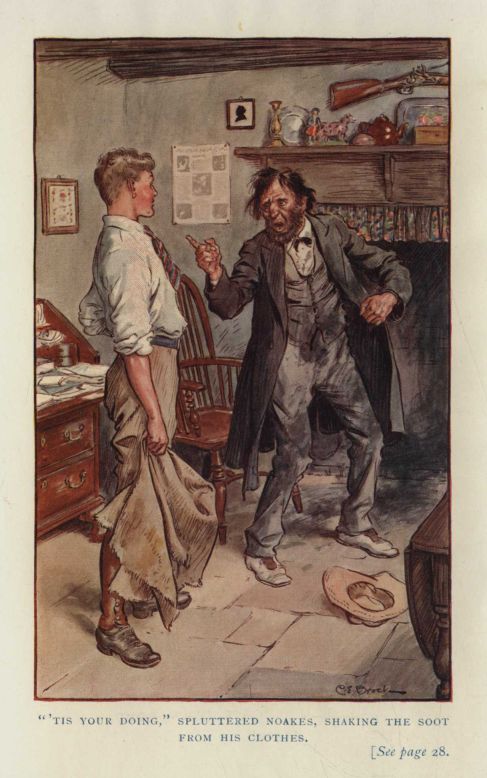
"'TIS YOUR DOING," SPLUTTERED NOAKES, SHAKING THE SOOT FROM HIS CLOTHES. (See page 28)
BRIGHT IDEAS
A RECORD OF INVENTION AND MISINVENTION
BY
HERBERT STRANG
ILLUSTRATED BY C. E. BROCK
HUMPHREY MILFORD OXFORD UNIVERSITY PRESS LONDON, EDINBURGH, GLASGOW TORONTO, MELBOURNE, CAPE TOWN, BOMBAY 1920
CONTENTS
THE SMOKE MACHINE TRESPASSERS WILL BE PROSECUTED A GAS ATTACK THE CLIPPER OF THE ROAD THE COLD WATER CURE A BRUSH WITH THE ENEMY
LIST OF ILLUSTRATIONS
FRONTISPIECE IN COLOUR
"''TIS YOUR DOING,' SPLUTTERED NOAKES, SHAKING THE SOOT FROM HIS CLOTHES" (see p. 38). Frontispiece
"THERE WAS A RATTLING SOUND AND NOAKES WAS HALF OBLITERATED"
"ITS RIDERS WERE FLUNG INTO THE HEDGE"
"TEMPLETON GRIPPED THE UNHAPPY MAN BY THE COLLAR, AND HAULED HIM UP"
"'I'VE COTCHED 'EE,' HE CRIED"
"'HERE I BE, AND HERE I BIDE,' SAID EVES, BRANDISHING THE POKER"
"THEY TRIPPED OVER THE WIRE AND SPRAWLED AT FULL LENGTH"
"'YES,' CUT IN EVES, WHO HAD COME OUT INTO THE ROAD. 'IF I WERE YOU, YOUNG FELLER, I'D JOLLY WELL CHUCK HIM INTO THE HORSE-POND'"
"THE BOOM SWUNG OUT, AND CAME INTO SHARP CONTACT, FIRST WITH NOAKES'S HEAD, THEN WITH THE WIND-SCREEN"
"DAZE ME!' SAID THE CONSTABLE. 'SURELY—AY, 'TIS THE MAYOR'"
"THE WHOLE CONTENTS OF TEMPLETON'S EXPERIMENTAL TANK POURED DOWN"
"THE LAD DASHED ITS HEAD FULL IN NOAKES'S FACE"
"COVERED THEM WITH A DELUGE OF LIQUID MUD"
THE SMOKE MACHINE
I
Bob Templeton tucked a leg under him on the parapet of the bridge on which he was sitting, and with a look of gloomy disgust spread a number of coins, the contents of his trouser pocket, on the weather-beaten stone.
"Eleven and ninepence," he said, dolefully. "That's all."
Tom Eves, who had been leaning his elbows on the bridge, and watching the roach darting among the weeds in the clear running stream below, straightened himself, smiled, and, diving a hand into his pocket, gave a comical glance at the coins it returned with, and said:
"Well, you beat me. I've got seven and fivepence halfpenny, and no chance of more for nearly a couple of months. We're sturdy beggars: under a pound between us."
"You can't do much with a pound."
"True, old sport, and still less with nineteen and twopence halfpenny. Might as well not count the halfpenny."
"And there was so much I wanted to do. There's the levitator, and the smoke machine, and the perpetual pump——"
"And the microphone, and the lachrymator, and the super-stink——"
"And the electric cropper, and the tar entanglement, and—but what's the good of talking? They all mean cash."
"Well, haven't I read, in the days of my youth, in the excellent Samuel Smiles, that most inventors have been poor men?"
"That's all very well; but they started with more than nineteen and twopence half-penny—and war prices, too! It's maddening to think what chances we are missing. This is just the sort of place where you can think out things quietly. No masters to pounce on your inventions before they are half finished. That automatic hair-cutter, now; there was a ripping idea simply squashed flat. A few touches would have made it perfect. If that blatant ass, young Barker, hadn't shouted before he was hurt——"
"Barked before he was bitten."
"Eh? Oh, that's a pun. I wish you'd be serious. If he hadn't shouted and brought old Sandy on the scene the thing might have been finished by now, and on the market."
"And what would the Hun say when he came back after the war and found your patent cutter in every one's pocket? His job would be gone. Really, I've a sneaking sympathy with the gentle Hun."
"I haven't—not a ha'porth. Anyway, now we've got to begin all over again, simply because young Barker hadn't the pluck of a—of a——"
He paused for want of a word.
"Of a cucumber?" suggested Eves, promptly filling the gap.
"Yes—of a cucumber," snapped Templeton, who, for all his lack of humour, was quick to suspect levity in his chum.
"By gum, he did look a sight!" added Eves, grinning in gleeful reminiscence. "Half his crumpet bald as a billiard ball; t'other half moth-eaten."
"Serve him right. If he'd waited until we'd readjusted the clippers, and shut his face instead of raising Cain and bringing old Sandy rushing in at a mile a minute, I'd have made a thorough good job of him. He was a beautiful subject, too; hadn't seen a barber for six weeks."
"And enough grease on his mane to make the thing self-lubricating. There's an idea for you, old man."
"Yes; I hadn't thought of that. But what's the good? Here we're in a quiet village, with the run of old Trenchard's disused barn; all the conditions favourable, but no funds! Upon my word——"
"Hullo, Postie," cried Eves at this point. "Anything for us?"
The village postman, a veteran of sixty years, had appeared round the corner of the lane that abutted on the bridge, his boots white with the dust gathered since he had started his morning tramp of ten miles a couple of hours before.
"Marnen, young genelmen," said the postman. "Fine marnen, to be sure. Ay, I've got one little small thing in the way of a registered letter."
"Then I've no further interest in you, my friend," said Eves. "Registered letters are not in my scheme of life."
"Good now; that saves me the trouble of asking ye which is Mr. Robert Templeton. No, no," he added, as Templeton held out his hand. "Ye'll sign the bit o' paper first. Just there, with my pencil, an 'ee please; 'twon't rub out, and I've got to think of my fame in the land; forty year in the service and no complaints, I don't care who the man is."
Templeton signed the green-tinted receipt slip; the postman handed over the letter, bade them good morning, and shambled away.
"From my aunt," remarked Templeton as he cut open the envelope.
"My prophetic soul!" exclaimed Eves. "How much, Bob?"
Templeton flourished a ten-pound note, but made no reply until he had read through the accompanying letter, which he then handed to Eves with the remark, "She's a good old sort."
"Wasn't it Solomon said, 'Go to the aunts'?" said Eves. A broad smile spread over his face as he read the letter, which ran as follows:
"MY DEAR NEPHEW,
"I am really sorry that we shall not be able to spend the holidays together this year, as we have often done so delightfully in the past, but I feel that I am only doing what is right. It is so important in these terrible times that everybody should practise the strictest economy in food; and every one must do what he (or she) can for our dear country; and I have every hope that by going about the villages in my caravan, as I told you in my last, and delivering simple lectures on the greens and other public places, I may persuade the dear people, especially the mothers, that it is not really necessary to health to have both bacon and eggs for breakfast every morning. If you were a little older and more experienced I am sure that you would be able and willing to give me very great assistance; but after your arduous labours at school I feel you need complete rest from brain work, and you will get that nowhere so well as with dear Mr. and Mrs. Trenchard. To make up for your disappointment in being deprived of our usual simple pleasures I send you a little pocket-money, which I am sure you will spend wisely. I hope and believe that you will not indulge in luxuries; we all of us owe it to our King and country to eat as little as we can. You will find that barley water and onions fried in margarine make an excellent light breakfast; will you tell Mrs. Trenchard that, with my love? In the course of my tour I hope to reach Polstead before your holidays come to an end. I will give you good notice, and rely on you to ensure me a large audience.
"Your affectionate aunt,
"CAROLINE TEMPLETON."
"Excellent Aunt Caroline!" exclaimed Eves. "But your 'arduous work,' Bobby. My hat!"
"I work jolly hard."
"The labour we delight in don't show on our reports, old man. Anyway, you've got a tenner. Better an aunt in England than a pater in India. The old boy's all right, of course; I don't blame him, but that old mummy of a solicitor who manages things here. He'll pay Mother Trenchard's weekly bills on the nail, but he won't send me another penny till next quarter day; theory is, teach me economy, as if any man could come through the summer term with a pocketful of money! The wonder is I've got fivepence halfpenny plus seven bob."
"Well, Aunt Caroline's tenner will go a long——"
"Will go along too fast," Eves interrupted. "What will you try first?"
"You see, I've got such loads of ideas. Better start with something useful and patriotic. The hair-cutter can wait."
"That's rather a pity. Young Noakes's flaxen locks are as long and twice as oily as Barker's. Still, his father might cut up rough; he'd certainly charge you for the hair-oil you'd wasted. Noakes gets my bristles up, and Trenchard looks very blue when he calls. Wonder what he comes for; we've only been here three days, and he's called twice at tea-time, and eaten enormously. Any one could see the Trenchards didn't want him; asked him to stay out of politeness, I suppose."
"I say, we're not getting on. There's the tar entanglement."
"Jolly good idea! Thousands of Huns stuck fast like flies on a fly-paper; you know, one of those you unroll and can't get off your fingers. But don't tar come from gasworks?"
"Really, I don't know. Why?"
"I believe it does. That idea's off, then, for the present. Let's try something with material we can get close at hand."
"Well, what about the smoke machine? With the submarines sinking our vessels——"
"Jolly good idea! Lick the submarine, and the Hun's done—undone, you might say. I vote for the smoke machine, then. By the way, where will you change your note? A tenner's a rarity here, I fancy, and Trenchard won't have any change."
"He'll be going into Wimborne or Weymouth or somewhere to draw his hands' wages at the week-end. We can jog on till then. That's him calling us, isn't it?"
A prolonged shout reminded them that it was time to start work.
"Another idea, Bob," said Eves as they crossed the bridge and walked up the road. "An automatic turnip-puller. Of all the dreary, deadly, backaching jobs, pulling turnips is the rottenest."
"Still, it's work on the land; got to be done by some one. An automatic puller: I'll think it over."
II
Fellow-members of the Sixth Form, and close friends, Eves and Templeton were spending the holidays together by force of circumstances. The latter was an orphan, and lived with his aunt. She, having embraced the temporary career of lecturer on food economy, had arranged that her nephew should undertake voluntary farm work with Giles Trenchard, whose wife was an old family servant of the Templetons', and at whose farm, in the Dorset village we will call Polstead, Miss Templeton had visited more than once. Eves's parents were in India, and the London lawyer in whose guardianship he was placed raised no objection when he proposed to spend the holidays with his friend.
Five Oaks Farm was of no great size, and had been the property of the Trenchard family for generations. The present owner, a hale old yeoman whose features were framed for perennial cheerfulness, had latterly looked rather careworn. A year before the war an epidemic among his cattle had caused him heavy losses. Both his sons had joined the Army and were now fighting in France, a constant source of anxiety. Being short-handed, he was glad enough to avail himself of the voluntary help of the two strapping schoolboys of seventeen, and they had already, though only three days at the farm, firmly established themselves in the good graces of both host and hostess by their readiness to turn their hands to any kind of work.
Templeton, however, had not come to this remote rural spot merely to work on the land. He had a serious belief that he was cut out for an inventor, the only ground for which was an astonishing fertility of ideas. At school he was always in hot water with the masters; he would rather construct an automatic hair-cutter than a Latin prose. The prospect of a six or seven weeks' stay in the quiet village, with the sea within a mile, held promise for Templeton of many opportunities for working out his ideas. There were hours of leisure even on the farm, and Mr. Trenchard, whom he had at once taken into his confidence, was impressed by his earnestness and put an old barn at his disposal, pleasing himself with the hope that some great invention would spring to birth on Five Oaks Farm.
Templeton took himself very seriously, and, as often happens, attracted to himself a very unlike character in Tom Eves, to whom life was one delightful comedy; even the flint-hearted lawyer was matter for jokes—except at end of term. While having a genuine admiration for Templeton, Eves's humorous eye was quick to see the lighter side of his friend's experiments, and he shared in them for the sake of the fun which he did not often trouble to disguise.
That evening, when work was over, Eves and Templeton strolled down to the seashore together to discuss plans for the smoke machine.
"You see," said Templeton in his most earnest manner, "in things like this you can't do better than follow the example of most other inventors, and see if anything in the natural world will give us a start."
"'Follow Nature,'" chuckled Eves. "You remember old Dicky Bird setting that as an essay theme?"
"Yes; he sent mine up for good."
"He jawed me: sarcastic owl! He was always asking for homely illustrations, as he called them, and when I gave him one he snapped my head off. I wrote, 'An excellent example of the application of this philosophical maxim in practical life is afforded by the navvy, who, as the most casual observer will often have noticed, dispenses with a handkerchief when he has a cold in the head.' A jolly good sentence, what?"
"But I don't see——"
"Oh, it's not worth explaining; it was the explanation that rattled the Dicky Bird. What were you saying?"
"I was saying we ought to get a hint from Nature. What's the object of the smoke machine?"
"To make a deuce of a smother, of course."
"Yes, to enable a vessel to hide itself from a submarine. Well, what's the nearest thing in Nature?"
"Give it up; I'm no good at conundrums."
"This isn't a conundrum; it's a scientific fact. You alarm a cuttle-fish, and it squirts out an inky fluid that conceals it from its enemy."
"You don't say so! Jolly clever of it. Ought to be called the scuttle-fish. But how does that help you? You want your cloud in the air, not in the water."
"Of course. The idea is to produce a large volume in a short time, of great opacity, yet spreading rapidly over a large area. What's the nearest parallel in Nature?"
"Human nature?"
"I said Nature."
"Well, human nature's a part of Nature; and, if you ask me, I should say a careless cook and a foul kitchen chimney—the fire engine up, and a month's notice."
"I do wish you'd be serious. But you've hit it all the same. Half-consumed carbon——"
"You mean soot?"
"Soot is half-consumed carbon. That's the stuff we want. It's the very thing, because a steamship produces loads of it every day. All you want is a suitable apparatus and what you may call a firing charge. I'll just make a note."
He took out his note-book, and wrote in his very neat handwriting the following tabular statement:
SMOKE MACHINE.
REQUIRED.
1. Soot. 2. Combustibles. 3. Receptacle. 4. Vehicle.
"Four-wheelers are cheap, but bang goes your tenner, Bobby," said Eves, looking over his shoulder. "Can't you do without the vehicle?"
"You don't understand. We must have something to carry the receptacle along at a good speed, like a ship at sea. A motor-boat would be the very thing, but that's out of the question. We must find something cheap to experiment with on land, and if it works I'll send the scheme to the Admiralty, and they'll provide funds for marine tests."
"Jolly good idea! I suggest we take the things in order. Soot first. What about that? There won't be much in the chimneys. Mother Trenchard's sure to have had a spring cleaning."
"We'll see. Combustibles are easily got."
"Fire-lighters! You can get 'em at old Noakes's; they make a fine smoke themselves and a jolly good stink. Splendid!"
"They might do. I don't see my way to numbers three and four at present, but I'll ask Trenchard if he has anything he could let us have cheap; he takes a great interest in my inventions."
"Good, old bird. I say, it's about supper-time; we'd better get back. You didn't say anything to Mrs. Trenchard about barley water and fried onions and margarine?"
"Not yet."
"Good man! She'll be quite satisfied with Aunt Caroline's love. Come on."
At supper, in the farmer's raftered living-room, while Templeton was considering how to open up the matter of soot with Mrs. Trenchard, Eves suddenly began to sniff.
"Is that a smell of soot?" he said. "Does the chimney need sweeping, Mrs. Trenchard?"
"There now!" exclaimed the farmer's wife, a comfortable-looking matron some years younger than her husband. "If I didn't say to Trenchard I was sure the noses of you London gentlemen would find it out! Us country bodies don't notice it, bless you."
Eves grinned.
"'Tis true," the good woman went on; "it do need the brush. But there, what can you do when the milingtary takes the only sweep in the village and makes a soldier of him? I declare I didn't know him, he was so clean. 'Tis a strange thought: the war makes men clean and chimneys dirty."
"And takes away my appetite," said Eves, with his mouth half full of bacon. "Look here, Mrs. Trenchard, you're going to market to-morrow morning; why shouldn't we sweep the chimney for you while you're away? I'm sure Templeton and I could do it, and we'd like to, awfully."
"'Tis very kind of you, that I will say; but I couldn't abear to think of you dirtying yourselves."
"Oh, that's nothing. We get dirty enough on the farm."
"But that be clean dirt, not like the bothersome sut. Besides, there's no chimney brush and no rods."
"Quite unnecessary," declared Eves. "Templeton has invented a new way of sweeping chimneys, haven't you, Bob?" He gave him a kick under the table. "You've no idea what a lot of useful notions he's got in his head."
"Well now, did you ever?" said Mrs. Trenchard. "Do 'ee tell me all about it, Mr. Templeton."
"To-morrow, Mrs. Trenchard," said Eves, hastily. "You see, it's quite new, and hasn't been properly tried yet. An inventor never likes to talk about his inventions until he's proved they're a success."
"Ay sure; he's in the right there," said Mr. Trenchard.
"I knew you'd agree," said Eves. "Well, then, we've settled that we sweep the chimney while you're out, Mrs. Trenchard, and we'll tell you all about it when you get back. You'll be delighted, I assure you."
When they went up to the room they shared, Templeton turned upon his chum a face of trouble, and began:
"Look here, old man, it isn't right, you know. You know very well I have not invented a way of——"
"Hold hard! You don't mean to tell me you haven't got it all cut and dried?"
"Well, when you began gassing, of course I had to think of something to save my face."
"I knew it! The idea was there; it only wanted switching on, like electricity. What's the scheme?"
"Still, I don't think you ought——"
"The scheme! Out with it."
"Well, I thought we might get on the roof with a long cord, with weights and a bundle of straw tied to one end, and jerk it up and down inside the chimney."
"And the soot falls, and great is the fall of it! Splendid! Couldn't be better. We'll have a ripping day to-morrow."
Next morning, soon after breakfast, Mrs. Trenchard set off for the market town, driving one of the light carts herself. The farmer went off to his mangold fields; the maids were busy in the dairy across the yard; and the inventors had the house to themselves. The simple materials they needed were easily obtained, and within an hour the novel sweeping apparatus was ready. It had been decided that Templeton should climb to the roof, while Eves remained in the room to see how the invention succeeded.
Only when he was left to himself did it occur to Eves that something should be hung in front of the fireplace to prevent the soot from flying into the room, as he had seen done by professional sweeps, and he ran to the potato shed to find an old sack or two that would answer the purpose. While he was still in the shed, a man entered the yard and looked cautiously around. He was a strange figure. A straw slouch hat, yellow with age, covered long, greasy black hair. His long, straight upper lip was clean shaven, but his cheeks and chin were clothed with thick, wiry whiskers and beard. He wore a rusty-black frock-coat, grey trousers very baggy at the knees, and white rubber-soled shoes. It was none other than Philemon Noakes, the owner of the village store, grocer, oilman, draper, seedsman—a rustic William Whiteley.
Seeing no one about, he approached the farmhouse, walking without once straightening his legs, glanced in at the open door, then round the yard, and, after hesitating a moment, entered the room. Mr. Trenchard's desk, open and strewn with papers, stood against the wall to the left. Noakes walked to it, and had just bent down, apparently with the object of looking over the farmer's correspondence, when a muffled sound from the neighbourhood of the fireplace caused him to start guiltily and turn half round.
At that moment Eves, carrying a couple of sacks, arrived at the door. Seeing the man start away from the desk, he stepped back out of sight to watch what was going on.
Noakes, as if to resolve a doubt or satisfy his curiosity, crept across the room, doubled himself, and looked up the chimney. There was a rattling sound, and Noakes was half obliterated in a mass of soot, clouds of which floated past him into the room. Hatless, choking, rubbing his eyes, he staggered back.
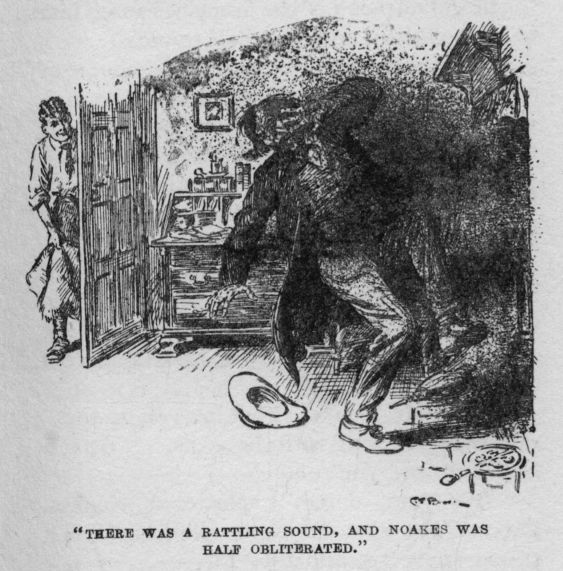
"THERE WAS A RATTLING SOUND, AND NOAKES WAS HALF OBLITERATED."
"I say, Mr. Noakes, what are you up to?" said Eves, entering with the sacks. "What a frightful mess you're in!"
"'Tis your doing," spluttered Noakes, shaking the soot from his clothes. "'Tis you, I know 'tis, and I'll—I'll——"
"Gently, Mr. Noakes, don't be rash. Why you should accuse me when I'm perfectly innocent—you've hurt my feelings, Mr. Noakes."
"What about my feelings?" shouted the angry man. "'Tis a plot betwixt you and t'other young villain, and——"
"Really, Mr. Noakes, with every consideration for your wounded feelings, I must say I think you most insulting. Who on earth was to know that you'd be paying one of your visits just at the moment when the chimney was being swept, and would choose that very moment to look up the chimney? You surely didn't expect to find Mr. Trenchard there?"
Noakes glared; at the same time his eyes expressed a certain uneasiness. How much had this smooth-spoken young ruffian seen? Picking up his hat he shook the soot from it, rammed it on his head, and strode to the door. There he turned, shouted, "You've not heard the last of this," and hurried away.
When Templeton came in a minute later he found Eves sitting back in a chair, shaking with laughter.
"My word, what a frightful mess!" exclaimed Templeton. "I forgot all about a covering. It's nothing to laugh at."
"Oh, isn't it! If you'd only seen him, soot all over his greasy head, and the more he rubbed his face the worse it got."
"What on earth are you talking about?"
"Old Noakes. It's a priceless invention, Bob. Great minds don't think of little things, but I remembered the covering and fetched these two sacks. When I got back Noakes was here, prying into Trenchard's papers. But I fancy he heard a sound, for he went over to the chimney, and then—by George! you've missed the funniest sight ever seen. He's only just gone, in a most frightful paddy."
"I don't wonder. Don't see anything funny in it myself. I called down 'Are you ready?' and if you'd been here as we arranged it wouldn't have happened."
"Of course it wouldn't, and old Noakes wouldn't have been jolly well paid out for sneaking. What's he want nosing about at a time when he thought every one was out? Trenchard must be told."
"I don't know about that, but I do know we'd better clear up this mess before Mrs. Trenchard gets back."
"Or she'll think precious little of your invention. It's a great success, anyway; you've got more soot than you expected. And old Noakes carried away a lot."
III
In Mrs. Trenchard's absence there was to be no midday dinner. After clearing up the mess with the assistance of one of the dairy-maids (who called it "a rare messopotamia as anybody ever did see"), the two lads went to join the farmer at lunch in the fields.
"That there invention, now," said Mr. Trenchard. "Hev it worked?"
"Splendid!" said Eves, emphatically. "We've got two good sacks of soot and scared a slug."
"It don't take a mighty deal to do that, sir," said the farmer with a smile. "I'll find that soot useful, and I'm much obleeged to 'ee, to be sure."
"Oh, but, Mr. Trenchard, could you spare me some?" said Templeton.
"For another invention," Eves added. "He's got a jolly good idea for protecting our ships from the U-boats, and soot's in it."
"As much as you do want, surely. I'd gie more'n a little to scrimp them there engines of iniquity."
"And perhaps you could help me with something else," said Templeton. "I want a sort of metal box; any old thing would do, something that's no good for anything else."
"I can find 'ee summat, I b'lieve. There be an old tank in the shed behind the dairy, where I keep th' old tricycle."
"A tricycle!" exclaimed Eves. "What about that for number four, Bob?"
"The very thing! Will you lend it or sell it, Mr. Trenchard?"
"I'll take no money from a young gent as is inventing for his country, danged if I will. 'Tis a old ancient thing that I bought five-and-twenty year ago for me and the missus."
"A sociable!" cried Eves. "We are in luck's way."
"'Tis called such, I b'lieve," said the farmer. "Ay, 'tis many a year since the missus and me went gallivanting about the country. She were a nesh young maid then, so to speak it; you wouldn't think it to see the size she've growed to. I've kep' th' old thing for the sake o' them gay young days."
"If you can spare us this afternoon, I'd like to experiment with it," said Templeton.
"Surely, and welcome, and I hope 'twill serve 'ee."
Hurrying back to the farmhouse they drew the tricycle from the shed and tried its paces over the yard. It was rusty and stiff, but a little oil eased the parts, and Templeton was delighted with his number four. The tank of which Mr. Trenchard had spoken was made of galvanised iron, and had several holes pierced in each side.
"The very thing!" cried Templeton. "We'll make some more holes at different heights, Tom."
"What for?"
"My idea is to rig up some trays inside the tank, one above another; there are several old sheets of iron lying about. They'll hold the soot and combustibles."
"By George! we forgot to ask Mother Trenchard to bring some firelighters."
"Never mind about them for the moment. We'll bore holes just above the trays, and put in some straw soaked in paraffin, and light it. Then when we start there'll be a fine draught through the holes."
"Splendid! But shan't we be fairly choked?"
"Of course we'll rig up the tank behind us; the smoke will all blow back."
Eves eyed the tricycle dubiously.
"It'll be the dickens of a job to fix this heavy tank," he said.
"Oh, we'll manage it. There's plenty of wire about, and we can hunt up something that will do for stays."
They worked energetically all the afternoon. Templeton's patience and ingenuity triumphed over all difficulties. The tank slipped off several times, but at last it was firmly fixed with an elaborate arrangement of stays and wire, and when Mrs. Trenchard returned, between five and six o'clock, she beheld her guests careering round the farmyard, making a trial trip.
"Well, I never did see!" she exclaimed, pulling up the horse at the gate. "Whatever hev happened to the old tricycle?"
Eves waved his hand gleefully.
"Splendid!" he cried, as Templeton halted the machine beside the cart. "A new invention, Mrs. Trenchard."
"'Tis like the butcher's contraption I saw in the town, only the box is behind instead of afore. What be the hidden meaning of that, I'd like to know?"
"It won't be hidden long, Mrs. Trenchard. But the sun will be hidden; there'll be an eclipse to-night."
"Go along with your rubbish, Mr. Eves. The sun will go down at his proper time, whatever the clocks do say; they Parlyment men up along at Lunnon can't make no eclipses, don't think it."
"Templeton means to; don't you, Bob?"
"He does talk rubbish, Mrs. Trenchard," said Templeton, earnestly. "All that he means is that we're going to try making a thick smoke, to see if we can hide our ships from the German submarines."
"Well, never did I hear the like o' that! You'll need a powerful deal o' smoke, Mr. Templeton."
"Of course, this is only experimental, on a very small scale. If it succeeds——"
"He'll be rolling in wealth, and you shall have a new bonnet, Mrs. Trenchard," said Eves.
"Ah, me! That do remind me of my boy Joe, to be sure; allers a-going to be rich and gie me a new bonnet. And now, poor boy, he's in them there horrible trenches, and the rats——"
"Cheer up, Mrs. Trenchard," said Eves, hastily, spying a tear. "I'm sorry for the rats, from what you've told us of Joe. I'm sure you want your tea after your long day. We want ours, I can tell you; and after tea, Templeton will give you a demonstration of this splendid invention. I say, Bob," he added, when Mrs. Trenchard had gone into the house, "while they're making tea there'll be just time for you to cut down to the village and buy some firelighters at old Noakes's. I don't suppose he'd serve me. Hurry up."
Mr. Trenchard returning from the fields a few minutes later, Eves unburdened himself.
"I say, Mr. Trenchard," he said, "when I told you we scared a slug, I didn't mean one of those small slimy things, you know. I meant Mr. Noakes. I caught him poking his nose into your papers this morning. I think you ought to know."
"Do 'ee tell me that, now?" said the farmer, looking distressed.
"Honest Injun. He was over at your desk when we were sweeping the chimney, and the fact is, he got a mouthful of soot and went away fuming."
"I'd never have believed it, and him a chapel member," said Mr. Trenchard. "Don't 'ee go for to anger Mr. Noakes, sir, med I beseech 'ee."
"All right. I dare say he'll keep out of our way. Of course, if he's a friend of yours——"
"I wouldn't say that, sir, but as the Book do say, 'as much as lieth in you, be at peace wi' all men.'"
"Jolly good idea! If the other chap won't be at peace with you, then you must go for him. Splendid!"
After tea they made their first trial at smoke production. Placing a layer of soot on each of the trays, with a couple of fire-lighters in the midst, they lit some straw soaked in paraffin, poked it through the holes, and began to treadle the machine round the yard, the farmer and his wife looking on at the door. A considerable volume of smoke poured out of the tank, but when they pulled up, Mr. Trenchard said:
"'Tis a noble beginning, to be sure; but I own, so to speak, I could allers see that there tank through the smother, and if I understand your true meaning, that hadn't oughter be."
"Quite right," said Templeton. "We want more of a draught, Tom. Larger holes and greater speed."
"Righto!" said Eves. "Will you chisel the holes larger? Then we might start on a real cruise—down the hill to the village, say. You can't work up much speed in the yard. What do you think of it, Mrs. Trenchard?"
"I know why my chimney wanted sweeping so bad, Mr. Eves. Ay sure, ye're just as full of mischief as my Joe."
Half an hour's work with a chisel and hammer sufficed to enlarge the holes. They then filled up the trays with more soot and firelighters, kindled a fire, and when the smoke began to surge, ran the machine out at the gate on to the high-road. A winding hill, nearly half a mile long, led down to the village. The slope was not very steep; the tricycle with its tank was heavy, and the bearings rusty; but by dint of hard pedalling they soon worked up a good speed, and the increased draught caused the smoke to pour forth in a dense cloud, ever increasing in volume and pungency.
Meanwhile in the village young Noakes had noticed the first issues of smoke, and ran into his father's shop shouting:
"Feyther, feyther, Farmer Trenchard's ricks be afire!"
Noakes, in a state of great agitation, rushed to the door in his apron, glanced up the hill, and cried, excitedly:
"Fire, fire! Run and rouse up the neighbours, Josiah. 'Tis a matter o' hundreds o' pounds. Fire!"
The boy set off through the village at a frantic run, shrieking "Fire!" at the top of his voice. Out rushed the baker in his singlet straight from the oven; the butcher in blue with his chopper; the smith from his forge, rolling up his leather apron; the agricultural labourers, smoking their after-tea pipes; the village constable in his shirt-sleeves. The little street filled with women and children, the latter flocking to the shed where the village fire manual was kept, and towards which the tradesmen, members of the volunteer fire brigade, were hastening. Waiting only to don their helmets, the men dragged the clumsy machine forth, Noakes being the most energetic, and began to drag it up the hill, the children following in a swarm.
"It do seem out a'ready, sonnies," said the smith, before they had gone many yards.
"That's true as gospel," said the baker. "Do 'ee think I med go back to my dough, neighbours?"
They came to a halt. It was the interval during which Eves and Templeton were overhauling and restocking the machine.
"'Tis a mercy for Trenchard," added the smith.
"A merciful Providence," murmured Noakes, the lines of anxiety disappearing from his face. "Run up along and tell neighbour Trenchard how we all do heartily rejoice, Josiah."
The boy started, but the moment after he had turned the first corner he came rushing back with his eyes like saucers.
"Feyther," he yelled, "fire bain't out. 'Tis blazing worse, and ricks be ramping down along like giant Goliath!"
"'Tis a true word, save us all!" cried the baker. "What in the name——"
"Now, sonnies, haul away," cried the smith. "Ricks hev staddles but no legs, as fur as I do know. 'Tis the wind blowing the smoke down along. Now, all together."
The windings of the road, and the hedges on each side, prevented them from getting a clear view of this singular phenomenon. All that they were aware of was a dense cloud of black smoke approaching them very rapidly. They had just restarted the manual engine when, round the bend just ahead, the tricycle shot into view with a huge trail of smoke behind it.
"Sakes alive!" gasped the smith.
The children yelled, and fled down the road. The men, after an instant's dismayed irresolution, scattered up the banks into the hedges, leaving the engine standing half across the road. Noakes, on whose face a dark flush had gathered as he recognised Eves, backed into a hazel and flourished his fists.
Templeton, who was steering, tried to turn the machine into the hedge before it reached the manual. But he was a shade too late; the off wheel fouled the engine; the tricycle spun round; its riders were flung into the hedge, and the trays, parting company with the tank as it overturned, were distributed in several directions, bestowing a good portion of their noisome contents impartially among the members of the fire brigade.
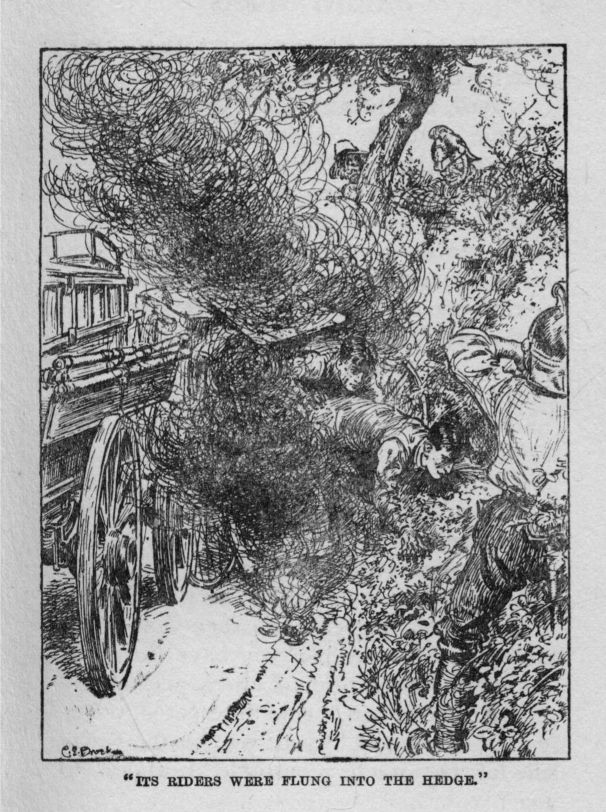
"ITS RIDERS WERE FLUNG INTO THE HEDGE."
The inventors picked themselves up, rubbed their elbows, and approached the discomfited villagers, who, coughing and spluttering, were now descending into the road. Templeton looked serious; Eves wore a broad grin.
"Really, I'm extremely sorry," began the former.
"Sorry be jowned!" shouted the baker. "Sorry won't clean my hands, and my dough a-spoiling."
"'Tis rank pison!" cried the butcher.
"Assault and battery and attempted murder," shrieked Noakes, furiously. "Wi' my own firelighters!"
"Let us discuss it calmly," said Templeton. "No one can regret more than I the—the inconvenience to which you have been put, quite without intention, I assure you——"
"But the fact is," Eves interposed, pointing to the manual, "you were on the wrong side of the road. Constable, I appeal to you."
The constable, who had left his fire helmet in the hedge, scratched his head, the villagers looking at him expectantly.
"Well, neighbours all," he said, slowly, "the law's what it is, and I'm not the man, being sworn in my office of constable—'t ud be high treason or worse to gainsay it. And I don't care who the man is, that there manual be on the right when the law says it oughter be on the left, and no true man can deny it."
"That's for horses and carts, for horses and carts," fumed Noakes.
"As a man I respect you, neighbour Noakes," said the constable, solemnly, "but as a officer of the law I say you don't know nothing about it. The manual's a vehicle; well, then, the law's no respecter of persons, and what be law for a horse and cart be law for a manual; ay sure, for a baby's pram, if so be a pram was in custody."
"That's all very well," said the baker, "but what's the law say about foul smoke? Tell us that, constable."
"Foul smoke be from factory chimneys; t'other smoke bain't foul."
"Of course not," said Eves. "You've got the law at your finger-ends, constable. The penalty for being on the wrong side is a heavy fine, isn't it?"
"That depends on whether 'tis Squire Banks or Sir Timothy on the bench, sir."
"Well, my friend won't prosecute, I'm sure. And when I tell you he was trying a new invention for beating the Germans, you'll be sorry you've ruined it through being on the wrong side of the road."
"Wish we'd knowed that afore, sir," said the smith. "The truth on't is, we thought 'twas Farmer Trenchard's ricks afire."
"And like true Britons you rushed to help your neighbour. Splendid! I'll tell Mr. Trenchard how promptly the brigade turned out; he's very lucky in having such good friends."
"Speaking for us all, sir——" began the smith.
"Not for me," Noakes interrupted, savagely.
"Hear what the man hev got to say, neighbour Noakes," said the baker. "Mebbe I won't agree with him myself, but I'm not the man to say so afore he's hawked it out."
"Speaking for us all," the smith went on, "I'm certain sure there's not a man of us but hopes the gen'lman's invention bain't ruined out and out. Anything as will beat the Germans hev our hearty good wishes, eh, souls?"
"Hear, hear!" cried the butcher.
"There, neighbour Noakes, you was too primitive," said the baker, reprovingly. "'Tis a good cause we suffer in, and I'm not the man to complain. And speaking for us all, I say three cheers for the young gen'lman."
The cheers were given, Noakes dissenting. Eves shook hands with them all round, Noakes excepted. Then he helped them to right the manual, and gave them a genial good-bye as they trundled it off.
"We've had a ripping day, Bob," he said, mopping his brow. "The smoke was splendid—a first-rate stink. Old Noakes's face was a picture."
He laughed heartily.
"I'm afraid the tricycle is crocked for ever," said Templeton with a gloomy look, "and I don't approve——"
"Oh, pax! You can pay Trenchard for the old thing out of your tenner; and you're jolly ungrateful. If I hadn't chipped in they wouldn't have cheered you. Let's pick up the ruins and get 'em back somehow. Buck up!"
Mr. Trenchard received Templeton's apologies for the break-up of the tricycle very good-naturedly. He refused his offer to buy it or have it repaired.
"'Tis come to a good end, if so be your invention is a success," he said.
Templeton drew out a specification of his smoke machine and sent it to the Ministry of Munitions. In about a fortnight he received a formal letter of acknowledgment. But by that time he had almost forgotten the smoke machine, other ideas having absorbed his attention and activities.
TRESPASSERS WILL BE PROSECUTED
I
Mrs. Trenchard that evening, after a brief absence from the living-room, reappeared in her best flowered bonnet and a muslin shawl and announced her intention of going "just there and back." Her husband, who was reading the newspaper, looked up and nodded. Templeton was sketching out a specification, and did not hear what she said. Eves gave her a cheerful au revoir from the depths of the chair where he lay at ease, and smiled at her retreating form.
"'Tis like that, sir," said the farmer, catching his look. "'There and back' in our family do mean a gossip with Martha Runt."
"The wife of Runt the smith?"
"Ay, that be the woman. I've not a word to say against Martha—not a word; but she be a rare workman with her tongue. We shan't see no more of Mother till supper-time."
He relapsed into his paper, and Eves stretched his legs and watched Templeton steadily pursuing his task.
Mrs. Trenchard returned a good hour before she was expected. Her rosy cheeks were flushed a deeper shade than usual; her bonnet was awry.
"I never did!" she exclaimed, pulling the strings into a knot. "No, never in all my born days, without a word of a lie in it—never hev I seed or heard no such goings on."
"What hev ruffled yer spirits, Mother?" asked the farmer, mildly.
"You may talk till yer throat be dry as a kex, Trenchard," cried the angry woman, "but you'll never make me believe as black's white—never!"
"What silly ass has been trying to, Mrs. Trenchard?" said Eves, sitting up. He had passed a dull evening.
"There's my boy Joe," she went on. "What did he do, though only a Territorial and not supposed to move a leg out of his parish? 'Mum,' says he—you heard un wi' yer own ears, Trenchard—''tis said here and there they want men in France. Seems to me I must go.' 'That heathen land!' says I. 'Ay, that's the place,' says he; 'we're all going.' And go he did, and what wi' the rats and the mud——"
"Now, now, don't 'ee carry on, Mother," said the farmer, seeing that his wife's eyes were filling. "Who've been vexing yer soul? And I don't care who the man is——"
"Man! He baint no man. He's a conscientious objection. You'd never believe it, Trenchard. When I traipsed down along to village, there was a crowd of a dozen or more by church gate, and, thinks I, 'They be talking o' young gentleman's invention'; but, coming up to them, no such thing; 'twas that lad of Noakes's holding forth, preaching peace as bold as brass."
"You don't say so, Mrs. Trenchard," cried Eves. "That little chap with the long hair?"
"No, no, Mr. Eves; little Josiah baint so gifted. 'Twas Noakes's elder lad, Nahum by name, as went away to work in Weymouth a year or two back, and now home he comes boasting of how he 'scaped the Army, and telling folks the war is wrong, and we be as much to blame as they Germans, and no one didn't oughter fight for their country, and a pack of rubbish. All fighting be against his conscience, says he—a pretty conscience, indeed, as growed sudden when the Lords and Parlyment said every man was a born soldier. Conscience! Why, Trenchard, you mind how he used to leather his feyther's horse; and many's the time I've seed un cuff and pinch his little brother till the poor soul hollered wi' pain. The likes of him! What them there tribunals be about in letting him off when good boys like my Joe, as wouldn't hurt a fly and haven't got no conscience—there, 'tis a scandal, and makes my blood boil, it do."
"Well, well, Mother," said Mr. Trenchard, "I'll go as fur's to say I agree with 'ee; but I wouldn't say a word against Mr. Noakes. He's a man of renown in the parish."
"The dickens he is!" ejaculated Eves, who had followed Mrs. Trenchard's story with the liveliest interest. Templeton, also, having finished his draft, had listened with his usual air of thoughtfulness.
"Judging by the price he charged for those firelighters," he said, "Mr. Noakes is a profiteer."
"Prophet neither here nor there, for all his Bible name, and his sons' likewise," said Mrs. Trenchard. "That there Nahum, coming here and stuffing his unnat'ral thoughts into the heads of our young fellers whose time be nigh come! There was Billy Runt, and young Pantany, and Tim Coggins, and such—oh! it did rile me, and I hadn't the heart to go there, so I comed home along. And bless 'ee, he be going to wag his tongue again to-morrow, and axed the boys to bring all their friends to hear un."
"Splendid!" cried Eves. "I say, Bob, we'll go. You can nobble the audience for Aunt Caroline."
This suggestion was not immediately accepted by Templeton, but in the privacy of their bedroom it bore fruit.
"This is rather serious, you know, Tom," he said.
"Broken a collar-stud, old man?" Eves rejoined.
"No; I mean this speechifying. It's not right for the fellow to turn the village boys against military service."
"Gas like that won't do much harm."
"But it may. It ought to be stopped. It's our duty to stop it."
"Jolly good idea! Start an opposition meeting and talk him down. Ripping rag!"
"I'm afraid I'm not up to that. You see——"
"Leave it to me, then. I bet I can rattle my tongue faster than Nahum Noakes. By George! Bobby, what an awful name!"
"You don't understand, Tom. It isn't talk that's wanted. The question is, is he sincere? If he is—well, what about free speech?"
"A free kick is more to the purpose. But what are you driving at?"
"Well, oughtn't we to find out if he really has a conscientious objection?—test him, you know? Mrs. Trenchard seemed to doubt it, and if he's a humbug he ought to be exposed."
"Just so, Socrates. I'll kick him, and see how he takes it. You can't take him to pieces like a clock, and examine his innards."
"That's the difficulty. Your idea won't do at all. You can't justify an unprovoked assault."
"I jolly well can. But I'm dead beat; pedalling that heavy old machine nearly biffed me. Sleep on it, Bob; perhaps you'll dream one of your bright ideas."
But in the morning Templeton confessed that he had slept as sound as a top, and hadn't given the matter another thought. Meditation during the day was not more fruitful, and in the evening, when they went down to the meeting-place opposite the church porch, Templeton had come to the conclusion that they had better hear what Noakes had to say, and act as circumstances seemed to require.
On the way they met Haylock, the constable, nodded to him, and passed on. After a few seconds, however, Eves ran back, saying:
"I'll catch you in half a tick, Bob."
Templeton strolled on, too busy with his thoughts even to wonder what his friend had to say to the policeman, or to notice the broad smile on Eves's face when he overtook him.
They found that the meeting had already started. A group of the male villagers, old and young, was gathered in a half-circle in front of a sturdy-looking fellow of some twenty years, who was perched on the churchyard wall. Nahum Noakes's appearance was that of an unusually robust clerk. His black hair was cut short; his straw hat was tilted back, showing a neat middle parting and well-oiled side-shows. He wore a pointed collar and a lilac tie; his grey flannel trousers were hitched up, revealing lilac socks neatly stretched above brown shoes.
"You want to know what I said to the tribunal?" he was saying as the two new-comers sauntered up. His accent was that of a countryman overlaid with a thin veneer of town polish. "I'll tell 'ee. 'Your name?' says the chairman. 'Noakes,' says I. 'Christian name?' says he. 'Nahum,' says I. 'Yes, your name,' says he. 'Nahum,' says I. 'Don't waste our time,' says he; 'what is your other name besides Noakes?' 'Nahum,' says I. You see, neighbours, I was taking a rise out of him. 'Is the man an idiot?' says he. 'No, he's not, and he knows his Bible,' says I. That was a good one, wasn't it? Well, there was a young officer there, only a lieutenant, but as stuck up as if he was commander-in-chief. Military representative, he's called, I believe. He had a paper in his hand, and he cocked his eye at it, and said: 'The man's Christian name is Nahum, I find.' 'Oh! ah!' says the chairman, fixing his eyeglass. 'One of the minor prophets. Well, Nahum Noakes, what are the grounds of your appeal?' 'I don't hold with fighting,' says I; ''tis against my principles.' One of the tribunal, a little worm of a feller, pipes up: 'What would you do, my man, if the Germans landed?' 'I'd meet 'em as men and brothers,' says I."
"Was they yer principles when you cracked young Beddoe's skull for saying as you sanded yer feyther's sugar?" cried a voice from the outskirts of the crowd.
There was a titter; Mr. Noakes, who had been listening to his son's eloquence with a fond smile of paternal pride, scowled at the interrupter, Runt the smith.
"Abuse is no argument, Mr. Runt," said Nahum, obviously nettled. "What happened years ago when I lived in the village is not to the point. Since I've been a resident in the town I've done a deal of deep thinking, I can tell you, and studied a lot of subjects you've never heard of——"
"Ever study phrenology?" asked Templeton, moving forward with Eves into the circle.
"Got it?" whispered Eves, eagerly.
"Perhaps," returned Templeton.
Nahum stared at his questioner. The villagers drew together, Runt winked at Coggins the butcher. Mr. Noakes looked annoyed, and stiffened his long, straight upper lip.
"You said?" began Nahum.
"I asked you if you had ever studied phrenology, the science of reading the mind through the skull."
"Well, I won't exactly say that I've been very deep into it, but——"
"Allow me," interrupted Eves, who had taken his cue. "Having only just returned to the village, you don't know my friend, Mr. Templeton, who has gone very deeply into loads of things, I assure you. Mr.—I think you said Nahum Noakes—you are really a splendid specimen for the phrenologist, and a little examination of your bumps——"
Nahum started back as Eves approached.
"It is quite painless, I assure you," said Eves, soothingly. "Mr. Templeton will only pass his hand gently over your head, and from the configuration of the cranium he will read your character like an open book."
"I don't think I need even touch your head," said Templeton. "If you will kindly just raise your hat—
"Give it a trial, Nahum," said Runt. At first puzzled, like the rest of the villagers, he had now risen to the situation, and was ready to lend his aid in its development.
"See if the young gen'l'man be right," added Coggins. "We all know 'ee, from a baby up'ard."
Half suspicious, angry at the interruption of his discourse, and still more at the sniggers of some of the younger members of the group, Nahum seemed to think that to acquiesce was the shortest cut out of his quandary. He took off his hat. Templeton stood in front of him, inspecting his head with the gravity of a judge at a cattle show. Nahum looked simply foolish.
Templeton moved slowly round, and leant on the wall to get a back view of Nahum's head.
"Yes, it seems genuine," he said at last. "I don't find the bump of pugnacity."
"Which means that he doesn't mind what you do to him?" said Eves.
"Just so. He's not a fighter."
Nahum's face cleared; his father shed a gratified smile around the group.
"Supposing some one pulled his nose?" Eves went on.
"He couldn't possibly resent it," replied Templeton. "It would be quite safe."
A loud guffaw from Runt brought a flush to Nahum's cheeks, and a scowl to his brow.
"I'd like to see any one try it," he muttered.
Instantly Eves shot out his hand, seized the somewhat prominent member in question, and pulled. Nahum sprang from the wall and hit out. Eves nimbly evaded the blow, and for half a minute dodged up and down like the matador at a bull-fight, pursued by the infuriate youth, who became only the more enraged as his clenched fists beat upon empty air. Shouts of laughter broke from the crowd. "Mind yer principles," cried the smith. "Gie un a larruping!" bellowed Mr. Noakes. Templeton looked worried.
At this moment the constable elbowed his way into the arena.
"Good now, gen'l'men," he said; "this be what the law do call a breach of the peace, and I'm not so sure but 'tis time to take 'ee both into custody for obstructing the police in the execution of his duty." He took Nahum's arm. "Come, come, sonny. I be surprised, and you such a man of peace as never was."
"Ay, and he axed the gen'l'man to pull his nose, he did so," said the smith.
"True, he said he'd like to see any one try it," said Coggins. "The gen'l'man only took him at his word—hee, hee!"
Aware now of the pitfall into which he had fallen, Nahum broke away from the constable, plunged through the crowd, and hurried away, followed closely by his father.
"A rare good randy, sir," said the smith to Eves, "but I hope Philemon won't make 'ee pay for it. Howsomever, Nahum's tongue won't wag no more, maybe, and that'll be for the good o' the nation."
"Another ripping day, Bob," said Eves, as he walked home with Templeton. "That idea of yours was splendid."
"I was quite serious," said Templeton.
"You always are, old man. But you don't mean to say you really meant to feel the fellow's bumps?"
"I did, till I funked the bear's grease."
"And there really is a bump of pugnacity?"
"Of course there is—combativeness, they call it. It's at the back, low down. The fellow hadn't got a trace of it. I really think——"
"You'll be the death of me, Bob. A fellow who lashed out like that not combative? Why, you can see it in his face—bully's written there as plain as a pikestaff. It's jolly lucky you've got me to work out your ideas! Anyway, it was a good rag, well worth half-a-crown."
"What do you mean?"
"Well, I tipped old Haylock half-a-crown to barge in if he heard a row. That leaves me four and elevenpence halfpenny."
A few days later Lieutenant Cradock, military representative at the county tribunal, rode over on his motor-bicycle and had a short interview with Constable Haylock. With the constable perched on the carrier he went on to Trenchard's farm, and found Eves and Templeton digging energetically along the border of a field. A conversation ensued, freely punctuated with laughter, and the officer rode away.
Next day a summons reached Nahum Noakes to attend an adjourned meeting of the tribunal. The chairman announced that an incident reported by the military representative hardly squared with the appellant's professions, and Nahum Noakes, passed A1, was handed over to the military authorities.
II
Spring and summer had been very dry, and Farmer Trenchard's fields, lying on a rocky upland, gave promise of but an indifferent harvest. The growth was thin, the stalks were short and yellow, the husks lean. The farmer had almost given up hope of his cereals, and his root crops could only be saved if the drought was soon broken.
On the morning following the affair of Nahum Noakes's bumps Mr. Trenchard was walking along the edge of one of his fields, looking disconsolately at the drooping upper-growth of the carrots. Eves and Templeton were hoeing some little distance away.
"Here's old Noakes," said Eves, suddenly. "Wonder if he's come to grouse about yesterday?"
Mr. Noakes, dressed as usual in his rusty frock-coat, but wearing a new straw slouch hat—his old one had not survived its bath of soot—was shambling up the field to meet the farmer.
"Marnen, neighbour Trenchard," he said.
"Marnen, Mr. Noakes," returned the farmer, with the air of timidity that marked all his intercourse with his neighbour. The two men stood together, Noakes smug and self-satisfied, Trenchard downcast and almost humble.
"It do seem you'd be the better for a drop of rain," Noakes went on. "The ground be dust dry. Them there carrots baint no good."
"True; I'm afeared 'twill be a bad year wi' me."
"Well, we're in the hands of Them above," said Noakes, smiling and rubbing his hands slowly together. "The old ancient men of Egypt had their lean years and their years of plenty; we can't look for no different in these here end o' the world times."
"Ah, Mr. Noakes, I don't gainsay 'ee, but 'tud hev made all the difference to me, a good moist season. I be afeard I shall have to axe 'ee——"
"Not a word, neighbour. Sufficient unto the day, you know. Not but what 'tis a misfortune to 'ee, but things may take a turn."
He thrust his hands into his pockets and stood for a few moments scanning the fields; then after a word or two of a general nature moved away, without having appeared to notice the two boys.
"Cut dead!" said Eves with a grin. "A good thing too; I loathe the fellow. Poor old Trenchard will be wretched all the rest of the day. I wonder why he always looks so hang-dog when Noakes is about? He couldn't look worse if Noakes was his landlord and he couldn't pay the rent. And upon my word, Noakes has cheek enough for two. I saw him prodding the cattle the other day as if he owned 'em, or would like to. What do you think about it?"
"Eh? about Noakes? I wasn't thinking of him," said Templeton. "I was wondering whether we couldn't do something to help save the old man's crops."
"Well, old chap, if you can invent rain——"
"Don't be an ass. Of course I can't. But I don't see why we shouldn't irrigate, as they do in India."
"We haven't got an Indus, and the river down there is too far away, and below this level. You can't make water run up-hill."
"But there's the brook just at the edge of the field, behind that ridge. All we've to do is to divert it."
"My good man, it's miles below the top of the ridge. Besides, there's not much water at the best."
"There's enough. We should have to build a dam, of course. Then the water would collect till it rose to the height of the ridge and flowed over, and we could carry it over the fields through small drains. You see, the stream runs straight to the sea; there are no fishing rights to consider, and it's not used for mills or anything of that sort."
"A jolly back-aching job, digging drains and what not. No chance of a rag. Still, the idea's good enough, and I'd like to see old Trenchard more cheerful. You had better see what he says about it."
The farmer was so much preoccupied with his gloomy thoughts that he scarcely appreciated at first the nature of the service which Templeton offered to render. This, as Eves pointed out afterwards, was partly due to Templeton's manner of broaching the subject.
"Your jaw about irrigation and the Punjab was enough to put him off it," said Eves, who was nothing if not frank. "Of course, the old countryman didn't understand; he understood right enough when I chipped in. There's nothing like what old Dicky Bird, when you do a rotten construe, calls sancta simplicitas."
Between them they managed to explain the idea to Mr. Trenchard, and to win his assent. Indeed, the chance of saving his crops had a magical effect on his spirits.
"It do mean a mighty deal to me," he said; "more'n you've any right notion of. I wish 'ee success, that I do."
They started work on the following morning. From the rocky banks of the stream they rolled down a number of stones and boulders and piled them in the channel to the height of the ridge, forming two adjacent sides of a square. Then up stream they cut a quantity of brushwood, which, being set afloat, was carried by the water against the piled-up stones. This occupied them the whole day, and they left for the next the final operation—the digging of earth to stop up the interstices through which the water still flowed away, and the carrying of it in wheelbarrows to its dumping places.
It was while they were digging that Lieutenant Cradock arrived to interrogate them about the conscientious objections of Nahum Noakes. About half an hour after his departure Nahum's father appeared on the scene, breathless from hurrying up the hill from the village. He had pumped Constable Haylock, who was a simple soul, and had learnt enough about the recent interview to feel a gnawing anxiety as to the fate of his beloved Nahum. He was hatless, and wore his apron, with which he wiped the shining dew from his face as he stood watching the diggers.
"Marnen, gen'l'men," he said, presently, in the tone of one who would be a friend. "'Tis warm work 'ee be at, surely."
"A warm day, Mr. Noakes," said Templeton, resting on his spade. Eves went on digging.
"Ay, sure, 'tis warm for the time o' year, so 'tis. Vallyble work; if there be one thing I do admire, 'tis to see young gen'l'men go forth unto their labour until the evening, as the Book says—earning their bread with the sweat of their brow. Ah, 'tis a true word."
Templeton was too modest to acknowledge this compliment. Eves went on digging. Mr. Noakes hemmed a little, and stroked his beard.
"Purticler such young gen'l'men as you be," he went on, "as hev gone deep into book learning and gives yer nights and days to high matters. That there finology, now; that be a very deep subjeck—very deep indeed; wonderful, I call it, to read into the heart through the head. Nobody 'ud never hev thought 'twere possible. And so correck, too; my boy Nahum, as peaceful as a lamb—you was right about that there bump, sir."
"He certainly hasn't got the bump of combativeness," said Templeton; "but——"
"Ah, yes, to be sure; he was a trifle overtaken with yer friend's joke, as any young feller might be; but I told un 'twas just a bit o' juvenile high spirits, and so he oughter hev took it. 'Let not the sun go down upon yer wrath,' says I, and bless 'ee, he smiled like a cherub next day, he did. That there bump be a good size on soldiers' heads, now? I warrant that young officer man as I seed down in village has a big un."
"I really didn't think to look, Mr. Noakes," said Templeton, patiently.
"Only think o' that, now, and I felt in my innards he'd come up along a-purpose. You didn't say nought o' finology, then?"
"Well, it was mentioned—just mentioned."
"And Mr. Templeton assured Lieutenant Cradock that your son hadn't the slightest prominence in that part of the skull," Eves broke in. "In fact, it's the other way about."
"Wonderful ways o' Providence!" said Mr. Noakes, rubbing his hands together and smiling happily.
"But I'm bound to say——" Templeton began.
"Come on, Bob; shovel in, or we'll never get done," Eves interrupted. "There's enough stuff dug; let's cart it down. We're trying an experiment in irrigation, Mr. Noakes."
"Ah! irrigation. It needs a dry soil, to be sure; it'll grow well here—very well indeed."
Eves smothered a laugh, and let Templeton explain. The explanation, strangely enough, brought a shadow upon Mr. Noakes's face. It darkened as he watched the dumping of the earth upon the dam. He was silent; his mouth hardened; and after a few more minutes he shambled away.
"I'm afraid we've given him a wrong impression," said Templeton, anxiously.
"Well, he shouldn't be sly. Besides, if he's ass enough to think 'finology' will go down with the tribunal, that's his look-out."
They worked hard through the rest of the day, and by tea-time the water had begun to trickle over the ridge in many little rills. It seemed, indeed, that there would be no necessity to dig the channels of which Templeton had spoken, the slope of the ground and the natural fan-like spreading of the streams promising that in due time the whole field would be thoroughly watered. Tired, but well pleased with the success of their experiment, they returned to the farmhouse.
Mr. Trenchard had been absent all the afternoon. At tea they told him what they had done, and he cheerfully assented to their suggestion that he should go with them to the ridge and see for himself their irrigation works.
It was dusk when they started. The ridge was at an outlying part of the farm, and as they strolled across the intervening fields Eves suddenly exclaimed:
"What's that?"
Some hundreds of yards ahead, a whitish object, not distinguishable in the dusk, was moving apparently along the top of the ridge. In a few seconds it disappeared.
"That was one of they rabbits after my turmuts, I reckon," said the farmer. "Terrible mischeevious little mortals they be."
"I say, Bob," cried Eves, "we might have a rabbit hunt one of these days."
"We've a lot of other things on hand," said Templeton, dubiously. "You see, there's the tar entanglement, and——"
"There it is again," said Eves, pointing towards a hedge some distance to the left beyond the ridge. "Rabbits don't live in hedges, do they, Mr. Trenchard?"
"Not as a general rule," replied the farmer, cautiously; "but there's no saying what they'll be doing. He's gone again; we've frighted him away."
"Well, here you see what we've done," said Templeton. "The dam there holds back the stream, the water is forced to rise, and it's now finding its way over the ridge in many little rivulets which I daresay by to-morrow morning will have flowed right over the field."
"Well to be sure!" said Mr. Trenchard. "Now that's what I call a downright clever bit of inventing. And to think that there stream hev been a-running along there all the days of my life, and I never seed no use for un! 'Twill be the saving of my roots, young gen'l'men, and I'm much beholden to 'ee."
It was as though a load had been lifted from the old man's mind. He was more cheerful that night than his guests had yet seen him, and was easily persuaded to join them and his wife in a rubber of whist.
Early hours were the rule at the farm. By nine everybody was in bed but the two strangers. They were always the last to retire. About ten they had just undressed. It was a hot, sultry night; the bedroom, low-pitched and heavily raftered, was stuffy; and Eves, after blowing out the candle, pulled up the blind and leant out of the window to get a breath of what air there was. The sky was slightly misty, and the moon, in its last quarter, threw a subdued radiance upon the country-side.
"By George!" exclaimed Eves, suddenly; "there's that white thing again."
"What does it matter?" said Templeton, who was getting into bed. "We've got to be up early; come on."
"Come and look here, you owl. That's no rabbit. It's bobbing up and down, just where the dam is. I'll be shot if I don't believe some one's interfering with it."
This suggestion brought Templeton to the window at once. Side by side they gazed out towards the ridge.
"This is serious," said Templeton. "If it really is any one interfering with our work——"
"We'll nip him in the bud. Come on; don't wait to dress; it's quite warm. Get into your slippers. We'll go out of the back door without waking the Trenchards and investigate."
Two minutes later they were stealing along under cover of the hedge that skirted the field to be irrigated. Arriving at the ridge some distance above the dam they turned to the left, and bending double crept towards the scene of their toil. There, rising erect, they saw Mr. Noakes up to his thighs in the stream, hard at work pulling away stones and earth from the dam.
The water was already gurgling through.
"Hi there! What the dickens are you up to?" Templeton cried.
The man turned with a start, and faced them. He appeared to be undecided what to do.
"What are you about?" repeated Templeton, indignantly. "What right have you to destroy our dam?"
"What right!" said the man, indignant in his turn. He was still in the water, and, leaning back against the dam, he faced the lads in the misty moonlight. "What right hev you two young fellers, strangers in the parish, to play yer mischeevious pranks here? 'Tis against the law to interfere wi' the waterways o' the nation, and the Polstead folk hev their rights, and they'll stick to 'em. Ay, and I hev my rights, too, and I'm a known man in the parish. This here stream purvides me wi' washing water, and to-morrow's washing day. You dam up my water; I can't wash; that's where the right do come in."
"My dear sir," said Eves, gravely, "however much you want washing, and however much it is to the interest of your neighbours that you should wash, the interests of our food supply, you must admit as a patriotic man, are more important. Wash by all means—to-morrow, when the dam, having done its work, will no doubt be removed. For my part, I have a distinct bias in favour of cleanliness. If a man can't be decent in other things, let him at least be clean. There was young Barker, now, a wretched little scug who wore his hair long, and always had a high-water mark round his neck. My friend Templeton, of whose ingenuity you have seen proofs, had an excellent invention for an automatic hair-cutter. But I am wandering from the point, which was, in a word, how to be happy though clean——"
Eves was becoming breathless. He wondered whether he could hold out. Templeton gazed at him with astonishment; as for Mr. Noakes, he looked angry, puzzled, utterly at sea. Once or twice during Eves's oratorical performance he opened his mouth to speak, but Eves fixed him with his eyes, and held up a warning hand, and overwhelmed him with his volubility.
"Yes, how to be happy though clean," Eves went on; "there's a text for you. Cleanliness is an acquired taste, like smoking. The mewling infant, with soapsuds in his eyes, rages like the heathen. The schoolboy, panting from his first immersion—my hat!"
The expected had happened. During Eves's harangue, the water had been eating away the pile of soil and rubbish which had been loosened by Mr. Noakes's exertions. Without warning, the dam against which the man was leaning gave way. He fell backward; there was a swirl and a flurry, and Mr. Noakes, carried off his feet by the rush of water, was rolled down stream. His new soft straw hat, which had betrayed him, floated on ahead.
Templeton sprang over the ridge and hastened to Mr. Noakes's assistance. For the moment Eves was incapacitated by laughter. Fortunately the stream was not deep, and after the first spate it flowed on with less turbulence. Templeton gripped the unhappy man by the collar, and hauled him up after he had been tumbled a few yards. Breathless, he stood a pitiable object in his frock-coat and baggy trousers, his lank hair shedding cascades.
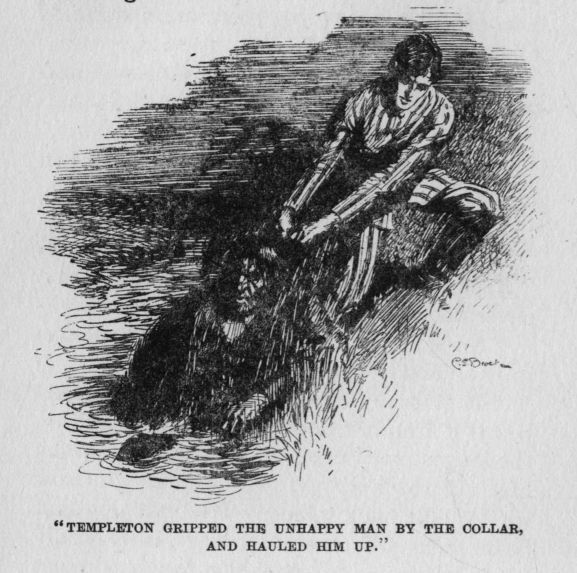
"TEMPLETON GRIPPED THE UNHAPPY MAN BY THE COLLAR, AND HAULED HIM UP."
"A most unfortunate accident," said Templeton. "You see, by removing some of the stones——"
"Mr. Noakes, your hat, I believe," interposed Eves, handing him the sodden, shapeless object which he had retrieved from the stream. Mr. Noakes snatched it from him, turned away, and started downhill. Never a word had he said; but there was a world of malevolence in his eye.
"We had better get back and dress," said Templeton.
"What on earth for?"
"Well, we can hardly repair the dam in our pyjamas."
Eves laughed.
"You're a priceless old fathead," he said. "Repairs must wait till the morning. I can never do any work after a rag."
"A rag! But it was a pure accident, due to the idiot's own meddlesomeness."
"Most true; but it wouldn't have happened if I hadn't kept his attention fixed by the longest spell of spouting I ever did in my life. It was a ripping rag, old man, and now we'll toddle back to bed. The one thing that beats me is, what's his motive? He'd hardly take the trouble to smash our dam just to get even with us, would he? That's a kid's trick. There's something very fishy about old Noakes."
III
Templeton had not settled which among his many ideas to work at, when accident launched his imagination upon a new flight.
One day the village was stirred to unusual excitement. Two items of local news, following quickly one upon the other, gave the folk so much matter for gossip that the amount of work they did was reduced fifty per cent. The first was that Nahum Noakes's final appeal had failed; the second, that young Wilfred Banks, the son of Squire Banks, one of the local magnates, had been seriously injured by the fall of an aeroplane.
Mrs. Trenchard, having been "there and back," was full of the story.
"Ay me, to think of a nice pleasant young gentleman like Mr. Wilfred lying at death's door through one o' they dratted airyplanes! That venturesome he always was, as a little small chiel. 'Tis against Nature to try to fly like the birds, that's what I say, and what can you expect? The world do be turning topsy-turvy, and all through they Germans."
That night, just as Eves had turned over to sleep, he was roused by a call from Templeton in his companion bed.
"What is it?" he murmured, drowsily.
"I've got an idea," was the reply.
"Well, sleep on it, old man."
"You know very well that I can't get a wink till I see daylight."
"Then you've got about five hours. Good night!"
"Of course I meant a light on the problem; you're so literal. You see, the evolution of a perfectly stable machine——"
Eves interrupted with a groan.
"I suppose I must be a martyr," he said, "but I wish you'd arrange for your ideas to come in the morning. Fire away! I'll keep awake if I can, but cut it short."
"You're a good sort, Tom. Really I'd like to know what you think of it. You see, an aeroplane ought to balance itself automatically, and I've got an idea for automatically adjusting the surfaces of the planes so that the machine will instantly adapt itself to gusts of wind, side-slips, and so on."
"Jolly good idea! Good night."
"Hold hard. You haven't heard the idea yet. My arrangement would be electric. Beyond the extremities of the frames I'd have a light framework on which an extension of the plane could be pushed out by a steel rod actuated by a small electric motor."
"I can go to sleep at once, then, because that won't work. It means more weight."
"No, no; we'll argue it out. Weight's becoming less and less important every day. Look at the weight of bombs an aeroplane can now lift. Anyhow, the point is that the motor would be controlled by the movement of the plane. A sphere moving in a horizontal channel would be affected by the slightest inclination of the plane. I'd arrange by a series of electrical contacts——"
"How?"
"I haven't worked out all the details yet; how could I? But the effect would be that the farther the sphere moved the farther the rod would push out the extension of the plane on the side required. And when the aeroplane had righted itself, the sphere would return to neutral."
"My sleepy brain is fairly dazed with your rods and spheres and the rest. Hang all that! The question is, would the extension idea work? Would the lengthening of the planes meet the case?"
"Of course it would. It's easily proved. All you want is a glider."
"Well, old man, the idea's ripping, and being a reasonable chap, you'll agree that you've got to go one step at a time. I don't say you're wrong, but treat me as a bit of a sceptic, who wants everything proved."
"Very well; I'm not unreasonable. We'll set to work and make a glider; then you'll see."
"Righto! Feel more easy now? Hope you won't wake in the night."
Templeton was just dozing off when from Eves there came:
"I say, Bob."
"What?"
"You'll have to cut into your tenner at last. Bye-bye!"
During the next week they did very little "work on the land." Farmer Trenchard, impressed as usual by Templeton's earnestness, allowed them as much leave as they wanted, and they devoted themselves during the hours of daylight to the manufacture of a glider. A journey to the nearest town and the cashing of the £10 note furnished them with the wood and the textile fabric they needed, and Templeton had sufficient skill in carpentry to fashion two wings, light enough for his purpose, yet strong enough to sustain him. His funds would not run to an electric motor, but he thought that, for his first experiments, the lengthening rod might be actuated by stout cords running over pulleys.
The contrivance was finished after a week's hard work. Tested in the farmyard, the lengthening apparatus worked smoothly; it only remained to try it in the air. Templeton had already marked a suitable spot for the trial—a sloping field some little distance from the farm, too steep for cultivation, and occupied usually by cattle fattening for Coggins, the butcher. It was enclosed by a thick hedge except at the gate, and that was kept locked, and blocked with brushwood.
"I think perhaps we had better ask Coggins's leave to use his field," suggested Templeton.
"Don't do anything of the sort," replied Eves. "We don't want a crowd of yokels looking on. If the thing goes all right, you can invite the village to an exhibition."
The morning chosen for the trial was warm and still. No danger from gusts of wind was to be anticipated. Mounting the glider on two wheels from the old tricycle, patched up for the occasion, they wheeled it up to the field and managed with some difficulty to hoist it over the gate, after having cleared a way through the obstructing brushwood. At the far end a few cattle were peacefully grazing. The well-cropped hill was a smooth inclined plane of springy turf.
They carried the machine to the top.
"I bag first go," said Eves.
"No, I can't agree to that," said Templeton. "You see, though I'm pretty sure it will work all right, there's bound to be a certain risk, and as it's my idea I ought to test it."
"That's no reason at all. Cooks never eat their own cake. Besides, if there is an accident, much better it should happen to me than you. I'm not an inventor."
"I still maintain——"
"Oh, don't let's waste time. Let's toss for it. Heads me, tails you. A use for my half-penny at last. Here goes."
He spun the coin.
"Heads! There you are. Now fasten the straps on my shoulders, and give me a gentle shove off."
The glider was not fastened to the wheels, Templeton's theory being that, having been started on them at the top of the hill, it would almost at once gain "lift" from the air. So it proved. After a few yards it rose slightly; a little farther on it was quite clear of the ground, and Eves, with legs bent and arms stretched out on the wings, enjoyed for a few brief seconds the exhilaration of aerial flight. Then, however, it began to tilt. Mindful of Templeton's careful instructions and the preliminary test in the farmyard, Eves tugged at the appointed rope, which should have thrown out an extension of the wing, and, according to Templeton's theory, have restored the balance. Unhappily the mechanism that had worked so smoothly before now proved treacherous. The machine swerved to the left, and crashed into a bramble-bush in the hedge at the foot of the hill.
Templeton rushed down in great agitation, sprang into the hedge regardless of scratches, unloosed the straps, and hauled Eves out.
"I say, you're not hurt, old man?" he asked, anxiously.
"I'm pretty well pricked, confound the thing!" said Eves. "The wretched cord jammed."
"But the theory's all right."
"Hang the theory! Look here, old man— Hullo, here's old Noakes."
Noakes, accompanied by a thick-set countryman in corduroys and leggings, had come over the crest of the hill just as the accident occurred, and run down almost on Templeton's heels.
"I've cotched 'ee," he cried, panting. "You're my witness, Ted Smail. Cotched in the act, the mischeevious young vipers. I'll have the law of un."
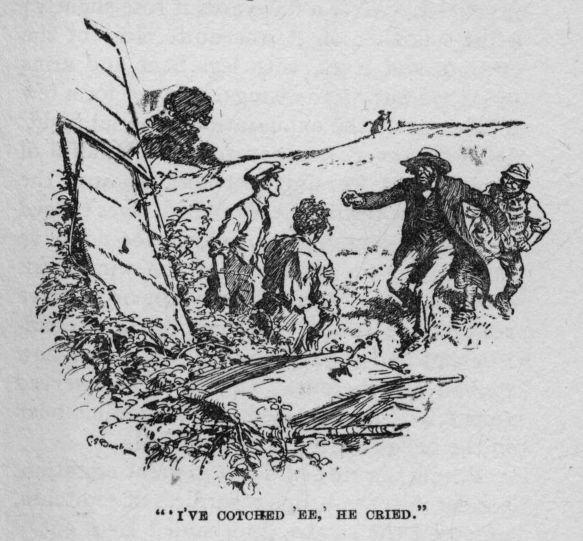
"'I'VE COTCHED 'EE,' HE CRIED."
"My dear sir, I don't think it has anything to do with you," said Templeton. "My friend, as you see——"
"Your friend, and you too, be a-trespassing on my field and a-ruining my property, and the law'll have something to say about that."
"Ruined a bramble-bush!" said Templeton.
"And the bush has ruined my clothes," Eves added.
"That there's my hedge, and you've been and knocked a hole in it, and——"
At this moment his tirade was suddenly interrupted by a bellow behind him. A bull, excited by the vagaries of the glider, had trotted up from the far end of the field to investigate, and further roused, probably, by Noakes's loud tones and waving arms, threw down its head and charged. The men scattered. Eves and Templeton made for the gate and vaulted over. Noakes ran one way, his friend another. The bull plunged straight at the glider, sticking in the hedge, and smashed it to splinters. Then it dashed after Noakes, who, seeing no other outlet, flung himself into the ditch below the hedge and scrambled through the tangled lower branches only just in time to escape the animal's horns.
"We must offer to pay Noakes for the damage," said Templeton.
"Rot! We haven't done tuppence-ha'-penny worth; and how do we know it's his field?"
"I'm sure he wouldn't say so if it wasn't, and there's certainly a hole in the hedge. I'll just see what he says."
Noakes, hatless, dishevelled, and scratched, was coming towards them.
"I'm willing to pay any reasonable sum for damages, Mr. Noakes," said Templeton.
"Are ye?" replied the man with a grin. "I be main glad to hear it. You shall have the bill, don't 'ee make no mistake about that. But I won't take no money 'cept by judge and jury."
He passed on, and stood at the gate until his friend should find it convenient to join him.
Two days later Constable Haylock came to the farm, and, with an apologetic air, handed to Eves and Templeton each a blue document, summoning them to appear at the justice court to answer a plaint of trespass and damage on the part of Philemon Noakes.
"This is serious," said Templeton. "You see, we've no defence. We did break his hedge and disturb his tenant's cattle, as he says. I wonder what the penalty is?"
"A fine of £5, old man, I expect," said Eves, cheerfully. "Don't you worry; I did the damage, and I can't pay."
"I'm sure I can't. That glider cost £7 16*s.* 4*d*. I haven't half £5."
"Well, they'll give us seven days C.B., or whatever they call it, and you'll have to write to Aunt Caroline to bail us out. Jolly good idea! We'll be able to give her tips in food economy after a week of prison fare."
"It's no joking matter. She'll be upset; no Templeton of our family has ever been in prison."
"You don't say so! You'll make a record, then. Splendid!"
On the appointed day they appeared before the justice.
"'Tis Squire Banks's day," whispered Haylock as they passed him at the door. "He baint such a hanging judge, so to speak it, as Sir Timothy."
Noakes gave his evidence, Smail corroborated it, and Squire Banks asked the culprits what they had to say in their defence.
"It was like this, sir," began Eves, before Templeton could start; "my friend Templeton devotes a lot of time to trying experiments—working out ideas for useful inventions. When he heard of that accident to a flying man the other day"—the old gentleman looked interested—"he kept me awake at night talking over an idea for making an aeroplane automatically safe. I confess I was sceptical, and it's my fault all this happened, because it was to prove his theory to me that he made a glider; it cost him over £7, sir; and we couldn't find a better place to try it on than that hilly field. I'm afraid I was clumsy; at any rate, the thing came to grief——"
"But the principle of it is quite sound," Templeton put in.
"But, of course, you're not concerned with principles here, sir, but only with law," Eves went on. "We didn't know the field belonged to Mr. Noakes, or I assure you we wouldn't have touched it with a pole, and as to damage, my friend offered to pay any reasonable sum."
"But didn't I understand that you caused the damage?" the squire interposed, his eyes twinkling. "That being the case, ought not the offer to pay have come from you?"
"I'm afraid it ought, sir; but—well, I've only got four and elevenpence halfpenny."
There were smiles in the court at this ingenuous confession.
"Well, Mr. Templeton offered to pay," the squire went on. "What then?"
"Mr. Noakes wouldn't hear of it, sir," Eves answered.
"Is that so, Noakes?"
Noakes had to confess that it was.
"Come, now, Noakes, brambles grow very fast, and any hedger will close the gap for eightpence. It's a trumpery matter. You young fellows can pay half-a-crown between you for the damage, and Noakes must pay his own costs; it's an unreasonable action. Call the next case."
"Jolly old trump!" said Eves as they went out. "And I'm jolly glad the old boy's son is getting better."
On reaching the farm, Templeton found awaiting him a letter from his aunt, written in reply to one he had sent her more than a week before. She explained the long delay by the fact that the letter had pursued her through three counties. "I am delighted to hear," she wrote, "that you have not yet spent any of the money I sent you. It shows great strength of character. You will be pleased to hear that my lectures are a great success. I expect to reach Polstead in about ten days, and I shall be so glad if you will do a little thing to prepare my way. My lectures are thoroughly practical; it is useless to talk about economical foods if the dear people cannot procure them. I want you to see Mr. Philemon Noakes for me; he is the principal tradesman in the village; and ask him if he will very kindly lay in a stock of certain cheap articles of which I will send you a list. A personal interview is so much more satisfactory than a formal letter, and you will find Mr. Noakes a very civil and obliging person."
"My hat!" cried Eves, laughing. "What a rag! I'll come with you, old man."
Templeton looked worried.
A GAS ATTACK
I
Mr. Noakes made no further attempt to interfere with the irrigation of Farmer Trenchard's fields. The two lads repaired the dam, gave the parched ground a thorough soaking for two days and nights, then demolished the simple structure and allowed the stream to pursue its usual course.
Templeton, meanwhile, had been anxiously weighing the claims of the other ideas that jostled in his brain. He wanted to perfect his automatic hair-cutter; to experiment with what he called, in advance, a "levitator"—a contrivance for enabling an aeroplane to rise more rapidly; to test his notion of a tar entanglement, and various other sound schemes. Unfortunately the incomplete hair-cutter had been confiscated by his head master, and it would take weeks to construct a new one. The levitator was out of the question at present, for it would cost a good deal more than the two pounds odd which remained out of his aunt's gift. Several ideas were unworkable for the same reason, and he had almost resolved on the tar entanglement when, with that suddenness to which inventors are accustomed, a quite new idea shot into his mind.
He had been reading, in a war correspondent's dispatch, about the star shells and Verey lights which were used at night to throw a fitful illumination upon the hostile lines. Eves noticed that as he cleaned his teeth before going to bed he made frequent pauses, holding the tooth-brush motionless for some moments at a time.
"What's up, old man?" asked Eves, who was already in bed. "Got toothache?"
"No; I was thinking," replied Templeton, rubbing again. "You see——"
"But I can't hear through the bristles. Hurry up, or I shall be asleep."
Templeton finished his toilet, blew out the light, and got into bed, sitting up and clasping his knees.
"Those flash-lights, you know—they don't last long enough. What our fellows want is some continuous illumination."
"What about the moon?"
"You know perfectly well the moon doesn't shine for half the month."
"I thought perhaps you'd invented an artificial moon. But expound, old bird."
"Well, you know the prevailing wind in winter is from the west. Why shouldn't our men start relays of light balloons——"
"Balloons always are light."
"I mean light-giving balloons. They'd float over the German lines and illuminate their whole positions with a steady continuous light."
"The Huns would shoot 'em down."
"Not easily, for they'd be dark."
"Light and dark at the same time! Go on, Bobby; I'm sure you can prove black's white."
"If you wouldn't interrupt, you'd see. The illuminant would be attached to the balloon by a long cord, and there'd be a shade like a lampshade over it, so that the balloon itself would be in darkness. It's easy enough to try."
"How?"
"All you want is a dozen toy balloons, a few cubic feet of hydrogen, a slow match, and a little magnesium wire. There you have it on a small scale. Fill the balloons with hydrogen, tie 'em together, fasten a slow match and a bit of wire to each, light the match, and send the whole caboodle up."
"But magnesium wire only burns for a second or two."
"You really are an ass, Tom. We'd only use magnesium wire for our experiment; there are heaps of things that could be used with big balloons at the front."
"You mean to try it, then?"
"Of course. Old Noakes has some toy balloons."
"But what about the hydrogen? It doesn't smell, does it?"
"No. Why?"
"Only that I forget all my chemistry except the stinks. How do you make it?"
"By the action of an acid on a metal. Don't you remember Zn + H2SO4 = ZnSO4 + H2? Iron will do as well."
"That's easy enough, then. But you'll want retorts, wash bottles, pneumatic troughs, and goodness knows what else. Bang goes the rest of your cash, Bob."
"Nonsense! Mother Trenchard has some old pickle bottles, and we're not out to make a specially pure gas. All we'll have to buy will be a little acid, a few feet of glass tubing, and a rubber cork or two. Four or five shillings will buy the lot. We shall have to go to Weymouth for them."
"Righto! That's a day off to-morrow."
The morning post brought a letter from Aunt Caroline enclosing a list of foods which she wished Mr. Noakes to stock. Templeton read it solemnly, and handed it to Eves.
"I say, Mrs. Trenchard, what do you think of this?" cried Eves. "Things Bob's aunt is going to lecture about, you know. Haricot beans——"