BRIGHT IDEAS (continued 3)
Reading edition
"Well, Mr. Wilkins," said Templeton, quietly, "I'm sorry you're not satisfied. Perhaps we had better part."
"I don't say that," said Wilkins, calming himself with an effort. "You're a gentleman, that's where 'tis, and not bred up to understand business. I'll say no more—let it bide—but another time don't 'ee go and refuse good money; that's business. Well, I'm off up along to the town; know where I can get some petrol on the quiet; that's business too. I'll be back afore long."
"You keep queer company, old man!" said Eves, when Wilkins was out of ear-shot.
"He's trying at times, I confess—a rough diamond," said Templeton. "But I think he's sound."
"I wonder! Somebody wanted him to give Noakes a tip, you remember. He must be very well in with Noakes, and that's suspicious in itself. His face was as long as a fiddle when you told him O'Reilly got in ahead of Noakes."
"Well, I'll give him the benefit of the doubt. Now, I've got to make a new crank pin for a motor cycle that was brought in for repair this morning. It'll take me some time, and I don't want to keep you hanging about. Why not go into the town and have a look round?"
"Righto. What time do you knock off?"
"Five."
"I'll call for you, then. So long!"
At half-past four, when Eves returned, the workshop was lighted by the two oil lamps which were its only illumination. Templeton had just finished his work, and was washing his hands at the sink.
"I've spent a profitable afternoon," said Eves, returning to his seat on the bench. "Don't think much of Pudlington, but an enquiring mind like mine can pick up pearls anywhere. I was strolling along when I came to an uncommonly ugly unfinished building, with 'Literary Institute' carved over the door. Some fellows were unloading chairs from a cart, and carrying them in. I went in too, and found your respectable friend the local builder there, superintending the fitting of some gas-burners. 'Getting ready for the meeting to-morrow?' I said to him. 'Ay, sure, sir,' said he. 'Town Hall's occypied by Food Controller and Fuel Controller, and I don't know what all, so the meeting's to be held here, though unfinished.' 'Rather a cold place,' I said. 'Bless 'ee, we'll hot 'em up to-morrow,' said he. 'The walls will sweat like you never see. We've got a proper fine furnace down underneath, and the only pity is I haven't got the ceiling plastered; 'twould have dried a bit.' Whereupon I mentioned your proposed experiment with your fire extinguisher, and the old boy became cordial at once when I told him you were a friend of mine. You've evidently impressed him, Bob."
Templeton grunted.
"It's quite true. To be a friend of yours lifts one a good many notches. 'That young gemman do have a terrible powerful piece of intelleck inside of his brain-pan,' says your builder. 'Ay, and what's more, he's a rare earnest soul, always inventing things for the good of his day and generation. He's a credit to the nation, that he be!' Of course I congratulated him and Pudlington on the temporary possession of so bright an ornament, and we had quite a friendly talk. He seemed rather doubtful whether it's legal to hold a public meeting in a building before it has been passed by the surveyor, but Noakes is above the law, or thinks he is. We'll go to-morrow, Bob: it'll be a good rag."
"I'm not sure that I want to go to the meeting," said Templeton.
"Oh, you must! I want to see Noakes's face when he spies us in the audience. By the way, I think he must be rather thick with your Wilkins. Not many minutes after I'd left the Institute I met the green car being towed along by two great farm horses. Noakes and Saunders were walking alongside. Noakes gave me his usual scowl as he passed, which I countered with my usual grin. Presently I walked round to the market-place, and there was Noakes again, in close confab with Wilkins. When they saw me they both began to talk at once, and it seemed to me that each was telling the other that he had the honour of my acquaintance. At any rate they both looked rather surprised and a good deal more than interested, and their heads were very close together when I saw them last."
"I'm sick of Noakes," said Templeton, somewhat irritably.
"What's the matter? Has he been here?"
"No, but half an hour after you left, Wilkins came back with a can of petrol, and offered it to me for my experiments in a way that was positively fawning."
"To make amends for his roughness before."
"I don't like that sort of thing. It's too much Noakes's way, and what you say throws light on it. If he and Noakes are pals—well, when I wangle, even if it's petrol, I like to do it in decent company. I disliked Wilkins's manner so much that I declined the petrol: told him I'd wait for the regular supply. The odd thing is that Noakes has not been here at the shop in my time."
"Rather lucky for you, for if he'd found you here, he would have told Wilkins you're a dangerous character, and got you fired out. He may do that yet."
"Well, let's get along home. Mrs. Pouncey will have high tea ready, and I'm ravenous."
After their meal, which was tea and supper combined, they smoked for an hour in the sitting-room. Then Templeton jumped up.
"Botheration!" he exclaimed. "I was going to work on my turbine specification, but I've left it in a drawer at the shop. I shall have to pull on my boots again and fetch it."
"Can't it wait? It's a horrid night."
"I really can't waste a whole evening. My time's getting short, and I've lots still to do."
"Well, I'll come along with you. After supper walk a mile, you know. It's about a mile there and back, I suppose."
The night was damp and murky. The country lane was unlit, and they found their way by intermittent flashes of Templeton's electric torch. There was no dwelling between Mrs. Pouncey's cottage and the garage, and at this hour, half-past eight on a winter night, they were not likely to meet either pedestrians or vehicles. So much the greater, therefore, was Templeton's surprise, when, on approaching the spot where the garage and workshop stood, he saw a dim light through the window of the latter.
"Wilkins went off at half-past three, and said he wouldn't be back to-night," said Templeton. "I suppose he changed his mind."
To reach the door they had to pass the window. It was only natural that Eves, who was on the inside, should glance in. Catching Templeton by the arm, he drew him back out of the rays of the lamp-light, whispering:
"There's some one stooping at a drawer, trying a key, apparently. Couldn't see his face, the light's too dim."
"It's Wilkins, I expect. No one else has any right here," replied Templeton. "I'll take a look."
Peeping round the frame of the window, through the dirty pane, he was able to distinguish nothing but a man's form at the further end of the shop. The lamp, hanging from the middle of the roof, was turned very low, and the bent attitude of the man, with his back three-parts towards the window, rendered it impossible to discern his features. He was covered with a long waterproof, and a storm cap was pulled low over his head. From his movements it was clear that he was trying one key after another.
"It's not Wilkins," whispered Templeton. "I never saw him dressed like that."
"Then it's a burglar," replied Eves. "Nab him!"
They moved on tip-toe to the door. Templeton grasped the handle, murmuring:
"I'll turn it suddenly—then make a dash!"
There was absolute quiet all around, and the sound of jingling keys came faintly through the door. After a few moments' pause Templeton turned the handle noiselessly, and pushed the door open. The damp weather had, however, swollen the timber, and the slight sound it made as it strained against the door-post attracted the attention of the man beyond. Still stooping over the drawer, he turned his head sharply.
"My hat! Noakes!" muttered Eves.
Springing into the shop past Templeton, who had halted on recognising Noakes, as if to consider matters, Eves dashed at the waterproofed figure. The moment's warning had enabled Noakes to prepare for attack. He projected a bony shoulder, prevented Eves from getting the clutch he intended, and made a rush towards the door.
"Collar him, Bob!" cried Eves.
During the next minute there was a rough-and-tumble in which Noakes's legs played as free a part as was possible to a man encased in a long waterproof. He displayed astounding agility in evading close action, and it was not until Eves caught him by the heel as he kicked out that he was brought to the ground. "I'll sit on him," said Eves. "Ring up the police station, Bob, and ask them to send a constable to arrest a burglar."
"But are you sure—" Templeton began.
"Don't argue," said Eves. "He's a desperate character; I can hardly hold him."
Templeton went to the telephone, lifted the receiver, then turned again towards Eves.
"Don't you think, as it's Mr. Noakes——" he said.
"Mr. Noakes! The Mayor of Pudlington?" interrupted Eves. "Picking locks! Nonsense! Ring up at once, Bob, and then come and help: the ruffian will be too much for me, just out of hospital."
Templeton gave the message.
"They'll send a man at once. He'll be here in about ten minutes," he reported. "Are you sure it isn't Mr. Noakes? I could have sworn I recognised him."
"So I am—so I am," panted the prisoner, who had hitherto struggled in silence. "What the Turk do 'ee mean by assaulting me—murderous assault—Mayor of Pudlington?"
"Now, now, don't be rash!" said Eves. "You won't make matters any better by pretending to be our worthy mayor. He won't like that, you know, when you're brought into court to-morrow. I shall have to give evidence, and when I tell him that the fellow caught rifling a drawer took his name in vain——"
"But I be the mayor—Philemon Noakes; and I'll send you to jail for assault and battery, without the option of a fine. Let me go! I'm the mayor, I tell 'ee!"
"I really think he's telling the truth," said Templeton.
Just then Noakes, kicking out, dealt Templeton a heavy blow on the ankle.
"You had better lie still, whoever you are!" said the latter, warmly. "Violence won't help you!"
"Of course not—only makes things ten times worse!" said Eves. "Catch his legs, Bob; if he isn't quiet we'll have to truss him up. I never came across such an impudent scoundrel. Here's a burglar, caught in the act, claiming to be the chief magistrate! That beats everything! How's it possible? I say, Bob, there'll be a queer scene in court to-morrow. Suppose it were true, I can't for the life of me see how the mayor on the bench and the criminal in the dock are going to arrange matters. Will he hop from one to the other, and finally sentence himself? That's a Jekyll and Hyde problem I can't solve. But here's somebody coming—the bobby, I expect."
Through the half-open door came a policeman, with handcuffs hanging from his wrists.
"Here he is, constable!" said Eves. "He's been struggling, but I dare say he'll go quietly."
"Now then, there," said the constable, "get up and come along quiet. We've been looking for you a month past. Who gives him in charge?"
"I do," said Eves, "though I suppose Mr. Templeton ought to do it. You know Mr. Templeton, constable? Temporary assistant to Mr. Wilkins."
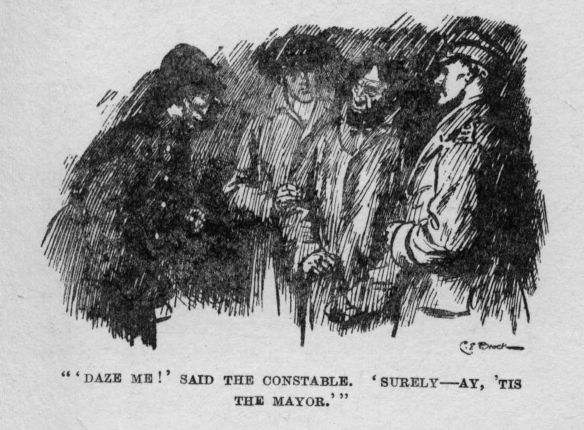
"Ay, sure, I've seed the gentleman." Noakes had now risen, and stood before the constable, Eves on one side, Templeton on the other. His face, hitherto in shade, had come within the rays of the dim lamp.
"Daze me!" said the constable, after a hard stare. "Surely—ay, 'tis the mayor, with the beginning of a black eye!"
"'DAZE ME!' SAID THE CONSTABLE. 'SURELY—AY, 'TIS THE MAYOR.'"
"Of course I'm the mayor!" said Noakes, truculently. "These young ruffians have assaulted me. I give them in charge, Brown."
"That's cool!" said Eves. "Don't pay any attention to him, constable. He's mad, or intoxicated. Mr. Templeton had occasion to come back to the shop, and we found this fellow in the act of trying to open a drawer where Mr. Templeton keeps important papers. He got a bit ruffled, of course. He says he's the mayor, but is that likely? Take him to the station, constable: we'll give the superintendent the facts."
"He's the mayor, or his double," said the constable. "And as to arresting the mayor——"
"Don't be a fool, Brown," said Noakes. "It's all a mistake—and a mistake that'll cost these young ruffians dear. I came here to see Wilkins, and afore I could get a word out, they knocked me down and nigh squeezed the breath out of me."
"And Wilkins knows that you open his drawers in his absence?" said Eves. "Are these your keys, Bob, or Wilkins's?"
He held up the bunch of keys which Noakes had dropped.
"Neither," said Templeton. "Mine are in my pocket: Mr. Wilkins no doubt has his."
"Well, jown me if I know what to do!" said the constable. "You'd better all come along and charge each other, seems to me!"
"What's all this?" said a voice at the door.
Wilkins entered breathlessly.
"They rang me up from the station, and told me there was burglars in my shop. Where be they? Mr. Noakes, what have been going on? What have come to your eye?"
"You may well ask, Wilkins. I came to have a word with you about that estimate, you know——" Wilkins tried to look as if he knew—"and these fellows, one an assistant of yours, I understand, set on me and half murdered me—took me for a burglar, ha! ha!"
"He was trying his keys on this drawer, Mr. Wilkins," said Eves.
"And why not?" demanded Wilkins, indignantly. "Why not, I ask 'ee? 'Tis my drawer, I keep my papers there, and Mr. Noakes having come to see me about an estimate, of course he saves time and gets the estimate out ready."
"And Brown will take 'em in charge for an unprovoked assault," said Noakes.
"Well, now, Mr. Noakes," said Wilkins, soothingly, "I wouldn't go so far as that. Not if it was me. It do seem 'twas a mistake. They took 'ee for a burglar—a nat'ral mistake, that's what it was, and my advice to one and all is, let it bide and say no more about it. We don't want no newspapers getting a hold of things like this. Won't do none of us no good—that's what I say."
Eves was loth to let Noakes go scot free, but after a whispered consultation with Templeton, who pointed out the improbability of any magistrate being induced to believe, in face of Wilkins's explanation, that the mayor was a burglar, he grudgingly agreed to withdraw the charge. Templeton took the precaution of removing all his own papers from the drawer, and leaving Noakes with Wilkins, returned with Eves to Mrs. Pouncey's cottage.
"So much for your rough diamond!" said Eves. "Noakes evidently didn't know before to-day that you were here, and when I saw him confabbing with Wilkins he was no doubt asking all about you. Wilkins must have told him about your inventions, and he thought a visit to your drawer would give him an idea or two, and enable him to get in first with a patent."
"But you don't suppose Wilkins was in the plot?"
"I don't know about that, but he's clearly under Noakes's thumb. Some one said that you know a man by the company he keeps. Wilkins keeps uncommonly bad company."
"I'm disappointed in him, I confess," said Templeton. "To-morrow I'll give him a week's notice, and work on my own for the rest of my leave."
III
Next morning Templeton, after breakfast, went to the workshop as usual, leaving Eves to his own devices until lunch-time. Eves spent an hour pottering about in the shed, and was particularly interested in the fire extinguishing composition.
"Rummy old sport!" he thought. "I suppose he will strike something really good one of these days, and be a bloated millionaire while I'm pinching on a miserable pension. Wonder what temperature this stuff melts at, by the way."
He found, standing against the wall, a metal tray pierced with holes which had been plugged with the composition. A thermometer hung on a nail.
"Hanged if I don't experiment on my own account!" he thought.
He filled the tray with water from the pump in Mrs. Pouncey's garden, laid it on an iron tripod which he found in the shed, and obtaining some firewood and coke from Mrs. Pouncey, kindled a small fire in an iron brazier. This he put underneath the tray, hanging the thermometer from the tripod. In a few minutes a sizzling informed him that water was trickling through the holes, and lifting the thermometer, he discovered that it registered 76°.
"By George! What a rag!" he exclaimed. "I wonder if it can be done! Mustn't tell Bob, though!"
He put out the fire, emptied the brazier and the tray, replugged the holes and removed all traces of his experiment. Then he walked into the town, and made his way to the Literary Institute.
"Good morning, Mr. Johnson," he said to the builder, whom he found reading a newspaper in the large hall, and smiling broadly. "You've got all ready for to-night, I see. How many will the place hold?"
"Two hundred and fifty, or thereabouts," said the builder.
"That's about the whole able-bodied population of Pudlington, isn't it?"
"Why no, sir, not with the women folk. They've got votes now-a-days, and there be more women voters than men, seemingly. Have 'ee seen the Echo, sir?"
"Your local rag? Anything in it?"
"A rare bit o' news that you won't see every week. Look 'ee here."
He handed the Pudlington Echo to Eves, pointing to a paragraph headed with large type.
"MISTAKEN FOR A BURGLAR
"AMAZING EXPERIENCE OF THE MAYOR
"Our worthy mayor was involved in an awkward predicament last night. In pursuance of an appointment with Mr. Wilkins, of the British Motor Garage, he arrived at the workshop between eight and nine o'clock, and was awaiting the proprietor, when he was suddenly seized and thrown down by a young man in the uniform of a second lieutenant, who had come up in company with Mr. Wilkins's assistant, and, not familiar with the mayor's lineaments, had mistaken him for a burglar. The police were telephoned for, and Constable Brown, on reaching the scene, found himself in an unenviable position, between cross-charges of burglary and common assault. The tension was relieved by the arrival of Mr. Wilkins, who saw at once that a pardonable mistake had been made by his assistant and the young officer, and by the exercise of his accustomed tact succeeded in bringing both parties to an amicable understanding. We have unfortunately to record that in the regrettable fracas our mayor sustained an ocular abrasion, the consequences of which, while temporarily disfiguring, will, we trust, be otherwise negligible. As a comparative newcomer Mr. Noakes may not be aware that he is in good company. Those familiar with the chronicles of our ancient borough will remember the historic bout between Ted Sloggins and Jemmy Wild, the prizefighter once Mayor of Pudlington, when the latter was knocked out in the tenth round with two broken ribs and a black eye."
"That's a nasty one!" said Eves, returning the paper.
"That last bit, sir? True, I feel it so—very nasty indeed. That feller have got his knife into the mayor, in a sly sort of way."
"Mr. Noakes isn't very popular, then? The local paper would hardly give a dig at a popular mayor."
"Well, sir, to tell 'ee the truth, there's two parties, one for and one against. Mr. Noakes is almost a newcomer, and some folks don't take kindly to his pushing ways. I don't myself, I own it. He's near driven me off my head over this meeting, and though I'd do anything in the way of business, I don't hold with his views. He was one of they 'Stop the War' kidney, and though goodness knows I'd 'a stopped the war, having a son over in France, I wouldn't stop it a moment afore we'd done what we set out to do, and thankful I am our lads have done it. That there young officer last night"—he smiled—"was you, I take it, sir."
"The curtain's dropped over that, Mr. Johnson," said Eves. "By the way, you were going to try Mr. Templeton's new fire extinguisher. Have you rigged up the apparatus?"
"Ay, sure, 'tis all ready. Come up along, and I'll show 'ee. I'll try it next week, just afore I plaster the ceiling."
He took Eves to the floor above, and showed him, between the workmen's planks and the matchboard, a large shallow tank of sheet iron resting on the rafters. It was filled with water, and the builder explained that the holes in the bottom had been plugged with the composition a week before.
"Most ingenious," said Eves, making a mental note of the position of the tank. "If it answers, I suppose you will make a tank to cover the whole of the ceiling."
"Surely, and put it into every house, hall or church I build."
"Johnson, where are you?" came a call from below.
"'Tis Mr. Noakes himself, come to bother me again!" said Johnson in an undertone. Aloud he cried: "Coming, Mr. Noakes, coming! ... Belike you'll bide here a bit," he added with a smile.
"I'm not keen on meeting your worthy mayor," replied Eves. "I'll come down when he's gone."
Through the matchboard Eves clearly heard the conversation between the two men.
"Look 'ee here, Johnson," began Noakes, irritably, "this won't do. The place is as cold as an ice-house, and my orders was to heat en well. Folks won't be no good listening to speeches if they're all of a shiver."
"Why, bless 'ee, Mr. Noakes, 'tis only ten o'clock. There's plenty of time to get the room comfortable warm by seven. The furnace is going, and you don't want the place like a greenhouse, do 'ee? Folks 'ud all drop asleep."
"There's a medium, Johnson. I count on you to regulate the furnace so's we're cosy-like. 'Tis a raw morning, and 'twill be worse to-night. Keep the furnace going steady, and come four o'clock shet all the winders to keep out the night air."
"But what about ventilation? If so be there's a good audience you'll have women fainting, and I don't know what all."
"There'll be plenty of ventilation through the matchboard," said Noakes, looking upward. "Besides, we've always the winders to cool the air if need be, but if you ain't got a good fire—why there you are! See that my orders are carried out, Johnson."
"Very good. You shall have it like an oven if you like: 'tis not for me to say."
Noakes, whose face suggested the recent application of a beefsteak, inspected the rows of chairs, mounted the platform and re-arranged the table, scolded the charwoman who had left her dust-pan on the chairman's seat, and finally departed. Then Eves rejoined the builder.
"They'll be warm afore they gets to work," said the latter, smiling, "And if so be there's any opposition, I won't say but what tempers 'll rise to biling point. However!"
"A queer man, your mayor!" said Eves. "By the way, I'd like to have a look at your furnace."
"Surely, sir. Come wi' me."
He led Eves into the basement, where a young man in shirt-sleeves was stoking the fire.
"I'll have to keep 'ee to-night, Fred," said the builder, "and sorry I be to say it, but the mayor's just been talking to me, and wants the place hotted up. You must stay till eight, my lad, and leave a good fire when you go: there's no telling how long the speechifying will last; these 'lection meetings are that uncertain."
The stoker brushed his arm across his damp brow, and muttered something uncomplimentary of the mayor. Johnson expounded to Eves the merits of his heating system, and followed him up the stairs again.
"The mayor's a busy man just now," said Eves. "Isn't there some sort of a ceremony coming on?"
"Ay, so 'tis, a ceremony that's come down from very ancient days, very ancient indeed, when we was all heathens, so it seems. 'Tis the anointing of the British Stone, they do call it, a rare old block of granite all by itself in a field some way north o' the town. Nobody knows how it come there, but 'tis said there was a battle on the spot, I don't know how many hundred years ago, and a whole cemetery of bones down below. Whatever the truth is, the mayor and corporation marches out in full rig once a year, and the mayor breaks a bottle o' cider, the wine o' the country, atop of the stone. I say 'tis just an excuse for a randy, for they make a sort of fair o't, wi' stalls and merry-go-rounds, and I don't know what all. There won't be so much fun as usual this year, though, owing to shortage of sugar for sweets and cakes and such. Still, maybe 'twill be worth your seeing, being so ancient."
"Rather! I'm tremendously keen on rags, ancient or modern. I'll be there!"
Eves bade the builder good-bye at the door of the hall, and the latter went up the street to his office. As soon as his back was turned, Eves hastened below to the furnace room.
"Pretty thirsty work, isn't it?" he said to the man. "I don't wonder you're not keen to be kept so long at it."
"'Tisn't that, sir," said the stoker. "The truth o't is I was going to take my girl to the cinema to-night. It begins at seven, and she'll be in a taking, 'cos they're showing some war pictures, and I'm in one of 'em, and she's mad on seeing me, though I tell her I ain't doing nothing, only looking down my nose at a blooming Hun prisoner."
"Naturally she wants to see you, and squeeze your hand, and—you know. I should myself. Well, I'll tell you what. I'll come about 6.45 and release you."
The man stared.
"I mean it, no kid," Eves went on. "I intended coming to the meeting, but there'll be nothing very interesting until half time, and the stoking will be finished by then."
"But you'll mess your clothes, sir, not to speak of your hands."
"Oh, no! I'll see to that. Besides, you know, we didn't fret ourselves about dirt in the trenches. That's all right, then, and look here—get your young woman a box of chocolates, a pound box—all one price, four shillings. She'll like your picture all the more."
He handed the man a couple of half-crowns, cut short his effusive thanks, and made his way back to the cottage.
"Bob come home, Mrs. Pouncey?" he asked the old dame.
"Not yet, sir, and I do hope he won't be late, for I've got as tender a loin of young pig as ever I've roasted."
"Capital! I'm ravenous, I always am. It's a disease, Mrs. Pouncey. Don't I show it in my face?"
"Bless your heart, sir, your face does me good: it do look so happy!"
"Happy thoughts, old dear. I've had a particularly happy thought all the morning, and it shines out on my ingenuous countenance. Some folks never show anything, you know. My friend Templeton, now—ah! here he is! Roast pork, Bob—hurry up!"
IV
After early supper that evening, Eves and Templeton, giving each an arm to Mrs. Pouncey, set off for the Literary Institute. The good woman was greatly excited at the prospect of giving her vote for the first time next day, and had announced her intention of voting for "the gentleman," whereupon Eves had reproached her, with well-assumed severity.
"That is not the right spirit, I am sure of it," he said. "You are going to exercise for the first time the priceless privilege, or right, or duty, of the franchise: a most solemn responsibility, Mrs. Pouncey. Yet you have made up your mind to vote for 'the gentleman' without considering what views he professes, and without hearing the other side, which may be one of Nature's gentlemen."
"I like 'em best bred, same as pig," said Mrs. Pouncey, stoutly.
"I don't dispute your taste," returned Eves, "but I think you owe it to the principle of fair play at least to hear what the other fellow may have to say. This is your last chance: to-morrow is the fatal day: like the man in the poem, you must make up your mind between truth and falsehood, 'twixt the good and evil side."
"Oh! how you do talk, Mr. Eves!" said Mrs. Pouncey. "I'll go, then, to please you, and I hope as I shan't be sorry for it."
"I don't think you will; in fact I think you will have quite a pleasant entertainment. Mr. Noakes has insisted on the hall being warm and cosy-like, and the chairs are quite good. I'll find you a good place at the back of the hall."
"Not too far back, then, for my hearing bain't what it was."
"But your eyes are good—wonderfully good for a lady of forty or so. You shall sit where you can hear—and see—everything."
Templeton had privately taken Eves to task for persuading the old dame to venture out on a cold night; but Eves had only chuckled.
The young officers were both in mufti, Eves having borrowed an old suit from his friend.
It was twenty minutes to seven when they reached the hall. The first few rows of chairs were already occupied, and people were streaming in. Eves piloted Mrs. Pouncey to a seat in the middle of the sixth row from the back wall.
"It do be warmish, to be sure," she said, removing her tippet.
"Thanks to the mayor! Bob, look after Mrs. Pouncey. I'll be back presently."
He dodged his way through the incoming stream, and disappeared.
Templeton sat beside Mrs. Pouncey, looking around the audience with an air of mild interest, and quite unconscious that the good lady was basking in the glory reflected upon her by the companionship of the "young feller as had his name in the paper." She nodded and smiled at her friends and acquaintances, and bridled visibly when she saw heads put together, nods in her direction, curious glances at Templeton, and lips whispering into ready ears.
The hall gradually filled. Tradesmen of the town, farmers from the outskirts, a sprinkling of khaki, and a considerable number of women, occupied all the chairs, and overflowed into the aisles along the walls. Conversation buzzed; the broad Doric of the county mingled quaintly with the north-country burr and the cockney twang of the soldiers whom chance had camped in the neighbourhood.
"Where be Mr. Eves, I wonder?" said Mrs. Pouncey, presently. She was in truth disappointed. "Mr. Templeton was a nice young gentleman, to be sure" (so she afterwards confided to a gossip), "but he was that quiet—well, you didn't like to speak to him promiscous-like, for fear you spoiled the high thoughts a-rooting in his mind. But that Mr. Eves, now—well, you weren't afeared of high thoughts with him. He was a merry feller, that he was, full of his fun; and talk—my dear, you should have heard him; 'twas just as if you poured out a kettle till it run dry, and the most beautiful long words, I do assure 'ee."
"Where be Mr. Eves, I wonder?"
The question roused Templeton from his abstracted scrutiny of the audience. He glanced at his watch; it was two minutes to seven. Some of the soldiers were already stamping their feet and calling "Time!" He looked up and down the hall, along the walls, into the doorway. Eves was not to be seen. A misgiving seized him. Eves had been very keen on coming to this meeting. Was he contemplating a "rag"? The idea made Templeton perspire.
An outburst of cheers and clapping of hands drew his attention from his uneasy thoughts. The platform party had arrived. Noakes, wearing his chain of office, stepped first on to the platform. He was followed by a lean, hungry-looking man with fiery eyes, clean-shaven, his reddish hair brushed up from the scalp. Templeton recognised the features of a fanatical agitator whose portrait had appeared in the picture papers. The local Labour candidate, a burly fellow with a jolly red face and closely trimmed beard, took his seat beside the speaker of the evening, and the remaining chairs on the platform were occupied by his principal supporters, male and female.
The cheers subsided, and the mayor rose. In the silence a high-pitched voice enquired from the rear of the hall, "Who said burglar?" Some of the audience laughed, some cried "Shame!" and a shrill cry of "It wasn't me!" and a scuffle announced that the chucker-out had proved more than equal to the occasion. Noakes smiled blandly until the noise had ceased: then he began.
"Ladies and gentlemen."
But there is no need to report his opening speech, which indeed was unusually brief for a chairman's. Templeton had begun to think better of him, until, after announcing that he would not stand between the audience and their great comrade from London, he said that, when the speech of the evening was finished, he would venture to make a few remarks by way of applying its principles to local circumstances. He then introduced his friend and comrade, and sat down.
Nor is it worth while, perhaps, to follow the "comrade from London" through his hour's declamation. "The fellow could speak," said Templeton, afterwards, "and what he said wasn't all rot. But it was full of the most hopelessly unpractical ideas, streaked with a vein of bitterness against every thing and every body, and absolutely vitiated for me by the assumption that every rich man is a knave, and every poor man a martyr. Noakes ought to have let well alone, but he tried to dot the i's and simply provoked Eves's question. If he had closed the meeting after the big speech, there'd have been no trouble."
Whether it was that the bucolic mind moved too slowly to keep pace with the orator's flying periods, or that the townsmen from London and the North were spell-bound by his fervid eloquence, or simply that the growing heat of the hall induced lethargy; certain it is that the meeting was quite orderly and decorous during the great speech. Not until the chairman was again on his feet did trouble arise, and that was due to a simple question put by Eves. But we must go back a little.
When Eves descended into the furnace room, and released the stoker, he stripped off coat, waistcoat and collar, rolled up his shirt-sleeves, and started energetically upon his self-assumed task. Hardly two minutes had elapsed when he heard a rasping voice behind him.
"That's the way. Keep it going steady, my man. There's a thermometer on the wall just inside the hall; run up every now and again and take a look at it: never let it drop below 60°."
"Ay sure," said Eves, counterfeiting the local brogue, and Noakes, who had been standing on the bottom step, went away gratified that his orders were being carried out so well.
"Not below 60°!" said Eves under his breath. "Sixteen degrees to go! Well, it's a long, long way to Tipperary, but my heart is there!" And he ladled coal and coke into the furnace with the fresh enthusiasm of an amateur.
It occurred to him that if he was to slip up into the hall for the purpose of examining the thermometer it would be just as well to look the part he was playing. So he smeared his face and arms, and what was visible of his shirt, with coal dust, much assisted by the dampness of his perspiring skin.
He paid his first visit to the thermometer just as the meeting opened. It hung on the wall near a group of Tommies who had been unable to obtain seats. They eyed him with a certain humorous sympathy. The thermometer registered 62°.
During the hour-long oration Eves was up and down several times, noting with satisfaction that the mercury was steadily rising, yet a little doubtful whether it would reach the critical point before the close of the meeting. He noticed towards the end of the hour that the heat was telling on some members of the audience. Women were fanning themselves; two or three plethoric farmers had fallen asleep: all the Tommies had unbuttoned their tunics. "Some fug, mate!" one of them remarked in a stage whisper. Eves only smiled in answer; he had seen that the mercury now touched 74°, and having stoked up the furnace to its full capacity, was satisfied that he could do no more, and stood among the soldiers.
The great speech ended in wild and whirling words: the speaker sat down amid applause, and Noakes arose.
"Now, my friends, we've heard a terrible fine speech, that we have, and I agree with every word of it. Afore I call upon our candidate—he'll be our member to-morrow—to propose a vote of thanks to our comrade, I've a thing or two to say for to bring it home to the hearts o' the men and women o' Pudlington. Capitalism, as he truly said, is the deadly poison as is driving a nail into the roots o' the nation: I couldn't say better nor that. Well, then, neighbours all, what I do say is, don't 'ee go and vote for no capitalist as belongs to a covey of profiteers, birds of prey as peck out the vitals o' the widder and the orphan. Ah, neighbours! my heart bleeds as I think o' the poor lone widder woman as pays dear for her bread, and can't get no cheese, scraping to pay the rate collector as he——"
"Who raised Widow Pouncey's rent?" came a clear voice from the back of the hall.
The mayor paused, and cast a swift glance in the direction of the questioner. He had recognised the voice, and sought for that well-remembered figure in officer's khaki. The somnolent audience was roused, every head was turned, many people had risen from their seats. Mrs. Pouncey, who had been dozing, her head constantly wobbling over towards Templeton's shoulder, suddenly sat erect, and exclaimed with a cry of delight: "That's Mr. Eves at last, bless him!" Eves himself, having launched his question, and ascertained that the mercury stood at 75°, turned with a smile towards the eager Tommies who wanted to know all about Widow Pouncey.
Noakes recovered from the shock before the first thrill of excitement had passed off.
"'Tis low manners to interrupt," he said in his smoothest tones, still trying to discover Eves's whereabouts, but in vain. "I was a-going to say——"
"Answer the question!" came in a chorused roar from the soldiers. "Who raised Widow Pouncey's rent?"
"Shall I tell 'em, sir?" whispered Mrs. Pouncey.
"No, no!" advised Templeton, anxious to avoid publicity. "Better say nothing."
"Ay, I be that shy, and the room so terrible hot."
"As chairman of this meeting," said Noakes, with a patient smile, "I rule that questions can't be asked now."
"Who—raised—Widow—Pouncey's—rent?" sang the Tommies, to the tune of "Here we suffer grief and pain" da capo.
"Who was it, mate?" asked one of them.
"I dare say he'll tell us presently," said Eves, "if you keep it up a little longer."
He had his eyes on the thermometer.
The "comrade from London" got up and spoke earnestly in Noakes's ear, while the chorus continued. The mayor gave a sickly smile and held up his hand. There was silence.
"My friend on my right," said the mayor, "reminds me as there's nothing more powerful than the truth."
"Righto!" yelled the Tommies. "Who—raised——"
"Nobody!" shouted the mayor. "'Tis a lie!"
"What's a lie?" cried one of the men. The others looked enquiringly at Eves.
"I say 'tis a lie!" repeated the mayor. "Mrs. Pouncey pays me five shilling a week, the same as she's paid——"
He stopped, for three parts of the way down the hall there rose a stout figure, with face flushed and bonnet awry. There was a moment's breathless silence, then Mrs. Pouncey, with forefinger outstretched towards the mayor, spoke out.
"Ay, the same as I've paid honest for twenty year, afore ever you come into the town, and 'twas you as said 'twould be doubled as soon as Parlyment lets you, if not afore, and not a word of a lie in it, Mr. Noakes."
The old woman collapsed into her seat, amid murmurs of "Shame!"
"Good old Mrs. Pouncey!" "Who said profiteer?" "Noakes raised Widow Pouncey's rent!" "Chuck him out!" "Get out, old crocodile!"
The hall rang with various cries. Eves, smiling broadly, glanced at the thermometer The mercury touched 76°. Noakes leant forward over the table, and shaking his fists, roared:
"As chairman of this meeting, and Mayor of Pudlington, here I be, and here I bide."
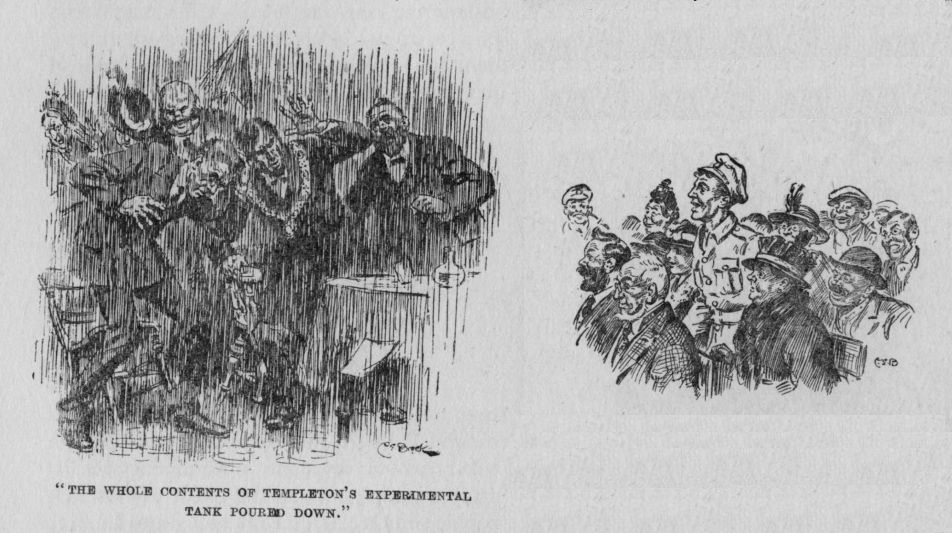
He started back suddenly, putting a finger between his collar and his neck, and looking upward. Next moment he dropped his head and brushed a drop of water from his nose. Several of the platform party turned their faces up, started back, and upset their chairs. Two or three thin streams of water, as from the eyelets in the spray of a shower bath, were descending from the unplastered ceiling. Noakes edged a little to the left, and was opening his mouth again, when with a hiss and clatter like a heavy shower of rain upon a glass house, the whole contents of Templeton's experimental tank poured down between the laths of the matchboard. Noakes gasped and spluttered, the ladies of his party shrieked, all the occupants of the platform stampeded like a flock of sheep, overturning their chairs, obstructing one another in their mad flight for the stairs. For one moment of amazement the audience was silent; then a roar of inextinguishable laughter broke from nearly three hundred throats, whistles and cat-calls resounded, the Tommies looked round for the stoker, whom, by some obscure instinct or intuition, they connected with the catastrophic shower. But Eves had slipped away.
"THE WHOLE CONTENTS OF TEMPLETON'S EXPERIMENTAL TANK POURED DOWN."
A special Election Edition of the Pudlington Echo appeared next day, and was bought up eagerly by the crowds who, in spite of the pouring rain, had flocked into the town to record their votes. The Editor had filled half a column with a descriptive paragraph in his best style.
"SHOWER BATH AT A MEETING
"REMARKABLE INCIDENT
"THE MAYOR MISSES HIS UMBRELLA
"The meeting at the Literary Institute in support of the candidature of Mr. Benjamin Moggridge was broken up by a most remarkable unrehearsed effect, which is probably without parallel in the political life of this country. The mayor, Alderman Noakes, was in the act of protesting, with all the dignity pertaining to his exalted office, against the demands of certain unruly spirits that he should vacate the chair, when a quantity of water, calculated to be equal to a rainfall of 2.8 ins., descended with startling suddenness and almost tropical violence upon the platform, bringing the meeting to a summary end. We understand that this inauspicious close to Mr. Moggridge's campaign was due to the unexpected operation of a new fire extinguisher, which the builder, our well-known and respected fellow citizen Mr. James Johnson, had located above the hall with a view to experimenting on a suitable occasion. The premature exhibition of this remarkable invention, which promises to be an epoch-making success, appears to have originated in the laudable desire of Mr. Noakes that the large audience should be in no way inconvenienced by the inclemency of the weather. His orders that the hall, which, in its unfinished state, might otherwise have sown the seeds of dangerous and possibly fatal complaints, should be heated to a wholesome degree of temperature, were carried out with what proved to be supererogatory solicitude; but our worthy mayor will doubtless console himself for his temporary discomfiture—the second this week, it will be remembered—with the reflection that the efficacy of the new fire extinguisher was abundantly demonstrated, and that the future immunity of the Literary Institute from the ravages of the devouring monster is assured."
A BRUSH WITH THE ENEMY
I
Eves was dozing comfortably beneath a pile of blankets. It was a cold morning, and though he had been awakened when Templeton rose from the adjacent bed, he had merely snorted in reply to his friend's declaration that it was time to get up, and turned over on the other side.
His slumbering ears were just conscious of a shout from below; but he paid no heed to it, even when it was repeated. He was settling down in luxurious warmth to that early morning sleep which so deliciously rounds off the night's repose, when two sinewy hands wrenched away the bedclothes wherein he had rolled himself, and Templeton shouted:
"Get up, you slugabed. It's come!"
"Cover me up, confound you!" cried Eves, wrathfully. "I shall catch my death of cold."
"Get up. I've been dressed half an hour. It's come, I tell you."
Eves bent his knees and pulled his pyjamas down over his ankles.
"I don't know what you're talking about, and I don't care. Mrs. Pouncey"—he raised his voice—"come and drag this murdering ruffian away. He's giving me pneumonia."
"Don't be an ass, Tom. Breakfast is nearly ready, and as the nozzle has just come by parcel post, I want to fix it and see how it works before I go off to the shop."
"You and your inventions will be the death of me," grumbled Eves, hugging himself. Then with a sudden movement he caught up his pillow, slammed it at Templeton's head, followed it up with a rush, and began to throw off his pyjamas. "Get out!" he cried. "I'll tub and dress in five minutes—not for you, old greaser, but for the bacon I smell frying."
"Well, I'll have time to fit on the nozzle before you're down."
He dashed out of the room, took the staircase in three resounding leaps, and ran bare-headed through the rain to the shed.
Eves smiled as he watched him through the window.
"Old Bob's excited this morning," he thought. "Another rag, I wonder?"
Templeton's usual stolidity was in fact quite broken down by the arrival of the nozzle made to his own design, for which he had been waiting in order to complete his reconstruction of the ancient road-sweeper. At breakfast he was too much excited to do full justice to the dish of bacon and eggs which the excellent Mrs. Pouncey had provided.
"It's just the thing, Tom," he cried. "It fits perfectly, and I believe the old 'bus will go like one o'clock. The only thing left, if it does work, is to complete my specification and fire it in at the Patent Office."
"I don't see that. Nobody wants a road-sweeper to go like a Rolls-Royce."
"You don't understand. I'm not out for making road-sweepers. I only bought the old thing to experiment on. It's the reversible steering I'm going to patent. Look here; here's my rough draft. That'll give you an idea of what I'm driving at."
Eves took the paper handed to him, and read aloud:
"'I, Robert Templeton, of the Red House, Wonston, Hampshire, in the Kingdom of England, lately a lieutenant in His Majesty's Forces, do hereby declare the nature of this invention and in what manner the same is to be performed to be particularly described and ascertained in and by the following——'
Oh, I say! I can't wade through all this balderdash. Tell me in plain English what you're after."
"Well, in plain English, then, my motor is provided with two sets of steering-gear, and the clutch couplings are so arranged that I can engage one and disengage the other simply by shifting round on the seat, on the pivot of which a cam is keyed——"
"For goodness' sake, Bob, spare me the rest, if that's plain English. D'you mean that you can drive your 'bus forward or backward as you please?"
"You can put it like that if you like, only, of course, the 'bus is always going forward, because when you shift round on the seat——"
"Exactly. Not a word more. Why couldn't you say that in a sentence instead of meandering through page after page? Why, hang it all, this will make a book before you've done with it."
"It does seem a little long-winded," Templeton admitted, seriously, "but you've no idea how particular the Patent Office people are. You have to be correct in the smallest detail, and draw diagrams showing everything. There's a lot of work to be done on this draft yet before it's ready."
"Well, let's go and see how it works in practice. I'd die happy if I thought one of your old inventions was really going to make your fortune."
"I'm afraid there isn't time now. I must hurry off to the shop. But we'll try it to-night when I get back. It's a pity old Wilkins insisted on my working out my week's notice; I'd have liked to devote all my time to it."
"Can't you forfeit your screw or something?"
"I offered to, but Wilkins wouldn't hear of it, and as I hate bothers, and my leaving without notice would certainly put him in a hole, I'll stick it till Saturday. Are you coming with me to the shop?"
"I'll walk with you so far; then I'll go on to the town and inquire tenderly after Noakes. We'll meet at the 'Three Tuns' for lunch. Mrs. Pouncey will be glad of a day off."
Encased in macintoshes, they trudged up the muddy lane. At the corner they met a farmer driving his cart westward. He nodded to Templeton.
"You've gotten she at last, zur," he said, with a smile.
"Yes; all right now, Mr. West."
"Ay. I knowed she'd come, gie un time. Gie un time, I said, and she'll come. Well, marnen to 'ee, zur."
"Who's your she, Bob?" asked Eves as they went on.
"Oh, he means the nozzle. They're fond of the feminine about here."
"But how on earth does he know anything about the nozzle? It came by post, you said?"
"Yes. I suppose the postman told him. You're not used to country ways."
"But how did the postman know what was in the parcel? They don't open things, I suppose?"
"Of course not. I dare say I mentioned to the postman one day what I was expecting, and they gossip about anything and everything here."
"What a place! Look here, my son, you'll have one of your inventions forestalled one of these days if you don't keep your mouth shut. Then you'd be sorry."
It was not Eves's way to keep his mouth shut, and he expatiated on the evils of talkativeness all the way to the workshop, where the friends parted. The same topic was revived when they met at the "Three Tuns" for lunch.
"Wilkins was unusually amiable to-day," Templeton happened to remark. "He seemed quite pleased that the nozzle is a success."
"Were you juggins enough to tell him that?" asked Eves with a touch of scorn.
"Well, what else could I do when he asked me point-blank? I didn't mention it first."
"I suppose he heard of it from the postman or from Farmer West, or from any other inhabitant of this gossiping old monkey-house. Wilkins is the last man who ought to know anything about your private affairs. Upon my word, I think I'd better get demobilised and take a job as your keeper. You're not fit to be trusted alone."
After lunch Eves accompanied Templeton to the shop, and watched over him with fatherly interest through the afternoon. He was amused to see Templeton from time to time break off his work on a purely mechanical job, hurry to his coat hanging on a peg, extract the specification from his breast-pocket, and make some trifling alteration in text or diagram.
"Is that the result of what they call unconscious cerebration?" he asked. "Or can your mighty mind attend to two things at once? You're a wonder, Bobby, and I hope I shall live long enough to write you a thumping obituary notice."
II
Next day, immediately after breakfast, Eves went off on his own devices, and did not see Templeton again until supper-time.
"You look rather down in the mouth. Bob," he said. "Anything wrong?"
"I'm a bit worried," Templeton replied. "I don't think I'm naturally suspicious——"
"Rather not! You're as innocent as a babe. Any old diddler could suck you in. But what's happened?"
"This afternoon I had to go out for an hour or so to try a car. Wilkins was away, so I left the shop closed. While I was running the car I had an idea for my specification and when I got back I took it out of my coat to alter it. And I found this."
He handed Eves the paper.
"Well? It's the same old thing—same old rigmarole, isn't it?"
"That smudge of ink!"
"Your elbow—but, of course, it's all in pencil. You don't mean—
"As you say, it's all in pencil. It hasn't been near ink, so far as I know. At any rate, that smudge wasn't there this morning."
Eves whistled.
"Wilkins knew about your specification, of course; everybody knows everything in this Arcadia. My prophetic soul! He's been copying your draft, Bob, and being an untidy penman, left his mark behind. He must have been uncommon slippy to copy it all in an hour, though, with all these erasures and interlinings. Any one else got a key of the shop?"
"No one, so far as I know."
"Noakes? You remember when we caught him at the drawer? My hat! They don't stick at trifles. This is felony, or I'm a Dutchman. Wilkins, or Noakes, or both of them, want to get in first at the Patent Office; they've stolen your specification."
"That's a serious charge. We've no proof."
"My dear chap, it's as plain as a pikestaff. But look here, what can be done? Look at the worst; say they have copied your stuff, what then?"
"If they file their application at the Patent Office it will be no end of a bother and expense to prove it's mine."
"I'd swear that before any beak in the country. But let's keep to the point. They couldn't get to the Patent Office to-night?"
"No; it closes at five; opens at ten in the morning."
"What time's the last train up?"
"It left twenty minutes ago," said Templeton, after a glance at his watch.
"And in the morning?"
"The first train reaches London something after eleven."
Eves mused for a few seconds, drumming on the table.
"I tell you what," he said at length. "You set to work and make a fair copy of this stuff, and we'll go up by the first train to-morrow and see if—Hallo! here's a car. Rather late for a visit."
The panting of an automobile engine was distinctly audible. There was a rap on the outer door. Mrs. Pouncey shuffled along the passage; voices were heard; then the landlady entered.
"A gentleman to see you, sir; O'Reilly by name."
"Our excitable Irishman," said Eves.
"Ask him in, Mrs. Pouncey, please," said Templeton.
O'Reilly came in like a tornado, waving his arms and wearing his capacious smile.
"Sure, I'm delighted to see the two of you, and me not knowing the way," he said as he shook hands. "The Government, or the colonel anyway, has taken my tender for the camp waste, and 'tis to you I owe it, and I'll beg you to drink to the colonel, or anyway the Government; I have the champagne in my pocket ready."
He produced a bottle from the deep pocket of his waterproof coat.
"Jolly good of you, Mr. O'Reilly," said Eves. "You've come in the nick of time. My friend Templeton wants something to cheer him up."
"Do you say so? What might be the trouble, now?"
"Expound, Bob; your invention, I mean. I should only make a mess of it."
"It was just a notion for driving a car in the opposite direction to what it has been going, the driver swinging round on his seat and automatically bringing into action steering-gear affecting the back wheels instead of the front, or vice versa."
"Saves turning in a narrow lane, you see," added Eves.
"Bedad, that would be a blessing to me this dark night," said O'Reilly. "But what is the trouble? Funds run out? Would you show me the plans, I'd find the capital—provided they'll work out, of course."
"Splendid!" cried Eves. "Here's the draft specification—but there's the rub; that smudge of ink. Look here, Bob, just set to work and copy your diagrams while I tell Mr. O'Reilly all about it, and he opens the fizz. We've no wine-glasses, only tumblers, but no one will mind that."
O'Reilly's face grew grave as he listened to the story told by Eves.
"That's bad," he said. "I stopped at the station a while ago to get a London evening paper, and I saw that mayor of yours, Noakes, step into the London train. There was another fellow with him, seeing him off."
"What sort of man?" asked Eves.
"A thick ruffian of a fellow in a long coat and a motor cap. I can't tell you which of them I dislike the most, by the faces of 'em, I mean—him or Noakes."
"That was Wilkins. There's no doubt I was right, Bob; Noakes has slunk off to London to get in first; and that was the last train!"
"Drink, my boys," said O'Reilly, who had meanwhile opened his bottle. "Health to ourselves, and confusion to Noakes. We'll get the top-side of him yet. There's one way to do it. 'Tis nine o'clock, and we are a hundred and sixty miles from London—that and a bit over. I'll drive you up in my car."
"Magnificent," cried Eves. "How long will your diagrams take, Bob?"
"Under an hour; but there's the specification to copy out."
"I'll do that. Hand over. We'll be ready in an hour, Mr. O'Reilly."
"Then I'll run back to the town and fill up my tank and see to my tyres and lamps," said O'Reilly. "Be you ready when I call for you, and with luck and no punctures we'll be in London by six o'clock."
He gulped a glass of champagne and hurried from the room.
The two lads went on steadily with their tasks. Templeton was finished first, and going to his desk scrawled a hasty note, which he placed in an envelope, and was addressing when Eves sprang up.
"That's done," he said, flinging down his pen. "What are you writing to Wilkins for?"
"Just to tell him I shan't be at the shop till Thursday."
"I wouldn't tell the brute anything."
"Well, you see, there's nothing proved yet, and——"
"And Noakes, I suppose, has gone up to town to leave his card on the King! Bob, you're an ass. But drink up your fizz; it's pretty flat. I hear the car. It'll be a pretty cold ride; rather sport, though."
"I hope we shan't have a spill. O'Reilly's a bit wild, you know. I wish we hadn't drunk that champagne."
"Oh, you're hopeless. Get on your coat, and don't worry. It'll be a splendid rag."
Ten minutes sufficed for their donning their thickest outer garments and soothing the agitation into which the announcement of their journey threw Mrs. Pouncey. Then they started.
It is to be feared that Eves's expectation of a "splendid rag" was somewhat disappointed. There was a certain excitement in the first hour's run over the quiet country roads, when the car, behind its glaring headlights, seemed to be continually dashing itself against a wall of impenetrable blackness. But it soon became monotonous. The air was cold and damp, and in spite of their thick clothes and the windscreen the two passengers soon became unpleasantly chilled. O'Reilly, a business man as well as an Irishman, had a proper respect for his car, and drove carefully through the towns. His enthusiasm for the Government was considerably damped when first at Bournemouth and then at Southampton he found all the hotels closed, and failed to obtain anything in the way of liquid refreshment stronger than spade coffee. These were the moments when Templeton felt most comfortable, and he confided to Eves his belief that after all they would arrive safely at their journey's end. By the time they reached Winchester the feet of both were tingling with cold; at Guildford even Eves had become morose; and it was not until they narrowly escaped a collision with an Army lorry as they swung round to cross Vauxhall Bridge that Eves felt the only thrill their journey provided.
It was nearly half-past six when O'Reilly drew up at the door of his rooms in a quiet Westminster street.
"You'll be cold, sure," he said. "I'll let you in and show you the bath-room; there'll be hot water. I'll garage the car, and by the time you're dry I'll be back. I don't dare wake my housekeeper. The last trump wouldn't get her out of bed before half-past seven. But her heart is never cold, and at half-past eight she'll give us a breakfast fit for the three kings of Carrickmagree. Not but what we'll forage out something before then."
Bathed, warmed, and fed, the three boarded a motor-bus soon after nine o'clock, and were set down at the end of Chancery Lane. As they walked up the street Eves suddenly pulled them into a shop doorway.
"There's old Noakes about ten yards ahead," he said. "The Patent Office doesn't open till ten, I think you said, Bob?"
"That's so."
"Then he's about forty minutes to wait. Surely he won't hang about the door. Let us follow him carefully."
They had taken only a few steps when they saw Noakes, swinging a fat umbrella, enter a typewriting agency.
"He's going to have your specification copied," said Eves.
"Sure, we'll be safe till ten," said O'Reilly with a chuckle. "The girls will keep the likes of him waiting. Now do you come with me to a patent agent, one of my friends. He'll put us up to the way of getting over Noakes."
The agent's office was but a few yards up the street. The agent himself had not yet arrived; his typist-secretary explained that he was not expected until ten, and might be later.
"Well, then, you'll be after doing us a kindness. My friend here has a specification which Mr. Jones is going to file for me, and he'll need it copied in duplicate at once. Indeed, he'll be mighty pleased to find it ready for him; he's been longing to get his hand on it these many weeks, and you will not disappoint him, will you now?"
"I won't disappoint you, Mr. O'Reilly," said the girl, with a smile.
She sat down at her machine, rattled away on the keys, and in twenty minutes handed to O'Reilly two clean copies of the specification. Her employer arrived on the stroke of ten. A few words from O'Reilly apprised him of the urgency of the matter, and he at once accompanied the three to the Patent Office and filed the formal application.
They left the office in couples, O'Reilly going ahead with his friend. The other two noticed that O'Reilly edged away to one side quickly, leaving a gap through which came hurriedly a shambling figure in a wideawake and a long brown ulster, in one hand a large envelope, in the other his huge umbrella.
"Our worthy mayor," whispered Eves, giving Templeton a nudge.
Apparently Noakes had not recognised O'Reilly, but his eyes widened and his chin dropped as he came face to face with Eves and Templeton. The shock of amazement caused him to halt with a jerk, bringing him into sharp collision with an errand boy hurrying along behind him, a basket of fish upon his arm.
"Here, old 'un, mind my toes," said the lad, not ill-temperedly, at the same time sticking out his elbow to ward off Noakes's obstructing bulk. His action was as a spark to powder. With the impulse of an angry, ill-conditioned man to vent his wrath on the nearest object, Noakes swung round and brought his umbrella heavily down upon the lad's shoulders.
"I'll learn you!" he cried, truculently.
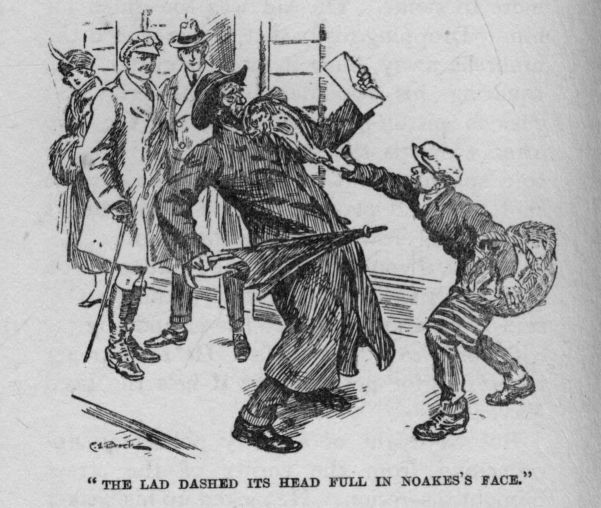
The response was unexpected. Snatching up a prime cod by the tail, the lad dashed its head full in Noakes's face. Noakes winced at the cold, slimy contact, staggered, then lurched forward, raising his umbrella once more to strike. The lad was too quick for him. Dropping his basket, he wrenched the umbrella away, flung it into the gutter, and, squaring his shoulders, commenced that curious piston-like movement of the two arms which is the street boy's preliminary to a sparring bout. Suddenly his right fist shot out, and planted a blow in the man's midriff. A crowd quickly assembled.
"THE LAD DASHED ITS HEAD FULL IN NOAKES'S FACE."
"I say, d'you know that the gentleman you are assaulting is the Mayor of Pudlington?" said Eves, stepping up to the errand boy.
"Don't care who he is. He ain't going to hit me for nothing, not if he's the Lord Mayor."
But the sight of a burly policeman approaching from the corner of the street brought discretion. He picked up his basket and ran off, turning to give Noakes a parting salute with his thumb to his nose.
III
O'Reilly treated the two lads to what Eves described as a topping lunch, and afterwards spent half an hour in a close examination of the specification.
"I like the looks of it," he said, finally. "Have you given it a trial?"
"Not yet," replied Templeton. "I've rigged up the mechanism, rather roughly, on an old road-sweeper I got cheap, and a little more tinkering should put it in working order. I might be able to try it on Saturday afternoon when I'm clear of the shop."
"Well, then, I'm the way of making you an offer. I'll run down on Saturday and watch your trial. If the creature works, I'll pay for the installation on a respectable car, and finance you up to a thousand pounds. You'll pay me six per cent. interest and repay the capital just when you can."
"It's really too good of you, Mr. O'Reilly," said Templeton.
"Sorra a bit, my boy. I'm doing you no favour; 'tis business, and there's no denying it."
"Splendid!" said Eves. "You've got your chance at last, Bob. Remember me, old man, when the profits come rolling in. I've stood by you in many old rags. I tell you what, I'll write your advertisements, and make your reversible steering as famous as Beecham's pills."
"I wouldn't wonder but you've got a flowery style, Mr. Eves," said O'Reilly. "Now, if so be you mean to catch your train, you'd better be off. I'll see you on Saturday."
They took a taxi and arrived at the station in good time. After securing seats, Eves walked the length of the train to see whether Noakes was their fellow-passenger. There was no sign of him. Eves kept an eye on the platform from the window of his compartment until the train moved off, but Noakes had not appeared.
"He'll go on the razzle, I suppose," he remarked, as he dropped into the corner opposite Templeton. "But he can't keep it up long. Isn't Saturday the day for that old ceremony—what do they call it?—anointing the British Stone? I'd made up my mind to see that; it will be a bit of a rag to finish up my holiday with. I suppose you'll be too much occupied with your road-sweeper to bother about it?"
"Well, you see, the afternoons are short now, and as O'Reilly is coming down specially——"
"Just so. Business before pleasure. I foresee the end of our old friendship. 'But O the heavy change now thou art gone!' Milton, old chap. That's what I shall say when I think of the spiffing rags we've had together, and mourn for the days that are no more. Hand over that Punch, or I shall burst into tears. Perhaps I shall anyhow."
Next morning, when Templeton arrived at the shop, he found Wilkins standing at the door, an image of truculence.
"You didn't turn up yesterday," he cried. "What was you after, eh?"
"As I explained in my note, I had to make a sudden journey to London."
"I don't want none of your explanations. You had ought to ask my permission, going gallivanting sudden like that. I won't have no more of it. You're sacked; you understand that? Sacked without notice. Here's half a week's wages; you shan't have nothing against me. Hook it! Now! This very minute!"
"With the greatest pleasure in life," said Templeton, coolly. "Good morning."
He was not aware, until informed by the omniscient postman, that Wilkins had received on the previous morning a telegram from Noakes, the cryptic wording of which had already been thoroughly discussed in the neighbourhood: "Boy in first sack immediate."
Delighted at the leisure afforded by his dismissal, Templeton returned to his lodging, and spent the remainder of that day and the whole of the next in working at the road-sweeper. Eves watched him for an hour or two, but finding his friend's patient labour too slow for his taste, he went through the town to the scene of Saturday's ceremony, and amused himself by looking on at the preparations, and chatting with any one who would listen to him. The British Stone was a sort of truncated monolith standing in a meadow about a couple of acres in extent. A small square enclosure had been roped off around it, and within stood a low wooden platform from which the mayor, after breaking a bottle of cider on the stone, would deliver the annual oration in honour of the town and its ancient worthies. Against the hedge, on all four sides of the meadow, were ranged caravans, roundabouts, Aunt Sallies, raree-shows, and all the paraphernalia of a country fair, with stalls for the sale of hot drinks and such comestibles as the Food Regulations had not debarred. The continuous wet weather and the passage of many vehicles had made the entrance to the field a slough, and many of the showmen wore gloomy faces at the expectation that fewer spectators than usual would attend the ceremony. They asked quite reasonably whether the women folk, their best customers, would brave the risk of sinking ankle-deep in mud.
Saturday morning came. A thin drizzle was falling; the sky was gloomy, and Mrs. Pouncey foretold that it was to be a "mizzly day." Templeton, however, was so anxious to prove the merits of his invention to O'Reilly in the afternoon, that immediately after breakfast, nothing daunted by the weather, he suggested that Eves should accompany him on a trial spin. They ran the road-sweeper up the muddy lane to the high road, Eves remarking that there was great scope for the activities for which the machine was designed. The macadamised surface of the highway was less miry, and Templeton assured his friend that he would not get very much splashed if the speed of the sweeper was kept low.
Templeton occupied the driver's seat; Eves stood on a rail above the fixed brushes behind, holding on to the framework. The machine ran steadily up the road, but when Templeton slowed down and turned upon the pivot which was to bring into action the steering-gear at the rear, the vehicle, instead of moving straight hi the opposite direction, showed a tendency to sheer off to one side. Moreover, it turned out that the gear which raised the brushes clear of the road was out of order. Every now and then the brushes dropped, and the machine reverted to its original use. At these times Eves's boots and puttees received a generous bespattering of mud and water, and when the brushes began to "race," sending a spray of mud not merely across the road, but into his face, he protested loudly.
"Why didn't you wait till you could rig cranks, or whatever they are, on a decent car instead of this ramshackle old piece of antiquity?" he grumbled.
"Sorry, old man," said Templeton; "I'll go a bit slower."
"Besides," Eves went on, "your reversible arrangements don't act. You can't steer the thing straight. It goes like a crab, or a drunk. Swing round again, for goodness' sake. Here's a wagon coming; I don't want to be chucked under the wheels."
"All right," said Templeton, with composure, turning round. "It's only a slight hitch. Of course, the clutch connection is roughly made; I did the best I could with my materials; but you see the idea's all right, and it'll be easy enough to correct the defects."
"You won't think of showing the thing to O'Reilly in its present state?"
"Why not? He's a practical man." Templeton began to get a little warm. "It's chaps like you who know nothing about machinery that lose heart at a trifling setback. And very likely another half-hour's work in the shed will greatly improve things. This is a trial spin; you can't expect everything to go like clockwork first go off."
"Jolly good speech, old man. Best I've heard of yours. My faith in you is restored. By all means run the thing back to the shed; but, if you don't mind, I'll dismount when we come to the lane. I don't mind a shower-bath from above, but from below—no, thank you. I've swallowed enough mud in Flanders."
Templeton spent the rest of the morning in overhauling his mechanism, and Eves in removing the worst of the mud splotches from his clothes. They had just finished lunch, when O'Reilly drove up in a growler hired at the station.
"Faith, 'tis a terrible day for wetness," he said. "But here I am, and I'll be glad now to take a look at your machine. Have you it in working order?"
"We gave it a short trial this morning," said Templeton. "It didn't behave quite so well as I had hoped, but I've spent a couple of hours on it since, and it ought to go better now."
"I like your modesty, my boy. 'Tis a rare thing in inventors."
"He's far too modest," said Eves. "That's why I've appointed myself his advertising agent. It's an old road-sweeper, remember; he's been working under difficulties. In my opinion—of course, I'm not an expert—the thing's a great success; you should see the amount of mud it scooped up."
"I saw a mighty deal of mud as I came down the lane. You will not try it here, sure?"
"We tried it along the road," said Templeton. "And I've been thinking of a better place. On the other side of the town the road is tarred, and the machine will run much more smoothly. Besides, there's very little mud."
"A bright idea," said Eves. "I propose that you drive the machine over the muddy roads while Mr. O'Reilly and I follow in the growler. We'll get out when we come to the tarred highway, and I'll perch up where I was before, and try to keep those brushes in order."
The suggestion was accepted. O'Reilly looked on critically as Templeton drove the sweeper slowly up the lane; then he stepped into the cab and told the driver to follow at a reasonable distance. Eves joined him.
As they proceeded along the road they passed at intervals small groups of farmers and labourers with their wives and children, who, defying the weather, had donned their Sunday best for the civic ceremony.
"Is it the likes of a wake, then?" O'Reilly asked. "Or a horse-race, maybe?"
"Only a country beano," replied Eves, and told what he knew of the afternoon's proceedings.
"That's disappointing, now. I'd have liked to see a good race, but I've no wish in the world to hear Noakes make a speech."
Arriving at the tarred highway the two alighted from the cab. Eves took up his post above the brushes as before, and O'Reilly, eager to watch the working of Templeton's apparatus at close quarters, chose a somewhat precarious position on the opposite side of the framework.
"Now, Tom," said Templeton, his manner betraying a little nervousness, "if you see the gear dropping, just raise it. There's very little mud, but there are pools here and there, and I don't want to splash you. I propose to run straight ahead for a few minutes till I get up a fair speed, for I fancy the mechanism will work better then. Are you ready?"
"Righto. The road's clear."
Templeton started his engine. The machine moved forward, at first slowly, but gradually gathering way. Eves kept a watchful eye on the brushes, and when they showed no sign of dropping he remarked to O'Reilly, "I think old Bob's done the trick this time."
"Maybe," replied O'Reilly, in an undertone, "but this reversing gear, now."
The speed continually increased until it reached a rate of about fifteen miles an hour. There was no traffic on the road, and Templeton was on the point of slowing down, preparatory to stopping and turning, when, rounding a slight bend, he came to a cross-road just as the head of the civic procession arrived at the corner. The town sergeant, bearing the mace, led the way; behind him came Noakes, in his mayoral robes, followed immediately by the councillors, the senior of whom carried a magnum bottle of cider.
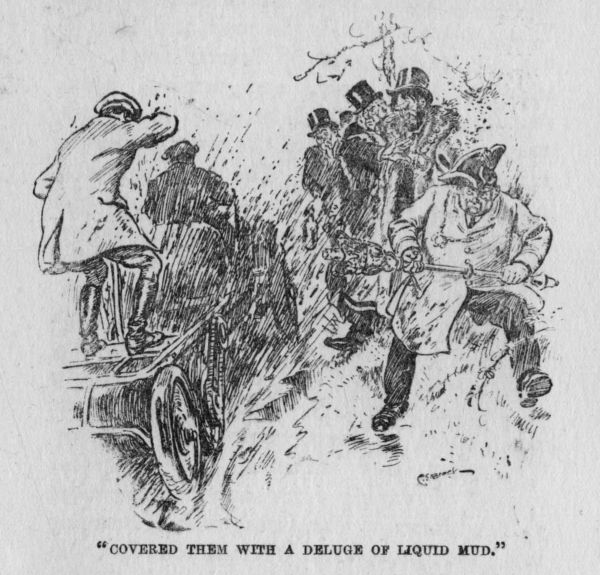
Templeton caught sight of the procession just in time to avoid a collision. Forgetting in the excitement of the moment the necessity of slowing down before bringing the reverse into action, he swung round on the pivot. The effect was amazing. The machine, instead of running in the opposite direction, plunged forward with zigzag rushes, charging into the procession. Templeton lost his head, forgot his brakes, and made frantic efforts to stop the engine, but something had stuck. Eves, between alarm and amusement at the stampede of the civic dignitaries, forgot to keep his eye on the brushes, which had dropped owing to the change of gear, and now began to race. Unlike the highway, the cross-road was deep in mud, and as the machine ran from side to side, dashing first into one hedge, then the other, the brushes flung up mud in all directions. Eves and O'Reilly were splashed from head to foot, but the full effect of this outrageous behaviour of the road-sweeper was felt by Noakes and the councillors immediately behind him. They had sought safety by backing into the hedge opposite to that at which the machine appeared to be charging as it approached them. Unhappily for them, it suddenly altered its direction, passed within a few inches of their shrinking forms, and covered them with a deluge of liquid mud. There was a crash as the bottle of cider fell and splintered into fragments, and loud cries of alarm and objurgation from the bespattered victims.
"COVERED THEM WITH A DELUGE OF LIQUID MUD."
The incident occupied barely half a minute. Templeton recovered himself, stopped his engine, rammed on his brakes, and, least bemired of all the actors, got down to make his apologies. Eves and O'Reilly by this time were shaking with laughter. Noakes, seeing that the machine had come to a stop, approached the contrite driver with uplifted fist, too irate even to speak. He had tried to rub the splashes of mud from his cheeks, with the result that he had only spread them.
"I am really very sorry, Mr. Noakes," said Templeton. "I was trying a new invention, and I can't say how much I regret——"
"Od rabbit you and your inventions," roared Noakes. "You did it o' purpose, you viper. I'll have you up, I will, for creating a nuisance——"
"Driving to the danger of the public, be jowned to 'em," put in a councillor who had suffered scarcely less than the mayor.
"Ay, the danger of the public and bodily injury to the mayor," cried Noakes. "No option of a fine, neither; you'll go to jail, sure as my name be Philemon Noakes."
"Come, come, now," said O'Reilly, thinking it time to intervene. "Sure, any one could see it was nothing but an accident that might have happened to the Lord Mayor of Dublin himself. You gentlemen have got splashed; faith, so have I. Look at me! The right way to look at it is that we're all suffering in a good cause—martyrs of science, and I wouldn't say but we've got off lightly."
"There's summat in that, Neighbour Noakes," said a councillor who, being at the rear of the procession, had not come within range of the rotating brushes. "Ay, what I say is, these young fellers what have served their country want to be encouraged, and if so be a little mud flies—why, there 'tis; it will brush off, and 'tis all one."
"There'll be no 'nointing to-day, that's certain," said another. "Seems to me we'd best all go home along before they get wind of it in the meadow up yonder. None of us wants a crowd ramping round and admiring of our muddy faces. The old stone won't hurt for want of its drop o' liquor for once."
"That's true," added a third. "And as for speeches—well, speaking as man to man, speeches are a weariness of the flesh to me. Let's go home along, neighbours, and drink a drop o' something hot, with our toes on the fire."
The suggestion won favour with the majority, and Noakes, irritably conscious of his unseemly appearance, allowed himself to be escorted towards the town. A few of the more curious waited to see what further antics the road-sweeper performed. But they were disappointed. A brief examination of the mechanism revealed to Templeton the cause of his failure. He made certain adjustments which enabled him to drive the machine home at a moderate pace, and without further experiments with the reversible steering. Eves and O'Reilly followed, prudently, in the cab.
"My hat, what a rag!" said Eves to his companion on the way. "But I'm afraid old Bob has come a cropper, poor old boy! It's not the first time; but I'll say this for him, he always comes up smiling."
"And he'll smile to a good tune if I don't be mistaken," said O'Reilly. "He's got hold of a good idea, and with the help of an engineer friend of mine he'll make something of it. I'll see to that."
The next week's local paper contained a copious but by no means a wholly accurate account of the incident. The deplorable appearance of the mayor was described, however, with excessive particularity. Unkindest cut of all, the editor pointed the moral:
"We have already more than once drawn the attention of the mayor and corporation to the disgracefully muddy state of our roads in winter-time. Now that our civic worthies have suffered in their own persons, and the town has been deprived for the first time in a hundred and forty years of its ancient and time-honoured ceremony, perhaps something will be done, or are we to wait until the present mayor's tenure of office has expired?"
A few months later Eves received from Templeton a long letter which gave him a good deal of pleasure. Templeton related that his invention, tested under more favourable conditions, had more than fulfilled his hopes. O'Reilly was enthusiastic about it, and had arranged to set up a small factory for him. But almost as agreeable was the news about the Mayor of Pudlington:
"Noakes was never popular," Templeton wrote, "and the sorry figure he cut in certain episodes we know of brought him into ridicule, which is always fatal. It began to be whispered, too, that there was something shady in his transactions over contracts and canteens, and what not. Anyhow, one fine day he disappeared, and I hear that there are warrants out against him. I'm not vindictive, but I can't say I shall be sorry if he is caught."
"Just like old Bob," said Eves to himself. He sat down to dash off a reply:
"I'm jolly glad, old man. 'There is a tide,' etc. (Shakespeare). I always said you'd make your fortune, though I must own I never thought it would be through a mad road-sweeper. I'm going to be demobbed after all, so I'll take on your advertising stunt as soon as you like. As to Noakes, I don't care whether he's caught or not. He was always a glorious rag, and I rather fancy he more or less inspired some of your bright ideas."
THE END
Printed by MORRISON & GIBB LIMITED Edinburgh
* * * * * * * *
HERBERT STRANG
COMPLETE LIST OF STORIES
ADVENTURES OF DICK TREVANION, THE ADVENTURES OF HARRY ROCHESTER, THE A GENTLEMAN AT ARMS A HERO OF LIÉGE AIR PATROL, THE AIR SCOUT, THE BARCLAY OF THE GUIDES BLUE RAIDER, THE BOYS OF THE LIGHT BRIGADE BRIGHT IDEAS BROWN OF MOUKDEN BURTON OF THE FLYING CORPS CARRY ON CRUISE OF THE GYRO-CAR, THE FIGHTING WITH FRENCH FLYING BOAT, THE FRANK FORESTER HUMPHREY BOLD JACK HARDY KING OF THE AIR KOBO LONG TRAIL, THE LORD OF THE SEAS MOTOR SCOUT, THE OLD MAN OF THE MOUNTAIN, THE ONE OF CLIVE'S HEROES PALM TREE ISLAND ROB THE RANGER ROUND THE WORLD IN SEVEN DAYS SAMBA SETTLERS AND SCOUTS SULTAN JIM SWIFT AND SURE THROUGH THE ENEMY'S LINES TOM BURNABY TOM WILLOUGHBY'S SCOUTS WITH DRAKE ON THE SPANISH MAIN WITH HAIG ON THE SOMME