Chapter V · INDUSTRIES
Reading edition
THE COFFEE INDUSTRY OF BRAZIL
The huge coffee industry in Brazil will not receive a great deal of space in this book for two reasons: the first is that the subject needs a special monograph to deal with it thoroughly, and there is an entire literature on the subject, especially excellent in French, Portuguese and Italian; the second reason is that coffee culture and marketing is so highly organized that there is little room for outside enterprise. Existing plantations are probably quite capable of taking care of what new planting may be required—and this likely to be in the immediate future: the drastic checks given to planting by the authorities after the terrible fright of the great over-production of 1906, that led to the much-discussed Valorization, have done their work so thoroughly that at the present, with the elimination of many thousands of trees owing to exhaustion, there is room for extended planting on São Paulo and Minas fazendas. Brazilians, to whom life on a fazenda is always pleasant, are large owners of coffee-producing lands, and are quite aware of economic conditions, as well as being experienced growers and exporters of coffee. I do not, therefore, advise any tyro to enter upon the business of a coffee fazenda; such plantations offer good opportunities for investment, but apart from that angle do not call for outside activity.
168There are many foreigners in the coffee-producing business in Brazil, of course. Italians, besides supplying a very large percentage of the labour on the S. Paulo estates, are considerable owners of plantations; the Dumont Estates, English owned and operated, are world famous; and the greatest single owner of coffee trees in the world, possessor of thirteen million shrubs, is Francisco Schmidt, who began life in Brazil as a poor German immigrant.
The first coffee plants brought to Brazil were of the liberica variety and were planted in Pará at sea-level, a situation to which this kind is not averse. This was in 1727 and when in 1761 the Mother Country remitted taxes on coffee from her American possessions, cultivation was encouraged and spread south to Maranhão, Ceará, Espirito Santo, Minas and Rio, eventually reaching the red diabasic soils of São Paulo. The variety grown here is chiefly café arabica, preferring an upland habitat, but in the course of years Brazil has developed hardy hybrid varieties of her own.
A couple of sacks of coffee are said to have been sent out from the south early in the nineteenth century, but real business did not develop until after Dom João arrived and promulgated laws freeing Brazilian trade from its swaddling clothes. Between 1835 and 1840 export began in large quantities, the latter year recording 1,383,000 sacks sent abroad for sale; slave labour was used, and the interior was searched for the deepest blood-red lands, found in their richest belts in São Paulo State.
By the year 1870 Brazil was exporting three million sacks annually (of sixty kilos, or about one hundred and thirty pounds, each); before the end of the century the 169output was ten million sacks, but meanwhile Brazil passed through a severe labour crisis. Abolition of slavery in 1888 left the plantations without an adequate supply of workers: it was necessary to supplement the free negro element remaining at work with more “braços”—the eternal need of Brazil. Experiments had already been made in colonization by Dom Pedro, and these proved the excellence of the Italian labourer; prompt measures were taken by the State as well as by private fazendeiros to bring agricultural workers from North Italy, the breach was filled, and so successfully that today out of a population of three million people in S. Paulo State, one million are Italians. Disputes occurred in early years owing to the disparity of race, and partly the lack of experience of the planter in dealing with white labour, but the State Government took up the cudgels on the part of the immigrant, saw to it that he was paid justly and that his condition was economically sound—to the great advantage of coffee cultivation in Brazil. This was the work of the Patronato Agricola, a Brazilian invention which owes much to Dr. Sampaio Vidal; its successful operation was instrumental in contenting the immigrant who came to work on coffee plantations, and while it was at first regarded with suspicion by some fazendeiros, eventually received their cordial co-operation as a source of mutual benefit.
Not only São Paulo but the coffee-growing regions of interior Rio, Minas, and Espirito Santo, sought immigrants officially: in spite of efforts there was no section of Brazil so successful as the southern State. Colonos who were brought to Minas melted away to São Paulo, perhaps chiefly on account of the “sympathy of numbers.” 170São Paulo eventually remained the only State with an organized, active immigration system.
At the end of the nineteenth century big prices were paid for coffee: on a few occasions a sack fetched one hundred and thirty-five francs, and large quantities were sold at ninety-five and ninety-seven francs. Cost of production was about fifty francs, and sixty-six was considered a fair return on investment; the industry was greatly stimulated by these profits and planting began feverishly all along the lines of deposit of the richest red soils. These new plantations came into bearing four or five years later, and in the crop season of 1906–07 a staggering yield was ready for an overwhelmed market. The bounty of nature brought Brazil face to face with ruin.
São Paulo State harvested 15,392,000 bags; Rio de Janeiro State offered 4,245,000 bags; Espirito Santo and Bahia together had another half million. Altogether Brazil had over 20,000,000 bags of coffee for sale, to a world whose annual consumption was then not much more than 17,000,000 bags; and in addition to the new Brazilian crop there was a harvest from Mexico and Central America of 1,500,000 bags, from Colombia of 1,000,000, with another half million from the East and 400,000 from the West Indies—and the not to be ignored contribution of real Mocha coffee of 115,000 bags.
Nor was that all. There had been a big Brazilian crop in 1901–02, reaching the then unprecedented figure of 15,000,000 sacks, and with a world consumption at that time of only 13,000,000 there was a large surplus of this coffee left in hand, as well as stocks of other varieties. Prices went down, and the planter was 171only saved by the imminence of a fall in exchange which meant that although his coffee sold for less gold than normally, yet this gold brought so much more Brazilian paper when exchanged that he was able to pay operating expenses and still count a profit in national currency.
From a gloomy level of thirty francs a bag, coffee rose in 1904–05 to about forty and fifty francs; but the threatening feature of the situation was retention in world warehouses of a stock averaging 11,000,000 bags. When Brazil was confronted with 20,000,000 bags of the new 1906 crop she thus had to consider a market which already held seven-tenths of the coffee needed annually by the world, apart from other sources of new supply.
To throw her coffee upon Europe and the United States meant the ruin of the premier industry of Brazil. After a series of hotly debated discussions, which had begun with the menace of the big crop of 1902, the State of São Paulo, with the support of the Federal Government and in agreement with the States of Rio and Minas, decided upon the famous, greatly abused and passionately defended Valorization Plan. The methods adopted may be open to criticism, but some remedy had to be sought, and the plan had the merit of boldness as well as the sanction given by success; the fact that this success was partly adventitious would probably prevent recourse to like measures at future times. The “Taubaté Agreement” forming the base of the plan obliged the contracting states to sell their coffee at not less than a given price,[11] to prevent exportation of grades below Type Seven; to commence propaganda 172work abroad to increase coffee sales; to collect a surtax of three francs per bag on all exports; and to limit new planting of coffee. It was farther suggested that the surtax proceeds should be held by the Federal Government and used for the amortization of the loan to be made, creating a Caixa de Emissão e Conversão to deal with financial aspects of the Plan and to regulate exchange—an excellent measure which was eventually carried out.
Difficulties checked the original agreement and in the end São Paulo faced the situation alone—meanwhile the harvest was coming in, and the price of coffee dropped below thirty francs a bag—obtaining a preliminary loan of £1,000,000 on August 1, 1906, from the Brasilianische Bank für Deutschland, for a one-year term; in December £2,000,000 was obtained through J. Henry Schroeder & Company of London, and subsequently the National City Bank of New York negotiated another million sterling. The money was used to buy and store the coffee of the Brazilian plantations, and was rendered sufficient only by the co-operation of fazendeiros and exporting houses.
In June, 1907, São Paulo held 8,000,000 bags of coffee, buying only high types and through the sole agency of Theodore Wille and Company, a strong coffee exporting firm of Brazil. When Minas and Rio protested against the exclusion of their eight and nine type coffees from the stores, the Federal Government at last actively assisted, lending the State of São Paulo ten million francs for the purchase of the lower types. In July, 1907, S. Paulo stopped buying. She had acquired over 8,000,000 bags, one-third of the total purchase price of 400,000,000 francs coming from foreign 173loans and the remainder from advances by commission houses in Brazil on coffee consigned to their keeping. Subsequent sums for the redemption of this coffee were obtained: two million pounds sterling came from Rothschild’s through the Federal Government, and a similar sum was obtained by the lease of the (State) Sorocabana railway to the Farquhar syndicate.
With the exception of a few hundred thousand sacks all this coffee was sent to different world markets for storage until opportune sales could be made; for a whole year not one ounce of it was sold, and then, when the next Paulista harvest turned out to fill only five million bags, the preciously guarded coffee was dealt out warily to a firm market at an average price of sixty francs a bag. Without this action Brazilians say that the price must have fallen to twenty francs.
At the end of 1908 financial adjustments were made; older debts were covered by a new loan of £15,000,000 arranged with an international syndicate headed by Schroeder of London and the Société Générale of Paris. These houses took £5,000,000 each, and the remainder was distributed between Germany, Belgium and New York. The loan was guaranteed by the coffee surtax, raised to five francs a bag, and by the seven million bags remaining in international warehouses. Havre, with nearly two million bags, was the greatest holder of the valorized coffee, and it continued to be sold during the next five years only when the price offered profits.
When the European War broke out stocks of this coffee amounting to three million sacks still lay in the countries suddenly rendered belligerent—it should be mentioned here that coffee improves by careful keeping. 174The combined stocks in Hamburg, Bremen and Trieste totalling 1,200,000 bags were at once taken over by the Teutonic governments, and the price (about £4,500,000) paid to a Berlin bank; it got no farther because proceeds of the coffee sales being mortgaged to London bankers, transfer would “benefit the enemy.” Germany was in this case only following the same financial rules as other belligerents, but Brazil was placed in the invidious position of innocent bystander, and in 1922 was still trying a way out of the difficulty. Adding the value of the Antwerp stock also under German control (718,000 sacks) São Paulo was owed nearly seven million pounds sterling, and this sum together with the price of the Havre stock, 1,216,000 bags, was about equal to the foreign debt of S. Paulo.
Although payment for the seized coffee stocks was necessarily delayed, São Paulo was by this suddenly opened market for her coffee relieved of the anxious time that might otherwise have been hers after the 1914–15 crop was harvested. A large crop was once more the result of perfect climatic conditions following small colheitas (harvests) of one or two previous years.
Early in 1915 the Federal Government prepared to lend São Paulo one hundred and fifty thousand contos of reis with which advances were to be made to planters, enabling the retention of surplus coffee—a variant of the valorization plan which was more generally approved. But by good fortune sales 175of Brazilian coffee far exceeded expectation; the Scandinavian countries enormously increased their purchases and although a general idea prevailed that it was largely passed on to Germany, no objection was for a long time raised by the Allies.
Country 1913 1915 1920
United States 4,914,730 7,061,319 6,248,000 bags of 60 kilos.
Germany 1,865,632 545,000 „ „ „ „
France 1,846,944 2,449,223 1,540,000 „ „ „ „
Netherlands 1,483,097 1,486,994 376,000 „ „ „ „
Austria 1,016,824 80,000 „ „ „ „
Belgium 444,988 320,000 „ „ „ „
Argentina 249,045 269,987 285,000 „ „ „ „
Great Britain 246,161 413,786 73,000 „ „ „ „
Italy 237,126 710,800 1,002,000 „ „ „ „
Sweden 212,034 2,333,386 386,000 „ „ „ „
Spain 108,928 106,329 145,000 „ „ „ „
Total exports 13,267,449 17,061,319 11,525,000 „ „ „ „
Prices, 1921—down to 7 m. bag; 1922 15816 m. In 1921 shipments were checked by the slump, and the Brazilian Government bought and held 4,500,000 bags. Prices, fallen to 7 milreis in 1921, recovered to over 15 milreis per 10 kilos in early 1922.
Agricultural maps of Brazil, freely and courteously handed to any visitor at the Escriptorio do Informações do Brasil in the rue St. Honoré in Paris, show a huge patch of green in the middle of S. Paulo State and extending to a point very near the frontier of Minas Geraes. This patch represents some seven hundred and twenty-two million coffee trees, covering a total space of over two million acres.
176At least one hundred million pounds sterling is invested in coffee plantations, and, with an output of an average twelve million bags, income from crops is not less than twenty-five million pounds sterling a year.
Advancing into the interior when the advent of railroads made cultivation of the sertão a commercial possibility, the culture of coffee in Brazil and especially in São Paulo is carried on upon a large scale: the plantations are great businesses, scientifically operated. The number of trees on a good estate is likely to run up into millions, although no other single grower rivals Colonel Schmidt’s production of eleven or twelve thousand tons of coffee. Visiting a fine fazenda one is aware of seeing the inside of a commercial undertaking of striking magnitude, where activity is regularized, the whole life of the fazendeiro and the colonos subordinated to the supreme interest—at least during the rush season of the colheita. Looking from the windows of the fazendeiro’s residence, which is generally upon a little eminence, one sees an ocean of dark green shrubs, planted in perfectly even lines, stretching away in unbroken symmetry as far as the eye can see. The São Paulo land chosen for coffee very often lies in long gentle slopes, its deep purple-carmine tint in sharp contrast to the glossy emerald coffee leaves, and down and up over the undulations run the rows, often extending for eight or ten kilometers. The storehouses, pulping machinery, and great cement drying grounds where the coffee is laid in the sun, are frequently in the hollow where the indispensable river runs; rows of neat little houses of labourers, the Italian colonos who plant, cultivate and gather the coffee, stand within sight. In the background is the area of wild woodland, for “no fazenda can prosper unless it has a certain amount of matto,” say the Brazilians. In the flowering season a coffee estate is a lovely sight, the sturdy shrubs strewn so thickly with waxy white blossoms that it seems as if snow had fallen on them; the air is clean, cool and sunny, and bees hum over the sweet-scented flowers. The trees are larger than those seen in Central America, are unshaded, and generally three or four roots stand together to make the bush. The ground beneath the shrub is kept carefully weeded.
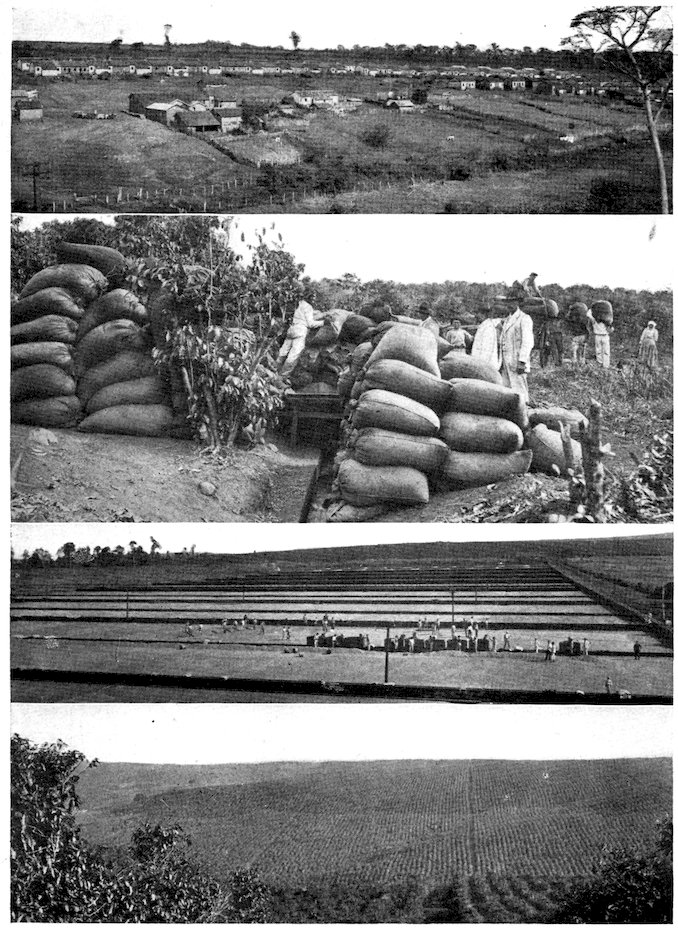
The S. Paulo Coffee Industry. Labourers’ houses; the coffee harvest; drying grounds; view of coffee plantation.
177When the round berries turn red harvesting begins. Men, women and children turn out, trained to strip the berries from the slender little branches without injuring the tree; the whole fazenda is in a bustle, the water-channels are racing with scarlet berries carried along in the stream, and the machinery house is noisy. When the berries are pulped and the twin beans freed and cleaned, the business of packing begins; day by day wagon loads of sacks leave the fazenda for São Paulo city, consigned to Santos, and thence to some country overseas. Brazilians appear to love fazenda life; the wife of a coffee fazendeiro will often take as keen and business-like an interest in the work as her husband does, discusses theories of planting with spirit, and will show you all the details of the new imported machinery. There is a true hospitality and geniality permeating the fazenda in Brazil; very large sums are often made, and while quantities of coffee money have been royally wasted on extravagances, there is a class of strong business men in plantation work who put profits into improvements, follow new ideas, and build up their estates from year to year in an admirable manner.
178It is in São Paulo, and especially about Riberão Preto, Campinas, São Simão, S. Carlos, Dous Corregos, Botacatú,—all along the lines of the fans of railroad—that the great coffee estates are found. The original Coffea Arabica has some naturalized children in Brazil of great merit and hardihood; the Nacional or Commun, the delicate Bourbon, yellow Botacatú, the big aromatic Maragogype, all have their defenders. From these plantations come the hundreds of thousands of tons of coffee that have made Brazil the premier coffee country of the world, and brought her to this eminence in a remarkably short space of time. The development of coffee culture in Brazil, and the simultaneous development of public taste for its essence, is one of the great industrial stories of the nineteenth century.
The interior of Rio State, with its endless series of little round hills crowned with coffee shrubs, is an assiduous producer; farther inland Minas Geraes substituted cotton with coffee when the United States began to sweep world markets with her product, but is now going back to cotton here and there as the demand of her own factories brings unheard-of prices for native fibres; she is however a regular supplier of coffee, in common with her neighbour Espirito Santo, and the more northerly state of Bahia. North of Bahia commercial production ceases, but, as in the case of cotton, shrubs may be seen all along the Brazilian littoral, up to Maranhão and Pará—of an African variety which does not need hilly country.
The world is steadily drinking more coffee. Consumption was only able to take ten million bags in 1885: the estimate for 1922 is 22 million bags. It is this 179reflection which preserves the fazendeiro from having nightmare whenever he sees a fine colheita promising. Increased sales of coffee seem to be partly the result of greater world demand for non-alcoholic drinks, but have been undoubtedly developed wherever a systematic propaganda has been carried out. São Paulo State went deliberately and level-headedly into the advertising and demonstration business; the campaign was first started in Great Britain, by the São Paulo Pure Coffee Company, which roasts, packs and sells good grades of beans. Numbers of cafeterias were established in which strong, hot, sweet Brazilian coffee was perfectly served. Later on the plan was carried to other European countries—notably France, Germany and Austria, all good customers of Brazil—to North America and even to Japan.
Recently the São Paulo Pure Coffee Company was acquired by the Brazilian Warrant Company, an enterprising house established in Brazil, with branches in São Paulo city, Santos, and Rio de Janeiro, and headquarters in London: a specialty is made by this company of advances against coffee, as well as sugar, cereals and general merchandise, while they are also commission and consignment agents. Exporters of Brazilian coffee are legion, but it is instructive to note how large a proportion of the names listed are Brazilian; coffee is not one of the businesses which the South American leaves to the foreigner.
Coffee accounts for forty per cent of all the Brazilian export. As far as S. Paulo is concerned, coffee represents over ninety-seven per cent of her exports. In 1915 the state’s total exports were worth a little over 180465,000 contos, and of this coffee was worth 453,000 contos. In S. Paulo city itself if one is not in business circles the predominance of coffee might escape the visitor but not so in Santos; here, in the coffee port, the apparatus of shipping has largely been constructed with coffee-loading as the aim: special mechanisms serve the ceaseless stream of laden coffee bags that arrive at the lines upon lines of armazens (warehouses) on the dock front. In the stony streets the scent of coffee prevails; at every doorway burly negroes are hauling out sacks of the aromatic bean; the cluster of banks down the main business street, some Brazilian and many branches of foreign houses, all live upon coffee. The dealers, commission men, shippers, roasters of coffee represent the commercial existence of the port.
The coffee industry is one which is a satisfaction to contemplate because it is a clean, wholesome business, from first to last; the conditions under which it is carried on are not only ably organized and in a prospering state, but the workers as well as the estate owners and shippers have a chance to make money and lead pleasant lives.
THE RUBBER INDUSTRY ON THE AMAZON
Rubber, the elastic gum bled from certain trees and shrubs, has been so long associated in thought with the sweltering, shadowy forests of the great Amazon river, that it is not a matter for wonder that for many years after Wickham made his famous experiments with rubber seeds, first in Kew and then in the East, both Brazilians and the general public paid little heed to the possibility of plantation rubber as a commercial rival of 181the Amazonian product. It was not until 1910 that manufacturers began to take plantation rubber seriously and to use it freely, and not until 1912–13 that production from these sedulously cared-for trees drew level with and surpassed the output from Brazil. Today, with plantation rubber offering something like one hundred and fifty thousand tons of crude rubber, and Brazil maintaining her average output of about thirty-seven thousand tons, the race would be a very uneven one if it were not for one factor, the wonderful resiliency of “hard fine Pará” which renders it unequalled in quality.
The two industries, that of Brazil and of Malaysia, are strikingly at variance in almost everything except the fact that they deal with extraction of the latex of hevea brasiliensis. In Brazil we have enormous areas of dim, sultry, water-bordered forest, where wild rubber trees are sought for amongst eighty or so other varieties of trees: where the labourer is, or at least imagines himself to be, a free agent, bound only by his debt to the central store, working when he thinks fit, living in a solitary hut without society, and making a little balance of profit at the end of the season if he is lucky; he buys all his necessities of food and tools in the dearest market in the world, and sells at the price forced upon the Amazon by the rival industry half the world distant. In the East is an organized industry operated by wealthy companies, where land was cleared, rubber planted methodically, hired labourers working under control, paid by the day, where the latex is coagulated in factories, milled into fine sheets, and goes to market in a form that does not bear outwardly any relation to the big black balls, smoke-cured in the seringueiro’s hut, 182sent out from the Amazon. Nevertheless it is the unorganized, unscientific industry which yields the product with the highest price on international markets, and, huge as is the deluge of plantation rubber today, there is no good reason why the Eastern and Amazonian industries should not continue side by side. Arabian coffee has not been commercially ruined on account of Brazilian production of coffea arabica.
There are in the world very many plants and trees yielding rubber of differing qualities. Three kinds of elastic gum are exported from Brazil in addition to the latex of the heveas: they are known as mangabeira rubber, from mangabeira hancornia speciosa; maniçoba, from the manihot plants of several kinds (euphorbias, and first cousins of mandioca); and caucho, drawn from the castilloa elastica tree. All these have their places in world markets, but, as also in the case of balata from the Guianas, and the gum of the guayule shrub in Mexico, it is not upon these rubbers that the great manufacturing industries of the world are based. That distinction belongs to the heveas, native dwellers of the deep, hot Amazonian valleys.
The elastic, resilient, waterproof properties of rubber were first discovered by the native children of the Americas, both in South and Central America and Mexico. When Hernan Cortés took his handful of conquering Spaniards into Mexico he found the Aztecs playing a game with bouncing balls made from castilloa, but during three centuries the Europeans visiting the New World did not dream of turning the gum to any utilitarian purpose. The first traveller who took recorded note of native use of rubber for water-proofing was the French scientist, de la Condamine, who came to 183Peru and travelled down the Amazon in 1743. He took specimens of what he spelled as “caoutchouc” back to Paris. In 1779 Priestly noticed that the gum would erase pencil marks on paper; small pieces were sold for this purpose, and as the chief supplies came from the East Indies (from the ficus elastica) the name India-rubber clung to the product. In 1823 Charles Macintosh found that rubber was soluble in benzine, and so led the way to its commercial adaptation—thinned out, spread into sheets, rendered amenable; the idea applied to waterproof coats immortalized his name.
In 1832 the Chaffee & Hoskins firm, founded in the United States, began manufacturing water-resisting objects, and thus laid the foundation of the present great rubber business in North America; their company, the Roxbury India Rubber Co., had in its employ a young man named Goodwin, and when this experimenter discovered that the gum would resist great extremes of heat and cold when sulphur was mixed with the solution, the process of “vulcanization” was the result, and rubber was made applicable to a score of new uses. Its great commercial employment dates from this time.
The Amazon valley began to send coagulated gum abroad: before this occurred, objects, chiefly high boots, were sent all the way to Pará to be water-proofed with a series of layers of the fresh latex. The industry was still in existence in the 1850’s, but died a natural death when rubber manufacturing got into its stride. It did not make this movement until large quantities of crude rubber began to reach world markets, and such amounts were not shipped until the Amazon received a great addition to its labour supplies. In 1877–79 184one of the terrible droughts that scourge the State of Ceará drove the populace out of the foodless region; hardy, daring, the Cearenses swarmed up the Amazon, into the reaches of the upper tributaries, into the Acre, searched the forests for seringueiras, and gathered a great harvest of latex. A little later the bicycle was invented and popularized, rubber tyres were called for in addition to the established demand from the boot and shoe trade, and rubber export became one of the big businesses of the industrial world.
The Amazon had shipped 31 tons in 1827; 156 tons in 1830; 388 tons in 1840. In another ten years she was shipping 1,467 tons; in 1860, 2,673 tons; 1870, 6,591 tons; 1880, 8,680 tons. Three years later she was sending over 11,000 tons, year by year adding about 1,000 tons until by 1890 the supply and demand came to 19,000 tons. It may be said here that up to the present demand has invariably taken the year’s supply; with great volumes coming from the Eastern plantations a surplus may occur, but with the present greatly stimulated demand such a condition is not yet in sight.
Steady rises in Amazonian production went on at the end of the century, and 1903 registered the receipt of over thirty thousand tons; when in 1906–07 the crop attained thirty-eight thousand tons output it had about reached its maximum with the quantity of labour available upon the Amazon. Production has fluctuated about this figure for the last ten years. It could be increased, if the estimate of 300,000,000 untapped trees in the deep interior forests is anywhere near the mark, to almost any amount; but the present production is the work of some one hundred and twenty thousand seringueiros, chiefly Brazilians, with some 185Bolivians and Peruvians, and there is no immediate prospect of labour supplies being largely augmented.
The sensational leaps in prices that have occurred in world markets since rubber became commercialized have brought great quantities of money to the Amazon; many fortunes rocketed to the skies, and there was a period when a golden flood flowed up the river as well as down, when Manáos, the rubber city of the riverine interior, displayed more luxury for its size than Paris, and the best diamond market in the world was in this remote spot. Anything sufficiently extravagant could be sold; a stream of jewels, silks, fine wines and foods, furniture, carriages, adventuring people and solid cash went up the Amazon, passing for a thousand miles nothing but the green matted walls edging the huge yellow river and an occasional palm leaf shack perched half in the water, and one or two trading points, to find their objective in the brilliant little mushroom town on the Rio Negro. There was one year when the yield of taxes from rubber to the public revenue of Amazonas was twenty-three thousand contos of reis, and this at an exchange of over £66 to the conto, means £1,520,000 or nearly $8,000,000. Practically the whole of this money was collected and spent in Manáos, then (1899–1900) a city of fifty or sixty thousand population—much of it “floating,” as its present reduction to about forty thousand demonstrates. It was in the golden period of Amazonian rubber exports that both Manáos and Pará clothed themselves in all modern civic graces; fine public buildings, well-paved streets, street-cars, good sanitation, water-supplies of unimpeachable source, electric light, and numbers of splendid private dwellings remain as a return for some of 186the floods of money earned by the gum of the deep forests. There was at the same time tremendous waste and an enthusiastic “graft” era, which has left a heavy burden of debt upon the Amazon. Numbers of unfinished buildings, some begun at great cost, still stand in Manáos, eloquent witnesses to the headlong gambling spirit that informed this city a few years ago. The Amazon refused to believe that any but temporary shadows could fall upon the rubber industry: there had been several periods of depression from various causes before plantation rubber loomed into view, but always “something happened to help the Amazon,” whether quickened demand or a fall in exchange which reduced local costs; now the European War is operating to stimulate American demands for Brazilian rubber, and to that extent faith in good luck is again justified, but the rubber-producing centres will need good works as well as faith if the present rewards, comparatively modest as they are, are to be maintained.
In 1874, and for some years afterwards, Amazonian rubber prices ranged between fifty-two and seventy-five cents (U. S. currency) a pound; between 1879 and 1880 there was a quick climb, due to the bull operations of a Brazilian syndicate which bought and held rubber. It was temporarily successful, prices during the last year of the ring’s existence touching one dollar and twenty cents and never falling below ninety-five cents, but in 1884 the bottom fell out, and rubber took a hasty dive to forty-eight cents—recovering, however, in the course of the next year, in response to demand for rubber tyres, to ninety-eight cents. For the next ten years rubber fluctuated about sixty, seventy and eighty cents, with new industrial uses developing 187in Europe and North America and demand always keeping pace with supply; by this time the total yield offered to the markets was about fifty thousand tons yearly, the Amazon supplying half and the rest coming from West Africa, Mexico and Central America. In 1896 the price rose, ranging between ninety cents and one dollar and twelve cents, and the Amazon boomed again as it had done twelve years before; Manáos, the terminus of ocean transportation and the central collecting point for the rubber of the upper rivers, bedecked herself in these rosy days. Five years later the failure of the American Crude Rubber Company, a distributing firm domiciled in New York, threw large stocks of the goma upon unready markets, and the price slumped. Rubber merchants upon the Amazon would have suffered more than they actually did had not the factor of exchange come to their aid; between 1899 and 1906 the value of the milreis oscillated all the way from sixpence to fifteenpence, and while to some Brazilian operations a low rate of exchange meant embarrassment if not ruin, it spelt salvation to the dealer in raw products. In 1906 exchange was fixed by the establishment of the Conversion Office in Rio, but by this time rubber was fetching such good prices that the Amazon was again basking in prosperity. The prices paid for Amazonian rubber during the period from 1903 to 1915 show the rise of the third great crest of rubber waves to the dazzling height of 1910, when the merchants who would have sold at seventy-five cents and made a profit found themselves with a dollar and a half, two dollars, two and a half and then three, without knowing why; money came like dew from heaven. In many instances it also melted as readily:
188
1903 78 to 1.13 cents
1904 94 to 1.30
1905 1.18 to 1.35
1906 1.22 to 1.37
1907 82 to 1.21
1908 67 to 1.24
1909 1.20 to 2.15
1910 1.50 to 3.00
1911 93 to 1.75
1912 93 to 1.30
1913 59 to 1.10
1914 49 to 1.15
1915 75 to 1.00
While the feverish drama of the Amazon was going through scenes typical of a gold-mining rush, the curtain was slowly rising upon another rubber scenario away over on the islands and peninsulas of Malaysia. Its movement passed almost unnoticed and unheeded by the very people who had most cause to watch it with alarm.
In 1871 an Englishman named Henry Alexander Wickham sailed from Trinidad up the Orinoco river, there studied latex-yielding trees and eventually made his way to the Amazon through the interior forests by way of the river Negro. His book of notes was published in London in 1872—Rough Notes of a Journey Through the Wilderness, with his own excellent drawings to illustrate his story of actual labour in the “ciringa” districts. In 1876 he was back again on the Amazon, with the idée fixe of rubber so firmly in his head that, going up the Tapajoz from Santarem, he filled his cases with seventy thousand seeds of hevea brasiliensis and carried them over to Kew Gardens in London. Here 189in carefully graduated hot houses the oval, mottled seeds were germinated, and in June of the same historic year Wickham was carrying his baby seedlings to Ceylon, believing that this island offered the climate most similar to that of the Amazon to be found under the British flag.
Two thousand nurslings were thus transplanted to the Spice Isle, lesser quantities going to Java, British Burma, Singapore and other points which appeared to offer the needed conditions for healthy growth. It was in Ceylon that the first young rubbers flowered in the year 1881; there is no earlier record of the blossoming of heveas outside their habitat in the Amazonian valleys. The resulting seeds were used to create new plantations, but the whole thing was still in a purely experimental stage; time proved that many saplings were planted under incorrect conditions, but the planters had nothing but theory as their guide; they cleared land—at great expense—kept it clean while the young plants grew, and waited; they did not know if the heveas would live, or that, living, they would produce latex coagulating into commercial rubber. Nor did the Amazon rubber dealers know it or believe it. When tales of Wickham’s enterprise came to Brazil a law was passed forbidding the export of rubber seeds, but this locking of the stable door after the loss of the steed was of no more avail than the subsequent measures promulgated to prevent export of the uricury nuts used for smoking the latex.
That the Amazonian industry could be duplicated in the East was not seriously credited. The thing was impossible! The plants would die; or if they did not die they would not yield latex; if they yielded latex it 190would coagulate into such wretched rubber that no market would accept it. Disease, blight, drought, would ruin the presumptuous plantations—something, in fact, must happen to prevent such an incredible, absurd event as rivalry between the famous and unique “black gold” of the Amazon and a plantation stepchild. The few people who spoke out about the danger were ignored.
While unbelievers still protested the deluge of plantation rubber began. In 1900, 4 tons of crude rubber were exported from the East; in 1905, 145 tons; in 1910, over 8,000 tons; in 1912, over 28,000 tons; in 1914, well over 71,000 tons; in 1915, nearly 107,000 tons. The output for 1916 is variously reckoned at 140,000 and 160,000 tons, from an area totalling about 1,350,000 acres in Ceylon, Malaysia, Dutch East Indies, India and Borneo.
When plantation rubber was first offered to manufacturers they were not greatly interested; it was taken rather grudgingly and at prices well below those paid for the black pelles of the Amazon to whose perfections and imperfections the industry was thoroughly accustomed. It was the artificial forcing up of prices in 1910 that sent manufacturers into the arms of the planters, for, while plantation rubber profited by the golden rain of that year, it did not attain the value of “fine hard Pará.” Today plantation rubber sent to the markets in sheets of creamy “crêpe” or clear brown gum is used for almost every manufacture demanding rubber; there are still some complaints that it is over-milled, that the treatment it undergoes takes the “nerve” out of it, and for this reason Amazonian rubber remains triumphant in certain lines requiring 191the highest resiliency—as, for instance, rubber thread. In spite of the preponderance of quantity of the plantation product since 1913 there has nearly always been a margin of price in favour of Brazil; during September and October, 1916, “fine hard Pará” fetched about seventy-five cents a pound in the New York markets while Plantation only brought sixty-five (due to shortage of Amazonian supplies through shipping difficulties as well as droughts upon the upper rivers which, impeding navigation, prevented normal supplies from finding exit); the difference in price is larger than is apparent, for reasons resulting from differences of preparation of the two products. Plantation rubber, product of an organized modern industry, is placed upon markets in such a form that the manufacturer can send it direct to his mills; the average amount of impurities contained in the sheets is less than one per cent. Amazonian rubber on the other hand contains anything from fifteen to forty per cent of impurities, which may include leaves, sticks and dirt due to sheer carelessness, or gums other than that of hevea, old nails, lumps of wood and axe-heads, deliberately introduced by the seringueiro to add weight to his pelle. Add to these considerations the cost of cleaning Amazonian rubber and the loss in time while this operation is performed, and it is plain that the manufacturer really pays a great deal more than the few cents’ difference of the market price for the Brazilian product; this money advantage might be largely retained by the Amazon if methods, not necessarily those of the East, but more careful and cleanly, were employed in coagulation.
The entire series of processes of Amazon rubber 192production, from the day when the matteiro clears a path in the forest from rubber tree to rubber tree, until the shipper boxes the split halves of the pelles in the armazem in Manáos or Pará, is in remarkable contrast not only to plantation methods, but to the system under which that other great Brazilian export staple, coffee, is prepared for market. It is the contrast between an industry that has evolved itself from methods first discovered by Indians of the forest interior, and another whose processes are mapped out on a preconceived plan. To this day the rubber dealers on the Amazon will tell you that they do not know the cost of production of a kilo of rubber; all that they or the collectors know with certainty is that it must necessarily cost less than the price at which the rubber is marketed—a smaller amount must be paid, and adjustment has to be made in the seringal, not in New York or London; with the inflated prices paid for every simplest necessity of life upon the Amazon, nearly all imported because the craze for rubber-collecting some years ago led to the abandonment of even such prolific crops as beans and mandioca, a time of stress falls most severely upon the people who are least able to bear it. Remedies for the ills of the Brazilian rubber industry have been suggested and demanded for many a year by the more far-seeing Brazilians; there is perhaps no better presentment of the subject than the paracer read to the Brazilian Congress in December, 1913, by Eloy de Souza, afterwards published in Rio under the title A Crise da Borracha (The Rubber Crisis); he speaks of the condition of “economic paradox” by which Amazonas “gave millions upon millions of gold without any part of this being used for the prosperity 193of the immense region where so much wealth was produced” and tells that when plantation rubber was looming in competition with the Brazilian product the authorities were entreated to arm themselves against the danger, but “the echo of these voices was lost in the wide desert of national indifference.” When the truth could be no longer avoided steps were at last taken, with nothing but the waste of enormous sums in the tragi-comedy of the “Defesa da Borracha” as the result: its failure was no fault of the men who constantly spoke out about conditions, such as Miguel Calmon, the Deputy, the journalist Alcindo Guanabara, Dr. Passos de Miranda, and the “genial and devoted Apostle of the Amazon,” Euclydes da Cunha.
Almost all of the people engaged or interested in the rubber business of the Amazon are agreed upon certain measures which should be taken to put it upon a sounder footing; they are, briefly:—
1.
Increased production of cleaner rubber, whether obtained from Amazonian plantations or by opening out new forestal wild regions.
2.
Reduction of living expenses of the rubber-collector, by increased Amazonian cultivation of cereals, beans, mandioca, fruit, vegetables, etc.
3.
Creation of a sturdier and larger labour supply, by rendering rubber regions healthy, improving living conditions, and thus inviting and retaining permanent dwellers.
4.
Reduction of export taxes imposed by the State authorities of the rubber regions.
The question of Amazon plantations is hotly debated. A few exist, and are living proofs of the fact that planted rubber kept clean of other growth yields 194latex at four or five years, at which time it is as large as a wild rubber twelve years old; but opponents of the system ask why they should plant “when Nature has already planted?” and declare that the best thing to do is to tap the latex of more of the reserves of the interior, calculated at three hundred million trees. Arguments in favour of this system include insistence upon the superiority of the latex from matured trees slowly developed in their native habitat, the chief reason of the high resilient quality of the Amazonian product; it is along the upper rivers of the Amazonian fluvial network that the “black” hevea is found most abundantly, yielding latex of the best variety, tough, elastic, resilient, and always fetching a better price than the fraca (weak) rubber from the latex of the “white” hevea, or the product of the “red,” which coagulates badly, and is listed as “entre fina” instead of “fina.” It is partly because the seeds which Wickham took from the Tapajoz in 1876 were of the “white” hevea brasiliensis variety, common in these lower regions, that the product of the plantations is more or less of the “fraca” quality; only a few hundred acres of the entire Eastern area under cultivation is planted with the fine “black” rubbers.
Can the untouched rubber regions of the upper rivers be opened up? The districts richest in seringueiras are frequently on the margins of these rivers, accessible by boat, but there are other areas thickly sown with the trees which, as in the Acre Territory, could be served best by a railroad line, such as has been projected to run across this region. Other plans deal with drainage of forestal areas, now rendered exceedingly unhealthy by their swampy, mosquito-breeding 195condition, and the introduction of immigrants accustomed to torrid climates. At present the working capacity of the collector is reduced from a possible two hundred and ten days, during the seven months of tapping, to an average of one hundred and twenty, chiefly as the result of sickness: he produces thus only about four hundred and fifty kilos of dry rubber, when under better conditions he could be expected to market about seven hundred kilos.
A few years ago Dr. Oswaldo Cruz, a Brazilian authority on tropical diseases, made a report upon the health conditions of certain Amazonian regions and those traversed by the Madeira-Mamoré railway: he said of Santo Antonio that there are “no natives of this place; all children born there die,” and that here (its ill-fame is not unique) “the region is infected in such a manner that its population has no conception of what good health means; for them the normal condition is sickness.” Brazilians born are as much subject to disease, it appears, as strangers, for among the workmen employed in the construction of the Madeira-Mamoré line ninety per cent of the natives of Brazil and seventy-five per cent of the foreigners were weakened by hookworm. Sharp changes of temperature in some districts, producing a devastating pneumonia; dysentery; beri-beri, and the worst and constant scourge, malarial fever, haunt certain of the interior regions: until a better medical service is established, and measures taken to render the country more healthy through engineering work, and through field cultivation, an increase of permanent dwellers in the deep rubber regions cannot be expected. Until then Amazonia can scarcely be other than what Eloy de Souza calls an 196“invaded region” which has been subjected to a “social phase of pure conquest.”
Cheapening of living expenses can be done just as soon as the fertile Amazon valley again supplies enough food for its population: there was a time, between 1886 and 1891 when the cereals grown sufficed for needs; today, with the threat of falling prices for the precious goma, cultivation has been resumed to an extent which is encouraging, but only a year or two ago Pará, Amazonas and the Acre were together importing beans, rice, and sugar to the value of 11,346 contos (over three million dollars); dried meat (xarque) to the value of 7,400 contos; bacalhau (dried cod), 846 contos; live cattle, 2,000 contos; tobacco, 1,000 contos, and conserves costing 2,600 contos, among other importations. Almost all the above list could be filled from Amazonia if the rubber-collecting fever, relaxing, permitted the development of other industries.
The price paid for many articles of prime necessity upon the Amazon is fantastic. While such rates are maintained it is a matter for admiration that Amazonian rubber can be placed upon the markets at all, in competition with the plantation product; it can only be done by the reduction of the seringueiro’s earnings to a minimum, and this will eventually lead to his extinction if conditions are not remedied. The following is a list of what are considered the chief articles needed by the collector for his lonely sojourn in the forests during the gathering season, with prices in milreis:—
197
Price in Rio In Pará In the Acre Price to Rubber-collector
5 alqueires of farinha[12] 20 27$500 100 175
40 kilos of sugar 14 26 45 80
25 kilos of coffee 24 25 34 100
128 kilos of lard 16 20 36 100
50 kilos dried meat 40 40 77 150
50 kilos of feijão (beans) 12.500 15 51 100
16 pounds of tobacco 11 22 53 120
5 gallons of kerosene 4 4 11 30
Half-sack of salt 1 1$500 8 15
40 kilos of rice 20 20 36 100
Half-case of soap 3 4 11.500 20
30 litres cachaça (rum) 15 15 46 105
3 boxes cartridges 24 30 33 45
Medicines, clothes, etc. 120 130 180 250
Total 324$500 380$ 721$500 1.390$
The price of an outfit for the season thus varies from about 324 milreis in Rio to 1390 milreis in the forest, or between, say, 80 and nearly 350 dollars.
If the collector in the course of his season’s work produces four hundred and fifty kilos of rubber, worth, at a good price of about five milreis, 2:250$000 (two and a quarter contos, or about five hundred and sixty U. S. dollars at 1916 exchange), he has left only seven hundred and fifty milreis to carry him through the rest of the year, and to support his family back in Ceará: but even this modest sum is reduced by the river freight of the rubber before it is marketed at Manáos or Pará, three hundred reis per kilo; rent of the seringal, commission to the aviador, and frequently freight of the pelles from the interior of the forest to the water, which items are likely to add up to another four or five hundred milreis.
Denunciations of the “truck” system, and the prices 198charged to the rubber collector are common; but the supplier of foodstuffs, etc. (the aviador) himself takes long risks and is bound to insure himself against them. His customer (aviado) may become ill and unable to work; he may die; he may, if he can elude the river guards and traverse the steaming interior forests, run away, although in these regions where the river is the only highway, this does not often happen. Also the price of rubber may drop—rubber has been a business so speculative that it has become a gamble in which the aviador, himself caught in a deeply-rooted system, takes long odds. He makes money nearly always, and the ownership of much of the great areas of Amazonian rubber forest has passed into his hands, but he is scarcely to be blamed for securing his profits in the manner decreed by the system; to change the industrial routine would be to effect a revolution upon the Amazon.
The approach of the dry season upon the Amazon heralds the incoming from other northern regions, generally Ceará, of a host of workers. Anyone who has travelled on the steamers going up the river at the beginning of the rubber season has looked down upon the deck where throngs of people are herded together, their hammocks slung in tiers one above the other; at times of drought whole families come out from the “distritos flagellados,” and men, women and children are crowded in an intimacy which would be more trying than it is were it not for the apparently unfailing good-nature and mutual courtesy of these northern peasants. Much of their simple cooking, washing, and toilet changes are perforce unsheltered; gentle, easily amused, they never seem to complain, but, playing their inevitable 199guitars and singing their modinhas, they watch the yellow flood of the great river, bordered with the line of distant forest, so vast that ideas of size are lost in its sweeping monotony. Arrived at Manáos the collector goes to the store of the aviador, gets his outfit of tools—cups for collecting latex, big knife (machado), little axe, bucket, and metal cone for smoke-regulation in the coagulating process—as well as food and such clothes as he may need, possibly adding a gun, and when the cost of his lodging has been added to the bill, he may set out in one of the gaiolas that ascend the upper rivers, en route to the seringal where he has arranged to work. An average seringal contains fifty estradas; to each seringueiro (collector), two estradas are allotted, tapped on alternate days and each estrada (literally road or walk) contains, in a good seringal, an average of seventy to one hundred and twenty trees. Before the seringueiro does a stroke of work there has been a heavy outlay by the owner (patrão) of the estate for its preparation. Forestal opening is done by the matteiro, the expert forester whose work is probably better paid than any other manual labour of the Amazon; it is he who enters the wild forest, locates the rubber trees within a given area, and makes paths from each seringueira (rubber tree) to the next in the central part of each estrada, always ending by cutting an encircling road which runs all about the estrada. On this outer road the rubber collector usually builds his little hut—“more of an oven than a home,” says Eloy de Souza—of palm thatch, and the tiny smoking room (defumador) where each day’s supply of latex is coagulated.
The work of the matteiro is paid according to the number of rubber trees found and prepared for tapping; 200he gets about the equivalent of one dollar for each tree; Woodroffe reckons that in the cases when the patrão of an estate has advanced money for the steamship fares of his imported labourers, advanced food and equipment, and paid for preparation of the seringal, each man represents an outlay of “quite £100 by the time he stands up under the trees to tap them.” It must not be supposed, therefore, that because rubber is wild upon the Amazon that it costs nothing to collect it; on the contrary in spite of the lavish hand of Nature expenses in the wild regions of South America are far higher than they are in the East, where land has been cleared and each sapling patiently planted and tended.
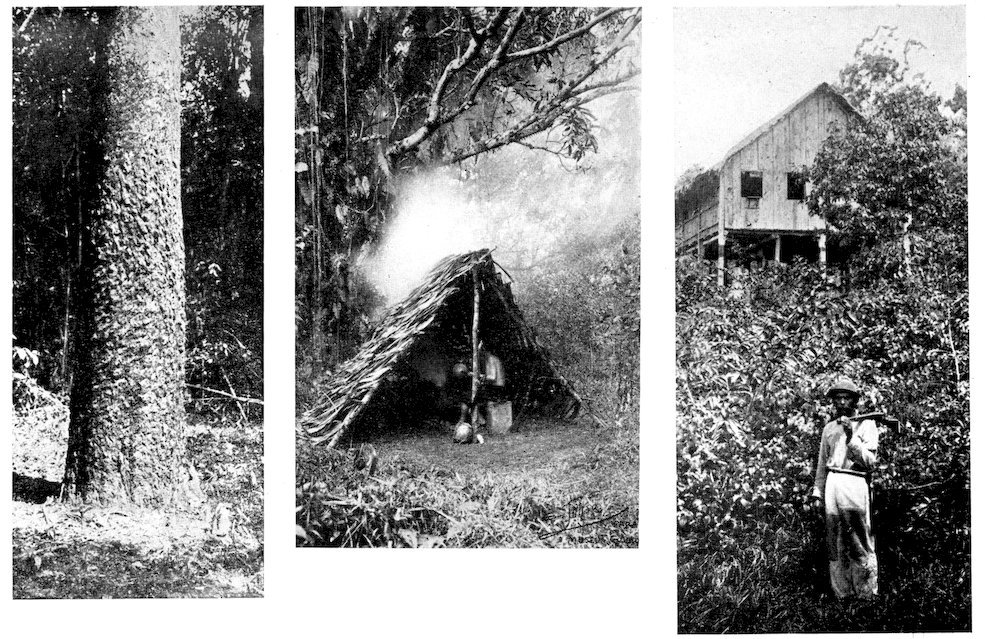
Rubber on the Amazon. Hevea brasiliensis tree, scarred by tapping. Smoking the day’s collection of latex. Hut of the Seringueiro.
201The seringueiro has no easy life. He gets out of his hammock before dawn, and with his lantern fixed to his head makes his way through the forest, laden with his little machadinho, the universally used and abused axe with which the trees are gashed, with the big knife, the machado or machete inseparable from the Central or South American, and perhaps a gun in case any edible animal of the woods is encountered. As each tree is reached it is hastily gashed, a little metal cup (tigelinha) fixed below each wound to receive the milk which immediately runs out; when he returns at last by way of the outer path to his hut it is past six o’clock and quite light. If he has a family with him, his senhora has prepared his coffee, but if as is usual he is alone he will now light a fire, drip his coffee, prepare a little food, and smoke a cigarro. Later in the morning he must make a second round, if the milk is not to coagulate in the cups; he takes his bucket (the balde), tips the contents of each little cup into it, carefully inverting these on sticks at the foot of the tree, to prevent the clotting of drippings and the invasion of insects. When he returns he may have four or more litres of milk which must now be coagulated in the defumador; the process may take half an hour or over two hours, according to the amount brought in and the quality of the latex. A fire is made with nuts of one of the attalea palms, generally “uricury,” which give off a remarkably acrid smoke with properties for rendering the rubber just what it should be that are the despair of chemists: no substitute has been found that equals it. A metal cone a couple of feet high is placed over the well-started fire, to bring the smoke into a narrow channel at the top; the seringueiro takes a prepared piece of wood, dips it into the bucket of milk, or pours milk over it with the cuia (little bowl made of a half-gourd) and holds it over the smoke. The milk coagulates instantly, turning pale brown on the outside; layer after layer is added, a skin at a time, until all the latex in the bucket is coagulated. It may be late at night before the seringueiro has finished his work, for in the course of the day he has walked anything from six to ten miles, and every part of the operations has been performed by him alone. It is fortunate that his housekeeping work is limited to the preparation of his food: practically the only furnishing of his hut is his hammock.
To produce a pelle, the big black ball which may be seen in Pará and Manáos on the wharves, in warehouses, on the pavements, whole or sliced in halves with their creamy hearts displayed, or floating down the tributary rivers on rafts, the seringueiro has to work for about a month. Each day’s collection of latex is coagulated on top of the previous rubber until the ball is made to what the seringueiro thinks is a convenient 202size. Day after day, only interrupted by sickness, he labours in the sweltering forest at this toil, eating food of very limited variety, without exchanging a word, perhaps, with another human being for weeks at a time; each seringal is supposed to be under inspection, to avoid maltreatment of the trees, but as a rule this supervision is a fiction. Small wonder that when the collector at last leaves the seringal, and takes his rubber to Manáos, he spends a few riotous days, limited by the amount of his money balance remaining after the debt has been paid to the aviador. The aviador it is who also buys the pelles and in the busy season when rubber begins to come in, these stores present a curious sight. Sometimes the seringueiro, in good years, saves money; he may buy a seringal or a little store of his own; a few fortunes have thus been made from the collector class, but they are rather the exceptions that prove the rule.
These conditions, under which a nominally independent collector works in a rented estrada and sells his rubber to the store-keeper to whom he is in debt—and who is often also the owner of the seringal—are general as regards the collection of the latex of the “black” rubber trees of the upper Amazon. This is the origin of the fina class of rubber, with sernamby or scrap as a kind of by-product, result of carelessness; the fina, however, is usually at least eighty per cent of a good workman’s product, and this is the rubber which, with caucho, has made Manáos.
Caucho is rubber produced from the milk of castilloa elastica, growing in profusion along the banks of the Rio Branco, tributary of the Negro, in North Amazonia and on many streams of Peruvian origin; the industry 203connected with this tree is really independent, the result of individual searchings for trees. Parties go up these rivers, hunt in the bordering woods for the castilloa, straightway cut it down and bleed it for the last drop of latex, and go on their way.
Down near the mouth of the Amazon, where the “white” rubber trees are most commonly found, it is not unusual for collectors to own sections of forest with their little homes at its edge; they, too, are almost independent—of everything except the industrial conditions upon the Amazon, and the rubber prices fixed far away in London or New York.
Nearly all South American States depend upon export and import taxes for their main revenues, and it is a fairly general rule that native products leaving the country pay heavily for that privilege. In Brazil all import dues are imposed and collected by the Federal Government, and are similar throughout the country without respect to the special conditions of separate states; the export taxes are imposed by the State Governments, without restraint. In some regions the “pauta” or export tax is changed every week or so in conformity with prices in world markets, a board sitting specially for the purpose of making these constant adjustments. Some Brazilian products are taxed to what may be called a reasonable extent, but in others exports have been bled out of existence, while still others are barely able to enter world markets, staggering under their load. How many exporting countries would put upon a product facing competition abroad a tax equal to one-third of its value? This is the weight with which Amazonian rubber went to market for many years: the combined charges of the 204State, municipalities, and other smaller items added up to over thirty per cent of the “official value” of the product.
In response to appeals, export taxes were reduced after the outbreak of the European War, and during the year 1916 State taxes, together with dues put on by cities, amounted to about twenty per cent of the value of the rubber—a sufficiently heavy burden, but which Amazonas proposes to increase again; at the same time the product of Matto Grosso pays only twelve per cent, an equal amount is imposed upon rubber originating in the Acre Territory, while that exported from Bolivia, Peru and Colombia, but finding its exit by the water highways of the Amazon, pays only five per cent. As a result of these lesser dues collected by sister countries, there is a certain amount of smuggling done: rubber originating near the boundaries is passed across, and exported as if coming from one of the three Republics named; that such evasion of taxes is limited is due to the lack of roads or of any communication means besides those of the rivers, all of which are watched by Government agents. At the same time that the Amazon imposes this burden upon her rubber, the Eastern (Plantation) product pays nothing at all when the market price is below 18 pence—say thirty-six cents—a pound, and when it stands above two shillings a tax of two and a half per cent of the value is paid.
Consumption of the entire supply of marketed rubber was, immediately prior to the European War, almost evenly divided between North America and Europe: one of the industrial adjustments made after 205hostilities began was the shifting of a larger share of rubber, and rubber manufacturing, to the United States, so that in 1914 she took fifty per cent of the marketed total, one hundred and twenty thousand tons, and in 1915 increased these purchases to nearly sixty-two per cent of the total marketed, or ninety-seven thousand tons out of about one hundred and fifty-eight thousand.
Distribution of the world’s crop in 1915:—
United States 61.5 97,000
Great Britain 9.6 15,072
Russia 7.6 12,000
France 7.2 11,500
Italy 4.8 7,500
Germany, Austria 3.8 6,000
Canada 2.5 4,000
Japan and Australia 1.6 2,500
Scandinavia 1.4 2,252
The course of the next few years may see Brazil herself on the lists as a rubber-consuming country. For fifty years she has exported rubber, crude, and such manufactures of rubber as she has used have been imported from the United States or Europe; she imported in 1915 about six hundred and eighty-three tons of rubber manufactures, chiefly tyres, worth a million dollars, which was less than the imports of 1913, and which might show greater diminution if the unfortunately conceived law intended to protect “fine hard Pará,” but which resulted in paralyzing rubber imports, were sustained. This alteration in the tariff, operating early in 1915, changed the old import tax of five per cent ad valorem to a scale with violent differences; 206rubber manufactures made with the Brazilian product were charged one hundred reis a kilo (a fraction over two cents U. S.) while articles made with foreign rubber were taxed ten milreis (say two dollars and sixty cents) a kilo.
An excellent idea, warmly applauded; but when the time came to apply the law it was found impossible to discover the real origin of the rubber, and in order to avoid any chance of letting in foreign material practically scot free the official valuers charged all entering articles at the high rate.
Thus a consignment of two hundred pneumatic tyres which under the old law would have paid about 2:200 milreis in duties for entry were under the new tariff charged 22:000—or let us say about $5,500 instead of the former $550, for import taxes alone. Needless to say, importing houses left rubber goods in the customs-houses while they appealed to the authorities for relief from this too paternal measure. Some of the Amazonian rubber merchants have defended the idea, which is good enough in theory, but in practice it seems to have been as little useful as that extraordinary commission charged with the Defesa da Borracha, which in the years 1912–14 spent about twenty-eight thousand contos of reis (over $7,000,000) in salaries, investigations, recommendations, experiments and printed matter, and has today not an iota of improvement of Amazonian conditions to show for the money.
Brazil has a few rubber factories of her own, generally small, but doing a satisfactory and increasing business; the Brazilian Government has also concluded an arrangement with the Goodyear Tire Company for the 207erection of a factory which should greatly increase national rubber manufactures. The first modern rubber factory in Brazil was established in São Paulo State, in 1913, by Theodore Putz and Company, where solid tyres, tubes, stamps, valves, and other articles are made; it has a capital of two hundred contos and an annual turnover of three hundred contos, paying twenty-five contos a month for labour. Five hundred kilos of Pará, and one thousand kilos of mangabeira rubber are used monthly. Another firm of recent origin is that of Berrogain & Cia. in Rio, turning out a variety of manufactures and prospering.
The future of rubber production is a question frequently discussed. It is not immediately probable that the Brazilian output will greatly increase from its average of twenty to thirty thousand tons, not only because more labour is not as yet available, but also because the untapped resources away from the easily reached river banks can scarcely be reached without large outlays on roads, drainage, and other expenses connected with opening-up, which are not more than planned for the time being. Plantation rubber has not yet reached its expected maximum, but no very great areas have been added since 1911, and it is reckoned that with an average yield of four hundred pounds an acre the world’s output will in a few years place from three hundred thousand to three hundred and thirty thousand tons of dry rubber on the markets. Demand by the year 1930, if it kept up at the same ratio as the last five or six years, would require a great deal more than this, no less than three hundred and seventy-three thousand tons of rubber. This will not occur unless automobile sales in the United States keep up also at 208the same rate (tyres for this industry already take over 100 thousand tons of rubber) but even with a diminution in the increase there appear to be good prospects ahead for the rubber industry: Germany, for instance, will be demanding crude rubber in great quantities when the European War comes to an end, for in spite of the ingenuity of German chemists it is plain that synthetic rubber is not a success. If it were anything like a substitute for the real thing the Central Powers would not have made such constant efforts to obtain even small quantities of the precious gum through the blockade of the Allies. The war has definitely disposed of that spectre. Synthetic rubber requiring a base of a special turpentine is said to be produced at a cost four times that of the gum of the hevea, and that figure alone would dispose of it as a commercial possibility, apart from the limitation of turpentine supplies, the need for mixing the solution with real rubber, and the practical demonstration of its unsatisfactory quality.
PACKING-HOUSES, MEAT EXPORT, AND CATTLE RAISING
The meat business is not a new one in Brazil, for her cattle raising states have had a surplus of beef animals ever since the first donatarios sailed out to take possession of their strips of coast, and brought seeds, saplings, ducks and chickens, goats, horses and cattle along with them: the cattle throve, soon ran wild in the interior, and becoming modified by natural selection developed national types which are today quite distinctive although their European origin is recognizable. The first cattle were shipped to Brazil to the Capitania of S. Vicente in 1534 by Dona Anna Pimentel, consort of the 209first captain, and manager of the interests of the colony during his absence in India.
Brazil has thirty million head of cattle. That is to say, two or three million more than the Argentine possesses. But her herds are only worth a fraction of the Argentine value because the stock is poor, some of it thin and scrubby, with but one steadily developed type of first-class quality. The scientific breeders of Brazil—and there is quite a list of them—have lacked a reason for developing their work until recently. In the absence of the packing-house there was no demand for beef beyond that of the matadouros (town slaughter-houses) and the xarque factories. For the xarque makers any class of animal would serve: a Hereford of pure blood would bring no more than a zebu unless he happened to weigh more.
Xarque making is the ancient meat-drying industry, invented by who knows what hunter in bygone ages; it is the biltong of Africa, the tasajo of the Argentine, the jerked beef of the North. Well salted and dried, it is good food enough, and France did not disdain to buy it from Brazil for the use of her troops in 1915–18. The southerly states of Brazil are the great supporters of cattle stocks, and there are the extensive beef-drying factories; Rio Grande slaughters over half a million head of cattle for this purpose every year, the number rising to its maximum in 1912 with nine hundred thousand head, and chiefly ships the xarque produced to other Brazilian regions; it is the carne secca of that beloved Brazilian dish, the feijoada, eaten all over the Union. The coastal and northern regions of Brazil, comparatively poor cattle regions, are so much dependent upon dried beef imports that the xarque industry 210should have a ready market in the future as in the past: but since 1914 a rival has risen up seriously threatening the old industry in prestige.
Almost simultaneously two packing-houses, both in S. Paulo State, began demanding cold storage space in vessels calling at Santos, and refrigerator cars on railways leading to the port. Brazil, to the astonishment of the markets, was offering chilled and frozen beef. At any other time she might have received a welcome less enthusiastic, but her offer came at a time when Europe needed every pound of meat for army use; the Brazilian product was tested by Smithfield standards, found good, and today has its place in overseas meat markets. It is a modest place, but today beef is taking its stand among the “principaes artigos da exportação”—hides have long stood in the list of thirteen favoured names—although the end of the war diminished overseas demands.
During 1915 shipments were made in increasing amounts month by month, the total for the year reaching about 8,514 tons, with a value of 6,122 contos. In 1916 shipments rose to nearly 34,000 tons; in 1917 to over 66,000; but sales decreased after the close of the war, when contracts for supplying troops in the field ceased, and markets closed in the slump of 1921.
The first frigorifico of Brazil was built by Paulista enterprise with Paulista capital, in the far north-west of São Paulo where the best pastures extend. The Companhia Frigorifica e Pastoril built its plant near the terminus of the Paulista Railway, at Barretos, and is headed by Dr. Antonio da Silva Prado, an energetic builder-up of his State and a man with many honours and interests. Opened in 1913, the frigorifico first 211supplied chilled meat to the city of S. Paulo; export was not seriously considered until the war in Europe began with its demands upon world food supplies. The first Brazilian shipment of exported meat was sent to England in November, 1914, an experimental ton and a half. During the ensuing year that country took four thousand, three hundred and sixty tons, Italy over two thousand tons, and the United States nearly the same quantity.
The figures displayed a steady rise all through 1915, January’s ten tons being quickly outclassed by April’s two hundred and ten and June’s over five hundred and seventy tons; by November Brazil was shipping two thousand tons a month. The standard was more than maintained as time went on cattle raisers improving animals for sale to meet demands, and proving the fattening quality of Brazilian pastures. But until after the close of 1918 little blood stock could be imported, and in 1922 an expert calculation gave 12% as the proportion of fat cattle in Brazil.
The output of Barretos was speedily rivalled. In May, 1915, another packing-house started operations, at Osasco on the outskirts of S. Paulo city. It is the property of the Continental Products Company, capital and personnel originating in the Sulzberger house at Chicago, and it is independent of, but has friendly relations with, the Farquhar group of interests, which include large railway control and a thriving land and cattle company.
The Osasco plant is, like Barretos, an excellent specimen of its class, operating with fine up-to-date machinery and all modern packing-house devices; on the edge of S. Paulo city, separated from the railway only by 212a strip of open grassy country, this establishment has the advantage of a short haul for its meat. The São Paulo Railway has to carry the product but fifty miles to Santos port. On the other hand, the Barretos plant’s position has the advantages of being in the heart of the best cattle country, and of getting both animals and labour at low prices; the journey from Barretos to S. Paulo, by the Paulista line, takes about fourteen hours. Brazilian employees are used at both packing-houses, the industry occupying about a thousand workmen. During 1916 a third frigorifico was opened, on the docks of Rio de Janeiro, but this chiefly performs cold storage functions, and before the close of 1919 ten packing-houses were in operation or building. General world depression in 1921 was responsible for the closure of most of these establishments for more than local demands. Few complaints have been registered in regard to quality so far; the Brazilian beef is on the whole smaller than that to which the meat markets are accustomed, and it was found that the quarters did not fill the space allowed for similar Argentine and Uruguayan meat when shipping first began. Dr. Prado says that the average weight of beeves slaughtered for export during the first year of operation at Barretos was only two hundred and eighty kilos. But this small, fat-less meat has a superior flavour—as anyone who travels in South America knows well.
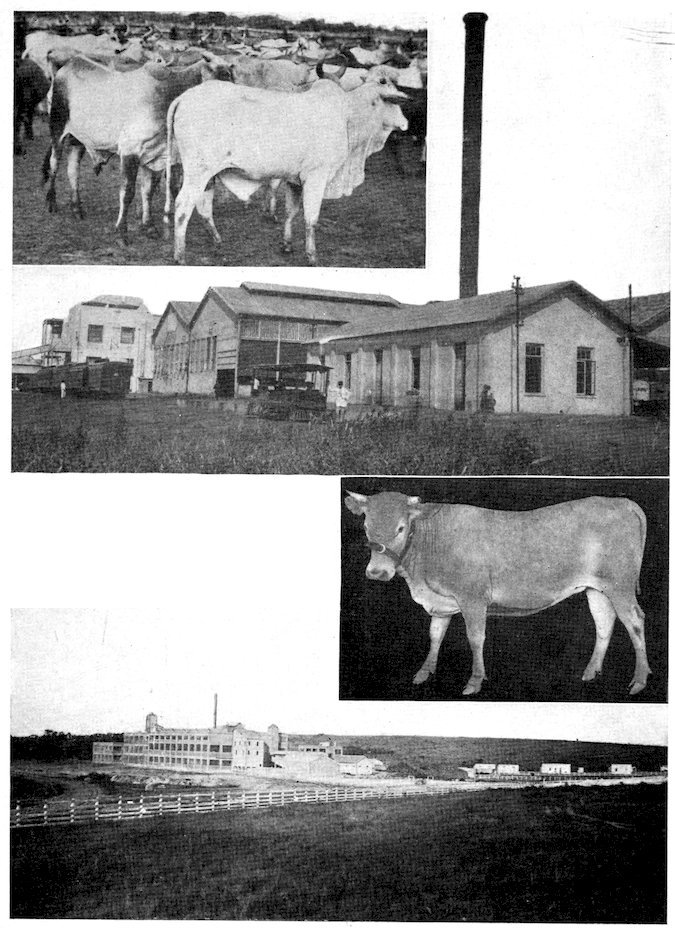
The Cattle Industry. The two frigorificos (packing-houses) in operation, at Barretos, top; at Osasco, below. Also humped “zebu” cattle of Indian descent, and, lower, a calf of native Caracú stock.
213It is generally reckoned that ten per cent of a cattle herd is fit for the slaughterhouse: but Brazil cannot offer three million of her existing stock to the yards. She has too many varieties, probably too much of the humped breed derived from Indian ancestry, although it has warm defenders, and there is a conspicuous lack of young fat cattle. As an example of the speed with which poor stock may be improved by good, unified methods, there is Brazil’s neighbour Argentina, a country which thirty-five years ago had less than nine million head of cattle, and these of a breed inferior to the Brazilian average today. Setting about her task methodically, Argentina created a complete transformation in the character of her herds, and while exporting great quantities of meat at the same time increased her stock so largely that by the year 1910 she had thirty million head. Sums spent on breeding stock were enormous during this period: in 1906, the banner year of importation, Argentina purchased (almost exclusively from Great Britain) 2,450 pure-bred cattle, 7,500 thoroughbred sheep, and one thousand blood horses. As a result she has animals today which take prizes side by side with pure Herefords and Durhams; the average abattoir price for steers is about two hundred Argentine pesos, or say eighty American dollars; she is able to record the sale of thousands of splendid creatures, amongst them a champion bull bred on her pastures which brought the price of thirty-two thousand dollars in United States currency. Today Argentina has more herds of thoroughly pure stock cattle than any other country in the world; estancias full of animals of fine blood, so much alike that to see them in endless lines, with white star on breast and head, is like looking at a concrete arithmetical calculation, are handed down as inheritances. Yet when the Argentine began her work she had no such advantages of modern invention as lie to the hand of Brazil; cold storage was not commercially developed, packing-houses were immature. She had to face the competition of the United 214States, and world markets were not educated to the reception of South American meat. Now cold storage is an art, steamers are fitted with refrigerator space as a matter of course, South American meat is welcome on world markets, and the United States is no longer taken into consideration as a rival meat exporter.
In 1901 the United States exported 352,000,000 pounds of beef; in 1910, 76,000,000; in 1914, only a little more than 6,000,000 pounds. Argentina had caught up with her North American sister in 1905, passed and out-distanced her until she was able last year to say that her only serious competitor was Australasia. It is true that the European War has caused a revival of meat export from the United States, but home demands are today so acute that no more than a temporary reaping of high prices is at the bottom of the movement. Argentina may look for a more formidable, because a younger, rival, nearer to her northern border.
The qualifications of Brazil as a future land of fine cattle are three in the main: first, her possession of an existing rebanho of 30,000,000 head; next her natural pastures and good climate which permit stock to remain in the open during the winter; third, tremendous expanses of suitable lands at moderate prices. Argentina has no natural pastures; she sows alfalfa, needs five acres of it to fatten one animal for six months and is thus at an expense of $7.50 for this purpose against Brazil’s outlay of rather less than three and one-half dollars, counting the value of the five acres of alfalfa land at three hundred dollars, the cost of twelve acres of Brazilian capim gordura at one hundred and thirty-three dollars, and interest on the two investments at five per cent. In regard to available 215territory there is no comparison; Brazil’s one state of Matto Grosso could swallow the whole cattle-raising country of the Argentine, without taking into consideration Goyaz, Minas Geraes, S. Paulo, Paraná or Rio Grande do Sul.
Space and climate, however, are not all that goes to make a cattle country fattening fine stock, and it need scarcely be said that much must be done before the cattle lands of Brazil can seriously compete with those of the Argentine: the time is not yet ripe for the wild pastures of Goyaz and Matto Grosso to fatten cattle in the same proportion as Rio Grande State. This state, with an area of two hundred and thirty-seven thousand square kilometers feeds about nine million head of cattle, a remarkably good showing in comparison with the premier cattle province of Argentina, Buenos Aires, which, with a superficial area of not much more than 305,000 square kilometers, feeds seven and a half million head.
Pastures are not—except by careful fazendeiros—planted in Brazil because there happens to be a gift of nature in the way of natural grasses, the capins of the sertão. Some of these are good, and some would feed nothing but a goat. Brazilian stock-raisers who combine earnestness with capital plant their own best grasses and appear to get satisfactory results, while I have also seen some interesting experiments made with “Soudan” or other of the wonderful varieties of grasses with which Africa is endowed. For lack of interior pastures the cattle of Brazil are periodically brought on foot for distances which may vary from a hundred to six hundred miles; many die by the way, and the unfortunate beasts are mere skin and bone 216when they arrive in the good grass country. On the São Paulo side of the Paraná river are some of the finest natural pastures of Brazil, but in many parts of the São Paulo uplands, interior Rio, Paraná, Santa Catharina, and Rio Grande, admirable cattle lands are to be seen. Rio Grande, especially towards the Uruguay boundary, is one of the most delightful grazing regions imaginable; Minas, too, shows some fine lush green grass lands, with the special advantage that cattle need never be put under shelter in the mild winter which visits this region. The good grass lands of Minas and interior São Paulo are frequently at an elevation of 1,400 feet, on the sloping plateau which is densely wooded near its dips to the rivers, and which is on the wide uplands covered with light matto alternating with sturdy native grass. It is not unlike the high veldt of the Western Transvaal in appearance, with the same exhilarating freshness, light and space, and the same miracle of nature performed immediately after the rains, when every inch of ground is covered with little dancing flowers and every bush is transformed into a nosegay.
Brazil possesses half a dozen technical breeding “posts” maintained by State or Federal Governments, but their number is insufficient to attack the work needed, and needed quickly; private enterprise must and does supplement government labours, but there is room in Brazil for scores of expert cattlemen with knowledge of semi-tropical conditions. Three-fourths of the State of Paraná, all Santa Catharina and all Rio Grande do Sul are below the Tropic of Capricorn, but although the great sertões of Brazil are inside the 217tropical belt, the effect of this latitude is partly nullified by the height of the plateau to which the largest area of the country attains.
One of the best breeding stations in Brazil is situated at the good, modern, actively-managed School of Agriculture at Piracicaba, in S. Paulo State, reached by the Sorocabana line; good imported bulls are stationed here, as well as some fine specimens of types developed in Brazil, notably the Caracú, a well-formed animal with a pale buff hide that is well fitted to form the base of standardized herds. The Caracú already has its official herd-book. Some attempts made to introduce pure blood foreign animals have ended in the death of the importations, perhaps chiefly because their accustomed food was lacking; for this reason the opinion of many stock-raisers in Brazil is against efforts to create pure herds of, say, Herefords, as Argentina has done, preferring the selection of a sound national type, acclimated, hardy, which can be improved by careful breeding. Controversy rages about this question in Brazil, and without trying to enter into it I will quote the opinion of Dr. Cincinato Braga, one of Brazil’s authorities on the subject of cattle, who says that at least six thousand pure-race bulls should be imported annually to improve the existing stock, while as a matter of fact only a few hundred enter yearly, and these chiefly as a result of private enterprise. The vexed question as to whether the introduction of Indian cattle, with its resultant inheritance of a hump in the zebu type (the hump has the disadvantage of not “packing,” say some of the buyers for frigorificos), is good or bad may be safely left to those ardent cattle-breeders Drs. Pereira Barretto, Eduardo Cotrim, Assis 218Brasil, Fernand Ruffier, and many others; it is undoubted that in the Triangle of Minas Geraes, with its centre Uberaba, fortunes have been made from prolific Indian cattle, but public opinion remains perplexed. Writing from Minas in early 1916, J. Nogueira Itagyba told the tale of his experiences as a cattle-breeder—how he imported a bull from Holland, bought Caracú cows, obtained a young herd, and then when droughts came in 1913–14, lost “thirty or more head, under a deluge of ticks, tumours, insects of all kinds....” He then bought a Nellore (Indian) bull, obtained a breed that was “a revelation” and came to this conclusion: “In Paraná and Rio Grande, where the climate is cold and there are fine pastures, a stock breeder with capital can raise the Devon, Hereford, Flemish, Durham, Jersey, etc.; he will have appropriate forage, and can use dips and calf-foods ... but in wild rural regions only strong, acclimated races resisting climate and insect plagues can prosper.”
Until the development of the meat industry for export Brazil sold nothing abroad as the product of her vast herds except hides, just as in the early days of Texas when only the skins of her cattle were worth anything. Today the cow-hide leather industry of North America in particular is largely dependent upon South American production, the three republics of Brazil, Argentina and Uruguay together furnishing fifty-five per cent of all the hides sold in world markets. Now and again the export of hides leaps for reasons that do not mean good business, as when Ceará in 1914–15 shipped out, in addition to her normal sales, the hides of animals that died of the terrible drought to the number of eight hundred thousand head; looking north to 219Mexico we find another big leap of hides exports after revolution invaded the cattle states, owners slaughtering their stock to avert theft by bandits.
Rise in sales by the Argentine and her neighbours since the European War has, however, been largely on account of increased slaughter in response to calls from the meat market: in two years Argentina has doubled her export of hides, Uruguay has multiplied her contribution by five, while Brazil between June, 1915 and March, 1916 shipped out thirty-seven million pounds of hides as against two and a half million pounds in a corresponding period two years previously.
The total value of Brazilian hides exported in 1915 was $13,260,000 U. S. currency; the amount was thirty-seven thousand metric tons. Of this nearly twenty thousand tons went to the United States, Great Britain taking 6,000 tons, France less than 3,000, and Uruguay 3,400 in round numbers.
War orders account for the marked stimulation of the leather business which is dependent to a considerable degree upon supplies of cattle-hides, the United States alone increasing her exports of leather from thirty-seven million dollars’ worth in 1914 to eighty million dollars’ worth in the fiscal year June 1915–16.
COTTON GROWING AND WEAVING
Cotton is native to Brazil, as to other regions of northern South America, Central America and Mexico, the south of the United States, and the West Indian islands. Wild, or carelessly cultivated Brazilian cottons are despite neglect of such excellent quality that George Watt, in Wild and Cultivated Cotton of the 220World says that when they are properly selected and standardized they will “make Brazil as famous as Egypt in the production of excellent fibres.” North American cotton buyers, visiting Brazil early in 1916 were astonished to find cotton of long silky fibre produced here, and made arrangements for shipping quantities of the Seridó variety to the United States; England has for a very long time been a purchaser of the same fine qualities of raw cotton, for mixing, as Egyptian cotton is mixed, with the short-fibre product of the United States.
Cotton of one kind and another is grown all over Brazil. There seems to be no region which refuses to mother it. But the best lands, yielding most prolifically and with large areas suitable for cultivation on a great scale are in the centre, on the north-east promontory, and all along the coast to the mouth of the Amazon. Comparatively very small fragments of this belt are under cotton culture, although wild cotton and patches of cultivation of more or less merit are widely scattered; Todd, in his World’s Cotton Crop says that Brazil “might easily grow twenty million bales, but her actual crop does not yet reach half a million bales.” Now, with the encouraging measures taken by the Brazilian Government as well as the enterprise of individual firms and planters, and the new realization of the opportunity waiting for the farmer with small capital but large technical skill, experience and good sense, cotton culture should open up great spaces of land suitable for this well-rewarding form of agriculture. Brazilian cottons or their Peruvian and West Indian kin have endowed the world with fine varieties; it remains for their standardization to benefit the land of their origin.
221Cotton was used by the Aztecs for making elaborate clothes, richly dyed and embroidered, long before the Spanish Conquest in 1520. Farther south, the carvings of the Maya show that that race was using textiles hundreds of years previously—as early as the beginning of the Christian Era, if the dates assigned to the Copán and Quiriguá temples are correct. In Brazil, where the inhabitants were much less socially and industrially developed, small domestic use was made of the fibre, but it had its name, amaniú.
Cotton (Gossypium) belongs to the natural order of the malvaceas, claims more kin in the New than in the Old World, and its parents are genuine tropical dwellers; there seems to be little doubt that the first of the fine, long staple cottons introduced into North America were perennials, and that they became annuals only because they were unable to survive the winter cold. Names of cottons grown in Brazil leave the searcher after details rather hazy on account of the many local appellations given them, but the scientist has classified them by the characteristics of their seeds, dividing them into eleven kinds. The first, Gossypium herbaceum, is not a tropical native, was brought in from Asia both here and to the United States, is not common or successful, and so may be dismissed.
G. mustelinum again “is only interesting for botanical reasons,” but is found wild in the hilly interior of Brazil; G. punctatum is said to be identical with the wild cotton of the United States; G. hirsutum is a true native of South America and the West Indies, and is the lineal parent of the “Uplands” cottons of North America. G. mexicanum is, together with hirsutum, which it resembles, grown all over the coastal cotton country of 222Brazil; it is a small plant with a prolific yield. The writer has seen in the vicinity of Campos, State of Rio, tiny plants of this variety not more than eighteen or twenty inches high, bearing forty and more bolls and forms. It is true that the district had suffered from lack of rain and thus the tendency to run to growth rather than production, the agricultural curse of the tropics, had been checked. The field yielded over a bale to the acre.
G. peruvianum is a highly interesting, hardy, prolific variety, relative of the best native cottons of Brazil. Professor Edward Green says that he considers it one of the two most valuable in the country. It is a perennial, grows best in the humid North, often reaches a height of four metres, and yields a crop for at least three years.[13] Maranhão has produced it for centuries, getting a reputation for long fine fibres on its account; the percentage of fibre is over thirty-eight per cent of the total weight of the boll, a very high average, and it is undoubtedly well adapted to the river valleys of North Brazil. It is said to be identified with the carefully cultivated, irrigated cotton of the Incas.
Cultivated forms of this excellent cotton are the famous Mocó, grown so successfully in Ceará, Parahyba, and other northerly states, the Seridó, and the Sede de Ceará, local names of which Brazil is proud.
G. microcarpum appears to have a relationship with the peruvianum, and seems also to be derived from the other side of the Andes; it is credited with producing a pound of clean cotton to one hundred and twenty bolls. 223This is the last on the list of cotton with “fuzz” on the seeds; the remaining four varieties have clean, free seeds. Of these by far the most important is the fine G. vitifolium. From this stock most of the cottons described as “Sea Island” are derived, as well as the best of the Egyptian varieties, and in a genuine wild state in Brazil it still produces a beautiful long silky fibre. When grandchildren of its stock have been brought to Brazil from the United States they have rapidly degenerated, delicate nurslings of exotic temperament; beside them the old estirpe selvagem flourishes and yields royally. G. purpurescens is another black-seeded perennial, identified with the “Bourbon” of Porto Rico, and said to owe its introduction into Brazil to the French. G. barbadense is a blood-brother of the vitifolium, and like all the Sea Island-Egyptian group, is a highly esteemed producer of top-priced cotton. The fourth of this class is G. brasiliense, a true native, observed growing wild by Jean Lery as early as 1557.