Chapter V · INDUSTRIES (continued 2)
Reading edition
The two most precious of the list, Gossypium peruvianum and Gossypium vitifolium, possess the advantage of being genuine South Americans; they form a magnificent stock from which the expert cotton grower can develop a product for the market which need not fear Sea Island as a rival.
Cultivation of cotton by the Portuguese colonists began very soon after the granting of the capitanias in 1530. By the year 1570 large crops were being produced in Bahia, chief centre of industrial activity, although they could not equal sugar in value. Europe was just beginning to use this material, for with the acquisition of strips of India by the Portuguese there 224was an entry into European markets of Calicut “calico.” Before this dawn of the cotton era Europe went clothed in leather, wool, and, on occasions of great splendour, silk. We may conclude that the clothing of the day was probably as comfortable as, and certainly more substantial than, garments of the present period, if not as sanitary: but cleanliness had not yet become a virtue. India taught Europe the use of cotton, and the spindles and looms of the ladies were filled with the vegetable fibre in lieu of wool.
In Pernambuco the culture of cotton became of more importance than sugar; farther south the Paulistas set their Indian slaves to work and were soon producing cotton crops on widely spread plantations. In the seventeenth century cotton was carried into Minas Geraes by the gold hunting bandeirantes, but it was only cultivated in the most desultory manner and when there was nothing else for the slaves to do. So complete indeed was disregard of all agricultural work that actual famines occurred in 1697–98 and in 1700–01 on account of the abandonment of plantations for gold-washing districts.
When the Marquis de Pombal practically ruled the destinies of Portugal good fortune led him to take a shrewd interest in Brazil; especially interested in the comparatively new settlements at Pará and Maranhão, and struck by the fine fibre exported from these northerly regions, he decided upon the establishment of spinning and weaving mills. In 1750 the Marquis de Tavora was given the task of engaging expert weavers for the colonies, and shortly afterwards the first cotton-cloth factories were set up in Brazil. Pombal’s fatherly interest in weaving did not extend to the south; these 225sections of the country should devote their time to mining and agriculture, he thought, and finding that looms were being set up all along the coast and in the interior of Minas—always a good cotton region—he passed a law in 1766 prohibiting cotton and silk weaving. It had the desired effect of checking the development of any considerable commerce, but did not prevent the use of hand looms in almost every farm, where a patch of cotton was as much a part of the crop as a field of maize. In a relatorio of 1779 the Viceroy Luis de Vasconcellos reported to Lisbon on the “independence of the people of Minas of European goods, establishing looms and factories in their own fazendas, and making cloth with which they clothe themselves and their families and slaves....”
In 1785 the Portuguese Government ordered the suppression of all factories in Brazil; they must have been considerably advanced, despite the previous orders, if the decree abolishing establishments for making “ribbons, laces of gold or silver velvets, satins, taffetas, bombazine, printed calico, fustian,” etc., etc., meant anything. In spite of this the weaving of coarse cottons managed to survive, perhaps with the connivance of sympathetic Viceroys, and repeated letters emphasized the inconvenience of factories in Brazil: a carta regia of 1802 instructed the Governor of Minas Geraes not to allow “anyone to present himself before him unless dressed in materials manufactured in the Kingdom or the Asiatic dominions.”
The transference of the Portuguese monarchy to Brazil in 1808 changed all these ideas—which helps to demonstrate the still burning need for all rulers, of whatever denomination, to take a travelling course—and 226in a few years cotton threads and cloths were freed from duties, the Prince Regent sent a master-weaver at his own expense to set up fabricas in the interior, and by 1820 the industry was thriving. Cotton growing was equally stimulated at this period by high prices in England; in 1818 that country was not only buying raw cotton, but cotton cloth, from Brazil.
With the development of the south of the United States in cotton production on a great scale a shadow fell over the Brazilian industry. Unable to compete with the low prices at which North America offered her bales in the early eighteen-forties the farmers of the southerly states of Brazil checked their planting, and, coffee just then dawning upon them as a commercial possibility, filled up the empty spaces in the fields with the beans of coffea arabica. North Brazil, with its special cottons of long staple, kept on producing these varieties for home mills, steadily at work, and for European export; a new incentive came with the Civil War of the United States when Confederate cotton shipments were contraband and English spinners were at their wits’ end for raw material, but prices sank with the declaration of peace.
Since the beginning of the present century Brazilian exports of, and prices received for, national cotton have varied so remarkably that it is worth while glancing at the statistics; almost the whole of the export of this raw cotton, and of cotton seed, went to England. If in addition to this export we reckon about fifty thousand tons as the amount consumed by the factories of the country, the whole production of Brazil can never have exceeded ninety thousand tons.
227
Year Tons Value in Gold Milreis
1902 32,137 10,701 contos (one conto equals 1000 milreis)
1903 28,235 11,766 „
1904 13,262 7,347 „
1905 24,081 10,291 „
1906 31,668 14,726 „
1907 38,036 15,418 „
1908 3,565 1,833 „
1909 9,968 5,261 „
1910 11,160 7,934 „
1911 14,647 8,714 „
1912 16,774 9,221 „
1913 37,423 20,513 „
1914 30,434 16,556 „
1915 5,223 2,551 „
Exports almost vanished, to 1000 tons, in 1916, not recovering fully until 1920, when 25,000 tons were shipped.
What measures are being taken in Brazil to develop cotton culture? First let us take into consideration new governmental means of assisting the industry. When the drought of 1914–15 scorched up northern plantations the weavers found themselves paying higher prices inside Brazil than the same national cotton was bringing in Liverpool. The Centro Industrial, a very strong and useful body, asked the Government to hold an enquiry, and the also extremely powerful Centro do Commercio e Industria of São Paulo made the suggestion that duties against imported cotton should be remitted so that the mills could get cheap supplies of foreign material. Remarking on the situation the Gazeta de Noticias of Rio said: “On one side we have the cotton planting industry declaring 228that it will face certain extinction if the door is opened to foreign raw material; on the other is the weaving industry declaring that it must shut its doors if it is not permitted to buy from foreign markets!”
The Federal Government only temporarily remitted dues, believing that the situation would remedy itself with the new crop—rain fell copiously at last in the scourged districts, and Ceará alone foretold a cotton crop of twelve thousand tons for 1916—but prepared to consider measures to open up larger areas of country to this culture. A project submitted to the Legislature at the end of 1915 suggested the construction of good cart roads in cotton districts, and the establishment of modern gins at convenient points, at the expense of the Government.
Already, three years ago, the Government had acquired the services of Professor Edward Green, a cotton expert from the United States who has been working with the double object of classifying and standardizing the best cottons for plantation in Brazil, and of noting the best regions for such plantations. At the Conferencia Algodoeira (Cotton Conference) held in Rio under the auspices of the Centro da Industria in June, 1916, Professor Green gave an address dealing with some phases of his labours, and concluded by saying:
“After three years of observation and experiment in Brazil I am convinced that this country, above any other, possesses excellent natural conditions for cotton production, and that the development of this great national resource depends only upon the adoption of a few simple measures:
“1.
The selection and standardization of superior 229types, and the production of great quantities of selected seeds for distribution.
“2.
Introduction of simple, animal-drawn cultivators, with practical instruction on their use to be given to large planters of cotton in the interior.
“3.
Stimulation by the Government of all activities related to the cotton industry, and suspension for some years of all connected taxes and duties.
“Extensive propaganda in favor of cotton growing is being animated by the far-seeing and incomparable activity of Dr. Miguel Calmon. If this work is continued in all parts of the country where cotton is cultivated there is no doubt of success. The cotton production of Brazil will find itself doubled if not quadrupled in a short time, and this country will take the high place in world markets which is legitimately hers as the greatest exporter of high-class cotton.”
Both Federal and State Governments have brought technical experts from foreign countries to help in the solution of Brazilian problems; the Directorship of the Jardim Botanico in Rio, where a series of valuable experiments in tropical agriculture were carried out, was for some time in the hands of an English expert, Dr. John Willis, who brought his knowledge of Ceylon and Malaysia to bear upon Brazilian conditions; the work of the eminent Swiss, Dr. Emil Goeldi, on the Amazon, succeeded by the labours of Dr. Jacques Huber, have been invaluable in regard to classification of North Brazilian natural plants and their adaptation to commercial uses, as well as the introduction of suitable tropical fruits, etc., from other regions. The Ministry of Agriculture in Rio is the centre of much live work, 230and has had a series of excellent men at its head. The brilliant Pedro de Toledo was neither the first nor the last of agricultural devotees in this post.
The work of State Societies of Agriculture is more highly specialized, and cotton has its list of societies just as coffee, cacao, sugar and tobacco have theirs. Many big cotton estate owners take a keen interest in improving conditions of production, and have been during the last few years definitely helped by the American expert already referred to and by a Texan cotton grower at the head of demonstration farms operated by the Leopoldina Railway Company. One meets in Brazil an unusually high percentage of finely educated men who are fazendeiros, who willingly leave the gay cities of the coast to live in patriarchal authority upon interior farms having as their sole connection with the outside world a narrow mule-track; they appear to have inherited the affection for land of their own possession which sent the early Portuguese so far afield, and which seldom seems to be mingled with any dislike of solitude. It is this feeling which scantily populates the sertão with fazendas, far removed from any town, dotting the vast interior with nucleos of independent life; it may be partly due to a strain of Indian ancestry, for it extends to the upper reaches of the Amazon and its tributaries, lining, at infrequent intervals, the banks of forest-bound rivers with palm-thatch huts, their foundations in the water, where families subsist upon a handful of farinha, and fish caught in the flood below them, looking with unenvious eyes at the passing boats of rubber collectors and apparently quite content with their withdrawal from the world. To such a people, not markedly gregarious, the opening of great tracts 231of interior is in accord with their instincts, and cultivation is but a matter of communication and transport.
The cotton country of Brazil needs expert growers and good roads or rail service; it will not lack the work of the small native farmer.
There is a cotton cloth factory near Pernambuco which is an excellent example of a self-contained industry in Brazil. Situated seven miles outside the mediæval port-city of Olinda, whose narrow cobbled streets are lined with tiled and gabled houses reminiscent of Dutch regimen, the estate covers forty-five square miles of pasture and woodland besides the area directly occupied by the works and the village of employees; one edge borders on the sea, fringed with coconuts, and there are two little ports where native barcaças bring their loads of raw cotton and merchandise, at the mouths of two rivers flowing through the estate.
Here, on the warm coast of the northern promontory with its tropic vegetation and mestizo population, a Brazilian company started a factory for spinning and weaving; it was not a marked success until Herman Lundgren, an energetic man of Swedish birth, resident in Brazil since 1866 and later a naturalized Brazilian, took over the management of the property. He made an arrangement by which the original owners were paid ten per cent on their investment, all farther profits belonging to himself, and later on bought out the old stockholders; new machinery was brought from Great Britain, technical workers imported from Manchester, and the scope of the business enlarged so that today all processes for producing fine coloured cotton cloths are performed 232on the estate—spinning, weaving, dyeing and colour-printing. When the writer visited the factory in the early part of 1915 a shortage of dyestuffs was predicted and I understand that since that time experiments have been successfully made with native vegetable dyes, too long abandoned for the convenient aniline varieties.
The factory employs three thousand five hundred people, of whom seventy per cent are women and children; the total population in the village is fifteen thousand. Over thirty-five thousand dollars a month is paid in wages. The manager of the mills, an Englishman, spoke highly of the Brazilian operatives: the company has never taken any measures to import other labour than that of the district; the majority of the workmen’s dwellings are built and owned by the company, and are rented out cheaply, while in some cases these modest cottages of sun-dried brick, thatched with palm or covered with a zinc or tile roof, have been erected by the workmen themselves, their only obligation to the company being the payment of ground rent of two to four milreis a month, the palm-thatched house paying the lowest and the zinc-roofed the highest rate. The company maintains a school, hospital and dispensary, free, for the villagers.
Apart from the mills the estate contains a dairy and stock farm—where some well-known English horses occupy stables, apparently unperturbed by their transference to Brazilian tropics—tile and brick factories, a bakery, blacksmith’s shop, and lumber yard. The company uses one thousand tons of coal a month when it can be obtained, but curtailment of imports since the outbreak of the European War has entailed a greater 233use of wood fuel. This is cut from the matto on the estate, typical Brazilian woodland of great beauty, containing a marked variety of different trees, but notable for its absence of animal life with the exception of insects and some fine butterflies in the neighbourhood of streams and pools.
The estate produces no cotton, purchasing all of this raw material from Pernambuco and Parahyba; one hundred and fifty bags weighing seventy-five kilos each are used daily, and the monthly bill for cotton amounted to £35,000 or £40,000 even when the price of Brazilian cotton was down to about eleven milreis an arroba (fifteen kilos), equal at the rate of exchange then prevailing to about eight cents a pound United States currency; but towards the end of 1915 native cotton rose in Brazil to twenty-five and thirty cents a pound in consequence of the drought in the North followed by crop failures, and factories all over the country suffered from the shortage.
Pernambuco and other northern factories had an advantage in being nearer sources of supply, the difference in freight enabling these mills to get raw material at a rate at least twenty per cent below that paid by the importers of Rio and S. Paulo. From forty thousand pounds to fifty thousand pounds a year is spent by the factory on drugs, colours and chemicals.
Production of cotton cloth averages one million, five hundred thousand metres a month, woven on nine hundred and sixty looms; the cloth measures twenty-two to twenty-six inches in width and has an immense variety, from heavy blue denim to fine flowered fabrics woven or printed in brilliant colours, beloved by Brazilian working classes. Trains of mules pass daily along the road from 234the factory, each animal carrying two bales of cotton cloth weighing seventy-five kilos each; the whole of this output is sold in Brazil, distributed over half a score of different States by shops established by the company. There are over eighty of these stores, selling cloth and also ready made garments of simple make, in Pernambuco State alone, as well as others in Bahia, Ceará, Parahyba, Rio, S. Paulo, Matto Grosso, etc.
HERVA MATTE
Herva matte, sometimes called “Paraguay tea,” is the leaf of a small tree belonging to the ilex family. It is, botanically, ilex paraguayensis, and has much the appearance of a small, particularly dense live-oak. It grows wild, and very thickly, in the south Brazilian State of Paraná, the forests straying out into Matto Grosso, São Paulo, Santa Catharina, Rio Grande do Sul, and over the borders of the Argentine; but Paraná is the great home of the little tree and of the manufacture of the leaf into a commercial product. Its preferred habitat is from 1500 to 2000 feet above sea-level, and until recently it had never been cultivated successfully except by the early Jesuit missionaries; but now Argentina announces her intention of fostering plantations of matte, and the Brazilian exporters are more alarmed than were the rubber shippers of the Amazon when they first heard of Wickham’s experiments.
Prepared in Brazil, matte has little sale in that country; only the states of the southern border have learned to drink the infusion. Buyers and users of the leaf are, first, Argentinos and next Paraguayanos, with several other South American countries taking smaller quantities; 235the confirmed matte drinker rejects Indian teas and coffee with contempt, and there is undoubtedly much to be said for this herb. It is tonic, is not accused of possessing nerve-attacking properties to the same extent as tea or coffee, and has a delicate flavour: it has a good opportunity to prove its qualities in world markets, now that a society has been formed in Paraná to defend and advertise it. In the Argentine stock-raising districts every gaucho has his apparatus for making the infusion, and is said to be able to work all day on this drink and a little bread.
The leaves are gathered for three or four months in the year, May or June until August; carried to a central hearth, they are dried over fires, packed in bags and sent on mule-back to Ponta Grossa or Curityba, and there carefully prepared for export. Mills and sieves of Brazilian invention reduce the dried leaves to powder, divide it into qualities according to the fineness of the reduction, and pack for export; Paranaguá is the matte port. Thousands of colonists and isolated dwellers of interior Paraná depend upon matte for the basis of their living; the hervaes (matte forests) are often seen together with the fantastic Paraná pine, a thick green growth below the tall stems of this other tree characteristic of the landscape of southern Brazil. The Paraná pine, besides its value as a yielder of excellent lumber, is noted for its product of pine kernels so large that they often exceed good-sized chestnuts in bulk. They are to be seen in huge sacks on sale in all the markets of South Brazil, are boiled like chestnuts and form a nutritious and excellent food. They should be better known, but their use seems to be largely confined to the Italian population, who have always had a predilection for pine 236kernels: when the Romans invaded Britain they brought and planted pine trees of the nut-yielding variety.
Each matte herval is invaded in the picking season by local gatherers; the central fire is started, the trees stripped of small branches; care is taken to prune them so that succeeding yields are not injured; there is not a great variety of shrubs in the vicinity of the matte forests, and not much cleaning has to be done. Brought down to the ports, the cost of prepared matte rarely exceeds six cents: including freight and other costs it could be placed upon North American markets as it is in European, at about eighteen to twenty cents a pound in normal times.
During the year 1915 Brazil exported her highest record of matte to date, 75,800 tons, but left this figure far behind in 1919 and 1920, with over 90,000 tons. This was not such a good price as that of 1913, when sixty-five thousand tons fetched 21,000 contos, at an average price of five hundred and forty-two reis per kilo. The amount exported has gone up steadily since the beginning of the century, when thirty-five to forty thousand tons was a fair total.
Argentina, the most important buyer of the “yerba,” has for some years imposed certain restrictions upon the entry of Brazilian matte, insisting, as she is right to insist, on guarantees and proofs of its purity: Brazil has conformed with wishes of the Argentine authorities. In April, 1915, the customs-houses of Buenos Aires were circularized by the Argentine Minister of Finance, requesting tests which would have meant the opening and submitting to chemical analysis of each package of 237matte. Compliance meant a very large addition to costs, as each separate analysis meant an expenditure of at least ten Argentine pesos, or about four dollars; as a result importation ceased and orders were countermanded. A month later restrictions were modified, but one analysis of each consignment being obligatory; at the same time even more rigid measures were taken to ensure the entry of nothing but unmixed leaves, the Argentine Counsel of Hygiene urging the Government not to admit any matte which did not contain at least seven per thousand of mateina or cafeina.
No such rules, meanwhile, have been imposed upon matte of Argentine origin or milling; the product of the home mills is not free from suspicion of adulteration with other herbs, and the Revista de Economia y Finanzas of Buenos Aires (July, 1916) wrote scathingly of the law which “imposes analysis upon the foreign product, with the preservation of public health as object, while the product of our mills, uninspected, may endanger it.” The root of the Argentine obstacle really seems to be a new project for planting the tree on an extensive scale in the territory of Misiones, bordering on the south Brazilian, matte-producing, states; the plan includes plantation of thirty thousand hectares of land and the construction of a railway line. If success crowns this enterprise Brazil will not immediately be forced to search for other consumers of the product of her two hundred thousand square kilometers of matte forests, but in the course of a few years she might find her industry seriously threatened. If the society which has taken up matte defence and advertisement is only half as successful as that specializing in Brazilian coffee propaganda, matte will find good markets north of the 238equator should those below it fail her. The following is the analysis of matte, compared with green tea, black tea, and coffee:—
In 1000 parts.
Green Tea Black Tea Coffee Matte
Essential oil 7.90 6.00 0.41 0.01
Chlorophyll 22.20 18.14 13.66 62.00
Resin 22.20 36.40 13.66 20.69
Tannin 178.00 128.80 16.39 12.28
Theine or caffeine 4.30 4.60 2.66 2.50
Fibre & cellulose 175.80 283.20 174.83 180.00
Ash 85.60 54.40 25.61 38.10
Extract and colouring matter 464.00 390.00 270.67 238.83
960.00 921.54 517.89 554.41
Out of her total exports in 1915 of nearly seventy-six thousand tons, Brazil sent over fifty-eight thousand to Argentina, fourteen thousand to Uruguay, and three thousand tons to Chile. In 1920, seventy thousand tons were sold to the Argentine, eighteen thousand tons to Uruguay, and rather more than three thousand to Chile, where sales of Oriental teas compete with the matte leaf.
SUGAR
Sugar production is one of the Brazilian industries which have waxed, waned, and with the encouragement of high market prices abroad, has recently again forged ahead. As in the case of cotton, sugar can be and is grown in the great majority of Brazilian states, from the mouth of the Amazon down to the Laguna Mirim, but there are areas, chiefly on the central littoral, where 239soil and climate are so well suited to sugarcane that production from these regions is able to compete with other world offerings. There was a time when Brazil was the chief source of sugar supplies to Europe, but the industry suffered two great blows—one, the stimulation of cane-growing in the British West Indies, and again the abolition of slavery in Brazil in 1888, which resulted in many instances in the abandonment of the plantations by a large part of the negro population, crowding into the coast cities to enjoy new liberty.
Cane production has all the advantages of an ancient industry whose details have long been reduced to an exact science. Its recorded history goes back to the fifth century, so that we can reckon that there have been fourteen centuries of experiment in cane culture. A native of Bengal, sugar was in cultivation in the fifth century along the valleys of the Tigris and the Euphrates; the conquering Moors took it into Spain in the eighth century, and during the following six or seven centuries its cultivation on a limited scale proceeded on the shores of the Mediterranean. In the fifteenth century when Portugal re-found and colonized Madeira and the Azores, sugarcane was introduced into these islands, flourished there, and yielded sugar to the home market in Lisbon. That it was an exotic luxury in Europe generally is proved by its price: a hundredweight sold in London in 1842 fetched £55. Twenty-five years later the price had dropped to ten pounds for a like quantity, but by that time larger supplies were coming in. After the discovery of the West Indian Islands by Columbus cane was introduced into Hispaniola and Cuba by the Spanish settlers, but cultivation was strongly discouraged by the home 240government, who chiefly aimed at the stimulation of gold-mining. Brazil, whose gold-deposits were luckily not discovered until the seventeenth century, became in contrast to New Spain an agricultural country from the time when the first capitanias were allotted: she began shipping sugar in the visiting Portuguese caravels in a few years after first settlement.
Thenceforth for over a century and a quarter Brazil became the main source of sugar supplies to Europe; when placer gold and diamond-bearing gravels were found by the bandeirantes everyone rushed to the General Mines taking slaves along, until the coast plantations were denuded both of masters and labourers. Consequent languishing of sugar production made it worth while for both England and France to develop cane growing in the West Indian isles which they had seized from Spain. It was in 1662 that the British “Company of Royal Adventurers of Africa” agreed to deliver three thousand slaves a year to the British West Indies, and sugar production in Jamaica, Barbados, etc., began to attract wealthy planters: whole fleets of high-prowed sailing ships came into Caribbean waters to take away sugar, rum and molasses in those palmy days, enduring until Napoleon started the beet-sugar industry and Great Britain, not long after, abolished the slave trade.
Europe only discovered her possession of a sweet tooth during the sixteenth and seventeenth centuries. Before the great production of sugar from the New World began to be carried to Spain and Portugal, and by them distributed at high prices and in small quantities to the rest of Europe, the only sweetening known to the masses of the population was honey, and this was 241a luxury. There was no taste for sweets until sweets became common. The real taste of the Middle Ages was for spices; it is not generally realized today to what extent the food of Europe was at this period saturated with cloves, nutmeg, cinnamon and other spices brought from the Orient. It was for the “Spice Isles” that the early navigators searched the wide seas, spices that they ate with a gusto almost incomprehensible today: they flavoured their beverages and scented their clothes with spices.
The most flourishing centres of sugar production in Brazil are in the State of Rio de Janeiro, where Campos is the focus of sugar deliveries, and Pernambuco, a thousand miles farther north; São Paulo has also an increasing sugar industry, as may be seen from the following list of large sugar mills; small factories, of which there are hundreds in Brazil chiefly turning out rapadura, a brown sugar-brick, and cachaça, the native rum, are not included:—
Alagôas 9
Bahia 7
Maranhão 3
Minas Geraes 7
Parahyba do Norte 2
Pernambuco 46
Rio de Janeiro 31
Santa Catharina 2
São Paulo 20
Sergipe 15
Piauhy 1
Rio Grande do Norte 3
139
242On almost every cotton, coffee, tobacco or other fazenda in Brazil, besides those given over to sugar production, one finds patches of the bright veridian green that demonstrates the presence of sugar, grown and milled for home uses; altogether the production of sugar in Brazil must be much larger than is shown by any statistics, and there does not exist any comprehensive estimate of the total amount. A few years ago the charge could be made that Brazilian sugar-milling methods were antiquated, extraction low because the machinery employed was inferior: but whoever repeats this tale today has not seen any of the huge, scientifically managed estates and mills of Pernambuco, the usinas of the country about Campos, where the sky-line is punctuated by slim chimneys, or any of the fine modern equipments of São Paulo. One of the first good mills that the writer saw in Brazil was at Piracicaba, in the interior of São Paulo, where an excellent product was marketed by the employment of thoroughly up-to-date methods. Here the installation of machinery is European, chiefly French, but there has been an increasing tendency since the outbreak of war in Europe towards purchases of American equipment, perhaps especially among the usinas of the northern promontory.
Exports of sugar from Brazil have fluctuated in an extraordinary manner since the beginning of this century; swift drops in amounts sent abroad have nearly always spelt “drought,” but there seems to have been a general tendency to decline until the stimulation of war prices helped the industry, due partly to formidable competition from the Caribbean islands and coasts, and partly to increased consumption in Brazil. A marked 243feature of the Brazilian sugar export lists is a developing sale to Argentina; it has been recently stimulated by the failure of Argentine supplies, but is also part of the symptomatic increase of interchange between the commercial South American countries. Brazilian sugar exports, shipped in bags of sixty kilos weight, 1906 to 1920 in round numbers:—
1906 85,000 tons
1907 13,000 „
1908 32,000 „
1909 68,000 „
1910 59,000 „
1911 36,000 „
1912 4,800 „
1913 5,400 „
1914 32,000 „
1915 59,000 „
1916 54,000,000 „
1917 138,000,000 „
1918 116,000,000 „
1919 69,000,000 „
1920 109,000,000 „
The price has ranged during this period from two hundred and twenty-five reis per kilo paid for the short crop of 1904, down to one hundred and eight reis paid in 1906 when the crop was large; from that low point it climbed upwards, fluctuating about one hundred and sixty to one hundred and eighty reis from 1907 to 1913, fixed exchange making this price the equivalent of about three and a half to four cents a kilo, or something like a cent and a quarter to a cent and three-quarters per pound. In 1914, with war prices encouraging the 244sugar market, the price rose to two hundred and twelve reis a kilo, and in 1915 to two hundred and forty-four reis, a figure exceeded enormously in the post-war boom of 1919–20.
The average yield of sugarcane per hectare in Rio de Janeiro and São Paulo is fifty tons, or let us say something over twenty tons an acre; this does not compare with Caribbean coast yields, where eighty or ninety tons an acre is obtained from lands impregnated with volcanic ash, and fields are to be seen which have not been re-planted for a dozen years. Brazilian soils, chiefly composed of drifts of disintegrated granite, oxidized by the sun to a brilliant red tint, are sometimes very rich, but also are frequently just good honest soils that cannot stand abuse without exhaustion following; with proper rotation of crops these lands will yield generously, but it is scarcely surprising that, in regions where sugar has been almost continuously cultivated for a couple of centuries, the cane crop per acre is comparatively low.
Pernambuco, for instance, counts her cane cultivation from the year 1534, when the first engenho (sugar mill), piously named Nossa Senhora de Ajuda, was established near the settlement at Olinda.
Brazilians are large consumers of sugar; the internal consumption has been calculated at three hundred thousand tons a year, or some eighty to ninety pounds a head of the population, and, with the exception of fine sweets imported, chiefly from France, all of the sugar used in Brazil is nationally produced. The sugar growing and refining industry is in an exceedingly healthy condition, is one of the important national resources, and has shown marked revival during the last two years.
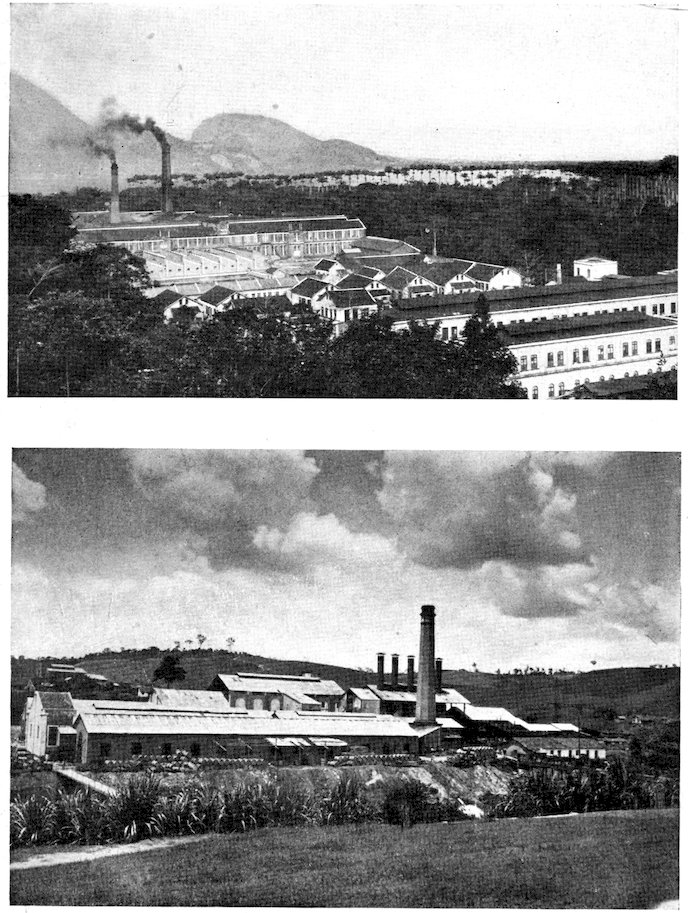
Carioca Cotton Mill, Rio de Janeiro. Catende Sugar Mill, Pernambuco.
245
TOBACCO
The use of tobacco in Brazil dates back an unknown number of centuries: the natives smoked the leaf, both in the form of rolled cigars and also in small quantities in wooden pipes, made in the fashion which Europe subsequently adopted. The first European to make any record of this habit was that painstaking Frenchman, André Thevet, who came to Rio de Janeiro with Villegaignon’s unfortunate expedition in November, 1555; he says that the native name for the plant was “betun” or “petum,” and the drawing in his book (La Cosmographie Universelle) identifies it with Nicotiana tabacum. In the Amazonian regions both men and women smoked tobacco as a recognized form of enjoyment, and its effects were so much appreciated by another traveller, Piso, that he declared it to be one of the three American plants which had no equal in the Old World for beneficial uses—coca, tobacco, and the root of mandioca. Tobacco-smoking by American natives had first been noticed by the crew of Columbus in 1492.
During the latter half of the sixteenth century Europeans began to take to the use of tobacco, the Spanish colonies sending it home from the West Indian Islands and the Portuguese from Brazil; it was not until about 1600 that it was seriously cultivated for export in the Brazilian capitanias, and when experiments were made with this object it was found that Bahia yielded the best product, although that of Pernambuco was also 246good, and the plant produced freely all along the littoral, from Amazonas to the lagoons of Rio Grande do Sul. Tobacco became during colonial days one of the important exports of Brazil, together with dyewoods and sugar.
Brazil marks her extensive cultivation of tobacco from about 1850, after her ports had been thrown open to world commerce and the flags of all lands were seen in her ports. In 1860 she exported 4,609 tons; in 1870, 13,276 tons and in 1873, nearly 17,000 tons, of which over 14,500 tons came from Bahia. By the year 1886 Brazilian exportation had risen to 23,000 tons, the value was over 15,000,000 francs (or more than $3,000,000) and a part of this to the value of 3,500,000 francs, “was returned to us made up into so-called Havana cigars,” remarks Almeida. “It was not fashionable to smoke any tobacco or cigars other than of the Havana kind in Brazil fifteen years ago.”
Now ideas have changed: Brazil realizes the value of her own product, and Bahia has no hesitation in challenging Vuelta Abajo to a comparison. Soils of the two regions are similar in qualities. Farther north, the Brazilian fumo has a stronger, less delicate flavour, and is largely consumed at home; cigarettes of Pará, Amazonas, Parahyba, Pernambuco, Matto Grosso, Minas, and many other states are manufactured in large quantities, and sold cheaply; very good Pará cigarettes made of the black local tobacco sell at ten for a “tostão”—a fraction over two cents.
By the end of the century Brazilian tobacco production had grown to some forty thousand tons, largely the result of ready markets in Germany, which practically absorbed the whole of this export until the outbreak 247of the European War, and the adoption of North American seeds and methods of cultivation. The output suffers fluctuations due to climatic conditions, as will be seen from inspection of the following figures; it will be noticed that prices have on the whole a tendency to rise:
Year Tons Total Value in Gold Milreis Price per Kilo in Paper Milreis
1905 20,390 7,335 contos 636 reis
1910 34,149 14,453 „ 714 „
1915 27,096 10,328 „ 835 „
1920 30,561 1200 „
In calculating prices it is well to bear in mind that the gold milreis is always worth twenty-seven English pence, while, although fixed between 1906 and 1914 at sixteen pence, the value of the paper milreis fluctuates. During 1915 it was worth an average of a fraction over twelve pence, so that the price of tobacco—eight hundred and thirty-five reis a kilo—may be considered as about eighteen cents a kilo, or a little over seven American cents per pound. While, as we have seen, thirty thousand tons of tobacco is exported each year from Brazil, enough remains in the country to supply ninety-six per cent of the internal consumption; cigars, tobacco and cigarettes are consumed in the country to the value of 40,622 contos, importations being worth only 1,500 contos of this amount.
Every state in Brazil has its large or small tobacco factories, but the great manufacturing region is that of São Felix, just across the bay from São Salvador (Bahia) city. Accessible to the factories established here are 248the finest tobacco regions: the product is excellent in flavour and well prepared for a discriminating market. Organizers of the manufacturing industry, as well as shippers to Europe, are largely German; German also is the big cigar factory of the South, that of Poock in Rio Grande do Sul, whose product goes all over Brazil.
Since the beginning of the European War the absence of German and Austrian shipping movement has paralyzed tobacco sales, and as this item forms about thirty per cent of Bahia’s exports it was necessary to seek unimpeded sales channels. Negotiations were opened with the Regie Française, the great French tobacco-buying organization, and the packing, quality, fermentation and other conditions studied with reference to sales.
CEREALS
Wheat growing is only possible on a commercial scale in the south of Brazil where temperature and climate are not unlike those of the European lands of origin of this cereal. At present Rio Grande is the only great wheat producing state, although Paraná has a budding industry; the great Italian firm of Matarazzo has recently acquired large areas of land in that state with the object of growing wheat and establishing a flour mill.
Rio Grande, which owes the major part of its opening-up to the German settlers who emigrated there about the middle of the nineteenth century, already grows half enough wheat to satisfy the internal needs of the State, for although she still imports 361,000 barrels of flour, and 236,000 bushels of wheat (equal to another 24947,000 barrels) yet she also grows enough wheat to yield 407,000 barrels of native flour. She has, it is calculated, over 83,000 hectares of land under wheat, employs 29,000 field hands, and has over a thousand grain mills. Many of these are equipped with out-of-date machinery, and are small, but there are others fitted with good modern systems producing fine flour.
Two of the best wheat producing municipalities are Alfredo Chaves and Caxias, each of which have over four thousand hectares under wheat and produce an average of six thousand tons of this grain; the first municipality has fifty-one and the second sixty-seven mills. To show the “riograndense” growth in wheat production:
1909 15,250 tons
1910 31,267 „
1912 52,332 „
1915 55,000 „
Santa Catharina is a cereal State, but does not today produce notable quantities; São Paulo, the high interior of Rio de Janeiro, and the hills of Minas, are all suitable; fine wheat, barley and oats are often seen in the vicinity of European colonies. But Brazilian production is not yet within measurable distance of coping with internal demands, and as a result wheat, with wheat-flour, accounts for one-fifth of Brazil’s total import values. The bulk of the grain imported comes from the River Plate.
Linked with the agricultural production of cereals is the flour-milling industry, which dates from the time when wheat entered Brazil free of duty while wheat-flour paid thirty reis a kilo: this was the condition of 250the tariff until December, 1899, by which time two large mills had been established in Rio de Janeiro. In January of the following year imported wheat was taxed for the first time, ten reis a kilo, while the duty on flour was reduced to twenty-five reis; national milling profits suffered correspondingly.
In 1906 other alterations were made in the tariff as regards flour from the United States, in addition to certain manufactured articles; it was suggested to Brazil that the United States was a good customer for Paulista coffee and Amazonian rubber, and that she expected “most favoured nation” treatment in return: a tax of three American cents per kilo against coffee was indicated as a short way with objectors. Brazil yielded, giving the United States a twenty per cent reduction on flour import duties, as well as for condensed milk, manufactures of rubber, clocks, dyes, varnishes, typewriters, ice-boxes, pianos, scales and wind-mills. Four years later the preferential tariff was extended to dried fruit, cement, school and office furniture, and in 1911 the rebate on flour entries was changed to thirty per cent.
As a result American sales of the goods indicated have increased very largely, although sales of rubber and coffee have remained, on Brazil’s part, about the same for the last seven or eight years; her more markedly larger shipments to North America are cacao and hides. But American flour imports into Brazil have increased from a little over twenty-four thousand tons in 1906 to nearly sixty thousand tons in 1920, with rises in other articles equally pleasant for the northern manufacturer—cement sales, for instance, increased from one hundred and twenty tons in 1908 to over 25176,000 tons in 1920; but in 1921 Germany, selling 30% below her rivals, captured this trade. Reduction of taxes on American flour is actively opposed from two points; the first is the group of flour mills operating in the country, and the second in the sister republic of Argentina who also has flour to sell.
The flour mills in Brazil of commercial importance are eleven in number: the Moinho Fluminense and the Rio de Janeiro Flour Mills, in the city of Rio; Moinho Santa Cruz, across the bay in Nictheroy; Grandes Moinhos Gambas and Moinho Matarazzo, in São Paulo city; Moinho Santista, in Santos; there are three modern mills in Rio Grande State, at Pelotas, Porto Alegre, and Rio Grande City; Paraná has two, at Paranaguá and Antonia.[14]
The great cereal of Brazil is that wonderful plant developed by the aborigines of the Americas, maize: it is commonly known as milho in Brazil. Only recently has the wild plant, mother of all the different kinds of maize in the world, been identified—a proof of the long culture which brought it to the perfection which the first European conquerors encountered; yet such was the hardihood of this cereal that thirty years after the Conquest it had spread all over the warm parts of Europe and was thriving in Africa and Asia.
252It is, with mandioca, the great food of all South and Central America and Mexico, grows under almost any conditions, apparently, and while the seed is seldom carefully selected, strongly marked varieties of prolific habit are found in Brazil, the red, white and yellow all yielding well. It is found in patches outside every little hut, and in enormous fields in Central Brazil. In spite of the large importation of wheat nowadays to satisfy the more luxurious tastes of the cities, Brazil could not live without maize.
Rye is grown by the Russians of the southern colonies, and the south also produces a limited quantity of oats and barley.
FIBRES
Among the fibres of Brazil which are offered extensive markets is the wonderful paina, known in European markets as kapok, which is thirty-four times lighter than water and fourteen times lighter than cork. Produced chiefly in the Orient, its qualities were many years ago appreciated by German manufacturers who were until recently the largest purchasers of the fibre, using it for life-belts, mattresses, etc. Today an unsatisfied demand for kapok comes from the Société Industrielle et Commerciale du Kapok of Paris and London, which is said to expect enormous calls after the close of the war, when rehabilitated Belgium and northern France will need pillows, mattresses, coverlets, and quantities of other things with the qualities of lightness, warmth, elasticity and impermeability possessed by this renowned fibre. At present world supplies come from Java (best fibre, cleanest, best 253packed), British India, an inferior grade, as is also that of Central Africa and Senegal; a few years ago, at the suggestion of Germans interested in Venezuelan railways, the kapok tree was introduced there; but when the cotton was sent to Europe it was rejected on account of its condition “the greater part of the bales containing stones, refuse, etc., which sometimes amounted to thirty per cent of the total weight; thus, in spite of the fine quality of Venezuelan kapok, French importers were obliged to cease purchases,”—a lesson for careless exporters.
Many parts of Brazil display this beautiful tree. When the writer was first in Petropolis, in bright May weather, the avenues of that mountain city were gay with the large bright pink flowers of this grey-trunked, spreading exotic. Later, when the bolls ripen, the fibre is collected, sold by the kilo over many counters throughout the country, and used locally for stuffing pillows and cushions.
The price paid by France for paina fibre is about one hundred and forty to one hundred and sixty francs per hundred kilos of good-grade material: she imposes no duties against its entry. Brazil has many good fibres, but their extensive industrial use is as yet limited to aramina, of which coffee bags are made in S. Paulo, a flourishing industry, and the pita which is used by the Indians of Amazonas to make hammocks. These are woven with great art, interspersed along the edges with delicate feathers of gay-coloured Amazonian birds.
Fibre production in a scientific manner and on a commercial scale is only in its infancy in Brazil, but has recently shown interesting development. There are numbers of fine fibres native to the country, yielded 254not only by a large number of palms, one of which supplies the piassava exported for broom-making, but also by many plants of the aloe tribe. Some of these produce fibres equal in commercial value to the famous henequen (sisal) of Yucatan, upon which the rope-making industries of the United States so largely depend.
Banana fibre is used by the lace-makers of the north for the production of a curious, stiff, shiny lace of fairly intricate workmanship. The best specimens which I possess of this lace were bought at Maceió, but the great home of the lacemaker is Ceará. She usually works with linen or cotton threads, and is to be seen at every cottage door, with her pillow bristling like those of the Devonshire lace-makers, with scores of pins, while she throws the myriad bobbins to and fro, working her pattern on the pins.
Some of the lace produced is quite beautiful, of extreme fineness and intricacy, some of the most prized being the labyrintho, with its darned-in pattern of heavier, silky thread, among the fine filaments of the background. Lace-making is one of the small industries of Brazil which are little known, but deserve a better market.
CACAO
Cacao culture and preparation is the great absorbing industry of southern Bahia, where soil and climate, particularly along a couple of river valleys, combine to render the pretty little cacao tree fruitful. Not even coffee presents a more charming sight than a good cocoa plantation ready for harvest, the sun filtering through 255the light branches, and these, as well as the trunk thickly clustered with the big heavy red or yellow pods, looking something like elongated melons attached, almost stemless, to the strongest parts of the tree. Methods in use on many native plantations in Brazil are fairly primitive, and it is the exception to see the elaborate machinery for fermenting, washing, and drying such as is common in Trinidad; but the cacao produced is good, has a ready sale in a market which never seems to have too much cocoa and chocolate, and has made remarkably good prices since the European War began. Bahia is the great producing state, but Maranhão, Amazonas and Pará also send contributions to the export lists; the chief Bahian centres of production are Ilhéos and Itabuna, which send two-thirds of the crop, the rest coming from Cannavieiras and Belmonte primarily. The groves run inland for more than two hundred miles along the river valleys, full of the red triturated paste which is the base of Brazilian soil.
The cacao year is reckoned from May the first to April the thirtieth, and there are two gathering seasons: the safra proper begins in September and goes on until April, while the summer crop, the temperão, begins in May and has a less important yield. Practically, picking goes on all the year.
Cacao is native to the Americas, but its first cultivation and export from Bahia appears to date no earlier than about 1834, when there are records of shipments of 447 sacks of sixty kilos each. In 1840 the export was nearly 2,000 sacks, and in 1850 had risen to more than 5,000 sacks. In 1915 Bahia shipped about 750,000 sacks, as a result of the enthusiastic planting which 256has gone on in this favourable region for the last twenty years.
Until the war broke out the average price for six years for Brazilian cacao was about 725 reis a kilo—about seven cents a pound. It was at this price that Brazil sold an average of thirty-two thousand tons. In 1915 the price soared to 1$248 a kilo, or about twelve cents a pound, and Brazil with the biggest crop then on record exported 44,980 tons, a total exceeded in each of the following five years, 1919 showing exports of 93,000 tons, at 1$500 per kilo.
Cacao is a very good business, because there is seldom a surplus in world markets; a demand exists for every pound, and the populations of great centres seem to consume it in increasing quantities; it is a valuable food, against which as yet no analytical chemist has laid one of the charges that seem designed to warn us from most things that are agreeable to eat and drink.
Anyone accustomed to warm climates, with a little capital to invest, and able and willing to wait three or four years for his first returns, could do worse than to take up cacao planting in Brazil.
Agricultural methods in Brazil are in many regions quite primitive. When wild land is taken up, it is denuded by the axe of its big trees, and the small scrub disposed of by burning the land over. Frequently the next process is little more than that of making holes in the ground with a stick, dropping in seed, and waiting for it to come up: a fertile land, Brazil gets her crops with a minimum of trouble. That is all very well for the little owner of a small property, but it has already given way in more advanced districts to sound agricultural 257methods. Modern scientific agricultural implements of American and European make are commonly seen in the centre and south, but in the extreme north and the deep interior they are more rare. There is an excellent market for small, light hand ploughs, harrows and cultivators, for in some parts of the country, such as interior Rio, the land in the bottoms of valleys is very good, has been neglected because only coffee, planted on the hilltops, has pre-occupied the small farmer, but there is not sufficient flat space for the use of large motor or animal operated machinery. A campaign of agricultural instruction has been inaugurated for some years by the Department of Agriculture, some good statistics and maps and literature sent out, but perhaps less theory and more practical instruction is needed. A recent writer in the Estado de S. Paulo remarked upon this, rather caustically: “... instructions for the culture of squashes—plough the ground with a plough with a disc of such a number, harrow it with such or such a harrow, drill it with such or such a drill; afterwards fertilize it with so many tons of phosphate of lime, so many of potash, and a few kilos of powdered gold; cultivate it with such a cultivator, harvest the crop with such and such methods, and take it to market in a certain kind of motor-truck, et cetera, this ‘etcetera’ meaning that the farmer must hand over his farm to his creditors and go to hunt a job as sanitary inspector....”
Other countries have also suffered from a plethora of agricultural theory, but there is plenty of room for instruction of a practical character and several good agricultural schools in Brazil, notably that at Piracicaba, São Paulo, are leading the way.
258
BRAZILIAN FRUITS
There are many fine fruits in Brazil, unrecognized abroad, which may some day, with refrigerating spaces in outgoing vessels multiplied, find a way to international tables; there is already a pineapple export to Europe, arriving in time for Christmas, and Brazil’s sweet bananas are shipped to the Plate. But who realizes that Brazil is the native home of the finest oranges in the world? Bahia is the place of origin of the seedless orange; slips of this tree, taken to California, have created a tremendous daughter industry whose products are spread far and wide by steamer and train; there is no export from Brazil, the Bahian orange, which is greatly superior in size and flavour to the Californian, hardly creeping down the coast to the markets of Rio and São Paulo. There is room for a huge industry in growing and shipping in this direction, and some of the planters of California, trembling of nights when the frosts come and smudges have to be burnt—sometimes in vain, would do well to transfer their skill and energy to a land where frosts are unknown, land is cheap, and the best oranges known are produced without any great care or science.
MINING
Brazil was for more than a hundred years after the discovery of placer deposits in the interior the source of important gold exports; altogether she is estimated to have yielded gold worth more than a hundred million pounds sterling, but her fame diminished with the exhaustion of the gold-bearing river sands. It was easy 259enough to wash out gold grains with the bateia, but when it became necessary to seek mother lodes and to use machinery, native capital and technical skill were lacking. Two gold-mining companies are working today in Brazil, both British owned and operated, and both in the State of Minas Geraes. One, at Morro Velho, property of the S. João del Rey Mining Company, is worked at a depth of a mile and a quarter, pays dividends regularly, and is a standing tribute to British energy and skill: it is a magnificent social organization as well as an engineering triumph.
The second company of importance using modern equipment is that of Passagem, close to the old capital of Minas Geraes, Ouro Preto; it is excellently operated, but has not had equal good fortune with the Morro Velho mine. In 1916 Brazil’s gold exports, in bars, weighed 4,564,523 grams, were worth about £480,000, and went entirely to England, but Brazil subsequently forbade gold exports, and now takes over all the product.
A certain amount of Brazilian gold is absorbed internally every year by the excellent native goldsmiths, for the fabrication of special jewellery objects, but no estimate of the value is obtainable.
Until diamonds were found in South Africa Brazil was the cradle of the most important diamonds put on foreign markets; the stones are still sought by native garimpeiros, mostly, in the interior of Minas and Bahia, and from the grutas of the latter State are obtained the finest white diamonds known. But they have practically disappeared from export lists together with the black carbonados, even more valuable, for a reason commented upon by the Diario Official of Bahia, discussing 1915 trade: “If diamonds and carbonados have been, 260since the war, sent to Europe or North America, their exportation, which is for the most part unknown, has been realized by the habitual processes of smuggling.” Brazil is the main source of these “carbonados,” black diamonds of great hardness and therefore value, used industrially.
The precious stones openly shipped from all Brazil during 1915 were worth only about one hundred and seventy-six contos of reis (say forty-four thousand dollars), of which about fifty-five per cent went to the United States and the rest to France. During 1916 the export of precious and semi-precious Brazilian stones to North America has been greatly stimulated by the access of luxury-purchasing which has coincided with the accumulation of war profits, and out of American purchases of jewels from abroad at the rate of a million dollars a week Brazil has her share. The stones of Brazil have long been appreciated in Europe—I am thinking of a certain shop in the Rue de la Paix in Paris and another at the top of Regent Street in London—and deserve to be better known in North America; the diamonds are beautiful, and their distribution among not only the wealthy but the “middle” classes in Brazil is so usual, the possession of good diamonds is so universally considered the right of every woman, that a gala night at the theatre in São Paulo or Rio is a display of brilliant stones which would put, for choice jewels, many capitals of the world to shame.
The lovely sea-blue agua-marinhas, with exquisite transparency and lustre, the soft green tourmalinas, the pink and golden topazes and purple amethysts are all found in great quantities in the Brazilian interior: many are native cut, and the wheel of the lapidary using 261beautiful coloured stones may be seen at work in Bello Horizonte, Rio, Bahia, and São Paulo.
If half that geologists have said of Brazil is true, this country is destined to become one of the greatest mining regions of the Americas; it has an extraordinary variety of minerals, but their location in the interior where little transportation exists, added to the restraining influences of archaic mining laws, has checked enterprise. Before the European War began plans were well under way for development of important iron mines in Minas Geraes by an English company, but work is in abeyance at present. There has been, however, a marked increase in exports of high-grade manganese, chiefly from Minas, chiefly shipped away in the newly operating line of freight steamers owned by the United States Steel Corporation, which bring manufactured products to Brazil. Out of the total of more than three hundred thousand tons of this ore exported from Brazil in 1915, over two hundred and sixty-six thousand tons were sent to the United States, the price paid being over two and a half million dollars; Great Britain also took ten thousand tons, but Germany and Belgium, former customers for this ore, were eliminated from the lists.
During 1916 production, mainly from Minas deposits, rose to over five hundred thousand tons, again increasing to five hundred and thirty-three thousand tons in 1917; after this time depression was experienced, due in great measure to lessened demands from the United States using home-produced low-grade ores for steel hardening. Post-war prospects of development of the great Itabira iron deposits suggest iron and steel industries within Brazil.
262Large manganese deposits also occur in the neighbourhood of Nazareth, on the mainland side of the Bahia de Todos os Santos (Bahia State), situated conveniently for shipment; its export was reduced to practically nothing from this point during 1914 and 1915, probably for the same reason that shipments of another famous Brazilian mineral, monazite sand, vanished about the same time from Bahian lists. This reason was the imposition of strangulating export taxes, amounting to about twenty-two per cent of the value of the mineral. Manganese deposits are known to exist, in addition to the beds in Bahia and Minas, in Matto Grosso, Santa Catharina, Paraná and Amazonas; the total quantity available is estimated at one hundred million tons.
Monazite sands lie all along the southerly shores of Bahia, extending into Espirito Santo; their peculiar glow and lustre was first noticed by an Englishman, John Gordon, who had samples examined and found that they contained thorium, used in making incandescent gas mantles; he was in the shipping business in Brazil, and had no difficulty in thenceforth sending large quantities of the precious sands abroad, as ballast; the story goes that only by an accident was the fact revealed to the authorities that the sands were valuable above the ballast of most vessels, after some years. Duties were put on, and eventually exports slumped. The largest amount officially sent abroad in one year was 2,114 tons, 1908, with a value of 609 contos of reis. In 1915 only 439 tons were exported, all to the United States.
These three meagre items, precious stones, manganese and monazite sands, complete the 1915 official mining exports of a great mineral country. Probably increases 263will be shown for the year 1916, for, in addition to manganese increases, there has been great stimulation of coal mining in the States of Rio Grande do Sul, Santa Catharina and Paraná. More than one Brazilian railway, exasperated at the prices demanded for foreign coal, has been using native coal and helping in its production, and during the latter part of 1916 experimental shipments were made to the Argentine. Results are said to be good, but a little caution must be used before serious claims are made concerning the existence of very extensive deposits of fine hard steam coal. In any case the production of useful coal is a blessing to the east coast of South America, devoid as this region has been up to the present of any source of reliable carvão de pedra; every ton has been imported, chiefly from Wales but latterly from North America. Chile, on the other side of the Andes, has been mining coal for years, but the quality is not satisfactory for all purposes, and supplies have been supplemented from Australia in normal times.
Brazil has, it is known, important deposits of nickel, copper, lead, mica, platinum, wolfram, and many other minerals, but there has been no real attempt at operations, and until prospecting is systematically undertaken and money put into good equipment, Brazil cannot take her place as a great mineral producing country. She has the minerals, but she needs roads to get them out, and favourable laws to encourage mining development, as well as abolition of strangulating taxes. With intelligent assistance, Brazil’s manganese should be able at the close of the European War to compete with that of Russia, and her monazite with that of Travancore (India), aside from the other rich deposits.
264
BRAZILIAN MANUFACTURES
There is much controversy in Brazil on the subject of national manufactures. I have heard extremists declare roundly that Brazil ought not to manufacture anything at all, because each mill-hand is one more person taken away from the fields to which all Brazilian attention should be given.
“Brazil is an agricultural country,” a cotton planter said to the writer. “She cannot legitimately compete with the manufactured products of great industrial countries because the price of living is too high here. To obtain large revenues from the import taxes which are the Federal Government’s source of support we have heavy duties against large classes of goods entering the country; the barrier has been so high that it has been worth while for factories to be started here, sometimes making things from material produced in the country, which is not bad policy when we have enough labour, but often making goods every separate item of which is imported, an absurdity.”
He went on to say that there is a considerable manufacture of matches in Brazil, but that the igniting chemicals, the little sticks, and the boxes were all imported; nothing was done but the mere putting together. “It is only remunerative because the tax on imported matches is so high, and in many districts owing to want of communication the match factory has a monopoly of local trade—a purely artificial condition.” This fazendeiro was equally opposed to the silk and velvet factories of Petropolis, declaring that “every item, raw silk, colours, machinery, even the skilled weavers, are imported” and that until Brazil produces national silk—a beginning has been made—she should not have silk factories.
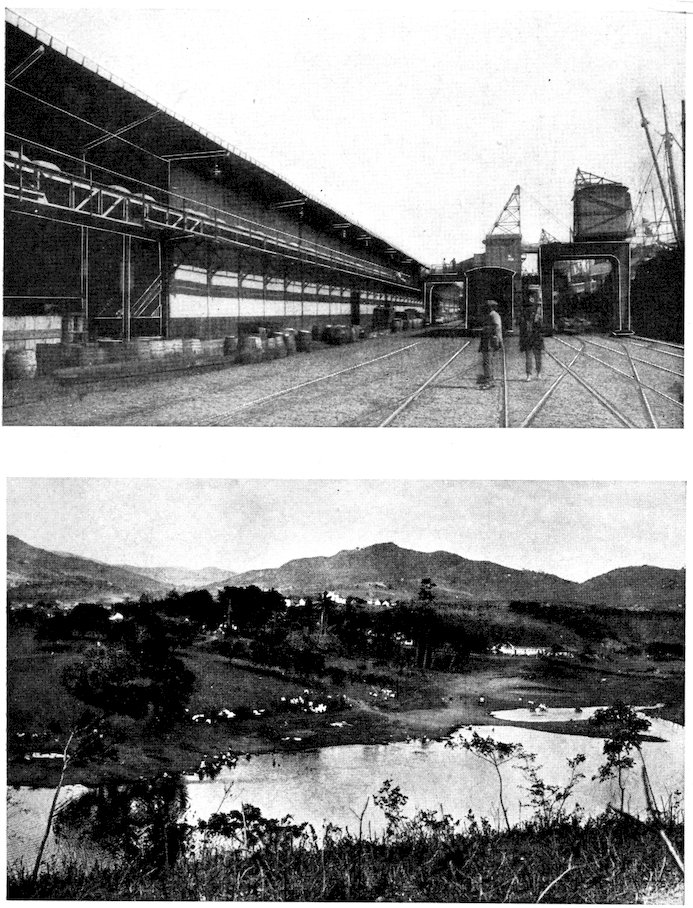
Coffee-loading equipment at the port of Santos, State of São Paulo. Sugar lands In Pernambuco.
265This view was that of the agriculturist who sees a menace to labour supplies in the growing manufactures of Brazil: I give it for what it is worth, as an interesting view point with force in some of the argument. But there are industries in Brazil which the agriculturist will admit to be legitimate in themselves and helpful to himself in that they tend to raise prices for his raw products. Of this class the most shining example is the list of cotton mills. They are already so active that the national supply of raw cotton is not sufficient for their needs, demand being so acute in 1919 that the price in Brazil rose to forty cents a pound. The output is sold in Brazil, supplying over eighty per cent of the fabrics used, with a surplus for export since 1918.
It is not generally recognized to what extent Brazilian manufactures have developed. The great industrial region is Rio de Janeiro. Her industrial advance has been made possible in this direction, as in agriculture, by the influx of sturdy Italians, Portuguese and Spanish workers.
At the same time the manufacturing section is not confined to S. Paulo; it is notably active in Minas and Rio, especially where electric power derived from waterfalls is employed, and in Bahia and Pernambuco where tobacco and sugar create legitimate home industries, and where there is a sufficiency of native and negro labour, the latter an inheritance from slavery days.
The total value of the products of Brazilian factories 266is about 2,000,000 contos of reis, equal at twelve pence exchange to £100,000,000 or in U. S. currency, $500,000,000 mais ou menos. This is a larger sum than the value of Brazil’s exported agricultural and forestal products, which was about 1,811,000 contos in 1919, and 1,464,000 contos in 1920.
This calculation, however, is not quite fair because it does not take into consideration the agricultural produce consumed in the country; there are no figures available on this subject.
In a review of commerce published in May, 1916, the Jornal do Commercio said that out of the ninety-four classes of Brazilian manufacture, eighty were free from internal taxes (the “imposto do consumo”) while fourteen were subject to tax, as well as to foreign competition.
It was demonstrated that in these fourteen classes Brazilian manufactures fell below fifty per cent of the total consumption in only one instance, that of pharmaceutical specialties. The most important items are these, in round numbers:
Brazilian-made Imported
Woven fabrics (chiefly cotton, but some silk and wool) 450,000 contos 47,300 contos 82
Beverages (mineral waters, beer, wine, spirits) 101,300 contos 47,640 contos 68
Footwear (leather shoes and boots, and alpagartas) 150,225 contos 2,425 contos 97
Prepared tobacco, cigarettes and cigars 39,000 contos 1,565 contos 96
Hats 29,000 contos 3,800 contos 86
Matches 18,000 contos 4 contos 99.9
Conserves 13,300 contos 9,800 contos 58
Pharmaceutical specialties 11,700 contos 15,780 contos 43
267In 1921 the number of home-made goods paying imposts rose to 21, and the value to well over one million contos, and includes, besides those detailed above, vinegar, walking sticks, salt, candles, perfumeries (of which Brazil makes sixty per cent of the consumption) and playing-cards.
Among the large class of manufactures free from internal taxes are the important items of cotton thread, jute products (rope, cord and coffee bags) the products of ironworks, potteries, furniture factories; goldsmiths and jewel-workers, soap makers, paper and paper-bag factories, biscuit and bottle, shirt, mirror, trunk, ink, pipe, pin, and window-glass makers; but all of these pay a contribution to their State or municipality or both, appearing in revenue lists under “Industrias e Profissões.”
In the city of São Paulo this tax upon industries and professions, the latter list embracing bankers, lawyers, barbers, shoe-shiners, hotel-keepers, doctors, newspaper sellers and so on with true democratic impartiality, brings in over forty per cent of the municipal income; it is now worth some three thousand five hundred contos a year, or let us say nine hundred thousand dollars, the cotton factories paying the biggest item, twelve thousand dollars, while shoe factories, jute mills, potteries, jewellers, furniture makers and metal works each pay about eight thousand dollars.
It is plain that manufacturers do not have things all their own way in Brazil, and must be prepared for fairly heavy taxes, but one does not hear the same complaints about petty taxation for every trifle as in the Argentine; on the other hand, the mill owner has not to face cut-throat competition as in older manufacturing 268countries, is able to get an excellent price for his products, is able to buy land at inexpensive rates and to obtain comparatively cheap labour. As soon as a district becomes thickly sown with factory chimneys prices of land and labour automatically rise, of course; this natural law has operated already in the now densely populated and built over suburbs of São Paulo, Braz and Moóca, and is, under one’s eyes, transforming the windy upland flats of Ypiranga. A year or two ago much of this area was red clay swamp, with a cottage here and there and a few Italian market gardens producing vegetables for the city dwellers, and land could have been bought for ten milreis an acre or less; today it is worth from two hundred to five hundred milreis; the wet lands have been filled in, an enormous undertaking, rows of workmen’s houses extend for miles to the crest of the hill where the Monument stands commemorating the Grito da Independencia, and from its summit one has a view that is mottled with factory smoke and punctuated with tall chimneys. To see this and to watch the crowds of pretty chattering Italian girls pouring out of Braz and Moóca factories at noon or evening is to obtain a revelation of the newer South America. It is no longer a land of sugar and brazil-wood only and although the agriculturist may shake his head over the lack of hands on the farm, manufacture in Brazil is a live, energetic phase of her modern development. São Paulo City was employing, by the end of 1921, over twenty-five thousand horsepower of electrical energy in her factories.
The fabric-weaving factories in all Brazil, including cloths of cotton, jute, linen, silk and wool, were 303 in 269number in 1914, employing 75,000 workpeople and capital totalling over 368,000 contos of reis; in 1920 they had increased to 328 including 242 cotton mills which alone employed 109,000 hands. The premier producer of cotton cloth in 1920, in values, was Rio de Janeiro (Federal District) with an output worth 102,000 contos; next came S. Paulo State, 92,000 contos; then Minas Geraes, 91,000; Rio de Janeiro State, 46,000; Bahia, 32,000; Pernambuco, 21,000; Alagôas, 16,000; Sergipe, 12,000; Maranhão, 11,000; Rio Grande do Sul, 9,000; Ceará, 3,000; and Piauhy, Rio Grande do Norte, Paraná, Parahyba and Espirito Santo, about 1,200 contos each. The States absent from cloth manufacturing returns are the great forestal territories of the extreme north, and those of the vast interior uplands, where conditions are not greatly changed from the time prior to the Portuguese discovery so far as development is concerned.
In numbers of mills São Paulo again comes first with seventy-eight mills making cloths: fifty-five of these weave cotton alone, leaving a higher proportion of fabrics made from other materials than in sister States; generally speaking cotton cloths occupy the greatest share of capital and labour, as for example in Minas, where sixty fabricas de tecidos operate, and out of the total value of the production, 23,500 contos, cotton accounts for over 22,600 contos. With a larger number of cotton-cloth mills at work than S. Paulo, but with production worth not much more than one-fourth, it is clear that factories are very much smaller in the interior State; nevertheless, she is able to pride herself upon a thriving industry, occupying nearly nine thousand people, twenty-five thousand contos of capital, and using 270ten thousand tons of raw cotton. In common with the other weaver States of the Brazilian Union, Minas ships her cloths to less industrially developed regions: in this connection some light is shed upon the ramifications of finance cum industry by the President of the Sociedade Mineira da Agricultura (Minas Society of Agriculture), Dr. Daniel de Carvalho, in an address at the Cotton Conference held in Rio in June, 1916. Stating that the Minas export of cotton cloth (to other States) was nearly 28,000,000 metres in 1915, he showed that, at an average price of four hundred reis (eight cents) a metre, the total value was more than eleven thousand contos: but in the official statistics the value of exported cotton cloth appeared as only 3,893 contos. “This anomaly is an example of the regimen of fiction in which we live, from the taxation point of view. The Minas legislator votes for high and sometimes excessive taxes,—and the Government in a fatherly manner corrects the excess in calculations of ad valorem percentages, accepting a benign interpretation of merchandise values. Instead of products appearing with exaggerated values we find on the contrary that most estimates are well below the real amount, as in the case of manganese....” The cure for this deliberate lessening of values, which certainly does Brazil poor service, would be, said Dr. Carvalho, an all-round diminution of tribute, together with a rigorous application of the law.
In the Federal District the number of weaving mills is thirty-five, several clustering in the mountain valleys of Petropolis and deriving power from waterfalls; the State of Rio has twenty-seven; Santo Catharina, fifteen; Bahia and Maranhão have thirteen each; Rio Grande 271do Sul, twelve; Ceará and Alagôas, ten each; Pernambuco, nine; Paraná and Sergipe, eight each; Espirito Santo, three; Rio Grande do Norte, Piauhy and Parahyba, one each.
The largest employer of labour in weaving mills is S. Paulo, with (1920) over thirty thousand hands; the next is the Federal District with about twelve thousand; third comes Minas with over eight thousand. São Paulo is also the greatest consumer of raw cotton, using thirteen thousand tons; the Federal District uses eleven thousand tons and the State of Rio nearly six thousand tons, Minas using, as we saw above, about five thousand.
At the end of 1915 when, in spite of great demands upon the national mills consequent upon checked importations of cotton cloth several had to reduce their staff on account of shortage of raw cotton, the Centro Industrial addressed a letter to the President of the Republic in which the plight of the manufacturers was displayed. A cotton famine in the North had reduced the national supply, and raised the price beyond precedent, while importations are always minute in Brazil owing to the heavy duty of about six cents per pound against it. The signatories of the letter explain that the cotton cloth industry never calls for less than forty-five thousand tons[15] of raw cotton produced on national soil, and that this amount was made up in 1913 into cloth worth over 162,000 contos; that, with the exception of aniline dyes, which cost about 2,000 contos a year, no other prime material enters into the Brazilian cotton Industry.
272“The time is long past when cotton yarns were imported on a great scale for weaving. Now, our numerous factories have created in their vast and modern mills a perfect industrial cycle from spinning to printing,” so that the present import of yarns is worth only 1,800 contos, and the value of cotton cloths brought from abroad less than 17,000 contos (1914 figures).
At the same time Brazil’s export of raw cotton from the Northern States of fine long staple, usually practically all sent to England, diminished until returns for 1915 show only 5,223 tons against over 37,000 tons in 1913 and 30,000 in 1914, but this restriction did not make up the shortage following the drought. The Centro Industrial asked for a governmental enquiry into cotton conditions; in the middle of 1916 the Conference was held in Rio, samples of cotton, etc., displayed, and, after a collection of facts by a questionnaire sent to all weaving mills, expositions of the highest interest were made by officials of the government, technical experts, and cotton growers. Reference is made to this valuable conference under “Cotton,” but the manufacturing notes of these pages may include the name of Miguel Calmon, Chemical Director of the Companhia Industrial do Brasil, popularly known as the “Bangú” factory, who gave an address on the use of native vegetable dyes; optimistic as regards tints drawn from Brazilian forests, Senhor Calmon spoke with appreciation of the “urucú,” a dye producing hues ranging from yellow to deep red, as well as many other better known colouring matters. There is already a very busy dye factory in Minas, the Fabrica de Tinta Machado, using native vegetable bases, and much is expected in S. Paulo from dyes made by the use of “Inglotina,” 273obtained from mangrove leaves: a factory has recently been established at Cubatão.
It was at the same conference that Dr. Costa Pinto gave details of the threads spun in Brazil; counting in English measurement, Brazilian mills spin from No. 2 to No. 100 thread. From No. 30 upward a long staple cotton is needed, and only a small proportion of native-grown fibres are suitable, although there is plenty of short fibre for the coarser weaves.
Brazilian manufacturing already depends considerably upon the water power accessible, especially in São Paulo, Rio de Janeiro, and Minas. There is enough hydraulic force available in Brazil to turn the wheels of the world but the majority of these wonderful cascades are scarcely known by name, and many were not charted in the interior of Matto Grosso and Amazonas until the work of the Rondon Commission opened great tracts of those unknown lands. It is not possible here to do more than mention one or two of the most important falls. The Maribondo, in the Triangulo Mineiro, has an estimated force of six hundred thousand horse power; Urubupunga, on the Paraná river, has some 450,000 horse power; Iguassú has 14,000,000, four times as much as Niagara; and the force of the Sete Quedas, or Guayra Falls, on the Paraná near the Paraguay boundary, is calculated at 80,000,000 horse power. The Light and Power companies of Rio, São Paulo, Campinas, Petropolis, and other cities obtain their force from falls, hundreds of little townships in the central interior sparkle with electric lights, run factories and public utilities as a result of a nearby source of water power.
274Allusion has before been made to the variety of Brazilian soils and climates which result in her possession of several important and utterly diverse industries; the list is so long that many interesting embryo industries, or others of local or internal importance only, can only claim space for passing mention. Among these is the wine-making industry of the far south, where European colonists cultivate grapes and have created quite a notable business in the production of fairly light red wines. These are shipped to many other parts of the country, are sold inexpensively in Rio and other cities, and while they lack the mellow tone of imported wines, they are sound, good, and popular.
Salt extraction in Rio Grande do Norte is another busy industry, and here is the chief source of Brazil’s native salt; it is exported from the ports of Macáu and Mossoró. Also in the north are the famous lace-makers, whose yards of fine rendas, made on a pillow with scores of bobbins, would not disgrace Malta; the big, thickly woven white hammocks of Ceará are justly prized all over Brazil, and both lace and hammocks should form the base of an export business. In Maranhão, where the babassú palm grows luxuriantly, a local industry extracts the fine oil from the kernel hidden in a stony shell, and experimental exports have occurred during the past year; the babassú is but one of the valuable nuts of the Brazilian north. One, the “Brazil nut”[16] of commerce, has of course been exported from the Amazon for nearly a century, and is a considerable revenue yielder to Pará and Amazonas states, but the sapucaia, of the same family but larger and sweeter, is rarer, less known, and fetches much higher prices in sophisticated world markets.
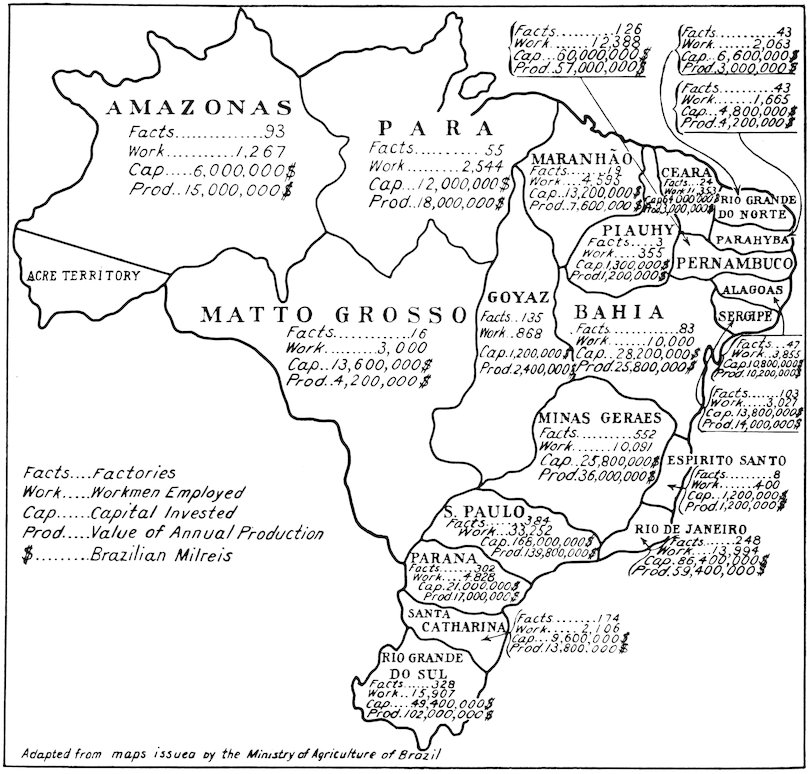
275In Parahyba State there is at least one considerable coconut oil extracting factory, on a sandy spit south of Parahyba city; several thousand people are said to be employed in this industry and the product is shipped as far south as Rio: in spite of the immense quantity of coconuts on the littoral of the northern promontory there is no copra or fibre industry yet established, apparently because the native consumption of the nut leaves little surplus for the one, and interest is lacking in the other.
276