THE WRECK OF THE HESPERUS
Reading edition
BY HENRY WADSWORTH LONGFELLOW
It was the schooner Hesperus, That sailed the wintry sea; And the skipper had taken his little daughter, To bear him company.
Blue were her eyes as the fairy-flax, Her cheeks like the dawn of day, And her bosom white as the hawthorn buds, That ope in the month of May.
The skipper he stood beside the helm, His pipe was in his mouth; And he watched how the veering flaw did blow The smoke now west, now south.
Then up and spake an old Sailor, Had sailed to the Spanish Main: "I pray thee, put into yonder port, For I fear a hurricane.
“Last night, the moon had a golden ring, And to-night no moon we see!” The skipper, he blew a whiff from his pipe, And a scornful laugh laughed he.
Colder and louder blew the wind, A gale from the northeast, The snow fell hissing in the brine, And the billows frothed like yeast.
Down came the storm, and smote amain, The vessel in its strength; She shuddered and paused, like a frighted steed, Then leaped her cable’s length.
“Come hither! come hither! my little daughter, And do not tremble so; For I can weather the roughest gale, That ever wind did blow.”
He wrapped her warm in his seaman’s coat Against the stinging blast; He cut a rope from a broken spar, And bound her to the mast.
“O father! I hear the church-bells ring, Oh say, what may it be?” “’Tis a fog-bell on a rock-bound coast!”— And he steered for the open sea.
“O father! I hear the sound of guns. Oh say, what may it be?” “Some ship in distress, that cannot live In such an angry sea!”
“O father! I see a gleaming light. Oh say, what may it be?” But the father answered never a word, A frozen corpse was he.
Lashed to the helm, all stiff and stark, With his face turned to the skies, The lantern gleamed through the gleaming snow On his fixed and glassy eyes.
Then the maiden clasped her hands and prayed That saved she might be; And she thought of Christ, who stilled the wave, On the Lake of Galilee.
And fast through the midnight dark and drear, Through the whistling sleet and snow, Like a sheeted ghost, the vessel swept Toward the reef of Norman’s Woe.
And ever the fitful gusts between A sound came from the land; It was the sound of the trampling surf, On the rocks and the hard sea-sand.
The breakers were right beneath her bows, She drifted a dreary wreck, And a whooping billow swept the crew Like icicles from her deck.
She struck where the white and fleecy waves Looked soft as carded wool, But the cruel rocks, they gored her side Like the horns of an angry bull.
Her rattling shrouds, all sheathed in ice, With the masts went by the board; Like a vessel of glass, she stove and sank, Ho! ho! the breakers roared!
At daybreak, on the bleak sea-beach, A fisherman stood aghast, To see the form of a maiden fair, Lashed close to a drifting mast.
The salt sea was frozen on her breast, The salt tears in her eyes; And he saw her hair, like the brown seaweed, On the billows fall and rise.
Such was the wreck of the Hesperus, In the midnight and the snow! Christ save us all from a death like this, On the reef of Norman’s Woe.
BY ABBIE FARWELL BROWN
It was a little, little page, Was brought from far away, To bear the great queen’s velvet train Upon her bridal day.
His yellow curls were long and bright, His page’s suit was blue, With golden clasps at neck and knee, And ruffles fair and new.
And faith, he was the smallest page The court had ever known: His head scarce reached the topmost step That led up to the throne.
And oh, ’t was but a little lad Had never been before So many leagues from kin and friends, And from his father’s door!
And oh!—’t was but a little child Who never yet, I wis, Had stolen lonely to his bed Without his mother’s kiss.
He had not seen the noble queen, Of whom his heart had fear; He knew no friend at court to give A welcome and good cheer.
It was the busy night before The great queen’s wedding-day, And all was bustle, haste, and noise, And every one was gay;
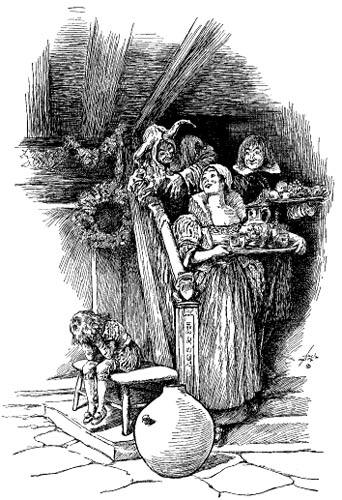
And each one had his task to do, And none had time to spare To tend a weeping little page Whose mother was not there.
Far in a big and gloomy room Within the castle keep, The little page lay all alone, And wept, and could not sleep.
The little page lay all alone, And hid his head and cried, Until it seemed his aching heart Would burst his little side.
The chamber door was set ajar, And one was passing by Who heard the little page’s sobs And then his piteous cry.
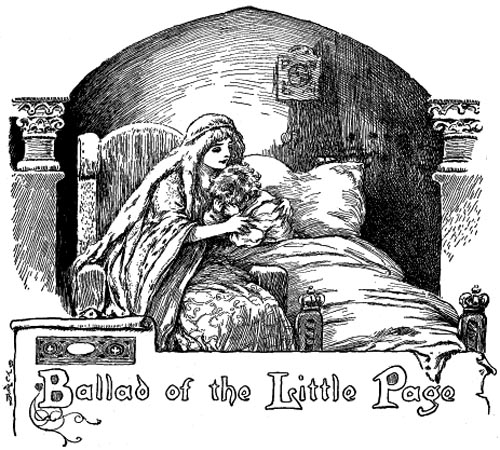
Then some one lifted up the latch And pushed the heavy door, And then a lady entered in And crossed the chamber floor—
A lady tall and sweet and fair, In bridal white who stepped; She stood beside the page’s bed, And asked him why he wept.
“—and none had time to spare to tend a little weeping page”
“he trembled and looked down”
And then he sobbed about a “kiss,” His “mother,” and his “home,” And wished the queen had called no page, And wished he had not come;
For she was “such a proud, great queen” He was afraid, he said; And he was “lost and lonely” there In that huge, gloomy bed.
And then the lady bent her down And kissed him on the lips, And smoothed his yellow, silken curls With tender finger-tips.
The tears stood in her gentle eyes; “Poor little lad!” she said, And cuddled him up in her arms And knelt down by the bed.
And so she held him, close and warm, And sang him off to sleep, While at her nod her waiting-maids A silent watch did keep.
And when the morning smiled again The little page awoke. They clad him in a suit of white, With velvet cap and cloak,
And crystal buckles on his shoes, And led him to the queen, All lovely in her bridal gear, The fairest ever seen.
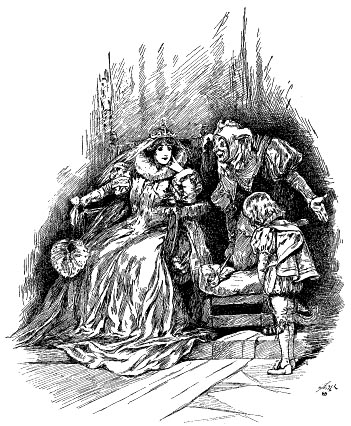
And he was such a tiny page, He trembled and looked down, For he was sore afraid to see The great queen sternly frown.
But lo! he heard a soft voice say, “O little page, look here! Am I, who sing to sleep so well, A queen for child to fear?”
He raised his eyes, and lo! the bride Looked on the page and smiled, And then he knew the queen had played At nurse-maid for a child.
And well he graced the wedding-feast And bore her velvet train, And at his dear queen’s side thenceforth Was never sad again.