THE LINE OF GOLDEN LIGHT, OR THE LITTLE BLIND SISTER[I]
Reading edition
THE LINE OF GOLDEN LIGHT, OR THE LITTLE BLIND SISTER[I]
BY ELIZABETH HARRISON
Once upon a time there lived a child whose name was Avilla; she was sweet and loving, and fair to look upon, with everything in the world to make her happy—but she had a little blind sister, and Avilla could not be perfectly happy as long as her sister’s eyes were closed so that she could not see God’s beautiful world, nor enjoy His bright sunshine. Little Avilla kept wondering if there was not something that she could do which would open this blind sister’s eyes.
At last, one day, she heard of an old, old woman, nobody knew how old, who had lived for hundreds of years in a dark cave, not many miles away. This queer, old woman knew a secret enchantment, by means of which the blind could receive their sight. The child Avilla asked her parents’ permission to make a journey to the cave, in order that she might try to persuade the old woman to tell her this secret. “Then,” exclaimed she, joyfully, “my dear sister need sit no longer in darkness.” Her parents gave a somewhat unwilling consent, as they heard many strange and wicked stories about the old woman. At last, however, one fine spring morning, Avilla started on her journey. She had a long distance to walk, but the happy thoughts in her heart made the time pass quickly, and the soft, cool breeze seemed to be whispering a song to her all the way.
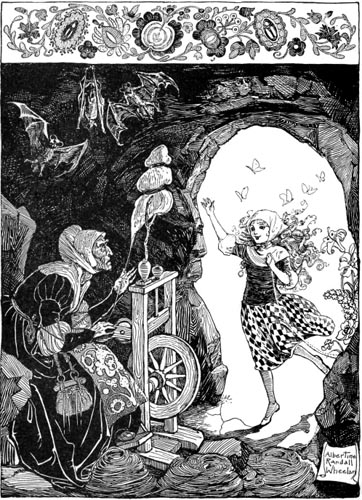
When she came to the mouth of the cave, it looked so dark and forbidding that she almost feared to enter it, but the thought of her little blind sister gave her courage, and she walked in. At first she could see nothing, for all the sunshine was shut out by the frowning rocks that guarded the entrance. Soon, however, she discerned the old woman sitting on a stone chair, spinning a pile of flax into a fine, fine thread. She seemed bent nearly double with age, and her face wore a look of worry and care, which made her appear older.
The child Avilla came close to her side, and thought, she is so aged that she must be hard of hearing. The old woman did not turn her head, nor stop her spinning. Avilla waited a moment, and then took fresh courage, and said, “I have come to ask you if you will tell me how I can cure my blind sister?” The strange creature turned and stared at her as if she were very much surprised; she then spoke in a deep, hollow voice, so hollow that it sounded as if she had not spoken for a very long time. “Oh,” said she with a sneer, “I can tell you well enough, but you’ll not do it. People who can see, trouble themselves very little about those who are blind!” This last was said with a sigh, and then she scowled at Avilla until the child’s heart began to beat very fast. But the thought of her little blind sister made her brave again, and she cried out, “Oh please tell me. I will do anything to help my dear sister!” The old woman looked long and earnestly at her this time. She then stooped down and searched in the heap of the fine-spun thread which lay at her side until she found the end of it. This she held out to the child, saying, “Take this and carry it all around the world, and when you have done that, come to me and I will show you how your blind sister may be cured.” Little Avilla thanked her and eagerly seized the tiny thread, and wrapping it carefully around her hand that she might not lose it, turned and hastened out of the close, damp cave.
“avilla ran forward and cried: ‘now give sight to my sister’”
She had not traveled far before she looked back to be sure the thread had not broken, it was so thin. Imagine her surprise to see that instead of its being a gray thread of spun flax, it was a thread of golden light, that glittered and shone in the sunlight, as if it were made of the most precious stuff on earth. She felt sure now that it must be a magic thread, and that it somehow would help her to cure her blind sister. So she hastened on, glad and happy.
Soon, however, she approached a dark, dense forest. No ray of sunlight seemed ever to have fallen on the trunks of its trees. In the distance she thought she could hear the growl of bears and the roar of lions. Her heart almost stopped beating. “Oh, I can never go through that gloomy forest,” said she to herself, and her eyes filled with tears. She turned to retrace her steps, when the soft breeze which still accompanied her whispered: “Look at the thread you have been carrying! Look at the golden thread!” She looked back, and the bright, tiny line of light seemed to be actually smiling at her, as it stretched across the soft greensward, far into the distance, and, strange to say, each tiny blade of grass which it had touched, had blossomed into a flower. So, as the little girl looked back, she saw a flowery path with a glittering line of golden light running through it. “How beautiful!” she exclaimed. “I did not notice the flowers as I came along, but the enchanted thread will make the next traveler see them.”
This thought filled her with such joy that she pushed forward into the dark woods. Sometimes she knocked her head against a tree which stood in her way; sometimes she almost feared she was lost, but every now and then she would look back and the sight of the tiny thread of golden light always renewed her courage. Once in a while she felt quite sure that she could see the nose of some wild beast poking out in front of her, but when she came nearer it proved to be the joint in a tree trunk, or some strange fungus which had grown on a low branch. Then she would laugh at her own fear and go on. One of the wonderful things about the mysterious little thread which she carried in her hand was, that it seemed to open a path behind it, so that one could easily follow in her footsteps without stumbling over fallen trees, or bumping against living ones. Every now and then a gray squirrel would frisk by her in a friendly fashion, as if to assure her that she was not alone, even in the twilight of the dark woods. By and by she came to the part of the forest where the trees were less dense, and soon she was out in the glad sunshine again.
But now a new difficulty faced her. As far as she could see stretched a low, swampy marsh of wet land. The mud and slime did not look very inviting, but the thought of her little blind sister came to her again, and she bravely plunged into the mire. The dirty, dripping mud clung to her dress and made her feet so heavy that she grew weary lifting them out of it. Sometimes she seemed to be stuck fast, and it was only with a great effort that she could pull out, first one foot, and then the other. A lively green frog hopped along beside her, and seemed to say, in his funny, croaking voice, “Never mind the mud, you’ll soon be through it.” When she had at last reached the end of the slippery, sticky marsh, and stood once more on firm ground, she looked back at the tiny thread of golden light which trailed along after her. What do you think had happened? Wherever the mysterious and beautiful thread had touched the mud, the water had dried up, and the earth had become firm and hard, so that any other person who might wish to cross the swampy place could walk on firm ground. This made the child Avilla so happy that she began to sing softly to herself.
Soon, however, her singing ceased. As the day advanced, the air grew hotter and hotter. The trees had long ago disappeared, and now the grass became parched and dry, until at last she found herself in the midst of a dreary desert. For miles and miles the scorching sand stretched on every side. She could not even find a friendly rock in whose shadow she might rest for a time. The blazing sun hurt her eyes and made her head ache, and the hot sand burned her feet. Still she toiled on, cheered by a swarm of yellow butterflies that fluttered just ahead of her. At last the end of the desert was reached, just as the sun disappeared behind a crimson cloud. Dusty and weary, the child Avilla was about to throw herself down on the ground to rest. As she did so, her eyes turned to look once more at the golden thread which had trailed behind her all day on the hot sand. Lo, and behold! What did she see? Tall shade trees had sprung up along the path she had traveled, and each tiny grain of sand that the wonderful thread had touched was now changed into a diamond, or ruby, or emerald, or some other precious stone. On one side the pathway across the desert shone and glittered, while on the other the graceful trees cast a cool and refreshing shade.
Little Avilla stood amazed as she looked at the beautiful trees and the sparkling gems. All feeling of weariness was gone. The air now seemed mild and refreshing, and she thought that she could hear in the distance some birds singing their evening songs. One by one the bright stars came out in the quiet sky above her head, as if to keep guard while she slept through the night.
The next morning she started forward on her long journey round the world. She traveled quite pleasantly for a while, thinking of how cool and shady the desert path would now be for any one who might have to travel it, and of the precious jewels she had left for some one else to gather up. She could not stop for them herself, she was too anxious to press forward and finish her task, in order that her little blind sister might the sooner see.
After a time she came to some rough rocks tumbled about in great confusion, as if angry giants had hurled them at each other. Soon the path grew steeper and steeper, and the rocks sharper and sharper, until they cut her feet. Before her she could see nothing but more rocks until they piled themselves into a great mountain, which frowned down upon her, as much as to say, “How dare you attempt to climb to my summit?” The brave child hesitated. Just then two strong eagles with outspread wings rose from their nest of sticks on the side of a steep cliff near by, and soared majestically and slowly aloft. As they passed far above her head they uttered a loud cry which seemed to say, “Be brave and strong and you shall meet us at the mountain-top.”
Sometimes the ragged edges of the rocks tore her dress, and sometimes they caught the tiny golden thread, and tangled it so that she had to turn back and loosen it from their hold. The road was very steep and she was compelled to sit down every few minutes and get her breath. Still she climbed on, keeping the soaring eagles always in sight. As she neared the top, she turned and looked back at the enchanted thread of golden light which she had carried through all the long, strange journey. Another marvelous thing had happened! The rugged path of sharp, broken rocks had changed into broad and beautiful white marble steps, over which trailed the shining thread of light. She knew that she had made a pathway up this difficult mountain and her heart rejoiced.
She turned again to proceed on her journey, when, only a short distance in front of her, she saw the dark cave in which lived the strange old woman who had bidden her carry the line of light around the world. She hastened forward, and on entering the cave, she saw the old creature, almost bent double, still spinning the mysterious thread. Avilla ran forward and cried out, “I have done all you told me to do, now give sight to my sister.” The old woman sprang to her feet, seized the thread of golden light and exclaimed, “At last! at last! I am freed! The spell has now been broken.”
Then came so strange and wonderful a change that Avilla could hardly believe her own eyes. Instead of the ugly, cross-looking old crone, there stood a beautiful princess, with long golden hair, and tender blue eyes, her face radiant with joy. Her story was soon told. Hundreds of years ago she had been changed into the bent old woman, and shut up in the dark cave on the mountain-side, because she, a daughter of the King, had been selfish and idle, thinking only of herself, and her punishment had been that she must remain thus disguised and separated from all companions and friends until she could find someone who would be generous and brave enough to take the long, dangerous journey around the world for the sake of others. Her mother had been a fairy princess and had taught her many things which we mortals have yet to learn. She showed the child Avilla how, by dipping the golden thread into a spring of ordinary water, she could change the water into golden water, which glittered and sparkled like liquid sunshine. Filling a pitcher with this they hastened together to where the little blind sister sat in darkness waiting for some one to come and lead her home. The beautiful princess told Avilla to dip her hands into the bowl of enchanted water, and then press them upon the closed eyes of her sister. They opened! And the little blind girl could see!
After that the fairy princess came and lived with little Avilla and her sister, and taught them how to do many wonderful things, of which I have not time to tell you to-day.
The Mermaids and the Sea-gulls were collected in crowds upon the shore. There was hardly a sound except the monotonous splash of little waves breaking, and the rippling rattle of the shingle as it followed the water returning. Thousands of eyes were fixed upon the piece of rocky land that jutted out into the sea, where the Philosopher’s magnificent castle stood, or had stood, for there was now very little of it left. No wonder the Mermaids and the Mer-babies and the Sea-gulls were astonished. Even the sea was speckled with fish who were putting their heads out of the water to watch. For the Philosopher’s castle was fading away, melting like mist before the sun!
The Philosopher himself could be seen rushing about, tearing his scanty white hair. That was another equally astonishing thing, for only yesterday the Philosopher had been young and handsome, as well as the richest and greatest man in all the land—so rich and great that he was to have married the Princess very soon.
Now he was old and wild and gaunt. A tattered brown cloak with rents and holes in it hung from his thin shoulders, flapping as he ran about, and all his dingy dress was dirty and ragged. He looked like a wandering peddler. What had become of his many servants? Where were his horses and chariots, and the strange beasts from foreign lands which had wandered in the beautiful gardens—the gardens with the pavilions, where all the flowers had been in bloom for the Princess?
There was only one tower standing now, and the top of that was growing more and more flimsy. Presently, through the walls, rooms could be seen. In one of them there stood a golden cage, and in it was a Parrot.
Very soon the bars of the cage were like cobwebs, and the Parrot began to tear them apart. Then he spread his wings with a joyful scream, and flew on to the rocks, above the heads of the crowds upon the shore.
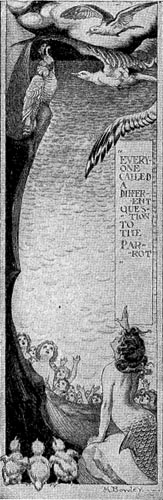
Immediately every one called a different question to the Parrot, who smoothed his feathers and took no notice until, when the noise and excitement were rather less, an old Sea-gull spoke for them all. Then the new-comer consented to tell what he knew of the events of the day.
It was due, he said, to the Philosopher’s having lost the Magic Stone. Upon this stone his youthful appearance, and everything that he owned, had depended.
Early that morning a great tumult had suddenly arisen. The Philosopher went out walking. Soon an old man had rushed in, crying that he had lost the Magic Stone. He commanded every slave in the castle instantly to leave whatever work he was doing, and help to find it. At first no one heeded him, for they could not any of them be persuaded that he was their master. Then the confusion had grown rapidly worse, for each one found he was fading away, growing every moment more pale and thin. As the hours passed all the servants became white ghosts, and they floated away in companies together.
The furniture was melting now in the same manner. The tables were sinking down, and all the vessels used for cooking, and what not, were falling softly and noiselessly upon the floors—where there were any floors to hold them. Everything was blowing gently about, so that the air seemed filled with bits of cloud. Presently the remnants would be swept into the sea by the passing breezes.
“And how have you escaped?” asked the Sea-gull.
The Parrot raised his crest and looked very much offended.
“Because I am real,” he said with dignity. “I was the only real thing in the castle. The Philosopher stole me at the same time that he stole the Magic Stone.”
“Stole it?” cried the Mermaids and the Mer-babies and the Sea-gulls.
“Yes,” said the Parrot; “he stole it in a far-off land, and he stole me. I was to be a present to the Princess; for he thought of marrying the Princess even at that time, and the Philosopher knew there was not in all the world another parrot like me.”
He opened his wings and puffed up every feather. He certainly was a magnificent creature. The grown-up Sea-gulls felt quite ashamed of their homely dresses of black and white; but the young ones only gaped, and crowded open-mouthed to the front to look.
The Parrot’s snowy coat shaded different colors like opals when he moved, and each feather was edged with gold. The crest upon his head sparkled as if there were diamonds in it, and under his wings he was rose-red.
“But I am free!” he cried, as the diamonds glittered and flashed,—“free to go home where the palm-trees grow, and the sun shines as it never shines in this chilly land! Look well at me while you can, for you will never see me again.”
With that he poised a moment above them, then sailed away to the South, like a gorgeous monster butterfly. And they never did see him again.
When they had watched him out of sight, and turned again, there was nothing remaining of the castle, and the Philosopher, too, had disappeared. The sun was setting, and the Mermaids and the Mer-babies went to their homes in the sea, while the Sea-gulls put their little gulls to bed in the nests among the rocks high above the restless waves.
Now all the talk was of the Philosopher’s Magic Stone, and who should find it. And at court every one was discussing how this unexpected turn of events would affect the Princess’s marriage. It was to have taken place in a very short time. The King was very angry. He considered that a slight had been cast upon the Princess and upon himself by the carelessness of the Philosopher. He was not well pleased, either, to know that the great wealth of the man who was to have been his son-in-law was all due to magic influences. Neither did he like what he heard of the Philosopher’s appearance when last he was seen. He announced that the Princess’s wedding would take place at the time fixed, and that she should be married to the first Prince, or other suitable candidate, who arrived on that day. And even the Philosopher might take his chance of being the first, if he were then in a position to support the Princess in the luxury to which she had been accustomed.
As for the Princess herself, what did she think of it all? No one knew, for she did not say. She sat at her palace window, and looked out over the distant mountains, and dreamed of her wedding day.
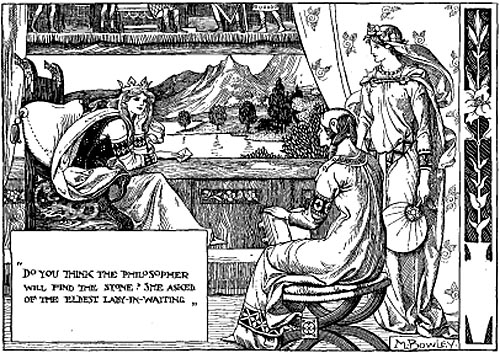
“Do you think the Philosopher will find the Stone?” she asked of the Eldest Lady-in-Waiting, who was in attendance.
“We may well hope so, your Royal Highness,” said the Eldest Lady. “He is a great man and wise. I hear, too, that he had been walking only a short distance from the castle when he lost the Stone. It can hardly fail to be found very soon.”
The Princess sat still and looked over toward the mountains.
“Do you think the Philosopher will find the Stone?” she asked presently of the Youngest and Favorite Lady-in-Waiting.
“Alas! your Royal Highness, I fear it is not likely,” said the Favorite Lady. “All the Sea-people have been searching day and night, I hear, and nothing has been heard of it yet.”
The Princess smiled. She still sat and smiled when the Favorite Lady wrapped a cloak about herself, and took a letter that lay by the Princess’s hand. Then, without permission or instruction, she set out toward the mountains. The Princess rested her elbows on the window-ledge, and watched her out of sight, and perhaps wondered who would be the earliest to arrive, and so fill the place of bridegroom, on her wedding-day.
And all this time, as the Lady-in-Waiting had said, the Sea-people had been searching day and night.
The Mer-babies and the little Sea-gulls were quite neglected, and did no lessons; for every one was too busy to attend to them. They played about and romped on the shore when they grew tired of hunting for the Philosopher’s Stone. The Sea-gulls had told the land-birds, who were searching the woods and the fields, while the fresh-water fish knew of it from their relatives in the sea, and they were searching the lakes and the rivers. Then the Sea-gulls determined to consult the Great Albatross of the Southern Seas, the King among all sea-fowl. They arrived one sunny morning, and found him expecting them, for he had heard what had happened—in the first place from the Parrot, who had passed that way. So he was prepared with his answer. It did not satisfy the Sea-gulls at all. They went away very much disappointed, for the Albatross was in a bad temper, and said only:
“Go home and attend to the children.”
They waited about until late, but he would say nothing more. So they were obliged to return and confess their want of success to the Mermaids, who sympathized with them, and agreed that it was very ill-natured of the Albatross. They proposed to go to the Sea-serpent and ask his advice, which the Sea-gulls thought a good plan. They set off at once for the deep seas, where he lived, inquiring of the fish they met whether any news had been heard. But the fish had nothing to tell, and the Mermaids came to the Sea-serpent’s home.
He was curled on his great rock throne, with giant seaweeds of all colors waving round him, and the stars of the anemones gleaming out from dark corners.
The Sea-serpent listened to the request of the Mermaids; but they met with no better luck than the Sea-gulls, for he said exactly the same: “Go home and attend to the children.”
Then he retired into the great caves, and would not come out again.
So the Mermaids went home disconsolate. They began to think they might have to give up the hope of finding the Magic Stone.
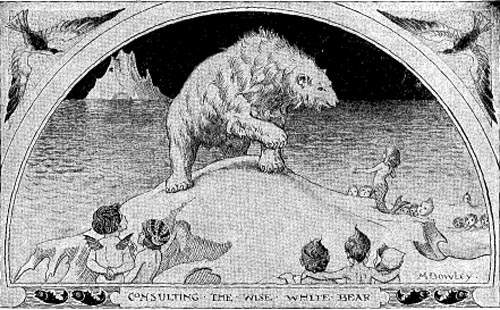
Of course the Mer-babies heard all that was going on. They discussed the situation, as usual. They did not mean to be left behind in this business, though they were not considered to be of any consequence. It was evidently correct to consult somebody who lived at a distance, and they thought of the Wise White Bear. He was farther off, too, than either the Albatross or the Sea-serpent, for he lived at the north pole; but when he was mentioned the very young Mer-babies for once suggested that it was nearly bedtime, and they found that they were sleepy. Some one whispered that the White Bear ate the poor seals, and the youngest Mer-babies crept into holes in the rocks to rest, they said, while the little Sea-gulls went walking home, one behind the other, right across the sands, without having been called. But the older Mer-babies set off for the north pole.
They arrived home next morning, very tired and very cross. When the sleepy ones who had stayed behind asked what the Wise Bear had said, they would not tell, and for the first time the Mer-babies quarreled. They declared in the end that they would none of them look for the “Philosopher’s ugly Stone ever any more.”
So if the Princess really wanted to marry the Philosopher, that day she lost some of her helpers. But no one knew what she wished, for she never mentioned him. She sat at her window that looked out over the mountains, and she gazed ever outward.
It was the night before her wedding. She had been there all day, and for many days. It was very quiet, and the lamps were lighted. The Eldest Lady-in-Waiting spread out the lovely robes, ready for the morrow, where the Princess might see them; but she never moved nor spoke. As midnight approached she leaned out and let the soft wind blow upon her face.
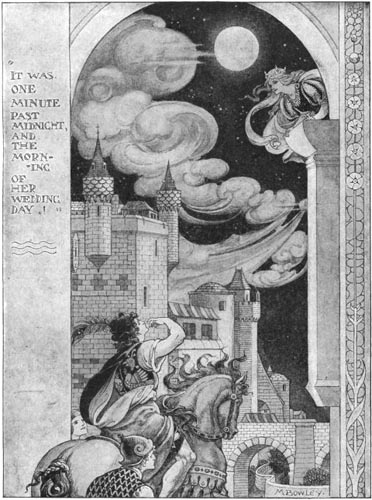
The hour of midnight was striking from all the belfries, when a great clatter sounded down below in the courtyard. Horses neighed, and men ran about. The Princess leaned more forward, and listened. Then a horseman, whose jewels sparkled in the moonlight, looked up and kissed a hand to her, and she kissed hers to him. It was one minute past midnight, and the morning of her wedding-day! She dropped the curtains and turned to greet the Favorite Lady-in-Waiting, who had come in. The Princess threw her arms round her Lady’s neck to welcome her back, she was so glad and happy.
So it came about that the Prince of the City Over the Mountains was the first to arrive on that eventful morning; for, though through all the rest of the night, and up to the very hour of the wedding, noble Princes and their retinues were received in state by the King, all of them had to be told that they were too late, and most of them rode off again at once. Some who had never seen the Princess, but who had been attracted by reports of her beauty and her stateliness, waited to attend her marriage feast, and to regret that they had not hurried themselves a little more.
As for the Philosopher, who should have been one of the chief persons of interest on that important occasion, no one even thought of him, unless the Princess did. But she looked too well pleased for any one to suppose she missed him—which was fortunate, for he was never heard of any more.
When the eventful day was past, the Mermaids and the Sea-gulls covered the shore once again, talking it over, and the Mer-babies and the little Sea-gulls stood around listening.
Presently the Mer-mothers said: “No more holidays. Lessons to-morrow!” and the Mer-babies sighed, and the little Sea-gulls looked gloomy.
One of the Mer-babies stepped forward, holding something.
“Please take care of our pretty ball for us,” she said, “until holidays come again.”
As she was speaking the Mermaids sprang up, and they and all the grown-up Sea-gulls cried with one accord:
“The Philosopher’s Stone!”
And, sure enough, it was. It lay in the Mermaid’s hand, all glowing with its magic blue, pale and dark by turns, its wonderful veins panting as if it were a living thing, its threads of gold moving and twining underneath, round the red heart burning deep in the midst of it.
“That!” cried every one of the Mer-babies and every one of the little Sea-gulls. “Why, we have had that all the time! We found it on the sand, and we have played with it every day since!”
Then the Sea-gulls remembered what the Albatross had said, and the Mermaids remembered what the Sea-serpent had said, and the Mer-babies remembered what the Wise White Bear had said, and they all looked at one another.
Now arose the question, What should be done with the Stone?
It needed no long discussion to settle. Every one agreed that it should be given to the Youngest Lady-in-Waiting; for she had done for the Princess what no one else had thought of doing, in carrying her letter to her true love so that he might be in time to win her. The happy day just past was entirely owing to her devotion.
The Stone was duly presented to her, and, accordingly, she became the richest and most beautiful woman in the land, as she was already the kindest, while the Sea-folks generally, and the Mer-babies in particular, gained great fame and distinction; for had they not found the Magic Stone when it was lost, and given it to the nation’s favorite? And they do say that the Favorite Lady-in-Waiting married a charming Prince almost (but not quite!) as captivating as the husband of the Princess.

1
Once upon a time, in a dainty little kingdom all parks and rivers and cottages and flowers, there lived a jolly, red-faced king named Rudolpho. Every one of his subjects loved him, the surrounding kings were his loyal friends, and the neighboring kingdoms were on the best of terms with him. Indeed, they had a happy way, these old kings, of exchanging thrones for a week now and then, just as some preachers nowadays exchange pulpits—to prove, I suppose, how very good their own is, after all. This king about whom I am telling you was fat, of course, and looked very like our good friend Santa Claus.
Yet, strange as it may seem, with all these blessings—a rich kingdom, faithful subjects, and a loving wife—this good king was not happy. There was one cloud, a very pretty silver-edged cloud, but yet a cloud, which hung just in front of the sun of his happiness and cast a great big shadow.
The king had a daughter, the Princess Madge, his only child; and though she was obedient in everything else, she just wouldn’t, wouldn’t, marry. Now the king was very anxious for her to marry and settle down on the throne, because he was growing old. Every morning for three weeks, just before breakfast, he had had three separate twinges of pain. The queen said it was because of his rheumatism, but he knew better; he was sure that it was old age, and it made him very eager to have the kingdom in the hands of the new son-in-law king before he died.
Of course there were plenty of princes and dukes and barons and lords who would gladly have wedded the pretty princess for her own sweet sake alone, to say nothing of the prospect of being king some day, but she wouldn’t have one of them. There was not a man in the kingdom nor in any of the surrounding kingdoms who suited her capricious fancy. Princes of haughty mien, princes of gentle manner, handsome princes, ugly princes, tall princes, short princes, fat princes, lean princes, had been introduced at the court, had been encouraged by the king and queen, and had sought to gain her favor. She had been showered with gifts of rare flowers and precious stones, and had received thousands of little letters smelling of perfume; but from prince, from jewels, and from written vows of love she turned away with the same cheerful determination.
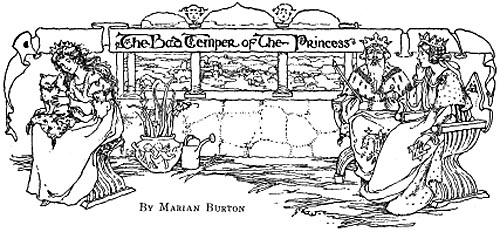
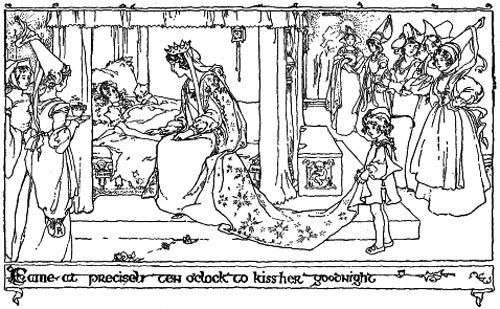
A princess is a lonely little body, you know, and custom was so rigid in the time of the Princess Madge that she had no one to talk to excepting Pussy Willow, the royal kitten. She had no brother, no sister, no cousin, and no dearest friend. She didn’t even have a chance to speak freely to her own father and mother. It is true, she took breakfast with them every morning at eleven in the great breakfast-room, but the butlers and waiters and pages and flunkies were always standing about, with their ears pricked up and their eyes bulging out, so that no one dared whisper a secret or have even the jolliest little family quarrel. It is true her royal mama came at precisely ten o’clock to kiss her good night every evening, but there were always a dozen maids and ladies in waiting, and it was impossible to have a real good talk. But Pussy Willow was her constant companion, and to Pussy she told everything. That friendly cat was the only living thing in the whole kingdom that really knew that the princess intended to marry sometime. That was what worried the king and queen so much; Madge made them believe that she would never marry any one, never, never, never, but would live alone to the end of her days and leave the kingdom to any one who wished for it.
“Pussy, I wouldn’t tell a story to the king and queen for the world, but isn’t it fun to see them take on so? If I really thought that papa was ill and likely to die, I would be as good as gold; but those little pains of his are only rheumatism, I am sure, so I don’t mind teasing him just a little. You know, Pussy, that when my ideal comes—oh, you needn’t look up and blink in such surprise, for I really have an ideal, and I will tell you all about him!” Whereupon Pussy shook her head till her gold-bell necklace tinkled loudly, then she yawned a little and began to wash her face. She looked very wise as she sat there stroking her whiskers and thumping thoughtfully on the floor with her bunchy tail. After thinking thus seriously for a few minutes, she suddenly began a sympathetic little purr-song which seemed to say:
“Go on, little mistress; I am all ready to listen, and I’ll not tell a soul.” Then Princess Madge continued:
“I don’t care whether he is prince or pauper, high or low, handsome or plain; but he must in any case be contented. You know what contented means, Pussy—satisfied with what he has until he deserves and can get something better. If he is like that he will always be unselfish and happy. Oh, yes, and I shall be happy, too. Now I am going to write a letter to papa and tell him that I will marry if he will find me a contented man.”
Quick as thought, the princess opened her rose-wood and gold desk, drew out some paper with her crest on it and a jeweled pen, and wrote daintily and carefully. It took her a very long time, Pussy Willow thought.
“Now, kitty, listen; I will read it to you:
“To his Majesty the King, from her Royal Highness, the Princess Madge.
“Dear Old Papa: I have at last decided to be married if you can find a man to suit me. Now read, my dear papa, and remember that this decision is final. I will marry the first contented man you can find, no matter who he is. Read this little poem; it is my guiding star at this very serious time:
“‘There is a jewel which no Indian mine can buy, No chemic art can counterfeit. It makes men rich in greatest poverty, Makes water wine, turns wooden cups to gold. Seldom it comes, to few from heaven sent, That much in little, all in naught—content.’
“What I have written, I have written. “Your own Madge.
“That sounds very well, doesn’t it, Pussy? I am going to fold it so, and so, then cut off a strand of my hair—see, Pussy, it is nearly a yard long, and it will go around and around this letter and tie in a great golden knot. When the king sees that he will know it is very important. Now I will go to the door and tell the page to run with this to papa, and then—oh, I wonder what he will say!”
She ran to the door, spoke a few words to the page who stood just outside, then returned to the great cushioned chair by the window. Pussy climbed into her lap. They both winked a few times and blinked a few times and then fell fast asleep.
II
Half an hour later the king, with his crown comfortably pushed back on his head, and a smile very much all over his ruddy face, burst into the queen’s sitting-room. He held a tangle of golden hair in one hand and a sheet of blue note-paper in the other.
“My dear, my dear, what do you think has happened? Here, written by her own hand, the hand of the Princess Madge, are the happy words which drive away all our fears. She will marry, my dear, she will marry; and listen: she cares not what may be his rank or age or condition—he must be a contented man, that is all. Oh, what a child, what a child!”
“Oh, Rudolpho, my love, is it true? Why, why, I am so happy! Is it really true? Do give me my fan. Yes, thank you. Fan me, dear; a little faster. It quite took my breath away. Just to think of that! Now go at once and issue a royal edict summoning every contented man in this kingdom and in all the surrounding kingdoms to a grand feast here in the palace. After the feast we will hold a trial, and the Princess Madge shall be the judge.”
Away rushed the king, the pages in waiting outside the door vainly trying to catch the end of his fluttering robe.
The next day a cavalcade of heralds set out from the palace gates, bearing posters which were hung in the market-place of every village for leagues about. In blue letters on a gold ground were these words:
Ho, ye! Hear, ye! Ho, ye!
On the twenty-third day of the month now present, every contented man throughout the universe is summoned to the court of King Rudolpho for a feast and a trial for the hand of the Princess Madge. He among you all who is absolutely contented shall have the princess’s hand in marriage, together with half the kingdom. Every man will be tried by the princess herself. Every man who falls short and stands not the test shall never again enter King Rudolpho’s court.
My hand + My seal +. Rudolpho, Rex.
The day dawned, brilliant and glorious. How the contented men jostled each other, and frowned at each other, and scolded each other as they thronged through the palace gates! They all gathered in the banquet-hall, where a wonderful feast was spread—a roasted ox, with wild boar and lamb and turkey and peacock, and a hundred kinds of fruit, and fifty kinds of ice-water; but as a dinner-party it was not a success. Conversation was dull, each man glowered at his neighbor, and all seemed eager to finish the feast and begin the trial.
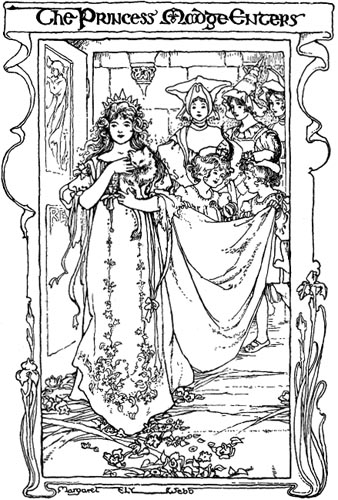
Finally it was over, and five hundred and fifty contented men assembled in the royal court-room. The king and queen were seated on their thrones, but the princess was nowhere to be seen. There was a moment of breathless waiting—then suddenly a door at the side of the court-room opened and the Princess Madge, carrying Pussy Willow, entered and was followed by her train-bearers and maids of honor. She wore a wonderful gown all white and gold down the front, with the foamiest of sea-foam green trains hanging from her shoulders away out behind her. Slowly, majestically, she walked across the room, and stopped before a table on which lay a golden gavel. A quick tap of the gavel silenced the little murmur that had arisen at her entrance. The king glanced at the queen, and they both smiled with pride in their stately daughter. The princess tapped again and began:
“Princes, baronets, honorables, commons of this kingdom and our neighboring kingdoms, I bid you welcome. You have come to sue for my hand and my fortune. I know full well, my noble men, that if I asked it you would gladly give me some great proof of your bravery and goodness—but I ask you to take no risk and make no sacrifice. I merely wish to know whether I can find in any of you that secret of all true courage and happiness—contentment. Now let every man of you who is contented, thoroughly contented, rise. Remember, there are no degrees in contentment; it is absolute.”
The black-robed throng arose—some eagerly, some impatiently, some disdainfully, some few slowly and thoughtfully, but they all stood and waited in utter silence.
“As I put the test question, if there is any one who cannot answer it, let him go quietly out through yonder door and never again show his discontented face in this court. You say you are contented—happy, unselfish, and satisfied with what the gods have given you. Answer me this! Why, then, do you scowl and jostle one another? Why do you want to marry any one—least of all, a princess with half the riches of a great kingdom as a dowry, to spoil your happiness? Greedy fortune-hunters! Do you call that contentment?”
The contented men stood a moment in baffled silence, then turned, one and all, and slowly marched out of the room. As the door closed upon the last one of the disappointed suitors, the princess picked up her pretty kitten and, turning to her father and mother, said:
“Would you have me marry one of those? Why, they aren’t half so contented as a common, everyday pussy-cat. Good-by!” And she laughed a merry laugh, threw a kiss at the astonished king and queen, and ran from the room.
III
At luncheon one day many months after the dismissal of the discontented suitors, the prime minister entered the dining-room and announced to the king that a man had been found within the palace gates without a royal permit, and had been immediately put in the dungeon. He was a handsome fellow, the prime minister said, but very poorly clad. He made no resistance when he was taken prisoner, but earnestly requested that his trial might come off as soon as possible, as he rather wanted to make a sketch of the palace and gardens, and he couldn’t see very well from the slit in the top of the dungeon; but he begged them not to put themselves nor the king to any inconvenience, as he could just as well remain where he was and write poems.
“In sooth, your Majesty,” said the prime minister, in conclusion, “from all we have heard and seen, it seemeth that at last we have found a contented man.”
As soon as the king finished his royal repast he disguised himself in the long cloak and hat of a soldier and went with the prime minister and the turnkey to catch a glimpse of the prisoner. As they approached the dungeon they heard a rich bass voice singing:
“Let the world slide, let the world go! A fig for care, and a fig for woe. If I must stay, why, I can’t go, And love makes equal the high and low.”
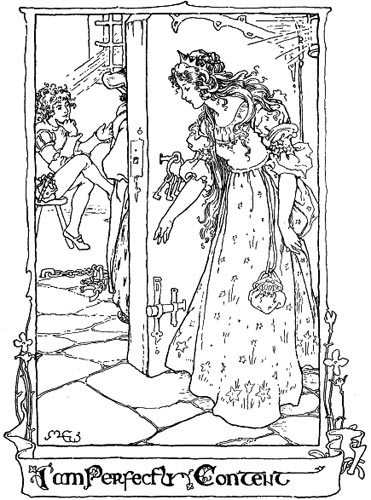
The king drew nearer, stooped, and peeped through the keyhole. Just opposite the door, on a three-legged stool, sat the prisoner. His head was thrown back and he was looking at the sky through the bars in the top of his cell. The song had ceased and he was talking softly to himself. The king, in a whisper, told the prime minister to bring the princess and have her remain hidden just outside the door. Then he motioned to the turnkey to throw back the bolts, and he entered the dungeon alone.
“Why are you talking to yourself, man?” he asked. The man answered:
“Because, soldier, I like to talk to a sensible man, and I like to hear a sensible man talk.”
“Ha, ha!” laughed the king. “Pretty good, pret-ty good! They tell me that all things please you. Is it true?”
“I think I can safely say yes, soldier.”
“But why are you so poorly clad?”
“The care of fine clothes is too much of a burden—I have long ago refused to be fashion’s slave.”
“But where are your friends?”
“Of those that I have had, the good are dead, and happier so than here; the evil ones have left me and are befriending some one else, for which I say, ‘Joy go with them.’”
“And is there nothing that you want?” As the king asked this question he looked at the man in a peculiarly eager way, nor did the answer disappoint him.
“I have all of the necessities of life and many of the luxuries. I am perfectly content. I know I have neither land nor money, but is not the whole world mine? Can even the king himself take from me my delight in the green trees and the greener fields, in that dainty little cloud flecking heaven’s blue up yonder like a bit of foam on a sunlit sea? Oh, no! I am rich enough, for all nature is mine—”
“And I am yours,” said a sweet young voice. The man looked up in surprise, and there before him, holding out her pretty hands toward him, stood the Princess Madge, who had slipped into the cell unnoticed.
The man sprang to his feet, clasped the little hands in his, and said:
“I know not what you mean, sweet lady, when you say that you are mine; but oh, you are passing beautiful!”
“Papa,” called the princess, “this is quite dreadful. Quick, take off that ugly soldier’s coat and tell him who we are and all about it!”
The king, starting as if from a dream, threw off the rough coat and hat and stepped forth into the beam of sunlight, resplendent in gold and ermine.
“Thou dost not know me, my man? I am the king. Hast thou not read our last proclamation?”
“No, your Majesty; I never do read proclamations.”
“Then thou didst not know that the hand of the princess is offered to the first contented man who enters the palace?”
“No, your Majesty; I knew it not.”
“Then know it now, and know, too, that thou art the man. To thee I give my daughter, together with half my kingdom. No, no—not a word. Thou deservest her. May you be happy!”
The prisoner, almost dumb with astonishment, almost dazed with joy, knelt and kissed the princess’s white hands, then looked into her eyes and said:
“Ah, well it is for me that I saw you not until now, for I should have been miserably discontented until you were mine!”